Pondicherry must have been a dream. To co-exist in the halls of history where the French had left their mark was well within one’s capacity, but to thrive in a society where sandwiches were the norm and butter paneer the exception verged on the extraordinary. Every day in Pondicherry merited a visit to Baker Street, whose otherworldly triad of sandwich, croissant and quiche deserved an equally competent pat on the back; to not grow fat, content and happy in this town would have been doing it an injustice.
The Basilica of the Sacred Heart of Jesus, towering above the modest remains of Mahatma Gandhi Road, buffered the excesses that Our Lady of Angels (or Notre Dame des Anges – you tended to pick up lingua colonia in Pondicherry) gracefully bypassed. The ashram of the terrorist-turned-mystic Aurobindo Ghosh sat quietly on Rue Marine. To capture the whiff of spirituality by contact two lanes away on Rue de Dupleix was not to ask for much.
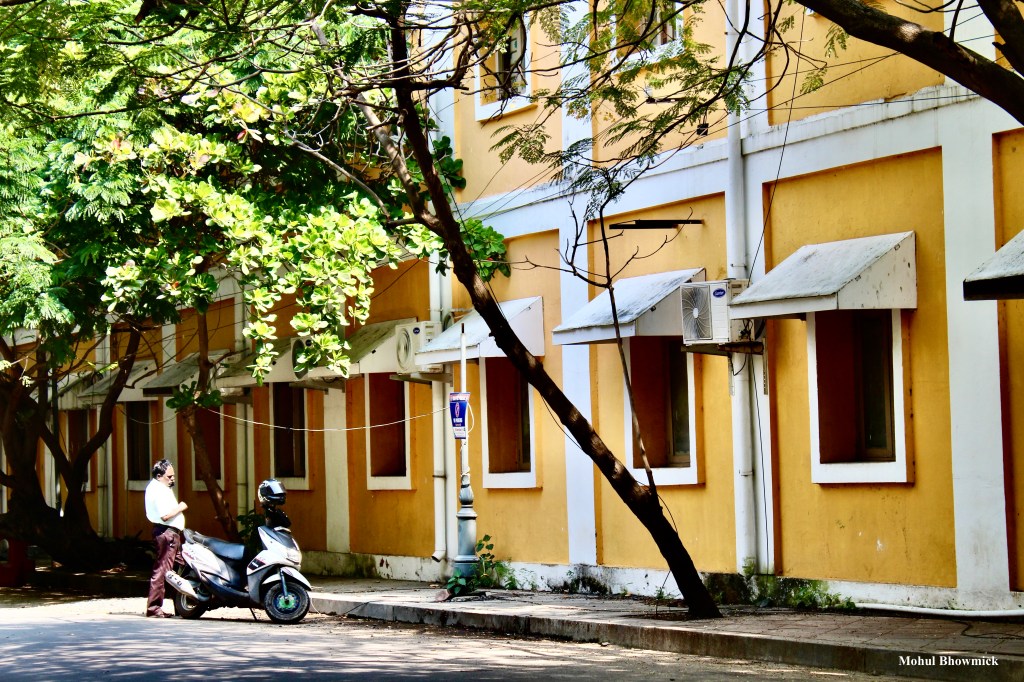
Yellow buildings in French Pondicherry Church of Notre Dame des Anges
The breath of fresh air that Ananda Adyar Bhavan up the same road promised but did not deliver remained just as it was when I had last come here three monsoons ago; in a stubborn reluctance to offer it anything but importune wisdom, I remembered being carried away by Alexander Dumas’ The Count of Monte Cristo (1846).Yet, it befitted the traveller to note that Rue Dumas honoured the colonialist Pierre Benoît Dumas[1], and not the man considerably greater than him. Of course, the French celebrated Dupleix[2] far more, as evidenced by a huge monument dedicated to him at the end of Goubert Avenue. To them, he was the greatest hero in a world where Napoleon was yet to be born, and where the English did not have Cromwell and the Americans had not seen Washington.
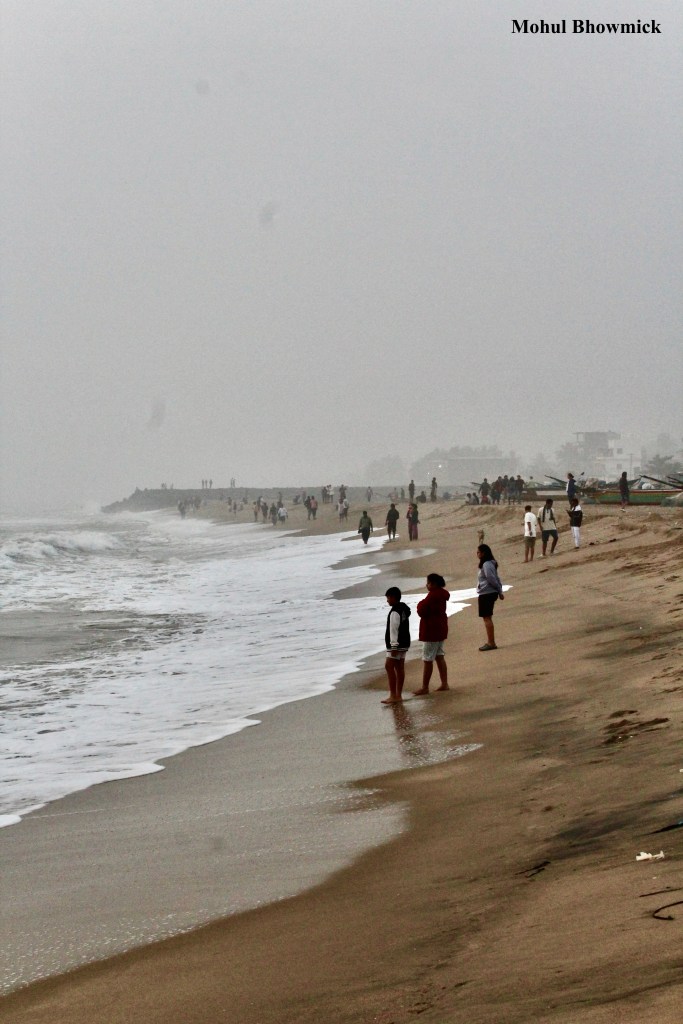
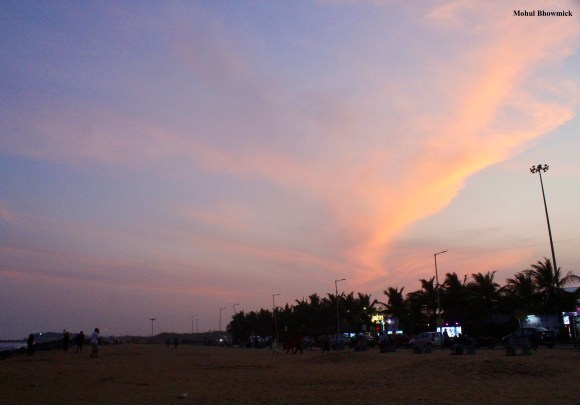
The sun bypassed the graceless winds that set up shop on the Promenade every evening; frequented far more by tourists than locals, it risked losing its sheen as something more than a weekend destination. But the coffee — of course, the coffee — whose aroma one could smell five streets away, was only a tad more appealing than the Pain au chocolat in all the bakeries of Pondicherry, upon whom entire paeans could be written.
To be carried away by such history was a must in Pondicherry; to stay sane, all one had to do was avoid mixing one’s emotions up in the Black Town, and be carried away by scarcity, poverty and destitution while crossing the canal between Netaji Salai and HM Kassim Salai. When I asked a fumbling Frenchman as to why the most significant roads of Pondicherry were named after men who vociferously advocated for self-rule, he told me that he did not know much about de Gaulle, and that his companion, a mild-complexioned young woman to whom being a liberal meant the same as being a libertine, had not read Voltaire.
“In the heart of every Frenchman, there is wine,” I said, quoting Ramanujan, who had been to Strasbourg and Marseille by road, but this only elicited the tiniest of smiles from a pockmarked student from Nantes who had read Hugo, and to whom the world was only just showing its vraies couleurs. It was all she could do not to stand in attention and belt out La Marseillaise under the mid-afternoon sun on Rue de Bussy.
[1] Pierre Benoît Dumas (1668–1745) was the French Governor General for Pondicherry
[2] Joseph Marquis Dupleix (1697-1763), Governor general of French India
Mohul Bhowmick is a national-level cricketer, sports journalist, poet, essayist and travel writer from Hyderabad, India. He has published five collections of poems and one travelogue so far. His latest book, The Past Is Another Country, came out in 2025. More of his work can be discovered on his website: www.mohulbhowmick.com.
.
PLEASE NOTE: ARTICLES CAN ONLY BE REPRODUCED IN OTHER SITES WITH DUE ACKNOWLEDGEMENT TO BORDERLESS JOURNAL
The December breeze had turned nippy in Bengaluru, carrying with it the aroma of roasted peanuts and freshly fried banana chips from roadside stalls. Fairy lights blinked across MG Road, and plastic Santas dangled from shopfronts. Ravi watched the sparkle through his rear-view mirror as he waited for his regular passenger, Ananya, to emerge from the Barton Centre, where she worked at a real estate firm.
“Sorry, Ravi bhaiya,” she said, sliding into the back seat. “The office party ran late. You know how these Christmas celebrations are: too much food, too little meaning.” She sighed, glancing at her half-open goody bag stuffed with unopened chips and chocolates.
Ravi smiled politely. He liked Ananya. Always punctual, always courteous, never haggling over the fare. But her words lingered. Too much food, too little meaning.
That night, after parking his autorickshaw near his rented room in Ejipura, Ravi noticed a group of slum children huddled under a flickering streetlight. They were watching a television through the open window of a well-to-do home. A Christmas carol drifted out, and the children sang along, slightly off-key.
“Santa will come!” one of the younger ones shouted.
“Arrey, fool,” another replied, “Santa only goes to rich houses.”
Their laughter carried a quiet truth. Ravi walked past them slowly, his chest tightening. What if Santa came here—just once?
The thought stayed with him.
The next morning, Ravi tied a cardboard sign inside his auto:
CHRISTMAS DONATION BOX – HELP BRING A SMILE TO CHILDREN LIVING IN SLUMS
An old plastic box sat beneath it. Some passengers glanced at it and looked away. Others smiled. A few dropped in coins or notes.
“What’s this for?” many asked.
“I want to buy small gifts for the children near my place,” Ravi explained. “Like Santa.”
An elderly woman patted his shoulder before slipping in a hundred-rupee note. “Good man. May God bless you.”
Within days, the box filled faster than Ravi had imagined. One evening, he counted the money: over three thousand rupees. More than a week’s earnings. His hands trembled slightly as he folded the notes.
At the market, he bought candy packets, crayons, and small notebooks. In a second-hand shop near Shivajinagar, he found a faded red Santa coat, a cotton beard, and a cap. It wasn’t perfect, but it would do.
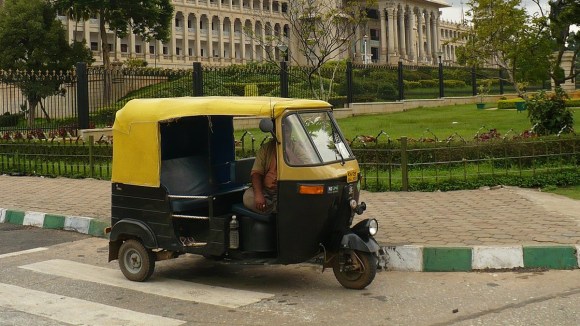
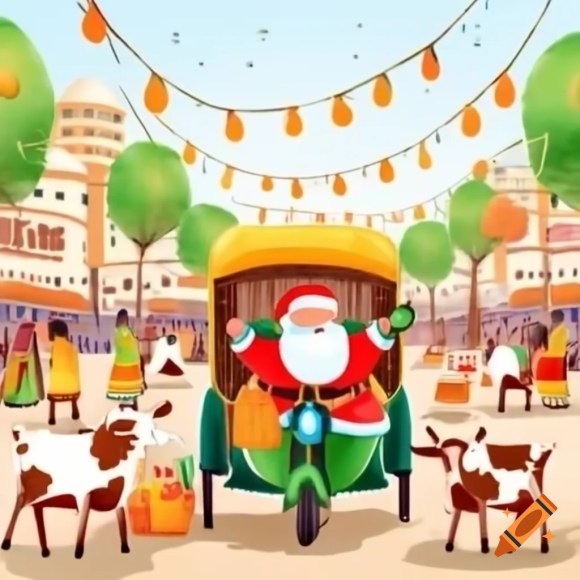
On Christmas Eve, Ravi transformed his green-and-yellow auto. Fairy lights ran along the roof. Paper stars swayed gently. A hand-painted ‘Merry Christmas’ sign was fixed to the back.
His neighbours laughed. “Ravi, have you gone mad? You’re a Hindu. Why Christmas?”
Ravi grinned. “Santa doesn’t ask who you are before giving gifts, right?”
By evening, the narrow lanes were alive with whispers and giggles. When Ravi stepped out dressed as Santa, a cheer erupted.
“Santa has come! Real Santa!”
He handed out candies, crayons, and notebooks. Laughter echoed between the tin roofs, mingling with jingling auto coins and distant church bells.
A barefoot little girl with bright eyes tugged at his sleeve. “Santa uncle, will you come next year also?”
Ravi bent down, his beard slipping sideways. “Only if you promise to study well and share your chocolates.”
She nodded gravely. “Done.”
Ravi laughed, blinking back, gripped by a sudden ache in his throat.
Later that night, he removed the Santa costume and counted the remaining money. Rs 1,800 still lay in the box. Someone had quietly slipped in two Rs 500 notes during the evening crowd. Ravi sat silently for a long moment, overwhelmed.
The next morning, he went to the Hanuman temple, where he prayed every Tuesday. He placed the leftover money before the priest as a thanksgiving.
The priest, an elderly man with cataract-clouded eyes, listened patiently as Ravi explained: the happiness he had brought to the slum children with the donation box, the costume, the Christmas star.
“I know it’s not our festival, Swamiji,” Ravi said apologetically. “But I wanted to do something good.”
The priest smiled. “Tell me, Ravi, did you ask those children their religion before giving them sweets?”
“No, Swamiji.”
“And did they ask yours?”
Ravi shook his head.
“Then where is the difference?” the priest said gently. “Whether one calls Him Krishna, Allah, or Christ, God smiles when His children care for one another. This is the true spirit of dharma[1].”
He placed his hand on Ravi’s head. “May your auto always carry light, not just passengers.”
That evening, Ravi drove through Bengaluru once more. Some fairy lights on his auto had dimmed, but a few still twinkled. The donation box remained inside. Though Christmas had passed, coins continued to clink into it.
For the first time, Ravi understood that Christmas wasn’t about religion, decorations, or abundance. It was about sharing warmth in a world that often forgets to care.
The road stretched ahead, glowing with city lights that shimmered like stars. And in the soft hum of his modest auto, Ravi felt as though he carried a small piece of swarg[2] through the streets of Bengaluru.
Snigdha Agrawal (née Banerjee) is the author of five books, a lifelong lover of words, and the writer of the memoir Fragments of Time, available on Amazon worldwide. She lives in Bangalore (India).
.
PLEASE NOTE: ARTICLES CAN ONLY BE REPRODUCED IN OTHER SITES WITH DUE ACKNOWLEDGEMENT TO BORDERLESS JOURNAL
Many, many years ago, even before time could be stamped with a number, our earth was absolutely empty. The utter silence depressed Singh Buga, the Adi devata—the First God. He could not live in peace in his heavenly abode. So Singh Buga decided to use his magical power to fill up the void with living things. But there was no soil on which they could be nurtured. Water, water, that’s all he saw everywhere. Yes, there was soil under the water, but who could bring it up from such depths? If only he could get some earth, even a small amount, he would fill it with trees and flowers, animals and other living beings. He thought and thought and then he created a leech, a crab and a tortoise. The leech was sent first to get some soil, but he failed in his mission. How could he go down to such great depths under the water? So, Singh Buga sent the crab. But for him too, the soil was too down below. At last, he sent the tortoise. The tortoise followed his Lord’s command and plunged in. He swam far into the depths, reached the bottom and touched the earth’s core. He smelled the earth, took a deep breath, rubbed some of the earth on his body, dug up some more that lay almost inert for eons under the cold water and carried it back for his Lord. Singh Buga was delighted and soon created all the things he desired. The earth that had lain lifeless underwater for thousands of years was touched by sunlight. Wind blew over it. It became full of life. The fertile land became green and spread to the horizon. Plants flowered, trees bowed down with the weight of ripe fruits. The earth was now full of colour. The God decided to create living beings. The calls of birds, animals and insects broke the silence. A pair of milk-white swans laid two eggs. From them Singh Buga created a pair of humans—a man and a woman. He was elated that men would now inhabit the earth. He let them live in a cave and waited with bated breath for news of a new arrival. But where was the news? He waited and waited, finally feeling crestfallen. The pair were very happy roaming around in the beautiful land, but they were ignorant about the mystery of creating life themselves. So, he made them drink laopaani—rice wine—to make their bodies throb with desire.
See that couple sitting morosely in a corner on the ferry? They are no older than the young couple Singh Buga had created out of two swan eggs. But this young couple exudes no sense of happiness. They belong to this burdensome earth; not for them the serenity of the pristine world that God Singh Buga had created. True, they worship him, but in their lives there is only pain and sorrow. Hunger and the torment of a painful existence has chased them every moment. Lack of peace and resentment towards their lot were their constant companions. Adi devata could intoxicate the young couple he had brought to life with liquor and generate in them a desire to create. But for this couple, even if God Singh Buga offered them the best drink, he would only lull them physically from the pain; he would be unable to awaken in them the ancient hunger of the body. Their minds were as dry as the drought-affected earth. On that famished land, only hot tears trickled down drop by drop. The hungry earth sucked in those tears instantly.
The girl, at the cusp of youth, looked utterly dejected. The long arduous journey had drained her energy. Her eyes shut, she rested her head on the shoulder of the equally exhausted young man sitting next to her. If she opened her eyes, the bright sunlight playing on the river’s surface dazzled her and made her head spin. She was too weak to move much.
Her name was Durgi. Durgi Bhumij. An expert sculptor seemed to have lovingly carved her figure. Her statuesque body had thinned down somewhat, but strangely, though wreaked by hunger and thirst, her light brown face had not lost its charm. She was, after all, Durgi—Durga mai, Goddess Durga. She was born during the autumn festival of Durga puja, when the throbbing madal drum was beating frenziedly outside their house. Her grandmother cut the umbilical cord, gave the baby a bath and placed her on her mother’s breast and said, ‘Durga mai has come to our house.’ The old woman named her Durgi in the likeness of the Shakti Goddess.
But now, her granny’s beloved Durga mai was facing terrible times. A devastating famine had crippled their land of red earth. Its canopy of forests of mahua, sal and teak were now filled with only heart-rending cries from hungry mouths, and death.
Durgi was at an age when she could digest even chips of stone. But there was nothing to eat. The fields lay dry. The white sahibs had taken away everything. There was no water in the river for them, no forests to pick fruits from. There was no work: no field to till, no forest to forage for potatoes and yams. Entering the forest for their age-old practice of hunting was banned. As was fishing in the river next to their village. All these now belonged to ‘others’. The only word that echoed through the land was: NOTHING…NOTHING. Nothing was left for them. Rice became as costly as gold.
There had been floods in the past, even droughts. But like a mother whose annoyance with a child does not last long, Mother Nature’s anger also did not carry on forever. The earth became indulgent again, green shoots showed up joyfully once more. But the kind of famine Durgi and her people were now facing was like coming up against a formidable hill they could not surmount…
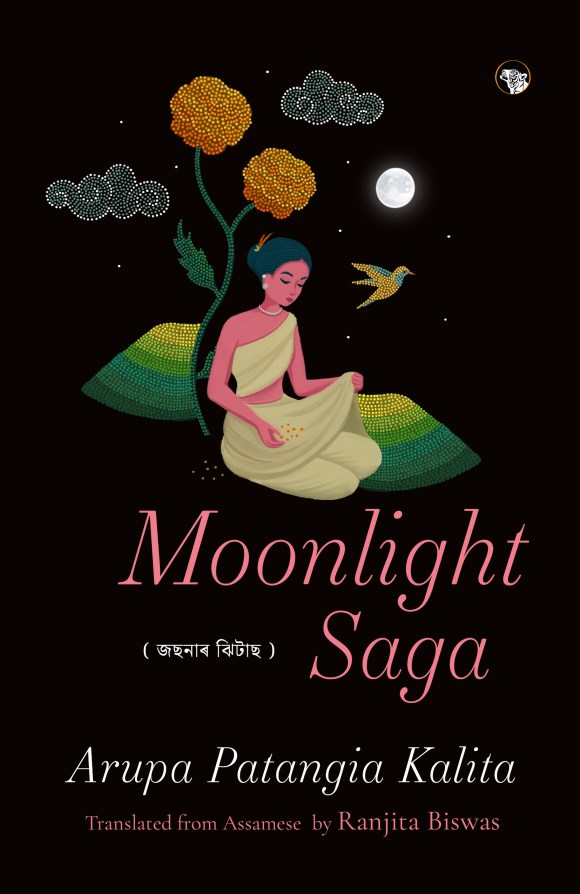
(Extracted from Moonlight Saga by Arupa Kalita Patangia, translated from Assamese by Ranjita Biswas. Published by Speaking Tiger Books 2026.)
ABOUT THE BOOK
In the lush yet brutal landscape of colonial Assam unfolds a haunting chapter of history—the rise of the tea plantations and the human cost that sustained them. Drawn by promises of Assam desh—a land of dignity, abundance, and fair wages—Adivasi families from central India are packed onto overcrowded steamers and sent upriver, where hunger, disease and death shadow every step of their journey. Among them is Durgi, a young woman whose resilience endures even in despair. With her, she carries a small bundle of marigold seeds, a fragile memory of the land of red earth she has left behind. At her side is her husband, Dosaru, the rebellious archer, bound to her by love and the shared hope of building a life of their own. However, what awaits them at Atharighat Tea Estate is no promised land. Labourers are stripped, disinfected, confined to barracks, and driven into relentless work, while sickness, fear, and muted defiance simmer beneath the ordered rows of tea bushes.
Durgi’s life takes a complicated turn over the years—an intimate affair with Fraser, the white manager of the tea garden, results in the birth of three mixed race children. Their unequal relationship exposes another unspoken truth about plantation life—the generations of similar children, many of whom, abandoned by their white ancestors, still live in Assam’s tea gardens today.
Rooted in lived experience, Moonlight Saga gives voice to the forgotten men and women who built the empire’s ‘green gold’, bearing witness to their suffering, endurance, and fragile hopes—as the British Raj begins to crumble in the shadows of India’s Independence struggle.
Originally written in Assamese, the novel is a celebrated and much-discussed work in Assam, recognised for its unflinching portrayal of plantation life and its place in the region’s collective memory. Its translation into English opens up an essential regional story to a wider readership, ensuring that the sacrifices and struggles embedded in the tea gardens are not forgotten.
ABOUT THE AUTHOR
Arupa Kalita Patangia is one of the best-known Assamese writers of today. She has five novels, twelve short story collections, several novellas, books for children, and translations into Assamese to her credit. In 2014, she received the prestigious Sahitya Akademi Award for her book of short stories, Mariam Austin Othoba Hira Barua.
ABOUT THE TRANSLATOR
Ranjita Biswas is an independent journalist, fiction and travel writer, and translator. Ranjita has won the KATHA translation awards several times. She has also to her credit eight published works in translation.
.
PLEASE NOTE: ARTICLES CAN ONLY BE REPRODUCED IN OTHER SITES WITH DUE ACKNOWLEDGEMENT TO BORDERLESS JOURNAL
Five poems by Pravasini Mahakudahave been translated to English from Odia by Snehaprava Das. Click here to read.
A Poet in Exileby Dmitry Blizniuk has been translated from Ukranian by Sergey Gerasimov. Click hereto read.
Kalponik or Imaginedby Tagore has been translated from Bengali by Mitali Chakravarty. Click hereto read.
Pandies Corner
Songs of Freedom: The Seven Mysteries of Sumona’s Life is an autobiographical narrative by Sumona (pseudonym), translated from Hindustani by Grace M Sukanya. These stories highlight the ongoing struggle against debilitating rigid boundaries drawn by societal norms, with the support from organisations like Shaktishalini and Pandies. Click here to read.
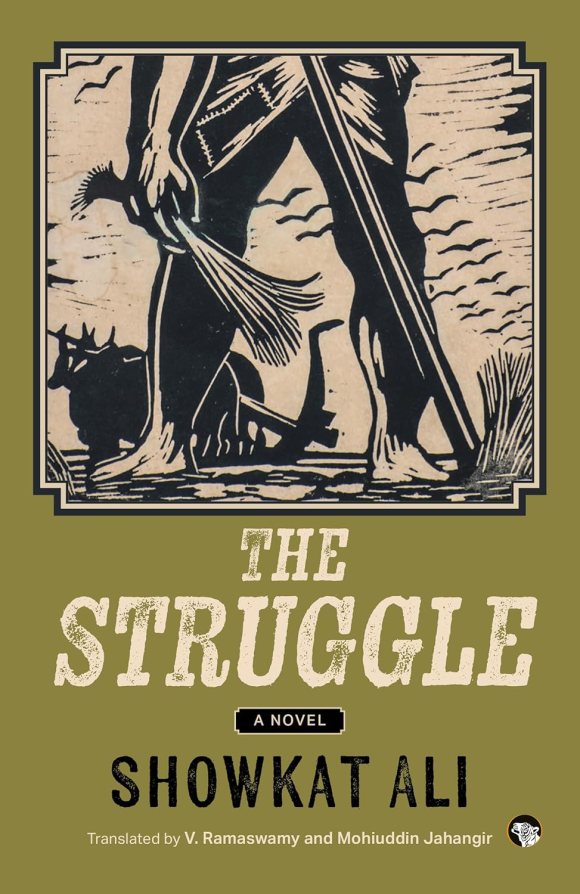
Showkat Ali (1936 – 2018) was a renowned Bangladeshi novelist, short story writer and journalist whose work explored history, class and identity in Bengali society. In 1989, he published a novel called Narai (translated from Bengali as The Struggle) which is set in a remote village in the Dinajpur region of undivided Bengal during the mid-1940s.
The novel is broadly divided into three sections. In the first section entitled ‘A Ploughing Household,’ the author gives us detailed description of an agrarian society where poor Muslim farmers as well as some other lower classes of untouchable Hindus eked out their living primarily through farming as well as other low-paying jobs. The feudal setup of the society is complete with threatening and wily landlords (often Hindus) who are always on the lookout for cheating the sharecroppers of their legitimate dues.
The story begins with a poor farmer called Ahedali who, unable to procure a second bullock to till his field, bore one side of the yoke himself, and soon fell ill and succumbed to death leaving his young wife Phulmoti and a ten-year-old son Abedali behind. The real problem for this widow begins when she is left alone to fend for herself along with a few ducks, chickens and goats. Her fragile world is shattered. People in the village start advising her to get married once again and she gradually finds it very difficult to survive from the ogling eyes and salacious offers from different men in the community. Her son can offer little defense against the men now circling her—neighbours, relatives, even the local cleric—drawn by desire and the lure of her small property. Malek, a kindly bookseller at the local market, too, proves not to be what he seems. It is Malek’s hired hand, Qutubali, who finds himself drawn into her struggles, standing by her in ways that others do not.
The second section of the novel ‘Home and Family’ describes in detail how Qutubali, the simple-minded outsider whose unexpected kindness and fierce loyalty turns into Phulmoti’s unlikely ally. Apparently, he was a senseless and stupid man who provided her benefaction again and again. Much younger to her, he was totally ignorant of standard man-woman relationships and though he often stayed back at Phulmoti’s house, he didn’t express any sort of physical desire for the young widow. He tended to the animals, helped in sowing seeds and worked relentlessly to bring some comfort and peace in the household.
This entire section gives us details of how they come close to each other. Finding no other alternative to live a decent and harmonious life, they go to a mosque where a saint called Darbesh Chacha, who had brought up the orphan Qutubali earlier, gets them married in order that both can live their lives peacefully hereafter. Since then, things gradually changed. If a young widow found a husband, or brought home a ‘ghor jamai’[1], that was definitely news, especially if the man in question was from another village. But people gradually accepted it. Of course, the widow’s suitors fumed with resentment, though even that fire cooled eventually. Qutubali also gradually started learning the tricks of the trade – he had their own land and along with the yield of the sharecropped land, he knew he could become a full-fledged farmer soon. He was sure the days of his misfortune were over. At the end of this section, when Phulmoti announces to the simple-minded Qutubali that she was pregnant, the reader feels that the rest of the story would follow suit in domestic harmony and bliss. The family had a happy air about them. But that was not to be.
The third section of the novel aptly titled ‘We Must Fight!’ begins amid the upheavals of a precarious feudal order and the stirrings of a nation on the verge of independence. Qutubali did not have the time to stay at home. He was never clear about where he went and what he did. When asked, he replied in monosyllables. He started attending sermons. The headmaster of the village school started indoctrinating him and the village folk with the idea of swadeshi.
The politics of the Congress and the Muslim League started to hover on the margins of village life, far removed from their daily battles. But when the tebhaga[2]struggle broke out in Bengal—with sharecroppers demanding two-thirds of the harvest from landlords as their rightful due—Phulmoti and Qutubali stand to lose what little of their lives they had pieced back together.
By that time, she no longer saw Qutubali as a callow youth. He had become a regular, responsible, labouring man but his gradual involvement in the politics could not be avoided. He got involved in the activities of the peasants’ union. The novel remains open-ended with Phulmoti keeping on waiting for her husband to come back from wherever he was even after a decade is over.
Before concluding, a note must be added about the excellent quality of translation. Both V. Ramaswamy and Mohiuddin Jahangir have done a wonderful job in translating this social realist novel from one of the most celebrated novelists of Bangladesh for the benefit of a wider audience to remember a very detailed study of rural Bengal from both social and political angles from the 1940s — a very significant time when amidst the prevailing feudal order of the agrarian society in rural Bengal, the stirrings of a nation on the verge of independence as well as outside forces were gradually creeping in.
[1] In the usual Bengali tradition, a wife moves on to live in her husband’s house after marriage. The situation is reverse when the married man comes to live in his wife’s or in-law’s house and is then called a ‘ghor jamai.’
[2] The Tebhaga movement was significant peasant agitation, initiated in Bengal in the late 1940s by the All India Kisan Sabha of peasant front of the Communist Party of India. It aimed to reduce the share of crops that tenants had to give to landlords.
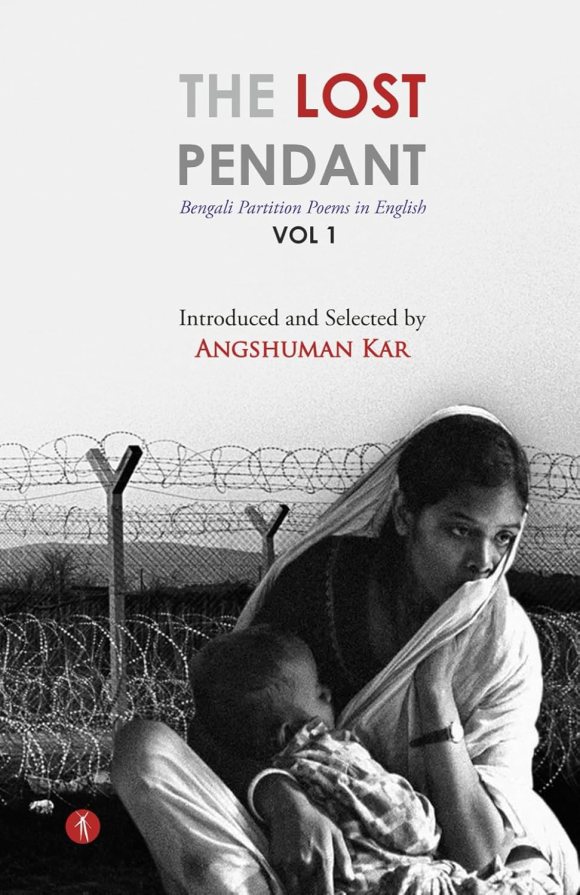
The Lost Pendant brings together poems translated from Bengali by translators such as Himalaya Jana, Mandakranta Sen, Rajorshi Patronobish, Sanjukta Dasgupta, Angshuman Kar, and Souva Chattopadhyay. Through these compelling translations, the volume makes a significant intervention in Partition literature, arriving at a moment when revisiting the lingering spectres of the event has become especially urgent. The Partition of India in 1947, which divided the subcontinent into India and Pakistan, resulted in one of the largest mass migrations in history and left enduring scars of displacement, violence, and fractured identities. As the editor, writer and academic, Angshuman Kar, notes in the book’s introduction how Partition remains a 78-year-old wound that continues to bleed.
The anthology showcases poetry from the eastern parts of the subcontinent, chiefly Bengal, Assam, and Bangladesh, featuring works by 41 poets from India and Bangladesh. Kar does not simply compile these poems but thoughtfully curates them to reveal several critical nuances. He invokes the concept of “buoyant memory,” introduced in his earlier work, Divided: Partition Memoirs from Two Bengals, to depict how “forgetting the past is impossible for the direct victims of Partition.” He also draws attention to the disproportionate representation of upper-caste Hindu Bengali poets, in contrast to the relative invisibility of Muslims and those from marginalised communities. This imbalance extends to gender as well, with a noticeable disparity between male and female poets in the collection.
The book is structured in two parts, respectively featuring poets from India and Bangladesh. The Indian section is notably larger and presents a wide range of emotions, reflecting both the immediate trauma of Partition and its long-lasting reverberations over the years. Many of the poems in this section express a deep nostalgia for a lost homeland. For instance, Alokeranjan Dasgupta’s ‘Exile’ evokes memories of abandoned spaces. Similarly, Ananda Sankar Rai’s ‘The Far Side’ laments the estrangement from what was once familiar. He writes, “Once it was a province, now an alien land / where you must enter passport in hand.” Basudeb Deb’s ‘Picture of My Father’ constructs a powerful portrait of the nation through the figure of the father: “Swadeshi movement war sirens famine flood / Riot and partition written in the wrinkles on his forehead.” After the father’s death, only a walking stick remains. The poem draws a powerful parallel between the futility of the father’s dismissive words, “This country is not a pumpkin that you can cut it in one blow”, and the uselessness of the walking stick after his passing. This object comes to embody the spirit of the deceased father, “just another old toy”, offering a stark commentary on how individuals became pawns in the hands of the state.
Several poets in the anthology focus intensely on the experiences of refugees, capturing both their suffering and the complexities of their identities. In ‘The Refugee Mystery’, Binoy Majumdar laments the loss of linguistic roots, noting how “the Bangals now speak the dialect of Kolkata all the time, having forgotten the dialects of Barishal and Faridpur / The Moslems of Dhaka are heard singing and speaking in the radio with the lilt of Uluberia.” His reflections emphasise the deep connection between language and social identity. This theme finds a resonance in Sunil Gangopadhyay’s poem ‘That Day’, where he writes, “On one side they named the waters Pani / on the other side–Jol.” Through this simple yet evocative contrast, Gangopadhyay underscores how a shared concept can be articulated through divergent linguistic expressions in India and Bangladesh, which become subtle yet potent markers of socio-linguistic divisions. Such poems provoke profound questions: Can the adoption of a new dialect truly redefine one’s identity? How does one navigate the tension between past and present linguistic selves, and is reconciliation even possible?
Viewed through the intertwined lenses of faith and suffering, poetry often functions as a repository of collective memory and a means of resilience. In this regard, Devdas Acharya’s three poems present a poignant exploration of the lived experiences of refugees in post-Partition India. A recurring and haunting image emerges in his work: a grieving father, who has recently lost a child to hunger, standing before a deity symbolically embodied by a swadeshi leader. This image encapsulates both the profound deprivation endured by displaced communities and their simultaneous reliance on unshaken faith. Despite the magnitude of loss, what sustained many refugees was a deeply rooted belief system that imbued their suffering with meaning.
By foregrounding the gendered dimensions of violence, Partition poetry exposes how women’s bodies became contested sites of power and trauma. In “She, on the Platform of a Station”, Krishna Dhar powerfully captures the plight of women during Partition. She writes, “Chased from the other side of the border, escaping fire and the fangs and tongues of wolves, one day she arrived,” evoking the image of a refugee woman doubly marginalised– “devastated by Partition” and simultaneously “dodging the eyes of the hyenas.” Here, the metaphorical wolves and hyenas represent predatory men who treated women’s bodies as extensions of territorial conquest. Kar points out in the introduction that very few women wrote poetry about their Partition experiences, largely because they were already engaged in the broader struggle for gender equality. While women’s memoirs on Partition exist, poetry by women addressing these themes, particularly from the 1970s, is strikingly limited. This absence is significant, as women’s experiences are crucial to understanding how deeply gendered the space of the subcontinent was during and after Partition.
Following independence, conflicts often emerged within the nation, revolving around issues of region, language, religion, and ethnicity. In ‘The Diary of a Refugee’, Shaktipada Brahmachari reflects on his sense of belonging across borders, juxtaposing his memories of a past home in Bengal with his present life in Assam. He writes, “The world is my home now, in Bangla my love I spell–Prafulla and Vrigu are the cousins of my heart,” referencing two leaders of the Asom Gana Parishad. While refugees in Assam experienced a more complex form of marginalisation due to ethno-linguistic differences, Brahmachari portrays a gradual process of acceptance, where both the homeland he left and the land he adopted come to hold emotional significance.
Across the border in Bangladesh, the theme of displacement persists. In “Leaving Home”, Jasimuddin asserts, “this land is for Hindus and Muslims,” calling on educators to return and “build the broken schools once more…we will find out our beloved brother, whom I lost,” a poignant appeal for reconciliation and return of Hindu families displaced by Partition. The motifs of memory and loss recur throughout most of these poems, a trope common between both the nations. This sense of finality is further echoed in Binod Bera’s lament: “Our nation is now three, all three are independent, and love lives an alien existence.” The emotional chasm created by Partition, and the subsequent loss of mutual affection, renders any notion of return futile.
The collection deserves commendation for its ambitious effort to recover voices from Bengali literature and render them accessible to a global readership beyond linguistic boundaries, through gripping translations. It is the first-ever translated collection of Bengali Partition poetry that captures the angst of the original poems with perfect nuance. The very title, The Lost Pendant, merits particular attention, for it resonates with themes of liminality and the fractured sense of identity experienced by the refugee poet Nirmalyo Bhushan Bhattacharya, better known by his pseudonym, Majnu Mostafa. Born in Khulna, Bangladesh, yet spending much of his life in Krishnanagar, India, Bhattacharya embodies the dislocation and dual belonging of Partition’s afterlives. As Kar insightfully observes, the choice of pseudonym can be read as a deliberate act of defiance, “a strategy to cross the boundaries set up by religious politics and fundamentalism–a move much needed in the subcontinent of our times.” In this sense, The Lost Pendant is not merely an anthology but a work of cultural recuperation as it attempts to resurrect poets whose voices risked erasure, while simultaneously protecting their oeuvres from the twin threats of historical amnesia and linguistic inaccessibility.
.
Udita Banerjee is an Assistant Professor of English at VIT-AP University. Her work has previously been published in platforms such as Outlook Weekender, Borderless Journal, Indian Review, and Poems India.
PLEASE NOTE: ARTICLES CAN ONLY BE REPRODUCED IN OTHER SITES WITH DUE ACKNOWLEDGEMENT TO BORDERLESS JOURNAL
It all began in the cold, uncertain days of early January 2025. I was in Tokyo, at Odaiba Beach with one of my closest friends, the icy water soaking our feet. It was bitterly cold, the wind merciless, but our love for the ocean pulled us in. We agreed to dip our feet into the sea, just for a few fleeting seconds. The water stung like needles, yet nothing stopped us from laughing, from enjoying the moment, from playing in the waves like children.
New Year had passed only a few days earlier. We were exhausted from celebrations, worn down by sleepless nights, just as we had been throughout last December. Still, that day felt different. It was the first time my best friend and I had reunited together in the Land of the Rising Sun. Back in Madagascar ten years earlier, we used to dream endlessly about Japan, whispering plans and wishes into the air as if they might someday carry us across the sea. And now here we were together in the country we once imagined only from afar.
I call her ‘Tsu Nami’, not her real name but the one she chose for herself. Her true name means waves in English, yet everyone calls her by her alias. We had known each other for years, but I never asked why she chose that name. Sometimes she said it held both serenity and ruin, as if calm and chaos lived inside her simultaneously. I never truly understood it then.
We spoke for hours that day, about life in Japan, the challenges, the bright moments, the ups and downs of living far from home. We were alike in many ways: two souls far from family and homeland yet living in a country we dearly loved. Life alone in a foreign place is thrilling, but also painfully heavy. She confessed the struggles that had pulled her toward depression, and I encouraged her as much as I could, reminding her of her strength, telling her that not everything deserved her energy.
We filmed silly videos, screamed with laughter, and let the waves numb our feet. Deep in the heart of winter, frozen to the bone, she suddenly asked if I knew how to swim. I said maybe, maybe yes, maybe no. I used to swim as a child, but I no longer knew if I still could. I told her I dreamed of surfing someday. She smiled and said it would be incredible if we could surf together in summer. We come from a warm island paradise where surfing is possible, yet neither of us had ever tried it.
Time slipped through my fingers like sand, and I only realised when spring whispered its gentle arrival. Somewhere along the way, I crossed paths with someone extraordinary, a girl from India, whom I will call A. We would see each other occasionally around the campus, studying in the same university, though in different fields. We first met in the early autumn, when the air was neither hot nor cold during a cultural exchange event.
A. seemed cold and distant; when I politely asked for her SNS contact, she answered in a sharp tone. By nature, I am sociable yet quietly reserved, someone who loves meeting new people and treasures cultural exchange, but my introverted side pulls me back, holding me at a distance like an invisible thread. However, A. is the opposite of me. She is entirely extroverted. And yet, something about her fascinated me, an aura of maturity, strength, reliability. Slowly our conversations grew, and the more time I spent with her, the more I cherished her presence. I never would have imagined she would become one of my dearest friends.
A. was warm, kind, and endlessly sociable, the type of person who knows almost everyone in the neighborhood. She understood my introversion, but she never stopped inviting me into her world. She took me along to events, introduced me to people, pushed me gently outside my comfort zone. She wanted me to live, not merely breathe.
Soon winter was coming to an end, and our friends organised a farewell party for A, who had completed her studies and was returning to India. The atmosphere was warm and lively, with music, laughter, and bittersweet goodbyes. It was there that I met J, a friendly and curious soul from Sri Lanka. He became the first person who ever asked so many thoughtful questions about my country, so many that sometimes I did not know how to answer. As we talked, I learned he loved water sports, especially surfing. And when he whispered the word surf, something inside me ignited. I felt the warmth of summer already, I imagined myself riding waves for the first time.
That day, I told Tsu Nami to visit me during summer break, that I had found someone who could teach us how to surf. She was thrilled. Together, we counted the days impatiently. And then July arrived, our university classes ended, and at last we were free. We went to the beach with J.
J. had lived in Japan for years and knew every hidden corner of our prefecture from quiet paths to secret places untouched by crowds. We asked him where the most beautiful beach was. He laughed and said there was not a perfect one here, not the kind you see in postcards, but there were places where the waves were strong and alive, perfect for learning to surf. So, we followed him, nervous and excited, ready to feel the ocean breathe through us.
It was our first surfing lesson, both for me and for Tsu Nami. The evening sun melted the sky into gold, the air warm but soft. Because of a physical issue, I could not surf that day, so Tsu Nami began first. She could not even swim, yet she stepped forward with fearless determination. J. taught her patiently, movement by movement. And in a surprisingly short time, she stood on the board, shaky, unsteady, but still, standing. Minutes later, she balanced perfectly, rising like a wave itself. I recorded it all, my heart glowing with pride. Even though I could not surf that day, I found joy at the shoreline, soaking my feet, screaming with laughter, recording moments I wanted to keep forever.
A few weeks later, I returned with J, but this time without Tsu Nami. She had returned to Madagascar, and her absence echoed through the sound of the waves. I missed her deeply. Yet something inside me trembled with excitement, my turn had finally come.
J. guided me gently, step by step. After a few minutes, I managed to stand on the board, unstable, but still balancing. I fell countless times, swallowed by the waves, but each fall made me rise stronger. The ocean roared like encouragement, whispering: ‘Again. Don’t stop’. I felt alive, truly alive.
A few days later, we went back to the beach again. The sky stretched above us, and the sea sparkled under the sun. Sometimes the waves were too calm to surf, so we simply floated on our boards, talking and laughing.
J. reminded me of a kind uncle, joyful, supportive, and gentle. He told stories about his country that made me laugh until my stomach hurt. J even told me, laughing, that some Japanese people go surfing eveninwinter, when the water is freezing and the wind feels like knives. I stared at him in disbelief, wondering how anyone could survive that kind of cold. He just smiled and said, ‘That’s the real surfing spirit!’ I could not help but burst into laughter, imagining myself turning into an ice statue somewhere in the middle of the ocean.
The ocean has long felt like the place where I truly belong. Every vacation in my homeland, I choose destinations where the beach is close enough to hear the waves. The sea clears my head, softens the storms inside me, and gently repairs the pieces of my heart. Standing at the shoreline, I can breathe again. It is more than just water and waves; it is where I find restoration.
Whenever I walk along the coast or step onto a surfboard, something inside me wakes up, the weight in my chest lifts, and my thoughts begin to move freely. Ideas return, like the tide rolling in, and I remember why I want to write, create, and keep moving forward. There were days when depression felt like weather that would never clear, but the sea gave me solace. It held me together when I thought I was coming apart. Its steady murmur softened the noise in my head, and each wave seemed to lift a little of the heaviness I could not carry by myself.
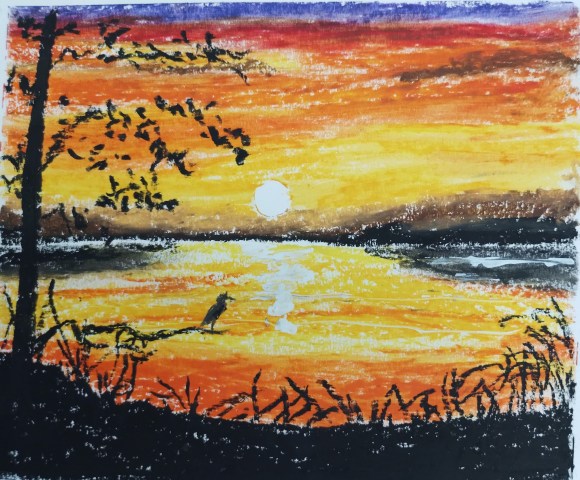
I cherished every moment of that summer, every surfing lesson, every fall, every laugh. That summer became another precious memory in the Land of the Rising Sun. The beach gave me peace, and a place where my soul felt at home. Now December is here, winter tightens its grip, and the warmth of that summer feels like a distant echo. But the ocean remains, waiting. The beach will always be a place to remember.
.
Randriamamonjisoa Sylvie Valencia is from Madagascar and is currently studying in Japan as a trainee student. She enjoys reading, writing, listening to music, and traveling to explore new cultures.
.
PLEASE NOTE: ARTICLES CAN ONLY BE REPRODUCED IN OTHER SITES WITH DUE ACKNOWLEDGEMENT TO BORDERLESS JOURNAL
With the amount of information I am bombarded with daily, I often wonder, as one usually does, how all these changes will change society. Are we all going to be empowered, aware, and demanding what is due to us? Will our minds be so open that we can accept that there is more than one way to skin a cat? On the contrary, will we become more aware of the many ways we can be taken for a ride, and so paranoid that we cannot even breathe a breath of fresh air? What if it is contaminated with toxic effluents?
Three recent video clips steered my mind towards this end.
In the first instance, a group of spectators in a stadium in Kolkata went amok. They were seen tearing fences and wrecking stadium chairs and equipment. They had come to see their favourite world-famous footballer, Lionel Messi, interact with fans. Perhaps the organisers had noble intentions that by having these types of exhibitions, more youngsters in India would take up the sport.
Unfortunately, the events of that day were quite different. It became a façade, with Messi surrounded by multiple VIPs and their entourages, all eager to take selfies from every angle.
The crowd was furious that the star was interacting only with VIPs, their children, politicians, and their kin. Messi was seen being passed around like a soccer ball to capture that perfect picture that would one day adorn their study. The ordinary spectators were left drooling, unable to get close enough to see Messi’s scoring actions. Messi was then seen joking around with the exclusive group of kids, kicking a few balls before departing.
The spectators paid good money not to see their hero paraded as a selfie model. They came expecting some action. A show promised to last two hours, but it ended after just half-an-hour when politicians and officials hijacked the event. One trigger, and chaos erupted.
What happened? Were the people in the stadium offended because they felt duped after paying a lot of money to catch glimpses of the hero posing with others and their children, not with them? They believed his appearance was too brief to matter. They thought the wealthy had used the ticket sales for their own pleasures.
Has Messi’s overexposure in the media led ordinary people to claim ownership of Messi? They believe they have a legitimate right to him. Watching others possess their hero while he is kept outside was too much for them to bear. Meanwhile, they overlook that their own football hero, Sunil Chhetri, reportedly the world’s third-highest goal scorer after Ronaldo and Messi, is ignored. Some Indians do not even know who Chhetri is.
Another reel that reached me showed stranded Indigo passengers having a field day berating the frontliners verbally as thousands of flights were cancelled because the airline could not comply with the new aviation regulations. The reel commentator scolded the passengers for their unruly behaviour. People of a certain stature, well-travelled and well-informed, should not be behaving as they did—loud, abusive, threatening, and insulting the ground staff. The recipients were merely lowly-paid messengers who had no control over operations, yet they bore the brunt of every customer’s insult.
The message further criticises the stranded passengers for losing their composure. They should have behaved with more dignity. In their view, flying is a privilege enjoyed by the educated; hence the need to act ‘cultured’ rather than resort to theatrics. The demonstration exemplified the deep-rooted middle-class mentality that seemed to prevail amongst the nouveau riche.
It is too simplistic to assume this. The rot runs deeper. On one hand, there is a feeling that passengers are being taken for fools. Airlines have recently been cutting corners due to the sharp increase in air travel. With so many new destinations, more flights, and affordability, the airline industry has never been more profitable. Making hay while the sun shines is the airlines’ motto. By squeezing pilots, crew members, and ground staff, the owners have had a field day. Recognising this, those in power tightened regulations to ensure air safety. Sufficient time was given to industry players to make amends. Indigo, holding the lion’s share of India’s air travel market, believed it was above the law. They procrastinated defiantly. That, in short, led to this fiasco.
So, were the passengers justified in their behaviour? Some were attending job interviews, some were about to get married, while others were taking part in equally important, life-changing events. All of it was for nothing because profiteers turned into vultures. There must surely be some etiquette in the business. They should have a minimum level of responsibility to follow the law and ensure safety. Instead, they failed. They killed the golden goose.
The failure of public relations to provide practical solutions, leaving customers in limbo about how events would unfold, is a recipe for disaster. And it happened.
In Malaysia, nearly every time after a fatal motor vehicle accident, the public is informed that the driver involved in causing death was driving without a valid driving licence, road tax, or had 30 or 40 unpaid summonses. Each time a suspect sustains fatal wounds during car chases, interrogations, or while in custody, the Malaysian public raises concerns. In defence, the police often mention possession of machetes and criminal records related to the deceased, as if their demise is justified and question why the public should mourn a hardened criminal.
This time, it was different. Police allegedly engaged in a highway car chase and shot three suspects. They soon announced their list of criminal records and provided a summary of the weapons found and the sequence of events. What the police did not know was that the spouse of one of the deceased had recorded her conversation with her partner, and the phone recording continued until after the trigger was pulled.
A day after the incident, the recording surfaced. The gunshot did not resemble a typical shootout but rather an execution. The postmortem report complicated matters further. The bullet entered the nose and pierced the heart, execution style.
For so long, the Malaysian public had been told to believe the various narratives about these kinds of deaths. For the first time, telecommunications tools may reveal what actually happens during police chases in the dead of night. Amnesty International has been warning us that our police custodial death rates are alarmingly high. The police have been dragging their feet on the public appeal to set up an Independent Police Complaints and Misconduct Commission and to equip their officers with body cameras.
Is the damning evidence produced by modern devices a turning point in how policing is done in Malaysia?
Modern life has changed many of our priorities. If, a century ago, the average man was content with decent square meals, enough garments to keep himself and cover the essentials, had a roof over his head and was able to provide for his family, the modern man needs more than that. The world’s modern economy, on the one hand, makes him quite aware of his surroundings. He is cognisant of different ways in which others live their life. On the downside, he has become a little self-centred and hedonistic. Travel to a foreign land has become an essential pastime. His obsession with famous media icons makes him mindlessly parrot his hero. He dresses like them, mimics their mannerisms and worships the Earth they stand on. Not all this work is for the betterment of society.
The fence that separates the elite and the plebeians is crumbling. Certain privileged information was kept from the general public, deemed necessary to ensure peace. Disinformation and uncertainty worked very well to maintain law and order. As information became more widely accessible, we found it helpful to curb abuses of the system. That, however, did not assure peace of mind. As in all things in life, there are two sides to the coin. Even though they may present opposing views, they are actually part of the same coin. The analogy is the same. Humans must learn to accept that everything is a work in progress. Not a single item that Man created has stood the test of time; it has needed constant twirling and re-modelling.
.
Farouk Gulsara is a daytime healer and a writer by night. After developing his left side of his brain almost half his lifetime, this johnny-come-lately decided to stimulate the non-dominant part of his remaining half. An author of two non-fiction books, Inside the twisted mind of Rifle Range Boy and Real Lessons from Reel Life, he writes regularly in his blog, Rifle Range Boy.
PLEASE NOTE: ARTICLES CAN ONLY BE REPRODUCED IN OTHER SITES WITH DUE ACKNOWLEDGEMENT TO BORDERLESS JOURNAL
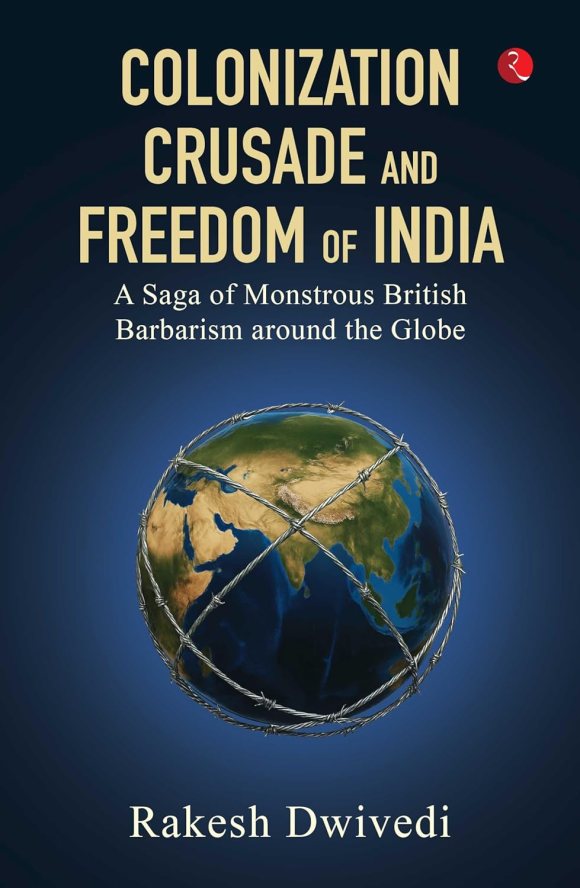
Title: Colonization Crusade and Freedom of India: A Saga of Monstrous British Barbarianism around the Globe
Author: Rakesh Dwivedi
Publisher: Rupa Publications
Rakesh Dwivedi’s Colonization Crusade and Freedom of India is an unflinching indictment of British imperialism and a forceful challenge to the long-standing narrative of colonialism as a “civilizing mission”. Written with the precision of a seasoned constitutional lawyer and the moral urgency of a historian disturbed by selective memory, the book seeks to dismantle the myths surrounding the British Empire while situating India’s freedom struggle within a wider global context of colonial violence.
At its core, the book argues that British rule in India was not an aberration of excesses but a carefully structured system of exploitation sustained by economic plunder, engineered famines, racial hierarchies, and institutionalised violence. Dwivedi rejects euphemisms such as “benevolent administration” or “rule of law,” insisting instead on naming colonialism for what it was: a barbaric enterprise masked by moral rhetoric. In doing so, he aligns himself with a growing body of postcolonial scholarship that seeks to recover suppressed histories of suffering and resistance.
One of the book’s notable strengths is its global frame. Dwivedi does not treat India in isolation but links the subcontinent’s experience to British imperial conduct in America, Africa, the Middle East, and Asia. By drawing parallels between policies of extraction, demographic manipulation, and divide-and-rule strategies across continents, he underscores the systemic nature of empire. This comparative approach lends weight to his claim that colonial brutality was not incidental but intrinsic to imperial governance.
The chapters dealing with famines, wartime exploitation, and economic drain are particularly compelling. Using archival material, parliamentary debates, and secret British records, Dwivedi exposes how starvation and deprivation were often outcomes of deliberate policy choices rather than natural calamities. His discussion of India’s role during the World Wars—both as a resource base and as expendable manpower—adds a crucial geopolitical dimension to the freedom struggle, reminding readers that independence was shaped as much by global power shifts as by internal resistance.
Dwivedi’s legal background is evident in his methodical narrative. He builds his case like a prosecution brief—marshalling evidence, anticipating counter-arguments, and dismantling colonial apologetics with forensic rigor. This gives the book a distinctive voice, though at times the prosecutorial tone may feel relentless. Readers looking for narrative subtlety or emotional restraint may find the language uncompromising, even polemical. Yet this stylistic choice appears deliberate: the book is less concerned with balance than with moral clarity.
The treatment of Partition is another significant aspect. Dwivedi views it not merely as a tragic inevitability but as a consequence of imperial betrayal and strategic manipulation. His critique of British exit policies challenges sanitized accounts of decolonisation and raises uncomfortable questions about responsibility, culpability, and historical accountability.
That said, the book’s sweeping scope occasionally works against it. The ambition to cover centuries of imperial history across multiple regions can lead to dense passages that demand close attention. Some readers may also wish for greater engagement with alternative historiographical perspectives. However, these limitations do not diminish the book’s central achievement: forcing a re-examination of colonial history stripped of nostalgia and imperial self-congratulation.
Colonization Crusade and Freedom of India is not a neutral history—it is a corrective one. It speaks directly to contemporary debates about historical memory, reparations, and the politics of remembrance. In an age when empire is often romanticised in popular culture and public discourse, Dwivedi’s work serves as a necessary provocation.
This book will resonate most with readers interested in colonial studies, Indian history, geopolitics, and the ethics of empire. Whether one agrees with all of Dwivedi’s conclusions or not, his argument compels engagement. It stands as a powerful reminder that freedom was not gifted to India—it was wrested from an empire whose legacy must be confronted, not softened.
.
Bhaskar Parichha is a journalist and author of Cyclones in Odisha: Landfall, Wreckage and Resilience, Unbiased, No Strings Attached: Writings on Odisha and Biju Patnaik – A Political Biography. He lives in Bhubaneswar and writes bilingually. Besides writing for newspapers, he also reviews books on various media platforms.
PLEASE NOTE: ARTICLES CAN ONLY BE REPRODUCED IN OTHER SITES WITH DUE ACKNOWLEDGEMENT TO BORDERLESS JOURNAL
If language were a haircut, “saloon” got a buzz cut and a blow-dry and came out as “salon.” That change in spelling is the visible tip of a larger style transformation: one rough, male-only ritual space has been trimmed, straightened, scented and repackaged into a gleaming, multi-service, mostly woman-centred retail experience. Along the way, the loud, fragrant, argument-heavy mini-parliaments of small-town India — the saloons — have been politely ushered into warranties, playlists and polite small talk.
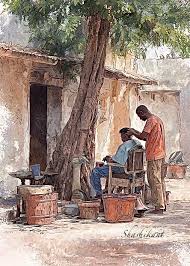
Barbers in India are almost as old as conversation itself. The profession of the barber — the nai or hajam — is embedded in pre-colonial life: scalp massage (champi), shaves, tonsure at rites of passage, and quick fixes between chores. These services were usually delivered in open-fronted shops or under trees, with tools that were portable and livelihoods that were local.
The “saloon” as a distinctive, Western-flavoured, male gathering place began to consolidate during the 19th and early 20th centuries. Port cities and colonial cantonments — Bombay (Mumbai), Calcutta (Kolkata), Madras (Chennai) — saw the rise of dedicated shops selling not only shaves and haircuts but also imported tonics, straight razors and a distinctly public atmosphere shaped by newspaper reading, debate and gossip. Over time, that form blended with older local practices and spread inland. By the mid-20th century, the saloon — a recognisable, chair-lined, mirror-fronted social stage — existed in towns from Kashmir to Kanyakumari and from Gujarat’s chawls to Assam’s market roads.
So ancient barbering traditions fed into a colonial-era intensification of the barbershop as public forum; by the 1950s–70s, the saloon as we remember it was firmly a part of India’s social furniture. The precise start date is a quilt of custom and commerce rather than a single founding ceremony — and that is part of the saloon’s charm.
Walk into a saloon in Nagpur, Nellore, Shillong or Surat and you’ll notice an uncanny resemblance. The reasons are simple and human:
Low price point: Saloons survive on quick volumes and walk-ins. That encourages many chairs, fast turnover, and layouts that invite waiting men to talk rather than sit quietly.
Ritual services: Shave, cut, champi. These are short encounters that thread customers through the same communal space repeatedly — ideal for gossip to collect and ferment.
Social role: The barber doubles as ear, counsellor, news-disseminator and crossword referee. That role is culturally consistent across regions: a saloon’s psychic geography is the same whether the tea is masala or lemon.
The result is that a saloon in Kutch and a saloon in Kerala will differ in language, politics and local jokes — but both will produce that same satisfying racket of opinion, repartee and advice. They are India’s unofficial, peripatetic fora for public life.
Enter the salon: padded seats, curated playlists, appointment-booking and a menu so long it reads like a restaurant wine list (colour, rebonding, keratin, facials, pedicures, threading, and sometimes a minor festival of LED lights). A couple of business realities did most of the heavy lifting:
Women’s services earn more and recur more often. Regular facials, hair treatments and beauty routines translate into steadier, higher bills. The money follows the customer, and the space follows the money.
Franchising and professional training created standardized staff who follow brand scripts — which tighten conversation and reduce the barber-confessor vibe.
Unisex salons consolidated footfall, but that consolidation shrank male-only territory. Men who once had a semi-public living room now sit in chic, quieter spaces that discourage loud, extended debate.
The practical upshot: the saloon’s boisterous mini-parliaments were replaced by stylists with laminated menus, muted background music and an etiquette that favours privacy over political salvoes.
What we miss (and what we gained)
We miss the moralisers, the wisecracks, the boisterous consultancy of unpaid experts who knew which councillor was friendly with which shopkeeper and which wedding was scandalous; the loud education in rhetoric and local affairs; the bench-seat apprenticeship in how to perform masculinity in public.
We gain in expanded choices for women, more professional hygiene and techniques, new livelihoods for trained stylists (especially women), and spaces where people can pursue personalised care without the social cost that used to attend public rituals.
It’s not a zero-sum game — but it does reorder who feels proprietorial about public grooming spaces. The new economics say: she who pays more — and pays more often — gets the say.
Not all saloons are extinct. In smaller towns they still hum. In cities, they’ve evolved into hybrid forms:
Old-school saloons persist where price sensitivity and cultural habit remain strong: walk-ins, communal benches, loud conversation and a barber who’ll recommend both a haircut and the correct candidate for local office.
Nostalgic barbershops in urban pockets lean into the past with “vintage” decor, whiskey-bar vibes and sports on TV — except now they charge a premium and call the barber a “grooming specialist.”
Some entrepreneurs stage “men’s nights” or open-mic gossip hours in neighbourhood shops, trying to recapture the civic pulse while keeping the modern business model.
If you want the old saloon spark, look for places without appointment apps, with too many phones in sight but none in use, and with a tea flask on the counter.
What’s lost isn’t only a loud, male-only gossip pit; it’s a training ground for public argument and a place where local memory was kept live and messy. The saloon taught people how to spar without a referee; the salon teaches how to look good while being politely neutral. If you mourn for the saloon’s barbed banter, you can grieve — but also take action: host a “Salon for Men” in your local café, revive a community noticeboard at the barber, or convince your neighbourhood salon to schedule a weekly “open-chair” hour for community talk (and maybe offer tea).
And until then, if you miss the salty, pungent chorus of small-town democracy, go to any saloon that still has a kettle on the stove and a barber who knows the mayor’s schedule by heart. Sit down, get a shave, and watch a mini-parliament assemble around you. You’ll leave clean-faced, better informed, and maybe a little animated — exactly how democracy used to feel.
From Public Domain
.
Charudutta Panigrahi is a writer. He can be contacted at Charudutta403@gmail.com.
.
PLEASE NOTE: ARTICLES CAN ONLY BE REPRODUCED IN OTHER SITES WITH DUE ACKNOWLEDGEMENT TO BORDERLESS JOURNAL




 Borderless