Categories
Poets, Poetry & Rhys Hughes

Nomads of the Bone

A Poem Of Unsuccessful Excess
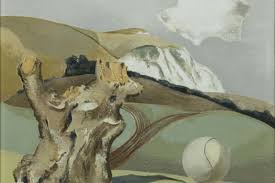
Art by Paul Nash (1889-1946)
Ogden Nash is the finest.
The snobs who dismiss his work
are knobs and jerks
whose heads should be examined
and given an F minus.
Of his talent they have not a tenth.
I mean, flipping heck!
Lacking depth is his strength.

And
now for some
HAIRY QUESTIONS…
Werewolf?
Whywolf? Howwolf?
Whenwolf? Whatwolf? Whowolf?

Questions like those never can
be answered
because the facts are tactless
and the fangs
will leave you gutless on nights
of a full moon.
The lycanthropic topic is one
best avoided
and thus I will always avoid it.

I made myself a sandwich.
I made it for my health.
I am a self-made man
despite my lack of wealth.

I made myself a promise
I would be a bitter gourd
cut into fancy segments
by an even fancier sword.

Unlike okra I’m not slimy.
If you ever dare to try me
I’m a vegetable Cockney,
I must say, “gourd blimey.”

Is that all?
No, it certainly isn’t.


Lady Rickshaw claims
we are all ghost ships
on the streets of cities,
drifting here and there.

That’s modern civilisation
for you: please join the queue
for the time machine.

But in more barbaric times
in chillier climes…

Our cavemen noses
glow in the cold.
They never grow
when we are old
but snowmen’s noses
linger for longer
and their nostrils
resemble craters.

The comet made from ice,
interstellar, vast,
oblivious, very fast,
will strike that fellah dead
when it hits his head.

And now
let’s take a trip to
ANCIENT GREECE

A gorgon’s internal organs
must be clever forgeries.
She turns heroes to stone,
in pairs or if they’re alone,
and when destiny calls
and Greece finally falls
those statues will be taken
to Rome, their new home.

But the gorgon’s heart
will never beat a rhythm
you can dance to.
It won’t thump like
a man-bull’s hoof-shaped
shoes, that’s true.
No swirling sonic brews
amuse our motley crews.

I’ve had better days
lost in this maze:
one time I almost
found my way out,
said the Minotaur…

Fenugreek Mythology
featuring Hercules
and Coriander leaves,
Turmeric and Ulysses,
Centaurs and Bottle Gourds
on a bed of saffron rice
is nicer to devour than plain
old Greek mythology.

Tell me honestly:
have you ever seen
A GHOST?

Death’s anniversary,
is a ghost’s birthday:
blowing out cake candles
with supernatural breezes
he teases the ectoplasm,
a professional phantasm.

Are spooks international?

I am turning Japanese
after a sneeze
because some wasabi
went up my nose.
Kimonos are my clothes.

Also, I play shogi
with my toes. (Shogi is a
kind of chess: I’m glad to
get this off my chest).

Now let’s have a
SELF-REFERENTIAL HAIKU

Counting syllables
when confronted with haiku
ruins the effect.

That’s done.
Where else can we find our fun?


Do you know the tale of
Patriarchy and Mehitabel?
Do you know the tail that
twitches on the windowsill?

The proof is in the pudding,
or so they say,
but I think I know a better way:
the waterproof
is in the puddling duck.

A vestige of a visage?
My face is the place
where my luck never runs out.
It may lack grace,
a waste of features
belonging to other creatures,
but each to their own.

The philosopher doesn’t like
my tone: he tells me
to ponder harder
but not to think about
swamp imps named Marsha.
Easily done: I don’t
know anyone with that name.

Harsher, he calls me timid,
says I am a coward.
Coward? But how?
I don’t know the meaning
of that word
but I can work it out
and applied to me it’s quite absurd.
It means to move
in the direction of a cow,
or many cows, a herd.

Have mercy if you’re thirsty.
Be ruthless if you’re toothless.

Do farm girls
grow on you over time,
seasonally?


A question I can’t answer
because I am a scarecrow.
No one planted me,
I do not grow. I do not know
a single thing.

But I can take a guess
about the mess
made by guests at dinnertime.
Billabong Monkeys
dunk their feet in the soup
in groups much larger
than gorillas are long.

Is that a SONG?
Somehow, I don’t think so.


And now
let’s have some
Soliloquies for Stringless Guitars.


Kiss her through the mask.
Miss her through the cask.

Foxglove Alley.
Weasel Stockings.
Garter Snakes, real and fake.
Rotten Shed and Rusty Rake.
I venture down
the Cul-de-Sac of Frogs.
I lost my way in the fogs.

That isn’t fog: it’s sand.
That’s no frog: it’s a panda.
Are you an understander?
There is no great demand
for sand disguised as mist
and so we insist you redo
the list of things you wish
to purchase in the sopping
shops that underwater lie.

Swinging on a garden gate,
it’s far too late
to palpitate at sunset
but the day’s still too early
to fly away and so you may
barbaric be,
barbaric bee, barbaric beer.

Beer comes in at the mouth.
Jokes come in at the ear.
Foam comes out of the nose.
POOR ATTILA lost his clothes
during a drunken stupor.
It’s not ideal but he is super.

Attila was very short.
Only one metre tall
and nocked with battle scars
at one centimetre intervals.
No wonder he was such
an effective ruler!

He wanted his wife
to call him ‘Darling’
in the marriage bed
but she insisted on
calling him ‘Hun’ instead.

Oh dear!
Have no fear:
King Lear has shed a tear
that splashes
on the lashes of the whip
that thickens cream
in dreams.

When I was younger
I had a narrow mind
and only thought of
narrow things:
tight corridors,
blocked canals,
mountain ledges,
malnourished gulls,
ladders designed
for stick insects,
crevices into which no
man could fall.

But now I am older
and think only of
wide things like
canyons and gulfs,
the open mouths that
shout bravo at gigs,
the taste in literature
of well-read people,
the square bases of
the mighty steeples
perched on churches
in historical towns,
the flapping gowns
of aristocratic vamps,
the pipe bowl of my
eccentric gramps and
the prehistoric snouts
of pigs snuffling for
unripe but fallen figs.

Listen closely, my dear…

My love for you
might sound hyperbolic
to hyperactive alcoholics.
But it will sound
perfectly fine to
good romantic folks.

Now here’s a thing:
sea roofs on the inside
are called sea lings.

Freshwater otters in Goa.
Salty authors in the shower.
Both are so clean
but only the latter dare dream
of rivers of cash.
The former dream only of fish.

FOR A FLUTE?

Love
for a flute
is holy love
because a flute without holes
is a stick
and love for sticks
makes me sick
but flutes have holes
thus my stomach will settle
at the base of the kettle
and I will laugh:
tea-hee cough-hee.

The frozen lion
thaws before he roars.


A thaw in the old ball bearings
and the machinery of his desire
began working again.

The machine marks time
like a strict examiner
puffing out his metal cheeks
in the weeks
before the summer holidays.

Do machines
really play the drums?


As a rule of thumb, yes!
Keeping the beat with steel feet.
How neat. What a treat.
The soul of the dance
is deep in the soles.
The heels heal the heart.

We have
our whole lifetimes
A HEAD of us
in which to try out
new hairstyles, she said.
She knew what
she was talking about.
The barber’s wife.

Mourning becomes Electra.
Evening becomes etcetera.

The gentle love drizzle
puzzles the riddler.
The lion is sizzling
in the meri jaan frying pan
over the fire
of our heartfelt desire.

And that’s
the end of the line
for the wandering rhymes
and the Nomads
of the Bone will soon end
up back home.

*meri jaan is an endearment in Hindi meaning my life

Rhys Hughes has lived in many countries. He graduated as an engineer but currently works as a tutor of mathematics. Since his first book was published in 1995 he has had fifty other books published and his work has been translated into ten languages.

.

PLEASE NOTE: ARTICLES CAN ONLY BE REPRODUCED IN OTHER SITES WITH DUE ACKNOWLEDGEMENT TO BORDERLESS JOURNAL

Click here to access the Borderless anthology, Monalisa No Longer Smiles

Click here to access Monalisa No Longer Smiles on Kindle Amazon International
Categories
Nostalgia

Of Birthdays and Bondings

Ratnottama Sengupta traces her bonding with Joy Bimal Roy that commenced with their birth and has wended through the warp and weft of life…

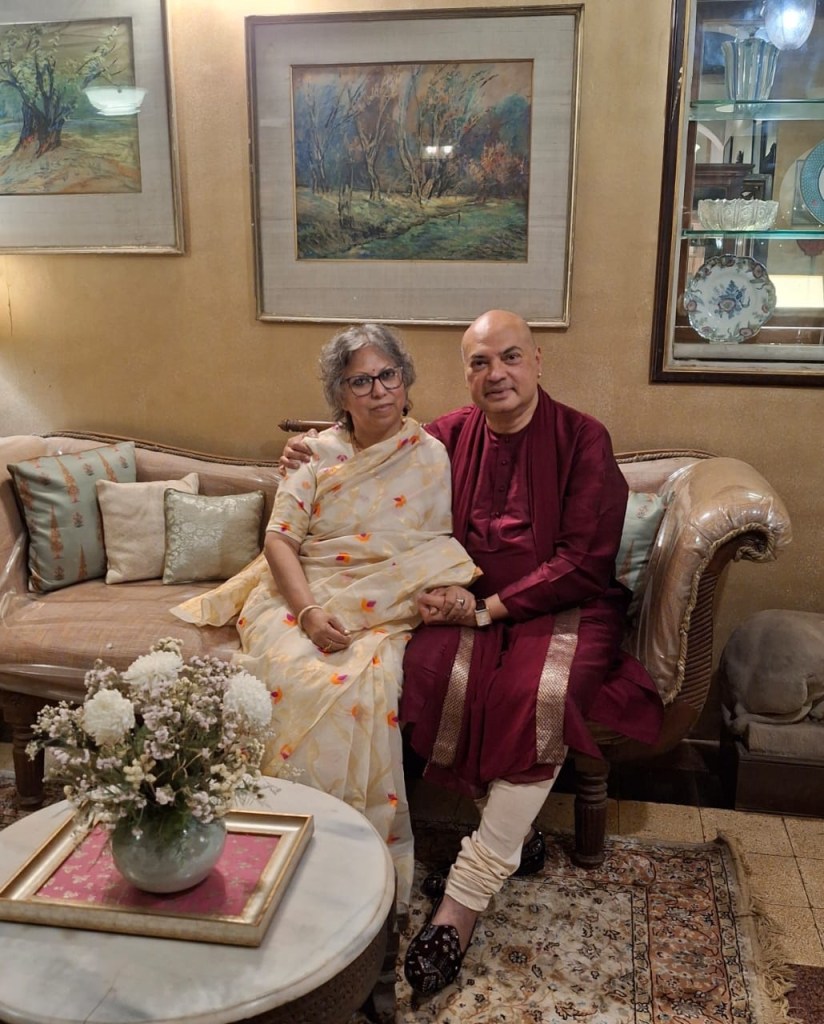
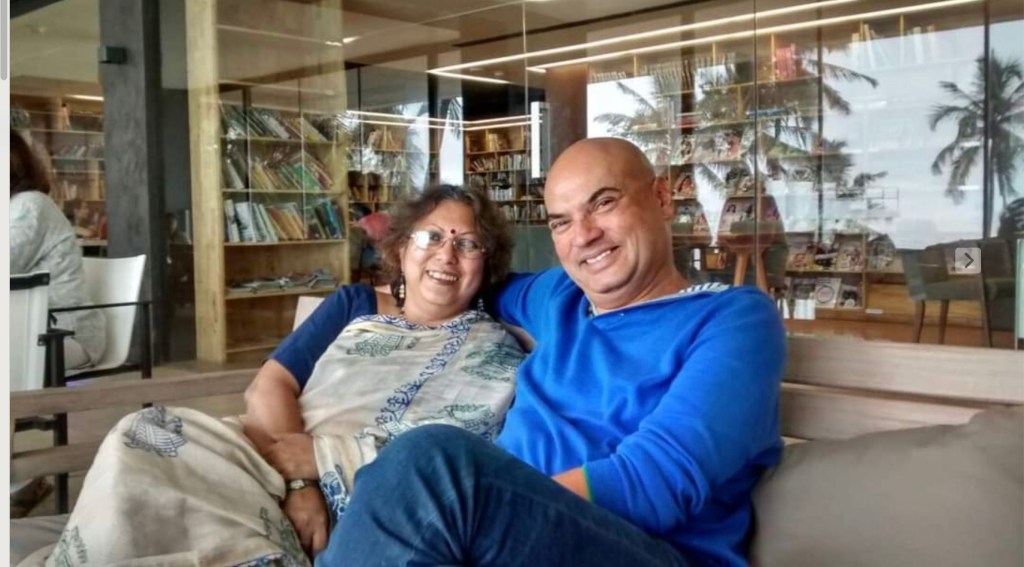
Ratnottama Sengupta and Joy Bimal Roy. Photo Courtesy: Debashish Sengupta

The year1955 is precious in the annals of Indian cinema. That year had seen the release of the Bengali classic, Pather Panchali in August and the Hindi evergreen, Devdas, in December. The opening month of that very year, a certain Mandakini Nursing Home in Bandra, the western suburb of Bombay had seen Manobina, wife of director Bimal Roy, give birth to a son, and Kanaklata, wife of writer Nabendu Ghosh, give birth to a daughter.

“Mita (Friend) Bina was expecting after three daughters and Kanak Boan (sister) was also in labour for the fourth time, after two sons (her first born had gone within months). And we were all praying that Mita should have a son, and Kanak should have a daughter – not the other way around!” This family lore comes from Mary Jethima, wife of music director Arun Mukherjee, first cousin of thespian Ashok Kumar.

So, every time the month of January came around, I would wonder, what if the Roys had a fourth daughter and the Ghosh family a third son? I have wondered but never needed an answer. Because? I have been ever grateful to the powers that be to have Joy as my virtual ‘twin’ born six days apart.

This bonding was forged years before our birth – when Nabendu Ghosh had watched Bimal Roy’s directorial debut, Udayer Pathey[1], in a theatre in Rajsahi, now in Bangladesh; and Bimal Roy had read Nabendu’s allegorical novel, Ajab Nagarer Kahini[2], wanting to film it before Pehla Aadmi [3]became a reality. “Never have I seen a film like this!” Nabendu had echoed what hundreds, thousands, were saying when Udayer Pathey released in 1944. And he had prayed, “If ever I get to work with this director, my dream will be fulfilled!”

Bimal Roy, on his part, had said to him, “Your writings have a graphic visual quality that is so important for cinema.” And when he took up Ashok Kumar’s offer to make Maa for Bombay Talkies, and moved to Bombay in 1951, he invited Nabendu to join him as his screen writer.

That momentous journey has moulded our lives.

*

My earliest memory of the Roys at Godiwala Bungalow on 5 Mount Mary Road is of a toy horse-drawn carriage that had come from some distant land, and a life-size doll – both properties of Joy. I would take turns to ‘drive’ the carriage through the giant hall. And the doll? It opened its eyes and shut them too and even said ‘Maw!’

Outside the bungalow was the garden, a beautiful landscape hemmed in by boulders that created nooks and corners where we children could play hide and seek. But wait, there was a swing and a seesaw too, and I had all the time in the world! There was a spoilsport well at the far end of the garden that I stayed as far away from as I could. “There are ghosts in the well!” – I remember Joy telling me in a hushed tone that was perhaps meant to fool me. But when Joy said something, could I ever doubt it?

The aforementioned giant hall indoors was dominated by an imposing photo of Jethu foregrounded by 11 identical statuettes. These dancing ladies, I later learned, were the coveted Filmfare awards he had won in his illustrious career studded with unforgettables like Do Bigha Zamin[4], Devdas, Madhumati, Sujata, Bandini. As long as he lived and for years after that, Bimal Roy was the sole ‘owner’ of that many ‘Black Ladies’. But, to a girl yet to grow up, more attractive were the Japanese beauties in colourful kimonos adorning another end of the hall. However, what struck even greater awe was a ‘mosaic’ image of Madonna that Joy had crafted while in school — at age 12? It still adorns a part of his world at 6 Mount Mary Road.

Joy had a natural gift for drawing cats: One large O, another horizontal O, a curve that was an inverted C, two bright eyes and perked up ears… How effortlessly he breathed life into the lines! Joy and Bubundi’s house is now overrun by cats but back then only two brown dogs ruled, Toto and Burikin.

*

Joy was the reason I trailed into a shooting floor for the first time in life. We were maybe seven when Benazir[5] was under production at the now-extinct Mohan Studios. As the producer, Bimal Roy need not have stood next to the camera when Meena Kumari, half lying on a mehfil-style chaise lounge, would sit up, sing a single line of a tarana, discant, and the director would say ‘Cut!’ Since the fans would all stop whirring as soon as a voice called ‘Action!’, every ‘Cut!’ was followed by the make-up person trotting up to the diva and retouching her beautiful face. How many ‘Cut!’ did we survive before Joy and I skittered off the floor? No idea. But to this day I remember the deep affection in the eyes of Jethu[6] who became an icon when Joy and I were yet to outgrow the tenth year of our lives.

We were not yet teenagers when Teesri Manzil [7] released in Bandra’s New Talkies which normally screened Hollywood films. Ma and I arrived when Joy, Bubundi and friends were heading for an evening show. I got included naturally. The super hit entertainer had smashing songs in a tautly constructed suspense tale – yet I was not floored. When I said this to Jethima[8], she said, “You are speaking like a critic Uttama!” Unknown to me, that comment had perhaps set me on the course of dissecting a film like an initiated viewer.

After our school finals, Joy took to studying Commerce at Sydenham College, while I marched on with the Arts. So, I joined the Elphinstone College where all the Roy sisters – Rinkidi, Tatudi and Bubundi – had studied English Literature. Bubundi – Aparajita is her bhalo[9] name — was in the final year of BA when I joined the institution. And after she graduated, I inherited all her books and notes. With her benign presence she has been the Didi I never had in the Ghosh house, I realised in the process of preparing the short Aparajita, for her 70th birthday.

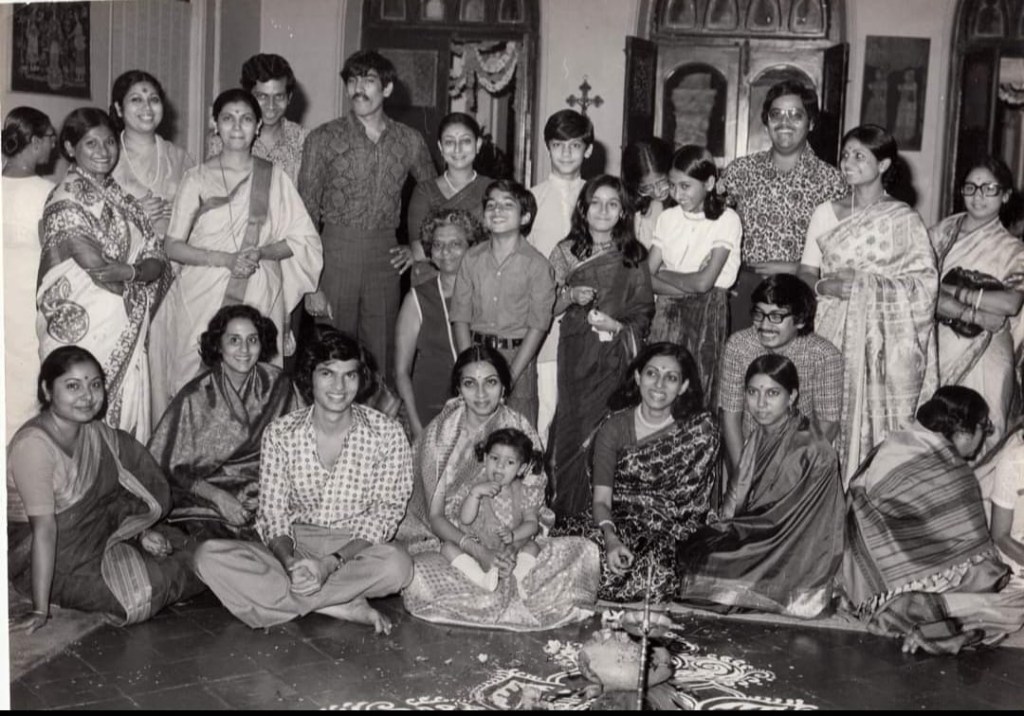
The Ghosh’s and the Roys at a family wedding. Photo provided by Ratnottama Sengupta

And when she got married, just like Joy I missed classes for days and weeks. More so because my elder brother, Dipankar, married Lesley Christine around the same time. Consequently, both Joy and I were least prepared for our MA exams. Together we shared our doubts with Mouni Baba, our spiritual guide who had come from Ujjain. “Do not entertain any doubt or fear,” Baba had drilled into us. “If you utter the word ‘No’ you say that to your inner self, and you will not succeed.” This priceless lesson has been my ‘Kindly Light’, leading me on at every turn of life.

*

* Jethima passed away when the 33rd International Film Festival of India was celebrating seven accounts of Devdas in Indian cinema, in 2002. In the chill of Delhi’s winter, Joy and I sat down in the Siri Fort lawns, clung to each other and howled away, oblivious of the curious stares darting in our direction.

* Joy was in Italy when Baba passed away in December 2007. The biggest bouquet at his funeral had come from Joy.

* Along with Aparajita and Yashodhara – that’s Tatudi’s formal name – Joy had completed Remembering Bimal Roy, a centenary tribute to their father. He had commenced its shooting with Nabendu Kaku, the most authentic and reliable resource person, having been with his father from Maa (1952), through Parineeta ( Wedded, 1953), Biraj Bahu (1954), Naukri (Job, 1953) and Yahudi ( The Jewess, 1957), till the very last Bandini (1964). There was another reason, as Joy himself wrote on Baba’s 90th birthday in March 2007. “He has expressed faith in my abilities even in my darkest moments of self-doubt and always encouraged me to come out of shell and move ahead in life.”

* Year 2008. Bimal Roy’s birth centenary was round the corner. Joy and I met my friend Neelam Kapur. As director, she lost no time in scheduling the tribute in the IFFI [10] at Goa. Serendipity! That very year, IFFI also paid a homage to Nabendu Ghosh who’d passed away the previous year.

The screenings, the press conferences, the purchases, the idling on the beach – more than all of these, I recall the time we spent on a boat that had ladies from Commonwealth of Independent States dancing away to glory. While most of the guests toasted with whiskey or wine, Joy and I sipped on our mineral water. Because? It happened to be a Sunday, the one day in a week we were enjoined by Mouni Baba to forego every food except one salt free vegetarian meal before sunset!

*After Remembering Bimal Roy had been feted internationally and enhanced Joy’s fan following at home, he said to me, “Here’s the entire conversation with Nabendu Kaku. I’ve used only a few minutes of it. I’ll be glad if you can use it.”

I can never thank him enough for this generosity. For, I culled 20 minutes out of the 2-hour conversation, added clippings, posters, stills, book covers, letters, reviews and critical comments to the hour-long documentary And They Made Classics… This centenary tribute traces the unique bonding Nabendu Ghosh shared with his Film Guru.

*

But let me circle back to the birth of a Bundle of Joy and the Best of Jewels in the Roy and Ghosh families respectively.

Days before 21 January 2015 Tatudi called me up. “Joy is turning 60, and how can the celebration be complete if you are not there?” Needless to add, I put on hold my preparation to retire from The Times of India just five days later, and boarded a flight bound for Mumbai. I alighted with just enough time to change into a joyous outfit, for I’ve always revered Tatudi’s good taste and Joy’s flair for dressing just right for any occasion. And was I glad I did so! For, when I reached the venue, I was speechless.


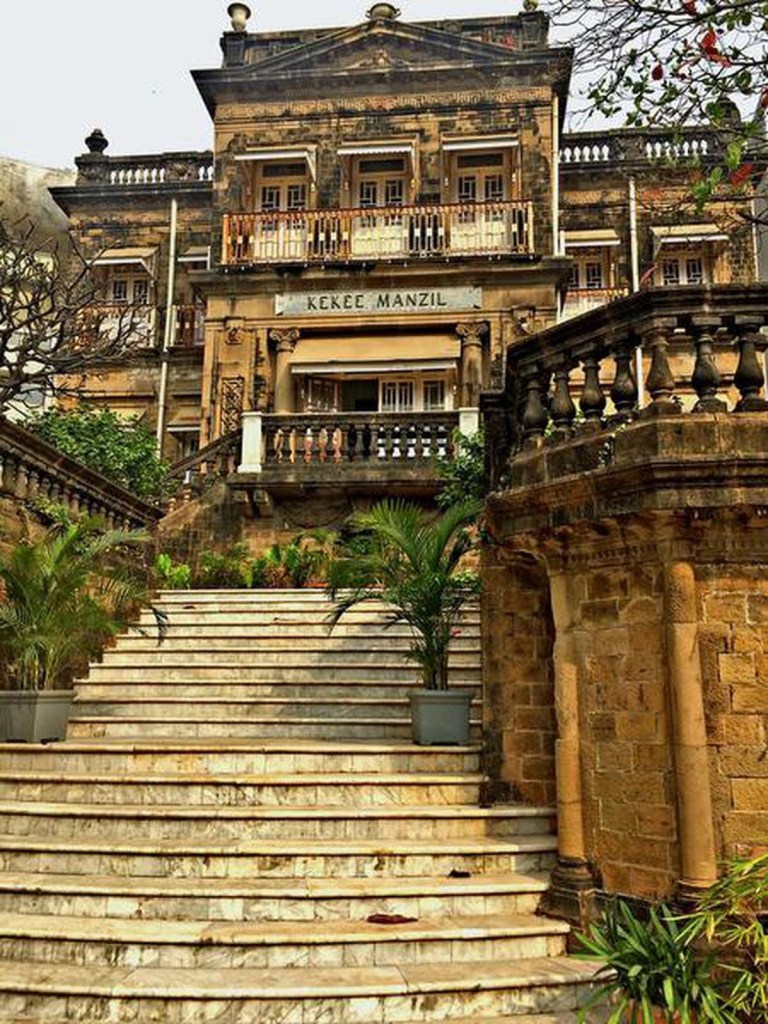
Filmmakers Behroze Gandhy and Dilesh Korya’s documentary,Kekee Manzil – The House of Art offers a glimpse into the interiors of a heritage home, shedding light on its iconic residents Kekoo and Khorshed Gandhy. Kekoo established the only picture-framing company in Asia in the 1940s and later opened the city’s first contemporary art gallery, Gallery Chemould, now known as Chemould Prescott Road, run by his daughter, Shireen Gandhy. The documentary captures how Kekoo and Khorshed displayed compassion during challenging times, stayed true to their secular ideals, and remained engaged civically, while building frameworks within which art could grow in post-colonial India.

What did I admire most? The heritage Kekee Manzil overlooking the Arabian Sea? The gathering of friends and family, including Gen-X of Bimal Roy’s team? The drinks, the amsatta paneer, the grand Birthday Cake? All of this, yes. But most of all, I will cherish for the rest of my life the taste of another cake that Tatudi and Bubundi and Joy had got. Inscribed on it were these words: “Happy Birthday Uttama!”

Some bondings start with our birth, but they live on beyond our life.

[1] On the Path of Light 

[2] Tales of a Curious Land

[3] The First Man(1950)

[4] Two Acres of Land

[5] Peerless, 1964 movie

[6] Uncle, father’s elder brother

[7] Third Floor, 1966

[8] Aunt, wife of Jethu

[9] Good, but when used with name, it conveys the formal name

[10] International Film Festival of India

.

Ratnottama Sengupta, formerly Arts Editor of  The Times of India, teaches mass communication and film appreciation, curates film festivals and art exhibitions, and translates and writes books. She has been a member of CBFC, served on the National Film Awards jury and has herself won a National Award. 

.

PLEASE NOTE: ARTICLES CAN ONLY BE REPRODUCED IN OTHER SITES WITH DUE ACKNOWLEDGEMENT TO BORDERLESS JOURNAL

Click here to access the Borderless anthology, Monalisa No Longer Smiles

Click here to access Monalisa No Longer Smiles on Amazon International

Categories
Conversation

Ramblings of Joy Bimal Roy

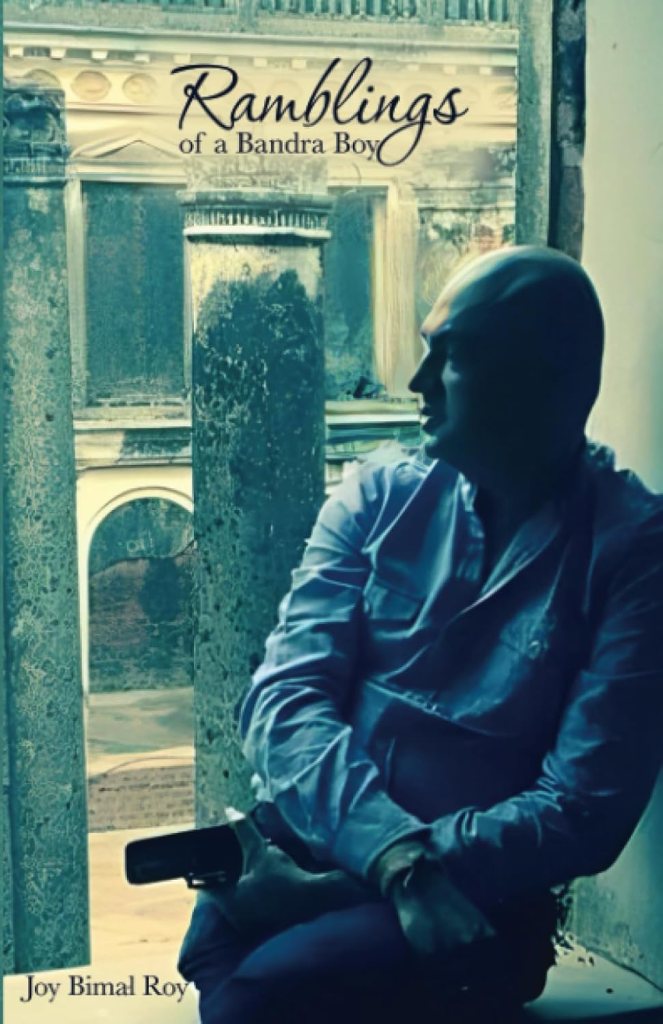
‘So what is it like being the son of Bimal Roy[1]?’ Ratnottama Sengupta asked the author of Ramblings of a Bandra Boy

Ratnottama Sengupta and Joy Bimal Roy. Photo Courtesy: Debashish Sengupta

Rambling, when used for writing – or speech – implies unmapped, confused or, at worst, inconsequential flow of thoughts. In another usage, the word applies to walking in the countryside for sheer pleasure. It is in this second sense that Joy Bimal Roy’s digitally published text, Ramblings of a Bandra Boy is a perfect match of form and content. For, its sweeping take hops from landscape to landscape and life to life of persons who have peopled the world of the author born in a typical Bandra household precisely 70 years ago.

Why typical Bandra household? Because Bandra – derived from the word bandar, meaning harbour – is the Queen of Mumbai’s suburbs. This pocket of history in the heart of the Financial Capital of India is also the home of VIPs, of Bollywood and of political variety too. As the time-weathered Bandra Fort overlooking the Arabian Sea vouches, Bandra predates the British ownership of the Seven Islands gifted to the Crown when Charles II married Princess Catherine of Portugal. Indeed, St Andrew’s Church, in existence since 1575, came up on the strength of Jesuit Priests who won over Koli fishermen winning Christians a stronghold in this part of coastal Maharashtra, much like in Goa.

In the 21st century, Bandra is where Mehboob Studios and Lilavati Hospital stand. Where the Bandra-Kurla Complex defines the dreams of the rich and the rising, overshadowing Asia’s biggest shanty town, Dharavi. And where the awe inspiring Bandra-Worli Sealink bridges the southern extreme of ‘Bombay’ with its ever growing ‘suburbs’.

But all through my lifetime, Bandra has been better recognised as the home of celebrities. Bollywood thespians, Dilip Kumar and Sunil Dutt, to Shah Rukh Khan and Salman Khan; art personalities, KK Hebbar to Kekoo Gandhy; actors, Rekha to Raakhee; directors, Nitin Bose and Hrishikesh Mukherjee, writer Gulzar and cricketer Sachin Tendulkar; umpteen fashion designers and models too have boasted 400050 as their Pincode.

Joy Bimal Roy’s Ramblings takes you on a multi-stop tour of this ‘port’ of India’s social fabric. For, as you skid from one story to another, in no predetermined chronology or thematic order, you get to meet his Yusuf Uncle (Dilip Kumar of Devdas[2] fame) and Bhoba Kaka (Ritwik Ghatak of Madhumati[3]fame), Lata Bai (Mangeshkar) and the Dutts — father Sunil and daughter Priya — who have represented North West Bombay in Parliament even as one member of that family slogged in a jail.

Take a quizzical look at Bollywood divas and peep at actors in their skin labouring on in a posh gym. Get a warm handshake with Shashi Kapoor and gift a sari to Sanjana. Riveting tales of travels to Lebanon, Beirut, Abu Dhabi, Greece, Switzerland, England, San Francisco and San Jose – they’re crowned by nuggets like “I delved into my sister’s recipe book… it has taken the place of Bhagvad Gita in my life” and “I do wish food wasn’t such an important feature in my life. Because it directly correlates to my expanding waistline.”

That’s not all. Here’s a reverential insight into what constituted Shyam Benegal’s greatness — and several irreverent accounts of the crème de la crème schools and colleges that have shaped the author who could have been a top notch contemporary artist, a charming singer, an enviable fashion designer, or an accoladed filmmaker.

Joy Bimal Roy chose not to be either of these. Instead, he stitched together Images of Kumbha Mela when he chanced upon the footage that were to be Bimal Roy’s last film. And he directed Remembering Bimal Roy [4]when his father’s birth centenary came around. He has mounted a series of world class exhibitions to showcase the photography of his mother, Manobina Roy, who, along with her twin Debalina Majumdar, was one of India’s earliest woman photo artist. And in her memory he has installed an imposing sculpture of two hands raised in prayer, ‘Requeim’, at the Bandstand promenade. He has got a road named after his venerable father. He has designed the career of musical talents like Alisha Chinai. He has up-cycled heritage saris and jewellery to support hospices. And he has been editing a newsletter chronicling the life of Bandra, the neighbourhood he was born in, grew up in, and continues to breathe life into.

Now Joy has given us Ramblings, a compilation of his posts on social media between 2017 and 2020. These slices of life “served without any extra seasoning or fancy garnish” as he puts it, have been described by Rachel Dwyer, professor of Indian Cultures and Cinema at SOAS[5], London, as jottings in kheror khata, the traditional cloth bound notebook that Satyajit Ray — and his father Sukumar Ray before him — used to pen down thoughts and visuals that are world’s treasure. In this exclusive, he converses about his book and his life.

What is your earliest memory of being the son of Bimal Roy? 

Finding out in school from classmates that my father was famous!

What is the strongest impression you retain of 8th January 1966 – the day Bimal Roy passed into eternity?

I remember hearing a song from the basti[6] behind our house while I was taking a bath. That song still haunts me. I wasn’t allowed into the living room where Baba’s body was kept, so I peered in through the slats of the back door of the living room. We lived in an old Parsi Bungalow where the wooden doors were 8 ft high and had moveable wooden shutters. The room was packed to capacity but there was pin drop silence. Time stood still. It hadn’t yet sunk in that I would never see Baba again.

Did you develop a deeper understanding of what Bimal Roy was, in the process of making Remembering Bimal Roy?

Absolutely. It was a cathartic and moving experience to hear the memories of people he had worked with over 60 years ago. Not only Tapan Sinha, who was with him in New Theatres; poet, lyricist, director Gulzar who had started as assistant in Bandini; Sharmistha Roy, daughter of his art director Sudhendu Roy; and his accountant Amrit Shah – even next generation personalities like Javed Akhtar and Ashutosh Gowarikar remembered him with so much love and respect that it brought tears to my eyes. I discovered anew that Baba was not only a superlative filmmaker but also a wonderful human being.

Did you likewise get to know Manobina Roy a little more through her photography?

Not really. I was fortunate to have her presence for 46 years of my life. So I grew up being photographed and seeing her photos. But it was only after her death that I discovered from a Bengali book called Chhobi Tola that she and her sister Debalina were two of the earliest known women photographers of India.

Has the insight into Bimal Roy films equipped you to be a responsible filmmaker? Or did you gain greater practical experience as an understudy/ through your interactions with Shyam Benegal, Girish Karnad[7], Basuda[8], and Hrishi Kaku[9]?

I had no interaction with Basuda and Girish in connection with film making. What I learned after watching the making of Chaitali[10] — the last film made under the banner of Bimal Roy Productions, nine years after Baba passed away — was how NOT to make a film. 

Whatever I learned about filmmaking was from watching Baba’s films and my work experience with Shyam Benegal.

I wouldn’t really describe myself as a ‘filmmaker’ after making one documentary on Baba. However it is true that I have very high standards and living up to them was a big responsibility. After all, I am my father’s son. He was a perfectionist and so am I. It took me six months to edit a one-hour film simply because I was striving to do the best possible job with the material I had in hand. 

Before you got into films you have ‘dabbled’ in fashion designing, worked with HMV[11],  and now you are a most absorbing and prolific writer. Personally, I have always admired your painting (which I seldom see you do now). And I know you have mesmerised your college events with your singing. Which of these is your natural calling?

All of them unfortunately, which is why I didn’t know which one I should follow. As a result I have been a ‘dabbler’ — to use your own word. You could accuse me of being a dilettante but as I said before, I have high standards. So whatever I did, it was with all my heart and soul. 

Tell me about the joys and woes of assisting Shyam Benegal.

 That is impossible to describe as one question in an interview. It would be an entire interview! You can, however, get some answers in my book.

Which of the film stars of Bimal Roy’s team have you been closest to?

None. Because I was not even eleven when Baba passed away. But we did keep in touch with Yusuf Uncle. He was incomparable.

What difference in the work culture or cinematic ethics have you noticed between these two legends? 

Baba and Shyam? I can only judge Baba from his films, but I worked with Shyam. It’s a difficult question to answer.

Please tell us about Uttama, Papri, Roopu, Sharmistha (Buri?), Aloka – essentially, about the extended Family of Bimal Roy?

That’s what all of them were and are: Family. One accepts and embraces them as they are.

What led you to the Ramblings which has been described as ‘social document of our times’?

My Facebook friends led me to Ramblings. They drove me mad demanding a book. I did it more to oblige them and make them stop making demands.

What next — cinema a la Bimal Roy — or books after Monobina Roy, who, besides being an ace photo artiste and a fabled cook, wrote Jato Door Tato Kachhe?[12]

A Bengali translation of Ramblings of a Bandra Boy

.

[1] Bimal Roy (1909-1966) Legendary Film Director

[2] Hindi movie, 1955, Dileep Kumar (1922-2021) played the titular role

[3] Hindi movie, 1958, written by Ritwick Ghatak (1925-1976)

[4] Joy Bimal Roy lost his father filmmaker Bimal Roy when he was 11 years. Joy remembered very little of his father. ‘Remembering Bimal Roy’ made by Joy Bimal Roy is the search of a son for his father.

[5] School of Oriental and African Studies

[6] slum

[7] Girish Karnad (1938-2019) Actor, director, playwright

[8] Basu Bhattacharya (1934-1997), Film director

[9] Hrishikesh Mukherjee (1922-2006), Film Director

[10] 1975 movie directed by Hrishikesh Mukherjee

[11] His Master’s Voice, British music and entertainment retailer

[12] Distance draws us closer – translation from Bengali

Read the book excerpt by clickling on this link

Ratnottama Sengupta, formerly Arts Editor of  The Times of India, teaches mass communication and film appreciation, curates film festivals and art exhibitions, and translates and write books. She has been a member of CBFC, served on the National Film Awards jury and has herself won a National Award. 

.

PLEASE NOTE: ARTICLES CAN ONLY BE REPRODUCED IN OTHER SITES WITH DUE ACKNOWLEDGEMENT TO BORDERLESS JOURNAL

Click here to access the Borderless anthology, Monalisa No Longer Smiles

Click here to access Monalisa No Longer Smiles on Amazon International

Categories
Musings

Rayban-dhan*

By Uday Deshwal

It’s been 12 years since the day I stepped out of Navrang Opticians as a happy-but-slightly-embarrassed owner of an expensive pair of sunglasses. I remember feeling an inexplicable, capitalism-infused sense of confidence and eye-mancipation, like this pair of sunglasses was all I had needed to kickstart my post-college journey into adulthood.

But wow! 12 years! The world that I first witnessed from behind your tinted lenses has now changed beyond recognition. That’s how long you’ve been there for my eyes.

You have been my trusted companion through all my adventures in the past decade. You helped conceal the deep apprehensions in my eyes when I tried, as an unsettled young Masters’ student, to blend into the daily rhythms of life in a foreign country. You were there reassuringly embracing my face all through the 600-kilometre-long road journey when I decided to leave behind the only life I had known and move to Goa. You adapted with me, without any complaints, when you had to carry the additional weight of two face masks wrapped around you during those two horrific pandemic years. You were there alongside my amazed eyes and overwhelmed heart when I saw the mighty Pyrenees, the pristine blue sea and white-sand beaches in Andaman, and other parts of this country and the world that I never believed I’d actually see. And amid all this, you even managed to make my face look somewhat presentable at times, thanks to which I was able to get at least few decent photographs.

You have always been a safe space for me; like when you allowed foolish and outlandish hopes and dreams to float freely in the pool of my eyes as I watched a beautiful sunrise on top of a hill. And also, when my eyes needed to shed tears of disappointment and sadness as I watched a sunset on December 31st of another painfully unfulfilling year.

I am realising now that I may have taken you for granted. That you will always just be there in my backpack when I travel, on the mantel as I step out from home, or resting in my pocket or on a table in a cafe. I don’t even want to think about the day when you are damaged beyond repair or worse if I misplace you, because I don’t know what eye will do without you.

*’dhan‘ is wealth in Hindi and ‘bandhan‘ is the word for ties.

Uday Deshwal claims to have an ‘always wanted to be a writer but was diagnosed with impostor’ syndrome.

.

PLEASE NOTE: ARTICLES CAN ONLY BE REPRODUCED IN OTHER SITES WITH DUE ACKNOWLEDGEMENT TO BORDERLESS JOURNAL

Click here to access the Borderless anthology, Monalisa No Longer Smiles

Click here to access Monalisa No Longer Smiles on Kindle Amazon International
Categories
Contents

Borderless, March 2024

Art by Sohana Manzoor

Editorial

‘If Winter Comes, Can Spring be Far Behind…’ Click here to read.

Translations

Travels of Debendranath Tagore are narratives translated from Bengali by Somdatta Mandal. Click here to read.

The Yellow Flower, a narrative by Haneef Sharif, has been translated by Fazal Baloch from Balochi. Click here to read.

Ye Shao-weng’s poetry ( 1100-1150) has been translated from Mandarin by Rex Tan. Click here to read.

Nazrul’s Amamai Nahi Go Bhalobashleo (Even if you don’t love me) has been translated by Professor Fakrul Alam from Bengali. Click here to read.

Rough Stone by Ihlwha Choi has been translated from Korean to English by the poet himself. Click here to read.

Phalgun or Spring by Rabindranath Tagore has been translated from Bengali by Mitali Chakravarty. Click here to read.

Conversations

A discussion with Radha Chakravarty on her new book, Subliminal, and a brief review of the book. Click here to read.

Jagari Mukherjee interviews Rajorshi Patranabis, discussing his new book, Checklist Anomaly and Wiccan philosophy. Click here to read.

Poetry

Click on the names to read the poems

Rhys Hughes, Alpana, Ron Pickett, Shamik Banerjee, Stuart McFarlean, Baisali Chatterjee Dutt, John Grey, Shahalam Tariq, Jim Murdoch, Kumar Ghimire, Peter Magliocco, Saranyan BV, Rex Tan, Samina Tahreem, Luis Cuauhtémoc Berriozábal

Poets, Poetry & Rhys Hughes

In Lines for Loons, Loonies and Such-like, Rhys Hughes shares a rare treat. Click here to read.

Musings/Slices from Life

The Elusive Utopia?

Farouk Gulsara discusses the ideal of a perfect world. Click here to read.

Serenading Sri Lanka

Mohul Bhowmick backpacks in Sri Lanka with a camera. Click here to read.

Musings of a Copywriter

In A Conversation with God, Devraj Singh Kalsi has a bargaining chip. Click here to read.

Notes from Japan

In Cherry Blossom Forecast, Suzanne Kamata brings the Japanese ritual of cherry blossom viewing to our pages with her camera and words. Click here to read.

Stories

Prison Break

C.J.Anderson-Wu gives a poignant flash fiction. Click here to read.

Terrace

Rakhi Pande relates a strange tale from Goa. Click here to read.

The Temple-going Snake

Devraj Singh Kalsi almost creates a fable but not quite. Click here to read.

Monsoon Arc

K.S. Subramaniam shows the human spirit pitched against the harshness of monsoon storms. Click here to read.

Felipe Jimenez’s Quest of the Unheard

Paul Mirabile travels to Spain of Goya’s times with an imaginary friend who takes after perhaps, Don Quixote? Click here to read.

Essays

Where the Rice is Blue and Dinosaurs Roar…

Ravi Shankar takes us on a tour of a Malaysian town. Click here to read.

Conquering Fears: Bowing to the Mountains 

Keith Lyons tells us of his challenging hike in New Zealand. Click here to read.

Book Excerpts

An excerpt from Out of Sri Lanka: Tamil, Sinhala and English Poetry from Sri Lanka and its Diasporas edited by Vidyan Ravinthiran, Seni Seneviratne and Shash Trevett. Click here to read.

An excerpt from Rajat Chaudhuri’s Spellcasters. Click here to read.

Book Reviews

Somdatta Mandal reviews Ilse Kohler-Rollefson’s Camel Karma: Twenty Years Among India’s Camel Nomads. Click here to read.

Rakhi Dalal reviews Anuradha Kumar’s The Kidnapping of Mark Twain: A Bombay Mystery. Click here to read.

Bhaskar Parichha reviews Mafia Raj: The Rule of Bosses in South Asia by Lucia Michelutti, Ashraf Hoque, Nicolas Martin, David Picherit, Paul Rollier, Clarinda Still. Click here to read.

.

Click here to access the Borderless anthology, Monalisa No Longer Smiles

Click here to access Monalisa No Longer Smiles on Amazon International

Categories
Stories

Terrace

Written by Rakhi Pande

Photo Courtesy: Rakhi Pande

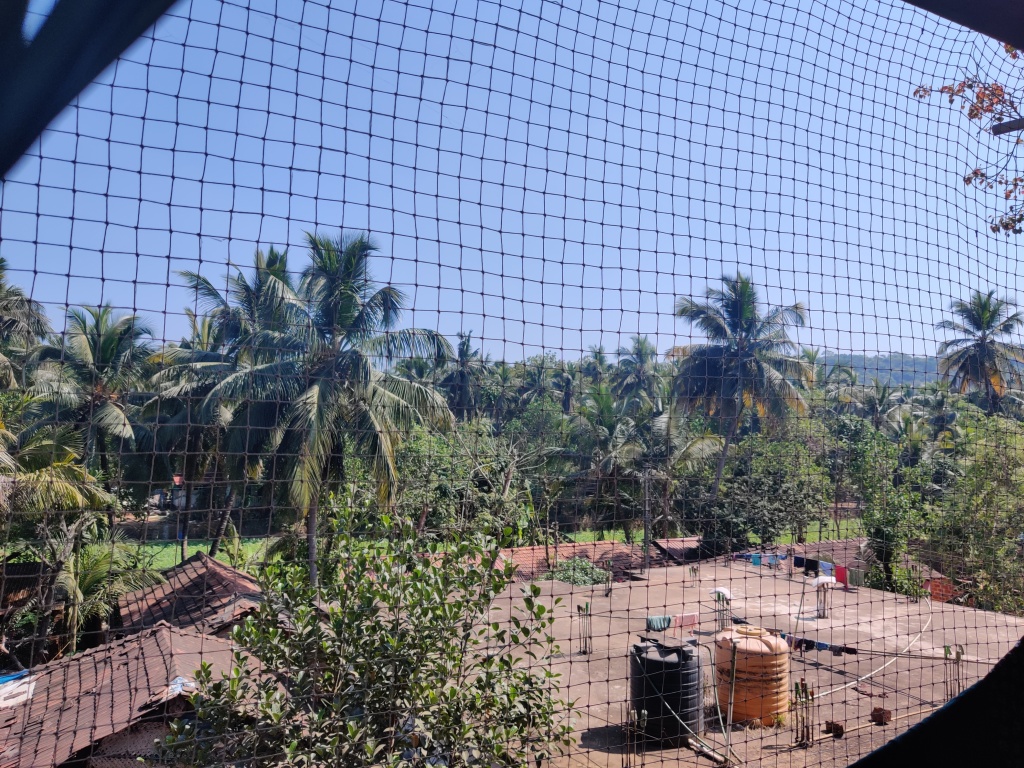
This was her second week in Siolim as a resident, in her aesthetically pleasing, slightly bohemian, rented two bedroom flat. The flat itself gave very tropical vibes with a host of plants – both real and artificial, enhancing the outdoorsy look. Though her building was part of a bigger residential complex, it was miraculously not blocked by views of other buildings. Instead, the windows at both ends of the flat faced east and west, providing stunning views of the morning sky change colour as the sun rose over the dense grove of coconut palms and as if that were not already enough to drive up the rent, a peek of the setting sun, from the opposite end. No less than three spacious balconies with French doors offered an unobstructed view of the quaint sloped roof homes of the ‘locals’, the villagers, bordered by paddy fields beyond.

Except for one house in their midst. From her bedroom balcony that faced east, Anika noticed the one slightly better and bigger home, built with concrete walls and a concrete flat roof, functioning as its terrace. It was not directly opposite but slightly to the right so that she could only see it only from the window or the balcony.

Every morning she would look out in hope of spotting the big fawn dog – the unknown ubiquitous mixed breed — on the terrace. She was always entertained by his movements. He would strut about for a bit, peering over the edge while woofing his alpha dominion over other dogs and cats he spotted. At other times, thinking himself unobserved, he would lie down flat on his back, utterly vulnerable with his legs up in the air, squirming about, tongue lolling, making her laugh.

She had seen the other residents occasionally: two teenage girls who would climb and sit together leaning against the water drum conversing in the evenings as the sky deepened it hues, probably out of the hearing distance of the lady who would sit by herself at the far end staring at the horizon. Anika imagined that this might have been her only place of escape from the endless chores and hubbub of daily life. At other times, a much younger boy of about five followed a slightly older girl, probably his sister (or cousin) of about seven. As she sat to read and do her homework, he would entertain himself skipping about the flat terrace or lolling about on a mattress placed there. After dark, however, the terrace was the domain of the men of the household. Though there were no lights on the roof, the occasional clink told Anika that feni or urak had been smuggled upstairs.

Local families here tended to be ‘joint’ ones with aunts and uncles, siblings and cousins included in the same household. Daily, a slim, capable lady would briskly hang clothes to dry on strings stretched out from stakes. So many clothes every day! The only times Anika didn’t spot too many visitors to the terrace was on extremely sunny days when cotton sheets would be spread out with a brick at each end. They would dry fish on the sheet. She could never identify which of them it was — kokum, shrimp, jambul — from the plethora of spices, fruit and and fish Goans loved to sun dry.

She would have loved procuring some of it straight from them but was still conscious of being the non Goan outsider. She had already experienced all types of opinions. Those who were hypocritical and contradictory – people who welcomed European expats but looked down upon Indians from other states. Those who lamented the growing population due to migration – yet, uncomplainingly, raked in profits from the meteoric growth of the square foot rate. She had also experienced the warmth and hospitality of the majority of the Goans who would go out of their way to help you settle in and make you feel like family.

*

The lady who sat by herself was back today sitting as usual at the very edge. She had the terrace to herself. Something about her intrigued Anika, who realised she had been staring at her instead of being at work on her laptop for the past few minutes. Was it because she was the most frequent visitor? She spent a lot of time staring out over the other end. Or was it because even if others were there, they barely acknowledged her, not even glancing in her direction, or exchanging a friendly word. Likewise, she too ignored them for most part. The only one who paid her any attention was the small boy, too innocent and young to pay heed to family politics, who would wave and go running towards her when he saw her. She seemed to be the family outcast yet was outwardly unperturbed, never getting confrontational, at least on the terrace, from what Anika could observe.

On this day, she was back, presumably ruminating about life. Hailing from a nuclear family herself, Anika mused over the conveniences that a joint family surely had, from shared expenses and chores, to child supervision and upbringing. As she looked at the lady on the terrace, she also thought about the difficulties that living in a large group in a confined space probably entailed, with no privacy, varying opinions and multiple imagined slights.

Today, she seemed restless as she was strolling on the terrace. Anika stepped out onto the balcony to get a closer look. The south-west corner of the terrace with the water drums was the closest point to her balcony. The lady was whiling away time by walking along the perimeter of the terrace. As she wandered closer to the south-west corner, Anika finally got a good look at her.

Her personality was apparent even from this distance, from the way she held her body upright to the confident yet feminine walk. She was neither slim nor thickset but somewhere in between. There was a certain sophistication to her gait. Anika watched as she turned the corner and continued her solitary stroll around the edge of the terrace.

*

The sound of loud arguments in male and female voices interrupted her work the next morning – the family members had reached the downward curve in the sine wave of highs and lows of joint family existence. Adding to the cacophony was a girl’s full-throated wail. Perhaps a fall, burn or injury, with the elders blaming each other for the oversight? 

The staircase that the family used to ascend was on the far east side and never visible to Anika. She now saw a small head make an appearance at the flat edge followed by the body of the boy who had climbed up unobserved. His sister as the designated minder was the injured one then. He looked for the assortment of toys that always lay in a heap in one corner of the terrace. Soon he was revving the toy car and following it about as it raced forward a few feet. Anika was a little concerned and stepped out to the balcony. What if the child wandered too close to the edge? The roof edge was unprotected by any railing or boundary wall. She stood undecided and hoped that someone else would arrive soon. That’s when she saw the lady walk towards the boy. Anika sighed in relief. She had probably been sitting, leaning against the other side of the water tanker, that’s why she hadn’t spotted her. The boy would point the car in her direction and she would then send the car revving back to him. The game continued until she heard shouts and the mother climbed halfway up the stairs gesturing at them to come down. The lady and the boy complied. Anika noticed that as usual she didn’t convey her gratitude either by gesture or a word to the lady who had kept a watchful eye over him. She wondered what had caused the breach in their relations and felt the lady deserved at least some acknowledgement. Maybe she sensed her empathy  because suddenly she turned and looked directly at Anika. Anika felt a voyeuristic warmth flush her ears and stepped back inside her bedroom.

*

Anika noticed over the next few days that the lady had started sitting closer to the south-west edge, closest to her balcony. She would occasionally glance towards Anika. Her eyes were dark, so dark that you couldn’t distinguish the iris from the pupil. Anika felt a little sorry for her unfortunate circumstances. The only time she noticed her smile was on the rare occasions the boy wandered onto the terrace alone. With nobody to stop him from interacting with her, he would sit beside her presumably listening to stories or they would chase each other.

Anika wondered why she didn’t leave this house – perhaps she had no independent income. Anika had been doing the cleaning herself in her apartment but now she took a decision.

*

Anika stood at the gate of the concrete house. One of the teenage girls came to the gate. Anika did not know Konkani, the local language, but it had similarities to Marathi and with that including a mix of Hindi and basic English, conveyed that she was looking for a daily help to sweep and mop the floors, do the dishes and some light dusting. Would anyone from this household be interested? “Okay! I tell to my mother, give me house number,” she replied. As she wrote down the apartment number behind a schoolbook she had got from inside, Anika tried to find a diplomatic way to say that the sturdy looking lady on the terrace who played with her younger brother would be better for this kind of a job instead of anyone else from the household. However, as the girl looked at her uncomprehendingly, she realised that this was a task beyond her communicative abilities and left.

*

It was not quite dusk when her doorbell rang. The younger, slimmer lady Anika had seen so many times on the terrace, stood at her doorstep. Julie spoke English quite well and understood it even better. Anika took her on a brief tour of the flat stopping at the balcony that overlooked her house. “I really enjoy your dog’s antics early in the morning!” she said, to break the ice. Julie laughed.

Anika noticed that the boy had found his way onto the roof again and was lying on his stomach with his head in his hands, absorbed in the story the lady was no doubt telling him. She sat cross legged in front of him, using gestures and making faces while telling the story, hugely entertaining him. Julie noticed them and her face changed to a scowl.

Anika gestured towards them, “What about her? Doesn’t she need a job? I have seen her on the terrace by herself so many times. She doesn’t seem to be as busy as you are — that’s why I approached your house to look for help.”

“Who? Her? Sheela?” Julie looked thunderous. “Look at her! Wasting time, always sitting on the terrace!”

Anika’s face looked a question. “Well, she seems to look after the boy so well.”

Julie turned towards her – the scowl changing to a confused look. “Her boy? How long have you stayed here?”

 “Oh, this is my just my fifth week.” And now, leaping to her defence, Anika continued, “I’ll tell you something you don’t know, that boy has come to the terrace so many times on his own and if it were not for Sheela’s presence, God knows what accident might have happened! Why do you all treat her so badly? Look, even now only she is there with him on the terrace, no one else is supervising him!”

I knew I had probably crossed a line with this as it was none of my business to comment on their affairs.

Julie was struck dumb by my outburst, but her eyes changed. The anger was fading. “Boy?” she repeated. “She lost her five-year-old son three months ago. He drowned in the well behind the house.”

The anger had faded completely from Julie’s eyes to be replaced with fear.  “Look at her — she keeps playacting like she’s doing now, as if she is talking to him and can see him, scaring the children — that’s why we argue. She spends all her time sitting on the terrace from where she can watch the well.”

Anika turned back to the terrace. Sheela had noticed them watching her and walked closer. She looked up at Anika with an appeal in her liquid black eyes, almost as if to say, “You can see him too, can’t you?”

.

Rakhi Pande, an experienced education professional, transitioned from a brand management career to become an award-winning teacher and school leader. An avid reader, she tries to write whenever time permits.www.linkedin.com/in/rakhi-pande

.

PLEASE NOTE: ARTICLES CAN ONLY BE REPRODUCED IN OTHER SITES WITH DUE ACKNOWLEDGEMENT TO BORDERLESS JOURNAL. 

Click here to access the Borderless anthology, Monalisa No Longer Smiles

Click here to access Monalisa No Longer Smiles on Kindle Amazon International
Categories
Review

‘Burradin’: An Indian Christmas

Book Review by Somdatta Mandal

Title: Indian Christmas: Essays, Memories, Hymns

Editors: Jerry Pinto and Madhulika Liddle

Publisher: Speaking Tiger Books

We all know that Christmas Day, the night that Jesus came to earth, bringing with him peace and love for all humanity, is celebrated by Christians all around the world with great enthusiasm and merriment. Interestingly, for a multicultural country like India, Christmas is equally celebrated — not only as a religious festival but also as a cultural one. For a country where less than three percent of the population is Christian, the central celebration is the birth of a child, but it takes on new meaning in different Indian homes.  Known in local parlance also as “Burradin”[big day] Indians from all classes and communities look forward to this day when they can at least buy a cake from the local market, shower their children with stars, toys, red Santa caps and other decorative items, and go for a family picnic for lunch, dine at a fancy restaurant or visit the nearby church. This syncretic cult makes this festival unique, and for Jerry Pinto and Madhulika Liddle editing this very interesting anthology comprising of different genres of Indian writing on the topic – essays, images, poems and hymns, both in English and also translated from India’s other languages is indeed unique.

In his introduction which he titles “Unto All of Us a Child is Born,” Jerry Pinto reminisces how he was surprised when he saw his first live Santa Claus. He was a figure in red that Akbarally’s, Bombay’s first department store, wheeled out around Christmas week. “He was a thin man, not very convincingly padded… seemed to be from my part of the world, someone who would climb up our narrow Mahim stairs and leave something at the door for us at three or four a.m., then take the local back to his regular job as a postman or seller of second-hand comics. The man in the cards and storybooks preferred London and New York. And a lot of snow. … Today, it is almost a cliché to say that Christmas, like every other festival, is hostage to the market.”

The other editor, Madhulika Liddle in her introduction “Christmas in Many Flavours” states, “According to the annals of the Mambally Royal Biscuit Factory bakery in Thalassery, Kerala, its founder Mambally Bapu baked the first Christmas cake in India”.  It was way back in 1883, at the instance of an East India Company spice planter he set about trying to create a Christmas cake. Liddle wondered what that first Christmas cake tasted like; how close it was to the many thousands of cakes still baked and consumed at Christmas in Kerala? She also writes about the situation in India, where instead of wholesale and mindless importing of Christmas ideas, the people have been discerning enough to amalgamate all our favourite (and familiar) ideas of what a celebration should be and fit them into a fiesta of our own.


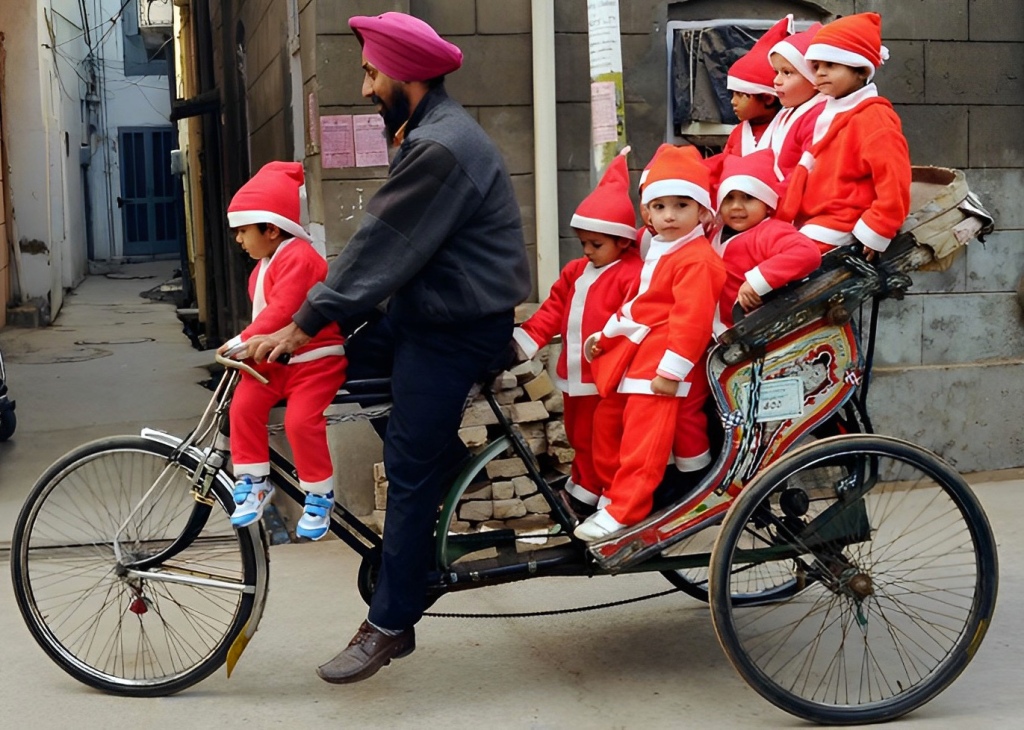
Images from Indian Christmas: Essays, Memories, Hymns: dressed up as Santa Claus leave for school in Punjab. (Picture courtesy: Ecocabs,Fazilka).

There are several other aspects of Christmas celebrations too. The Christmas bazaars are now increasingly fashionable in bigger cities. The choral Christmas concerts and Christmas parties are big community affairs, with dancing, community feasts, Christmas songs, and general bonhomie. Across the Chhota Nagpur area, tribal Christians celebrate with a community picnic lunch, while many coastal villages in Kerala have a tradition of partying on beaches, with the partying spilling over into catamarans going out into the surf. In Kolkata’s predominantly Anglo-Indian enclave of Bow Bazar, Santa Claus traditionally comes to the party in a rickshaw, and in much of northeast India, the entire community may indulge in a pot-luck community feast at Christmas time. Thus Liddle states:

“Missionaries to Indian shores, whether St Thomas or later evangelists from Portugal, France, Britain, or wherever brought us the religion; we adopted the faith, but reserved for ourselves the right to decide how we’d celebrate its festivals.”

Apart from their separate introductions, the editors have collated twenty-seven entries of different kinds, each one more interesting than the other, that showcase the richness and variety of Christmas celebrations across the country. Though Christianity may have come to much of India by way of missionaries from Europe or America, it does not mean that the religion remained a Western construct. Indians adopted Christianity but made it their own. They translated the Bible into different Indian languages, translated their hymns, and composed many of their own. They built churches which they at times decorated in their own much-loved ways. Their feasts comprised of food that was often like the ones consumed during Holi or Diwali.

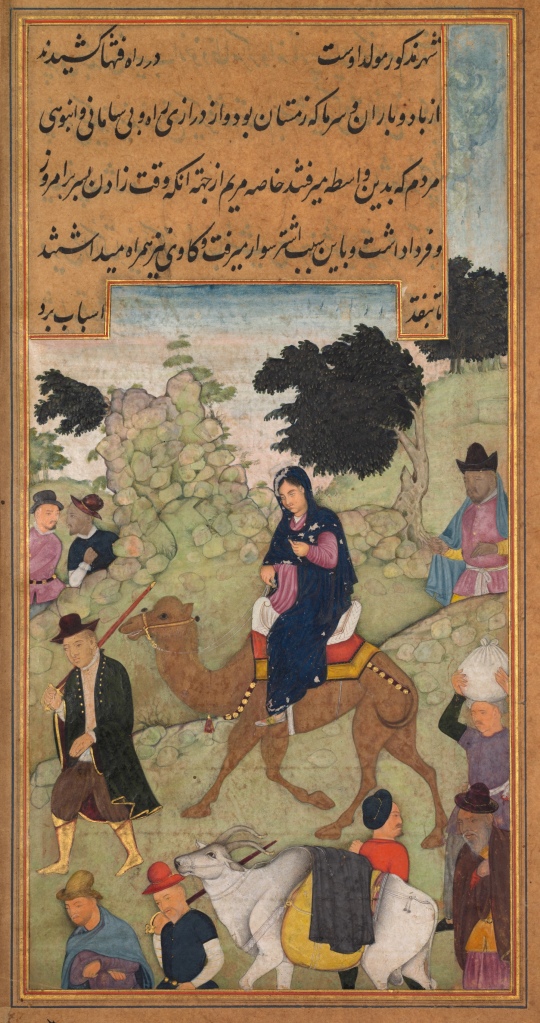
Thus, Christmas in India turned to a great Indian festival that highlighted the syncretism of our culture. Damodar Mauzo, Nilima Das, Vivek Menezes, Easterine Kire, Hansda Sowvendra Shekhar, Nazes Afroz, Elizabeth Kuruvilla, Jane Borges and Mary Sushma Kindo, among others, write about Christmas in Goa, Nagaland, Kerala, Jharkhand, Delhi, Kolkata, Mumbai, Shillong and Saharanpur. Arul Cellatturai writes tender poems in the Pillaitamil tradition to the moon about Baby Jesus, and Punjabi singers compose tappe-boliyan about Mary and her infant. There are Mughal miniatures depicting the birth of Jesus, paintings by Jyoti Sahi and Sister Claire inspired by folk art, and pictures of Christmas celebrations in Aizawl, Bengaluru, Chennai and Kochi and these visual demonstrations enrich the text further.

Interestingly, the very first entry of this anthology is an excerpt from the final two sections of one of Rabindranath Tagore’s finest long poems, inspired by the life of Jesus Christ. Tagore wrote the poem “The Child” in 1930, first in English and translated it himself into Bengali the following year, titling it “Sishutirtha.” But many years even before that, every Christmas in Santiniketan, Tagore would give a talk about Christ’s life and message. Speaking on 25 December 1910, he said:

“The Christians call Jesus Man of Sorrow, for he has taken great suffering on himself. And by this he has made human beings great, has shown that the human beings stand above suffering.”

India celebrates Christmas with its own regional flair, its own flavour. Some elements are the same almost everywhere; others differ widely. What binds them together is that they are all, in their way, a celebration of the most exuberant festival in the Christian calendar.

Apart from the solemnity of the Church services, there is a lot of merrymaking that includes the food and drink, the song and dance. The songs often span everything from the stirring ‘Hallulujah Chorus’ to vibrant paeans sung in every language from Punjabi to Tamil, Hindi to Munda, Khariya and Mizo tawng.

Among the more secular aspects of Christmas celebrations are the decorations, and this is where things get even more eclectic. Whereas cities and towns abound in a good deal of mass decorating, with streets and public places being prettied up weeks in advance, rural India has its own norms, its own traditions. Wreaths and decorated conifers are unknown, for instance, in the villages of the Chhota Nagpur region; instead, mango leaves, marigolds and paper streamers may be used, and the tree to be decorated may well be a sal or a mango tree. Nirupama Dutt tells us how since her city had no firs and pines, she got her brother’s colleague to fetch a small kikar tree as kikars grew aplenty in the wild empty plots all over Chandigarh. In many entries we read about how Christmas decorations were rarely purchased but were cleverly constructed at home.

A very integral part of the Christmas celebrations of course is music. In many Goan Catholic neighbourhoods, Jim Reeves continued to haunt the listeners in his smooth baritone: “I’ll have a blue Christmas without you/ I’ll be so blue thinking about you/ Decorations of red on a green Christmas tree/ Won’t mean a thing, dear, if you’re not here with me.”  Simultaneously, the words and music of “A Christmas Prayer” by Alfred J D’Souza are as follows: “Play on your flute/ Bhaiyya, Bhaiyya/ Jesus the saviour has come./ Put on your ghungroos/ Sister, Sister/ Dance to the beat of the drums!/ Light up a deepam in your window/ Doorstep, don with rangoli/ Strings of jasmine, scent your household/ Burn the sandalwood and ghee,/ Call your neighbour in, smear vermillion/ Write on his forehead to show/ A sign that we are one/ Through God’s eternal Son/ In friendship and in love ever more!/ Ah! Ah!” But the most popular Christmas song was of course “Jingle bells, jingle bells, jingle all the way….”

In “Christmas Boots and Carols in Shillong”, Patricia Mukhim tells us how the word ‘Christmas’ triggers a whole host of activities in Meghalaya and other Northeastern states that have a predominantly Christian population. Apart from cleaning and painting the houses, everything looks like fairyland during Christmas, a day for which they have been waiting for an entire year. She particularly mentions the camaraderie that prevails during this time:

“Christmas is a time when invitations are not needed. Friends can land up at each others’ homes any time on Christmas Eve to celebrate. Most friends drop by with a bottle of wine and others pool in the snacks and the party continues until the wee hours of morning. It’s one day in the year when the state laws that noise should end at 10 p.m. is violated with gay abandon. …Shillong [is] a very special place on Planet Earth. Everyone from the chief minister down can strum the guitar and has a voice that could put lesser mortals to shame. And Christmas is also a day when all VIPism and formalities are set aside. You can land up at anyone’s home and be welcomed in. It does not matter whether someone is the chief minister, a top cop, or the terrifying headmistress of your school.”

One very significant common theme in all the multifarious entries is the detail descriptions provided on food, especially the makeshift way Christmas cakes are baked in every home and the Indian way meat and other specialties are being prepared on the special day. There are several entries that give us details about the particular food that was prepared and consumed at the time along with actual recipes about baking cakes. “Christmas Pakwan[1]” by Jaya Bhattcharji Rose, “The Spirit of Christmas Cake” by Priti David, and “Armenian Christmas Food in Calcutta” by Mohona Kanjilal need special mention in this context.  Liddle in her introduction wrote:

“Our Christmas cakes are a reflection of how India celebrates Christmas: with its own religious flair, its own flavour. Some elements are the same almost everywhere; others differ widely. What binds them together is that they are all, in their way, a celebration of the most exuberant festival in the Christian calendar.”

Later in her article “Cake Ki Roti at Dua ka Ghar[2],” the house where they lived in Saharanpur, Uttar Pradesh, she wrote how her parents told her that ‘bajre ki tikiyas’, thin patties made of pearl millet flour sweetened with jaggery, used to be a staple at Christmas teatime at Dua ka Ghar[3], though she has no recollection of those. She of course vividly recalls the ‘cake ki roti’. This indigenisation of Christmas is something that’s most vividly seen in the feasting that accompanies Christmas celebrations across the country. While hotels and restaurants in big cities lay out spreads of roast turkey (or chicken, more often), roast potatoes and Christmas puddings, the average Indian Christian household may have a Christmas feast that comprises largely of markedly regional dishes.

In Kerala, for instance, duck curry with appams is likely to be the piece de resistance. In Nagaland, pork curries rich in chillies and bamboo shoots are popular, and a whole roast suckling pig (with spicy chutneys to accompany it) may hold centre stage. A sausage pulao, sorpotel and xacuti would be part of the spread in Goa, and all across a wide swathe of north India, biriyanis, curries, and shami kababs are de rigueur at Christmas.

This beautifully done book, along with several coloured pictures, endorses the idea of religious syncretism that prevails in India. As a coiner of words, Nilima Das came up with the idea that ‘Christianism’ in our churches is after all, a kind of ‘Hinduanity’ (“Made in India and All of That”). This reviewer feels guilty of not being able to mention each of the unique entries separately that this anthology contains, so it is suggested that this is a unique book to enjoy reading, to possess, as well as to gift anyone during the ensuing Christmas season.

[1] Cuisine

[2] Cake bread

[3] Blessed House

Somdatta Mandal, critic, academic and translator, is a former Professor of English at Visva-Bharati, Santiniketan, India.

Click here to access an excerpt of Tagore’s The Child

PLEASE NOTE: ARTICLES CAN ONLY BE REPRODUCED IN OTHER SITES WITH DUE ACKNOWLEDGEMENT TO BORDERLESS JOURNAL

Click here to access the Borderless anthology, Monalisa No Longer Smiles

Click here to access Monalisa No Longer Smiles on Kindle Amazon International
Categories
Poets, Poetry & Rhys Hughes

Tintin in India

An Indian newspaper published an article about adults who still read Tintin and I realised that although I would have liked to be interviewed for that article, my qualifications were inadequate, for there is no ‘still’ in my particular case. I only began reading the comic when I was grown up. In fact, I only read it properly in the past few years, and I am more than half a century old. True, I did read one or two of his adventures when I was young, but I read them half-heartedly, I don’t know why, instead of with unalloyed delight, as they ought to be read. Possibly they were too elaborate for me back then.

Yes, Tintin is elaborate, but this doesn’t mean it isn’t simple. Yet it has the kind of simplicity that seems complex to the very young reader. There are plots and subplots, conspiracies and clues, and all of this is perhaps a bit much for the mind of a child more familiar with the primitive antics of Dennis the Menace or The Bash Street Kids from The Beano. Each of Tintin’s exploits seemed beyond reasonable length to me, too adult and requiring a heavy investment of my time and intelligence. I speak, naturally enough, only from a personal perspective. In some households, Tintin was read by minds younger than mine, understood and enjoyed too. I was clearly a late developer.

Thanks to a remarkable bookshop in Bangalore, I have been able to obtain the comic books in omnibus editions and catch up with what I missed out on. It intrigued me to learn that the elements I had regarded as impossibly modern in my youth are now quaintly dated. Tintin’s adventures are not hugely dissimilar in tone and setting to the adventure stories of John Buchan1 and they even put me in mind of Somerset Maugham2 at his most sensational, with their heavy reliance on seaplanes and tramp steamers and open-topped automobiles. The pacing is as fast as The Thirty-Nine Steps or Greenmantle, the atmosphere as exotic-colonial as The Moon and Sixpence or The Narrow Corner. There are differences too, of course, but the differences are less surprising.

The pacing is incredibly fast and Tintin blunders his way into scrapes and pickles almost as if destiny has chosen him for the role of spanner in the cogs of the workings of villains, which in a way it has (if we regard Hergé as Fate). He is highly competent most of the time, but can also be inefficient and even inept, often hampered as well as helped by his dog, Snowy. But no quantity or quality of hampering can keep him down for long, he is deft at seizing the opportunities of coincidence that extreme contrivance throws his way. He is fully the equal of any ancient hero from legend or mythology.

And he is mentally strong: no amount of trauma, no near-death incidents or hair-breadth escapes affect him psychologically. He falls out of an aeroplane, an assassination attempt by a dastardly pilot, and his parachute malfunctions. A flat character on a flat page is about to be flattened on the flat ground, but no, he has the singular good fortune to land in a hayrick being transported on a cart. There are no broken bones and no gasping for breath. He picks himself up, dusts off a few straws, resumes his mission with perfect aplomb. One might even say he is inhuman in his attitude to danger. A touch of psychopathy, perhaps? But he is a friend of goodness, an enemy of criminality.

He is also weirdly tolerant of the pompous ineffectiveness of all the sundry supporting characters who populate his existence. Thomson and Thompson, the detectives who never get it right but always take credit for cases solved in their vicinity, provide comic relief, which justifies itself, but even a cursory analysis of their deeds raises a few awkward questions. How on earth are they entrusted continually with missions requiring the utmost delicacy, tact and cunning? They are negative factors in the field of detection, hindrances rather than boons, a pair of slim buffoons (we normally regard buffoons as portly) with a strange sartorial taste and peculiar speech patterns, dramatically underperforming sleuths who are prone to take what they are told at face value. They are worse than useless; they are beneficial to the continuance of evil.

It was a long time before I was able to tell them apart but now, I know they are doubles rather than twins, and that the one with the drooping moustache is Thompson and the one with the flaring moustache is Thomson. In the original French, they were Dupont and Dupond, which is a little less confusing but not much. Tintin ought to have nothing to do with them, but he is always delighted to see them and treats them as highly competent and valuable colleagues. This is a symptom of his own occasional incompetence. But this has nothing to do with India and so we must regretfully forget them.

Tintin travels to India on several occasions. In Egypt, he daringly escapes a firing squad, requisitions an aeroplane, a 1929 de Hallivand DH-80 Puss Moth, one of the highest performing aircraft of its time, with a 130 hp (97 kW) Gipsy Major engine (this aircraft is also notable for being the first to cross the Atlantic from east to west, in 1932) and he courageously, some might say foolishly, sets off for India. Unlike the pilot Nevill Vintcent3, who flew the exact same aircraft from Britain to Sri Lanka (Ceylon, as it once was) without crashing, Tintin runs out of fuel and comes down in the jungle.

Although extremely absurd, the idea of piloting such a plane so far isn’t as implausible as it might appear. We should remember Maurice Wilson4, that very noble but eccentric mystic who planned to climb Mount Everest solo in 1934, forty-six years before Reinhold Messner5 managed the feat, and of course it was inevitable that he would fail, for all the odds were against him. Despite his lack of flying experience, he purchased a de Havilland DH.60 Moth, a more rickety aircraft than the one Tintin used, and flew it from Britain to India in a series of hops. It was a lunatic thing to attempt and yet he succeeded. His failure was on the mountainside, not in the air. Therefore, we have established that Tintin really could have flown to India from Egypt.

Tintin, after his crash landing, meets elephants in the jungle and he wishes to solicit their aid but he doesn’t know their language. He decides to learn it and improvises a trumpet in order to do so, carving the instrument from a block of wood with a penknife, an amazing feat of carpentry (but in Land of the Soviets he creates a new propeller in a similar manner). Now he can fluently talk to all elephants in their own tongue, for elephants apparently speak in a kind of jazz. It is good to have such magnificent animals on your side. One elephant is worth a dozen human friends when it comes to strength and endurance. And they will never forget a service rendered. That, as far as I’m aware, was Tintin’s first visit to India, but he had another a little later.

Tintin in Tibet, often regarded as his finest adventure, finds Tintin visiting Delhi in the company of Captain Haddock, that boisterous, drunken, bumbling, loquacious master mariner who frequently makes matters worse rather than better. They admire the Qutab Minar, as I did, awestruck, when I was in Delhi. I have since learned that the Qutab Minar was based on a tower in Afghanistan, the Minaret of Jam, which must be the most marvellous name ever devised for a tower. I imagine it is made from apricots and strawberries and I lick my lips as I contemplate it. But this has nothing to do with Tintin, who after leaving Delhi travels to Kathmandu and then overland into the mountains. He meets a Yeti and scares it off with the flash of his camera.

The Tintin comics always had a very substantial fanbase in India and letters from Indian readers often were mailed to Hergé. It is therefore unfortunate that a Tintin adventure set entirely in India doesn’t exist. Personally, I would be happy to see one set in Goa. In the 1990s, a nameless artist designed a series of t-shirts bearing images that are parodies of the Tintin book covers with the title “Tintin in Goa” on them. They show the intrepid reporter doing nothing intrepid at all, simply lounging about the beach or going for a joy ride on a motorcycle. Even a comic character as psychologically resolute as Tintin needs a holiday once in a while. What better place for a relaxing stay?

  1. John Buchan ((1875–1940), Scottish peer, writer and editor ↩︎
  2. Somerset Maugham (1874-1965), British writer ↩︎
  3. Neville Vintcent (!902-1942), South African aviator ↩︎
  4. Maurice Wilson (1898-1934), British soldier, mystic and aviator, who died trying to climb Mt Everest solo ↩︎
  5. First mountaineer to ascend Mt Everest solo, without oxygen in 1970 ↩︎

Rhys Hughes has lived in many countries. He graduated as an engineer but currently works as a tutor of mathematics. Since his first book was published in 1995 he has had fifty other books published and his work has been translated into ten languages.

.

PLEASE NOTE: ARTICLES CAN ONLY BE REPRODUCED IN OTHER SITES WITH DUE ACKNOWLEDGEMENT TO BORDERLESS JOURNAL

Click here to access the Borderless anthology, Monalisa No Longer Smiles

Click here to access Monalisa No Longer Smiles on Kindle Amazon International