Nazrul’s Jonomo, Jonomo Gelo(Generations passed) has been translated from Bengali by Professor Fakrul Alam. Click here to read and listen to a rendition by the famed Feroza Begum.
Ajit Cour‘s short story, Nandu, has been translated from Punjabi by C Christine Fair. Click here to read.
The Scarecrowby Anwar Sahib Khan has been translated from Balochi by Fazal Baloch. Click here to read.
Naramsetti Umamaheswararao moulds children’s perspectives. Click here to read.
Notes from Japan
In American Wife,Suzanne Kamata gives a short story set set in the Obon festival in Japan. Click here to read.
Conversation
Neeman Sobhan, author of Abiding City: Ruminations from Rome, discusses shuttling between multiple cultures and finding her identity in words. Click here to road.
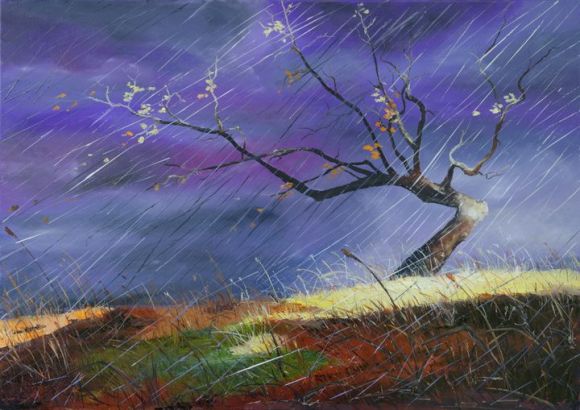
Storm in purple by Arina Tcherem. From Public Domain
If we take a look at our civilisation, there are multiple kinds of storms that threaten to annihilate our way of life and our own existence as we know it. The Earth and the human world face twin threats presented by climate change and wars. While on screen, we watch Gaza and Ukraine being sharded out of life by human-made conflicts over constructs made by our own ‘civilisations’, we also see many of the cities and humankind ravaged by floods, fires, rising sea levels and global warming. Along with that come divides created by economics and technology. Many of these themes reverberate in this month’s issue.
From South Australia, Meredith Stephens writes of marine life dying due to algal growth caused by rising water temperatures in the oceans — impact of global warming. She has even seen a dead dolphin and a variety of fishes swept up on the beach, victims of the toxins that make the ocean unfriendly for current marine life. One wonders how much we will be impacted by such changes! And then there is technology and the chatbot taking over normal human interactions as described by Farouk Gulsara. Is that good for us? If we perhaps stop letting technology take over lives as Gulsara and Jun A. Alindogan have contended, it might help us interact to find indigenous solutions, which could impact the larger framework of our planet. Alindogan has also pointed out the technological divide in Philippines, where some areas get intermittent or no electricity. And that is a truth worldwide — lack of basic resources and this technological divide.
On the affluent side of such divides are moving to a new planet, discussions on immortality — Amortals[1] by Harari’s definition, life and death by euthanasia. Ratnottama Sengupta brings to us a discussion on death by choice — a privilege of the wealthy who pay to die painlessly. The discussion on whether people can afford to live or die by choice lies on the side of the divide where basic needs are not an issue, where homes have not been destroyed by bombs and where starvation is a myth, where climate change is not wrecking villages with cloudbursts. In Kashmir, we can find a world where many issues exist and violences are a way of life. In the midst of such darkness, a bit of kindness and more human interactions as described by Gower Bhat in ‘The Man from Pulwama’ goes some way in alleviating suffering. Perhaps, we can take a page of the life of such a man. In the middle of all the raging storms, Devraj Singh Kalsi brings in a bit of humour or rather irony with his strange piece on his penchant for syrups, a little island removed from conflicts which seem to rage through this edition though it does raise concerns that affect our well-being.
Parichha has also reviewed a book by another contemporary Odia woman author, Snehaprava Das. The collection of short stories is called Keep it Secret. Madhuri Kankipati has discussed O Jungio’s The Kite of Farewells: Stories from Nagaland and Somdatta Mandal has written about Chhimi Tenduf-La’s A Hiding to Nothing, a novel by a global Tibetan living in Sri Lanka with the narrative between various countries. We have an interview with a global nomad too, Neeman Sobhan, who finds words help her override borders. In her musing on Ostia Antica, a historic seaside outside Rome, Sobhan mentions how the town was abandoned because of the onset of anopheles mosquitos. Will our cities also get impacted in similar ways because of the onset of global ravages induced by climate change? This musing can be found as a book excerpt from Abiding City: Ruminations from Rome, her book on her life as a global nomad. The other book excerpt is by a well-known writer who has also lived far from where he was born, MA Aldrich. His book,From Rasa to Lhasa: The Sacred Center of the Mandala is said to be “A sweeping, magnificent biography—which combines historical research, travel-writing and discussion of religion and everyday culture—Old Lhasa is the most comprehensive account of the fabled city ever written in English.”
With that, we come to our fiction section. This time we truly have stories from around the globe with Suzanne Kamata sending a story set in the Bon festival that’s being celebrated in Japan this week for her column. From there, we move to Taiwan with C. J. Anderson-Wu’s narrative reflecting disappearances during the White Terror (1947-1987), a frightening period for people stretched across almost four decades. Gigi Gosnell writes of the horrific abuse faced by a young Filipino girl as the mother works as a domestic helper in Dubai. Paul Mirabile gives us a cross-cultural narrative about a British who opts to become a dervish. While Hema R touches on women’s issues from within India, Sahitya Akademi Award Winner, Naramsetti Umamaheshwararao, writes a story about children.
With such hope growing out of a neolithic burial chamber, maybe there is hope for life to survive despite all the bleakness we see around us. Maybe, with a touch of magic and a sprinkle of realism – our sense of hope, faith and our ability to adapt to changes, we will survive for yet another millennia.
We wind up our content for the August issue with the eternal bait for our species — hope. Huge thanks to the fantastic team at Borderless and to all our wonderful writers. Truly grateful to Sohana Manzoor for her artwork and many thanks to all our wonderful readers for their time…
Short story by S Ramakrishnan, translated from Tamil by T Santhanam
It was Malavika who sent me the video of the monk who plays guitar. Malavika is my daughter. She is pursuing fashion designing course in Kingston University, England. Her desires and interests are a puzzle to me. Some days ago, she sent a recording of a poem by William Blake in her voice. After that, she sent a photo of her carrying a placard in a demonstration against global warming. As clouds change to forms unimaginable, her interests keep on changing. After watching a butterfly, she had sent her impressions in writing. It seemed as though it was from a seasoned writer.
Children who leave home for far off places, in a sense, leave us. She was no longer the girl she was in Chennai. The new country and new environment have changed her. The changes are reflected in her appearance and deeds. My wife did not like these alterations. Below the video of the monk who played guitar, she had given the caption: “Music is Meditation”. I could not understand her. At the age of twenty-two, I thought she would be fondly giving herself to worldly pleasure. But she was immersed in meditation, agitation and museum visits.
In the video sent by Malavika, the monk must have been about thirty years old. His head was tonsured. He wore a robe coloured orange. His ears were slightly big. He had a sharp nose and small lips where a smile was frozen. It was hard to find out if he was a Nepali or a foreigner. On his left arm, was tattooed the image of Buddha.
It was funny to see a Monk with a guitar. The image we have formed about saints and the looks of current day saints are not alike. Perhaps, we refuse to update that image. Perhaps, the meaning of sainthood has changed.
The musical piece was given the title “Falling flowers”. From the way he was playing, it seemed as real as the blossomed cherry leaves falling gently. The normal rapidity and gush associated with guitar music was not there. Like an insect that moves in the water, his fingers moved on the guitar strings. Music tunes to the past more easily than photographs. A small piece of music is enough to take us back to our school days.
I saw the video once or twice. I felt the urge to listen to it again and again. While listening at night, I felt as if the fragrance of incense was wafting into the vacant spaces of my heart. I found His name was Limang Tolma while searching for his other videos. There were hundreds of musical pieces by him. All of them were only seven minutes long. Evidently, he played the guitar for only seven minutes in a day. That too under the sal tree in Coben Monastery seated on a stool. Hundreds of people from various countries pour in to listen to his performance. All this I gathered while browsing the internet. His music was melodious and sweet. Why did he play for seven minutes only at each stretch was beyond comprehension.
To know more about Limang Dolma, I called Malavika on her mobile. She sent a message that she was observing silence for the past five days. Why this silence? Tongue can be tied down. But the mind?
I told my wife. She responded that she had scolded Malavika and that was why she was doing this.
I could not understand. What was the skirmish between mother and daughter? I sent a message to Malavika asking her how long her silence would continue. “God only knows,” was her reply.
As I am a senior executive in an automobile company, I had to conduct two to three meetings in a day. My blood pressure sometimes would rise after returning from these meetings.Sometimes, I would have a headache too. At times, the meetings would last for ten hours. After the meeting, I would feel as if somebody has placed a pile of iron on my shoulders. I would feel sick, wondering why we could not conduct our work without talking, discussing or fighting.
One day, before the commencement of the meeting, I started to listen to the monk’s guitar music from my cell phone rather impulsively. I closed my eyes for seven minutes as though I was in a deep meditation. It was as pleasant a feeling as a moist breeze caressing my body. There was peace in my heart and an exhilaration I had never known before. On that day, I could sense the change in my voice and the way I was moving towards a solution. Somehow the officials of the sales department seemed to understand this. After the conclusion of the meeting while coming down in the lift, Amarnath said, “There was something new in your speech today. You spoke like a Zen Master.”
“Yes” I nodded approvingly with a smile. I was just wondering how a small piece of music could bring such a tremendous change in me.
I wanted to know more about Limang Dolma. Searching through the internet I was more and more astonished. The real name of Limang Dolma is Christopher Cane. He was born in Milan. He had pursued Anthropology. After coming into contact with a Buddhist monk, he has embraced Buddhism and become a monk in the Buddhist Monastery. He plays the guitar only under the tree of the monastery and nowhere else. Young people throng to him. They listen to his music. Some of them stay there for days together to savour his music. They wear T-shirts bearing his image with the words, “Buddha plays Guitar”. In an interview, a young lady asks him. “All saints in India hold one or other instruments. Why does Buddha not play any instrument nor is seen holding one?”
“He himself is a musical instrument. One who knows how to tune himself finds no need for a musical instrument. In the same way, Nature tunes itself. Is there any tune better than what the water plays?”
“Why do you play only for seven minutes?”
“Seven is the symbol of consciousness in Buddhism.”
“Seven minutes is not enough for us. Can’t you play more?”
“Will you take honey in a gulp? Is a spoonful not enough?” he asks.
I admired Limong Dolma fo his speech, poise and the way he handled guitar. I too felt like wearing a T-shirt bearing his image. I sent the video of Limang Dolma to some of my friends asking them to listen to his music. Only Mohan Muralidharan, a neurologist and my school mate, sent a reply saying that a man from Turkey played better than the monk and shared the video. Why should one musician be compared to another? Can’t this foolishness be avoided?
I called Mohan and blurted out my irritation. He said in a mocking tone, “You’re aging. That is why you listen to a monk playing the guitar. Music should make us feel young. It should twinge our nerves. You have never touched a musical instrument in your entire life. Can you whistle atleast?”
Mohan was right. I haven’t even played the mouth organ which many played during my school days.
I felt like owning a guitar. The same evening, I went to a musical store in Leo mall. I showed the video of Limang Dolma and asked for a guitar like the one in the video. The face of the girl at the counter brightened. “Limang Dolma?” she asked. I felt glad that she too has listened to the music. She brought a guitar from inside. I told her, ” I don’t know how to play guitar. This is for my daughter.”
The girl told with a smile, “Limang Dolma was a thief. He was in prison. After his release, he became a Monk. People say he speaks to Buddha through his music.”
“Really!”
“I overheard two girls talk of it when they came to purchase a guitar.”
“Do you believe that?”
“I believe it partially.”
“Which part?”
“That he speaks to Buddha,” she smiled.
She looked like my daughter when she smiled. Perhaps for young girls Buddha is a different personality. May be, the Buddha known by the ones who have crossed fifty years like me and the Buddha these young girls adore are not the same.
When I brought guitar home, my wife chided me.
“Why have you brought this? Who will play?”
“Just let it be,” I responded.
“Is it a show piece to be kept just like that?” she asked.
I did not reply.
I placed the guitar in Malavika’s room close to her bed. I had a feeling that Malavika had returned. I sent that night the picture of guitar to Malavika by WhatsApp. She sent an emoji of two clapping hands. Also, she sent a message “We are going to visit Limang Dolma.”
Though I felt happy, I was eager to know who was the other in the ‘We’. I did not venture to ask Malavika. Instead, I asked, “When?” She did not respond.
After five days, she sent a picture to me. She was among the hundreds of youngsters before Limang Dolma, as he was playing the guitar. My eyes were cast on a young man with long hair, not on Limang Dolma. The young man hung his arms around Malavika’s shoulder.
Who was this fellow? How long had she known him? I could not see his face properly. I widened the image. An European face. Perhaps was he also a musician? I thought of asking Malaviika. But I curbed that thought and went on to ask about the musical event, as I called her. She was full of cheer. She told me,” Listening to Dolma’s music, one feels like a kite fluttering in the air. I do not know what to say. Flying to heaven.”
“I read somewhere that he was a thief,” I said.
” Oh, that’s a myth constructed by magazines. When asked about this, Dolma says raindrops do not have a past. Jonah and myself were in the Monastery for three days. Wonderful experience!”
A question arose on my mind as to who Jonah was. I was not sure whether to ask her or not. Why wouldn’t she talk about him?
I asked, “Is Jonah a musician?”
“Dad, how do you know? Indeed, he is. He plays the guitar well. It was he who introduced me to Dolma’s music.”
“Is Jonah your classmate?”
“No, he works in a bar where I hold a part time job.”
“You didn’t tell me,” I pretended to be angry.
“Dad, don’t tell Mom about this.”
“About your working in bar?” I asked deliberately.
“About Jonah too?” she laughed. As she was so laughing, she seemed to be some other young girl. After she hung up, I was thinking about Jonah. Was he a good person or bad? Was he also a thief earlier? Or could he be a drug addict? Who were his parents? Was he in love with Malavika? Had I become old? Was Mohan right? I
admired a Monk playing guitar somewhere. But I do not like Jonah who also plays guitar. Why? I was perplexed. Suppose if Limong Dolma put his arm around the shoulder of my daughter, would I dislike him too? I was confused.
Two days later, Malavika forwarded a video of Limang Dolma downloaded in her phone. Limong Dolma walked as though he was floating in the air. He sat under the tree. Peace was on his face as he tuned the guitar — the same music that I savoured earlier. No longer did I feel close to that music. Somehow, instead of Limang, Jonah’s face came before me. I felt as if a bitterness had settled down on my tongue.
The same night, Malavika called me. Before my asking anything, she said, ” After visiting Limang Dolma, I do not feel like listening to his music again”
“Why?” I asked as if I did not know anything.
“I do not like it any more just the way I suddenly liked it before.”
“How is Jonah?” I asked intentionally.
“Do not talk about him. I hate him. I hate whatever he introduced to me.”
Inwardly I was happy.
” Any problem? Shall I talk to Jonah?”
“Why should you talk to him? The days I moved with him, it was a nightmare. Daddy, why do you not rebuke me?”
“You are not a kid, after all.”
“But you think of me as a kid only. You don’t know me as Mom does.”
I was flummoxed. I could hear Malavika sobbing for the first time ever. I did not know how to console her. I hurriedly gave the phone to my wife. She started walking towards the kitchen with her words of consolation. What has transpired between her and Jonah? Why was she weeping? I could not make out. At the same time, I was happy that she disliked the world she created for herself and moved back towards my world. A thought arose that she was coming home. I asked my wife what Malavika had said.
“That boy is not good. I told her from the beginning itself. But she did not pay heed.”
“Did you know about Jonah before?”
“She told me six months back. I scolded her saying that your Dad will not like this. I have spoken to Jonah also.”
“To Jonah? You?”
“Yes, I could not understand a bit of what he spoke.”
“What is the problem now?”
“It’s over. No use talking about it!”
I could not understand what happened. But Malavika had been closer to her mother than to me. She had shared everything with her mother. I was pained at this. Why then did she asked me not to tell her mother? Why this drama? Children after growing up, treat their father as a plaything. The daughter I know is now the girl I do not know. I could not reconcile myself to this.
I heard the guitar music of the monk that night. I was more attracted to the tree than to the music.
Leaves do not stay on the tree for long. When a leaf falls, the tree does not reach out to catch it. When falling leaves sail along the wind, the trees can do nothing but look at them in silence. Somehow, the music stirred a grief in me.
As I prepared to leave for office next morning, I saw my wife keeping the guitar next to dustbin. What was the fault of the guitar after all?
” What are you going to do with this?” I asked.
“Anish told me, he will take it. What do we do with this? Malavika does not want it any more.”
I nodded giving the impression that she was right. But I felt sorry while doing that.
.
S. Ramakrishnan is an eminent Tamil writer who has won the Sahitya Akademi Award in the Tamil Language category in 2018. He has published 10 novels, 20 collections of short stories, 75 collections of essays, 15 books for children, 3 books of translation and 9 plays. He also has a collection of interviews to his credit. His short stories are noted for their modern story-telling style in Tamil and have been translated and published in English, Malayalam, Hindi, Bengali, Telugu, Kannada and French.
T Santhanam is a retired Bank Executive in Bangalore, India. He has a passion for literature with a special affinity for poetry. He writes poetry in Tamil. He is also a blogger.
.
PLEASE NOTE: ARTICLES CAN ONLY BE REPRODUCED IN OTHER SITES WITH DUE ACKNOWLEDGEMENT TO BORDERLESS JOURNAL
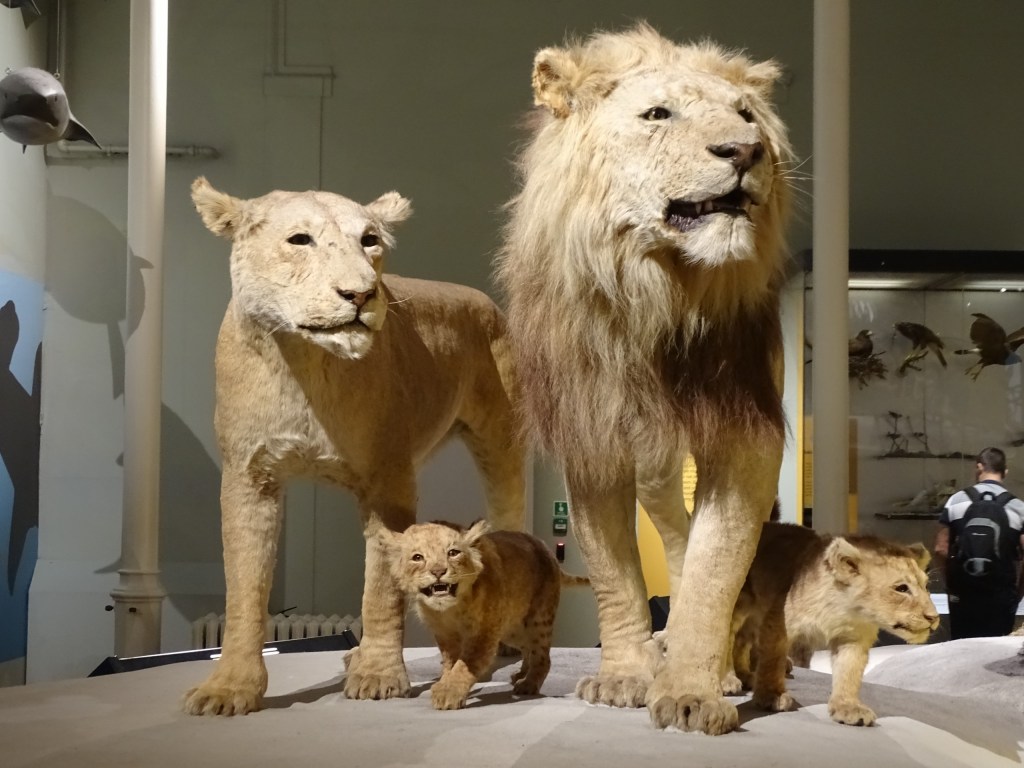
The King of Beasts in the Museum of the Extinct

The king of beasts, my child,
was terrible, and wild.

His roaring shook the earth
till the feeble cursed his birth.

And all things feared his might:
even rhinos fled, in fright.

Now here these bones attest
to what the brute did best

and the pain he caused his prey
when he hunted in his day.

For he slew them just for sport
till his own pride was cut short

with a mushrooming cloud and wild thunder;
Exhibit "B" will reveal his blunder.


After the Poetry Recital

Later there’ll be talk of saving whales
over racks of lamb and flambéed snails.


Evangelical Fever

Welcome to global warming:
     temperature 109.
You don’t believe in science,
     but isn’t the weather Divine?


God to Man, Contra Bataan

Earth, what-d’ya think of global warming?
Perth is endangered, the high seas storming.
Now all my creatures, from worm to man
Know how it felt on the march to Bataan.
Michael R. Burch’s poems have been published by hundreds of literary journals, taught in high schools and colleges, translated into fourteen languages, incorporated into three plays and two operas, and set to music by seventeen composers.
PLEASE NOTE: ARTICLES CAN ONLY BE REPRODUCED IN OTHER SITES WITH DUE ACKNOWLEDGEMENT TO BORDERLESS JOURNAL
The COVID-19 has taught us that we are in an emergency. In 2019 a teenager named Greta Thumberg was crying hoarse that we are in an emergency and no one was listening. It’s time for us to take stock of the matter. Which is the greater emergency, this COVID-19 emergency or the climate emergency that Greta Thumberg was warning about?
Up to 1 million: species threatened with extinction, many within decades
>500,000 (+/-9%): share of the world’s estimated 5.9 million terrestrial species with insufficient habitat for long term survival without habitat restoration
>40%: amphibian species threatened with extinction
Almost 33%: reef forming corals, sharks and shark relatives, and >33% marine mammals threatened with extinction
25%: average proportion of species threatened with extinction across terrestrial, freshwater and marine vertebrate, invertebrate and plant groups that have been studied in sufficient detail
At least 680: vertebrate species driven to extinction by human actions since the 16th century
+/-10%: tentative estimate of proportion of insect species threatened with extinction
>20%: decline in average abundance of native species in most major terrestrial biomes, mostly since 1900
>6: species of ungulate (hoofed mammals) would likely be extinct or surviving only in captivity today without conservation measures Food and Agriculture
Yes this is an EMERGENCY that very few are talking about.
Why are all these species going extinct? Just because of the actions of this invasive dominant species called homosapiens!
The same UN report points out that:
1 degree Celsius: average global temperature difference in 2017 compared to pre-industrial levels, rising +/-0.2 (+/-0.1) degrees Celsius per decade
>3 mm: annual average global sea level rise over the past two decades
16-21 cm: rise in global average sea level since 1900
100% increase since 1980 in greenhouse gas emissions, raising average global temperature by at least 0.7 degree
40%: rise in carbon footprint of tourism (to 4.5Gt of carbon dioxide) from 2009 to 2013
8%: of total greenhouse gas emissions are from transport and food consumption related to tourism
5%: estimated fraction of species at risk of extinction from 2°C warming alone, rising to 16% at 4.3°C warming
Even for global warming of 1.5 to 2 degrees, the majority of terrestrial species ranges are projected to shrink profoundly.
When Countercurrents.org started in 2002, the CO2 level in atmosphere was 370 ppm. Now it stands at 412 ppm. Dr. Andrew Glikson, a climate scientist has pointed out in several articles in Countercurrents that total green house gases in the atmosphere in the atmosphere including CO2, Methane, Nitrous Oxide, Ozone etc has topped 500ppm.
The Paris Agreement’s goal is to keep the increase in global average temperature to well below 2 °C above pre-industrial levels; and to pursue efforts to limit the increase to 1.5 °C.
Coordinated by the World Meteorological Organisation which is also backed by the United Nations Environment Programme and the Intergovernmental Panel on Climate Change, the United in Science report released in September 2019 estimates global emissions are not likely to peak before 2030 on the current trajectory. It says policies to reduce emissions must triple to meet the 2°C target and increase fivefold to keep heating to within 1.5°C.
With the forced COVID-19 lockdown we are well on track to reach the Paris temperature goals. The COVID lockdown taught us what is essential for our sustenance. Most of the carbon emitting vehicles and airplanes are grounded. Our consumption has come down to our basic essentials. Continents jumping tourism has come to a standstill, so has the neoliberal globalisation. It is good time for globalisation to fail and save our planet. Pollution has come down. Cities have become serene. Rivers have become clean. We’ll have to wait for authentic studies to confirm how much carbon footprint did we reduce.
We were living a reckless life like there is no tomorrow, consuming as much as we can and travelling as far as we can. COVID lockdown has put a break to this reckless lifestyle. In fact it is so much better for the environment. The COVID lockdown has taught us how much wastage we were making. It also taught us we can live better life with much less than we usually consume.
The COVID lockdown has also taught us we have to do a lot more work to do make our economy resilient. We have to make our local economies resilient. We have to grow our food in our neighbourhood. It will create more local jobs and stop the long haul migration to the cities. The cities too have to become resilient by producing its own food. May be cities itself may not be a good idea and wither away.
The COVID lockdown has given us a sneak preview into the future if we are to meet the global temperature goals. We have no other choice if we are to believe our science experts. Scientists like James Hansen predicts that even the human species may go extinct if we can not control global warming.
Human civilization has seen many pandemics and have won over all of them. We’ll overcome this pandemic too. But I’m not so sure about the battle against global warming. The COVID-19 lockdown has taught us that we can win the battle against global warming too. With a little bit more planning we can do even better.



 Borderless