Categories
Essay

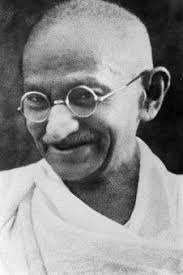
What Gandhi Teaches Me

By Candice Louisa Daquin
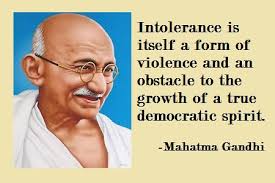
Generally, a Westerner shouldn’t try to dabble in writing about Indian great men because it’s that kind of appropriate-ism that caused so much misunderstanding and damage to begin with. The idea the West had all the answers, which clearly it does not. The idea someone whose country used to be a colonialist-force, had the right anymore to discuss countries that were colonized, can smack deeply of appropriate-ism or worse.  However, there are also ways we can appreciate what we know and transmit that without being patronizing or culturally insensitive.

I choose to consider Gandhi and his impact on the world, to remain in the middle ground. Neither applauding Gandhi without reservation, nor ignoring his incredible impact and influence on India and beyond. I don’t always do this, in the case of someone like Woody Allen or Charles Bukowski (hardly comparable) I cut them off immediately because despite being talented, their talent simply doesn’t measure against the harm they caused. With someone like Friedrich Nietzsche I would say, he has some brilliant perspectives, but his over-all views were too harmful for me to support him. Revisionist thinking is necessary, but sometimes like anything else, it can go too far and condemn significant people based on modern thinking that doesn’t take into account the mores of the time.

One of the hardest things in the world is when your heroes appear to fall. But in this case, there is so much positive about Gandhi I believe (and this is a personal belief), that his goodness encourages us to retain his relevance and enduring impact.

Firstly, Satyagraha – belief in using truth to resist evils with non-violence. Not the same as simply ‘truth’ or ‘verité’ as I would say in French. But more the ideal of believing in truth rather than being deceived or unable to believe. This is not just valuing truth, but believing in truth and thus, through that belief, knowing what is true (and reasonably, what is not).

I find this very interesting because whilst we all ‘think’ we know truth, obviously most of us do not. When does opinion and truth come together? Really holding an opinion has nothing to do with truth but with multiple versions of truth, how do we ever know which one is right? This is a discussion I have had many times in my life with friends of differing views. For a time, I wanted to be a Christian because I needed to believe in something and so many whom I knew were Christian would try to persuade me that was the ‘right’ (true) path. I was not convinced, despite my own attempts to be and it did not strike me as ‘truthful’ or ‘the truth.’ But the question is if people ‘doubt’ another’s truth then where does that end up?

I think of what Gandhi might have said; that truth is beyond conjecture, difference and trying to be ‘right’ the truth is there all along, it is immutable, transformative and fluid at the same time. And by truth he is not speaking purely of a particular faith, or a particular creed, but a universal truth. That is pretty esoteric for Westerners, I think overall Western thinking is prescribed, it feels comfortable having absolutes to follow and only demurs when it’s considered socially ‘trendy’ to disagree. While there may appear to be diverse thinking in the West, I would say it’s no more diverse than closed societies like China, the propaganda is just less obvious. After all, it’s not a societal dictate that has people unquestioning, it’s the mandate of the individual which links with the concept of  Swaraj – self-rule which ultimately led to home rule, the idea that led to an independent India.

If I think of his ideals today, how many of us believe in truth by considering how this lies within us and then without us. Isn’t it more common for us to be spoon fed a ‘truism’ from our respective societies, and even if we question that truth, we do so with groupthink, subscribing to a ‘truth’ without considering what believing in truth means in relation to ultimate truth? Thus, without individual self-policing (or by proxy, the questioning of something outside ourselves) and perhaps by being so busy, we take the easy road because to question everything can be an exhausting enterprise, and as Marx would say, we’re distracted by how busy we are in the machine of work. Leading to at times, mass delusion, or mass indifference, but definitely not an understanding or questioning of how to cultivate a belief in truth.

In fact, how important is truth to us? We bandy around the words, paying lip service to the idea, but without going further to consider the idea at a more personal and then social level. Truly believing in truth would be almost like letting go of everything and beginning over (as one could say Gandhi did) and as you rebuild, doing so with belief in truth in a pure sense of the word. I believe in truth and therefore reject attempts of subterfuge in favour of increasing my belief in the existence of truth. In many ways this is like believing in God without it becoming all about the details (scripture, deity, icons etc). It seems to have a lot in common with the pure heart of Buddhism too,

This leads to another principal of Gandhi’s — simplicity. Simplicity of an idea clears the clutter to reach at the truth. That simple. Practice simplicity and you will see more clearly. How many of us truly practice simplicity? I may try, but I fail, as most of us do, with this increasingly complicated pull and push of modern society, where I might rail against absurdities because I’ve been sucked into thinking they matter. Maybe some of us don’t have the luxury of opting out and going back to basics, maybe our lives are too interwoven with an unnecessarily complicated society that ‘demands’ we brush our hair, shine our shoes, iron our clothes, wipe our faces and face the world a certain way.

The perennial question has always been: is this the only way to live? And as we lose more and more of our simplicity, we may no longer care about other options, in favour of following the status quo. Furthermore, we may believe a complicated life with stress and demands, is the only way we can live, the only way things can work. I would think Gandhi could see, by giving things up, you gain more than by taking on more, and whilst his message may seem inapplicable to many, we can all learn something by doing less, wanting less, needing less.

After all, we cannot take what we accumulate with us, so the ideals of physical wealth seem less important than spiritual health. Many of us may brag about the car we drive, the house or neighborhood we live in, where our kids go to school or university, what they do for a living and so it goes on. Even in India, this is true, as the upper and middle classes seek to emulate what they have seen dominate the rest of the world and define themselves by those status markers that mean so much (and conversely, may mean so little). It is easy to get caught up in it.

I was never an acolyte of the materialistic world, but like most people, I had my insecurities and wanted to jump through  few hoops that I felt defined you as a success in society. When I became sick, it really showed me in a shocking way, how little those things mattered. I recall one day in hospital, my hair matted from throwing up, I just reached for my ponytail and cut half of it off. I had always been vain of my hair as it was thick and long and yet, it felt absurd to hold onto something for vanities sake when I was so sick and bereft of any normalcy. Likewise, when I went out into the common area of the hospital, I saw people sicker than me, and as we talked, I saw they were friendly irrespective of my not wearing make-up, or shoes (!) and in a gown with a green face. They saw ‘me’ and it felt like being a child again, liked for being ‘me’ instead of the ‘me’ I had become used to showing the world which was a counterfeit version. This principle then applies also to the notion of truth, and self-policing. Without an inflexible doctrine like religions, Gandhi’s philosophy was free to consider the whole rather than the individual steps toward being whole.

9/11 has just passed here in America my adopted country, and at its 20-year anniversary there has been much made of our withdrawal from Afghanistan, the country America invaded after 9/11 for sheltering the terrorists who were involved in the murder of so many people. Whether you are a Democrat, or Republican, many Americans believed someone had to pay for the atrocities committed on American soil. I recall at the time understanding both perspectives: the felt need for revenge or justice, and also, the need to lean towards understanding the how and the why of the incident to prevent it from recurring again.

When America withdrew from its longest and unsuccessful war against the Taliban, only to find the Taliban and Isis took over Afghanistan as if America had never been there, it did strike many as being a truly futile war (and we can argue, all wars are futile to some degree). How blatant was the takeover of a country America had wrongly thought was tamed from its former ‘enemies’.  Over time, it had just felt a lot like other wars (Vietnam etc.) where so much death, destruction and expense wrought no change, certainly not as Americans had visualised. Furthermore, did the taxpayer really want to leave behind US$ 2.26 trillion of their hard-earned money to equip Afghanistan? Yet that is exactly what happened along with the providing a free access to the very latest technology in the abandoned US embassy.

Why doesn’t America learn this lesson? That going to war doesn’t really change the ideology of an invaded country, that small bandit terror cells continue to thrive and even increase, because the promotion of American ideals isn’t always universal or accepted, and promoting them whilst invading a country, breeds as much resentment as it does thankfulness. By this I am not suggesting everything America did was negative, they truly tried to help the Afghani people, but at what cost? And did it work? I would say it did not. That’s perhaps because it is not the role of any one nation to police another or dictate to another.

But what do you do if you are a military person, and your country is attacked? It’s hard to imagine sitting there and debating how to have a non-violent discussion with the enemy. Yet that is exactly what Gandhi is most famous for. Satyagraha may seem a very outdated term, or it may appeal as a modern notion, either way it’s so laden with symbolism we hardly understand its core anymore. On the one hand, there is the Old-Testament idea of ‘an eye for an eye’ and then as Gandhi followed ‘An eye for an eye leaves the whole world blind’.

Personally, I find truth in both, maybe truth can have a duality or not be as black and white as we often want it to be, but either way, non-violence is erasing the option for any kind of vengeance or payback, not an easy thing to accomplish when your enemy is being deeply unfair, as was the case with Gandhi watching the treatment of Indians in South Africa and then again with the colonial invading forces of the British in India. Gandhi founded the Natal Indian Congress in 1894, where he campaigned for the rights of indentured labourers in South Africa and protested against the system of requiring passes for Indians. Gandhi went on to organise the local Indian community, of all income brackets, into a passive resistance against this inequality. With these early eye-openers, Gandhi began his first experiences of community building into protest, utilizing peaceful means, against entrenched inequality and racism.

But every situation is different and 9/11 did not happen out of the blue, it came about as a result of decades of fighting between Christian and Muslim extremists on both sides. It also came about because the West wanted the Muslim world to accept some things, they found unacceptable. When asked why he caused the 9/11 attacks, Osama Bin Laden said because Saudi Arabia, his homeland, was in bed with America in going after Saddam Husain and others in Iraq. Why did he find this so offensive? In part because he didn’t like American military in his country, especially women soldiers. His brand of extremist Islam did not believe women equal to men and found that an abomination.

What is ironic about this extremist thinking, which can be found in all faiths, is how hypocritical those who believe it seem to be. All the terrorists who came to America to attack on 9/11 visited brothels and took full advantage of the Western ‘evils’ they preached against. They would argue that they had no respect for those people because they were ‘evil’ – in essence justifying their behavior based on a greater sin. But who are we to dictate who is more ‘sinful’ than another, and surely, if we believe in truth, we don’t break it when tempted by the very thing we condemn? Going back to Gandhi’s ideal of belief in truth, one who does, would not be hypocritical.

Yet so many humans are. Some people who condemn homosexuals have secretly practiced homosexuality. People who condemn women might be profiting from their exploitation. Those kinds of hypocrites negate the truth of their original argument. If we simplify the argument, we have no legs to stand on. Oppression of others goes against all religions but is practiced by all religions. I think Gandhi saw this palpably and was trying to redirect us to see how absurd this was. And what greater way than to practice non-violence against a violent oppressor? It literally was an act of faith, and incorporated belief in truth, and political self-policing. Is this not the ultimate reality? ‘Ahimsa’ isn’t just ‘non-violence’ because no one principle exists in isolation from ‘other’ in this case, love. Without love there is no mercy, there is no wish for non-violence. It is the connection between the intension and the outcome that produces Gandhi’s ‘Ahimsa’ (non-violence).

If all life is one, then all violence perpetrated against self or other is experienced as a whole, the welfare of human beings at the core. The very opposite of the competitive consumerism of Capitalism, which America is known for. And with this, Gandhi predicted the future, a practical need to eat less meat, (vegetarianism) or to respect life (by not consuming animals or exposing animals to suffering) relating back to the idea all living things are connected. I recall as a child being deeply impressed with this concept and it was one reason I myself became a vegetarian at a very young age. To many in the West, vegetarianism is considered the purview of the privileged, and I now understand that, because if you live a very simple life, it’s often very hard to be vegetarian and consume enough calories. To an extent, being vegetarian is abstinence. Many people with eating disorders become vegetarian or vegan as a form of orthorexia. Many middle-class kids have the ‘fad’ of vegetarianism. But the core behind Gandhi’s form vegetarianism or veganism is more in line with Hindu/Buddhist perspectives of respecting living things and causing no suffering.

The hardest principle of Gandhism I have encountered is faith. For some, this is the easiest as they already possess faith, as Gandhi did. He said: “I must confess that the observance of the law of continence is impossible without a living faith in God, which is living Truth. It is the fashion nowadays to dismiss God altogether and insist on the possibility of reaching the highest kind of life without the necessity of a living faith in a living God. I must confess my inability to drive the truth of the law home to those who have no faith in and no need for a Power infinitely higher than themselves. My own experience has led me to the knowledge that fullest life is impossible without an immovable belief in a living law in obedience to which the whole universe moves.” But unlike the shaming faith separating gender and men and women, Gandhi didn’t impose those divisions: “It is not woman whose touch defiles man, but he is often himself too impure to touch her ……” As a woman who disliked the inferior status given women in most mainstream religions, I found Gandhi’s perspective on this, refreshing and egalitarian. I cannot speak on faith as I do not possess it adequately, but I can see its place in Gandhi’s principles and understand it didn’t come to him all at once, but through the experience in part of the other values he lived with. They built into on one another and are interconnected.

Gandhi’s belief included celibacy. “Brahmacharya … means control in thought, word and action, of all the senses at all times and in all places.” The conclusion in some ways to the fulfilment of all the other principles. Those who find ways to condemn Gandhi, point to the potential for scandal by Gandhi’s relationship with Sarla Devi Chaudharani, daughter of Rabindranath Tagore’s elder sister owing to materials where Gandhi called Sarla Devi his ‘spiritual wife’. Yet in Gandhi’s letters to his friends, Gandhi explained that he called Sarla Devi his ‘spiritual wife’ because theirs’ was a ‘wedding based on knowledge.’ Why this matters, is Brahmacharya is related to celibacy and people often question whether any man is capable of celibacy or whether it was just the outward appearance of.

Personally, I’m not sure it’s as important as others feel it is, to discern whether Gandhi remained celibate, because I do not place importance on celibacy, but I understand if you are literally reading Gandhi, you would hope he did what he said he did. I wonder why this matters so much and why sex with a woman (or man) would be such an issue for those who love Gandhi (or for that matter Jesus, because many thought, he had a wife and this idea alone, scandalized others). Perhaps when it doesn’t matter if a spiritual leader has sex or not, we’ll really be free of all shame attached to sexual relations. Although for Gandhi it was more about control over impulses that could sway him from his path. Gandhi wrote in a letter on the subject; “I have reached a definition of a spiritual marriage. It is the partnership between two people of the opposite sex where the physical is wholly absent. It is therefore possible between brother and sister, father and daughter. It is possible only between two brahmacharis in thought, word and deed.”

I understand for him, perhaps passion was an inflammation of sense and morality, and this would distract him. Gandhi was thought to have developed his perspectives on carnal passions by concluding a person cannot selflessly serve humanity without accepting poverty and chastity. This seems an enduring theme among many holy men and I’m not one to dispute it, although I think it’s different for a woman. When Gandhi said: “physical union for the sake of carnal satisfaction is reversion to animality,” he may have set himself up to be perceived as unrealistically idealist and unrealistically puritanical.

On the other hand, like anything, we have to take the influences of the time-period into account; what Gandhi was responding to, what he witnessed, what he saw occur, how those played into his striving for inner-strength. I see it like trying to translate what a great painter meant by their painting, hundreds of years later. Ultimately, we do, but that painter if alive today, may say; ‘oh no you got it all wrong.’ So, when people point to the strange things Gandhi did in his Brahmacharya experiments, they could be very right, or it could be one piece of a much larger puzzle. We are all twisted by our life experiences, but we expect Gandhi to be free of this, even as he said he wasn’t. Perhaps the shame of not being with his father during his last moments as he went to his bedroom to have sex with his wife, was among some of the reasons he embraced Brahmacharya, Gandhi was after-all, human.

Trying to understand the motives of someone born in another era involves taking into account their worldview as influenced by that era. Gandhi was from a middle-class family, and we know those born into higher classes are often received differently to those from other classes. This isn’t right, but it’s the way the world has operated and blaming the person born into that family is blaming the wrong person. It is the system that perpetuates this, just as now, most ‘notable’ people come from some degree of privilege than obscurity (with significant exceptions). Gandhi was a product of that privilege but that’s not quite the same as being privileged in thought. Likewise, it’s easy to say, he got married at 13 and had 4 kids, so it was relatively easy to become celibate, but without experiencing that personally, that’s an assumption based on reaction, not fact.

I can understand the unease of revisiting historically important figures, the desire to applaud them but also the need to criticize their failings. I think if Gandhi were alive today, he would say ‘have at it’ and be open to criticism, although possibly he would find today’s world untenable, for who really knows how a historical figure would greet the future? We become the future by evolving. Only 20 years ago, the idea of gay-marriage would be abhorrent to most, so much transforms with acceptance and shifting of ideas. Some of that actually comes from thinkers like Gandhi who perhaps paved the way in some form, for the future, even if that future is quick to criticize him. But just as we must respect our grandparents view things differently from us, often through no fault or hate on their part but their upbringing, we cannot always realistically expect people, however smart, to transform on par with our own insights; that’s just not realistic or how we work as humans.

Either way, whether you are successful in incorporating the principles of Gandhi-ism in your life, or not, value lies in taking a leaf out of some of his philosophies. I don’t agree with everything I have read of Gandhi’s beliefs, but he was the first one to say, we contradict ourselves, as we grow, and nothing we do is set in stone. He was continually questioning and evolving, and that to me seems far more realistic than to be a static deity demanding fealty without question.

I remember buying my Goddaughter the kids book; The Lion The Witch and The Wardrobe and worrying that her generation may not find it as bewitching as mine did. Some things don’t age well. Others endure. But on average, there are always parts that last the test of time. Instead of being precious about Gandhi, we should be open to questioning his perspectives without rancor, because he would have wanted us to. At the same time, dismissing him because he held some views that at the time were considered normal but are now unfashionable, is to dismiss the value he brought to the table when we discuss faith and philosophy. If we demand perfection, we’ll not find anyone to be inspired by, at the same time it is not wrong to want to redefine norms as we evolve as a society, just the way Gandhi hoped we would.

Candice Louisa Daquin is a Psychotherapist and Editor, having worked in Europe, Canada and the USA. Daquins own work is also published widely, she has written five books of poetry, the last published by Finishing Line Press called Pinch the Lock. Her website is www thefeatheredsleep.com

.

PLEASE NOTE: ARTICLES CAN ONLY BE REPRODUCED IN OTHER SITES WITH DUE ACKNOWLEDGEMENT TO BORDERLESS JOURNAL.

Categories
The Literary Fictionist

Bapu, Denied

By Sunil Sharma

The City of Concrete (CC) was all excited and discussing the new viral video of a man claiming to be the “Real Gandhi”.

The middle class hardly cared for surnames but anything viral got them talking. And this real vs. fake debate always made them social– quick WhatsApp exchanges of videos and messages, that is all of it, then moved on for other limited conversations, mainly digital.

In fact, the City did not care about history and heritage and trifles got them interested– who is eating what, how and where? Or wearing what and where? Or dating whom or where?

The CC grew inward-looking and obsessed with tech gadgets.

Smart phones were their portals to instant nirvana.

And viral videos, their mainstay of an urban narrow existence cramped in few hundreds of square meters in the vertical cages!

So, on a crisp morning of a holiday, the City got jolted by the new sensation of a man claiming to be authentic Gandhi left them intrigued.

But who is Gandhi, dude?

Here was this video of a somber old man with a magnetic persona– yes, you could feel the electrifying currents across the small mobile-phone- screens that affected you directly– the high-energy field, halo around the man that left you in thrall.

Incredible!

Within an hour, it was the top trending topic.

As per the recording, the man in round glasses and loin cloth, told some slum children that he was India’s Bapu.

The folks were initially dismissive and some die-hard skeptics openly cynical of this grandfatherly, scantily clad man, and told him rudely to go some other place and let them enjoy the off day.

The man was quite understanding and patient and asked them, “What day is this?”

An out-of-job guy replied gruffly, “October 2nd.”

The visitor persisted, “Why is it declared a national holiday?”

The folks, gathered under the bronze statue of a man with round glasses and walking stick, had no answer.

Then a child finally replied, “Wait! It is the birthday of the ‘Father of the Nation’.”

The stranger smiled, “Yes, son, you are right! It is my birthday.”

Thereupon, the wide-eyed child asked, “Are you that iconic Mohandas Karamchand Gandhi who delivered us from slavery to the wily British through your philosophy of non-violence and satyagrah ?”

The old man smiled and said, “Yes, I am that Mohandas, an ordinary son of motherland, who was lucky enough to serve my country in most humble manner, with the loving support of my country.”

The child beamed and shouted, “Lucky me! Meeting the Apostle in person! My dream has come true!”

The child raised voice: “Mahatma Gandhi zindabad !”

Children of the poor neighbourhood repeated it as a feisty slogan.

The old man smiled and kept on walking fast across the broken city.

The children followed — and soon others joined the long procession.

It was huge!

People clicked the man who seemed to be walking on another fresh mission.

Soon the news spread.

Citizens came out of their customary slumber and started following the kind old man who, a bit pale, still retained a strange luminosity and a hypnotic pull over his simple beholders. The moment he had stepped into their middle from nowhere, the whole space was lit in a strange way. There was a certain spring in his gait and his walking stick shone like some royal emblem. His watch had an unearthly chime—mesmerizing!

His voice was strong, eyes steady, gait firm.

This dimension collapsing into the other dimension; this reality fused into that reality– that kind of thing!

History was coming alive — in an unpredictable way! A professor wrote.

A sole surviving freedom fighter remarked, the visitor reminded them of the aura of Mahatma Gandhi, in an odd way.

This Gandhi looked other worldly, ethereal but inspired confidence—and faith!

Bapu’s smile was pure and eyes and tone, gentle.

The CC got enthralled by the heavenly presence of Gandhi and the residents went wherever this person went.

The fever spread further.

The WhatsApp exchanges galvanized the sleepy city, and it turned into a mass event.

There were the loud and regular chants of “Bapu! Bapu! Bapu is back for his country—again! We love you, Bapu!”

People got hysterical at the sight of the frail man. Many openly wept and said, “We need you Bapu, in our empty lives as mere consumers. You have made us whole!”

The freedom fighter cried, “Bapu! Nobody cares for us here!”

Bapu smiled: “They will. Follow the moral compass. The world will listen.”

The freedom fighter said, “Yes, Bapu. I will teach students your philosophy.”

.

The City of Concrete was on fire.

A real hero had emerged from the darkness.

Everybody talked of Mahatma Gandhi only.

An antidote to the global doctrine of hate.

.

The municipal corporation was busy celebrating the birthday of the ‘Father of the Nation’ via sterile speeches and garlanding.

Initially the corporators thought that he was another look-alike walking the narrow streets this morning, an annual practice for few models but when apprised of his increasing popularity, the bunch of the city fathers grew apprehensive of a new threat to their base.

By mid-morning, the national media grew aware of a new sensation. A man who called himself the original Gandhi and was visiting the CC for a reality check.

.

Of course, the new-millennial young crowd had never bothered about history or India, and they were least interested in searching for a name and legacy that no longer resonated within a geography being redone for the malls and foreign outlets of food, clothes and entertainment. Plugged into their iPhones, the cool set ate burgers and pizza and sang Western songs, wearing baseball caps turned around, dressed up in sneakers and cotton-Ts and cargo pants, tattooed up and ears, pierced.

What hooked them was the unusual sight of a bare-chested man radiating terrific energy and calmness, kind of raw star power unseen so far in a media culture and thinking of the possibility of the 5-second fame in the clutter, the teens and young adults raced to the spot where Bapu was talking to the masses. They wanted to join the trending hash tag: #Seen with our Beloved Bapu! The crowds from outside CC kept on joining that famous historical frail figure full of steely resolve and power.

Meanwhile, media arrived in big numbers and the circus started. The loud reporters asked questions about this phenomenon, without a match. One teen said he saw the statue of Gandhi in the garden coming alive; another claimed he saw the statue walking down the street in animated condition, while other versions spoke of witnessing Gandhi floating on a cloud or descending from the air! The viral videos flooded the cyber space, and the world began reacting to another trend: #Bapu, Alive!

#New Messiah of Love! Another trended.

Love Triumphs Finally! Wrote another on her blog: Young Nation.

.

The local leaders got unduly alarmed: Who is this pop figure? His minute-by-minute-increasing fandom and heavenly persona posed a problem. The cops were dispatched.

Bapu was brought before the Wise Council.

One of the senior leaders asked: “How can you be Bapu?”

Bapu asked calmly: “And why can’t be I?”

Leader: “Because you died many years ago…”

Bapu: “When did I die? I never did. Hatred can never win. I live on…”

The leader fumbled: “But, we are told you died, years ago. How can you be re-born?”

“Ideas never die. They live on. Faith revived me.”

The leader nodded.

Bapu smiled: “Do you really know me?”

“Yes, Bapu.”

“Any idea about the incident at Pietermaritzburg station? The year 1893? June 7?”

The leader did not know anything. He looked like an idiot.

Bapu said calmly: “A leader must know the history of their nation. Lead by example. By honesty. Simplicity. Ethically. Remain connected to the fellow citizens. Create a legacy of love and ahimsa! Understand?”

The leader nodded again, crestfallen before this luminous being, beyond the pale of death.

Bapu left smiling. Huge crowds waited outside.

“Gandhi is alive!” They shouted. “He has come back for his children!”

.

The Great Leader was woken up.

The media in-charge, a seasoned man handling information technology cell of the party, reported the developments that could cast a shadow on the Tall Leader.

The Great Leader replied: “Do not worry!”

“But Saab!” croaked the sycophant.

“Listen!” commanded the Tall Leader.

“Yes, sir!”

“The surest way to neutralize is to institutionalize them.”

“Sir!”

“Ritualize their memory!”

“Sir!”

“And re-write history.”

“Sir.”

“And…”

“And? Sir?”

“The best way is to erase history by making it ugly, unreadable and unproductive!”

The Tall Leader chuckled and disconnected.

.

Glossary:
Satyagrah — Using truth to non-violently resist abuse

Zindabad — Long live

Ahimsa — Non-violence

Sunil Sharma is an academic and writer with 22 books published—some solo and joint. Edits the online monthly journal Setu.

.

PLEASE NOTE: ARTICLES CAN ONLY BE REPRODUCED IN OTHER SITES WITH DUE ACKNOWLEDGEMENT TO BORDERLESS JOURNAL. 

Categories
Poetry

A Poem for Dreamers

Michael R Burch wrote this poem under the spell of the famed “I Have a Dream” speech by Martin Luther King Junior, an ardent practitioner of  Gandhi’s ideology, a student and disciple of the Mahatma. Michael says that the iconic speech was like poetry to him.

Poet to poet
 
I have a dream
...pebbles in a sparkling sand...
of wondrous things.
 
I see children
...variations of the same man...
playing together.
 
Black and yellow, red and white,
... stone and flesh, a host of colours...
together at last.
 
I see a time
...each small child another's cousin...
when freedom shall ring.
 
I hear a song
...sweeter than the sea sings...
of many voices.
 
I hear a jubilation
... respect and love are the gifts we must bring...
shaking the land.
 
I have a message,
...sea shells echo, the melody rings...
the message of God.
 
I have a dream
...all pebbles are merely smooth fragments of stone...
of many things.
 
I live in hope
...all children are merely small fragments of One...
that this dream shall come true.
 
I have a dream!
... but when you're gone, won't the dream have to end?...
Oh, no, not as long as you dream my dream too!
 
Here, hold out your hand, let's make it come true.
... I can feel it begin...
Lovers and dreamers are poets too.
...poets are lovers and dreamers too...

Michael R. Burch has over 6,000 publications, including poems that have gone viral. His poems have been translated into fourteen languages and set to music by eleven composers. He also edits The HyperTexts (online at www.thehypertexts.com).

.

PLEASE NOTE: ARTICLES CAN ONLY BE REPRODUCED IN OTHER SITES WITH DUE ACKNOWLEDGEMENT TO BORDERLESS JOURNAL.
Categories
Editorial

Restless Stirrings

As we stand on the threshold of a new normal that will eternally rewrite the history of social interactions, of movements across the globe, of new world orders that will have to be more inclusive and more transparent to world view, we will, perhaps, feel the need to redefine business laws so that even countries with lesser wealth are able to access vaccinations and peace. We are now looking  up to leaderships which seem to be in crises themselves. Sitting securely on a tiny island that is well governed, an island where affluence and well-being set it adrift from the turmoils of countries around it, I wonder thirty years from now, what will mankind be like…  Will we be forever marred by the current events of the world? Globalisation has ensured that none of us can be secure on any secret island. There can be no land of lotus eaters hidden from the rest of mankind and accessed by only a few anymore. Even if one region is affected by the virus in any corner of the world, can the rest of the world be pandemic free? Perhaps, a question that those who peddle in vaccines and human well-being can address.

These issues have not only been highlighted by the news media but have also found echoes in some of our content this time. Keith Lyons’s essay talks of his last stay in India, when a tourist carried the  the pandemic  unwittingly into Kerala in February 2020 and subsequent repercussions. More stories and poems that dwell on the spread of the virus this year cry out for compassion. One hopes young poet Ruchi Acharya’s verses are born true.

One day the roses of hope will grow
Meeting the horizon,
Roses that, even plucked, will not die
But will bloom and bloom
Every single day that passes by.

We have young writers on the virulence of the virus and mature pens like that of globe-trotting academic Wendy Jones Nakanishi, who maps the pandemic from UK. Perhaps, we will find a new direction eventually.

There have been calls for uniting above divides as a single unit called mankind earlier too, from greats like Tagore and Nazrul. This time we carry translations of both — Nazrul’s translated poem calls for uniting against artificial divides drawn by man-made constructs and Tagore’s translation talks of redefining through self-reflection. An essay on Tagore by academic Parineet Jaggi talks of the impact of the teachings of Guru Nanak, the founder of Sikhism, on Tagore.

We have essays on writers and icons from around the globe. A photo-essay on the bald eagle, heralding the American Independence Day on the 4th of July, gives a humorous anecdote on how the eagle was chosen above the turkey. We have more variety by Candice Louisa Daquin, an immigrant in US, who shows how important human movement across man-made borders is to the development of a country. Michael Burch has given us beautiful poetry reflecting the history of America and American dreams, one of them with the voice of the legendary Mohammed Ali. These verses add substance to the concerns raised by Daquin. Jared Carter brings to us the colours of life with his poetry.

We have humour in verses from Rhys Hughes and even from a young poet, Sutputra Radheye. Limericks from Michael Burch and Penny Wilkes photo-poetry on ‘Changing Seasons’ puts us in a more cheerful mood.  More poetry from multiple writers across the world, including Nepal, Macedonia and Korea, have found their way into our journal.

Hughes has also given us a comprehensive and interesting essay on a twentieth century poet called Ivor Cutler, who said much as he sang his poetry and was encouraged by Paul McCartney of the Beatles. The brilliant poetry of Akbar Barakzai continues translated on our pages by Fazal Baloch and one must give many thanks to the translator for his indefatigable energy and for bringing us wonderful fare from Balochistan. An excerpt translated by eminent journalist Ratnottama Sengupta from Nabendu Ghosh’s autobiography ends with Satyajit Ray’s starting his famed career with Apu’s triology (based on Pather Panchali, a novel by Bibhuti Bhushan Bandopadhyay). These three films have become iconic in cinema history.

We were fortunate to have Professor Fakrul Alam agree to an interview. An eminent translator, critic and academic who has lived through the inception of Bangladesh from East Bengal, Alam has translated not just the three greats of Bengal (Tagore, Nazrul, Jibanananda) but also multiple political leaders like Mujibur Rahman. In this exclusive, he has taken us through the annals of history, reflecting on less-known perspectives of the Partition. Also, in conversation with Borderless, is Arindam Roy, a journalist with forty years’ experience and the founder of Different Truths who started his writing career, much in the tradition of Cyrano de Bergerac on a humorous note.

This time our backpacking granny, Sybil Pretious, gives us a glimpse of her wisdom, wit and compassion while visiting Philippines and talks of an ancient death ritual, volcanoes and strange mud baths. Devraj Singh Kalsi explores young romance in his tongue-in-cheek fashion. We also have more semi-humorous musings from young writers across borders. While Sunil Sharma has explored facets of the impact of terrorism, the other stories are told in a lighter vein.

Our book excerpt from Feisal Alkazi’s Enter Stage Right has a picture of the young artiste in a discotheque dancing in abandon — check it out. It made me smile. Rakhi Dalal has reviewed Jnanpith Award winner Shrilal Shukla’s Fragments of Happiness translated by Niyati Bafna. The book review by Meenakshi Malhotra of Neelima Dalmia Adhar’s The Secret Diary of Kasturba brings out an interesting facet on Gandhi and women in the Independence movement. It makes one notice the contrasts in the perspectives of Gandhi and Tagore, who created women like he saw around him in fiction. Kasturba’s life also contrasts with the independence found in the life of the avant-garde artist, Amrita Sher-Gil, who lived around the same time. In an essay, Bhaskar Parichha has shown how Sher-Gil lived out her dreams, blending the best of the East and West, while Malhotra writes, that though “Gandhi called women to join the national movement … he was not seeking to emancipate, but more to call forth their capacity for self-abnegation and self-sacrifice.”

Parichha has also introduced us to the need for changes in the banking sector in India while reviewing Transformational Leadership in Banking edited by Anil K. Khandelwal. Perhaps these will be part of the changes that will ultimately lead to a revision of old systems and the start of new ones. Changes, though not always welcomed or convenient, hopefully will lead to progress that can mould our future into a happier one. Restless stirrings transformed mankind from cave dwellers to an intelligent race that can assimilate nature and technology to survive and dream of a future, living among stars.

As Borderless reaches out to unite mankind transcending artificial constructs, its attempts can bear fruit only with support from each and every one of you. I would like to thank all our editorial team for their wonderful support, contributors for being the backbone of our content, and all our readers for continuing to patronise us.

Do take a look at our current issue for the writers who remain unmentioned here but create phenomenal bridges towards a borderless world.

Best wishes,

Mitali Chakravarty

Categories
Review

The Fascinating Saga of Feisal Alkazi

Book Review by Rakhi Dalal

Title: Enter Stage Right: The Alkazi Padamsee Family Memoir

Author: Feisal Alkazi

Publisher: Speaking Tiger Books, 2021

Feisal Alkazi is an educationist, a theatre director, and an activist. Over the past 40 years, his group, Ruchika, has directed over 200 plays in Hindi, English, and Urdu. Noor and A Quiet Desire, two plays written by him, were produced recently. He has also directed thirty films, and more than 100 productions for schools all over India. He is actively involved in heritage education, initiating projects in Delhi, Jaipur, Srinagar, and Hyderabad each of which has culminated in a book. He has written over 20 books.

Enter Stage Right by Feisal Alkazi is a family memoir which recounts the story of two families intertwined by a single love – theatre, of people who helped shape much of the Indian theatre from 1940s to 1990s, of people who came together by chance and stayed on to weave a rich tapestry which not only included theatre but also art, media, cinema and advertising. A memoir which draws an exhaustive portrait of one of the first families of theatre in a subtle yet candid manner, unveils some secrets, shares some anecdotes while capturing the complete attention of the reader.

The prologue of this memoir titled ‘Around the Horseshoe – Shaped Table’ starts with:

English theatre in Bombay was born on my grandmother’s horseshoe-shaped dining table in 1943. Literally. A group of young college students, among them my father, Ebrahim Alkazi, listened wide- eyed as my Uncle, Sultan Padamsee, spoke of how they intended to form their own group, simply called the Theatre Group.”

These lines open the book with a perfect scene for the reader, drawing attention to the setting which was at the core of foundation of theatre group formed by Sultan Padamsee, the eldest of the Padamsee siblings including Roshen and Alyque. Roshen became a costume designer for plays directed by Sultan and later by her husband Ebrahim Alkazi. Akbar, their cousin, though not a part of the horseshoe table gathering, became a famed painter, one of the pioneers of modern Indian art, while Alyque a famous theatre personality and ad film maker, probably best known for playing Mohammad Ali Jinnah in Richard Attenborough’s movie Gandhi.

How in the 1940s, the entire Padamsee clan would come together for the preparation of plays directed by Sultan, or Bobby as he was lovingly called, is well recounted by Alyque Padamsee, who was then a kid and Sultan’s younger brother.

There was a little trellis in our bedroom, the roshandaan. We used to climb up on stools and peek through that window to watch what was going on in the drawing room. Bobby reciting Shakespeare, Roshen stitching costumes, Zarina painting posters, Shiraz making some props. It was like a cottage industry, and it was so thrilling to be in a family that had something so exciting to do!”

The seed of this industry, as he calls, was sown by Sultan’s mother Kulsum Padamsee, who had determined the best of English education for her children, which meant that her children were all sent to an elite residential school in Bombay where they had their first lessons in theatre. At her home in Kulsum Terrace, overlooking Colaba Causeway in Bombay, she would allow them to enact plays. Later, she took them to Shropshire, England for further studies where the worlds of Shakespeare and Dickens and Hardy were revealed to them. However it was Sultan, who — having spent six months at Christ Church in Oxford before World War II — began directing plays for the St. Xavier College’s Shakespeare Society in 1943.

Feisal writes about the flamboyant and bold Sultan who revolutionized the theatre scene in 1940s, about his choice of directing Oscar Wilde’s Salome which was controversial enough for the times. His restructuring Shakespeare’s Othello was also a move towards the unimaginable in those days. He writes about Sultan’s suicide at the age of twenty three, the cause of which remained a well-guarded secret of the family for many years. Though Sultan’s untimely demise did create a void, the revolution helmed by him was forged further by the rest of Padamsee clan. As present on the horseshoe – shaped table that day in 1943, was also Ebrahim Alkazi, mentored by Sultan, who was later to become the director of National School of Drama and to shape the subsequent theatre milieu.

In the successive chapters, Feisal delves into the history of his father’s family and staging of plays by the Theatre group after Sultan’s death, about the split in Theatre group with Ebrahim and Alyque going separate ways, about his parents’ stay in post War London and the influences they carried back to India, about his early years at Vithal Court where his father, perhaps continuing the tradition of Padamsee family, turned the whole house into a rehearsal space for theatre! Imagine a life where entire days of the family were spent in reading, rehearsing, soaking in various forms of art, hosting the likes of Nissim Ezekiel, M.F. Hussain, Tyeb Mehta, John Cage, Merce Cunningham and Adi Davierwala, where the house constantly bubbled with activities stimulating the mind, where the children, joined by their numerous cousins and friends, would perform plays for the audience, constituted of their families. Fancy having a childhood like that!

Feisal describes the experience:

Sound, smell, touch, flavor. Open windows that allowed the world in, and that allowed me to peep into the world from my tiny height. Not the isolated ivory tower of the Padamsee childhood but a vibrant, open, engaged view of the world.”      

In one of the chapters, aptly titled Six Women Who Revolt, Feisal gives us a glimpse into the choice of plays his father directed during his last phase of directing for the Theatre Unit in Bombay. Henrik Ibsen’s Hedda Gabler, August Strindberg’s Miss Julie, Jean Anouilh’s Antigone and Eurydice, Lorca’s Yerma and Euripides’ Medea – plays with strong female central characters. While offering critique of these plays and sharing some anecdotes about their production, Feisal interestingly remarks how through the exploration of these characters, his father seemed to be trying to comprehend his own equation with women. It is a discreet, well intended remark which somehow seems to familiarize the reader with the relationship shared by Ebrahim Alkazi with his wife Roshen and then with his later partner, Uma Anand.

In writing about his parents, Feisal dwells more upon his father’s professional life, the plays he directed, the experiments he did with the use of space and light, the revolutionary ideas he brought to NSD (National School of Drama, New Delhi), the fine actors he mentored during his years as Director, but not upon the personal life which Ebrahim shared with his mother. In the chapter where he writes about his parents’ separation, he does write about his mother’s sadness and their difficult initial years in Delhi but focuses more upon his mother’s endeavour in establishing and running an art gallery with her husband and continuing designing costumes for all of his plays even after their separation. What’s even more intriguing is that his parents continued travelling together, every alternate year, to Europe and Beirut to visit Ebrahim’s parents and siblings. Despite their differences, they came together to enrich their children’s lives by revealing to them the best of art and theatre the world had to offer and by letting them spend time with their paternal grandparents, soaking in love, and mores of a culture they lived far away from.

Back home in Delhi, both Feisal and his sister Amal would spend time at NSD, where their father would rehearse and direct plays and their mother would design costumes. During his college years at St. Stephens, Feisal made his own theatre group called Ruchika and spent considerable time in acting and directing the plays. However, it is while he writes about the theatre of questioning and dissent which gained momentum during the late 1970s and 1980s, that the readers get a peek into his role in taking theatre to wider audiences. He talks about the Sikh pogrom of 1984, the rallying of Narmada Bachao, Babri demolition, brutal murder of Safdar Hashmi and about terrorism in Kashmir. Despite his very humane account of repercussions of violence in a society in those times, he does not anywhere refer to the present regime and the sufferings faced by people in the current times.

In writing about his family, he also gives an account of his maternal grandfather Jafferbhai and his aunt Pearl Padamsee, wife of his Uncle Alyque Padamsee. He credits Alyque for making English Theatre accessible, popular and relevant to middle-class audience of Bombay. According to him, Safdar Hashmi, Mahesh Elkunchwar and Alyque were three individuals who widened the scope, subject matter and audience for theatre in 1970s and 1980s, so that it never looked the same again.

Feisal pays homage to his mother by saying that it was the greatest privilege of his life to have been her son — an endearing tribute to the one who taught him all he ever learned of life. He ends the memoir befittingly with an epilogue in which he mentions the death of his father in August 2020. Ebrahim Alkazi was the last survivor of those who had gathered at the horse-shoe shaped table in 1943 and his going marked an end of an era.

Writing a family memoir comes with its own challenges, especially when the entire family is engaged in pursuits which are open to speculations and public opinions. There is always a risk of either going overboard or offering little to the reader in terms of a relevant account. Feisal does a brilliant job in maintaining that balance while offering this memoir. He gives us a detailed account of what matters and merely touches upon that which can be omitted. His writing is astute, rational and pragmatic while being vigorously ebullient.

This memoir is not only the story of a family dedicated to theatre but also an important document which chronicles the history of Indian theatre as well as arts centred around the two important cities of Bombay and Delhi, of the plays which shaped much of the theatre’s panorama in India, of actors, playwrights and directors whose entire lives revolved around enhancing and taking the form to a wider audience, of the efforts the theatre and people associated with it made to give voice to the common man’s concerns in difficult times. This is an essential read for anyone interested in theatre and in the broader art scene happening in the country during the period.

.

Rakhi Dalal is an educator by profession. When not working, she can usually be found reading books or writing about reading them. She writes at https://rakhidalal.blogspot.com/ .

.

PLEASE NOTE: ARTICLES CAN ONLY BE REPRODUCED IN OTHER SITES WITH DUE ACKNOWLEDGEMENT TO BORDERLESS JOURNAL. 

Categories
Essay

My Experiments with Identity

By Tejas Yadav

“Who are you?” Rarely do people vocalize this question, but you know they’re thinking it — from the very moment you meet them. To answer that question, you have to deal with another, internal one first. Who amI?

For a long time, I believed in a rigid identity, a fixed innate truth. Identity was a monolith, immutable and inherited. Down the river of years and landscapes, I have docked at numerous destinations, calling at each port with a distinct call. Heraclitus said you cannot step into the same river twice: the river moves on and so do you. If everything is in flux, how could I be, forever and everywhere I went, only one of the many things I could be?

In an interview, author Jhumpa Lahiri contended a singular, unchanging identity no longer interested her. Instead, she was seeking out different facets of her being and pushing the limits of how she defines herself. Lahiri grew up in an immigrant Indian family in the US but now lives in Rome, having learned and published in her adoptive language. She wonders if she is a Bengali, an American, an Italian, a woman, a writer, a wife or all of the above? Reading Lahiri’s words was liberating. Here was someone who had immersed herself into the Heracletian river, instead of skimming its superficial curves and bends.

I find this detachment from an unchanging, stereotypical identity appealing as I grow older. The more I turn around the sun, the more I want to shed cloaks of nationality, race, religion, sexuality and career. I want to be who I am, only I get to decide which emotional, political and social avatar I wish to place uppermost given the context. The richness of a pluralistic life means different hues take precedence depending on space and time. Back in the Renaissance period, polymaths were celebrated for being cultural chameleons and intellectual infidels. Utilitarianism has turned us into reductionists and prejudice into bigots. We want quick, short, predictable, comfortable answers to “Who are you?”. “Save the transgressive, subversive ambiguity of your Being,” they seem to say. “We need a label to comprehend your humanity. So, hurry up, what’s yours?”

Like Gandhi who wrote My Experiments with Truth, I too am Indian but unlike him, I am also the person who has lived most of his adult life away from India. I am gay, part of the identity politics of the LGBTQ+ minority and in the same breath I am also a cisgender able-bodied male with unspoken privileges. I am a scientist, but I am also a writer, poet. Sometimes I am a ‘person of colour’ and sometimes my emotional reactions against the racial battle fatigue, make me wish I could simply blend into the seawater of majority White.

Today, I have a paid job, but I am also someone who carries inside the memory of being unemployed. At times the immigrant in me surges to the forefront, on other occasions the anti-capitalist. I can be lucid and peaceful, but I know too the chasms between depression and vitality, the ones that are never fully bridged. Although this schizoid state recalls split personalities, a multi-layered identity is far from an incoherent, fragmented sense of self. All of these planes of existence make me who I am and, nevertheless, none of them are sufficient to define me. Only a paradox remains when I think of the whole of me. Identity then is an oxymoron, in evolution.

Undeniably, in a world that likes stock labels and neat boundaries it can feel chaotic to juggle different identities. Heterogeneity strikes many as a threat. Dissonance, variance, deviance constitute a trident charged against the constant, the power-wielding majority. The allure of sameness is strong in mobs, groups, entitled circles. They proclaim cohesiveness is the same as compassion. All outliers are dangerous. This primitive insularity reeks of exclusivity, of othering.

Invariability strikes those with unquestioned identities as the paragon of assimilation. But assimilation asks a great deal out of me and nothing out of you. How is that fair? Perhaps it is fair in the same way that ignorance and intolerance prosper while justice langours in the darkness. Assimilation has one objective: constancy. I’ve lived in four countries, speak five languages, straddle Science and Art. I stand at the crossroads of the developing East and developed West. I know the taste of racism deep in my skin (like spit full of hateful fear), I’ve walked down shiny corridors of privilege (Oxford, New York, Paris). I know the eyes that ask “Who are you?” and answer before I can, denying me the dignity of equality. In their gaze, my identity is a foregone, implicit bias. To them I say, constant is a dead word to me.

I live in the rough, mean, fleeting edges, the boundaries that no one sees because intersections are tough places. They are also thriving, lush, transcendent niches for the invisible and ignored. At intersections, we become so much greater than the sum total of our experiences. The goal of self-determination is not to figure out the right identity label and hold on to it dearly and protect it vehemently when attacked. Instead, fluidity serves natural order better. Amorphous like the primordial sizzling soup we come from, full of protean charm. Complex and dazzling like precious stones under a stolid terra firma. I wish to carry myself with my multitudinous, contradictory truths.  If someone is not prepared to engage in meaningful exchange with my nebulous vibrant ‘otherness’, they will receive a unidimensional, disengaged version of me. Or better, none at all.

Rumi allegedly said “You are the universe in ecstatic motion.” As I write these words, I’m starting to see what he meant. My experiments with difference continue, ironically because the word identity comes from the Latin one, idem, which means the same. How much of me is lost if the river stops flowing? Congruity always tries to boss over irregularity. In the end, the truth of one’s identity stems from uniqueness, not uniformity. Manifold and bewildering is the flow of an ecstatic river that refuses to be forded by narrow constraints imposed by mankind.

Tejas Yadav is an Indian scientist and writer. Currently, he lives in Paris. Themes of immigration, race and mental health inspire him. You can read more of his published work here:https://ytejas.medium.com/my-published-work-7cc06b99a443

.

PLEASE NOTE: ARTICLES CAN ONLY BE REPRODUCED IN OTHER SITES WITH DUE ACKNOWLEDGEMENT TO BORDERLESS JOURNAL.

Categories
Index

Tagore Anniversary, 2021

Celebrating the 160th birth anniversary of the polymath, Kobiguru Rabindranath, we offer our readers a selection of translations of his songs and stories and some essays on and around him. For more exhaustive translations and coverage on Tagore, do visit our new section — Tagore & Us.

We launched this section with the translation of seven of his songs by the gifted Sahitya Akademi winning translator and author, Aruna Chakravarti.

Songs of Tagore: Translations by Aruna Chakravarti

This selection of seven songs has been excerpted from Songs of Tagore translated by Aruna Chakravarti and brought out by Niyogi books. Click here to read.

Tagore Translations: One Small Ancient Tale

Rabindranath Tagore’s Ekti Khudro Puraton Golpo (One Small Ancient Tale) from his collection Golpo Guchcho ( literally, a bunch of stories) has been translated by Nishat Atiya. Click here to read.

Tagore Songs in Translation

To commemorate Tagore’s 160th birth anniversary, we translated five of his songs from Bengali to English. Click here to read, listen and savour.

At Home in the World: Tagore, Gandhi and the Quest for Alternative Masculinities

Meenakshi Malhotra explores the role of masculinity in Nationalism prescribed by Tagore, his niece Sarala Debi, Gandhi and Colonials. Click here to read.

A Tale of Devotion and Sacrifice as Opposed to Jealousy and Tyranny

Sohana Manzoor explores the social relevance of a dance drama by Tagore, Natir puja. We carry this to commemorate Tagore’s birth anniversary. Click hereto read

Categories
Essay

At Home in the World: Tagore, Gandhi and the Quest for Alternative Masculinities

By Meenakshi Malhotra


In exploring the question of Rabindranath Tagore (1861-1941) and alternative masculinities, it is important to keep in mind the multiple contexts and registers in which this question can be explored. One is obviously Tagore’s critique of and take on man-woman relationships in his books and stories throughout his life, which he had observed at close quarters in an extended/joint family context. Many of his short stories, like “The Exercise-Book”, and novels like, Chokhher Bali (A Grain of Sand), show a keen sympathy for women’s aspirations and the situation of that unaccommodated woman, the young widow. Tagore demonstrates his sympathy, even empathy, with the young widow, Binodini, while recognizing that she might pose a threat to social stability within the household of Mahendra and Asha, his girl-wife. The second register is the intertwining of creative writing and androgyny (the latter being a necessary attribute for an author, according to Virginia Woolf), and how Tagore in his capacity as a creative writer had qualities of empathy and sensitivity, which he drew upon to forge unusually close emotional bonds with women. This theme  has been discussed by writers and critics under the rubric of Tagore and the feminine or Tagore and women. However, this article seeks not just to explore Tagore’s views on women but his search for a calibrated and balanced way of being in the world without falling into the binaries of imperial and colonized masculinities, and to shape the contours of a self which makes the world its home and is at home in the world.

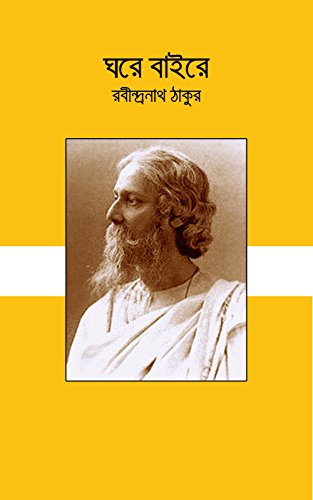
In his novel Ghare Baire (The Home and the World), we come across a criticism of extremist politics and jingoistic nationalism. A tripartite narrative about the growing political consciousness of Bimala, her failure to understand her liberal husband, Nikhilesh, a landlord and his friend Sandip, a fiery nationalist and a turbulent petrel, who storms the bastions of their household and marriage. Sandip’s brand of militant nationalism appeals to Bimala, who had once harboured feelings of inferiority because of her birth in an ordinary family, and who feels elevated and special under Sandip’s scrutiny. Sandip singles her out for special attention and calls her the “Queen Bee’’ and his muse and inspiration leading her to ignore Nikhilesh’s more mature and balanced views. Early in the novel, Nikhilesh who often functions as a mouthpiece for Tagore’s views in the novel, says that though he loves his country/nation, he cannot place nationalism over humanity. Reflecting Tagore’s views, which espouses internationalism and humanitarianism, Nikhilesh is not understood by his politically immature wife and ignored by his self-serving and unscrupulous friend.

Central to the formation of Tagore’s political views and suspicion about nationalism was his ideological debate with his own niece, his sister, the novelist Swarnalata Debi’s daughter, Sarala Debi Chaudhurani. A keen and fiery nationalist and patriot, Sarala was deeply impressed by the physical culture of imperial masculinities. She was particularly enthused/motivated by the concept of uplifting the nation through encouraging the growth of a physical culture. A statement that resonated with her was the idea of national character and she quotes lines from the ‘Educationist’:

“Physical weakness is a crime-against yourself and those who depend on you. Weaklings are despised and a weakling nation is doomed. The decline of ancient Greece and Rome which fell rapidly from the pinnacle of supreme civilization was due to physical neglect and abuse of the inflexible laws of nature. A physically weak nation is drained out mentally, its feet are on the downward path and it will end upon the scrap-heap if it does not act before it is too late.”

She also quotes a proverb which pronounces that the “battles of England are fought and won in the fields of Eton” (Chapter 18,129).  Her interest in and involvement with the politics of the freedom movement led her to initiate the celebration of Birashtami (festival of heroes to celebrate martial prowess, bravery and courage)) to mark courage and martial valour. Her belief in developing a physical culture and strengthening the national character made her revive certain traditions, re-invent rituals in order to paint a glorious version of India’s past. In doing so, she encouraged celebrations of Birashtami and invoked and revived the ‘braveheart’, Pratapditya, a landlord with questionable antecedents since he was also guilty of killing his father. In elevating such a figure to a status of a nationalist war-hero, she elicited mixed responses, particularly from her Brahmo family and her uncle, Rabindranath Tagore.

Rabindranath Tagore, among others, strongly objected to Sarala’s invocation of the figure of a parricide as a martial hero. Such a figure could act as a dangerous precedent since it would seem to encourage untrammeled and uncontrolled aggression and blur moral boundaries and ethical codes. This blunting of all moral and ethical codes and boundaries, the danger lurking in a militant and violent nationalism was, as indicated above, represented by Tagore in his novel, Ghare Baire but also in his essays on nationalism. In the novel, the conflict between a rational civic and humanitarian nationalism which eschews violence is embodied by the idealized figure of Nikhil and the primordial reactionary chauvinistic version of nationalism which endorses violence by his ‘friend’, Sandip. After casting a spell (metaphorically speaking) over the impressionable Bimala, whose affection he then misuses to drive a wedge between the couple and then to extract money from her to fund his terrorist activities.

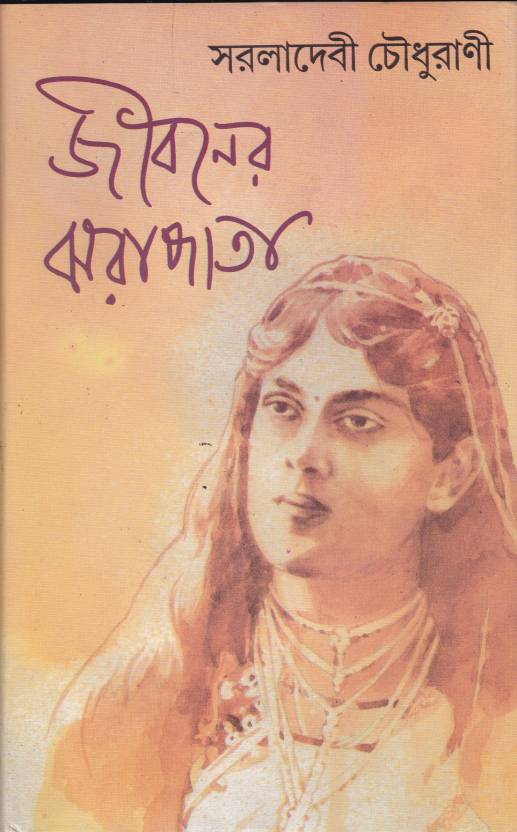
The Scattred Leaves of my Life By Saraladebi Chaudhurani

Rabindranath’s indictment of Sandip could be viewed as his response, a sort of extended debate and dialogue with an ideological viewpoint diametrically different from his own, which was represented by his niece.  The increasing rift and estrangement between the two — Rabindranath and Sarala — might explain the wistfulness and occasionally melancholic and autumnal tone of Jibaner Jharapata (The Scattered Leaves of My Life) Saraladebi’s autobiography. A proud and self-respecting person, Sarala was probably conscious of the slur or aspersion of effeminacy that the British had cast on the Bengali character. She felt the humiliation and indignity too keenly to accept such descriptions and attributions quietly.

Gandhi and the Crafting of Political Masculinity

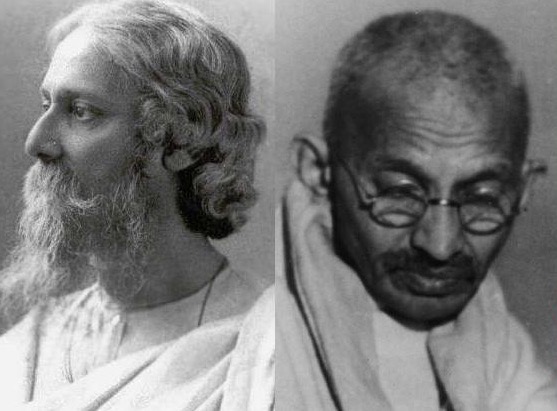
One common threadthat runs through the work and writings both these towering personalities of Tagore and Gandhi, is a critique of existing, culturally prescribed and sanctioned models of masculinity as they prevailed in the eastern (Tagore) and western (Gandhi) extremities of India. Both these great men, as public personages, were conscious that they were thought leaders and role models and that examples set by them would be emulated.

In the case of M.K. Gandhi(1869-1948), a great national leader who was instrumental in India’s throwing off the yoke of colonialism in 1947, there is a conscious experimentation with the “truth’’, presumably of one’s inner self, to oppose certain culturally sanctioned models of masculinity. Interestingly, his great-niece, Manu Gandhi referred to the ageing Gandhi as “Gandhiji, my mother” in her diaries, which were translated into English in 2019. When we focus on his corporeal politics, we see in Gandhi’s “experiments with truth” a series of experiments to do with the body which express both a consciously crafted gender ambivalence and throws a challenge to the concept of the manly body of the colonizer. Here my point is that Gandhi was consciously deploying his self, his body identity/ies and attendant subjectivities, in order to make a political point. He used his body and body-politics to establish his difference from the colonially attributed native body and also to mark his distance from colonial models of masculinity. While in one sense, this fluid body seems almost gender ambivalent, it is also an invitation to re-imagine and revision stereotypical notions of gender which circulate in cultures.

  Both of these thinkers were probably conscious of the import of the political masculinities espoused by them, particularly under the yoke of imperialism, at a specific historical conjuncture. This conjuncture is the first two decades of the twentieth century, when the models of masculinity available can be broadly conceptualized as imperial, colonial and ascetic masculinities.

The imperial masculinity model is based on the white imperial ‘master’, the civil servant, the ‘pukka saheb’, the kind extolled by Kipling and criticized by E. M.Forster. Coincidentally, this Kiplingesque masculinity, often caricatured, found its takers in people who extolled the muscular, strong masculinity of imperial cultures, like Sarala Debi, Tagore’s niece. The Forsterian view that the English public school culture shaped “well developed bodies, under-developed minds and undeveloped hearts’’ was not known to her, nor would it have found favour. This model also made its way into Indian discourses where it becomes linked with questions of national character and patriotism. In his book, The Intimate Enemy (1983) Ashis Nandy proffers the view that the Indian elite in the 19th century perceived the British as agents of progressive change and accepted the ethos of aggressive imperial masculinities.

According to historians and critics like Indira Chowdhury, Mrinalini Sinha and Chandrima Chakraborty, there was a developing discourse of de-masculinization and emasculation among the British, where they denigrated the Indian middle class and particularly the Bengali men as weak and effeminate and this also led some political leaders to move in the direction of defining and conscious crafting of alternative masculinities.    

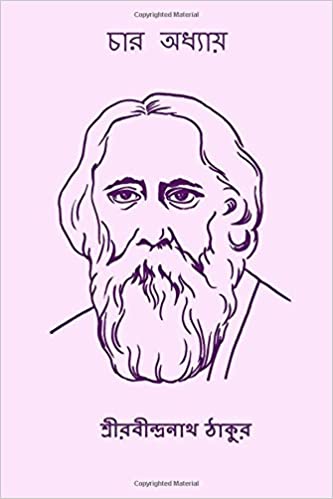
Four Chapters by Tagore

The third or ascetic model is available in Ananda Math by Bankim Chandra Chatterjee and Char Adhay ( Four Chapters, 1933), the last and thirteenth novel by Tagore along with real life characters such as Swami Vivekanand (1863-1902) and Sri Aurobindo (1872-1950), albeit delineated with some ambivalence. Chandrima Chakraborty in her book on Masculinity, Asceticism, Hinduism: Past and Present Imaginings of India (2011), highlights the “conjunctural alignment of asceticism and masculinity in Indian political history,” in order for its transformation into a strident symbol of Indian nationalism.

Interestingly, there is a further dimension and  addition to this narrative. Jibaner Jharapata is not the only source of Sarala’s life story. She is described in Rajmohan Gandhi’s biography as Gandhi’s “spiritual wife”, because he felt strongly drawn to her, seeing in her a woman who possessed a unique combination of education and emotional strength. To Gandhi, she was a woman whose love for the nation was equally strong as his, although it followed and developed along different trajectories. In a peculiar role-reversal, we find Sarala Debi, who spent her formative years in Tagore family mansion at Jorashanko, inverts the models of “colonized masculinity” to promote and propagate militant nationalism. Tagore and Gandhi, whose spheres of influence she existed in, do not seem to have brought about much of a change in her. The great men eschewed and turned away from existing models of masculinity and moved towards the crafting of new masculinities, drawing on asceticism and spiritualism to do so.

References

Chakraborty, Chandrima(2011)Masculinity, Asceticism, Hinduism: Past and Present Imaginings of India. Delhi: Permanent Black

Chattopadhyay, Bankimchandra, Anandamath or The Sacred Brotherhood.Trana Julius Lipner, New DelhiOUP

Chaudhurani, Sarala Debi(2007)Jibaner Jharapata, Calcutta, Dey’s Publishing.(Bengali) All references in the text are to this edition,with translations by the author of this paper

Gandhi, Rajmohan (2006) Mohandas: A True Story of a Man, his People and an Empire. New Delhi:Penguin/Viking.

Kumar, Radha (1993) The History of Doing: An Illustrated History of Doing. New Delhi, Kali for Women

Malhotra, Meenakshi (2018) A Dark Goddess for a Fallen World: Mapping Apocalypse in Some of Bankim C.Chatterjee’s Novels in Unveiling Desire: Fallen Women in Literature, Culture and Films of the East eds Devaleena das and Colette Morrow. New Brunswick: Rutgers University Press

Ray, Sangeeta (2000) En-Gendering the Nation: Women and nation in Colonial and Postcolonial Narratives Duke UP

Dr Meenakshi Malhotra is Associate Professor in English at Hansraj College, University of Delhi and has been involved in teaching and curriculum development at several universities. She has edited two books on Women and Lifewriting, Representing the Self and Claiming the I, in addition  to numerous published articles on gender and/in literature and feminist theory.

.

PLEASE NOTE: ARTICLES CAN ONLY BE REPRODUCED IN OTHER SITES WITH DUE ACKNOWLEDGEMENT TO BORDERLESS JOURNAL

Categories
Essay

When West meets East and Greatness blooms

Debraj Mookerjee explores how syncretism permeates between the West and the East — how the two lores do meet

Cultural influences travel at the speed of human imagination. In the modern world it is easy to plot the journey of cultural influences across the planet, thanks to the seamlessness created by communication technologies. The Internet links us all. But we also know cultural influences travelled through the globe since the earliest migration of humans.  We know the Chinese invented paper some 2,000 years ago. We know potato came to India from the new world through the Portuguese and became widely popular only around the 19th century. We know Marco Polo brought pasta from China to Italy. These are things we know. We also know because these are things. But along with things, ideas also travelled, as did poetry and song. Philosophy travelled, and ways of knowing and experiencing the world travelled. How many of us know for example that Ibn Rushid, an Andalusian of Arabic descent born in Islamic Cordoba, Spain, in 1126, translated Aristotelian philosophy into Arabic? Or the fact that these translations were further retranslated into Latin by Thomas Aquinas, a mediaeval scholar who was influenced by, though he differed strongly with, Ibn Rushid? Such is the power of ideas. Ideas are borderless. That is their power.

 In the context of the so-called East–West encounter, there are so many cross-cultural influences we are unaware of. Influences that travelled to and fro between the West and the East. India seeped into the cultural experiences of either of the two worlds. History and society can be viewed in many different ways. As E. M. Forster suggests in his essay ‘Art for Art’s Sake’, politics often invents a vocabulary that insists on differences; art on the other hand weaves patterns that merge into each other, producing beautiful new forms that emerge organically. 

Art and the philosophy surrounding it bring different cultures into play with each other. We will walk around some examples of such cross-fertilisation. And in the process, perhaps, expand the borders of our own minds and how we look at the world. I shall dwell on two such instances of cross-cultural influences. First, I shall look at Gandhi and the influences he shared with the West and the sharing of political ideas and philosophies they produced. I will explore the diverse trajectories his core ideas of non-violence and civil disobedience took in shaping up to what they eventually became, and even the influences they have had after him. I shall thereafter present Tagore and begin by looking at the shaping of his worldview as a thinker and as an artist, reading closely into his specific interactions with particular milieus in England. Finally, I shall look at Tagore iconic music (Rabindra Sangeet) and trace the influence Western (especially Welsh) music had on his works.

 “You can love a person dear to you with a human love, but an enemy can only be loved with divine love.”

“Let us forgive each other—only then will we live in peace.”

Who would you imagine might have spoken these words?

Gandhi? Almost, but not quite. These are Tolstoy’s words. Tolstoy was a writer, a philosopher and a religious thinker. Gandhi was particularly influenced by Tolstoy’s The Kingdom of God is Within You and his essay ‘Christianity and Patriotism’. Tolstoy’s ideal of “simplicity of life and purity of purpose” had a deep and abiding impact on Gandhi’s core thinking. In ‘Christianity and Patriotism’, Tolstoy writes: “Patriotism may have been a virtue in the ancient world when it compelled men to serve the highest idea of those days—the fatherland. But how can patriotism be a virtue in these days when it requires of men an ideal exactly opposite to that of our religion and morality—an admission not of the equality and fraternity of all men but of the dominance of one country or nations over all others? But not only is this sentiment no virtue in our times, but it is indubitably a vice; for this sentiment of patriotism cannot now exist, because there is neither material nor moral foundation for its conception.”

Gandhi had carried Tolstoy in his heart for the longest time. But shortly before Tolstoy passed  away in 1910, as Gandhi began the active phase of his fight for human rights for Indians in South Africa, and thereafter his struggle for India’s independence, he wrote to Tolstoy, prompted by the writer’s ‘Letter to a Hindoo’, in which he paves a path for freedom sans violence. The letter from Tolstoy was addressed to Tarak Nath Das, editor of Free Hindustan, who advocated the violent approach. 

Gandhi apprised Tolstoy about the Indians’ ‘passive resistance’ against racial oppression in Transvaal. He wrote (in October, 1909) that nearly half of the total Indian population of 13,000 in Transvaal had left Transvaal rather than submit to the degrading law, and “nearly 2,500 have for conscience’s sake allowed themselves to be imprisoned, some as many as five times”. Tolstoy’s letter explained why non-violent resistance and a resolve by Indians to become free were the only solution. Gandhi sought Tolstoy’s confirmation for his letter to Das and his approval to print 20,000 copies for distribution and having it translated to Indian languages. He had “taken the liberty” to write the letter “in the interests of truth, and in order to have your advice on problems the solution of which you have made your life-work”. Gandhi quoted Tolstoy thus, as he introduced his letter, when indeed it was widely distributed: “Do not resist evil, but also do not yourselves participate in evil: in the collection of taxes, and in the violent deeds of the law courts and (what is more important) the soldiers. Then, no one in the world will enslave you.”

But there is a bigger symmetry at work here than just the transfer of wisdom from Tolstoy to Gandhi. Thiruvalluvar was a legendary Tamil poet who lived sometime between the fourth and first century BCE. His work Thirukkural is an unparalleled treatise on ethics, communicated in verse. The first translation of the Thirukkural in a European language was done in Latin by Constanzo Beschi, a Jesuit Missionary, in 1730. Beschi himself was a Tamil scholar and poet, known as Viramamunivar. Tolstoy is said to have read a German translation of the work. And his ‘Letter to a Hindoo’ was apparently inspired by what he’d read in the Tamil saint-poet’s work.

 Around the time, Gandhi wrote an article, ‘Tolstoy’s Satyagraha’, showing how thousands, acting on his views “advising people not to obey the laws of the Russian Government, not to serve in the army, and so on”, were going to jail. Tolstoy’s writings, though proscribed, were being published, leading to the imprisonment of his agent. Tolstoy thought that “my views are true, and that it is my duty to propagate them”. Gandhi concluded: “True freedom is to be found—only in such a life. That is the kind of freedom we want to achieve in the Transvaal. If India were to achieve such freedom, that indeed would be swarajya.”

Gandhi had told Rev. J.J. Doke, his first biographer (1909): “It was the New Testament which really awakened me to the rightness and value of Passive Resistance. When I read in the Sermon on the Mount such passages as ‘Resist not him that is evil’, I was simply overjoyed, and found my own opinion confirmed when I least expected it. The Bhagavad Gita deepened the impression and Tolstoy’s The Kingdom of God Is Within You gave it a permanent form.”

When we imagine Gandhi, along with perhaps Asoka and the Prophet Muhammad, as among those historical figures who imagined society and politics through the prism of morality, we ought to know the influence of Tolstoy’s thoughts. Tolstoy thought of morality as a category that steps beyond politics. Gandhi could not afford that luxury. India needed freedom. So, he introduced morality into politics. 

Gandhi harvested patriotism through the principles of ahimsa and satyagraha —non-violence and truth force. The latter was the goal and the former the means. In these he drew influences from ancient Indian philosophy, and from thinkers like Tolstoy and the transcendentalists of America—more on the latter in a bit. So, we find a saint-like figure, a Russian aristocrat and also among the more celebrated writers of his time, conversing across time and space with one whom Churchill infamously labelled as the ‘Naked Fakir’, but who went on to become the Father of a Nation.

Beyond the influence of Tolstoy  — and we need to frame this in the context of the Cold War that was to commence soon after the assassination of Gandhi—the other major influence on Gandhi came from the United States of America. The transcendentalists were radical thinkers of the early 19th century who rejected organised traditional religious belief systems. They believed in the ‘oneself’ of the self and the universe. Ralph Waldo Emerson, thinker, poet, writer, philosopher, and the most famous of the transcendentalists, once wrote: “Within man is the soul of the whole; the wise silence; the universal beauty; to which every part and particle is equally related; the eternal ONE.”

Emerson took interest in Hindu texts thanks to his aunt Mary Moody. His idea of the over-soul, the universal oneness can be read as a derivative of the idea of Brahman —the singular force signified by the chant ‘Aum’. In this poem by Emerson entitled ‘Bhrama’, the oneness mentioned above is emphasised, as an idea subsumed in the concept of ‘Brahman’, which goes beyond this or that or even the specific injunctions of scripture:

 If the red slayer think he slays,
 Or if the slain think he is slain,
 They know not well the subtle ways
 I keep, and pass, and turn again.
  
 Far or forgot to me is near;
 Shadow and sunlight are the same;
 The vanished gods to me appear;
 And one to me are shame and fame.
  
 They reckon ill who leave me out;
 When me they fly, I am the wings;
 I am the doubter and the doubt,
 I am the hymn the Brahmin sings.
  
 The strong gods pine for my abode,
 And pine in vain the sacred Seven;
 But thou, meek lover of the good!
 Find me, and turn thy back on heaven. 

A contemporary of Emerson and one deeply influenced by him was Henry David Thoreau, who advocated both self-reliance and civil disobedience, elaborately discussed in his book, Walden Pond, which is an account of his experiments with asceticism. His practices were motivated by his encounter with yoga. Thoreau seldom was ecstatic. And yet he wrote: “What extracts from the Vedas I have read fall on me like light of a higher and purer luminary, which describes a loftier course through a purer stratum, free from particulars, simple, universal.” 

He was fond of quoting from the Bhagavad Gita, as was Gandhi. Gandhi was significantly influenced by Thoreau’s experiments and ideas. Gandhi, to correct the misperceptions (thanks to the British media) in the American mind about the Indian freedom struggle, wrote a letter (on October 3rd, 1942, while travelling to Bombay from Wardha, where the Congress had just held a session in which it had urged the British to withdraw from India in the interest of the Allied cause) that was to be sent via the India league, ‘To American Friends’. He wrote, very cleverly invoking Thoreau to buttress India’s cause (having already written separately to Roosevelt on the issue): “You have given me a teacher in Thoreau, who furnished me through his essay on the ‘Duty of Civil Disobedience’ scientific confirmation of what I was doing in South Africa”. 

At the Second Round Table Conference in London in 1931, the American reporter Webb Miller, a long-time admirer of Thoreau, asked Gandhi, “Did you ever read an American named Henry D. Thoreau?” Gandhi replied: “Why, of course I read Thoreau. I read Walden first in Johannesburg in South Africa in 1906 and his ideas influenced me greatly. I adopted some of them and recommended the study of Thoreau to all my friends who were helping me in the cause of Indian independence. Why, I actually took the name of my movement from Thoreau’s essay, ‘On the Duty of Civil Disobedience,’ written about eighty years ago.” 

Miller noticed that Gandhi, a ‘Hindu mystic’, adopted from Thoreau the philosophy which was to affect millions of Indians and inspire them to defy the powerful British Empire. “It would seem,” Miller concluded, “that Gandhi received back from America what was fundamentally the philosophy of India after it had been distilled and crystallised in the mind of Thoreau.”  

The back and forth does not end here. We all know how Martin Luther King Jr was influenced by Gandhi. He once wrote, “While the Montgomery boycott was going on, India’s Gandhi was the guiding light of our technique of nonviolent social change.”

So ancient Indian philosophy influenced the transcendentalists. The transcendentalists influenced Gandhi. And Gandhi went on to influence Martin Luther King Jr Kipling might have written that “East is east, and the West is West. And ne’er the twain shall meet”, at the cost of sounding frivolous, perhaps he had not read Walt Whitman’s famous poem, ‘A passage to India’.

Gandhi and Tagore were in conversation in the deepest sense of the term, both captured by the tight frame of history, yet never ever contained by it. It is apposite, therefore, to try and capture within the rubric of the larger argument, the influences and intellectual trajectories of both Gandhi and Tagore. Tagore, India’s iconic poet, the first non-European to receive a Nobel Prize, who travelled to England in 1912 clutching a collection of 103 self-translated English poems, became a world phenomenon in a little more than a year. Though Tagore is revered among Bengalis and indeed all Indians as ‘Kobi guru’ (Poet Guru, as it were), his development as an artist was syncretic. 

As a young boy, he spent a month in Amritsar with his father and was greatly impressed by the devotional songs sung inside the Golden Temple, with his father often joining in. While a landlord in East Bengal during the 1890s he became familiar with the great baul tradition of Lalon Shah. He absorbed Western influences, especially in his poetry, but also influences as diverse as the paintings of specific communities in islands as far-flung as New Ireland in Papua New Guinea! Tagore took to painting later in age and was never quite sure of his own work, but they have a magical haunting quality that is all too difficult to pin onto a singular culture.  

One of the first persons whom Tagore wanted to meet and know about in London was Stopford A Brooke[4]. Tagore, being a prominent member of the Brahmo Samaj, which was closely allied to Unitarianism, had heard so much of him, and had perceived an alignment of convictions. Sir William Rothenstein,in his account of Tagore’s days in London, says, “Stopford Brooke asked me to bring Tagore to Manchester Square; ‘but tell him’, he said, ‘that I am not a spiritual man’.” 

Soon Tagore would become quite the toast of young poets, who would seek him out, Ezra Pound being prominent among them. Among others whom Tagore met were Shaw, Wells, Galsworthy, Andrew Bradley, Sturge Moore and Robert Bridges. In a 1915 letter to Robert Bridges, Tagore wrote, “I know what this war is to you… Please let Mrs. Bridges accept my heartfelt sympathy and reverence [for one] whose son is fighting for the cause of liberty in one of the greatest wars in the history of mankind.” Bridges included Tagore’s poems in his anthology The Spirit of Man in 1915. On his part, Tagore was struck by the breadth of view and the rapidity of thought that he found among his new friends. Rothenstein recounts that while addressing his English audience, Tagore said, “Those who know the English only in India, do not know Englishmen … All you people live, think and talk while a strong, critical light is constantly focussed on you. This creates a high social civilisation. We in India, on the contrary, live secluded among a crowd of relations. Things are done and said within the family circle which would not be tolerated outside; and this keeps our social standards low.” 

Tagore famous novel, Ghare Baire (Home and the World, 1916; trans. 1919) presents his disquiet with insular nationalist sentiments, to the exclusion (of what he believed) larger humanist imperatives. His protagonist, Nikhil articulates liberal universal values and is willing to sacrifice his life to ensure peace in his domain (he is a landlord). His fiery friend, the nation- (as mother) worshipping ultra-nationalist radical Sandeep, stokes the violence that ultimately consumes Nikhil, but from which he himself stealthily slinks away.

Tagore absorbed more than just ideas from the West. His music, especially the scores of many of his songs, was influenced by his interactions with the West. On his 2012 visit, he’d heard the music hall songs and folk tunes that he later incorporated into his distinctive musical genre, Rabindra Sangeet. As a child, he’d heard his siblings play myriad instruments. His older brother Jyotirindranath, significantly, played the piano and violin. From him, Tagore developed an early ear for Western musical lilts. Lively English, Irish and Scottish folk tunes impressed Tagore, whose own tradition of Brahmo hymnody was subdued. Tagore confesses: “At seventeen, when I first came to Europe, I came to know it intimately, but even before that time I had heard European music in our own household. I had heard the music of Chopin and others at an early age.”

Of particular note is Robert Burns, whose poetry and music were quite widely known in metropolitan Bengal. His work was particularly popular with Bengali students in the early days of Hindu College (now Presidency University), Calcutta (Kolkata now). The Scottish missionary to India, Alexander Duff, remembers students in Henry Derozio’s (poet and assistant headmaster of Hindu College) discussion group reciting Burns’s poetry and singing his democratic anthem ‘A man’s a man for a’ that’. Two of Burns’s sons served for many years in the Company army, and one of them, James Glencairn Burns, was later appointed judge and collector of Cachar (in Assam), and became an expert in Hindi, instructing company cadets in the language on his return to England in 1839. Burns’s songs pervaded 19th century British India and were well known to many Indians: Rabindranath Tagore adapted at least three of them and set musical scores to the Bengali versions of the original melodies.

Tagore created one of his most popular songs, ‘Purano shei deener katha,’ on the model of the old Scottish folk song collected by Robert Burns: ‘Auld lang syne’ (1788). Whereas the Scottish is in dialect, its Bengali counterpart in the standard tongue. There can be no literal translation in songs transcreated, as it were in a different language, since the nature of the two languages is different. And yet, there are great similarities between the songs. The original communicates the eternal sentiment of nostalgia for old friends, memories of good times and longing to revive the same. Tagore communicates the same basic sentiment. One should remember that even though Tagore adapts the tune of the Western songs, he very often varies the tempo and the rhythm to suit his own creative needs. The mention of ‘dola’ (swing), ‘banshi’ (flute) and ‘bokuler tolay’ (beneath the bokul tree) introduces interesting indigenous cultural symbols. These words introduce the concept of the god Krishna and his worldly amour divesting them of both divine and erotic connotation. The Bengali song stands as an eternal paean to reunion of friends of all categories.

Tagore’s ‘Phule phule dhole dhole’ is a transcreation of Burns’ ‘Ye banks and braes of bonny Doon’ (1792), the tune of which is based on ‘The Caledonian Hunt’s delight’. The first four lines of Tagore’s song evoke faint sweet breezes, rippling gurgling stream, cuckoo song and an undefined longing. It is close to the mood of the ‘Ye banks and braes’, though more mystic and abstract. In Burns’ original version, the nostalgia and longing are rooted in unfulfilled love. In the Bengali translation, there is no hint of narrative though the narrative is obviated when sung in its proper context. Sung independently, it appears as a universal romantic desire for an unattainable ‘something’, intensified by the beauty of nature. 

But Burns was not the only one to influence Tagore’s music.  In 1885, much before his heydays, Tagore composed ‘Kotobar bhebechhilnu’, using the tune of Ben Jonson’s ‘Drink to me only with thine eyes’. The tune of the original English song is adapted to his original Bengali lyrics. Tagore’s song raises interesting cultural issues. The words are radically different, though the mood of love is dominant in both, the English song is much more sensuous, redolent of physical and Petrarchan appeal. Tagore’s Indianisation is romantic, idealistic and self-effacing, but with a witty twist in the last two lines: “Now that you yourself have come to ask me/ How can I explain how much I love you?” Another Irish folk song that inspired Tagore was ‘Go where glory waits thee’ (1807), which was anothologised by Thomas Moore (1779–1852) and based on ‘Maid of the Valley’. Tagore’s songs ‘Ohe Dayamoy’ and ‘Aha aji e basante’ are based on these two originals. 

There is a general consensus that Western and Indian songs are essentially different in that in the former the rhythm may change many times within the same song, while it remains the same in most Indian songs. Tagore nevertheless finds the change of rhythms ideally suited to express different facets of feeling (see Tagore’s essay ‘Sangeet o Bhab’). One cannot be entirely sure as to the exact source of his musical preference, whether it came from Western music, or even from his ear for kirtan (popular Bengal devotional music associated with the Vaishnavite tradition). But what is certain is that his music comes from a syncretic imagination, which was able to discern beauty and form beyond the restrictions of nation and culture.  

Both Gandhi and Tagore were closely allied to the cause of India’s independence from colonial rule, and they were, therefore required to shape their thoughts and philosophy to serve certain political ends. Notwithstanding this monumental obligation that history chose to rest on their ever-exploring minds, they strove for an imaginative space “Where the world has not been broken up into fragments / By narrow domestic walls.” Both were deeply devoted to the idea of the Indian nation, but not by having to pay the price of a severed humanity. Most significantly they filtered ideas from great minds from around the world, allowing themselves to be suffused by the thoughts of distant thinkers, while also imbuing those thoughts with the inflection of their own greatness. Reading Einstein’s conversations with Tagore, you realise two things. Small things can separate small minds. When it comes to truly big minds, there is little that can separate them.

Debraj Mookerjee has taught literature at the University of Delhi for close to thirty years. He claims he never gets bored. Ever. And that is his highest skill in life. No moment for him is not worth the while. He embraces life and allows life to embrace him.

.

PLEASE NOTE: ARTICLES CAN ONLY BE REPRODUCED IN OTHER SITES WITH DUE ACKNOWLEDGEMENT TO BORDERLESS JOURNAL. 

Categories
Editorial

The Heart of Non-violence

“God is Truth”

That is what Gandhi believed and this month, we celebrate this soul who would have loved a world without borders but was forced to be part of drawing boundaries that still lead to violent dissensions and bloodshed. Gandhi himself dissented but with non-violence.

This I understood well when I completed reading My Experiments with Truth from cover to cover. In the process, I uncovered a man who despite his idiosyncrasies had a lot to offer the world — his outlook and his persistence, his organisational skills, his ability to analyse a solution, his ability to forgive, his presence of mind.

I wonder how many of us understand his ultimate weapons Satyagraha, action based on truth, and ahimsa or non-violence. Is that why often our protests are ineffective as opposed to his protests, only some of his worked in his estimation, like the ones in South Africa? Because people listened and learnt his system. But what happened in India? Bapu’s autobiography cleared up much for me, though only a small portion of the book is devoted to his life in India. He was in South Africa for twenty-one years. I, perhaps, have understood a bit on what he said about protest, about a practitioner of Satyagraha, a Satyagrahi:

“A Satyagrahi obeys the laws of society intelligently and off his own free will, because he considers it to be his sacred duty to do so. It is only when a person has thus obeyed the laws of society scrupulously that he is in a position to judge as to which particular rules are good and just which are unjust and iniquitous. Only then does the right accrue to him to the civil disobedience of certain laws in well-defined circumstances. My error lay in my failure to observe this necessary limitation. I had called on the people to launch upon civil disobedience before they had does qualified themselves for it, and this mistake seem to me of Himalayan magnitude.”

(An Autobiography or My Experiments with Truth, Penguin, Pg423)

Gandhi realised his error and withdrew civil disobedience. But I wonder if every protester across the world understands this definition or accrues more to Malcolm X’s school of getting one’s way by “any means necessary”, a reflection that I borrow from the interview of the writer who wrote Gandhi’s life in ballad form, Santosh Bakaya. The other interview we are carrying is of a journalist who upholds the truth — perhaps someone who Gandhi might have admired, like he did Mrs Besant or Gangaben Majumdar (the woman who helped him realise his dream of Khadi) — Teresa Rehman. An award-winning media person, she has spoken of her journey as a “reporter” or a “chronicler” of people’s lives.

This month we had given a call for writings on Gandhi and humour. Some of the responses were a pleasantly surprised. It was amazing to have a surprise essay from New Zealand by Keith Lyons. I only understood what an impact Bapu has had all over the world after reading Lyons’s essay. This time our essay section is filled with writing on Gandhi — Rakhi Dalal’s essay on the relevance of Gandhian values in the present context and Dustin Pickering’s essay, again on My Experiments with Truth, Gandhi’s autobiography. He has even managed to apply some of Gandhi’s outlook to American politics.

Pickering has also given us a spoof on Trump in the future, which brings a smile to your lips as does Bakaya’s spoof on Gandhi and Martin Luther King Jr in Heaven. We have lot of stories this time, flash fiction and otherwise, few exhibiting Gandhian values. Our fiction columnist, Sunil Sharma has given us a story that revolves around finding the creator of Alice. Also centring around the theme of Alice’s Wonderland is a review we carry on a translation by Arunava Sinha of Sukumar Ray’s Haw Jaw Bo Ro Lo ( Habber Jabber’s Law in English) by an academic who has worked on Bengali Children’s literature, Nivedita Sen.

The other reviews are that of Bhaskar Parichha — essays brought out on Gandhi as part of his sesquicentennial celebrations last year — and Moiank Dutta, who has given a glowing review of Bakaya’s the Ballad of Bapu. Debraj Mookerjee has reviewed a book called India Dissents and has identified Gandhi as the giant of all dissenters. Here is what he says, and I do not think I could have said it better: “He (Gandhi) was a devout Hindu who was secular to a fault, and against the evils inherent in Hindu society. It is precisely because of this that Gandhi was so successful in mobilising India both politically and socially.”

Varied thoughts on a man who is a major contributor to world change, thought and philosophy with his simplicity and stubbornness have been captured in Borderless this month.

We have a couple of musings on Bapu too, including one which attempts to bridge gaps between the different ‘castes’ in New Delhi.

Our columnist, Devraj Singh Kalsi, has given us his trademark poignant cum humorous non-fiction down the memory lane. Veering more towards humour is our book excerpt of Rhys Hughes new book, Corybantic Fulgours. Do pause by to see what this humorist has to say on evolving a new form of artistic expression, that started out with a doodle any one of us could attempt but leads up to an impossibly named book! More humour in verse has been provided by Mauritian poet, Vatsala Radhakeesoon. We are absolutely delighted that she and Hughes have agreed to contribute humour to Borderless on a monthly basis.

Poetry has an interesting collection this time with three Korean poets, mouthing values that sound like those of Tagore and Gandhi! We also have poetry on and around Gandhi. A poem in which the very well-known Nabina Das reflects on the universality of Shaheen Bagh in being a meeting ground for all believers in democracy would have almost been Gandhian in intent but is it? I leave you to decide for yourself.

Sara’s Selections for young people has a range from butterflies to Gandhi, thanks to Nidhi Mishra and Archana Mohan of Bookosmia. They gave a call for young people to write on Gandhian values too and some of the pieces have been amazing.

Our translations this month have housed a pièce de résistance — Saratchandra’s short story, ‘Abhagi’s Heaven’, translated by no less than Akademi Award winner, Aruna Chakravarti. And we have Fazal Baloch with a translated story from Balochistan. The interesting feature we have had in translations is that two poets from Nepal and Kashmir have translated their own poetry in their respective languages to English! 

I leave you all now to discover for yourselves the rest of the magic provided by writers and I thank you all contributors and readers for making Borderless a part of your lives and thoughts!

Wish you happiness and sunshine always!

Mitali Chakravarty

Borderless Journal