Categories
Notes from Japan

One Thousand Year Story in the Middle of Shikoku

Photographs and Narrative by Suzanne Kamata

I’d wanted to go on the Shikoku Mannaka Sennen Monogatari (One Thousand Year Story in the Middle of Shikoku) train trip ever since I saw it advertised on a poster in the window of Tokushima Station. When I investigated, however, I discovered one couldn’t begin the journey in Tokushima, where I live. Although it starts (or ends, depending on which way you’re coming from; it’s a one-way trip) deep in the mountains of Tokushima, I would have to change trains a few times before boarding the special sightseeing train. It would take hours to get there. A better way would be to board in Tadotsu, which is in the neighboring prefecture Kagawa. I could drive there in a little over an hour, take the fancy train to Oboke, and return by express train.

I decided to take a ride on the spur of the moment. The train was pretty much booked for the rest of the season, at least on the days when I didn’t have other plans, like my job. I did find one last seat on a train in mid-November. It might have been more fun to go with someone else, but I didn’t have time to coordinate with friends. I immediately booked the seat, reserving my lunch as well.

The morning of my train trip was chilly, but sunny. I donned a thin tunic and a long cardigan, wondering if it would be cold in the mountains. Maybe I should bring my down jacket? I rolled up a windbreaker and stuffed it into my backpack. I entered my destination – Tadotsu Station – into my phone’s navigation app, selected a podcast for the drive, and set off.

Tadotsu turned out to be a sleepy little town, which makes sense. These are the kinds of places that need something special to attract visitors and their money. If the whole purpose of these sightseeing trains is to rejuvenate dying towns, then Tadotsu seemed like a good choice. I could see that some construction was in progress, perhaps to accommodate the hordes of new visitors brought by the train. Porta potties temporarily served as bathrooms.
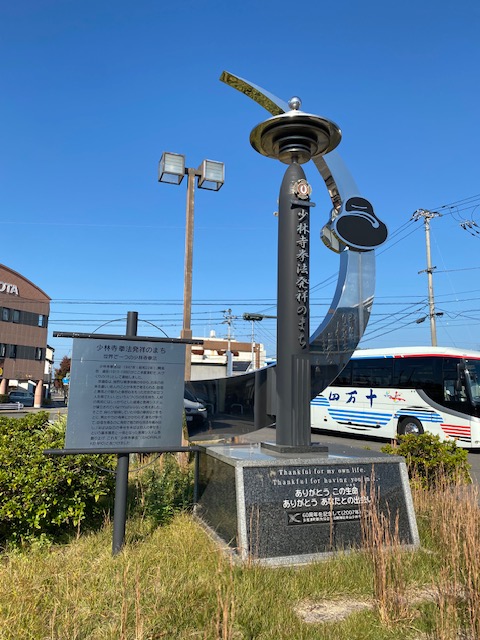
In front of the station, an intriguing sculpture attracted my attention. To me, it looked like a tall armless man wearing a hat, backed by a sickle. There was an emblem like a coat of arms where the neck of the man would be. At the base of the sculpture was a plaque with the words: “Thankful for my own life. Thankful for having you in it.”

Later, I discovered that it was meant to commemorate Doshin So, nee Michiomi Nakano, a former military intelligence agent who spent many years in China. After returning to Japan, he was stationed in Tadotsu, where he established a cram school to teach Buddhist philosophy and martial arts.

In 1947, he founded Shorinji Kenpo, a Japanese martial art with a holistic system. The training methods are divided into self-defense training, mental training, and health training. According to his philosophy, spirit and body are as one, and they must be trained together as such. His teachings emanated from this small town of about 20,000 people to the rest of the world. The emblem, as it turned out, was the symbol for Shorinji Kenpo.

I took a photo of the monument and proceeded to the train platform, where I was met with heavy equipment surrounded by a chain link fence. A sign apologised for this inconvenience, and explained that construction was underway to make the station barrier-free.

I was twenty minutes early, but my fellow passengers – Japanese, as far as I could tell – were already milling about, taking selfies and photos of each other in advance of their train trip. The group was mostly female, middle-aged, and older. Many people were wearing masks.

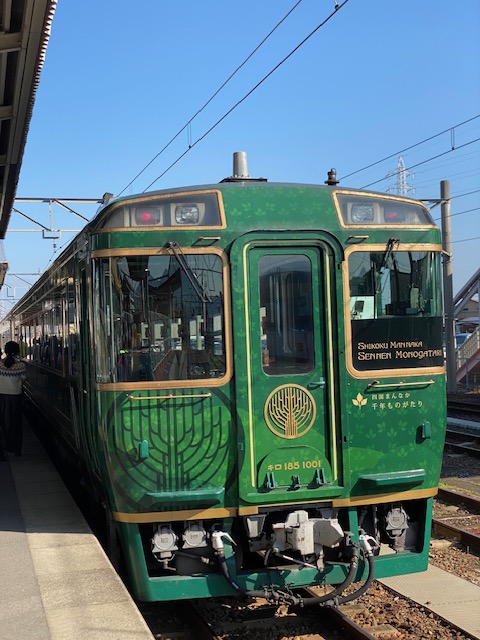
A cinematic melody heralded the approach of the train, accompanied by another rush for selfies and photos. The three cars, all different colors, were named after spring, summer, and fall. What happened to winter? A small doormat with the train’s motif, which resembled a stylized tree, was positioned on the platform at the entrance to the train. I boarded the green “spring” car, Haru Akari, and found my seat, a fuzzy green upholstered chair at a table against the wall, facing the window. The two seats next to me were unoccupied.

Most people wore casual clothes. I rarely saw folks from Tokushima get dressed up, unless it was for a wedding, say, or a graduation ceremony. One woman at the four-top on the other side of me was striking in a sumptuous Chinese-style jacket and gold barrettes. I wondered for a moment if she might be some kind of celebrity. I tried not to stare.

I examined the orange cloth placemat, again with the tree motif. Already my mouth was watering. Disposable chopsticks and a wet napkin were aligned at the bottom, while a spoon rested on a rectangle of granite. Paper napkins, toothpicks, and creamers were tucked into a small basket made of vines. Brochures detailing the train’s route, souvenirs for purchase, and additional menu items were laid out.

You could use your phone to scan a QR code and order keychains, sweet potato cakes, or a yusan-bako, a traditional lunch box which originated in Tokushima. This one was made of Japanese cypress adorned with Kagawa lacquerware. It had three drawers for various delicacies, which fit into a box with a handle, perfect for toting to a picnic in a meadow somewhere. You could also buy a CD with the train’s theme song.

I had already ordered my lunch, but I glanced at the menu anyway. Fish cutlets, another specialty of Tokushima were available, along with bamboo shoots, and ice cream made with sake lees. The sweet potato crumble, with a dollop of whipped cream, was also tempting, but I summoned my willpower.

One of the uniformed attendants pointed out the wooden box under my car for storing my backpack and purse. I got those items out of the way. She also handed me a coupon for soup and water to be redeemed at our first stop. And then finally, the train began to move. A whistle blew. Japan Railway employees and others lined up with flags and round paper fans and began waving at us. We all waved back.

After that enthusiastic send-off, the train began to trundle along the tracks, picking up speed as we zipped past backyards of houses, apartment buildings with laundry hanging on balconies, convenience stores, crows alighting on power lines, an empty playground. We passed rice paddies, some surrounding family gravestones; a construction site with bright blue, green, and yellow earth moving machines.

As we neared Kotohira Station, our first stop, a young woman chirped that Kotohira’s brass band had been declared second best in the country. She reminded us to redeem our coupons in the welcome center. After the train had stopped, I followed everyone into a small room adjacent to the station where we lined up at a counter. I handed over my little piece of paper and received a bottle of water and a small China cup of kabocha 1potage. I perched on the padded bench to drink it, while gazing around at the proud display of photos of the award-winning high school band. A white-gloved attendant came around with a tray to collect my empty cup, and I got back on the train.

A young Chinese family – a couple and their plump baby – were now occupying the seats beside me. The train moved on. The view outside my window was now more expansive – terraced fields, occasional houses with tiled roofs and walled gardens, tufts of pampas grass, a patch of pink and magenta cosmos.

The voice announced that we were nearing Sanuki Saida Station, which boasts a 700-year-old tabunoki tree, said to be a “power spot.” Apparently if you stand under the tree, you can absorb some of its spirit and energy. The tree has also been designated a Kagawa Prefectural Protected Tree. The train came to a stop again, but this time we didn’t get off. Instead, we all whipped out our smartphones to take photos of the person dressed in a polar bear costume shooting soap bubbles from a bubble gun. The baby was delighted.

Once we were again underway, the attendant distributed large square bento boxes with gold-rimmed lids. I opened mine to find an array of chilled meat dishes – the first course. I unsheathed my disposable chopsticks and broke them apart. “Itadakimasu!2

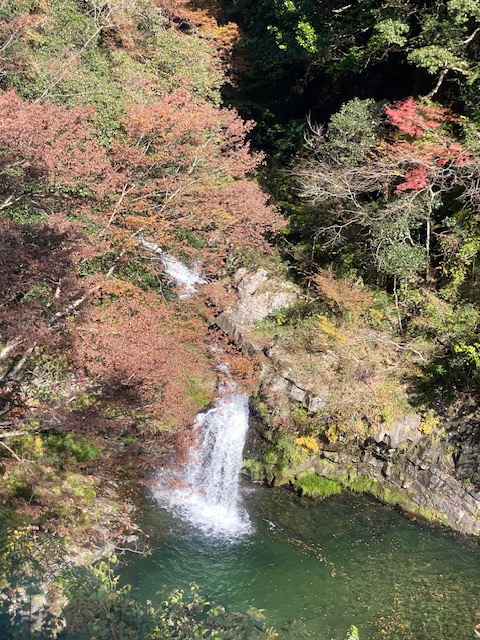
Out the window, farmland had given way to gnarly brush. `Although the foliage wasn’t quite at its peak, swatches of scarlet and gold popped against the greenery. I wondered about the wildlife in the mountains. I knew that there were monkeys, boars, and deer. The latter two appeared on menus deep in the interior of Shikoku. You could get a burger made with game meat, or “peony hot pot,” in which thin slices of pink boar meat curled up like flower petals after being cooked in miso broth.

Next to me, the young parents passed their good-natured baby back and forth. When I caught his eye, I smiled at him, and he showed his dimples, smiling back. I remembered how, when I had first come to Japan, whenever I had tried to engage with a stranger’s baby on the train, the baby’s face had crumpled up in terror. Apparently, big-nosed foreigners were scary even for infants. At least back then. It was nice to be able to engage with a small child without causing tears.

We made a brief stop at Tsubojiri Station, a small, unmanned station accessible only by switchback, surrounded by trees. “You can get off the train and smoke,” the voice announced. We all scampered off the train, but I didn’t see anyone light up a cigarette. Instead, passengers posed in front of the station’s sign and the weathered wooden building.

Back on the train, the next course was served – buttered rice and pork, arranged on a gold-rimmed China plate. The narration continued. “Please look to the right. You will be able to see Mount Hashikura. You can take a ropeway to Hashikura Temple, which was established by the famous Buddhist monk Kukai, also known as Kobo Daishi.”

Kobo Daishi is known as the father of Shikoku’s 88-Temple Pilgrimage. Hashikura Temple is not one of the 88, but is considered to be an associated temple. According to the Tourism Shikoku website, the name “Hashikuraji” contains the character for “hashi,” or chopsticks, “an everyday unifying ubiquitous tool of daily life for all Japanese. In 828 [CE], Konpira Daigongen revealed himself to the priest Kukai and promised to save all who use chopsticks, a pledge of salvation for all.”

According to an announcement, we would soon have a good view of the Yoshino River, the majestic “wild” river which runs west to east across Shikoku. Its rushing waters carved out the Oboke Gorge over millennia. This river flows 121 miles, past Tokushima City, and the house where I live, and into the Kii Channel. At one time, it flooded repeatedly. The “Tora-no-Mizu” (“Tiger’s Water”) flood of 1886 (Year of the Tiger), one of the worst floods in Japanese history, led to the deaths of an estimated 30,000 people. Now, however, strong levees keep the waters in check, though heavy rains can still shut down the roads nearest the river. These days, the Yoshino River is more known as a place where visitors can enjoy various forms of recreation including swimming, fishing, and white-water rafting.
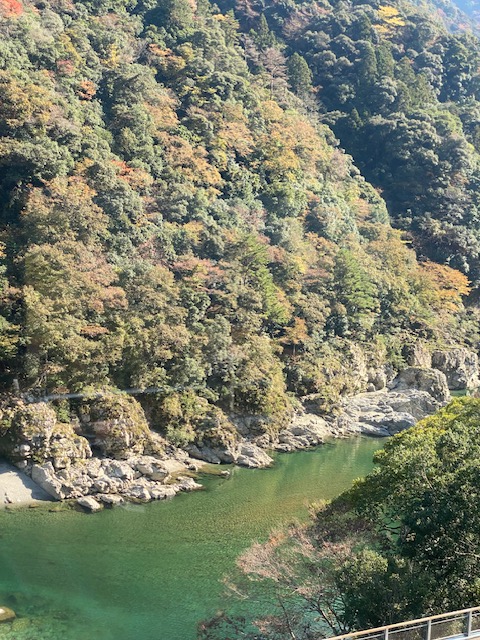
As I gazed out at the glassy emerald waters, which reflected the rocky banks, the voice announced that we were approaching Awa-Ikeda. High school baseball, I thought. Sure enough, the voice told us that we would soon have a view of baseball players practicing at Ikeda High School’s diamond, and that they had once won the National High School Baseball Tournament at Koshien.

The train chugged on. We passed another station, Awa Kawaguchi, where another person in a polar bear suit filled the air with soap bubbles. A sign on the platform declared that this was a town where tanuki (an indigenous animal that is often called raccoon-dog, and is a notorious trickster in Japanese folklore) and people live together.

After traversing another tunnel, coffee was served with a petite madeleine. Outside the window, I could see the water rushing through the gorge, frothing over rocks. We were almost at the end of our thousand-year journey. It had lasted a little over two hours.

The train pulled into Oboke Station, in the town of Miyoshi, and we got off. We were greeted by a man wearing a woven peaked hat and happi coat, banging on a drum affixed with characters from the animated series Anpanman. Although my fellow travelers had been mostly Japanese, quite a few European and American tourists were milling around the station, perhaps waiting for transportation.

At the time I first visited, over thirty years ago, I recall no restaurants or hotels, but now there was a large roadside station with souvenir shops, food vendors, and a Yokai House. There was even yokai3-themed food. Some traditional houses have been refurbished as high-end inns.

I took a short walk around the area and then attempted to buy a return ticket on an express train. Although the station was now geared for tourists with English signage and souvenir shops, it was still old-fashioned in many ways. I realised it wasn’t equipped to deal with phone apps or credit cards. I hadn’t brought a lot of cash, but I had just enough to buy a ticket back to my starting point.

  1. A variety of winter squash ↩︎
  2. I humbly receive (feel grateful for the food) ↩︎
  3. A spirit having supernatural powers ↩︎

Suzanne Kamata was born and raised in Grand Haven, Michigan. She now lives in Japan with her husband and two children. Her short stories, essays, articles and book reviews have appeared in over 100 publications. Her work has been nominated for the Pushcart Prize five times, and received a Special Mention in 2006. She is also a two-time winner of the All Nippon Airways/Wingspan Fiction Contest, winner of the Paris Book Festival, and winner of a SCBWI Magazine Merit Award.

PLEASE NOTE: ARTICLES CAN ONLY BE REPRODUCED IN OTHER SITES WITH DUE ACKNOWLEDGEMENT TO BORDERLESS JOURNAL

Click here to access the Borderless anthology, Monalisa No Longer Smiles

Click here to access Monalisa No Longer Smiles on Amazon International
Categories
Review

To Lhasa, with Love

Book Review by Somdatta Mandal

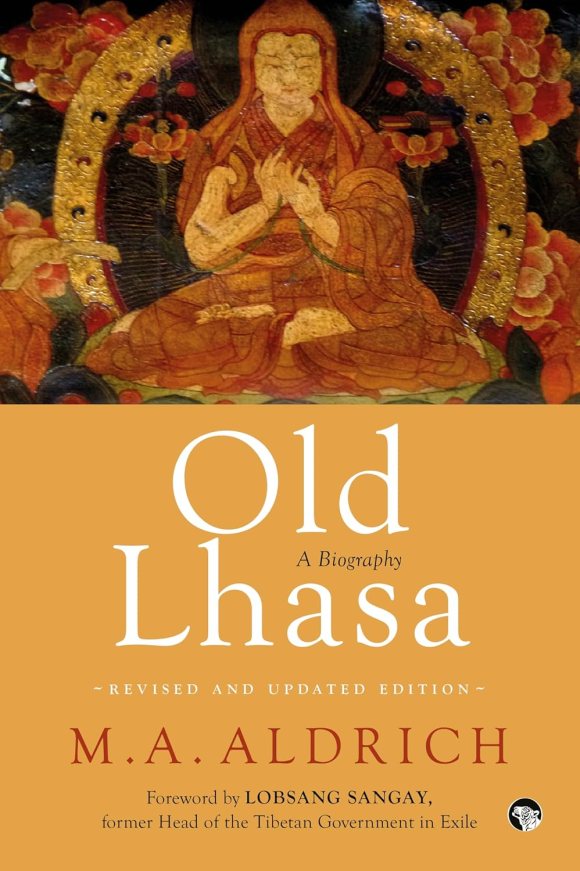
Title: Old Lhasa: A Biography

Author: M.A. Aldrich

Publisher: Speaking Tiger Book

“Contrary to common perceptions, Lhasa is not forbidden to outsiders” – M.A.Aldrich

Old Lhasa: A Biography, (a revised edition published in 2025 for the South Asian market of a book originally published in 2023), is a voluminous 615-page book that combines historical research, travel writing, religion, and culture to offer a comprehensive account of Lhasa, the capital city of Tibet. The author, M. A. Aldrich, is a lawyer who has lived and worked in Asia since the 1990s and had earlier published books on cities like Peking and Ulaanbaatar. Written on the basis of his multiple trips to Lhasa and its surroundings (the last one as late as September 2024), he is happy to discover that Old Lhasa has stood the test of time and still accurately captures the sight, sounds, and feelings of the city and foreigners can wander about freely without a minder so long as their papers are in order. As this book slowly emerged, it grew into both a portrait of the history and culture of that city as well as a serviceable guidebook for readers who are able to go to Tibet when political and regulatory circumstances permit.

Aldrich paints an intricate portrait of Lhasa, a storied city and its history, by giving us the evolution of how the Tibetan script came to be, with inspiration from ancient India and at the same time livens up the narrative with humorous anecdotes, interesting legends and charming fables that makes this book blend many genres into one. Divided into 49 chapters and enriched with several maps and black and white photographs, the chronological narration rightfully begins with the first chapter titled ‘Prelude to Lhasa’ where we are told that with Lhasa as the geographical focal point of their faith, Tibetans believe the dharma[1] has always been connected to their country. He begins the journey in the seventh century during the final moments of the life of Buddha, mentions specific Buddhist virtues such as compassion, wisdom, and benevolent power, among other essential qualities for the path to awakening. For Tibetan followers of the dharma, the history of Tibet is the history of the Bodhisattva of Compassion, which is simultaneously woven into the story of Lhasa.

In the 1920s, when Tibet enjoyed its greatest freedom from outside interference in the modern era, Lhasa had a population of only around twenty-five thousand. It was divided into two districts: one that is now the Old Town, with its seventh-century Jokhang Temple (or, more simply, the “Jokhang,” meaning the “House of the Lord”) at its centre; and the other being Shol Village, which is at the foot of Marpo Ri (Red Mountain). These administrative districts were divided by a north-south boundary that ran through the Turquoise Bridge, another structure dating to the seventh century. The Old Town was not much larger than two- or three-square kilometers, while Shol was even tinier. The residents of Lhasa at that time took immense pride in the religious heritage of their city. Nearly every luminary in Tibetan history had come to Lhasa because of the importance of the Jokhang as the focal point from which Tibetan civilization evolved and expanded. No other city could rival it.

Lhasa grew organically outward in concentric circles. Around 1160, a monk built the Nangkhor, a pilgrim’s circuit (korlam) directly adjacent to the inner sanctum of the Jokhang, so that devotees could practice the religious ritual of circumambulation. It is from this kernel that the boundaries of Old Lhasa came into existence. By the 14th century, Lhasa was enclosed within the Barkhor, a kilometre-long korlam circling the temple and a monastery among other buildings. By the 1650s, Lhasa’s outer limits had been expanded to the Lingkhor, a ten-kilometre pilgrimage route. And so, the boundaries of the city remained until recently.

Lhasa’s significance also drew heavily upon the nearby presence of government buildings and monastic sects of learning. The Potala Palace, with its superb representation of Tibetan architecture, is a massive and dazzlingly beautiful fortress-like monastery that had been the residence of the Dalai Lama and the seat of the Tibetan government since 1648. Three monasteries outside the city were centres of the so-called Yellow Hat or Gelukpa School of Tibetan Buddhism, preserving a venerable tradition of scholasticism and monastic training that had been imported to Tibet from the universities at Nalanda, Odantapuri and Vikramshila in Northern India. Daily life in early 20th century Lhasa was mostly grounded in religion for both the laity as well as the clergy. The Lhasa calendar year revolved around a sequence of religious festivals that tracked the flow of one month into another in a never-ending cycle of faith and devotion. Though religion permeated society, Lhasa was not an “other-worldly” place. In 1951, when the People’s Liberation Army marched into Lhasa behind portraits of Chairman Mao Zedong, Zhou Enlai, and Liu Shaoqi, the days of the city with its self-administered culture were numbered. During the 1959 Tibetan Uprising, the Chinese Communist Party reacted to the civil unrest as if Tibet should be taught a lesson. The Party continues to do so despite brief intermittent periods of slightly relaxed policies. Though Chinese modernity has been imported wholesale into Lhasa, the author opines that Old Lhasa is still there in its people who maintain their centuries-old faith and customs. One just needs to know where and how to look.

In the Prologue, Aldrich had confessed that this is not a “serious book” about Lhasa as the term is understood within the narrow confines of modern academia, since its objective is only to share what he had learned about Lhasa with simpaticos. His audience is the general reader or armchair traveller with a basic understanding of the tenets of Buddhism and the broad outlines of Asian history. He does not go into great depth on religious theory, and he hopes his views might also be of interest to Tibetans who have come of age in the diaspora and are curious about what a non-Tibetan thinks of this fabled city. He attempts to avoid the excessive solemnity and despair that attends much writing about Tibet. It is not that he is ignorant of ongoing atrocities and the appallingly cruel policies of the Party, but he has no doubt Tibet will have a renaissance. He opines Tibetans will overcome the current dark cycle just as they have overcome other bleak phases in their history.

In conclusion, it can be said that even after reading it thoroughly and enjoying it, this book as the author rightly states, “will nudge readers to learn more about Tibet and Tibetan culture.” Also, as Dr. Lobsong Sangay, former head of the Tibetan Government in Exile, rightfully mentions in the ‘Foreword’

, “Though the story of Tibet is an ongoing tale of tragedy, it also is a tale of the human spirit and the resilience of the Tibetan people. …this book is a window for seeking genuine access that will help you make meaningful discoveries of your own, whether you are physically travelling through the streets of Lhasa or traveling through the pages of this book far away from Lhasa.”

[1] faith

Somdatta Mandal, critic and translator, is a former Professor of English at Visva-Bharati, Santiniketan, India.

PLEASE NOTE: ARTICLES CAN ONLY BE REPRODUCED IN OTHER SITES WITH DUE ACKNOWLEDGEMENT TO BORDERLESS JOURNAL

Click here to access the Borderless anthology, Monalisa No Longer Smiles

Click here to access Monalisa No Longer Smiles on Amazon International
Categories
Essay

Drinking the Forbidden Milk of Paradise…

By Meenakshi Malhotra

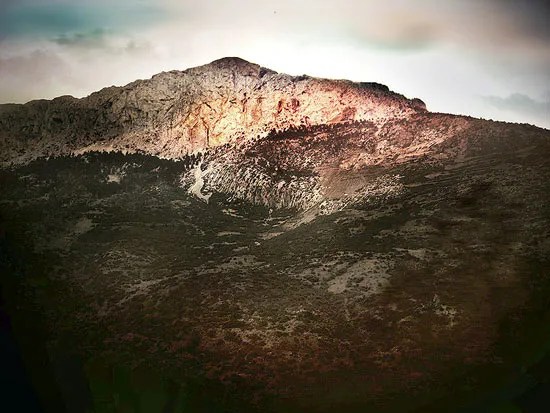
Mount Parnassus in Greece, where the muses were said to gather, was regarded as the home of poetry: From Public Domain

For the longest time, women were uncomfortable occupants of the house of poesy[1], particularly where there were existing canons of poetry established by the institutional gate-keepers and male custodians of literature. At best, they were viewed as Jane-come-latelies who sought to transgress the hitherto hallowed domains of high verse, interlopers to the hallowed heights of Parnassus who dared not “drink the milk of paradise”.

This ‘absence’ of women from the terrain of poetry is in spite of the fact that women have always written poetry, from ancient times to now. Sappho in the western tradition, was a Grecian poet from 5th-6th century BCE who was the pioneer of lyric poetry, a genre which apart from being set to music, also inaugurated the poetic ‘I’. In India, Buddhist nuns in the Mahayana and Theravadas who wrote poems known as the therigathas were early precursors of female poets. These early women poets engaged in the sometimes forbidden, sometimes lascivious charms of verse and versification. Down the ages, there were many others who joined them and kept the lamp of women’s versification lit. However, if women have always been versifiers, why has there been a  resistance and grudging admission for women to the poetic domain, which becomes a sort of “No (Wo)man’s land”? Why do women poets have only a token presence in traditional poetic anthologies?

Some reasons have been offered, not least among them being the preponderance of male poets who have often also been self-proclaimed and self-appointed guardians, legatees and arbiters of poetic tradition. Canonical poetic traditions, many claim, require a knowledge and understanding of Latin and Greek in the West while a knowledge of Sanskrit/Persian in the Asian context was deemed necessary. Thus women, who, for the most part, lacked formal education and had but small Latin and less Greek, could only hover around the margins and fringes of poetry. The situation with Sanskrit and Persian was similar and women remained mostly absent from or shadowy denizens of poetic terrains. Even if and when women were writing, they were doing so in colloquial registers and in the languages of the common people  and not in formal or decorative language, deemed essential for poetry, for the most part. Almost the first group of women writing poetry in India were Buddhist nuns who wrote in Pali, one of the many ancient languages in the ancient Indian subcontinent, which enshrined its own scholarly tradition. Sappho wrote in the Greek Aeolic dialect, which was difficult for Latin writers to translate.

Between 12th and 17th century, there was an advent  of devotional mystic poetry called “Bhakti” and “Sufi” poetry. While the poems were uttered/written in a devotional idiom, the poems and songs were often rebellious and iconoclastic, rejecting institutional religions and social norms. This poetry was rooted in personal and unmediated devotion and rejected formal languages and established societal norms. Some of this poetry was in an informal register, colloquial language and performative with a strong dramatic quality. Thus we have lines in Kannada from Akka Mahadevi (1130-1160) who rejects her earthly husband:

I love the handsome one: He has  no death decay nor form… no end no clan, no land.
Take these husbands who die, decay, and feed them to your kitchen fires.(Vachanas)

Women poets for the longest time had a crisis of identity, identification and non-belonging. They laboured under the anxiety of authorship where they felt the absence of precursors and fore-mothers and the lack of a poetic tradition to which they could belong. They were often made to feel as if they lacked genuine poetic talent or that they were transgressors against womanhood and femininity.

In Aurora Leigh (1855) by Elizabeth Barrett Browning, the eponymous title character, considers  the diverse fields of literature where women can exercise their talent and claim a space. The field of dramatic writing poses a challenge because the former demands that the woman writer be in the public eye in order to promote her plays. Further, to achieve or even aspire to the rank of Poet, Aurora must become capable of  “widening a large lap of life to hold the world-full woe”. Over the course of the long epic poem, she tries to reconcile her femininity with her artistic aspirations. In both cases, she is denied emotional fulfilment. She refuses to accept the role of an obedient wife, since it would mean foregoing the intellectual independence needed to develop as an artist, but then she must also refuse the love of a husband. In Book Five, she mentions three poets, none of whom she admires for their “popular applause”. Yet she admits that she envies them for the time they can devote to their chosen vocation and the adoring women that surround them and provide emotional support and fill their days with glory.

Another issue with women’s writing and poetry is the uncomfortable positioning of women in relation to patriarchal language or male centred language. If as Dale Spender  declares in “Man-made Language”, the masculine is asserted as the norm, where do we position women’s voices? While language is a universal medium of communication, man-made language is full of sexism and chauvinism and expresses reality from a predominantly masculine and patriarchal perspective. If language is a social system which women are persuaded or co-opted to use, how do they work within its confines to express their poetic aspirations? How do they stretch, bend, subvert language to express their own realities? Can we read techniques of irony, satire and other figurative and metaphoric strategies of defiance and subversion and an attempt to undermine from within?

Juliet Mitchell in her essay on ‘Femininity, Narrative and Psychoanalysis’ states that the woman writer/novelist must of necessity be a hysteric, straddling two opposed worlds. One world is that of male definitions and conceptions of femininity  and the other, a resistance and defiance of such conceptualising, accompanied by an attempt to undermine from within. Her defiance and resistance makes her character that of a hysteric, one who defies accepted notions and standards of femininity and is therefore considered transgressive. She troubles fixed gender categories, roles and definitions. She also disrupts and challenges the symbolic order of language, one which insists on rules of grammar and linguistic structures through the semiotic order which uses word play, repetitions and  childish rhymes, in order to express inner desires and drives. The symbolic order deals with the denotative aspects of language and the semiotic order with the affective aspect.

Women’s poetry often houses and accommodates the semiotic, seeming psychobabble that plays with and disturbs fixed notions of femininity and binary gender identities.

What are the popular themes that inform women’s poetry? Some themes are to with women’s search for authentic  self-hood and identity, their search for roots and a space of their own. As we see in Aurora Leigh, much of women’s poetry is self-conscious and self-reflexive, about the act of writing itself, the “awful daring of a moment’s surrender which an age of prudence could never retract.”(T.S.Eliot

Many contemporary women poets, across continents, have evinced a substantial  interest in exploring their poetic self  through their poems. On the one hand is the confessional poetry of Sylvia Plath and Anne Sexton, on the other the brief gnomic utterances of Emily Dickinson. Before the advent of the twentieth century, one hears of Barrett Browning, Emily Dickinson and Christina Rossetti, among many others. Names like Aphra Behn and Anne Bradstreet have been included in many syllabi, often as a token inclusion in an otherwise male centric course.

Women poets have talked about the horrors of war including rape, pillage and destruction. In their critique of war and violence, we find the forging of transnational solidarities, whether it is women’s poetry from Sri Lanka or Birangona (War heroines). 

In India the many names that come to mind are that of  Kamala Das, Eunice D’Souza, Meena Alexander, Sujata Bhatt and Sunuti Namjoshi. Women poets have employed effective means to explore the entire gamut of experience.The private  and the public domain, their process of  self-analysis; the process of poetic creativity and a probe into  poetic identities are all significant fields of exploration. For these women writers, analysing the creative process becomes much more than just a poetic theme. As they unravel the mystery of their poetic psyche in their writings, it becomes an epiphanic journey for the poets and their readers.

[1] Archaic word for poetry

Dr Meenakshi Malhotra is an Associate Professor of English Literature at Hansraj College, University of Delhi, and has been involved in teaching and curriculum development in several universities. She has edited two books on Women and Lifewriting, Representing the Self and Claiming the I, in addition  to numerous published articles on gender, literature and feminist theory.  Her most recent publication is The Gendered Body: Negotiation, Resistance, Struggle.

.

PLEASE NOTE: ARTICLES CAN ONLY BE REPRODUCED IN OTHER SITES WITH DUE ACKNOWLEDGEMENT TO BORDERLESS JOURNAL

Click here to access the Borderless anthology, Monalisa No Longer Smiles

Click here to access Monalisa No Longer Smiles on Amazon International

Categories
Interview

Folklore, Fiction, Ghosts and Grammar

Storytelling is central to the life and work of Malaysian author, editor and teacher, Daphne Lee. Keith Lyons finds out what keeps her up at night.

When I1 first met Daphne Lee in person, in a Chinese Buddhist cafe in Christchurch, New Zealand, on a summery day. I was struck by her curiosity. And I came away impressed, not just by how she delights in hearing ghost stories, myths, supernatural tales, and folklore but how she makes connections to the universality of storytelling, and what lies beneath.

Daphne Lee

As well as being a collector and curator of stories, she’s a writer, a creative writing teacher, and an editor—since 2009 she’s been consulting editor at Scholastic Asia.  She’s been active in supporting the work of writers and illustrators of children’s and young adult literature with Asian content. Daphne curated and edited Malaysian Tales: Retold & Remixed (ZI Publications) in 2011 and Remang: An Anthology of Ghostly Tales (Terrer Books) in 2018, while Bright Landscapes, Daphne’s first collection of short stories, was published in 2019. She’s working on a new short story collection, and her first novel, which she is currently revising while in New Zealand on a writing retreat, far from the streets of Kuala Lumpur and her Roman Catholic school upbringing.You can find out more about the multi-talented Daphne at her website https://daphnelee.org/.

Interview with Keith Lyons

What inspired you to create Remang: An Anthology of Ghostly Tales?

Malaysians love ghost stories. We would rather any misfortune or unusual occurrence be caused by a spirit or other supernatural phenomena than try to figure out a logical reason. Having said that, I don’t believe in ghosts, but I do enjoy ghost stories. I thought it would be fun to edit a collection of these, but I was wrong …  

How do you approach writing and curating ghost stories? What elements do you feel make a truly eerie and memorable tale?

I prefer a story to suggest a mood and to be atmospherically or suggestively spooky than to be full of gory and blood-curdling details. I like the sort of ghost stories that are frightening only if you read between the lines or that seem unremarkable at first, but months later, you suddenly realise what it all means.

Your work often draws from Asian folklore and supernatural beliefs. Are there any particular myths or legends that have influenced your storytelling?

Nothing in particular, but I have heard the same stories all my life and with surprisingly few variations and differences. I enjoy retelling the old tales or building on elements in them. Hopefully, I make a completely new story, but with recognisable features because I like reading stories in which there are some familiar details.  

Do you have a personal ghost story or supernatural experience that shaped your interest in this genre?

My family lived in a haunted house in my hometown (Segamat in Johor, the peninsula’s southern-most state) and we experienced things like lights going on and off, footsteps, odd, unexplained sounds, and so on. I can’t remember much, but I don’t think any of us ever felt threatened during the eight years we lived there. If there were spirits, they were not malevolent. My interest in the supernatural was probably more shaped by the films I watched as a child, including The Exorcist and the Hammer House of Horror — Dracula films starring Christopher Lee.

As an editor, what do you look for in a compelling ghost story?

The problem with the ghost stories we tell one another is that they are usually just anecdotal fragments. I look for fully-formed stories with well-developed characters—the ghostly element might even seem merely incidental to the plot yet be significant enough to make an impression. It should haunt you a long time after you’ve stopped reading.

How do you balance creative freedom with maintaining a strong thematic or narrative structure in an anthology?

I’ve curated two anthologies—one of ghost stories and the other of retellings of folktales, myths and legends. For both the brief was quite open and I welcomed a variety of styles and voices.

What are some of the challenges you face when working with authors, particularly in speculative fiction and folklore-based stories?

I find that when it’s an open call, it can be challenging to gather enough suitable stories for an anthology. Once you’ve made the selection, the editing process is usually long and laborious, with more back and forth than the deadline allows. It’s a much more straightforward process when experienced authors are invited to contribute to an anthology. With the authors published by my day-job (at Scholastic Asia), the major challenge is when the author is too precious about what they’ve created and is adamant about retaining something that doesn’t work or refuses to/is unable to develop a half-formed idea. Fortunately, that has rarely been the case. It’s imperative that authors trust their editors and, thankfully, I’ve had a good relationship with most of the writers with whom I’ve worked.

Youve been deeply involved in the Malaysian publishing scene. How has the landscape for local horror and supernatural fiction evolved over the years?

I’m not directly involved in the scene as most of my work as an editor is with an American publishing house, albeit its Asian imprint. However, I am a reader of locally published books and do read some supernatural fiction written in the Malay language. When I was a teenager, I was a fan of a series of books with the series title Bercakap Dengan Jin (Talking with a Jinn)—they were dark tales that featured a witch doctor, set in rural Malaysia, with lurid covers and badly designed interior pages. The production value of horror fiction has improved, but the stories that are most popular are still the ones we are familiar with, especially about the ghosts that haunt every school and hospital in the country. They are hastily written and barely edited, with high print runs—horror sells, second only to romance novels.

How important is it for Malaysian and Asian supernatural stories to be represented in the broader literary world?

The world needs to realise that there is more to Asia than just what the West is showing it. Right now, a handful of houses controls what most of us are exposed to and end up reading. Even if Asian fiction is getting on the shelves, it’s only what these publishing houses have decided is worthy. In Asia, especially those countries that were colonised, readers are still stuck with the idea that books out of the UK and the US are better than those published locally. In Malaysia, we have some authors who have ‘made it’ in the West—people like Tan Twan Eng, Tash Aw, Preeta Samarasan and Zen Cho. They are excellent writers, but I don’t know if many Malaysians would pay attention to their work if they were published by Malaysian houses. Unfortunately, we don’t appear to be very discerning readers. Penguin Random House SEA, which runs out of Singapore and is riding on the Penguin brand, fails to offer sufficient editorial support to its authors and seems to be prioritising marketability and quantity over quality. Readers buy the books because Penguin is supposed to equal quality. Writers sign contracts with the house because they recognise PRH as a popular brand with a great reputation. They complain about the poor editing but choose to stay with the company. This is a kind of horror story too!

Do you think traditional ghost stories still resonate with modern readers? How do you adapt them to contemporary audiences?

I think so. I think part of the attraction of ghost stories is that people like to be scared as long as they can also feel safe while feeling terrified. Traditional ghost stories are the perfect comfort reads. They are thrilling yet familiar. You know what’s coming—all the scary bits, but there’s usually a happy ending too, when the ghosts are put to rest and the humans go back to their boring lives.

Many Western readers are familiar with ghosts like the vengeful spirit or the haunted house trope. What uniquely Malaysian or Asian ghostly elements do you wish more people knew about?

The Asian ghosts most familiar to Western readers are probably the Japanese yokai. Once again, there is a degree of gatekeeping going on. A Malaysian author I know was looking for a lit agent and was told that although her writing was good, her stories were ‘too South-east Asian’. What does that even mean? Western publishers and agents underestimate the ability of readers to relate to subjects unfamiliar, especially when they originate in South-east Asia. Often you hear that a publisher or agent already has a South-east Asian on their list and does not have room for more. Yet, there are officially eleven countries that make up the region. They are not interchangeable, and do not share a common language, history or culture. Malaysia has many types of ghosts and they each reflect the various beliefs and attitudes Malaysians have towards life and all its big and petty questions. To know these spirits is to know the fears and anxieties of the common Malaysian.

Youre planning an online archive of Malaysian folktales. Could you share more about this project and why its important to preserve these stories?

I was recently on a panel about folktales with two other Malaysian authors who write books that draw on folktales for inspiration and one of them said that the folktales that stick around are the ones that mean something to the community. This may have been true in the past when folktales were shared orally. These days, the ones that survive are those that get included in collections or are retold and reimagined into films etc. The same ones get recycled time and time again, probably because they are the most dramatic or sentimental. Collecting as many folktales as possible and storing them online gives them all a fair chance of surviving. What may be insignificant to one generation, may resonate for another. The main thing is to let each generation decide, and for the stories to be available and accessible.

Bright Landscapes was your first personal collection of short stories. How did that experience differ from curating Remang?

For Bright Landscapes I had only myself with whom to argue and disagree. My editor and I were, fortunately, on the same wavelength, but she really helped me improve on the quality of the stories. I wouldn’t undertake another project like Remang unless more time and more resources were available.

Can you share any details about your upcoming novel? What themes or ideas are you exploring?

During the pandemic I completed a novel but on reading it, I realised how rubbish it was. It’s very close to my heart, but I think it’s not quite the right time for a rewrite. It needs to ‘cook’ more, in my subconscious. That novel is set in a world where gods and humans live side-by-side, during a time of religious reform. The protagonists are a priest and a deity, and the story deals with questions of friendship, integrity, religious belief, and faith. I have a second novel that I am currently working on—a coming-of-age story set in a convent school in a small Malaysian town in the 1980s. It also explores questions of friendship and faith. I attended two Convent schools from age five to seventeen, and I was raised Roman Catholic. I did think of becoming a nun when I was in my early teens, like the protagonist of my novel, but I have been an atheist since my early twenties, although I am now probably more agnostic than anything. Religious belief and faith are subjects fascinating to me.

As a creative writing teacher, what advice would you give to aspiring writers interested in supernatural fiction?

The same advice I would give any aspiring writer: Read widely and voraciously. And write every day, about anything and everything.

If you could collaborate with any author—living or deceased—on a ghost story, who would it be and why?

I don’t want to collaborate with anyone, but I would like to have a conversation with Elizabeth Bowen about the handful of ghost stories she published. They are my favourites—quiet, mysterious, melancholy, sardonic. I have questions about them that still keep me up at night, decades after I first read them.

  1. Keith Lyons ↩︎

Keith Lyons (keithlyons.net) is an award-winning writer and creative writing mentor originally from New Zealand who has spent a quarter of his existence living and working in Asia including southwest China, Myanmar and Bali. His Venn diagram of happiness features the aroma of freshly-roasted coffee, the negative ions of the natural world including moving water, and connecting with others in meaningful ways. A Contributing Editor on Borderless Journal’s Editorial Board, his work has appeared in Borderless since its early days, and his writing featured in the anthology Monalisa No Longer Smiles.

.

PLEASE NOTE: ARTICLES CAN ONLY BE REPRODUCED IN OTHER SITES WITH DUE ACKNOWLEDGEMENT TO BORDERLESS JOURNAL. 

Click here to access the Borderless anthology, Monalisa No Longer Smiles

Click here to access Monalisa No Longer Smiles on Kindle Amazon International

Categories
Review

The Oldest University in the World?

Book Review by Bhaskar Parichha

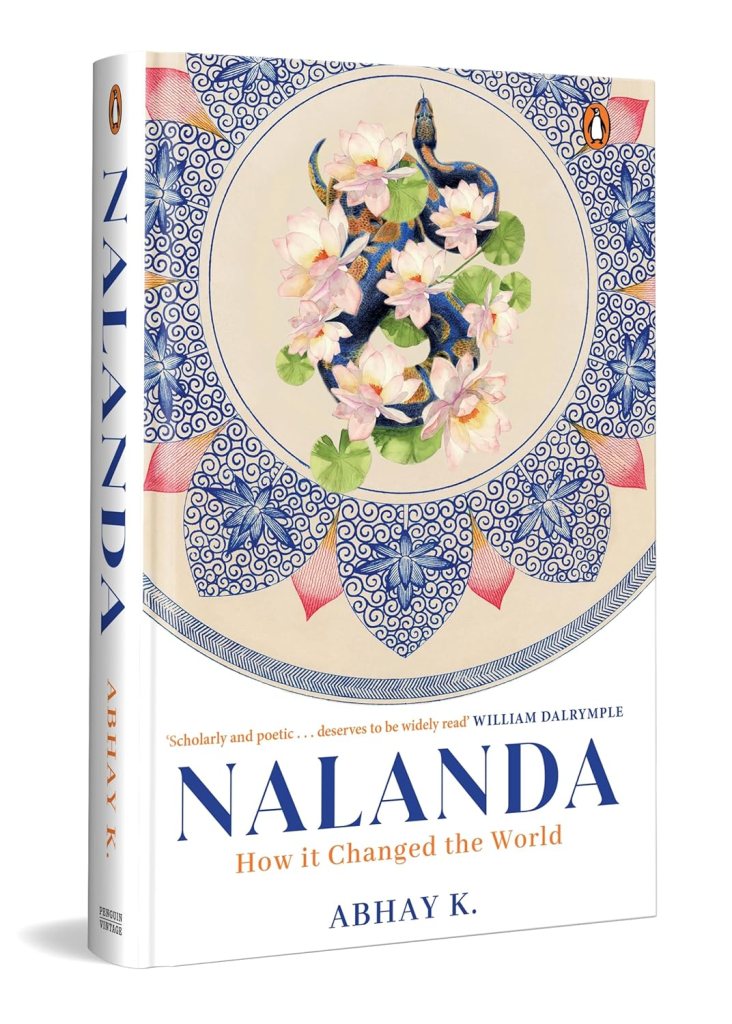
Title: Nalanda: How it Changed the World 

Author: Abhay K

Publisher: Penguin Vintage

Nalanda University, founded in 427 CE in ancient India, is considered the world’s first residential university. It attracted 10,000 students from across Eastern and Central Asia to study medicine, logic, mathematics, and Buddhist principles. The University flourished for over seven centuries, predating the universities of Oxford and Bologna by more than 500 years. Nalanda’s enlightened approach to philosophy and religion significantly shaped Asian culture long after its decline. The Gupta Empire, though Hindu, supported Buddhism, fostering a liberal environment that allowed it to blend intellectual Buddhism with multidisciplinary academics.

Nalanda was destroyed in the 1190s by Turko-Afghan military general Bakhtiyar Khilji, who sought to extinguish the Buddhist center of knowledge. The fire set by the attackers reportedly burned for three months. Today, the excavated site is a UNESCO World Heritage site.

Numerous aspects of Nalanda continue to be enveloped in an enigma. What is the date of its establishment? Who were its founders? Which individuals engaged in study and instruction at this institution? What disciplines were available for study? What was the population of students and educators? Can Nalanda be classified as a university by contemporary standards? What factors contributed to its eventual decline? Nalanda – How It Changed The World by Abhay K. unravels these questions.

Abhay K. has authored numerous poetry collections, such as Celestial, Stray Poems, Monsoon, The Magic of Madagascar, and The Alphabets of Latin America. Additionally, he serves as the editor for several notable works, including The Book of Bihari Literature, The Bloomsbury Book of Great Indian Love Poems, Capitals, New Brazilian Poems, and The Bloomsbury Anthology of Great Indian Poems.

Writes Abhay in the introduction to the book: “There is no clear and entirely reliable interpretation of Nalanda’s past or, for that matter, the past of just about anything. Rather, there are scattered ideas that we try to string together as history, an overview stitched from snippets. And there is no single interpretation of these snippets but rather competing and conflicting interpretations. Recognizing this slippery nature of the past and its documents is part of what makes scholarship such an exciting enterprise.

“Buddhist monasteries existed all over India, Central Asia, and East Asia. However, Nalanda became a celebrated monastery in comparison to its contemporaries. What might be the reason? One of the reasons was its proximity to Rajagriha (modern Rajgir), the first capital of Magadha. Rajagriha in those days was full of political intrigue and rivalries. It became a fertile ground for the birth of the Magadha Empire. Over the centuries, Magadha was ruled by a succession of dynasties, including the Brihdratha dynasty, the Pradotya dynasty, and the Haryanka dynasty. The Haryanka dynasty was the third ruling dynasty of Magadha. It was founded by Bimbisara (c. 558-c.491 BCE). He is considered to be a contemporary of both Mahavira (599-527 BCE) and Gautama Buddha (563-483 BCE). His son Ajatashatru further consolidated it after forcefully taking over Magadha from his father and imprisoning him. He fought a war against the Vajjika League, led by the Lichhavis, and conquered the republic of Vaishali.”

Divided into eight chapters – Nalanda the capital of Magadha, the legendary sons, the rise of Nalanda Mahavihara, luminaries, foreign scholars of Nalanda, Nalandas’s contributions and its global footprint – this is an exhaustive book. The narrative chronicles the ascendance, decline, and resurgence of Nalanda Mahavihara. It delves into Nalanda’s significant contributions to various fields, including science, mathematics, philosophy, art, architecture, and poetry, supported by thorough research. Additionally, it emphasises the distinguished scholars who enhanced its unmatched status as a leading center of learning, as well as the international scholars who frequented the renowned monastery.

Concludes Abhay K: “Nalanda’s footprints to be spreading to new territories in the twenty-first century, where they have not been strong before. As our planet faces the triple threats of climate change, biodiversity loss, and environmental pollution, humanity needs to make peace, both with its inner self as well as with its fellow species, rivers and lakes, oceans, and all entities that support life on our beautiful planet. Nalanda’s timeless tradition of imparting knowledge, wisdom, and kindness can guide humanity toward overcoming hatred, anger, frustration, and greed while fostering inner and outer peace.”

The core message of the book — with numerous photographs — is that the creation of institutions named after Nalanda around the world instills in him a sense of optimism that humanity will eventually resolve all its conflicts through the esteemed Nalanda tradition of dialogue and discourse, rejecting violence and warfare permanently. In this context, the ongoing legacy and revival of Nalanda, both in India and internationally, serves as a significant beacon of hope.

Nalanda, with its expansive scope and rich historical background, offers an engaging narrative that illuminates the evolution of this ancient institution over the course of thousands of years.

Bhaskar Parichha is a journalist and author of Cyclones in Odisha: Landfall, Wreckage and ResilienceUnbiasedNo Strings Attached: Writings on Odisha and Biju Patnaik – A Political Biography. He lives in Bhubaneswar and writes bilingually. Besides writing for newspapers, he also reviews books on various media platforms.

.

PLEASE NOTE: ARTICLES CAN ONLY BE REPRODUCED IN OTHER SITES WITH DUE ACKNOWLEDGEMENT TO BORDERLESS JOURNAL

Click here to access the Borderless anthology, Monalisa No Longer Smiles

Click here to access Monalisa No Longer Smiles on Amazon International
Categories
Review

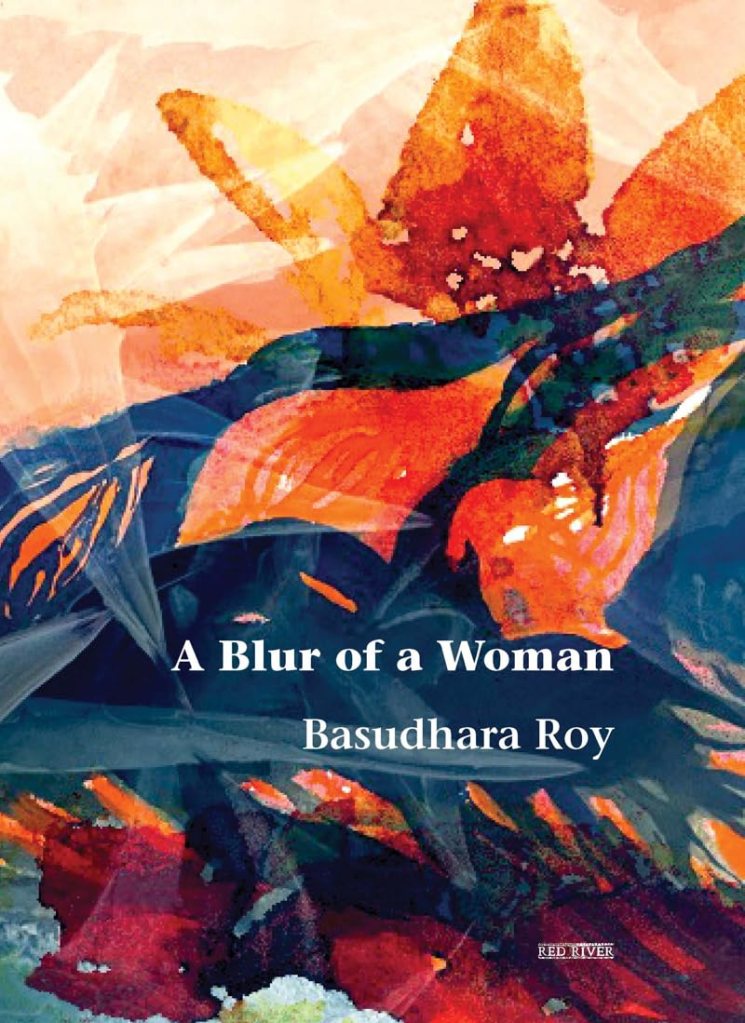
A Blur of a Woman

Book Review by Malashri Lal

Title: A Blur of a Woman

Author: Basudhara Roy

Publisher: Red River

The feminine mystique has defied every attempt to capture its attributes. If clusters of stories surround a goddess, dilemmas are embedded in them. If the pavement-dwelling mother with children clinging to her skirt images economic deprivation, there are stories hidden in her grey-flecked eyes. Basudhara Roy recognises this amorphous, protean aspect of the feminine and titles her collection A Blur of a Woman, poetically declaring; “she owns the place/and the little magic she has earned…she will use it someday to unbuild herself/disappear dissolve/ become a blur”.

This collection is a subtle attack on patriarchy as it encompasses the history and socio-cultural conditions that have moulded women into being mercurial yet tangible, pliant as well as resistive, buoyant but also vulnerable. As the poems flow in a drumroll of many contexts, vignettes of the journey are captured, symbolically strong and offering a plethora of layered meanings. The lines encourage a dialogic exchange whether with the poet, or with one’s own half-acknowledged self that is suddenly confronted by Medusa’s mirror.

The first two sections begin with poems titled ‘Duhkha’ and ‘Soka’[1], directing us towards the Buddhist principle of inevitable mutability and the need for acceptance.

I have seen hearts shut and bolt doors
from within, their windows walled while
on love the mold of ingratitude thrives

With such adaptations, the contemporary takes precedence over the philosophical teachings, and the identification with thwarted expectations, social discord, betrayal and helpless sorrow is almost immediate. If solace is to be found it is now individual—and, in this instance, by  turning to the gnarled trunks of trees where tears have watered the serrated bark. Speaking of the imagistic density of Roy’s phrases, this kind of interlinking through poetic shorthand is perceived in much of her narrativisation. The ‘betrayal’ that causes sorrow and also the maturity of recovery is a process resonant through the history of women’s writing. ‘Soka: A Triptych’ strings this further through contemplating the elegiac notes of death and mourning—yet birth and death are twins: “If life alone can be seen/all this emptiness must surely be death.”

A sizeable section of the book charts a trajectory of feminist fables, gleaning references from Rabindranath Tagore, Jayadev’s Geet Govinda, Philomela’s story, Virgo’s distress, and others. In Roy’s hands, irony becomes a viable and effective tool of social critique as in the poem

‘In Which Bimala Agrees to an Interview for a Special Issue of Post-Text Feminism’. Tagore’s popular novel Ghare Baire/ The Home and the World presents Bimala as the conventional woman who is persuaded to discover the turmoil of the world outside the threshold. Basudhara devises an imaginary conversation, some of which is quoted:

Where, then, would you locate yourself?
Here. Now.
Come on! I am hardly lost
and need no GPS of theory to find myself!

Such a startling reinvention of a canonical text subverts many assumptions with sharp, clear strokes: the jargon of literary theory, the leap into digital alignments, the confidence of the liberated woman, and the time travel that feminism has enabled.                     

My other favourite piece is about ‘Lalita’, a sakhi or friend  of the beauteous Radha who is always the heroine in the traditional tale. In Lalita’s version of the mysterious raas leela where Krishna is perceived by each woman as her partner, she is jubilant about her societal escape and physical abandon;

limbs supple like vines we danced,
thrilled to be
where love was recklessly returned.

This may be the right time to refer to the Author’s Note which is titled ‘I Write from the Body’ and seems to carry forward the feminist discourse of theorists such as Hélène Cixous who invented the term écriture feminine, or Julia Kristevawho perceived the  chora as a specially maternal zone.  According to Roy, “In the earth-bed of this woman’s life that I live, poetry runs as a river, its plenitude being both a lesson and an antidote to the prosaic borders of my world.” In which case, “Blur” is the right metaphor for attempting to break the boundaries through word-play and subversive themes expanded in poems  such ‘Aid to Forgetting’, ‘Praise for the Subaltern’, ‘Dis/enfranchised’—and several other poems  are expressions of resistance to the bastions of control. Philomela’s severed tongue has again learned to speak– but it’s a new language of assertion and intertextuality.

The semiotic breakthrough in Roy’s poems is accompanied by stylist experiments too, the Ghazal section being one such. The transcreated  use of the Urdu structure allows for couplets on a variety of subjects—for example, the seasons in the manner of the Baramasa (songs of the twelve months) with a twist that the woman is no longer the bereft, perpetually waiting figure uttering  her woes to the firmament. She says confidently now: 

You etch every constellation on your  palm
Yet secrets line the arcane of the body

In all, A Blur of a Woman, offers  poems for the intellect and the heart which are  indivisible aspects of a woman’s existence. That she  is mercurial  and evasive is once again a reminder of a fascinating mystery that has prevailed over time — and perhaps its more exciting to keep it that way.

[1] Both Dukha and Soka are forms of grief

Malashri Lal, writer and academic, with twenty one books, retired as Professor, English Department,  University of Delhi. Publications include Tagore and the Feminine, and the ‘goddess trilogy’ (co-edited with Namita Gokhale) In Search of SitaFinding Radha, and Treasures of LakshmiBetrayed by Hope: A Play on the Life of Michael Madhusudan Dutt  received the Kalinga Fiction Award.  Lal’s poems Mandalas of Time has recently been translated into Hindi as Mandal Dhwani. She is   currently Convener, English Advisory Board of the Sahitya Akademi.

.

PLEASE NOTE: ARTICLES CAN ONLY BE REPRODUCED IN OTHER SITES WITH DUE ACKNOWLEDGEMENT TO BORDERLESS JOURNAL

Click here to access the Borderless anthology, Monalisa No Longer Smiles

Click here to access Monalisa No Longer Smiles on Kindle Amazon International

Categories
Essay

How Dynamic was Ancient India?

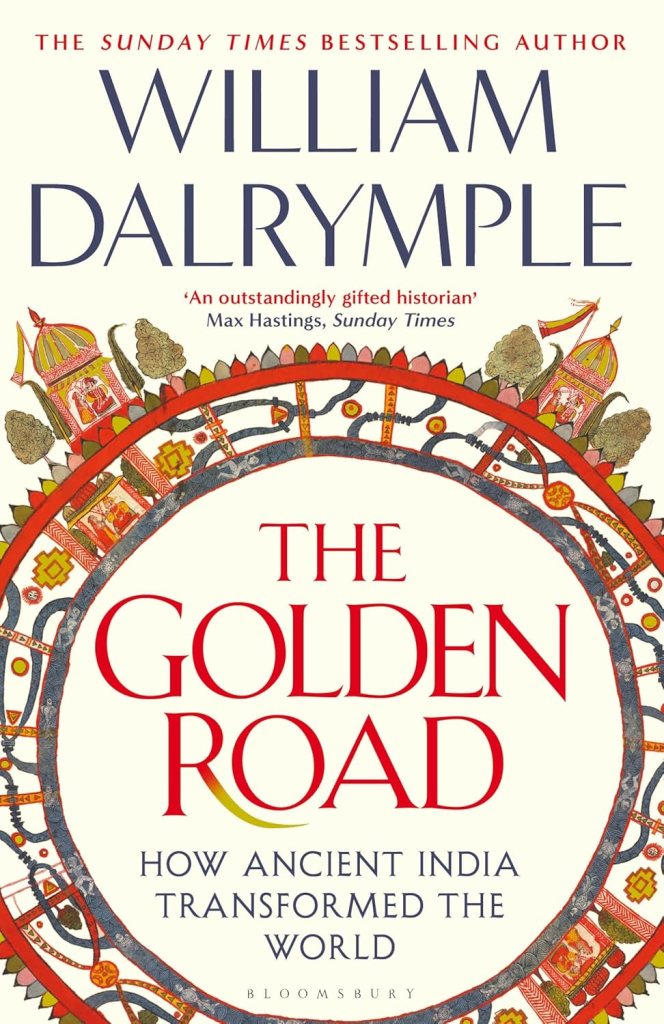
Farouk Gulsara discussed William Dalrymple’s latest book

Growing up in the later part of the 1970s, kids of my generation were drilled with stories that India was a subcontinent of poverty, filth, and pickpockets. Even our history books taught us that it was a land of darkness, living in its myths, superstitions, and cults, waiting to be civilised by the mighty European race and their scientific discoveries. 

That was what was impressed upon us as we sauntered into adulthood. The media did not help either. With eye-catching news like a particular Indian Prime Minister having his daily dose of gau mutra[1] for breakfast and another ousted after thirteen days of taking oath as the Prime Minister, India was made out to be just another third-world country. Then came the 21st century and the turn of tides. Locally bred academicians started teasing deeper into India’s forgotten history. They started doubting the self-deprecating history that was taught to them by leftist historians in the textbooks.

Like many historians before him, historian William Dalrymple, in his latest book, The Golden Road: How Ancient India Transformed the World outlines the importance of India as a cradle of knowledge that peddled wisdom to regions near and far. Its scientific knowledge was far ahead of its time. This know-how was put into practice and spread via trade routes. Their port of entry received not just their goods but also their culture and way of life.

Enduring attack after attack from foreign invaders, Indians had already forgotten their glorious past by the time of the British Raj. A tiger hunting expedition inadvertently brought British hunters to various beautiful cave carvings and Buddhist sculptures. That kind of rekindled India’s history, which had disappeared from the Indian imagination.

India had been a crucial economic fulcrum and a civilisational engine in early world history. As early as 31BCE, Indians had learnt to manipulate the monsoonal winds to steer their ship to the West to the prosperous kingdom of Ethiopia, Egypt and subsequent access to the Mediterranean. With their mammoth merchant ships, they transported pearls, spices, diamonds, incense, slaves and even exotic animals like elephants and tigers in exchange for gold. Trade favoured India so much that a Roman Naval Commander, Pliny the Elder, lamented the unnecessary spicing of the food and the almost transparent Indian fabric that left nothing to the imagination. It is said Buddhism reached the shores of Egypt through these ships. The Christian monastic way of life is said to have been influenced by these monks.

With seasonal monsoon winds, Indian ships brought not just trade but philosophy, politics, and architectural ideas to Southeast Asia, China, and even Japan. All this cultural allure and sophistication did not happen through conquest. Sanskrit was the language of knowledge and a conduit for spreading knowledge. 

Buddhism emerged in the 5th century BCE as an alternative to caste-centred and animal sacrifice-filled rituals. Unlike Jainism’s strict austerities, it offered a middle path. Due to King Ashoka’s untiring efforts, Buddhism spread beyond its borders. Contrary to the belief that Buddhism promotes an impoverished way of living, early Buddhists drew interests (and resources) from the merchant group, as evidenced by the Ajanta Caves’ findings. Buddhism drew many Chinese scholars to India’s centres of higher learning in Nalanda and Kanchipuram in the South to get first-hand experience reading Buddhist scriptures in Sanskrit. India’s universities later became the template for other varsities the world over. 

India’s cultural influence on South Sea Asia is phenomenal. Stories from Indian epics, Ramayana and Bhagvad Gita, are told and retold in children’s stories, plays and cultural art forms. Their ruling elites were Hindus. The biggest Hindu and Buddhist temples are not in India but in Cambodia and Java, respectively, as Angkor Wat and Borobudur. Marvellous stony statues and temple are similar to those in India. At a time when the Byzantines were presiding over Europe, the Suryavarman clan was ruling a Hindu Empire so huge it would dwarf their European counterpart.  

The 5th to 7th century of the common era was the golden age of Indian mathematics. Between Aryabhata and Brahmagupta, their knowledge of the nine-number system (and zero) brought them the know-how of negative numbers, algebra, trigonometry, algorithms and astronomy far ahead of their time. They understood that Earth was a sphere spinning on its axis, about the eclipse, gravity and planetary rotations. The Indians even built a space observatory tower in Ujjain to study constellations and devise a solar calendar. The idea of a prime meridian arose from here. 

In the 8th century, the Abbasids exerted control over the Afghanistan region through treaties with local viziers. At that time, the Bamiyan region in Afghanistan had over 460 monasteries and 10,000 monks. A member of an influential Buddhist family, the Barmakid, converted to Islam to establish his family in the Abbasid fold. They brought Indian medicines, texts, and scholars with them and encouraged and promoted Islamic engagement with the East. Sanskrit texts were translated into Arabic. It is said that the Barmakids were instrumental in the building of Baghdad. 

The Islamic hegemony spread, as did the scholarship it had built. 

The Bamakid-Abbasid liaison met a tragic end due to palace power dynamics. The Abbasids started looking at the Romans for inspiration. Many Europeans were drawn to the Golden Age of Islam. Many texts were translated into Latin. Toledo of Andalusia introduced the science of timekeeping from Ujjain to Oxford. A particular young Italian named Leonardo of Pisa picked up the beauty of Mathematics during his stay in Algeria. He returned to publish ‘Liber Abaci‘ (The Book of Calculation) in 1202, which introduced Europe to the sequence of Fibonacci numbers and the mystic power of mathematics. This sudden gush of knowledge spurred the European Renaissance.  

The whole cycle completed its full arc when European powers rose to great heights. Benefitting from the knowledge from India that layered its way through, passing from hand to hand, the colonial masters returned to chop off [2]the hands that had nourished it. 

Emerging rejuvenated from their occupation-induced slumber, with their Anglophilic familiarity, Indians have risen from the ashes to claim their status in the Indosphere[3], a world where Indian influences permeated every layer of society.

This well-researched, unputdownable book is for all history buffs. Infused with little nuggets from cover to cover that would excite nerds, it is a joy to read about the history of India in a way that is not often told in the mainstream.

[1] Gau mutra, cow urine, has a sacred role in some forms of Hinduism and Zoroastrianism and is used for medicinal purposes and in some Hindu ceremonies.

[2] https://www.thedailystar.net/lifestyle/special-feature/the-muslin-story-187216#

[3] Indosphere is a collective linguistic term for areas under Indian linguistic influence. It includes countries in the Southern, Southeast, and East Asian regions. 22 languages, including Indo-European and Dravidian languages, are recognised under this category and are considered to have originated in India. 

Farouk Gulsara is a daytime healer and a writer by night. After developing his left side of his brain almost half his lifetime, this johnny-come-lately decided to stimulate the non-dominant part of his remaining half. An author of two non-fiction books, Inside the twisted mind of Rifle Range Boy and Real Lessons from Reel Life, he writes regularly in his blog, Rifle Range Boy.

.

PLEASE NOTE: ARTICLES CAN ONLY BE REPRODUCED IN OTHER SITES WITH DUE ACKNOWLEDGEMENT TO BORDERLESS JOURNAL

Click here to access the Borderless anthology, Monalisa No Longer Smiles

Click here to access Monalisa No Longer Smiles on Kindle Amazon International

Categories
Stories

The Return

By Paul Mirabile

Jonathan Harper was startled out of sleep by an impatient ringing at the door bell. He rolled out of bed, tip-toed to the sitting-room and peeked through the curtains covering the bay windows. In the dim, moonlit night he perceived a slender, young man dressed in some sort of long robe. He was completely bald. Again the bell rang and rang under the young man’s relentless ringing. Jonathan hastened to the hearth, picked up the poker out of its andiron then quietly moved towards the door. With a quick jerk he unlocked it so as to take the knocker by surprise. The knocker looked stonily at Jonathan’s sleepy, pale face and at the poker.

“Whatever are you doing with that mighty weapon, father?” was that knocker’s first remark. Jonathan stared in astonishment, mouth agape. “Yes, father it’s me, your son Francis. Have you forgotten me ?”

And that was how Francis Harper, the fugitive Buddhist monk, and his father Jonathan, completely thunderstruck, were reunited …

“Quick, come in … come in … At this hour of the night, Francis. And look at you, dressed like a beggar monk. So thin. I hardly recognised you.” Jonathan was in a state of great excitement. Francis sailed in, closed the door and settled on the familiar canopy. He scanned the sitting-room: Nothing had changed.

“You gave me a scare, Francis,” Jonathan resumed, still standing.

“Well, who would be ringing at this hour of the night?” Francis returned in a flat voice. His father hadn’t quite understood the question. He seemed half asleep. “Where’s mum?”

“Who?”

“Mummy … your beloved wife?” Francis pressed ironically. Jonathan stared emptily at him. “Well, is she here, or has she gone to see her boring sister Hazel ? Perhaps she’s out with her lover?” Jonathan winced.

“Don’t be vulgar, Francis, please.”

“Come on, I’m only having you on. Where is she?”

Jonathan stepped forward: “I thought she was with you! She went to find you in Laos a year ago, and I’ve never had any word from her since.”

Francis looked blankly at this father then jumped up. “She’s mad ! Why did you let her go, damn it?”

“I didn’t let her go, Francis; she woke up one morning and off she went leaving me a note.”

“What note? Do you still have it?”

“The note … Yes …” Jonathan shuffled to his bedroom to procure Heather’s note that she had left for him on the chimney-mantle. He handed it to his son. It seemed that it had been wrinkled up into a ball then roughly flattened out.

“Bloody hell! Why did she do that?” Francis gritted his teeth. “It’s such a dangerous place to be for mummy. She has no clue of the dangers : the jungles are infested with disease and wild animals. Food and water are dodgy. It’s another world.”

The son glared at his father then threw himself down onto the canopy, burying his face in his hands.

“I’ve put the police on to it but nothing has come up,” Jonathan defended himself, yet in a contrite tone of voice. “She believed that only she could bring you back to us. But … how did you come back here?”

The question struck Francis oddly. He looked at his father who still stood: “Do put down that poker, you cut such a ridiculous figure.” Indeed, Jonathan hadn’t noticed that he still clenched the poker tightly. He tossed it into the cold hearth. Francis sighed: “Me ? Do you really want to know, father?”

“Of course I want to know, then we can both set out to find mother.”

“No we cannot just set out to find mother. I am a wanted criminal in Thailand and in England. Have you forgotten?”

“Rubbish! How then did you manage to get home if you are wanted by the police?” Jonathan persisted, trotting back and forth from the sitting-room to the kitchen to make coffee and toast muffins.

“That’s a long story,” Francis lamented, crumbling up the letter and dropping it to the carpeted floor.

“Well, we have the whole night, so please, I must know the truth. It’s been a nightmare for me in this house all alone. You know that Andy pops in almost every day to rub salt into my wounds, drinking my brandy and wheeling that mordant wit of his.”

“You mean that you’ve been pissing it up with that halfwit?” Francis snapped.

“No … no, of course not. But he invites himself over and never knows when to leave. How many times have I put up with his drunken effrontery.”

“Well, if I ever see him here …”

“No ! He must not see you; if he does all Stevenage will know and that means the police, too. No. We must find a way to hide you, to keep you safe from the law until this rotty mess is straightened out.”

“Straightened out?” Francis sneered. He eyed his father coldly. ‘Forced’ solitude had wrinkled the old man’s ashen face, had given him the appearance of Gandalf straight out of The Hobbit, all he needed was a grey cloak, staff and floppy hat to complete the portrait instead of his thirty-year old pyjamas. The flesh on his neck had gone flabby and his eyes, colourless, like his thinning, flaky hair. Jonathan finished his coffee: “Please tell me how you left Laos and managed to reach England,” he said in a weak voice, practically beseeching his son.

Francis took a gulp of coffee, he made a wry face: “I haven’t drunk coffee for over twelve years.” Setting the cup down on the settee, he began his tale. And as Francis fumbled to find his words Jonathan observed the metamorphosis of his appearance.

Francis’ face, laboured by years of privations, illness and fasts, had the appearance of rough, sandy stone. His eyes were set deep in their orbits whilst the furrows of his crow’s eyes twitched at every slight movement or sound in the sitting-room. The callousness of his face darkened all its former freshness of youth – that youth he had abandoned in southeast Asia. He swayed slightly in the canopy, nibbling at his muffin, apathetically. Jonathan made some more coffee and toasted more muffins for his enfeebled son. He opened slightly the bay window curtains then finally settled down in his wicker chair.

Francis began lethargically, rubbing his hairless head: “I had been living from monastery to monastery in northern Laos, constantly ill because of the food and water until one day I decided that I had no future in those remote places of worship. Mind you, the religious services captivated me as did the jungle and the snaking, mystical Mekong. The monks were jovial chaps, very respectful and reserved. They offered a soothing solace to my inner and outer sufferings. But I had to leave and return to England. My mind and body ached for familiarity… for mother and for the English language …”

“And your father?” interposed Jonathan, biting his quavering lower lip. Francis looked sadly at his aging father. “I know I haven’t been the best of fathers to you, Francis,” Jonathan conceded, his cheeks flushing red with shame. “But you will acknowledge that I did encourage you to travel to Asia to earn your livelihood. You know, I did not choose my solitude. It was imposed on me.”

“Did we then impose it, me and mummy?” came Francis’ laconic retort.

Jonathan looked dismal, a bit jarred by the remark. He stared at his son through sleepy, spent eyes. Francis laughed: “Of course I’ve returned for you too!” He pursued: “Thanks to my Lao passport procured for me by the Venerable Father, I travelled to visa-free countries. First, I boated it down to Vientiane, then took a cheap flight to Moscow. From there to Cairo, where I renewed my British passport at the embassy wihout any questions asked, although it had expired over six years. Anyway, with my British passport I entered Italy by boat, and from there on used my British passport since European border officials hardly looked at it. To avoid the usual big entries into England I hitched up to the Hook of Holland and took the ferry to Harwich.”

“But hadn’t the border officials suspected anything … your dress?” 

“I changed dress in Italy but wore my robe when crossing into England.”

“But your photo?”

“My face has undergone a drastic change, father — haven’t you noticed?” Jonathan had but said nothing. “Anyway, what could they say to a tonsured-headed Englishman who had become a Buddhist?” Jonathan paused, as if reflecting.

“And the money to pay for all these flights, boats and trains?”

“I had my Cook’s travellers’ cheques safely in my money belt.”

Jonathan sighed. “Look Francis, we must not dilly-dally, Interpol may be on your trail at this very moment. No dawdling about, I have to find a place to hide you.”

“Don’t exaggerate, father, please.”

Jonathan sized up his gaunt, emaciated son: “I hope you’re not thinking of turning yourself over to the police.” Jonathan wrung his hands fearfully.

“No, no, I’ve paid for my selfishness and stupidity. Every day and night for twelve years that horrible scene still floods my mind.”

Here it seemed to Jonathan that Francis began to weep quietly. What to do ? What to do ? Comfort him with a fatherly hand on the shoulder ? A paternal embrace ? Or simply a kind, appeasing word ? Jonathan, whilst he observed his son, realised that he had never been a fatherly towards his son. Heather had been right — he thought as he looked on helplessly at his son’s bony, trembling shoulders.

The grandfather clock struck six.

“My God, it’s morning!” Jonathan cried, going to the bay window. “People will be milling about.”

“So what, people always mill about in the morning,” came Francis’ sardonic reply.

“Someone may see you.”

“Through the window? Who will see me father if I stay in the house?”

“Right you are, Francis.”

“And mother?” Francis retorted, a glare of reproach in his cloudy eyes.

“Mother? Why hasn’t she ever written to me? Did you not have any news of her in Laos?”

“Some monks did speak about an old lady with grey hair seen in different boats on the Mekong. That’s about all. It could have been anyone … “

“Anyone? An old, grey-haired lady traipsing up and down the Mekong,” Jonathan cut in savagely. He fell back into his wicker chair. “I have to get you out of England before I tend to your mother. I will act quickly and decisively for you and her.”

Francis stared at his wizen-faced father, and for the first time in his life the young man felt a pang of pride towards him. Yes, a pang of pride because Francis had always believed his father to be a moral coward, a skulker who purposely disavowed, even mocked all his childhood projects, which had gradually raised an emotional tension between them. The clock struck half-past six. The first rosy rays of the sun trickled into the sitting-room with the warm, gay light. At that stroke of the clock Francis truly felt that their generational tension had been somehow lightened.

Francis stood. Jonathan stood. They gazed at each other and an instant later broke out into howls of laughter, laughing like two little boys. They laughed and laughed as they had never laughed before.

Jonathan strode over to Francis and slapped him paternally on the back: “Let’s have a real British breakfast.” Which they did — bacon and eggs, kipper and fresh orange juice which Jonathan squeezed himself.

The doorbell rang. Jonathan jumped out of his chair. Francis hastened to the bay window. It was Andy. “Blast! Into your room Francis and don’t make a sound. I’ll send that bugger packing. How dare he  come bothering me at this hour of the morning.”

As Jonathan shuffled to the door, Francis made a bee-line for his bedroom. Jonathan threw it open.

“Well old man, up bright and early, hey?” began Andy in his usual strident, exasperating tone. “How about a little excursion to St Albans this morning ? They have an excellent pub where the food is the best in Hertfordshire.” Andy struck his customary ill-bred pose.

“No thanks, not today Andy, I’m terribly busy …”

“You, busy, Johnny old boy? Come on, mate, we’ll take your car.”

“That goes without saying since you haven’t one,” Jonathan rejoined peevishly. “No, today I must finish some work. You go and tell me how the food is. We’ll see about tomorrow.” He corrected himself. “No … next week ; I shall be popping over to visit my cousin-in-law.”

Andy sensed that Jonathan was lying.

“I see,” and a grotesque smile stretched over his red-spotted, pasty face. “What’s good for the goose is good for the gander, hey?”

“What are you insinuating?”

“Oh nothing … nothing, old boy. Have a good time and let me know how things work out.” He gave Jonathan an equivocal wink. Jonathan slammed the door in his face.

“Bloody idiot!” he growled. Jonathan stopped in his tracks. “My cousin-in-law … that’s it ! I’ll send Francis to Mary in Ireland. No one will ever think of searching for him in Ireland.”

Jonathan was all agog. He had found a solution to Francis’ dilemma thanks to Andy’s unexpected visit. He called to Francis who opened the door of his room carefully.

“No bother, the blighter’s gone, and I have a smashing idea, Francis. I have half a mind to drive you to Ireland where the British police will never hunt you down. My cousin-in-law, Mary O’Casey,  lives in Waterville. Once we’re there and you’ve met her, I’ll drive back to England, get a flight to Laos and bring mother back home.”

Francis had never seen his father so animated. His shrivelled features seemed to rejuvenate, new blood infuse that puffy, pasty, unshaven Gandalf face. Francis, however, stood at the door of his room, a strange, alien gleam in his eyes. He turned to his father: “You’ve left everything as it was,” he pronounced softly. “Malraux’s La Voie Royale, Maugham’s The Gentleman in the Parlour. My desk … Everything as it was … exactly … “

“Yes, your mother wished it so. Nothing has been touched. The room has been waiting for your return. Unfortunately the circumstances require desperate action that I would never have imagined. We must buckle up, my boy.”

“Ireland?” wondered Francis sceptically.

“Ireland,” Jonathan echoed. “I shall get you there tonight and we’ll be on the Birkenhead ferry for Dublin tomorrow morning. Dress like an average Englishman and use your British passport.”

“What do you mean by an average Englishman, father?” Francis enquired.

“Well … Put a cap on your bald head and dress in English clothes. You’re not thinking of getting into Ireland with your monk’s robe, are you?”

Francis chuckled: “Don’t worry, my days of impersonating a Buddhist monk are over.”

“Were you then not sincere about your conversion?” his father asked rather puzzled.

Francis shrugged his shoulders: “I don’t know. I don’t know who I really am. I seem to have lost all identity of myself by impersonating or embracing so many identities. Now I’m off to Ireland. Will I become an Irishman?” A melancholic smile stretched his bloodless lips.

“Whatever you become Francis you will always be my son.” Francis nodded, albeit the resigned gesture seemed to embarrass his father who eyed his son with genuine sympathy.

“Mary will have you working in the gardens, and you know she has lodgers there all year round. You could help her out in her home. She lost her husband many years ago. A fine woman, she is.”

Francis nodded again and stepped back into his room. He closed the door silently and lay on his bed, his blood-shot eyes fixed on all his books nicely arranged on the shelves. He smiled. Then those sleepless eyes fell on a photo of his beloved Irish setter, Patty. He closed them and thought of nothing … nothing at all. He began to murmur a prayer of contrition in the name of the Enlightened One …

Meanwhile in the sitting-room Jonathan set to work without delay. He had already contacted his cousin-in-law by phone, explaining Francis’ predicament. He related everything to her without any feelings of guilt or mawkish sentimentality. Mary despised sentimentality. She would welcome Francis like her own child — a child she had never herself had.

Francis had fallen asleep. His father woke him at five in the afternoon. They had a large dinner, after which, under the cover of darkness, Jonathan packed Francis’ belongings in the boot — two shirts and trousers, a pair of walking boots and woollen socks, and his favourite books, Malraux’s La Voie Royale, Maugham’s Collected Short Stories, three of Richard Burton’s travel books and T.E. Lawrence’s Seven Pillars of Wisdom.

They reached Birkenhead in the morning two hours before the first ferry to Ireland. The bored border official hardly looked at their passports. An hour and a half later they were in Dublin. There the Irish waved them through after having taken a cursory glance at their passports. Two hours later they arrived at Mary O’Casey’s homestead near Hog’s Head. They were both exhausted but relieved to have accomplished their mission.

Mary welcomed them with a hearty lunch. She hadn’t seen Jonathan for over twenty-five years. As to Francis, she had seen him once at the age of five or six. Jonathan stayed on several nights. Mary had no lodgers at that time so she was happy to sit at the welcoming hearth, drink her evening brandy and chat with her distant family-in-law. She read about Heather in the tabloids and wished Jonathan all the luck to bring her back home. If the British bobbies couldn’t do it, well, Jonathan would! He nodded, weakly. Francis remained silent.

Three days later Jonathan bid farewell to Mary and his son. It was time to put into action his plan to retrieve Heather from the jungles of Laos. He would obtain his visa for Laos in London, then buy his flight ticket. He promised to keep Francis informed of any developments.

“Good or bad!” said Francis, with a serious face. Jonathan’s cheeks reddened. He didn’t answer, casting a covert glance at Mary. Instead he strode over to his son, kissed him on both cheeks, something he had not done since he was a baby, kissed Mary on the forehead and hastened out to the car. He was gone in a few minutes.

“I hope you’ll tell me some good stories of your travels, Francis,” Mary chirped cheerfully, taking Francis by the arm. “You know, I like a good story round the hearth. I’ll have you know that you’re in the land of leprechauns, banshees and sidhes.” Her greenish eyes twinkled with impishness.

“What are banshees and sidhes?” Francis asked sheepishly.

“Ah! The spirits of the dead, lad. The unquiet dead. But you needn’t bother about them, I chase minions away with my broom.”  And Mary broke into peels of good-natured laughter.

Francis worked daily in Mary’s lovely flower and vegetable gardens, and when lodgers arrived he cooked them breakfast and dinner whenever she was at Waterville on an errand. Oftentimes, he accompanied the guests on the loop road where he could again and again admire the blanket bogs. Mary warned him on several occasions, waving a minatory finger at him, never to step foot in the lime-covered homestead. He never did, not because he was afraid of ghosts — his upriver experiences in Laos had hardened him on all fear of supernatural beings — but because he hadn’t the heart to disobey his father’s cousin-in-law, a cousin-in-law, by the way, that he never quite came to comprehend the genealogical connexion. No matter. He felt at home with this charming woman and with her lively lodgers.

Four quiet months elapsed. One late misty Autumn morning Mary handed Francis a letter from his father. It was posted from Luang Prabang, Laos. Francis quickly opened it. As he scanned the almost unreadable scribble of his father’s handwriting his now bearded face contracted and hardened into a stony expression of restrained grief.

“What is it, my lad?” Mary strolled over to him, frightened.

The young man set the letter down gently on the table: “Mummy’s dead, Mary. She died of illness in northern Laos six months ago. Father is bringing her back home for burial.” Mary placed a motherly hand on Francis’ shoulder and spoke a few words of real warmth. Francis stared vacantly through the open front door into the greyish autumn sky.

The first lodger of the morning thumped slowly down the wooden stairway for breakfast.  

From Public Domain

.

Paul Mirabile is a retired professor of philology now living in France. He has published mostly academic works centred on philology, history, pedagogy and religion. He has also published stories of his travels throughout Asia, where he spent thirty years.

.

PLEASE NOTE: ARTICLES CAN ONLY BE REPRODUCED IN OTHER SITES WITH DUE ACKNOWLEDGEMENT TO BORDERLESS JOURNAL

Click here to access the Borderless anthology, Monalisa No Longer Smiles

Click here to access Monalisa No Longer Smiles on Kindle Amazon International

Categories
Poetry

A Beach Novel with a Difference…

In Conversation with Suzanne Kamata about Cinnamon Beach, published by Wyatt Mackenzie Publishing, and a brief introduction to her new novel.

Cinnamon beach by Suzanne Kamata seems to be ostensibly a normal romantic novel but there is an aspect that makes it unique. It glues all colours of humanity together. Almost all the families in her narrative are of mixed heritage or multiracial. She has stepped beyond the veneer of race and nationality to highlight that all humanity has the same needs— for love, acceptance and kindness, irrespective of colour and creed, a gentle reminder in a world that is moving towards polarisation in terms of constructs made by human laws.

Set against the backdrop of the Cinnamon Beach, the narrative shuttles through two countries that she has called home — Japan and USA. There are autobiographical elements woven into the narrative but perhaps, they halt in becoming lived experiences. The protagonist, upcoming writer, Olivia Hamada, an American married to a Japanese, has lost both her job and finds her marriage in doldrums when she visits her sister-in-law, Parisa. Parisa is a renowned fashion designer, daughter of an immigrant Indian and has lost her husband, Ted, Olivia’s elder brother. It is a poignant story with Olivia and her deaf daughter, Sophie, falling in love with a star, Devon, and his son, Dante respectively — both persons of colour. Devon’s ancestors were brought in from Africa. So how mixed are the races – Sophie is half Japanese-half American and Dante is part African-part American!

The narrative start simply and gains nuances as it progresses. There are comments and conversations that introduce twists and turns to explore attitudes and prejudices.

At a point Kamata tells us: “She’d heard, several years ago, of a revolt at a liberal college cafeteria in protest of its serving sushi. And there was that dust-up over a reality TV star using the name ‘kimono’ for her new line of shapewear. Perhaps she had been wrong to ever go to Japan in the first place. But she had done it and she had gone and written a collection of short stories heavily inspired by events in her real life, and now, here she was.” The bias against Japan that led to the destruction of Hiroshima and Nagasaki are hinted at conversationally – world events that conspired more than eighty years ago. Why do such biases still exist today when we have moved forward so much technologically?

When Olivia asks Devon why he never liked to talk race or indulge in activism, he tells her, “It’s just that I would rather build bridges than burn them.”

And he explains further, “Sometimes taking a stand on issues creates more division.”

Religious observances seem to be unboxed too with Buddhist, Hindu and Christian customs intermingled. All festivals become a celebration of love and acceptance. Her world is idyllic when it comes to interactions between the lead characters. Living in a city like Singapore, that does not seem an impossibility as many are of mixed origins. 

One would hope that the whole world will eventually learn that all these differences are only the colours of the rainbow, as shown in Kamata’s novel. The novel ends on a note of hope — hope for a new beginning and for love and for a multiracial relationship.  

Kamata’s style is fluid. The situations and events are so much a part of the lived reality that you can almost feel and see the characters come to life. Anyone can enjoy the novel, whether as a light read or to find the nuances that explore the need for the redefinition of societal norms. With her smooth and untroubled storytelling, Kamata leaves it to the reader to decide what they want to find in her storytelling. Nothing is coerced or made incomprehensible.

With a number of novels, short stories and poetry collections under her belt, as an award-winning storyteller, Kamata guides us through her world skilfully leaving us with a feeling of having made new friends and gained deeper insight into myriad colours of humanity. In this interview, she talks about her writing, her novel and beyond.

Tell us when you started writing? And how?

I have been writing since I was a child. I loved reading, so perhaps it was natural that I would start to make up my own stories. I got a lot of encouragement from my teachers and parents, which inspired me to continue.

How many novels have you written in all? And which has been your favourite?

I have written seven, including young adult novels and one for middle grade readers. At the moment, Cinnamon Beach is my favourite, maybe because it’s shiny and new.

You do stories for children too and poetry. Tell us a bit about those.

I subscribed to a magazine called Ladybug for my children when they were young. I decided to try writing a story and submitting it to the magazine, and it was accepted. Other stories, inspired by my children, followed. For example, my son requested a baseball story. My middle grade novel, Pop Flies, Robo-pets and Other Disasters is the result of that.

What is your favourite genre to read and to write?

I prefer to read and write realistic fiction. The age level doesn’t really matter. I personally read everything from picture books to middle grade novels to adult novels.

How did Cinnamon Beach come about? How long did it take you to write the novel?

This was my pandemic book. I wrote most of it within a year, which is unusual for me. It usually takes me about four years to finish something. But I had a lot of free time during the pandemic, when I was alone in my office, and I wrote. I was kind of obsessed with what was happening in the United States, where things were much, much worse than where I live in Japan. I actually made a visit to the US at the height of COVID-19 because my father broke his hip. So, my thoughts were turned toward South Carolina, where my parents and sister-in-law live. Also, I had been thinking about writing a multicultural beach novel for some time. I enjoy reading novels set at the beach, but they usually feature only white people. My family is very diverse, so when we go to the beach together there is a very interesting mix of cultures. I wanted the book to reflect that.

 What kind of research went into it?

As I mention above, I did visit South Carolina during the pandemic. I also talked about it with my sister-in-law, who is Indian American. She gave me some ideas and commented on the final draft. Other than that, I went for a lot of walks on a nearby beach here in Japan.

In Cinnamon Beach, you have woven in autobiographical elements. Tell us how much of it is from your lived experiences.

A lot of it starts with something true and then leaps into “what if”? I did lose my brother, but not during the pandemic. He died in 2019, and I attended his funeral, but what if he had died a year later, when travel restrictions were in place? Also, I did have a work experience similar to Olivia’s. I brought my story to a newspaper, but I found a new job before the story was published, and I asked that it not appear in print after all. But what if I had allowed it to be published? My daughter is deaf and she uses an app to communicate with non-Japanese users. As far as I know, she doesn’t have a secret boyfriend, but what if she did?

You have written of nepotism in a Japanese University. Is that based on your experiences, facts or is it fiction?

Olivia’s experiences at a Japanese university are based on mine. People often get jobs through connections in Japan.

Having been married to a Japanese for a number of decades, what are the cultural differences? How do you bridge them? Is that woven into your narrative?

There are so many! There are a lot of little ones, such as my husband’s expectation for homemade soup with every meal (which I find troublesome to prepare), and my expectation for some sort of celebration on my birthday (which is rarely met). And there are many greater differences. For example, I feel that people don’t take gender harassment as seriously in Japan as they do in my native country, or that they are unaware of what it means. Also, Americans are very forthcoming about mental health issues, whereas it seems more secret and shameful to talk about them in Japan. I don’t know that my husband and I have necessarily bridged our cultural differences, but I have accepted that we think differently about many things. Olivia is divorced, so she and her Japanese husband did not bridge them very well.

Are mixed marriages more common in Japan or America? Please elaborate.

Mixed marriages are much more common in the United States than in Japan. Marriages between Japanese men and Western women are quite rare. According to Diane Nagatomo’s Identity, Gender, and Teaching English in Japan, in 2013, less than 2 percent of the 21,488 marriages registered in Japan between a Japanese and foreign national were between Japanese men and American women. I doubt that those numbers have changed much.

Do such families — with Western, Japanese, Indian and black, exist outside your fiction? Please elaborate.

Certainly. The ethnic mix of the family in Cinnamon Beach is based on that of my own family. As another example, Nikki Haley, the former governor of South Carolina, is an Indian American married to a white man. Their daughter married a black man. Many children of my Western friends who are married to Japanese have partners who are of other cultures (neither Japanese, nor Western). I think Third Culture Kids tend to be very open to people from other cultures.

 What books, stories, music impact your writing and how?

In the case of Cinnamon Beach, having read beach novels by authors such as Elin Hilderbrand, Dorothea Benton Frank, Mary Alice Monroe, Patti Callahan Henry, Kristy Woodson Harvey and Sunny Hostin made me want to write my own beach novel. I don’t know that music influences my writing, because I write in silence, but it was fun to come up with a playlist of songs that related to the book.

Having said that, I love music and I have known people in bands. The music world is fascinating to me, and I have created musician or music-adjacent characters in other books as well. The character Devon was inspired by the Black American  Country and Western singer Darius Rucker. I knew him a bit in college, because he and his then-band sometimes practiced in the house next to mine. 

What are your future plans? What other books can we look forward to from you soon?

Next up in a short story collection, River of Dolls and Other Stories, which will be published in November by Penguin Random House SEA. And I also have an essay collection (mostly travel narratives) in the works. Will keep you posted!

Thank you for giving us a lovely novel and your time.

(The online interview has been conducted through emails and the review written by Mitali Chakravarty.)

Click here to read an excerpt from Cinnamon Beach

PLEASE NOTE: ARTICLES CAN ONLY BE REPRODUCED IN OTHER SITES WITH DUE ACKNOWLEDGEMENT TO BORDERLESS JOURNAL. 

Click here to access the Borderless anthology, Monalisa No Longer Smiles

Click here to access Monalisa No Longer Smiles on Kindle Amazon Internation

Categories
Excerpt

Once Around the Sun: From Cambodia to Tibet

Title: Once Around the Sun: From Cambodia to Tibet

Author: Jessica Mudditt

Chapter 20 – In or out?

As I walked the streets of downtown Hohhot in search of a travel agency, I felt further than five hundred kilometres from Beijing. I was still in East Asia, but the capital city of Inner Mongolia had Central Asian influences too, such as the cumin seed flatbread I bought from a hawker with ruddy cheeks and a fur hat. I passed a Muslim restaurant with Arabic lettering on the front of its yellow-and-green facade, and many street signs and shops featured Mongolian script as well as Mandarin. With its loops, twirls and thick flourishes, Mongolian looked more similar to Arabic than Chinese. In actual fact, the top-down script is an adaptation of classical Uyghur, which is spoken in an area not far to the west.

The winds that blew in from the Russian border to the northeast were icy cold, so I was glad to soon be inside a travel agency. It was crammed with boxes of brochures and a thick film of dust covered the windowpanes. Hohhot is the main jumping-off point for tours of the grasslands, so I was able to get a ticket for a two-day tour that began the following morning.

I wasn’t enthusiastic about going on a tour because I preferred to move at my own pace, however there was no other way to access the grasslands. The upside was that I was guaranteed to sleep inside a ger, which is a circular tent insulated with felts. The Russian term of ‘yurt’ is better known. I had read that Inner Mongolia was a bit of a tourist trap for mainland Chinese tourists, but I was nonetheless excited to get a glimpse of the Land of the Weeping Camel.

I walked into a noodle shop and a customer almost dropped her chopsticks when she saw me. The girls at the cash register were giggling and covering their faces as I pointed at a flat noodle soup on a laminated menu affixed to the counter.

Foreign tourists must be thin on the ground in Hohhot, I thought as I carried my bowl over to a little table by the window.

Inner Mongolia was one of the few places that Lonely Planet almost discouraged people from visiting: ‘Just how much you can see of the Mongolian way of life in China is dubious.’ But I was still keen to see what I could.

I ate slowly, enjoying each fatty morsel of mutton. I was pretty good with chopsticks by that point – I’d never be a natural, but I didn’t drop any bits of mutton into the soup with a splash, as I used to in Vietnam.

Hohhot seemed a scruffy, rather bleak sort of city – or at least in the area where I was staying close to the train station. Street vendors stood cheek by jowl on one side of the road, calling out the prices of their wares. The opposite side was under construction and the one still in use was unpaved, which meant that two lanes of traffic had to navigate a narrow area of bumpy stones while avoiding massive potholes and piles of dirt. I saw a motorbike and a three-wheel truck almost collide.

I spent the next few hours wandering around the Inner Mongolia Museum, which has a staggering collection of 44,000 items. Some of the best fossils in the world have been discovered in Inner Mongolia because its frozen tundra preserves them so effectively. The standout exhibit for me was the mammoth. It had been discovered in a coal mine in 1984 and most of its skeleton was the original bones rather than replicas. I gazed up at the enormous creature and tried to imagine it roaming the earth over a million years ago. Mind-boggling.

I admired the black-and-white portraits of Mongolian tribesmen, and then took photos of a big bronze statue of Genghis Khan astride his galloping mount. The founding leader of the Mongol Empire was the arch-nemesis of China, and parts of the Great Wall had been built with the express purpose of keeping out his marauding armies. Genghis Khan must have rolled in his grave when China seized control of a large swathe of his territory in 1947.

What was once Mongolia proper became a Chinese province known as ‘Inner Mongolia Autonomous Region’. This long-winded name is an example of Orwellian double-speak. So-called ‘Inner Mongolia’ is part of China, whereas the independent country to the north is by inference ‘Outer Mongolia’. Nor is the Chinese region autonomous. The Chinese state has forced Mongolians to assimilate. Their nomadic lifestyle and Buddhist beliefs had been pretty much eradicated, and although speaking Mongolian wasn’t outlawed, learning the state language of Mandarin was non-negotiable.

On top of this, the government provided tax breaks and other financial incentives to China’s majority ethnic group, the Han Chinese, if they relocated to Inner Mongolia. Mongolians now account for just one in five people among a total population of 24 million. The same policies of ethnic ‘dilution’ exist in China’s four other ‘autonomous regions’, which include Tibet and Xinjiang, the home of the Uyghurs.

Shortly before I left the museum, I came to a plaque that described the official version of history, which was at odds with everything I’d read in my Lonely Planet.

‘Since the founding of Inner Mongolia Autonomous Region fifty years ago, a great change has happened on the grasslands, which is both a great victory of the minority policy and the result of the splendid leadership of the Communist Party of China. The people of all nationalities on the grassland will never forget the kind-hearted concerns of the revolutionary leaders of both the old and new generations.’

I rolled my eyes, snapped a photo of the plaque for posterity, and continued walking.

* * *

I didn’t venture far from my hotel for dinner because I planned on having an early night. I chose a bustling restaurant with lots of families inside and was waiting for a waiter to come and start trying to guess my order when a group of men at the next table caught my eye. They seemed to be waving me over.

Me? I asked by pointing at myself.

Yes, they were nodding. Shi de.

I happily joined the group and introduced myself by saying that I was from ‘Aodàlìyǎ’. I think they were Han Chinese, as they didn’t look Mongolian. I whipped out my phrasebook and tried to say I had come from Beijing, but I was fairly certain they didn’t understand me.

Anyhow, no matter. Ten shot glasses were filled from a huge bottle of baijiu, and I was soon laughing as if I was with old friends. One of the slightly older guys used a set of tongs to place wafer-thin slices of fatty pork into the bubbling hotpot on the table, followed by shiitake mushrooms and leafy greens. As the impromptu guest of honour, my bowl was filled first once it was cooked – by which time I’d already had three shots.

The hotpot was fantastic, and I had to remind myself not to finish everything in my bowl. Bethan had told me that Chinese etiquette requires a small amount of food not to be eaten at each meal. This indicates that it was so satisfying that it wasn’t necessary to eat every last bite. As a kid, it was ingrained in me to finish everything on my plate. I loved food and was generally in the habit of licking my bowl clean, so I had to exercise a certain amount of restraint.

I had just rested my chopsticks across the top of my bowl to signal I was finished when I was invited to go sit on the wives’ table, which was across from the men’s. The women were very sweet and a couple of them seemed to be around my age. I once again tried to communicate using my phrasebook, but I was hopelessly drunk by then. I could hardly string a sentence together in English, let alone Mandarin. I was also beginning to feel queasy from the baijiu, so I gratefully accepted a cup of green tea from the porcelain teapot that came my way on the lazy Susan. After taking some photos together, I bid the two groups ‘zaijian’ (goodnight). I tried to contribute some yuan for the meal, but they wouldn’t hear of it. I curtsied as a stupid sort of thank-you, and then I was on my way.

* * *

More hard liquor awaited me the following day. A striking woman in a red brocade gown with long sleeves handed me a small glass of baijiu as I stepped off the minibus a bit before noon.

‘It’s a tradition,’ she said with a smile, while holding a tray full of shots.

I downed the baijiu with my backpack on and grinned as the backpacker behind me did the same. There were four foreign tourists on the tour, and about eight domestic ones. The liquor gave me an instant buzz, which I needed. I hadn’t slept well and woke up feeling lousy, so I’d kept to myself during the two-hour journey. Even though I should have been excited, I got grumpier and grumpier as the reality of being on a tour began to sink in. Plus, the landscape was not the verdant green steppes I’d been expecting. At this time of year, it was bone dry and dusty. It hadn’t occurred to me to check whether my visit coincided with the low season.

I began chatting to the other tourists. The guy who had the baijiu after me was Lars from Holland. There was also a couple from Germany. I could immediately tell they were pretty straitlaced. Their clothes looked very clean and functional, and the girl refused the baijiu.

The woman in red introduced herself as Li, our tour guide. Then she led us along a path lined with spinifex to a dozen gers. They faced each other in a circle, and off to the right was a much larger ger with the evil eye painted on its roof and Tibetan prayer flags fluttering in the fierce winds. There were no other buildings in sight and no trees.

Li told us to meet inside the big ger in fifteen minutes after we’d put our stuff in the smaller gers she proceeded to assign us. Lars and I would be spending the night in a ger with ‘82’ painted on its rusted red door. There certainly weren’t eighty gers, so the logic behind the numbering system wasn’t clear – but no matter. The German couple took the ger to the right of ours.

These were not portable tents for nomads. Each ger was mounted on a concrete base and I think the actual structure was made of concrete too, and merely wrapped in grey tarpaulins. The door was made of metal and at the top was a sort of chimney structure – perhaps for ventilation. Like igloos, the only opening was the door, and it was pitch-black inside. I located a dangling light switch as I entered.

‘Ah – I love it!’ I exclaimed.

It was a simple set-up, with single beds lining the perimeter and a low table in the middle of the room. Patterned sheets were draped from the concave ceiling. I chose the bed with a framed portrait of Genghis Khan above it. Lars put his backpack next to a bed on the other side. I was happy enough to share a ger with him. He gave off zero sleazy vibes.

‘I might just take a couple of those extra blankets,’ I said to Lars as I piled on a few extra floral quilts from another bed. The wind had an extra iciness to it out on the steppes and I shuddered to think what the temperature would drop to overnight. We zipped our jackets back up and headed out.

I wandered over to the toilet block, which was quite a distance from the gers. I made a mental note to drink as little as possible before getting into bed to avoid having to go in the night. Once I got closer to the toilets, I was glad they were so far away. The stench was unbelievable.

In the female section were two concrete stalls without doors. In the middle of the floor in each was a rectangular gap. I almost gagged. Just a few centimetres away from the concrete was an enormous pile of shit. I could make out bits of used toilet paper and sanitary pads and there were loads of flies buzzing around. Without running water or pipes, the excrement just sat there, day after day, building up. I would have turned and walked straight back out but I was busting for a wee. I held my breath so I wasn’t inhaling the smells. I wanted to close my eyes too, but I was terrified of falling in, so I had to look at what I was doing. I couldn’t get out of there fast enough.

‘Oh my god, Lars – the drop toilets are totally disgusting,’ I said after I met up with him in the big ger. ‘It’s just a pit of shit without running water.’

‘I know an American girl who fell into a drop toilet in China last year,’ he said.

‘No way,’ I said with a shudder.

‘Yeah. She said it was terrible. She was in a really poor village somewhere in central China and she went to the toilet at night. She couldn’t see that some of the wooden planks had gaps in them – and then one of them broke and she fell in. She was up to her neck in shit. She was screaming for people to come help her. Apparently, it took them half an hour to fish her out, and all the while she could feel creatures writhing around her body. She cut her trip short and had to get counselling when she got home.’

‘I bet she did,’ I said. ‘That’s the most disgusting thing I’ve ever heard in my life. The poor girl.’

Just then Li appeared and said we were heading outside to watch horse racing and traditional wrestling after some sweet biscuits and tea. We assembled around a fenced area where there were about thirty ponies tethered to poles. Some were lying down while still saddled.

‘Horses usually sleep while standing up, so these ponies must be knackered – pardon the pun,’ I joked to Lars.

Notwithstanding, they looked to be in reasonably good condition, with shiny coats and no protruding ribs. There were chestnuts, bays and dapple greys.

I heard the sound of hoofbeats and looked behind me. A group of men on horseback came thundering across the steppes. It was a magnificent sight, and any lingering resentment I had about being on a tour melted away.

One of the men rode ahead of the rest. He was wearing a cobalt-blue brocaded tunic and his wavy black hair came down past his ears. He was really good-looking. He approached Li with a smile, said something to her and dismounted with the ease of someone who had probably started riding horses before he learned to walk. Li and the man exchanged a few words – I definitely saw her blush – and then he got back on.

‘Gah!’ he yelled as he dug his heels into his horse’s sides.

The other horsemen followed after him with whoops, leaving a trail of dust in their wake. These Mongolian ponies were only about twelve or thirteen hands, but they sure were fast and could turn on a dime. I loved watching them carve up the dry earth.

Next a group of men on motorcycles appeared along the track. There were quite a lot of them – at least twenty. We formed a big circle, and the traditional wrestling began. I wasn’t sure what the rules were, but it was fairly self-explanatory: one man got another in a headlock and thumped him to the ground. The next man came along and fought the winner, and so on and so forth. The spectators egged on the fighters with what I assumed were good natured cat calls. Everyone was grinning. By the time the wrestling matches were over, the fighters were absolutely covered in dust and the sun was beginning to set. I’m sure it was all staged for our benefit, but it was good fun.

With the seamless orchestration of a tour that has been done a thousand times before, we gravitated to the big ger. Dinner was bubbling away in a large clay pot and it smelled pretty good. There was also a big vat of noodles with black sauce and the ubiquitous Chinese vegetables of thinly sliced carrot, bok choy, baby corn and onion. There was a bottle of baijiu on each table.

We were serenaded with traditional music while we ate. One of the instruments reminded me of the didgeridoo and there was also a violin. I had read that strands of horse mane are used to make violin strings. The male singer had a deep voice that was almost a warble, and it was hauntingly beautiful.

Five men and women emerged from behind a red curtain and began to dance. They wore long-sleeved, billowing satin tunics that were cinched at the waist with embroidered belts. One of the women had a tall hat made of white beads that dangled down to her waist. It must have been heavy. It was a high-energy display of kicks and splits and parts of it were reminiscent of Irish dancing. They twirled their billowing skirts like sufis. The Chinese tourists started clapping in time with the music and then we all joined in. Sure, it was a bit cheesy, but I was really enjoying myself. At the end of the concert, we had photos with the performers as they were still trying to catch their breath.

We were given torches to light our way back to our gers. It was absolutely freezing, so I wore all my clothes to bed. I snuggled into my blankets and pulled them right up to my chin, feeling grateful for the warmth of Bethan’s jumper.

Mercifully, I slept right through until morning and avoided a late-night visit to the shit pit.

When I wandered out of the ger the next morning, breakfast was being prepared nearby. The carcass of a freshly slaughtered sheep was hanging from the back of a trailer. A man was skinning it while the blood drained out of its neck into a big metal bowl. Its head was in a second bowl, while squares of wool were laid out flat to dry on a tarp. A toddler in a puffy orange jacket was playing in the dust while his mother worked away at skinning parts of the wool. What distressed me more than butchery up close was the live sheep that was watching on from the back of the trailer. He presumably knew he was next.

After a breakfast of ‘sheep stomach stew with assorted tendons’ (as Li described it) we headed out for a ride on the steppes. I couldn’t wait to ride a horse again. I’d spent most of my childhood obsessed with horses, and I was lucky enough to have one for a few years, until I got older and became more interested in hockey and parties.

I rode a stocky bay with a trimmed mane that bobbed up and down as it trotted along the path. I looked over its perky little ears. The saddle had an uncomfortable pommel that kept jabbing me in the stomach, but I loved being under the wide open sky. It was a pale blue with just a few wispy clouds. Sheep grazed and crows rested on clumps of rocky outcrops.

I winced at the Chinese guy ahead of me, who was bouncing out of time to the rhythm of his horse’s gait and landing with a heavy bump in the saddle; his oversized suit flapping in the wind and his feet poking out straight in the stirrups. Much easier on the eye was the guide two horses ahead of him. He was every inch the Mongolian cowboy. Dressed from head to toe in black, he wore a leather jacket, cowboy hat and scuffed black cowboy boots. He never took off his wraparound sunglasses and he spoke little. He smouldered like the heartthrob actor, Patrick Swayze.

We’d travelled several kilometres when we came to a building block that was the same greyish brown as the earth. Inside it had a cottage feel. We sat around a table covered with a frilly tablecloth and drank yak milk. As we did, Lars told me about his day trip to North Korea. While in South Korea for a couple of weeks, he had visited the demilitarised zone (better known as the ‘DMZ’), where a ceasefire was negotiated between the two Koreas in 1953. In a military building is what is known as the ‘demarcation line’ – and Lars had one foot in North Korea and another in South Korea. I hung on his every word.

Our conversation got me thinking about how cool it would be to go to North Korea. I was actually quite close to the border. When I got back to the ger, I retrieved my Lonely Planet out of my bag and thumbed to the section titled ‘Getting there and away’, which had instructions for every country that borders China.

‘Visas are difficult to arrange to North Korea and at the time of writing, it was virtually impossible for US and South Korean citizens. Those interested in travelling to North Korea from Beijing should get in touch with Koryo Tours, who can get you there (and back).’

I was pretty sure the cost would be prohibitive for my budget and decided to stick with my existing plan of cutting south-west towards Tibet. Maybe one day I’d get the chance to visit North Korea, but it wouldn’t be on this trip.

Once back in Hohhot, I boarded a train bound for Pingyao. As I watched the apartment blocks pass by in a blur, I thought with satisfaction about the past twenty-four hours. Any visit to Inner Mongolia is problematic, but I couldn’t fault the Chinese tour company. They had made every effort to keep us entertained. Mongolian culture was so new to me that I couldn’t even tell whether something was authentic or staged, but I had seen and done all the things I hoped to during my visit. And, sure, my time there was really brief. But I’d be forever grateful to have seen a part of the world I thought I’d only ever get to see in a documentary.

Photo Courtesy: Jessica Muddit

About the Book: While nursing a broken heart at the age of 25, Jessica Mudditt sets off from Melbourne for a year of solo backpacking through Asia. Her willingness to try almost anything quickly lands her in a scrape in Cambodia. With the nation’s tragic history continuing to play out in the form of widespread poverty, Jessica looks for ways to make a positive impact. She crosses overland into a remote part of Laos, where friendships form fast and jungle adventures await.

Vietnam is an intoxicating sensory overload, and the hedonism of the backpacking scene reaches new heights. Jessica is awed by the scale and beauty of China, but she has underestimated the language barrier and begins her time there feeling lost and lonely. In circumstances that take her by surprise, Jessica finds herself hiking to Mount Everest base camp in Tibet.

From a monks’ dormitory in Laos to the steppes of Inner Mongolia, join Jessica as she travels thousands of kilometres across some of the most beautiful and fascinating parts of the planet.

About the Author: Jessica Mudditt was born in Melbourne, Australia, and currently lives in Sydney. She spent ten years working as a journalist in London, Bangladesh and Myanmar, before returning home in 2016. Her articles have been published by Forbes, BBC, GQ and Marie Claire, among others. Once Around the Sun: From Cambodia to Tibet is a prequel to her earlier book, Our Home in Myanmar.

.

PLEASE NOTE: ARTICLES CAN ONLY BE REPRODUCED IN OTHER SITES WITH DUE ACKNOWLEDGEMENT TO BORDERLESS JOURNAL

Click here to access the Borderless anthology, Monalisa No Longer Smiles

Click here to access Monalisa No Longer Smiles on Kindle Amazon International