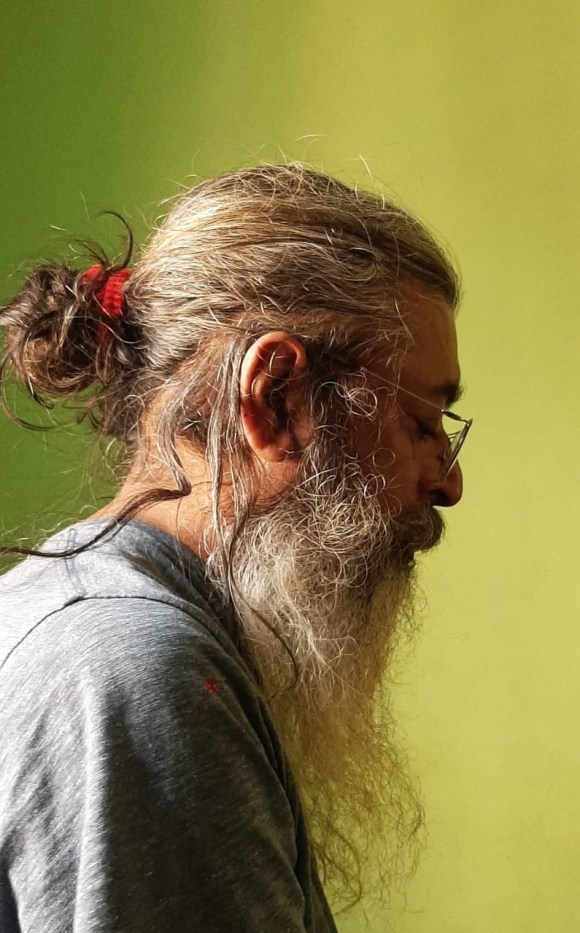
Professor Fakrul Alam translates two songs by Nazrul on social isssues from Bengali
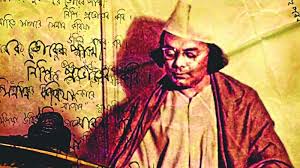
Kazi Nazrul Islam (1899-1976)
Born in united Bengal, long before the Partition, Kazi Nazrul Islam(1899-1976) was known as the Bidrohi Kobi, or “rebel poet”. Nazrul is now regarded as the national poet of Bangladesh though he continues a revered name in the Indian subcontinent. In addition to his prose and poetry, Nazrul wrote about 4000 songs.
Arise O Woman
Arise, o woman, arise flaming! Arise, daubing your forehead blood-red, Everywhere unfold your flaming tongue. Dance wildly—excited, inspired. Arise, hapless, maligned snake, Awake, kindling the world aflame! Burn briskly, o fume-filled smoky one, Arise, mothers, daughters, brides, wives, nieces. Arise prostitutes, cast out, exiled ones With the tidal force of the Ganges, arise, Down-trodden ones. Streaking clouds with lightning Arise, aroused by Durga, the ever-triumphant one.
‘Arise O Woman’ performed in Bengali
Two Flowers on One Leafstalk
Hindu and Muslim -- two flowers on one leafstalk -- Muslim its jewelled eyes, Hindu its heart and soul! In the lap of their mother, the same sky is reflected, Where sunlight and moonlight alternately sway. Within their bosoms the same blood courses While the same navel string binds the twain. We breathe the same earth mother’s air And drink the same earth mother’s water. In her bosom, the same fruits and flowers grow. In the soil of the land are burial sites quite akin -- Doesn’t matter if one is called Gore -- the other Shoshan! We call out to our mothers in the same language. We sing for them songs strung in similar tunes!
Dolly Narang muses on Satyajit Ray’s world beyond films and shares a note by the maestro and an essay on his art by the eminent artist, Paritosh Sen
Brochure cover: Provided by Dolly NarangSatyajit Ray(1921-1992): From Public Domain
My trunk call from Delhi to Calcutta booked one day before finally materialised. This was way back in 1990 when trunk calls were the fastest mode of communication. In a coarse voice, the operator demanded a response from the deep, modulated voice on the other end. ‘Satyajit Ray hai[1]?’ she asked, her tone sharp with impatience.
I could hear the legendary filmmaker’s composed response to the operator’s gruff, abrupt tone. I winced at her brusqueness feeling helpless to intervene and apologise.
When she connected me, I introduced myself to Satyajit Ray and ventured to share my idea of an exhibition that would showcase a lesser-known yet equally fascinating facet of his oeuvre—his drawings, film sketches, graphic design and more. A visual archive that, though rarely seen by the public, was as significant as his cinematic legacy. He was initially apprehensive—modest about this body of work and uncertain about how it would be received
This initial conversation was followed by a series of follow-up exchanges over trunk calls, over several months. Each call felt like a step closer to realising the exhibition. I would book trunk calls in the urgent category request for PP (person to person) as they took less time to materialise. PP calls were specifically for the person whose name was specified. Still, patience was essential.
Ray, to my surprise and admiration, always answered the phone himself. No secretary, no assistant screening the calls. The simplicity and humility was endearing.
I had first shared the idea of the exhibition with Paritosh Sen one of India’s master painters and a friend of Ray’s of an exhibition of a lesser known yet fascinating facet of Ray’s genius: children illustrations, detailed film sketches, designs for book and magazine covers, typeface designs, his diverse portfolio of graphic work. Paritoshda, as I affectionately called him who mentored and guided me as I began my journey into the art world, not only approved of the idea but took it upon himself to speak to Ray, whom he knew personally. Following the introduction through Paritoshda, I pursued the idea with the legend.
During the first phone call, I briefly spoke about my concept— an exhibition that would focus on his rarely seen visual art. His immediate response was hesitant and guarded, “These are very small works on paper just a few inches in length and width.” he said. “They would be of no interest.” I ventured that this was a unique and a first time view into his visual legacy and the size would not take away from the impact. He further expressed his doubt about his graphic work having any resonance beyond Bengal, in North India. I further submitted that his artistic genius and versatility has an appeal beyond Bengal. This exhibition would give a rare insight into the work and thought process of not only the deeply respected and admired film maker that we all know but also of Satyajit Ray the illustrator, the graphic designer, along with revealing the meticulous and detailed planning into his films.
I hoped to bring this body of work — into public view for the first time. The idea was to get people to see another Ray — not the filmmaker behind the camera, but the artist behind the pen and brush.
I remember Ray had explained that he had a busy schedule and preoccupied with the editing of Ghare Baire. After several months of trunk calls and waiting, I booked another urgent, person to person call. Finally the breakthrough I was waiting for, “ Come next week,” he said. His doubts of an exhibition having been cleared through the intervention of Paritoshda and somewhat through my persuasion.
As I boarded the Indian Airlines flight to Calcutta the following week, a surge of excitement gripped me. I was given a morning time to meet him at his residence: 1/1 Bishop Lefroy Road. I arrived with some trepidation. Standing outside this tall imposing door, I rang the bell. Soon, I found myself face to face with the master who opened the door himself—his tall, commanding presence matched only by his deep, well-modulated baritone voice greeting me warmly. He led me into his much photographed studio/workplace. He was looking comfortable and relaxed in a white kurta pajama. In contrast to his majestic yet simple presence, I was nervous and hoping it was well masked.
Thereafter, began a series of visits to his flat. Each time the door was opened by the master himself. And I would be led into his study teeming with books lining the teak wood book shelves.
He would sit in a comfortable looking swivel chair with a brown rexine cover, the corners of which were slightly frayed. Opposite him and within a comfortable arms reach was a small work table with jars tightly packed with paint brushes, pen, pencils. Here is where he did his drawings to create his vast and varied visual legacy of set design, costume design, make up instructions, graphic design, children’s illustrations for the monthly children’s magazine, Sandesh, started by his grandfather, He also designed the covers for Sandesh, more books and magazine covers.
Making of the exhibition
Working alongside him to sort through his drawings was an enriching and memorable experience—one that offered rare insight into his creative mind. Each meeting felt like a step closer to the exhibition becoming a reality. I noticed his interest was slowly growing and he was participating in the selection with increasing enthusiasm and a discerning eye. He approved some while some he felt need not be exhibited. Our meetings would stretch till lunch time until he was gently summoned by his wife, Bijoyadi, to take his lunchbreak. He would extend the search and wrapped up a little beyond lunch time. I too was cautious not to overstep limits.
As he began to look in his study, he unearthed these miniature treasures on paper tucked between books or between their pages, resting on tall teakwood bookshelves. Some were found under sofa cushions. He remembered that many were with his cousin Lila Majumdar[2] and that he would have to ask her. As he delved deeper into his collection he remarked, “I had forgotten I have done all this work.”
During few initial meetings, I would address him as Mr. Ray, which was beginning to feel formal and somewhat awkward. So I asked if there was another way I could address him.
“Manik,” he asserted. “Everyone calls me Manik.”
From that moment on, I called him Manikda. These recollections return to me vividly as I write this piece.
We turned our attention to his iconic crimson books, neatly stacked in his study. These well-known volumes are a treasure of Ray’s meticulous preparatory work—filled with detailed sketches for his films, costume and set designs, makeup instructions for his makeup artist, architectural notes, and an astonishing range that gave glimpses into his thought and work process.
Sourced from the brochure provided by Dolly Narang
We did not want to remove any drawings from these precious notebooks. He selected the drawings that he liked and decided he would ask Nemai Ghosh (1934-2020), his close associate and long-time photographer, to photograph them for the exhibition.
Several drawings, having come loose from the notebooks, were used in their original. We did not want to remove any drawings which were firmly in place in these volumes. Ray identified the drawings that appealed to him and Ghosh photographed them.
Part two of the exhibition was titled “Drawings and Sketches For Films’ and it comprised of both originals and the photographs by Nemai Ghosh of the drawings chosen by Ray.
I nudged him further and asked if there was anything else he might suggest from his visual repertoire.
He thought of his film posters. The ones readily available in his flat were posters of Nayak and Ghare Baire, which were loaned for the exhibition. He was particularly eager to include the poster of Devi, but after searching, he discovered he only had one copy and was reluctant to part with it.
Top: Hoarding of Ray’s film Goopy Gyne Bagha Byne (1969). Below:: Film posters of Nayak(Actor, 1966) and Ghore Baire (Home and the World, 1984). Sourced from the brochure provided by Dolly Narang
We tried to include artworks which would represent the different aspects of his visual repertoire. It seemed there was no end — typefaces he had designed, advertising campaign when he worked for D.J.Keymer. While searching he realised he did not have the originals of the typefaces he had designed but fortunately they had been preserved in the photographs taken by Nemai Ghosh. Later Paritoshda told me that he was given an award for the typeface by an American foundry and named it after him, Ray Roman.
Provided by Dolly Narang
An album was discovered containing a silent film he had conceptualised on paper but never brought to life—a silent film on Ravi Shankar with his music in the background. The album, composed of monochromatic black watercolours, was photographed by Nemaida. It drew great interest, offering a first-ever glimpse into a project that was never realised.
Paritoshda advised that Ray had composed music for many of his films. A tape with his compositions was playing continuously and softly in the background at the exhibition.
The exhibition was presented in two parts each had a duration of three weeks. Part one was devoted to his Graphic design, drawing and part two was about his preparatory sketches for films.
I requested Paritoshda to write an article for the exhibition catalogue, to which he graciously agreed. He penned an insightful essay which was appreciated by Ray himself as well as by fellow artists, critics, and visitors who found his insights both illuminating and deeply engaging. When I asked him for his suggestion for a title for the exhibition, he thoughtfully suggested — “The Other Ray” — a title both fitting and meaningful.
With the socio-political upheavals around us in Delhi, it wasn’t easy—cataloguing, printing invitation cards, framing, arranging transport to distribute the invitations. Invitation cards from our mailing list of over one thousand had to be hand delivered.
I asked Manikda for names of his friends and associates who he would like invitations to be sent to. His list included names both in India and abroad.
About a week before the event, I visited AIFACS[3] to put up a poster for the exhibition. To my surprise and delight, sitting in one of the exhibition halls was none other than M.F.Husain himself. It felt like a godsend—an unexpected opportunity to personally invite him.
He was visibly excited upon hearing about the exhibition and expressed interest in seeing the artworks immediately wherever they were. I explained that the pieces were still at home and would be better appreciated once they were displayed on the gallery walls. But he was insistent—he wanted to see them right away. We got into my car and drove to my house. Husain viewed the works in thoughtful silence moving from work to work, looking at each with great interest. After perusing them keenly he settled at the dining table and began reminiscing about his association with Ray – a moment as historic as it was moving, etched forever in my memory.
I was not prepared with either a tape recorder or a camera to record this memorable encounter. Fortunately, The Illustrated Weekly, under editor Pritish Nandy, later published his reflections in an article spread over two pages with several illustrations of his graphic work.
Opening to the Public
When the exhibition finally opened at The Village Gallery in New Delhi’s quaint Hauz Khas Village it was received with great enthusiasm and acclaimed by both critics and the public
Visitors from all walks of life came to see the “ The Other Ray”. For many, it was a revelation. The same legendary filmmaker who had given the world The Apu Trilogy had also crafted whimsical illustrations for children, designed book jackets, created typefaces. It was exciting for them to get a peek into his creative process as a filmmaker through his detailed film sketches.
I made another trunk call to inform him that the article in the brochure by Paritosh Sen had been chosen for The India Magazine’s cover story. The next day, when I spoke to him again and offered to send him a copy of the magazine, he responded with excitement. He said he couldn’t wait and had already gone to the market to buy a copy for himself.
Once the exhibition—having stirred great excitement in the art world—came to an end, it was finally time to take it down. The last few days were deeply moving. Visitors lingered, often spending long hours in the gallery, reluctant to leave, as if trying to hold on to the experience a little longer. The space was filled with quiet reflection and enriched by heartfelt exchanges.
Looking back, organising this exhibition remains one of the most fulfilling experiences of my life. What I cherish is the memory of the many hours spent in his study carefully selecting the works for the exhibition. It was a collaborative process, he was open to my suggestions yet he became more and more involved as he delved deeper into his graphic work.
An idea, carefully nurtured, took shape as an exhibition. What was especially fulfilling about the exhibition was how it brought to light a lesser-known facet of Ray’s creative genius—his remarkable visual imagination, his penchant for details, his industriousness. Until this exhibition, only a few of his sketches had appeared in articles and books, leaving much of this work largely unseen. The display offered audiences a rare and intimate glimpse into his visual world as well as his work and thought process, making it especially significant.
The final step was to return the works. I personally placed each delicate sheet into thin plastic sleeves, compiled them into a portfolio, and flew to Calcutta to return them to the master. True to his dignified demeanour, he received the compilation with quiet pleasure. He expressed both satisfaction and a hint of surprise at the enthusiastic response the exhibition had received. I took the liberty of asking him if I could keep as a memento two works from each part of the exhibition. He readily agreed and asked me to choose. I selected one black white illustration for Sandesh and credit title from his film Sonar Kella (The Golden Fort, 1974) . One more request — Could he sign these please? To which he graciously agreed.
As I took my leave, I shared a thought—could we perhaps work on a sequel to The Other Ray? He received the idea warmly, but unfortunately, it never came to fruition. He soon became immersed in Agantuk (The Stranger, 1991), and not long after, his health began to decline.
As I write this, memories come rushing back, and I find myself tempted to echo Manikda’s words of my experience that “I had forgotten I had done all this work.”
Costume designed and sketched by Ray for Hirak Rajar Deshe (In the Country of the Diamond King, 1980) Sourced from the brochure provided by Dolly Narang
Ray’s Note in the Brochure:
My grandfather was, among other things, a self-taught painter and illustrator of considerable skill and repute, and my father — also never trained as an artist — illustrated his inimitable nonsense rhymes in a way which can only be called inspired. It is, therefore, not surprising that I acquired the knack to draw at an early age.
Although I trained for three years as a student of Kalabhavan in Santiniketan under Nandalal Bose, I never became a painter. Instead, I decided to become a commercial artist and joined an advertising agency in 1943, the year of the great Bengal famine. Not content with only one pursuit, I also became involved in book designing and typography for an enterprising new publishing house.
In time I realised that since an advertising agency was subservient to the demands of its clients, an advertising artist seldom enjoyed complete freedom.
This led me to the profession of filmmaking where, in the 35 years that I’ve been practising it, I have given expression to my ideas in a completely untrammelled fashion.
As is my habit, along with filmmaking, I have indulged in other pursuits which afford me the freedom I hold so dear. Thus, I have been editing a children’s magazine for thirty years, writing stories for it and illustrating them, as well as illustrating stories by other writers.
While preparing a film, I’ve given vent to my graphic propensities by doing sketches for my shooting scripts, designing sets and costumes, and even designing posters for my own films.
Since I consider myself primarily to be a filmmaker and, secondarily, to be a writer of stories for young people, ·I have never taken my graphic work seriously, and I certainly never considered it worthy of being exposed to the public. It is entirely due to the tenacity and persuasiveness of Mrs. Narang that some samples of my graphic work are now being displayed. Needless to say, I’m thankful to Mrs. Narang; but, at the same time, I must insist that I do not make any large claims for them.
Ray’s signature: Sourced from the brochure provided by Dolly Narang
SATYAJIT RAY
The Consummate Artist by Paritosh Sen (1918-2008)
(Republished from the brochure of “The Other Ray” exhibition)
It was the summer of 1945. I was holding my third one-man show and my first in Calcutta. On the third day of the exhibition, Prithwish Neogy (a brilliant scholar, now heading the Department of Asiatic Art at the Honolulu University) entered the exhibition hall accompanied by an extraordinarily tall and swarthy young man. I had known Prithwish earlier. The latter was introduced to me as Satyajit Ray. I was vaguely aware of him as the only son of the late Sukumar Ray, the creator of a unique body of nonsense rhymes and humorous prose remarkable for their originality of vision and an extremely sharp intellect and imaginative power. Satyajit was also known as the grandson of Upendra Kishore Ray, one of the inventors of half-tone block making, a pioneering creator of a sizeable body of children’s literature and the founder of the well-known children’s magazine, Sandesh, and a painter of no mean talent either.
Satyajit was then doing a course in painting in Santiniketan under the very able guidance of Benode Behari Mukherjee, a great artist and an equally great teacher. Besides, Ray had also the unique opportunity of coming in close contact with Nandalal Bose, the guru of both Benode Behari and Ram Kinkar, undoubtedly the foremost sculptor of contemporary India.
Earlier he had also received the blessings and affection of Rabindranath Tagore. Although he did not complete the art course in Santiniketan, the experience of being surrounded by these great artists and the unique rural setting of the Santhal Parganas, as portrayed by these artists and the poet, enabled Ray to appreciate nature in all its diverse and glorious manifestations and opened his eyes to the mysteries of creation. This single unprecedented and cherished experience helped him to formulate his ideas about the visual world and to unlock doors of visual perceptions. Added to this was his study and understanding of the classical and folk art, dance and music of our country. The magnificent collection of books in the Santiniketan library of world art and literature also helped him to widen his horizon. It was here that he read whatever books were available on the art of cinema. The seeds of a future design artist and a filmmaker were simultaneously sown here.
Having lost his father early in life, the need for earning a livelihood assumed enough importance to make him leave Santiniketan prematurely and look for a job in the field of advertising art or, as it is better known in modern parlance, graphic design. A latent talent is bound to make its presence felt sooner or later, whatever be the chosen field. As Tagore said in one of his early verses, “Flowers in bloom may remain hidden by leaves but can they hide their fragrance?” Satyajit Ray was appointed by the then D.J. Keymer (now known, as Clarion Advertising Services Ltd.) as a visualiser-cum-designer, often executing the finished design or an entire campaign himself.
Together with two of his contemporaries, O.C. Ganguli and Annada Munshi, Ray was trying to evolve certain concepts not only in illustrations but also in typography which would give their design an overall Indian look. One recalls those highly distinctive newspaper and magazine ads, the magnificent calendars, posters, cinema slides and what not of the late ’40s and ’50s not without a certain nostalgia. If my memory does not fail, I think some of the works of these three artists were even published in Penrose Annual and elsewhere. Here it may be worthwhile to bear in mind that the style evolved by these three artists made a welcome departure from the dull academicism and the stereotypes being practised by most of the advertising agencies of those times. The freshness and vigour displayed in their approach was readily appreciated both by their employers and their clients. Ray was particularly strong in the difficult area of figure drawing, an area in which many graphic designers were found singularly wanting.
Although he was soon to move away from commercial art to embrace his new-found love of filmmaking, he would continue to remain an illustrator of the first order as would be evident from his emergence as a story-teller in the two popular genres of detective and science fiction. (Not many outside Bengal know that Ray’s literary output is in no way less than that of his cinema and that most of his books have already run into thirty to thirty-five editions). He has not only been illustrating his own stories, but over the years he has been designing the covers of his grandfather’s once defunct children’s magazine Sandesh, revived by him nearly two decades ago, which also carried many illustrations by him. But in my opinion his most cherished field is calligraphy, whether that be of the pen or brush variety.
Illustrations from Sandesh: Sourced from the brochure provided by Dolly Narang
This art he imbibed from his guru Benode Behari Mukherjee. Over the years he had also been studying the art of typography with the scrutinising eye of a highly creative calligrapher. The result has been a series of innovations in both Bengali and English lettering evolved for posters, banners and book covers. These very original works gave a tremendous fillip to graphic design in general and book, magazine and record covers in particular, especially in Bengal. The books Ray designed for the now defunct Signet Press of Calcutta way back in the early ’50s set new trends and were considered as models for book production both in terms of page layout, typography and jacket design, the last being his chosen field where, as I said earlier, his innovations have known no bounds. The covers of the well-known literary magazine Ekshan, which he has been designing for many years, to give only one instance, bear ample testimony to his apparently playful but significant experiments with the forms of three Bengali letters which constitute the name of the magazine. The wide variety of his inventiveness is one of his great achievements in the field of cover design.
Cover designs for Ekshan. Sourced from the brochure provided by Dolly Narang
Then there are the posters, banners and slides he designed for his own films. These too were eye openers and instant trend setters. Who can ever forget the huge banners and billboards of the Apu trilogy put up at important street junctions of Calcutta! Their freshness of ideas, design concepts and calligraphy were not to be missed even by men and women in the street. Simultaneously with his creative outburst in the art of cinema, his creativity in graphic design reached new heights. What was remarkable was the fact that Ray imminently succeeded in investing all these works with a highly distinctive Indian flavour derived from his awareness of our folk traditions (especially 19th century Bengali book illustrations and woodcut prints of decorative lettering) both in their linear vigour and simplicity as well as in ornamentation.
One of the most outstanding examples of this approach was the publicity material he designed for Devi. The underlying theme of the title expresses itself forcefully both in the highly imaginative design of the lettering and the image. Their fusion is perfect. Not many graphic designers have been as type conscious as Ray. He personifies the printing designer’s gospel “type can talk”. That a letter or a printing type is not only a sign but an image by itself, and if appropriately employed can have immense communicative power and is capable of expressing a whole range of human emotions was known to Ray from the very beginning of his career.
In the enormous range of Roman printing types there are many in the humanist tradition in their simple aesthetic charm, warmth of feeling as well as in their highly elegant but delicate anatomical details. There are also those which are severe, powerful and cold but nonetheless are highly attractive in their own ways.
It is often overlooked by most readers that a letter’s structure and anatomy can be reminiscent of things in the visible world, both natural and man-made. Some can have the gentle rhythm of the rise and fall of a female form, others may have the majestic look of a well-designed edifice-just to give only two similes. Ray not only bore all these considerations in mind but used his calligraphic knowledge, skill and innovative power to their full advantage when he designed the three printing types called Ray Roman, Daphnis and Bizarre for an American type foundry nearly two decades ago.
Sourced from the brochure provided by Dolly Narang
Not many of us know the infinite patience, rigours, discipline and the endless process of trial and error involved in designing a whole series of a printing type. That, in spite of his other demanding preoccupations, he found enough time to design three complete sets of types bears ample proof of his diligence and perseverance and his passionate love for the world of types. Those of us who have known him over the past decades are profoundly admiring of the fact that he is a workaholic in the best sense of the term. His diverse creative output is staggering and would put many a man half his age to shame.
In the ’40s, I met Satyajit periodically as I worked as an art master in Indore. One of the high points of my visits to Calcutta during the long summer or the short winter holidays was to frequent his ground-floor apartment in South Calcutta. It was at his place I first listened to TS Eliot’s recital in the poet’s own voice of TheWaste Land which was just brought out by HMV (now known as EMI). It was on such visits I would also have an opportunity to listen to his latest collection of records of European classical music. And it was also on one of such occasions I first heard him toying with the idea of making a film based on Rabindranath Tagore’s novel, Home and the World, a project which was abandoned soon after and was finally realised nearly four decades later.
It was not before1 returned home in 1954 after a five years’ stint in Paris that I came to know of his intense involvement with the making of Pather Panchali[4]. I vividly remember to this day the excitement with which he described it to me and invited me to a screening of the rushes. He brought out all the sketches and doodles he made along with side notes in Bengali not only of the dress, props and characters in the script but also very quick but masterly sketches of frames of each of the sequences, camera movements, etc. I remember asking him why he thought it necessary to make such careful preparations before shooting. To which his quick but significant reply, “One of the foremost but very difficult things in filmmaking is to determine the placement of the camera.” He was equally quick to point out that this is only the first part of shooting a movie and not stills.
Those of us who watched him in action know only too well that although there is always a professional cameraman present in his unit, in reality he becomes the cameraman himself. The visual richness of a film is as important to him as a story well told — the one being inseparable from the other. This is the most distinctive feature of his artistic achievements in all his films.
Ray is a lyricist of the highest order. From his first film Pather Panchali to his latest ShakhaPrashakha[5], this lyrical bend binds all his films together in the form of an oeuvre and finds full fruition in his most recent work.
Some of the imperceptibly slow camera movements in this film are sheer poetry. Although not yet released, I had the opportunity of seeing it twice, and apart from anything else, I as a painter was bowled over by its visual richness and its consummate technical finesse. I have reasons to say this. Whenever I see a movie, I try to see it through the lens of the camera and having witnessed many film shootings of some of Ray’s films, it has become a habit with me to follow the movements with great fascination. Thus, it helps me greatly to enjoy watching a film from the aesthetic and technical viewpoint.
I am sure that in order to achieve maximum artistic quality Ray finds the preliminary exercises made primarily in pen and ink very useful. These small and simple sketches, evidently done in quick succession, have all the spontaneity and vigour of something impeccably visualised and bear the unmistakable stamp of a born lyricist. Their linear treatment, unorthodox positioning on paper and an apparent insouciance, at any rate, in my eyes, are the products of a highly creative mind and are designed to meet the needs of a fastidious aesthete.
Among the sketches, one comes across portraits of many of the characters in his films in various moods and postures. These could easily be rated as some of his best works in this group. Only someone with consummate skill can bring out the full characterisation in a postage-stamp format with utmost economy and clarity. The lines which define the contours and other details of the figures are free flowing, sure and firm, the result of years of practice both with the pen and the brush.
One of the most interesting exhibits in the present collection is the album containing one of his earliest essays in visualisation of a film project — the documentary he once wanted to make on Ravi Shankar playing the sitar and on the tabla accompaniment. Ray showed it to me as early as 1954. It is possible that the inspiration came from his viewing Uday Shankar’s ballet film, Kalpana (Imagination) -– a film which he studied frame by frame by taking scores of stills in the dark theatre where the film was released. He showed me the entire series one by one and pointed out among other things the unusual camera angles, the dramatic lighting, the magic of black and white, especially in the close-ups of both the dancers and the tabla playing. Although the Ravi Shankar film was never released, I think Ray thoroughly enjoyed the exercise and learnt a lot from it.
Sourced from the brochure provided by Dolly Narang
This, along with numerous sketches and doodles related to his films, will ever be regarded as something unique in the history of filmmaking in our country.’ Only a few’ and they can be counted on one’s fingers, in world cinema have been such gifted artists too like Eisenstein, Kurosawa, Fellini and a few others. The Village Gallery should be congratulated for presenting to us “The Other Ray – the Consummate Artist.”
Dolly Narang, a gallerist, has conceptualised innovative pathbreaking exhibitions. A recent student of sculpture, she has the satisfaction of experiencing both personal and spiritual evolution as a Pranic healer and as a grandmother.
.
PLEASE NOTE: ARTICLES CAN ONLY BE REPRODUCED IN OTHER SITES WITH DUE ACKNOWLEDGEMENT TO BORDERLESS JOURNAL
Title:One More Story About Climbing a Hill: Stories from Assam
Author: Devabrata Das (translated from Assamese by multiple translators)
Publisher: Speaking Tiger Books
1. A Night with Arpita
(‘Arpitar Erati’ translated by Meenaxi Barkotoki)
The side berth was created by lowering the back rests of the two single seats along the aisle of the compartment. Crouching in one corner of that berth, chin in her hands, eyes looking out of the window, could the expression on her face be called disinterest, or was it heartache? On the other hand, she had not the slightest curiosity about what was going on inside the compartment. Drawing the free end of her sari tightly around the upper half of her body, she had withdrawn even her feet into the cavity created by her sari. Her presence in the compartment seemed more like an absence. She seemed completely oblivious and unaware of her surroundings; her look betrayed a sense of resignation. Or perhaps of surrender.
Having positioned myself in the compartment, the sense of resignation that was evident in her demeanour attracted me to her the very first time that I looked at her attentively. I told myself that if I wrote a story someday on the girl, I would name her Arpita (the one who offers herself). Arpita what? Ganguly or Acharya, Roy or Majumdar? Because on hearing the Hindi strewn with Bengali words spoken by the girl’s father, (who had complained animatedly to the waiter about the stale fish served for the meal) I was certain that the girl was not an Assamese disguised in a sari, she was actually Bengali. Regardless of whether she was Assamese or Bengali, she was just a girl, a more or less pretty girl, and she was presently in another world, completely oblivious to her surroundings. Her entire being was concentrated on a point in the darkness of the world outside the compartment, a point that could easily be defined as infinity. Her absentminded beauty aroused my curiosity. Puffing at my Charminar cigarette I kept staring at her from my middle berth in the three-tiered compartment. Just then Kiran returned from the bathroom and broke my reverie. ‘What is this? Why are you already in bed? You don’t mean to go to bed so early, do you?’
This story is actually the story of Arpita and me. I am the protagonist, Arpita the heroine. Apart from the two of us, there is no need for anyone else in this story. The problem, however, is that in order to be able to describe the chain of events, the inclusion of some redundant characters becomes necessary; their presence in the story is not essential but without them it is difficult to narrate what happened. Among those extras, unnecessary characters actually, one is my friend Kiran Debnath. We work in the same office and it is on official work that both of us are travelling by train to another city. We had to travel at very short notice, so we had no reserved train seats; hence the second unnecessary character, Krishna, became necessary. Krishna lives in our neighbourhood. A young man barely out of his teens, he had recently joined the NF Railway as Travelling Ticket Inspector, in short TTI. The moment I saw him at the train station, I was relieved; we wouldn’t have to travel in the crowded, unreserved compartment after all. Since Krishna was there, with his help we would get at least two sitting seats for ourselves. But luckily there was not a huge rush that day and after doing the rounds, Krishna arranged two sleeping berths in a three-tier compartment for us. The sleeper charges for a night are five rupees fifty paise each, so eleven rupees in all. I gave him three five-rupee notes. He forgot to return the change. A little while after the train started, another uniformed ticket checker came and wrote out our reservation slips. The fourth unnecessary character in this story is Arpita’s father, who, after finishing the long and animated argument with the waiter about the stale fish served for dinner, turned his attention to his daughter. She was still staring out of the window. He told her to lie down and go to sleep, and gave her other sundry bits of advice, all of which were met with monosyllabic answers. He then climbed onto the upper berth, above his daughter. In a little while, his snoring proved that he was fast asleep. This is the last time I will mention these unnecessary characters, except for Kiran.
I told Kiran that we had a lot to do the next day. We would have to go through all the documents and records of our branch office in the town we were travelling to. It was not clear whether we would have any free time at all. So instead of sitting up chatting till late in the night, since we had secured two sleeping berths, it might be wiser to go to sleep. Like a good boy, Kiran agreed immediately and went to sleep in the berth below me. To tell the truth, I was not at all sleepy. If I had wanted to or if we were somewhere else, I would have easily chatted with Kiran for an hour or two. But at that moment, in that situation, the single-minded desire to enjoy the distracted attractiveness of a beautiful girl made me give up the wish to chat with Kiran.
Arpita sat immersed in herself on the rattling train, on that otherwise still night, ignoring the silent presence of the many other passengers sleeping in the compartment. No exam results had been declared recently. Then why was Arpita so unwaveringly distracted and sad? Was her pain intensely personal? For instance, had some sly lover cheated her and gone away, after having made a thousand promises of many-hued rainbows and eternal love? Or was there some complication in her recent wedding proposal? Had the partner that her parents chose for her, seen and approved of her but demanded a huge dowry, which made it completely impossible for her to leave her parents’ home? What could it be? What was her real story?
(Extracted from One More Story About Climbing a Hill: Stories from Assam by Devabrata Das, Published by Speaking Tiger Books, 2025.)
About the Book:
In ‘A Night with Arpita’, a beautiful young girl in a train compartment captures the imagination of the writer—but he is unable to fathom the reason for her melancholy until it is too late. In ‘Ananta with His Seema’, three apparently disconnected incidents take place on a railway platform. Descriptions of the incidents are interspersed with passages from a letter written by Ananta’s friend, that lays bare his helplessness in the face of injustice and the loss of his youthful ideals.
In the eponymous story, life imitates art with a disastrous twist. A young couple treks up a hillside to recreate for themselves the experience of two characters in a love story set in idyllic Shillong. But the beauty of the pine shrouded hills is marred by extremist violence and their climb to the top of the hill has an unforeseen, macabre end.
Each of the eighteen stories, translated by multiple translators, in this collection provides an insight into life in an area of conflict, told with irony and ingenuity. Regarded as a torchbearer of post-modernism in Assamese literature, Das is often a character in his stories, blurring the distinction between writer and narrator and, often, between fiction and reality, leaving readers to construct their own endings. This first English translation of his work is a valuable addition to the pantheon of India’s regional literature.
About the Author
Devabrata Das is considered to be a torchbearer of post-modernism in Assamese literature, following in the footsteps of other great Assamese writers such as Saurav Kumar Chaliha and Bhabendra Nath Saikia. With more than twenty-five bestselling books to his credit in a career spanning more than four decades, his repertoire ranges from fiction to non-fiction, and from screenplays to reviews and critical essays. He received the Sahityarathi Lakshminath Bezbarua Award in 2018, the Sahitya Sanskriti Award of the literary organization Eka Ebong Koekjan in 2010, and the Tagore Literature Award of the Sahitya Akademi in 2011.
About the Translator
Meenaxi Barkotoki is a mathematician turned anthropologist by profession. An avid translator from Assamese into English, her most recent work includes a couple of novels, notably a children’s novel by Arupa Patangia Kalita titled Taniya (Puffin Classics, 2022). Her translations have appeared in newspapers and periodicals as well as in prestigious compilations like The Oxford Anthology of Writings from North-East India (OUP, 2011) and in Asomiya Handpicked Fictions (Katha, 2003). She also writes short stories, travel pieces and current interest articles, and her work has been published in newspapers, journals and magazines. She is a Founding Member of the North East Writers’ Forum.
.
PLEASE NOTE: ARTICLES CAN ONLY BE REPRODUCED IN OTHER SITES WITH DUE ACKNOWLEDGEMENT TO BORDERLESS JOURNAL.
Offerings during Qing Ming Jie, a festival honouring ancestorsSongkran(Thai New Year) CelebrationsFestivals in April: From Public Domain
April is a month full of celebrations around the world. Asia hosts a spray of New Year festivities. Then there are festivals like Qing Ming Jie, Good Friday and Easter. All these are in a way reminders of our past. And yet, we critique things as old fashioned! So, where does tradition end and ‘outdated’ or ‘outmoded’ start? Meanwhile we continue to celebrate these festivals with joy but what happens to those who have lost their home, family and their living due to war or climate disasters? Can they too join in with the joie de vivre? Can we take our celebrations to them to give solace in some way?
In our April issue, we have stories from climate and conflict-ridden parts of the world. From Bangkok, Amy Sawitta Lefevre gives an eyewitness account of the March 28th Earthquake that originated in Myanmar. While in her city, the disaster was managed, she writes: “I’m also thinking of all the children in Myanmar who are sleeping in the open, who lost loved ones, who are feeling scared and alone, with no one to reassure them.” As news reels tell us, in Myanmar there have been thousands of casualties from the earthquake as well as shootings by the army.
From another troubled region, Pakistan, Zeeshan Nasir gives a heartrending narrative about climate change, which also dwells on the human suffering, including increase in underage marriages.
Human suffering can be generated by rituals and customs too. For instance, if festivals dwell on exclusivity, they can hurt those who are left out of the celebrations. Odbayar Dorje muses along those lines on Mongolian traditions and calls for inclusivity and the need to change norms. On the other hand, Devraj Singh Kalsi hums with humour as he reflects on social norms and niceties and hints at the need for change in a light-hearted manner. Farouk Gulsara makes us laugh with the antics of his spoilt pet cat. And Suzanne Kamata dwells on her animal sightings in Kruger National Park with her words and camera while Meredith Stephens takes us sailing on stormy seas… that too at night.
Art is brought into focus by Ratnottama Sengupta who introduces artist Haren Thakur with his adaptation of tribal styles that has been compared to that of Paul Klee (1879-1940). She also converses with filmmaker Leslie Carvalho, known for his film The Outhouse, and his new novel, Smoke on the Backwaters. Both of these have a focus on the Anglo-Indian community in India. Also writing on Indian film trends of the 1970s is Tamara Raza. Bhaskar Parichha pays tribute to the late Ramakanta Rath (1934-2025), whose powerful and touching poetry, translated from Odia by the poet himself, can be found in our translations section.
We have an excerpt from Professor Fakrul Alam’s unpublished translation of Tagore’sRed Oleanders. It’s a long play and truly relevant for our times. Somdatta Mandal shares with us her translation of Tagore’s essay called ‘The Classification in Society’, an essay where the writer dwells on the need for change in mindsets of individuals that make up a community to move forward. A transcreation of a poem by Tagore for his birthday in 1935 reflects the darkness he overcame in his own life. Two poems expressive of longings by Jibananada Das have been translated from Bengali by Professor Alam aswell. From Balochistan, we have an excerpt from the first Balochi novel, Nazuk, written by the late Syad Zahoor Shah Hashmi and rendered into English by Fazal Baloch. Among contemporaries, we have a short story by Bitan Chakraborty translated from Bengali by Kiriti Sengupta, a poignant story that reflects on gaps in our society. And a Korean poem by Ihlwha Choi rendered to English by the poet himself.
This issue has been made possible because of support from all of you. Huge thanks to the team, all our contributors and readers. Thanks to Sohana Manzoor for her fabulous artwork. Do pause by our contents page as all the content could not be covered here.
Perhaps, world events leave a sense of pensiveness in all of us and an aura of insecurity. But, as Scarlett O’ Hara of Gone with the Wind[2] fame says, “After all, tomorrow is another day.”
Looking forward to a new day with hope, let’s dream of happier times filled with sunshine and change.
Story by Bitan Chakraborty, translated from Bengali by Kiriti Sengupta
Bitan Chakraborty. Photo Courtesy: Kiriti Sengupta
The black smoke rises in a straight line. It will fade into the air as it reaches a certain altitude in the sky. The wind feels still today, causing a grey layer to form. Not long ago, Lali experienced recurrent bouts of excruciating pain, but now it refuses to subside. She tries to relax, her spine loosely resting against the wall of the leather factory. Lali shrinks again as her little baby stretches its limbs inside her womb. In the distance, her husband, Fatik, is tending to their domestic belongings in the dilapidated house. He is vigilant, working hard to safeguard their utility items. He won’t let anyone take away their hard-earned household goods. Fatik does not know what will be put into the fire. A few government-appointed people collect the crushed bamboo walls from the ghetto and add them to the flames. The more they burn, the more smoke rises. At a safe distance, a curious crowd observes the unfolding events.
Fatik packs goods in small quantities and takes them to Lali, who is resting under the shade. He quips, “I could have packed up sooner if I had someone to help. You’re in pain, huh? Hold on for a bit; we will board the train shortly.”
“Hey scoundrels, that’s mine. Keep it there, I’m telling you! Otherwise, I’ll put y’all in that fire.” Fatik rushes to their ruined house. It’s not a house anymore! An empty stretch reveals the impressions of bricks laid down for years. Fatik’s shanty looks the same — a square piece of land with torn plastic sheets and scattered, fragmented earthen roof tiles.
Lali continues to endure pain. Fatik appears exhausted; he is busy organising goods. There’s no point in disturbing him further with another complaint of discomfort. Lali remains silent and attempts to sketch the new place they will inhabit for the next few months or possibly years. No one will be a stranger there; they cannot afford the luxury of exploring exotic living. Fatik once told her, “Shashthida has affirmed that we can come back here once the air cools down.”
It’s easy to earn a living in the city, but finding a job is difficult in the countryside, where opportunities are scarce. Once the flyover is built, Fatik plans to return and set up a small eatery for the evenings. In a tone filled with love and care, Fatik tells Lali, “No one can resist the mutton curry you cook. All visitors will become regular customers at our shop.” Lali adds a touch of sass to her response, “I won’t. I’d rather teach you the recipe. You can then cook and feed them.” Gazing at the ceiling with wide eyes, Fatik remains lying in bed.
Lali does not believe in Fatik’s words that they will be able to come back here again. A few minutes ago, Hema came to see her, “My bad luck; I won’t get a chance to see your child. But you never know if I will meet you again somewhere else.”
“Won’t you come back here?” Lali asks.
“They will not allow us here again,” Hema replies. “The officials informed us that they were planning to build a marketplace below the flyover after its construction.”
Mum’s the word when Lali relays the news to Fatik. He murmurs, “But then Shashthida[1] has assured…”
“You can pursue a small shop in the proposed market,” Lali advises.
“I can’t say; they might ask for a cash lump sum as advance payment.” Fatik appears worried.
The pain shoots once again. Lali flings her legs aimlessly. The dusty floor reflects her movements. She remains silent. On the other side, Fatik gets into trouble with Dulu and his family. Dulu’s mother seems to have taken Lali’s rice pot. Lali raises her voice, “The pot is mine!” Unfortunately, her words go unheard.
2
Fatik knocks Lali with his bag, “Come on, the Hasnabad local is at platform eight. Walk along the straight direction.”
Lali has heard of the Sealdah railway station, but she has never been there. It is a large station with several platforms, numerous trains, and huge crowds. Passengers jostle against one another. With great caution, Fatik quickly walks across the platform to board the train and get into a compartment by any means necessary. There are likely a few travelling ticket examiners around, but during this time, they usually don’t enter the coach. Lali is unable to keep pace with Fatik and remains far behind him, but she compensates for the distance by tightly gripping one side of the gamcha[2] draped around his neck. Fatik collides with the commuters approaching from the other end, and a few passengers express their annoyance with a word or two of irritation. Fatik does not respond at all. Lali pulls her saree to cover her breast. She has no control over the saree girded around her head, which has now slipped onto her back.
The train will start in ten minutes. All coaches are full; not a single seat is vacant. Fatik quickly decides on a favourable compartment and boards the train with his wife. Lali cannot stand any longer, so she sits on the floor beside the door, her hands resting on her belly. Fatik arranges their bags around Lali. An elderly gentleman asks, “Where will you get off?”
“Barasat,” Fatik answers.
“What the hell are you doing here? Get inside the coach. Have you lost your mind or what? How can a sensible man board the train in such conditions?”
Fatik turns to his wife and whispers, “There aren’t any vacant seats. Do you still want to go inside?”
Lali refuses to move. The spasm has taken over her body and mind. She cannot stand up. She wants to stretch her legs to give her baby more space. However, the situation does not allow for that privilege. With each passing minute, more passengers crowd the coach, and the draft is cut off. In a dry voice, Lali calls out to her husband, “I cannot breathe. I need some air.”
“Wait a moment. The crowd should thin out after we pass two stations,” Fatik says.
As soon as the train departs, more than a handful of late passengers hurriedly board the coach. They will travel a long distance and want to get inside. The bags and goods piled around Lali create an obstacle to their movement. One of them raises his voice, “Is this a place to sit?” Another man from the crowd yells at Lali, “Stand up, I said!” Someone empathetically informs, “Try to understand; she is carrying.”
“Oh! This is horrible. Hey brother, you aren’t pregnant, are you? Better you stand up. More passengers will enter the coach at Bidhan Nagar and Dum Dum. They will smash you to death.”
Fatik gets anxious and follows the instructions. Lali shrinks in fear, feeling breathless. In her womb, she carries their only child, who waits to see the world — as if the baby complains, “I cannot stay in this small dark space anymore, Ma!” The passengers become frightened as Lali lets out a low moan of pain.
“Are you okay?”
Fatik bends toward Lali as much as possible to ask, “I’m sure it’s terrible to bear any longer.”
“No air; it’s suffocating!” Lali sounds fragile.
“It won’t be long; I’ll take you to the hospital as soon as we reach there. Shashthida has shared the address.”
Lali’s facial muscles contort in extreme agony. Fatik isn’t sure whether she has heard him. Intoxicated, Fatik had seen her suffer from pain before; during those times, he did not feel her distress. Lali wept profusely. Fatik never intended to hurt her but lost control as he downed liquor. The very next day, Fatik committed to his wife, saying, “I won’t trouble you anymore. All I want is a son!”
With a hint of dejection in her eyes, Lali poked, “Right! So, he can run a liquor shop you longed for.”
“Shut up! I’ll make him a real gentleman,” Fatik readily addressed her concern.
3
Several travellers board the train as soon as it stops at the next stations. Lali, who somehow remains seated on the floor, gets pressed painfully against the legs. She feels worse than ever. Fatik seems restless and cautiously peeks out from behind the crowd to read the station names. At times, he turns to look at the goods around him. A few passengers become irritated, saying, “What’s wrong with you? Why don’t you stand still?”
“Be careful, dada! Take care of your pocket. You never know…Dasbabu lost three hundred bucks yesterday only.” Someone from the crowd airs the words of caution.
Fatik understands the meaning of such lines. He does not utter a word, for he knows if he begins an argument, they will forcibly push him out of the coach at the next station and beat him like hell. He requests the passenger beside him, “Dada, please let me know as we reach Barasat.”
“We are currently at Cantonment. Please be patient; it will take another thirty minutes or so to reach Barasat.”
4
Lali wants to scream. She feels thirsty. Amid the numerous legs visible to her, she cannot identify Fatik’s. Even when Lali looks up to see the faces, she is unable to locate her husband. The child in her womb revolts; it will not tolerate the torture to which the mother is subjected. The baby twirls, rapidly changing positions. Lali realises that her child is responding to the world — specifically, the passengers in the coach. The tiny tot wishes to emerge from confinement to greet them. Lali is afraid — will they treat the child as lovingly as their family?
Fatik bends down and says, “We will get off at the next station. Several others will disembark. I’ll first grab the bags, and then I’ll help you off the coach. Be careful.”
Lali gathers her courage and prepares for the exit. She moves her palm over her belly, saying, “A little more waiting, Baba[3]!”
The train halts at Barasat. Passengers disembark from the train like a vigorous flow of water. Fatik feels puzzled as the bags scatter. A few passengers are still getting off. Meanwhile, many commuters waiting to board the train begin to enter. Ignoring the chaos, Lali tries to stand but fails. Fatik quickly gathers their bags and helps them to ensure a swift exit. The passengers ready to disembark push him out of the coach. Fatik cannot withstand the force and is shoved away from the train. The coach has room for more passengers and fills up quickly. Lali crouches toward the gate and cries, “Help! I’ll get off; stop the train.” People leaning out of the coach warn her.
No one can hear Lali. Fatik rushes to the coach to grip the gate’s rod, but he fails every time he stretches his hand to grasp it. A guy leaning out of the coach holds it in such a way that Fatik cannot access the rod. He refuses to give up and keeps running alongside the train. The thick crowd challenges his swift movement. Amid several passengers inside the coach, Fatik sees his wife’s hands and the two pairs of bangles she wears. He reaches the far end of the platform.
Fatik breathes rapidly. He is exhausted and sweating profusely. He shivers while keeping his head lowered. A drop of sweat rolls down his forehead and falls onto the tip of his nose. Fatik can see the passengers hanging out of the coach, trying their best to get inside. Amid their relentless efforts, Lali’s hands disappear.
[1] Dada/Da: In Bengali, the elder/older brother is calledDada(Dain short).Dada or Daissuffixed to the first or last name when addressing an acquaintance, relative, or stranger during a conversation. Bengalis also suffix Babu to a name (first or last) to show respect.
[2] A traditional, thin cotton cloth (generally, a handloom product) of varyinglengths used in Bengali households to dry the body after bathing or wiping sweat. It is also used in several Hindu rituals.
[3] Baba is father. But parents often use this word affectionately to address their sons.
(Translated from the original Bengali by Kiriti Sengupta. First published in the EKL Review in December 2021)
Bitan Chakraborty is essentially a storyteller. He has authored seven books of fiction and prose, translated two collections of poems, and edited a volume of essays. Bitan has received much critical acclaim in India and overseas. Bougainvillea and Other Stories, The Mark, Redundant and The Blight and Seven Short Stories are four full-length collections of his fiction that have been translated into English. He is considered one of the flag-bearers of Indian poetry in English, being the founder of Hawakal Publishers. When Bitan isn’t writing or editing, he is photographing around Rishikesh, Varanasi, Santiniketan, among other places. He has successfully participated in the 3-day-long Master Class on Photography led by the legendary Raghu Rai. Chakraborty lives in New Delhi with Jahan, a pet Beagle. More at www.bitanchakraborty.com.
Kiriti Sengupta has had his poetry featured in various publications, including The Common, The Florida Review Online, Headway Quarterly, The Lake, Amethyst Review, Dreich, Otoliths, Outlook, and Madras Courier. He has authored fourteen books of poetry and prose, published two translation volumes, and edited nine anthologies. Sengupta serves as the chief editor of Ethos Literary Journal and leads the English division at Hawakal Publishers Private Limited, one of the top independent presses established by Bitan Chakraborty. He resides in New Delhi. Further information is available at www.kiritisengupta.com.
.
PLEASE NOTE: ARTICLES CAN ONLY BE REPRODUCED IN OTHER SITES WITH DUE ACKNOWLEDGEMENT TO BORDERLESS JOURNAL
Title: Needle at the Bottom of the Sea: Classic Bengali Tales from the Sundarbans
Translator: Tony K. Stewart
Publisher: Speaking Tiger Books
What comes to mind when we think of the Sundarbans? Verdant mangroves, elusive Bengal tigers, and the mystique of the Bay of Bengal. But the late Tony K. Stewart’s Needle at the Bottom of the Sea reminds us of another legacy—its rich cultural heritage. Stewart, a Gertrude Conway Vanderbilt Chair who did pioneering work in Bengali narratives, passed on in October 2024. This vivid collection of five timeless kathas (stories), one co-translated with Ayesha A. Irani, a scholar from University of Massachusetts, starts with a compelling introduction to the diverse syncretic traditions of the region.
The anthology has five stories that are translated lyrically in the form of story poems filled with suspense and surprises. The opening verse from the first translated katha “The Auspicious Tale of the Lord of the Southern Regions — the Rāy Maṅgal of Kṛṣṇarām Dās” poetically sets the mood of the genre and gracefully takes the reader to familiar and unfamiliar grounds and it goes as follows —
With palms pressed together in respect, I praise the lotus feet and magnificent girth of the Lord Dakṣiṇ Rāy, Master of the Southern Regions, … Against Baḍa Khān Gāji, the Great Sufi Warrior, You waged war throughout the territory’s canals and channels, but in the end you became close, fast friends.
The narrative depicts the incredible sophistication of the diversity in India with relatable characters and compelling themes, evoking emotions that we feel at different junctures of life, between life and death irrespective of religion, caste, culture or creed. Stewart uses vivid imagery and figurative enhanced with rhyme and rhythm to bring just enough for the reader in English without diluting the beauty of the language or history and culture of the original work. The beauty and quality of the literature is translation set in the beginning is maintained throughout the five sections. The rich mystical and spiritual spirit of the region is evoked in the coming together of the cultural elements in Hinduism and Sufism. As the introduction is named, the book is truly a unique flavour that brings “Bengali Tales from the Land of Eighteen Tides”
In these tales, the mythic meets the moral. Demigod Daksin Ray and Sufi warrior Bada Khan Gaji clash on the battlefield, commanding armies of tigers, until God intervenes as Satya Pir to mediate peace. They cross paths again when Gaji battles for his beloved Princess Campavati, and once more during Ray’s confrontation with Bonbibi, the forest’s matron-protector—each time with Gaji or Satya Pir stepping in to guide or save. Other stories follow Madansundar’s search for his lost brothers with Satya Pir’s help, while Khwaja Khizr aids Gaji in retrieving a needle from the sea, affirming his identity as a living saint, or “jinda pir”.
Stewart’s translation is a triumph of linguistic artistry. He brings alive a world of talking tigers, floating rocks, flying trees, giants, miracle-working saints, and more. These fantastical elements coexist with deeply human struggles, as the characters strive for honor and morality in a corrupt and chaotic world. The stories, drawn from 16th- and 17th-century oral traditions, are richly interwoven with both Hindu and Muslim worldviews, offering a textured portrayal of a pluralistic Bengali society.
The tales are full of romance and adventure—unlikely heroes and heroines, ocean-faring merchants, whimsical gods, revered prophets, and powerful zamindars. They reflect familiar events and cultural motifs of the Bangla-speaking world, infused with imaginative solutions and heroic feats. Stewart captures the emotional and linguistic nuance of the original Bangla, carefully preserving idioms and explaining cultural references to ensure resonance with an English-speaking audience.
The result is not just a literary collection, but a vital cultural document. It offers anglophone readers insight into the everyday lives, beliefs, and spiritual practices of the Sundarbans’ inhabitants, where Islam and Hinduism blend in creative harmony. These tales situate the Sundarbans within the broader currents of South Asian and Indian Ocean history, illustrating how Islamic narratives became integral to the Bengali literary imagination.
Needle at the Bottom of the Sea is a scholarly feat and a literary delight. Stewart’s careful and rich translations open a portal to a fantastical world grounded in real human values. These stories resonate across boundaries, blending chaos with compassion, conflict with harmony, and myth with morality. A remarkable contribution to Bengali literary studies and interreligious history, this book is essential reading for anyone interested in Translation Studies, South Asian literature, folklore, or cultural syncretism.
.
Gracy Samjetsabam is a freelance writer and copy editor. Her interest is in Indian English Writings, Comparative Literature, Gender Studies, Culture Studies, and World Literature.
.
PLEASE NOTE: ARTICLES CAN ONLY BE REPRODUCED IN OTHER SITES WITH DUE ACKNOWLEDGEMENT TO BORDERLESS JOURNAL
Ratnottama Sengupta tracks the journey of Leslie Carvalho over a quarter century
Leslie CarvalhoPhotos provided by Ratnottama Sengupta
It seems like only the other day. The International Film Festival of India, IFFI, 1998 was on. Along with a colleague, I was seated on the steps outside Siri Fort I auditorium connected to a long corridor going to Siri 2. Someone introduced Leslie Carvalho. “Aha! The young filmmaker from Mangalore?” I responded. “There’s a write up on you in The Times of India today. It says there’s a lot of expectation from The Outhouse.”
The “delightfully sweet” film had lived up to the expectation of the critics. It was bestowed the Aravindan Puraskaram, presented by the Kerala Chalachitra Film Society to commemorate the iconic Malayalam director, and the first Gollapudi Srinivas award, another national level award to recognise filmmakers marking their debut in Indian cinema. So I was not surprised to meet him next as a co-member of the jury for the National Film Awards 2000.
The Tennis coach who is also a German language teacher with a passion for painting has now published his first novel, Smoke on the Backwaters. It centres on Rosa, a twenty-year-old from Mangalore, who is forced to flee overnight because of the storm of gossip, fear and shame unleashed by a single incident in her life. Her unexpected journey across continents becomes a path of healing. Seven years later, armed with education and maturity, she returns home, determined to pursue her purpose in life. But how much had the town she left altered from its old ways?
RS: Leslie, before we talk Backwaters, can we briefly revisit The Outhouse? From where did you derive its content? And what was your compulsion for choosing that subject?
Provided by Ratnottama Sengupta
LC: The Outhouse was a simple, linear narrative about moving on in life despite the odds. A young mother’s need to gain economic independence to supplement the family income; the help she received from her financially independent sister; a kind hearted Bengali landlady’s generosity which causes stress and violence in the Anglo-Indian couple’s day to day life, and how it affects the two children growing up.
RS: Why did you choose this subject as your debut vehicle? If you were to travel in a time machine, would you choose a ‘mainstream’ subject?
LC: I chose this subject as my debut vehicle as I had seen quite a bit of violence in the Anglo- Indian community in the Lingarajapuram area of Bangalore I grew up in.
I was itching to make a movie after my six-month course at the New York Film Academy. As I was working on a very tight budget, I just stuck to what was taught — to keep it simple, straightforward and just tell a story using the various tools of cinema — in short, to make it cinematic.
If I were to go back in time, I don’t think I would have chosen a ‘mainstream subject’. I derived immense satisfaction along with the cast and crew as we felt we were working on something we were passionate about. We all felt drawn towards the characters, the story and the theme of the film.
RS: How did you get interested in cinema? And what were the problems you faced while filming The Outhouse – in terms of funding, casting, shooting location, distribution?
LC: I grew up watching Tamil, Kannada, Hindi, a couple of Konkani and lots of Hollywood films. My mother tailored clothes at home, and she taught a whole lot of women stitching. They were fans of Tamil cinema, especially of Sivaji Ganesan, MGR, and the heroes of Kannada cinema, Dr. Rajkumar and Vishnuvardhan. She also enjoyed the Hindi films of Rajesh Khanna, Dharmendra, Hema Malini, Amitabh Bachchan, Sanjeev Kumar, Jaya Bhaduri and Rekha — that is the popular cinema.
And my father, being an Army person, took us to see English films, like The Ten Commandments, The Bible, Hatari, To Sir, With Love[1]. Also, St. Germain’s School where I studied, screened English films every Friday afternoon in the Hall, from spools off a projector that made a jarring sound. It was an amazing experience — black and white Charlie Chaplin, Laurel & Hardy films and also Patton with all the bad words. Later, when in college, we would bunk classes to watch most of the popular Hindi and English movies.
At the New York Film Academy, I was exposed to an entire range of the world’s best in cinema. Satyajit Ray, Akira Kurosawa, Ingmar Bergman, Antonioni, John Ford, William Wyler, Fellini, Jean Renoir… And I watched a whole lot of films on the American Movie Chain (AMC). There I discovered all of Spencer Tracy’s films and fell in love with his sense of timing and under playing. It was also a time when I discovered Guru Dutt and marveled at his brand of filmmaking from Pyaasa, Kaagaz Ke Phool, Chaudhvin Ka Chand, Sahib Biwi Aur Ghulam to Aar Paar and Mr & Mrs 55[2].
It is hard to believe I began the shoot for The Outhouse on September 18, 1996, and completed it in 14 days – on October 1. After we went through the rushes, we required two more shots to link the gaps. Since I was on a shoestring budget of a few lakh rupees, I had rehearsals with the cast for close to three months. I doff my hat to them in gratitude as 90% of the film was canned on first takes. I could not afford retakes, and I worked with a brilliant cameraman, S Ramachandra, who was very supportive and encouraging. He shot most of B V Karanth, Girish Karnad, and Girish Kasaravalli films as well as the popular tele-serial Malgudi Days[3]. A number of first-time directors like myself, had benefitted immensely by his generosity and patience.
Since it was an independent film, whatever little finance I had, I sunk into the film. And then it took me a year to complete post-production for lack of finance.
I was particular about the casting. I wanted the Anglo-Indian look, feel, mannerisms, costume, interiors to be authentic. I met each cast member and spoke to them at length about the vision I had for my film. Almost all of them were from the Bangalore English Theatre, and all of them were cooperative. Moreover, Cooke Town is a quaint little place with many English bungalows and outhouses. After some struggle, I found one on Milton Street which suited my story perfectly.
After The Outhouse was selected for the Indian Panorama in IFFI ’98 and received the two national awards, I just walked into Plaza Theatre on MG Road in Bangalore and met the owner, Mr Ananthanarayan. He had heard about the film and asked me to meet the distributor, Nitin Shah of Hansa Pictures in Gandhi Nagar, the biggest distributor of English films. He put it on for a noon show for three weeks while Fire was on for the matinee and evening shows. The distributor then put it in Mangalore and Udupi for a week. And when I received the Gollapudi Srinivas National Award in Chennai, Aparna Sen was one of the honoured guests. She saw a small portion of the film and said that she would speak to Mr Ansu Sur to screen it at Nandan in Kolkata — founded by Satyajit Ray to help screen small independent films. A theatre owner in Kolkata recommended a person who took the film to the North East. It was also screened in parts of Kerala.
Coincidentally, this April 30th, The Outhouse will be screened in the leafy neighbourhood of Cooke Town next to the outhouse where the film was shot.
Still from The Outhouse, provided by Ratnottama Sengupta
RS: In the last 50 years we have seen films by directors like Aparna Sen, Ajay Kar, Anjan Dutt. Even before these, Ray had touched upon Anglo Indians in Mahanagar. These are all films made in Kolkata. Is it because this is the erstwhile capital of the Raj?
LC: Many of the films on Anglo-Indians were based in Calcutta. It was the influence of the British Raj and its culture that was so much a part of their long history of ruling there. Of course their influence was in other parts of the country as well like Madras, Hyderabad, Bangalore, Whitefield and Kolar Gold Fields, the railway colonies all over the country, the hill stations, and many other cities which has pockets of Anglo-Indians.
RS: I remember one Hindi film, Julie that had an Anglo-Indian protagonist. How has the community been projected in popular culture? Was it lopsided or biased?
LC: Throughout our film history Anglo-Indians have played bit roles here and there. Some significant roles came their way in Bhowani Junction, the teleserial Queenie, 36 Chowrighee Lane, Bow Barracks Forever, Bada Din, Cotton Mary, The Outhouse, Saptapadi, Mahanagar, Julie, and Calcutta I’m Sorry[4].
Some of the characterisations have been quite biased; some not well fleshed out; some in passing fleeting moments of drunkenness, prostitution. The song and dance sequences have not helped the community, sadly.
RS:What led you to writing? The screenplay for The Outhouse?
LC: I wrote the screenplay of The Outhouse on plain A4 sheets of paper, on both sides. This is not done but I did it to save on cost. I gave the screenplay to my cinematographer S. Ramachandra, and in his generosity he understood my purpose. I went by what was taught at the New York Film Academy. Of course, I had to combine all the elements to make it whole. The idea of the screenplay came to me while I was at the film school in 1995.
RS: What was the trigger for writing Smoke in the Backwaters?
LC: As an artist, filmmaker, and writer, I have tried to combine all the elements of story-telling – fact and fiction — keeping in mind the flow of ideas, pace and momentum to engage and interest my audience and readers.
I remember beginning to write the novel two decades ago when my mother — who studied in Kannada medium — said, “I hope you will write it in simple English so I can read it too.”
And I wanted it to be reader friendly with regard to the font size, the brightness of the paper, the spacing, the clarity and the size of the book. I was lucky my publisher ‘Anglo-Ink’ was supportive and combined well to find that centre.
Provided by Ratnottama Sengupta
RS: How are you marketing the book? Through Litfests? Bookstore readings? Airport bookstalls? A H Wheelers?
LC: Since Anglo-Ink is a small-time publisher, we’ve had a dream launch in my hometown Bangalore at the Catholic Club. My book seller is Bookworm on Church Street in the heart of Bangalore and for people in Cooke Town it is in The Lightroom’ library.
We are looking at launches in various cities as well, through book readings, LitFests, Airport book stalls, AH Wheelers, readings at schools and colleges.
Since a major portion of the novel is set in Germany, we are looking at translating it into German. I hope to get it translated in a few Indian languages as well.
RS:Since the sunset decade of 1900s, Anglo Indians have been migrating to Australia and Canada. What triggered this migration? Economics or politics?
LC: The migration of Anglo-Indians was inevitable. It was bound to happen for reasons more than one, be it political, economic or social. First under the ‘Whites Only’ policy, many fair skinned Anglo-Indians migrated — the brown and dark skinned were left behind. Slowly they opened up and even they left. Some felt they would adapt better to a western culture, and have adopted their new country as their homeland.
RS:You were a big support for me when my son joined NLSUI in 2000. Again, when I curated Anadi, the exhibition of paintings by Contemporary and indigenous artists from MP and Chhattisgarh. Bangalore has since become an international megalopolis. How has life changed for the locals?
LC: Bangalore has changed dramatically and drastically. The change was bound to happen because of its growing prominence of an International City. The IT industry brought jobs, slowly other industries, started picking up from real estate, fashion, digital technology and social media platforms, start-ups, academics, sports, games, recreational and tourism.
The moderate climate was a huge bonus that attracted people from all over. Bangalore has always been cordial, encouraging and accommodative of people from all over through their mild manners, hospitality and gentleness.
Today Bangalore is unrecognisable. Still, some pockets retain that old world charm of neat, clean and green Bengaluru from the old Pensioners Paradise of Bangalore.
.
[1]The Ten Commandments (1956), The Bible (1966), Hatari (1962), To Sir, with Love (1967)
[2]Pyaasa (Thirsty, 1957), Kaagaz Ke Phool (Paper flowers, 1959), Chaudhvin Ka Chand (The Full Moon, 1960), Sahib Biwi Aur Ghulam (The Master, the Wife and the Slave, 1962), Aar Paar (This shore or that, 1954), Mr &Mrs 55 (1955).
[4]Bhowani Junction (1956), TV miniseries Queenie (1987), 36 Chowrighee Lane (1981), Bow Barracks Forever (2004), Bada Din (1998), Cotton Mary (1999), Saptapadi (Seven Steps, 1981), Mahanagar (The Big City, 1963), Julie (1975), and Calcutta I’m Sorry (2019)
Ratnottama Sengupta, formerly Arts Editor of The Times of India, teaches mass communication and film appreciation, curates film festivals and art exhibitions, and translates and write books. She has been a member of CBFC, served on the National Film Awards jury and has herself won a National Award.
.
PLEASE NOTE: ARTICLES CAN ONLY BE REPRODUCED IN OTHER SITES WITH DUE ACKNOWLEDGEMENT TO BORDERLESS JOURNAL
Jibanananda Das’ poems on war and for the common masses have been translated from Bengali by Professor Fakrul Alam. Click here to read.
A Scene with an Aged Queen, a poem by Ihlwha Choi has been translated from Korean by the poet himself. Clickhere to read.
Tagore’sEsho Bosonto, Esho Aj Tumi(Come Spring, Come Today) has been translated from Bengali by Mitali Chakravarty. Click here to read.
Pandies’ Corner
For Sanjay Kumar: To Sir — with Love has been written for the founder of pandies’ theatre by Tanvir, a youngster from the Nithari village where pandies’ worked with traumatised victims. Over time, these kids have transcended the trauma to lead fulfilling lives. The late Sanjay Kumar passed on this January. This is a tribute to him by one of his students. It has been translated from the Hindustani original by Lourdes M Surpiya. Click here to read.
Drops of water gather to make a wave. The waves make oceans that reshape land masses over time…
Five years ago, on March 14th, in the middle of the pandemic, five or six of us got together to start an online forum called Borderless Journal. The idea was to have a space that revelled with the commonality of felt emotions. Borderless was an attempt to override divisive human constructs and bring together writers and ideators from all over the Earth to have a forum open to all people — a forum which would be inclusive, tolerant, would see every individual as a part of the fauna of this beautiful planet. We would be up in the clouds — afloat in an unbordered stratosphere— to meet and greet with thoughts that are common to all humans, to dream of a world we can have if we choose to explore our home planet with imagination, kindness and love. It has grown to encompass contributors from more than forty countries, and readers from all over the world — people who have the same need to reach out to others with felt emotions and common concerns.
Borderless not only celebrates the human spirit but also hopes to create over time a vibrant section with writings on the environment and climate change. We launch the new section today on our fifth anniversary.
Devraj Singh Kalsi with a soupçon of ironic amusement muses on humans’ attitude to the fauna around him and Farouk Gulsara lays on a coating of sarcasm while addressing societal norms. Meredith Stephens brings us concerns for a green Earth when she beachcombs in a remote Australian island. Prithvijeet Sinha continues to familiarise us with his city, Lucknow. Suzanne Kamata, on the other hand travels to Rwanda to teach youngsters how to write a haiku!
Professor Fakrul Alam takes us to libraries in Dhaka with the hope that more will start writing about the waning of such paradises for book lovers. Other than being the month that hosts World Environment Day, March also homes, International Women’s Day. Commemorating the occasion, we have essays from Meenakshi Malhotra on the past poetry of women and from Ratnottama Sengupta on women in Bengali Cinema. Sengupta has also interviewed Poulami Bose Chatterjee, the daughter of the iconic actor Soumitra Chatterjee to share with us less-known vignettes from the actor’s life. Keith Lyons has interviewed Malaysian writer-editor Daphne Lee to bring to us writerly advice and local lores on ghosts and hauntings.
We also have a translation by Lourdes M Supriya from Hindustani of a student’s heartrending cry to heal from grief for a teacher who faced an untimely end — a small dirge from Tanvir, a youngster with his roots in Nithari violence who transcended his trauma to teach like his idol and tutor, the late Sanjay Kumar. With this, we hope to continue with the pandies corner, with support from Lourdes and Anuradha Marwah, Kumar’s partner.
Borderless has grown in readership by leaps and bounds. There have been requests for books with writings from our site. On our fifth anniversary, we plan to start bringing out the creative writing housed in Borderless Journal in different volumes. We had brought out an anthology in 2022. It was well received with many reviews. But we have many gems, and each writer is valued here. Therefore, Rhys Hughes, one of our editorial board members, has kindly consented to create a new imprint to bring out books from the Borderless Journal. We are very grateful to him.
We are grateful to the whole team, our contributors and readers for being with us through our journey. We would not have made it this far without each one of you. Special thanks to Sohana Manzoor for her artwork too, something that has almost become synonymous with the cover page of our journal. Thank you all from the bottom of my heart.
Wish you all happy reading! Do pause by our content’s page and take a look at all the wonderful writers.
Esho Bosonto, Esho Aj Tumi (Come Spring, Come Today) was part of Tagore’s collection called Smaran (Remembrances) in 1903. Here is a translation of the poem.
Art by Sohana Manzoor
O Spring, come today, Welcome to my world steeped In untidy darkness and emptiness. The flowers remain unplucked. Mock at the poverty And disarray if you must. Still O Spring, today, Do visit my home. Today, all my windows— all of them — are open. The day stretches without hindrances. There is no hope, no work. The heart swings as All the windows stay open In the empty house. For many days, laughter and tears Have not been heard here. Let them find freedom in your skies. Let them breathe your breeze. Let them be reborn with Blooms of bokul and champa. The past is over — all its tears and laughter. Revel with your festivities Amidst the wounds in my heart. Play your flute. Blossom in abundance. Let all the returning birds Sing in chorus. Celebrate your vernal festivals Tuning in with my pain. I will heal with the joy Of your celebrations. The heaven and Earth will Come together as you celebrate. They will laugh at death’s door Repeatedly. Such festivities Will heal, touch deep within My being to find closure.
Champa FlowersBokul Blooms From Public Domain
This poem has been translated from Bengali by Mitali Chakravartywith editorial input from Sohana Manzoor
.
PLEASE NOTE: ARTICLES CAN ONLY BE REPRODUCED IN OTHER SITES WITH DUE ACKNOWLEDGEMENT TO BORDERLESS JOURNAL