
Categories
Essay

250 Years of Jane Austen: A Tribute by Meenakshi Malhotra

Jane Austen. From Public Domain

It is a truth almost universally acknowledged that Jane Austen is a great writer. The world created by her in just six novels continues to regale generations of readers with tales of love, marriage and money, a sentiment which would be reiterated by substantial numbers of her fans all over the globe.  We could well echo Evelyn Waugh on the comic writer P. G. Wodehouse: that his (Wodehouse’s) inimitable world could never grow stale….that he has made a world for us (readers) to live in and delight in…

Jane Austen(1775-1817) has acquired a kind of cult status in the last couple of centuries. Such is her reputation that it has helped birth a veritable Jane Austen industry, replete with museums, memorabilia and mementos. There have been numerous novels and films inspired by Pride and Prejudice and Emma and many films (and remakes and adaptations) based on her novels.

16 December 2025 marks her 250th birth anniversary. Many museums in the UK and the USA have showcased exhibits which give viewers delightful glimpses into her life and writing.  Her novels, full of wit and satire, provide an insightful commentary on the social hierarchies, as well as the quirks and oddities of her milieu.Their plots and themes are woven around women and the necessity of marriage, money and the determining power of money.With considerable irony and subtlety, she turns the mirror on how manners are a function of morality and good sense and not just a matter of appearances. Rarely didactic or preachy(with Mansfield Park as the only exception), her novels convey in perfectly nuanced and measured prose, how difficult and crucial it is for women to find the right spouse and space.

As the youngest daughter of a poor clergyman, mostly educated at home, Jane Austen was well aware of the value of an independent income and a home of their own. After the death of her father, she, her sister Cassandra and mother, rather like the Dashwood women in her novel Sense and Sensibility, had to move around as they were dependant on the financial support of her brothers, especially her wealthy brother, Edward. The pain of this unequal fortune and frequent shifts, which Jane and her sister Cassandra may have experienced, is expressed by Elinor and Marianne in the novel where they have to practice small economies and learn to scale their expectations according to their situation.  

Austen led a largely sheltered and sequestered existence, surrounded by her family, bound to family duties which “might have been the more expected of a dependent spinster aunt such as she was.”[1] Many intelligent women, like Charlotte Lucas, Elizabeth Bennett’s friend in Pride and Prejudice are shown to accept inferior matches to escape from spinsterhood and the expectations of their natal families. The absence of livelihood opportunities for women in her day and the lack of any income of her own would have proved irksome to Austen and provided her with a further impetus to “write her way into some money,” as she wrote in a letter to her brother, Captain Francis Austen, in July 1813. Further, in another letter to her niece Fanny Knight, she writes that “single women have the propensity to be poor which is one very strong inducement for women to marry.”

Her novels often do not always reveal the full measure of Jane Austen’s remarkable achievement: how she, constrained by genteel poverty, “the lack of a room of her own”, and writing materials which had to be put away often to attend to obligatory family commitments, wrote her novels based on such close  observation of, and acute insight into contemporary life. Her eye for detail is such that it invites frequent references to her own words: “A little bit of ivory, two inches wide, on which I work with a brush so fine as to produce little effect after much labour.” This modest disclaimer and “little effect” have,  however, fascinated generations of readers and inspired hosts of writers. 

That  Jane Austen’s 250th anniversary is  being celebrated and commemorated all over the English-speaking world perhaps comes as no surprise but it still leaves us with some questions.  What is the relevance of her novels now? Are her novels relevant to present-day political realities, in addition to their astute observations on graded social hierarchies? Can we view her as a feminist? Does she merit inclusion and study in universities of the global south at a time when there is a strong drive to decolonise English, the language of the erstwhile colonial masters?

In her book Jane Austen: The Secret Radical, Helena Kelly writes of the subversive and radical potential and intent of Jane Austen’s novels. Kelly goes a step beyond Marilyn Butler’s 1987 Jane Austen and the War of Ideas that had suggested that Austen leaned on the conservative Burkean side when challenged by new-fangled  Jacobinism with its ideas of equality and brotherhood, coming from France which disturbed hierarchies, ideas and values long held to be sacrosanct in traditional English society. Kelly suggests that far from being conservative, insulated from contemporary political concerns, Jane Austen held radical and possibly subversive views which she did not express openly but which are clearly configured in the world of her novels. In doing so, she made the novel a meaningful art-form and a vehicle for  the expression of  ideas around love, marriage and additionally also of debates on slavery, female education and emancipation.

“It is a truth universally acknowledged that a single man in possession of a good fortune must be in the want of a wife.”[2] This famous ironic opening sentence of Austen’s has captured attention and elicited many critical commentaries. It’s a brilliant masterstroke where Austen underlines the mindset of young women and their anxious mothers on the lookout for eligible bachelors. Articulated like a truism, it seeks to facetiously universalise a partial truth. The omniscient authorial tone and tenor encompasses the dominant themes of Pride and Prejudice in the opening statement itself. Marriage, women’s responses, men’s reactions, social rank and wealth —  all the principal subjects of Austen’s writing are near universal themes. In her novels, Austen communicates the constraints within which women function and the limited or literally the only ‘choice’ available to them. Having experienced financial instability and economic dependence, she had a clear understanding of the constraints experienced by women in early nineteenth-century England.

The happy ending that we see where Elizabeth Benett indeed becomes “mistress of Pemberley” symbolises the moment when some  women, having acquired a certain status, become custodians of the home and the private sphere. Some feminist historians like Gerda Lerner, however, have pin-pointed this moment as one where the economic marginalisation of women is complete, in the aftermath of the Industrial Revolution, and they are pushed back from the public sphere.

Even as women were participating in print culture and taking their place as readers and writers, they were increasingly relegated to the private sphere. The tendency to relegate women to the private sphere and making them responsible for the entire range of domestic tasks of nurturing and care-giving and thereby sustaining the edifice of domestic life is something that persists even now. The fact is that women’s participation in the paid economy and public sphere has added to their ‘double’ burden in the 21st century.      

Many critical voices have pointed out that Jane Austen’s writings do not directly mention the political situation, philosophical debates or religious discourses of the day centering on questions of social equality, justice, economic questions or the rights of man. Yet her fine crafted depiction of socio-economic relations, the dynamics of  human relationships shaped and moulded by the struggle for wealth or power or status exposes the political reality, social hierarchy and the economic structure in society which shaped and informed all social transactions.

While the position of women may have improved in some spheres, there are still glaring gaps when it comes to women’s access to equality or justice. Changes in the last two centuries have gone beyond superficial tokenism. There are still miles to go in our march towards equality. It is in this larger context where there is a grudging acceptance or disavowal of women’s rights that the Jane Austen heroine’s negotiations with patriarchy remain relevant.

They demonstrate a mode of assertion, of agency in the face of inequality and in socially disadvantaged  situations, which sustain an illusion of female empowerment and wish-fulfilment. It is this vision of romance, which, informed by a comic and somewhat ironical view of life, consolidates the exercise of female agency and makes the reading and re-reading of Jane Austen’s novels a rewarding and enriching experience. Her astute delineation of human delusion and human folly holds up a mirror to her society that often impels recognition on our part and remains forever relevant. Her perceptive analysis of the warp and weft of her society remains almost unmatched.

To recall Auden’s well-known lines on Jane Austen:

…yet he (Byron) cannot match the shock she (Austen) gives me;
Beside her, Joyce is as innocent as young grass. I feel truly uneasy, my mind unsettled,
Watching the English middle-class spinster
describe the power of money to attract love,
so plainly and soberly revealing
the economic foundations that sustain human society.

W.H.Auden’s lines on Jane Austen and the unlikely comparison with the prince of notoriety, Lord George Byron, never fails to instruct or entertain us. Such is the mark of great literature which leaves its imprint decades and centuries after its inception.
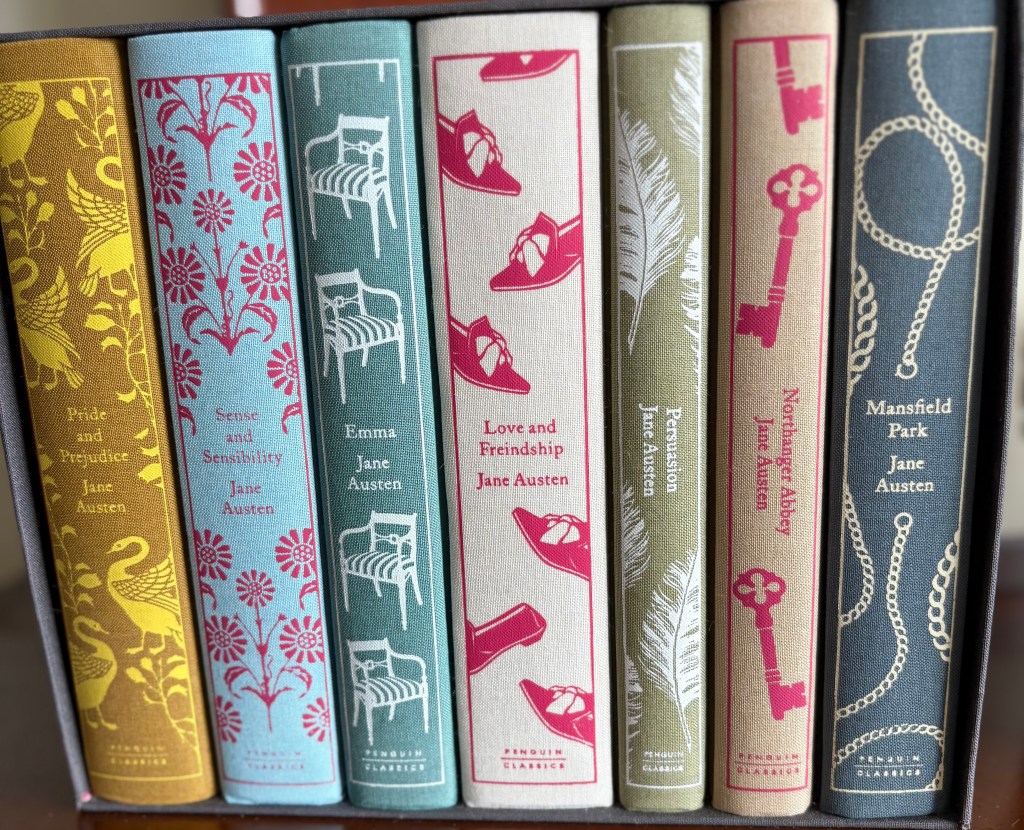

[1] Juthika Patankar, Wire, November 2025

[2] Pride and Prejudice

Meenakshi Malhotra is Professor of English Literature at Hansraj College, University of Delhi, and has been involved in teaching and curriculum development in several universities. She has edited two books on Women and Lifewriting, Representing the Self and Claiming the I, in addition  to numerous published articles on gender, literature and feminist theory.  Her most recent publication is The Gendered Body: Negotiation, Resistance, Struggle.

.

PLEASE NOTE: ARTICLES CAN ONLY BE REPRODUCED IN OTHER SITES WITH DUE ACKNOWLEDGEMENT TO BORDERLESS JOURNAL

Click here to access the Borderless anthology, Monalisa No Longer Smiles

Click here to access Monalisa No Longer Smiles on Amazon International
Categories
Contents

Borderless, February 2024

Art by Sohana Manzoor

Editorial

Finding Godot?… Click here to read.

Conversations

Ratnottama Sengupta talks to Ruchira Gupta, activist for global fight against human trafficking, about her work and introduces her novel, I Kick and I Fly. Click here to read.

A conversation with Ratna Magotra, a doctor who took cardiac care to the underprivileged and an introduction to her autobiography, Whispers of the Heart: Not Just a Surgeon. Click here to read.

Translations

Two poems by Nazrul have been translated from Bengali by Niaz Zaman. Click here to read.

Masud Khan’s poetry has been translated by Fakrul Alam. Click here to read.

The White Lady by Atta Shad has been translated from Balochi by Fazal Baloch. Click here to read.

Sparrows by Ihlwha Choi has been translated from Korean by the poet himself. Click here to read.

Tagore’s Dhoola Mandir or Temple of Dust has been translated from Bengali by Mitali Chakravarty. Click here to read.

Pandies Corner

Songs of Freedom: What are the Options? is an autobiographical narrative by Jyoti Kaur, translated from Hindustani by Lourdes M Supriya. These narrations highlight the ongoing struggle against debilitating rigid boundaries drawn by societal norms, with the support from organisations like Shaktishalini and pandies’. Click here to read.

Poetry

Click on the names to read the poems

Rhys Hughes, Maithreyi Karnoor, Luis Cuauhtémoc Berriozábal, Sivakami Velliangiri, Wendy Jean MacLean, Pramod Rastogi, Stuart McFarlean, Afrida Lubaba Khan, George Freek, Saranyan BV, Ryan Quinn Flanagan, Sanjay C Kuttan, Peter Magliocco, Sushant Thapa, Michael R Burch

Poets, Poetry & Rhys Hughes

In City Life: Samples, Rhys Hughes takes on the voice of cities. Click here to read.

Musings/Slices from Life

Ratnottama Sengupta Reminisces on Filmmaker Mrinal Sen

Ratnottama Sengupta travels back to her childhood wonderland where she witnessed what we regard as Indian film history being created. Click here to read.

Suga Didi

Snigdha Agrawal gives us a slice of nostalgia. Click here to read.

Healing Intellectual Disabilities

Meenakshi Pawha browses on a book that deals with lived experiences of dealing with intellectual disabilities. Click here to read.

Musings of a Copywriter

In Hobbies of Choice, Devraj Singh Kalsi explores a variety of extra curriculums. Click here to read.

Notes from Japan

In Becoming a Swiftie in my Fifties, Suzanne Kamata takes us to a Taylor Swift concert in Tokyo. Click here to read.

Essays

Walking about London Town

Sohana Manzoor takes us around the historic town. Click here to read.

How Do You Live?

Aditi Yadav explores the universal appeal of the translation of a 1937 Japanese novel that recently came to limelight as it’s rendition on the screen won the Golden Globe Best Animated Feature Film award (2024). Click here to read.

The Magic Dragon: Cycling for Peace

Keith Lyons writes of a man who cycled for peace in a conflict ridden world. Click here to read.

Stories

A Night at the Circus

Paul Mirabile tells a strange tale set in Montana. Click here to read.

Echoes in the Digital Expanse

Apurba Biswas explores a futuristic scenario. Click here to read.

Two Countries

Ravi Shankar gives a story about immigrants. Click here to read.

Chadar

Ravi Prakash writes about life in an Indo-Nepal border village. Click here to read.

Just Another Day

Neeman Sobhan gives a story exploring the impact of the politics of national language on common people. Click here to read.

Book Excerpts

An excerpt from Nabendu Ghosh’s Journey of a Lonesome Boat( Eka Naukar Jatri), translated from Bengali by Ratnottama Sengupta. Click here to read.

An excerpt from Upamanyu Chatterjee’s Lorenzo Searches for the Meaning of Life. Click here to read.

Book Reviews

Somdatta Mandal reviews The History Teacher of Lahore: A Novel by Tahira Naqvi. Click here to review.

Basudhara Roy reviews Srijato’s A House of Rain and Snow, translated from Bengali by Maharghya Chakraborty. Click here to read.

Bhaskar Parichha reviews Toby Walsh’s Faking It : Artificial Intelligence In a Human World. Click here to read.

.

Click here to access the Borderless anthology, Monalisa No Longer Smiles

Click here to access Monalisa No Longer Smiles on Amazon International

Categories
Editorial

Finding Godot?

Discard all prayers,
Meditation, hymns and rituals.
Why do you hide behind
Closed doors of temples?
....
There is no God in this house.

He has gone to visit the
Farmers who plough the hard ground,
The workers who break rocks ...


— Tagore, Dhoola Mandir or Temple of Dust (1910)

Love is a many splendoured thing and takes many forms — that stretches beyond bodily chemistry to a need to love all humankind. There is the love for one’s parents, family, practices one believes in and most of all nurtured among those who write, a love for words. For some, like Tagore, words became akin to breathing. He wrote from a young age. Eventually, an urge to bridge social gaps led him to write poetry that bleeds from the heart for the wellbeing of all humanity.  Tagore told a group of writers, musicians, and artists, who were visiting Sriniketan in 1936: “The picture of the helpless village which I saw each day as I sailed past on the river has remained with me and so I have come to make the great initiation here. It is not the work for one, it must involve all. I have invited you today not to discuss my literature nor listen to my poetry. I want you to see for yourself where our society’s real work lies. That is the reason why I am pointing to it over and over again. My reward will be if you can feel for yourself the value of this work.”

And it was perhaps to express this great love of humanity that he had written earlier in his life a poem called Dhoola Mandir that urges us to rise beyond our differences of faith and find love in serving humankind. In this month, which celebrates love with Valentine’s Day, we have a translation of this poem that is born of his love for all people, Dhoola Mandir.  Another poet who writes of his love for humanity and questions religion is Nazrul, two of whose poems have been translated by Niaz Zaman. Exploring love between a parent and children is poetry by Masood Khan translated from Bengali by Fakrul Alam. From the distant frontiers of Balochistan, we have a poem by Atta Shad, translated from Balochi by Fazal Baloch, for a fair lady — this time it is admiration. Ihlwha Choi translates poetry from Korean to express his love for a borderless world through the flight of sparrows.

Love has been taken up in poetry by Michael Burch. Borne of love is a concern for the world around us. We have powerful poetry by Maithreyi Karnoor that expresses her concern for humanity with a dash of irony or is it sarcasm? Luis Cuauhtémoc Berriozábal expresses his admiration for the poetry of Italian Poet Antonia Pozzi (1912-1938) in poetry. We have poems by Stuart McFarlane, Pramod Rastogi, Afrida Lubaba Khan, George Freek, Saranyan BV, Ryan Quinn Flanagan and many more. Rhys Hughes brings humour into poetry and voices out in his column taking on the persona of two cities he had lived in recently. There is truth and poignancy in the voices of the cities.

Suzanne Kamata writes a light-hearted yet meaningful column on the recent Taylor Swift concert in Tokyo.  Aditi Yadav takes up the Japanese book on which was based a movie that won the 2024 Golden Globe Best Animated Feature Film Award. Sohana Manzoor journeys to London as Devraj Singh Kalsi with tongue in cheek humour comments on extracurriculars that have so become a necessity for youngsters to get to the right schools. Snigdha Agrawal gives us a slice of nostalgia while recounting the story of a Santhali lady and Keith Lyons expresses his love for peace as he writes in memory of a man who cycled for peace.

Ratnottama Sengupta also travels down the memory lane to recall her encounters with film maker Mrinal Sen as he interacted with her father, Nabendu Ghosh. She has translated an excerpt from his autobiography to highlight his interactions with Ghosh. The other excerpt is from Upamanyu Chatterjee’s latest novel, Lorenzo Searches for the Meaning of Life.

In reviews, Somdatta Mandal has explored Tahira Naqvi’s The History Teacher of Lahore: A Novel. Srijato’s A House of Rain and Snow, translated from Bengali by Maharghya Chakraborty, has been discussed by Basudhara Roy and Bhaskar Parichha has reviewed Toby Walsh’s Faking It: Artificial Intelligence in a Human World. News and Documentary Emmy Award winner (1996) Ruchira Gupta’s daring novel born of her work among human traffickers, I Kick and I Fly, has been brought to our notice by Sengupta and she converses about the book and beyond with this socially conscious activist, filmmaker and writer. Another humanist, a doctor who served by bridging gaps between patients from underprivileged backgrounds, Dr Ratna Magotra, also conversed about her autobiography, Whispers of the HeartNot Just a Surgeon: An Autobiography , where she charts her journey which led her to find solutions to take cardiac care to those who did not have the money to afford it,

We have fiction this time from Neeman Sobhan reflecting on how far people will go for the love of their mother tongue to highlight the movement that started on 21st February in 1952 and created Bangladesh in 1971. Our stories are from around the world — Paul Mirabile from France, Ravi Shankar from Malaysia, Sobhan from Bangladesh and Ravi Prakash and Apurba Biswas from India — weaving local flavours and immigrant narratives. Most poignant of all the stories is a real-life narrative under the ‘Songs of Freedom’ series by a young girl, Jyoti Kaur, translated from Hindustani by Lourdes M Supriya. These stories are brought to us in coordination with pandies’ and Shaktishalini, a women’s organisation to enable the abused. Sanjay Kumar, the founder of pandies’ and the author of a most poignant book about healing suffering of children through theatre, Performing, Teaching and Writing Theatre: Exploring Play, writes, “‘Songs of Freedom’ bring stories from women — certainly not victims, not even survivors but fighters against the patriarchal status quo with support from the organisation Shaktishalini.”

While looking forward in hope of finding a world coloured with love and kindness under the blue dome, I would like to thank our fabulous team who always support Borderless Journal with their wonderful work. A huge thanks to all of you from the bottom of my heart. I thank all the writers who make our issues come alive with their creations and readers who savour it to make it worth our while to bring out more issues. I would urge our readers to visit our contents’ page as we have more than mentioned here.

Enjoy our February fare.

Mitali Chakravarty

borderlessjournal.com

Click here to access the content’s page for the February 2024 Issue.

.

READ THE LATEST UPDATES ON THE FIRST BORDERLESS ANTHOLOGY, MONALISA NO LONGER SMILES, BY CLICKING ON THIS LINK.

Categories
Review

A Lyrical Love Song for Milkwood Trees

Book Review by Basudhara Roy

Title: A House of Rain and Snow

Author: Srijato, translated from the Bengali by Maharghya Chakraborty

Publisher: Penguin Random House

“I believe I would want nothing else if I am allowed to just think. If it were a real job, I would be the first to get it. The only problem then would be that I would have to think on someone else’s command. Now I am free to think whatever I want.”

A quiet tenderness beckons the reader to A House of Rain and Snow. The title suggests everything generous and hospitable. Once inside the cosy house of this novel set in days before the internet revolution, there is, indeed, no disappointment. A translation of Srijato’s[1] Prothom Mudran, Bhalobasha [2]from the original Bengali into English by Maharghya Chakraborty[3], the novel offers, on the face of it, a simple coming-of-age story but such simplicity is only deceptive. Churning within the novel’s agonised romantic spirit are vital interrogations of the relationship between life, living, and livelihood, art and the market, the value and significance of art to life, and the question of integrity in both.

A Künstlerroman[4] that primarily focuses on Pushkar’s journey from an aspiring poet to a published artist, the novel frames more narratives than one. There is the story of Pushkar’s parents – Abanish and Ishita, of his friends, Abhijit and Asmita, and that of his mentor, Gunjan (and Parama), each constituting a mirror of the narrative prism in which Pushkar, the reflected subject, kaleidoscopically understands himself and his journey better. But Pushkar is not alone. Journeying with him in spirit are Nirban and his circle of poet-friends, the girl he is in love with – Saheli, and his most cherished friend and ‘confession box’, the milkwood tree.

Where does art come from? For Srijato, art is not extraneous to life but intrinsic to the very fabric of living. Every character in the world of the novel needs art, in one form or another, to survive. Not everyone, however, can become an artist. This privilege and responsibility is offered to the chosen few — those who can step out of their self-obsessed private worlds to establish a sincere relationship with the wider currents of life. Pushkar, for instance, tells the milkwood tree:

“…solitude is entirely a relative thing, silence too. I cannot understand myself without the immense tumult of this city, that’s where my silence lies. Unless I am standing in this swiftly moving crowd, I cannot find any solitude.”

Art, as the novel seems to assert, cannot be born except within life’s chaotic womb. A house of rain and snow can only be a nursery, a protected locale to nurture vision and aspiration. For the artist to grow, an engagement with the wider world would be mandatory.

But how does one engage with the world? Would the world even be worth engaging with? Is art a means of engagement or retreat, activism or escapism? No clear-cut answers to these questions are possible but A House of Rain and Snow attempts, as all worthy stories do, to shine its own light upon them. The novel’s world is divided into two kinds of people — those who view art as an existential end and those who, like Parama or Sumit Dastidar, view it only as a means or an avenue to something else. Those who see art as an end in itself understand that commitment in art does not necessarily guarantee accomplishment. Neither does accomplishment guarantee material success. As an aspiring artist, one can only bring all of one’s life and living to art without expecting anything in return, the fact of journeying being the artist’s only receipt.

There is very little physical action here. The journeys in A House of Rain and Snow, as the reader will observe, are all psychological. Place and time are important coordinates in this movement. The city of Kolkata emerges evocatively as inspiration and muse, its descriptions exuding a clear eye for detail, a deep sense of cultural nostalgia, a delineation of not just place but of spirit, and a documentation of the city’s multifarious, shapeshifting life — its strength, tenacity, and bustling beauty. Concrete yet shapeless, definite yet blurred, prosaic yet poetic, the city firmly anchors this novel as both stage and ship, contouring its artists’ perspectives on life and art.

The idea of time, in the novel, is as fluid as that of space. There is the constant sense, awareness, and reminder of its passage and yet, in Srijato’s fictional world, time refuses to be linear with the past, present, and future merging frequently through hallucination, dream and memory:

“Today, Gunjan notices the newspaper, he has never seen one in the moonlight. He bends over to pick it up from the mosaic floor gleaming under the light of the moon and, instead of the paper, comes back up with a tiny doll that had fallen on the ground a little while ago. A little more than seven years, to be precise.”

There is a strong visual quality about Srijato’s writing, intricately woven cinematographic effects which, had they been of any significance to the plot, might have amounted to magic realism. But being strictly organisational and descriptive in function, this cinematic quality is instrumental to the novel in other ways — it insulates the narrative from realism, liberates it from answerability to everyday logic, defamiliarises the familiar, and renders the strange intimate. Most importantly, it creates a surrealist impression, reminding us of all that remains constant in our consciousness in the most bizarre of circumstances, and manifests itself in the novel as an artist’s specialised and idiosyncratic way of relating to the world. Examine the windows of rain and snow, for instance:

“No one other than Pushkar knows about this, neither does he wish to tell anyone. There are two windows in his room, side by side, one almost touching the other. Outside one of them it rains the entire day and snows throughout outside the other. On the days this happens, Pushkar finds himself unable to leave the house.”

It is worth noting that it is not Pushkar alone who has such experiences. Other characters like Abanish and Gunjan also experience such strange reconfigurations of time and space — expansion, compression, repetition, alternation, all of which can be interpreted at a symbolic level.

Surcharged with intense lyrical passages, A House of Rain and Snow is quintessentially an exploration of the aching need for art in life. Life, in the pages of the novel, is almost unliveable without the solace of art. Art, in turn, can be born only out of love, the kind of love that Pushkar can extend to the milkwood tree and the world around him:

“He, Pushkar, is in love. A little too much, with everything. …Why, he is not sure. How, he is not sure either. All he knows is that at this very moment, it is love that is becoming his language, his constant recourse. Love. Not just for the people close to him or his writings or his own life. Love for everything. Everything happening around him at this moment, the moving earth, every incident everywhere in the world, the forests, the oceans, the mountains, the plains, the cities, the sky, even the vast outer space beyond earth.”

The translation wonderfully captures the linguistic nuances of Bengali in the English language, its semantic eccentricities, syntactic pace, and its lush images, making the novel a rich and rewarding read. A number of images linger steadily in the reader’s mind long after the book has been read – a tall, wet milkwood tree, an idol-maker shaping a goddess out of clay, and a young boy lifting his exhausted father on his palm.

.

Click here to read an excerpt.

[1] Srijato, one of the most celebrated Bengali poet-lyricists of our times, is the recipient of Ananda Puroskar in 2004 for his book Udanta Sawb Joker (All Those Flying Jokers).

[2] Literal translation from Bengali: First Gesture of Love

[3] Maharghya Chakraborty is a well-known translator. He teaches at St Xavier’s College in Kolkata.

[4] A coming-of-age novel about an artists

Basudhara Roy teaches English at Karim City College affiliated to Kolhan University, Chaibasa. Author of three collections of poems, her latest work has been featured in EPW, The Pine Cone Review, Live Wire, Lucy Writers Platform, Setu and The Aleph Review among others. 

.

PLEASE NOTE: ARTICLES CAN ONLY BE REPRODUCED IN OTHER SITES WITH DUE ACKNOWLEDGEMENT TO BORDERLESS JOURNAL

Click here to access the Borderless anthology, Monalisa No Longer Smiles

Click here to access Monalisa No Longer Smiles on Kindle Amazon International

Categories
Contents

Borderless, January 2024

Art by Sohana Manzoor

Editorial

Imagine all the People, Sharing All the World’Click here to read

Conversations

Interviewing Bulbul: Remembering Mrinal SenRatnottama Sengupta introduces Bulbul Sharma to converse with her on Mrinal Sen, the legendary filmmaker, reflecting on Bulbul Sharma’s experience as an actress in his film, Interview. Click here to read.

In conversation with Gajra Kottary, eminent screenplay writer, and a brief introduction to her recent book of short stories, Autumn Blossoms. Click here to read.

Translations

Nazrul’s poem, Samya or Equality, has been translated from Bengali by Niaz Zaman. Click here to read.

Masud Khan’s Fire Engine has been translated from Bengali by Fakrul Alam. Click here to read.

Short Poems by Mulla Fazul have been translated from Balochi by Fazal Baloch. Click here to read.

Disaster Alert by Ihlwha Choi has been translated from Korean by the poet himself. Click here to read.

Prarthona or Prayer by Rabindranath Tagore has been translated from Bengali by Mitali Chakravarty. Click here to read.

Poetry

Click on the names to read the poems

Radha Chakravarty, David Skelly Langen, Urmi Chakravorty, Avantika Vijay Singh, JM Huck, Isha Sharma, Stuart McFarlane, Saranyan BV, Ron Pickett, Mereena Eappen, Ahmad Al-Khatat, Ganesh Puthur, George Freek, Rhys Hughes

Poets, Poetry & Rhys Hughes

In Some Differences Between India and Sri Lanka, Rhys Hughes relates his perceptions of the two countries with a pinch of humour. Click here to read.

Musings/Slices from Life

When the Cobra Came Home

Antara Mukherjee nostalgically recalls her past and weaves it into the present. Click here to read.

The Old Man

Munaj Gul Muhammad describes his encounter with an old Balochi man. Click here to read.

Corner

Anita Sudhakaran muses on the need for a quiet corner. Click here to read.

Musings of a Copywriter

In Taking Stock…Finally, Devraj Singh Kalsi writes of stocks that defy the laws of gravity. Click here to read.

Notes from Japan

In A Sombre Start, Suzanne Kamata talks of the twin disasters in Japan. Click here to read.

Essays

Abol Tabol: No Nonsense Verses of Sukumar Ray

Ratnottama Sengupta relives the fascination of Sukumar Ray’s Abol Tabol, which has  just completed its centenary. Click here to read.

Peeking at Beijing: Fringe-dwellers and Getting Centred

Keith Lyons shares the concluding episode of his trip to Beijing. Click here to read.

Stories

The Gift

Rebecca Klassen shares a sensitive story about a child and an oak tree. Click here to read.

Healing in the Land of the Free

Ravi Shankar gives the story of a Nepali migrant. Click here to read.

Pigeons & People

Srinivasan R explores human nature. Click here to read.

Phôs and Ombra

Paul Mirabile weaves a dark tale about two people lost in a void. Click here to read.

Book Excerpts

An excerpt from Srijato’s A House of Rain and Snow, translated from Bengali by Maharghya Chakraborty. Click here to read.

An excerpt from The Kidnapping of Mark Twain: A Bombay Mystery by Anuradha Kumar. Click here to read.

Book Reviews

Somdatta Mandal reviews Sudha Murty’s Common Yet Uncommon: 14 Memorable Stories from Daily Life. Click here to read.

Meenakshi Malhotra reviews Rhys Hughes’ The Coffee Rubaiyat. Click here to read.

Rakhi Dalal reviews Ajit Cour’s Life Was Here Somewhere, translated by Ajeet Cour and Minoo Minocha. Click here to read.

Bhaskar Parichha reviews Scott Ezell’s Journey to the End of the Empire: In China Along the Edge of Tibet. Click here to read.

.

Click here to access the Borderless anthology, Monalisa No Longer Smiles

Click here to access Monalisa No Longer Smiles on Kindle Amazon International

Categories
Editorial

‘Imagine all the People, Sharing All the World’

Art by Sohana Manzoor

Let’s look forward to things getting better this New Year with wars tapering off to peace— a peace where weapons and violence are only to be found in history. Can that ever happen…?

Perhaps, all of us need to imagine it together. Feeling the need for peace, if we could dwell on the idea and come up with solutions, we could move towards making it a reality. To start with, every single human being has to believe firmly in the need for such a society instead of blaming wars on natural instincts. Human nature too needs to evolve. Right now, this kind of a world view may seem utopian. But from being hunter-gatherers, we did move towards complex civilisations that in times of peace, built structures and created art, things that would have seemed magical to a cave dweller in the Palaeolithic times. Will we destroy all that we built by warring – desecrating, decimating our own constructs and life to go on witch-hunts that lead to the destruction of our own species? Will human nature not evolve out of the darkness and chaos that leads to such large-scale annihilation?

Sometimes, darkness seems to rise in a crescendo only to be drowned by light emanating from an unknown source. This New Year — which started with an earthquake followed the next day by a deadly plane collision — was a test of human resilience from which we emerged as survivors, showing humanity can overcome hurdles if we do not decimate each other in wars. Bringing this to focus and wringing with the pain of loss, Suzanne Kamata, in her column tells us: “Earthquakes and other natural disasters are unavoidable, but I admire the effort that the Japanese people put into mitigating their effects. My hope is that more and more people here will begin to understand that it is okay to cry, to mourn, to grieve, and to talk about our suffering. My wish for the Japanese people in the new year is happiness and the achievement of dreams.”

And may this ring true for all humanity.

Often it is our creative urges that help bring to focus darker aspects of our nature. Laughter could help heal this darkness within us. Making light of our foibles, critiquing our own tendencies with a sense of humour could help us identify, creating a cathartic outcome which will ultimately lead to healing. An expert at doing that was a man who was as much a master of nonsense verses in Bengal as Edward Lear was in the West. Ratnottama Sengupta has brought into focus one such book by the legendary Sukumar Ray, Abol Tabol (or mumbo jumbo), a book that remains read, loved and relevant even hundred years later. We have more non-fiction from Keith Lyons who reflects on humanity as he loses himself in China. Antara Mukherjee talks of evolving and accepting a past woven with rituals that might seem effete nowadays and yet, these festivities did evoke a sense of joie de vivre and built bridges that stretch beyond the hectic pace of the current world. Devraj Singh Kalsi weaves in humour and variety with his funny take on stocks and shares. Rhys Hughes does much the same with his fun-filled recount on the differences between Sri Lanka and India, with crispy dosas leaning in favour of the latter.

Humour is also sprinkled into poetry by Hughes as Radha Chakravarty’s poetry brings in more sombre notes. An eminent translator from Bengali to English, she has now tuned her pen to explore the subliminal world. While trying to explore the darker aspects of the subliminal, David Skelly Langen, a young poet lost his life in December 2023. We carry some of his poems in memoriam. Ahmad Al-Khatat, an Iraqi immigrant, brings us close to the Middle East crisis with his heart-rending scenarios painted with words. Variety is added to the oeuvre with more poetry from George Freek, Ganesh Puthur, Ron Pickett, Stuart McFarlane, Urmi Chakravorty, Saranyan BV, JM Huck and many more.

Our stories take us around the world with Paul Mirabile from France, Ravi Shankar from Malaysia, Srinivasan R from India and Rebecca Klassen from England, weaving in the flavours of their own cultures yet touching hearts with the commonality of emotions.

In conversations, Ratnottama Sengupta introduces us to the multifaceted Bulbul Sharma and discusses with her the celebrated filmmaker Mrinal Sen, in one of whose films Sharma ( known for her art and writing) had acted. We also have a discussion with eminent screenplay writer Gajra Kottary on her latest book, Autumn Blossoms and an introduction to it.

Somdatta Mandal has reviewed Sudha Murty’s Common Yet Uncommon: 14 Memorable Stories from Daily Life, which she says, “speaks a universal language of what it means to be human”. Bhaskar Parichha takes us to Scott Ezell’s Journey to the End of the Empire: In China Along the Edge of Tibet. Parichha opines: “The book evokes the majesty of Tibetan landscapes, the unique dignity of the Tibetan people, and the sensory extremity of navigating nearly pre-industrial communities at the edge of the map, while also encompassing the erosion of cultures and ecosystems. Journey to the End of the Empire is both a love song and a protest against environmental destruction, centralised national narratives and marginalised minorities.” Meenakshi Malhotra provides a respite from the serious and emotional by giving us a lively review of Rhys Hughes’ The Coffee Rubaiyat, putting it in context of literature on coffee, weaving in poetry by Alexander Pope and TS Eliot. Rakhi Dalal has reviewed a translation from Punjabi by Ajeet Cour and Minoo Minocha of Cour’s Life Was Here Somewhere. Our book excerpts from Anuradha Kumar’s The Kidnapping of Mark Twain: A Bombay Mystery introduces a lighter note as opposed to the intense prose of Srijato’s A House of Rain and Snow, translated from Bengali by Maharghya Chakraborty.

Translations this time take us to the realm of poetry again with Fazal Baloch introducing us to a classical poet from Balochistan, the late Mulla Fazul. Ihlwha Choi has self-translated his poetry from Korean. Niaz Zaman brings us Nazrul’s Samya or Equality – a visionary poem for the chaotic times we live in — and Fakrul Alam transcribes Masud Khan’s Bengali verses for Anglophone readers. Our translations are wound up with Tagore’s Prarthona or Prayer, a poem in which the poet talks of keeping his integrity and concludes saying ‘May the wellbeing of others fill my heart/ With contentment”.

May we all like Tagore find contentment in others’ wellbeing and move towards a world impacted by love and peace! The grand polymath always has had the last say…

I would like to thank our contributors, the Borderless team for this vibrant beginning of the year issue, Sohana Manzoor for her fabulous art, and all our readers for continuing to patronise us.

With hope of moving towards a utopian future, I invite you to savour our fare, some of which is not covered by this note. Do pause by our contents page to check out all our fare.

Mitali Chakravarty

borderlessjournal.com

Click here to access the contents page for the January 2024 issue

.

READ THE LATEST UPDATES ON THE FIRST BORDERLESS ANTHOLOGY, MONALISA NO LONGER SMILES, BY CLICKING ON THIS LINK.

Categories
Excerpt

A House of Rain and Snow

 Title: A House of Rain and Snow

Author: Srijato

Translator: Maharghya Chakraborty

Publisher: Penguin, Vintage Imprint

It rains outside one of the windows, snows outside the other. This happens in Pushkar’s house. Well, not their house exactly, they are tenants, but this does happen there. Not every day, only from time to time. No one other than Pushkar knows about this, neither does he wish to tell anyone. There are two windows in his room, side by side, one almost touching the other. Outside one of them it rains the entire day and snows throughout outside the other. On the days this happens, Pushkar finds himself unable to leave the house.

The light in rented houses has a pallor of its own, a unique dimness, as if it never wishes to fully brighten. As if it knows it has been confined within the walls of a leased property. So every evening it flickers into life in a blurry, understated manner. Like it lacks self-confidence, lacks the courage to be loud. Thus the walls of the rented property, the calendar hanging on it, the door that refuses to shut properly and the ancient curtain sticking to it—they all look a bit pale in that low, dim light.

This is not a lie, Pushkar is well aware of that. It is hardly possible to know how one’s house looks from within. Like one has to be in space to truly understand how the earth looks, one has to step out of one’s house to see it, from afar. Pushkar has never really managed to do it that much. There’s a narrow lane just outside their house and rows and rows of walls and houses of the tiny neighbourhood beyond it. He has never managed to examine his house from a distance. So one must wonder how he figured out the matter of the paleness of the lights. It was quite easy. Whenever he had to take the local train back from a friend’s distant house in the evening, he witnessed the lights of the houses coming on one after the other. Various kinds of lights coming on behind big and small windows—a scene he watched many a time from the moving train. Such scenes immediately made him aware of the houses where families were living on rent, the ones where the lights were yellowish, slightly oil-stained and diffident. He used to count them on his way back and arrive at the conclusion that there were more tenants than landlords in this world. Or else the world at night would have been far more luminous every day.

Such was their house too. The only consolation being theirs was visible from aeroplanes. He has never seen it himself, but many a time he has seen the planes up close from the roof during their descent en route to Dum Dum Airport. If any passenger were to look down from the plane window that very instant, they would be able to spot Pushkar’s house and tell it was a rented one. That was nothing to be ashamed of, at least not for Pushkar. Many people don’t even have a roof over their heads, those who are barely discernible as human beings from planes and trains.

Although, in his own sliver of a room, he hardly switches on the lights most evenings even after it’s dark. Not because he is embarrassed or anything. Rather, he is fond of watching the light die out slowly and darkness descend all of a sudden. To wrap that feeling around himself—as if the only reason the day had dawned was to bring him this cover. Thus, many an evening he spends in the darkness of his small, square room. Just above the study table is a light on the oil-stained walls, one that he does not switch on every day. Like he will not today, he thinks.

It’s still early afternoon though, he just finished lunch a while back. Baba is on a day shift today, he will be late. Ma is getting some shut-eye, for soon she will have her singing classes in the adjacent room. This is what he is used to since childhood—his father’s job as a journalist in the newspaper office and his mother singing at local concerts and teaching music at home. This is how things have been for them, how they still remain. So, the days don’t really change for them, they mostly remain the same and Pushkar, too, can predict what will come to pass and when. Like today, like how he was not going to switch on the lights this evening.

Most days, he gets held back in his room, does not get to go out. His first-year classes have just begun. Geography. An excellent subject and it’s taught very well at their college. Yet, he is absent more than half the days. It’s not that he does not want to go, it’s just that he cannot bring himself to do so, always getting stuck. Mornings roll into afternoons and afternoons into evenings; he shuts the shaky doors of his room and sits alone on the far end of his bed, unable to leave. Perhaps because of the windows divided by the rain and snow. He cannot seem to fathom what he needs to do to go out, how he must prepare so he can walk down the narrow lane of their locality towards the main road, where the evening gathers together streams of light that split and disperse all around again.

About the Book:

Pushkar, an offspring of the most incredible of times, has next to nothing to call his own. Except for a seasoned but out-of-work and disheartened father, and a defiant, uncompromising mother with a truly astounding gift for music. It is only in the gradually widening chasm between his parents that he discovers his world of poems, which he desperately tries to hide from everyone.

Everyone else except Saheli, that is, only she gets to read his poems. Saheli, his school friend who he is in love with. Abhijit, another friend from school, is unwilling to leave it all up to fate and insists on dragging Pushkar to meet Nirban and their independent publishing house—at least to ensure that Pushkar’s poems manage to see the light of day.

In this entirely strange, magical and leisurely course of life swirling all around Pushkar, there is but one entity with whom he shares all his secrets. A milkwood tree, a chatim is privy to everything in his life. And so time moves on, leading him to eventually confront a truly secret equation of life—the change made possible by the transformative power of love.

A House of Rain and Snow is a testament to an era, a witness to an astounding journey of a young poet.

About the Author                           

Srijato, one of the most celebrated Bengali poet-lyricists of our times, is the recipient of Ananda Puroskar in 2004 for his book Udanta Sawb Joker (All Those Flying Jokers).

About the Translator

Maharghya Chakraborty is a well-known translator. He teaches at St Xavier’s College in Kolkata.

.

PLEASE NOTE: ARTICLES CAN ONLY BE REPRODUCED IN OTHER SITES WITH DUE ACKNOWLEDGEMENT TO BORDERLESS JOURNAL