Categories
Editorial

Making a Grecian Urn

“Beauty is truth, truth beauty — that is all
                Ye know on earth, and all ye need to know.”  
  
John Keats (1795-1821), Ode to a Grecian Urn
‘Beauty is Truth’ : The Potato Eaters(1885) by Vincent van Gogh (1853-1890). Courtesy: Creative Commons

What makes for great literature? To me, great literature states the truth — the truth that touches your heart with its poignancy, preciseness, sadness, gentleness, vibrancy, or humour.  If Khayyam, Rumi, Keats, Tagore, Frost or Whitman had no truths to state, their poetry would have failed to mesmerise time and woo readers across ages. Their truths – which can be seen as eternal ones — touch all human hearts with empathetic beauty. Lalon Fakir rose from an uneducated illiterate mendicant to a poet because he had the courage to sing the truth about mankind — to put social norms and barriers aside and versify his truth, which was ours and still is. This can be applied to all genres. Short stories by Saki, O’ Henry or plays and essays by Bernard Shaw — what typifies them? The truth they speak with perhaps a sprinkle of humour. Alan Paton spoke the truth about violence and its arbitrariness while writing of South Africa — made the characters so empathetic that Cry, My Beloved Country (1948) is to me one of the best fictions describing divides in the world, and the same divides persist today. The truth is eternal as in George Orwell’s 1984 (1949) or Suskind’s Perfume (1985). We love laughter from Gerald Durrell or PG Wodehouse too because they reflect larger truths that touch mankind as does the sentimentality of Dickens or the poignancy of Hardy or the societal questioning of the Bronte sisters, George Eliot, and Jane Austen. The list of greats in this tradition would be a very long one.

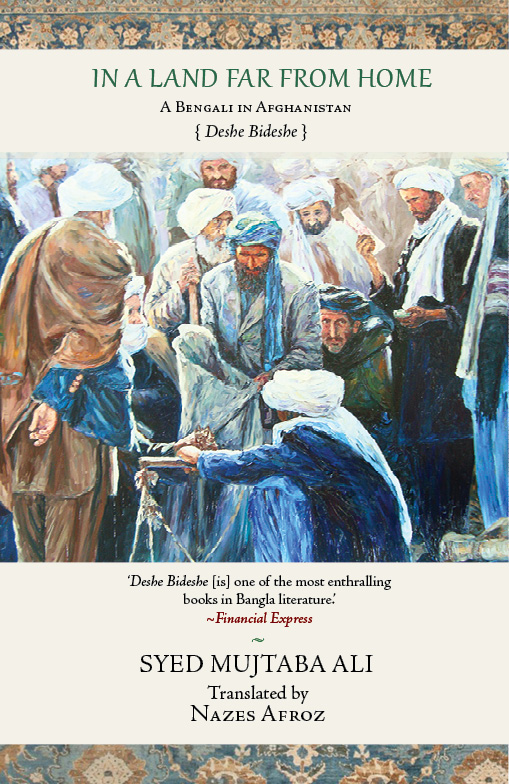
 Our focus this time is on a fearless essayist in a similar tradition, one who unveiled truths rising above the mundane, lacing them with humour to make them easily digestible for laymen – a writer and a polyglot who knew fourteen languages by the name of Syed Mujtaba Ali (1904-1974). He was Tagore’s student, a Humboldt scholar who lived across six countries, including Afghanistan and spoke of the things he saw around him. Cherished as a celebrated writer among Bengali readers, he wrote for journals and published more than two dozen books that remained untranslated because his witticisms were so entrenched by cultural traditions that no translator dared pick up their pen. Many decades down the line, while in Afghanistan, a BBC editor for South and Central Asia, Nazes Afroz, translated bits of Mujtaba Ali’s non-fiction for his curious friends till he had completed the whole of the travelogue.

The translation named In a Land Far from Home: A Bengali in Afghanistan was published and nominated for the Crossword Awards. This month, we not only run an excerpt from the translated essays but also have an interview with the former BBC journalist, Afroz, who tells us not only about the book but also of the current situation in ravaged Afghanistan based on his own first-hand experiences. Nazes himself has travelled to forty countries, much like our other interviewee, Sybil Pretious, who has travelled to forty and lived in six. She had been writing for us till she left to complete her memoirs — which would cover much of history from currently non-existent country Rhodesia to apartheid and the first democratic election in South Africa. These would be valuable records shared with the world from a personal account of a pacifist who loves humanity.

We have more on travel — an essay by Tagore describing with wry humour vacations in company of his niece and nephew and letters written by the maestro during his trips, some laced with hilarity and the more serious ones excerpted from Kobi and Rani, all translated by Somdatta Mandal. We have also indulged our taste for Tagore’s poetry by translating a song heralding the start of the Durga Puja season. Durga Puja is an autumnal festival celebrated in India. An essay by Meenakshi Malhotra explains the songs of homecoming during this festival. It is interesting that the songs express the mother’s views as highlighted by Malhotra, but one notices, never that of the Goddess, who, mythology has it, gave up her life when the husband of her own choosing, Shiva, was perceived by her family as ‘uncouth’ and was insulted in her parent’s home.

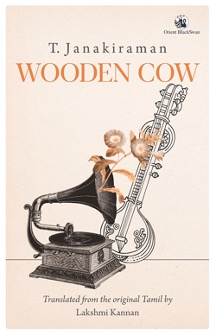
In spirit of this festival highlighting women power and on the other hand her role in society, we have a review by Somdatta of T. Janakiraman’s Wooden Cow, translated from Tamil by Lakshmi Kannan, where the protagonist upends all traditional values ascribed to women. Another book which is flavourful with food and would be a real fit on every festive occasion is Mohana Kanjilal’s A Taste of Time: A Food History of Calcutta. Bhaskar Parichha tells us in his review, “In the thriving universe of Indian food books, this clearly stands out.”

Aruna Chakravarti’s review of Shazia Omar’s Golden Bangladesh at Fifty also stands out embracing the colours of Bengal. It traces the title back to history and their national anthem — a Tagore song called ‘Amaar Sonar Bangla – My Golden Bengal’. Gracy Samjetsabam’s review of Suzanne Kamata’s The Baseball Widow, a cross cultural novel with an unusual ending that shuttles between America and Japan, winds up our review section this time.

As Kamata’s book travels across two continents in a pre-covid world, Sunil Sharma in reality moved home from one continent to another crossing multiple national borders during the pandemic. He has written an eye-opening account of his move along with his amazing short story on Gandhi. Another unusual story creating a new legend with wonderful photographs and the narrative woven around them can be relished in Nature’s Musings by Penny Wilkes. This time we have fiction from India, Malaysia, Bangladesh and America. Steve Davidson has given a story based partly on Tibetan lore and has said much in a light-hearted fashion, especially as the Llama resumes his travels at the end of the story. Keeping in step with light humour and travel is Devraj Singh Kalsi’s account of a pony ride up a hill, except it made me laugh more.

The tone of Rhys Hughes cogitations about the identity of two poets across borders in ‘Pessoa and Cavafy: What’s in a Name?’ reminds me of Puck  or Narada! Of course, he has given humour in verses with a funny story poem which again — I am not quite sure — has a Welsh king who resisted Roman invasion or is it someone else? Michael Burch has limericks on animals, along with his moving poem on Martin Luther King Junior. We have much poetry crossing borders, including a translation of Akbar Barakzai’s fabulous Balochi poetry by Fazal Baloch and Sahitya Akademi winning Manipuri poet, Thangjam Ibopishak, translated by Robin S Ngangom. A Nazrul song which quests for a spiritual home has been translated from Bengali by no less than Professor Fakrul Alam, a winner of both the SAARC award and Bangla Academy Literary Award.

Former Arts Editor of Times of India, Ratnottama Sengupta, has shared an essay on how kantha (hand embroidered rug) became a tool to pass on information during the struggle against colonial occupation. The piece reminded me of the narrative of passing messages through mooncakes among Chinese. During the fourteenth century, the filling was of messages to organise a rebellion which replaced the Yuan dynasty (1271-1368) with the Ming (1368-1644). Now the filling is delicious lotus paste, chocolates or other edible delicacies. Women were heavily involved in all these movements. Sameer Arshad Khatlani has highlighted how women writers of the early twentieth century writing in Urdu, like Ismat Chughtai, created revolutionary literature and inspired even legendary writers, like Simone de Beauvoir. There is much more in our content — not all of which has been discussed here for again this time we have spilled over to near fifty pieces.

We have another delightful surprise for our readers – a cover photo of a painting by Sohana Manzoor depicting the season titled ‘Ode to Autumn’. Do pause by and take a look at this month’s issue. We thank our writers and readers for their continued support. And I would personally like to give a huge thanks to the team which makes it possible for me to put these delectable offerings before the world. Thank you all.

Wish you a wonderful month full of festivities!

Mitali Chakravarty,

Borderless Journal

Categories
Interview Review

Unveiling Afghanistan: In Conversation with Nazes Afroz

 Cry, My Beloved Country (1948) reflected the plight of Africans and the deep divides that created schisms between different groups in South Africa. The book won the author, Alan Paton, a Nobel prize. Another remarkable book that was published in the same year was a non-fiction written by a student of Tagore called Syed Mujtaba Ali. Mujtaba Ali wrote Deshe Bideshe in Bengali. This has been translated in recent times by the former BBC editor, Nazes Afroz, as In a Land Far from Home: A Bengali in Afghanistan. It is an outstanding memoir that demystifies and explains what led to the issues that are being faced by a country repeatedly jostled by varied regimes, a country that seems to be so steeped in problems that worrying about the pandemic remains a far cry for the common inhabitants.

For many decades this book had been feted by only a small group of readers, though the book is no lesser than Paton’s in crying out against injustices, terrors of violence and starvation, because it was written in Bengali. It was so witty and flavourful that people were afraid to translate it for the fear of losing the nuances of the original. As Afroz tells us in this interview, he had similar reservations. A book written by a scholar, it peppers history and political issues with lucidity and humour, making it an enjoyable experience for the lay reader. The author has a way of turning the mundane or intellectual into an amusing anecdote. During a conversation at an embassy party, the author through the voice of a fellow professor, makes a hilarious observation – but also, one that does convey much about Afghanistan despite its attempts at liberalisation.

Madame Vorvechievichi argued, ‘But there are mullahs in this country.’

“Dost Muhammad said reassuringly, ‘No need to worry, Madame. I know these mullahs very well. Their knowledge of religion is very little and I can teach you all of it in three days. However, a woman can’t be a mullah.’

Madame Vorvechievichi said angrily, ‘Why not?’

“With a deep sigh Dost Muhammad said, ‘Because she can’t grow a beard.’”

The book is speckled with multiple such instances. Along with these witticisms, the pathos of the country, the plight of the people is well captured by poignant observations:

“The real history of the country was buried beneath the soil, much like the way that Indian history was hidden in its Puranas, Mahabharata-Ramayana. Afghanistan is a poor country; Afghans do not have the time or the resources for archaeological excavations to write their own history.”

The writer, Syed Mujtaba Ali (1904-1974) a polyglot, scholar, traveller and humanitarian did just that – he recorded the history of the time he spent in Afghanistan, a time when a swift takeover from the liberal king Amanullah (1892-1960) was staged by Bacha-ye-Saqao (1891-1929) during the Afghan Civil War (1928-29).  Does this sound familiar, reminding one of the recent August 2021 takeover by Taliban?

A Humboldt scholar, Mujtaba Ali was conversant in fourteen languages, lived in five countries, including Afghanistan, where he had gone to teach. That his erudition never interfered but enhanced without marring the simplicity of rendition is what makes the book an attractive read for all lay persons. His astute observations are laced with wit and realism. The residue of the book lingers as the vibrant narrative flows — vicariously bringing to life, with humour and empathy, a culture that is distinct and yet warm in its uniqueness. His style is reflective of an in depth understanding of the situation and a sense of empathy for the common people with who he interacted daily – like his man Friday and the colleagues he mentions. For the author, everyone, from an uneducated villager to the crown prince (who invited him to play tennis), seemed to grow effortlessly into a rounded persona of a friend. All these have been transmitted by Afroz in the translation too. Translating two cultures across borders in a language that does not have all the words to capture the intimate nuances is not an easy feat, but it has fruited into an unusual and captivating read.

Nazes Afroz

Afroz’s maiden venture at translation was shortlisted for the Raymond Crossword Book Award. Afroz himself has spent a long stretch of time in Afghanistan. He joined the BBC in London in 1998. He was a senior editor in charge of South and Central Asia for a number of years. He has visited Afghanistan, Central Asia and West Asia regularly for over a decade. In 2013, he moved back to India. A passionate photographer, he writes in English and Bengali for various newspapers and magazines. In recent articles, he has been voicing his own concerns about developments in Afghanistan. In this interview, he reflects on what led him to translate the book, the situation as it was then and as it is now.  He dwells not only on the historic civil war as captured in the book but also on current day politics and the Taliban takeover.

You are a journalist. What got you interested in translating a Bengali classic from the last century?

I became a journalist five years after I read Deshe Bideshe. I was still a teenager when I picked up the book from a library rack. Reading Mujtaba Ali at that age had a profound impact on me. The erudition, the smooth sailing between multitude of cultures and languages, the gripping storytelling in his writing mesmerised me. I had never read anything like that in Bangla. Every Bengali reader of Syed Mujtaba Ali had felt the same way as I did. As a child I had the uncontrollable urge for travels and seeing the world. In Mujtaba Ali I found a role model. Deshe Bideshe stayed with me since then. It was one book that I would read two to three times a year from my teenage. So, by the time I decided to translate Deshe Bideshe more than thirty years after I first laid my hands on the book, I had read it for more than a hundred times! I knew its each page, I knew its each story and Afghanistan had seeped inside me permanently as I could relate to all the characters of the book.

While working for the BBC World Service in London, I had the opportunity to go to Afghanistan in 2002 soon after the Taliban were dislodged from power in a short war towards the end of 2001. I visited the country a number of the times in the following few years. As I travelled more, I befriended my BBC colleagues there and met other journalists and people on various walks of life. Some of them became good friends as well. I used to refer to events from the times of King Amanullah while discussing Afghanistan. They were surprised to hear all the details that I mentioned from a time that they said, ‘Even we don’t know!’ So, I mentioned how a Bengali scholar came from Kolkata to Kabul in 1927 and taught here, was a participant of the modernisation project of Amanullah by teaching English and French, played tennis with the crown prince Inyatullah (1888-1946) became an eyewitness of the rebellion against the king, got caught in the anarchy in the winters of 1928-29, and nearly perished starving before managing to go back to India. Hearing my story, they asked if there was any English translation of the book as they were keen to read. I told them that there was none as it was untranslatable!

As years went by and more and more of my Afghan friends got to know about Deshe Bideshe, they demanded that I did the translation. But I had my doubts. Would I be able to capture Mujtaba Ali’s unique language? Would I be able to transpose his wicked sense of humour? Would I be able to convey his erudition?

Eventually in 2011, I had already made up my mind to quit the BBC and move back to India. At that point my day-to-day workload in the BBC was significantly reduced. As I had ample time in hand, I thought I would attempt the translation. At that point I didn’t think of any publication; I wanted to do it just for fun and for my Afghan and non-Afghan friends who knew about the book and were keen to read it. I thought I would give them a taste of Mujtaba Ali’s writing by doing a few chapters. So, I did the first few chapters and shared them with a few friends. After reading those chapters they wanted to read more. I felt encouraged and I carried on with the translation for the following few months. Eventually the whole book was complete in about a year. After completing the translation, I let it sit for a few months before picking it up again and reread it as new text without looking at the original text. That exercise went on several times over the following one year till the final manuscript shaped up.

How many countries have you worked from? You were also in Afghanistan for several years I believe. Can you share your experiences?

My work has taken me to a dozen country or so. But as an intrepid traveller, I have visited more than 40 countries so far across four continents. Apart from my regular visits to Afghanistan, I spent months at a stretch on several occasions. Working in Afghanistan was certainly a unique experience. It wasn’t a country where one could travel and roam around freely. There were always the security alerts. One needed to negotiate security barriers everywhere. The accommodations – hotels, guesthouses were guarded by armed men. In the early years – in 2002 to 2004, there weren’t so much security in the hotels or guesthouses we stayed in. But that started to change from 2010 onwards as the Taliban had at that time started to regroup, and they made their presence felt in the country and in Kabul. Even at that time, cities like Mazar-e-Sharif and Herat were considered lot safer than Kabul. With increased and unpredictable attacks by the Taliban, the country became more and more edgy.

What was it about the book that drew you to it?

As I mentioned earlier, the uniqueness of Mujtaba Ali was that his erudition wasn’t frightening. He penned Deshe Bideshe almost twenty years after he left Kabul. By then, he had completed his PhD in comparative religion from Germany as a Humboldt scholar, did his post-doctoral research from al-Azhar university in Cairo, learned more than a dozen languages, and travelled extensively in Europe. So, even though his narrative of Afghanistan was drawn from what he had witnessed in his mid-twenties while teaching there, when he decided to write the book, he had acquired profound knowledge in philosophy, literature, culture and history of the world in many languages. The multilingual and multicultural references with an oblique yet gripping story-telling style infused with a wicked sense of humour that came in his writing, had been drawing ardent followers, including me, since 1948 when Deshe Bideshe was first published.

The book highlighted a growing divide between the minority with liberal education and the majority without education. Is that true still? Would you call the book relevant to the present-day crisis?

Yes, that divide between the educated and the not educated that Mujtaba Ali elicited in Deshe Bideshe is still there. But the gap has certainly reduced. The years between 1929 to 1978 had been relatively stable and peaceful in Afghanistan. Modern education had spread but without giving a jolt to the conservative society and keeping the clergy more or less content. In Kabul and other major cities, girls and women were getting more and more education; they were also seen in public life more. Following the coup through which the communists – the People’s Democratic Party of Afghanistan or PDPA came to power in 1978, there was a big push for universal education. This created a much bigger educated class. Women were the biggest beneficiary of that time in terms of acquiring knowledge and finding jobs. Women were joining the police and military as well. Following the capitulation of the PDPA government in 1992, the modern education system collapsed during the Mujahideen civil war years until 1996 and then after the takeover of virtually the whole of the country by the Taliban.

A large number of Afghans – almost a quarter of the population became refugees in neighbouring countries or elsewhere. When the American led international forces ousted the Taliban from power in 2001 following the 9/11 attacks in the USA, the population got a fresh chance to get education. Schools opened again. Both girls and boys went back to school. Internationally there were many programmes to give scholarships to Afghan women and men who were seeking higher education. As a country with a very young population (the average age of Afghanis is 18), a large number of students joined the public and private universities. So, tens of thousands of young women and men are now educated holding masters or even PhD degrees in the country. But the rural areas lagged behind. So, the gap is more of the city and rural areas.

Do you find similarities between the Afghanistan of then and of now?

The way the Afghan society works, based on its ethnic and tribal identities as witnessed by Mujtaba Ali, still exist. The stranglehold that the clergy had on the uneducated mass about a century ago has possibly changed; it’s been replaced with more political interpretation of their religion. The ethnic divisions have sharpened for multitude reasons – primarily due to the outside interference and the way ethnic groups have been used in the larger geo-political game of the world powers.

One of the issues that tussles through the book is that people were basically poor and lacked education. Syed Mustaba Ali spoke of the vicious cycles of poverty, how much has it changed from what he wrote and what you experienced? Please elaborate.

Mujtaba Ali talked about how poverty contributed to the cycle of unrest in Afghan history. Yes, that poverty still exists but with that, a toxic potion of religio-politics has been added to the cauldron. The conflict of the past four decades is more due to the global religio-political dynamics rather that its own poverty.

Did/ do you find parallels in the political situation where Amanullah and his brother escaped from the invading hardliner, Bacha-ye-Saqao? Would you see Bacha as a precursor of Taliban?

The only parallel that one can draw between 1929 when Amanullah and his brother Inayetullah fled and now in 2021 is that the suddenness of the events. Amanullah’s fall happened in months and Bacha took over Kabul in matter of days – almost the same way the Taliban took control of the country.

I don’t think Bacha-ye-Saqao or Habibullah Kalakani as he called himself, was a precursor of the Taliban. Bacha was more of an opportunist; he grabbed the opportunity that came his way. But the Taliban are more of an organised religio-political force what was the product of the geo-politics of the last decade of the Cold War. So, they two are not comparable.

Did the American or Russian intrusions into Afghanistan serve any purpose? Did they actually help the Afghans?

The short answer is no. Both the superpowers came to achieve their own strategic and foreign policy objectives. The Soviets came to expand their sphere of influence beyond their borders in Central Asia. In the process they were badly bruised and had to retreat. The Americans came to get hold of Osama-bin-Laden and dismantle the al-Qaeda infrastructure. It was never about helping a nation that had been devastated by decades of conflict in which they had no role. They just became pawns in the greater game of geopolitics.

By the descriptions in the book, Afghans seem to be fairly open as humans and yet, they have a distinct identity borne of their culture, their ethos — very different from any other. Was that undermined in any way by the attempts at modernisation?

Like many other rural, traditional and old societies, Afghans are hospitable and warm people. They are bound and governed by their age-old custom and codes of conduct.

Even when they are outside of their own land – in the West too, they extend their hospitality to strangers the same way they would in their own country and their behaviour would not differ much. It is not the question, if modernisation has or will undermine their tradition. They have had encounters with modernisation – the way modernisation is understood from the Western prism. Did that change the people who had experienced that modernisation in the time of Amanullah? Mujtaba Ali saw that the ‘so called’ modern people did not lose their Afghan-ness. The same can be said now. As a people they have largely remained unchanged despite connecting with the outside world like never before.

In the book, the international community was practically chased off Afghanistan. As the US troops left, one felt the same way. Do you feel intervention from the international community is necessary in Afghanistan? Why?

The backdrops of 1929 and the present are not identical. In 1929, the rebellion was against the king who had lost the support of the clergy. The king did not come to power with foreign intervention. So, the international community was not chased out in 1929. The Europeans left because of the chaos and the violence. The rebels didn’t fight with the foreigners. Yes, there was an armed opposition to the presence of the USA since the war in 2001, but that opposition wasn’t big enough to send the USA packing.

The USA left because they had achieved their goals in Afghanistan, and it was becoming hugely expensive for them to stay on. Many are also drawing parallels of the US’s departure from Afghanistan with their hasty retreat from Vietnam in 1975. But they were again not identical. In Vietnam, the USA visibly lost the war. But in Afghanistan they did not lose. They could have stayed on if they wanted but it made no sense to them to spend tens of billions of dollars each year. Hence, they left. They had been talking about withdrawing from Afghanistan since 2012, a year after they killed Osama bin Laden in Pakistan.

The intervention that the Afghans had been experiencing since 1979 – first by the Soviets, then Pakistan and finally the US led Western nations, devastated the country and the ordinary Afghans had been paying for it with all they had. No external intervention is beneficial for any country. It’s not desirable to have; certainly not the way the global powers had been intervening for the past 40 odd years in various corners of the world. But the question is, if unspeakable atrocities are committed on certain sections of a country or society, what does the international community do? Should the international community intervene? The world powers have unfortunately always used these as pretexts to intervene to further and achieve their own objectives not only in Afghanistan but in other countries too.

In the book, only foreigners with work seemed to be in Afghanistan. Is/ Was it possible for tourists to visit Afghanistan, even before the Taliban took over?

In the last twenty years, Afghanistan had been unstable. Violent incidents kept happening. So, it was not advisable for tourist to go there. But the country always issued tourist visa for short visits! For a few years, Japanese tourist used to come to visit the ancient Buddhist sites like Bamiyan. That too waned due to the escalating conflict.

Thank you for this wonderful interview and also for the flawless translation of a classic memoir.

Click here to read a book excerpt from In a Land Far from Home: A Bengali in Afghanistan.

(This is an online interview/review by Mitali Chakravarty.)

PLEASE NOTE: ARTICLES CAN ONLY BE REPRODUCED IN OTHER SITES WITH DUE ACKNOWLEDGEMENT TO BORDERLESS JOURNAL

Categories
Story Poem

The Voyages of Caractacus Gibbon

By Rhys Hughes

Caractacus in Rome: A Welsh king in 1st century AD who resisted the Roman invasion. Courtesy: Creative Commons
THE VOYAGES OF CARACTACUS GIBBON

First Voyage

He took a ship,
a sailing ship,
and he sailed away
across the bay
but then he turned around
with a frown and groan
and came right back
to his home town
and postponed his
trip for another day
because it was raining.
Oh, brave Caractacus Gibbon!


Second Voyage

He took a ship,
another ship,
and he cast away
the mooring ropes
and all his hopes
of having fun
were at a high
as he toured the sun
kissed lands on
the far ocean’s side
and his smile was wide
as he allowed the tide
to pull him into a harbour
where damsels stood
in a welcoming pose
with very few clothes
and he told them stories
about the glories of
sailing the deep blue sea
on a vessel of wood
and they giggled
as if tickled and wiggled
hips and pouted lips
and he was a happy man.
Oh, plucky Caractacus Gibbon!


Third Voyage

He took a ship,
a gift from the king,
tied up in a ribbon instead
of string, and he
sailed it far by following a star
to the edge of the world
where a pool that whirled
span him around
and down with a dreadful sound
and he ended up
spilling a cup of rum
over his tum and then his bum
as the ship capsized
and his subsequent sighs
were deeper than any abyss.
Oh, sopping Caractacus Gibbon!


First Drunken Interlude

I’m a jolly sailor
but I go to a very good tailor
and so you can see
when you look at me
my coat with a hood
fits perfectly and so
do my shirts, my trousers too,
but just to you I must
confess that I look a mess
because I wear them back to front.
Is that understood?


Fourth Voyage

He took a ship,
a groaning hulk,
and though he sulked
and made a fuss
like a fish on a hook,
he sailed it through
the foaming murk
of the stormy passage
where it’s not at all obvious
If he’ll emerge alive
in time for his tea
at a quarter past five
but he did, yes he did.
Oh, thirsty Caractacus Gibbon!


Fifth Voyage

He took a boat,
a rowing boat, 
and he rowed it
right into the mouth
of a thesaurus
and because the planks
of his hull were porous /
hollow / full of holes
he wallowed / rolled
until he was swallowed /
consumed by the waves
but he remained
bold / courageous / brave
as he went down
in a race to the bottom
without a frown
on his visage / face.
Oh, valiant Caractacus Gibbon!


Second Drunken Interlude

You are a figurehead
most alluring, and if I said
we ought to wed
I wonder how
you would respond?
And yes, I know
you are made of wood
and fastened to the bows
of this ship with pegs
But I don’t care,
you have great legs.
Let’s get varnished together!


Sixth Voyage

He took a canoe
all painted blue
and he paddled while addled
with a potent brew
and somewhere out there
upon the sea an eel jumped
up and bit his knee
but for only for a moment.
Well, we are quite aware
that when an eel
bites our knee in such a way
that eel’s a Moray.
Only when it bites our knee
for rather longer can we say
with confidence that
the eel’s a Conger,
and this one didn’t do so.
And now he wishes
He was resting on a couch,
ouch ouch ouch!
Oh, sore Caractacus Gibbon!


Seventh Voyage

He took a raft,
which is extremely daft,
and he let it drift
in a random direction
and for many days
without a purpose
he sat and talked to dolphins
with great affection
but never to creatures similar
in shape and size
who were a lot less friendly
and a little less wise.
Yes, he sat and talked
for many long days
without a porpoise.
Oh, lonely Caractacus Gibbon!


Third Drunken Interlude

Come with me
and be my fantasy girl
under the pearly grey
of the stormy sea
and we’ll drink tea
laced with rum
and have such fun
in courteous Atlantis
dunking biscuits
provided gratis
by the inhabitants
beneath the sea.
Come my love,
we ought to risk it.


Eighth Voyage

He took a ship,
a paddle steamer,
and splashed his way
to the port of Lima
to buy bananas
from tropical farmers.
What a dreamer!
But he didn’t know
he had a stowaway,
a cunning schemer
hiding in the hold.
And then one night
on the journey back
when the stars were bright
and the wind was light
the uninvited passenger
came up on deck
and climbed the mast
fast to the very top.
Heck, it was a monkey!
And the hold was full
of empty banana skins.
Oh, fruitless Caractacus Gibbon!


Ninth Voyage

He took a yacht,
how about that?
carved in one piece
from an iceberg,
And he sailed away
with an open mouth
directly south
to the hottest place
on the face of the earth
but he kept his cool
for as a general rule
he rarely panicked
unless his mechanic
who was a parrot
shouted a warning
that the ice was melting
which he soon did
just before flying away
unlike the captain
who was forced to stay
and end up in the drink.
Oh, steamy Caractacus Gibbon!


Last Voyage

He took a ship,
a sailing ship,
and he wrapped it up
in a very big sack
and addressed it to
you-know-who
or maybe you don’t
but that’s not my fault,
and with a stamp
he mailed it thither
like a gigantic arrow
in an enormous quiver
because it’s easier
to let the post office
do the work while
he stayed behind
with an enormous smirk.
Oh, efficient Caractacus Gibbon!

Rhys Hughes has lived in many countries. He graduated as an engineer but currently works as a tutor of mathematics. Since his first book was published in 1995 he has had fifty other books published and his work has been translated into ten languages.

.

PLEASE NOTE: ARTICLES CAN ONLY BE REPRODUCED IN OTHER SITES WITH DUE ACKNOWLEDGEMENT TO BORDERLESS JOURNAL

Categories
Stories

Lunch with Baba Rinpoche in Kathmandu

A fiction by Steve Davidson

Like most people, I had always been fascinated by the ‘Celebrated Wisdom of the East’.  Especially exotic was the ‘Ultra Mysterious Wisdom of Tibet’.  So, when a university acquaintance in British Columbia mentioned that, through a personal connection, he could set up a meeting in Kathmandu with one of the most storied of all the lamas, Baba Rinpoche, I rose to the challenge. 

As was his wont, in the springtime, Baba Rinpoche would be walking across the Himalayas, from Tibet to Nepal.  I, being of a less transcendental bent, would be flying into Darjeeling, then taking a helicopter, Riddington’s Ride, into Kathmandu. 

We connected for lunch at the Lama’s Lair, a miniature version of the Potala Palace in Lhasa, sat near the fire, and dined on vindaloo curry over basmati rice, with green tea.  Baba Rinpoche is about five foot eight, lean, with a shaved head, and was wearing Ugg boots (“One must keep up with the times”), and a thick maroon robe.  He moved with ineffable grace, spoke with excellent diction, seemed to have a permanent facial expression of subtle joy, and altogether radiated the cheerful serenity of perfect self-control.  I was struck by the ultimate logic of his communication, then recalled that he had been a philosophy student at a highly regarded English university prior to the unfortunate incursion from Beijing, when he returned home to provide his people moral support.

When we met, he pressed his hands together, bowed, and said, “May peace be with you”.  I asked him if that were a standard Buddhist greeting, and he said, “No, but, although I am a good man, I am my own man!”  Pious, but a perky personality turned out to be part of his charm.

BR:  Now, I understand you would like to investigate the obscure and storied “Wisdom of the East”.  From that, I assume, you will essay to deduce lessons for good living in the West.  I am not certain I am a repository for any knowledge you do not already possess.  Nonetheless, I will be happy to respond to your questions with . . . something. 

However, as I am a Tibetan monk, you must be prepared that some of my answers will in fact be . . . nothing.  Silence. 

Validating, I suppose, your initial premise of impenetrable Oriental mystery!  But this is our Way.  Take it or leave it!

Now, what may I tell you? 

I:  I really only have one question.

BR:  And what is that? 

I:  Buddhists world-wide revere life itself.  And that includes all the animals.  But most

people feel that the only animals that really count are us.  How do you explain your reverence for all life?

BR:  Scaling.

I:  Scaling? 

BR: “Let us go then, you and I”, to quote Eliot, that American, who became a Brit, and then became a citizen of the world, a refugee of the wasteland, a wanderer in the rose garden of the mind.  Where was I?  Oh, yes.  “Let us go then, you and I”, onto the plains of the Oriental intellect.  Then let us go and make our visit to the room where the women come and go, speaking of the mystical Dao.  Let us be prophets in our own land.

I:  I think I already may have had too much green tea.

BR:   Not possible.  Now, one of the reasons Eastern thought seems obscure, not to say irrational, to Westerners is that Western thought is narrow, focused, and concrete, whereas eastern thought is broad. holistic, and abstract.  Western thought was born on the Island of Samos, a small place, with many rocks.  Eastern thought was born on the Gobi Desert, a large place, with much open sky.  That scaling of geography emerges, like Houdini from an iron box, in the scaling of thought.

I:  I am completely lost!  And here I expected to go to all this trouble and at last nail down Eastern thought.  But it’s already completely out of reach!

BR:  Not to fret.  You see, that is the first thing I told you—be at peace!  Does a lotus flower worry if the Royal Orient Train will be on schedule?  Does a perfect piece of jade brood as to whether anyone influential is admiring it? 

We all have our place, and that place is here.  We all have our time, and that time is now.  We all have our person, and that person is us.  Our most precious possession is our minds, and our minds are always present.  Thus, we are secure.  So, be of good cheer!

Logic is hard to master, yet terribly basic.  But the logic of scaling is not so complicated.  You’ll get it.

I:  I’m going to have to take your word for it! 

BR:  You see.  We’re already making progress!  Consider Genghis Khan. 

I:  I’m lost again.

BR:  Though no one in the West wants to admit it, Genghis Khan conquered the world. Nobody beat the terrible khan. 

Think about this.  One yurt, perfectly arranged, with military precision.  One cavalryman, a masterful rider.  Dead shot with bow and arrow.  Comfortable in all kinds of weather.  Tough as a piece of iron.  Dedicated to the leader, and instantly responsive to commands.

Multiply that by two hundred thousand.  Now you have a crack force that can level cities from the Yellow Sea to the Danube River.

That’s scaling.  

I:  I think I have had too much, or not enough, vindaloo curry.  Maybe I should have had a hot dog.

BR:  Enlightenment ever calls for patience.

Now, consider this.  The Great Wisdom, which created the World, wants to create Life.  The skies are in place.  The mountains are in place.  The seas are in place.  But it would be nice to have some company.  But, to build Life, a design is needed. 

I:  A blueprint?

BR:  Even so.

Of what will Life be comprised?  That is, what is the list of Qualities that go into what we think of as Life?

I:  And that is?

BRPerception that sketches out the nature of reality: wet and dry, hard and soft, sweet and bitter.  Interpretation of perceptions: opportunity or threat, safety or danger.   Identification and classification of pieces of reality: self or other, friend or foe, refuge or exposed field.  Causal relations: this does this, and that does that.  Social relations: this is my group, and we cooperate; that is their group, and we compete.  Planning: I will go here and do this to get that, and to avoid the other thing.  Emotions: I got what I wanted, so I feel good; I got injured, so I feel bad.

I:  Wow.  That’s a lot! 

BR:  Not so much, really.  What in logic we call necessary and sufficient.  A minimum set of Qualities necessary and sufficient to comprise what we think of as Life.  Some life ranks higher on the complexity scale, naturally, and some life ranks lower on the complexity scale.

I:  Ah, I think I may be getting this!  Life is essentially the same, up and down the scale of complexity.  The lowest level is essentially the same as the highest level. 

BR:  Even so.

I:  The dolphins are a lot like us, the whales and the orangutangs, the parrots and the jaguars, the bears and the beavers.  It’s the same basic system up and down!   The scale doesn’t change the system.  Is that right?

BR:  Precisely, exactly so.

I:  And that’s why Buddhists all over the world revere life itself, because it’s all essentially the same.  “They” are all “Us”.  “We” are all “Them”.  Is that it?

BR:  Spot on!

I:  You know, I think I might have a little more vindaloo curry and green tea.

As we stood outside the restaurant, Baba Rinpoche hitched his small blue canvas backpack onto his shoulders and looked south into the sapphire mountain sky at a distant, huge, drifting, snowy cloud, as if trying to decide whether it was going to be friendly or unfriendly.  “I am going to visit the Bodhi Tree, where Buddha found Enlightenment.  I haven’t been there in years”.  He mentioned that as casually as if he had said, “I’m going down to the market to pick up some tea”. 

“But it’s hundreds of miles to that place,” I protested.  “And you haven’t any money.”

He gave me one of those little serene smiles of his, and that placid look gazing a thousand years into the future, and said, “The world will provide”.  And off he strode, zigzagging through afternoon traffic with the grace and ease of an Olympic skater.

And he was right.  I paid for our lunch.

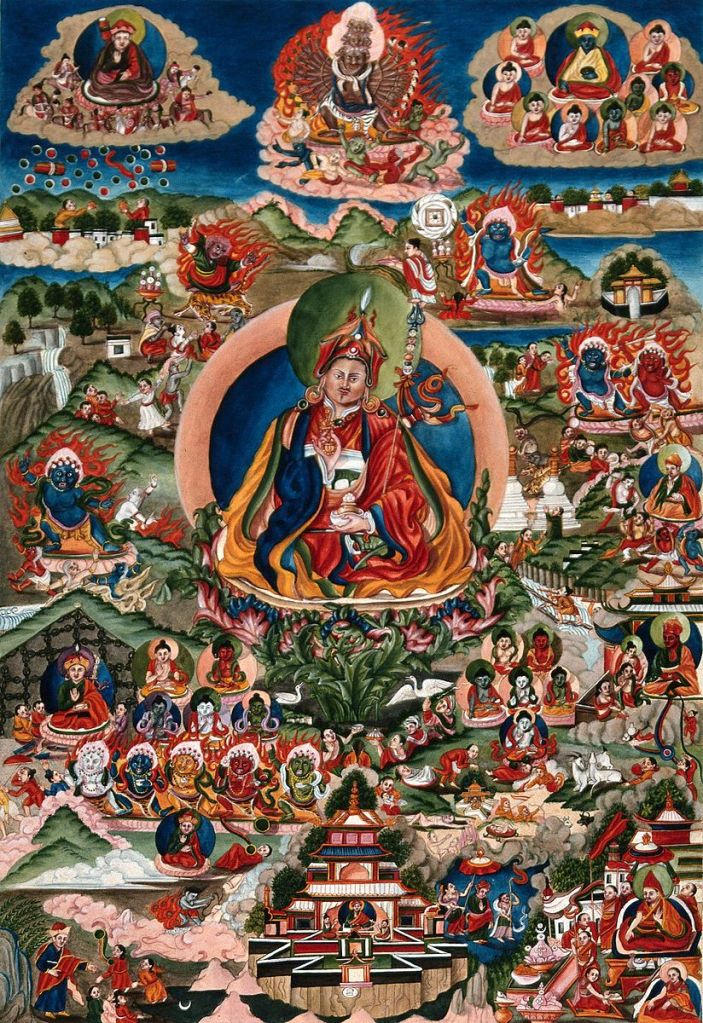
Guru Rinpoche (Tibetan “Precious teacher”) lived in the 8th-9th century. He was the founder of the Nyingmapa school of Buddhism in Tibet. Courtesy: Creative Commons

Steve Davidson is a psychologist from California, the author of the clinical textbook “An Introduction to Human Operations Psychotherapy”.

.

PLEASE NOTE: ARTICLES CAN ONLY BE REPRODUCED IN OTHER SITES WITH DUE ACKNOWLEDGEMENT TO BORDERLESS JOURNAL

Categories
Poetry

Sorrows Left Alone

Written in Korean & translated by Ihlwha Choi

Sorrows Left Alone

When we apologise even to the flower,
the wind is sweet and the sunshine bright.
When we settle their misunderstandings,
a mound is tranquil and the birds' songs are friendly.

If birds stop singing and flowers fall blankly,
time will rattle like a wagon rolling over gravel.

We must not trust commonplace sorrow
only to heavens.

If humans do not come forward,
the world will be overthrown by the sea of tears
as only sorrows will retain their hold.

Ihlwha Choi is a South Korean poet. He has published multiple poetry collections, such as Until the Time, When Our Love will Flourish, The Color of Time, His Song and The Last Rehearsal.

.

PLEASE NOTE: ARTICLES CAN ONLY BE REPRODUCED IN OTHER SITES WITH DUE ACKNOWLEDGEMENT TO BORDERLESS JOURNAL

Categories
Review

Wooden Cow

Book Review by Somdatta Mandal

Title: Wooden Cow

Author & Translator: T. Janakiraman, translated from Tamil by Lakshmi Kannan

Publisher: Orient Blackswan Private Ltd, 2021

T. Janakiraman (1921-82), affectionately known as Thi Jaa, is an iconic, widely read and revered Tamil writer and one of the most influential figures of the twentieth century. Belonging to the Manikkodi movement in Tamil literature, which brought in new ways of writing, with an emphasis on the art of fiction as practiced by the Modernist writers in England, he wrote in a deliberately pared-down style and explored psychological ramifications. It is no coincidence that the hundredth year of his birth is being celebrated in 2021 in a great way. As a tribute to him, Orient Blackswan has just published a second edition of his Tamil novel Marappasu (Wooden Cow) aptly translated by Lakshmi Kannan, the well-known contemporary bilingual writer and poet. A novel quite controversial when it was written, it is basically the portrayal of a strong woman who lives by her own convictions, rejects the institution of marriage, and who remains true to herself, despite social censure.

Narrated in the first person by the protagonist Ammani, it is through her consciousness that the events of the novel are reflected. Divided into two parts, the first section delineates Ammani’s growth from a precocious child to a luminous, spirited young woman. She leaves her natal home for higher education to live with her Periappa and Periamma, her uncle and aunt, and starts living a non-traditional life. The opening sentence of the novel, “Almost anything makes me laugh” vouches for her strange beliefs and behavior. Her headstrong nature coupled with her intolerance of injustice results in her being mired in controversy over and over again. She ‘hardened’ her mind as she “knew there is no meaning in marriage and all that sham in the name of respectability”. She doesn’t wish to steal but wishes to live on her own terms. She spouts communist philosophy and rails against the unjust treatment of the poor by the government. Though financially very poor, she goes and invites the famous singer and musician Gopali to perform at her cousin’s wedding celebrations. Soon Gopali’s charisma draws her into his ambit. He takes her to Madras and also arranges dance lessons for her and moves her into a house he buys for her. Ammani rejects marriage as a bourgeois concept but soon accepts her hedonistic new life and begins her unconventional and volatile relationship with Gopali.

In the second part of the novel, we see Ammani as a woman of the world, divested of all her connections with traditional Brahmin society. Wary of marriage, which she sees as a lifelong imprisonment, she travels around the world giving Bharatnatyam performances.  Gradually her relationship with Gopali is strained when he realises that he is not her only male companion. Ammani’s many romantic entanglements provide her with a different view of the man-woman relationship. She gets into a relationship with a man called Pattabhi but laughs it off when he proposes marriage, thus wounding him deeply. Throughout the novel there are many more instances of her waywardness. She poses as a streetwalker in London and picks up a Vietnam war veteran called Bruce with whom she spends three weeks. Initially Bruce is convinced that he “got to know a rare human being”. He tells her, “You may have slept with three hundred people and kissed a few thousand. But you are a very pure woman”. But when he tries to be intimate with her, Ammani states: “I’m a public girl. At the same time, I’m also not public. I can be bought. But I’m also not for sale. It’s possible to stick to me, but it won’t last. Why are you looking at me as if I was an exhibit?”

She explains to him that she has no relations or friends. She drops each friend in their place and moves on. While on a train journey with Gopali, she makes a sardonic assertion that she is not Gopali’s wife and confuses the fellow English passengers travelling with them. Thus, far from adhering to the caste and class hierarchies and morality, the novelist portrays Ammani as a woman who lives by her own convictions and remains true to herself despite social censure. Towards the end of the story however she realises through the marital relationship between her servant Pachiappan and his wife Maragadham that a man and a woman can also be true soulmates, and this renews her faith in the institution of marriage.

The title is based on her perceptions when she sees a dead cow on the street one day. People were wary of the unpleasant task of having to dispose the carcass, even though the cow had provided milk and had borne calves when she was alive. Metaphorically speaking, she perceives herself to be similar to the cow that lacks functionality, and therefore wooden. By disclaiming the institution of marriage, she has been merely a shining curio that has not been of any real value to others.

Translation and its problems are nothing unique and hence critics have even labelled it by terms like ‘transliteration’ and ‘transcreation.’ In Mouse or Rat? Translation As Negotiation, Umberto Eco writes about a postlapsarian movement between different tongues, the perilous attempt to express concepts from one language into another. “Translation is always a shift, not between two languages but between two cultures. A translator must take into account rules that are not strictly linguistic but, broadly speaking, cultural.” By suggesting that translation is a negotiation’ not just between words but between cultures, whether it be a loss or a gain on either side, Eco emphasizes that a translator’s job is to decide what elements are vital and which may be neglected. In another instance, the problems of translation are put forward by Jhumpa Lahiri in her latest novel Whereabouts (which she self-translated from Italian to English) attests to the fact: “Translation shows me how to work with new words, how to experiment with new styles and forms, how to take greater risks, how to structure and layer my sentences in different ways.”

That Lakshmi Kannan decided to re-translate the original Tamil text once again after a gap of nearly forty years vouches for the fact that a translation can never be declared as one and final. What she did in the first edition in 1979 left her dissatisfied and as she herself declared, trying to do a fresh translation of an older piece of work was like wrestling with “a new kind of beast that is hard to describe and difficult to handle”.

By paying more attention to enhance readability for a contemporary audience as well as to preserve the Tamil flavor of the original by retaining many original words in the text and providing a glossary at the end, this revised version has emerged rejuvenated as a new text.

As Anita Balakrishnan rightly points out in her foreword, the author wrote in the distinctive Tamil dialect of the Kaveri delta that created a characteristic style. This made the task of translating even more daunting, for the carrying across of the nuances of the Thanjavur Brahmin register is no mean task. Also, Jankiraman’s technique of interweaving the mellifluous strains of Carnatic music with his pathbreaking themes helped him to ensure his place in the great tradition of modern Tamil fiction. With a good command of both English and Tamil, Kannan’s translation ably captures the nuances of the original text, and she should be congratulated for bringing the works of T. Janakiraman to a pan-Indian as well as global readership. Her unique attempt to re-translate the novel once again by rectifying all the lapses in the earlier translation speaks of her sincerity, integrity and ultimately love for her mother tongue Tamil as well.

Somdatta Mandal is a critic and translator and a former Professor of English at Visva-Bharati, Santiniketan, India.

.

PLEASE NOTE: ARTICLES CAN ONLY BE REPRODUCED IN OTHER SITES WITH DUE ACKNOWLEDGEMENT TO BORDERLESS JOURNAL

Categories
Poetry

The Mysteries of the Universe by Akbar Barakzai

Balochi Poetry by Akabar Barakzai, translated by Fazal Baloch

Mysteries of the Universe

I wonder if mountains smile
If the wind gets hungry
If clouds too have a mind
I wonder if ants wash themselves
If flowers have any sight
If colours breathe

I wonder if the sun also feels thirsty
If the moon stretches out for a yawn
If fire ever becomes pregnant 
If water dreams any dream

I wonder if stones, pebbles and gravels
Pass through childhood, youth and old age?
I wonder if beads and pearls are passionate for one another
If fish and birds compose songs
I wonder if there exist such walls
Which have no ears at all
If dead can also see us from their grave
If they laugh at us
If days and nights have tongues
If they mourn for others
I wonder if clouds too burst forth in the heavens
If flowers and trees also tie the knot
If river, lake and sea feel grief and pain
If stars and Pleiades have heart, eyes and ears
I wonder if Mars and Venus know of friendship and poetry
I wonder if the earth has ever fallen in love
If it has endured any pain and anguish
I wonder if anyone can unravel the enigmas
Embedded in Akbar's verse
The mysteries of the universe

Akbar Barakzai was born in Shikarpur, Sindh in 1939. He is ranked amongst the proponents of modern Balochi literature. His poetry reflects the objective realities of life. Love for motherland, peace and prosperity and dignity of a man are the recurrent themes of his poetry. His love for human dignity transcends all geographical and cultural frontiers. Barakzai is not a prolific poet. In a literary career which spans over half a century, Barakzai has brought out just two anthologies of poetry, Who can Kill the Sun and The Lamps of Heads, but his poetry has depth and reaches out to human hearts with its profundity. Last year, Barakzai rejected the Pakistan Academy of Letters (PAL) award, quoting  the oppressive policies meted out to his region by the government as the reason.

Fazal Baloch is a Balochi writer and translator. He has translated many Balochi poems and short stories into English. His translations have been featured in Pakistani Literature published by Pakistan Academy of Letters and in the form of books and anthologies. Fazal Baloch has the translation rights to Barakzai’s works and is in the process of bringing them out as a book.

.

PLEASE NOTE: ARTICLES CAN ONLY BE REPRODUCED IN OTHER SITES WITH DUE ACKNOWLEDGEMENT TO BORDERLESS JOURNAL

Categories
Pirate Poems

Pirate Blacktarn is Nearly Blown Away

By Jay Nicholls

Pirate Blacktarn is Nearly Blown Away


Pirate Blacktarn was feeling dizzy,
The winds above his head were being very busy.
They were roaring altogether in a contest of blowing,
Till the pirates didn’t know if they were coming or going.
Whooosh! went the West Wind, warm and wet.
EEEssh! hissed the East Wind in a fuss and a fret.
Rruusssh! went the North Wind, cruel and cold,
Swisssh! blustered the South Wind, burning and bold.

The pirate’s poor ship was spinning round and round
And the crews’ ears buzzed with the rush of sound.
“I’m going to be sick,” moaned Blacktarn yuckily.
“I’ll look after you,” said Big Bob pluckily.
“Eeeehow!’” blew the East Wind, “these Lemon Seas are mine,
I’m the wind to rule over this lemony brine.”
“Rubbish,” whooshed the West wind, “it’s me they need,
To bring them the rain, it’s obvious indeed.”
“Oh no,” niggled the North Wind, “oh no, no, no,
The Lemon Seas need me to bring them ice and snow.”
“Shusssh,” blew the South, “what’s needed is my breeze,
To bring the breath of warmth to the lovely Lemon Seas.”

The pirate’s ship tilted from side to side,
The crew fell on the deck and began to slide.
They clutched at the ropes and the yardarm and the sails,
Rakesh the mate grabbed at the rails,
Stowaway Fay tied herself to the mast,
Tim Parrot perched on her shoulder and held on fast.
It was the worst of storms the Lemon Seas had ever known.
“We’ll be blown to bits and pieces,” cried Blacktarn with a groan.
The ship tilted one way and the mast almost snapped
And then tipped the other as the great sails flapped.

The North Wind blew hailstones that clattered on the deck
And the West Wind whirled rain that poured down Blacktarn’s neck.
The East Wind blew a fog that hid them all from view
Till the South scorched it away, “Phew, phew, phew.”
“We’ll drown, we’ll drown,” moaned the terrified crew.
But all of a sudden the sea began to glow,
And a magical figure surged up from below.
Sea horses danced and sea nymphs sang
And all on its own, the ship’s bell rang.
For Neptune himself appeared on the scene.
He shook his trident which glittered gold and green.
For he was very angry and his face was very stern.
The Winds went silent and looked down in concern.
“What do you think you’re doing, blowing like fools
Over some stupid argument about which wind rules?”
“Puff,” muttered the West wind in great alarm,
“We didn’t really mean to do any harm.”
“I didn’t start it,” stuttered the East wind in a hurry.
“Nor me,” whinged the South, “I just blew a little flurry.”
“No, no,” fluttered the North, “it was only just in fun,
We didn’t really mean any harm to be done.”

“It’s just not good enough,” Neptune told them in a rage,
“You’re causing problems for sailors at every stage.
Ships are lying stranded in oceans far and near
Because you rowdy lot are all quarrelling here.
There’s no wind for any ship to sail, not even the smallest,
Everyone is stuck from the littlest to the tallest.
Now you just stop huffing and listen to me,
I’ll have no more rows over who blows on the Lemon Sea.
For a quarter of the year, the West Wind will bring rain,
To make sure the Lemon Seas are full of water again.
Then the next quarter the North Wind shall blow
And sometimes, not too often, bring the sleet and the snow.
The quarter after that shall blow the breeze of the East
And in the final quarter, last but not least,
Shall come the South Wind with the heat of the sun,
So all winds shall have their turn when my will is done.”

“What a good idea,” cried Blacktarn and his crew,
While the Winds huffed and puffed and wondered what to do.
But they daren’t defy Neptune, the Emperor of the Sea,
So grumbling and rumbling, they had to agree.
“Good,” said Neptune, “I’m glad we’ve settled that,
Now I’ll board ship and see Blacktarn for a chat.
Let the South Wind stay now and the rest of you go.”

So the West and East and North roared away in a tornado
And set the ship reeling in the last awful storm.
But Neptune raised his trident and the South Wind blew warm
And calmed the angry seas till all was at peace
And the waves whispered with relief that the storm would cease.
“Now let’s have a party,” cried Neptune once aboard.
“How useful,” said Blacktarn, “to be friends with the Sea Lord.”
So they danced and sang all day and all night.
But when they awoke at the sun’s first light,
Neptune and his sea nymphs were nowhere to be seen.
“Was it a dream?” wondered Mick, “what did it all mean?”
“Never mind,” called Blacktarn, “I stopped those winds all blowing,
Now set sail crew, it’s time we were going.”

Note: The ‘Pirate Blacktarn’ poems were written in the early 1990s but were never submitted anywhere or shown to anyone. By lucky chance they were recently rescued from a floppy disc that had lain in the bottom of a box for almost thirty years. There are twelve poems in the series but no indication as to what order they were written in and the author no longer remembers. However, they seem to work well when read in any order. They all feature the same cast of characters, the eponymous pirate and his crew, including a stowaway and an intelligent parrot. The stories told by the poems are set on a fictional body of water named the Lemon Sea. (Dug up by Rhys Hughes from the bottom of an abandoned treasure chest).

Jay Nicholls was born in England and graduated with a degree in English Literature. She has worked in academia for many years in various student support roles, including counselling and careers. She has written poetry most of her life but has rarely submitted it for publication.

.

PLEASE NOTE: ARTICLES CAN ONLY BE REPRODUCED IN OTHER SITES WITH DUE ACKNOWLEDGEMENT TO BORDERLESS JOURNAL

Categories
Stories

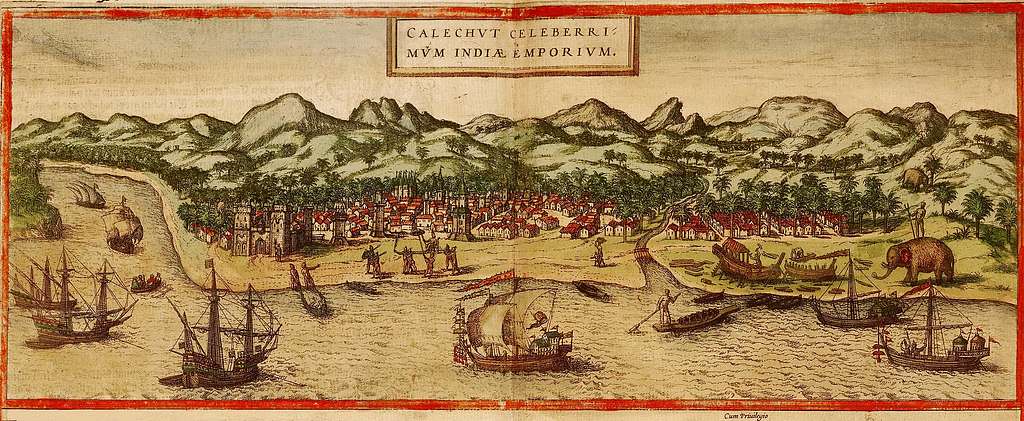
Dawn in Calicut

By Krishna Sruthi Srivalsan

The call for fajr from the local mosque
Pierces the stillness of early morning,
The sruthi box in the puja room stirs awake.

It is dawn in Calicut. The house is quiet, except for the muffled sound of water from the washroom, where my aunt does her ablutions before prayer. She shuffles her way into the puja room and hurriedly shuts the door, careful not to let even a slice of light escape the room and disturb the rest of us. For the next hour, she will be in deep meditation.

Across my bed, I see Amaama. Wisps of white hair framing her toothless mouth, she seems peaceful. Sleep didn’t come to me easy the previous night. A long journey back home and the sudden shock of seeing my grandma succumb to inevitable illness, leaving both her mind and body fragile, have rattled me. I watch her, drifting away in the land of nod.

As the sun peeks out reluctantly from the rain clouds, she wakes up. She looks at me, a question mark on her face. “Do you remember me, Amaama?” I ask. She nods, but when I ask her to tell me my name, she mumbles. I realise that I have become unrecognisable to her. Even after watching her struggle with her memory for the past two years, this upsets me.

My aunt makes idlies for breakfast. I offer to feed Amaama idlies and sugar. It is the food of infants, but it seems like she is a helpless child all over again. After an hour, she quips in a plaintive tone, “I haven’t eaten anything.” We make her a cup of Horlicks and she smacks her lips appreciatively while sipping on the sweetness of the malt.

I spend the day sitting near her bed, reading, in an effort to forget the maze of memories that cloud my mind. I also feel vaguely guilty, though I can’t really tell why. Should I have called her more often when I was away? Should I have been more affectionate to her when she could remember? Could I have been a better grandchild? The regrets pile on, one after the other, and then I understand that the root cause of my guilt is the startling realisation that I never got to know Amaama as a person. All my life, she has been Amaama. What was she like as a child? What was she like as a young woman? What made her happy? Did she have any regrets? I will be in Calicut for the next two weeks and I determine to make use of that time to understand more. I speak to my aunts, pore through old photographs, try talking to Amaama herself.

                                               *

A little girl in pigtails and pinafore
Finds the greatest joy
In knitting needles and yarn.

My grandmother, Saraswathi Menon, was born in 1932. Her ancestral house is in a village called Kalapatti, in the district of Palakkad, in the foothills of the Western Ghats of southern India. Sarasu, as she is known to her family, was the fifth of seven children. Her father was an inspector in the public works department of the Indian Railways. The family moved between Tuticorin and Sucheendram, two towns on the tip of the Bay of Bengal, and Sarasu grew up in relative affluence. The first brush with hardship must have come at the age of eight, when she lost her mother, who at that time was hardly thirty-three.

Sarasu’s paternal aunt helped raise her, and she moved back to her hometown in Kerala with her younger siblings. As a teenager, she developed a lifelong interest in embroidery and knitting, spending all her time with her knitting needles and balls of yarn. She did not pursue studies after her high school matriculation exams; she did not pass the English examination and did not want to place a burden on the family’s dwindling finances by making another effort.

A memory of Amaama urging me to study flashes across my mind. At that point, she had self-deprecatingly joked that she had no buddhi and that’s why she didn’t study further. I think back and often marvel at how Amaama still aced the many challenges that life presented her, despite this lack of formal higher education. To think of the person she could have become with the right opportunities…

Barely out of her teens, Sarasu returned to Tamil Nadu, as a newly married bride. This time, she found herself in Trichy. I look at Amaama sitting in her bed, propped up by pillows, listening to a version of the Ramayana rendered by Kavalam Sreekumar. I try to jog her memory, and surprisingly, she offers a story of her Trichy days. Her eyes well up as she mentions hopping onto rickety buses that took her to the Rockfort temple and the Sriranganathan temple on an island in river Cauvery. She smiles as she remembers an old lady who taught her how to make murukku and other delectable goodies that she treated her daughters to after a long day at school. She remembers getting married to my Thatha, and accompanying him to the various towns that his job as a sales engineer demanded.

I try to ask more questions, but Sarasu’s spark has disappeared now, and Amaama cannot remember anything else. She can remember events that occurred more than thirty years ago, but she cannot remember what she ate this morning — how treacherous is this mind!

As Kavalam Sreekumar sings in the background, my aunt quietly tells me of Sarasu’s first born child — it was not my aunt, as I had always thought. Sarasu’s first born was a boy; they named him Ravi but they lost him to smallpox at the age of two. This news startles me again — how had Amaama coped with the loss of her only son all those years ago? He would have been the brother my mother never had. How little do we really know of those close to us!

Life blessed Amaama and Thatha with four other children, all of them girls. My aunt talks about the ridicule and pity heaped on her parents, Amaama in particular – “Four girls! No sons! How will you raise four girls?” They raised them with love, making numerous sacrifices, instilling in them courage, confidence, compassion, and a sense of fierce dignity, a determinedness to be independent. It is a testament to Amaama’s sacrifices that all her daughters, and by extension, us — my cousins and I — have reached so far.

                                                        *

Coffee stains on the table
A jumbled-up algebra problem
Anger turns into a ghost of regret.

The day has come to an end. I have learnt new things about Amaama’s life, and I can now see a glimpse of Sarasu, behind the shadow of Amaama. My mother lights the lamp and takes it to the entrance of the house, chanting “Deepam, Deepam!” It is auspicious to keep a lit lamp at the door front at twilight. The air is alive with the buzz of mosquitoes. Amaama is awake. I venture to sing an old bhajan which she used to love. She smiles, she seems to recognise the song, but she still cannot recognise me. Memories spring up from the cobwebs of my mind.

It is supposed to be a holiday for Amaama. Two months in Dubai with her youngest daughter, my mother. I am in grade 10, at the peak of schoolgirl rebellion. A few weeks before the all-important board examinations begin, we have study leave. With my parents away at work, I find myself alone with Amaama.

One morning, I am working on algebra, timing myself to see how quickly I could finish a sum. I hear a cup of coffee being knocked over in the kitchen, but I pretend not to hear. Amaama calls out for me, but I ignore her. When she calls me a third time, I can no longer ignore her, so I stomp into the kitchen, sulking. Not saying a word, I mop up the coffee stains, and slam the microwave to warm another cup of coffee from the flask.

Amaama has not spoken a word about my unreasonable behaviour. I know I have reacted badly, behaving like a spoilt child, but a false sense of pride keeps me from apologising. I hand her a second cup of coffee and try to study for the rest of the day. It is a completely useless day; my anger has now turned to regret and guilt.

When my parents return from work, I observe Amaama speak with them. Will she snitch on me, complain about the brat they raised? She remains quiet, does not say a word about me; instead, she asks them about their day and tells them about gifts she wants to take back from Dubai. I feel uncomfortable. I would have felt better if she had reprimanded me instead.

That night, I toss and turn in bed. Amaama and I share a room, and I hear her sob quietly into her pillow. Guilt engulfs me. I reach out to hug her and I begin to cry too. Amaama turns over and asks what is upsetting me. Exams, I mumble, not wanting to apologise. She hugs me tight and says “What is there to worry? You’re such a midukki kutty. God is always with you!” I sob into the softness of her sari and she says, “I was wondering why my midukki kutty doesn’t like me anymore!” I reply in my garbled Malayalam that I would always love her, but I still did not apologise.

Forgiveness has always been Amaama’s best friend.

                                                        *

Barefoot pilgrims walk to Pandharpur
Saffron flags fluttering in the wind
“Vitthal! Vitthal!” The palkhi bearers chant.

It is pilgrimage season in Maharashtra. Visiting my aunts in Mumbai after ages, we arrange for a trip to Shirdi. A road trip will take us at least six hours. Amaama cannot sit in a car for that long. We decide that the Shirdi trip can wait, but Amaama insists that we do not cancel on account of her. “I’ll stay alone. Will keep myself busy with TV and my books. And anyway, Padma will come for a few hours in the afternoon, so I won’t be lonely”, she says. I wonder what sort of conversation our Marathi speaking helper will have with Amaama whose vocabulary in Hindi (leave alone Marathi) does not extend beyond Kaise Ho! I tell my parents and aunts to go ahead, and I offer to stay with Amaama. “Nothing doing, you have to go see the Baba at Shirdi!” Amaama insists. I slowly understand where my mother gets her stubbornness from.

We set out at dawn the next day and reach Shirdi a little ahead of noon. We spend the next few hours in the temple town, offering our prayers, and soaking in the meditative stillness of the masjid where Baba lived — it is a salve to a weary heart. Before dusk sets, we leave Shirdi. We whizz past fields of sugarcane and cotton, growing in abundance, on the rich black soil of these lands, stopping for a quick cup of tea at Igatpuri. There is a thick shroud of mist, and my mind keeps wandering back to Amaama. What could she be doing, all alone in that flat?

We reach home an hour before midnight. The Matunga neighbourhood is quiet. Amaama is in her chair by the puja room, reading Narayaneeyam. “Did you get scared, Amaama?”, I ask. She shrugs away the question and asks me back, “What is there to get scared of when I have God by my side?” Faith has always been Amaama’s best friend.

*

The Nilambur river quietly chugs along
Through hills and fields and forests
And merges into nothingness at Beypore.
                                                    

It has now been three years since Amaama finally succumbed. Watching her struggle through ill health, losing control of her mind and memory, has been an excruciating journey for all of us. Ironically, death seemed to free her, release her from the terrible pain she endured for a few years. When I miss her a little too much, I turn to my phone which had faithfully captured a Boomerang video of her making a dosa when she was in better health. It reminds me of better days in the past when she would make bite sized unniappams, as dainty as the dimples on a toddler’s fist. Sometimes the grief of losing her is too much to bear. I think of a story I read as a child — something about a magic pot which kept cooking porridge for a hungry family. The family gobbled up the porridge, but the pot simply would not stop. It kept cooking porridge, till the porridge overflowed and flooded the entire city! Sometimes, my grief is like that. But then, I look at the photo of Amaama by my bookshelf. A sparkle in her eyes, and a half smile on her lips, she looks the picture of equanimity.

Many dawns have now passed by in that house in Calicut. Sometimes, during the monsoon season, I gaze at the grove of coconut trees outside. The wind rustles the coconut palms and the foliage sways, like dervishes drunk on divine nectar. Sometimes, a bubble of calm quietens an intense battle in my head. Sometimes, instead of holding onto an angry thought, I just let go, like the Nilambur river. In those times, I feel as if Amaama is watching me, from somewhere, where she is reunited with her beloved Krishna, where she can forever listen to the lilting melody from his flute, where she can watch him play by the Yamuna river. In those times, I feel as if her prayers and love have formed a protective shield, an invisible amulet protecting me from all perils. Love has always been Amaama’s best friend.

Glossary

Fajr – The first of five Islamic prayers, also known as the dawn prayer

Sruthi box – An instrument used in Indian classical singing to help tune the voice

Puja room – A shrine room for worship, religious rituals, prayers, and meditation in a Hindu household

Amaama – Malayalam word for grandmother

Idlies – Steamed rice dumplings, traditionally eaten as a breakfast dish in south India

Buddhi – Malayalam word for intelligence

Murukku – Savoury crunchy snack made from rice flour and lentils

Thatha – Tamil word for grandfather

Deeepam, deepam – The word “deepam” means lamp in Malayalam. In Kerala, at dusk, women carry lit lamps to the entrance of the house, chanting “deepam, deepam” in order to invite light and auspiciousness into their homes.

Midukki kutty – Malayalam term for smart girl

Vitthal – Form of the Hindu god Vishnu or Krishna, as he is known in the state of Maharashtra

Palkhi – Marathi word for palanquin. In this context, the verse refers to a yearly pilgrimage where devotees carry the sandals or padukas of the saint Dnyaneshwar from his shrine at Aalandi to the famous Vitthal temple at Pandharpur. The barefoot pilgrims carry the padukas in a wooden palkhi and the journey takes around 21 days by foot.

Shirdi – A town in Maharashtra, which is the home of Shirdi Sai Baba, a revered fakir or saint

Kaise ho! – Hindi phrase for “How are you?”

Narayaneeyam – An epic poem, comprising of 1,035 verses, narrating the life of Lord Krishna. The poem was composed in the 16th century by Melpathur Narayana Bhattathiri, a renowned Sanskrit poet hailing from Kerala.

Unniappam – Sweet dumplings made with rice, banana, jaggery and coconut


Krishna Sruthi Srivalsan is a chartered accountant by profession and is passionate about  books, writing, travel, and celebrating diversities, not in any particular order. She firmly believes that human beings should not strive to “fit in” when they are designed to “stand out”. She reads on a variety of subjects and genres and hopes to publish a novel someday.

.

PLEASE NOTE: ARTICLES CAN ONLY BE REPRODUCED IN OTHER SITES WITH DUE ACKNOWLEDGEMENT TO BORDERLESS JOURNAL

Categories
Poetry

Unasked-For

By Tony Brewer

Unasked-for


I love your tiger
I hate your king
I have too many unpopular things
You looked really cute in your floppy hat
You have something in your teeth
Most movies bungle act 3
I will tolerate lima beans
I often lose track of days
Happy people here look like ads
No, thanks anyway

Tony Brewer is a poet, live sound effects artist, and event producer. His most recent book is The History of Projectiles. More at tonybrewer71.blogspot.com.

.

PLEASE NOTE: ARTICLES CAN ONLY BE REPRODUCED IN OTHER SITES WITH DUE ACKNOWLEDGEMENT TO BORDERLESS JOURNAL