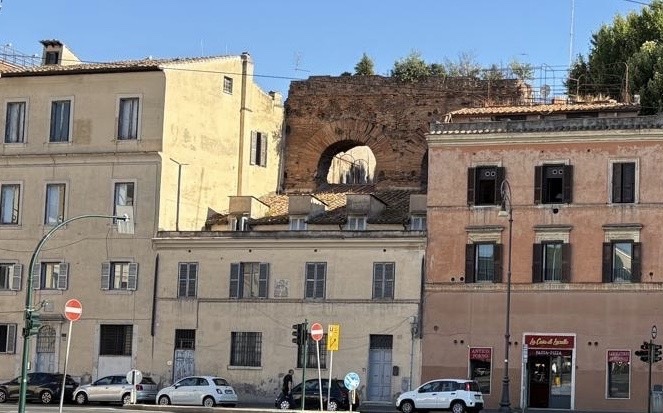
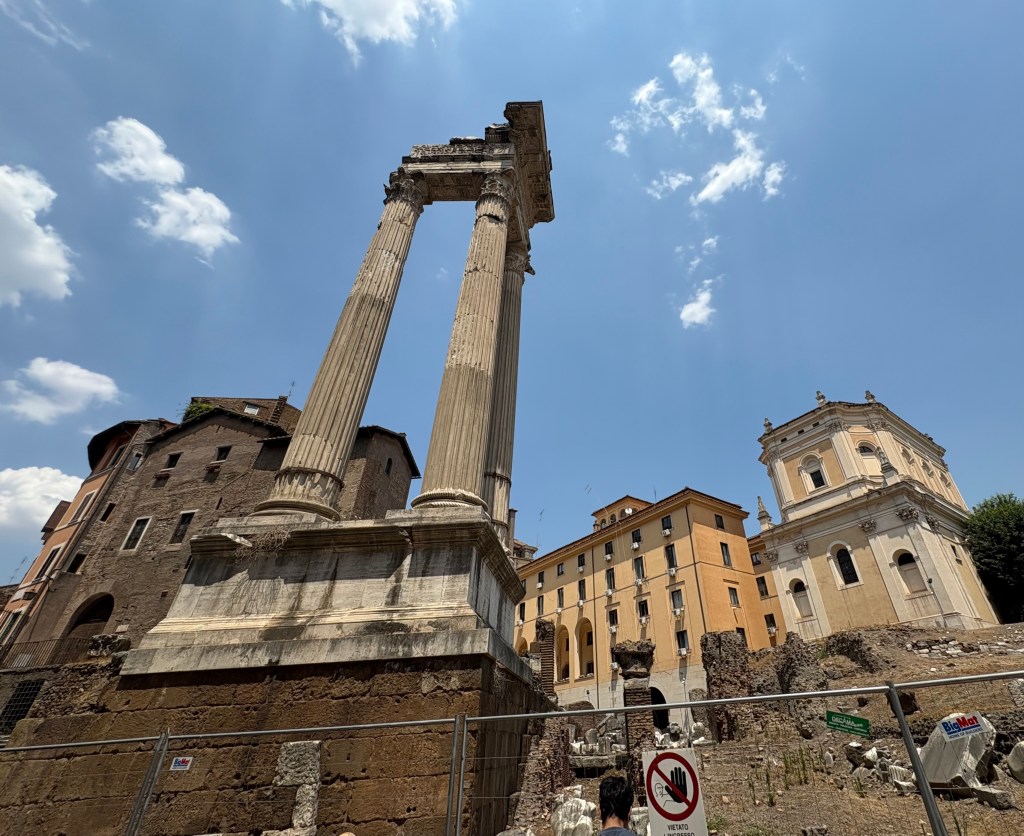
All around us, we hear of disasters. Often, we try to write of these as Tagore seems to do in the above lines. However, these lines follow after he says he draws solace and inspiration from a ‘serene lotus’, pristine and shining with vibrancy. He gazes at it while looking for that still point which helps him create an impact with words. That is perhaps what we can hope to do too — wait for a morning where clarity will show us the path to express not just what we see, but to find a way to heal and help. Finding parallels in great writings of yore to our own attempts at recreating the present makes us realise that perhaps history is cyclical. In Rome, new structures rear up against thousand-year walls, reflecting how the past congeals into the present.
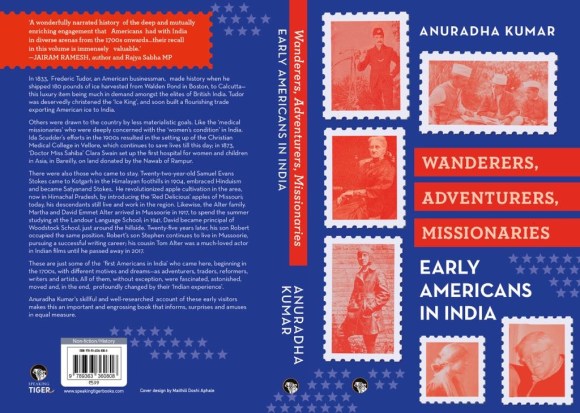
Congealing the past into our present in this July’s issue are stories of American migrants — like Tom Alter’s family who made India their home — by Anuradha Kumar in her new non-fiction Wanderers, Adventurers, Missionaries: Early Americans in India. We feature this book with a review and an interview with the author where she tells us how and why she chose to write on these people. We have more people writing of their own wanderings. Mohul Bhowmick wanders into Cambodia and makes friends over a local sport while Prithvijeet Sinha strolls by the banks of the River Gomti in Lucknow. Meredith Stephens not only takes us to the Prime Meridien in Greenwich but also to Carnarvon which houses a science and technology centre in Australia. Devraj Singh Kalsi wanders with humour to discover gastronomical inspiration and hopes for sweeter recompense.
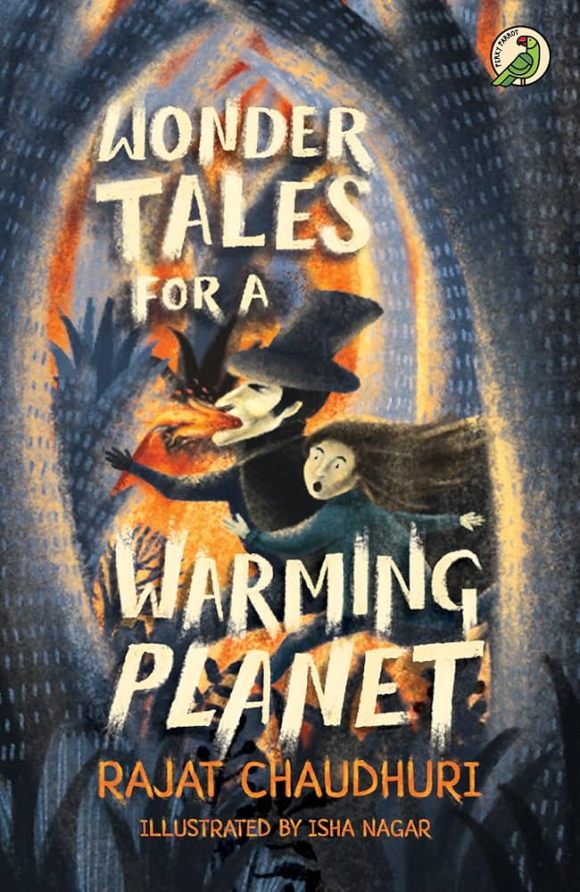
Taking up the theme of cli-fi, Rajat Chaudhuri’s Wonder Tales for a Warming Planetseems to bring hope by suggesting adapting to changing climes. Rakhi Dalal tells us in her review: “It dares to approach the climate crisis through the lens of empathy and imagination rather than panic or guilt. In doing so, Rajat Chaudhuri gives us what many adult climate narratives fail to deliver—a reason to believe that another world is not only possible but already being imagined by the young. All we need to do is listen.” Bhaskar Parichha has discussed the autobiography of a meteorologist and Distinguished University Professor at George Mason University, Jagadish Shukla. In A Billion Butterflies: A Life in Climate and Chaos Theory, he claims Shukla has “revolutionised monsoon forecasting.” Somdatta Mandal has written about Dilip K Das’s Epidemic Narratives: The Cultural Construction of Infectious Disease Outbreaks in India. And Gower Bhat reviews Neha Bansal’s best-selling poetry collection, Six of Cups.
With that, we wind up the contents of this month’s issue. Do pause by our content’s page to check it out in more details.
This month’s edition would not have been possible without all our contributors, our fabulous team and especially Sohana Manzoor’s artwork. Huge thanks to all of them and to our wonderful readers who make it worthwhile for us to write and publish. Do write in to us if you have any feedback. Five years ago, we chose to become a monthly from a daily… We have come a long way from then and grown to host writers from more than forty countries and readers from almost all over the world. For this, we owe you all – for being with us and encouraging us to find fresh pastures.
Probhatey (In the Morning) was published as a part of Rabindranath Tagore’s collection called Kheya (Ferry) published in 1906.
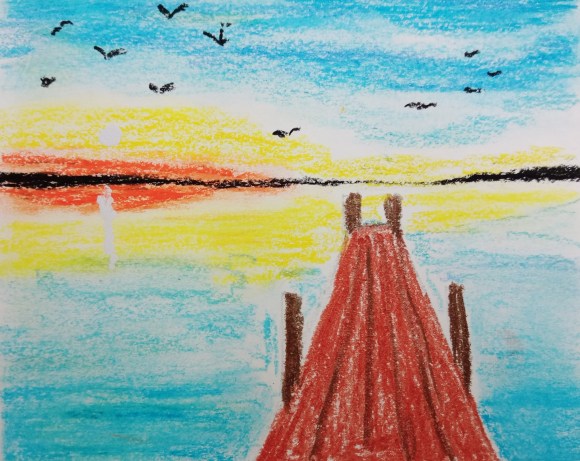
Art by Sohana Manzoor
      IN THE MORNING

 The heavy downpour
               Of one night
   Has filled the lake in my home
              To the brim.
        When I look, I see
     Deep blue waters overflow.
Where is its shore? Where is its bottom?
        Where does it turn?
  With one downpour, see the lake
          Is filled to the brim.


    Last night, who could imagine
            This would happen!
      The rain poured incessantly
            In the deep dark night.
     In the midnight of this monsoon,
     While I lay in a lamp less room,
            I heard the wind howl
                 As if in distress —
                  Who knew then
                This would happen!


  Amidst this outpouring of teardrops,
            I found today
           A serene lotus
        Presiding the scene.
   O tell me, when O when did it bloom,
          Pristine among multitudes
             Shining with vibrancy,
             Bringing solace to me
            In the midst of this abyss
                   Of despondency!


Today, sitting alone, I ponder
          Gazing at the site.
       I see the treasures torn
  From the chest by the tragic night.
       I can see the heartbreak,
    Hear the wailing, the awakening,
          I write from my heart
          Of the raging tempest.
    I gaze at the treasures torn
 From the chest by the stormy night.
This poem has been translated from Bengali by Mitali Chakravartywith editorial input from Sohana Manzoor.
.
PLEASE NOTE: ARTICLES CAN ONLY BE REPRODUCED IN OTHER SITES WITH DUE ACKNOWLEDGEMENT TO BORDERLESS JOURNAL
A review of Anuradha Kumar’s Wanderers, Adventurers, Missionaries: Early Americans in India (Speaking Tiger Books) and an interview with the author
Migrants and wanderers — what could be the differences between them? Perhaps, we can try to comprehend the nuances. Seemingly, wanderers flit from place to place — sometimes, assimilating bits of each of these cultures into their blood — often returning to their own point of origin. Migrants move countries and set up home in the country they opt to call home as did the family the famous Indian actor, Tom Alter (1950-2017).
Anuradha Kumar’s Wanderers, Adventurers, Missionaries: Early Americans in India captures the lives and adventures of thirty such individuals or families — including the Alter family — that opted to explore the country from which the author herself wandered into Singapore and US. Born in India, Kumar now lives in New Jersey and writes. Awarded twice by the Commonwealth Foundation for her writing, she has eight novels to her credit. Why would she do a whole range of essays on wanderers and migrants from US to India? Is this book her attempt to build bridges between diverse cultures and seemingly diverse histories?
As Kumar contends in her succinct introduction, America and India in the 1700s were similar adventures for colonisers. In the Empire Podcast, William Dalrymple and Anita Anand do point out that the British East India company was impacted in the stance it had to colonisers in the Sub-continent after their experience of the American Revolution. And America and India were both British colonies. They also were favourites of colonisers from other European cultures. Just as India was the melting pot of diverse communities from many parts of the world — even mentioned by Marco Polo (1254-1324) in The Kingdom of India — America in the post-Christopher Columbus era (1451-1546) provided a similar experience for those who looked for a future different from what they had inherited. The first one Kumar listed is Nathaniel Higginson (1652-1708), a second-generation migrant from United Kingdom, who wandered in around the same time as British administrator Job Charnock (1630-1693) who dreamt Calcutta after landing near Sutanuti[1].
Kumar has bunched a number of biographies together in each chapter, highlighting the commonality of dates and ventures. The earliest ones, including Higginson, fall under ‘Fortune Seekers From New England’. The most interesting of these is Fedrick Tudor (1783-1864), the ice trader. Kumar writes: “In Calcutta, Dwarkanath Tagore, merchant and patron of the arts (Rabindranath Tagore’s grandfather), expressed an interest to involve himself in ice shipping, but Tudor’s monopoly stayed for some decades more. Tagore was part of the committee in Calcutta along with Kurbulai Mohammad, scion of a well-established landed family in Bengal, to regulate ice supply.”
Also associated with the Tagore family, was later immigrant Gertrude Emerson Sen (1890-1982, married to Boshi Sen). She tells us, “Tagore wrote Foreword to Gertrude Emerson’s Voiceless India, set in a remote Indian village and published in 1930. Nobel Laureate Rabindranath Tagore called Emerson’s efforts, ‘authentic’.” She has moved on to quote Tagore: “The author did not choose the comfortable method of picking up information from behind lavish bureaucratic hospitality, under a revolving electric fan, and in an atmosphere of ready-made social opinions…She boldly took in on herself unaided to enter a region of our life, all but unexplored by Western tourists, which had one great advantage, in spite of its difficulties, that it offered no other path to the writer, but that of sharing the life of the people.’” Kumar writes of an Afro-American scholar, called Merze Tate who came about 1950-51 and was also fascinated by Santiniketan as were some others.
Another name that stuck out was Sam Higginbottom, who she described as “the Farmer Missionary” for he was exactly that and started an agricultural university in Allahabad. Around the same time as Tagore started Sriniketan (1922), Higginbottom was working on agricultural reforms in a different part of India. In fact, Uma Dasgupta mentions in A History of Sriniketan: Rabindranath Tagore’s Pioneering work in Rural Reconstruction that Lord Elimhurst, who helped set up the project, informed Tagore that “another Englishman” was doing work along similar lines. Though as Kumar has pointed out, Higginbottom was a British immigrant to US — an early American — and returned to Florida in 1944.
There is always the grey area where it’s difficult to tie down immigrants or wanderers to geographies. One such interesting case Kumar dwells on would be that of Nilla Cram Cook, who embraced Hinduism, becoming in-the process, ‘Nilla Nagini Devi’, as soon as she reached Kashmir with her young son, Sirius. She shuttled between Greece, America and India and embraced the arts, lived in Gandhi’s Wardha ashram and corresponding with him, went on protests and lived like a local. Her life mapped in India almost a hundred years ago, reads like that of a free spirit. At a point she was deported living in an abject state and without slippers. Kumar tells us: “Her work according to Sandra Mackey combined ‘remarkable cross-cultural experimentation’ and ‘dazzling entrepreneurship.’”
The author has written of artists, writers, salesmen, traders (there’s a founder/buyer of Tiffany’s), actors, Theosophists, linguists fascinated with Sanskrit, cyclists — one loved the Grand Trunk Road, yet another couple hated it — even a photographer and an indentured Afro-American labourer. Some are missionaries. Under ‘The Medical Missionaries: The Women’s Condition’, she has written of the founders of Vellore Hospital and the first Asian hospital for women and children. Some of them lived through the Revolt of 1857; some through India’s Independence Movement and with varied responses to the historical events they met with.
Kumar has dedicated the book to, “…all the wanderers in my family who left in search of new homes and forgot to write their stories…” Is this an attempt to record the lives of people as yet unrecorded or less recorded? For missing from her essays are famous names like Louis Fischer, Webb Miller — who were better known journalists associated with Gandhi and spent time with him. But there are names like Satyanand Stokes and Earl and Achsah Brewster, who also met Gandhi. Let’s ask the author to tell us more about her book.
Anuradha Kumar
What made you think of doing this book? How much time did you devote to it?
These initially began as essays for Scroll; short pieces about 1500-1600 words long. And the beginnings were very organic. I wrote about Edwin Lord Weeks sometime in 2015. But the later pieces, most of them, were part of a series.
I guess I am intrigued by people who cross borders, make new lives for themselves in different lands, and my editors—at Scroll and Speaking Tiger Books—were really very encouraging.
After I’d finished a series of pieces on early South Asians in America, I wanted to look at those who had made the journey in reverse, i.e., early Americans in India, and so the series came about, formally, from December 2021 onward. I began with Thomas Stevens, the adventuring cyclist and moved onto Gertrude Emerson Sen, and then the others. So, for about two years I read and looked up accounts, old newspapers, writings, everything I possibly could; I guess that must mean a considerable amount of research work. Which is always the best thing about a project like this, if I might put it that way.
What kind of research work? Did you read all the books these wanderers had written?
Yes, in effect I did. The books are really old, by which I mean, for example, Bartolomew Burges’ account of his travels in ‘Indostan’ written in the 1780s have been digitized and relatively easy to access. I found several books on Internet Archive, or via the interlibrary loan system that connects libraries in the US (public and university). I looked up old newspapers, old magazine articles – loc.gov, archive.org, newspapers.com, newspaperarchive.com, hathitrust.org and various other sites that preserve such old writings.
You do have a fiction on Mark Twain in India. But in this book, you do not have very well-known names like that of Twain. Why?
Not Twain, but I guess some of the others were well-known, many in their own lifetime. Satyanand Stokes’ name is an easily recognisable still especially in India, and equally familiar is Ida Scudder of the Vellore Medical College, and maybe a few others like Gertrude Sen, and Clara Swain too. I made a deliberate choice of selecting those who had spent a reasonable amount of time in India, at least a year (as in the case of Francis Marion Crawford, the writer, or a few months like the actor, Daniel Bandmann), and not those who were just visiting like Mark Twain or passing through. This made the whole endeavour very interesting. When one has spent some years in a foreign land, like our early Americans in India, one arguably comes to have a different, totally unique perspective. These early Americans who stayed on for a bit were more ‘accommodating’ and more perceptive about a few things, rather than supercilious and cursory.
And it helped that they left behind some written record. John Parker Boyd, the soldier who served the Nizam as well as Holkar in Indore in the early 1800s, left behind a couple of letters of complaint (when he didn’t get his promised reward from the East India Company) and even this sufficed to try and build a complete life.
How do these people thematically link up with each other? Do their lives run into each other at any point?
Yes, I placed them in categories thanks to an invaluable suggestion by Dr Ramachandra Guha, the historian. I’d emailed him and this advice helped give some shape to the book, else there would have been just chapters following each other. And their lives did overlap; several of them, especially from the 1860s onward, did work in the same field, though apart from the medical missionaries, I don’t think they ever met each other – distances were far harder to traverse then, I guess.
What is the purpose of your book? Would it have been a response to some book or event?
I was, and am, interested in people who leave the comforts of home to seek a new life elsewhere, even if only for some years. Travelling, some decades ago, was fraught with risk and uncertainty. I admire all those who did it, whether it was for the love of adventure, or a sense of mission. I wanted to get into their shoes and see how they felt and saw the world then.
Is this because you are a migrant yourself? How do you explain the dedication in your book?
I thought of my father, and his cousins, all of whom grew up in what was once undivided Bengal. Then it became East Pakistan one day and then Bangladesh. Suddenly, borders became lines they could never cross, and they found new borders everywhere, new divisions, and new homes to settle down in. They were forced to learn anew, to always look ahead, and understand the world differently.
When I read these accounts by early travellers, I sort of understood the sense of dislocation, desperation, and sheer determination my father, his cousins felt; maybe all those who leave their homes behind, unsure and uncertain, feel the same way.
You have done a number of non-fiction for children. And also, historical fiction as Aditi Kay. This is a non-fiction for adults or all age groups? Do you feel there is a difference between writing for kids and adults?
I’d think this is a book for someone who has a sense of history, of historical movements, and change, and time periods. A reader with this understanding will, I hope, appreciate this book.
About the latter half of your question, yes of course there is a difference. But a good reader enters the world the writer is creating, freely and fearlessly, and I am not sure if age decides that.
You have written both fiction and non-fiction. Which genre is more to your taste? Elaborate.
I love anything to do with history. Anything that involves research, digging into things, finding out about lives unfairly and unnecessarily forgotten. The past still speaks to us in many ways, and I like finding out these lost voices.
What is your next project? Do you have an upcoming book? Do give us a bit of a brief curtain raiser.
The second in the Maya Barton-Henry Baker series. In this one, Maya has more of a lead role than Henry. It’s set in Bombay in the winter of 1897, and the plague is making things scary and dangerous. In this time bicycles begin mysteriously vanishing… and this is only half the mystery!
Jibananada Das’s poem translated from Bengali by Professor Fakrul Alam
GIVEN THE BOON OF ETERNITY

Given the boon of eternity, I would walk the ways of the world eternally.
All, all alone — what if I would see lush green grass in full bloom then?
And what if I beheld the yellowing grass withering away— And view
The sky full of wan white clouds at dawn? Like a tattered munia bird
Blood reddened breast in the evening — I would see the stars repeatedly;
I would see an unknown woman’s hair drifting away from a loosened bun;
A woman who would leave — with a face bereft of the evening sun’s glow.
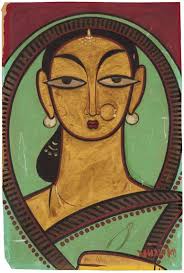
Art by Jamini Roy
Jibanananda Das (1899-1954) was a Bengali writer, who now is named as one of the greats. In his lifetime, he wrote beautiful poetry, novels, essays and more. He believed: “Poetry and life are two different outpouring of the same thing; life as we usually conceive it contains what we normally accept as reality, but the spectacle of this incoherent and disorderly life can satisfy neither the poet’s talent nor the reader’s imagination … poetry does not contain a complete reconstruction of what we call reality; we have entered a new world.”
Growing up as an American, school vacations were a time of freedom. I could play or watch TV or do nothing as much as I wanted. In fact, my brother and I had so many idle hours, we sometimes got bored and looked forward to going back to school.
Here in Japan, the breaks between semesters are busy. My kids were sent home for the school holidays with reams of worksheets, charts for keeping track of toothbrushing and chores, and a calligraphy assignment. Sometimes they would have to take care of the class pet for a week or so.
When my daughter was in kindergarten, she volunteered to take care of the class stag beetle during the first few weeks of summer vacation. She was supposed to feed it and moisten the soil with water from time to time. I guess we were supposed to change the soil, but no one said anything about that, and I didn’t get around to buying any.
My daughter was quite enthusiastic for the first few days, remembering to feed it the smelly jelly even when I forgot. But then, it crawled out of the plastic box once and she was freaked out. She said she wanted to give it to her grandmother. Since then, she had fallen in love with the kindergarten’s hamsters and had decided that she wanted one of those.
I’d been feeding the beetle and sprinkling water on the soil. Up until the last night, I heard it scrabbling around. But one morning, when I checked on it, the jelly was uneaten, and the beetle was belly up in the box. Nothing happened when I tapped the box. I was pretty sure it was dead.
My daughter was supposed to take it back to school the following day for the hand-off to her classmate. I figured they’d be having a beetle burial instead. But we went out for a while, and when we came back, the beetle had moved! Phew! I reached in and turned it over so it could burrow into the dirt. We never kept a beetle as a pet again.
In addition to pet care, there was also, typically, a craft assignment. For instance, every summer, as part of her elementary school homework, my daughter was required to make a bank. I wondered why she had to make the same thing, year after year? What were we supposed to do with all of those banks? Was some sort of lesson in money management embedded in the task? She was supposed to come up with an original design, and the result was entered in a contest. Of course, as the head teacher reminded us parents, the kids needed help.
At the beginning of summer, I would try to think of ideas. Maybe a papier mache rabbit? Or some kind of house constructed from all of the popsicle sticks we’d accumulated over the past couple of months? At the end of the vacation, with only a few days left to go, I would be casting about for something quick and easy that we hadn’t done before.
We’d stop by the bookstore to look for a craft book. At the beginning of school breaks, there were oodles of such books on display – books intended to give parents and kids inspiration for how to while the days away. Just before school started, they would be gone. In Japan, everything has its season.
My son went to a different school which had different requirements. The kids made banks only once, in first grade, many of them using ready-made kits. One summer, my son was supposed to paint a picture on the theme of “freedom.” I was thinking doves, or maybe of people of many colors holding hands, but he needs to come up with the idea on his own. I tried to help him out a bit. “What do you think of when you hear the word ‘freedom’?” I asked. My son said, “Getting out of jail.”
Now that my kids are out of school, my idea of freedom is not having to nag them to finish their homework, or fill out their charts, or feed the class beetle – or, especially, to come up with an idea for their summer crafts.
From Public Domain
Suzanne Kamatawas born and raised in Grand Haven, Michigan. She now lives in Japan with her husband and two children. Her short stories, essays, articles and book reviews have appeared in over 100 publications. Her work has been nominated for the Pushcart Prize five times, and received a Special Mention in 2006. She is also a two-time winner of the All Nippon Airways/Wingspan Fiction Contest, winner of the Paris Book Festival, and winner of a SCBWI Magazine Merit Award.
PLEASE NOTE: ARTICLES CAN ONLY BE REPRODUCED IN OTHER SITES WITH DUE ACKNOWLEDGEMENT TO BORDERLESS JOURNAL
I am not young anymore. In the evening, I stay home. I have no bouquet of flowers to offer for any beautiful girl.
In the evening, I keep to myself. I buy no roses for anyone. I write no love poems. I do write a few for the birds.
I prefer a silent evening. I prefer sleeping a little too much. The birds sing me to sleep. Their song pushes through my window.
I am not young anymore. I pick at my scab I got from picking oranges, not from picking flowers for a beautiful girl. If you did not know, the orange tree has sharp thorns.
I LOVE YOU
There is one thing I will never say to you. And if I say it once, I will not say it again. I will not say the one word I want to say to you. There was a time I knew nothing. Even my eyes gave me away. I settle for what we have if it is just for a little while. Let’s face it, a little while might be all I have left. The hourglass has the sand near the bottom. It will not be long when I get too old or sick for you. I watch the sky from my window. It goes from light to grey to black. I am living this life one day at a time. What is lost I will never get back. There is one thing I want you to know. I will not say it to you today or tomorrow.
MY OWN BOOK
I brought my own book for a ride. I took it and stopped at 9th Street pretending it is where it wanted me to stop. I read a few poems to a man that was just got off the train. One line I read made him laugh. He asked me to stop before he threw up.
The man did not like my poetry. He told me not to quit my day job. That thought never crossed my mind, and poetry was never a second job. I got back in my car and drove my own book home and put it away in the bookshelf for the night to sleep.
Born in Mexico, Luis Cuauhtémoc Berriozábal lives in California and works in the mental health field in Los Angeles. His poetry has been featured in Blue Collar Review, Borderless Journal, Mad Swirl, Rusty Truck, and Unlikely Stories.
.
PLEASE NOTE: ARTICLES CAN ONLY BE REPRODUCED IN OTHER SITES WITH DUE ACKNOWLEDGEMENT TO BORDERLESS JOURNAL
In a world teetering on the edge of ecological collapse, it’s often children who inherit the burden of our choices. But what if they could also inherit the tools to re-imagine the future? In Wonder Tales for a Warming Planet, Rajat Chaudhuri doesn’t simply tell stories—he offers blueprints for curiosity, resistance, and wonder. This collection of three speculative tales—’Tina and the Light of the World’, ‘The Seventh Sense’, and‘How Did the Oceans Vanish’—invites young readers to explore climate change not as a distant apocalypse, but as an unfolding narrative in which they are already key players.
Chaudhuri, author of acclaimed climate novels like The Butterfly Effect and Spellcasters, and short story collection like Hotel Calcutta, does not offer didactic lessons to children here. Instead he channels the age-old power of storytelling—immersive, imaginative, and intimate—to speak directly to children. His tales empower children not by shielding them from the truth, but by equipping them with imaginative tools to face it.
The first story, ‘Tina and the Light of the World’, revolves around a young girl’s encounter with a solar-powered future. In a town gripped by blackouts and crumbling infrastructure, where the rich have access to energy while the nights of those poor are engulfed in darkness, Tina meets Stoker who takes her to light but vanishes after sometime. Then Tina meets Anu who accompanies her for a while but soon she leaves her too. Finally, Tina meets sun-catcher in a place where people use solar panels to trap sun’s energy. Tina’s journey—from darkness to a solar-powered community—unfolds like a fable of illumination, both literal and symbolic. The characters she encounters—Stoker, Anu, and the sun-catcher—each represent stages in her awakening to the possibility of decentralised, sustainable energy. Chaudhuri while suggesting the alternate sources of energy other than those used earlier, cleverly weaves together issues of energy access, decentralised power, and the democratisation of technology. But the story also touches something deeper: the notion that light—both electric and symbolic—can emerge not from grand solutions, but from the small, often overlooked spaces where ingenuity persists.
In ‘The Seventh Sense’, Chaudhuri turns inward, weaving a delicate tale around Gogol, a neuro-divergent boy who develops an extra sense—one attuned to ecological shifts. What initially feels like a fantasy premise soon unfolds into a sophisticated meditation on sensory perception and ecological empathy. This “seventh sense” allows its young bearer to understand the impact of forest cutting to make way for an urban city. The brilliance of this story lies in its central metaphor: that saving the planet may not be about creating more infrastructures mindlessly in the name of fulfilling the needs of people but about cultivating an intuitive, affective connection to the non-human world. The writing is delicate, almost lyrical, yet grounded in a chilling recognition of the precarity the present world seems to now inhabit.
The final tale, ‘How Did the Oceans Vanish’, moves from the speculative to the cautionary. Told as an oral history in a distant future where seas have dried up, the story is framed as a conversation between a grandmother and her grandchild of a different evolved species. Through anecdotal fragments we piece together a slow-motion disaster — brought about by different methods of geo-engineering ushered without considerable testing — that no one tried hard enough to stop. This retrospective mode of storytelling is effective; it avoids heavy-handedness while building a quiet, cumulative sorrow. But even here, Chaudhuri resists fatalism. The tale ends not with despair, but with a question, almost whispered: What will you do differently now?
Across all three stories, Chaudhuri’s prose remains crisp and fluid. He avoids the pitfall of jargon while subtly integrating scientific ideas— alternate energy, sustainable living, geo-engineering, and more. What binds the collection is not only its thematic concern with climate but its faith in the moral imagination of children. These are not just tales about the future; they are invitations to imagine alternate presents.
That said, the book does not attempt to be everything. The storytelling is intentionally restrained. There are no dramatic twists or action-packed sequences. The stakes are emotional and ethical, rather than physical. Young readers who’ve already begun to sense the ambient anxiety of climate discussions—will find in this collection recognition, reassurance, and a language to speak about what they feel but cannot yet articulate.
Wonder Tales for a Warming Planet deserves a place not just in classrooms or children’s libraries, but in dinner table conversations. It dares to approach the climate crisis through the lens of empathy and imagination rather than panic or guilt. In doing so, Rajat Chaudhuri gives us what many adult climate narratives fail to deliver—a reason to believe that another world is not only possible but already being imagined by the young. All we need to do is listen.
Rakhi Dalal is an educator by profession. When not working, she can usually be found reading books or writing about reading them. She writes at https://rakhidalal.blogspot.com/ .
.
PLEASE NOTE: ARTICLES CAN ONLY BE REPRODUCED IN OTHER SITES WITH DUE ACKNOWLEDGEMENT TO BORDERLESS JOURNAL
Quack, quack!
Oh, what bad luck!
Pappu the duck
got stuck in the muck.
Flapped his wings,
kicked his feet,
but that thick mud
was his nemesis!
He was to attend
a birthday bash
with ‘Papri chaat’
and scrambled eggs...
his favourite.
Pappu sighed,
"This isn't fair!
I should be partaking
that birthday fare".
Then a cow walked by
and advised...
"Try harder, Pappu!”
So, he tugged and tugged
With all his might
and with one big SPLAT,
tumbled free
and waddled off
to the birthday party,
albeit with muddy feet
From Public Domain
Snigdha Agrawal (nee Banerjee) is a passionate septuagenarian writer with five published books, including Fragments of Time, her deeply personal memoir. A lifelong lover of storytelling, she blends fact and fiction with a keen eye for detail and emotion. Her works span diverse genres, reflecting her rich experiences and insightful observations.
.
PLEASE NOTE: ARTICLES CAN ONLY BE REPRODUCED IN OTHER SITES WITH DUE ACKNOWLEDGEMENT TO BORDERLESS JOURNAL
Entering the sherbet shop introduced me to an ambience I was not au courant with at all. Not the usual, expectedly flashy interiors greeted my bespectacled eyes. Instead, I was transported to another era, a kangaroo leap of a century in time, to witness heritage stir up breezy nostalgia. With old-fashioned teakwood tables, carved chairs, and antique lamp shades, framed, sepia-tone portraits of legends decorating the distempered walls chipped at various places, it was not difficult to guess that the outlet had retained a robust connection with the hallowed past.
As I walked in with the curiosity of an aficionado exploring an art gallery, there was so much else to engage myself with – apart from the listings on the laminated menu card. Before I sat down and ordered something to gulp down my parched throat, I chose to update myself with a walking tour of the entire sherbet joint. Driven by thirst to find enriching inputs from knowledgeable sources, I finally settled down and asked for assistance from the gentleman who served. He looked eager to share anecdotes about the quaint little shop, tucked away in a small, congested lane, that had managed to retain its client base with support from young students who made it their favourite haunt despite the easy availability of snazzy food kiosks and juice corners proliferating around their college premises. That the present generation – and the several earlier ones – had realised the need to patronise this outlet as a historical and cultural link was truly worthy of appreciation.
I trooped in at different hours of the day, and found that most of the seats were occupied by college and university students who were also lovers searching for a comfortable, affordable space where they could sit for long hours, sip their favourite sherbet, and slow down the passage of time while holding hands and making lifetime commitments. As the straw pipes in the two glasses made empty noises, couples ordered another tall glass of sherbet, of an untried flavour, to keep alive the flow of their discussions and personal plans for some more time without feeling remorseful that they were adversely impacting the commercial profitability of the century-old outlet with their prolonged stay. This sensibility was rare but precious and the sherbet store staff never disturbed such couples who preferred the rear seats, keeping themselves away from public glare. The front benches were readily available for fleeting customers of our kind who walked in casually to enjoy the chilled sherbet and walked out with a vintage experience.
Leading luminaries from diverse streams such as politics, arts, and literature frequented this shop over time. Their portraits on the walls were not only tributes to their contribution but also a part of cherishing the close association with the change-makers. A small conversation with the manager revealed snippets from the past – passed down the generations as heirlooms. Refreshing tales energised customers who felt delighted to be present here. Imagining this century-old world was recreated by the culturally conscious owners, who brushed aside upgradation requests only to preserve as much of the past as possible. The giant ceiling fans circulated not much air. So an air-conditioning system had been installed. But the slowly whirring fans were not dismantled. The wooden deer head wall mount above the door was a silent reminder of how much had not changed despite the lapse of time.
I chose to go with the manager’s recommendation – daabmalaisherbet[1]– for a hot summer afternoon. He called it the favourite summer drink of a famous city-based author from the last century. I should have thanked him for offering it to another wannabe writer – even though he would not have been much impressed with this disclosure. At a personal level, the writer inside felt motivated that two authors, from two different centuries, enjoyed the same cooling drink under the same roof. Talking about the merits of the sherbet, it was amazing to taste: authentic and traditional. The flavour was different if not unique and this outlet was proud to offer it to those who valued the past. When I asked him if I could get this drink anywhere else in the city, he was reticent for a while. After poring over its faint possibility, he set me free to explore the city to find something remotely close and comparable to this drink. There was a smirk on his face, which suggested I would fail in my mission to get an equivalent to what I was served here.
He suggested grapes crush sherbet as another specialty I would relish, and its taste was unique this time, with crushed grapes floating around the fragmented ice cubes to lend an authentic appeal. After consuming these two flavours, the flavours of the past came alive in my mind. I felt really close to the great artists on the wall, feeling the immediate need to write creative stuff. This was working at another level: offering me loads of inspiration and motivation to write. It was more effective and quicker than attending motivational workshops or literature festivals to boost up creative energies and overcome my writer’s block. Tuning into great speeches by life coach experts often failed to resonate with the audience. But my brief visit here seemed to have worked wonders as I was already feeling charged up to go home and write something powerful to move the cold, insensitive generals of warring nations to embrace peace forever.
The rapid flow of ideas made me insecure about losing them on my way home and I regretted not carrying a notebook to jot them down. When I visited the place again, I made it a point to carry my diary and pen and sat for hours to draft a story outline. It was not a matter of shame as I found the serving staff look happy to see my passion, to be added to their new list of great patrons. As our familiarity developed further, they showed me newspaper cuttings mentioning the sherbet outlet – how some journalists kept them alive in the print editions just as the young crowd made their outlet famous on the social media, with hundreds of Instagram reviews and top ratings of the place.
This was just one outlet that motivated me but I was sure there should be more in the city, not just sherbet shops. I looked for other outlets that were part of the lives of the great artistes. I made it a quest to look for them in order to experience a surge of motivation that always does not come from sitting idle in front of an open window. As I began my search for similar outlets, I came across several of them still operating from modest spaces.
There was a bookstore on the first floor of a ramshackle building where some leading film directors came to buy imported books. Climbing the same stair case evoked feelings of nostalgia. In an era when many bookstores have shut down, this family-owned bookstore had over the generations expanded its list to include vernacular and academic books to stay commercially viable. The wooden shelves and the cash counter manned by a dhoti-clad septuagenarian gentleman keeping a hawk’s eye like a surveillance camera suggested retirement was still far away. I was informed by the gentleman regarding the operational presence of another stationery store where many freedom fighters came to buy pens and ink. Holding a fountain pen bought from the store located in the next street, hidden behind a paan shop basking in the glory of serving great musicians of the country, I walked home to begin a new story with it.
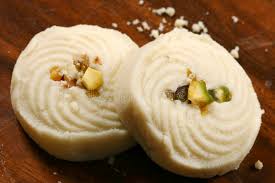
As I continued with my search for such outlets to stir the pot of motivation, I realised, to identify closely with such landmark establishments, was indeed a powerful way to fill myself with zest and zeitgeist. During my next journey, I came across a sweet shop specialising in a wide variety of sandesh and its owner, standing beside a pedestal clock that was functional since the nineteenth century, spoke of the days of glory, with the intellectuals of the city dropping in the evening to pack boxes of sweets. They continued to keep the freshness of the sandesh alive without any compromise in terms of quality. They are not affected by modern shops making false claims of serving high quality traditional sweets. They proudly say those who value good taste and can differentiate between fake and original are their clients, always ready to pay extra to buy pure and tasty stuff. The melt-in-the-mouth experience of their sweets was heavenly indeed. I made it my preferred shop to buy sweets from to celebrate all successes in life. For festive occasions, there could be other shops, but to celebrate success I chose to bring home sandesh from this shop alone, even if it meant going an extra mile for their delicacy. It has been quite a while since I last went there – because the occasions to celebrate successes have dried up in the recent years, with tragedies and setbacks mounting allied attack since the pandemic. While the sherbet store has helped me regain a lot of confidence in the writing process, I hope the sandesh shop will soon find me at their glass counter, to order packets of sweets to celebrate literary success.
Devraj Singh Kalsiworks as a senior copywriter in Kolkata. His short stories and essays have been published in Deccan Herald, Tehelka, Kitaab, Earthen Lamp Journal, Assam Tribune, and The Statesman. Pal Motors is his first novel.
PLEASE NOTE: ARTICLES CAN ONLY BE REPRODUCED IN OTHER SITES WITH DUE ACKNOWLEDGEMENT TO BORDERLESS JOURNAL
No eyes to cry.
Only the weight of numb eyes.
Like a scream
That stopped just short
of the throat.
Somewhere, someone waits --
not to be found,
Just to be remembered.

There is a kind of loneliness
that doesn’t shout.
You sit in it.
Feed it.
Let it braid itself into your spine.
And when you try to speak,
even silence looks away.

The world keeps moving
like a feed you can’t pause.
It scrolls past your face,
your name,
your grief.
And you learn how to be present
without being anywhere.
Shahriyer Hossain Shetu is a Bangladeshi writer and researcher currently pursuing his Master’s in Sustainability Management at University of Waterloo, Canada.
.
PLEASE NOTE: ARTICLES CAN ONLY BE REPRODUCED IN OTHER SITES WITH DUE ACKNOWLEDGEMENT TO BORDERLESS JOURNAL.






 Borderless