Five poems by Hrushikesh Mallick have been translated from Odia by Snehaprava Das
AFTER THEY LEAVE

After they leave,
The tree in the midst of a bare field
Stands forlorn.
Not a single bird,
Nor the sound of chirping anywhere
Not a leaf flutters in the breeze,
No one speaks a word
After they leave.

The world is a meaningless void
When they are not there.
Flowers bloom and wither aimlessly.
Festive seasons come and depart.
The privileged and the poor come and go
Without making an impact.
Silence reigns everywhere and around
When they are not there.

Living in a pattern,
Like, in every moth-hour
‘Chhatu bhai’ riding back
From the village market, ringing the bicycle bell,
Or, farmers sitting on a platform in the evenings
And deciding which patch of the land
Would be plowed next morning,
Like, the moon coming up routinely
At measured intervals,
And discussions centering around
How ‘Gaya-bhai’
Escaped the wrath of the village-goddess
Last night by a sheer miracle.
Routine life continues
Like rice cooking tender in the kitchen-hearth
While cow-dung cakes are put
To smoulder in the cowsheds.
The regular pattern of living
Is dull and cheerless
In their absence.
Who are they, then? Who indeed?
They are the fragrance of the paddy-buds
In the farmlands by the hillside,
They are the Siju bushes that
Grow under the eaves in the backyard,
They are the sound of the clearing of throat
That inspires courage in a fearful heart
 On a dark pathway,
They are the drumbeats floating in
In gentle waves from the neighbouring village,
They are the pallbearers that twine ropes
 To make a pyre;
And, after they leave life loses its meaning!

WHEN THERE IS NO GOD

Once you join your palms
sitting on the bed
while going to sleep
or, as you wake up,
worries stop disturbing
your calm.
You are assured of the presence
of someone called God
who might break your fall.
But these are the bleak days
of God’s absence,
these days the headless bodies
saunter down the streets of the night
whispering to one another.
The dogs howl in a chorus.
The sounds of sermons or devotional songs
do not float in from the mandapa,
the air throbs instead with the siren
of ambulances.
As such belief is that
the God that holds
the trident and the mace
is omnipotent.
 Why does that God stand dull
 and lifeless in the temple now?
Does an idol in any temple
have the power now
even to chase away the stray dogs?
Is there a God in any shrine
who can hold open
its closed doors and by some miracle
turn auspicious
all that is ominous?
In these dark days when
God is not there,
if we take a fall,
we have to get up on our own.
We have to lean on our own mettle
and our own merit
in the moments of death or survival.
In the absence of God,
we have to commit ourselves
to the service of the distressed,
to feed the hungry
and nurse the sick,
give shelter to the homeless.
It’s time we repented our indulgences
without religious extravaganza.
It’s time we stopped
pinning blind faith in
the figures of stone.

THE LONE GIRL

The lone girl has nowhere to go,
She sits alone lamenting her loss;
Once upon a time she had
 a country like we all have,
it was called Syria.
Its lofty national flag
soared to the clouds.
It had a national anthem that
sparked the spirit of martyrdom
in its people!

In the evenings,
perched on the shoulders
of her babajaan,
she watched the moon
in the sky of her homeland;
heard stories from her mother
that set her eyes rolling in wonder;
that country, her homeland is now in ruins
a vast, barren expanse,
littered with severed limbs.
Its air is sick with the smell of
tons and tons of explosives
there lay piles of disfigured childhood
in pathetic abandon
to tell the tale of a country that was!

No one had ever warned the girl
that her tomorrows will be spent
in makeshift shelters under the tents,
nor did she know that
her palms would join to make begging bowl,
and there would be merchants
to trade on
the perfumed void in her.
No one predicted that she would grow up
believing in hatred instead of love!
And when she would learn to ask
the whereabouts of her parents
the whole civilized world will
keep mute.

EYES

Just as I believed that all poems
which could have been written on ‘eyes’
are already written
your ‘eyes’ flashed before me
and what an amazing lot of trees
laden with fruits and flowers
 and birds, they held!
I wondered where did you flick
your deep, boundless glance
from the corridors of the hospital
like a handful of floral offerings.
The anguish that glance held
was like the lost look in the eyes of a kid
who was rudely denied a father’s lap,
 like a fresh bloom shying away
from the eyes of a honeybee
or, a streak of lightning flashing
in the overcast noon-sky
like a poor man’s last hope.
Your eyes are like the lines of a poem
that unfold a new meaning
at every other reading.
Your eyes,
like a strange horizon captures
the crimson of the dawn
and the gleam of a red silk sari
in a perfect balance!
Your eyes could transform a waste land
to a paddy field in luxuriant green,
at times they are moist with muffled sobs,
or, like a spear smeared in blood, at others!
What is more beautiful --
the bright loquacity in your eyes
or the rain-washed sunshine,
the mysterious mutter in your eyes
or a village enveloped in a wispy darkness?

THE HONEYBEE DOES NOT KNOW

The son writes poems.
His mother does not know.
‘You are rotting yourself through writing,’
She complains,
‘Did you write them?’
A girl-friend, looks at him in wonder,
‘Can you swear to that?’ she asks.
The boy writes poems
The street where he lives does not know it,
Nor does the village!
His young face does not sport a beard,
Nor have the creases appeared on his forehead.
There was not that distant look
Like the faraway stars in the eyes,
How could then he be a poet?
Who would believe that?
A man who picks up a quarrel with the fisherwoman
Could recite the brajabuli,
Or, the fellow weaving clothes at the loom
Can sing lines from Tapaswini

A poet is not supposed to have a home.
He sits under the trees
Amidst the anthills.
A poet hacks off the branch he sits on.
He does not have that worldly intelligence.
A poet is not pragmatic.
He begins a line at the wrong point
And ends it at a wrong one too.
A good poet forgets the right way of chanting
The mantra that would protect him from dangers
While actually facing them.

The mother does not know that
Her son is a poet; nor does the father.
The owner of the hut where the poet takes shelter
Does not know his tenant to be a poet.
The poet’s voice does not know
It belongs to a poet.
The reflection has no idea it is the poet’s image.
The lizard exploring the shelves
Does not know the ‘Award of Padmashree’
Carefully preserved there,
Was won by the poet.
The honeybee that circles the graves
Does not know that
The lines engraved on the tomb
 Were the epitaph for the poet.
Glossary: Mandapa is a pavilion. Brajabuli is a dialect based on Maithali that was popularised for poetry by the medieval poet Vidyapati. Tapaswini: A famous long poem by the 19th century Odia poet Gangadhar Meher.
.
Dr Hrushikesh Mallick is a reputed Odia poet and writer. He has 13 Poetry collections. His first book in 1987 heralded a new era in Odia poetry. He has received Odisha Sahitya Akademi Award (1988), Sarala Award (2016) and Central Sahitya Akademi Award (2021).He is also an eminent literary critic and fiction writer. He served as President of Odisha Sahitya Akademi (2021-2024). He has been a professor of Odia language and literature from 2012.
Dr.Snehaprava Das, is a noted writer and a translator from Bhubaneswar, Odisha. She has five books of poems, three of stories and thirteen collections of translated texts (from Odia to English), to her credit.
PLEASE NOTE: ARTICLES CAN ONLY BE REPRODUCED IN OTHER SITES WITH DUE ACKNOWLEDGEMENT TO BORDERLESS JOURNAL
I grew up in a town where fish, shellfish, and seafood are abundant, so the specialty dishes are related to its topography. The location is humble, yet it boasts special delicacies such as noodles, porridge, tofu, duck eggs, and rice cakes. Many stores line the town’s main street, serving these types of morning and afternoon snacks that I was quite fond of. I particularly remember a store famous for its huge burgers with generous slices of cucumber, tomatoes, and onions on a tangy mayo-ketchup dressing — also popular for its all-day breakfast meals. Despite its marine resources, my hometown has no particular brand associated with it.
A Philippine-based fast-food chain was recently established in the area, and residents claim that development has now been put in place. Consumption is erroneously classified as development. A former English language student mistakenly believed that the Philippines was a wealthy nation because of the abundance of malls, only to realise later that poverty is widespread behind these malls. Consumption is peddled as a sign of progress.
This also happened during my university years when I had to take the elevated rail system to go to school. At the north end point of the train system stood a central grade school on a sprawling campus, which has now been transferred to a much smaller space but is still referred to as a central school. All central schools in our country are located on large campuses. Its original location is now part of a nationwide mall chain. Is going to the mall productive?
Years ago, my younger brother moved to the southernmost province of Luzon Island, which was our father’s hometown. In the past, I would spend holidays at my brother’s residence with some very close friends. The roads are well-paved, and in the city half an hour away, there are small commercial shops and a local fast-food chain unique to the area. The province is well-known for its “pili” nuts and handicrafts.
Pili nutsJewellery from pili nuts From Public Domain
According to my brother, the city’s landscape has drastically changed with the addition of a big mall chain and a Roman-inspired colosseum. My nephew recently informed me that the provincial projects mainly consist of community-based gymnasiums. “Progress” seems to be selective and does not necessarily foster a strong culture of creativity and productivity in each household.
In my current municipality, the main issue is the lack of social infrastructure to support entrepreneurship. The prevailing norm is consumption, whether physical or digital. Bureaucratic red tape makes business mechanisms inaccessible, discouraging newcomers from starting any kind of enterprise.
Perhaps another reason for this lack of visitors is the municipality’s location. Being the last town in the province, only residents and haulers typically come to the area. It is isolated from the main arterial road that traverses the entire province.
The town does not have a specific product to boast of, unlike other cities and municipalities known for their specialties like shoemaking, salted and duck eggs, fish sauce, specialty noodle dishes, and slippers made from water lilies.
The town’s main products are concrete and sand, extracted through continuous quarrying activities that are detrimental to both human health and the environment. Agricultural produce — such as bananas, mangoes, tomatoes, okra, and eggplants — is limited due to the town’s rocky terrain. During a visit to an upland village, I met a caretaker of a small property that was supposed to be organic, but I discovered during our conversation that it was merely a facade by a large mobile phone provider for its social enterprise project. Additionally, the population of native tilapia[1] is low due to murky waters caused by silt and mud. Despite having numerous hiking sites that also cater to consumerist interests, the municipality lacks a distinct specialty dish for people to enjoy and remember as part of its commercial offerings.
According to my sister-in-law’s brother, the main source of income for their island-province is remittances from Overseas Filipino Workers (OFWs) [2] .He also claims that the province is an ideal place to retire and spend money, boasting beaches, volcanic hot springs, coconut plantations, rice farms, nature resorts, and rivers. Despite having a root-crop based delicacy and an abundance of dried fish, the province lacks production or manufacturing facilities, with the exception of mining, which unfortunately led to one of the worst environmental disasters in the country’s history. As a result, consumption is the prevailing norm on the island. Isn’t it ironic that the ex-girlfriend of a close friend pursued a degree in BS Entrepreneurship but currently works as a Customer Engagement Manager at a global fast-food chain? She should have considered starting her own business, no matter how small. She is actually promoting a perpetual cycle of consumerism, rather than entrepreneurship.
Based on online sources[3], there are only ten small manufacturing firms in my current area, Montalban (Rodriguez), which covers a total land area of 172.65 km 2 (66.66 sq mi)[4]. This implies that a culture of production is not the town’s priority when it should have been the first step to economic and social progress, alongside environmental protection and sustainability.
In hindsight, society generally encourages individuals to consume the latest gadgets, trends, food, technology, shoes, fashion, apps, make-up, and hairstyles. We are therefore told to consume and discard in a never-ending cycle of consumption and waste. Creativity in building enterprise is relegated in favor of a consumerist culture. To move forward, communities must do the reverse, so wealth is neutralized. Not everyone has the business acumen to succeed. However, production must still exceed consumption.
One main reason for the failure of production to establish a strong foothold in our communities could be attributed to the lack of practical and relevant entrepreneurial courses that are accessible to everyone in terms of fees, range, and distance. These courses are not tailored to the specific needs of each locality, as businesses tend to be similar in one area, causing most enterprises to struggle to take off without offering anything unique to attract patrons. Creativity and productivity go hand in hand.
To create a more sustainable society, we need to move away from consumerism and focus on increasing production through manual, mechanical, automated, or digital means. A thriving community relies on its ability to expand and improve production capabilities.
Manuel A. Alindogan, Jr. or Jun A. Alindogan is the Academic Director of the Expanded Alternative Learning Program of Empowered East, a Rizal-province based NGO in the Philippines and is also the founder of Speechsmart Online that specialises in English test preparation courses. He is a freelance writer and a member of the Freelance Writers’ Guild of the Philippines (FWGP).
.
PLEASE NOTE: ARTICLES CAN ONLY BE REPRODUCED IN OTHER SITES WITH DUE ACKNOWLEDGEMENT TO BORDERLESS JOURNAL
O clouds of loneliness,
I beckon your shadowed embrace.
Drift gently into the seams of my heart,
And rain, soft as whispered sorrows.

Sweep away the filth and dust,
The clinging residue of ceaseless strife,
Etched by life's restless tumult,
And leave behind a moment's quiet clarity.

But, O clouds, be but a fleeting guest,
Do not settle as my abiding home.
The deeper you linger,
The heavier grows your weight.

You threaten to rend from me
The final thread of self,
A fragile anchor to light and hope,
Swept away in torrents of despair.
Pramod Rastogi is an Emeritus Professor at the EPFL, Switzerland. He is a poet, academician, researcher, author of nine scientific books, and a former Editor-in-chief (1999-2019) of the international scientific journal “Optics and Lasers in Engineering”. He was an honorary Professor at the IIT Delhi between 2000 and 2004. He was a guest Professor at the IIT Gandhinagar between 2019 and 2023. He is presently an honorary adjunct Professor at the IIT Jammu.
.
PLEASE NOTE: ARTICLES CAN ONLY BE REPRODUCED IN OTHER SITES WITH DUE ACKNOWLEDGEMENT TO BORDERLESS JOURNAL.
Rose’s Odyssey:Tales of Love and Loss is a translation of ‘Gulafsangako Prem1’, a short story collection in Nepali by Sangita Swechcha. Jayant Sharma, the translator, has displayed his incredible skill transmitting the essence and the texture in his translation as they are in the original version.
Swechcha’s writing moves across geographies and emotional landscapes. In Rose’sOdyssey, we see the influence of her own journey: born and raised in Nepal, her time spent in Australia, and her life in the UK. Her experience of multiple cultures gives her work both depth and relatability. She writes not just as a woman, or a feminist, or a diasporic voice, but as a humanist. Her stories resonate because they are grounded in truth and told with generosity.
Several reviewers on Amazon have echoed the sentiments generated by the stories. Dr. Tamer Mikhail describes the experience as “mesmerising,” noting how vividly the characters come to life. Ketan Varia praises Swechcha’s exploration of how life unfolds and the unintended consequences of human choices, while Nirmala Karanjeet highlights the wit, humour, and deep perception of human emotions in every story. These voices of readers moved by the same qualities.
Among the twenty stories, a few stood out with particular force. The titular story, ‘Rose’s Odyssey’, reminded me in scope and ambition of Homer’s Odyssey. Yet this is no imitation. Swechcha’s tale of love, betrayal, vengeance, and repentance transcends a simple love story. It is a story within stories, a tapestry woven with dramatic shifts and psychological insight.
Another memorable piece is the final story, presented in diary format. The narrative offers a poignant glimpse into diasporic life, told in a male voice, which is an unusual and ambitious choice for a female writer. The story’s ability to inhabit male psychology with such authenticity is no small achievement.
The shortest story, ‘Ram Maya’, dealing with the issue of human trafficking, is devastating. In just a few pages, it trembles with urgency. Then there is ‘Shattered Dream’, a story I had previously read in its original Nepali and was eager to revisit in English. The translation, no easy feat, is executed beautifully, preserving cultural nuances while making the narrative accessible to a broader audience. In fact, I was reminded of Toni Morrison’s The Bluest Eye (1970), particularly in how Sweccha addresses themes of bodily autonomy, survival, and the commodification of womanhood.
What ties all these stories together is Swechcha’s ability to write about complex emotional terrain with elegance and restraint. Each story is deeply personal, yet universal. The immigrant experience, cultural duality, gender, longing, and resilience are all present without ever feeling heavy-handed. It is heartening to see readers on Amazon responding so positively. One reviewer calls it “an easy and interesting read,” while another from Holistic World notes how each tale is “captivating and alluring,” connected by “the thread of love.” This feedback is not only encouraging, it also affirms the book’s power to reach readers from all walks of life.
In addition to the warm reader responses and literary features, I also recall Shahd Mahanvi, author of White Shoes, at the launch event aptly described Rose’s Odyssey as “a powerful exploration of human emotions.” She added that it is “a compelling collection that delves into themes of control, mistrust, the impulse to hurt those we love, and the complex intersections of human relationships, provoking deep reflection.”
In the year since its release, Rose’s Odyssey has had a successful run, from warm reader responses to literary features, several book signings in the UK and Nepal, and community events. Its journey is far from over. The success of the book is not just a testament to Swechcha’s literary talent, but to her ability to connect across continents, cultures, and hearts.
Dr. Rupak Shrestha, a London-based Nepali poet from Pokhara, is acclaimed for diverse literary forms and translation. He also serves as Advisor to the International Nepali Literary Society (INLS) UK Chapter.
.
PLEASE NOTE: ARTICLES CAN ONLY BE REPRODUCED IN OTHER SITES WITH DUE ACKNOWLEDGEMENT TO BORDERLESS JOURNAL.
That dawn, beachside after the wedding night, the sky was a canvas like the bride’s forehead- bright red smeared across, sindoor* spread carelessly, wet air and warm breath, filling both their hearts with memories to last a few lives beyond their own.
*Sindoor is a red cosmetic powder worn as a dot on the forehead or along the parting of the hair by Hindu women, especially as a sign of marriage.
FIRST KISS
Do you remember how my lips turned red, same shade as yours, as I tasted your lipstick when mine pressed hard against yours on the glass wall, curved so delicately, smudged slightly, when for the first time, we shared a goblet of Malbec?
Photo provided by the poet
Joseph K. Wells is an American poet and healthcare executive, originally from India. Since 2016, his poems have found a home in over two dozen journals and lit mags internationally. A selection of his published works is available at https://paperonweb.wordpress.com/ .
.
PLEASE NOTE: ARTICLES CAN ONLY BE REPRODUCED IN OTHER SITES WITH DUE ACKNOWLEDGEMENT TO BORDERLESS JOURNAL
For the entire month Sandy was upset in her newly set-up office. Swanky, plush glass cabin with mood lighting and a deluxe leather couch to sink in could not prevent the buzz in her head. How to get rid of the creative consultant her husband had hired as a temporary replacement for her creative protégé who went on maternity leave for six months had emerged as her consistent worry.
Despite being the creative controller of S&S, the independent, mid-sized advertising agency positioned to be idea-driven, she could not do much to infuse creativity and rein in the team of acolytes who praised her recycled, AI-inspired work to the skies to keep their jobs safe. With the termite called mediocrity hollowing the agency from inside, client retention emerged as a big challenge. One fine afternoon she was informed by her strategist husband, Snehasish, about the probable loss of key clients and his desperate bid to onboard an overseas major to offset this financial setback.
The scapegoat she found apt for this occasion was none other than Mohit. This was the biggest as well as the brightest idea to hit her after several months of creative drought. With a sudden burst of energy, she lifted herself out of the couch and approached her loyalist manager, Adarsh, waiting for her order. Raising her heels, she looked straight into his sunken brown eyes, and snaked her arms around his neck.
“I want you to do me a small favour, baby,” Sandy poured into his wax-laden ear in her faintly husky voice.
For the man surviving and thriving on her benevolence, saying no was impossible even if his moral compass did not allow. Before she disclosed her plan, Adarsh blinked its confirmed execution.
“By the time I am back from my vacation, do whatever it takes to ensure Mohit is thrown out of my agency.” Sandy ticked him off for the dirty job and landed a dry peck on his beard cheek before stomping out of the agency corridor, rushing down the high-speed elevator, and reaching the parking bay with the remote keys pressed from a distance to unlock her sedan.
Seated behind the steering wheel, she pushed the shades up her forehead and booked herself business class, texted Snehasish about her trip, and rushed home to take a shower and pack her travel bags.
“Bon voyage -” he texted back, regretting he was unlikely to see her off at the airport as he was yet to ink the deal with a beverage client arriving from Dhaka in Kolkata during the weekend.
*
Adarsh was aware of the creative skills Mohit possessed. He had what it takes to be classified as an asset but merit alone does not decide the fate of an employee in any organisation – more so in a flippant, flamboyant profession like advertising and media. Maintaining a low profile, with the hope of getting noticed, was what Mohit believed in, expecting his work to speak volumes. But the unabashed self-promotion by his team mates eclipsed his presence and trivialised his output.
Although Adarsh was much higher up the ladder in terms of designation, the presence of Mohit scared him at times. It was a matter of relief – and perverse delight – for Adarsh to know that Mohit was not in the good books of the agency owner. All he had to do at the earliest was form a core team of account managers and designers and brief them regarding the urgent need to eliminate Mohit.
He cherry-picked Amar and Ragini to lead this mission. Since Ragini had worked closely with Mohit who pricked her ego several times in the past, she was thrilled to be chosen for the special task and recalled the earlier episodes of friction, primarily to justify her moral descent. However, she was slightly disappointed that Sandy Madam did not confide in her despite her frequent visits to her penthouse apartment over the weekends to binge-watch with her and later smoke flavoured hookah in royal style under the star-lit sky before going for a dip in her private pool.
“Trust me, Sir,” Ragini assured Adarsh, picking up her bottle of chilled beer from the table when she noticed the other guys had already polished down their drinks. Quite fond of Ragini, Amar saw this was the perfect opportunity to spend maximum time with her. He seconded her every move and sentence, making it sound like it was a petty gig. Although Ragini did not reciprocate his feelings, she kept their relationship within the realm of friends with benefits, spending time together in pubs and discotheques late at night, when Adarsh returned to his cocoon, to his family fold to play the role of a doting husband. For Amar, keeping the hope of a happy union alive was the ultimate driving force.
“Make sure Mohit faces rejections every day. Get negative feedback from clients for his submissions, set crazy deadlines for him, double his workload, add power-points to his responsibilities, make him redo every piece of crap he writes, and do not hesitate to call him a difficult, outdated person to work with. You have full freedom and my unconditional support but make sure you keep me in the loop,” Adarsh waxed eloquent while tearing the plastic cover of a new pack of imported cigarettes.
He knew Ragini would make it unbearable for Mohit to survive in this toxic environment and he would dash off his resignation within a week. On several occasions in the past, Ragini had rushed to his cabin, spewing venom against Mohit. But he never took any strict action based on her complaints as he was under the false impression that Mohit was the new, emerging favourite poster boy with the agency owners. Sandy’s startling disclosure reversed Adarsh’s inference, making him curious to ferret out what had annoyed her so much in just a month that she wanted him axed in a single deft stroke.
To mount a second line of attack, he briefed Samit, the senior account director, to engage Mohit in client meetings, brainstorming sessions, and critique his past work, to make it seem it was quite frustrating to get approvals for his work. Collective onslaught would demoralise Mohit faster and he would tender his exit note. His past observations encouraged him to believe that Mohit would display immature behaviour under pressure.
“You cannot write proper English, with absolutely no knowledge about the nuances of grammar,” Ragini exploded in the presence of several junior employees one afternoon. Such acerbic comments did not hurt Mohit who gauged that this allied gang of detractors had been activated against him. Being confident of his ideation skills, Mohit had the strength to pulp what others wrote and submitted. He could defend his original work but he thought it was not the wise thing to do at this stage.
Mohit invited Ragini for a serious discussion on the nitty-gritties of grammar usage and explain to her why it was a good and accepted practice to delete articles from headlines. He could share multiple examples of great print ads with missing articles from the headlines. When she found this would embarrass her, she went for a quick huddle in the conference room to discuss deliverables with designers. She emerged when she saw Mohit was nowhere around and rushed straight to Adarsh’s cabin and firmly shut the door behind her, to update and discuss what to do next since their negative approach didn’t seem to work.
Contrary to expectations, Mohit had decided to persist and resist all opposition. With a singular focus, he carried on with his job and took all forms of criticism in his stride, making strong commitments to fix his non-existent flaws at the earliest. That left no room for knee-jerk reaction and it became clear that Mohit was not going to quit even if these guys engaged in verbal spats and fired a fusillade of salvoes.
Lighting up a cigarette flicked from Adarsh’s pack to reduce her stress, Ragini sat on the table and blew out smoke rings, waiting for him to break the silence. Using her other hand, she playfully pulled his handlebar moustache grown as a tribute to a living legend, egging him to crack something new. Unwilling to disclose that he had already deployed another missile called Samit, Adarsh wanted to wait for a couple of days and see how things panned out.
“Mohit is not the kind of guy to swallow insults on a daily basis, I am sure he would go on an unannounced leave and then stringent action against him, just waiting for one day of absence and he is kicked out,” Adarsh revealed, stroking her hair as a sensitive, caring gesture of assurance.
Mohit proved to be a tough nut to crack as the worst humiliations heaped on him went waste. They raised storms that would not capsize his boat. With an accommodative, tolerant mindset, he prepared himself for every challenge. Mohit had realised the band of opponents had teamed up to isolate him in the absence of Sandy Madam. He decided to report this matter to her once she returned from vacation, reposing full faith in her justice system.
*
The news of Mohit’s imminent departure was leaked to the colleagues by none other than Ragini. She could not contain the excitement even though nothing was achieved yet. She went around spreading the false information that her ideas were far better than Mohit’s, and she had to rectify his errors.
“Adarsh Sir is fed up with Mohit and he is looking for a subtle way to dump that jerk,” Ragini told one of her confidantes who happened to like Mohit for his dashing personality.
The rapport between Ragini and Adarsh was an open secret. The way she thrust the birthday cake slice into his mouth just last week was ample visual proof of their flirtatious bond captured on smartphones and shared across profiles.
Mona and Ragini had joined S&S around the same time with the same level of experience. Familiar with her gossip-mongering nature, Mona went and asked Mohit if everything was fine at work. He pretended to be fine but she concluded from his downcast eyes that something wasn’t. After his denial, she could not alert him that his days were numbered in this agency. Nobody here, not even the peon, could survive without the support and approval of Adarsh. What Ragini said regarding Mohit was a forecast – much more accurate and reliable than any weather alert or astrological prediction. The planets could change in Mohit’s favour any time, but the combined brutal attack of Adarsh and Ragini could not prevent his unceremonious exit from S&S.
Almost the entire team was up against Mohit. False allegations were propped up against him – including the grave charge that due to his flawed writing, the agency lost business. No sympathy came his way and Mohit could sense that the campaign to defame him was more successful than any social media campaigns done for the clients.
Strong indicators began to surface. Nobody bothered to greet Mohit inside the office. His presence was overlooked — as if he was an outsider. Nobody asked him to join the group for lunch outside. He was left alone. This intentional boycott began to affect Mohit who felt his presence was not required anymore. Though he had promised to ignore the rival group plotting against him, he was assuaged with the dismissive attitude of his other colleagues who happened to bond well with him earlier. Particularly Vishesh.
Earlier, Adarsh had urged Ragini and Samit to flood him with work, to wear him out. But this approach underwent a complete overhaul: Mohit was made to sit idle for the entire day, with executives approaching other writers, including trainees, to work on the brands he handled earlier. Half of the day he sat gazing out of the window and felt ashamed, and then tried to seek assignments from Ragini. She was blunt in saying it was useless to provide him with briefs when fast turnaround and quick approvals were required.
Mohit was left with no choice but to approach Adarsh for clarity as he knew these scheming tactics wouldnot work without his consent. Guided by instinct, he chose to avoid any escalation in the absence of Sandy Madam. He turned back without knocking on his cabin door. The only helpline to tide over this crisis was to lie low for another week. He made himself comfortable with idleness and focused on watching ads. He was attending office every single day and he was getting paid on time so there was no reason to get rattled. Many people in the office pretended to do a lot of work even though their output was much below par. He saw inferior work getting approved but he kept himself out of it. Unless adverse communication came from the management side, he should enjoy his relaxed stay and keep himself occupied with creative pursuits. He knew everything would get resolved once Sandy Madam came back.
One fine day, the inevitable happened. Mohit was asked by Adarsh to visit his chamber for a quick chat. He entered the room and kept standing. Adarsh put his legs on the teakwood table and began in a mellowed voice, with eyes cast on his tablet screen: “As you can see, there is not much work. Half the day you solve crossword and watch ads. The business scenario is bleak. Two of the clients you handled are leaving us after five years and it is tough for all. I am sorry but the bitter truth has to be told. This is your last month. Snehasish will give you a call shortly and explain it better. The severance package and all that stuff.”
Mohit emerged with a forlorn expression, walking like a ghost without any spirit to live. All his suppressions proved useless. His creative work had gone waste, unrecognised and belittled. More shocking for him was the fact that the top management brass was also skewed in favour of his dismissal. All this while he was thinking it was a gang in the office helmed by Adarsh. When Snehasish called up in the evening, he minced no words and coldly conveyed that his services were no longer required and he would get paid for another month without doing any work. He was assured that the entire process would be smooth, no hiccups, no hurdles.
Reporting for work to get paid and not doing any work was unethical. Mohit thought he should forget the salary bait and quit right away to show he did not care two hoots. That would be a heroic, dignified exit in front of all employees. But then, the domestic realities broke his resolve. He thought how he would disclose the sudden job loss news to his wife. So, he went to Adarsh and requested him to be considerate.
“My spouse is undergoing treatment and if I sit at home now… At least for two months, let me continue. Once she recovers, I will stop coming here. I can show you her medical reports. I can’t take any risk with her health. I am not lying, Sir.”
This was the first request ever made by Mohit to any company honcho – the only favour he sought. He was shown no leniency and advised to get in touch with Snehasish for a reconsideration.
Mohit felt Adarsh must have disbelieved his story and called it a fake narrative to hang on for some more time on sympathetic grounds. When he gave a buzz after office hours, it was dropped. A clear indication he would not get any extension. When the truth he spoke was brushed aside, he saw no point in coming to the office where he had worked for almost a year. He was still not ready to believe that Snehasish was involved in this conspiracy. When did this drastic change happen? What led to this change of heart? He could go on thinking and thinking without finding any answers.
*
That Snehasish was the mastermind that planned his termination was difficult to accept. How could he alone be the architect of his fall from grace? Sandy Madam also came under his scanner even though throughout his working phase there was not a single moment of distrust or dislike between the two. Sandy Madam was sensitive to his needs so Mohit removed all doubts for the time being. She would either go against her husband and reinstate Mohit or she would toe his line like a devoted partner. That was the sole reason why he did not burn bridges yet, with the hope of reconciliation flickering somewhere despite near-unanimity inside the office regarding his expulsion.
Mohit was immersed in worries about how his wife would react to his job loss. He was left with no option but to tell her the truth if she did not guess it on her own. Finding her husband at home during the week days had already raised her suspicions and he could not keep lying. Working from a remote location was no longer an available excuse after the pandemic ended. With divine strength, she remained calm and held his hand in support, assuring him of good times coming their way soon. Tears welled up in his eyes in gratitude to God who had already simplified his tough task by blessing her with maturity.
When Snehasish called him up again, he was specific and abrasive: “Mohit, no point begging for an extension. Don’t crib. Your wife is ill but we are not here to finance her medical bills. We don’t run a bleeding business or conduct any charity. As you know, we lost two accounts you handled and there is no way we can continue this contract.”
Mohit could not believe this was the same employer he knew a year earlier. He had been soft-spoken and polite and now he had shown the colours of a chameleon. He understood he was held responsible for the loss of business. But surprisingly, he did not find any faults with those who mishandled these accounts and the designers who played the fool by offering them the same templates.
When it was a matter of saving himself, Mohit had to speak the truth. Even if that failed to bring any positive outcome, he would at least have the satisfaction of releasing it all.
“Sir, you cannot fully blame me for the business loss. There were other reasons. Account guys took them for granted.”
This made Snehasish furious.
“You are making these wild allegations to save yourself. Why were you silent earlier? Grow up, man. I will still write a recommendation letter for you — good luck finding another employer.”
He did not wait for a formal closure and disconnected without waiting for Mohit’s reaction.
Those who wrote pedestrian stuff were retained was a reality yet to sink in. Mohit realised it was futile to wait for Sandy’s return from London. He had no hope she would go against the majoritarian view and reverse what her husband had decided. After all, Mohit was not worth defending and making a ruckus about within the family. But he did message Sandy Madam about his lay-off. It was seen after two days and she chose not to respond, making him suspect she was an accomplice who knew what was about to unfold.
The way the chain of events had unfolded seemed to hold many more secrets. He was not informed by Adarsh or Snehasish that a new big client was roped in. Why would they share this good news and strengthen his case regarding retention? In fact, he got to know about this from a trade magazine that listed the account movement.
Even though he was given a month’s timeframe, Mohit found it humiliating to continue in that role. Since their guns and knives were already out, there was no point in facing his colleagues who would make fun and keep him idle for the day. When he found he had been evicted from all client groups by Adarsh, he saw it was meaningless to go to office unless he intended to carry a gun and blow up their brains. A pool of blood inside the office, with multiple casualties. Ragini’s blood-soaked tank top, with Adarsh’s lifeless ring-studded hand resting on her bust formed a gory image in his fecund mind. Had he not been married with domestic responsibilities he would have hit the headlines as a cold-blooded killer who massacred almost the entire team in a manic state.
Despite losing his only source of income, with ailing wife at home, no life support around, he could not think of suicide as a solution. The fear of failure in this act and the love for his soulmate made him abandon extreme negativity. Being punished despite doing good work was not easy to digest. The ways of the world were not going to change for Mohit. Expecting kindness from selfish people was his mistake. He would soon be forgotten and replaced within a week, and to sacrifice your precious life for such thankless people would be an act of foolishness.
*
It came as a bolt from the blue when Mona met him outside the office over a cup of coffee at a nearby café. The information she provided was an eye-opener of sorts. Stirring brown sugar in her cup of cappuccino, Mona chose to cross-check certain details before she shared some vital information.
“Did you know you were hired for a temporary period, Mohit?”
“No. Not at all. There was nothing temporary mentioned in the letter.”
“You were a replacement for Jyoti who is joining back next month. She was on maternity leave actually.”
“Who told you this?” Mohit asked, his coffee turning cold.
“It is a known fact. Everybody is excited about her comeback. Sandy and Jyoti are great pals.”
“Could you share more details,” Mohit requested her.
“I don’t know much but it is Jai-Veeru[1] type of bonding. Sandy will shut down her agency if Jyoti decides to leave. I mean, you can guess their mutual fondness. I don’t need to specify more…”
“You are suggesting my time was limited here – but Sandy never disclosed that.”
“Come on, nobody joins for six months. Initially, you are supposed to be here for six months but your quality performance made it tough to get rid of you. You survived more.”
“I never got to smell that,” Mohit mourned the delay, “just the client loss story is offered to me…”
“Client loss does not bother Sandy at least. And don’t think Jyoti is back because she is a powerhouse of talent. Believe me, she is a mediocre writer,” Mona explained, and started sharing her own plans of leaving the agency because of Adarsh who had nothing to do with principles.
“He calls me up on holidays at odd hours and chats endlessly. My family does not like that. He thinks every female employee in advertising smokes and drinks and loves to sit on his lap. I have always maintained a safe distance, unlike Ragini. That’s why she grew so fast while I am stuck without a promotion for two years.”
“Precisely for this reason I think advertising is not moral. But I also feel creative people are supposed to be good human beings. My exposure has convinced me I am wrong. Creative people can be mean and awful just like in any other profession,” Mohit shared his generic assessment about the profession he had now decided to quit forever.
Slightly taken aback to hear that Mohit had decided to switch his career at this advanced stage, Mona felt she was also a contributor to his setback. Experiences of this kind are change makers, but she believed Mohit would continue to keep his relationship with words alive irrespective of what he pursued in life.
“On a lighter note, your unceremonious exit was an ideal occasion to cut the blueberry cheese cake,” Mona disclosed how the agency guys celebrated his departure and showed the photos on her mobile. “Though it was not announced like that, that was the main intent. Ragini and Adarsh danced together and Amar sat in a corner and guzzled beer. And yes, Sandy loved their pics and commented she missed the party.”
“She is returning soon?” Mohit asked for an update.
“Yeah, next Monday she joins office,” Mona informed him, “Do you want to meet her and discuss?”
“Oh, it was all premeditated and planned,” Mohit connected the dots though there were many loose ends he could not put together yet. “Perhaps Ragini could throw light on this matter. Being an insider and confidante. She is your friend, isn’t it?”
“Do you really think so? Don’t be naïve. Adarsh will strangle her. But I have a hunch she is a mere pawn being used by Adarsh. The remote control is elsewhere. Do stay in touch and if I get to know anything big, I will give you a buzz. Pray your wife has a speedy recovery,” Mona concluded the chat and rose up to leave before the grey skies opened up.
To pore over the past and sulk was not a healthy indulgence but for Mohit this was a critical phase of life and such betrayals made him think the world is there to make things worse for him. His personal problems weighed him down. He hated to use the name of the last agency in his resume. He found it was better to call himself unemployed than to mention the name of his last employer. Besides, he was sure Adarsh or Sandy would not have nice things to say.
Mona had specified the reason for his exit was Jyoti. While it was a convincing ground, there was something more than that, something that remained buried within. Adarsh and Mohit had the same queries. But the chances of Adarsh excavating the real truth were higher because he was close to Sandy.
*
When Sandy returned after a grand holiday, she found the entire office decked with marigold flowers to welcome her back. Adarsh had beautified her private cabin with her favourite upholstery and silk curtains. After spending a few minutes with the entire team, she asked Ragini to meet her in the cabin. She walked behind Sandy and followed her footsteps.
Dropping her vanity bag and silk stole on the sofa, Sandy asked her, “So how does it feel to be working without Mohit around? He insulted you a lot.”
Sandy collapsed on the sofa and pulled Ragini to sit beside her.
“It is nice and relaxing, honestly, Ma’am,” Ragini glowed with joy.
“I have some good news for you. Get ready to helm the new account we have won. You have bigger responsibilities and a fat package with perks,” Sandy rewarded her for being a loyalist.
Adarsh joined the two and Ragini got up to leave. Sandy did not stop her, but promised a cool, heady celebration at her apartment soon. She mentioned to Adarsh that Ragini was promoted. Adarsh congratulated her, holding her hand and squeezing it hard, and then opened the door for her like a perfect gentleman. Ragini turned around and asked, “Ma’am, can I make this news public? I mean to my colleagues.”
“Of course, sweetheart, Adarsh will shoot an email by the end of the day,” Sandy assured her and she gently closed the door. They could hear the celebratory outburst outside, with Ragini making the grand announcement and getting a huge round of applause.
“Have we done the right thing from the agency perspective?” Adarsh asked Sandy, sitting beside her, without specifying the context.
“You mean his exit?” Sandy asked though she understood he was referring to that.
“Jyoti is joining soon and that is good for you. But there is a hell lot of pending work and we need sharp writers.”
“Hire one. Released a job ad,” Sandy said casually, “You will get hundreds of applicants and we do not pay very bad either.”
“If it was affordable, why did we need to do this exit drama and now go through the same recruitment process? I mean, you knew very well Mohit was a good writer.”
“Is it that you are not convinced with my reason. You suspect the truth is something else?”
“Yes, I am sure the truth is completely different.”
“Okay, then hear me out. I have not suffered so much like I did in the past one year. Snehasish hired him but I was never comfortable. His presence made me feel low. I sank into depression. This guy getting paid here out of my pocket proves to be a better writer. The hospital client rejects mine and okays his headlines. I handled this client for three years. But now it is such a smooth process between the two of them. What message does it give to my team here? There is a better writer in this office than Sandy. I can’t take it lying down. I want my team to be less qualified than me so I can control and manipulate with ease. Those who know more, they can go elsewhere. If he is so talented, let him go to any MNC agency – what is he doing here? Look, I don’t nurture creative talent here. I set him free. Prove your worth and get the dream job,” Sandy burst forth with all the filth of jealousy.
“I sensed something of this kind, Sandy. I can feel your anger simmering within, with a smiling face covering your real self for so long. This couldn’t go on. And yes, I was going through Mohit’s previous portfolio and he is damn creative. Strong ideator!”
“Since when did we aspire to become a creative boutique agency. We are into billings, right?” Sandy brought him back on track.
“And one more thing, that fellow is a writer who pens stories. I have not written a single book and he flaunts a literary background, which was not my forte. Else, I would have chucked him out on day one. Ragini forwarded the links to his published works. I don’t want novelists here. I asked Snehasish to find a way to eject him when Jyoti decided to rejoin. I was jolted last month when he said he was assisting a big shot in the scripting of a Bollywood film. His presence pricked my self-worth. As the creative boss here, I cannot tolerate a more talented person. Simple as that. Sometimes he behaved like a literary rockstar and sometimes like an auteur. He forgot he was a copy guy first. Other fancy titles are dreams, advertising is the reality.”
“He was pleading his wife was ill and asked to be allowed for two months. This was his last request.”
“Why are you spoiling my good mood, buddy. Give me a can of beer, please,” Sandy demanded with a vexed look and raised her feet on the sofa without removing her stilettoes.
Adarsh rushed out and fetched two chilled cans from his mini fridge.
As she cooled down with the first sip, she said, “Pay him compensation for two months instead of one. Does that lessen your guilt? Where the hell is Snehasish, not yet back from Kolkata?”
“He said the deal is done but he stayed behind for a recce in Eastern India as we wish to set up a new branch there.”
“Big news for me! I think he will do a fab job and then return to give me a lovely surprise. I called him before boarding the flight and he said he was stuck,” Sandy said while taking off her baseball cap, and urging him to be left alone for a while.
Adarsh returned to his cabin and released the funds and mailed Mohit about the severance details. He wished him good luck and also put it on record, “You are a damn good writer. And Sandy cannot write like you. Cheers.”
When Mohit read this mail, he could not understand why Adarsh had a change of opinion but he felt he was also an employee worried about his job. He forgave Adarsh in an instant and realised the politics of compulsion.
*
To kickstart her literary career, Sandy self-published a poetry collection and hired a PR team. She asked her staff to praise her work, to help her become a literary heavyweight. But soon she ran out of luck – when her office was flooded with anonymous letters containing the same message: Sandy cannot write.
The letters addressed to Sandy were brought to the conference table by Ragini who opened these to read fan praise. She was shocked to get Sandy cannot write printed messages in these letters. Unfortunately, Sandy accessed these letters and felt hurt as the pile-up became heavier with each passing day. So deeply affected by the content, Sandy realised she was not an artist. The communication was like a divine confirmation. She began to hallucinate and read the same message everywhere: Sandy cannot write. She took an overdose of sleeping pills to calm her agitated mind. Sometimes she picked up the marker pen and wrote the same message herself on the mirror and began to laugh loudly. The hard outer shell was broken by a single line and her sensitive inner self was revealed to all her employees. She could not take rejection in her stride – the first big quality of pursuing any art form.
Snehasish returned to find Sandy in this pitiable condition. As a precautionary step, he kept her confined to the apartment, with Ragini allowed to visit her sometimes as a caregiver. Sandy did not handle any accounts now. S&S premises was sold and the agency decided to move to a new, quieter address in the hope of receiving no such letters.
One day, Mona called up Mohit and asked him to meet her at the same café in the evening. When they met at the scheduled hour, Mona told him of Sandy’s deteriorating mental health, referring to it as a karmic blow. She mentioned letters carrying Sandy cannot write messages bombarded their office and now they had relocated. He sympathised with her but he was not sure whether he should reveal the name of the prime suspect. Only he knew who was hammering Sandy through those letters.
“I know you guys suspect I am behind this foul play. That is why you came here to find out. Trust me, I am not involved. I have far better things to do than stalk an old lady. Though I think I know who is doing this to Sandy, I do not know why he is up to it. Certainly not for me. The rest is for Snehasish to dig up if he cares for his ailing wife.”
Mohit stood up and prepared to leave the spot. He fished out the termination email print-out from his pocket, asking her to keep the proof and forward it to Snehasish in case it carried any worth. The striking similarity between the letters and the last sentence of the email left Mona in a state of shock. Was Adarsh the real culprit? Or Mohit hiding his revenge story with this unputdownable evidence?
.
[1] Jai-Veeru, 2009 Bollywood film about two friends
Devraj Singh Kalsiworks as a senior copywriter in Kolkata. His short stories and essays have been published in Deccan Herald, Tehelka, Kitaab, Earthen Lamp Journal, Assam Tribune, and The Statesman. Pal Motors is his first novel.
PLEASE NOTE: ARTICLES CAN ONLY BE REPRODUCED IN OTHER SITES WITH DUE ACKNOWLEDGEMENT TO BORDERLESS JOURNAL
That night a shadow spread over the Moon's face. The moon, heavy in its Pain of loss became red And shed scarlet tears On the nocturnal earth caught in a Warm vaporous net.
The shadow lengthened down to A morning full of rain and river And the waves screaming a vow To drag the fields into Coffins of sand even while They still breathed in green.
The morning after, No sun peeped through the clouds of east. No music dropped from the wind Or the drowsy trees.
The green lay inert in its grave And rotted. Dreams rotted too, eaten away By worms swarming in grey abandon.
The shadow swallowed everything Like a desert, like an ocean, Like the endlessly expanding time.
Everything, like the moon went inside the dark, crippling net. The sparkle in a thousand pairs of eyes sank in the shadow of the river In a permanent eclipse.
From Public Domain
Snehaprava Das is an academic, translator and writer. She has multiple translations, three collections of stories and five anthologies of poetry to her credit. She has been published in Indian Literature, Oxford University Press, Speaking Tiger, Penguin and Black Eagle Books.
.
PLEASE NOTE: ARTICLES CAN ONLY BE REPRODUCED IN OTHER SITES WITH DUE ACKNOWLEDGEMENT TO BORDERLESS JOURNAL.
The tussle between the neoclassical economist [that stubborn, unyielding breed] and the ecological economist [the rebellious change-seeking breed] has been going on for several decades now, and now has reached a climax. As per the former – Robert Solow, Joseph Stiglitz and John Hartwick[1] among them –capital has to be interpreted as an aggregate of the natural and manmade varieties and as long as this sum total is constant, we are good. A decrease in the former can be made up for, by an increase in the latter – it is as simple as that, according to the neo-classicists.
Stress-free thinking? Just move on doing what you will, and the Universe will keep caring for you and protecting you. In fact, that is how a large majority of Homo Sapiens have been conducting their lives and livelihoods over the years, short-changing the conscientious ones in the process. Now this presents a disintegrated view – the adjective being important here. Disintegrated, ironically, even though the neo-classicists claim that what was not created by man can be balanced out by anthropogenic[2] assets, and one could claim that the total utility and happiness and welfare will remain unchanged.
Let me tell you a story – fiction, yes, but may well have happened somewhere in the world, or maybe in many places in the world, on several occasions. Say there was a forest yonder a few kilometres out of the city. A forest my grandpa used to take me to, for a stroll on weekends, when I was a school-goer. Communion with Mother Nature. Feet on the soil. Glimpses of songbirds, rabbits, squirrels, gurgling streams. Shady trees under which, I and my grandpa would sit and play Ludo. He would tell me stories from the Aesop Fables and I would visualise those animals in that very forest. He would sing for me in his mellifluous singing voice and I would be enthralled and that would develop in me an interest for singing and expressing my locked-up emotions in my adulthood to vent out my grief. We would sit there, and he would teach me how to sketch the elements of Nature. I would grow up to develop an abiding interest in drawing, sketching and painting. Grandpa is no more. But thanks to those strolls, I now think I am a well-diversified individual with multiple tastes and abilities, and also a leaning towards industrial ecology, ecological economics and the like.
That was then. Now, I am a city planner in the very same city I grew up in. I have forgotten those lessons from childhood, even though I retain the said abilities – sing, sketch etc. Grandpa watching from the astral plane is surely sad. But I decide not to care. I veer towards the neoclassical, as I come under pressure from the others I am working with. I cannot stand my ground like Howard Roark did in Ayn Rand’s The Fountainhead (1943). I give my consent to the idea that miners be allowed to prospect for gold in the same forest I used to go for strolls with my grandpa in the past. I visualise a stream of royalties and taxes for the city, which could be used to set up many parks. As the neoclassical theory goes, I would be convincing city-dwellers that I am creating easily-accessible capital for them right at their doorsteps!
The city parks styled as mini-forests, come up in due course of time [money loaned out by banks, which will be repaid thanks to the said royalties and taxes which are anticipated, as the miners have struck gold, literally]. I take my sons out to the park, and while telling them about how they came about and boasting about my planning skills, I slip into memories of the past and tell them how I enjoyed my strolls with their great grandfather long ago in those natural forests yonder. My younger son looks up at me and asks, “Why have not you taken us there? We wish to see where you used to go with your grandpa.” I am dumbfounded. An epiphany!
I have stolen from them what I enjoyed as a little boy. I have deprived them of what Mother Nature had bestowed upon all of us. Surely, people of my grandpa’s generation also used to visit the forest when they were young? And possibly their own ancestors too? Obviously, that is how grandpa knew of the value of the forest for holistic development? My sons have since joined the Greta Thunberg gang and they do not spare me in their criticism. I am proud of them while I am ashamed of myself, if at all these two feelings can arise in the human heart at the very same time. But what I have done, cannot be undone.
Well, the parks and the forests can surely co-exist, so that the aggregated capital can increase a bit and then saturate, instead of having to remain constant. After all, a conscientious city planner should realise that every inhabitant in the city may not have the time, energy or the wherewithal to go to the forest a few kilometres away [especially if he/she does not own a car and there is no public transportation out to the forest]. For such people [who may perhaps account for a sizable percentage of the city population], the city parks are indeed worthwhile investments the municipality can make. A poor substitute, yes, but something good better than nothing.
We came from the forests, right? Those of you who believe that God created Adam and Eve and we all trace our lineage back to a ‘poisoned apple in the Garden of Eden’ (now was that a park or a forest?) may take a hard left. But when you have already read through the article, maybe you have no choice but to pause and ponder. Then, head to the park for a quiet walk, or if there is a forest nearby, you could go there as well for some introspection.
[1] Robert Solow, Joseph Stiglitz and John Hartwick are economists known for their theory on economic growth
[2] of, relating to, or resulting from the influence of human beings on nature
G Venkatesh is a ‘global citizen’, currently serving at The Energy and Resources Institute’s School of Advanced Studies (New Delhi, India). Prior to this, he was Associate Professor at the Karlstad University in Sweden. has published a memoir, four volumes of poetry, four e-textbooks, numerous scientific publications, crosswords, and magazine articles over time. He is a ‘sustainabilist’ who sketches in his spare time, likes singing, and is a sports enthusiast, cricket in particular.
PLEASE NOTE: ARTICLES CAN ONLY BE REPRODUCED IN OTHER SITES WITH DUE ACKNOWLEDGEMENT TO BORDERLESS JOURNAL
The word arrives in my inbox screaming, steam rising from its sizzling, alone, answering a simple question. May I send you a poem? or simply May I?
An all-caps no.
You do wield your expletives well.
But I do too. I reply — Thank you.
Jyotish Chalil Gopinathan is a nephrologist residing in Kozhikode, India. His poems have been published in several online journals including Muse India, Borderless Journal, Poems India, Madras Courier, The Punch Magazine, Annals of Internal Medicine, Ethos Literary Journal, Plato’s Cave Online, and The Chakkar. In August 2025 Hawakal published his second collection of poems, Almanac of the Sickle Moon.
.
PLEASE NOTE: ARTICLES CAN ONLY BE REPRODUCED IN OTHER SITES WITH DUE ACKNOWLEDGEMENT TO BORDERLESS JOURNAL
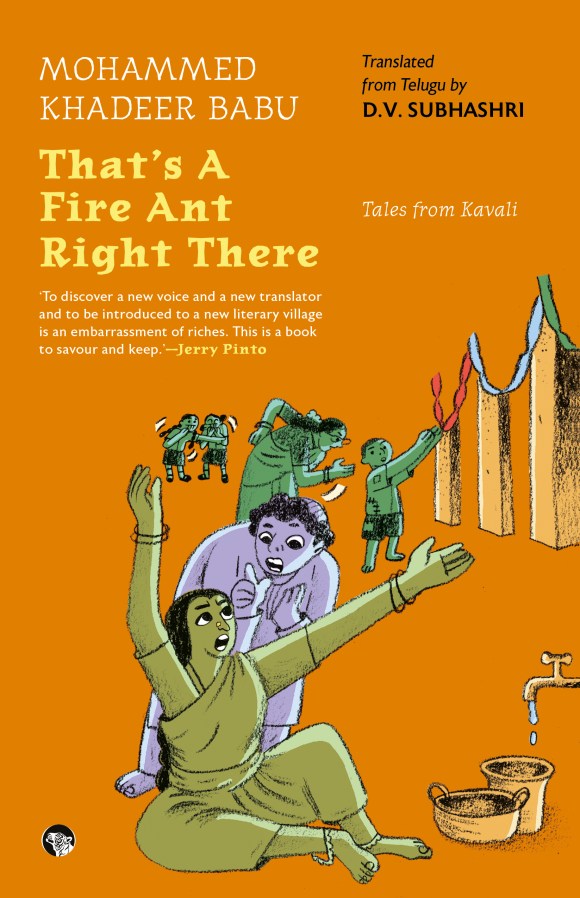
Title: That’s A Fire Ant Right There! Tales from Kavali
Author: Mohammed Khadeer Babu
Translator: D.V. Subhashri
Publisher: Speaking Tiger Books
True-blue Palavenkareddy!
It’s only now when he’s running a Palav Center in front of Kavali Court that he’s able to see twenty-six rupees in his hand for every plate he sells, but there was a time in our childhood when Palavenkareddy too was down on his luck!
Palavenkareddy (Palav + Venkareddy) was my father’s best friend. He was also the one who got him married.
When my grandfather Mastan Sayibu was considering giving my mother’s hand in marriage to my father, it seems he went straight to Palavenkareddy to enquire about my father’s ‘conduct’.
‘Don’t worry about that boy, saami! He’s 24-carat gold. You can get them hitched with your eyes shut!’ Palavenkareddy reassured my grandpa and lifted a load off his mind.
Although seven-eight years older than my father, Palavenkareddy, always dressed in white, appeared much younger, with his toned muscles (he was a wrestler once, I might add), shining skin and dyed hair.
At the time of nikah, as my mother was still a young fourteen-year-old, Palavenkareddy used to address her as ‘ammayi’ or ‘girl’, and continued to call her that even after marriage. Whatever his feelings for my father, he definitely favoured my mother and had more affection for her.
If Sankranti was here, Palavenkareddy wouldn’t be far behind. He’d show up with a large steel carrier full of ariselu, manuboolu, laddulu and hand it to my mother saying, ‘Here you go, girl.’ Then he would take my father, my brother and me to his house, fill our leaf-plates full of sweet payasam and treat us to a full festival meal. (This is also the time to reveal yet another truth. Until recently, whenever my mother had to go to a wedding or any other function, she would borrow Palavenkareddy’s wife’s or daughter-in-law’s jewellery as if she had every right to do so.)
I don’t really know if he was into farming or not, but as kids we always saw she-buffaloes tied up at their house. His wife would wake up early and toil hard, tending to the buffaloes all day. Seemingly in an effort to reduce her drudgery, he dabbled in various businesses, but being a man of truth, failed to make money in any of them. Finally, he hit the jackpot when he opened the Palav Centre. And since then, his surname changed from Remala to Palav and he came to be known as Palavenkareddy to everyone in our town.
During our childhood, he owned a cloth store near the Ongole bus stand. Barely a metre would sell each day at the shop, but Palavenkareddy and his elder son could always be seen dutifully minding the store.
Now why I’ve been telling you this long story about Palavenkareddy is because when the month of Ramzan arrived we were forced to draw on his services—thanks to my mother’s pestering.
‘All the ladies in the street are going to Gademsetty Subbarao’s shop and getting themselves whatever clothes they want. Why don’t you also toss me a hundred or two? I’ll go get the children some new clothes.’ My mother had been badgering my father ever since Ramzan had begun.
My father responded with neither ‘aan’ nor ‘oon’. Ultimately, she decided that this was not the medicine for my father’s attitude and cleverly started instigating my grandma.
‘Rey abbaya! How heartless can you get! Even if we adults don’t buy anything, how can you not get a few pieces of cloth for the children? When other children in the street roam around wearing new clothes, won’t ours feel bad?’ poked my grandma.
Who knows what came over him, but he replied, ‘Send the older one and the second one to the shop in the evening. If I happen to get money by then, I’ll buy them some, alright,’ and left for work.
When evening came, with high hopes my mother dressed us up—not just me and my brother but also our sister—and sent us to our electrical shop on Railway Road.
And my father? What did he do? When we reached there, he was sitting at the table with a deadpan face and hands over his head. The moment he saw us, he stood up and said, ‘Not today. Go home,’ then picked up my little sister and prepared to lock the shop.
We were crestfallen. My brother was on the verge of tears.
That is exactly when, like Gods appearing out of nowhere, Palavenkareddy appeared before us. On seeing us, he laughed, ‘Endayyo? What’s up here? All the little Nawabs have descended together.’
My father too laughed and told him the matter. ‘What, Karim Sayiba? The children have come for their festival clothes and you’re taking them back empty-handed? Didn’t you think of my shop? Come, come, let’s go,’ Palavenkareddy urged him.
‘Not now, Enkareddy. We’ll see when I have the money,’ said my father reluctantly.
‘Do you ask for money when you do electric work in my house? Then why would I demand money for the children’s clothes?’ he insisted, herding us along. And so, together we all went to Palavenkareddy’s cloth shop near Ongole bus stand.
‘Karim Sayiba! It’s not as if you’re going to buy clothes again anytime soon, so might as well pick a sturdy fabric that will last a few days,’ he said, opening a wooden almirah and pulling out a tough-looking piece of blue cloth from the swathes of fabric inside.
‘Guarantee cloth. No question of tearing at all,’ he said.
Whenever my father hears the word ‘guarantee’, he forgets everything else and says, ‘Yes, give that one’, and so, he said the same to Palavenkareddy as well.
That was that! Before we knew it, in five minutes Palavenkareddy had cut the cloth and all of us had given our measurements to the tailor Sayibu beside the shop, who promptly soaked the cloth in an iron bucket.
(Excerpted from That’s A Fire Ant Right There! Tales from Kavali by Mohammed Khadeer Babu, translated by D.V. Subhashri. Published by Speaking Tiger Books)
ABOUT THE BOOK: Captured in the innocent voice of a young boy, Mohammed Khadeer Babu’s Chaplinesque-style of portraying misery through humour shines a sweeping light on Muslim lives in coastal Andhra. Populated with strong women, cheeky scamps, virtuous dawdlers and scrupulous teachers, his witty storytelling in the Nellore dialect is a riveting portrayal of the daily struggles of adapting to a majoritarian world in small-town India. Belying the nostalgic memories of childhood are scathing observations of the education system, child labour, social barriers, and casteist attitudes. Yet, the stories also resound with a clear message of friendship, especially among Hindus and Muslims, making this book essential reading in today’s fraught times, to remind ourselves of our inherited legacy of communal harmony—which makes it possible for the young narrator to say, ‘I’ve never regretted even once that I didn’t learn Urdu or that I don’t know Arabic, or that I have never even touched the Quran in these languages, only in Telugu.’
D.V. Subhashri’s unique translation, which retains all the richness of the original, quaint expressions and sounds et al, brings a smile to our faces, while showing us why the book made Khadeer Babu a household name in the Telugu community. This first English translation of his work opens up a new world for us.
ABOUT THE AUTHOR: Mohammed Khadeer Babu is a senior journalist and award-winning writer in Telugu with short stories, anthologies, non-fiction books and movies to his credit. A two-time Katha awardee, his stories have won various prizes at the state and national level and earned him the Government of Andhra Pradesh Achievement Award in 2023.
ABOUT THE TRANSLATOR: D.V. Subhashri is a multilingual writer and translator based out of Bangalore. Her stories and translations have appeared in various online magazines and her children’s books have won awards in Telugu and English. She is currently translating two books from Telugu and Kannada.
PLEASE NOTE: ARTICLES CAN ONLY BE REPRODUCED IN OTHER SITES WITH DUE ACKNOWLEDGEMENT TO BORDERLESS JOURNAL








 Borderless