Categories
Musings

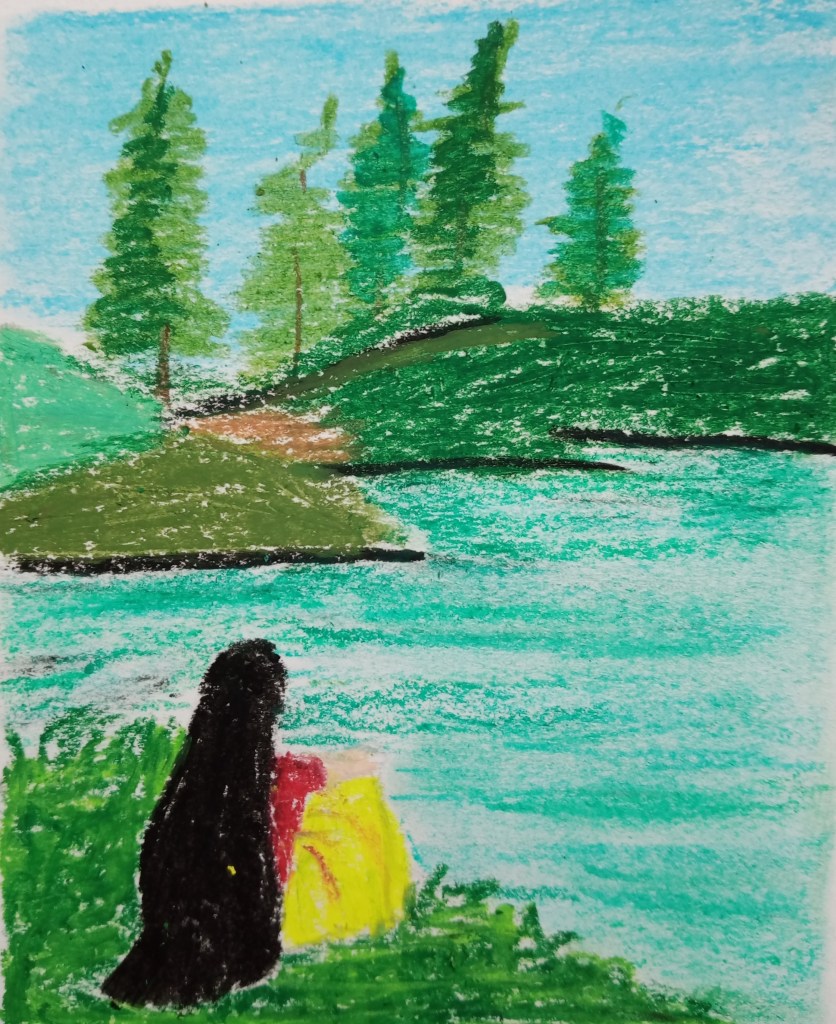
Can Peace come Dropping by…

Candice Louisa Daquin explores war and peace pausing over the attack on Ukraine

Courtesy: Creative Commons

War is among the main stays in human history. Is anything more instinctive than to go to war? I’ve never been able to relate to this but perhaps that’s because I have the advantage of living in a society where we’re protected from the literalisms of war. Or perhaps it’s because I’m female, although I don’t think it is as simple as being a male prerogative (though we can never be sure until a history of women making decisions proves this). To the outsider, war always seems futile. But what we must always do in order to fully understand something is to understand the other side. Not our own opinions but those we do not comprehend. As French philosopher Albert Camus said: “We used to wonder where war lived, what it was that made it so vile. And now we realise that we know where it lives…inside ourselves.”

Why would anyone ever want to go to war?

Imagine the first reason war was enacted. Was it as simple as Cain and Abel? Or one village attacking another village? One child attacking another child?

War tends to be on a larger scale, but perhaps it begins on a smaller scale.

It is said murderers have ‘symptoms’ of evolving as killers as do rapists and predators. If this is true, then watching children and seeing them skinning a cat as a predictor to future violence, could also be applied to war-mongering behaviour. Or conversely, could we establish what experiences that child has that engenders him/her to favour war?

If children who become violent often witness violence, then it stands to reason children who support wars or encourage wars, may witness something that in their minds is pro-war. What could it be? If you grow up in a war-torn country, surely you are more likely to seek peace and an end to violence, than to crave it? The fifth century famed military strategist Sun Tzu is quoted as saying: “Victorious warriors win first and then go to war, while defeated warriors go to war first and then seek to win.” Is war about the appearance of bravery or perceptions of strength? Ironically, Sun Tzu also said: “The wise warrior avoids the battle.” But do we follow this wisdom?

Studies show wars are committed by groups who are cohesive and decide (on invasion) and groups who defend. In essence, there is an aggressor and a protector. Sometimes wars start with two aggressors, but rarely with two protectors (this would cancel the desire for war out). Therefore, the thing everyone has in common who enters a war, is they are either seeking to invade or protect.

If people did not seek to protect, the invader would arrive and receive no resistance, and thus there would be no war. Sadly, it wouldn’t stop the invaders from say, raping and pillaging, so laying down arms and hoping for fairness, may lead to slaughter and oppression.

If people did not seek to invade, there would be no need to go to war.

What are the main reasons historically people have warred? Over land. Religion is a close second. The historic wars were over disputes of land or religion or other reasons related to both of these. The seizure of assets is related to greed/wealth/power, same as seeking to enslave people or promote an agenda (social control – another form of power). Essentially then all invasions can be reduced to one sentence: Seeking power.

One group believes they should have (more) power over another group. They invade. The other group defends or capitulates. This is the essence of war.

If we assume then most wars are enacted over a need to gain power of one sort or another, the next question becomes; Are all humans as likely to war? Or do certain societies promote war more than others? Throughout history there have been wars, many times one group did not want to go to war but were forced to in order to defend themselves. It implies there are those who are (warmongers) and there are those who are not (peacemakers or pacifists) and possibly while the latter may not seek war, they get involved if there is no alternative.

War then is to some extent – a luxury. Odd that if this is so, it’s often during the hardest times in human experience that a war begins. Wouldn’t you think if war is a luxury (by being a choice, as no war is enacted because the invaders have no choice), they’d choose not to go to war during hard times? Yet, the reverse is true.

We’re still in the struggling with the pandemic, but instead of seeking reconciliation and safety, Vladimir Putin has started the invasion into Ukraine. On the face of things this makes no sense because Russia must be hurting economically post the pandemic. To go to war when you are struggling seems madness.

Yet if this is often the case, maybe it’s like when everything is hard, people are less balanced and considerate than when things are easier? People are more charitable when they feel they can be, versus when it’s an emergency. That’s when they start looting and trampling over others. There is an inherent selfishness to humanity where they feel. “If I am alright I might be charitable but if I’m not alright you’re on your own’. It takes a really truly charitable person to stay behind and help others. Most people flee.

If we use this ‘typical’ personality trait and then apply it to a megalomaniac leader, it becomes less surprising they would choose an inopportune moment to strike. Perhaps it’s as inconvenient for everyone else as it is for Putin, therefore they have the element of surprise and inconvenience. They strike when the iron is hot, so to speak. The other impact of war is misdirection. If everyone believes something won’t happen (the invasion of Poland by Germany 1939 in WW2) when it does happen, everyone’s so surprised that they have a delayed reaction (which adds to the invader’s strengthen).

War strategy aside, do some people actually relish war ‘games’ and enjoy the enactment and planning of war? Boys are taught culturally to play with guns, war-gaming, mock-battles etc. If they were not, I suspect they would be no more inclined to go to war than a woman. Then again since we cannot prove or disprove this, we can only guess what is nature and what is nurture. Without doubt, the machinations of the war ‘machine’ promote an ideology of war – not unlike the machinations of a religion to promote an ideology. It’s a form of brain washing. Perhaps, one can agree that “In war, truth is the first casualty.”

When countries encourage a percentage of their population to join the military and have a robust army, they tend to be primarily pro-war – in that – they may not wish to die fighting nor encourage a war, but if one happens, they’re ready and, perhaps, they want it to happen because that’s what they have trained for. If you spend billions on war machines, would you wish them never to be used? Or would you see them as more than deterrents? Would you want to manufacture all this impressive battalion equipment only to see it do nothing? The problem with the creation of tools of war is then someone wants to use them. It is much like the debate raging in America over whether the ownership of guns perpetuates violence. On the one hand some believe if we didn’t have (access to) guns we’d have less violence or gun-deaths. They point to countries with lower rates of gun-ownership to ratify their beliefs. On the other hand, people say it’s not the gun but the person who wields the gun; if they don’t use a gun, they will use something else. They point to the rates of stabbing deaths and other forms of violence endemic in countries with low gun-ownership and to countries with high gun ownership (Switzerland/Canada) who have low gun crime.

There is no easy answer here. Guns have caused countless futile deaths, and gun ownership is a hot topic not likely to be resolved. But if we had less machines of war, would we be less inclined to go to war? Critics point to this as a reason to scale back the US military, whilst others say without such deterrents there would be more attacks on America (or any country without a robust military) because peace is actually wrought by both sides having enough machines of war (and nuclear weapons) that neither side feels they can strike without the other side striking back – and this is what enables us to avoid war. It’s a pretty twisted scenario that makes sense until someone in power decides – I’m not going to play by those rules. In non-interventionist theory, there was a drive to establish international courts to adjudicate disputes between nations and an emphasis on war contributing to moral decline and brutalisation of society in general. Whether true or not, it hasn’t stopped millions signing up for war.

In considering whether being anti-war is realistic, we must analyse the history of war, why humans go to war, what war means to us and what provokes it, as well as whether we can realistically avoid it? It’s one thing to wish for no war, I think a great many of us would share that perspective. But there is an old joke about this: A woman meets a genii and she gets one wish, she wishes for world peace. The world grinds to a halt. Why would the world grind to a halt? Do we depend on war so much? Personally, I don’t think war keeps us ticking over but if we consider our history, much of what we have done revolved around war of some kind (or the prevention of) and thus, we’d have a very different planet earth today if we had world peace. Classics like  All Quiet on the Western Front (1929) by German writer Erich Maria Remarque, have become part of a canon of anti-war media, that enduringly influences the pacifist movement. Perhaps without knowing war, we cannot know why war is such a terrible price to pay.

I am utopian in that I would like to see world peace. Imagine a world where people received funding for healthcare and food rather than bullets and violence? But is that like wishing human nature should have been different? Can we ever hope to become enlightened enough to actually stop wars from occurring? In 2022 as with history thus far, humanity as a whole has not been enlightened sufficiently to stop war from occurring. America, as a developed nation, is the only country to have used nuclear bombs on another country in our entire history. A less developed country that has historically been a trigger for war, may have more growing pains and therefore more wars. But let us not believe in ‘developed’ versus ‘developing’ to judge the pacifist intent of one country over another. Historically, we’re all guilty.

“Just war theory has been converted into a form of apologetics for whatever atrocities your favoured state is carrying out,” says Noam Chomsky in his book What We Say Goes: Conversations on U.S. Power in a Changing World. It’s not ethnicity, income or development that causes war. It’s human beings. Within us is a penchant for going to war, that cannot easily be explained but clearly has existed since the beginning of (human) time. Until we can come up with alternatives to war, this destructive cycle shows no hope of ending. We can reason ourselves to death, but it only takes one unpredictable leader, the right speech, and we’re at war again. What we know if nothing else is, humans go to war. What we don’t yet know, is how to remove that impulse.

Is it an impulse like sexual attraction or hunger? Something as intrinsic and hard-wired or more of a defense mechanism for men? Again, I think without proof of this, it makes more sense to assume this is a human predilection and not a gender-driven one. Would women go to war as gladly as men? We may not have enough historical precedence to substantiate this issue. It could be argued they were working with a masculine model, but we have no proof either way. Rather than entering the ‘blame game’ what would be a way to avoid war altogether?

Negotiations only go so far. What one country may wish another country to do, doesn’t mean they will. If that country feels that is a deal breaker, then war is on. How can you ever alter that outcome when it’s as common place as two people disagreeing? This will always occur and if those two people are world leaders, then war may be the result. Is it unavoidable even if so many of us wish for peace? What are the ‘necessities’ of peace? German philosopher, Immanuel Kant was one of the earliest exponents of the idea that “perpetual peace could be secured through universal democracy and international cooperation.” Democracy isn’t a save-all and has severe down-sides, making ideas in reality, less like their philosophical ideal. Novelist Victor Hugo contended, “Peace is the virtue of civilisation. War is its crime.”

I feel fortunate I did not grow up in war-torn countries, but even in my lifetime, I have heard of so many wars. All wars are a huge waste of money. Even the World Wars, where nearly every country entered in order to fight off the invading fascists. Whether anti-imperialism, an end to totalitarianism or nuclear disarmament, are the answers for enduring peace, they’re complicated and don’t explain the enduring penchant for violence and war within humanity.

One thing I noticed when I immigrated to America was how many people believed being pro military meant being pro war. People would say things like; ‘they are defending our freedom’ and I would ask; ‘how are they defending our freedom if our freedom was never in jeopardy?’ I felt most of the wars in America since WW2 were completely unnecessary. Not a single one of them was really justified (in terms of it being necessary to defend America against a true threat). Most were born out of paranoia and a need for control (anti-communism) or greed and a need for control (Afghanistan and beyond). They were not ‘as advertised’ meaning the average American thought America invaded countries for one reason but it was often a completely different reason.

When 9/11 happened, the entire world was shocked. America did not have a history of being attacked on their soil since the Civil War (and that, by their own populous). The outrage with a staggering death toll of about 3000 was so stunning that a need for vengeance or rectitude was experienced. The result was the longest drawn war in American history which led to billions being spent and weapons getting into the hands of ‘the enemy’ which so often has been the case. How can this be a good thing? Anymore than creating a generation of young men who seek vengeance for what was done to their countries in the name of ‘freedom.’

The polarisation of religion, culture, politics and ethos seems more acute than ever before. There is no universal agreement and those who sue for peace, must realise that just wishing for it, isn’t going to resolve those long-standing fractions. Maybe it’s simply not in our nature to want to all get along, to avoid war and seek peace. Maybe humans are warmongers and we’ve replaced the hunt of big game with fighting each other. Maybe the veneer of our so-called civilisation is very thin and waiting for any excuse to implode. That said, I’m an optimist. As such I believe there are ways to gain peace and avoid war. I don’t think it’s as simple as putting our weapons down, because someone will always cheat. Trust must be earned and even then. But if we seek the same goal, that’s a start. It may not happen in my lifetime, but it is my hope with every generation we come closer to a rejection of war. There are quite simply, too many other needs and just imagine — if we poured our collective funds into helping those in need, we could live in a paradise instead of buying bullets that erase life. Ultimately every single one of us is responsible for what happens going forward, collectively.

Quoting Ralph Waldo Emerson, “Nobody can bring you peace but yourself.”

Candice Louisa Daquin is a Psychotherapist and Editor, having worked in Europe, Canada and the USA. Daquins own work is also published widely. She has written five books of poetry, the last published by Finishing Line Press is called Pinch the Lock. Her website is www thefeatheredsleep.com

.

PLEASE NOTE: ARTICLES CAN ONLY BE REPRODUCED IN OTHER SITES WITH DUE ACKNOWLEDGEMENT TO BORDERLESS JOURNAL.

Disclaimer: The opinions expressed are solely that of the author and not of Borderless Journal.
Categories
Editorial

‘What’s Love Got to Do with It’

Art by Sohana Manzoor
‘Why does education in love not feature in today’s curriculum?’
— Mahasweta Devi, Our Santiniketan (Translated by Radha Chakravarty, 2022, Seagull Books)

As the world celebrates Valentine’s Day, one pauses to think how far commercialisation has seeped in over time that the very concept of a tender emotion was questioned by Tina Turner in a song called, “What’s love got to do with it” nearly four decades ago. 

This was written even before Mahasweta Devi (1926-2016) published a nostalgic memoir of 1930’s Santiniketan in Bengali in 2001. She raised her pen to ask the very pertinent question that is quoted above. Why is education in love not a part of our curriculum anymore? She was reminiscing about her days in Santiniketan where children were brought up with rigorous academics while discipline was coloured with love and affection. They nurtured a love for nature in students too. This has become a rarity for many and perhaps needs to be revived as the Earth struggles to continue habitable for humankind. In the process of educating students to love and give, Santiniketan threw up many greats like the writer herself. We are delighted to host an excerpt from the start of Our Santiniketan translated beautifully by Radha Chakravarty.

Santiniketan was only the very visible part of a huge project taken on by Tagore (1861-1941). The other part now united with Santiniketan under the banner of Visva Bharati University is Sriniketan, a group of villages where Tagore experimented with raising consciousness and standards of villagers to integrate them into a larger world. He brought in new techniques in agriculture and crafts into the villages under this programme involving many prominent scientists, artists and humanists. And the project has blossomed. Did you know Tagore thought of himself as an NGO and his ‘life work’ he felt was developing villages (Sriniketan) and educating young minds to build a world where borders of knowledge, poverty and ignorance could be smoothened?

He wrote: “I alone cannot take responsibility for the whole of India. But even if two or three villages can be freed from the shackles of helplessness and ignorance, an ideal for the whole of India would be established.

“Fulfill this ideal in a few villages only, and I will say that these few villages are my India. And only if that is done, will India be truly ours.”

All this can be found in a book called A History of Sriniketan (Niyogi Books), written by Uma Das Gupta, a major authority on Tagore who moved from Oxford to Santiniketan and made Tagore’s work in these two institutions her own life’s work. We have featured her and her book in our interview/review section.

Raised out of such ashes of poverty that Tagore sought to dispel, are youngsters from the village of Nithari, where ceaseless efforts by volunteers of organisations like Saksham and pandies’ has given a new lease for life to those who have been exposed to violations, violence, divides, poverty and deprivation. One of them, Sharad Kumar, now studying to be an engineer, kicks off our new section called Pandies’ Corner with his story in Hindustani translated by a volunteer, Grace M Sukanya. His story learns from history and shows rather than tells.

A similar approach to view the present through lenses focussed on the past at a much grander scale has been taken by Shazi Zaman, an author and journalist, who has stepped into the Anglophone world with the transcreation of his own novel from Hindi to English, Akbar, A Novel of History (Speaking Tiger Books). He has brought to the fore how in days when sectarian violence based on religions killed, Akbar (1542-1605) tried to create a new path that would lead to peace so that he could rule over an empire united by administration and not broken by contentious religious animosities which often led to wars. In his interview, he tells us of the relevance of the Great Mughal in a period of history that was torn by divides, divisions so deep that they continue to smoulder to this day and date. That history repeats itself is evident though our living standards seem to improve over time. Bhaskar Parichha’s review of Growing up Jewish in India: Synagogues, Customs, and Communities from the Bene Israel to the Art of Siona Benjamin, edited by Ori Z. Soltes, also reinforces these divides and amalgamations in the modern context. The other books that have been reviewed include The Best of Travel Writing of Dom Moraes: Under Something of a Cloud by Indrashish Banerjee, and Gracy Samjetsabam has introduced us to an intriguing murder mystery in Masala and Murder by Patrick Lyons.

Translations have thrown up interesting colours this time with a Tamil story by a Sahitya Akademi winning writer, S Ramakrishnan, translated on our pages by B Chandramouli, one from Korean by Ihlwha Choi and of course a transcreation of Tagore’s songs where he sings of the meeting of horizons. A beautiful poem by eminent Balochi poet Atta Shad (1939-1997) has been translated by Fazal Baloch. We are again privileged to host an original translation of Jibananda Das(1899-1954) by Professor Fakrul Alam. We also managed to get permission to share some of Professor Alam’s fabulous translations of Jibananada Das from UPL (United Press Limited) and are starting it out by excerpting two of his poems on Banalata Sen, which were till now restricted to readership who only had access to the hardcopy. Rakibul Hasan Khan has given us an essay on these translations. An interesting essay on Satyajit Ray (1921-1992) by Rebanata Gupta and personalised tribute to the first Booker Prize winner from New Zealand, Keri Hulme (1947-2021), by Keith Lyons, who had many non-literary encounters with the sequestered author, add to the richness of our oeuvre.

Ratnottama Sengupta has also paid a moving tribute to the music legend, Lata Mangeshkar, who died at the age of 92 on 6th February, 2022. The choral symphony of multiple voices that hums through the paean recreating the larger than life presence of Lata reinforces that her lilting voice will stay embedded in many hearts and lives forever. Her perfect honing of musical skills delivered with the right emotions make her an epitome of human excellence. She gave the best of herself to the world.

Brooding on death and suicide is Candice Louisa Daquin essay. This is a topic under discussion as Switzerland might start a resort for abetting suicides. It is rather frightening that while people value life and as technology and humans work in consonance to preserve it, the rich can think of squandering away this unique process that has till now not been replicated. The other strange long literary yarn that is dark in colours is woven by Sunil Sharma as he explores the futility and self-pity experienced by retirees in their existentialist quest to find a meaning to live. It has bits of poetry too. Penny Wilkes has also introduced verses into her photographic tour of dewdrops. Candice’s vibrant poetry this time has joined that of Ryan Quinn Flanagan, Mike Smith, A Jessie Michael, Ananya Sarkar, Jay Nicholls, Saptarshi Bhattacharya, Rhys Hughes and many more I leave you to unfold. Rhys Hughes has also given us a spooky piece which says ghosts might be genies — check it out. Do you agree or is he just being bizarre and funny?

Wrapped in more dry humour is Devraj Singh Kalsi narrative on why he does not want pets. Meredith Stephens, on the contrary loves pets and sails the seas of West Australia with her camera, words, seals and dolphins. Luke PG Draper also speaks for animals — for the intrusion of pollutants that harm creatures like whales in his short story. Hop all over the world with Ravi Shankar breaking nightly fasts with food from different cultures. More colour is brought in by Suzanne Kamata who starts a new column, Notes from Japan — introducing us to Japanese sensation, Masaki Nakagawa, who has sung his way to hearts with Lativian songs that he loves, so much so that he got to perform at the Japanese coronation and has pictures with the Latvian President.

The time has come to let you discover the mysterious pieces that have not been mentioned here in the February edition — and there are many.  

Before I wind up till the next month, I would like to thank our fabulous team who make this journal possible. Keith Lyons has now become part of that team and has graciously joined our editorial board. Sohana Manzoor and Sybil Pretious deserve a special kudos for their fabulous artwork. Our grateful, heartfelt thanks to all our wonderful contributors and readers who keep the journal alive.

Wish you all a lovely month.

Best wishes,

Mitali Chakravarty

Borderless Journal

Categories
Essay

One Life, One Love, 300 Children

Keith Lyons writes of Tendol Gyalzur, a COVID 19 victim, a refugee and an orphan who found new lives for many other orphans with love and an ability to connect.

Tendol Gyalzur: “My religion is wiping children’s noses.”

This story is about how one person found joy and happiness, not in accumulating material possessions or going viral on social media, but in finding her purpose through doing service, and making a difference to many, many lives.

Yet it might have turned out differently for Tendol Gyalzur. Her parents and brother were killed as they fled Tibet. As an orphaned refugee she was adopted in Europe. She had every reason to be bitter, every reason to hold a grudge, every reason to hate. It took great courage for her to return to her childhood homeland which had been invaded by China. It took huge sacrifice for her to work with those occupiers who’d orphaned her. And it took a deep love for her to admit that sworn enemies were actually capable of love.

I first met Tendol nearly 20 years ago while I was travelling in the Tibetan borderlands of north-west Yunnan province, in a place which later changed its name to Shangrila in a shrewd move to attract tourists in search of the fictional place of James Hilton’s Lost Horizon (1933). In Zhongdian, a predominantly-Tibetan town which sits at a literally breath-taking 3,300m above sea level, the owner of my guesthouse drew me a rough hand-drawn map on a blank back page of Lonely Planet China showing the route from the Old Town to the ‘Gū’ér yuàn’ (solitary nursery).

I made my way through the rough cobblestone lane maze of the Old Town, past steamy yak hotpot restaurants and karaoke bars where red-robed monks drank beers and barley spirits, to the much-larger New Town with its wide boulevards, guarded bank buildings and muddy construction sites.

After turning right at a new 4-star hotel, skirting alongside a placid lake, and halting just before the town’s new traffic-light junction, I spotted a sign for the orphanage. The arrows took me behind a primary school into a residential area, and up to a walled compound. I knocked on the gate metal door, a couple of guard dogs inside started barking, and eventually, the door was opened by someone in a cook’s apron and sporting the trademark Tibetan alpine rosy cheeks. “Welcome,” she said, and I presented my offering of a bag of warm winter hats, scarves and gloves. “Come in, and I will get Tendol.”

I’ve watched enough television and late-night charity ads in my life to assume that any orphanage will have poor, sad, bedraggled kids confined in drab quarters, but I was not expecting the light, spacious and clean courtyard, with a basketball court and stable with horses. Bright Tibetan motifs of the sun and moon and swirly cloud patterns decorated the trim of buildings, while in small gardens orange and yellow flowers reached for the clear blue skies above.

From one of the buildings out came a woman who, after stopping to tie up the shoelaces of a small child and send them off to play with a hug, introduced herself to me as Tendol. She ushered me into a small reception area where I was given tea, and after explaining about her work, she showed me around the facility, which had spartan but well-maintained tidy dormitories, classrooms for after-school study, and a cosy kitchen.

I was surprised not just at the uplifting environment and its positive vibe, but also at just how content the dozens of children seemed. As a deliberate policy, two aspects of the orphanage’s operation were aimed at mainstreaming and protecting the children. Rather than become a closed institution like most other orphanages in China, the children went to school at the nearby school next to the orphanage, so they could integrate with their peers. To give greater security and remove the fear of being further displaced, Tendol committed to keeping all the children in her care safe from being put up for adoption.

It was one big family, and the children regarded each other as brothers and sister, with the house-parents and Tendol and her husband Losang referred to as parents, aunty or uncle. While most of the children were Tibetan, some were from seven other ethnic minorities including Naxi, Yi, Lisu, and Han Chinese. With orphans found abandoned on the street, or having lost parents, she said how Children’s Charity Tendol Gyalzur doesn’t discriminate on the ethnic origin, the colour of skin, or religion. “Instead we accept those who are most in need of our help and protection.”

While most Tibetans practice Tibetan Buddhism, Tendol was brought up in Europe with Christian values, but her mission was never religious and the orphanages were non-denominational. In an interview she once said her work was practical and pragmatic rather than religious, “My religion is wiping children’s noses.”

“I am the happiest person on Earth,” Tendol would often tell me when I visited her bringing donated clothes and food, or guests. “Really, I am the happiest person,” she would declare, wrinkles appearing around her deep dark twinkling eyes as she smiled, while outside youngsters playing tag, improvised soccer and hopscotch shrieked and chortled. “You can write that down.”

I did take note of her genuine proclamation and was curious to learn about her story, not just of her tangible ‘bricks and mortar’ achievements, but also of her personal transformation which made her in my books more saintly and less dogmatic than the likes of Mother Teresa (now known as Saint Teresa of Calcutta).

So how did an exiled orphan return from Switzerland to establish orphanages and nomadic schools across Tibetan areas during the last three decades? That journey, going full circle, from being an orphan herself to caring for hundreds of orphans, is Tendol’s story. The short answer is that was obviously very hard work, requiring dedication, perseverance, and boundless love. Tendol was supported by her family, especially her husband Losang Gyalzur and two sons, as well as donors throughout the world.

Given Tendol’s tough, turbulent childhood as an exile, refugee and orphan, you might expect her to hold a grudge against those who orphaned her. Yet she was possibly the kindest-hearted person you might ever meet.

I wanted to know about her life and struggles, and how she overcame the obstacles. When I stayed in Shangrila for 18 months, and later lived in the nearby town of Lijiang for a dozen years, I came to appreciate the difficulties for outsiders to live and work in China. For me and many other foreigners, the cost of visas and frequent visa-runs were higher than the actual cost of living.

Every year or so, someone I knew would be fined and deported. Several Tibetan-focused NGOs operating in Lhasa were kicked out, re-establishing in Yunnan, only to face more scrutiny and barriers. Tendol no doubt had to make some compromises in her work, but her continued ‘licence to operate’ seemed to come from her outstanding reputation, key connections and ultimately, from her record of success: she provided a social service for those most in need.

Tendol fled Tibet in 1959 during the suppression of the uprising against Chinese rule, escaping across the Himalayas with her parents and brother. Along the way, during the treacherous journey, her parents and brother died, and at one stage the group of refugees she travelled with left her behind in a remote village. She realised her plight, and ran after the caravan, making it through Bhutan to India, where she was placed in a refugee camp. She didn’t know the names of her parents or brother, nor did she know the date or year of her birth. Her age was only estimated based on the number of baby teeth.

The events of 1959 left tens of thousands dead and saw over 80,000 Tibetans, including the 14th Dalai Lama, flee to India. Tendol was transferred to an orphanage in Dharamsala run by the Dalai Lama’s sister and was chosen to be part of a group of a dozen children to go to Europe in 1963. Before departing to Munich, the Dalai Lama spoke to the children, hoping that one day they would be able to return to help rebuild Tibet and spread happiness, as ‘flowers that would later bloom in Tibet’.

She was adopted by a young German couple, both doctors, and grew up near Konstanz. As well as suffering culture shock and racial abuse for the darker colour of her skin, her less traumatic early memories include being invited to lunch with the mayor of Munich only to be served a bland meal of hominy grits, and being sick from eating too much chocolate at Easter.

In Germany, she met her husband, Losang, a fellow Tibetan refugee who had fled to Switzerland in 1972. They moved to near Zurich in Switzerland (the country with one of the largest populations of Tibetans) and started a family.

When her sons were still young, and when Tendol was 36 years old, she returned to Tibet for the first time in 1990, this time bearing the distinctive bright red Swiss passport with its bold white cross. While other visitors in the capital Lhasa were marvelling at the enchanting Tibetan Buddhist architecture and magnificent high-altitude scenery, she came across two dishevelled children rummaging through trash. She took them to a nearby place to eat, but at first, the manager refused to let them in.

“It was then, for the first time in my life, I realised that the only thing I wanted to do was fight for the rights of these abandoned children,” she said. “I know there are orphans all over the world, but I am Tibetan, and I wanted to help the orphans of Tibet.”

When she described her vision of establishing an orphanage in Tibet to her family and friends back in Switzerland and Germany, many argued it was an impossible dream. After all, she was just a surgical nurse, with little money, up against seemingly insurmountable obstacles to set up a private institution in bureaucratic and xenophobic Communist China.

Haunted by the images of the scavenging Tibetan street-children, which triggered her own memories of being an orphan, she took out her savings and some of her husband’s pension, sought donations and loans from family and friends, and secured some financial support from the Tibet Development Fund. Within three years of that pivotal moment in Lhasa, she returned in 1993 to open Tibet’s first private orphanage at Toelung just outside Lhasa. It started with just six children.

She opened a second orphanage in her husband’s hometown of Shangri-la in 1997, and five years later established a centre in western Sichuan for the children of nomadic herders.

Back in Europe, particularly in Switzerland, Germany, Austria and France, she gained more support from those inspired by her work. After dividing her time between both worlds she eventually moved to Shangri-la, spending time at the two other facilities and returning to Europe to report on progress and fundraise.

Although the authorities appreciated her work, and would often find or refer children to her care, the local government didn’t provide much in the way of resources. I remember one time Tendol showing me a large screen television gifted to the orphanage by officials, and lamenting the lack of government support for her humanitarian work. In later years, the government was more supportive, offering to fund teachers’ salaries and helping with clothing, food, housing and transportation. Chinese have been among the sponsors and volunteers, though the vast majority of the funds to maintain the operation have always come from abroad.

While some children’s charities gain sympathy and support by showing emotive images of deprived downtrodden children, Tendol didn’t rely on this tactic to attract donors. Instead, the charity showed the children doing activities, playing, and having fun, with some before and after photos showing the transformative for some of the orphans found abandoned on the streets.

Her husband joined her in Shangrila, and one of her sons, who had been a professional ice hockey player in Switzerland, relocated to establish a craft brewery, one of the highest in the world, which also employs adult orphans as part of a training and apprenticeship scheme. Songtsen’s two restaurants also give skills to youngsters in the tourism-oriented economy.

As the children in the orphanage grew older, some went on to tertiary study, vocational training and jobs. One of the former orphans from her Lhasa home became house parent in Shangrila. Tendol once confessed to me the challenges of seeing the children grow into adults. “It was a big change for me, from looking after them as children, to seeing them start careers, get married and have families.”

She hoped that in the family-atmosphere of the homes the children would not only strengthen their identity and independence but also live and work peacefully together. Each child had daily and weekly duties including keeping the premises clean, with teenagers, often seen hanging out laundry, helping the cooks prepare meals or playing for younger residents.

Volunteers were enlisted to help teach the Tibetan language, which was in danger of dying out, and as well as completing homework the residents were given lessons in Tibetan and English. When I lived in Shangrila I often visited, bringing other travellers to play with the kids. Teachers would devise fun games, musicians would teach new songs, and a juggler would entertain the children. When a new performance hall was completed, the interaction could take place indoors, with the children sometimes welcoming visitors with traditional songs and dances. The openness of the orphanage and its standing in the community meant you were as likely to see Tibetan monks or government officials come to study the innovative model as you were overseas sponsor groups or student volunteers.

After Songtsen joined his parents in 2008, an additional grassland property gave the children more space to run around in. The father of the orphanage, Losang, was an accomplished horseman, and a number of the children learned the skills of Tibetan horse riding, with several winning prizes at Shangri-la’s annual horse-riding festival.

Later when I moved to Lijiang, four hour’s drive away, I would still visit, sometimes taking small groups and families. If Tendol was in town and not away at the other orphanages or back in Europe, she was more often than not in a meeting or doing necessary paperwork. But she always made time, getting up from her desk to give me a big hug, sometimes lapsing into German (she admitted to mistaking me for a German-speaker as this was her main working language in liaising with sponsors and donors).

She was proud of all of her children. Around the walls of her office, certificates and prizes awarded her children joined photographs of her Swiss family and birth sons. Tendol had a big family that went beyond her own and her homes. She was also quick to point out that her endeavours weren’t just a one-way exchange, saying she’d learned a lot from the children, and that others might learn how to live in peace from them.

She said at the start she saw the Chinese as enemies. Her children would throw stones at any Chinese. But she was able to turn those enemies into friends and allies, and Chinese have been among those supporting her work.

As she passed retirement age, and Losang turned 70, they gradually closed the orphanages, with the remaining children now under the care of well-run government orphanages, and the couple returned to Switzerland. The Shangri-La Brewery and Soyala restaurant still remain in Shangrila.

Last year Tendol’s achievements were outlined in the German-language book Children of Tibet: The Unbelievable Story of Tendol Gyalzur, published in Switzerland. Publishers Woerterseh would like to release an English translation.

However, the last chapter of Tendol’s life of service in helping 300 children came earlier this month, when she succumbed to coronavirus, and died in Switzerland. The New York Times was one of the media offering a tribute to her life, in its new ‘Those We’ve Lost’ section highlighting the lives of those who have died from COVID-19. In Shangrila, one media outlet praised her inspirational life overcoming many obstacles, poetically declaring, “Love is boundless, and able to turn dry lands into a lush pasture.”

.

Keith Lyons (keithlyons.net) is an award-winning writer, author and creative writing mentor, with a background in psychology and social sciences. He has been published in newspapers, magazines, websites and journals around the world, and his work was nominated for the Pushcart prize. Keith was featured as one of the top 10 travel journalists in Roy Stevenson’s ‘Rock Star Travel Writers’ (2018). He has undertaken writer residencies in Antarctica and on an isolated Australian island, and in 2020 plans to finally work out how to add posts to his site Wandering in the World (http://wanderingintheworld.com).

.

PLEASE NOTE: ARTICLES CAN ONLY BE REPRODUCED IN OTHER SITES WITH DUE ACKNOWLEDGEMENT TO BORDERLESS JOURNAL. 

Categories
Poetry

Happening and more…

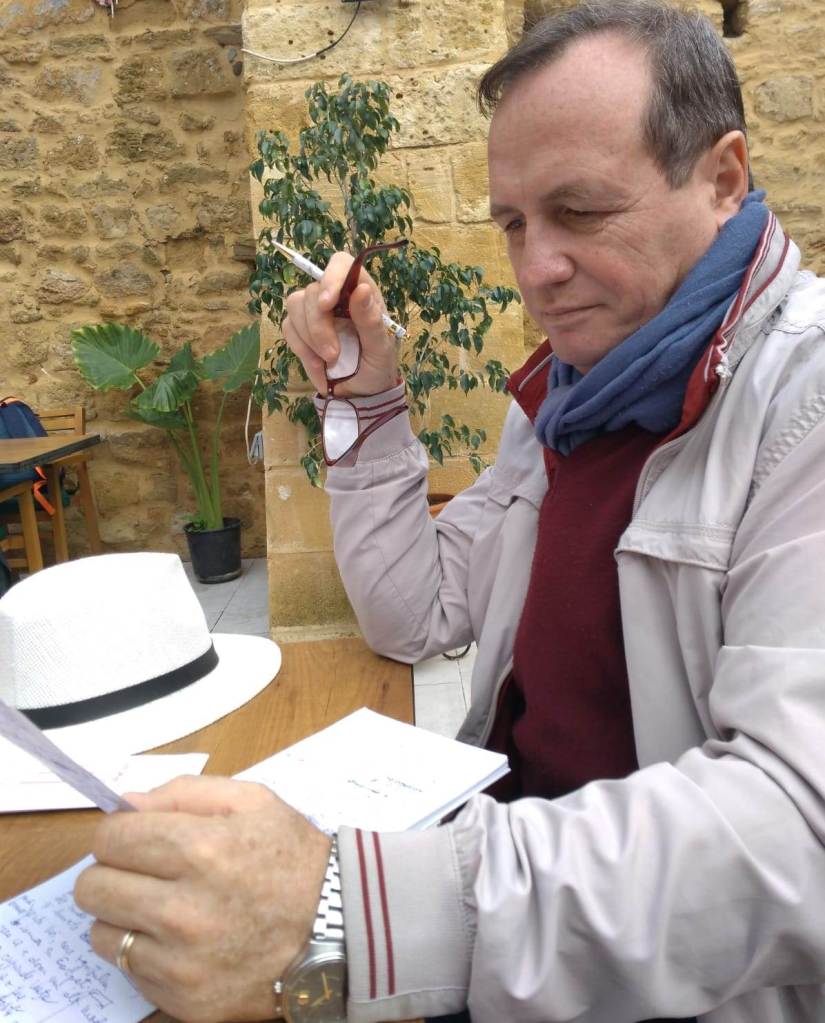
By Vasile Baghiu

Happening

Yesterday, I met poetry 
on the stony Loch Long shore,
near Ardpeaton.
The place was empty, and I think
she felt very well as she was: ignored, 
neglected, abandoned among the wood pieces 
and dry sea wracks.
Though I had suspected for some time 
she was not just the kind of a thing written 
on a paper sheet, 
it was at that moment 
I viewed the truth.

The waves looked like real sea;
the breeze, kingfishers, 
the insistent wind bringing clouds, 
by heaps,
carrying them further away, like in 
a movie shown with high speed,
yet other details, not very easy 
to be described - 
all made me recognize her 
from the distance. 

I had my camera close at hand, so I took 
many photos 
thinking to impress my friends later, 
as I knew they would not believe my story.

In the evening, when 
the images were downloaded, 
nothing could be seen 
on the monitor.
I resigned then to sadness and insight,
and I confine myself to write here. 

Still I am sure I really met 
poetry yesterday.

Under Wave

It is as if I were ill sometimes,
feverish, lonely, 
abroad.  

I do not share myself between
me and my own person.

The world swishes inside;
and the heart, 
agreeing secretly with the brain,
makes waves to show I am still alive.

Despite the smile, 
I am not on the wave --
quite under it. 

Maybe I am in vacation
and try to take advantage of
the good weather. 

Striving to be at least 
a part of what I will never be,
I dare not venture too deep
but splash a bit with the oars here,
where I suppose the shore is nearby
helping me feel safe.


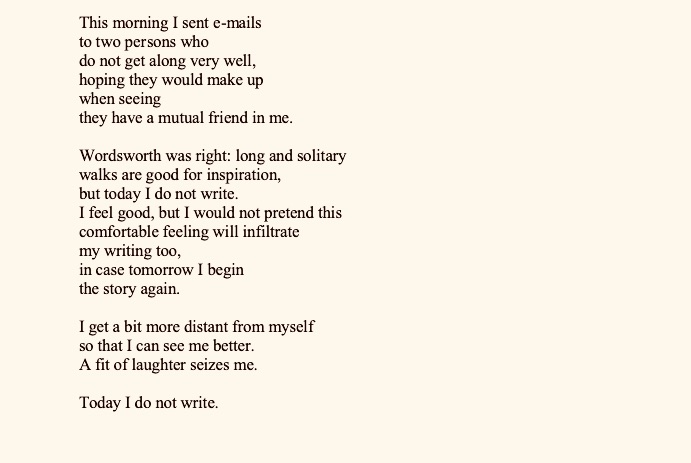
I Do Not Write
Today I do not write. 
I wish I could live a bit more than I do 
in normal circumstances. 
I put aside all the pencils and papers,
close the computer
and come into the midday sun. 
I do not write, 
so I go for a walk,
and think of the things 
concerning me closely
these days:
the life at home,
and the new British poetry
at “Bloodaxe”
I spent all the last evening.

This morning I sent e-mails 
to two persons who 
do not get along very well, 
hoping they would make up 
when seeing
they have a mutual friend in me. 

Wordsworth was right: long and solitary 
walks are good for inspiration,
but today I do not write. 
I feel good, but I would not pretend this 
comfortable feeling will infiltrate 
my writing too, 
in case tomorrow I begin
the story again. 

I get a bit more distant from myself
so that I can see me better. 
A fit of laughter seizes me. 

Today I do not write.

(First appeared in the volume Cât de departe a mers/ How Far Have I Gone, 2008)

Vasile Baghiu (b. 1965) is a Romanian writer, author of eight books of poetry, a collection of short stories and three novels published in his country. He has been awarded a few writers-in-residence grants, in Germany, Austria, Scotland and Switzerland. Some of his works have appeared in translation in magazines and anthologies such as Penmen Review, Magma Poetry, Southern Ocean Review, The Orange Room Review, Stellar Showcase Journal, L.A. Melange, Poetry Can, Banipal, Cordite Poetry Review, The Aalitra Review, Bordertown. Co-author of the poetry collection Transatlantic Crossings: The Constant Language of Poetry, (TJMF Publishing, USA, 2006). Vasile had in the past diverse work experiences as a nurse, including a sanatorium. A psychologist and a teacher now, married, he has a daughter and a son. He currently is working simultaneously on a new novel, a new collection of poems and a non-fiction book.