Categories
Greetings from Borderless

Auld Lang Syne…

As we wait for the new year to unfold, we glance back at the year that just swept past us. Here, gathered together are glimpses of the writings we found on our pages in 2024 that herald a world of compassion and kindness…writings filled with hope and, dare I say, even goodwill…and sometimes filled with the tears of poetic souls who hope for a world in peace and harmony. Disasters caused by humans starting with the January 2024 in Japan, nature and climate change, essays that invite you to recall the past with a hope to learn from it, non-fiction that is just fun or a tribute to ideas, both past and present — it’s all there. Innovative genres started by writers to meet the needs of the times — be it solar punk or weird western — give a sense of movement towards the new. What we do see in these writings is resilience which healed us out of multiple issues and will continue to help us move towards a better future.

A hundred years ago, we did not have the technology to share our views and writings, to connect and make friends with the like-minded across continents. I wonder what surprises hundred years later will hold for us…Maybe, war will have been outlawed by then, as have been malpractices and violences against individuals in the current world. The laws that rule a single man will hopefully apply to larger groups too…

Poetry

Whose life? by Aman Alam. Click here to read.

Winter Consumes by Luis Cuauhtémoc Berriozábal. Click here to read.

Hot Dry Summers by Lizzie Packer. Click here to read.

House of Birds (for Pablo Neruda) by Ryan Quinn Flanagan. Click here to read.

Poems for Dylan Thomas by Michael Burch. Click here to read.

Dylan Thomas in Ardmillan Terrace? by Stuart McFarlane. Click here to read.

Bermuda Love Triangle & the Frothiest Coffee by Rhys Hughes. Click here to read.

Satirical Poems by Maithreyi Karnoor. Click here to read.

Three Poems by Rakhi Dalal. Click here to read.

Manish Ghatak’s Aagun taader Praan (Fire is their Life) has been translated from Bengali by Indrayudh Sinha. Click here to read.

Manzur Bismil’s poem, Stories, has been translated from Balochi by Fazal Baloch. Click here to read.

Ye Shao-weng’s poetry ( 1100-1150) has been translated from Mandarin by Rex Tan. Click here to read.

Amalkanti by Nirendranath Chakraborty has been translated from Bengali by Debali Mookerjea-Leonard. Click here to read.

The Mirror by Mubarak Qazi has been translated from Balochi by Fazal Baloch. Click here to read.

Homecoming, a poem by Ihlwha Choi on his return from Santiniketan, has been translated from Korean by the poet himself. Click here to read.

Pochishe Boisakh (25th of Baisakh) by Tagore (1922), has been translated from Bengali by Mitali Chakravarty. Click here to read.

Nazrul’s Ghumaite Dao Shranto Robi Re (Let Robi Sleep in Peace) has been translated from Bengali by Professor Fakrul Alam. Click here to read.

Jibananada Das’s Andhar Dekhecche, Tobu Ache (I have seen the dark and yet there is another) has been translated from Bengali by Professor Fakrul Alam. Click here to read.

Tagore’s Shotabdir Surjo Aji ( The Century’s Sun today) has been translated from Bengali by Mitali Chakravarty. Click here to read.

Non-fiction

Baraf Pora (Snowfall)

A narrative by Rabindranath Tagore that gives a glimpse of his first experience of snowfall in Brighton and published in the Tagore family journal, Balak (Children), has been translated from Bengali by Somdatta Mandal. Click here to read.

Dylan on Worm’s Head

Rhys Hughes describes a misadventure that the Welsh poet had while hiking as a tribute to him on Dylan Thomas Day. Click here to read.

Travels of Debendranath Tagore 

These are from the memoirs of Tagore’s father translated from Bengali by Somdatta Mandal. Click here to read.

Two Pizza Fantasies

Rhys Hughes recounts myths around the pizza in prose, fiction and poetry, Click here to read

Is this a Dagger I See…?

Devraj Singh Kalsi gives a tongue-in-cheek account of a writer’s dilemma. Click here to read.

Still to Moving Images 

Ratnottama Sengupta explores artists who have turned to use the medium of films… artists like the legendary MF Husain. Click here to read.

How Dynamic was Ancient India?

Farouk Gulsara explores William Dalrymple’s latest book, The Golden Road: How Ancient India Transformed the World. Click here to read.

The Magic Dragon: Cycling for Peace

Keith Lyons writes of a man who cycled for peace in a conflict ridden world. Click here to read.

A Cover Letter

Uday Deshwal muses on writing a cover letter for employment. Click here to read.

A Manmade Disaster or Climate Change?

Salma A Shafi writes of floods in Bangladesh from ground level. Click here to read.

Pinecones and Pinky Promises

Luke Rimmo Minkeng Lego writes of mists and cloudy remembrances in Shillong. Click here to read.

 Educating for Peace in Rwanda

Suzanne Kamata discusses the peace initiatives following the terrors of the 1994 Rwandan Genocide while traveling within the country with her university colleague and students. Click here to read.

Breaking Bread

Snigdha Agrawal has a bovine encounter in a restaurant. Click here to read.

From Srinagar to Ladakh: A Cyclist’s Diary

Farouk Gulsara travels from Malaysia for a cycling adventure in Kashmir. Click here to read.

A Saga of Self-empowerment in Adversity

Bhaskar Parichha writes of Noor Jahan Bose’s Daughter of The Agunmukha: A Bangla Life, translated from Bengali by Rebecca Whittington. Click here to read.

Safdar Hashmi

Meenakshi Malhotra writes of Anjum Katyal’s Safdar Hashmi: Towards Theatre for a Democracy. Click hereto read.

Meeting the Artists

Kiriti Sengupta talks of his encounter with Jatin Das, a legendary artist. Click here to read.

The Comet’s Trail: Remembering Kazi Nazrul Islam

Radha Chakravarty pays tribute to the rebel poet of Bengal. Click here to read.

The Myriad Hues of Tagore by Aruna Chakravarti

Aruna Chakravarti writes on times and the various facets of Tagore. Click here to read.

The Year of Living Dangerously

Professor Fakrul Alam takes us back to the birth of Bangladesh. Click here to read.

A Short, Winding, and Legendary Dhaka Road 

Professor Fakrul Alam takes us on a historical journey of one of the most iconic roads of Dhaka, Fuller Road. Click here to read.

 A Sombre Start 

Suzanne Kamata talks of the twin disasters in Japan. Click here to read.

Fiction

The Snakecharmer

Shapuray by Nazrul, has been translated from Bengali by Sohana Manzoor. Click here to read.

Significance

Naramsetti  Umamaheswararao creates a fable around a banyan tree and it’s fruit. Click here to read.

Just Another Day

Neeman Sobhan gives a story exploring the impact of the politics of national language on common people. Click here to read.

The Ghosts of Hogshead

Paul Mirabile wanders into the realm of the supernatural dating back to the Potato Famine of Ireland in the 1800s. Click here to read.

A Queen is Crowned

Farhanaz Rabbani traces the awakening of self worth. Click here to read.

The Last Hyderabadi

Mohul Bhowmick talks of the passage of an era. Click here to read.

The Gift 

Rebecca Klassen shares a sensitive story about a child and an oak tree. Click here to read.

Galat Aurat or The Wrong Woman

Veena Verma’s story has been translated from Punjabi by C Christine Fair. Click here to read.

The Melting Snow

A story by Sharaf Shad,  has been translated from Balochi by Fazal Baloch. Click here to read.

Conversations

Ratnottama Sengupta talks to Ruchira Gupta, activist for global fight against human trafficking, about her work and introduces her novel, I Kick and I Fly. Click here to read.

A conversation with eminent Singaporean poet and academic, Kirpal Singh, about how his family migrated to Malaya and subsequently Singapore more than 120 years ago. Click here to read.

A brief overview of Rajat Chaudhuri’s Spellcasters and a discussion with the author on his book. Click here to read.

A review of and discussion with Rhys Hughes about his ‘Weird Western’, The Sunset Suite. Click here to read.

Categories
Editorial

Where Are Those Happy Days?

Festivals are like friends.

They bring hope, solace and love to those who believe in them. But, when the structures holding the fiestas in place start to crumble, what do we do then?

Our lives have moved out of wilderness to cities over centuries. Now, we have covered our world with the gloss of technology which our ancestors living in caves would have probably viewed as magic. And yet we violate the dignity of our own kind, war and kill, destroy what we built in the past. The ideological structures seem ineffective in instilling love, peace, compassion or hope in the hearts of the majority. Suddenly, we seem to be caving in to violence that destroys humanity, our own kind, and not meting out justice to those who mutilate, violate or kill. Will there be an end to this bleak phase? Perhaps, as Tagore says in his lyrics[1], “From the fount of darkness emerges light”. Nazrul has gone a step further and stated clearly[2], “Hair dishevelled and dressed carelessly/ Destruction makes its way gleefully. / Confident it can destroy and then build again …Why fear since destruction and creation are part of the same game?”

And yet, destruction hurts humans. It kills. Maims. Reduces to rubble. Can we get back the people whose lives are lost while destruction holds sway? We have lost lives this year in various wars and conflicts. As a tribute to all the young lives lost in Bangladesh this July, we have a poem by Shahin Hossain. Afsar Mohammad has brought in the theme of festivals into poetry tying it to the current events around the world. In keeping with the times, Michael Burch has a sense of mirthlessness in his poems. Colours of emotions and life have been woven into this section by Malashri Lal, Luis Cuauhtémoc Berriozábal, Fhen M, Shamik Banerjee, George Freek, Matthew James Friday, Jenny Middleton and many more. This section in our journal always homes a variety of flavours. Stuart MacFarlane has poems for Wordsworth… and some of it is funny, like Rhys Hughes’ poem based on photographs of amusing signposts. But then life has both sorrows and laughter, and poetry is but a slice of that as are other genres. We do have non-fiction in a lighter vein with Hughes’ story and poem about pizzas. Devraj Singh Kalsi has given a tongue in cheek narrative about his library experiences.

Suzanne Kamata has written for us about her visit to Rwanda. Farouk Gulsara has pondered over humanity’s natural proclivitiesWiccan lore has been discussed by Rajorshi Patranabis. And Snigdha Agrawal has tuned into humour with her rendition of animal antics that overran festivities. Ravi Shankar, on the other hand, has written about the syncretic nature of festivals in Kerala. Professor Fakrul Alam has given a nostalgic recap of Durga Puja during his childhood, a festival recognised as an “Intangible Cultural Heritage of Humanity” by UNESCO, and known for its syncretic traditions where people from all backgrounds, religions and cultures celebrate together.

Festivals have also been taken up in fiction by Tanika Rajeswari V with a ghostly presence hovering over the arrangements. Paul Mirabile has taken us around the world with his story while Saeed Ibrahim writes from his armchair by the Arabian sea. Sahitya Akademi winner for his children’s stories, Naramsetti Umamaheswara Rao, has showcased peer pressure among youngsters in his narrative.  

Two stories have also featured in our translations. Christine C Fair has rendered Veena Verma’s Punjabi story about an illegal immigrant into English. Hinting at climate concerns, Sharaf Shad’s fiction, has been translated from Balochi by Fazal Baloch. Tagore’s powerful poem on Africa has been brought to Anglophone readers by Debali Mookerjea-Leonard as well as his inspiring lyrics, Andhokaarer Utso Hote (From the Fount of Darkness), by our team. Nazrul’s vibrant lyrics, Shukno Patar Nupur Paye (With Ankle Bells of Dried Leaves), has been rendered into English from Bengali by Professor Alam.

Our reviews explore immigrant stories in fiction with Somdatta Mandal reviewing Ammar Kalia’s A Person Is a Prayer. Bhaskar Pariccha has written about Selected Works of Vyasa Kavi Fakir Mohan Senapati, edited by Monica Das. Fakir Mohan is a legendary writer from Odisha. Meenakshi Malhotra has discussed a book on another legend, Safdar Hashmi, one of the greatest names in street theatre in India. The book is by Anjum Katyal and called, Safdar Hashmi: Towards Theatre for a Democracy.

Our book excerpts usher good cheer with a narrative by Ruskin Bond from Let’s Be Best Friends Forever: Beautiful Stories of Friendship. And also hope with a refugee’s story from Ukraine, which travels through deserts, Italy and beyond to US and has a seemingly happier outcome than most, Lara Gelya’s Camel from Kyzylkum. This issue’s conversations take us around the world with Keith Lyons interviewing Lya Badgley, who has crossed continents to live and write. Malashri Lal, the other interviewee, is an academic and writer with sixteen books under her belt. She travels through the world with her poetry in Mandalas of Time.

Huge thanks to the Borderless team for putting this issue together – the last-minute ties – and the art from Sohana Manzoor. Without all this, the edition would look different. Heartfelt thanks to our contributors without whose timely submissions, we would not have a journal. And most of all we thank our readers – we are because you are – thank you for reading our journal.  As all our content, despite being indispensable, could not be mentioned here, do pause by our content’s page for this issue.

We wish you a wonderful month!

Cheers,

Mitali Chakravarty

borderlessjournal.com

[1] Tagore’s Andhokaarer Utso Hote (From the Fount of Darkness)

[2] Nazrul’s Proloyullash translated by Professor Alam as The Frenzy of Destruction

Click here to access the content’s page for the October 2024 Issue.

.

READ THE LATEST UPDATES ON THE FIRST BORDERLESS ANTHOLOGY, MONALISA NO LONGER SMILES, BY CLICKING ON THIS LINK.

Categories
Review

Safdar Hashmi: Towards Theatre for a Democracy

Book Review by Meenakshi Malhotra

Title: Safdar Hashmi: Towards Theatre for a Democracy

Author: Anjum Katyal

Publisher: Orient Blackswan

How do you write a biography of a man who was yet to reach the full expression of his multifaceted talents? How do you document his contribution to social action? Do you say that the tragedy of such a premature death is not only that he died young, but that his  life was cut short while his talents were still quivering on the cusp of flowering, struggling for full self-expression? As witnesses to this shocking and traumatic event, we can call it a critical event; a moment in time which is still out of it. It is a moment of reckoning which forces us to revisit our assumptions about theatre as entertainment, a Brechtian moment which alienates us from our previous experience and which forces on us “a new and shocking revelation/revaluation of all we have been.”

In a kind of tragic irony, Safdar Hashmi’s[1]story became front page news when he was brutally attacked by some goons who were trying to stop the Jana Natya Manch actors from enacting a street play in Sahibad, one of Delhi’s industrial suburbs, on the 2nd of January, 1989. At that time, he was barely 35 years old.

Born into a close-knit family in 1954, the youngest of four siblings, Safdar Hashmi grew up in Delhi and Aligarh. His first few years of initial schooling were Aligarh and then he moved to Delhi, where he graduated from St Stephens. While the family had to struggle financially, they had plenty of opportunities to be involved in the vibrant cultural scene of Delhi in the late 1960s and early 1970s.  Safdar Hashmi: Towards Theatre for a Democracy by Anjum Katyal, a writer, editor and translator, with a forward by the eminent actor Naseeruddin Shah, details the journey of Hashmi, his total dedication to and involvement with theatre. In his forward, Shah writes that Hashmi was an actor who was unconcerened with personal fame or celebritydom. He was a theatre activist who saw theatre as a means of social action and an instrument of change; he was so dedicated to his work that he was “willing to die for it”.

The book houses his early years, his stint in Kashmir, where he proved to be a catalyst in college and university theatre and drew students into it. He worked for the newly instituted television industry in Kashmir, which helped him earn some much needed money to sustain his passionate love for his own work with street theatre .

 The slim volume is a veritable treasure trove of anecdotes about theatre from one of its scholars and connoisseurs and the narrative of Safdar’s journey is interspersed with rich dollops of theatre history. Katyal tell us stories of theatre giants like Badal Sircar, Utpal Dutt, Vinod Nagpal and M.K.Raina, thespians whose life stories and work were closely entwined with the history of theatre in India.

To quote the author, “[T]here is little reliable scholarship on the history of theater in India and on Safdar Hashmi’s contribution to Indian theatre.” Katyal’s book on Hashmi addresses both the issues, covering a substantial chunk of post-independence theatre and specifically the 1960s and seventies. Thus, we get to hear about the contributions of Utpal Dutt and Badal Sircar, doyennes and trail blazers of people’s theatre.  Katyal examines the larger socio-political environment against which  activist theatre evolved within the country. Drawing from different folk traditions , this adumbrated the vision that was truly democratic in its scope and reach and which moved out of proscenium theatre to reach trade unions and factory workers, the streets, factories and the marketplace.

Utpal Dutt, the intrepid screen and theatre actor recalled that they were  “infected by the real IPTA[2]’s concern for the people’s political struggle” and he professed, “the exhilaration of direct political action…changed me completely”.  These actors also offered valuable insights into the nature of the street theatre, including its capacity for consciousness raising and revolutionary action. Many of the street plays with their specific critiques “gathered the dispersed rage (of the people); it rallied angry men into an angry mass.”

Apart from socio-economic issues like price rise and labour exploitation, street theatre also focused on  political issues like the Emergency  and the Naxalite movement. In terms of experiments with form, in 1972 Badal Sircar and his group, Satabdi[3], introduced their Third Theatre; pieces evolved through intensive workshops. The physical and even  “graphic body  language, the ensemble approach in which all actors formed a close part of the whole with interchangeable ‘roles’,  the simple uniform-like costumes, and the strategic props were all taken straight from the news or the actors’ lives, in many cases. The narrative was often non-linear, like a collage of facts , ideas and images”.

Non-proscenium theatre, which could be performed in intimate spaces or outdoors for larger audiences, inspired groups in other parts of the country to evolve performances, which were experimental and non-formal,  combining disparate styles. The Third Theatre enabled practitioners the flexibility to practise their art even if they had no access to funds or sponsors. However, state-sponsored violence and the imposition of the Emergency in 1975 clamped down on street and activist theatre in India.

From IPTA to the plays of Utpal Dutt and Badal Sircar, the book gives a dialogic account of history of theatre, both for the specialist and non-specialist alike. Safdar Hashmi himself has written quite extensively on the history of street theatre, stating that “street theatre as it is known today can trace its direct lineage no further than the years immediately after the Russian Revolution of 1917.” It was a basically a militant, political theatre of protest. As Katyal traces the history of street theatre, she writes, “The history of street theatre in India is usually traced back to the 1940s and to the IPTA. However, the attempt to use theatre in public spaces to communicate a political message to the common people began as early as the 1930s, when the SFI[4] started using it to spread the message of class struggle among the masses.”

JANAM or the Jana (People’s) Natya (Dramatics ) Manch (Stage)was founded by Safdar Hashmi in 1973. He poured himself into developing plays like Machine, From the Village to the City and Killers, which demonstrated the group’s commitment to workers’ rights and issues. The group also took up women’s causes to raise consciousness in a society which had normalised violence against women. Their play, Aurat (Woman), met with unprecedented success and had 2500 shows. Their theatre also dealt with sectarian or communal violence.

In her book, Katyal ultimately  locates the significance of Safdar Hashmi’s and the Jana Natya Manch’s work in its strengthening of democracy and democratic processes. Tragically and ironically, he paid a high price for it.

.

[1] Safdar Hashmi (1954-1989) was one of the most major proponents of street theatre in India.

[2] Indian People’s Theatre Association founded in 1943.

[3] Translates to mean century

[4] Student Federation of India

.

Dr Meenakshi Malhotra is Associate Professor of English Literature at Hansraj College, University of Delhi, and has been involved in teaching and curriculum development in several universities. She has edited two books on Women and Lifewriting, Representing the Self and Claiming the I, in addition  to numerous published articles on gender, literature and feminist theory.  Her most recent publication is The Gendered Body: Negotiation, Resistance, Struggle.

.

PLEASE NOTE: ARTICLES CAN ONLY BE REPRODUCED IN OTHER SITES WITH DUE ACKNOWLEDGEMENT TO BORDERLESS JOURNAL

Click here to access the Borderless anthology, Monalisa No Longer Smiles

Click here to access Monalisa No Longer Smiles on Amazon International

Categories
Review

The Fascinating Saga of Feisal Alkazi

Book Review by Rakhi Dalal

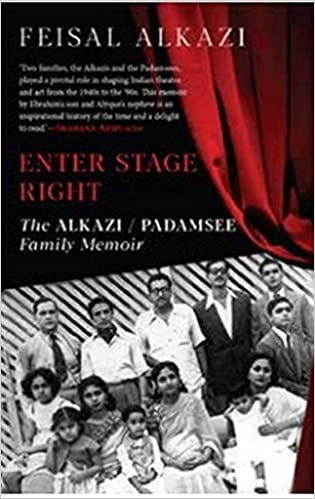
Title: Enter Stage Right: The Alkazi Padamsee Family Memoir

Author: Feisal Alkazi

Publisher: Speaking Tiger Books, 2021

Feisal Alkazi is an educationist, a theatre director, and an activist. Over the past 40 years, his group, Ruchika, has directed over 200 plays in Hindi, English, and Urdu. Noor and A Quiet Desire, two plays written by him, were produced recently. He has also directed thirty films, and more than 100 productions for schools all over India. He is actively involved in heritage education, initiating projects in Delhi, Jaipur, Srinagar, and Hyderabad each of which has culminated in a book. He has written over 20 books.

Enter Stage Right by Feisal Alkazi is a family memoir which recounts the story of two families intertwined by a single love – theatre, of people who helped shape much of the Indian theatre from 1940s to 1990s, of people who came together by chance and stayed on to weave a rich tapestry which not only included theatre but also art, media, cinema and advertising. A memoir which draws an exhaustive portrait of one of the first families of theatre in a subtle yet candid manner, unveils some secrets, shares some anecdotes while capturing the complete attention of the reader.

The prologue of this memoir titled ‘Around the Horseshoe – Shaped Table’ starts with:

English theatre in Bombay was born on my grandmother’s horseshoe-shaped dining table in 1943. Literally. A group of young college students, among them my father, Ebrahim Alkazi, listened wide- eyed as my Uncle, Sultan Padamsee, spoke of how they intended to form their own group, simply called the Theatre Group.”

These lines open the book with a perfect scene for the reader, drawing attention to the setting which was at the core of foundation of theatre group formed by Sultan Padamsee, the eldest of the Padamsee siblings including Roshen and Alyque. Roshen became a costume designer for plays directed by Sultan and later by her husband Ebrahim Alkazi. Akbar, their cousin, though not a part of the horseshoe table gathering, became a famed painter, one of the pioneers of modern Indian art, while Alyque a famous theatre personality and ad film maker, probably best known for playing Mohammad Ali Jinnah in Richard Attenborough’s movie Gandhi.

How in the 1940s, the entire Padamsee clan would come together for the preparation of plays directed by Sultan, or Bobby as he was lovingly called, is well recounted by Alyque Padamsee, who was then a kid and Sultan’s younger brother.

There was a little trellis in our bedroom, the roshandaan. We used to climb up on stools and peek through that window to watch what was going on in the drawing room. Bobby reciting Shakespeare, Roshen stitching costumes, Zarina painting posters, Shiraz making some props. It was like a cottage industry, and it was so thrilling to be in a family that had something so exciting to do!”

The seed of this industry, as he calls, was sown by Sultan’s mother Kulsum Padamsee, who had determined the best of English education for her children, which meant that her children were all sent to an elite residential school in Bombay where they had their first lessons in theatre. At her home in Kulsum Terrace, overlooking Colaba Causeway in Bombay, she would allow them to enact plays. Later, she took them to Shropshire, England for further studies where the worlds of Shakespeare and Dickens and Hardy were revealed to them. However it was Sultan, who — having spent six months at Christ Church in Oxford before World War II — began directing plays for the St. Xavier College’s Shakespeare Society in 1943.

Feisal writes about the flamboyant and bold Sultan who revolutionized the theatre scene in 1940s, about his choice of directing Oscar Wilde’s Salome which was controversial enough for the times. His restructuring Shakespeare’s Othello was also a move towards the unimaginable in those days. He writes about Sultan’s suicide at the age of twenty three, the cause of which remained a well-guarded secret of the family for many years. Though Sultan’s untimely demise did create a void, the revolution helmed by him was forged further by the rest of Padamsee clan. As present on the horseshoe – shaped table that day in 1943, was also Ebrahim Alkazi, mentored by Sultan, who was later to become the director of National School of Drama and to shape the subsequent theatre milieu.

In the successive chapters, Feisal delves into the history of his father’s family and staging of plays by the Theatre group after Sultan’s death, about the split in Theatre group with Ebrahim and Alyque going separate ways, about his parents’ stay in post War London and the influences they carried back to India, about his early years at Vithal Court where his father, perhaps continuing the tradition of Padamsee family, turned the whole house into a rehearsal space for theatre! Imagine a life where entire days of the family were spent in reading, rehearsing, soaking in various forms of art, hosting the likes of Nissim Ezekiel, M.F. Hussain, Tyeb Mehta, John Cage, Merce Cunningham and Adi Davierwala, where the house constantly bubbled with activities stimulating the mind, where the children, joined by their numerous cousins and friends, would perform plays for the audience, constituted of their families. Fancy having a childhood like that!

Feisal describes the experience:

Sound, smell, touch, flavor. Open windows that allowed the world in, and that allowed me to peep into the world from my tiny height. Not the isolated ivory tower of the Padamsee childhood but a vibrant, open, engaged view of the world.”      

In one of the chapters, aptly titled Six Women Who Revolt, Feisal gives us a glimpse into the choice of plays his father directed during his last phase of directing for the Theatre Unit in Bombay. Henrik Ibsen’s Hedda Gabler, August Strindberg’s Miss Julie, Jean Anouilh’s Antigone and Eurydice, Lorca’s Yerma and Euripides’ Medea – plays with strong female central characters. While offering critique of these plays and sharing some anecdotes about their production, Feisal interestingly remarks how through the exploration of these characters, his father seemed to be trying to comprehend his own equation with women. It is a discreet, well intended remark which somehow seems to familiarize the reader with the relationship shared by Ebrahim Alkazi with his wife Roshen and then with his later partner, Uma Anand.

In writing about his parents, Feisal dwells more upon his father’s professional life, the plays he directed, the experiments he did with the use of space and light, the revolutionary ideas he brought to NSD (National School of Drama, New Delhi), the fine actors he mentored during his years as Director, but not upon the personal life which Ebrahim shared with his mother. In the chapter where he writes about his parents’ separation, he does write about his mother’s sadness and their difficult initial years in Delhi but focuses more upon his mother’s endeavour in establishing and running an art gallery with her husband and continuing designing costumes for all of his plays even after their separation. What’s even more intriguing is that his parents continued travelling together, every alternate year, to Europe and Beirut to visit Ebrahim’s parents and siblings. Despite their differences, they came together to enrich their children’s lives by revealing to them the best of art and theatre the world had to offer and by letting them spend time with their paternal grandparents, soaking in love, and mores of a culture they lived far away from.

Back home in Delhi, both Feisal and his sister Amal would spend time at NSD, where their father would rehearse and direct plays and their mother would design costumes. During his college years at St. Stephens, Feisal made his own theatre group called Ruchika and spent considerable time in acting and directing the plays. However, it is while he writes about the theatre of questioning and dissent which gained momentum during the late 1970s and 1980s, that the readers get a peek into his role in taking theatre to wider audiences. He talks about the Sikh pogrom of 1984, the rallying of Narmada Bachao, Babri demolition, brutal murder of Safdar Hashmi and about terrorism in Kashmir. Despite his very humane account of repercussions of violence in a society in those times, he does not anywhere refer to the present regime and the sufferings faced by people in the current times.

In writing about his family, he also gives an account of his maternal grandfather Jafferbhai and his aunt Pearl Padamsee, wife of his Uncle Alyque Padamsee. He credits Alyque for making English Theatre accessible, popular and relevant to middle-class audience of Bombay. According to him, Safdar Hashmi, Mahesh Elkunchwar and Alyque were three individuals who widened the scope, subject matter and audience for theatre in 1970s and 1980s, so that it never looked the same again.

Feisal pays homage to his mother by saying that it was the greatest privilege of his life to have been her son — an endearing tribute to the one who taught him all he ever learned of life. He ends the memoir befittingly with an epilogue in which he mentions the death of his father in August 2020. Ebrahim Alkazi was the last survivor of those who had gathered at the horse-shoe shaped table in 1943 and his going marked an end of an era.

Writing a family memoir comes with its own challenges, especially when the entire family is engaged in pursuits which are open to speculations and public opinions. There is always a risk of either going overboard or offering little to the reader in terms of a relevant account. Feisal does a brilliant job in maintaining that balance while offering this memoir. He gives us a detailed account of what matters and merely touches upon that which can be omitted. His writing is astute, rational and pragmatic while being vigorously ebullient.

This memoir is not only the story of a family dedicated to theatre but also an important document which chronicles the history of Indian theatre as well as arts centred around the two important cities of Bombay and Delhi, of the plays which shaped much of the theatre’s panorama in India, of actors, playwrights and directors whose entire lives revolved around enhancing and taking the form to a wider audience, of the efforts the theatre and people associated with it made to give voice to the common man’s concerns in difficult times. This is an essential read for anyone interested in theatre and in the broader art scene happening in the country during the period.

.

Rakhi Dalal is an educator by profession. When not working, she can usually be found reading books or writing about reading them. She writes at https://rakhidalal.blogspot.com/ .

.

PLEASE NOTE: ARTICLES CAN ONLY BE REPRODUCED IN OTHER SITES WITH DUE ACKNOWLEDGEMENT TO BORDERLESS JOURNAL.