Book Review by Basudhara Roy
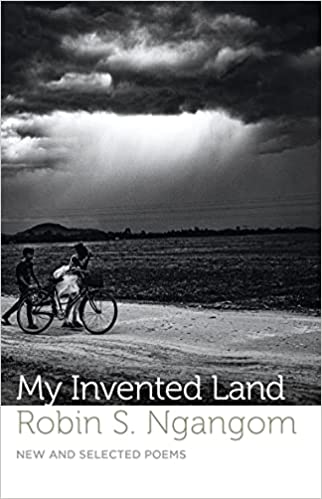
Title: My Invented Land: New and Selected Poems
Author: Robin Ngangom
Publisher: Speaking Tiger Books
Into the myriad-doored faith of poetry, there are manifold ways to arrive. Some come to it for respite, some for resuscitation, some for refuge. To a lot of us, poetry is therapeutic; to many others, an arsenal; to yet others, an immortal witness. Through what door one seeks admission into poetry’s realm is important for the way poetry will speak to us and the kind of poetry we will, in turn, create.
To Robin Ngangom, poetry manifests itself as both companion and quest, currency in circulation and archive, vision and the language to communicate the thought. “Poetry cannot help anyone to get on in life,” he writes, “or make a successful human being out of anyone. But poetry should move us; it should change us in such a manner that we remain no longer the same after we’ve read a meaningful poem.” (‘Introduction’) As necessary, as native, and as effortless to him as breath, Ngangom’s poetry bespeaks an honest and wholehearted engagement with life that is rare.
My Invented Land: New and Selected Poems recently brought out by Speaking Tiger Books is Ngangom’s fourth poetry collection. Containing an admirable selection of his work from his three earlier collections Words and the Silence (1988), Time’s Crossroads (1994) and The Desire of Roots (2006) along with more than thirty new poems, this volume brings to us a fascinating diachronic document of Ngangom’s steady journey in and with poetry over the last thirty-five years. For readers familiar with his work, this volume is an asset. For those who wish to make an acquaintance with it, the book will be indispensable and an immensely appealing starting point.
In reading Ngangom’s poems, one is pleasantly startled, each time, by his distilled sensibility, his linguistic finesse and his inimitable lyrical fecundity. Simplicity is the catchword of these poems. One would be hard put to identify any posturing in Ngangom’s poetry. There are no mirages here, no postmodernist obsession with camouflage, no cautious construction of the self or deliberated distance between poet-observer-speaker. Personality, in fact, is such an important accompaniment of these poems that it casts each poem in the resolutely warm light of its familiarity, meeting in poem after poem, an expectation unarticulated but answered.
Self, land and poetry constitute an essential thematic triangle in My Invented Land – each theme inevitably leading to the other. For Ngangom, there is no poetry apart from the existential rootedness of the self in (home)land, this relationship being both a prism and a prison through which his sensibility is reflected upon the world – “But where can one run from the homeland,/ where can I flee from your love?” (‘The Strange Affair of Robin S. Ngangom’) In the best of times, this bond with the land becomes one of gratitude; in spans of torment, a burden he cannot do without; and during moments of reflection, an agonising search as in ‘Poem for Joseph’:
It is never too late to come home.
But I must first find a homeland
where I can find myself,
just a map or even a tree or a stone
to mark a spot I could return to
like an animal lifting his leg
even when there’s nothing to return for.
Even love and its exploration through adolescence into manhood which is an important concern in Ngangom’s poetry, finds its expression in the distinct foreground and background of the landscape, so much so that be(love)d and land become one:
Maternal earth,
generous and callous.
You untouchable then,
and invulnerable now;
all your instincts
rearranged with
your scattered hair.

Were I to trace
my name on your frosted mirror
you would quickly efface it with your breath. (‘Age and Memory’)
There is no denying the sharp political edge of this poetry, its inveterate honesty and its essential inability to water down the truth with fancy or idealism. In ‘To Pacha’, a moving elegy to Pacha Meetei, one of Manipur’s finest writers, Ngangom writes:
There are no more tears to shed
in this withered country where they
kill pregnant women and children; its
nipples have long gone dry, and leering
death walks your homeland.
In ‘The Strange Affair of Robin S. Ngangom’, patriotism is “admiring the youth who fondles grenades,/ patriotism is proclaiming all men as brothers/ and secretly depriving my brother,/ patriotism is playing the music of guns/ to the child in the womb.” ‘My Invented Land’ writes home as “a gun/ pressed against both temples/ a knock on a night that has not ended/ a torch lit long after the theft/ a sonnet about body counts/ undoubtedly raped/ definitely abandoned/ in a tryst with destiny.” The uneasiness between homeland and nation is a palpable presence in the telling use of the phrase ‘tryst with destiny’ as it is in many of the poems in this book. The golden jubilee of the nation’s independence becomes, in ‘15 August 2008, Northeast India’, “fifty years of discrimination festering in the periphery/ with another anniversary of murder and disappearances.” In ‘My Invented Land’, the homeland “has no boundaries./ At cockcrow one day it found itself/ inside a country to its west,/ (on rainy days it dreams looking east/ when its seditionists fight to liberate it from truth.)”
But this is not poetry of writing back, of witness, of resistance or of conscious activism. My Invented Land is poetry of observation, of quiet but ceaseless self-exploration and self-assessment (the land being an inalienable unit of the self and vice-versa), of lament and of agonis
ed truth-seeking with “only one pair of shoes/ but many roads” (‘Saint Edmund’s College’). One marvels at the beauty of the title, an apposite image for a body of poems that is invested so completely in poetry as this essentially nourishing collection of eighty-two poems is. This invented land, one realises, is as much Imphal or Manipur or Shillong or the Northeast of India as it is the land of memory, imagination, hope, language and poetry.
One must take special note of Ngangom’s deftness with language in this collection, his mastery over its opulence and crisis, its headiness and its insomnia, its velocity and meditativeness. Much of his poetry is pointedly and joyously literal with little need of metaphor to expand or accentuate his ideas. However, his language arrives from such depth in the soul that lyricism and beauty are innate to it, deluging the reader with an unsurmised assertion of its grandeur in a poem like ‘Laitlum’ for instance:
I want to be converted amongst houses kneeling
in the thick of firs of former lives,
randomly built without electricity.
It is characteristic of Ngangom to lift what would be, in most hands, a random assortment of prosaic moments and to elevate it, with his heightened attention, into iridescent poetry. Observe the following lines from ‘Street Life’:
I’ve had decadence forced on me.
I let the rain waste my day, and arriving
at streets that do not even know my name
I take off just like that, waving to silhouettes,
buying drinks for anyone, even primates
for whom I have no great regard, hating the houses
which warn of dogs instead of welcoming me.
The new poems in this collection, while retaining a spiritual connect with the poet’s earlier work, branches off into greater profundity. Marked by the loneliness, uncertainty and despair of the Pandemic, the language has grown quieter and more serene so that a metaphysical restlessness animates these poems, quiet unlike the earlier ones – “All voyages will be inward from now,” (‘September’) The language of realism mutates here into unexpected symbols and uneasy images that haunt. ‘Postcard’ written for Jayanta Mahapatra finds “ghosts leaving friends on the road”; in ‘Home’, a river swirled with “brown waters/ until it died, strangled by garbage”; in ‘Flight’, “The most vulnerable will sell bodies./ Because in spite of the landmines/ they still shared limbs.”
But despite Ngangom’s disquiet with the world and his unceasing inquest into its maladies, love remains his avowed and timeless panacea. It is in and through love that human life acquires redemption and as one moves through the collection, one perceives it watermarked by love of many kinds – amorous, passionate, seductive, lustful, nostalgic, mythic, idyllic, ecological, fraternal and forgiving. Every despondency, for the poet, springs from an absence of love and can find an effective resolution in love – love for the beloved, for the homeland, for one’s brethren, for humanity, for poetry, and above all, for love itself. “…someone who cannot love is always alone,” he writes in his ‘Introduction’. In ‘Day’, he prays for the Pandemic’s end so that “a primeval need/ may be restored to us:/ the ability to hold another/ before the day ends.” The all-embracive and sustaining religion of love that leads him to fashion each word “from a private hurt”’ (‘Introduction’) can alone right the balance. In ‘January’, for instance, he believes that “If anyone were so much as to mention a word like ‘love’/ everything will fall quietly again as snow.”
Poetry, according to Ngangom, “should not merely amuse us or make us think: it should comfort us, and it must heal the heart of man.” (‘Introduction’) With a brilliant introductory essay by the poet (that makes one desperately wish there were more such essays by Indian English poets on their vision and craft) and its timeless verses, My Invented Land accomplishes this and more with poise, grace and an unquestionable claim to the glory of its writer in the canon of Indian English poetry, his committed pilgrimage in verse promising to be an inspiration for many poets to come.
Basudhara Roy teaches English at Karim City College affiliated to Kolhan University, Chaibasa. Author of three collections of poems, her latest work has been featured in EPW, The Pine Cone Review, Live Wire, Lucy Writers Platform, Setu and The Aleph Review among others.
.
PLEASE NOTE: ARTICLES CAN ONLY BE REPRODUCED IN OTHER SITES WITH DUE ACKNOWLEDGEMENT TO BORDERLESS JOURNAL
Click here to access the Borderless anthology, Monalisa No Longer Smiles


 Borderless