A translation from Nabendu Ghosh’s autobiography, Eka Naukar Jatri(Journey of a Lonesome Boat), translated by Dipankar Ghosh, from Bengali post scripted by Ratnottama Sengupta. Clickhereto read.
Ueharaby Kamaleswar Barua has been translated from Assamese and introduced by Bikash K. Bhattacharya. Clickhere to read.
Kurigram by Masud Khan has been translated by Professor Fakrul Alam from Bangla. Clickhere to read.
Bonfire by Ihlwha Choi has been translated from Korean by the poet himself. Clickhere to read.
In Indian Pale Ale, Rhys Hughes experiments with words and brews. Click here to read.
Conversation
Being fascinated with the human condition and being vulnerable on the page are the two key elements in the writing of fiction, author and poet Heidi Northtells Keith Lyons in a candid conversation. Clickhere to read.
In Multicultural Curry, Suzanne Kamata reflects on mingling of various cultures in her home in Japan and the acceptance it finds in young hearts. Clickhere to read.
Ratnottama Sengupta explores the poetry in lyrics of Bollywood songs, discussing the Sahityotsav (Literary Festival) hosted by the Sahitya Akademi. Clickhere to read.
Imagine a world without wars, without divisions, where art forms flow into each other and we live by the African concept of Ubuntu — I am because you are’ — sounds idyllic. But this is the month of March, of poetry, of getting in touch with the Dionysian elements in ourselves. And as we have said earlier in the introduction of Monalisa No Longer Smiles: An Anthology of Writings from across the World, what could be a better spot to let loose this insanity of utopian dreams than Borderless Journal!
Having completed three years of our Earthly existence on the 14th of March, we celebrate this month with poetry and writing that crosses boundaries — about films, literature and more. This month in the Festival of Letters or Sahityaotsav 2023, organised by the Sahitya Akademi, films were discussed in conjunction with literature. Ratnottama Sengupta, who attended and participated in a number of these sessions, has given us an essay to show how deep run the lyrics of Bollywood films, where her father, Nabendu Ghosh, scripted legends. It is Ghosh’s birth month too and we carry a translation from his Bengali autobiography which reflects how businessmen drew borders on what sells… After reading the excerpt from Nabendu’s narrative translated by Dipankar Ghosh and post-scripted by Sengupta, one wonders if such lines should ever have been drawn?
Questioning borders of a different kind, we have another piece of a real-life narrative on a Japanese Soldier, Uehara. Written by an Assamese writer called Kamaleswar Barua, it has been translated and introduced by Bikash K. Bhattacharya. The story focusses on a soldier’s narrative at his death bed in an alien land. We are left wondering how his need for love and a home is any different from that of any one of ours? Who are the enemies — the soldiers who die away from their homes? What are wars about? Can people live in peace? They seemed to do so in Kurigram, a land that has faded as suggests the poem by Masud Khan, brought to us in translation from Bangla by Professor Fakrul Alam, though in reality, the area exists. Perhaps, it has changed… as does wood exposed to a bonfire, which has been the subject of a self-translated Korean poem by Ihlwha Choi. Tagore’s poem, Borondalatranslated as ‘Basket of Offerings’, has the last say: “Just as the stars glimmer / With light in the dark night, / A spark awakens within/ My body. / This luminosity illuminates / All my work.” And perhaps, it is this luminosity that will also help us find our ideal world and move towards it, at least with words.
We have a book review by Aruna Chakravarti of Bornali Datta’sIn A Better Place: A Doctor’s Journey, a book that is set amidst immigrants and takes up certain social issues. Baba Padmanji’s Yamuna’s Journey, translated from Marathi by Deepra Dandekar, one of the oldest Indian novels has been discussed by Somdatta Mandal. Bhaskar Parichha has told us about S.Irfan Habib’s Maulana Azad – A Life. Basudhara Roy has brought out the simplicity and elegance of Robin Ngangom’sMy Invented Land: New and Selected Poems. He writes in the title poem that his home “has no boundaries. / At cockcrow one day it found itself/ inside a country to its west,/ (on rainy days it dreams looking east/ when its seditionists fight to liberate it from truth.)”. We also carry an excerpt from his book. Stories by Jessie Michael, Brindley Hallam Dennis, Sangeetha G and Shubhangi bring flavours of diversity in this issue.
Our journey has been a short one — three years is a short span. But, with goodwill from all our readers and contributors, we are starting to crawl towards adulthood. I thank you all as caregivers of Borderless Journal as I do my fabulous team and the artists who leave me astounded at their ability to paint and write — Sohana Manzoor, Gita Vishwanath and Pragya Bajpai.
Thank you all.
Looking forward to the next year, I invite you to savourBorderless Journal, March 2023, where more than the treasures mentioned here lie concealed.
It was my turn to do the shift from midnight to two o’clock in the morning. I hastily arose and donned a thick coat.
“Put the personal location beacon (PLB) in your pocket,” Alex instructed me.
He retrieved the PLB and zipped it into my right coat pocket. I wondered what I would do if I were thrust into the sea as the boat lurched to the side. Would I recall the instructions and be able to hold onto it, unfasten it, push the alert button, and hold its antenna above the water until help came?
“Put your life jacket on too,” urged Alex.
I fiddled around with the life jacket and worked out where to put my arms through. I clinched the buckle across my chest and passed the strap though my legs, attaching it underneath the buckle.
“You need to tether too,” Alex added.
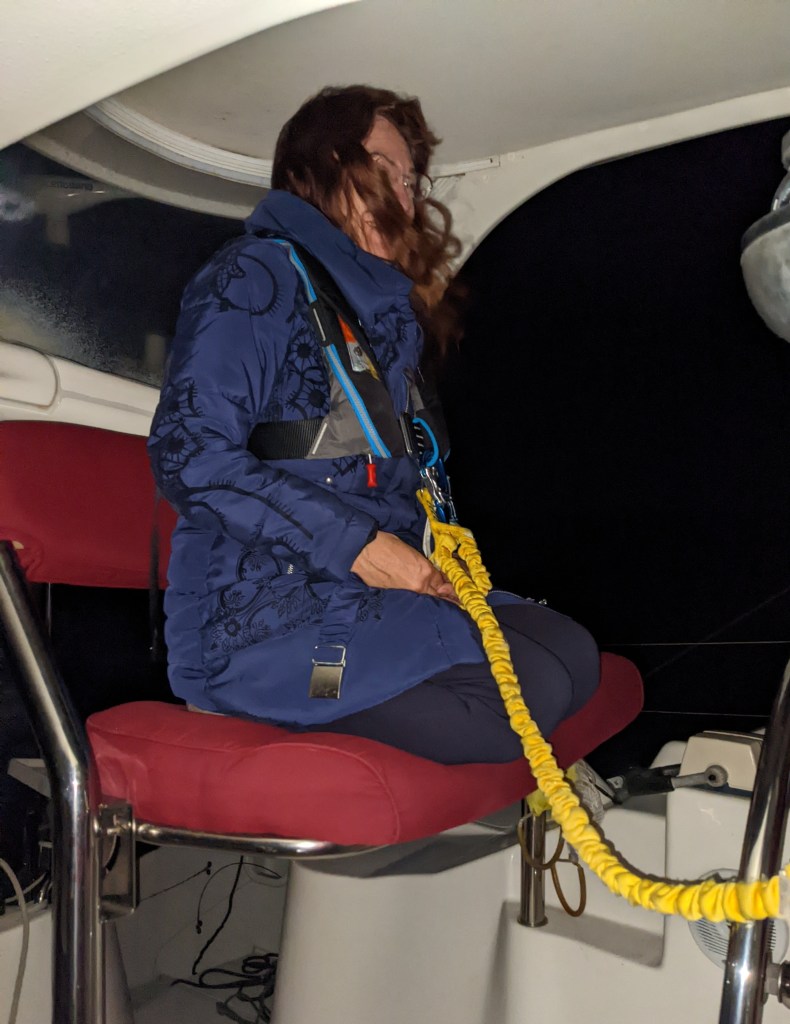
Tethered to the helm
I was so sleepy I was afraid the lurching of the boat might hurl me into the ocean. Alex attached one end of the bright yellow tether to my life jacket and the other to a clasp under the helm.
Alex sat next to me at the helm to check the instruments, and then retreated to bed. I had two hours to monitor the Automatic Identification System and radar for obstacles, and to scan the horizon for lights of other vessels. I couldn’t tell where the sea ended and where the sky started, but I tried to peer through the blackness around the gennaker[1] immediately in front of me while I periodically glanced down to the instruments.
I let my mind wander to reflect on my past in a dreamlike state. Gradually, I got used to holding my posture erect at the helm, as the vessel rocked across the waves. Because the motion reminded me of riding a horse, I sat deep in the saddle, as I had been taught in my youth. Eventually two hours passed, and I was glad it was not three, as it had been during our night sailing on a previous trip. Fellow crew member Luke appeared to relieve me, and I returned to bed, only to find slumber elusive as the boat crashed through the waves. Eventually the seas calmed, and the boat resumed to a slow canter, and I fell into a pleasurable sleep, like a child in a cradle.
The next morning, I was the last to rise, and languished reading a book in my bed as I heard the banter of my fellow sailors — Alex, Luke and Leo — in the saloon above. I eventually roused myself and greeted the others. The conversation turned to night sailing.
“It was so dark at four am this morning that I couldn’t see the horizon,” observed Leo.
“The boat was sluggish last night because the speed dropped to one knot at times,” Luke informed me.
Oh no! Had I sacrificed those two hours for nothing? Alex assured me that we’d averaged 5.8 knots (11 km/h).
Then Luke looked up.
“There’s a hole in the gennaker!” he exclaimed.
Alex searched for sail tape and then the three of them moved to the deck to attend to the hole. The tape seemed to hold up and the sail was deftly repaired.
Luke attending to the gennaker
“We’re now ten degrees off our desired course,” observed Alex.
“I think that’s fine,” affirmed Luke. “We still have lots of ocean to cover.”
Over the next two days, our boat speed averaged 6.8 knots and we covered 326 nautical miles (604 km). Alex and Luke scrutinised the satellite weather forecasts several times a day, adjusting our course to take advantage of wind changes.
On our fourth day, Alex announced, “At this rate, we’ll arrive at Nouméa in the middle of the night. I think we should slow down.”
Slow down? Surely not! Five days is quite long enough, I mused.
The days and nights blurred, but we persevered sailing over the Coral Sea to reach Nouméa. I was assigned to speak in French to announce our arrival to the port. The last time I’d stayed in a Francophone country was as an au pair in Paris thirty-six years ago, so I was nervous to use my rusty French, particularly in front of the crew. I took hold of the VHF radio and announced the name of our vessel, Arriba, using the phrases from the French sailing handbook to no avail. Every few minutes I repeated the phrases but was met with silence. Was my French incomprehensible?
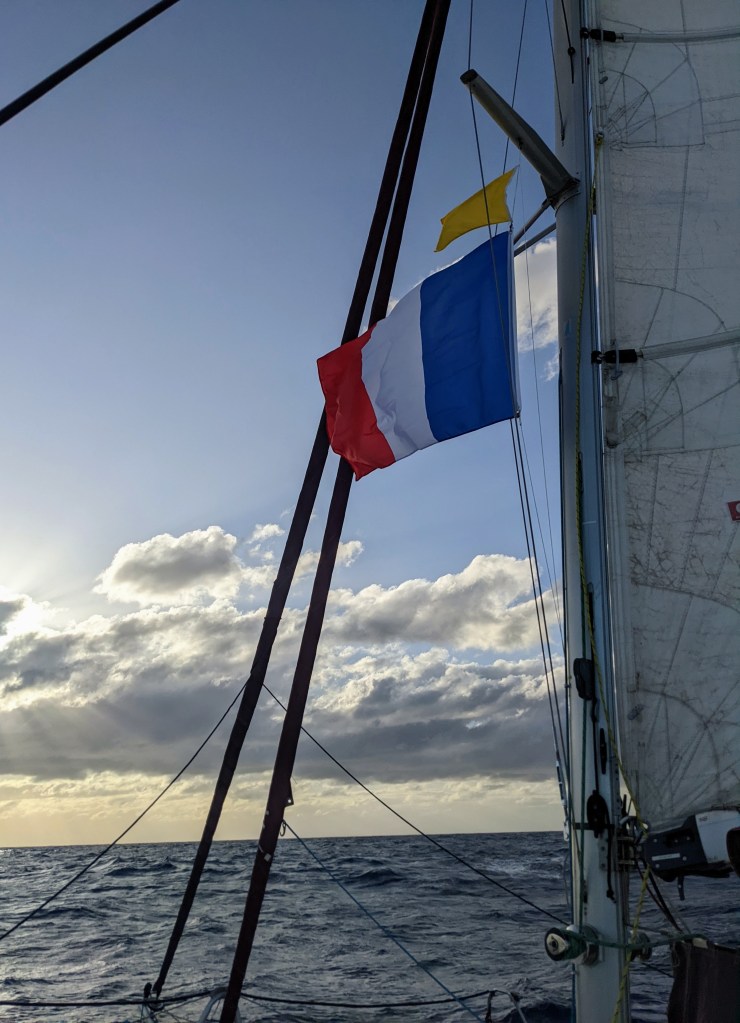
We arrived in the evening of day six, five days and ten hours after departing from Australia. Having failed to contact the port earlier in the day, we anchored at a suitable distance from the shore in Baie de L’Orphelinat. As a foreign vessel, we flew our bright yellow quarantine flag above the flag of our host country, France. Flying the host country’s flag, far from being a nicety, is a centuries-old maritime tradition that indicates that sailors come in peace.
Quarantine flag above the host country’s flag
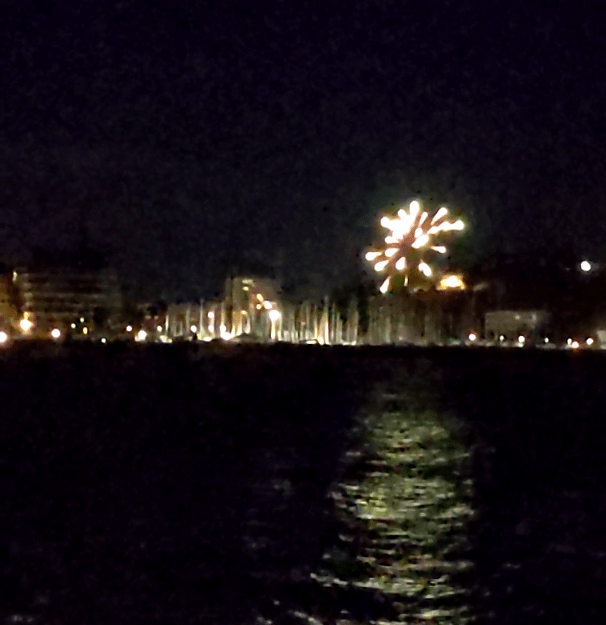
After so many days and nights at sea I was excited and relieved to see land. I looked to the shoreline and noticed fireworks erupting from the hills. Was this a special welcome for our Australian vessel? After safely anchoring, Alex retrieved the sparkling Tasmanian wine we had saved for the celebration of arriving at port. He stood at the bow, exultant, and made a speech, as he uncorked the bubbly wine. It made a large popping sound and then splashed into the ocean. Alex filled our glasses, and we toasted our arrival in Nouméa.
Fireworks over Nouméa.
The next day we made our way to the marina to complete the customs and immigration formalities. Stepping onto the pontoon, I was greeted by a fellow boatie walking back through the gates with a baguette under his arm. Instead of it being excessively wrapped in plastic or even a paper bag, it was wrapped in a slim piece of wrapping paper just where it was designed to be held. Of course, Francophones require their morning baguette, even if they are staying in a marina.
We made our way along the pontoon to the dock. The only trouble was that we could not open the pontoon gate from the inside. Some local children playing on the rocks lining the marina noticed our trouble and called out to us, directing us to the button to open the gates. We followed their instructions and stepped on to New Caledonian soil for the first time. After sailing for five days and nights we would not be deterred by a mere button to a gate. We soon found the marina office and were treated with utmost politeness and warmth by the officers we came into contact with. We were perturbed as to why our attempts to announce our arrival the previous day had been ignored, and then we realised. We had arrived on the 14th of July, Bastille Day, France’s national holiday, and the office must have been closed.
[1] The gennaker, or screecher, is a large flying headsail, i.e., a sail flown in front of the mast.
Alex & Meredith in Nouméa
(Photographs provided by Meredith Stephens)
Meredith Stephens is an applied linguist from South Australia. Her work has appeared in Transnational Literature, The Muse, The Font – A Literary Journal for Language Teachers, The Journal of Literature in Language Teaching, The Writers’ and Readers’ Magazine, Reading in a Foreign Language, and in chapters in anthologies published by Demeter Press, Canada.
PLEASE NOTE: ARTICLES CAN ONLY BE REPRODUCED IN OTHER SITES WITH DUE ACKNOWLEDGEMENT TO BORDERLESS JOURNAL




 Borderless