Keith Lyons converses with globe trotter Tomaž Serafi, who lives in Ljubljana. Click here to read.
Translations
Barnes and Nobles by Quazi Johirul Islam has been translated from Bengali by Professor Fakrul Alam. Clickhereto read.
Cast Away the Gun by Mubarak Qazi has been translated from Balochi by Fazal Baloch. Click here to read.
One Jujubehas been written and translated from Korean by Ihlwha Choi. Clickhere to read.
A Hymnto an Autumnal Goddess by Rabindranath Tagore, AmraBeddhechhi Kaasher Guchho ( We have Tied Bunches of Kaash), has been translated by Mitali Chakravarty. Click hereto read.
Dr. KPP Nambiar takes us through his journey of making a Japanese-Malyalam dictionary, which started nearly fifty years ago, while linking ties between the cultures dating back to the sixteenth century. Click hereto read.
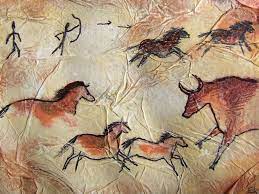
Pre-historic cave painting in France La Tauromaquia. Leap with the Spear by Picasso (1881-1973)Courtesy: Creative Commons
There was a time when there were no boundaries drawn by humans. Our ancestors roamed the Earth like any other fauna — part of nature and the landscape. They tried to explain and appease the changing seasons, the altering landscapes and the elements that affected life and living with rituals that seemed coherent to them. There were probably no major organised structures that laid out rules. From such observances, our festivals evolved to what we celebrate today. These celebrations are not just full of joie de vivre, but also a reminder of our syncretic start that diverged into what currently seems to be irreparable breaches and a lifestyle that is in conflict with the needs of our home planet.
Reflecting on this tradition of syncretism in our folklore and music, while acknowledging the boundaries that wreak havoc, is an essay by Aruna Chakravarti. She expounds on rituals that were developed to appease natural forces spreading diseases and devastation, celebrations that bring joy with harvests and override the narrowness of institutionalised human construct. She concludes with Lalan Fakir’s life as emblematic of the syncretic lore. Lalan, an uneducated man brought to limelight by the Tagore family, swept across religious divides with his immortal lyrics full of wisdom and simplicity. Dyed in similar syncretic lore are the writings of a student and disciple of Tagore from Santiniketan, Syed Mujtaba Ali (1904-1974). His works overriding these artificial constructs have been brought to light, by his translator, former BBC editor, Nazes Afroz. Having translated his earlier book, In a Land Far from Home: A Bengali in Afghanistan, Afroz has now brought to us Syed Mujtaba Ali’s Tales of a Voyager (Jolay Dangay), in which we read of his travels to Egypt almost ninety years ago. In his interview, the translator highlights the current relevance of this remarkable polyglot.
Humming the tunes of Mujtaba Ali’s tutor, Tagore, a translation of Tagore’s song, AmraBeddhechhi Kasher Guchho (We have Tied Bunches of Kash[1]) captures the spirit of autumnal opulence which heralds the advent of Durga Puja. A translation by Fazal Baloch has brought a message of non-violence very aptly in these times from recently deceased eminent Balochi poet, Mubarak Qazi. Professor Fakrul Alam has translated a very contemporary poem by Quazi Johirul Islam on Barnes and Nobles while from Korea, we have a translation of a poem by Ihlwha Choi on the fruit, jujube, which is eaten fresh of the tree in autumn.
A poem which starts with a translation of a Tang dynasty’s poet, Yuan Zhen, inaugurates the first translation we have had from Mandarin — though it’s just two paras by the poet, Rex Tan, who continues writing his response to the Chinese poem in English. Mingling nature and drawing life lessons from it are poems by George Freek,Ryan Quinn Flanagan and Gopal Lahiri. We have poetry which enriches our treasury by its sheer variety from Hawla Riza, Pramod Rastogi, John Zedolik, Avantika Vijay Singh, Tohm Bakelas and more. Michael Burch has brought in a note of festivities with his Halloween poems. And Rhys Hughes has rolled out humour with his observations on the city of Mysore. His column too this time has given us a table and a formula for writing humorous poetry — a tongue-in-cheek piece, just like the book excerpt from The Coffee Rubaiyat. In the original Rubaiyat, Omar Khayyam (1048–1131) had given us wonderful quatrains which Edward Fitzgerald immortalised with his nineteenth century translation from Persian to English and now, Hughes gives us a spoof which would well have you rollicking on the floor, and that too, only because as he tells us he prefers coffee over wine!
Humour tinged with irony is woven into Devraj Singh Kalsi’s narrative on red carpet welcomes in Indian weddings. We have a number of travel stories from Peru to all over the world. Ravi Shankar takes us to Lima and Meredith Stephens to Californian hot springs with photographs and narratives while Sayani De does the same for a Tibetan monastery in Lahaul. Keith Lyons converses with globe trotter Tomaž Serafi, who lives in Ljubljana. And Suzanne Kamata adds colour with a light-veined narrative on robots and baseball in Japan. Syncretic elements are woven by Dr. KPP Nambiar who made the first Japanese-Malyalam Dictionary. He started nearly fifty years ago after finding commonalities between the two cultures dating back to the sixteenth century. Tulip Chowdhury brings in colours of Halloween while discussing ghosts in Bangladesh and America, where she migrated.
The theme of immigration is taken up by Gemini Wahaaj as she reviews South to South: Writing South Asia in the American South edited by Khem K. Aryal. Japan again comes into focus with Aditi Yadav’s Makoto Shinkai’s and Naruki Nagakawa’s She and Her Cat, translated from Japanese by Ginny Tapley Takemori. Somdatta Mandal has also reviewed a translation by no less than Booker winning Daisy Rockwell, who has translated Usha Priyamvada’sWon’t You Stay, Radhika? from Hindi. Our reviews seem full of translations this time as Bhaskar Parichha comments on One Among You: The Autobiography of M.K. Stalin, the current Chief Minister of Tamil Nadu, translated from Tamil by A S Panneerselvan. In fiction, we have stories that add different flavours from Paul Mirabile, Neera Kashyap, Nirmala Pillai and more.
“One of the children gave it [the bunch of bananas] to the child sitting in front. An emaciated girl and a little boy were seated next to me. I told them to pass on the fruit to everyone in the back and keep one each for themselves. The girl looked curiously at the bunch as she turned it around in her hands. Then she looked at the other children.

“‘I’ve never seen an onion like this one,’ she said.

“Her little companion also touched the fruit gingerly and innocently added, ‘Yes, this is not even a potato.’

“I was speechless to say the least. These children had never seen anything apart from onions and potatoes. They had definitely never chanced upon bananas…”
Heart-wrenching but true! Maybe, we can all do our bit by reaching out to some outside our comfort or social zone to close such alarming gaps… Uma Dasgupta’s book tells us that Tagore had hoped many would start institutions like Sriniketan all over the country to bridge gaps between the underprivileged and the privileged. People like Satyarthi are doing amazing work in today’s context, but more like him are needed in our world.
We have more writings than I could mention here, and each is chosen with much care. Please do pause by our contents page and take a look. Much effort has gone into creating a space for you to relish different perspectives that congeal in our journal, a space for all of you. For this, we have the team at Borderlessto thank– without their participation, the journal would not be as it is. Sohana Manzoor with her vibrant artwork gives the finishing touch to each of our monthly issues. And lastly, I cannot but express my gratefulness to our contributors and readers for continuing to be with us through our journey. Heartfelt thanks to all of you.
The street lay wet and shimmering after the afternoon rains. I stood at the window sipping tea, enjoying the cool breeze for a moment entranced by the glitter of the raindrops falling off the potted plants, on window sills and ledges, down electric poles and wires by the street crossings where crows and pigeons preened and shivered like musical notes. In the sudden burst of sun warmed air, the rainbow hued petrol drips trembled in the puddles. It was a single moment of evanescence and peace, as in Robert Browning’s poem,‘Pippa Passes’ in ‘God’s in his Heaven/All’s right with the world!’
The mood gave way when I suddenly noticed the gait of a woman on the street. She turned into the street bent down with the weight of the bags on her shoulders and trudged slowly with the open black umbrella even though the rains had stopped. I could not see her face but I recognised her.
Staring at her, my heart thumped with sudden anxiety as I turned away and tried to quell the panic inside me. I knew her. I had seen her since my childhood following the same set routine as a young woman. Now as an old lady without changing her daily habit for more than fifty years, she continued doing the same thing, a creature of habit.
I felt the need to sit down. On the way to the sofa the ornamental mirror on the wall caught my reflection.
I could not stop staring at it in fear and fascination. That person was me now. Where had I gone? Alone with myself ! Age! Time! The sinuous whisper of crawling fear made me tremble. Age is just a number! I am as young as I feel — love is ageless.
All those self-assertions were hopeless. I could feel the sweat break out of my pores.
I sat down and gripped the poetry book I had been reading. He had insisted I read it when he gave it as a surprise gift — a good friend and colleague who had kept in touch. Why did he still remain kind and nice. Was he like or unlike others with whom I had been on good terms? Did he expect anything from me. Have I missed the signals all my life?
I was now a middle-aged single woman and fear gripped me as the thought that sprung to my mind was, I would also end up like her. My calm was tattered to pieces, fluttering away in confusion. I was caught in a whirl of emotions and thoughts. Why did she disturb me so much?
I had definitely traversed a very different path from her. There were no parallels in our lives. But now at this moment, suddenly when I was enjoying my ‘me’ time, the splintering truth struck out of the blue. I am alone. The sprawling apartment spoke of comfort, care and luxury with a live-in maid, with all the gizmos and art and cultural ambience of a successful life and career, a single woman could achieve; I suddenly felt like a cipher. Raw, exposed and empty. Why did I feel like that?
The demon called loneliness mocked my aloneness. It had no shape or size or smell. It was like a vapour, like air that sometimes crept silently or jumped up terrorising my very breath. Those moments of sheer emptiness and choking sensations that I had thought were over, seized me again.
Who are you.? What have you achieved. Have you made any one happy? Does anyone wait for you, ask about you ? Such were the dark numbing thoughts that gathered inside me and gave way to spontaneous outflow of tears. My sighs cradled unknown sorrows I could not fathom. Melancholy and depressed, moody and restless all the shine was tarnished and lost meaning. I thought I was beyond it and a very stable person. But I knew now that I was deluding myself.
My eyes fell on the page I had been reading, Andrew Marvell’s poem ‘To His Coy Mistress’.
Had we but world enough and time,
This coyness, lady, were no crime.
We would sit down, and think which way
To walk, and pass our long love’s day.
Thou by the Indian Ganges’ side
Shouldst rubies find; I by the tide
Of Humber would complain. I would
Love you ten years before the flood,
And you should, if you please, refuse
Till the conversion of the Jews.
My vegetable love should grow
Vaster than empires and more slow;
An hundred years should go to praise
Thine eyes, and on thy forehead gaze;
Two hundred to adore each breast,
But thirty thousand to the rest;
An age at least to every part,
And the last age should show your heart.
Am I lonely? Am I old ? Why am I still single? The looping thoughts suffocated me in its coils.
The naked bulbs of truth has a harsh way to call attention in the most make-believe moment of tranquillity. The mirror held me in its snare but it did not crack my image — vanity, pride, self-delusions shatter inside me.
I look at the degrees framed on the wall; the decorative pieces brought from the different countries during my world-wide travels, and wander into a mental fog .
What use are these papers to me now? In my loneliness, do I crave aloneness? However high I go, I must come down to earth among people, to get applause; hear it, share it to have meaning.
My mind was filled with her image. I knew without looking she would stop under the old banyan tree, pause for breath and turn into the narrow lane where the cluster of chawls[1] with the rows of common toilets and bathrooms existed since I could remember. They were all built more than eighty years ago and opened into the central courtyard. The multi-storied building and high-end gated communities I occupied came later and had gates, gardens and lifts with bathrooms and toilets inside our homes.
Her name was Kokilaben. All knew her as she was well known in the locality called Gaiwadi, for singing and dancing during the nine day garba festival[2] during Navaratri. She would decorate others homes with beautiful rangoli designs if requested. Whether it was her nickname or her real one, whether her dark complexion contributed to her remaining single, no one knew and no one confirmed. Since I could remember, she was a slim young woman who wore her saree in the traditional Gujarati style, taught in the primary Muncipal school and looked after her ailing mother after her father passed away.
I remember the ladies in our old building talking about her in whispers sometimes, and at other times, praise her spirit and dedication to her mother for taking care of her.
Growing up, the difference I perceived in my teenage mind, was that she was single, unmarried and had a job unlike the married women who looked after their husbands, children and ran a budgeted households. They cooked, cleaned, argued with the vegetable and fruit vendors, hung clothes and gossiped across their balconies and windows . They fought with other women for water and at the ration shop, women who looked dishevelled and pulled up their sarees tight, and knotted its end as if ready to fight and take on the world. After 4 O’clock they became ladies and dressed up in the evening to await their husbands return.
Kokilaben was a permanent subject of gossip ; no one spoke to her but about her. Her immediate neighbours kept watch on who visited her. They watched out to see if she spoke to men of the locality – whether strange men visited her. They wondered why she showed no interest in marriage.
Everyone kept an eye on her while they gossiped about the new couples, which boy made eyes at which girl. Inquisitiveness and curiosity was a virtue here. They spoke of not giving dowries and cursed the burden of daughters, but secretly took it for their sons on the pretext of marrying their daughters. They gossiped about , mothers-in-law, sisters-in-law and good husbands, saintly husbands and philandering ones, of shame and cruelty and all that happened in their lives, but the worst was kept for the working single girl and she was suspected of committing the worst crimes. They praised their children, told lied about them too. Behind the closed doors, they beat them and abused them and took out their frustrations in secret silence. All wore masks.
One common topic for a long time I remember was the marriage of Kokilaben, as she was the one who chose to live alone after her mother passed away. She used to go missing for a week every three months and no one knew where she went . After some years, she did not disappear. Once her hair turned grey she ceased to exist.
Realisation struck me when I passed my civil service exams, from the security of my loving family how she must have craved the sense of freedom after carrying the burden of a home and her parents. I understood she was a rarity in the conservative middle class of 1960s.
Now I too stay alone. Kokilaben had no one and she had still lived the way she wanted. People spread stories about her. She was a transgender. She was a witch. She brought bad luck if you met her on the way. She ate children. She was not the pleasing friendly auntie but did not disturb any one and gave money for the annual Holi, Ganesh Chathurthi, and Navaratri festivals when the colony held mass celebrations. She lived quietly and asked no body’s help as she grew old. She paid her bills and fed the street dogs during the monsoons. She gave shelter in her chawl verandah to dogs during downpours and then drove them away when the rains ceased.
So today why was my calm broken by this familiar figure.?
She had not existed in my daily frame. She had merged with my memories even though she was alive like part of the furniture in the background. Living a full animated, varied life, only the present and exciting future mattered. On a certain day called retirement, all that ceased with the strike of a government rule. We all had to retire at the age of sixty. I suddenly became a senior, a retired officer, a suffix, a past tense, a marginalised peripheral person brought down from the tabletop, kept in a corner sometimes consulted. My importance diminished. I was an afterthought, with no fresh shoots , only roots.
It was not loss or failure in love; A spinster missed the bus for not making efforts to find a mate. It was not a voluntary decision to be single. It was not even a decision to be self-sufficient and complete. It was not out of vanity waiting for the best catch or being rejected. I had security, love, care and many relatives and friends looking out for me .
Still I stayed unmarried. I did not have an affair or secret liaisons. I felt I was not ready. I did not know how to handle that particular relationship while I could handle anything else. I feared domination or giving in to being used or abused, being beholden to someone, losing independence, feared not sharing common values and ideas on what I cared or despaired about, feared of the other not being empathetic or sympathetic with me on all issues. Would I be mentally free without commitments?
In my case, it was because of a personality trait of fear, anxiety or disorder as you may call it. Externally, I seemed like a perfect apple but the insides was not perfect. It was flawed with delusional mental problems and phobias. Seeing the woman today, the realisation was stunning. There was no difference between me and her. Both lived but at the end of day, I was alone and lonely and she was not. She lived within herself content with her difficulties.
I lived in my mental cocoon, a moth, and did not struggle to come out as a butterfly. She did emerge out of her pupa. I hid all the broken glass pieces of my mind well and succeeded by external calibration to become a versatile achievement-oriented woman. Kokilaben lived and lives while I now search for the shades and shadows with regret. I fooled myself for I never learnt to depend on myself for my happiness.
Why did he give this book to me, I wondered? The suspicions started gathering like thundered clouds before a storm. The old pain of not believing in my own capacity and struggling to get appreciation and achieve heights of fame and praise imploded inside me. I could not form a trusty relationship; commitment phobic for the fear of failure as anxiety eroded my fragile feelings and left me feeling numb. I was convinced that it was safer to hide behind my own self, not sharing my life with anyone.
But at my back I always hear
Time’s wingèd chariot hurrying near;
And yonder all before us lie
Deserts of vast eternity.
Thy beauty shall no more be found;
Nor, in thy marble vault, shall sound
My echoing song; then worms shall try
That long-preserved virginity,
And your quaint honour turn to dust,
And into ashes all my lust;
The grave’s a fine and private place,
But none, I think, do there embrace.

(Andrew Marvell’s poem ‘To His Coy Mistress’, published posthumously in 1681)
My single hood was surely inferior to Kokilaben’s life. I took the cup to wash in the sink and did not know where the detergent and wipe was kept. I had to wait for the maid to return from the market. I felt my illusions of grandeur turn to mundane sniggers of self-pity.
Kokilaben opened up my deep seated fears and the truth sprang punching my face.
Life is for living. I dreamt my life away. Yes, with luck and some help I slid through life, but at some point or moment, like now my face smashed on that reflection on the mirror. I will taste the salt of blood and tears of reality, feel the self-demeaning regret and pain of not having experienced the love, the hurts and happiness of having a partner.
Kokilaben had self-respect I did not , for I lived in others words and mind .
Why did he still remain my friend or was he trying to say something? Was it too late? I must call him. Talk to him now! Can I live a life time in the time I have? Time was dripping drop by drop, but now I felt life gushing by in my tears .
The panic attack when it came was bad. I struggled up panting to swallow the tablet that was kept handy as an ‘sos’ , but at that moment the telephone rang and I trembled as I took the call, in hope, in fear, in desperation.
Now therefore, while the youthful hue
Sits on thy skin like morning dew,
And while thy willing soul transpires
At every pore with instant fires,
Now let us sport us while we may,
And now, like amorous birds of prey,
Rather at once our time devour
Than languish in his slow-chapped power.
Let us roll all our strength and all
Our sweetness up into one ball,
And tear our pleasures with rough strife
Through the iron gates of life:
Thus, though we cannot make our sun
Stand still, yet we will make him run.

(Andrew Marvell’s poem ‘To His Coy Mistress’, published posthumously in 1681)
[2] Traditionally, garba is performed during the nine-day Indian festival, Navarātrī, that is held around September-October.
Nirmala Pillai is a writer, painter, and an Ex-Civil Service Officer, who has published three collections of poems and one of short stories. Her published works have appeared in PEN, The Asian Age, Indian Literature, Bare Root review from Minnesota University, Poetry Can, UK [Poetry Southwest], The Telegraph, The Little Magazine, Cha; An Asian literary journal.
PLEASE NOTE: ARTICLES CAN ONLY BE REPRODUCED IN OTHER SITES WITH DUE ACKNOWLEDGEMENT TO BORDERLESS JOURNAL
In conversation with Isa Kamari, a celebrated writer from Singapore, with focus on his latest book, Maladies of the Soul. Click here to read.
Translations
A Hunger for Stories, a poem by Quazi Johirul Islam, has been translated by Professor Fakrul Alam. Click here to read.
A Hand Mill, a story by Ammina Srinivasaraju, has been translated from Telugu by Johny Takkedasila. Click here to read.
Kiyya and Sadu, a part of this long ballad on the legendary lovers from Balochistan, has been translated from Balochi by Fazal Baloch. Click hereto read.
In Tintin in India, Rhys Hughes traces the allusions to India in these iconic creations of Hergé while commenting on Tintin’s popularity in the subcontinent. Click hereto read.
Meredith Stephens shares the response of some of the Californian community to healing after the 2020 forest fires with a narrative and photographs. Click hereto read.
Time leaves footprints on my body,
Wrinkles my skin, greys my hair.
Makes me tell a lie with Dyes and Botox;
But my neck and fingers refuse to lie:
Lying still, won’t cooperate with me,
Whisper the ageing lie, the mirror is a referee.
Every time I face my reflection,
It only stares back,
A nirvana-detached yogi,
Doing its duty.
Every time I face the glass --
Silvered true with oxides,
I fall into despair:
The mirror only makes it worse.

Beauty lies in the eyes
Of the beholder;
Naked truth lies, in my image.
The dead truth lies,
On the crinkled parchments
Of my neck and hands.
The veins like old banyan roots,
Strangle the fleshless bones.
Muscles are only memories --
Of a shape I used to be.
No scalpel changes me.
No pills, No creams, No chants:
Only muffler, stoles and gloves.
To play hide and seek.
Some sad emojis left to laugh,
With me, with me.
Nirmala Pillai is a writer, painter, and an Ex-Civil Service Officer, who has published three collections of poems and one of short stories. Her published works have appeared in PEN, The Asian Age, Indian Literature, Bare Root review from Minnesota University, Poetry Can, UK [Poetry Southwest], The Telegraph, The Little Magazine, Cha; An Asian literary journal.
PLEASE NOTE: ARTICLES CAN ONLY BE REPRODUCED IN OTHER SITES WITH DUE ACKNOWLEDGEMENT TO BORDERLESS JOURNAL



 Borderless