Categories
Review

Anime Novel Comes of Age

Book Review by Aditi Yadav

Title: She and Her Cat

Author: Makoto Shinkai and Naruki Nagakawa

Translator: Ginny Tapley Takemori

Publisher: Penguin Random House

Makoto Shinkai is a giant in the world of anime. His animated movie Kimi no Nawa (Your Name) garnered worldwide critical acclaim and commercial success. He is often hailed as the ‘next Miyazaki’ in the world of animation.  His first work as a director was a five-minute long monochrome Japanese animation movie titled Kanojo to Kanojo no Neko (She and her cat) released in 1999 which won grand prize the DoGA CG Animation Contest in 2000. In 2013, Shinkai along with Nagakawa wrote a novel under the same name, whose English translation, She and Her Cat, was released in 2022.

The novel narrates four interwoven sub-plots involving four females and their feline companions.  Shinkai weaves a rich tapestry which plays out like a movie capturing a wide spectrum of colours, sounds and emotions. The cats appear more caring and observant about their humans, while the latter often seem indifferent or distant. Nevertheless, they give each other support and much needed warmth of life.

The novels starts on a rainy day in spring, when Miyu happens to find an orphaned kitten in a carton. A chance encounter or a fated one, either way, they discover each other on a depressing spring day with dripping skies. Notwithstanding the crestfallen  hearts and morose weather, the blossom of a soulful bond springs to life.

There is a cryptic hint of shared melancholy as the kitten remarks “… her hair and my fur were heavy from the rain.” It’s like one sad heart recognising the other and finding inexplicable comfort and sense of belonging as it feels, “I was now her cat.”

Miyu names him Chobi. The novels voices alternately between felines and humans, as we get to see their respective worlds in the narration.

Chobi is a restless fur ball as he skips about in animated action to catch Miyu’s attention; and watches her all day long as she cooks, sings, washes laundry, wears makeup, and so on. He is happy in a warm, cozy world where he is cared for. He thinks of Miyu as his ‘grown-up girlfriend’. In contrast, the owner doesn’t think of it as any life changing experience. But subconsciously, she begins to change, without a trace of conscious awareness.

While Chobi goes around the neighbourhood, he makes friends with other animals. He shares an endearing relationship with an old dog named Jon. Jon has the demeanour of a stately guardian. His encouragement uplifts Chobi’s spirit making him feel a part of the world. He has interesting tales to shares about life, cosmos and philosophy. Chobi opens his heart to Jon wishing to ‘fill the gap’ in Miyu’s heart. 

Chobi also befriends a white chirpy cat. She discovers an ‘awesome’ human named Reina who doesn’t shoo her away as a stray cat. Instead, she feeds her and names her Mimi.  Reina studies art at the technical college where Miyu is an administrative officer. Mimi notices how passionate Reina is about painting and sketching and how ‘weird’ she smells –- of paints, spices, alcohol, perfume and tobacco. Despite being talented she is struggling to find her footing in the world of growp-ups.

Mimi brings back memories of the cat she owned during high school. While the adults around the adolescent Reina were critical of her talent, her feline companion gazed at her paintings with fascination. The cat’s innocent gesture had the warmth of sunshine in the winter of her troubles. Reina has a resilient personality. As Mimi was an abandoned frail kitten, she finds strength in Reina’s optimism, independence and self-confidence. There is a mutual bond that serves to fill the vacuum inside them.  

The story saunters along the neighbourhood detailing various encounters between humans and animals.

Cookie, Mimi’s kitten gets adopted by Aoi’s family. Aoi is a chronically sad girl because she carries an emotional scar in her heart. Cookie notices that permanent sadness around her and wants her to get better. As they live together, the little feral companion, thaws the frigidness inside her.

The non-human characters often give deep insights into the human world… “no human is always strong, but then no human is weak forever, either.”

Kuro, a fat old cat isn’t scared of his own death, but worried that his owner Shino would have a tough time after he departs, as he says, “humans are really frightened of death…not just of their won deaths, but of those of us dogs and cats too.” While Jon, the dog, claims he’d become eternal when he dies.

The book begins with on a wet spring and winds its way through the sound of summer cicadas and the winter snow, through life and death, to reach a bright scenery of cheerful cherry blossoms.  

Shinkai paints a multi-layered world through the eyes of humans, cats and dogs, which comes alive in Takemori’s lucid translation. It is a heartwarming and uplifting read that moves like a ‘slice-of-life’ anime and reminds you of reasons to be grateful for this life as Chobi concludes, “I love this world…with absolute clarity”.

.

Aditi Yadav is a public servant from India. She is also a South Asia Speaks fellow (2023). Her works have appeared in Rain Taxi Review of books, Mint Lounge Magazine, EKL review, Usawa Literary Review, Gulmohur Quarterly, Narrow Road Journal, Borderless Journal and the Remnant Archive

PLEASE NOTE: ARTICLES CAN ONLY BE REPRODUCED IN OTHER SITES WITH DUE ACKNOWLEDGEMENT TO BORDERLESS JOURNAL

Click here to access the Borderless anthology, Monalisa No Longer Smiles

Click here to access Monalisa No Longer Smiles on Kindle Amazon International

Categories
Notes from Japan

How I Wound Up in Japan

By Suzanne Kamata

I had planned to go to Africa.

I suppose it is politically incorrect to say that I was somewhat under the influence of the movie, Out of Africa (1985), which featured European expatriates living the colonial life on a coffee plantation, or that my do-gooder impulse had been activated by other films such as Cry Freedom (1987) with Biko in it. I had decided that after I graduated from college, I would join the Peace Corps as a volunteer.

I had wanted to be a writer since I was a little girl growing up in Michigan. I have especially always wanted to write fiction. However, by the time I became a student of English literature in college, I realised that it would be difficult to make a living as a novelist. My plan upon graduation was to travel the world through teaching English as a foreign language. In this way, I would accumulate life experiences which would become fodder for my stories and novels.

Earlier, as a junior, I had spent a semester in Avignon, France, on foreign study, somewhat following in the footsteps of my older brother, who’d spent a year in Germany while we were in high school. I’d been inspired by his letters telling of his adventures abroad, sleeping on Spanish beaches, skiing down Austrian slopes. When he came back home, I saw how living abroad could transform a person. I wanted that for myself.

The interview for the Peace Corps was gruelling – a four-hour grilling, sometimes quite personal. They asked me if I had a boyfriend. I winced, because I had recently broken up with someone I thought I wanted to marry. “No,” I said. They told me that the most common reason for leaving a Peace Corps posting early was a boyfriend or girlfriend back home.

In the meantime, my brother, who’d majored in business, and who was concerned that I would be working for free, sent me a newspaper clipping about something called the JET Program, a fledging one-year scheme for “native speakers of English” to work as assistant language teachers in Japanese public schools. The position came with a salary that was decent at the time. I applied to that, too, as a back-up, in case the Peace Corps didn’t want me.

To be sure, I had an interest in Japan. At t the time, its economy was thriving and Japanese companies were buying up iconic American buildings. It seemed as if Japan was about to take over the world, and that it would behoove me to know something about the country. Also, I had taken a course in Asian history, and developed an interest in Heian Court poetry. I loved the idea of a country where people had communicated by passing poems to one another. And I was intrigued by the futuristic images depicted in the movie, Blade Runner (1982) the kitschy aspects rendered in Jay McInerney’s novel, Ransom (1985).

Anyway, I was accepted into the Peace Corps and told that I would be sent to Cameroon. After some consideration, I decided that I would go to Japan for one year, and then enter into a two-and-half stint in the Peace Corps. But then once I arrived in Japan, I found that I wanted to stay a little bit longer. Just one more year. There was still so much to learn, so much to explore. I hadn’t yet climbed Mt. Fuji! I hadn’t been to Okinawa! I renewed my contract. In my second year, I fell in love with a Japanese high school teacher. And, yes, dear reader, I married him. I stayed in Japan and started a family. I have never been to Africa.

As I write this, I have been living in Japan for well over half of my life. From time to time, I wonder how my life might have turned out differently if I had gone to Cameroon as originally planned. Would I be working for an NGO in Africa? Or what if I had gone back to the United States after one or two years? Would I be living somewhere in suburbia, working nine to five at a company?

However, I also often consider what Japan has given me. Living outside my country has opened my mind, and has given me countless opportunities, including fodder for the stories that I write. And thanks to my writing, I am now employed at a small university where we have many students from around the world. I continue to nourish my heart and mind by reading literature and watching films from and about other cultures.

I find that we are not so different after all.

.

Suzanne Kamata was born and raised in Grand Haven, Michigan. She now lives in Japan with her husband and two children. Her short stories, essays, articles and book reviews have appeared in over 100 publications. Her work has been nominated for the Pushcart Prize five times, and received a Special Mention in 2006. She is also a two-time winner of the All Nippon Airways/Wingspan Fiction Contest, winner of the Paris Book Festival, and winner of a SCBWI Magazine Merit Award.

PLEASE NOTE: ARTICLES CAN ONLY BE REPRODUCED IN OTHER SITES WITH DUE ACKNOWLEDGEMENT TO BORDERLESS JOURNAL

Click here to access the Borderless anthology, Monalisa No Longer Smiles

Click here to access Monalisa No Longer Smiles on Kindle Amazon International

Categories
Stories

The Japanese Maple

By Shivani Shrivastav

Courtesy: Creative Commons

I saw her again. She was wearing dark slacks and a loose top she was blowing leaves off her lawn and into a corner with a blower. I had been seeing her daily for almost six months now, mostly in her front yard or her porch, or sometimes slowly driving to or from her house. She also seemed to be of Indian descent, as I could make out from her features, and as was confirmed when once her Amazon package that was wrongly delivered to our house.  When I had gone to return it, she had been pleasantly surprised, telling me that it was an expensive coffee maker she had ordered, and not everyone would have sought out the rightful owner.

That’s how we got talking. After that, I would always wave to her — when I saw her doing her yard work, on my evening walks or when either of us drove by, on our way to get groceries. In the spring she would plant colourful flower beds, and could often be seen cleaning and watering them. On sunny days, she would be mowing her lawn or talking to the college kids who sometimes came to do her yard work. In autumn, I saw her raking out leaves, putting the garden waste into large brown disposal bags and decorating her porch with colourful wreaths of maple leaves and berries.  Winter saw her blowing fresh snow off her porch and lawn and clearing and salting her driveway, so that the garage pathway would be clear for her to take out her car. She would often be seen driving to and from the local grocery stores, where I met her at times. Gradually, as we got friendlier, she invited me over for tea and then later for potluck lunches and sometimes just for sharing something special she had made that day, or a new recipe she had tried.

I had a hectic schedule, with frequent out of town work trips. She would often tell me, “Tara, you eat very less! You should take care of yourself; you should put on a little weight.” and more along the same lines. My usual replies were, “Mrs. Sen, I can’t cook yummy food like yours!” or “I don’t usually have time to cook!” accompanied by an indulgent smile. Of course, these reasons were true, but there was also the fact that I really did not enjoy cooking. I would much rather spend my time reading a good book or indulging my leisure time activity of writing poetry, than slaving over a hot oven or cooktop! She, on the other hand, was an excellent cook and baker, having picked up various tips and tricks for making the most mouth-watering dishes out of almost the most basic ingredients. She shared these with her book club members in their weekly meetups as well as with some lucky neighbours, me being one of them.

One day, as we sat talking on her porch, surrounded by the sweet smells of the lush lavender growing in one of a flower beds, she shared, “I came to Canada with my husband, after my marriage in 1988. Two years later, my brother and my uncle shifted here to, along with their families. Those early years were beautiful. Although we didn’t have much back then, we were happy, happy to have each other in a new land. Many of us were not fluent in English, coming from rural Indian backgrounds. We practised with each other, to gain confidence in social interactions as gradually we enlarged our social circles. Once everyone started on their  respective jobs, they also shifted to other places. One of my sons is now in California, the older one. The younger one is in Vancouver.”

We were interrupted by the barking of her tiny wire-haired terrier who was fiercely protective of her. Mostly, he was almost like a therapy dog, sitting on her lap, or somewhere near her, where she could reach out and pet him often. Right now, he had seen a delivery guy approaching the house. She took a parcel from him, offered it to Mickey, her tiny self-appointed protector, to sniff and judge okay, for that was her practice, which she said made him feel included in all her day-to-day activities and interactions.

Placing it aside, she thanked the delivery guy with a smile. Sitting down on one of the two cherry red Adirondack chairs on her porch, she told me, “Nowadays I prefer having as much delivered as I can: it’s easier, particularly for the stuff not readily available at Costco or Home Depot.” I could only imagine how difficult it must be for a lady of advanced years living by herself.

“I go to Toronto almost once a week and also to one of the farmer’s markets nearby. If you want, you could come along if you have some work or want to buy something from there. I could even bring it for you if you so wish.”

Although it was not my intention to cause her any kind of pain, what I had said had seemingly touched her, for as she looked up at me, she had tears shining in her eyes. “Thank you, my dear, I can’t tell you how much it means to me. It has been more than five years that I have been by myself now. Usually it’s okay, but some days are just harder. When Sudhakar passed away I lost my best and oldest friend. He used to tell me – Maya, you should make more friends; you should have your own life too.”

I do have friends here, my book club people too, plus some relatives living in Toronto and some other nearby places, but it’s not the same.”

“I understand”, I could only pat her hand helplessly, wishing I could do more. Going with the change of mood, we picked up the tea things as the breeze turned colder and went inside. It was nearly autumn again and the October evenings were getting quite chilly. The red, orange and yellow autumn foliage had its  own grace and beauty, but I would miss the long summer evenings, when I could just sit out on the patio or enjoy working in the backyard garden or water the front lawn barefoot. Not to mention, the beautiful flowers summer brought. Mrs. Sen, or rather, Maya, as she had instructed me to call her, had beautiful gardens, both at the front and back of her house. These she tended meticulously, taking care of her perennials through the change of seasons and making sure to  plant various varieties of seasonal flowers and shrubs. She had two gorgeous Japanese maples in her front yard, and had a beautiful weeping willow in her back yard that fascinated me. The flowerbeds were populated with multiple herbs like lavender, thyme, sage and rosemary, as well as flowers like peonies, roses, pansies, violets, lilies, hydrangea etc. She also had some beautiful shrubs and flowering trees like lilacs and magnolias. It was a veritable dream for the most discerning of botanists, at the very least!

As we entered the house, I realised that this was the first time I had been inside her home. Somehow, most of our conversations till date had been outside, on our patios or in one of our backyards, while one of us worked in the garden. She had successfully transmitted her enthusiasm for flora to me too. This was a first for us. As I placed the tray of biscuits and cookies on the kitchen counter, I noticed the wall next to it filled with lots of pictures — pictures of Tara with her family and of her visits back to India and their travels to various places. I could see pictures in front of the Taj Mahal, the Notre Dame, the Sydney Harbour and more.

“Oh, these are so beautiful! It seems you travelled quite a bit!”

“Oh yes, when the children were young, we travelled during the winter and summer breaks. Mostly to India, sometimes to America and Mexico, sometimes to more exotic places like Egypt, Bulgaria etc. It was only when the children started their own careers and moved away that we stopped our frequent travels.”

She went quiet for a bit, looking off into the distance, reliving the past perhaps.  Maybe a past that brought back bittersweet memories. I felt a little guilty for having asked her about the pictures. Some moments later, I took her leave, wishing her well and promising to meet her soon after having mastered the new biscuit recipe she had shared.

As fall turned to winter and I returned from some work-related travel, I thought of her as soon as I had settled back into my regular routines. I decided to meet her in the evening, but being severely jet-lagged, had to postpone it a little.

I finally went after three days. I noticed that her driveway was freshly shovelled and salted. As I rang the bell, I admired the beautiful wreath on her door, with her trademark red winter berries and green ribbons. I knew that nearer to Christmas, she would add some striped candy canes to it.

I heard some shuffling steps and she came to the door.

“Oh hello Tara!  It’s been quite a while! Were you out of town?”, came her cheerful greeting.

She did seem a little frailer to me, and I noticed her favouring one leg more than the other.

“Hello! Yes, I came back from a ten-day work trip three days ago. Sorry I couldn’t visit earlier. How have you been? Is anything the matter with your leg?”

“Yes, I fell down and hurt myself. There was a patch of black ice in the driveway. Although I had cleared and salted it, there were more flurries that day, followed by some rainfall. When I came back from visiting a friend, who dropped me back to my place, she had to hurry back as she had received a phone call, and I got down from the car and had barely taken a step when I slipped and fell. I hurt my leg and my back. Worse was that after the fall, the ice was so slippery that I couldn’t get back up. I walked like a four-legged animal for a few steps till some neighbours who had seen me fall rushed out and helped me back up and took me inside the house. This was two days ago. Since then I have been resting. Yesterday I got groceries delivered here, once the snow stopped.”

Feeling bad that I had not been there for her at such a time, I escorted her inside and shut the door. I gave her a little Reiki healing and made her a little tea after the session. We sat and chatted for a little while, and then I came back.

As I was on the way back her word echoed in my head, “No one knows what life might bring. I had never thought I’d be alone at this age. Back in India, people say that a lady who has sons is very fortunate. Well, I have two sons. When I called them, they said that they were sorry to hear about my fall, but they would not be able to come till the weekend. For the first two days, during which it snowed heavily, the neighbours who had seen me fall were kind enough to bring food over, two times a day. I am fortunate to have good people around me.”

I reflected on my own situation. I was separated, with no chances or desire of a reconciliation. Having decided that I did not need anyone in my life who had the power to hurt me, I had walled myself off, interacting briefly with people and that too, only to the extent needed. Very rarely did I venture out of my comfort zone;  letting people within my walls was a risk which I could not bear to take. Maya was the first person in the last three years that I had spoken to with such an open heart. Maybe it was because I felt such comfort in her presence and understood subconsciously that she would never hurt me.

When I thought about her, I remembered all her acts of kindness – the food drives for the homeless, the collection drives for clothes for refugees she ran, offering to collect all the donated clothes at her  house and later on sort through them for distribution, her gardening and plantation drives etc. This year, on Canada Day, she had gifted many trees and plants to her neighbours, as per their choice and need. I had received a beautiful Japanese maple, a sapling from her one of her own trees. She had said that the trees were saplings created from the tree that she had planted in her first home in Canada. The sapling she gave me looked very promising and would definitely turn out to be a beautiful and healthy tree, vibrant with its deep red leaves. Whenever I looked at it, I was reminded of Mrs Sen’s spirit and her welcoming smile.

Through the next few days, I kept a regular check on Mrs. Sen. She recovered quite well and was soon back to her usual tasks.

One day as I came to her place to meet her before going away on another work trip, she opened the door with a big smile. I smiled and asked her, “Wow! You are really glowing today! What’s up?”

“I am going to visit my son in California. He is coming over the next week for some work to Canada. After that, I plan to take him to see our beautiful Niagara-on-the-Lake, then I’ll accompany him back to California. I plan to stay there for almost a month.”

“That’s great news! You haven’t meet him for such a long time!”

“Yes! I’m so excited I will get to meet the grandchildren again!”

The rest of my visit passed in discussions of her upcoming trip. I promised to take care of her mail and plants while she was away, then left.

When I came back from my office trip, she had already left for California. I dutifully collected her mail, laying it aside on my hall table to give to her once she was back. I took special care of her two red maples, knowing that  she was especially fond of them. They stood to either side of her driveway, forming a delicate arch over her garage door.

The season changed again and spring blossomed, bringing with it fresh leaves on all the plants. The Japanese maples sprang fresh with vibrant leaves. I liked overseeing her yard work, paying the college students who came to clean it every week from the fund she had left with me when she met the last time.

Sitting there on her porch, reading a book while waiting for the boys to finish, I often looked at the trees, which seemed like two sentient sentinels. Now lush, they merrily waved their branches with their cherry-red leaves in the spring breeze.

“How happy Maya would be when she comes back and looks at them again!” She had shared some photos of her son’s house in California; it was a condo — no garden or even house plants; ‘they didn’t have the time for frivolities’, as her son had said.

“That is the one thing I’m really going to miss when I’m there — my garden. These plans that I choose every year with care and the perennials are like my children too. I love them all — the daisies, the sunflowers, the weeping willow at the other end of my lawn, the many seasonal flowers I like to keep in my window planters, all of them! I’m really going to miss them all!

“Don’t worry, you’re coming back before spring will have passed. You’ll still have your lilacs in bloom when you come back, and your begonias, petunias and lilies would all be in full bloom too.”

She smiled but seemed a little unconvinced.

That day, she was supposed to return. She had been in the habit of brining me warm meals the days I returned from one of my trips, so that I would not have to cook immediately after having journeyed, and also to ensure that I ate well. Taking a leaf out of her book, I thought I would return the favour and cooked a hearty soup, along with some homemade pasta. Balancing the bag with the food, I rang her bell but receiving no reply, thought maybe she was sleeping and came back, thinking that I would try again a little later, or maybe the next day.

The same thing happened the next day and the next; no reply to the doorbell. I had tried calling her cell phone, but it always went to voicemail. The three messages I had sent were delivered but not answered. Now I was truly worried, but there was little I could do except wait. Maybe she had extended her stay, because she certainly didn’t seem to be in the house. Although the lights turned on and off, I knew it was the automated system I had helped her install before leaving, so that the house would not seem empty.

I continued the upkeep of her garden in the meantime, hoping that she would show up any day and  sit blissfully once again, in her lovingly created garden. I missed her more than I thought I would. She had taught me a lot, even without my knowing.

Feeling a little bit like a stalker, I went to her Facebook profile and also the profile on the neighbourhood app, and found her sons’ profiles and dropped them both messages related to the wellbeing of Mrs. Sen. After a week, I still hadn’t received any replies. Almost a month passed. One day, I saw a ‘For Sale’ sign put up in her garden, right in front of one of the maples. Shocked, I called the agent’s number written on the board and was told that her son had made the decision to sell the house. All her stuff would be going to Goodwill as both her sons had no intention of coming back there to live.

I was broken-hearted that they cared so little for the place hey had grown up in, and which was so loved by their mother. She would never again get to see her garden. The flowers were all there; the garden still bloomed, but its creator had gone.

Two days later, I got a letter from her in my mailbox. It was dated a month and a half ago, so as per  my calculations, must have been written mere days before she passed away. In it, she had thanked me for taking such good care of her garden in her absence. Showering me with love and blessings, entreating me to take good care of myself, she ended her letter with something that surprised me. She mentioned that there was a key enclosed; indeed, there was a small but intricate key in one corner of the envelope, that must have slipped back when I pulled out the letter. She had written that it was the key to a post office box in her name. She had said, “If I do not return, please collect whatsoever is there and distribute it to all our neighbours. It is nothing that my sons would value, as I have set aside all else for them, except this mail box and its contents, that I will to my neighbours, who have loved and supported me through my last years.”

With tears in my eyes, I clutched the key to my heart and remembered her love for all her neighbours, sent across the border, across the bounds of life itself.

The next day, I went to the post office to collect the gifts. To my surprise, they were heirloom seeds, along with carefully collected and preserved flower bulbs, both of which she had painstakingly collected over the years. I remembered her getting some from as far as Vancouver and Montreal; some were tulip bulbs from Holland. Coming back home with the precious living gifts, I framed a message to post on the neighbourhood app. Hitting send, I looked out of my window. My beautiful Japanese maple was dancing in the breeze; her blessings and legacy would live on, spreading to the four winds.

.

Shivani Shrivastav is a Reiki Master and Osho sannyasin. By profession she’s a UK CGI Chartered Secretary and a Governance Professional/CS. She loves meditation, photography, writing and French jazz.

PLEASE NOTE: ARTICLES CAN ONLY BE REPRODUCED IN OTHER SITES WITH DUE ACKNOWLEDGEMENT TO BORDERLESS JOURNAL

Click here to access the Borderless anthology, Monalisa No Longer Smiles

Click here to access Monalisa No Longer Smiles on Kindle Amazon International

Categories
Poetry

Migrant Poems

By Malachi Edwin Vethamani

Courtesy: Creative Commons
A HABITATION OF ONE’S OWN 

(i)

His journey began
with a seed of hope,
an unwavering resolute
to seek new opportunities.

                Tossed on a sea
caught between two land masses,
a small soul
lurching towards a dark land.

Greeted on land by few, familiar faces 
his hungry belly needed feeding
and work to provide a roof,
shelter from sun and rain. 

                     *
Daytime sweat saving dollars
to return home one day
to buy land
build a house, raise a family.

The journey home,
constantly deferred,
soon blurs
familiar family faces.

News from home
arrives with newcomers
few and far between.
Scant and sketchy.

Life takes a new turn
and begins to take root
in the once harsh 
friendless, orphaned land.

               *
The years pass on,
the world encroaches
upon little lives with
deaths and disappearances.

A sudden change of masters
abandoned by the white man 
terrorised by Japanese swords, 
heads on stakes.

Survived to hear shouts of “Merdeka”! 
gave little cause for rejoicing 
received a red identity card,
labelling him a foreigner.

(ii)

His labour,
faith in his God,
hope for his children
remain resolute and unyielding.

The change of masters
has meant little for his lot,
still second-class citizens
meted out meagre morsels. 

The land that had drawn
the father now pushes
his children away, 
to seek new shores.

They now depart
to distant lands,
leaving father and mother
like their father once had.

(iii)

Tirunelveli
Madras
Penang
Kuala Lumpur
Malaya
Malaysia

All the places
my father passed through,
then resolutely remained
refusing to return.

Now he lies in Cheras, 
at final rest, all labours done
in Malaysian soil
with a blue identity card.

(First published in  ‘Life Happens’, Petaling Jaya, Maya Press, 2018)

NEW ARRIVALS 

You now arrive 
on wings of hope
small bands of brothers
leaving behind kinfolk.
Budding youth
soon to be savaged
in this land.

Like you,
my father and uncles
once made that journey.
Different routes, 
not similar conditions.
Same hopes, not of wealth
but to mete out 
a life for themselves.

Decisions made to leave
home and village
on a single-way passage
unclear destinations.

Their long journey
many decades ago
tossed and turned
on unkindly seas.

The sight of land
through sea-sick eyes
gave little comfort,
knowing that another journey
was set to begin
with no preparation
on touching land -
the promised Malaya.

Now, you arrive
over land and by air,
fatigued and clueless.
A piece of paper
in your hand
holding hope and despair
Like so many before you. 


(First published in  ‘Life Happens’, Petaling Jaya, Maya Press, 2018)

THE OTHER CHILD

As the candles on his thirteenth 
birthday cake were blown out,
so ended a dear dream. 

Unlike his freshly minted teenage friends 
he is labelled different. 
Losing the camaraderie of childhood friends,
set aside as a refugee. 
A word he would hear more and more.  

He too was born in this land.
Sang Negaraku* every school week,
the last six years. 
Now those doors he yearned for
are closed to him. 

His parents are silent. 
They have no answers.
They say: Be patient. 
God will answer our prayers. 

I have not changed overnight. 
But they see me different now.
My sun-filled school days now grey.
I now wait for my father 
with news of a new school,
among others sharing a similar fate
born in this land 
but still a refugee. 


*Malaysian national anthem

(First published in Rambutan Kisses, 2022)

Malachi Edwin Vethamani is a poet, writer, editor, critic, bibliographer and Emeritus Professor at University of Nottingham. His publications include: Rambutan Kisses (2022), The Seven O’clock Tree (2022) and Love and Loss (2022), Coitus Interruptus and Other Stories (2018), Life Happens (2017) and Complicated Lives (2016). His individual poems have appeared in several literary journals and anthologies. His edited four volumes of Malaysian poetry in English. The Malaysian Publishers Association awarded Malchin Testament: Malaysian Poems the National Book Award 2020 for the English Language category. His collection of poems Complicated Lives and his edited volume of poems Malaysian Millennial Voices were finalists for the National Book Award 2022 for the English Language category.

PLEASE NOTE: ARTICLES CAN ONLY BE REPRODUCED IN OTHER SITES WITH DUE ACKNOWLEDGEMENT TO BORDERLESS JOURNAL. 

Click here to access the Borderless anthology, Monalisa No Longer Smiles

Click here to access Monalisa No Longer Smiles on Kindle Amazon International

Categories
A Special Tribute

Will Peace Come Dropping by?

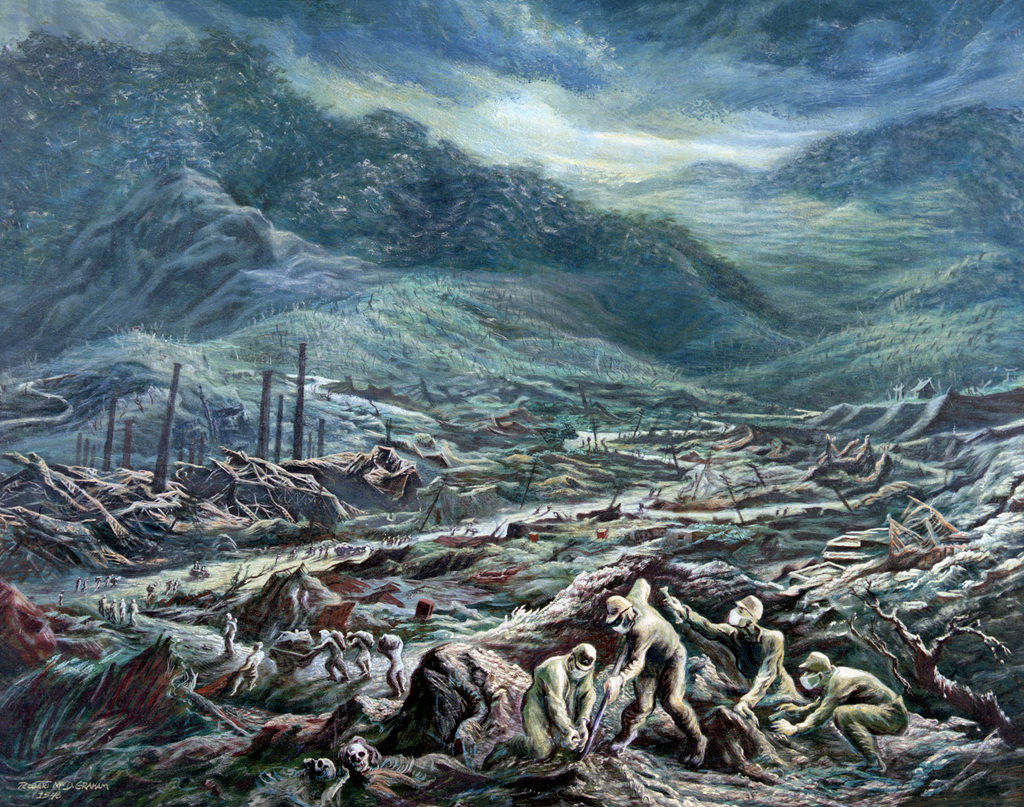
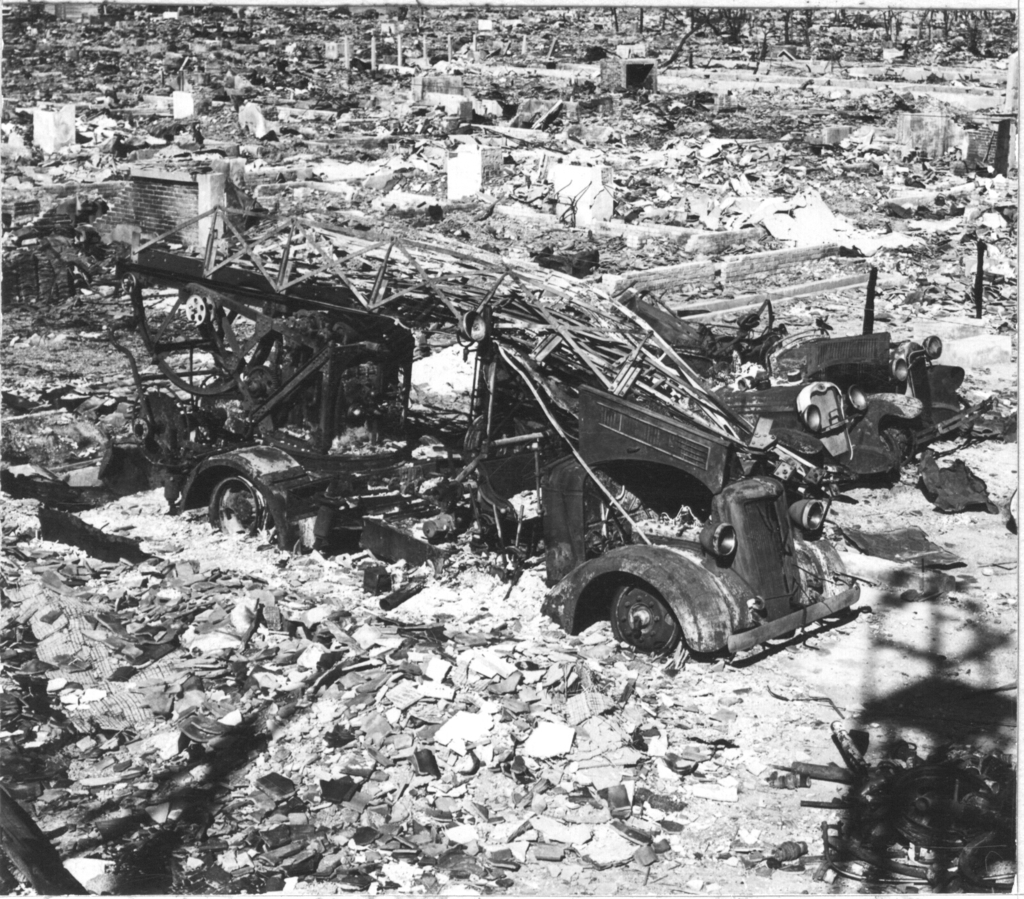
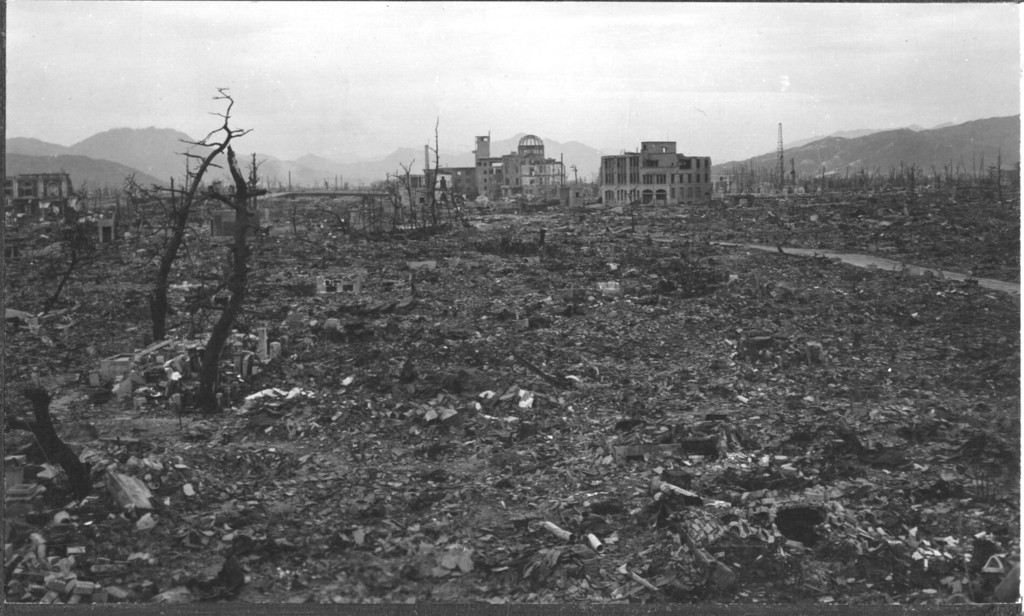
When in 1945, the Allied forces dropped atom bombs on August 6th in Hiroshima and on August 9th in Nagasaki, the Second World War drew Japanese aggression to a halt. But what was the impact on the lives of those innocents whose home, family and future changed forever? Their lives were wrecked — within a few seconds for no fault of their own. The impact clearly continues to ravage the second generation, as can be seen from the narrative of a hibakusha’s daughter who shares her travails while expressing her candid views on the recent movie, Oppenheimer, and the sale of ‘Boppenheimer’ products. She writes: “I live with it1 now having a chronic progressive nerve pain disease. My damaged immune system is attributed to my mother’s exposure to radiation from the atomic bombing.”

Are we forgetting that past, where two whole towns were decimated by atomic bombings with uncountable numbers of deaths and suffering handed down generations? Will we repeat the horrific story again to resolve issues as conflicts continue to ravage the planet with weapons, without considering their impact on the already felt climate crises? Will there be a replay of the bombing of 1945 to annihilate a people, their way of life and create suffering among all humanity? We may not be around to comment on the outcome!

Way back in 2017,  climate experts contended that in case of another such bomb blast, “The effect would be similar to that of the giant meteor believed to be responsible for the extinction of the dinosaurs. This time, we would be the dinosaurs.” 

With that in mind, we hope for a world without wars. In this special edition, writings look for peace by creating awareness and suggesting alternatives. Kathleen Burkinshaw writes about the 1945 bombings and her perspectives on media packaging of mushroom clouds. We have a story from a soldier’s perspective during the First World War by the eminent Bengali poet, Nazrul, who fought in it as a soldier for the British army. Current conflicts show up in the writing of Ramy-Al-Asheq, who was born in a refugee camp in the Middle East. They move to Ukraine with voices of Lesya Bakun, a refugee on the run, and Ron Pickett, a US army veteran. Poetry on Myanmar in the past by Sister Lou Ella Hickman and a story of the Rohingya’s plight by Shaheen Akhtar brings the focus into civil wars within Asia. More poems by Don Webb and Michael Burch urge for peace through poetry. Awareness about conflicts that nonetheless impact an interconnected world are brought in with interviews with journalists who were in Afghanistan (Andrew Quilty) and Myanmar (Jessica Muddit) when the takeovers by the current regimes started. We conclude with a discussion for alternatives towards a better future with Anthony Sattin.

Non-Fiction

Mushroom Clouds and Movies: Response from a Hibakusha’s Daughter: Kathleen Burkinshaw, a second generation victim who suffers nerve disorders from the atom bomb dropped on Hiroshima, where her mother watched her own father perish, responds to the recent media packaging of the event. Click here to read.

The Refugee and the Other, an excerpt from Ever Since I Did Not Die by  Ramy Al-Asheq, translated by  Isis Nusair. Click here to read.

Poetry 

I am Ukraine by Lesya Bakun, a refugee from Ukraine. Click here to read.

Wars and Rumours of War, a response on the war in Ukraine by Ron Picket, a a retired naval aviator with over 250 combat missions and 500 carrier landings. Click here to read.

My Visit to Myanmar in 1997, a poem about peace in the land where Buddha flourished by Sister Lou Ella Hickman. Click here to read.

Philosophical Fragments by Don Webb, an anti-war poem. Click here to read.

Poetry for Peace by Michael Burch. Click here to read 

Fiction 

Hena is a short story by Nazrul from the perspective of a soldier during the first world war, translated from Bengali by Sohana Manzoor.  Click here to read.

The Magic Staff is a poignant short story about a Rohingya child seeking refuge by Shaheen Akhtar, translated from Bengali by Arifa Ghani Rahman. Click here to read.

Interviews 

A discussion about Afghanistan, with journalist Quilty who went back to Kabul as Taliban entered the city. Click here to read.

Keith Lyons talks to Jessica Mudditt, who watched from within the country as the Myanmar Junta took over. Click here to read.

Could there be a way out of this world wide unrest? A discussion with Anthony Sattin as he explores concept of brotherhood unique to earlier times, when borders were not this well defined. Click here to read.

*

  1. the impact of the atomic bomb ↩︎
Categories
Notes from Japan

Olives and Art in the Inland Sea

Photographs and narrative by Suzanne Kamata

Sodoshima

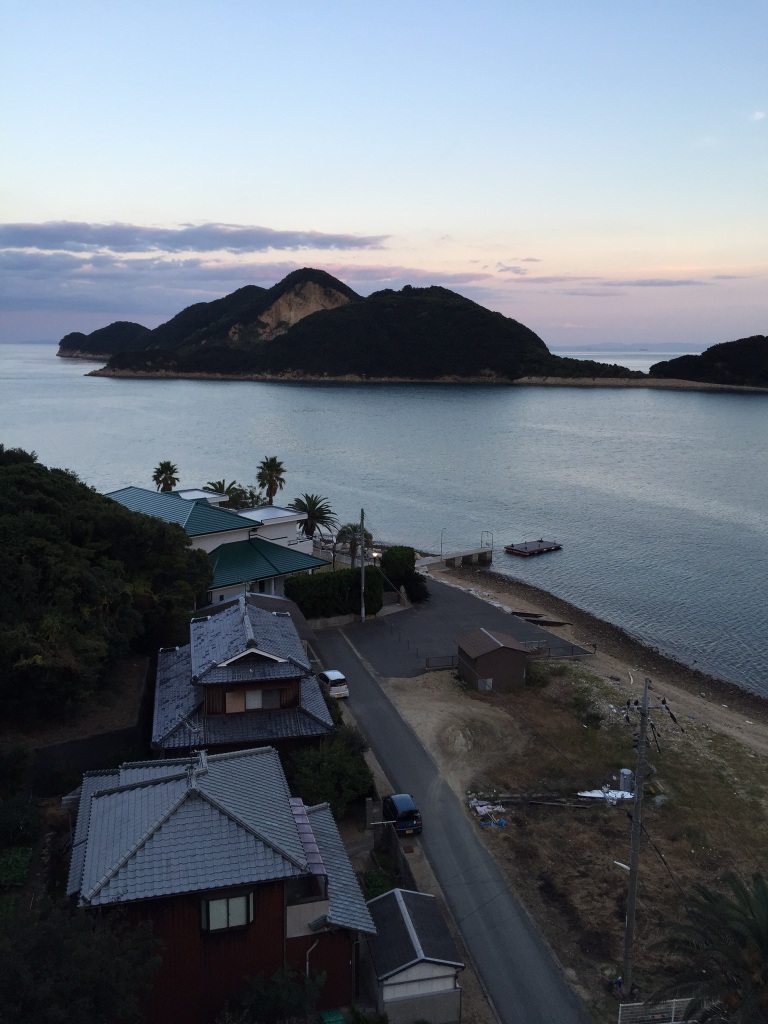
My daughter Lilia, my friend Wendy, and I set out on a Saturday morning for Shodoshima. It’s the largest island in the Inland Sea, home to about thirty thousand people, many of them aging. My mother-in-law went there years before on a group tour. She brought back olive oil as a souvenir. I am intrigued by the idea of a Japanese island with a Greek flavour. Because of its relatively large size and population, and its popularity with tour groups, I figure it would be somewhat accessible for my daughter, who uses a wheelchair and is deaf.

On the island, we stop at a tourist center for maps. I drive through the town. Some of the streetlights are shaded by green or yellow globes. Maybe they are supposed to look like olives. The road follows the seashore. Off the coast we see fishing boats. Here and there are small clusters of olive trees, the branches beaded with black olives. We finally come across a sign advertising the Olive Garden. I pull over and park in a handicapped parking space. A restaurant is up the hill.

“Shall we go eat lunch?” I ask.

“Yes,” Lilia nods. The hill is steep, but there are no steps. Lilia gets into her wheelchair and I begin to push her up the slope. From the restaurant, the view of the sea is marvelous. I smell olive oil. Wendy and I order spaghetti, which comes with bread. Lilia orders Japanese noodles, which are served with tempura fried shrimp and vegetables. When the food arrives, the server tells us how to eat it. “You should drizzle olive oil on the tempura,” she says. “You should put some olive oil and herbed salt in a small dish and dip your bread in it.”

According to a brochure, locals make olive lip gloss, olive soap, olive wax, olive hand cream, and olive-oil smoothies. You can even take classes in using olives to dye fabric. Every October the island holds an Olive Harvest Festival. People come to pick olives. They enter the “Healthy Olive Cooking Recipe Contest.” I imagine that the people of Shodoshima spend a lot of time thinking about new ways to use the olive oil that they produce. The islanders have been growing olives since 1908, and from the taste of our lunch, it’s clear that they have gotten quite good at it.

“Shall we find the Greek windmill?” I ask after we’ve eaten. I had caught a glimpse of it on our way up the hill. It’s actually a replica of the white windmills often seen on postcards from Mykonos.

Olive Park is just down the road. According to the brochure, the chalk- white building is “an exact replica” of an ancient Greek building. The brochure continues, “You may feel as if you are standing on an island in the Aegean Sea.” I’m surrounded by people speaking Japanese. Somehow, I still feel as if I am on an island in the Inland Sea. I really want to see the Greek windmill, but it’s down another hill.

“I don’t care if I see it,” Wendy says. “I can stay here with Lilia while you go.”

I ask Lilia if she wants to see the windmill. “Yes!” she replies.

Wendy and I take turns backing the wheelchair down the hill. It’s laborious, and maybe dangerous. If we lose control, we could all be injured. At last, we enter an olive grove and get close to the white windmill, which was built to commemorate the friendship between Shodoshima and Milos Island in Greece. Emperor Hirohito planted an olive tree near the windmill. As we walk back to the main building, I pluck an olive from a branch. I pop it into my mouth. It’s bitter and tough-skinned. I spit out the black skin. So much for raw olives.

We enter the small museum. A large statue of Athena greets us. Some brooms are on sale. They’re imitations of brooms in a movie about Kiki, a young witch who runs a delivery service, which has recently been filmed on the island. Lilia wants to watch the film about olive cultivation on the island. While she watches, I look at the exhibits. There are photos of Japanese women in kimonos covered with aprons, pressing olives. “They don’t look happy,” Wendy says. “It looks like hard work,” I add. “And in those clothes!”

“Anger at the Bottom,” an art installation by Takeshi Kitano, is in another small port town called Sakate. In Japan, the artist is a famous comedian called Beat Takeshi who often appears on TV. In the West, he is considered a serious actor, writer, and artist. He created this work of art with another artist, Kenji Yanobe. At first glance, this installation is a well. On the hour, however, a monster rises out like a jack-in-the-box. Water spews from its mouth. I think that Lilia would enjoy seeing this. She loves stories about ghosts and monsters.

On the way, we pass a soy sauce factory, and a small gift shop advertising soy sauce–flavored ice cream. Yuck. But Lilia signs that she wants ice cream. “Later,” I sign back, determined to see the monster rise from the well. It’s almost three o’clock. If we’re late, we’ll have to wait another hour to see the beast rise up. We arrive at the port. Another sculpture, which resembles a silver star, faces the harbor. Some elderly men sit idly in front of a nearby building. I decide to ask one of them where the installation is located. I show him the photo I had printed from the Internet. “Where is this?” He points toward some houses. People probably ask him all the time.

“Is it within walking distance?”

“Yes, but there are few tourists now so you would be able to park closer.” He nods at the wheelchair. “It would be better to drive.”

Wendy has to go back to Takamatsu. We decide that I will drop her off at the nearest ferry terminal and then Lilia and I will come back to see the monster. After that, we’ll go farther north to our hotel. I notice that there are many signs in English directing visitors to “Anger at the Bottom.” I didn’t really need to ask how to get there. I follow the signs down a narrow road. We pass a persimmon tree heavy with fruit. There’s another slight incline. I find a parking area near the well. The monster is already out of the well, but it isn’t moving.

Lilia gets into her wheelchair and I begin pushing her up the hill. She could help me by gripping the wheels and moving them forward. She doesn’t. She sits with her hands on her lap on top of her sketchbook. “Go, Mama, go!” she says. I huff and puff. “What do you mean? Why aren’t you helping?” Surprised at my reaction, she grabs onto the wheels and pulls.

At the well, the monster is still. This is the off- season. As the man at the harbour said, there aren’t many tourists this time of year. Perhaps the monster doesn’t rise and spit out water on the hour in this season. Maybe it stays in place. The monster’s red eyes seem to stare at the sea. I detect a yearning in its expression. Its lips are pressed together. No teeth are visible. The neighbourhood is quiet. The only sounds are the flapping of a crow’s wings and the twitter of an invisible bird. A slight breeze stirs the goldenrods. I wait while Lilia sketches the monster. I’m disappointed that she couldn’t see it in motion. Since it isn’t moving, however, she takes her time drawing it. When she finishes, she shows me her work. “Good job,” I say. “Now how about some soy sauce–flavoured ice cream?”

I read that the sunset somewhere on Shodoshima has been rated one of Japan’s hundred best sunsets. Since our hotel room has a view of the sea, I’m eager to check in before sundown so we can watch. I drive along twisty mountain roads, past a quarry, and past stone sculptures, down to another tiny port town in a secluded cove. I check us in to the hotel. “You can borrow DVDs,” the desk clerk says. “Or borrow books.” The lounge is filled with comfortable white leather armchairs. Some books in English are on a shelf, as well as many books in Japanese. I grab a DVD of a movie called 24 Eyes which is based on a novel written by Sakae Tsuboi, a famous Japanese writer who was born in Shodoshima. From our eighth-floor room, we can look out upon the sea from the bathtub. However, I discover that a mountain is blocking our view of the sunset.

We have dinner in the restaurant on the first floor. All the food is fresh and healthy – fish, followed by peeled grapes and slices of persimmon. After a while, we go back to our room and watch the movie. The plot of 24 Eyes is about a young teacher from the larger island of Shikoku who gets a job on Shodoshima in the 1920s. Most people on the island were poor. They wore kimonos. The teacher wore Western clothes and rode a bicycle, which shocked everyone on the island. Later, of course, everyone grew to love the teacher.

In the movie, there is a lot of singing. The children sing about dragonflies and crows. There is also a lot of crying. One girl has to give up her dream of going to music school because her parents are against it. Another gets sick and dies. Three boys go off to war. Many miserable things happen. Sometimes there is singing and crying at the same time. Lilia cries, too. I bring her tissues and give her a hug.

The next morning, we set out for The Movie Village on the southern coast of the island. Many of the tourists at the theme park are much older than us. I spot a group of senior citizens communicating in sign language. One of them notices that I am signing to Lilia and approaches us. “Where are you from?” she asks in sign language.

“Tokushima,” Lilia signs back.

The woman signs that she is from Osaka. “Is that your mother?” She gestures to me. I’m pleased. We look nothing alike. When we are in America, most people think she is adopted.

“Yes,” Lilia replies. She draws her hand down the middle of her face. “I am half.”

“It’s the first time I’ve met an American,” the woman signs.

We look at the old-fashioned wooden buildings. Kimonos are hung on bamboo poles, as if someone has just finished the laundry. Shops sell vintage toys and candies. Visitors try to walk on bamboo stilts or roll a hoop with a stick.

We come to a restaurant with painted pictures of Japanese movie stars propped in front. At the entrance is a photo of the food served. The restaurant’s theme is Shōwa- era school lunch. I ate Japanese school lunches when I first came to Japan. I taught English at junior high schools, and I ate with the students. I don’t feel nostalgic for those lunches, but Lilia wants to eat here. We go inside. Posters from different movies filmed on Shodoshima cover the walls. Some clothes worn in one movie are on display in a corner. We order school lunch. It’s served on a metal tray, just as I remember. There is a bowl of watery curry, a big white roll sprinkled with sugar, and a tangerine. Lilia gets milk in a bottle. I ask for the milk mixed with coffee, also served in a bottle. To tell the truth, it isn’t that great. I’m glad that the food in Japan has gotten better.

Lilia wants to visit the monkey park. She also wants to check out the ravine with a ropeway going across it. Sadly, we don’t have enough time. But now that she knows this island is here, she can return. We drive along the coast, back to the ferry port. The sea glistens in the late afternoon sun. Sometimes it seems as if all the beauty of the world is within our reach.

Lilia in Sodoshima

Suzanne Kamata was born and raised in Grand Haven, Michigan. She now lives in Japan with her husband and two children. Her short stories, essays, articles and book reviews have appeared in over 100 publications. Her work has been nominated for the Pushcart Prize five times, and received a Special Mention in 2006. She is also a two-time winner of the All Nippon Airways/Wingspan Fiction Contest, winner of the Paris Book Festival, and winner of a SCBWI Magazine Merit Award.

PLEASE NOTE: ARTICLES CAN ONLY BE REPRODUCED IN OTHER SITES WITH DUE ACKNOWLEDGEMENT TO BORDERLESS JOURNAL

Click here to access the Borderless anthology, Monalisa No Longer Smiles

Click here to access Monalisa No Longer Smiles on Kindle Amazon International

Categories
Review

Resisting ‘Death from Overwork’

Book review by Bhaskar Parichha

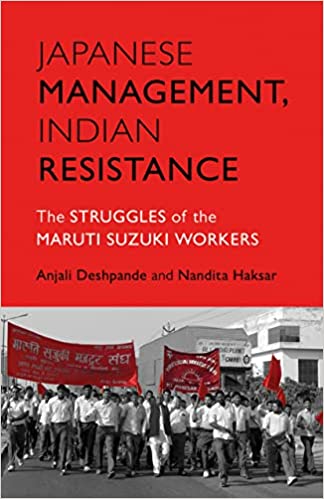
Title: Japanese Management, Indian Resistance: The Struggles of the Maruti Suzuki Workers 

 Author: Anjali Deshpande / Nandita Haksar

Publisher: Speaking Tiger Books

A fire broke out around 7 pm on 18 July 2012 at Maruti Suzuki India’s manufacturing plant in Manesar (Haryana). It claimed a manager’s life. The workers have been in the public eye since. Basically, worker-management tension snowballed into a major fracas that day — a fire broke out in the plant. The manager, Awanish Dev, was suffocated to death. Workers were held responsible.

Within days, over two thousand temporary workers and 546 permanent workers were dismissed by the company. Thirteen of them— including the entire workers’ union leadership-were later charged for murder, ending yet another independent body for collective bargaining.

Japanese Management, Indian Resistance: The Struggles of the Maruti Suzuki Workers by Anjali Deshpande and Nandita Haksar tells the story of the biggest car manufacturer in India through the voices of the workers, interviewed over three years. They give us an understanding that the Maruti Suzuki revolution wasn’t the unmitigated success it was touted to be when they tell us about their resistance to being turned into robots by uncompromising management. It becomes abundantly clear that the Maruti Suzuki revolution was not what was expected. It is a fascinating account of what happened behind the scenes, particularly what happened both in the beginning and during the ensuing years. A closer look at the facts would cast doubt on the anti-worker judgment. 

Anjali Deshpande is a journalist and activist. She has participated in many campaigns and movements including the women’s movement and the Bhopal gas tragedy survivors’ struggle for justice. She is also a novelist and writes in Hindi. Nandita Haksar is a human rights lawyer, teacher and campaigner. She represents contract workers and trade unions in the Supreme Court. She writes extensively and has published several books, including on the trade union movement in Kashmir and migrant workers from the Northeast. 

Says the blurb: “Unions are the last, and often only, line of defence workers have in modern industries, especially when the management isn’t averse to undermining their rights, dignity and health in pursuit of higher profits. This was true of Maruti Suzuki. Workers would get a seven-and-a-half-minute break from physically demanding work—precise to the hundredth of a second—to run to the toilet half a kilometre away and force a samosa and piping hot tea down their throats. But they were denied two minutes of silence in the memory of a deceased colleague’s mother.”

The sabotage of their unionising efforts, generally in collusion with the Haryana state government, came as no surprise to the workers. Yet they struggled through and managed to form successive representative bodies at both the Gurgaon plant, and the one set up in Manesar in 2007. But not only were they crushed, some were never officially registered. The often misrepresented events of July 2012 were far from an isolated incident. But few today, as then, are willing to see the matter from workers’ perspective. 

This book was the culmination of months of work by the authors, including locating and interviewing many workers and trade union leaders, including former life convicts out on parole. In the book, oral history narratives are interwoven with detailed analyses of legal processes as they are framed against the backdrop of widespread labour unrest, which makes for a book that has been meticulously researched. The context of a welfare state transforming into a corporate state, in which profits trump citizens’ rights, and Japanese-style management policies ruthlessly trample on workers’ rights, is clearly delineated, as is the sustained resistance of workers against this development. 

As the factory got privatised, while Suzuki made more profits, workers experienced a steady deterioration in their work conditions. The level of automation increased, the number of robots grew and so did the dehumanisation of working conditions. The Japanese have a word for a phenomenon that distinguishes modern Japanese work culture: `karoshi’, meaning `death from overwork’. This culture was imported onto Indian soil.

Several changes were instituted after Suzuki tightened its grip on the Indian production units. Among these were some pseudo-spiritual measures: vastu expert, Daivajna K S Somaiyaji, conducted rituals over two or three weeks to rid the Manesar plant of `negative energy’ which he said was due to its once being a burial ground, and because three temples were razed to set up the plant. Brahmakumaris also taught yoga and meditation to workers, specifically to keep their emotions in check!

It is a must-read book for anyone who is interested in organisational behaviour, labour relations, social work, industrial psychology, law, or political science. Aside from the clarity of the writing, the vivid descriptions bring alive the lives of the people who participated in one of the most widely known but least understood conflicts in management-worker relation.

Bhaskar Parichha is a journalist and author of UnbiasedNo Strings Attached: Writings on Odisha and Biju Patnaik – A Political Biography. He lives in Bhubaneswar and writes bilingually. Besides writing for newspapers, he also reviews books on various media platforms.

PLEASE NOTE: ARTICLES CAN ONLY BE REPRODUCED IN OTHER SITES WITH DUE ACKNOWLEDGEMENT TO BORDERLESS JOURNAL

Click here to access the Borderless anthology, Monalisa No Longer Smiles

Click here to access Monalisa No Longer Smiles on Kindle Amazon International

Categories
Review

A Dialogue with Stillness

Book Review by Basudhara Roy

Title: Ukiyo-e Days… Haiku Moments

Author: Bina Sarkar Ellias

Publisher: Red River

The wonder of art acknowledges and affirms the potency of stillness, its pregnancy vouching for a revelation that is both vital and imminent. Ambitious as the thought is, is it possible to engage in a dialogue with stillness, to distil the flurry of a day into the transcendence of a moment, and to transform that moment, in turn, into a metaphoric prism for the illumination of all our hereafters? In her recent collection of poems Ukiyo-e Days… Haiku Moments, Bina Sarkar Ellias can justifiably claim to have assayed each of these tasks with remarkable felicity and quiet grace.

A form of Japanese art that flourished between the 17th and the 19th centuries, ‘ukiyo-e’ is a composite of three words – ‘uki’ (floating), ‘yo’ (world) and ‘e’ (pictures), literally meaning “pictures of the floating world”. The ‘floating world’ referred to the theatre districts and (licensed) courtesan quarters that flourished in Japan’s major cities during the Edo period and constituted an important source of attraction for the nouveau-riche of the era. Inhabited largely by courtesans and the traditional kabuki actors, this floating world, despite its low status in the social hierarchy of the times, made its impact as valuable cultural capital, its sartorial customs and mannerisms becoming quite effectively, a rage among common people.

Since paintings could be afforded only by the prosperous, the ukiyo-e artists made a distinct historical move to democratise art by being the first to experiment with woodblock prints which could be produced cheaply and in large numbers, thus making ukiyo-e widely accessible to the  populace. Actors, courtesans, legends, folklore, and landscapes were some of the common subjects that marked this art, the heroic and the erotic being significant thematic notes within it.

Ukiyo-e Days… Haiku Moments revisits this memorable Japanese artform to bring to the reader a remarkable collection of 68 ukiyo-e by 28 artists from across the seventeenth to the early twentieth century, showcasing a delectable mix of the traditional and the modern in Japanese art and its unique blend of native and foreign influences. Compounding the effect of the Ukiyo-e here, is a set of 62 haiku by Bina that excavate, explore and expand the meaning and value of the artworks by bringing them into dense ekphrastic conversation with her own mind and times. “My haiku travels with each of the ukiyo-e works as a companion through this journey, responding with a deep kinship I feel with the artworks,” she writes in her Preface.

In this collaborative project of creativity, the haiku become a companion to the historical journey of the ukiyo-e, illuminating them in a transcultural framework which even as it asserts the omnipotent significance of art, helps draw attention to its omniscience across temporal and cultural divides. “To read a haiku,” says Jane Hirshfield, “is to become its co-author, to place yourself inside its words until they reveal one of the proteus-shapes of your own life.” As Bina places her contemporary and complex historical self within the sensibility of the ukiyo-e, her unravelling of meaning through the haiku becomes yet another act of seeking connection and consolation in an alienated world.

As a poetic form, the haiku establishes a constant romance with the brevity of expression on the one hand and the expanse of space on the other. Its sharp imagism helps to illumine both the moment and the emotional ambience that will render this moment organic in every context. Scale, speed, succinctness and surrealism can all work in concert within the seemingly fragile universe of the haiku to make it an emblem of and testimony to the wide-ranging historical forces within which it is birthed. The animated and tender conversation between colour, form and script in Ukiyo-e Days… Haiku Moments works similarly holding both word and beauty in suspension, mirroring the moment as self and self as moment, and asking us to return to the quintessential celebration of both:

you want to be free
but maya mesmerises-
locks all the doors

The haiku is, often, a lesson in perception. It is characteristic of the haiku to be profoundly epiphanic and in many of her pieces, Bina ascends to that level of quiet illumination wherein an inner truth becomes simpler by the sole virtue of its lucid expression. Art, life, hope, faith, poetry, war, human vulnerability — all emerge as important themes here. One cannot help noticing, however, the collection’s loving partiality toward women. Women and their myriad-layered lives constitute a recurrent thematic motif in these poems:

into the long night
her toil of pleasure-giving
a tale of two worlds

Since in much of the ukiyo-e, the women represented were courtesans, Bina brings a profound sense of tenderness and understanding in reinterpreting their situation for modern women whose lives, in different contexts, remain emotively the same. In their intensity and in the overall poignance with which these haiku delineate women’s ever-shifting roles in terms of profession, domesticity and relationships with the world, Bina evinces a deep knowledge of women’s spiritual multiplicity. To Torii Kiiyonaga’s delicate artwork ‘Bathhouse Women’, for instance, Bina, deflecting attention from the voyeuristic potential of the scene to give the bathhouse a larger cultural and political logic, responds:

a day for washing
wash away patriarchy
energise our souls

Another beautiful narrative turn in haiku is offered in response to Kitagawa Utamaro’s print ‘Naniwa Okita Admiring Herself in a Mirror’ in which Bina imagines a different (more youthful) face emerging from the mirror. While the mirror has mostly been used as a truth-telling device in literature and a means of shattering illusion, this particular mirror becomes a gateway to the discovery of the magical self within, unmarred by the winter of time:

i see a mirage
see my youth in winter years
does the mirror lie?

With Chobunsai Eishi’s ‘The Courtesan Hanaogi of the Ogiya Brothel’, Bina communicates thus:

within the prose
of her pleasure-house living
she breathes poetry

Here is a mature and perceptive weaving of art and life — a recognition of art as art and of life as life with the potential of building strong and tenable bridges across them. It is noteworthy how each haiku stands independently even as it adds a significant hermeneutic or experiential dimension to the ukiyo-e, imparting a certain luminosity to this book. There is a distinct sensation of time-travel in this collection, of moving through the slow whirl of centuries while remaining undivorced from the crises and flavours of the present:

realisation
we were not born violent
let’s repair ourselves

Empathy becomes a powerful voice in Ukiyo-e Days as Bina’s haiku touches raw spots within our shredding cultural fabric to draw attention to greed, war, exploitation and the relentless process of needing to find our integral human selves:

all the world’s armies
trained as cannon fodder
they live to die

In these delicate and consummately-crafted pieces, one finds doors open to deep investigation of the moment and what it stands for in life’s ever-shifting landscape. There is a stillness that the collection speaks from and to, a stillness that characterises both the ukiyo-e and the haiku as art forms. Invested with extraordinary visual and tactile charm and an interesting Preface that throws light on the genesis and growth of the ukiyo-e in Japan, this book accomplishes a unique synthesis between two valuable Japanese art forms, bringing to a connoisseur-reader the unforgettable enchantment of both.

Basudhara Roy teaches English at Karim City College affiliated to Kolhan University, Chaibasa. Author of three collections of poems, her latest work has been featured in EPW, The Pine Cone Review, Live Wire, Lucy Writers Platform, Setu and The Aleph Review among others. 

.

PLEASE NOTE: ARTICLES CAN ONLY BE REPRODUCED IN OTHER SITES WITH DUE ACKNOWLEDGEMENT TO BORDERLESS JOURNAL

Click here to access the Borderless anthology, Monalisa No Longer Smiles

Click here to access Monalisa No Longer Smiles on Kindle Amazon International

Categories
Notes from Japan

A Clean Start

By Suzanne Kamata

Courtesy: Creative Commons

On the last day of the year, the line at the carwash snakes all the way into the street. My family and I wait patiently in our mini-van, preparing to hose and hoover, and to slather wax onto metal. Our bodies are tired and slightly grimy. For the past two weeks, we’ve been consumed by O-soji, the traditional thorough end-of-the-year cleaning. Every window in our house has been washed. Old newspapers have been bound and toted off to the recycling center. Our floors are as shiny as mirrors.

O-soji, or “Big Cleaning”, can be quite a task for my organisationally-challenged family. As an American, I come from a country where a leading magazine encourages women to aspire to “good enough housekeeping.” Better to become a lawyer or a doctor than spend all my spare time chasing dust bunnies, I learned.

Here in Japan, however, where wiping the floor is part of a kid’s education, cleaning is serious business. And Japanese women seem to spend far more time pushing a vacuum around than their counterparts across the sea. The mother of one of my daughter’s kindergarten classmates told me that she vacuums every day! This, in a country where one has to take off one’s shoes before stepping into a house. Another mother confessed that “tidy up” were among the very first words that her son learned. On a visit to our house, my own mother-in-law once took it upon herself to line up all of the socks in my children’s sock drawer.

However, if the tendency to tidiness is hereditary, my husband apparently missed out. He often leaves a trail of dirty, balled up socks, plastic snack wrappers and empty beer cans, and the car that we are about to wash is cluttered with trash. And although my daughter is often praised by teachers at her school for her obsessive-compulsiveness – i.e., she can’t concentrate unless her pencil case is perfectly aligned with the edge of her desk and she dutifully lines up hers and others’ shoes at the entrance of her classroom – at home, she lapses into sloppiness. And my son? The floor of his room is usually layered with cast-off clothes, comic books, and school papers.

But on the last day of the year, at least, our house is as neat as the proverbial pin.

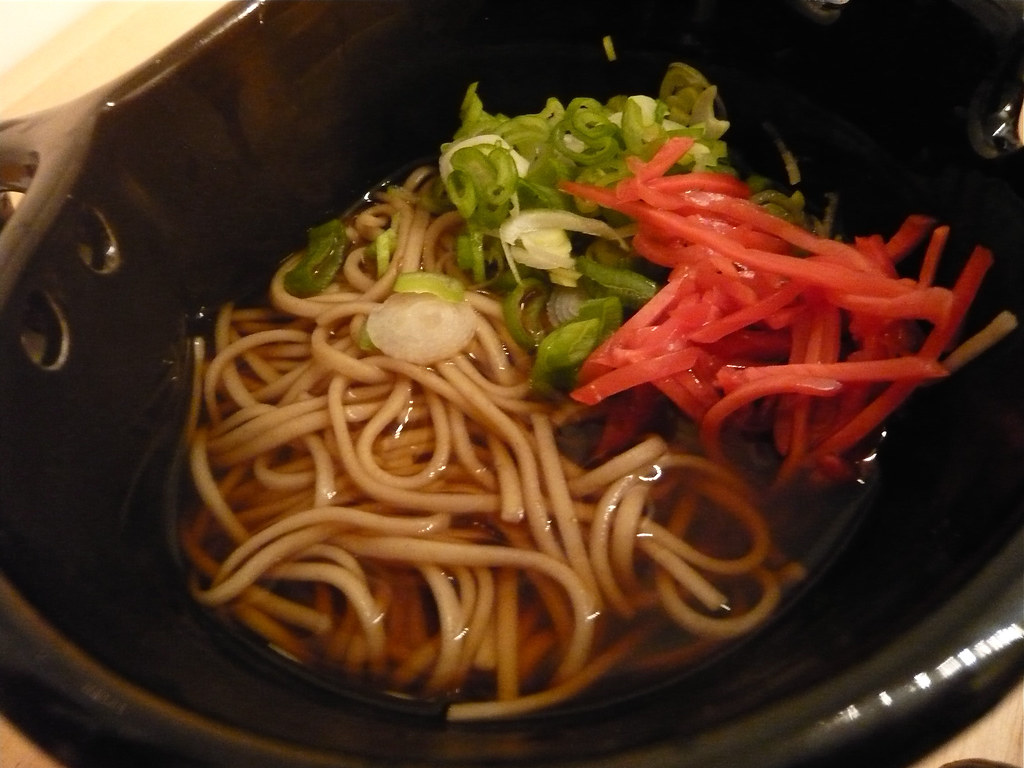
The car ahead of us finishes, and we pull up in front of the hose. The four of us clear out the empty drink containers, vacuum up crumbs and dirt, and scrub the outside of the car. When we are finished, we go home and collapse on the sofa. We will eat noodles at midnight, and then wake feeling fresh and pure, ready for the first sunrise and the first dreams of the new year.

New Year End Noodles. Courtesy: Creative Commons

Suzanne Kamata was born and raised in Grand Haven, Michigan. She now lives in Japan with her husband and two children. Her short stories, essays, articles and book reviews have appeared in over 100 publications. Her work has been nominated for the Pushcart Prize five times, and received a Special Mention in 2006. She is also a two-time winner of the All Nippon Airways/Wingspan Fiction Contest, winner of the Paris Book Festival, and winner of a SCBWI Magazine Merit Award.

PLEASE NOTE: ARTICLES CAN ONLY BE REPRODUCED IN OTHER SITES WITH DUE ACKNOWLEDGEMENT TO BORDERLESS JOURNAL

Click here to access the Borderless anthology, Monalisa No Longer Smiles

Categories
Contents

Borderless, November 2022

Art by Sohana Manzoor

Editorial

We did it! … Announcing our first anthology … Monalisa No Longer Smiles… Click here to read.

Conversations

Suchen Christine Lim, an iconic writer from Singapore in conversation about her latest book, Dearest Intimate. Click here to read.

Blazing trails, as well as retracing the footsteps of great explorers, Christopher Winnan, a travel writer, delves into the past, and gazes into the future while conversing with Keith Lyons. Click here to read.

Translations

Rows of Betelnut Trees by My Window by Nazrul has been translated from Bengali by Professor Fakrul Alam. Click here to read.

A Day in the Life of the Pink Man is a story by Shankhadeep Bhattacharya, translated from Bengali by Rituparna Mukherjee. Click here to read.

The Clay Toys and The Two Boys is a story by Haneef Shareef, translated from Balochi by Fazal Baloch. Click here to read.

Saturday Afternoon is a poem by Ihlwha Choi, translated from Korean by the poet himself. Click here to read.

Tagore’s poem, Tomar Shonkho Dhulay Porey (your conch lies in the dust), has been translated from Bengali by Mitali Chakravarty as The Conch Calls. Click here to read.

Poetry

Click on the names to read

Jared Carter, Asad Latif, Rhys Hughes, Alpana, Mimi Bordeaux, Saranyan BV, Luis Cuauhtémoc Berriozábal, Quratulain Qureshi, Jim Bellamy, Sourav Sengupta, Ron Pickett, Davis Varghese, Ryan Quinn Flanagan, Jonathan Chan, Terry Trowbridge, Amrita Sharma, George Freek, Gayatri Majumdar, Michael R Burch

Poets, Poetry and Rhys Hughes

In Infinite Tiffin, Rhys Hughes gives an unusual short story centring around food and hunger. Click here to read.

Musings/Slices from Life

The Scream & Me

Prithvijeet Sinha writes of how Edvard Munch’s painting, The Scream, impacts him. Click here to read.

A Fine Sunset

Mike Smith travels with a book to a Scottish beach and walks in the footsteps of a well-know novelist. Click here to read.

The Death of a Doctor

Ravi Shankar mourns the loss of a friend and muses on mortality in his experience. Click here to read.

My Contagious Birthday Party

Meredith Stephens writes of her experience of Covid. Click here to read.

Dim Memories of the Festival of Lights

Farouk Gulsara takes a nostalgic trip to Deepavali celebrations in Malaysia. Click here to read.

Musings of a Copywriter

In Strumming Me Softly with His Guitar…, Devraj Singh Kalsi talks of his friends’s adventure with the guitar. Click here to read.

Notes from Japan

In Therese Schumacher and Nagayoshi Nagai: A Love Story, Suzanne Kamata introduces us to one of the first German women married to a Japanese scientist and their love story. Click here to read.

Essays

My Favourite Book by Fakrul Alam

The essay is a journey into Fakrul Alam’s evolution as a translator. Click here to read.

The Ultimate Genius of Kishore Kumar

Shantanu Ray Chaudhuri, an eminent film critic, writes on the legend of Kishore Kumar. Click here to read.

T.S Eliot’s The Waste Land: Finding Hope in Darkness

Dan Meloche muses on the century-old poem and its current relevance. Click here to read.

The Observant Immigrant

In Piano Board Keys, Candice Louisa Daquin talks of biracial issues. Click here to read.

Stories

The Funeral Attendee

Ravi Prakash shares the story of the life of a migrant in rural India. Click here to read.

A Letter I can Never Post

Monisha Raman unravels the past in a short narrative using the epistolary technique. Click here to read.

Red Moss at the Abbey of Saint Pons

Paul Mirabile takes us to St Pons Abbey in France in the fifteenth century. Click here to read.

You have lost your son!

Farhanaz Rabbani gives a light story with a twist that shuttles between Dhaka and Noakhali. Click here to read.

Book Excerpts

An Excerpt from Manoranjan Byapari’s How I Became a Writer: An Autobiography of a Dalit, translated from Bengali by Anurima Chanda. Click here to read.

An excerpt from Evening with a Sufi: Selected Poems by Afsar Mohammad, translated from Telugu by Afsar Mohammad & Shamala Gallagher. Click here to read.

Book Reviews

Reba Som has reviewed Aruna Chakravarti’s Through the Looking Glass: Stories. Click here to read.

Somdatta Mandal has reviewed Shehan Karunatilaka’s The Birth Lottery and Other Surprises. Click here to read.

Basudhara Roy has reviewed Afsar Mohammad’s Evening with a Sufi: Selected Poems, translated from Telugu by Afsar Mohammad and Shamala Gallagher. Click here to read.

Bhaskar Parichha has reviewed Rahul Ramagundam’s The Life and Times of George Fernandes. Click here to read.

Borderless Journal Anthology

Click here to access the Borderless anthology, Monalisa No Longer Smiles