Categories
Stories

The Monk Who Played the Guitar

Short story by S Ramakrishnan, translated from Tamil by T Santhanam

It was Malavika who sent me the video of the monk who plays guitar. Malavika is my daughter. She is pursuing fashion designing course in Kingston University, England. Her desires and interests are a puzzle to me. Some days ago, she sent a recording of a poem by William Blake in her voice. After that, she sent a photo of her carrying a placard in a demonstration against global warming. As clouds change to forms unimaginable, her interests keep on changing. After watching a butterfly, she had sent her impressions in writing. It seemed as though it was from a seasoned writer. 

Children who leave home for far off places, in a sense, leave us. She was no longer the girl she was in Chennai. The new country and new environment have changed her. The changes are reflected in her appearance and deeds. My wife did not like these alterations. Below the video of the monk who played guitar, she had given the caption: “Music is Meditation”. I could not understand her. At the age of twenty-two, I thought she would be fondly giving herself to worldly pleasure. But she was immersed in meditation, agitation and museum visits.

In the video sent by Malavika, the monk must have been about thirty years old. His head was tonsured. He wore a robe coloured orange. His ears were slightly big. He had a sharp nose and small lips where a smile was frozen. It was hard to find out if he was a Nepali or a foreigner. On his left arm, was tattooed the image of Buddha.

It was funny to see a Monk with a guitar. The image we have formed about saints and the looks of current day saints are not alike. Perhaps, we refuse to update that image. Perhaps, the meaning of sainthood has changed.

The musical piece was given the title “Falling flowers”. From the way he was playing, it seemed as real as the blossomed cherry leaves falling gently. The normal rapidity and gush associated with guitar music was not there. Like an insect that moves in the water, his fingers moved on the guitar strings. Music tunes to the past more easily than photographs. A small piece of music is enough to take us back to our school days.

I saw the video once or twice. I felt the urge to listen to it again and again. While listening at night, I felt as if the fragrance of incense was wafting into the vacant spaces of my heart. I found His name was Limang Tolma while searching for his other videos. There were hundreds of musical pieces by him. All of them were only seven minutes long. Evidently, he played the guitar for only seven minutes in a day. That too under the sal tree in Coben Monastery seated on a stool. Hundreds of people from various countries pour in to listen to his performance. All this I gathered while browsing the internet. His music was melodious and sweet. Why did he play for seven minutes only at each stretch was beyond comprehension.

To know more about Limang Dolma, I called Malavika on her mobile. She sent a message that she was observing silence for the past five days. Why this silence? Tongue can be tied down. But the mind? 

I told my wife. She responded that she had scolded Malavika and that was why she was doing this.

I could not understand. What was the skirmish between mother and daughter? I sent a message to Malavika asking her how long her silence would continue. “God only knows,” was her reply.

As I am a senior executive in an automobile company, I had to conduct two to three meetings in a day. My blood pressure sometimes would rise after returning from these meetings.Sometimes, I would have a headache too. At times, the meetings would last for ten hours. After the meeting, I would feel as if somebody has placed a pile of iron on my shoulders. I would feel sick, wondering why we could not conduct our work without talking, discussing or fighting.

One day, before the commencement of the meeting, I started to listen to the monk’s guitar music from my cell phone rather impulsively. I closed my eyes for seven minutes as though I was in a deep meditation. It was as pleasant a feeling as a moist breeze caressing my body. There was peace in my heart and an exhilaration I had never known before. On that day, I could sense the change in my voice and the way I was moving towards a solution. Somehow the officials of the sales department seemed to understand this. After the conclusion of the meeting while coming down in the lift, Amarnath said, “There was something new in your speech today. You spoke like a Zen Master.”

“Yes” I nodded approvingly with a smile. I was just wondering how a small piece of music could bring such a tremendous change in me.

I wanted to know more about Limang Dolma. Searching through the internet I was more and more astonished. The real name of Limang Dolma is Christopher Cane. He was born in Milan. He had pursued Anthropology. After coming into contact with a Buddhist monk, he has embraced Buddhism and become a monk in the Buddhist Monastery. He plays the guitar only under the tree of the monastery and nowhere else. Young people throng to him. They listen to his music. Some of them stay there for days together to savour his music. They wear T-shirts bearing his image with the words, “Buddha plays Guitar”. In an interview, a young lady asks him. “All saints in India hold one or other instruments. Why does Buddha not play any instrument nor is seen holding one?”

“He himself is a musical instrument. One who knows how to tune himself finds no need for a musical instrument. In the same way, Nature tunes itself. Is there any tune better than what the water plays?”

“Why do you play only for seven minutes?”

“Seven is the symbol of consciousness in Buddhism.”

“Seven minutes is not enough for us. Can’t you play more?”

“Will you take honey in a gulp? Is a spoonful not enough?” he asks.

I admired Limong Dolma fo his speech, poise and the way he handled guitar. I too felt like wearing a T-shirt bearing his image. I sent the video of Limang Dolma to some of my friends asking them to listen to his music. Only Mohan Muralidharan, a neurologist and my school mate, sent a reply saying that a man from Turkey played better than the monk and shared the video. Why should one musician be compared to another? Can’t this foolishness be avoided?

I called Mohan and blurted out my irritation. He said in a mocking tone, “You’re aging. That is why you listen to a monk playing the guitar. Music should make us feel young. It should twinge our nerves. You have never touched a musical instrument in your entire life. Can you whistle atleast?”

Mohan was right. I haven’t even played the mouth organ which many played during my school days.

I felt like owning a guitar. The same evening, I went to a musical store in Leo mall. I showed the video of Limang Dolma and asked for a guitar like the one in the video. The face of the girl at the counter brightened. “Limang Dolma?” she asked. I felt glad that she too has listened to the music. She brought a guitar from inside. I told her, ” I don’t know how to play guitar. This is for my daughter.”

The girl told with a smile, “Limang Dolma was a thief. He was in prison. After his release, he became a Monk. People say he speaks to Buddha through his music.”

“Really!”

“I overheard two girls talk of it when they came to purchase a guitar.”

“Do you believe that?”

“I believe it partially.”

“Which part?”

“That he speaks to Buddha,” she smiled.

She looked like my daughter when she smiled. Perhaps for young girls Buddha is a different personality. May be, the Buddha known by the ones who have crossed fifty years like me and the Buddha these young girls adore are not the same.

When I brought guitar home, my wife chided me.

“Why have you brought this? Who will play?”

“Just let it be,” I responded.

“Is it a show piece to be kept just like that?” she asked.

I did not reply.

I placed the guitar in Malavika’s room close to her bed. I had a feeling that Malavika had returned. I sent that night the picture of guitar to Malavika by WhatsApp. She sent an emoji of two clapping hands. Also, she sent a message “We are going to visit Limang Dolma.” 

Though I felt happy, I was eager to know who was the other in the ‘We’. I did not venture to ask Malavika. Instead, I asked, “When?” She did not respond.

After five days, she sent a picture to me. She was among the hundreds of youngsters before Limang Dolma, as he was playing the guitar. My eyes were cast on a young man with long hair, not on Limang Dolma. The young man hung his arms around Malavika’s shoulder.

Who was this fellow? How long had she known him? I could not see his face properly. I widened the image. An European face. Perhaps was he also a musician?  I thought of asking Malaviika. But I curbed that thought and went on to ask about the musical event, as I called her. She was full of cheer. She told me,” Listening to Dolma’s music, one feels like a kite fluttering in the air. I do not know what to say. Flying to heaven.”

“I read somewhere that he was a thief,” I said.

” Oh, that’s a myth constructed by magazines. When asked about this, Dolma says raindrops do not have a past. Jonah and myself were in the Monastery for three days. Wonderful experience!”

A question arose on my mind as to who Jonah was. I was not sure whether to ask her or not. Why wouldn’t she talk about him?

I asked, “Is Jonah a musician?”

“Dad, how do you know? Indeed, he is. He plays the guitar well. It was he who introduced me to Dolma’s music.”

“Is Jonah your classmate?”

“No, he works in a bar where I hold a part time job.”

“You didn’t tell me,” I pretended to be angry.

“Dad, don’t tell Mom about this.”

“About your working in bar?” I asked deliberately.

“About Jonah too?” she laughed. As she was so laughing, she seemed to be some other young girl. After she hung up, I was thinking about Jonah. Was he a good person or bad? Was he also a thief earlier? Or could he be a drug addict? Who were his parents? Was he in love with Malavika? Had I become old? Was Mohan right? I

 admired a Monk playing guitar somewhere. But I do not like Jonah who also plays guitar. Why? I was perplexed. Suppose if Limong Dolma put his arm around the shoulder of my daughter, would I dislike him too? I was confused.

Two days later, Malavika forwarded a video of Limang Dolma downloaded in her phone. Limong Dolma walked as though he was floating in the air. He sat under the tree. Peace was on his face as he tuned the guitar — the same music that I savoured earlier. No longer did I feel close to that music. Somehow, instead of Limang, Jonah’s face came before me. I felt as if a bitterness had settled down on my tongue.

The same night, Malavika called me. Before my asking anything, she said, ” After visiting Limang Dolma, I do not feel like listening to his music again”

 “Why?” I asked as if I did not know anything.

“I do not like it any more just the way I suddenly liked it before.”

“How is Jonah?” I asked intentionally.

“Do not talk about him. I hate him. I hate whatever he introduced to me.”

Inwardly I was happy.

” Any problem? Shall I talk to Jonah?”

“Why should you talk to him? The days I moved with him, it was a nightmare. Daddy, why do you not rebuke me?”

“You are not a kid, after all.”

“But you think of me as a kid only. You don’t know me as Mom does.”

I was flummoxed. I could hear Malavika sobbing for the first time ever. I did not know how to console her. I hurriedly gave the phone to my wife. She started walking towards the kitchen with her words of consolation. What has transpired between her and Jonah? Why was she weeping? I could not make out. At the same time, I was happy that she disliked the world she created for herself and moved back towards my world. A thought arose that she was coming home. I asked my wife what Malavika had said.

“That boy is not good. I told her from the beginning itself. But she did not pay heed.”

“Did you know about Jonah before?”

“She told me six months back. I scolded her saying that your Dad will not like this. I have spoken to Jonah also.”

“To Jonah? You?”

“Yes, I could not understand a bit of what he spoke.”

“What is the problem now?”

“It’s over. No use talking about it!”

I could not understand what happened. But Malavika had been closer to her mother than to me. She had shared everything with her mother. I was pained at this. Why then did she asked me not to tell her mother? Why this drama? Children after growing up, treat their father as a plaything. The daughter I know is now the girl I do not know. I could not reconcile myself to this.

I heard the guitar music of the monk that night. I was more attracted to the tree than to the music.

Leaves do not stay on the tree for long. When a leaf falls, the tree does not reach out to catch it. When falling leaves sail along the wind, the trees can do nothing but look at them in silence. Somehow, the music stirred a grief in me.

As I prepared to leave for office next morning, I saw my wife keeping the guitar next to dustbin. What was the fault of the guitar after all?

” What are you going to do with this?” I asked.

“Anish told me, he will take it. What do we do with this? Malavika does not want it any more.”

I nodded giving the impression that she was right. But I felt sorry while doing that.

.

S. Ramakrishnan is an eminent Tamil writer who has won the Sahitya Akademi Award in the Tamil Language category in 2018. He has published 10 novels, 20 collections of short stories, 75 collections of essays, 15 books for children, 3 books of translation and 9 plays. He also has a collection of interviews to his credit. His short stories are noted for their modern story-telling style in Tamil and have been translated and published in English, Malayalam, Hindi, Bengali, Telugu, Kannada and French. 

T Santhanam is a retired Bank Executive in Bangalore, India. He has a passion for literature with a special affinity for poetry. He writes poetry in Tamil. He is also a blogger.

.

PLEASE NOTE: ARTICLES CAN ONLY BE REPRODUCED IN OTHER SITES WITH DUE ACKNOWLEDGEMENT TO BORDERLESS JOURNAL

Click here to access the Borderless anthology, Monalisa No Longer Smiles

Click here to access Monalisa No Longer Smiles on Kindle Amazon International

Categories
Slices from Life

The Toughness of Kangaroo Island  

By Vela Noble

A lone house juts out of the cliffs on Kangaroo Island, like a villain’s lair in a James Bond movie. Its floor-to-ceiling windows are marred only by salt spray and swallow poo. The receding orange cliffs set against a fierce ocean makes for a view even the stonemason called, ‘the best on the island’. I slink down into the backseat of our car and admire the azure downhill view of Cape Jervis, where the ferry departs. Today my dad, his partner and I are driving to our holiday house for a short trip planting trees. On the North Cape of Kangaroo Island, the fields of matted grass pocked with weeds make for a melancholic landscape. Having been ravaged by decades of farming, helping revegetate is the least we can do.

My bedroom on the island has large eastern-facing windows. This gives me a view of Boxing Bay, a beach only visited by tourists willing to brave the potholed dirt road. Bleached book spines featuring nautical adventures or “101 Guide to Prepping” line the bookshelf. Dusty DVDs, mostly starring Ben Stiller, have also been faded by the elements. A box reveals an arsenal of art supplies my mum ordered online. I unearth my mum’s fancy French Sennelier watercolours. They come in a navy carry bag with crisp brushes begging to caress a canvas. Staring at these items hits a nerve, but I tenderly place it in my backpack.

That same afternoon we plant some trees. We have around sixty to get through this trip, mostly bristly casuarinas and muntrie berry bushes. I gently pat around each seedling and send a prayer into the earth. After I have done the bare minimum, I do what I usually do every trip; I wander off. I decided to make the trek from Boxing Bay up the hill to the solitary lighthouse. Passing a droopily arching tree, I tentatively open my sketchbook and bring pen to paper. The earth and sky don’t like me much. Juicy fat ants keep biting me and my pale arms are getting fried. The drawing comes out horribly, so I shove the sketchbook away. Life isn’t just tough for me, but for everything out here. We once caught a monitor lizard so thirsty that it was licking a leak in our hot tub. We offered it a drink, from which it drank like a dog from a bowl. On the North Cape, you can often glimpse the grand wingspan of a sea eagle surveying the hills in search of prey, such as mice. Echidnas are a bit rarer to spot. They must have it tough too, for they could get mistaken for a chubby mouse. Everywhere I look, there’s subject matter pleading to be painted. It’s in the flattened fields where settlers heaved limestone into neat little rows, or in the sheep skull perched on the wire fence. Around halfway to the lighthouse, I see some abandoned machinery in the corner of a field. I attempt to sketch. Yet again, something isn’t quite right. So, I tear an angry gash with the pen instead. The overcast weather rolling in urges me to slouch on home.

A storm hits tonight. The windows in my room shiver under every gale. The little sprouts we had just planted are getting a brutal welcome to their new home, but at least the earth gets a drink. Below the house on the cliffside, a grove of wizened casuarinas grow sideways as a result of with this abusive weather. Somehow, they still grow. I teeter to the toilet in the middle of the night.

My mum took charge of designing this home and her dedication is apparent even in the bathroom, where a nifty hidden wooden panel pops out to reveal storage for toothbrushes and toilet paper. She passed away in 2020 and didn’t get to enjoy that hidden toilet paper compartment. Both here and at home, there is no escaping the memory of my mum. In the morning, the sun beams straight into my slumbering retinas. I had hardly slept. Dad cranking up the coffee machine doesn’t help.

“What are you going to do today?”

“More terrible art, probably.”

“Go for a walk. Look for some sea eagles. There’s so much to do out here.”

I walk down to the grove of gnarly casuarinas. A solitary sheep that strayed from the feral herd appears in front of me. It startles, the dags on its butt dangling with every leap. I follow it and reach a sandy spot on the clifftop. These trees survived last night’s storm, why can’t I survive this?

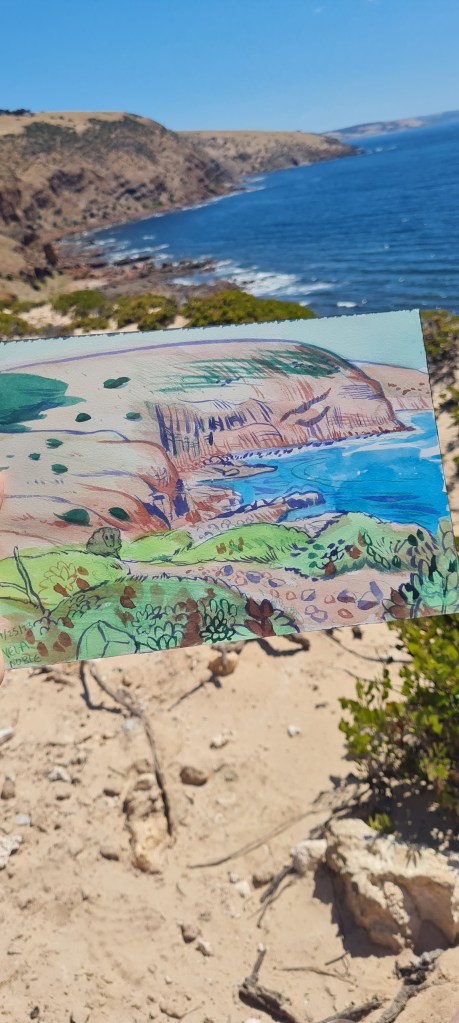
I rummage through my bag and realise I have my mum’s watercolours. I admire the glossy hues snuggled in their metal tins. It’s as if her dreams are laid to rest in this little plastic case. After my mum passed away, I suffered a psychotic break which impaired my ability to do art. Art had been my passion. Professionals tell me it’s not damaged and I’ll get better but, I have yet to see any proof of that. Seeing the dirty sheep posing right in front of me, I can’t help but have hope. This time I don’t draw, I paint. I pop open the water filled jam jar and bring the brush to the ultramarine. The blue spills onto my page. Next is the sky that’s freckling my skin. I am not just painting, I am soaring on wings and scurrying through the undergrowth on tiny paws. Like the almighty creator, I lay down the stoic earth. Before I know it, I have a picture. Hey, it turned out alright! Above all else, I was happy making it. That evening I showed the picture to my dad.

“That’s fantastic Vela! Why do you keep saying you’ve lost your art?”

He puts it on the stonemason crafted mantelpiece, next to a bowl of seashells and under the happy gaze of my mum’s self-portrait.

It’s a pale purple dawn when we depart. The white drop cloths draped over the furniture to protect them from the sun makes the living room appear full of ghosts. We putter down the crushed limestone road, the rumbling white dust proclaiming our departure to all the thirsty lizards and echidnas shuffling in the bush. I take a final look at the wind-bent casuarinas on the cliffside. I too, feel beaten down by life, by relentless winds trying to rip me out by the roots. The trees get tougher and tougher, clinging into that poor soil. It may not be the best conditions, but when I think about the harshness of life on Kangaroo Island, I realise there’s something I can learn from it. Something in me can thrive too. The North Cape has made me just that little bit tougher.

.

.Vela Noble is a South Australian artist who is currently developing her own indie games. She has many years of experience working in animation for Netflix and Dreamworks. 

.

.

PLEASE NOTE: ARTICLES CAN ONLY BE REPRODUCED IN OTHER SITES WITH DUE ACKNOWLEDGEMENT TO BORDERLESS JOURNAL

Click here to access the Borderless anthology, Monalisa No Longer Smiles

Click here to access Monalisa No Longer Smiles on Kindle Amazon International

Categories
Musings

Islands that Belong to the Seas

By Paul Mirabile

Islands belong to oceans and seas and lakes. They are born within the deepest depths of the marine underworld like infants in the depths of their mothers’ wombs. Born often from surging volcanic eruptions, the molten lava hardens into rock. The rock is smoothed by ocean-swept sands that turn fecund over time. They are gradually populated by migrating birds who rest their weary wings and deposit seeds from which sprout rich and luxuriant vegetation. To these shingled or sandy shores, little by little, pirates, buccaneers, conquistadors, renegades, the exiled or self-exiled, slaves, missionaries and migrant workers come to explore and eventually settle.

They all come flocking to this primordial land floating in the waters of the world, birds and humans, animals too follow. Bees buzz their contentment, donkeys hee-haw, goats baa and mosquitoes whine. And yet the islands do not belong to any one of these creatures. They belong to the oceans and seas and lakes — their creators and benefactors.

Ah! The birth of an island! The centre of which rises high above those shingled or sandy shores, the dense jungles or arid scrub, where Vulcan in rampant rage had spat out smouldering rock and tongues of lava. There they now waft as if levitating from their aqueous-bed, home to a new Humanity …

Since my childhood, whenever I poured over maps my eyes would invariably fall on the islands that dotted the oceans or seas or lakes of our world. They held a more significant, a more imaginative, a stronger attraction for me, ones with which I could empathise. For Sicily was my genealogical point of attachment on those maps, a legacy of thirteen civilisations or so which had landed, settled or departed, leaving their immemorial traces both on the land, in the architecture, in our very mixed genes. Sicily is a perfect ‘officina[1] which I translate as the ‘melding of Humanity’ !

I day-dreamed while pouring over those frazzled maps and islands, whilst reading Jules Vernes’ Mysterious Island and Daniel Defoe’s Robinson Crusoe. Actually, I don’t believe that I love islands because of those novels (or any other), but they did arouse in me a sense of friendship, affection and human compassion towards islands because of the extraordinary diversity of their errant or settled communities, their many languages and customs, their manifold landscapes. Languages that have forged the hybrid compositions of Creole, forged inter-marriages, forged populations whose quotidian merges into the hybrid species of fauna and flora.

I read and read again and again the fabulous tale of Hayy Ibn Yaqzān[2] who lived on his uninhabited island amongst the plants, trees and animals, all alone in wondrous solitude, learning from them: his human qualities, his religion, his love of humanity and sympathy for every quintessential being or object that came into contact with him — be it mineral, vegetal, animal or eventually human …

Islands are bursting with nature and nature is a friend of humanity, thus islands are bursting with friendship — bursting with hybrid species … like their ethnicities and their languages. Even when Nature can become an enemy, this enmity offers islanders the possibility of strength and force through trial and error. When storms arise, they build sturdier homes. When dangerous interlopers reach their shores, they offer hospitality and eventual integration. Perilous sea creatures and beating waves against boulders demand of islanders to muster their ingenuity and imagination. To cultivate friendship, virtue ; to draw closer to one another ; to be able to live only in a way that conforms to Nature … to an island’s generous and bountiful treasures ; to befriend Nature and Humanity, for they are equal in diversity and disinterestedness.

I suddenly stopped dreaming of islands as they pinched with patriotism, narrow nationalism, circumscribed communitarianism. I stopped dreaming of islands and with my fingers touched Sicily, Cuba, Cyprus, Malta, Madeira, and the Princess Islands stringing out in the Marmara Sea. I slid them upon the island of Olkhon on Lake Baikal in Russia, the oldest and deepest in the world; an island where Shamanism, the oldest religion of the world, and Orthodox Christianity vie in relative peacefulness. There my fingers brushed against layers of civilisation, of ethnic blending, of howling winds and raging white-crested waves off boulders and high cliffs and laughing seagulls on the wing. There I heard a myriad of languages spoken by the communities of Humanity both in the public and the private domains: Greek, Turkish, Sicilian, Spanish, Italian, Maltese, Russian, Arabic, Jewish-Spanish, Norman, Armenian and so on. There swelled dark secrets of mythical creatures, of legendary figures whose wild wisdom infused a shroud of enigma that piqued my curiosity towards the universal sympathy that exudes from those aforesaid islands: the fragrance of bougainvillaea, wisteria, honeysuckle and jasmine, of ossified forests laden with the ice of deep winter, of the briny sea spray of stoic rocks, of cries of fishermen at the docks and those of traders at the markets. When I lift my finger that sacred moment, that spell which has been cast upon me vanishes from my waking state …

To Sicily, Cuba, Malta, Madeira Cyprus, Olkhon and to the Princess Islands I weighed anchor and set sail on various shaped vessels — ships that cleaved the high seas or navigated the coasts. At dawn upon disembarking, the colours of the skies drip from violet to orange to red to blue. The fishermen at the harbours or docks always asked me: “How do you like it ?”

“What, the island ?”

“Yes.”

“There is no point on Earth that rivals an island,” I would always repeat in sympathetic earnest.

On shore, wherever that shore be, we would drink coffee or tea in one of the wooden cooperatives for fishermen, traders and sailors. Chickens cackled, dogs barked, seagulls laughed whilst glasses and conversation chimed out the tunes of the islanders’ community spirit: tunes chanted in many tongues, gesticulated in many forms. I broke bread and filled my glass, observing the leathern faces of these hard-working tradesmen mending their nets, fitting their poles, scraping or painting their sea vessels … accomplishing their livelihood together as a whole.

“The wind is blowing from the southeast,” a rough-looking chap declared for all to ponder upon.

“That’s rain !” shouted another with a slight nod of his head.

And then I fell asleep in my bungalow and dreamt of dancing boats and throngs of fishermen talking about their fortunes or misfortunes. Villagers living near the rising waves filled my sleep with their colourful robes or coiffeurs, their daily gestures of sympathy to both nature and humanity.

Pouring over maps filled my childhood. Fingering the points that we call islands submerged me in oceanic rhapsody. Entire archipelagos coiling from North to South and West to East pervaded my soul with the rhythmic cadence of their tides. And as the tides beat out cosmological tunes, my dreams ended. I woke and embarked on many an island adventure in Sicily, Madeira, Cuba, Cyprus, Olkhon, Malta and on the Princess Islands. Points on the map became the unchartered lands of my great middle age sympathetic adventure. I had returned to the lands of my ancestors ! Ships had bore me to those points of human sympathy, exploring fantastic landscapes, communicating in innumerable tongues. There I breathed the air of island sovereignty, simplicity, silence and solitude.

I lived happily on all those islands. And in spite of certain prejudices and intolerances, I rejoiced living with the islanders who are good, heroic, honest and fair in their daily commerce. Who earn their daily living by the sweat of their brow and by the devotion to one another, whoever be that one or other. Inside the cafés faces furrowed by wind and sun concentrated on their drink or their cards or dominoes, whilst outside, hands hardened by generations of toil and moil, mended nets, built boats, cut fish, rowed boats. I rejoiced at all those acts of universal friendship.

I lived happily, intermingling with the melded species of plants, birds and humanity — not only as a spectator, but as an actor: the spectator who observes himself acting, and the actor who perceives his observations. Like in a dream … day and night !

It seemed to me like paradise. Paradise, a word derived from the Old Persian ‘pairidaëza‘ which meant ‘enclosure, a place walled in’: walled in or enclosed by its creator — the water ! But its meaning shifted when read by the Hebrews and became ‘pardēs‘ ‘a garden’. The Garden of Eden ? Yes, a garden so pristine and divine, yet possessing that infamous apple tree of the forbidden fruit. All paradises can descend into the bowels of Hell if tempted by a slithering, sly, snaky and insidious interloper … As we shall soon see !

At present the tides of time have consumed my youth, so I have decided to write a humble meditation about my mingling amongst the islanders of so many islands, of so many archipelagoes. I see them all from the porch of my bungalow, stretching out like a necklace of pearls. A pearly necklace cast in its oceanic casket. So I write and wander upon the silent, deserted roads of the many islands that I have treaded; that I have seen, touched, smelt and tasted. The time has hence come to render homage to those islands, to the nature of those islands, to the nature of those populations.

At this point, I expect readers will retort and point out that not all islands should benefit from such a distinguished homage: How about Cyprus, and the Turkish-Greek conflict ? And Sri Lanka and the terrible war that raged between 1983 and 2010 ? Japan and England, too, big islands indeed but islands, nevertheless. Was the subjugation of Welsh, Scot and Irish not enough? No, those English islanders set out on the high seas to subjugate other ethnic communities … other islands! The first being Ireland, invaded in the XIVth century and conquered uninterruptedly by Henry the Eighth and Oliver Cromwell. The ‘de-Irelandising’ of the island, or more appropriately formulated, the genocidal ‘civilising mission’ produced exile, persecution, misery and death until the founding of the Irish Free State in 1921 and finally the Republic of Ireland in 1949![3]

Were the Japanese not content to eliminate any foreign intrusion on their precious island ? No, they set out to decimate and enslave the ethnic communities that thrived on the islands of the Pacific: Guam, Wake Island, the Philippines, the Solomon Islands, the Aleutian Islands, etc. Japan’s violent and bloody imperialism during WW II, and England’s century’s long brutal colonisation have marked all our History books and memories of their so called ‘civilising missions’. Be it the imperialistic brutality in the lands of the rising sun or that of the setting, as the French say: c’est bonnet blanc et blanc bonnet ![4]

Yes, these counter examples are, alas, historically documented. Are they then accidents of history or sorrowful exceptions? I will answer that in the case of Cyprus, the Cypriots, a fine blend of Greek and Turkish ethnic commingling since the Middle Ages, with a sprinkling of English since King Richard the Lion Heart (1191), became the unfortunate victim of Britain’s ‘civilising mission’. One needs only to read Lawrence Durrell’s Bitter Lemons of Cyprus[5]to understand the sad and tragic events that erupted in the 1950s and their never-ending aftermath and continuity. Cyprus belongs neither to Greece nor to Turkey (and certainly not to Great Britain), but to the Cypriot Greek and Turk, who in turn know perfectly well that their grand island for centuries has always belonged and will always belong to the brilliant whiteness of the Mediterranean Sea! The tragedy that befell this island sprang from the combined effort of British cynicism, Greek nationalism and Turkish overweening military reaction.

As to Sri Lanka, Sinhalese and Tamils had been living together since the twelfth century, assuredly not under the most perfect idyllic neighbourly conduct, yet the intermingling populations, be they Hindu, Christian or Budddhist, carried out their daily lives without too many eruptive disturbances. It was only with the full British conquest in 1815, and their fancied game of pitting one community against another, there, favouring the Tamil populations of the island, that a slow but steady bitterness, rancour and animosity grew within the Sinhalese population. The pent-up enmity exploded as soon as the British abandoned their ‘mission’, leaving both communities in a sort of political vacuum: Who was to govern? Who was to replace the ‘civilisers’ once they decamped without preparing Sinhalese and Tamil for self-rule, as the British had always done in the benignity and magnanimity of their decolonisation? The vacant legacy they left behind was rapidly filled with ethnic rivalry, exposed to Sinhalese vindictiveness and Tamil claims to share power and land in spite of their minority status. Each community claimed their rights as the deprived community at the expense of one another, a situation so similar to the void left behind by the British in Cyprus. The dramatic events that followed became the final act in the history of Britain’s ‘civilising mission’ performance …

In these two cases, the two communities, forsaken victims of the British colonial mindset, instead of achieving ethnic unity, wallowed in the abysmal chasm of oblivion. Islands that could be paradises plunged into the throes of Hell !

To conclude, an island belongs to the vast waters that enshrine it, as its etymology translates: a ‘land’ in ‘water’. Islands do not belong to imperialists or colonialist powers ; they belong to the oceans or seas or lakes that give birth to them, to the nature that stretches its silken carpet over them, to the ethnic groups or communities that gradually settle upon them, intermingling, trading, marrying, creating together a hybrid or Creole culture worthy of any ‘continental’ civilisation. For this very reason, there should not be any dominate power on an island, or official boundaries which sever communities from one another save the natural one that has nurtured and provided for its very existence: the surging billows and silent tides of their eternal creator …  

.

[1]‘Factory’ or ‘workshop’ of production. It is of Latin origin

[2] An allegory written by Alī Ibn Sinā or Avicenna (950-1037) Hayy Iby Yazqān, the Bird Salāmān and Absāl interpreted and adapted by Ibn Tufayl with the same title, born in Muslim Spain in the XIIth century. See Lenn Evan Goodman, Ibn Tufayl’s Hayy Ibn Yaqzān, gee tee bee, Los Angelos, CA, 2003.

[3]The slaughter of all Irish aristocrats, the prohibition of inter-marriage between Anglo-Normand and Irish and the prohibition of the Gaelic written language in 1592 were part of the English ‘civilising mission’ in Ireland.

[4]‘It all amounts to the same thing’ or ‘It’s six of one and half a dozen of the other’.

[5] Lawrence Durrell, Bitter Lemons of Cyprus, 1957.

Paul Mirabile is a retired professor of philology now living in France. He has published mostly academic works centred on philology, history, pedagogy and religion. He has also published stories of his travels throughout Asia, where he spent thirty years.

.

PLEASE NOTE: ARTICLES CAN ONLY BE REPRODUCED IN OTHER SITES WITH DUE ACKNOWLEDGEMENT TO BORDERLESS JOURNAL

Click here to access the Borderless anthology, Monalisa No Longer Smiles

Click here to access Monalisa No Longer Smiles on Kindle Amazon International

Categories
Poets, Poetry & Rhys Hughes

An Experiment with Automatic Poetic Translation

Courtesy: Creative Commons

I am intrigued by the whole process of translation, a most remarkable alchemy of words and meanings, and when it comes to the translation of poetry, I find the operation especially bewildering and beguiling. But this is not the place for me to discuss my views on the mechanics of the subject, for in fact I have no such views. I am not a translator. I merely wish to explain that the following poem is the result of a minor experiment I have been planning for a long time, a variant of the ‘Chinese Whispers’ game, performed using an automatic translation program. A poem is written, a poem using fairly obvious imagery, and then the translation game begins. The poem is translated from English into another language, in this case Albanian, then from Albanian into another language, Arabic in fact, and from Arabic into Basque, and so on. Eventually the poem exists in Zulu, and from there it is translated back into English.

Possibly it will no longer sound like a real poem at this stage. But it can be easily adjusted, turned into something resembling a new poem, and presented as a continuation of the original poem. The final poetic work will consist of the original stanza followed by the manipulated stanza. If they enhance each other, so much the better, but if not, nothing much has been lost.

The Transformation

The transformation is lengthy
but painless,
it does not drain us. The way
ahead is clear
as far as the glowing horizon
where the moon
has promised to rise. The eyes
of the night
stare intensely in preparation
for blinking
thanks to the white eyelid of
a belated moon
and we grow wise when at last
it arrives, saying
that the stars belong in sleep
and so they do and so
do we and finally
the change
occurs
rest
ful
ly.

This poem was automatically translated between all the following languages:

English – Albanian – Arabic – Basque – Bengali – Czech – Dutch – French – German – Greek – Hindi -Indonesian – Korean – Latin – Macedonian – Maltese – Nepali – Persian – Portuguese – Romanian – Sanskrit – Slovak – Swahili – Thai – Turkish – Urdu – Vietnamese – Welsh – Zulu – English

And the result, after a very small manual adjustment, is:

After a long time
I’m still crying,
a street name outside of us.
This is obvious at first:
bright horizon.
Where is the moon?
And so ends the contract.
Dinner?
I can’t wait to get ready.
This is not a rumour
of white hair
or months.
Finally we bring you a sage.
They started talking,
you are sleeping,
and so
I continue to do so.
Be careful,
what’s up is silence,
targeted
from where?

Rhys Hughes has lived in many countries. He graduated as an engineer but currently works as a tutor of mathematics. Since his first book was published in 1995 he has had fifty other books published and his work has been translated into ten languages.

.

PLEASE NOTE: ARTICLES CAN ONLY BE REPRODUCED IN OTHER SITES WITH DUE ACKNOWLEDGEMENT TO BORDERLESS JOURNAL

Click here to access the Borderless anthology, Monalisa No Longer Smiles

Click here to access Monalisa No Longer Smiles on Kindle Amazon International

Categories
Bhaskar's Corner

Chittaranjan Das: A Centenary Tribute

By Bhaskar Parichha

Chittaranjan Das (1923-2011)

In the contemporary world, with its multiple environmental crises, conflicts, and violence, persisting poverty, and social exclusion, the question about the role of arts in general, and of literature specifically, must inevitably arise. Do they have any positive role other than entertainment and distraction, or are they merely the icing on a rapidly decaying and disintegrating cake?

Without naming the problem in exactly this way, much of Chittaranjan Das’s work was devoted to implicitly answering this question, for he clearly recognised that a merely functionalist approach to trying to identify the role of the arts in society would be totally inadequate and theoretically shallow. Rather, to answer the question more fully, we should ask what constitutes a society’s self-understanding, its modes of self-representation, and its internal hermeneutics, and how, methodologically speaking, we can gain access to this deep cultural grammar of a society. Das’s original professional career was as a rural sociologist and teacher of the subject in Agra and elsewhere. As a sociologist he would have been aware that such questions arise not only in the sociology of the arts, but equally in relation to such intractable subjects as religion, suicide, and the emotions.[1]

The year 2023 is the centennial birth anniversary[2] of the thinker, educationist, critic, pioneer of Odia non-fiction writing and one of the finest translators, Professor Chittaranjan Das. Chittabhai — as he was known throughout Odisha — was the most prolific writer, with numerous diaries, essays, reviews, autobiographies, memoirs, columns, textbooks, and monographs.

Many eminent writers were born in Bagalpur village in Jagatsinghpur district. Chittaranjan Das was one of them. He was the third child of five brothers and three sisters. He attended Punang School after schooling in his native village. Afterwards, he attended Ranihat Minor School and Ravenshaw Collegiate School. In 1941, he passed the matriculation examination and enrolled at Ravenshaw College, Cuttack, for higher education. However, he became involved in the independence movement. His inspiration came from Manmohan Mishra[3]

During his Ravenshaw student days, he was an active member of the Communist Party of India. In 1942, he joined the Quit India Movement and was imprisoned. During his jail term, Das  acquired many skills, including learning languages, particularly French. In 1945, he was released from prison and attended Santiniketan. During his academic career, he was exposed to a wide variety of intellectuals, thinkers, and writers. He was deeply influenced by their works.

His studies in psychology, sociology, and cultural anthropology continued in Europe and abroad in the years that followed. He was trained in clinical psychology at the Vienna School established by Sigmund Freud. It was here that he met philosopher Martin Buber. He continued his studies at Santiniketan and later at Copenhagen University, Denmark.

He returned to Odisha in 1954 and joined the Jibana Bidyalaya, a school inspired by Gandhi’s ideals on education, established by Nabakrushna Choudhury and Malati Devi. Later on, he became the headmaster of this institution. He left after four years and took a teaching assignment near Agra.

Sri Aurobindo’s philosophy drew Das to the revered sage’s teachings. Upon returning to Odisha, he taught at the Institute of Integral Education in Bhubaneswar, based on Sri Aurobindo’s values. This was in 1973. While he did not stay for long, he remained associated with this movement until his death in 2011.

Das considered the whole world to be his home. He was proficient in a wide range of languages, including Hindi, Urdu, Bengali, Assamese, Sanskrit, Danish, Finnish, French, Spanish, and English. His vast studies covered many areas of social and human sciences like philosophy, psychology, religious studies, and linguistics as well as school studies. His knowledge is reflected in 250 books he wrote or translated into Odia.

He was a regular contributor to newspapers and his columns appeared in major Odia dailies like Dharitri, Pragativadi, Sambad, Samaja and more. These short pieces have been compiled into books that give insight into his views on contemporary issues. His first writing was an article in a school magazine. The article ‘Socrates’ appeared in 1937 in the Ravenshaw Collegiate magazine, Sikshabandhu.

Das travelled widely around the world. During his travels, he closely examined the social, cultural, and political life of the countries he visited. He wrote books describing his impressions. He has translated many books into Odia from countries he visited. His translation work is vast. His understanding of the topic and the translation of the books make for a pleasant reading experience.

He was an excellent diary writer. These captured his feelings about many incidents. The autobiographical diary entries have been published as Rohitara Daeri[4], a series of over 20 volumes. His love for the mother tongue was unparalleled. Despite excellent command of more than a dozen languages, including German, Danish and Finnish, as well as Sanskrit, Pali, Urdu and Bengali, he wrote mostly in his mother tongue, Odia.

His contribution to Odia literature was huge because he translated the works of many prominent writers — Bengali writer Ashapurna Devi, polymath Albert Schweitzer, French novelist François Mauriac, British-Indian anthropologist Verrier Elwin, Danish poet Karl Adolph Gjellerup, French writer Antoine de Saint-Exupéry, Lebanese-American poet and writer Kahlil Gibran, Russian poet Boris Pasternak, former President of India Sarvepalli Radhakrishnan and the iconic Mahatma Gandhi. Sri Aurobindo’s principal philosophic work, a theory of spiritual evolution culminating in the transformation of man from a mental into a supramental being and the advent of a divine life upon earth, Life Divine, is Chittranjan Das’s significant work.

Many awards have come his way. In 1960, for his essay ‘Jeevana Vidyalaya’[5], he was awarded by the Odisha Sahitya Akademi. He was given the Sarala Award in 1989 for his essay ‘Odisha O Odia’. He was conferred with the Sahitya Akademi Award in 1998 for his book Biswaku Gabakhya [6]. He bagged more accolades from Prajatantra Prachar Samiti, Gangadhar Rath Foundation, Utkal Sahitya Samaj and Gokarnika.

Chittaranjan Das’s works incorporate both creative experimentation and a transformative philosophy. He has worked in education, literature, cultural creativity and artistic criticism. During his lifetime, he was instrumental in the growth and development of numerous social action and development groups. Throughout his writings, he discussed self-development, social change, and mankind’s evolution. His Odia autobiography Mitrasya Chakhusa  [7]is an extraordinary work in the genre.

A scholar of eminence, literary commentator and author of numerous books in Odia and English, he was known as ‘Socrates of Odisha.’

.

[1] John Clammer (The Essays of Chittaranjan Das on Literature, Culture, and Society/Ed. Ananta Kumar Giri and Ivan Marquez)

[2] The Odia writer lived from 1923-2011.

[3] A revolutionary writer and poet who lived from 1917 to 2000.

[4] Rohit’s Diary

[5] School of life

[6] Window to the World

[7] Through the eyes of a Friend

Bhaskar Parichha is a journalist and author of UnbiasedNo Strings Attached: Writings on Odisha and Biju Patnaik – A Political Biography. He lives in Bhubaneswar and writes bilingually. Besides writing for newspapers, he also reviews books on various media platforms.

.

PLEASE NOTE: ARTICLES CAN ONLY BE REPRODUCED IN OTHER SITES WITH DUE ACKNOWLEDGEMENT TO BORDERLESS JOURNAL

Click here to access the Borderless anthology, Monalisa No Longer Smiles

Click here to access Monalisa No Longer Smiles on Kindle Amazon International

Categories
Stories

Mister Wilkens

By Paul Mirabile

Courtesy: Creative Commons

 “Indeed, so fierce was this sense of resistance to change, and so universal were the powers ascribed to it, that in reading the Orientalists one understands that the apocalypse to be feared was not the destruction of Western civilisation but rather the destruction of the barriers that kept East and West from each other.

This unreferenced passage was found upon the mangled body of a certain Mister Wilkens after he had thrown himself from a speeding night express from Paris to Madrid. I, riding on that train, and possessing a peculiar nature for the bizarre, decided to investigate rhe reasons for such a gruesome suicide. Fortunately, upon arriving in Madrid, I ran into the Englishman who had shared the compartment in which Mister Wilkens had been travelling on that memorable night. I had seen him on the railway tracks whilst the train officials searched the surrounding embankments for the body of the poor man. Apparently, it had been Mister Wilkens’ travelling companion who had alerted the officials. He knew why Mister Wilkens had killed himself but seemed rather parsimonious with the details when questioned by the police or the press, feigning that he was about to fall asleep when the tragic event occurred, and was only awakened by a terrible laugh or scream. (Which we shall soon learn was a blatant lie!)

When I met him in Madrid by some extraordinary chance and bought him a drink at the famous beer saloon at the Plaza Santa Anna, made famous by its association with Ernest Hemingway who drank and got rowdy there, I offered the man money to divulge the reason for the suicide to me. He bluntly refused. I explained my idiosyncrasies towards the bizarre and he, smiling a wicked smile, promised to tell me only if I would not submit the story for publication or spread its contents orally to the press, friends or family until he authorised me to do so. As to my offer of payment, he suggested two hundred quid would do! I agreed all agog, albeit the amount of money seemed to be rather steep. In any case, I assured him that I had neither friends nor family, and that I had no great love for journalists. His story, thus, would be perfectly safe with me.

This was how I came to be the first to put into writing the nature of Mister Wilkens and the reasons for his suicide. Now if readers ask themselves how I’ve managed to publish the testimony without breaking my solemn oath, I would then have to elaborate on the unforeseeable and tragic end of my informer (whose name, by the way, I never learned). But that is yet another story. Permit me to recount this one first.

*

“We were the only two in the compartment.” My English informant began smugly in a slightly high nasal tone while the air smelt somewhat of that Cambridge midnight lamp oil. “I can genuinely recollect at the train station in Paris that his personality was of a sullen, meek sort, one of a man who had fallen hard, got up, but only to fall again. He wore a tragic, tormented face, and if I recall correctly, every two or three minutes suffered an unsightly twitch under his left eye that made the other eye seem exorbitant. Anyway, once we had left Paris far behind, he engaged in the most singular gambit as regards the way in which he sought to enlist my attention : ‘Have you ever travelled to the Orient ?’ The gambit put so bluntly shook me out of my dreamy thoughts. I noted that his left eye began to twitch as if it sought to put me out even before I ventured an answer.

“‘No I haven’t, although I’ve read many travel writers and adventurers’ tales of the Orient.’

“‘Oh really !’ he snorted in overt contempt. ‘For example ?’

“ ‘Well … there’s Marco Polo.’

“He guffawed : ‘He never left his dingy cell in Venice, the seedy bugger !’ I shrugged my shoulders.

“ ‘I have perused Sir Richard Burton[1].’

“He lifted an appraising eyebrow : ‘Yes, a remarkable polyglot and reader of the Oriental heart ; an ethnologist and anthropologist avant la lettre. He was, nevertheless, a man fraught with prejudices and terribly dogmatic. Alas, a man of his times. Yet, his writings do hold much insight, and so humorous at that. Did he not say that England was just a tiny island ? He secretly despised it for he breathed more spacious air in Asia, Africa and Continental Europe.’ He adjusted his badly knotted tie. ‘Go on …’

“ ‘I’ve read all of Alexandra David-Néel’s novels[2]?’ I pursued with an amused air of a child.

“ ‘Ah ! Now there’s an outstanding, pugnacious explorer ! She outstrips them all — except Burton of course — in intrepidity, intelligence, will-power and writing style. Her sarcasm and irony suit my humour, whilst her practice and research into Buddhism bear the seriousness of any so called specialist or expert.’ He smiled a self-congratulatory smile as if he had brought up the name himself. I must admit that I too was pleased at his overt approval; indeed, to have outsmarted the Brits and the Tibetans through cunning and acumen in order to reach Lhasa on foot safe and sound was a fantastic feat.

“My travelling companion lifted his chin for me to continue my enumeration : ‘Pierre Loti[3] ?’

“He snorted : ‘Please be serious, sir.’ And he yawned.

“‘André Malraux[4],’ I jested.

“He threw up his hands : ‘His novels are wonderful, but his Orient is as imaginary as his imaginary museums.’

“‘Pearl Buck[5] ?’ I countered with excessive decorum as if all this were just a parlour game.

“ ‘Hum … yes, she is the only Westerner who really knew China, more so than the American journalists Louis Strong and Edgar Snow. Read her Nobel Prize speech, it’s an incredible lesson in Chinese literature. Yes, Pearl Buck had a genuine love for the East. Her books plunge us into the remotest depths of twentieth century rural China. The Mother is a sparkling piece of penmanship …’

“ ‘I shall not name all the modern travel-writers to the East whom I have read on my train rides, many of whose narratives are quite dull and stereotyped.’ I rejoined, hoping to put an end to this ridiculous ‘parlour game’.

“ ‘So right you are, sir,’ he beamed. He sat back in his seat fidgeting with the buttons on his vest, some of which were missing. ‘I noted, too ….’

“Our compartment door slid open violently. The conductor practically jumped in demanding our tickets. My heart almost jumped with his jump ! Anyway, we dutifully showed them to him. When he had jumped out, so to speak, Mister Wilkens, although unperturbed by all this jumping about, seemed, none the less, beset by something, his eyes staring blankly at the table aside the window where he had placed a shoulder-bag, perhaps because he had lost the thread of our conversation. He looked up and blurted out: ‘You know sir, I spent over forty years living in the East : Turkey, Syria, Armenia, India, China, Laos, Mongolia, not as a conquering dolt, a cosmopolitan snob or a professional prig, but as a pilgrim in quest of my humane origins.’

“My travelling companion was in a state of unusual excitement. ‘Humane origins ?’ I repeated with a soupçon of irony.

“ ‘Yes, humane origins. I see that you fail to grasp the essence of that formula. Humane is another word for Humanism, my dear fellow. Humane defines our human heritage, the fount of our soul and spirit.’

“Just at that moment several French customs officials slid our door open and asked for our passports. When they were examined and returned, a few minutes later the Spanish police entered and inspected them in the same taciturn manner. As soon as these formalities had been completed we leaned back in our seats.

“I sat politely, absorbed in Mister Wilkens’ rather dark comments, exposed with such bursts of emotion. I swallowed every word he said, albeit the digestion caused me great discomfort. Be that as it may, sceptical at first, I grew somewhat more interested as he rambled on, amused at the man’s gyrating gesticulations, wondering, however, if he had gleaned his monologue from a book or from his own experiences as he so pompously pretended. This being said, I did feel a certain fraternal respect for him, although I will confess that he annoyed me with that composed self-sufficient poise. A poise I had stupidly preened in my old university days at Cambridge; you know, the eloquence of words, however boastful and bombastic, hollowing out dismal logic and stale equations. But I was dead sure that if I hadn’t been to Cambridge, this man would have never even addressed a single word to me. He sniffed out his ‘own kind’ ! But of this ‘kind’ I was particularly sceptical and mistrustful, especially of pedants like him. A sentiment of distrust one encounters in people who throw themselves upon you, spilling out their watered down philosophies or immature phantasies during long hours in trains. To be fair though, I did not detect this incorrigible comportment in Mister Wilkens’ hurried, but measured spurts. His words were solid, linked together like the shiny mail-coats of those fine mediaeval smithies.

“ ‘Are you then not content with your many years spent amongst the populations of Asia ?’ It was a mundane question but… 

“ ‘Disorientation …’

“ ‘What ? Disorientation ?’

“ ‘Yes, disorientation, sir. Look at the word closely : ‘dis-‘ apart from and ‘orient’ … I am separated from the Orient … my Orient ; like dis-order, out of order, or dis-jointed, out of joint. Or how does disease appeal to you : out of or separated from ‘ease’, or disaster, out of the harmonious movements of the ‘astres‘ or stars ? The Eastern stars of course. Have I made myself understood ?’ He sneezed.

“I nodded without conviction. That pedantic tone, plus his semantic shenanigans unnerved me as well as that left eye of his which had been twitching with each jerky gesture of head and hands. He then began wringing those hands of his like some sort of maniac, gazing at the top berth above me, starry-eyed.

“ ‘Were you there on mission ?’ I ventured, hoping to regain his attention.

“ ‘Mission ? Yes, my mission ; not there, but here in Europe. I must relocate my orientation here in the West, if that is at all possible, given the fact that I am completely disorientated.’ He scratched that twitching eye peevishly. ‘So many languages and cultures studied and taught all gone up in smoke. A tragic fire has set aflame my life since returning to Europe; it has turned all my dreams to ashes. All my written and spoken words wrapped in the flame of a setting sun! And I can assure you sir, no phoenix will ever arise from them. Once disorientated, always disorientated as they say.’ He reached for his shoulder-bag, pulled out a soft-covered book, opening it at random with a look of disdain.

“I must admit that I found it painstaking to follow Mister Wilkens’ histrionic tirade with any seriousness. There he sat, lofty and smile-less, his head swaying listlessly from one side to the other like a puppet. His twitching eye had become intolerable to look at; I turned my head away and peered out of the window. Darkness had mantled the low-lying countryside in a softness that diverted my attention momentarily from those inflamed words. During this dream-like state, the darkness absorbing me within her lush, humid vortex, it seemed to me — though I am hardly a psychologist — that my travelling companion had experienced a traumatic relationship crisis with peoples of very alien values to his own European ones, a crisis that exhausted and put to trial his intellectual and emotional limits, exhausting him of any margin of repartee, driving him to self-accusation, even to self-maceration. His ‘Oriental’ experiences hardly broadened his vision of the world; on the contrary, they left him in an utter state of culpability. I felt that all his monologuing, if I may use that ugly word, was a confession pronounced before the hour of death. This may be an exaggeration, but I did sense that Mister Wilkens had been touched by some unknown madness, perhaps a loss of identification or an explosion of a multitude of identifications with which he could not cope … nor wished to cope! He made weird grimaces, sighed, fidgeted about in his seat, ignoring me completely until the train pulled into a station. Three minutes later we pulled out.  Mister Wilkens had not once raised his eyes from that book, which I am sure he was not reading at all.

“If I remember correctly it was a very cold night, the sky, a crisp, obsidian black, the stars, frozen, and the moon, full and bright. I dare say our compartment was so cold that we were forced to bundle up in our overcoats. Mister Wilkens looked up at me several times from his pretended book-reading, though he displayed no desire for conversation. I broke in on him once, rather bombastically, lauding the French railway system. He nodded apathetically, then plunged his pug nose back into those pages. A few moments later the conductor poked his head in to apologise about the heating that, he promised, should be coming on shortly. I sighed in relief for I was freezing.

“Mister Wilkens cast me a cursory glance: ‘Have you studied things seriously, sir ?  I mean the things in life, yourself, for example ?’

“I found the question impertinent, but answered, none the less: ‘Yes I have as a matter of fact … including myself,’ I retorted, holding my head haughtily high. ‘I too have travelled widely.’ He snorted. I remember at that point I had taken off my overcoat, for the heating was slowly coming back on. Mister Wilkens, however, kept his on in spite of the beads of sweat rising to the surface of his high, furrowed forehead. He offered no repartee, thumbing nervously through that book of his.

“I thought to retaliate, judging him an unmannerly upstart: ‘So you consider yourself an Orientalist ?’

“He looked up from his ‘perusing’ and stared at me as if I had insulted him with the grossest of four-lettered words. ‘That is an ugly word,’ he sneered. ‘All your years at Cambridge have taught you nothing.  Anyway, to answer your question: no, I am not an Orientalist. Alas, as I have just finished explaining, everything has gone up into smoke: to have learned all those languages for nothing… to have undertaken all those voyages for nothing; to have taught and written for nothing ! Do you understand, sir … For nothing …’

“ ‘But …’

“ ‘But what ? Please, don’t pretend to console or pamper me, I abhor puerile commiseration. For nothing, sir. Do you realise that besides this train from Paris to Madrid back and forth, back and forth …’  A woman threw open our compartment door to step in, but when she saw Mister Wilkens’ twisted face and his twitching eye, she gasped and slammed it shut. He scoffed, fell mute and turned to the window.  

“Large snowflakes fell. They formed little rims of melting sleet on the window. The wind whipped them about, giving an impression of so many odd geometric configurations. During that uneasy interlude I searched frantically for something to say. I couldn’t bear that slice of silence arching over us, that biting irony of contempt.

“Before I was able to say what I had finally conjured up to say, he burst brusquely into my crowded thoughts: ‘I must tell you a little story about Sandy, a mate of ours at Cambridge with whom we would go out on Saturday nights to “drink up the town” as the Americans say! There we were, a bit tipsy, carousing with the crowd, having a jolly good time, and Sandy, making a perfect bore of himself. So, to enliven the ambience I mustered everyone’s attention to inform them that I had stuck up for Sandy a week ago. Hearing his name suddenly mentioned, he raised his fat face out of the beer mug and looked blankly at me. I turned to Sandy and said : ”Sandy, how ungrateful you are, just think, I stuck up for you the other day, someone said that Sandy wasn’t fit to live with the pigs and I said that he certainly was !” All of us roared with laughter whilst poor Sandy buried his pasty face in the froth of his beer. In fact the whole pub was howling with laughter. It was truly a smashing night out.’

“Mister Wilkens was choking with laughter. He appeared so pathetic to me. He wore such a cretinous smirk on his twitching face. That revolting anecdote of his was cheap and full of childish contempt. Was he doing this purposely to disgust me, to urge me to get up and leave the compartment? He calmed down and eyed me with a sort of conspiratorial smile: ‘Have you ever thought of taking the Leap, sir ?’ He pushed his tortured face forward waiting for an answer. His hysterical tone had shaken me up a bit. I wished only now to be left alone. 

“ ‘The leap ?’ I asked, examining him rather warily. It was an odd word which he emphasised with an accompanying gesture of his hand raised high overhead. He noted the tint of circumspection in my voice. He sneered and threw open our compartment window. Stretching his hand out, he caught the flakes of snow that shone in the half-lit wintry night. I made no move. Cold air rushed into the warmth of the compartment. I nodded towards the window. He feigned to ignore me and his sneer erupted into a series of ugly snickers. I snuggled up in a corner and for an instant thought it best to leave him to his madness. It was becoming frightfully cold, and furthermore, his attitude frightened me, his gestures were nervous, erratic. His face, morose, spiteful. He kept tapping his feet and hands, playing nervously with the frayed ends of the cuffs of his shirt. Was it because of the cold or some inner anxiety? I sensed that he was displeased with the tone of my voice and most probably even disgusted with my company, and was undoubtedly endeavouring to communicate it to me. I sprang to my feet to take leave of him. He grasped my shoulder. His fingers were wiry, hard as steel.

“ ‘Yes, the leap, my good fellow. Leaps are like twilights and rainbows, terribly brief. Do you understand who all those peanuts in a jar are ? No, you have understood absolutely nothing of what I have been saying.’ I stood gaping at him, frozen in terror. He released his grip and in one violent movement pushed me aside against the compartment door. ‘You may plead in my favour that I’ve had my day in the sun; I shan’t disapprove of that banality. But tell me, sir, you, so well cultivated, was it all then just fairy dust ? A forty-year timeless fairy tale existence before … before the plunge into this nightmare, waking up into a dank, grim prison of biological and material utility ? Are we all forbidden to accomplish our dreams ? Must we live out our lives in a stifling cocoon of time- and energy-consuming survival of the fittest ? Well sir, yes, I’ve had my day in the bold, rising sun, but it has since sunk …’ Mister Wilkens threw back his head in the most theatrical fashion, grabbed his book, leapt up on to the table aside the window then rolled out of it without uttering the slightest sound. Confounded, I made no effort to stop him. At length, coming to myself, I ran for the conductor. The rest of the story you know.”

When he had finished his account and his fifth beer (which I had been paying for) I again promised him that I would neither write nor mention this unusual event to anyone. I enquired, however, about  the book he had been reading or pretended to be reading in the train. My informer said that he had tumbled out of the window with it cradled in his arms, but no one, apparently, made any effort to find it. I paid him, and without another word, he stood and left the beer-hall.

At this point the reader is undoubtedly eager to know why I have broken my vow and have divulged the tragic end of Mister Wilkens. Well, let me record without going into details that a similar tragedy befell my English informer some months ago on the December 9, 1976, on a night train between Paris and Madrid, so reported El Pais[6]. A large photo of him reminded me that I had never asked him his name, and it was only by the photo that I knew it was my informer. Perhaps he, like Mister Wilkens, had also made the leap, although I doubt whether he dabbled in the field of Orientalism. This being said, I hope these suicides are not contagious, and that because of poor Mister Wilken’s embryonic virus, I too have been contaminated by his travelling companion! To look at it from another point of view, however, I have often wondered about that book; that is, Mister Wilkens’ book which he had held in his arms when he leapt out of the speeding train. My guess is that it may be the key in understanding the reason for killing himself, that and the citation found on him, which I have put into quotation as an epigraph to my narrative, and unfortunately –I must confess– whose author I have never been able to discover. I’m sure the key to the mystery lies in that name of the book.

[1]    (1821-1890) British military officer, explorer, erudite, writer and polyglot.

[2]    (1868-1969) French explorer, intellectual and writer.

[3]    (1850-1923) French military officer, traveller and writer.

[4]    (1901-1976) French writer, traveller and Minister of Culture under President General De Gaulle.

[5]    (1892-1973) American writer, winner of the Nobe Prize for Literature in 1938, born in China.

[6]   The national newspaper of Spain (The Nation)

Paul Mirabile is a retired professor of philology now living in France. He has published mostly academic works centred on philology, history, pedagogy and religion. He has also published stories of his travels throughout Asia, where he spent thirty years.

.

PLEASE NOTE: ARTICLES CAN ONLY BE REPRODUCED IN OTHER SITES WITH DUE ACKNOWLEDGEMENT TO BORDERLESS JOURNAL

Click here to access the Borderless anthology, Monalisa No Longer Smiles

Click here to access Monalisa No Longer Smiles on Kindle Amazon International

Categories
Poetry

The Franks Were French Long Before They Ever Became Hotdogs

By Ryan Quinn Flanagan

THE FRANKS WERE FRENCH LONG BEFORE THEY EVER BECAME HOTDOGS


Tiara Morgan barbecues in the crew cut grass line burbs.  A semi-circle of rosy-cheeked beer garden parents and a tiny splash pool for the shrieking ecstatic kiddies.  Attention seeking progeny and some matted little rescue dog living out its days of swaddled butt-sniffing glory.  As the buns come out, the smoke from grandpas fiery holy grill.  The Franks were French long before they ever became hotdogs, did you know that?  Liberté, Egalité, Fraternité!  The hamburger crowd could care less and all those tiny Orange Crush faces hugging droopy sunflowers in buzzing yellow-belted back gardens.  The roof retiled and the floors just redone.  There is a tour for the wives lost to marriage.  And animated refills bringing out the paper plates.  A condiment-rich table for the snotty rug rats.  On these long summer days that smell thrice as good as they ever look.  Not a cloud in the passing service station sky.  Everyone laughing and young as they will ever be again.

Ryan Quinn Flanagan is a Canadian-born author residing in Elliot Lake, Ontario, Canada with his wife and many bears that rifle through his garbage.  His work can be found both in print and online in such places as: Evergreen Review, The New York Quarterly, Borderless Journal, GloMag, Red Fez, and The Oklahoma Review

.

PLEASE NOTE: ARTICLES CAN ONLY BE REPRODUCED IN OTHER SITES WITH DUE ACKNOWLEDGEMENT TO BORDERLESS JOURNAL

Categories
Review

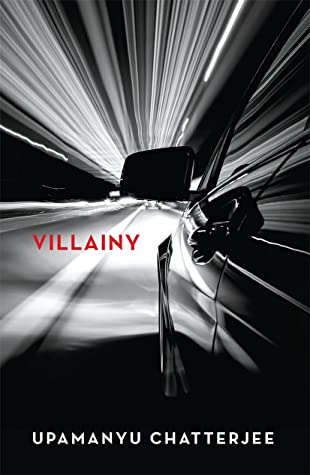
  Is Villainy by Upamanyu Chatterjee a ‘Commercial Thriller’?

Book review by Indrasish Banerjee

Title: Villainy

Author: Upamanyu Chatterjee

Publisher: Speaking Tiger Books


Delhi has many sides to it. It’s the city of Islamic dynasties, transformative history, cultural finesse, power politics. However, some of the celebrated books in last the decade or so on Delhi — The White Tiger (Arvind Agida), The Capital (Rana Dasgupta) — have mostly highlighted its cynical side: the shallowness of its rich, the constant oppression of the poor, the misuse of wealth and power, the ubiquity of corruption, moral decadence and a casual acceptance of everything wrong. I spent a few formative years in Delhi in the 80s. Even back then the common view about Delhi was it wasn’t a place for the straightforward.  But people also felt the city had some redeeming qualities.

In last two and half decades or so, the Manu Sharma case(1999) where the murderer shot a bartender for refusing to serve him; the sordid  tandoor murder (1995) where a suspicious husband killed his wife and several other outrageous occurrences which wreaked havoc in the city exposing its underbelly  and shaped its reputation as a place where nothing is right. This is the timeframe of Upamanyu Chatterjee’s latest book Villainy.

Upamanyu Chatterjee shot to fame with English August in 1988. The Last Burden (1993), Mammaries of the Welfare State (2000) and many more critically acclaimed novels followed. He also wrote a novella, The Revenge of Non-vegetarians (2018) and a collection of long stories, and The Assassination of Indira Gandhi (2019). He won the Sahitya Academy Award for the Mammaries of the Welfare State in 2000 and, in 2008, was awarded the Order of Officer des Arts et des Letters by the French Government for his contribution to literature.

Villainy is structural delight. It starts in 2016 and then takes the reader to the late 90s, into a completely different narrative setting without any obvious linkage to the former strand. In 2016 a dead body of an anonymous person is discovered in a park one early morning when the residents of the area are starting their day. It remains anonymous even after the police leaves no stone unturned for establishing its identity. The other strain is set in 1997, a boy, a spoilt brat, high on Ecstasy pill, out with his father’s Mercedes Benz, murdered two people and a dog.

Loosely based on the high profile Manu Sharma murder case where a rich man’s son killed a woman and justice was meted out only seven years later, the novel would have been every bit a commercial thriller but for the literary style of Upamanyu Chatterjee. If you subtract the style, however, Villainy reads like a novel waiting to be adopted for a pacy web series. The narrative is speedy; the chapters are long, without becoming tiresome, and episodic; the scenes have a visual quality, and they transition swiftly.

There is another thing that reminds you that Villainy is a work of a literary writer: ideological hangover. When a literary writer writes a thriller, characters’ actions mostly conform to their ideological stereotypes. Nemichand, a rich jeweller, is (or has to be) an amoral man. His attitude towards social or economic inferiors is always driven by a bristling class consciousness. He is boorish and uses expletives whenever aroused but when his benefactors do the same, he feels they are acting above station. Atmaram, Nemichand’s driver, on the other hand, is no paragon of virtues – he has accepted money to have his son, Parmatma, falsely admit to committing the murders – but Atmaram is largely a victim of circumstances, which, being the making of the rich, morally exempt the poor man.

But whatever may be its biases, Villainy works at different levels. As a thriller it doesn’t give you too many boring moments. As a literary fiction it gives some moments to reflect on – you should read Chatterjee’s take on villainy in general. Chatterjee has been able to create a sense of time for both the periods (2016 and the late 90s) the plot operates in. His efforts are sometimes cliched like invoking the most talked about events of those times but sometimes they are subtler and less obvious giving you a feeling of reliving those days.

With declining sales of literary fiction and burgeoning popularity of web series, former literary fiction writers are taking to thrillers discarding their subtler muses. Villainy is quite a journey from English August.  But that the likes of Chatterjee are taking to popular genres is actually good news.  Villainy projects a picture of a society with all its flaws and failings — responsibly and deftly.

Click here to read an excerpt

Indrasish Banerjee has been writing and publishing his works for quite some time. He has published in Indian dailies like Hindustan Times and Pioneer, and Café Dissensus, a literary magazine. Indrasish is also a book reviewer with Readsy Discovery. Indrasish stays and works in Bangalore, India. 

.

PLEASE NOTE: ARTICLES CAN ONLY BE REPRODUCED IN OTHER SITES WITH DUE ACKNOWLEDGEMENT TO BORDERLESS JOURNAL