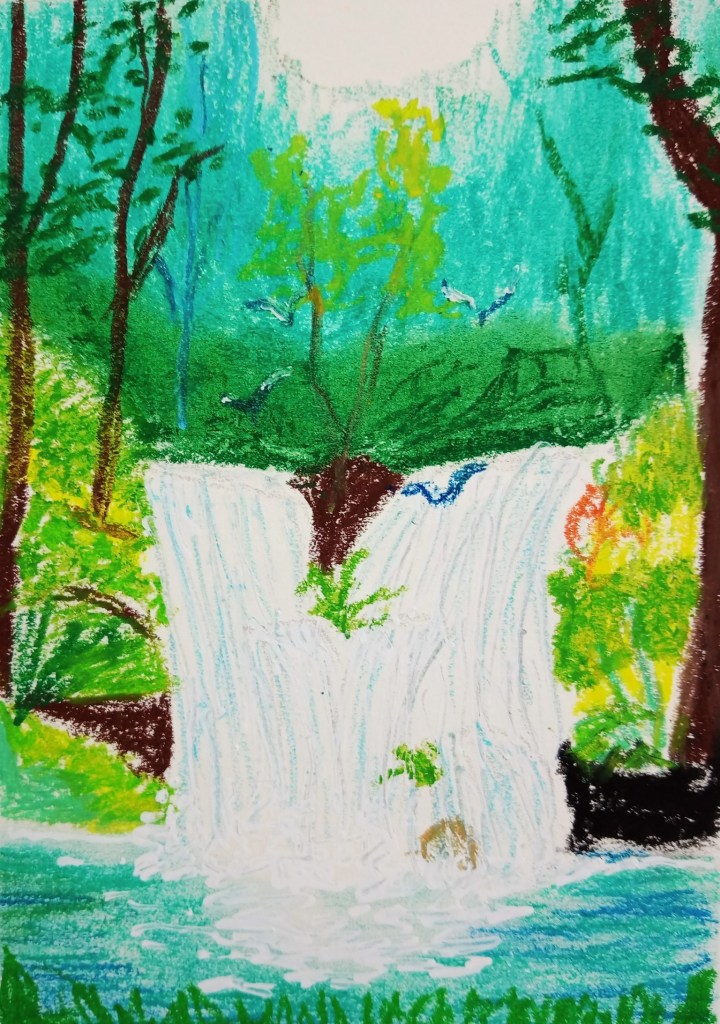
The description in ‘Hot Dry Summers’ is not of hell but what is perceived as happening on certain parts of Earth due to global warming or climate change. Forest fires. Nearer the equator, the storms have become harsher with lightning strikes that seem to connect the Earth to the sky. Trees get uprooted as the soil is softened from excessive rain. Sometimes, they fall on passers-by killing or injuring them. There is no rain in some places, forest fires or flooding in others… The highest temperatures touched 55 degrees Celsius this year. Instead of worrying about losing our homes lodged on land masses to the oceans that continue to rise, becoming dark heat absorbers due to loss of white ice cover, we persistently fight wars, egged on by differences highlighting divisive constructs. It feels strange that we are witness to these changes which seem to be apocalyptic to doomsday sayers. Are they right? Our flora, fauna and food will also be impacted by global climate change. How will we survive these? Will we outlive these as a species?
Poetry in our translations’ section travels to Balochistan, from where a Hafeez Rauf translated from Balochi by Fazal Baloch, talks of burning tyres, again conflicts. It takes on a deeper hue as Ihlwha Choi translates his poignant poem from Korean, reflecting on the death of his mother. We have a translation of Tagore’s less popular poem, Mrityu[1], reflecting on the same theme. His reflections on his wife’s death too have been translated by Professor Fakrul Alam who has also shared a song of Nazrul, written and composed on the death of Tagore. Another lesser-known poet but brilliant nonetheless, Nirendranath Chakraborty, has been translated for us by Debali Mookerjea-Leonard. And what a tremendous poem it is when the person called Amalkanti wanted to be sunshine! We have a story too — ‘Speech Matters’ by Naramsetti Umamaheswararao translated by Johny Takkedasila.
Our stories as usual travel around the world — from Holland (by Paul Mirabile) to Hyderabad (by Mohul Bhowmick) and with a quick pause at Bangalore (by Anagha Narasimha). Travels in the real world are part of our non-fiction. Sai Abhinay Penna takes to a the second largest mangrove forest in the world and Ravi Shankar to Colombo. Madhuri Bhattachrya gives us a glimpse of an Indian summer and Snigdha Aggrawal explores the impact of climate change in her part of the world. Farouk Gulsara actually writes his reflections at a traffic junction. And it reads droll…
We have an in memoriam by Keith Lyons on Morgan Spurlock, the documentary maker who ate McDonald fare for a month and then made a film on it. We have two tributes to two legends across time. Wayne F Burke has given a brief piece on the iconic illustrator, Norman Rockwell. And Aruna Chakravarti, the queen of historic fiction who brought the Tagore family alive for us in her two very well researched novels, Jorasanko and Daughters of Jorasanko, has given us a fabulous tribute to Tagore on the not-so common aspects of him.
Suzanne Kamata, the novelist who does a column from Japan for us normally, has spoken to us about her new novel, Cinnamon Beach, which overrides multiple manmade constructs. It’s an interesting read from someone who lives her life across multiple cultures and transcends many boundaries.
This is a bumper issue, and it is difficult to convey the vibrant hues of words that colour this edition. Please do pause by our contents page for a more comprehensive look.
This issue would not have been possible without all our fabulous contributors and a wonderful, dedicated team. We are delighted that Rakhi Dalal — who has done many reviews and shares her poetry with us in this issue — has agreed to be a writer-in-residence with us. A huge thanks to all of you, and especially Sohana Manzoor for her artwork. I am truly grateful to our readers for popularising our efforts to put together an online space with free and vibrant reads.
I would like to end with a few lines that gives me hope despite climate change, wars and doomsday predictions.
There’s more to life, he says to me, than what you choose to see.
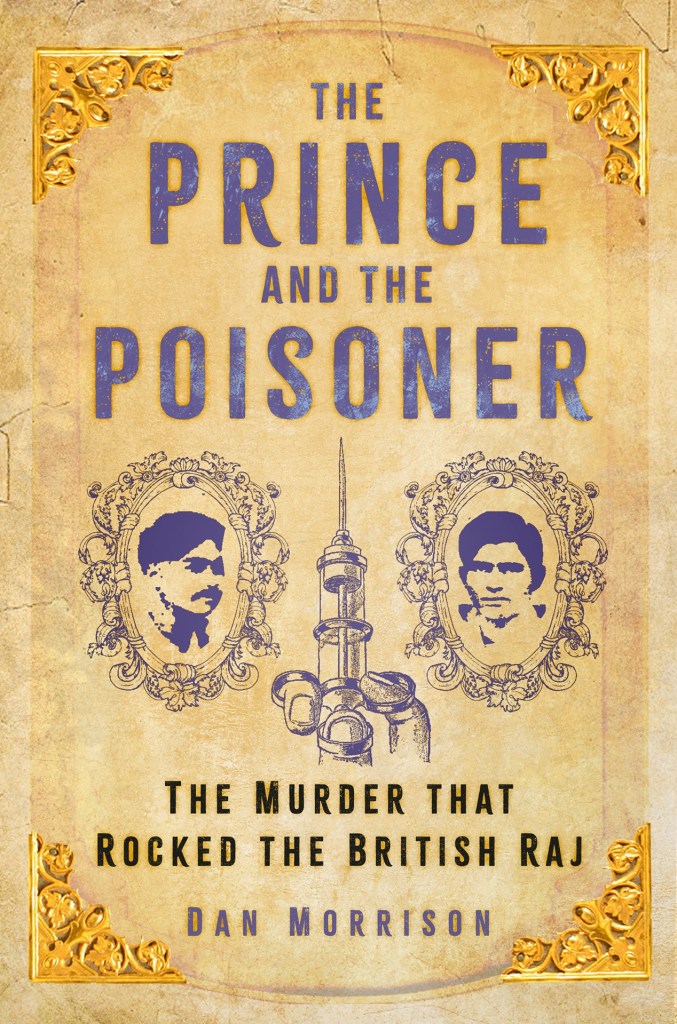
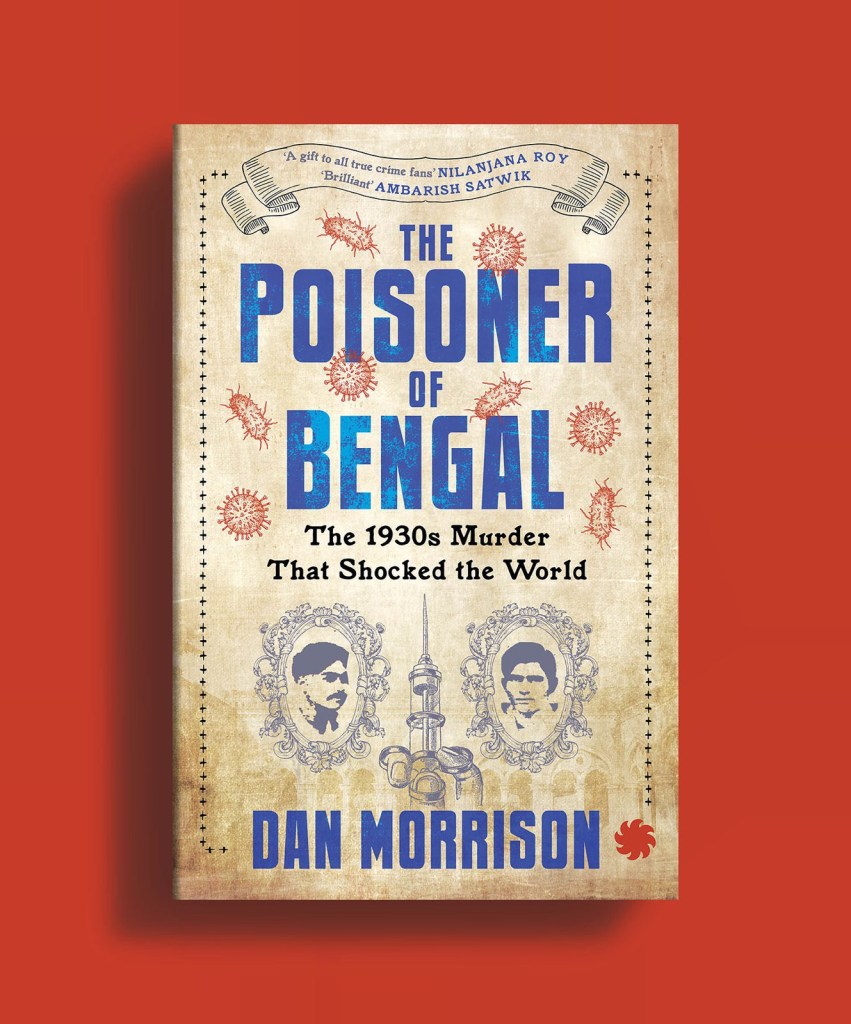
Titles: The Poisoner of Bengal/The Prince and the Poisoner
Author: Dan Morrison
Publishers: Juggernaut (India)/ The History Press (UK)
November1933:HowrahStation
For most of the year, Calcutta is a city of steam, a purgatory of sweaty shirt-backs, fogged spectacles, and dampened décolletage. A place for melting. In summer the cart horses pull their wagons bent low under the weight of the sun, nostrils brushing hooves, eyes without hope, like survivors of a high desert massacre. The streets are ‘the desolate earth of some volcanic valley’, where stevedores nap on pavements in the shade of merchant houses, deaf to the music of clinking ice and whirring fans behind the shuttered windows above.
The hot season gives way to monsoon and, for a while, Calcuttans take relief in the lightning-charged air, the moody day- time sky, and swaying trees that carpet the street with wet leaves, until the monotony of downpour and confinement drives them to misery. The cars of the rich lie stalled in the downpour, their bonnets enveloped in steam, while city trams scrape along the tracks. Then the heat returns, wetter this time, to torment again.
Each winter there comes an unexpected reprieve from the furious summer and the monsoon’s biblical flooding. For a few fleeting months, the brow remains dry for much of each day, the mind refreshingly clear. It is a season of enjoyment, of shopping for Kashmiri shawls and attending the races. Their memories of the recently passed Puja holidays still fresh, residents begin decking the avenues in red and gold in anticipation of Christmas. With the season’s cool nights and determined merriment, to breathe becomes, at last, a pleasure.
Winter is a gift, providing a forgiving interval in which, sur- rounded by goodwill and a merciful breeze, even the most determined man might pause to reconsider the murderous urges born of a more oppressive season.
Or so you would think.
On 26 November 1933, the mercury in the former capital of the British Raj peaked at a temperate 28°C, with just a spot of rain and seasonally low humidity. On Chowringhee Road, the colonial quarter’s posh main drag, managers at the white- columned Grand Hotel awaited the arrival of the Arab-American bandleader Herbert Flemming and his International Rhythm Aces for an extended engagement of exotic jazz numbers. Such was Flemming’s popularity that the Grand had provided his band with suites overlooking Calcutta’s majestic, lordly, central Maidan with its generous lawns and arcing pathways, as well as a platoon of servants including cooks, bearers, valets, a housekeeper, and a pair of taciturn Gurkha guardsmen armed with their signature curved kukri machetes. Calcuttans, Flemming later recalled, ‘were fond lovers of jazz music’. A mile south of the Grand, just off Park Street, John Abriani’s Six, featuring the dimple-chinned South African Al Bowlly, were midway through a two-year stand entertaining well-heeled and well-connected audiences at the stylish Saturday Club.
The city was full of diversions.
Despite the differences in culture and climate, if an Englishman were to look at the empire’s second city through just the right lens, he might sometimes be reminded of London. The glimmer- ing of the Chowringhee streetlights ‘calls back to many the similar reflection from the Embankment to be witnessed in the Thames’, one chronicler wrote. Calcutta’s cinemas and restaurants were no less stuffed with patrons than those in London or New York, even if police had recently shuttered the nightly cabaret acts that were common in popular European eateries, and even if the Great Depression could now be felt lapping at India’s shores, leaving a worrisome slick of unemployment in its wake.
With a million and a half people, a thriving port, and as the former seat of government for a nation stretching from the plains of Afghanistan to the Burma frontier, Calcutta was a thrumming engine of politics, culture, commerce – and crime. Detectives had just corralled a gang of looters for making off with a small fortune in gold idols and jewellery – worth £500,000 today – from a Hindu temple dedicated to the goddess Kali. In the unpaved, unlit countryside, families lived in fear of an ‘orgy’ of abductions in which young, disaffected wives were manipulated into deserting their husbands, carried away in the dead of night by boat or on horseback, and forced into lives of sexual bondage.
Every day, it seemed, another boy or girl from a ‘good’ middle- class family was arrested with bomb-making materials, counterfeit rupees, or nationalist literature. Each month seemed to bring another assassination attempt targeting high officials of the Raj. The bloodshed, and growing public support for it, was disturbing proof that Britain had lost the Indian middle class – if it had ever had them.
Non-violence was far from a universal creed among Indians yearning to expel the English, but it had mass support thanks to the moral authority of Mohandas Gandhi. Gandhi, the ascetic spiritual leader whose campaigns of civil disobedience had galvanised tens of millions, was then touring central India, and trying to balance the social aspirations of India’s untouchables with the virulent opposition of orthodox Hindus – a tightrope that neither he nor his movement would ever manage to cross.
And from his palatial family seat at Allahabad, the decidedly non-ascetic Jawaharlal Nehru, the energetic general secretary of the Indian National Congress, issued a broadside condemning his country’s Hindu and Muslim hardliners as saboteurs to the cause of a free and secular India. Nehru had already spent more than 1,200 days behind bars for his pro-independence speeches and organising. Soon the son of one of India’s most prominent would again return to the custody of His Majesty’s Government, this time in Calcutta, accused of sedition.
It was in this thriving metropolis, the booming heart of the world’s mightiest empire, that, shortly after two o’clock in the afternoon on that last Sunday in November, well below the radar of world events, a young, slim aristocrat threaded his way through a crowd of turbaned porters, frantic passengers, and sweating ticket collectors at Howrah, British India’s busiest railway station.
He had less than eight days to live.
About the Book:
A crowded train platform. A painful jolt to the arm. A mysterious fever. And a fortune in the balance. Welcome to a Calcutta murder so diabolical in planning and so cold in execution that it made headlines from London to Sydney to New York.
Amarendra Chandra Pandey, 22, was the scion of a prominent zamindari family, a model son, and heir to half the Pakur Raj estate. Benoyendra Chandra Pandey, 32, was his rebellious, hardpartying halfbrother – and heir to the other half. Their dispute became the germ for a crime that, with its elements of science, sex, and cinema, sent shockwaves across the British Raj.
Working his way through archives and libraries on three continents, Dan Morrison has dug deep into trial records, police files, witness testimonies, and newspaper clippings to investigate what he calls ‘the oldest of crimes, fratricide, executed with utterly modern tools’. He expertly plots every twist and turn of this repelling yet riveting story –right up to the killer’s cinematic last stand.
About the Author:
Dan Morrison is a regular contributor to The New York Times, Guardian, BBC News and the San Francisco Chronicle. He is the author of The Black Nile (Viking US, 2010), an account of his voyage from Lake Victoria to Rosetta, through Uganda, Sudan and Egypt. Having lived in India for five years, he currently splits his time between his native Brooklyn, Ireland and Chennai.
.
PLEASE NOTE: ARTICLES CAN ONLY BE REPRODUCED IN OTHER SITES WITH DUE ACKNOWLEDGEMENT TO BORDERLESS JOURNAL


 Borderless