Categories
Contents

Borderless, March 2023

Art by Sohana Manzoor

Editorial

Imagine… Click here to read.

Translations

A translation from Nabendu Ghosh’s autobiography, Eka Naukar Jatri (Journey of a Lonesome Boat), translated by Dipankar Ghosh, from Bengali post scripted by Ratnottama Sengupta. Click here to read.

Uehara by Kamaleswar Barua has been translated from Assamese and introduced by Bikash K. Bhattacharya. Click here to read.

Kurigram by Masud Khan has been translated by Professor Fakrul Alam from Bangla. Click here to read.

Bonfire by Ihlwha Choi has been translated from Korean by the poet himself. Click here to read.

Tagore’s Borondala (Basket of Offerings) has been translated by Mitali Chakravarty from Bengali. Click here to read.

Poetry

Click on the names to read the poems

Michael R Burch, Kirpal Singh, Luis Cuauhtémoc Berriozábal, Amit Parmessur, Carl Scharwath, Isha Sharma, Gale Acuff, Anannya Dasgupta, Vaishnavi Saritha, Ryan Quinn Flanagan, Pragya Bajpai, George Freek, Sanket Mhatre, Ron Pickett, Asad Latif, Rhys Hughes

Poets, Poetry and Rhys Hughes

In Indian Pale Ale, Rhys Hughes experiments with words and brews. Click here to read.

Conversation

Being fascinated with the human condition and being vulnerable on the page are the two key elements in the writing of fiction, author and poet Heidi North tells Keith Lyons in a candid conversation. Click here to read.

Musings/Slices from Life

Mother Teresa & MF Hussian: Touching Lives

Prithvijeet Sinha muses on how Mother Teresa’s painting by MF Hussain impacted his life. Click here to read.

The Night Shift to Nouméa

Meredith Stephens writes of her sailing adventures to Nouméa. Click here to read.

Musings of a Copywriter

In Simian Surprises, Devraj Singh Kalsi describes monkey antics. Click here to read.

Notes from Japan

In Multicultural Curry, Suzanne Kamata reflects on mingling of various cultures in her home in Japan and the acceptance it finds in young hearts. Click here to read.

Essays

Which way, wanderer? Lyric or screenplay…

Ratnottama Sengupta explores the poetry in lyrics of Bollywood songs, discussing the Sahityotsav (Literary Festival) hosted by the Sahitya Akademi. Click here to read.

One Happy Island

Ravi Shankar takes us to Aruba, a Dutch colony, with photographs and text. Click here to read.

Cadences in A Portrait of the Artist as a Young Man

Paul Mirabile explores the stylistic nuances in this classic by James Joyce. Click here to read.

Stories

Heafed

Brindley Hallam Dennis plays with mindsets. Click here to read.

Busun

A Jessie Michael narrates a moving saga of displacement and reservations. Click here to read.

A Wooden Smile

Shubhangi gives us poignant story about a young girl forced to step into the adult world. Click here to read.

The Infallible Business

Sangeetha G tells a story set in a post-pandemic scenario. Click here to read.

Book Excerpts

An excerpt from Robin S. Ngangom’s My Invented Land: New and Selected Poems. Click here to read.

An excerpt from Vikas Prakash Joshi’s My Name is Cinnamon. Click here to read.

Book Reviews

Aruna Chakravarti reviews Bornali Datta’s In A Better Place: A Doctor’s Journey. Click here to read.

Somdatta Mandal reviews Baba Padmanji’s Yamuna’s Journey, translated from Marathi by Deepra Dandekar. Click here to read.

Basudhara Roy reviews Robin Ngangom’s My Invented Land: New and Selected Poems. Click here to read.

Bhaskar Parichha reviews S.Irfan Habib’s Maulana Azad – A Life. Click here to read.

.

Click here to access the Borderless anthology, Monalisa No Longer Smiles

Click here to access Monalisa No Longer Smiles on Kindle Amazon International

Categories
Editorial

Imagine…

Art by Pragya Bajpai

Imagine a world without wars, without divisions, where art forms flow into each other and we live by the African concept of Ubuntu — I am because you are’ — sounds idyllic. But this is the month of March, of poetry, of getting in touch with the Dionysian elements in ourselves. And as we have said earlier in the introduction of Monalisa No Longer Smiles: An Anthology of Writings from across the World, what could be a better spot to let loose this insanity of utopian dreams than Borderless Journal!

Having completed three years of our Earthly existence on the 14th of March, we celebrate this month with poetry and writing that crosses boundaries — about films, literature and more. This month in the Festival of Letters or Sahityaotsav 2023, organised by the Sahitya Akademi, films were discussed in conjunction with literature. Ratnottama Sengupta, who attended and participated in a number of these sessions, has given us an essay to show how deep run the lyrics of Bollywood films, where her father, Nabendu Ghosh, scripted legends. It is Ghosh’s birth month too and we carry a translation from his Bengali autobiography which reflects how businessmen drew borders on what sells… After reading the excerpt from Nabendu’s narrative translated by Dipankar Ghosh and post-scripted by Sengupta, one wonders if such lines should ever have been drawn?

Questioning borders of a different kind, we have another piece of a real-life narrative on a Japanese Soldier, Uehara. Written by an Assamese writer called Kamaleswar Barua, it has been translated and introduced by Bikash K. Bhattacharya. The story focusses on a soldier’s narrative at his death bed in an alien land. We are left wondering how his need for love and a home is any different from that of any one of ours? Who are the enemies — the soldiers who die away from their homes? What are wars about? Can people live in peace? They seemed to do so in Kurigram, a land that has faded as suggests the poem by Masud Khan, brought to us in translation from Bangla by Professor Fakrul Alam, though in reality, the area exists. Perhaps, it has changed… as does wood exposed to a bonfire, which has been the subject of a self-translated Korean poem by Ihlwha Choi. Tagore’s poem, Borondala translated as ‘Basket of Offerings’, has the last say: “Just as the stars glimmer / With light in the dark night, / A spark awakens within/ My body. / This luminosity illuminates / All my work.” And perhaps, it is this luminosity that will also help us find our ideal world and move towards it, at least with words.

This is the poetry month, and we celebrate poetry in different ways. We have an interview with poet Heidi North by Keith Lyons.  She has shared a poem that as Bijan Najdi said makes one “feel a burning sensation in …[the]… fingertips without touching the fire”. It flows with some home truths put forward with poignancy. We have poetry by Michael R Burch, Kirpal Singh, Luis Cuauhtémoc Berriozábal, Amit Parmessur, Ryan Quinn Flanagan, George Freek, Sanket Mhatre, Asad Latif and Rhys Hughes. While Burch celebrates spring in his poetry, Parmessur explores history and Hughes evokes laughter as usual which spills into his column on Indian Pale Ale. Devraj Singh Kalsi has written of simian surprises he has had — and, sadly for him, our reaction is to laugh at his woes. Meredith Stephens takes us on a sailing adventure to Nouméa and Ravi Shankar explores Aruba with photographs and words. Suzanne Kamata shows how Japanese curry can actually be a multicultural binder. Prithvijeet Sinha links the legends of artist MF Hussain and Mother Teresa while Paul Mirabile explores the stylistic marvels of James Joyce in his A Portrait of the Artist as a Young Man, a very literary piece.

We have a book review by Aruna Chakravarti of Bornali Datta’s In A Better Place: A Doctor’s Journey, a book that is set amidst immigrants and takes up certain social issues. Baba Padmanji’s Yamuna’s Journey, translated from Marathi by Deepra Dandekar, one of the oldest Indian novels has been discussed by Somdatta Mandal.  Bhaskar Parichha has told us about S.Irfan Habib’s Maulana Azad – A Life. Basudhara Roy has brought out the simplicity and elegance of Robin Ngangom’s My Invented Land: New and Selected Poems. He writes in the title poem that his home “has no boundaries. / At cockcrow one day it found itself/ inside a country to its west,/ (on rainy days it dreams looking east/ when its seditionists fight to liberate it from truth.)”. We also carry an excerpt from his book. Stories by Jessie Michael, Brindley Hallam Dennis, Sangeetha G and Shubhangi bring flavours of diversity in this issue.

Our journey has been a short one — three years is a short span. But, with goodwill from all our readers and contributors, we are starting to crawl towards adulthood. I thank you all as caregivers of Borderless Journal as I do my fabulous team and the artists who leave me astounded at their ability to paint and write — Sohana Manzoor, Gita Vishwanath and Pragya Bajpai.

Thank you all.

Looking forward to the next year, I invite you to savour Borderless Journal, March 2023, where more than the treasures mentioned here lie concealed.

Mitali Chakravarty

borderlessjournal.com

Click here to access the Borderless anthology, Monalisa No Longer Smiles

Click here to access Monalisa No Longer Smiles on Kindle Amazon International
Categories
Review

Is There No Place like Home…?

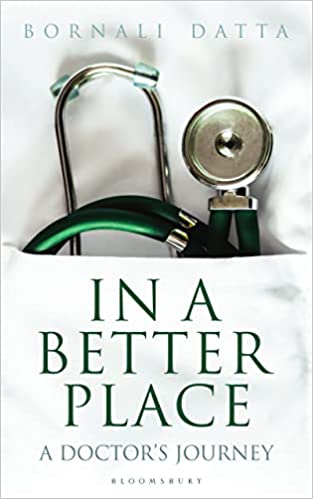
Book Review by Aruna Chakravarti

Title: In A Better Place: A Doctor’s Journey

Author: Bornali Datta

Publisher: Bloomsbury, U.K.

The author of In a Better Place is a highly respected medical practitioner with a long and distinguished career in U.K. and India. Given the vast knowledge and wide-ranging experience that have gone into the writing of this book, it is surprising to note that it is not an academic work. It is a novel, written with effortless ease, that proves to be as informative as it is readable and interesting. Bornali’s language is simple and has a gentle mellowness and her style, though lively, isn’t racy or trendy. It has a leisurely flow but demands close attention. She gives her reason for writing this book in her ‘Author’s Note’:

“While reams of clinical history and medical notes are written arduously every day in every hospital by its diligent doctors and nurses, there is hardly anyone to document the human stories that unfold continuously in the long corridors and lonely wards of hospitals.”

The book, as per her own admission then, is not an account or analysis of medical research and clinical practice. It is a story of human lives caught in the cusp of aspiration and reality. Of sickness and suffering entwined with the pressures and frailties of care givers. It draws from detailed and extensive research into the lives of Indian doctors during the last thirty years of our history. A momentous period which saw globalization and the waking up to a Many countries; One world, concept in a big way.

 The writer shows a comprehensive understanding of her subject. Her characters are a group of idealistic young doctors, who are genuinely eager to use their medical education to treat the sick in the best way possible. They inhabit two worlds, India and England, sometimes physically; sometimes in spirit. They are confronted with two choices to begin with. Adherence to convention and traditional ways. Or carrying out their aspirations for what they think will be a better life, in defiance of social and parental pressure. Those who are unhappily trapped in India’s heat and dust, poverty and primitive systems, crowds and chaos yearn for foreign shores. Those who have made it to the West are ill at ease in the strange new life they have embraced. A sense of not fitting in, of somehow being reduced to the other despite all their education and proficiency in English, dogs them. Swamped in nostalgia and exile they are confused and bewildered.

Both sets of lives are seen as fragmented. Places define people and relationships. The book provides a fascinating kaleidoscope of yearning and aspirations in a direct, not always complimentary way. The value of the book lies in its creation of complex emotions, use of empirical data and honest telling.

The chief protagonist of the novel, Sudha, undergoes post graduate training in a government hospital in Delhi before moving to England with her husband, another young doctor called Girish. Their friends, Jai and Sanjay, also make it to their dreamland. All four are overwhelmed, initially, by the difference in the two systems and take a jingoistic delight in having reached where they wanted to be. The dirt and squalor in Indian hospitals, the rusted equipment and callous attitude to suffering by overworked doctors and nurses, is a shameful contrast to what they see in English hospitals. At first the picturesque buildings, manicured lawns, spotless beds and hushed corridors win their total admiration and respect. But, gradually, they get a sense that all is not as it appears on the surface. They, who only wish to do their best, encounter hurdles, injustice and racism and the cold, hard superiority of people who will never forget or let them forget they were once their rulers. An immigrant angst overtakes them. Some make a desperate bid to overcome it and manage to carve a groove for themselves in the land of their exile through unequal, often loveless, marriages with British citizens. Some begin to consider going back to India. But the choice, either way, is equally hard.  

Dr. Chatterjee, a senior doctor in the hospital Jai works in, has made two attempts to return to India. Both proved abortive and he was forced to return. His wife and children, having lived too long in the West, could not adjust to India. He has become the proverbial nowhere man, unable to find a comfort zone anywhere. Though an excellent doctor and an intelligent, cultured gentleman, he knows that he will never reach the top of his profession or be accepted socially by his colleagues.

 “’The Whites…,’ he tells Jai, ‘don’t want to socialize with you. Take Dr Smith and Dr Weldon. I’ve called both of them for dinner to my house, their entire families, not once but two times. But there is no reciprocation from their side. Not once have they invited me over, although they get together quite often.’”

Aspirations die but hope continues. People suffer but they also find solutions. The author is non-judgmental.

“There is never right or wrong­­­, she says in conclusion to her story.  Just what works for one and what works for another. Life goes on regardless, both inside and outside of the hospital, through the trepidation of change, of migration, of loss and adoption of a foreign land.”

 But what, in the end, is a better place? Though Bornali doesn’t provide the answer I am tempted to do so. I quote from a poem I used to recite as a child:

Mid pleasures and palaces though we may roam
Be it ever so humble there’s no place like home.

Aruna Chakravarti was the principal of a prestigious women’s college of Delhi University for ten years. She is also a well-known academic, creative writer and translator with a number of published books on record. Her novels, The Inheritors, JorasankoDaughters of Jorasanko, have sold widely and received rave reviews. The Mendicant Prince is her last novel and Through a Looking Glass, her latest short story collection. She has also received awards such as the Vaitalik Award, Sahitya Akademi Award and Sarat Puraskar for her translations.

PLEASE NOTE: ARTICLES CAN ONLY BE REPRODUCED IN OTHER SITES WITH DUE ACKNOWLEDGEMENT TO BORDERLESS JOURNAL. 

Click here to access the Borderless anthology, Monalisa No Longer Smiles