Categories
Poetry

Learning to Listen to Silence

By Saranyan BV

Our friendship overcomes the distance between the balconies.

At first the extent seems long, gaping like the head of a ship-mast sailing beyond the horizon.

We could connect only with our eyes. We do not have access to each other.

Otherwise, she is companionable, very bubbly. She is petite,

I guess she feels lost being alone. She demands I remain in the balcony all the time.

And I would, a book of poems on my lap.

My neighbours often leave her alone,

go roaming, to play or to munch popcorns in movie malls,

She would express her stress by barking through the morning,

or whining the rest of the day. I learn not to be troubled by her tantrums.

She would jump with joy upon seeing me, let me know how happy she felt using the tail.

I never reason any other purpose for that appendage.

It makes me feel inadequate, the absence of it.

In that period of love we forge our clandestine kinship by panting like mountaineers doing high altitude trek.

I learn to return her love.

I would lean over the balustrade and pretend to hug.

She taught my eyes to ooze oxytocin, which she channels into her wide-eyed ardour.

And then her folks move away to another apartment, taking her along.

She is not aware of the plan to move, she has not been told, she goes without saying goodbye.

I still have the book on my lap, the book of poems, open and face down.

The silence is not adequate to replace the ligature of our bond

or to teach me how to bear her absence with quietude.

Saranyan BV is poet and short-story writer, now based out of Bangalore. He came into the realm of literature by mistake, but he loves being there. His works have been published in many Indian and Asian journals. He loves the works of Raymond Carver.

.

PLEASE NOTE: ARTICLES CAN ONLY BE REPRODUCED IN OTHER SITES WITH DUE ACKNOWLEDGEMENT TO BORDERLESS JOURNAL

Click here to access the Borderless anthology, Monalisa No Longer Smiles

Click here to access Monalisa No Longer Smiles on Kindle Amazon International
Categories
Stories

Alvin and the Curious Case of Spoilt Milk

By Anagha Narasimha

The Bangaloreans will mostly remember the spring of 2024 for bringing on only the heat wave. The Garden City’s temperature reached an unprecedented forty-one degrees Celsius (falling just nine short of a half-century. The summer was terrible for Bangaloreans on two counts – the heat wave and the RCB[1] Men’s team drifting further away from their slogan, hashtag ESCN[2]. But, all of it changed and changed suddenly. The pre-monsoon showers finally brought some relief from the heat wave. Although it initially teased everyone with sprinkles (making the entire city seem like a hot dosa pan, from which steam emanates as soon as the chef sprinkles water). The clouds took pity on the poor souls and became generous eventually. Similarly, RCB Men’s fortunes also changed and changed utterly as they stood with a legitimate chance of qualifying for playoffs after six consecutive wins on the trot.  

Amidst the aforementioned cloudy weather, teasing the Bangaloreans, Alvin, a young advocate in a mid-tier law firm, enjoying his long-sought break from the court, finally decided to make himself a coffee from the coffee brewer. All thanks to the summer that preceded, he had forgotten the setting of the coffee brewer and had to rely on the manual. Finally, he found a way to set the brewer to make a cappuccino with 80 ml of milk and 40 ml of coffee. Just when he was about to press start, his senior colleague interrupted: “What the heck are you doing? Can’t you see that the milk is spoilt?” Alvin did not even bother checking the authenticity of the claim by himself as he knew he would not be able to figure it out. He directly took the matter to the only other colleague who happened to be working even during court vacation, albeit cursing her fate.  

Avni, who was buried inside her file, was suddenly brought back to the office by Alvin.

Avni blurted, “Oh good you are here!”

Alvin showed her the container with the milk and Avni realised she made a big blunder by assuming that Alvin’s presence was a good sign.

Alvin confirmed her fear by asking, “Tell me whether it’s spoilt.”

“Spoilt? It has become curd, you idiot, ” retorted Avni, adding, “And here I was… thinking I would take your advice on my cheque bounce case.”

Accepting Avni’s judgment, Alvin proceeded to throw the milk (or curd) into the wastebin and just then… He noticed the empty aseptic tetra-pack milk sachet lying there craving his attention. He carefully picked it up, went straight to Avni and held it in front of her as a matter of fact. Avni had given up on Alvin’s antics and had decided to finish her work and go home.

Avni: “What?”

Alvin: “It was lying in the dustbin.”

Avni: “Ewwww gross. Throw it away.”

Alvin: “You don’t see?”

Avni: “I see trash but I don’t see why it is outside the dustbin!”

Alvin: “The maid clears the bin every morning around ten thirty…”

Avni: “Mhmm. You are the one to tell. Who’s never in office before 11!”

Alvin: “It is nonetheless. It is twelve forty-eight now. And the packet is still in the bin. Which means it was opened after ten thirty.”

Avni: “Mhmm.”

Alvin: “So processed milk, packed in an aseptic tetra-pack, gets spoiled within two hours?”

Avni, finding all the strength within her, dragged herself out of the file she was covered in and yelled, “What do you want me to do now? Sue them? For fifty rupees?”

Alvin: “No!”

Avni: “Yeah right. Let’s add damages too!”

Alvin: “No!”

Avni: “I must prepare for cross-examination in a Section 138 NI Act case. So why don’t you just blurt out whatever it is?”

Alvin: “How did the milk get spoiled?”

Avni: “Really? I’m asking you for a way to rebut the presumption against the accused in a cheque bounce case and you are worried about spoilt milk?”

Alvin: “Well…”

Avni: “You know what they say? Do not cry over ‘spoilt’ milk!”

Alvin: “What?”

Avni: “Forget it.”

Alvin: “You don’t get it. Cause milk can’t get spoiled for no reason. That would change everything. If you let it go then the very fabric of causality will be ruined and once that’s done… Well, it opens the floodgate and anything can happen.”

Avni stared at him with a dismissive look, “All that’s great but some of us are dealing with real-life problems like preventing a person from going to prison. So can we first focus on that?”

Alvin: “Ah, maybe you’re right. What is it now?”

Alvin sat beside her and cleared the long pile of files that were enjoying their summer break.

Avni: “Good! We’re for the accused. The complainant alleges that the accused issued the cheque in discharge of the amount he lent to the accused in cash on January twenty-seventeen, worth sixteen lakhs[3]. Well, the accused says he received no such cash and the complainant is misusing his signed cheques – but the presumption under Section 118 and Section 139 is against the accused, so…”

Avni was startled when she saw Alvin dozing off in the middle of her narration.

Avni: “Oh come on! For crying out loud! I am not narrating some chanda mama[4] story or singing a lullaby.”

Alvin: “Well you know me. I want my afternoon nap. That’s the reason I wanted to have a cup of coffee in the first place.”

Satisfied with his explanation, he laid his head to rest on the cleared table. Avni could not afford that luxury and she went back to her files. Alvin, who was struggling to stay awake, was now struggling to sleep. Coffee was supposed to help him not fall asleep, and now the thought of missing coffee kept him awake.

The entire event ran in flashes while he tried to sleep.

INT. MID-TIER LAW OFFICE – MID-NOON

Nitin, a middle-aged, office clerk, is running around haphazardly stitching a file. He is cursing somebody – “Even on vacations — these people won’t let me even have a cup of coffee in peace. Keep calling again and again, interrupting. Screw them.” 

Alvin makes sure that the coffee beans are filled. Alvin presses the buttons to make the coffee. Nothing is working. Realises it is switched off. Finds the plug and connects it to the switchboard. The tray on which the coffee cup is supposed to be placed is dusty. Searches for a towel nearby, and finds it on the printer. The towel is also dusty. Ends up wiping the tray with tissues…

BLACKOUT

Alvin woke up suddenly, imagining himself to have exclaimed “Eureka”, except, he had done that only in his sleep. Avni felt she was oblivious to the world of Alvin and continued with her day out with the file.

Alvin ran towards the coffee brewer, completely ignoring Avni’s presence. He had reached the coffee brewer by the time he realised his mistake, and returned to the office cabin to drag reluctant Avni with him.

Alvin: “I got it!”

Avni: “There is no way I can escape this is it?”

Alvin: “So why bother?”

Avni: “I’ll listen to your crazy explanation only if you promise to assist me in preparing for the cross.”

Alvin proclaimed, “Done.”

Alvin: “You see the Bean Hopper? It is recently filled.”

Avni: “So?”

Alvin: “The brewer wasn’t even connected to the power source and I had to dust it before connecting. Obviously, everyone’s on vacation and it wasn’t in use so it was dusty.”

Avni: “Can we cut to your big reveal, where my exhaustion takes the form of beating you up?”

Alvin: “If these are dusty, the milk container must also be dirty.”

Avni: “Ewwww and you were making coffee with that?”

Alvin: “Hell no. The milk was already filled, and I saw Nitin running around, cursing the work that he had been asked to do.”

Avni: “Poor Nitin. Just like me.”

Alvin rushed past Avni to the washbasin where the sponge was lying on the washbasin, completely displaced from its actual position.

Alvin: “You see?”

Avni: “What am I supposed to see?”

Alvin: “Nothing is in order. The sponge is over there, the liquid soap isn’t even closed properly, and you can even find the soap smudges on the washbasin.”

Avni: “Don’t wait for me to react. Just get done with it already.”

Alvin: “Nitin came to the office, earphones plugged, listening to some merry song, thinking of starting his day by making a cup of coffee. He brought out a packet of milk, prepared to clean the milk container, and the office telephone rang – vibrations tearing through the melody of the song being played on his earphones.”

Narrating thus, Alvin walked towards the telephone and pressed a button revealing the call logs.

Alvin continued: “Nitin cursed his fate when they assigned work, but thought he could start with it after having his daily cup of coffee. He went back to cleaning the container and then again – as you can see from the call log – multiple calls didn’t let him have the coffee.”

Avni: “He spoilt the milk so that none can have coffee?”

Alvin: Nah! There is no mens rea[5]whatsoever. If that was the case, he would have made sure none would notice. He was constantly disturbed by the calls. He realised he couldn’t have his coffee so decided to clean it and pour the milk so that he could have it as soon as he was done with the work. While he was cleaning the container – you can see there were a few more calls – he hurried, after cleansing the container with the liquid soap, he forgot to soak it in hot water to remove the soap remnants.”

Avni: “How do you know?”

Alvin points at the water dispenser, which was switched off, which further implied that Nitin had no access to hot water.

Alvin: “Nitin, in that state of mind, added milk to the container which had soap remnants.”

Alvin pointed out the lemon on the liquid soap bottle and with a wide grin exclaimed, “…did the job of spoiling the milk”.

Avni: “That’s artificial lemon, you genius. They don’t add actual lemon.”

Alvin: “Yes indeed. What they add to get that lemon flavour is limonene — a colourless liquid aliphatic hydrocarbon classified as a cyclic monoterpene, which is the major component in the volatile oil of citrus fruit peels. That’s how we were faced with the curious case of spoilt milk.”

Avni: “You. Just you. Don’t you dare include me by saying we. Now, if you’re done playing Sherlock Holmes, can we switch to Perry Mason and find a way to rebut the presumption against the accused in our case?”        

Alvin: “Ah, don’t worry about it.”

Avni: “Why? You have a few more spoilt milk puzzles to solve?”

Alvin: “You can disprove the complainant’s testimony.”

Avni: “How? The complainant says he gave a loan worth sixteen lakhs to the accused. The signature is not disputed. There is no way to prove that the complainant hasn’t given sixteen lakhs because the presumption in his favour.”

Alvin: “How much does the complainant claim to have paid?”

Avni: “Sixteen Lakhs.”

Alvin: “Date of payment?”

Avni: “Sometime during January 2017.”

Alvin: “Mode of payment?”

Avni: “Cash. How convenient?”

Alvin: “Denomination?”

Avni: “I don’t know. Five hundreds and thousands?”

Alvin: “There. You have proved him wrong.”

Avni: “How?”

Alvin: “In January 2017, he paid a sum of sixteen lakhs via cash. November 2016, we had demonetisation — five hundred and thousand notes were discontinued. Moreover, he couldn’t have paid more than two lakhs in cash to the accused as per the guidelines that existed. There. You have proved he is lying on oath.”

Avni ran to her chamber to verify the statements – “He says he paid the entire sixteen lakhs at one stretch” – Her facial expression screamed “Eureka”, while Alvin prepared coffee for both of them.

Avni, sipping her coffee, “So when did you realise this loophole?”

Alvin: “As soon as you told me the case.”

Avni: “And why didn’t you tell me?”

Alvin: “You would have gone home and I had to solve the curious case of spoilt milk alone.”

Avni: “One day… You’ll find poison in your coffee and you’ll die without ever knowing how it got there.”

Alvin sounded baffled, “You’re so mean”.

Finally, the rain made up its mind to show mercy on Bangalore by pouring down as they had their coffee in peace.

.

[1] Royal Challenger’s Bengaluru, a football team.

[2] Ee Sala Cup Namde translates to ‘This time, the cup is ours’

[3] A lakh is an Indian denomination equal to 100,000

[4] Chanda mama or moon uncle in Hindi… here used in lieu of fairy tale

[5] The intention or knowledge of indulging in a crime constitutes a criminal act.

Anagha Narasimha C N, an advocate by profession, is also a poet and writer. His poems in Kannada and English are published in various online journals and he is actively involved in playwriting and theatre production. 

.

PLEASE NOTE: ARTICLES CAN ONLY BE REPRODUCED IN OTHER SITES WITH DUE ACKNOWLEDGEMENT TO BORDERLESS JOURNAL

Click here to access the Borderless anthology, Monalisa No Longer Smiles

Click here to access Monalisa No Longer Smiles on Kindle Amazon International

Categories
Essay

Picked Clean

By Snigdha Agrawal

Right now, we are on the cusp between pre-monsoon and full-blown monsoon.  The commencement of cool windy breezes and the partially cloudy skies comes as a welcome relief after the asphalt-melting summer heat, experienced this year.  Just what is needed to uplift melting spirits. The mind has started recalibrating, the body readjusting, to the sudden dip in temperatures in the ‘Garden City’ of Bangalore, known for its salubrious climate right around the year.  Defined by a short, short summer with the temperature barometer rarely rising above 34°C.  December, January, and February, temperatures usually hover around 16°C to 18°C, a trend that has barely changed over the last thirty-plus years of my stay in the city.  However, over these thirty-odd years, there have been several departures concomitant to the growth and evolution of the city. 

The nomenclature “Pensioner’s Paradise”, has lost its significance with the progressive encroachment into virgin lands and lung spaces in the city getting systematically squeezed. A ‘Paradise lost’ and no hopes of it ever being regained.  Road rollers, cranes, and crawlers are seen in every neighbourhood, slowly but surely picking the city clean of all its flora, fauna and water bodies. Justifiably nothing different from the growth path in other metros across the world but its impact on the environment, has become more and more evident.  I can unequivocally say, that some of these major shifts have had a huge impact on both climate and the environment. The causative effect of overpowering greed hinged on profitability.  The then Bangalore, a far cry from the now Bangalore. I will come to that later.  


When I first relocated to Bangalore from Kolkata, a coastal city with a hot and humid climate, the sobriquet ‘air-conditioned’ City was not its only USP.  It had earned the epithet ‘Silicon Valley’ that came about with IT companies/industries shifting their operations, lock stock and barrel to this much sought-after location, ergo necessitating a shift of manpower.  The city thus, witnessed a massive exodus of techies/white-collar workers, moving in from various parts of the country to take up residence in the city.  Dominique Lapierre’s City of Joy[1] saw the greatest pullout.  Discarding the old for the new as some would think, was not so out of choice but for compelling reasons, following the shutdown of establishments, an antiquated work culture, and the government’s short-sighted policies; some of the contributing factors attributed to this attrition.

In June 1991, we moved into the city which surprised us pleasantly.  First, there was no need to run ceiling fans.  Strikingly different from Kolkata, where fans and air-conditioners did little to relieve the heat and humidity. Bangalore’s room air-conditioner vents remained tightly closed permanently, and by extension, contributed to a reduction in noise pollution.  The susurration of the breeze, floating in through the windows was like being permanently plugged into music channels on YouTube.  Therefore, it was unsurprising to that the figure for the first month’s electricity bill was a record low since the previous decade. 

Natural lighting was more than abundant without anything to block it, eliminating the need to switch on the lights till well after sunset. The view from the 6th-floor apartment balcony on Richmond Road opened into an orchard of tall palm trees, beyond which stood the Good Shepherd Convent.  Nuns walking in the coconut orchards while fingering the moving rosary beads had this effect of transporting one to a seaside setting, sans the sand and sea.  Sublime.  Often, I wondered if we had moved to a city at all! The ambience was so contrary to what one would conjure about big cities. 

By the time, we moved out of the apartment, after a stay of twelve years, the view was curtained off.  Gone were the tall trees. Felled indiscriminately.  Spidery earth movers had taken over, raising noise pollution, and piercing through the ear drums.  The heavily laden polluted air inhaled gave rise to frequent allergies. From the perspective of the locals, who resented the invasion of their paradise, parthenium was not alone to blame.  Rightly so. 

Funnily with the commencement of the academic year, my girls then twelve and eight were taken aback by the need to wear sweaters to school. “Woollens are for winter months, right Mamma?”  True that. A strange phenomenon for the newly arrived Kolkata migrants precipitated the need to unbox the woollens, with naphthalene balls inserted between folds.  Duvets and blankets intended to be unpacked during November and December got a premature release from their taped cardboard cartons.  That was Bangalore weather then. 

In a couple of years, as the girls moved from school to college, they were no longer layering during these monsoon months of June/July.  The only conclusion drawn is either they had acclimatised to the Deccan plateau weather conditions or had become self-conscious during the growing up process, or was it a clear pointer to climate change? The latter seems more plausible.  Supported by the fact that initially during the first few years, the bathroom geysers stayed plugged in for the entire day, to the subsequently reduced hours (one/two hours before shower time) stay highlighted with a bright marker on memory panels. 

With the wiping out of tree-lined avenues and vintage colonial bungalows dotting the landscape, giving way to multi-storeyed offices and high-rise apartment complexes, the city soon acquired a garish makeover plastering the natural tone of the city’s face.  Twelve years on Richmond Road, saw all this and more.  Decentralisation was on its way.  Moving out from the central district to the outlying areas, becoming inevitable.  In 2003, we moved to our new apartment in Domlur Layout, still relatively pristine, with virgin forest cover.  But not for very long.  The tentacles of greed reached out grabbing all this, in justification of better civic amenities.  In a couple of years, the inner ring road snaked its way connecting Indiranagar to Koramangala thus reducing travel time.  Hailed as the best thing for commuters, at what cost?  Filling up ponds, deforestation, levelling whole villages, and gobbling up military land as well — approvers of the city’s expansion worked tirelessly.    

Water shortage was evident here with most residential complexes having to rely on tankers for water supply.  A cost added to the already steep monthly maintenance fee paid by apartment dwellers as well as stand-alone homes. Unbudgeted.  Dipping into pockets, water shortage was rearing its ugly head in the City of Thousand Lakes, conceived and built by Kempe Gowda.  The bane of urbanisation, reportedly, of the eighty-one existing ‘live’ lakes Kempambudhi and Ulsoor dating back to the 16th century, have since shrunk in acreage. Many others have just disappeared from the landscape.

In our pursuit of green spaces and low noise pollution, we once again moved further to Whitefield, named the Electronic City, a neighbourhood in Bangalore developed explicitly for housing the electronics industry in 2017.  Greens visible.  Aha! This would be our paradise in a city turned inside out with ugly stitches showing up in the inner seams.  Alas! A short-lived dream.  The beautiful Vathur Lake, a huge water body, soon was seen foaming and frothing, spilling over to the adjacent lands as a consequence of chemical effluents pouring into the lake.  Resulting in the discolouration of water and an unbearable stench, it became imperative for lake-side dwellers to shift residence. The lavender hyacinth blooms floating on the lake surface were permanently coffined and nailed down by concrete slabs.  Roads ran over these.  Voices were raised in protest.  But who’s listening?  Construction activities continued, all in the name of development, providing job opportunities, and housing for the increased growth in population.  A city bursting at the seams.

This year summer took the worst toll, with temperatures peaking at 38.1°C on 2nd May, the hottest day in forty years.  From no air conditioners being run in 1991 to sitting whole day in air-conditioned surroundings is riling for all.  Faced with acute shortages, the city authorities clamped down on water usage, making it mandatory for apartment dwellers to install aerators on taps, to reduce the water flow. Failure to comply would invite heavy penalties, uniformly across the city.  And they were deadly serious, warning of inspectors making surprise visits to homes to ensure compliance.

Now, in a two-member household, that to retirees, that made no sense.  I confess to non-compliance and got away with it.  Resorting to ‘bucket baths’ in place of standing under the shower, was a contribution in the right direction. With the rains, this mandate has been lifted. And that brought on chuckles rewinding to childhood memories of those bitterly cold winter months and Ma’s famous line ‘no kager chaan[2]’ before our baths and, most often, being sent back to repeat baths.  Ma put up with no excuses for short-cut baths.  But the writing on the wall is loud and clear.  Heading to the apocalypse?  

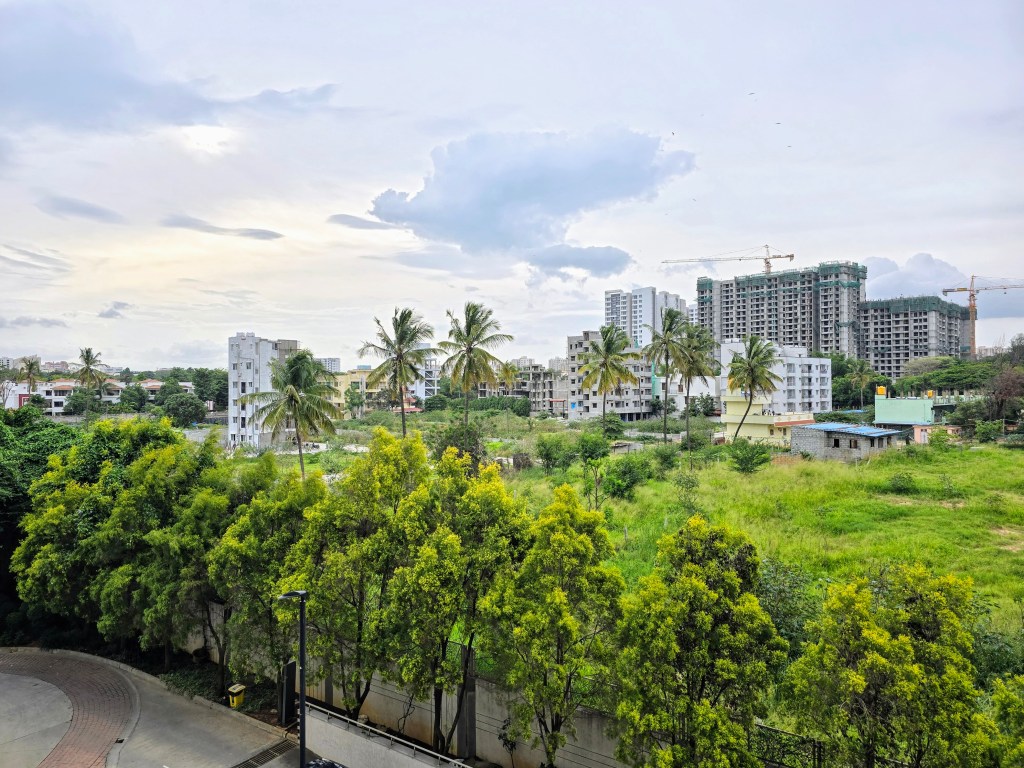
For the time being, I feel privileged that the green field outside my third-floor living room balcony, a disputed property, remains untouched.  A treat for the old eyes.  For how long is anybody’s guess?  

The green field outside the window. Photograph by Snigdha Agrawal

[1] Kolkata. The City of Joy by Dominique La Pierre gave Kolkata that sobriquet

[2] Crow’s bath

Snigdha Agrawal (nee Banerjee) is a published author of four books and a regular contributor to anthologies published in India and overseas.  A septuagenarian, she writes in all genres of poetry, prose, short stories and travelogues.

PLEASE NOTE: ARTICLES CAN ONLY BE REPRODUCED IN OTHER SITES WITH DUE ACKNOWLEDGEMENT TO BORDERLESS JOURNAL

Click here to access the Borderless anthology, Monalisa No Longer Smiles

Click here to access Monalisa No Longer Smiles on Amazon International

Categories
Poetry

Poetry by Saranyan BV

Standing in the Expanse Under the Neem Tree Cluster

I wait with a bundle of tinder logs rolled in a hessian sack.
It’s raining, the air humid, the dust in the air settled.
I wait for the pilgrims to pass, the coast town is overfilled.
I wait for today’s angels to avail my service,
Angels who arrive with spices and groceries,
They never bring the firewood. I cook their food with love.

I stand waiting at the crossroad with a jerrycan of petrol,
The fuel’s brown looking like gold, no sediments in there,
No decisions to be made by the private car users,
Except to notice the quality of my fuel,
And ask me if I could take over the wheels.
I drive with love. Whatever I do, I do with love.

All this waiting is about being and the essence of being
And finding means to make ends meet;
When the need stops, you would no longer find me
Standing in the expanse under the neem tree cluster;
The hessian sack or the jerrycan would continue
In the hands of another good person, waiting to learn.

Saranyan BV is poet and short-story writer, now based out of Bangalore. He came into the realm of literature by mistake, but he loves being there. His works have been published in many Indian and Asian journals. He loves the works of Raymond Carver.

.

PLEASE NOTE: ARTICLES CAN ONLY BE REPRODUCED IN OTHER SITES WITH DUE ACKNOWLEDGEMENT TO BORDERLESS JOURNAL

Click here to access the Borderless anthology, Monalisa No Longer Smiles

Click here to access Monalisa No Longer Smiles on Kindle Amazon International

Categories
Poetry

Poetry by Saranyan BV

Not Knowing What to do with What is Left


I sat in the railway station leaning on a chair.
The evening was pleasant with orange-violet cotton clouds.
The chairs were meant for the passengers waiting for the 5.45 pm shuttle.
The passengers carried veggies and sweetmeats in yellow bags to take home.

Most of the passengers were old and capable of coughing the phlegm of life.
One or two well-to-do walked up the refreshment stall and slurped the hot brew.
I never went to that side because it reeked of sour milk.
Aroma of guavas rented the air where I was seated. It is the season, though late.

The bill advertising the tabloid press said,
‘An engineer from the public works department was found dead in the reservoir.’
I have seen only fishes in those turbid waters, big and small ones snapping their tails.
Sometimes pachyderms appeared from the thick groove on the banks for a drink.

Doubts were raised if the engineer committed suicide, or was it a murder?
A crow wearing a grey collar flew under the roof. It pecked at crumbs fallen off
The potato wafers people bought, ate from polythene bags to kill hunger
While the wait pounded blue vessels and produced dreariness.

The fritters would be swept away before sunset
By the station cleaning staff enveloped in bellow-like overalls.
These particles would soon be part and parcel of the purple carboys in which garbage collects.
The crow has to make a quick dash for its supper. It did not pause to read the bill.


The news of the engineer’s death did worry the crow or anyone. We were not like the crow with the grey collar.
We sat craning our necks and knitting brows, not knowing what to do with what is left.
One of us returned and said the post-mortem is done. The pyre is lit without a trace.

Saranyan BV is poet and short-story writer, now based out of Bangalore. He came into the realm of literature by mistake, but he loves being there. His works have been published in many Indian and Asian journals. He loves the works of Raymond Carver.

.

PLEASE NOTE: ARTICLES CAN ONLY BE REPRODUCED IN OTHER SITES WITH DUE ACKNOWLEDGEMENT TO BORDERLESS JOURNAL

Click here to access the Borderless anthology, Monalisa No Longer Smiles

Click here to access Monalisa No Longer Smiles on Kindle Amazon International

Categories
Poets, Poetry & Rhys Hughes

City Life: Samples

Published in 1972, this novel by Italo Calvino explores Marco Polo’s journey to China and is in the form of a conversation between Marco Polo and Kublai Khan.

Last year I began work on a project called City Life, which will consist of fifty short stories that are each exactly 500 words in length. I don’t know where the idea for this project came from, but I suppose it must have been influenced by Italo Calvino’s Invisible Cities. Perhaps my project is a modest tribute to that magnificent author, my favourite writer of fiction, but there are differences in approach. His cities are imaginary; mine are real. I tell the stories of my cities from the viewpoint of the cities themselves.

I feel a little uncomfortable trying to compare myself to Calvino. I stand in his shadow. City Life will never match Invisible Cities, yet I am pleased with my progress so far. I have written 32 instalments to date. I am at present unsure how I will go about finding a publisher for the book when it is completed, especially as my ideal format is for the book to be published in a box, with each individual city on a separate piece of paper, meaning that the tales can be easily read in any order. I will deal with that issue in good time.

Meanwhile, the following two extracts are told in the voices of Bangalore and Colombo.

City Life: Bangalore

Once I was a garden city, full of lakes and trees, an environment with a climate very conducive to good health. But someone in another country discovered the transistor and then the computer chip. How did these technological innovations change me? I rapidly became a major centre for the new industries generated by those inventions. I expanded, lost my original definition, acquired a new one. A human being who expands too rapidly does so because of misapplied greed and a reckless disregard of bodily danger. I had no choice in the matter. I turned into an electronics hub, one devoted to the money that can be made from computers, those miraculous and alarming devices.

Yet my appearance matches no true vision of an imaginary future. Do not suppose that I am clean and beautiful, filled with crystal towers and monorails of gleaming glass. My roads are clogged with traffic, I am dusty, cracked, prone to flooding, polluted and overstressed. My air smells of smoke and chemicals. I am ashamed of my lakes, plastic-choked and foamy with effluent. I have grown huge and ugly, I tremble with the urgency of the commercial transactions taking place inside me, as if I have a nervous disorder, damage to my spinal cord. Yes, I generate enormous wealth, but who for? Not for the majority of the inhabitants who fight for the daily right to survive.

We think of deserts as empty wastelands and we suppose that the addition of a thousand lakes would transform them into paradisal realms. But deserts can be created by intense ambition as surely as by weather patterns and geography. Cut down trees, build roads, pound the ground flat in order to erect buildings, absorb villages on the edge of the sprawl. The process is too late to arrest. It will keep going until I am unable to recognise myself in my dreams. Not that I sleep enough these days for dreams to be common. I am a restless giant. The noise of the traffic is permanent. It reduces at night but never ceases. The coming and going of freight trains keeps me awake.

But I am not yet ready for despair that resembles an infinite resignation. Every desert, even one manufactured for profit, should contain an oasis. Near my heart, at the centre of my flux, there is a certain street and halfway along it can be found the greatest bookshop in the world. Blossom Book House not only has a tremendous selection of titles, it also provides the burning desert traveller with pools of thoughtful quiet. I am a city that contains a bookshop. How can I enter and browse that store without turning myself inside-out? This is a mystery with a solution I intend to keep secret. Perhaps a city’s spirit can enter a human consciousness every once in a while?

I immerse myself in books full of pictures of the way I was. When I was the fairest one of all on my high plateau.

City Life: Colombo
Colombo

There is crime in all big cities, that’s a law of life, and a certain amount of crime occurs in me too. On the western shores of the island of Sri Lanka I recline, but it is difficult to relax for long. There are sirens, shouts, a scuffle. Someone is robbing pedestrians at knifepoint or breaking into a shop again. What is to be expected? There is even murder on occasion.

The police frequently arrest those responsible, but sometimes the best detectives are mystified by a cunning theft or abduction. They admit defeat. One day there is a spectacular homicide near the ocean. The perpetrator leaves no clues at all. The experts are baffled. At last, a forensics specialist comes up with the ingenious idea of turning the case over to me.

I am the city itself and must be fully aware of every incident that happens within me. If anyone can solve this case, it is I, the capital of my modest nation. When I am approached with the proposal, I agree immediately. There’s no need for me to examine evidence, which is non-existent anyway. The usual methods of the criminologist are suitable for human beings only.

I am a metropolis, not huge but significant enough, and the killing took place inside my body. I tightly shut my notional eyes and concentrate. Where do I feel a peculiar itch? In one of my southern suburbs, in a particular street. I narrow it down quickly enough, to a house and a room in that house. A man is sitting on a chair at a table. He is eating his dinner.

I speak to him. He is so surprised that he drops his spoon. But he is rather a resourceful person, able to recover his composure in a matter of moments, wide grin on his mouth, his eyes full of mockery. It is clear he feels safe from arrest, an assassin who carefully covered his tracks after the deed.

Securing his confession is the only way he can be prosecuted and he has no intention of admitting anything to a disembodied voice, a voice he assumes is his own guilty conscience toying with him in order to test the firmness of his resolve. I ask him questions about his movements on the night of the murder and he answers in an offhand manner.

He doesn’t even pause while eating his meal. He has an alibi, a plausible answer for everything. Half an hour of questioning and I am ready to give up. I tell him this and he smiles thinly and nods. I turn to leave. On the threshold of his consciousness, I suddenly stop and turn.

“Just one more thing,” I say, and I reveal that I am the city of Colombo, that he lives inside me and I’m aware of everything he has done. He is deeply shocked. His confession follows. How could it not? We might betray the people we love, but who willingly betrays their own home?

Rhys Hughes has lived in many countries. He graduated as an engineer but currently works as a tutor of mathematics. Since his first book was published in 1995 he has had fifty other books published and his work has been translated into ten languages.

.

PLEASE NOTE: ARTICLES CAN ONLY BE REPRODUCED IN OTHER SITES WITH DUE ACKNOWLEDGEMENT TO BORDERLESS JOURNAL

Click here to access the Borderless anthology, Monalisa No Longer Smiles

Click here to access Monalisa No Longer Smiles on Amazon International

Categories
Poetry

Final Chapter in the History of Atonement

By Saranyan BV

Courtesy: Creative Commons
Imagine a situation, 

where Earth instructs the gravitational force
to stop wasting its energy
holding together earthlings…
Earth is not God,
yet it speaks against God’s own subjects.
The earthlings comprised of us --
we always come as primary --
then the animals, the flora
-- the trees, plants the shrubs --
and the pale green cloud of fungus,
the water, the seas, the oceans,
the rivers, the lakes with or without bunds,
dams, reservoirs, dead tree-trunks sprouting from under,
the loose sand, the tight sand, the clay, the quartz, rocks
tnd the angry embryo of core --
the magma, anything in that or any other order.

Imagine a situation,
where the gravitational force decides
to stop wasting energy…
We would all be flying -- away from one another,
trying to wrest air in our lungs, those of us living beings,
try and find happiness for the left-over period of our life --
which is the primary purpose of everything,
of being alive, of breathing and of being. In that short time,

we delight in listing our achievements,
listing them as pinnacles to the sun,
to the moon and to that God, who has no ear for trivia,
and to God’s keeper of records,
who watches earthlings disintegrate. Some atone, atone and atone--
atoning for everything, in no particular order,
for the fear of truth behind some halfwits propounding
that death would place us at the crossroad,
between hell and paradise in which we no longer have a say.

Saranyan BV is poet and short-story writer, now based out of Bangalore. He came into the realm of literature by mistake, but he loves being there. His works have been published in many Indian and Asian journals. He loves the works of Raymond Carver.

.

PLEASE NOTE: ARTICLES CAN ONLY BE REPRODUCED IN OTHER SITES WITH DUE ACKNOWLEDGEMENT TO BORDERLESS JOURNAL

Click here to access the Borderless anthology, Monalisa No Longer Smiles

Click here to access Monalisa No Longer Smiles on Kindle Amazon International
Categories
Slices from Life

Wayward Wayanad

Narratives and Photographs by Mohul Bhowmick

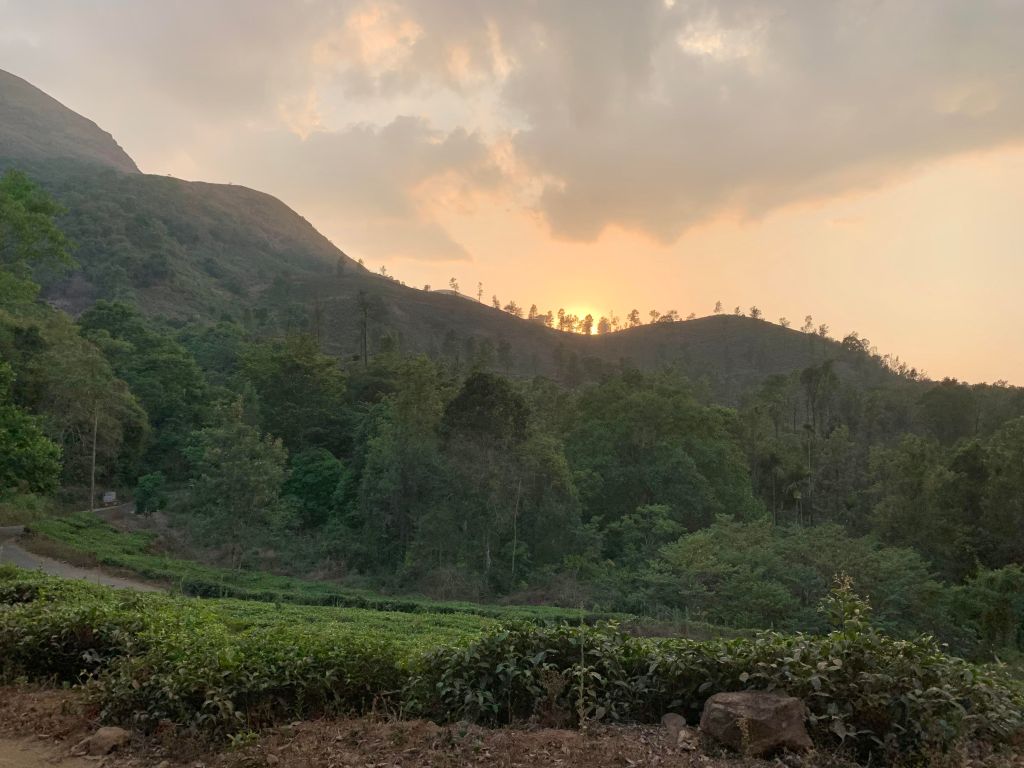
Chembra stands out imperceptibly in the background as the mist descends over its northern side. The driver of the rickety auto-rickshaw in which I make the topsy-turvy trip from Kalpetta settles to drop me at the backpacker’s hostel at Chembra’s foothills for 500 rupees. A vast tea estate stretches out for as far as the eye can see, and it is only when one edges closer to the property’s north-western precipice is any semblance of Wayanad encountered. 

Originally a hospital set up by the British in the 1920s, the hostel is a renovated colonial-style structure with a vast corridor that runs parallel to its rooms. I learnt much later that the tea estate that houses the hostel is spread over 700 acres. The fall to the northwest is spectacular, with hills in the lower range of the Western Ghats basking in the late evening sun as it makes its way down to the low-country orbs of Mysore and Chamarajanagar.

It is no surprise that one has to cross Bandipur to reach Wayanad in the first place; any easier and one would have been tempted to think that one was within the anonymity of civilisation.

*

Earlier in the day, the elephants that I spotted from an unobtrusive window on the bus from Mysore seemed triumphant and exultant — for what I did not know. The egret that sat contentedly upon the shoulders of a rather guileless water buffalo winked at me as I struggled to bring my camera out of the mishmash that my backpack had become. I was reminded of an older boy with whom I never got along in school and who often bullied me for the pancakes my mother painstakingly packed. 

*

I am forced to snap out of this reverie when my hostess reminds me that elephants were spotted at the southern expanses of the property a few days ago. She asks me to not step out after dark. In the common area boasting of a sit-out on a makeshift tree house, a motley crew from all hues of life rejoice at what appears to be a joint venture launched by a businessman from Bangalore and an engineer from Bombay. I join the pack and am welcomed by a loud cheer.

John, a chartered accountant who rode all the way from Coimbatore on his imported motorcycle, recounts having seen a leopard when turning in one of the several snaking curves when climbing from Kalpetta. He slurs as he articulates and his eyes appear bloodshot; I know only too well to separate the wheat from the chaff. Advait, a veterinarian from Anantapur, rebuffs everything that John says and vociferously advocates for an early dinner. He is, quite promptly, turned down.

*

The trek towards the peak of Chembra is made through the heartland of the eponymous forest range. Langurs peer out inadvertently while a flying squirrel makes an appearance from its cosmic abode. Catching sight of me and my companions’ incongruously sunscreened visages, it jumps shyly onto the double-storied Bo where it has made its home. Murali, the young forest officer who accompanies us jokes with Estelle, the German lady who quite fortuitously chooses to trek in her Birkenstock footwear, about sightings of bears in the vicinity but restrains himself when she turns ashen white. 

The heart-shaped lake peeks with unabashed curiosity as we huff and puff our way up to the midway point of the trek. To our great consternation, this is where we have to end our trip as the summit of the peak is sealed off by the government. A few years ago, Murali tells us, a group of nincompoops who made it to the summit lit a couple of cigarettes to celebrate. They did not, however, stub them when they were done. What happened next is well documented — a forest fire of gargantuan scale that wiped out about 60 hectares of forest land and claimed the lives of hundreds of wild animals. The summit has been off-limits to travellers ever since. 

The parched outcrops that surround the lake by no means diminish the panorama that lies to the west. A faint countenance of the vast fields of tea and paddy which fortify the district of Wayanad is visible through the mist. It is almost noon, but my companions and I find no reason to shed our coats. Specks of Mohit Chauhan’s Phir Se Ud Chala[1] fill the air; it feels as if Chembra herself has come to life. 

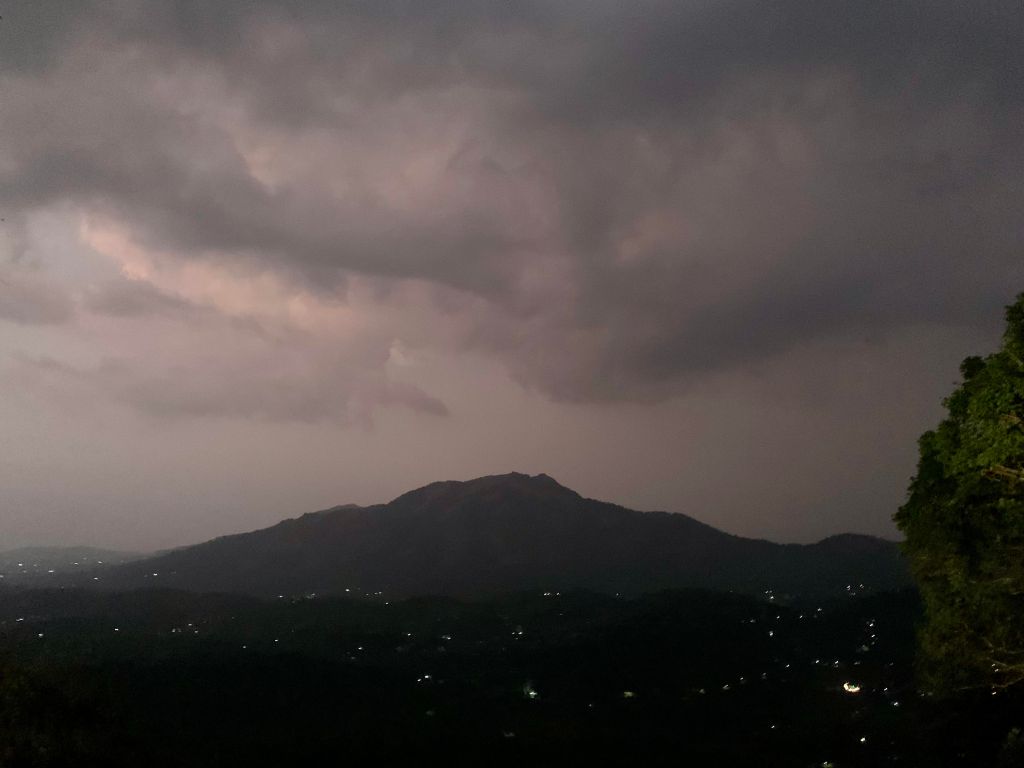
It is not exactly wise, but we surrender to the lure of lying down on the grass and bask, cocooned by the benevolent gaze of Chembra. Dark clouds brew overhead but Begum Akhtar reassures us in her palliative voice, and it is not before the first drops fall on my forehead that I alert the others over our predicament. Unsurprisingly, I find that most of my friends had nodded off, obliged by the exercise and the accompanying iridescent breeze. 

*

The descent, as always, is trickier than the climb, and we take refuge from the rain under a giant rock midway. The shelter is insubstantial for a group of ten, and we end up getting soaked to the skin anyway. Murali, rather ingeniously, offers his service raincoat to Estelle. Much to his chagrin, she declines, and continues unabated in her soaking t-shirt, Nike track pants and Birkenstocks. Someone mentions a childhood spent in the Bavarian Alps…

Dry leaves fall from the trees — these untimely showers ensure that they are not held on to their material comforts for long — and the fauna we encountered on the way up seemed to have disappeared. The langurs call out occasionally, but the mynahs respond in dulcet tones of their own. 

Drenched to the core yet alive beyond measure, the rain loses significance as we meander down the trail. Consciousness makes itself felt in every cell of my body as I lumber past the sludge and try to find a foothold on the wet tracks. Awake to the moment and mindful of not slipping — essentially holding my life in my hands — I experience a pacifying sense of tranquillity that I normally associate with timing a straight drive back past the bowler on a cloudy afternoon at the Gymkhana.

Damp pathways mark our way back to the hostel. On the way, an appetising breakfast of puttu and kadala curry[2] is sought to calm our nerves. A gulp of tea, brewed from the plants of the estate on which our hostel stands, soothes and brings some warmth back into our bodies. After that, we sleep all afternoon. The 1980s restaurant at this point serves as a reputable hotbed for the exchange of accounts as fellow travellers make their way upcountry for further investigation. Krishnagiri, Edakkal, Banasura and even Ooty, among other places, feature on their itinerary. Buses out of Meppadi take the circuitous route towards Sultan Bathery via Kalpetta. A few companions remain as I make the hike back to the hostel. 

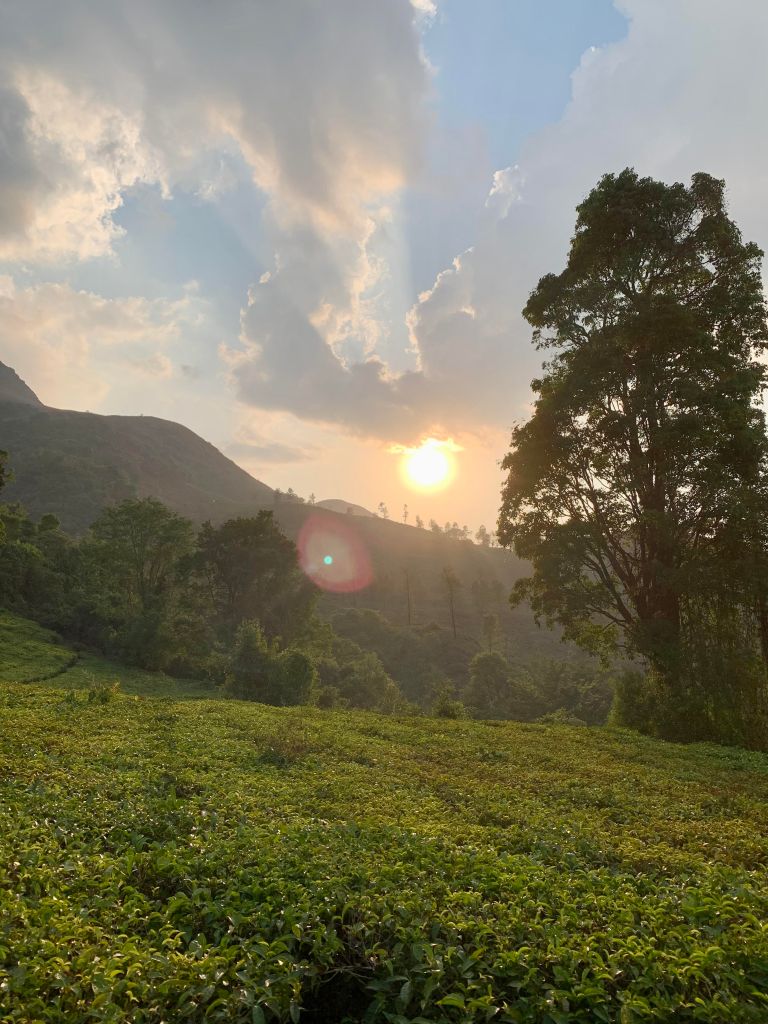
Last vestiges of the raindrops from earlier in the day cling on with pride on the tea leaves. Seen from a distance as we walk up the bend onto the track that leads to the hostel’s gates, it appears as if the leaves have shed tears of their own. 

The sky turns a dull shade of orange, almost as if playing testament to friendships made and attachments uncovered. I am content enough to watch the sunset over the lower Western Ghats as another pre-monsoon drizzle wafts in. Someone mentions a fresh batch of pazham pori[3] being made in the kitchen. I scramble down the tree house to beat the rush.

[1] Song from Bollywood movie, Rockstar. Translates to: He flew again

[2] Local fare. Rice cake and spicy chick pea curry

[3] Banana Fritters

Mohul Bhowmick is a national-level cricketer, poet, sports journalist, essayist and travel writer from Hyderabad, India. He has published four collections of poems and one travelogue so far. More of his work can be discovered on his website: www.mohulbhowmick.com.

PLEASE NOTE: ARTICLES CAN ONLY BE REPRODUCED IN OTHER SITES WITH DUE ACKNOWLEDGEMENT TO BORDERLESS JOURNAL. 

Click here to access the Borderless anthology, Monalisa No Longer Smiles

Click here to access Monalisa No Longer Smiles on Kindle Amazon International
Categories
Review

I am Not the Gardener

Book Review by Ranu Uniyal

Title: I am Not the Gardener: Selected Poems by Raj Bisaria

Author: Raj Bisaria

Publisher:  Terra Firma, Bangalore

Here is a book that I have been waiting for.  In several sittings you go through these breathtaking poems by Raj Bisaria.  A book that needs to be read with patience and, if you have had the privilege of being taught by him, you read with a curious eye.  Soft and gentle – a touch of an artist gently goads you to read it loudly– as if you are in an auditorium reading out to an unknown audience.  Who will listen to this voice of a gardener who with I am Not the Gardener weaves seasons of delight “telling of one’s heart is not self-gazing” but divine contemplation? 

The book does not carry an introduction to the author.  It has forty-three poems with photos capturing moments with family and friends. A few pictures of the domes and spires from Lucknow too add a special meaning to the verses. As director, producer, designer, actor and professor, Raj Bisaria has left an indelible mark. Press Trust of India described him as “Father of the modern theatre in North India”. Raj Bisaria founded Theatre Arts Workshop in 1966 and Bhartendu Academy of Dramatic Arts in 1975 in Lucknow. He taught English literature for more than three decades at the University of Lucknow. He is the first to receive Padma Shree from Uttar Pradesh for his contribution to modern theatre.  As a theatre artist his contribution remains unparalleled.

The first poem in this collection is ‘The Curtain Boy’. The poem is a thoughtful mediation on the meaning rather meaninglessness of all our actions.  The poet writes “I am not the gardener, / Nor the owner of the garden. / My job is to do odd things/ To weed out little wrongs/ To keep the pathway clean”. ‘Odd’ and “little” acts of “watching” lead to an awareness of the burden of possession and the transitory nature of dreams.  And this is followed by a similar concern in the poem ‘To a Young Actor’ – “I was told once to discipline/ Imagination in the rhythm/ of iambs and trochees. Only I wonder / If external form will give / Meaning to chaos.”

The poet, artist, and the philosopher in him create a complex mirage of emotions that reflect the restlessness and the anxiety of a man who finds comfort in words.  “In your dying/ My love has found / A new lease:/ For beyond death / Only love goes on”, the poet expresses his love for his mother in the poem ‘Elegy’.  Like Hamlet he gives voice to his own fears and then affirms with a defining certitude “Love is a quiet secret, / The seed within the rose.” The images are drawn from garden to the sea and the mountains “And I learnt to be silent / with the unspeakable granite of the mountains.”

Travel as a motif binds his restless spirit and opens the unreachable corners of his heart.  Love and fulfilment are contraries in a world trapped in the mundane.  In his poem ‘Byzantium’, Yeats refers to “The fury and mire of the human veins”. An artist seeks perfection in this imperfect world. The desire to transcend the ordinary compels him to write. The debut collection of poems gives us fascinating insights as Bisaria draws us to a wide range of experiences with a cry for attention “Do not shut my words out.  It is winter.” Here in lies an assertion with a sad awareness that yes, life is ending.  The artist within and the performer without must often be traversing contradictory spaces.  Both are equally strong and vulnerable. 

Sometimes the voice of the performer seems to undermine the anguish of the poet.  “He who does not forgive himself/ Forgives others less.” These are poems of love, longing, grief, and interminable loneliness that invades an artist whenever he confronts his inner self.  Those familiar with Bisaria’s dramatic productions might find a different voice lurking behind these poems.  It requires courage to accept one’s vulnerabilities, to confront the inner daemons and to pour an array of emotions with a faith that only an eternal seeker can display.  “To your shrines I came my Lord, / But I came without faith; / To your people I spoke my Lord / But I spoke without love; …Yet give me Lord peace/ To bear my own emptiness, / And your silence /Quieten my doubting mind.” This is not just a poem with the title ‘Prayer’, but a plea that resonates with a quest for self-realisation. 

A sadness runs through these poems.  Read and receive every word, every glance, every touch of this mortal self where “Love comes slowly by and by…” and the poet firmly believes “Love’s life is more than time…”. “It is a flight in the freedom of self…”. Even if you try hard, it is difficult to run away from oneself.  Like a shadow your inner conscience follows you, here, there, and everywhere.   

Ranu Uniyal is a poet and a Professor from the Department of English and Modern European Languages, University of Lucknow.

.

PLEASE NOTE: ARTICLES CAN ONLY BE REPRODUCED IN OTHER SITES WITH DUE ACKNOWLEDGEMENT TO BORDERLESS JOURNAL

Click here to access the Borderless anthology, Monalisa No Longer Smiles

Click here to access Monalisa No Longer Smiles on Kindle Amazon International
Categories
Stories

Getting Old is like Climbing a Mountain

By Saranyan BV

Courtesy: Creative Commons
Getting old is like climbing a mountain, you get a little out of breath 
but the view is much better!
                                                                     - Ingrid Bergman, actress

He arrived in the morning. He was carrying a small bag but enough to contain things to stay for three to four days. His visit was unannounced. Although he was cordial, I didn’t inquire into the purpose of his visit. I invited him inside and showed him the spare room where he could rest a while. He was seventy-nine years and could do with some rest. His body language showed he was grateful, yet he didn’t offer a reason for his presence in the morning. I went inside the kitchen so that I could prepare a cup of coffee for him. I heard him move inside his room, the footsteps of an old man. I could hear him take things out from the bag and push some back. After a while, the sounds stopped. The house turned silent. It sounded silent and silence sounds like death. My eyes roved over the kitchen table to check on the things available to make a decent breakfast for uncle. He was in need. He looked famished.

I pushed open the door leading to the backyard, in the kitchen garden, the plants were unkempt. It was a messy area of about forty-four square feet. I plucked brinjals and tomatoes to make the sambar respectable and to add on to the coconut chutney which was already done. There was also coriander, not ready for plucking, but at times like this it could be useful. I heard the sound of the cistern flush, the water drained without giving inkling of anger. I handed him the cup, he took it and kept looking at the floor. He drew an arc with the toe of his right foot. I could not understand what the act meant except he was disturbed. There would be time later to get to know. For the time being I let him feel at home. He didn’t inquire about my husband’s whereabouts. My husband was his nephew. Uncle might have assumed Shyam has gone to office. Actually, Shyam has gone to handover his Renault Kwid for the first unpaid service. He would be late today. Shyam too would have to have his breakfast before starting for work. Maybe they could have it together. We all could.

I hoped uncle would spruce himself and be ready before Shyam returned. I was not going to rush him.

Shyam would be in a terrible hurry. He could catch up with his uncle while he is pushing the idlis[1] down his throat. I have to keep requesting Shyam time and again to eat slowly. Food is meant to be enjoyed and not be dealt with as if it is a task to be completed. Breakfast is the only meal Shyam has at the dining table. He took his lunch in the office canteen and the night meal was invariably at the bar he frequented. I had rehearsals for the coming play at Ranga Shankara in Jayanagar. Most evenings, I was out. I think he ate only fritters and no proper dinner. I never questioned him about his activities. He found that convenient.

I went past the room in which the uncle was lodged. I pretended to go out under some pretext. The garbage collector had entered the street. The garbage needed to be in cans outside the gate. I peered in. The door was open. Uncle was seated on the mattress leaning back on his hands. He was looking up at the ceiling fan, at his own reflection on the chromium plated hub-cap. He had not switched the fan on, the weather was fine. I collected the compost bag and kept tossing handfuls on the potted plants in the courtyard. That was my weekly routine. The plants responded to the manure but the moment the plants shoot buds, insects destroyed them. I tried to give uncle some privacy by remaining in the garden. He looked rather pulled down. If he wanted to make some calls in my absence, I’d rather facilitate it; but he didn’t.

Uncle lived in Hebagoddi with his only son, his house overlooking the wholesale fruit market. Whenever we visited, I found him standing on the open terrace upstairs and watching the trucks loading and unloading. Ajay resigned his job in Hosur and had left to take up new assignment in Abu Dhabi. He told us he wanted to move with his family to Abu Dhabi. I wondered if he could take his father as well. Maybe that was what made uncle preoccupied – the thought of being left alone without his son, who was also his caregiver.  Uncle had a handsome pension as a retired school master. He was not dependent monetarily, but he needed someone to assure him everything was going to be fine. An old man required assistance and supervision. My dad’s brother had dementia from being lonely they said.  since He had no one to talk to. He was a bachelor with lots of money but dementia doesn’t check the wallet before setting in.

I went back to the kitchen. The decoction had filtered down. I mixed the coffee and took it along with two Marie biscuits. He took it and placed it on the table. His hand shook. He said, “Thanks.” He wasn’t curious about Shyam’s absence. I was surprised he did not inquire.  He was Shyam’s uncle not mine.

I told him, “Shyam would be back shortly, I will serve breakfast when he comes.”

“That’s nice”, he said. “In that case I will have the coffee after breakfast. I took Pantacid just now. Let the medicine do the job.” He took the two biscuits, placed them on the paper napkin and returned the cup.

I said, “Fine.” I lifted my chin to scrutinize his face.

“Its difficult to live with Ajay’s wife,” he said. Uncle moved towards the window turning face away from me. The top two panes of the window were open. They overlooked the vegetable garden I was ambitious about curating. Beyond that was a small 30 feet road. I did not attempt to mollify him. I left the job to Shyam. He was Shyam’s his uncle.

Uncle said, “I can grow enough vegetables in my house in the terrace, I mean in Ajay’s house. People these days grow vegetables in plastic grow-bags you know. I can grow enough for the family or even more. She wouldn’t allow.” He meant Ajay’s wife. Growing vegetables is my passion. My conviction is one should try to grow food in lifetime instead of only consuming. It’s my desire to grow at least one kilo of rice with my bare hands at least once in my life, I told this to uncle in order to keep him cheerful until Shyam returned.

“We should find a place in our village and try doing growing the rice there. Being in city, you can’t”, he said and curbed his instinct say more. The conversation cheered him and I believed took his mind away from Ajay wanting to shift his family to Abu Dhabi. I was not sure if Ajay was planning to take his dad there. It may not have been a workable proposition.

I said, “Its good to try, to think on those lines. I guess Shyam would agree to the idea post his retirement. As of now I have this theatre group which pegs me here.”

A car entered the lane, the sound of its engine was echoing from the between the compound walls. The colony would have looked more impressive without the compound walls. The car stopped in front. The driver’s face seemed familiar but I could not place him. Shyam got down from the other side. He thanked the driver and entered. The car sped away, it was an old red-coloured Punto. The driver smiled on seeing I was trying to place him.

I was not sure if I should inform Shyam about the unannounced guest or leave him to find out for himself. Maybe he knew of the arrival and had forgotten to inform me.

Shyam said, “I must rush, Sundar has promised to pick me on the way. Can’t make Sundar wait.” He went straight into the washroom. He was the type who would expect his wife to keep his clothes ready when he came out of the bath. Before that, he would want the towel. I did that part of the chore, returned to the living room from where I could see uncle. He was not affronted by Shyam’s behavior. He seemed to understand. He smiled sympathetically upon seeing my distress.

“Let me set the table for breakfast,” I told him and went about doing so. I wanted to tell Shyam to eat slowly — to get up only when uncle finished. Uncle came out of the room for the first time. He sat quietly in front of the dining table where Shyam sat normally. He leaned using his elbows on the table. He saw me arranging the plates. He opened the lid where idli was stacked. He smiled again. There was plenty. I too sat pretending to remove the speck on my plate.

“I have to find an old age home,”he said nodding his head.

 “It would do you good. you can be all by yourself,” I said.

“You don’t understand the point Kamala,” he said. I could hear Shyam coming out of the bathroom. He started dressing. He dressed himself first before using the hair drier and combing his hair. I knew as soon as he finished, he would head for the dining table. I waited for the sound of the drier being switched off. I had not informed Shyam about uncle’s presence as yet. Waiting at the breakfast table, I was not sure I should make the effort. He obviously was not expecting to find uncle. I hoped he would be polite to his uncle.

Shyam came in. He had heard our voices, if not the subject of our conversation. He was pleased perceptibly to see his uncle, he went behind him, put his hand over uncle’s shoulders and gave him a hug from behind. He said, “What a surprise! How is Ajay doing? Is he really liking it out there, it is a dangerous country, not meant for one with his kind of temperament.” Shyam rushed with his words, he wanted to convey whatever he wanted quickly without giving scope for his uncle to respond. He looked at me and said, “I promised uncle that I would find him a comfortable old age home. Better that Ajay takes his family quickly to Abu Dhabi. He has the knack of getting into trouble if left alone.”

Uncle didn’t want to prolong the conversation about his son. He said, “Something that fits my pension, not a paise more, I don’t want to take help from Ajay though he may be earning in Dinars now.”

He craned his neck to see when I would start serving. Shyam pulled the chair away from the table to sit, the chair made a grating noise on the floor. I switched the fan on and started serving. The three of us ate quietly. Shyam kept stuffing idlies as was his habit. He choked a bit but managed to swallow without any issues. I had only one idli. I got up to prepare coffee. Sundaram could arrive any moment, though Shyam had not stated the time of his arrival. Shyam took his uncle to the verandah in front. I could hear them talking, though I could not make out what they discussed. It sounded like they wanted to keep me out.

Uncle left our house after three days. He never went back to Ajay’s house. He went straight to the old age home. I felt sad. Shyam had arranged accommodation where uncle could stay in relative comfort. That’s what Shyam told me the previous night.

Whatever the comfort and care the old age home offered, such homes for the aged could not offer hope. Inmates kept falling sick, became invalids and sunk to death slowly. Besides they all had their own tales of woe which each would share, deepening the shadows in others lives. A home could not offer hope.

Shyam said the three days stay with us had restored uncle’s faith in humanity. It was a tall statement, though I suspected it was true. We tend to seek our own space in the kingdom of self-righteousness, we feed on such feelings. During the afternoons we had watched movies together on Netflix or Prime Video. Uncle made the selection. He always chose a crime thriller or science fiction, avoided movies focused on family relationships.

He took me into confidence and confessed on the last day. Shyam was to drop him at an old-age home named after Mother Theresa the next day. Uncle told me almost in whispers after the movie, as if he didn’t believe what he said, “Ajay’s wife is very loving, I can’t say she was wanting in that faculty.” I wanted to believe uncle.

When uncle left, there were tears in his eyes. He didn’t try to mask his feelings. I could not figure if it was on account of a feeling of gratefulness or of grief. He sprayed the insecticide on the rose plants in the courtyard while Shyam was loading his things in the car. I had presented him warm blanket in case the home didn’t provide one. Shyam promised to visit him often, though he did not specify how often.

Ajay’s family had left. He sent uncle photos of their new home. I had half a mind to tell uncle to stay with us, though I didn’t. He was not a bother, was really not a bother. He would have helped with the kitchen and courtyard garden as well as the proposed one in the terrace upstairs. During his brief stay, he helped to water the plants, folded the laundry, cut vegetables for cooking, he cut such perfect cubes. He enjoyed peeling garlic pods. He loved it. One day when the daily maid absented herself, I even found him doing the dishes quietly without letting me know. I had closeted myself in our room to memorise lines and cues of a new play.  

Uncle could have stayed with us if it was not too long. Life looks interminable if we don’t know how long. We didn’t know how long all this would go on had he stayed. He looked healthy though he was seventy-nine. You never know. Love without willingness to take on the responsibility was an aborted child, that much I knew.

.

[1] Steamed, savoury rice cake

.

Saranyan BV is Bangalore based poet and short-story writer. His works are being published in Indian and Asian journals regularly. He came to the realm of English by mistake but loves being there. He is a big fan of Raymond Carver and Charles Bukowski. He thinks that the genre short story is going to rule literature in the days to come, if the writers are ready to take up the challenge.  

.

PLEASE NOTE: ARTICLES CAN ONLY BE REPRODUCED IN OTHER SITES WITH DUE ACKNOWLEDGEMENT TO BORDERLESS JOURNAL

Click here to access the Borderless anthology, Monalisa No Longer Smiles

Click here to access Monalisa No Longer Smiles on Kindle Amazon International