Categories
Contents

Borderless August 2023

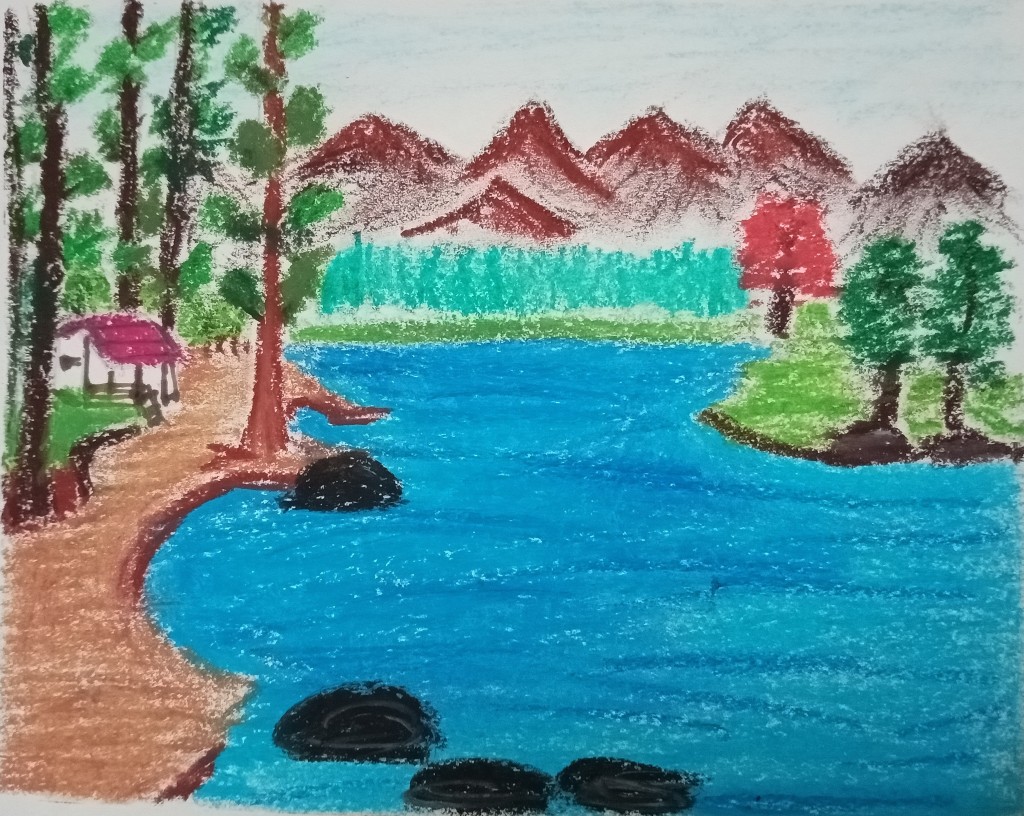
Art by Sohana Manzoor

Editorial

Other Echoes in the Garden… Click here to read.

Interviews

Ujjal Dosanjh, former Minister from Canada and former Premier of British Columbia, discusses his autobiography, Journey After Midnight – A Punjabi Life: From India to Canada, and the need for a world with less borders. Click here to read.

Professor Fakrul Alam discusses his new book of Tagore translations, Gitabitan: Selected Song-Lyrics of Rabindranath Tagore. Click here to read.

Translations

Tagore’s Musalmanir Galpa (A Muslim Woman’s Story) has been translated from Bengali by Aruna Chakravarti. Click here to read.

Masud Khan’s poem, In Another Galaxy, has been translated from Bengali by Professor Fakrul Alam. Click here to read.

Wakeful Stays the Door, a poem by Munir Momin, has been translated from Balochi by Fazal Baloch. Click here to read.

Dangerous Coexistence, written in Korean and translated by Ilhwah Choi. Click here to read.

Proshno or Questions by Tagore has been translated by Mitali Chakravarty. Click here to read.

Pandies Corner

Songs of Freedom: An Ordinary Tale is a narrative by Nandani based on her own experiences, translated from Hindustani by Janees. These narrations highlight the ongoing struggle against debilitating rigid boundaries drawn by societal norms, with the support from organisations like Shaktishalini and Pandies. Click here to read.

Poetry

Click on the names to read the poems

Jared Carter, Rhys Hughes, Malachi Edwin Vethamani, Luis Cuauhtémoc Berriozábal, Saranyan BV, Ryan Quinn Flanagan, A Jessie Michael, Jahnavi Gogoi, George Freek, Koushiki Dasgupta Chaudhuri, David Francis, Akil Contractor, Michael Burch

Poets, Poetry & Rhys Hughes

In An Experiment with Automatic Poetic Translation, Rhys Hughes auto translates an English poem sequentially through 28 languages and then back to English with hilarious results. Click here to read.

Musings/ Slices from Life

Mister, They’re Coming Anyway

Timothy Jay Smith writes on the refugee crisis in Lesbos Island, Greece with photographs by Michael Honegger. Click here to read.

Migrating to Myself from Kolkata to Singapore

Asad Latif explores selfhood in context of diverse geographies. Click here to read.

Islands that Belong to the Seas

Paul Mirabile muses on how humans are like migrants on islands borrowed from the seas. Click here to read.

Of Dreams, Eagles and Lost Children

Aysha Baqir muses on the narrow, closed borders that condemn children. Click here to read.

Mushroom Clouds and Movies: Response from a Hibakusha’s Daughter

Kathleen Burkinshaw discusses Oppenhiemer the movie. Click here to read.

Sleepless in the High Desert, Slumber in the Sierra

Meredith Stephens covers Nevada to Columbia in a car with her camera. Click here to read.

My Hostel Days

Ravi Shankar reminisces on bygone days. Click here to read.

Musings of a Copywriter

In The Amateur Professional, Devraj Singh Kalsi writes of a amateur who thought of himself as a professional. Click here to read.

Notes from Japan

In How I Wound Up in Japan, Suzanne gives her story as an immigrant. Click here to read.

Essays

A Different Persuasion: On Jane Austen’s Novels & their Adaptations

Deepa Onkar delves into the world of Jane Austen books and films. Click here to read.

A Foray into Andamans

Mohul Bhowmik explores Andaman with a camera and narrative. Click here to read.

Bhaskar’s Corner

In Chittaranjan Das: A Centenary Tribute, Bhaskar Parichha discusses the life of one of the most legendary Odia writers. Click here to read.

Stories

Belacan

Farouk Gulsara shares a story based on the life of a migrant in 1950s. Click here to read.

The Japanese Maple

Shivani Shrivastav weaves a story of friendship and loneliness among migrants. Click here to read.

The Coin

Khayma Balakrishnan explores human and supernatural interactions in a school setting in Malaysia. Click here to read.

The Vagrant

Reeti Jamil narrates a strange tale set in a village and told by a farmer. Click here to read.

Book Excerpts

An excerpt from Ujjal Dosanjh’s Journey After Midnight: A Punjabi Life from Canada to India. Click here to read.

An excerpt from Roses in the Fire of Spring: Better Roses for a Warming World and Other Garden Adventures, by M.S. Viraraghavan and Girija Viraraghavan. Click here to read.

Book Reviews

Somdatta Mandal reviews Amitav Ghosh’s Smoke and Ashes: A Writer’s Journey Through Opium’s Hidden Histories. Click here to read.

Basudhara Roy reviews Greening the Earth: A Global Anthology of Poetry, edited by K. Satchidanandan & Nishi Chawla. Click here to read.

Bhaskar Parichha reviews Arunava Sinha’s The Greatest Indian Stories Ever Told: Fifty Masterpieces from the Nineteenth Century to the Present. Click here to read.

.

Click here to access the Borderless anthology, Monalisa No Longer Smiles

Click here to access Monalisa No Longer Smiles on Kindle Amazon International
Categories
Editorial

Other Echoes in the Garden…

“Other echoes
Inhabit the garden. Shall we follow?
Quick, said the bird, find them, find them…”

— TS Eliot, ‘Four Quartets: Burnt Norton’(1936)

Humans have always been dreamers, ideators and adventurers.

Otherwise, could we have come this far? From trees to caves to complex countries and now perhaps, an attempt to reach out towards outer space for an alternative biome as exploring water, in light of the recent disaster of the Titan, is likely to be tougher than we imagined. In our attempt to survive, to live well by creating imagined constructs, some fabrications backfired. Possibly because, as George Orwell observed with such precision in Animal Farm, some perceived themselves as “more equal”. Of course, his was an animal allegory and we are humans. How different are we from our brethren species on this beautiful planet, which can survive even without us? But can humanity survive without Earth? In science fiction, we have even explored that possibility and found home among stars with the Earth becoming uninhabitable for man. However, humanity as it stands of now, continues to need Earth. To live amicably on the planet in harmony with nature and all the species, including our own, we need to reimagine certain constructs which worked for us in the past but seem to have become divisive and destructive at this point.

Ujjal Dosanjh, former Minister in the Canadian cabinet and former Premier of British Columbia, in his autobiography, Journey After Midnight – A Punjabi Life: From India to Canada, talks of regionalism as an alternative to narrow divisive constructs that terrorise and hurt others. He writes in his book: “If humanity isn’t going to drown in the chaos of its own creation, the leading nations of the world will have to create a new world order, which may involve fewer international boundaries.” We have a candid conversation with him about his beliefs and also a powerful excerpt from his autobiography.

An interview with Professor Fakrul Alam takes us into Tagore’s imagined world. He discussed his new book of Tagore translations, Gitabitan: Selected Song-Lyrics of Rabindranath Tagore. He has brought out a collection of 300 songs translated to English. In a bid to emphasise an inclusive world, we also have a translation of Tagore’s ‘Musalmanir Galpa’ (A Muslim Woman’s Story) by Aruna Chakravarti. A transcreation of his poem, called ‘Proshno or Questions’ poses difficult challenges for humanity to move towards a more inclusive world. Our translation by Ihlwha Choi of his own Korean poem to English also touches on his visit to the polymath’s construct in the real world, Santiniketan. All of these centring around Tagore go to commemorate the month in which he breathed his last, August. Professor Alam has also translated a poem from Bengali by Masud Khan that has futuristic overtones and builds on our imagined constructs. From Fazal Baloch we have a Balochi translation of a beautiful, almost a surrealistic poem by Munir Momin.

The poetry selections start with a poem on ‘Wyvern’, an imagined dragon, by Jared Carter. And moves on to the plight of refugees by Michael Burch, A Jessie Michael, and on migrants by Malachi Edwin Vethamani. Ryan Quinn Flanagan has poetry that suggests the plight of refugees at a metaphorical level. Vibrant sprays of colours are brought into this section by Luis Cuauhtémoc Berriozábal, Saranyan BV, Jahnavi Gogoi, George Freek and many more. Rhys Hughes brings in a spot of humour with his mountainous poetry (literally) and a lot of laughter with his or rather Google’s attempt at automatic translation of a poem. Devraj Singh Kalsi has shared a tongue in cheek story about an ‘amateur professional’ — rather a dichotomy.

We travel to Andaman with Mohul Bhowmick and further into Sierra with Meredith Stephens. Ravi Shankar travels back in nostalgia to his hostel and Kathleen Burkinshaw dives into the past — discussing and responding to the media presentation of an event that left her family scarred for life, the atomic holocaust of 1945 in Japan. This was a global event more than seven decades ago that created refugees among the survivors whose homes had been permanently destroyed. Perhaps, their stories are horrific, and heart wrenching like the ones told by those who suffered from the Partition of India and Pakistan, a divide that is celebrated by Independence Days for the two nations based on a legacy of rifts created by the colonials and perpetrated to this day by powerbrokers. Aysha Baqir has written of the wounds suffered by the people with the governance gone awry. Some of the people she writes of would have been refugees and migrants too.

A poignant narrative about refugees who flock to the Greek island of Lesbos by Timothy Jay Smith with photographs by Michael Honegger, both of whom served at the shelters homing the displaced persons, cries out to halt wars and conflicts that displace them. We have multiple narratives of migrants in this issue, with powerful autobiographical stories told by Asad Latif and Suzanne Kamata. Paul Mirabile touches on how humans have adopted islands by borrowing them from seas… rather an unusual approach to migrations. We have an essay on Jane Austen by Deepa Onkar and a centenary tribute to Chittaranjan Das by Bhaskar Parichha.

The theme of migrants is echoed in stories by Farouk Gulsara and Shivani Shrivastav. Young Nandani has given an autobiographical story, translated from Hindustani to English by Janees, in which a migration out of various homes has shredded her family to bits — a narrative tucked in Pandies Corner.  Strange twists of the supernatural are woven into fiction by Khayma Balakrishnan and Reeti Jamil.

In reviews, Parichha has explored Arunava Sinha’s The Greatest Indian Stories Ever Told: Fifty Masterpieces from the Nineteenth Century to the Present. Somdatta Mandal’s review of Amitav Ghosh’s Smoke and Ashes: A Writer’s Journey Through Opium’s Hidden Histories seems to be an expose on how historical facts can be rewritten to suit different perceptions and Basudhara Roy has discussed the Greening the Earth: A Global Anthology of Poetry, edited by K. Satchidanandan and Nishi Chawla.

There is more wonderful content. Pop by our August’s bumper edition to take a look.

I would like to give my grateful thanks to our wonderful team at Borderless, especially to Sohana Manzoor for her fabulous artwork. Huge thanks to all our gifted contributors and our loyal readers. Borderless exists today because of all of you are making an attempt to bringing narratives that build bridges, bringing to mind Lennon’s visionary lyrics:

You may say I'm a dreamer
But I'm not the only one
I hope someday you'll join us
And the world will live as one

Thank you for joining us at Borderless Journal.

Have a wonderful month!

Mitali Chakravarty

borderlessjournal.com

.

Visit the August edition’s content page by clicking here

READ THE LATEST UPDATES ON THE FIRST BORDERLESS ANTHOLOGY, MONALISA NO LONGER SMILES, BY CLICKING ON THIS LINK.

Categories
Review

The Greatest Indian Stories Ever Told 

Book Review by Bhaskar Parichha

Title: The Greatest Indian Stories Ever Told: Fifty Masterpieces from the Nineteenth Century to the Present 

Editor: Arunava Sinha

 Publisher: Aleph Book Company

The Indian subcontinent has had a long tradition of storytelling that is referred to as ‘contes’ or tales, by the French. ‘Kathasaritsagar‘ by Somdev in Sanskrit compiled in the 11th century CE is a great example of this. Flavourful folk tales can also be found in renditions after the 11th Century CE — like the Singhasan Battisi’[1].

Various Indian languages soon adopted this genre, gaining popularity throughout the country. Over the past 150 years, hundreds of memorable and popular stories have been written in more than 20 different languages. There are many ways in which they have become cultural cornerstones. Even those who do not read books often quote from a Premchand story or refer to a Tagore character in conversation. There are more people who know about our recent history as a result of Manto’s stories than any other history book published.

The Greatest Indian Stories Ever Told: Fifty Masterpieces from the Nineteenth Century to the Present  edited by Arunava Sinha, is a welcome addition to the genre. As an English translator, Sinha specialises in translating Bengali fiction and non-fiction from Bangladesh and India into English, including classic, contemporary, and modern works. More than seventy of his translations have been published so far in India, UK, and USA. He has twice won India’s top translation prize, the Crossword Award for translated books. He teaches at Ashoka University, where he is also the co-director of the Ashoka Centre for Translation.

This anthology contains stories that draw inspiration from a wide range of Indian regional dialects, languages, literature, and cultures, and includes early masters of the form, contemporary stars, and brilliant writers who came of age during the twenty-first century.

Among these authors are some of the most revered in Indian literature and have, between them, won almost every major literary award, including the Nobel Prize for Literature, the Jnanpith Award, the Sahitya Akademi Award as well as numerous other honours at the state, national, and international level. 

There is a plethora of literary delights in this collection, from Tagore’s evocative prose to Amrita Pritam’s emotional depth, from Ruskin Bond’s enchanting stories to Mahasweta Devi’s thought-provoking stories. It is a treasure trove of narratives translated to or written in English. If all these weaving the colours of the diversities in India are to be savoured across all the Indian states with diverse languages, they need to be in English. Collections of some of the best literary short fiction written by Indian writers began to emerge in the country at the end of the nineteenth century. And now in the twenty first century, the trend has been retained by this collection.

A must-have for any Indian literature enthusiast, The Greatest Indian Stories Ever Told provides a literary journey that explores space and time, which makes it a precious collector’s item that will become a valuable over time. Anyone who is interested in India’s rich cultural heritage as well as the rich tapestry of Indian storytelling should definitely read this anthology in order to gain some insight into the country’s rich cultural heritage. It promises to be an exciting and enticing literary feast, leaving readers awe-struck and enriched by the depth and beauty of Indian storytelling whether you are familiar with these eminent authors or are new to them, regardless of whether you know their work or not.

.

[1] Collection of ancient Indian folk tales; Literally, 32 tales of the throne, compiled after the 11th century CE

.

PLEASE NOTE: ARTICLES CAN ONLY BE REPRODUCED IN OTHER SITES WITH DUE ACKNOWLEDGEMENT TO BORDERLESS JOURNAL

Click here to access the Borderless anthology, Monalisa No Longer Smiles

Click here to access Monalisa No Longer Smiles on Kindle Amazon International

Categories
Review

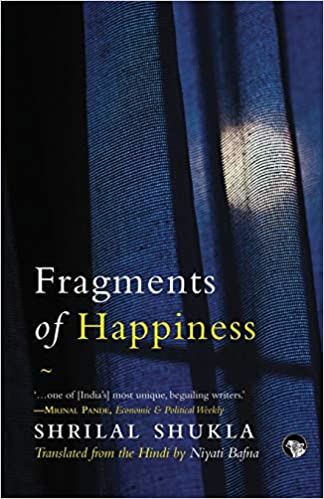
Fragments of Happiness

Book Review by Rakhi Dalal

Title: Fragments of Happiness

Author: Shrilal Shukla, translated from Hindi by Niyati Bafna

Publisher: Speaking Tiger Books, 2021

Fragments of Happiness is a translation of Shrilal Shukla’s novel, Seemayein Tootati Hain, originally published in 1973. Shrilal Shukla (1925 –2011) was a Hindi writer, notable for his satire. He has written more than 25 books and received the Jnanpith Award, the highest national recognition for writers (2011), the Padma Bhushan (2008) and the Sahitya Akademi (1969). Seemayein Tootati Hain has been translated to English by Niyati Bafna, who has studied translation under Arunava Sinha and is currently a student of Computational Linguistics pursuing an MSc in Prague as an Erasmus Mundus scholar.

In this novel, Shukla, widely known for his satire, weaves the story of a family struggling to come to terms with its reality in the aftermath of an unfortunate incident. Durgadas, a businessman based in Delhi, is convicted for a murder and is sentenced to life imprisonment. He has two sons and a daughter. His children believe in their father’s innocence. Over time, the brothers become convinced that the murderer is Vimal, their father’s partner and a long-time friend. The story is centred on the idea of their father’s innocence and the subsequent efforts of the brothers to find the real criminal. However, the book is not a murder mystery. It does not offer a solution to the impasse that the brothers Taranath and Rajnath seem to find themselves in. And it certainly is not a story which offers closure. Rather it is an exploration of the beliefs, opinions, and nature of its characters as well as of the dynamics of relationships shared by them. The author takes on a well-to-do family in early 1970s Delhi to track the trajectory of each character as they tackle the situation.

Taranath runs a college. Rajnath takes care of his father’s business. Their younger sister Chaand is a 23-year-old researcher in the field of Chemistry.  Rajnath’s thoughts and actions are dictated by his desire to restore the reputation of his family whereas those of Taranath to see his father happy. Chaand is more of a realist, who accepts the situation and is more focused upon her career and her personal life. Vimal, on the other hand, stands by the family through the trial of Durgadas and believes him to be innocent too. However, the zenith of the plot revolves around the relationship between Chaand and Vimal.

Mrinal Pande, an eminent author and journalist, dubs Shrilal Shukla as one of India’s most unique and beguiling writers. This is evident as the author treads ahead with the narrative that is crisp and advances effortlessly to portray remarkably the interplay between societal influences and individual opinions and behaviour. Speckled with spiritual and philosophical musings and satire, the narrative skilfully captures the subconscious of its characters. The characters are life-like, with their fears and insecurities governing their responses and actions. One of the most unpredictable characters is that of Julie, Vimal’s confidante and once a sex worker. She is taken aback when she comes to know of Vimal’s deliberate silence about his presence at the scene of murder in which Durgadas was convicted and adds she wouldn’t have done so in his place, that she would have spoken the truth. Vimal’s character remains beguiling till the very end, and it may unsettle some readers.

Also, quite notable in the novel is the depiction of early 70s Delhi. Connaught Place, its cafes, espressos, cinema, localities –flavours and sounds of old Delhi, reminiscent of a distinctive era that may tickle the senses of a reader. In carving the character of Chaand, the author portrays an independent woman who has the courage to make her life choices, is determined and not affected by the expectations of her family or friends. Her individuality parallels the rising class consciousness among women in early 70s which recognised the inequalities within power structures of family, tribe and region as well. With Taranath’s character, he addresses the question of religion and with that of Rajnath and his wife Neela, the restrictions imposed within the familial structures. We know next to nothing of the character of Durgadas, around whose conviction and sentence, the story is constructed. By making this choice, the author has consciously aimed to focus on recounting the ways in which different characters try to cope with adverse circumstances in their lives.

To translate such a distinctive novel by an acclaimed author from Hindi to English, while capturing the nuances of the language, is not an easy task. Bafna has done a commendable job. Although, those who have read the novel in Hindi may wonder at some points about the choices made by the translator, the overall experience is closer to reading the original work and is, definitely, a step forward in making the work reach diverse readers.

.

Rakhi Dalal is an educator by profession. When not working, she can usually be found reading books or writing about reading them. She writes at https://rakhidalal.blogspot.com/ .

.

PLEASE NOTE: ARTICLES CAN ONLY BE REPRODUCED IN OTHER SITES WITH DUE ACKNOWLEDGEMENT TO BORDERLESS JOURNAL. 

Categories
Review

How Non-nonsensical is Sukumar Ray’s Nonsense Verse?

Book review by Nivedita Sen

Title: Habber-Jabber Law:  Nonsense Adventure.

Author: Sukumar Ray; translated from Bengali to English by Arunava Sinha  

Publisher: Speaking Tiger Books, 2020

It is believed by and large that Ha Ja Ba Ra La (1921) by Sukumar Ray, the father of Satyajit Ray, was attempted as an adaptation of Lewis Carroll’s Alice in Wonderland. Both start with the child protagonist going off to sleep out of doors on a hot summer’s day, under the shade of a tree, and entering a dreamscape in which creatures that are a mix of the real and the fantastic live out their lives. These characters are caught in situations where they constantly argue with one another and the protagonist about the strangest of words, events and ideas. Yet the very normalcy, credibility and sanity offered through the voice of the first person protagonist, juxtaposed and tested against the curious and the implausible in their formulations, is portrayed satirically, critical of some of the assumptions and values we take for granted, and interrogated for their logical fallacies.

Although Alice travels down a rabbit hole that leads her to Wonderland, Sukumar Ray changed everything from this point onward to match the ambience of an Indian, more specifically Bengali, way of life. And in the process, he not only crafted an original which is a milestone in the genre of nonsense writing in Bengali for children but offered food for adult thought to anyone who could read between the lines.

The book has an attractive cover and design and includes all the delightful original illustrations by the author. But it is a colossal task to actually translate line by line, if not word by word, this early twentieth century Bengali classic into English. Over the last forty years, language based translations have moved to culture based translations. This initial spadework was taken care of by Sukumar Ray in his adaptation of Alice.

When Arunava Sinha translates this text into English, we can assume that it is meant for an Indian readership. A crow (read human being) that traces its upper caste pedigree to the pure-blooded Rex Ravenus, a man who coyly appeals to people not to ask him to sing only because he wants his singing to be heard, and a court case for defamation in which the number of witnesses goes up because they get paid (bribed) for the ‘work’ are not unfamiliar across a pan-Indian spectrum. But the facetiousness and irony also extends to a universal human predicament in which the child encounters the worldly wisdom of ‘money is time’ that has to be factored in every calculation (reminiscent of a railway journey scene in Caroll’s Through the Looking Glass), when he iterates a multiplication table correctly but naively. Or in the utopian make-believe of making the world a happier place, when he learns, to his bewilderment, of an odd reversal in which the ages of people turn backward after they are forty, so that nobody dies old age.

Sukumar Ray’s Ha Ja Ba Ra La provides undiluted amusement to child readers but communicates more seriously to adult readers. Ashish Lahiri, an academic and writer, in an essay in 1982 in a magazine called Prabashi, had underlined the significant dichotomy between the first and second parts of the story. In the first, the current ‘scientific culture’ with its discourses of temporal and spatial relativity is tried to absurd extremes by the nonsensical utterances of the cat, the crow and the two dwarfish brothers. To start with, the handkerchief-turned-cat deconstructs our accepted structures of logic and common sense by arguing that he can be called cat chief, kerchief or capital zed, and extending its reasoning to spell out the ridiculous combination of alphabets that can identify it. Exact nomenclatures and absolute definitions are challenged in this episode.

Similarly, in keeping with findings in astrophysics and geography about the rotation of the earth, the cat says that we will never find anyone where we expect to find them, because no creature remains rooted in the anticipated spot, even if they are stationary. This hilarious observation while looking for someone called Big Tree Brother dwells on the relativity of time. It is corroborated by the logic of the crow who says that seven times two is not always fourteen because time is forever on the move and the arithmetical calculation changes by the time one works it out. Yet, all the bodily measurements of the first-person protagonist are fixed at twenty-six inches by the very creatures who make a case for the idea and practice of relativity, perhaps because he carries a baggage of absolute and rigid assumptions imposed on him by the adult world of common sense.

Hzzbuzzbuzz (whose original Bengali name Hijibijbij suggests hijibiji, a scribble that is garbled and meaningless) connects the two parts of the story with his compulsive need to laugh at the most hypothetical and incredible of situations. The second part, set in the open air courtroom of fantastic creatures, is resonant of human society at large for its dishonesty and deceit. It keeps the reader’s focus on the incongruity, dissonance and comicality of everything we ever learned or cultivated, from science and philosophy to the legal arbitration of civilised, educated, middle class life.

The court scene includes the moss-ridden coat or camouflage of the fraudulent lawyer, the book of law that epitomises a theoretical and meaningless justice and the owl-judge who cannot see things that are obvious by the clear light of day but only when they are under cover of nocturnal darkness. The crocodile’s convoluted questions for the sake of questions and his own weird interpretations suggest the ambivalences and distortions involved in the legal process. That the entire organisation of law and other human institutions and systems is based on big, unintelligible and fancy words that are absurd lies is critiqued in Hzzbuzzbuzz’s incoherent, unrelated but irreverent ramblings that tickle his funny bone. These anomalies, it suggests, are extant not only in law but every template of our civic rights and duties.

The transference of culture, except for very Bengali-specific ways of talking, social and professional behaviour, is not required in an Indian context. The simplicity and transparency of the situations would also not be difficult to translate verbatim if they were not based on tongue in cheek utterances that are apparently nonsensical. The translator’s credit lies in his translating each and every one of the nonsense rhymes, and much of the word play, including alliteration, assonance, puns, internal rhymes and onomatopaea. Evaluating what is technically termed as the aesthetic equivalence of the source text against the target text, these word and sound-related fragments are commendably done.

Sinha has, at times, morphed the nonsense expressions to equally incredible but compatibly bizarre sounding words and phrases that maintain an altered meter and matter in an attempt to integrate the English language within the coordinates of an indigenous linguistic culture. In a rhyme, for instance, that uses three different words for female ghosts – petni pishi, shankchuni and ultaburi, for example, the translator uses banshee aunty, ghouless and crone to cover all of them. Rhythms and cadences can hardly be the same in both languages, but Sinha struggles with and juggles the nonsense vocabulary by muting certain words, mutating others but also ends up mutilating a few. That, of course, is unavoidable in the linguistic upheaval of such a landmark of nonsense prose.

.

Nivedita Sen is Associate Professor in English at Hansraj College, University of Delhi. She works on Bangla children’s literature, and has translated authors like Tagore, Sukumar Ray, Asha Purna Devi, Leela Majumdar and others for Harvard University Press, Vishwabharati Press, Sahitya Akademi, Katha, Tulika and more. Some of her works on children’s literature are Family, School and Nation: The Child and Literary Constructions in Twentieth Century Bengal. (Routledge, 2015), The Gopal-Rakhal Dialectic: Colonialism and Children’s Literature in Bengal (Tulika, 2015), translated from Sibaji Bandyopadhyay’s book, and articles on Alice in Wonderland and Alice Through the Looking Glass in Alice in a World of Wonderlands (New Castle: Oak Knoll Press, 2015) and Libri et Liberi: Journal of Research on Children’s Literature and Culture (2016).

.

PLEASE NOTE: ARTICLES CAN ONLY BE REPRODUCED IN OTHER SITES WITH DUE ACKNOWLEDGEMENT TO BORDERLESS JOURNAL.