Categories
Essay

The Year of Living Dangerously by Fakrul Alam

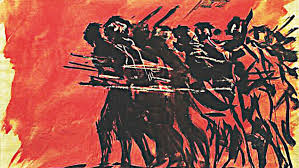
Painting by Zainul Abedin. From Public Domain

1971 began and ended on a note of hope but in the course of the year we went through the whole gamut of human emotions: love for our motherland and hate for its enemies; desire for freedom and abhorrence at those who had curtailed our right to be ourselves; feelings such as anxiety, fear, even terror caused by the knowledge that at any moment we might be abducted and murdered; and excitement and elation at the thought that relief could not be far away. 1971 was the year when for months we lived from day to day, totally insecure in a Dhaka which had become like a city of the dead; it was also the year when we discovered what it meant to hope against hope. 1971, in short, was a cataclysmal year; for every Bengali it was the year of living dangerously.

The year must have begun innocuously enough; at this point in time, I have simply no recollection what I did or how I felt in January and February of that year. But certainly, hope must have been in the air; after Sheikh Sahib’s massive election victory all of us must have been feeling confident and secure in the knowledge that we were finally about to master our destiny. For me—temperamentally apolitical and not yet out of my teens at the beginning of that year—the first sign that something was seriously wrong came one day while we were watching a test match in Dhaka Stadium on the first of March. Suddenly, the game was interrupted and then abandoned as news came about Yahya Khan’s decision to not call a meeting of the Pakistani National Assembly. Pandemonium ruled for a while in the field, but soon everyone left, muttering that this cannot be, indignant that the army chief could not go against the resounding mandate given to the Awami League to change the course of Pakistani history.

And then for a while: hartals[1], demonstrations, slogans, meetings, public displays of discontent, and the will to oppose and resist on one side and display of the carrot as well as the stick on the other. In fact, the month of March showed a whole nation in a state of ferment, ready to go to any length against a brutal but posturing force.

A first climax was Sheikh Saheb’s[2] speech of March 7. Hearing it now, I cannot but think: is it as stirring for people of this generation as it was for ours? Contemplated in retrospective, the speech seems to be the quintessence of the Bengali spirit in 1971: inspired, defiant, pulsating, and resolute. It considers the dangers ahead but is emphatic about the need to put up resistance and counter whatever measures were taken to contain us.

The real climax, of course, came on the night of March 25. That night I was in Sylhet, visiting my sister and her husband, along with my father and two other sisters. In Sylhet that night we could have no idea that Dhaka had become the scene of carnage or that our family, friends, and acquaintances were in the greatest of danger. It was only next morning, waking up to discover that Sylhet town was under curfew, and listening to Indian radio and the BBC, that we began to have an inkling of how devastated Dhaka had become in a night and in how much jeopardy our loved ones were.

Throughout the next week we alternated between a feeling of joy at the knowledge that Bengalis were fighting back and a foreboding that a grievous wound had been inflicted on us. We were elated by Major Zia’s declaration on the radio about independence and the reports of resistance everywhere; we were depressed by the news items transmitted in the air waves about Dhaka as a city that had been flattened by heavy weapons and was still burning. Since, our house was close to Farmgate, we were full of anxiety: had my mother and the sister we had left behind survived the mass slaughter of Dhakaites that was being narrated everywhere except on Radio Pakistan?

After a few days my father decided that he had had enough of waiting and uncertainty; he and I would head for Dhaka and determine for ourselves the fate of my mother and sister. My brother-in-law and three other sisters would remain in what seemed the relative safety of Sylhet. Little did we realise as we left them on a day in early April the hardship and suffering they would go through in the next few months, fleeing from tea garden to tea garden and even to the safety of Tripura[3] to escape the pillaging Pakistani army. Only after we were reunited with them in Dhaka in July did we get to know of their travails as they attempted to evade the marauding forces.

The trip to Dhaka was a tense and an unforgettable one. A few images are etched in my memory vividly: driving through the tea gardens, we saw tea garden workers with bows and arrows, determination wrought on their faces. In Brahmanbaria, we heard gripping stories of the confrontations that had taken place in Comilla and saw the intense preparations being taken in the town itself to resist the Pakistani onslaught. But the most vivid memory of the journey are the scenes of mass exodus we witnessed as we neared Dhaka: men, women, and children on foot or on rickshaws, looking harrowed, wearily fleeing to village homes from the city to escape genocide. Not a few of the people we met told us not to be so foolhardy as to return to Dhaka.

Thankfully, we managed to reach our Indira Road home without facing any unpleasant situations and found that my mother and sister were safe. But there were troop movements all the time and stories of mass arrests of young men during curfew. The elders of my family decided that I would be safer in my uncle’s house in Dhanmondi than in a house in the Farmgate area.

In the few weeks that I stayed in Dhanmondi I managed to get in touch with some of my friends. The news they told me was horrifying: Dr. Jyotirmoy Guhathakurta, my tutorial teacher, and the man who first made me feel that I had the sensitivity to be a student of Shakespeare, and who went beyond his role as a tutor to talk to me about his passion for radical humanism, as well as Mr. Rashidul Hasan, who taught us Blake and was as humble and meek as some of the denizens of The Songs of Innocence and of Experience, had been brutally murdered. More horror stories: one of my school friends, Arun Chowdhury, and his father, could no longer be traced after they had been abducted from Ranada Prasad Saha’s Narayanganj home along with the millionaire philanthropist; one of my uncle’s in-laws, a Rajshahi University professor, had also disappeared after being picked up by the army; other people that we knew had been shot at or humiliated or hurt. A friend who had joined her family in Bogra had witnessed their house being burned and the family had barely managed to escape with their lives. The whole Bengali nation appeared to be bleeding and bruised.

Nevertheless, no one felt defeated and hope still flickered as a candle newly lit and solidly fixed will even in the darkest night. For one thing, there were the daily broadcasts from Swadhin Bangla Betar Kendra[4]containing news about Mujibnagar and organised resistance all over the country. Then there was the knowledge that some friends had crossed the border and were receiving training so that they could be inducted into the Mukti Bahini[5]. Everywhere one could view the resentment against the Pakistani army being concentrated to the point when it would rebound upon them.

Eventually, my parents decided that we would take a house in a part of the city which was relatively free from regular army patrolling and I rejoined them in a Central Road flat. But, really, no part of the city was completely safe. One night, to take just one example, the boys of the neighbouring family climbed the wall separating our two houses because the army had raided the house next door and stayed with us till next morning. I still remember how tense we were that night and nervous and indignant.

Gradually, we learned to sleep better and not hear the stray shots that were fired into the night by who knows whom. Inevitably, we adapted to a life lived mostly indoors, listening to the radio or the tape recorder all day, or reading, or playing cards. But we had to be very careful about everything that we did: the radio had to be toned down, books with insidious sounding titles not read, and visit to and from friends of our age restricted. Fear of army raids constricted us and forced us to make life a diminished thing. Only my father would go out regularly to spend the day in office or shopping; his greying hair gave him a kind of limited freedom that we could not hope to have.

However, consolations for lives lived under such strained circumstances were not impossible to seek even in those days when we would rarely venture into natural light. By June, bombs which were beginning to explode at regular intervals all over the city announced loudly to us that the Bengali capacity to resist, far from being diminished, had transformed itself in spectacular fashion. My father told us one day that he was one of many people who had been donating money for freedom fighters who were now infiltrating into the city in large numbers. In July and August, the Mukti Bahini activity in Dhaka intensified and I even met a few of them. Also, every once in a while, a close friend suddenly disappeared from Dhaka and those of us who still remained in the city still unsure of what we should do talked about his decision to join the freedom struggle and his daring with a mixture of admiration and envy.

Of course, we knew that the life of a freedom fighter was far from a glamorous one, and full of risks. Exactly how hazardous their life could be was driven home to us when in late August a number of them were caught and murdered. Because we knew a few of these valiant fighters personally or by name, for some time, indeed for perhaps the only time that year, we felt depressed and shaken. But another few weeks and many amongst us roused ourselves and felt hopeful again. True, there had been a setback and some of the muktis[6]who had become legendary in a short time because of their exploits had been killed or imprisoned, but September showed that the spirit of resistance was very much alive.

Explosions could once again be heard in and around Dhaka and were signs to us of the vigour and irrepressible nature of our freedom fighters. By October, Swadhin Bangla[7]Radio broadcasts regularly reassured us that there were advances being made on the diplomatic front by our government-in-exile and that on the battlefield our reconstituted Bangladesh army were beginning to engage the Pakistani forces and defeat and demoralise them.

By early November, Nasim Mohsin, my best friend at that time, decided that it was time for him to join the freedom fighters and that the moment for a decisive assault on the Pakistani army was near. I was with him when he contacted some local muktis about crossing over to training camps in Tripura. They told him that the borders were already the site of daily skirmishes and that he should postpone the journey for a while till they could confirm a safe crossing. Desperate to become part of the freedom struggle, Nasim ignored their advice and our pleas to be patient and left us, never to be seen again. Much later, we were to discover that he had been captured by collaborators of the Pakistani army in a village in the Comilla border. They then handed him over to the local Pakistani troops who summarily shot him.

Late November and our excitement grew: the Bangladesh army was no longer content with skirmishes and raids and was now attacking the Pakistanis frontally. By late November war looked inevitable as desperate Pakistani tactics drew India into the campaign. Finally, on the night of December 3, the Dhaka night sky was spectacularly lit by tracer bullets and then invaded by Indian bombers targeting military installations. The next day all of us were on roof-tops watching dog-fights and cheering Indian jets attacking the airport and the cantonment, oblivious to the danger from shrapnel and debris from shattered planes.

Over the next two weeks, our joy grew by the hour, for every Swadhin Bangla Radio broadcast or Indian radio bulletin informed us of Pakistani reverses and detailed advances made by the liberation forces. In our enthusiasm we did not realise that we were going through dangerous times in the capital city as the Pakistani army and its collaborators, their backs against the wall, were becoming more and more vicious. It was only later that we discovered that the brother of a friend who had joined the freedom fighters had been picked up by the Pakistani army during this time and would disappear from our sights forever. And as the liberation forces closed in on Dhaka, rumours spread of youths and prominent people being abducted. Undoubtedly, the scariest memory I have from this period is of a Pakistani plane droning one night, which we knew had dropped bombs on an orphanage the previous night in a bid to discredit the Indian Air Force. It was a moment when we felt totally vulnerable and at the mercy of forces whose reason had become warped to the extent that they could indulge in mass destruction of innocents merely to smear India in the eyes of the world.

Nothing the vicious Pakistani military/propaganda machine could do, however, could thwart the logic of history and prevent liberation, and by December 15 we were hearing the booming of artillery in and around Dhaka. On December 16, we headed for the Ramna Race Course area because we heard that a surrender ceremony was scheduled there in the afternoon.

But we could only go as far as the Hotel InterContinental, where we got caught in a cross-fire. A friend who was with me got slightly hurt as a splinter from a bullet pierced his leg. We took him to his house and then scattered, telling ourselves that we had not survived nine months of occupation only to get killed at the moment of liberation. But by evening we were out in the streets celebrating with muktis, among whom I could see at least one close friend, firing his Sten gun into the air. The year of living dangerously was ending, and the time for unmitigated hope had finally come to stay with us, at least for a while!

(Published on March 31, 2019, The Daily Observer)

[1] Strikes

[2] Sheikh Mujibur Rahman (1920-1975)

[3] A northeastern state of India

[4] Independent Bengali Wireless Centre

[5] The freedom vehicle: The army that fought to free Bangladesh as an independent entity

[6] Freedom fighters

[7] Free Bengal

Fakrul Alam is an academic, translator and writer from Bangladesh. He has translated works of Jibonananda Das and Rabindranath Tagore into English and is the recipient of Bangla Academy Literary Award (2012) for translation and SAARC Literary Award (2012).

PLEASE NOTE: ARTICLES CAN ONLY BE REPRODUCED IN OTHER SITES WITH DUE ACKNOWLEDGEMENT TO BORDERLESS JOURNAL

Click here to access the Borderless anthology, Monalisa No Longer Smiles

Click here to access Monalisa No Longer Smiles on Amazon International
Categories
Editorial

And Wilderness is Paradise Enow…

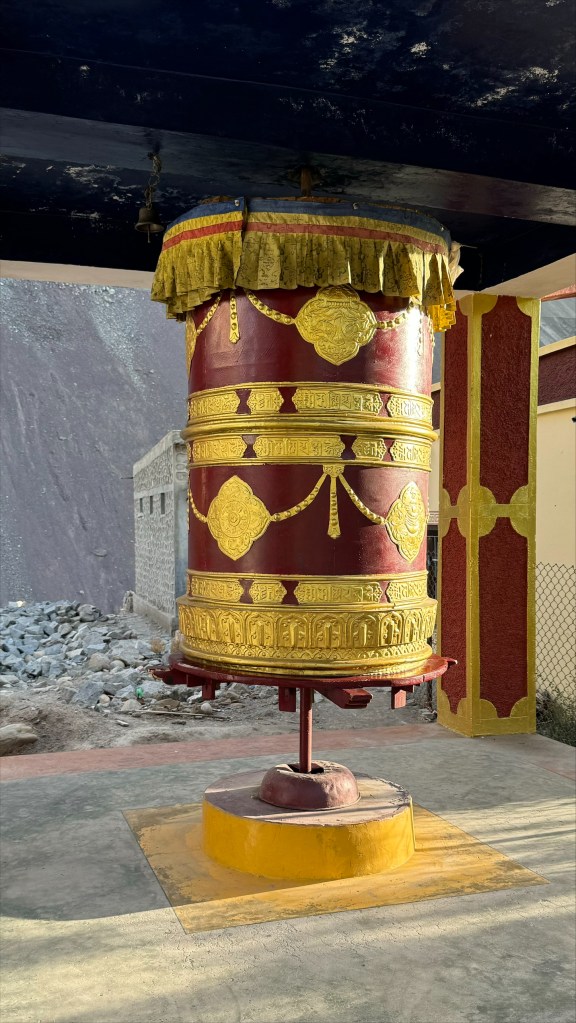
Prayer Wheel at Nurulia, Ladakh. Photo Courtesy: Farouk Gulsara
We lock eyes, find glimmers
of smiles, trust our leaders.
We break bread with strangers
because there aren’t any.

--Imagine by Miriam Bassuk

Imagine the world envisioned by John Lennon. Imagine the world envisioned and partly materialised by Tagore in his pet twin projects of Santiniketan and Sriniketan, training institutes made with the intent of moving towards creating a work force that would dedicate their lives to human weal, to closing social gaps borne of human constructs and to uplifting the less privileged by educating them and giving them the means to earn a livelihood. You might well call these people visionaries and utopian dreamers, but were they? Tagore had hoped to inspire with his model institutions.  In 1939, he wrote in a letter: “My path, as you know, lies in the domain of quiet integral action and thought, my units must be few and small, and I can but face human problems in relation to some basic village or cultural area. So, in the midst of worldwide anguish, and with the problems of over three hundred millions staring us in the face, I stick to my work in Santiniketan and Sriniketan hoping that my efforts will touch the heart of our village neighbours and help them in reasserting themselves in a new social order. If we can give a start to a few villages, they would perhaps be an inspiration to some others—and my life work will have been done.”  But did we really have a new social order or try to emulate him?

If we had acted out of compassion and kindness towards redefining with a new social order, as Miriam Bassuk points out in her poem based on Lennon’s lyrics of Imagine, there would be no strangers. We’d all be friends living in harmony and creating a world with compassion, kindness, love and tolerance. We would not have wars or regional geopolitical tensions which act against human weal. Perhaps, we would not have had the issues of war of climate change take on the proportions that are wrecking our own constructs.

Natural disasters, floods, fires, landslides have affected many of our lives. Bringing us close to such a disaster is an essay by Salma A Shafi at ground level in Noakhali. More than 4.5 million were affected and 71 died in this disaster. Another 23 died in the same spate of floods in Tripura with 65,000 affected. We are looking at a single region here, but such disasters seem to be becoming more frequent. And yet. there had been a time when Noakhali was an idyllic vacation spot as reflected in Professor Fakrul Alam’s nostalgic essay, filled with memories of love, green outdoors and kindnesses. Such emotions reverberate in Ravi Shankar’s account of his medical adventures in the highlands of Kerala, a state that suffered a stupendous landslide last month. While Shafi shows how extreme rainfall can cause disasters, Keith Lyons writes of water, whose waves in oceanic form lap landmasses like bridges. He finds a microcosm of the whole world in a swimming pool as migrants find their way to New Zealand too. Farouk Gulsara muses on kindness and caregiving while Priyanka Panwar ponders about ordinary days. Saeed Ibrahim gives a literary twist to our musings.   Tongue in cheek humour is woven into our nonfiction section by Suzanne Kamata’s notes from Japan, Devraj Singh Kalsi’s piece on premature greying and Uday Deshwal’s paean to his sunglasses!

Humour is wrought into poetry by Rhys Hughes. Supriya Javelkar and Shamik Banerjee have cheeky poems that make you smile. We have poetry on love by Michael Burch and poetry for Dylan Thomas by Ryan Quinn Flanagan. Miriam Bassuk has described a Utopian world… but very much in the spirit of our journal. Variety is brought into our journal with poetry from Jackie Kabir, Jennifer McCormack, Craig Kirchner, Stuart MacFarlane, George Freek, Luis Cuauhtémoc Berriozábal and many more.

In translations, we have Nazrul lyrics transcreated from Bengali by Professor Alam and poetry from Korean by Ihlwha Choi. We pay our respects to an eminent Balochi poet who passed on exactly a year ago, Mubarak Qazi, by carrying a translation by Fazal Baloch. Tagore’s Suprobhat (Good morning) has been rendered in English from Bengali. His descriptions of the morning are layered and amazing — with a hint of the need to reconstruct our world, very relevant even today.  A powerful essay by Tagore called Raja O Praja (The King and His Subjects), has been translated by Himadri Lahiri.

Our fiction hosts two narratives that centre around childhood, one by Naramsetti Umamaheswararao and another by G Venkatesh, though with very different approaches. Mahila Iqbal relates a poignant tale about aging, mental health and neglect, the very antithesis of Gulsara’s musing. Paul Mirabile has given a strange story about a ‘useless idler’.

A short story collection has been reviewed by Rakhi Dalal, Swadesh Deepak’s A Bouquet of Dead Flowers, translated from Hindi by Jerry Pinto, Pratik Kanjilal, Nirupama Dutt, Sukant Deepak. Somdatta Mandal has written about a book by a Kashmiri immigrant which is part based on lived experiences and part fictive, Karan Mujoo’s This Our Paradise: A Novel. Bhaskar Parichha has reviewed Ayurveda, Nation and Society: United Provinces, c. 1890–1950 by Saurav Kumar Rai, a book which shows how healthcare was even a hundred years ago, politicised. Meenakshi Malhotra has reviewed Anuradha Marwah’s novel, Aunties of Vasant Kunj, of which we also have an excerpt. The other excerpt is from Mineke Schipper’s Widows: A Global History. Ratnottama Sengupta converses with Reba Som, author of Hop, Skip and Jump; Peregrinations of a Diplomat’s Wife.

We have more content that adds to the vibrancy of the issue. Do pause by this issue and take a look. This issue would not have been possible without all your writings. Thank you for that. Huge thanks to our readers and our team, without whose support we could not have come this far. I would especially like to thank Sohana Manzoor for her continued supply of her fabulous and distinctive artwork and Gulsara for his fabulous photographs.

Let us look forward to a festive season which awakens each autumn and stretches to winter. May we in this season find love, compassion and kindness in our hearts towards our whole human family.

Have a wonderful month!

Mitali Chakravarty

borderlessjournal.com

Click here to access the content’s page for the September 2024 Issue.

.

READ THE LATEST UPDATES ON THE FIRST BORDERLESS ANTHOLOGY, MONALISA NO LONGER SMILES, BY CLICKING ON THIS LINK.

Categories
climate change

A Manmade Disaster or Climate Change?

Salma A. Shafi writes from ground level at Noakhali

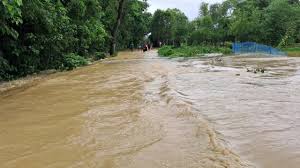
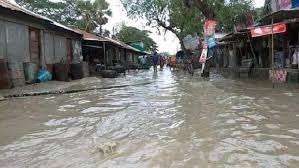
The Greater Noakhali region of Bangladesh is experiencing one of the most severe flood and water-logging crises in recent memory, driven by persistent heavy rainfall since mid-August 2024. The flood affected more than 5 million people, submerging houses, roads, and marketplaces, and leaving large portions of the region inundated. A total of 71 people, including women and children, lost their lives in the flood affected areas. With water levels reaching alarming heights, the disaster has raised significant concerns about vulnerability of the region for future flooding.

Almost every year floods occur in Bangladesh, but the intensity and magnitude vary from year to year. Their nature causes and extent of destruction gives them various definitions such as river flood, rainfall flood, flash flood, tidal flood, storm surge flood. The term manmade flood is a recent phenomenon attributed to encroachment on vital water channels, such as canals and wetlands sometimes for construction of roads and bridges and frequently for fish cultivation, hatcheries and shrimp farming.

Context of recent flood in Bangladesh

Since August 20, 2024, Bangladesh has been facing severe flooding triggered by continuous heavy rainfall and, according to the Bangladesh Ministry of External Affairs, water releases from Dumbur Dam, upstream in Tripura, India[1], a claim that is denied by the Indian government. Tripura also suffered severe floods and landslides[2] from this August. The flood impacted several districts in Bangladesh, including Feni, Noakhali, Comilla, Lakshmipur, Brahmanbaria, Cox’s Bazar, Khagrachhari, Chattogram, Habiganj, and Moulvibazar. By August 23, 2024, the Ministry of Disaster Management and Relief reported that floods had affected 4.5 million people across 77 upazilas in 11 districts. Nearly 194,000 people, along with over 17,800 livestock sought refuge in 3,170 shelters as the crisis continued.

In addition to widespread displacement, the floods led to tragic fatalities, with deaths reported across multiple districts. Communication with key river stations, such as Muhuri[3] and Halda[4], were completely severed, hampering collection of vital data necessary for relief and rescue operations. The extensive flooding has caused significant damage to property, crops, and infrastructure, displacing thousands of families. The disruption to transportation and agriculture  deepened the humanitarian crisis, demanding immediate action to mitigate long-term impacts of disaster on the affected communities.

The flood situation in Noakhali District worsened due to continuous heavy rainfall and rising water levels of the Muhuri River. The district Weather Office recorded 71 mm of rainfall within 24 hours, exacerbating the flooding. Approximately 2 million people were stranded as floodwaters submerged roads, agricultural fields, and fish ponds. Seven municipalities in the district went underwater, with widespread waterlogging affecting both rural and urban settlements.

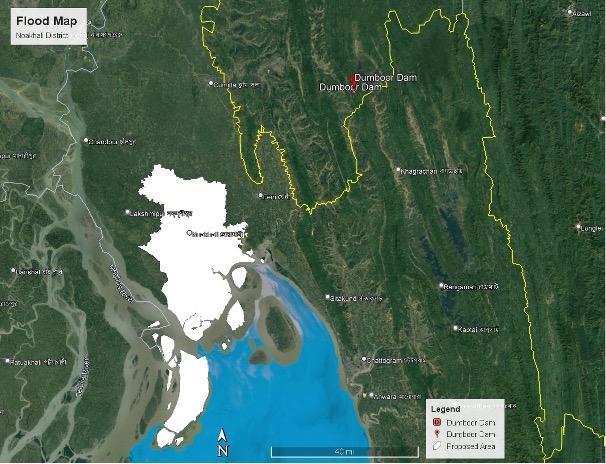
Map provided by Salma A Shafi

On September 1, 2024, the Noakhali Meteorological Office reported a staggering 174 mm of rainfall within a 12-hour period, causing widespread flooding and waterlogging across low-lying areas. The worst-affected upazilas include Noakhali, Senbagh, Sonaimuri, Chatkhil, Begumganj, Kabirhat, Companiganj, and Subarnachar, where over 2.1 million people were stranded. Additionally, more than 264,000 individuals sought refuge in emergency shelters and school buildings. The prolonged water-logging devastated local economy, particularly the agricultural sector, where vast areas of farmland, including Aman rice seedbeds and vegetable fields, were submerged, jeopardizing livelihoods of farmers and disrupting essential food production for a prolonged period.

With 90% of Noakhali district’s population impacted by this flash flood, the region faced critical humanitarian and environmental emergency. An analysis of the causes and consequences of flood and waterlogging in Greater Noakhali reveals an interplay of meteorological, infrastructural, and environmental factors coupled with geographic location of Bangladesh and the geo morphology of the river systems of the region. Bangladesh and India share 54 rivers of which the Teesta, Ganges, Brahmaputra, Meghna forming the GBM basin are the most important. This river basin is one of the largest hydrological regions in the world and stretches across five countries Bangladesh, Bhutan, China, India and Nepal. This basin area is home to 47 percent of the Indian population and 80 percent of the Bangladeshi population. Food security, water supply, energy and environment of both countries are dependent on the water resource of the rivers.

Uncertainty and Challenges in Flood situation 

During the monsoon periods development of a low-pressure system over northern Bangladesh can bring very heavy to extremely heavy rainfall in Assam, Meghalaya, and Tripura posing great threat to flood-prone areas in Bangladesh. These overlapping weather patterns and regional dynamics create highly uncertain and dangerous situation, making it difficult to coordinate an effective response and leave millions of people vulnerable to worsening flood conditions.

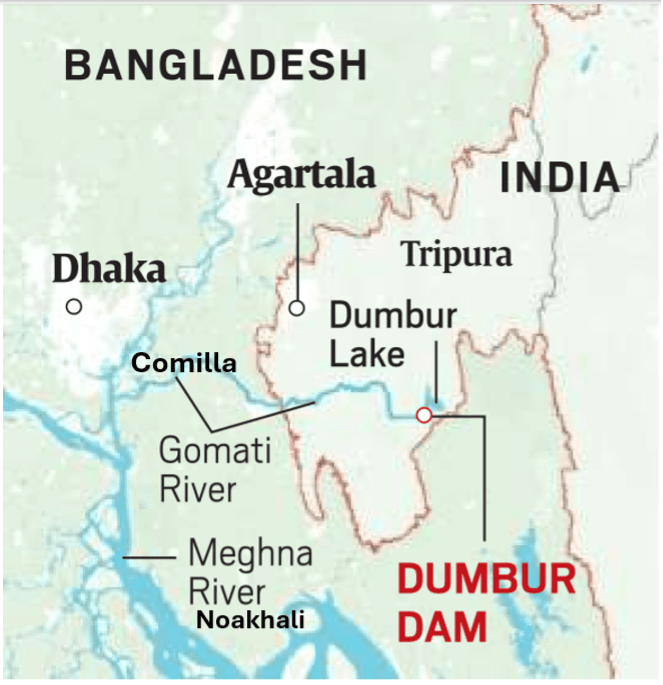
Map provided by Salma A Shafi

Flooding in Noakhali region resulted from heavy rainfall and floods in western Tripura in August and as per MEA[5] news broadcast that the Dumbur Dam, a hydro power project had been, “auto releasing”, water as a consequence of the rainfall. The Dumbur Dam in Tripura is located far from the border about 120km upstream of Bangladesh. It is a low height dam (30m) that generates power and feeds into a grid from which Bangladesh also draws 40MW power. There are three water level observation sites along the 120km river course. As per news from the monitoring agencies excess water from the Gumti reservoir was automatically released through the spillway once it crossed the 94m mark which is the reservoirs full capacity. It is a known fact there is no comprehensive regional mechanism for transboundary water governance or multilateral forum involving the five Asian nations. The lower riparian nations particularly India and Bangladesh are therefore the worst sufferers.

Key Impact Areas in Bangladesh:

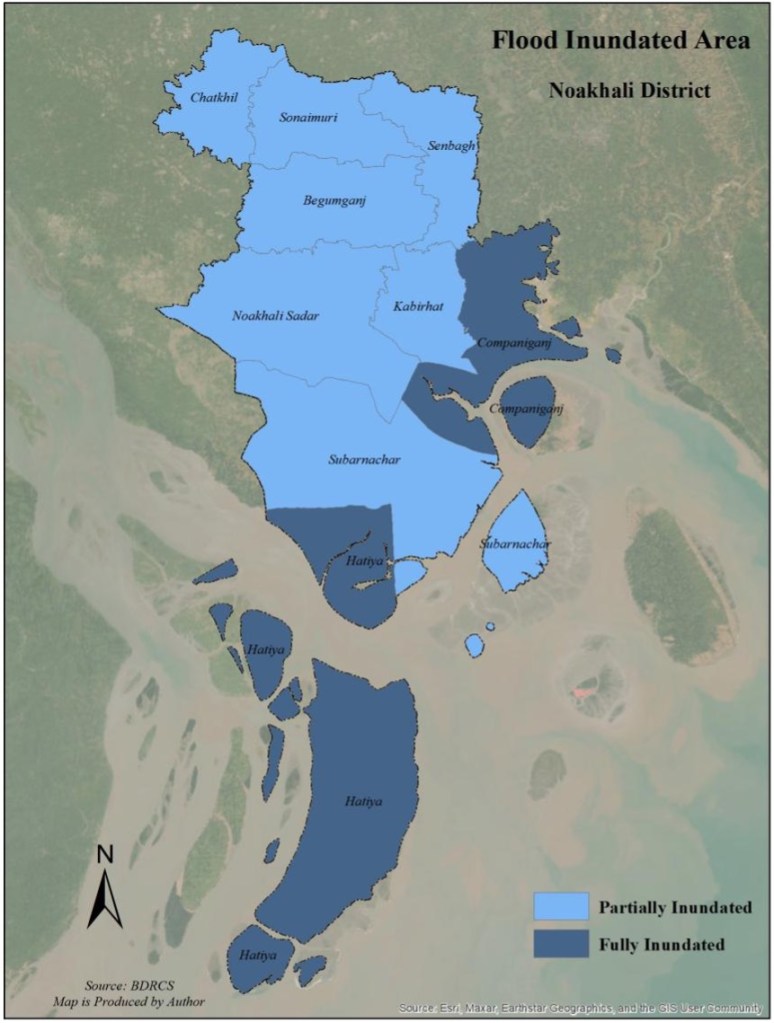
The flood in the Noakhali region was caused by overflow of water from the large catchment areas downstream of the Dumbur Dam. While river channels were not deep enough to accommodate the excess water, unplanned constructions on rivers and canals caused the water to spill into settlement areas causing humanitarian crisis unseen in decades. Kompaniganj and Hatiya upazilas (sub-districts) were completely inundated by floodwaters, while Subarna Char, Sonaimuri, Noakhali Sadar, Kabir Hat, and Senbag upazilas were partially affected. The flooding submerged homes, roads, and marketplaces, with water levels reaching roof levels in the high flood zones, waist-deep in some areas and knee-deep inside most homes. The rising floodwaters devastated farmlands, particularly Aman paddy seedbeds and vegetable fields, swept away, a large number of the cattle, poultry including the sheds which sheltered them.

Current Challenges

The ongoing flood crisis in Bangladesh faces several critical challenges. One of the most immediate issues is the submersion of roads and the disruption of communication networks, which has significantly hindered relief efforts. The situation is fluid, with new districts continuously being affected, complicating the delivery of aid and emergency services to those in need. This has also resulted in delays in evacuations, leaving many communities stranded without access to basic necessities.

Another key challenge is the conflicting information from different meteorological agencies. The Bangladesh Meteorological Department and the Flood Forecasting and Warning Center (FFWC) have issued varying reports regarding upcoming weather conditions. This uncertainty is affecting the preparedness of the affected populations, making it difficult for them to take timely and appropriate measures to protect themselves and their property.

Geo-political Tension in River Management in Bangladesh

Bangladesh, known as one of the most climate-vulnerable nations globally is facing increasing geopolitical challenges due to its strategic location on the Ganges-Brahmaputra Delta. Besides, annual monsoon floods, flash flood, particularly in northeastern districts of Sylhet, Feni and Cumilla, Noakhali are exacerbated by water releases from upstream dams, such as the Dumbur Dam. These actions have intensified tensions between Bangladesh and India, highlighting the complex dynamics of transboundary river management.

Despite legal recognition of rivers as living entities, both nations continue to exploit these water resources through infrastructure projects that disrupt natural river flows. Extensive dam and hydropower projects on shared rivers have caused significant environmental and social injustices downstream, impacting both ecosystems and livelihoods. This situation reflects a broader pattern of unilateral control and inadequate cooperation in water management, which contradicts international agreements and hinders equitable water sharing.

The Bangladesh-India Joint River Commission, established in 1972, is yet to resolve these critical issues. The recent floods have further underscored the need for more effective communication and cooperation between the two nations to prevent future disasters. As calls for water justice grow louder, there is increasing pressure on both countries to remove barriers and ensure the free flow of rivers across borders, upholding the principles of transboundary water governance and protecting the rights of those affected downstream.

Flood Map of Noakhali District, 2024. Map provided by Salma A Shafi

[1] India disputes this claim saying that they have been releasing the same quantity of water for the last fifty years. https://www.downtoearth.org.in/natural-disasters/india-has-no-role-in-bangladesh-flood-dumbur-dam-opens-automatically-for-last-50-years-tripura-official https://www.thedailystar.net/news/bangladesh/news/india-refutes-claims-causing-floods-bangladesh-3683526

[2] The floods displaced 65,000 people and killed 23 in Tripura. https://www.reuters.com/world/india/floods-landslides-indias-tripura-displace-tens-thousands-2024-08-23/

[3] A river that starts in Tripura and flows down to Feni. Also, Muhuri Irrigation Project is Bangladesh’s second largest irrigation project. https://en.wikipedia.org/wiki/Muhuri_Project

[4] The Halda River is the breeding ground for carp and fishermen harvest the carp eggs.  https://bsmrau.edu.bd/seminar/wp-content/uploads/sites/318/2020/08/003-Umme-Hani-Sharanika-seminar-paper.pdf

[5] Ministry of External Affairs, in this case Bangladesh.

Salma A. Shafi is an architect and urban planner. She did her MSc. in Urban Planning from AIT, Bang­kok, Thai­land and has a Bachelor of Architecture (B. Arch.) degree from BU­ET, Dhaka. Salma Shafi has extensive experience in urban research and consultancy, specialising in urban land use and infrastructure planning, housing and tenure issues. She is a well-known researcher in the field of urbanisation and urban planning. Urban Crime and Violence in Dhaka published by the University Press Limited (2010), Housing Development Program for Dhaka City, Centre for Urban Studies, Dhaka (2008) and Feroza, a biography of her mother published by Journeyman (2021).

.

PLEASE NOTE: ARTICLES CAN ONLY BE REPRODUCED IN OTHER SITES WITH DUE ACKNOWLEDGEMENT TO BORDERLESS JOURNAL

Click here to access the Borderless anthology, Monalisa No Longer Smiles

Click here to access Monalisa No Longer Smiles on Kindle Amazon International

Categories
Slices from Life

Heatwave & Tagore

Once more, Ratnottama Sengupta explores the contemporariness of Tagore ….

The continuing heatwave in Kolkata that has defied the geographical reality of Kaal Baisakhi — the norwester that brings relief to sun-scorched beings — prompted me to continuously hum this Tagore song in Brindavani Sarang Raag, written in 1922.

Darun Agni Baaney Re... 
(Shafts of Fire)


Shafts of fire pour thirst on us --
Sleepless nights, long scorching days,
No respite in sight!
On withered branches,
A listless dove wails
Droopy doleful notes...
No fear, no scare,
My gaze is fixed on the sky,
For you will come in the
Form of a storm,
And shower rain on scorched souls.

And as I kept singing the song first penned in Santiniketan, I marvelled at the creativity of the giant whose words are true to this very day, more than 100 years later!

Kaal Baisakhi, the nor’wester known in Assam as bordoisila, is a localised rainfall and thunderstorm event which occurs in the Indian states of West Bengal, Bihar, Jharkhand, Odisha, Tripura, and Assam as well as in Bangladesh during the summer month of Baisakh (April 15-May 14). This first month of the Bengali calendar also saw the birth of Rabindranath Tagore. These storms generally occur in the afternoon or just before sunset, when thick dark black clouds appear over the sky and then bring gale-speed wind with torrential rain, often with hail, but spanning only a short period of time.

Kalbaisakhi

Tagore’s love for Nature had compelled him to set up in Santiniketan open air classrooms, where students would learn sitting on the ground in the bower, under trees where birds would chirp and gentle breeze would caress their tired brows.

And, his involvement also expressed itself in the 293 songs he wrote in the segment titled Prakriti (nature) Parjaay. There are songs about nature in general. But he himself further classified the songs under subsections — Upa parjaay — that focus on the six seasons: grishma (summer), barsha (Monsoon), sharat( early autumn), hemanta (late autumn or early winter), sheet (winter), basanta (spring). 

Tagore clearly was taken up by the wild beauty of monsoon with its dark clouds and thunderous showers. For, he wrote 150 songs on the drops of nectar from the heavens, while summer elicited a tenth of this number! If this is half the number celebrating sharat, the festive season of Durga Puja, it is thrice the number dedicated to hemanta, the confluence of autumn and winter.

I take heart in the fact that Grishma subsection includes Chokkhe aamar trishna, Ogo trishna aamar bakkho jurey… [1]

Thirst fills my eyes, Dear, 
Thirsty is my heart too...
I'm a rain-starved day of Baisakh
Burnt by the sun, heat stroked.
There's a storm brewing
In the ovenated air..
It sweeps my mind into the distance.
It rips me of my veil.
The blossom that lit up the garden
Has withered and fallen.
Who has reined in the stream
Imprisoned in heartless stone
At the peak of suffering?

And then, when it rained? The torrents poured balm on the angry burns. The fleet-footed lightning seared the heart of the cloud-covered darkness and extracted the nectar-like flow…

It assured us that no hardship lasts forever. It reiterated faith in the eternal words, “This too shall pass!” And, for me? It confirmed Tagore’s words that “You will come in the form of a storm and shower rain on scorched souls…”

Tagore lives on, 163 years after he came. In his words. In his imagery. In his empathy with every human situation…

[1] Thirst fills my eyes, Dear, /Thirsty is my heart too…

Ratnottama Sengupta, formerly Arts Editor of The Times of India, teaches mass communication and film appreciation, curates film festivals and art exhibitions, and translates and write books. She has been a member of CBFC, served on the National Film Awards jury and has herself won a National Award. 

.

PLEASE NOTE: ARTICLES CAN ONLY BE REPRODUCED IN OTHER SITES WITH DUE ACKNOWLEDGEMENT TO BORDERLESS JOURNAL

Click here to access the Borderless anthology, Monalisa No Longer Smiles

Click here to access Monalisa No Longer Smiles on Amazon International