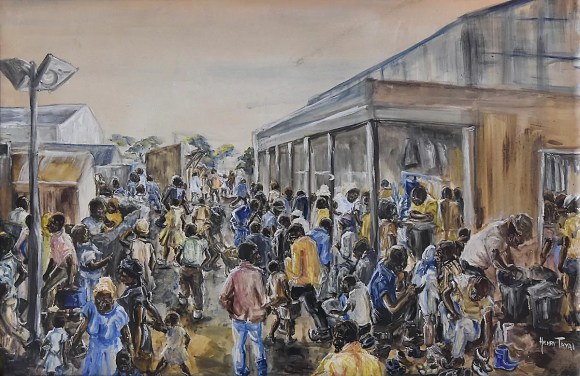
Art by Henry Tayali(1943-1987). From Public Domain
Let us imagine a world where wars have been outlawed and there is only peace. Is that even possible outside of John Lennon’s song? While John Gray, a modern-day thinker, propounds human nature cannot change despite technological advancements, one has to only imagine how a cave dweller would have told his family flying to the moon was an impossibility. And yet, it has been proven a reality and now, we are thinking living in outer space, though currently it is only the forte of a few elitists and astronomers. Maybe, it will become an accessible reality as shown in books by Isaac Asimov, Arthur C Clarke or shows like Star Trek and Star Wars. Perhaps, it’s only dreamers or ideators pursuing unreal hopes and urges who often become the change makers, the people that make humanity move forward. In Borderless, we merely gather your dreams and present them to the world. That is why we love to celebrate writers from across all languages and cultures with translations and writings that turn current norms topsy turvy. We feature a number of such ideators in this issue.
Nazrul in his times, would have been one such ideator, which is why we carry a song by him translated by Professor Fakrul Alam. And yet before him was Tagore — this time we carry a translation of an unusual poem about happiness. From current times, we present to you a poet — perhaps the greatest Malay writer in Singapore — Isa Kamari. He has translated his longing for changes into his poems. His novels and stories express the same longing as he shares in The Lost Mantras, his self-translated poems that explore adapting old to new. We will be bringing these out over a period of time. We also have poems by Hrushikesh Mallick translated from Odia by Snehprava Das and a poignant story by Sharaf Shad translated from Balochi by Fazal Baloch.
Book reviews homes an indepth introduction by Somdatta Mandal to Banu Mushtaq’s Heart Lamp: Selected Stories, translated from Kannada by Deepa Bhasthi. We have a discussion by Meenakshi Malhotra on Contours of Him: Poems, edited and introduced by Malaysian academic, Malachi Edwin Vethamani, in which she concludes, “that if femininity is a construct, so is masculinity.” Overriding human constructs are journeys made by migrants. Rupak Shreshta has introduced us to immigrant Sangita Swechcha’s Rose’s Odyssey: Tales of Love and Loss, translated from Nepali by Jayant Sharma. Bhaskar Parichha winds up this section with his exploration of Kalpana Karunakaran’s A Woman of No Consequence: Memory, Letters and Resistance in Madras. He tells us: “A Woman of No Consequence restores dignity to what is often dismissed as ordinary. It chronicles the spiritual and intellectual evolution of a woman who sought transcendence within the rhythms of domestic life, turning the everyday into a site of resistance and renewal.” Again, by the sound of it a book that redefines the idea that housework is mundane and gives dignity to women and the task at hand.
We wind up the October issue hoping for changes that will lead to a happier existence, helping us all connect with the commonality of emotions, overriding borders that hurt humanity, other species and the Earth.
Huge thanks to our fabulous team, especially Sohana Manzoor for her inimitable artwork. We would all love to congratulate Hughes for his plays that ran houseful in Swansea. And heartfelt thanks to all our wonderful contributors, without who this issue would not have been possible, and to our readers, who make it worth our while, to write and publish.
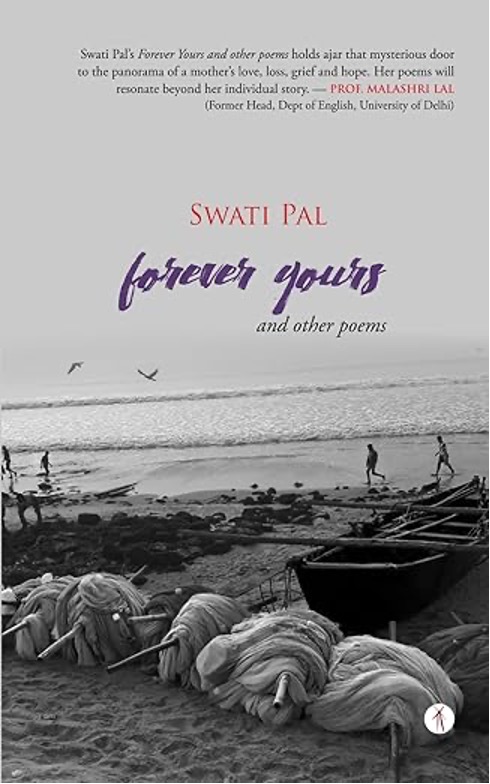
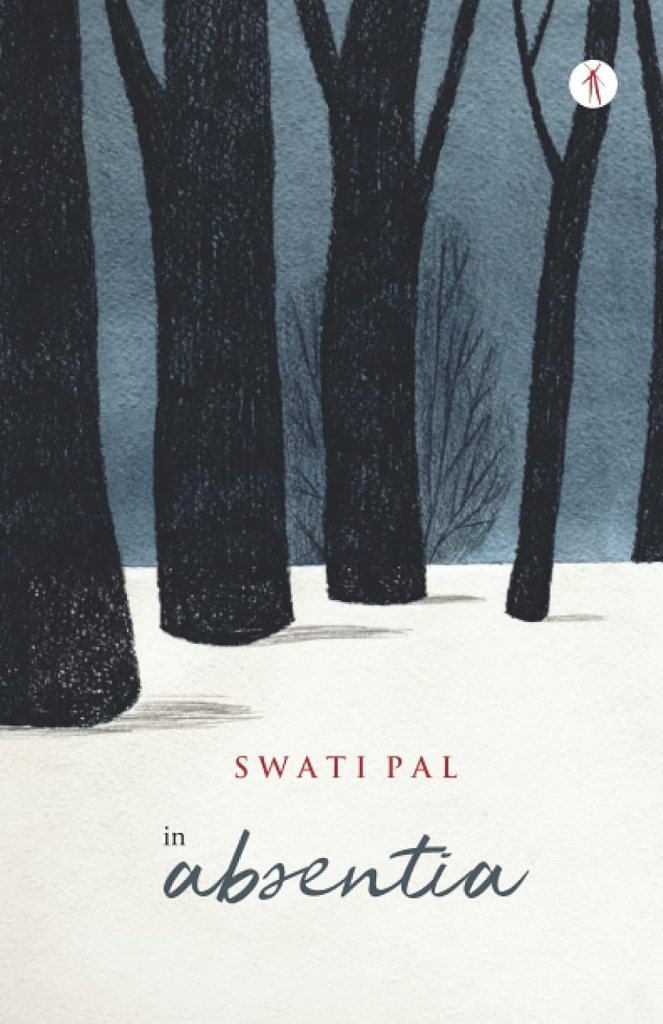
A discussion on writing to heal with Swati Pal, author of Forever Young and In Absentia, both brought out by Hawakal Publishers.
Swati Pal Swati Pal’s latest collection of poems
Strength is a badge
Worn by the bereaved.

(The badge of the bereaved)
Swati Pal is an accomplished academic, an able administrator, a much-loved teacher. But most of all she is a resilient mother. Her poetry glows with resilience. It’s honest and endearing… perhaps best described by these lines from John Keats’ ‘Ode to a Grecian Urn’: “Beauty is truth, truth beauty — that is all”. She writes poetry for her late son that makes one weep and feel with her.
If you hear a laugh
Wafting in the breeze
And floating around,
Know that it's me,
Your Diva, Mohan.

(Mohan whispered to me)
She finds him everywhere… he lives on for her.
I can still get
The scent
Of you,
Feel your tousled
Silky hair
And see it
Flying in the breeze.

(A Flower Called You)
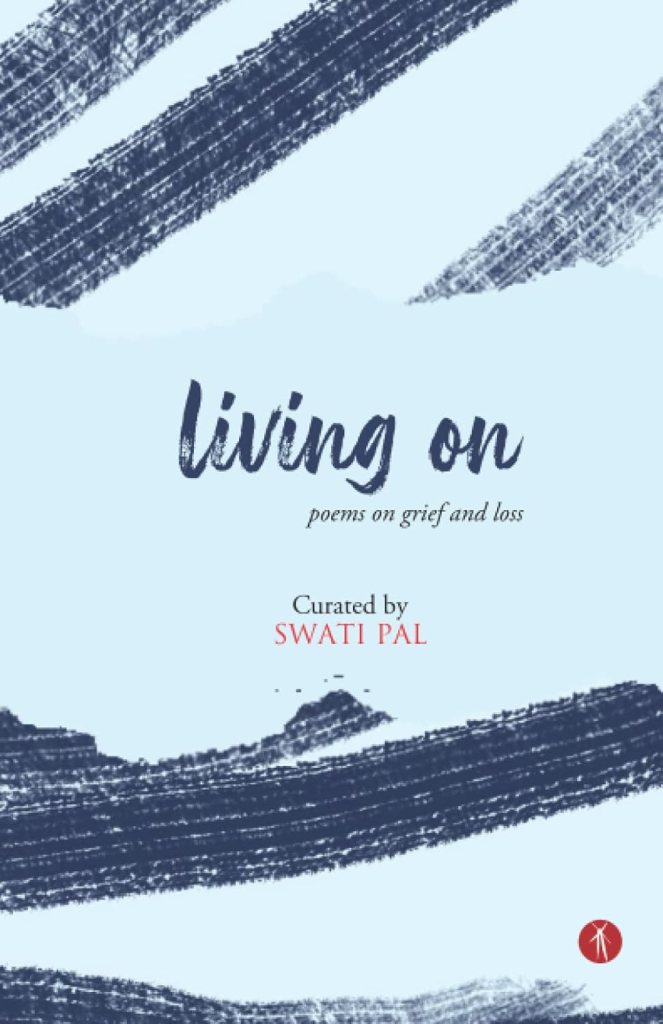
What is amazing is that she responded to her loss with a sisterhood, creating a group of poets from grieving women. She brought out with her sisters an anthology on loss, Living On (2022).
Anthology edited by Swati Pal and brought out by Hawakal Publishers
Overriding grief with love and action is tough. But that is something that seems to be woven into her earlier poems in In Absentia (2021) and in her most recent collection, which seems more stark, Forever Yours and Other Poems. As Professor Malashri Lal points out, they “resonate beyond her individual story”. Her poems capture the vastness of the universe with their love and longing. One doesn’t know whether to weep or wonder at the beauty that seems to emerge out of the poems — like a flower that blooms unfolding petal by petal. In this conversation, Swati Pal dwells on her journey of resilience and strength through writing.
When did you start writing poetry? What got/gets your muse going?
I was an oversensitive, expressive kid and teenager and went through the classic angst about life that such humans are prone to, I guess! I was complicated and tended to brood about everything with bouts of melancholia, most really genuine, but some a bit because at that age, it appeared to be most ‘romantic’! So writing was something that I turned to almost naturally and then to poetry by instinct. I used to read a lot of poetry actually and somehow was always captivated by the craft– the rhyme or the rhythm, the play with ideas and images, the words few yet saying so much; it was as if an entire universe existed in the poetic world. And I found the form beautiful, exacting and creative.
It helped too when Jayanta Mahapatra would select poems to be published in the Sunday magazine edition of The Telegraph, and he selected one that I dared to send! My vanity/pride was certainly boosted by what I considered a singular honour and the cheque for a small sum of perhaps 150 rupees (I forget the exact amount) was exciting to say the least– my first earning!
It was then the ideal way to deal with my own inner mess. If my morale was low(‘I am not beautiful’; ‘I can’t do this/ that/ or the other’; ‘So and so is better than me, I can never match up; ‘ Why can’t I have this/that or the other?’) and I was plagued by misery, I would write poetry; sometimes scathing stuff about people and life in scurrilous verse; sometimes light and hopeful like the dappled sunlight playing on the window sill to take my mind away from the negativity and escape into mostly the world of nature.
So poetry, even if it didn’t ever heal me or resolve my doubts and inner conflicts, calmed me. It kept me sane. It kept me rooted. So really, what has always got my Muse going is anything that moves me to tears – not necessarily about myself at all times but even a limping bleeding dog on the road, or a woman in rags and mentally unsound tearing her hair and crying; a leper sitting on the pavement completed dejected with life; pain, grief, loss — whether my own or anyone else’s, keeps my muse going.
Losing loved ones is tough. You dealt with poetry about your losses. How did you channelise your grief into writing?
As I said, I have always done so. Anything I found a hurdle, anything that caused me to be moved, anything that hurt my emotions or disturbed my peace, made me seek a companion — one I could pour my heart to. And seek I did! But misery, as they say has no bedfellows. Those I would vent to would get exhausted if the frequency of my exhortations became excessive (which they might have been). I think my emotional outbursts were fairly overpowering and sometimes the best of my friends and family would evade my searching them out, justifiably! But poetry. She never failed me. She was someone I could turn to in the dead of the night or the wee hours of the morning. She would let me rave and rant hysterically or in a fit of rage and tears and then equally quietly, let me rewrite when I was calmer, without remonstrations.
I lost my father when I was eighteen and it was terribly unfair as I had bided my time (the youngest of four siblings) to finally find my exclusive space in his dominion when poof! he was gone. And I was left feeling unanchored as suddenly everything became topsy turvy. That was the time I took to playing the clown at home, my mask ever in place, speaking ridiculous stuff and acting hilariously hoping that my behaviour could dispel the clouds of gloom that hung low over my home for a good many years after he died. And the more I played the clown, the more I longed to break free and scream out my rage and regret, my hurt at the void left by my father’s passing. In despair I turned to poetry and realised that working on making something beautiful, creating a pattern and a tempo with words, would somehow soothe my raging breast. It would stop me from being unhinged.
Since 2019, I when I lost my son, I lost sleep. And when I lie quietly on one side of the bed so that I don’t disturb my husband with my restlessness, I find myself turning to write poetry (on my mobile phone!) to keep me from holding my breath forever.
How did you form a sisterhood of women while dealing with your losses?
The sisterhood found me! I wanted to run away from everyone! To begin with, my sisters especially the eldest and the third, would come home every single evening those first few excruciating months when the loss made my life seem surreal and my physical self something I wanted to cast off. They would just sit with me; have a cup of tea and a snack they would bring along and chatter gently about the day. If I wept or screamed, they let me, clutching my hand tightly and saying things I shunned but which they spoke anyway. And in this way, through sundry humdrum things, they made the pain, the monumental grief, part of my every day. It is my three elder sisters who first helped me cross the bridge from being a mother with a living son to a mother of an angel with wings. There were others too, some friends since school days, a young sister-in-law, a niece, a young woman who is all but a biological daughter – whose companionship, whose concern in those early days, which soon timed with the Covid isolation, kept me afloat and were a balm to my soul.
And then one day a determined petite young lady was at my doorstep with food and her husband. She had heard about me from a relative, talked to me over the phone and tried to get me to agree to meet her and the support group of grieving mothers which I completely rejected as who on living earth ever wants to join such a group? But she was Radha– and my son is called lovingly, Mohan — and it had to be a Radha who would make me a part of In our hearts forever — a community of sisters and soulmates that are now an integral part of my life.
How can I forget my college students? The young girls with their starry eyes, sometimes brimming with tears when I mention Mohan, hugging me and making me smile with their crazy ways, their unbridled energy, their spontaneous affection — they were step sisters according to Mohan (he always complained that I loved his ‘stepsisters’ more as I spent more time with them!). This was and is a precious sisterhood. A special one.
This is only part of the reality. Lest it not be understood that the world is full of kind people and it is easy to form sisterhoods, I must hasten to add that I actually found, that some of those communities which I thought would form a sisterhood and be my support, turned out to be vicious, toxic and utterly cruel to me — they struck their blows of hatred and malice at a time when I was at my most vulnerable. I now know that I was such a naïve idealistic fool in my expectations! And finally, there were some men too who enabled me, two in particular and it would be so wrong to leave them out of my circle of hand holders.
What led to your anthology, Living On? Tell us a bit about the anthology.
It was Covid time and all my soulmates in the support group as well as myself were feeling desperate trapped withing the confines of our houses with our grief as our only companion. I could feel us all struggling. I suggested we do something to beat the blues and we would meet online with one person taking the lead to share something and make us do something together in a novel way.
I saw the blues being banished, at least for that time when were online. That made me feel I need to do more. That all my sister grief travellers needed to express their grief and shared the same wish as me: to make our child remembered. We were living on without our children, but our heart was nothing save a bleeding wound.
My first collection of poems had been In Absentia and obviously as the name suggests, it was about absence. It was about my Mohan. I knew now that I had to write about how I was living with that absence. I invited the support group members and others outside it who were also suffering from the grief of other losses such as parent/s to write if they wished. I wrote too. And thus, was created Living on — a chance for us to immortalise our loved one, as best as we could. I can only invite all to read it. It has photographs too of the lost ones. It is a truly moving book of recollection, a book of love. Those who wrote said that when they got the books in their hands, they were initially almost unnerved to see the words and pictures jumping out of the page. That they felt a great sense of achievement but also emotionally drained. All this was only to be expected. But it made us stronger, I think.
Has poetry drawn you closer to your sisters in grief?
Yes. They feel I speak for all of us. I know that I do.
How does writing help you cope with your loss?
It stops me from crossing that thin line between sanity and insanity, it gives meaning, at least for a while to my life which seems mostly irrelevant to me now.
You use lot of imagery from nature. It almost feels that you live with the loss all the time. And yet there is a sense of solace in your poems. Would you like to comment on that?
I breathe the pain and loss. It is not forgotten for a single second. Everything in nature reminds me of my son as we spent so much time together, including outdoors. The scent of the flowers in the breeze when we walked at night, the grass on the hockey field where I would time him as he prepped for the 100 meters race which he specialised in, the sound of the birds who Mohan was a bit wary of having been pecked a few times by the eagles and crows.
At first, Nature in fact hurt me as I could not renew myself the way nature does. I would be anguished and did not want to see the flowers blossoming or the squirrels running off the trees for food. But then I learnt that butterflies flitting around the house were a symbol of loved ones who had gone too soon and I began to look out for them. I learnt that feathers, especially pure white ones, were also a sign that our loved ones were hovering around. And that the rain falling on our faces is our loved ones communicating with us, crying with us. Nature does not provide me solace; nothing can and nothing will. But yes, I seek Mohan in nature.
You are a well-known academic and a principal of a college in Delhi University. Does that help in your writerly journey and to build your resilience? Please elaborate.
Well, it certainly makes me more resilient! The experiences I go through even when I battle so many things, do enable resilience, I guess. Writerly journey? I can’t say, I think everything that touches our life shapes the way we think and respond. Including the profession we have. And it is bound to enter into all our communications, including writing.
Would you have turned to poetry if you did not face losses in your life?
Yes, I love it as a form. It stirs me.
Do you plan to experiment with other genres?
Yes, I have already started with short story writing. And within poetry too, I have experimented with modes– trying my hand at Haiku and the tanka.
Do you have any advice for people dealing with loss and looking for resilience?
Clean a cupboard. Seek out people– the more they run away, chase them harder and insist that they cannot leave you alone, that you need them. In other words, do things that bring beauty even through simple acts (writing poetry is just one of the many alternatives; you could equally, scrub the floors!)
People your life. Don’t wait for it to be peopled. Be noisy, without any shame in demanding attention– sometimes people assume you might want to be left alone — let them know that you don’t want the aloneness, that you don’t want to further lose your identity (loss does that you know. When I lost my son, I felt, and still do, that I no longer have any identity). And I have asked myself this question regularly– do I want my son to recognise me for the woman he left on earth? If so, I must keep that woman as alive as possible, even if it kills me. For what would we not do for a great love? I advise young people to tell themselves this when they deal with loss– it will build resilience if nothing else will.
.
(This online interview has been conducted by Mitali Chakravarty)
About the Book: “The deafening silence of a loved one’s absence turns the poet into the eternal Ma enduring separation. Swati Pal’s poetry also straddles the particular to the universal theme of grief and loss and symbolically suggests compassionate ways of healing the pain … Swati Pal’s Forever Yours and Other Poems holds ajar that mysterious door to the panorama of a mother’s love, loss, grief and hope. Her poems will resonate beyond her individual story.” — Prof. Malashri Lal (Former Head, Dept of English, University of Delhi)
About the Author: Swati Pal, Professor and Principal, Janki Devi Memorial College, University of Delhi, is a Fulbright-Nehru fellowship scholar, a Charles Wallace scholar and the first Asian scholar to receive the John McGrath Theatre Studies Scholarship at Edinburgh University. Author of several books on theatre, creative and academic writing, her newspaper articles articulate her views on education. Her areas of research interest include performance studies and cultural history. She translates from Hindi to English and several of her translations have been published. She writes poetry and her poems appear in several anthologies; she also has two collections entitled In Absentia and Forever yours and a curated collection called Living On. She is the Vice Chair of the Indian Association for Commonwealth Literature and Language Studies and has been the recipient of several national and international awards, both as a teacher as well as an administrator.

 Borderless