Gower Bhat discusses the advent of coaching schools in Kashmir for competitive exams for University exams, which seem to be replacing real schools. Clickhere to read.
I’d wanted to go on the Shikoku Mannaka Sennen Monogatari (One Thousand Year Story in the Middle of Shikoku) train trip ever since I saw it advertised on a poster in the window of Tokushima Station. When I investigated, however, I discovered one couldn’t begin the journey in Tokushima, where I live. Although it starts (or ends, depending on which way you’re coming from; it’s a one-way trip) deep in the mountains of Tokushima, I would have to change trains a few times before boarding the special sightseeing train. It would take hours to get there. A better way would be to board in Tadotsu, which is in the neighboring prefecture Kagawa. I could drive there in a little over an hour, take the fancy train to Oboke, and return by express train.
I decided to take a ride on the spur of the moment. The train was pretty much booked for the rest of the season, at least on the days when I didn’t have other plans, like my job. I did find one last seat on a train in mid-November. It might have been more fun to go with someone else, but I didn’t have time to coordinate with friends. I immediately booked the seat, reserving my lunch as well.
The morning of my train trip was chilly, but sunny. I donned a thin tunic and a long cardigan, wondering if it would be cold in the mountains. Maybe I should bring my down jacket? I rolled up a windbreaker and stuffed it into my backpack. I entered my destination – Tadotsu Station – into my phone’s navigation app, selected a podcast for the drive, and set off.
Tadotsu turned out to be a sleepy little town, which makes sense. These are the kinds of places that need something special to attract visitors and their money. If the whole purpose of these sightseeing trains is to rejuvenate dying towns, then Tadotsu seemed like a good choice. I could see that some construction was in progress, perhaps to accommodate the hordes of new visitors brought by the train. Porta potties temporarily served as bathrooms.
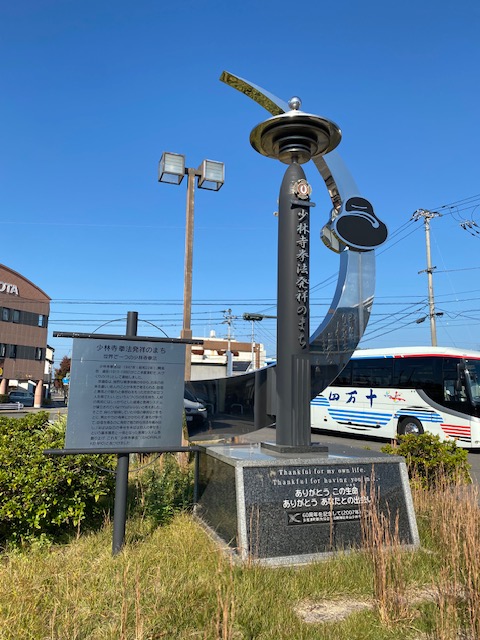
In front of the station, an intriguing sculpture attracted my attention. To me, it looked like a tall armless man wearing a hat, backed by a sickle. There was an emblem like a coat of arms where the neck of the man would be. At the base of the sculpture was a plaque with the words: “Thankful for my own life. Thankful for having you in it.”
Later, I discovered that it was meant to commemorate Doshin So, nee Michiomi Nakano, a former military intelligence agent who spent many years in China. After returning to Japan, he was stationed in Tadotsu, where he established a cram school to teach Buddhist philosophy and martial arts.
In 1947, he founded Shorinji Kenpo, a Japanese martial art with a holistic system. The training methods are divided into self-defense training, mental training, and health training. According to his philosophy, spirit and body are as one, and they must be trained together as such. His teachings emanated from this small town of about 20,000 people to the rest of the world. The emblem, as it turned out, was the symbol for Shorinji Kenpo.
I took a photo of the monument and proceeded to the train platform, where I was met with heavy equipment surrounded by a chain link fence. A sign apologised for this inconvenience, and explained that construction was underway to make the station barrier-free.
I was twenty minutes early, but my fellow passengers – Japanese, as far as I could tell – were already milling about, taking selfies and photos of each other in advance of their train trip. The group was mostly female, middle-aged, and older. Many people were wearing masks.
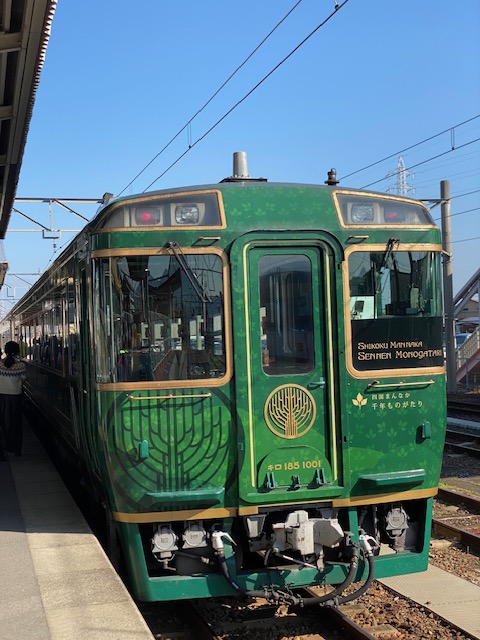
A cinematic melody heralded the approach of the train, accompanied by another rush for selfies and photos. The three cars, all different colors, were named after spring, summer, and fall. What happened to winter? A small doormat with the train’s motif, which resembled a stylized tree, was positioned on the platform at the entrance to the train. I boarded the green “spring” car, Haru Akari, and found my seat, a fuzzy green upholstered chair at a table against the wall, facing the window. The two seats next to me were unoccupied.
Most people wore casual clothes. I rarely saw folks from Tokushima get dressed up, unless it was for a wedding, say, or a graduation ceremony. One woman at the four-top on the other side of me was striking in a sumptuous Chinese-style jacket and gold barrettes. I wondered for a moment if she might be some kind of celebrity. I tried not to stare.
I examined the orange cloth placemat, again with the tree motif. Already my mouth was watering. Disposable chopsticks and a wet napkin were aligned at the bottom, while a spoon rested on a rectangle of granite. Paper napkins, toothpicks, and creamers were tucked into a small basket made of vines. Brochures detailing the train’s route, souvenirs for purchase, and additional menu items were laid out.
You could use your phone to scan a QR code and order keychains, sweet potato cakes, or a yusan-bako, a traditional lunch box which originated in Tokushima. This one was made of Japanese cypress adorned with Kagawa lacquerware. It had three drawers for various delicacies, which fit into a box with a handle, perfect for toting to a picnic in a meadow somewhere. You could also buy a CD with the train’s theme song.
I had already ordered my lunch, but I glanced at the menu anyway. Fish cutlets, another specialty of Tokushima were available, along with bamboo shoots, and ice cream made with sake lees. The sweet potato crumble, with a dollop of whipped cream, was also tempting, but I summoned my willpower.
One of the uniformed attendants pointed out the wooden box under my car for storing my backpack and purse. I got those items out of the way. She also handed me a coupon for soup and water to be redeemed at our first stop. And then finally, the train began to move. A whistle blew. Japan Railway employees and others lined up with flags and round paper fans and began waving at us. We all waved back.
After that enthusiastic send-off, the train began to trundle along the tracks, picking up speed as we zipped past backyards of houses, apartment buildings with laundry hanging on balconies, convenience stores, crows alighting on power lines, an empty playground. We passed rice paddies, some surrounding family gravestones; a construction site with bright blue, green, and yellow earth moving machines.
As we neared Kotohira Station, our first stop, a young woman chirped that Kotohira’s brass band had been declared second best in the country. She reminded us to redeem our coupons in the welcome center. After the train had stopped, I followed everyone into a small room adjacent to the station where we lined up at a counter. I handed over my little piece of paper and received a bottle of water and a small China cup of kabocha1potage. I perched on the padded bench to drink it, while gazing around at the proud display of photos of the award-winning high school band. A white-gloved attendant came around with a tray to collect my empty cup, and I got back on the train.
A young Chinese family – a couple and their plump baby – were now occupying the seats beside me. The train moved on. The view outside my window was now more expansive – terraced fields, occasional houses with tiled roofs and walled gardens, tufts of pampas grass, a patch of pink and magenta cosmos.
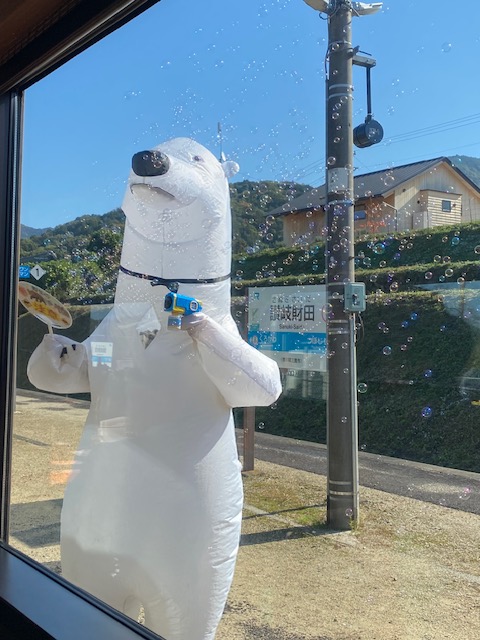
The voice announced that we were nearing Sanuki Saida Station, which boasts a 700-year-old tabunoki tree, said to be a “power spot.” Apparently if you stand under the tree, you can absorb some of its spirit and energy. The tree has also been designated a Kagawa Prefectural Protected Tree. The train came to a stop again, but this time we didn’t get off. Instead, we all whipped out our smartphones to take photos of the person dressed in a polar bear costume shooting soap bubbles from a bubble gun. The baby was delighted.
Once we were again underway, the attendant distributed large square bento boxes with gold-rimmed lids. I opened mine to find an array of chilled meat dishes – the first course. I unsheathed my disposable chopsticks and broke them apart. “Itadakimasu!2”
Out the window, farmland had given way to gnarly brush. `Although the foliage wasn’t quite at its peak, swatches of scarlet and gold popped against the greenery. I wondered about the wildlife in the mountains. I knew that there were monkeys, boars, and deer. The latter two appeared on menus deep in the interior of Shikoku. You could get a burger made with game meat, or “peony hot pot,” in which thin slices of pink boar meat curled up like flower petals after being cooked in miso broth.
Next to me, the young parents passed their good-natured baby back and forth. When I caught his eye, I smiled at him, and he showed his dimples, smiling back. I remembered how, when I had first come to Japan, whenever I had tried to engage with a stranger’s baby on the train, the baby’s face had crumpled up in terror. Apparently, big-nosed foreigners were scary even for infants. At least back then. It was nice to be able to engage with a small child without causing tears.
We made a brief stop at Tsubojiri Station, a small, unmanned station accessible only by switchback, surrounded by trees. “You can get off the train and smoke,” the voice announced. We all scampered off the train, but I didn’t see anyone light up a cigarette. Instead, passengers posed in front of the station’s sign and the weathered wooden building.
Back on the train, the next course was served – buttered rice and pork, arranged on a gold-rimmed China plate. The narration continued. “Please look to the right. You will be able to see Mount Hashikura. You can take a ropeway to Hashikura Temple, which was established by the famous Buddhist monk Kukai, also known as Kobo Daishi.”
Kobo Daishi is known as the father of Shikoku’s 88-Temple Pilgrimage. Hashikura Temple is not one of the 88, but is considered to be an associated temple. According to the Tourism Shikoku website, the name “Hashikuraji” contains the character for “hashi,” or chopsticks, “an everyday unifying ubiquitous tool of daily life for all Japanese. In 828 [CE], Konpira Daigongen revealed himself to the priest Kukai and promised to save all who use chopsticks, a pledge of salvation for all.”
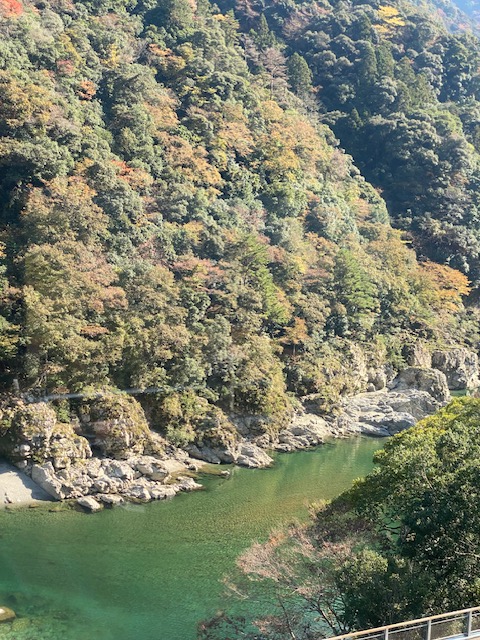
According to an announcement, we would soon have a good view of the Yoshino River, the majestic “wild” river which runs west to east across Shikoku. Its rushing waters carved out the Oboke Gorge over millennia. This river flows 121 miles, past Tokushima City, and the house where I live, and into the Kii Channel. At one time, it flooded repeatedly. The “Tora-no-Mizu” (“Tiger’s Water”) flood of 1886 (Year of the Tiger), one of the worst floods in Japanese history, led to the deaths of an estimated 30,000 people. Now, however, strong levees keep the waters in check, though heavy rains can still shut down the roads nearest the river. These days, the Yoshino River is more known as a place where visitors can enjoy various forms of recreation including swimming, fishing, and white-water rafting.
As I gazed out at the glassy emerald waters, which reflected the rocky banks, the voice announced that we were approaching Awa-Ikeda. High school baseball, I thought. Sure enough, the voice told us that we would soon have a view of baseball players practicing at Ikeda High School’s diamond, and that they had once won the National High School Baseball Tournament at Koshien.
The train chugged on. We passed another station, Awa Kawaguchi, where another person in a polar bear suit filled the air with soap bubbles. A sign on the platform declared that this was a town where tanuki (an indigenous animal that is often called raccoon-dog, and is a notorious trickster in Japanese folklore) and people live together.
A polar bear suit filled the air with soap bubblesA man wearing a woven peaked hat
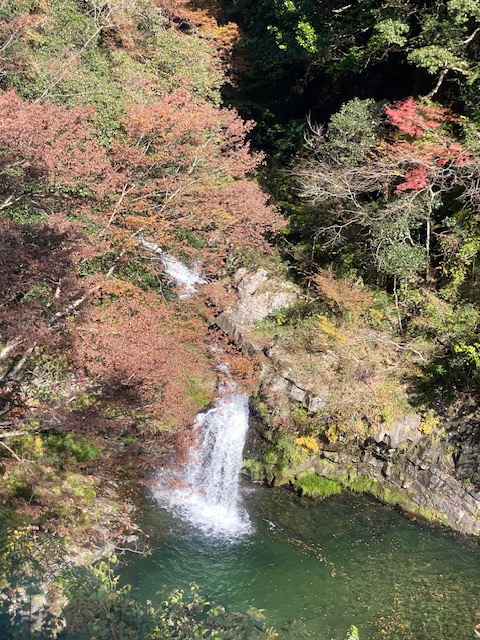
After traversing another tunnel, coffee was served with a petite madeleine. Outside the window, I could see the water rushing through the gorge, frothing over rocks. We were almost at the end of our thousand-year journey. It had lasted a little over two hours.
The train pulled into Oboke Station, in the town of Miyoshi, and we got off. We were greeted by a man wearing a woven peaked hat and happi coat, banging on a drum affixed with characters from the animated series Anpanman. Although my fellow travelers had been mostly Japanese, quite a few European and American tourists were milling around the station, perhaps waiting for transportation.
At the time I first visited, over thirty years ago, I recall no restaurants or hotels, but now there was a large roadside station with souvenir shops, food vendors, and a Yokai House. There was even yokai3-themed food. Some traditional houses have been refurbished as high-end inns.
I took a short walk around the area and then attempted to buy a return ticket on an express train. Although the station was now geared for tourists with English signage and souvenir shops, it was still old-fashioned in many ways. I realised it wasn’t equipped to deal with phone apps or credit cards. I hadn’t brought a lot of cash, but I had just enough to buy a ticket back to my starting point.
Suzanne Kamatawas born and raised in Grand Haven, Michigan. She now lives in Japan with her husband and two children. Her short stories, essays, articles and book reviews have appeared in over 100 publications. Her work has been nominated for the Pushcart Prize five times, and received a Special Mention in 2006. She is also a two-time winner of the All Nippon Airways/Wingspan Fiction Contest, winner of the Paris Book Festival, and winner of a SCBWI Magazine Merit Award.
PLEASE NOTE: ARTICLES CAN ONLY BE REPRODUCED IN OTHER SITES WITH DUE ACKNOWLEDGEMENT TO BORDERLESS JOURNAL
“Please show me your international driver’s licence.”
“Certainly!”
Alex produced the licence.
“This is out of date! I’m sorry but we can’t hand over the car.”
“No! It’s current! It’s valid for five years.”
We scrutinized the licence. The start date was prominently displayed, but not the expiration date. As we squinted to decipher the fine print on page three, we discovered that it had expired three years ago. Alex had thought it would be valid for five years, but it was only valid for one. We attributed it to his light-heartedly referred to “OCD Deficit Disorder”. And that is how a one-week road trip suddenly became a public transport and taxi trip.
This was my first visit back to Japan after having left at the beginning of the pandemic. Alex and I had been deliberating where to spend our honeymoon, and we agreed that the island of Shikoku in western Japan where I had spent over twenty years would be our first choice.
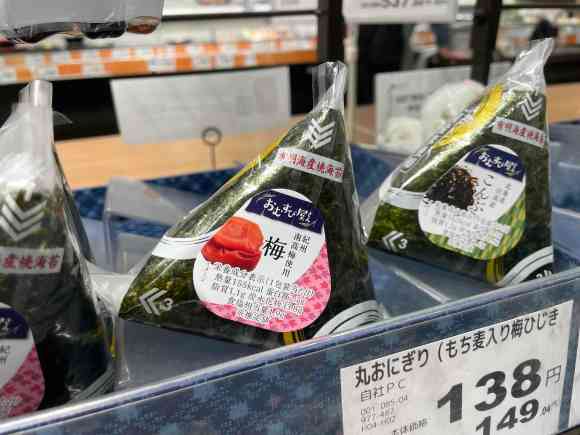
Onigiri. Photo courtesy: Mariko Hisamatsu
There were so many things to look forward to. The first thing I did, before even leaving Kansai Airport, was rush into the convenience store and buy an onigiri flavoured with an umeboshi pickled plum. An onigiri is a triangle of rice, with a choice of flavours in the centre such as fish, seaweed, or the aforementioned umeboshi. It is wrapped in a crisp sheet of seaweed. Before eating it you gently pull away a thin layer of wrapping which protects the outer seaweed from absorbing the moisture of the rice. As you bite into it you can enjoy the three distinct textures and flavours – the piquant centre, the contrasting bland rice, and the crisp outer layer of seaweed. Next, I purchased a mugwort daifuku. This is a Japanese sweet, consisting of a layer of pounded mugwort-flavoured rice around a centre of sweet azuki bean paste. All of this was washed down with a bottle of green tea.
From the above account, it might sound like I was returning to Japan to indulge in simple culinary delights from a convenience store, and maybe this is a possibility I am unwilling to admit to myself. Of course, the main purpose was to reconnect with old friends, the second to reconnect with old pleasures, such as the aforementioned onigiri and daifuku, and the third, to stay in a traditional Japanese house.
After having been refused permission to drive our hire car, we headed back towards the terminal and searched for the railway station. We caught trains out to the UNESCO heritage listed site of Koyasan to enjoy the autumn leaves, and then seven trains and two buses later, to Wakayama station. Finally, we caught a taxi to our accommodation, which turned out to be a house that was over two hundred years ago, dating from the end of the Edo Period.
Jiomaru-an Edo period house. Photo Courrtesy: Alan Noble Inside the house. Photo Courtesy: The Host
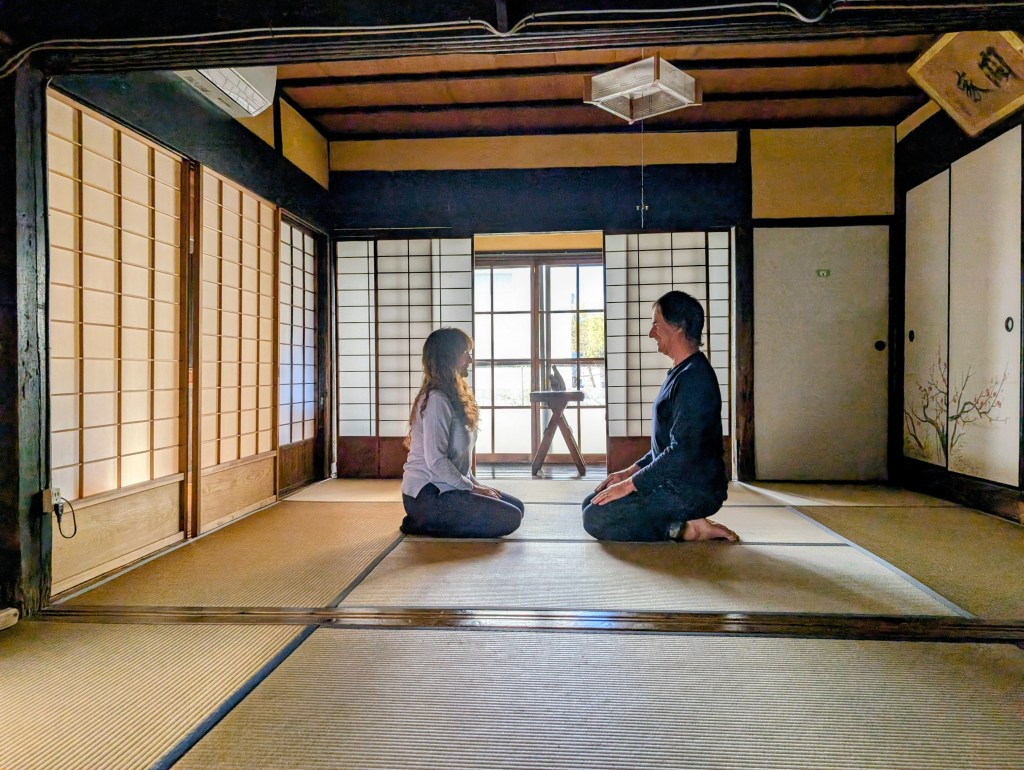
The door slid open to reveal an earthen floor. We walked down the hall to the kitchen, left our shoes in the sunken area, and donned the provided slippers. The kitchen opened onto two traditional tatami rooms, with fusuma sliding cupboards, and latticed paper shoji screens leading onto the garden. Beyond the shoji was a narrow hall known as an engawa, with a small wooden table and chair where you could enjoy sipping a drink while looking out over the garden. This was the kind of room I had been longing for during my five years away from Japan.
But we hadn’t had dinner yet and I was longing to ride to a local supermarket to purchase a ready meal.
‘“Do you have any bicycles?” I asked the host.
“Certainly. We have mountain bikes too!”
“You don’t want to go cycling in the dark?” queried Alex. “Not after a long-distance flight, seven trains, two buses, and a taxi ride? Surely not!”
I insisted, and Alex gave up persuading me otherwise. Rather than a mountain bike I chose the mamachari, a vintage bike replete with a shopping basket attached to the front handlebars.
We cycled to the supermarket, as I had done almost daily during my twenty years of living in Shikoku. There we bought sushi and sashimi ready meals, and cycled home, scanning to avoid roadside ditches with sheer drops and no guard rails. Once safely home, we indulged in the much longed for sushi and sashimi, enjoyed the traditional deep Japanese bath, spread out the futons on the tatami, and luxuriated in a deep sleep.
The next morning, we woke to a gentle light streaming through the latticed paper shoji screens. We cycled to Wakayama castle, Alex on the mountain bike and me on the mamachari. We strolled around the traditional garden before entering the castle and then completed it with a visit to the adjacent tearoom, where we enjoyed green tea and a sweet bean paste confectionery.
The following day, we bid farewell to our Edo Period home, and our kind host drove us to the ferry terminal. As soon as I saw the sign in Japanese for Tokushima, I could feel the colour rising to my cheeks. This had been my home in Japan for fifteen of my twenty years in Shikoku, until the day I departed for a routine visit to Australia, just before the international borders were closed due to COVID. Little did I know that the pandemic would prevent me from returning to Japan. I boarded the ferry as I had so many other times after returning from various work trips, but this time I was visiting on my honeymoon. The two-hour crossing readied me for the arrival in my old stomping ground and was heralded by the sentimental music played to signal a homecoming. Alex and I exited the ferry to be met by my old friend and writing mentor, Suzanne. Overcome with emotion, I covered my face with my hands to spare her the sight of my crumpled features and then gave her a hug. Then I went back to covering my swollen eyes and gave her another hug.
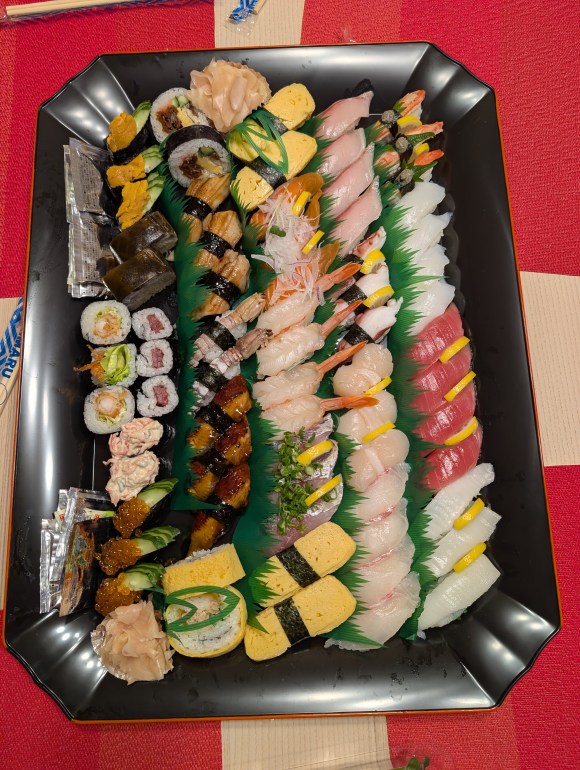
Platter of Sushi at Sally’s home. Photo courtesy: Alan Noble
Suzanne drove us to the home of the son of another old friend, Sally, who had kindly offered us a couple of nights’ accommodation. That evening a subset of old friends dropped in to see us and eat sushi. I braced myself for the entry of each friend into the house, trying to compose my features, after an unanticipated five-year interval. My eyes, however, betrayed me. I caught the expressions of those who returned by gaze, and they could sense my relief and excitement of meeting them again. Over five years people’s appearances were a little different. Those who had long hair now wore it shorter. Those with shorter hair had grown it. Those who were curvaceous were now svelte, and those who were svelte were now curvaceous. A child had now become a lanky teenager. I’m sure I must have looked different to them too. What had not changed was people’s smiles, conversation and sense of humour. People who I would normally see a few times over a month were now all present in the same room in the space of a few hours.
A few days later, we took the bus across Shikoku to Matsuyama, where another happy reunion took place of eight friends from six different countries. I was freshly aware of the joys of the expat life, where you can make friends from a greater range of countries, and a greater range of ages, than you would at home.
Ranma Carvings in a traditional room. Photo Courtesy: Alan Noble
I had been craving another stay in a traditional house, and we savoured a room with ranma carvings suspended from the ceiling, letting in light and air flow from the adjacent room. We sat at the kotatsu low heated table on the tatami, and slept on futon, in a room featuring shoji paper screens facing outside and fusuma cupboards where futons were stored. Features which had once seemed so ordinary were now infused with nostalgia.
Family obligations called us back to Australia after only one week of our Japanese honeymoon. A taxi was followed by a bus which took us on the long trek back across Shikoku, driving through impossibly long tunnels, crossing elegant bridges, with views of the sea and mountains. Once we crossed the final bridge onto the largest main island of Honshu, the landscape was transformed into high rise apartments, and dense traffic. We alighted from the bus at Kobe’s Sannomiya Station.
There we asked directions to the airport limousine bus and made a final purchase of onigiri. My favourite umeboshi pickled plum one was not on sale, so I had to make do with a tuna mayonnaise one and a pickled seaweed one. We ran to the bus stop, purchased tickets, and skipped into the bus holding our luggage. There was no time to store the luggage in the hold. Once the bus pulled into the traffic, we knew we could relax after our long and complicated journey. I gently pulled away the wrapping separating the layers of the tuna mayonnaise onigiri and savoured the contrasting flavours and textures. Our fleeting trip to Japan was punctuated by savouring onigiri on both arrival and departure. We bade farewell to this land of delectable tastes, exquisite arts, historic houses, hair-raising bicycle rides, and precious friends.
.
Meredith Stephens is an applied linguist from South Australia. Her recent work has appeared in Syncopation Literary Journal, Continue the Voice, Micking Owl Roost blog, The Font – A Literary Journal for Language Teachers, and Mind, Brain & Education Think Tank. In 2024, her story Safari was chosen as the Editor’s Choice for the June edition of All Your Stories.
PLEASE NOTE: ARTICLES CAN ONLY BE REPRODUCED IN OTHER SITES WITH DUE ACKNOWLEDGEMENT TO BORDERLESS JOURNAL
Several years ago, I published a short book, A Girls’ Guide to the Islands (Gemma Open Door, 2017) about traveling amongst the islands of Japan’s Inland Sea with my daughter, who is deaf and uses a wheelchair. One of the islands that we visited was Naoshima, the site of several art museums, including the Chichu Art Museum, which houses five paintings from Claude Monet’s Water Lilies series. In addition to writing about our responses to the various artworks, I touched upon the difficulties and differences in traveling with a wheelchair user. For one thing, the ferry which conveyed us from Takamatsu City to the island, did not have an elevator to the upper decks. While others got out of their vehicles to take in the scenery from above decks, my daughter and I spent the crossing in my car.
Shortly after this trip, I received a grant from the Sustainable Arts Foundation for a longer book about traveling with my daughter, which became the award-winning Squeaky Wheels: Travels with My Daughter by Train, Plane, Metro, Tuk-tuk, and Wheelchair(Wyatt-Mackenzie Publishing, 2019). A slightly different variation of our trip to Naoshima appears in that book.
Although I loved our time on the island, and had not yet visited all the museums and installations, I had not been back since that trip with my daughter. I finally had a chance to revisit last month when I learned that the couple who had administered the grant that had made my book possible would be visiting Naoshima. I arranged to meet with them on my way back from Kyoto, where I was going to attend a book launch. Unfortunately, I wouldn’t be going with my daughter this time. She is now an adult living in Osaka, and it takes a bit of effort to coordinate our schedules. Nevertheless, I figured I could scout out the situation before planning our next mother-daughter adventure.
Although on previous visits, I had taken a ferry from Takamatsu, on the island of Shikoku, this time I took the shinkansen, Japan’s high speed bullet train, from Kyoto to Okayama, where I spent the night in a hotel. The next morning, I easily found the stop for the bus bound for the ferry terminal. Almost everyone in the queue was foreign. As far as I could tell, most of them were from Europe.
No doubt some had timed their visit with the Setouchi Trienalle, an art festival which takes place mainly in the ports and amongst eleven islands every three years. Japan, in general, has seen a huge surge in tourism over recent years due to the weak yen and governmental efforts to promote inbound tourism. While this has been good for Japan’s economy, it has driven prices up for local residents. It also means that public transportation is often crowded.
When we arrived at the ferry terminal, I purchased my ticket and joined the tail end of a very long line. Luckily, I was able to board the ferry and find a seat. I was pleasantly surprised to find the ferry had been upgraded since my last visit. Not only was it appointed with plush seats facing the water, but also there was now an elevator!
About twenty minutes later, we arrived at Minoura Port. Armies of English-speaking guides were readily available. I quickly found my way to the bus stop and onto the bus that would take me to the recently opened Naoshima New Museum of Art. I had just enough time before meeting my benefactors to check it out and have lunch.
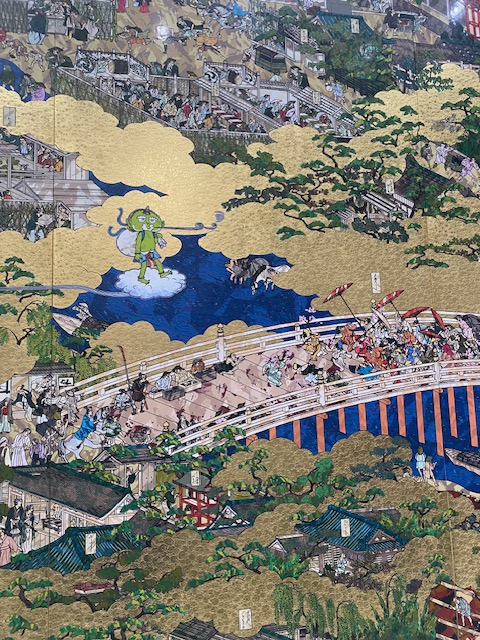
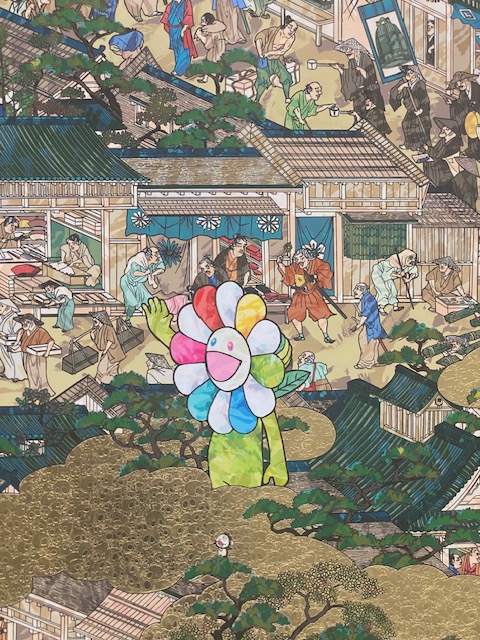
The inaugural exhibition featured the work of twelve artists and groups, including Takashi Murakami, who has achieved worldwide fame. His cartoonish characters appear on coveted Louis Vuitton bags. He also designed a special shirt, printed with cherry blossoms, for fans of the Los Angeles Dodgers. His work on display, a 13-meter-wide painting, is modeled after a 17th century folding screen titled Scenes In and Around Kyoto by Iwasa Matabei. Murakami’s rendition portrays scenes of everyday life in early modern Kyoto. But look closely, and you will find some of his iconic original characters!
Another impressive exhibit, Head On, by Cai Guo-Qiang, features lifelike wolves running toward and colliding with a glass wall. According to the exhibit brochure, the wall “symbolizes the intangible yet deeply felt ideological and cultural divisions between people and communities.”
After going through the exhibits, and vowing to return with my daughter, I popped into the museum café for a quick lunch. The dining area was in open air, with a view of the sea and the islands beyond. I ordered pumpkin toast, perhaps Naoshima’s answer to America’s ubiquitous avocado toast, and a nod to the famous Yayoi Kusama pumpkin sculptures which grace the island.
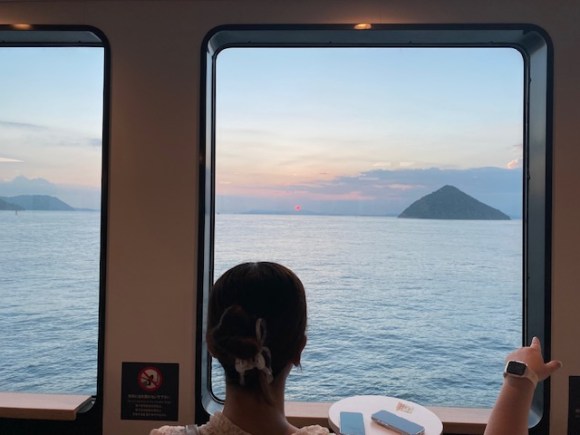
Finally, I took another bus and went to meet my friends. They are no longer awarding grants to parent artists, having shifted their focus to indigenous groups, however, I will remain forever grateful for their support. We met and had a drink near the Benesse House Park, just outside the Terrace, where my daughter and I had dined several years ago. Then it was time for me to head to the ferry terminal and back to Takamatsu, where I would catch a bus. I happened to cross at sunset – a final blast of beauty before returning home.
Suzanne Kamatawas born and raised in Grand Haven, Michigan. She now lives in Japan with her husband and two children. Her short stories, essays, articles and book reviews have appeared in over 100 publications. Her work has been nominated for the Pushcart Prize five times, and received a Special Mention in 2006. She is also a two-time winner of the All Nippon Airways/Wingspan Fiction Contest, winner of the Paris Book Festival, and winner of a SCBWI Magazine Merit Award.
PLEASE NOTE: ARTICLES CAN ONLY BE REPRODUCED IN OTHER SITES WITH DUE ACKNOWLEDGEMENT TO BORDERLESS JOURNAL
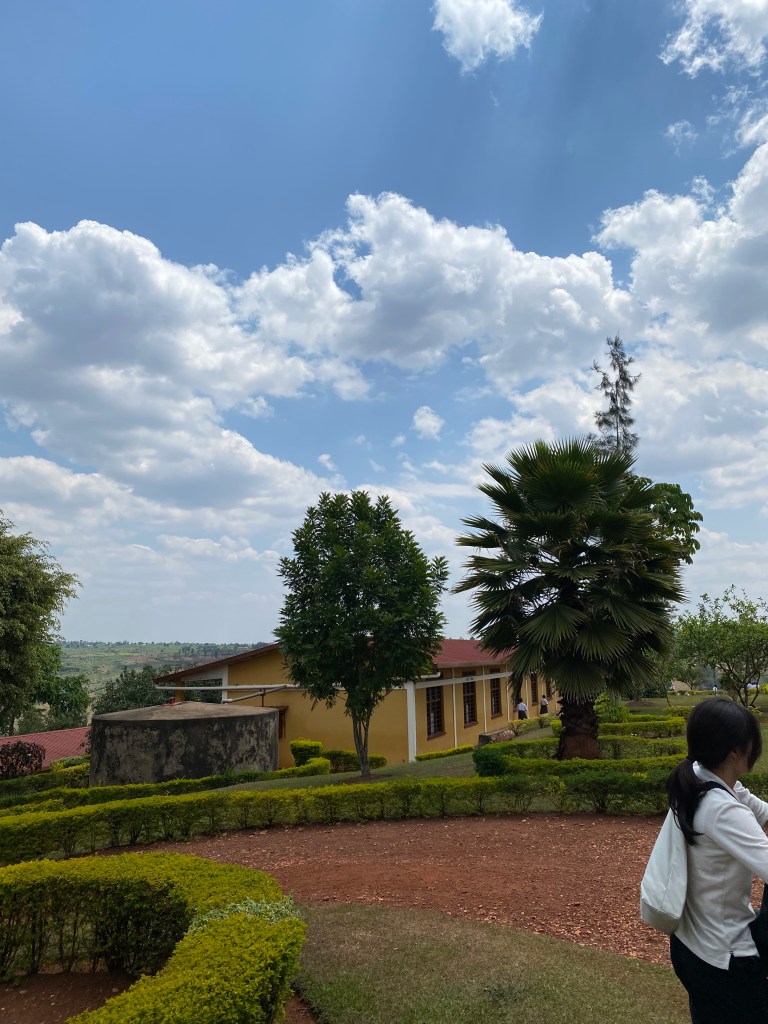
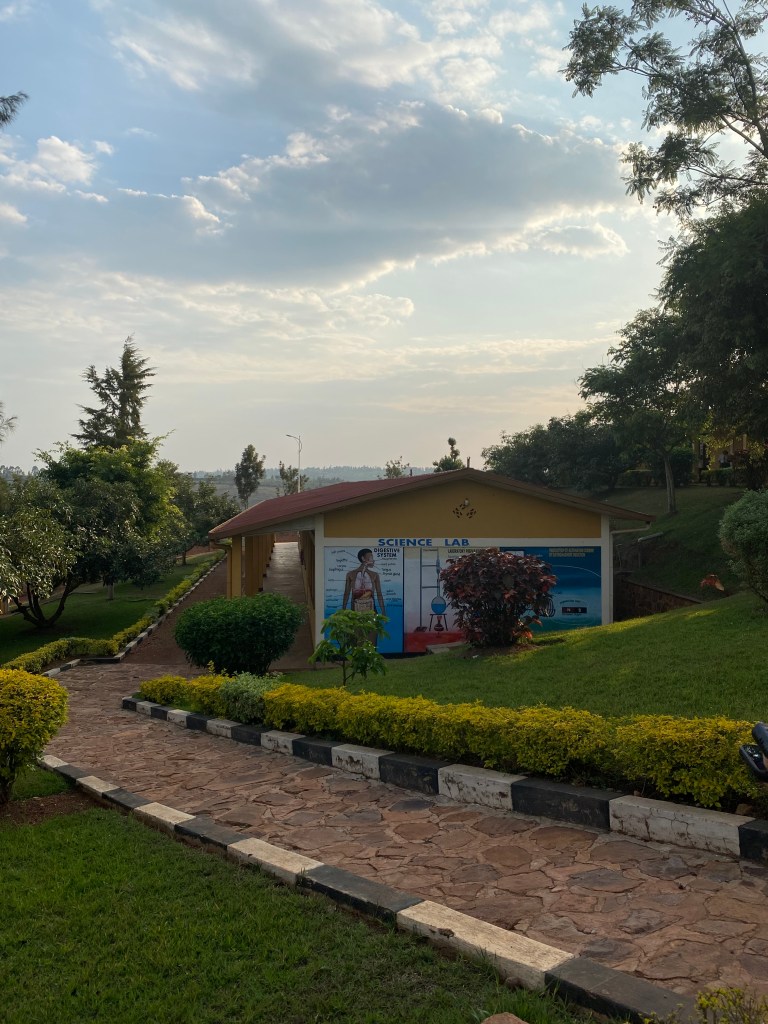
FAWE Girls’ School Gahini is in the Kayonza District of Rwanda, up a bumpy red-soiled road, on a hill overlooking acres of green. Various kinds of trees and shrubbery decorate the campus, which is made up of several small buildings painted yellow and roofed in red connected by walkways. Some are painted with murals or words extolling the importance of education. The outer wall of the Science Lab, for example, features a detailed diagram of the digestive system.
A male teacher in a white lab coat comes out to greet my three Japanese traveling companions and I as we alight from the air-conditioned Prado. Our driver Eugene, hired for this week by my colleague Satoshi, remains behind.
We have traveled here from Naruto, on the Japanese island of Shikoku, where two of us are professors and two, graduate students at a small teacher’s college, for a one-week research trip. Satoshi is going to conduct a survey on metacognition in solving math problems. This is part of an ongoing project for which he has visited Rwanda several times already. Last year, when he was about to embark on his trip, I mentioned that I had always wanted to go to Africa. Without hesitation, he said, “Let’s go!”
Of course, it was impossible for me to join him on such short notice, but he checked in with me periodically, telling me the dates of his next trip. I assured him that I was still eager to accompany him. For years I had included my dream of visiting Africa in my first day self-introduction to incoming students. Here was my chance.
I am not a math professor. I have an MFA in creative writing, but I have few chances to teach Japanese students how to write poems and short stories. Mainly, I teach English conversation, and academic writing courses. In the one class I devote to non-academic writing, an elective, I am lucky if even one undergraduate enrolls. Last year, the class included a visiting teacher from the Philippines and a graduate student, both of whom were auditing the class. Even the aspiring English teachers at our university mostly hate reading and writing. If it isn’t manga in Japanese, forget it! I keep a variety of popular novels in my office and press them into students’ hands when they ask me how they can improve their TOEIC[1] scores, but I feel victorious if even one student a year comes back for more.
During the trip, we would be visiting schools, and I would have the chance to conduct a few lessons. We would be visiting a private girls’ boarding school on the second day.
“You can do whatever you want,” Satoshi assured me.
Mostly, what I knew of Rwanda was from media reports about the 1994 genocide in which over a million Rwandans from the Tutsi ethnic group were killed by fellow Rwandans who identified as Hutu. I’d seen movies about the genocide, such as Hotel Rwanda, which the director of one of the memorials we visited would declare “a scam,” and read several books by the acclaimed Rwandan writer, Scholastique Mukasonga, who lost 37 family members in the massacre.
I boned up on education in Rwanda and found that as in some other African nations, such as Kenya, the country didn’t have much of a reading culture, although efforts are afoot to change that. In the epilogue to her poetry collection, Requiem, Rwanda, Laura Apol writes that in April 2009, at the International Symposium on the Genocide against Tutsi, the prime minister spoke of “the historical and literary necessity of having survivors not only tell their stories, but for the sake of history and art, write their stories as well.” Apol conducted writing workshops through a writing-for-healing project to help survivors and perpetrators process their grief and trauma. She’d helped Rwandans develop their writing over a week. I only had 30-40 minutes. Maybe I could get them to write a haiku.
Although there is still occasional violence by so-called Hutus against Tutsis (now simply Rwandans, according to their documents), the atrocities — which made up the genocide — occurred thirty years ago. The girls that I would be meeting hadn’t been born yet. I didn’t want to dwell on that sad historical event. I wanted to encourage Rwandan joy.
I prepared a PowerPoint presentation on haiku with photos, choosing examples that I thought would appeal to teenaged girls — a poem about eating ice cream, another about meeting a boy with “pirate eyes” on a beach, a poem featuring robots and a rainbow. I also included a sad haiku about violence against children in the United States, wanting to give them permission to write about tragedy, if they really wanted to.
I was hoping that they would write distinctly African poems, maybe featuring the gorillas that lived in the Western region, or the trees bearing mangoes, bananas, and avocadoes that seemed to grow everywhere. Perhaps they would write about the many people I saw bringing yellow plastic jerry cans to the river to gather water for daily use, the vendors of kitenge cloth in the markets, or the women who balanced loads upon their heads, or tended the fields with their hoes. They might write about the goat that they had sold to pay for their education, or the wild animals they’d seen on safari in Akagera National Park. But maybe all these things were cliches of Africa. I would not suggest these topics, would not insist that they reinforce my stereotypes.
On the day of the school visit, we are introduced to the smiling head teacher, a tall man who tells me that he has written both haiku and waka, the traditional five-lined Japanese poem. He seems bemused by our presence at his school. Nevertheless, he is affable and game to have us try to teach some girls something about Japan.
We are led to a dimly-lit classroom with four long tables. Laptops for each student’s use are on the tables connected to a power source. The English teacher, another man in a lab coat, sets up a projector, and I hand over my USB drive.
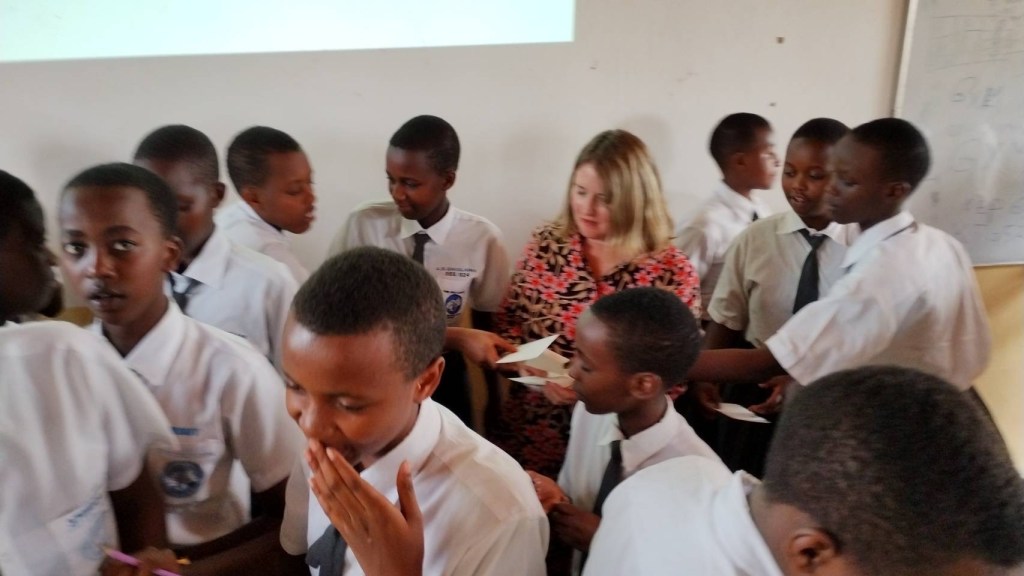
The girls file in, sit down, and automatically open the laptops. Their hair is shorn, and they are wearing white short-sleeved shirts, pleated gray skirts, and matching neckties. To get things started, Satoshi introduces our group and asks a few what they want to be in the future.
“Surgeon,” says one.
“Banker,” says another.
I remember how, when I had first arrived in bubble-era Japan as an assistant high school English teacher, the female students had replied “A good wife and mother.”
Okay. So these girls are good at English, and they are ambitious.
“Please close your laptops,” I say. I personally prefer to write poetry by hand, and I am always worried about students using generative AI, so I have brought pink and lavender pencils, which I bought at Daiso and sharpened back in Japan, and loose leaf lined paper.
I introduce myself briefly, explaining that I am an American, but I married a Japanese man, and have now lived in Japan for over thirty years. I also tell them that I am a writer, and I have brought some books by myself and others which I will donate to their library.
“A haiku,” I tell them, “is a short Japanese poem, usually consisting of 17 syllables, and including a kigo, or seasonal word.”
Their forty or so faces are turned toward me, but I can’t tell if they are engaging. When I ask if any of them have ever written poetry, four raise their hands. When I ask if they have ever written haiku, or even heard of it, the hands stay down. I go through my PowerPoint, noting their interest in a poem about Girls’ Day in Japan, on which families with daughters display ornate dolls representing the emperor, empress, and court.
“And now it’s your turn,” I tell them when I reach the last slide. “Let’s try to write a haiku.”
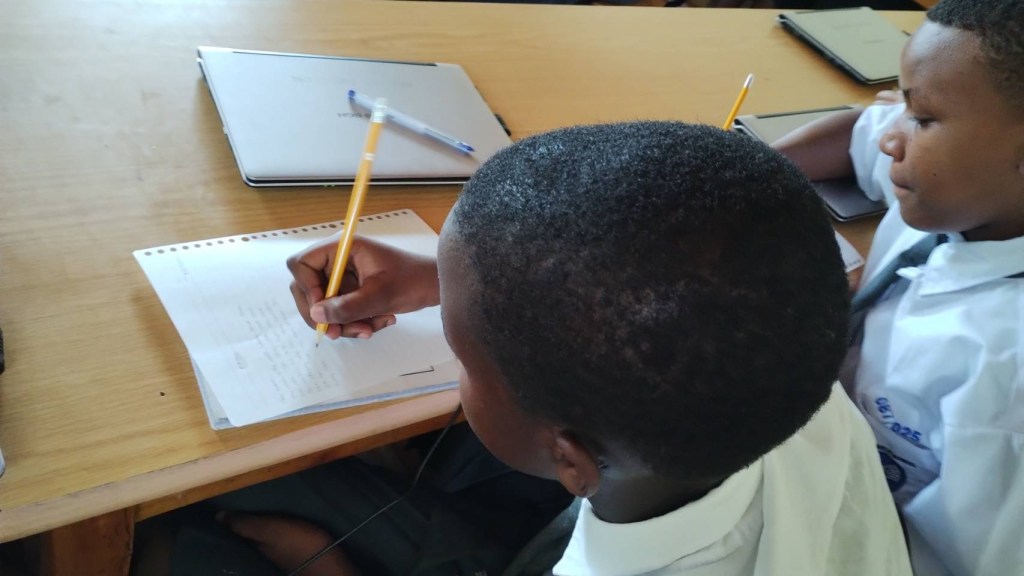
I ask them to think of an event, or a moment, and write whatever related words come into their heads over the next five minutes. They begin to scribble. When the timer on my phone goes off, I remind them that it’s okay to ignore the five-seven-five syllable rule, and that they don’t have to stick to seasonal topics. I tell them that if they are having trouble, they can use a poem from the PowerPoint as a template.
While they ponder and write, I wander along the rows, looking over their shoulders. I’m pleased to see that some have taken my suggestion to model their poem by one by Masaoka Shiki, about eating and drinking with friends on an autumn evening. But pizza? Ice cream? I’m a little disappointed that they didn’t use a more African dish, like brochettes, and banana beer. Then again, that is just my stereotype. Rwandans eat pizza, too.
Instead of writing a haiku, one girl writes a longer poem, which is clearly about the genocide. I realize that even though I want to encourage them to move on, to look to the future, to laugh and dance and celebrate, the trauma caused by the slaughter persists, hanging like a cloud over the country. Their parents probably lived through it, and there are reminders everywhere. Everyone has a story. Our driver tells me later that his father, sister, and brother were murdered. Rwandan students visit genocide memorials on school excursions as part of their education, just as Japanese students visit Hiroshima and Nagasaki. Peace education is deemed very important here, and, during this time of division, I can’t help thinking that it would be good in my own country as well.
At the end of the lesson, I tell them that what they have created belongs to them. I want them to keep their poems, but I also want to read them. I ask them to copy their haiku onto another piece of paper and give it to me.
“I hope you will keep writing haiku,” I tell them, my grandiose idea of promoting Rwandan literature in mind. I tell them of where they can send their poems for publication to an international audience. We pose for a group photo.
Later, I bring my books to the library.
“Bonjour,” says the nun librarian, who must have been schooled when French was the official medium of education.
I had not realised that this was a Catholic institution. I hope that no one takes offence that one of the books I am donating, which has been banned in some places in the United States, is about a Muslim girl. In another, a novel by a contemporary Zimbabwean writer, a teenaged girl confesses to having had premarital sex. A character is one of my own novels is a gay figure skater.
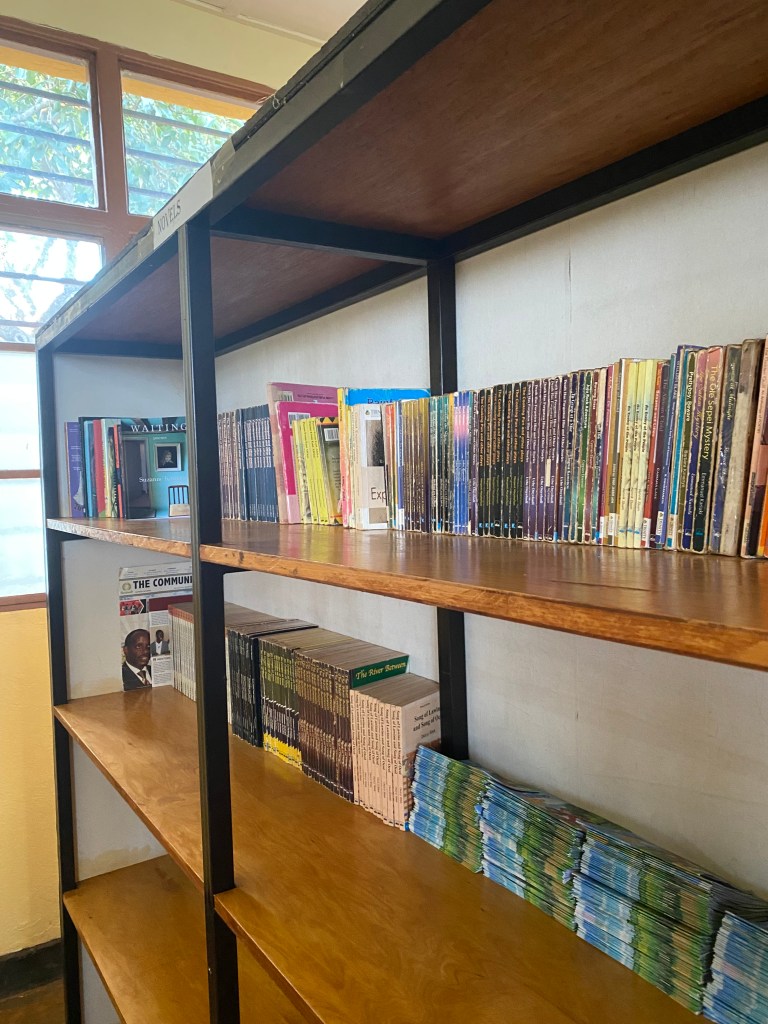
The nun accepts the books graciously and tells some tag-along students to place them on the fiction shelf. I stand back, noting that the ones already there are old and worn. Perhaps they do most of their reading online? In any case, there are no young adult novels for girls, nothing published in the past few years, and I know how expensive imported books are.
“I hope you will read them,” I say, thinking of my students back in Japan who hate to read.
“We will,” the girls promise.
I imagine a single girl, coming upon these novels and greedily devouring them one after another, perhaps seeking out more, and then beginning to write her own stories. I imagine coming across a novel in a bookstore written by a girl who grew up in Kayonza, who attended the FAWE Girls’ School Gahini. I imagine reading that book and posting about in on Instagram. And then I try to let go of my expectations, and say “murakoze,“ which means “thank you” in Kinyarwanda, and “goodbye.”
Hamburgers and fries
Speakers blare Billie Eilish
--lunch in Kigali

A Haiku by Suzanne Kamata
[1] The Test of English for International Communication
Suzanne Kamatawas born and raised in Grand Haven, Michigan. She now lives in Japan with her husband and two children. Her short stories, essays, articles and book reviews have appeared in over 100 publications. Her work has been nominated for the Pushcart Prize five times, and received a Special Mention in 2006. She is also a two-time winner of the All Nippon Airways/Wingspan Fiction Contest, winner of the Paris Book Festival, and winner of a SCBWI Magazine Merit Award.
PLEASE NOTE: ARTICLES CAN ONLY BE REPRODUCED IN OTHER SITES WITH DUE ACKNOWLEDGEMENT TO BORDERLESS JOURNAL
Aparna Vats shares a narrative around female infanticide centring her story around a BBC interview and an interview with the journalist who unfolded the narrtive. Click here to read.
Dolly Narang recounts how she started a gallery more than four decades ago and talks of her encounter with world renowned artist, MF Husain. Click hereto read.
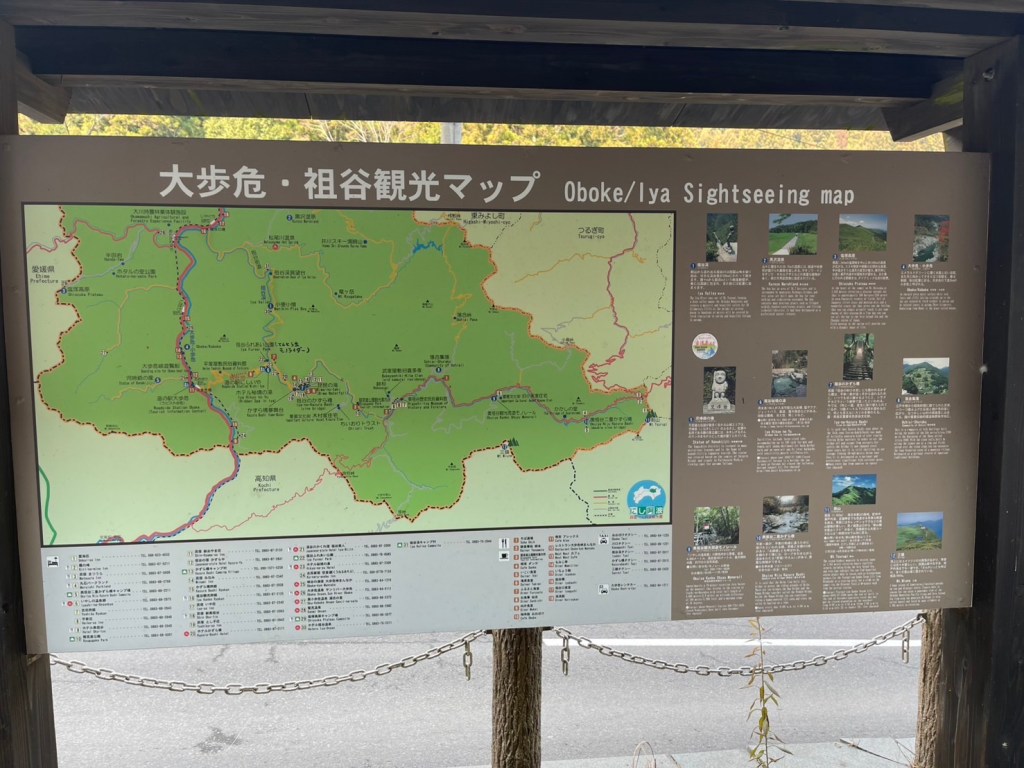
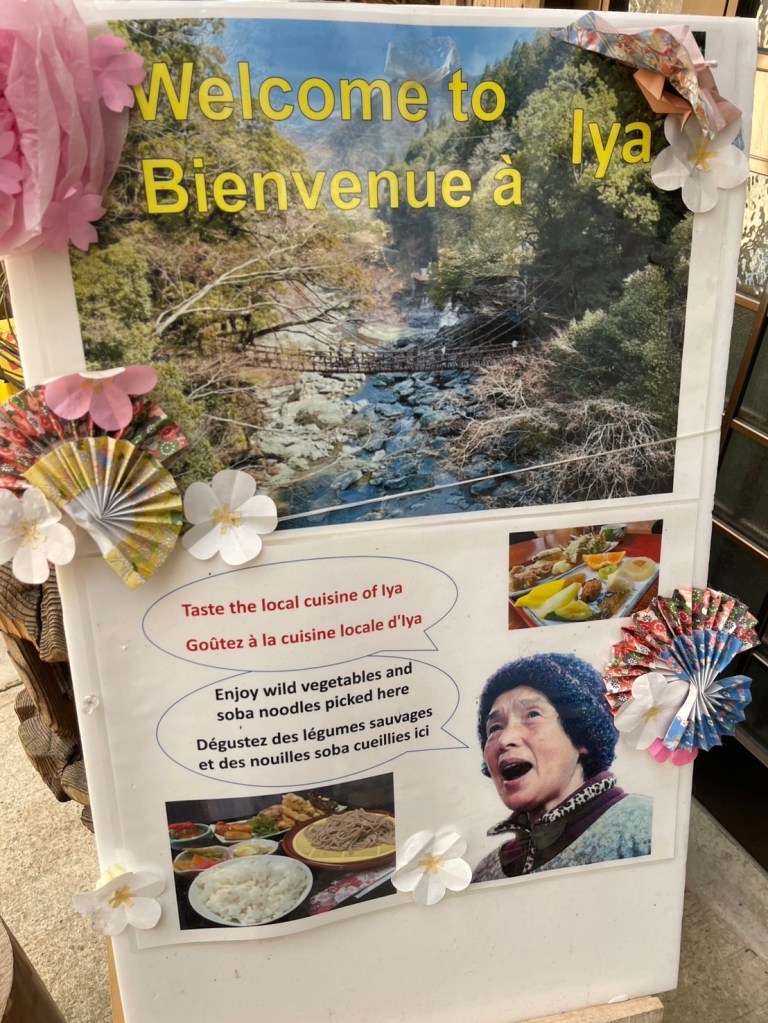
When I first arrived in Japan over thirty-five years ago, one of the first places that I visited was the Iya Valley, deep in the interior of Tokushima Prefecture. It wasn’t easy to get there then, and it’s not easy now. From Tokushima, there are no trains – only very occasional buses, or you can brave the narrow, twisty mountain roads sans guardrails and drive on your own. At the time I visited, I recall no restaurants or hotels, but apparently some abandoned houses have been refurbished as high-end inns.
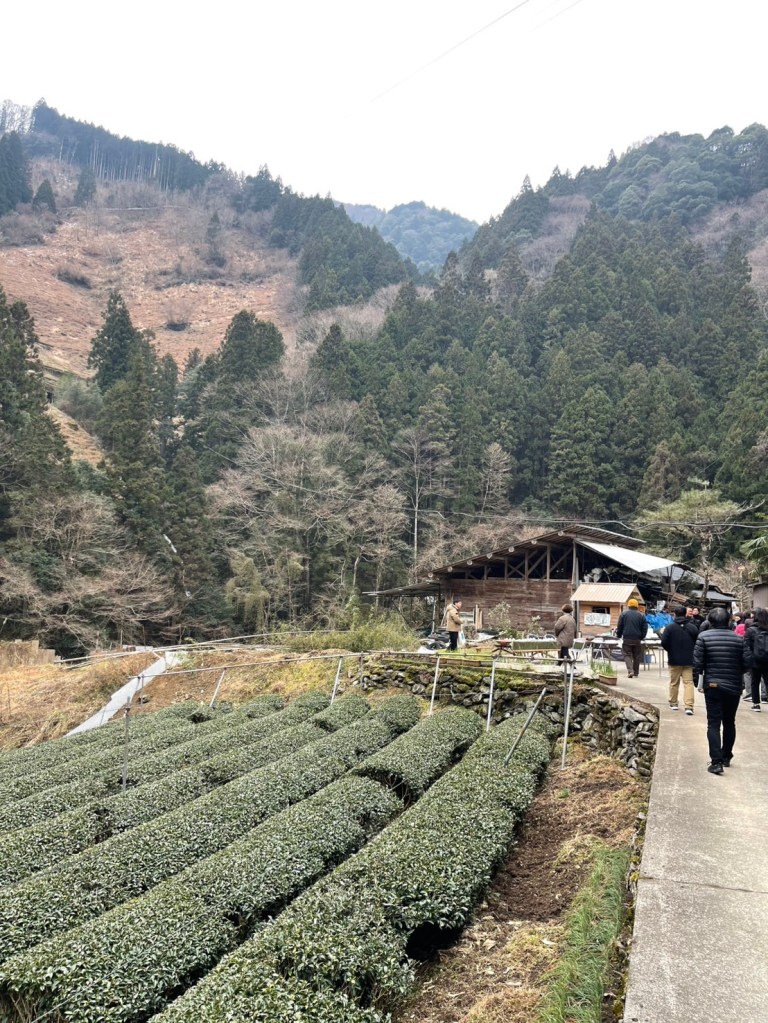
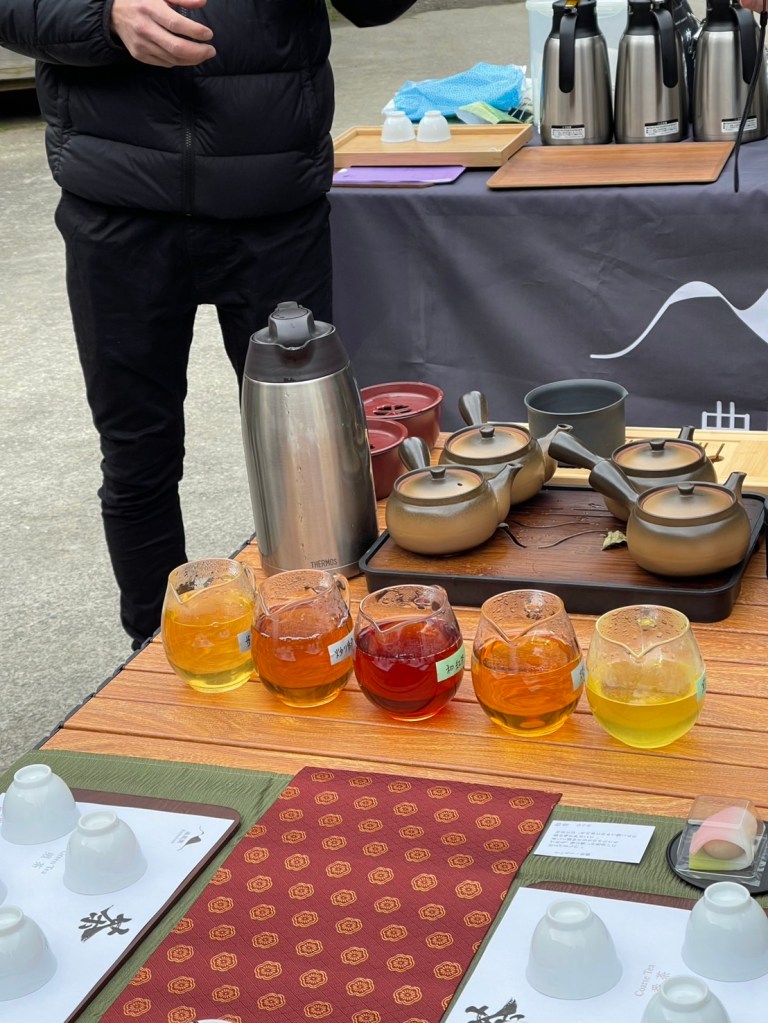
Tea gardens of Iya
The Iya Valley attracts adventurous travelers who are up for white-water rafting on the river that cuts through the Oboke Gorge. Another thrill that can be had is crossing Iya Kazurabashi, the swaying vine bridge that spans the gorge. I crossed the bridge on that first visit years ago, and I remember clinging to the rope railings while taking careful steps, my heart hammering all the while.
The vine bridge is periodically reconstructed, but the original was said to have been created by aristocrats who had fled the capital of Kyoto. The Heike clan, who have been immortalised in the Japanese literary classic Heike Monogatari, were defeated by the Minamoto clan in the Genpei War (1180–1185) at the end of the Heian Period. They found the wilds of Shikoku to be the perfect hideout. Their descendants continue to live in the area.
I found this story incredibly fascinating. As a university student, I had been captivated by descriptions of Heian court life – the ladies-in-waiting in their layered brocade kimono, lover’s messages exchanged in the form of poetry. As anyone who has seen the recent miniseries Shogun has noted, ancient Japan was filled with aesthetic delights. Imagine going from a wooden house with fragrant tatami mats, sliding paper doors, and an ornamental garden to an untamed mountain, probably teeming with wild boar and monkeys.
I was inspired by this place to write the short story “Down the Mountain,” which appears in my newly published collection River of Dolls and Other Stories. I blended ancient history with the Japanese folktale “Kaguyahime,” or “The Moon Princess.” I was also influenced by reports that I had read of the forced sterilisation of Japanese women who were mentally ill. The story begins like this:
You say that you want to leave this mountain, daughter, and I know that your will is strong. For you, there is not enough of life in selling fish-on-a-stick or serving noodles to strangers. You look at the swaying vine bridge and see a magnet for tourists, those busloads of people who come up from the city, filling the valley with sounds of laughter and loud voices. I will not stand in your way, but before you go, there are some things that you must know.
Last week my husband, who is newly retired, took a trip to the Iya Valley as a tour-guide-in-training. While I was at work, he crossed the bridge and was treated to thick udon noodles in broth and a sampling of teas grown on the mountain. A local woman sang a traditional song to the group of visitors.
“Have you ever been to Iya?” he asked me when he’d returned home.
“Yes,” I told him. “Long ago. As a matter of fact, I even wrote a story about it.”
Suzanne Kamatawas born and raised in Grand Haven, Michigan. She now lives in Japan with her husband and two children. Her short stories, essays, articles and book reviews have appeared in over 100 publications. Her work has been nominated for the Pushcart Prize five times, and received a Special Mention in 2006. She is also a two-time winner of the All Nippon Airways/Wingspan Fiction Contest, winner of the Paris Book Festival, and winner of a SCBWI Magazine Merit Award.
PLEASE NOTE: ARTICLES CAN ONLY BE REPRODUCED IN OTHER SITES WITH DUE ACKNOWLEDGEMENT TO BORDERLESS JOURNAL
Many years ago, when my children were small and I was working on my first-to-be-published novel Losing Kei, I joined an online writing group made up of members of the Association of Foreign Wives of Japanese. Since I live off the beaten track, on the island of Shikoku, this group was a godsend for me. Not only was I able to connect with non-Japanese women raising biracial kids in a supposedly homogenous country, but I could also connect with others writing in English.
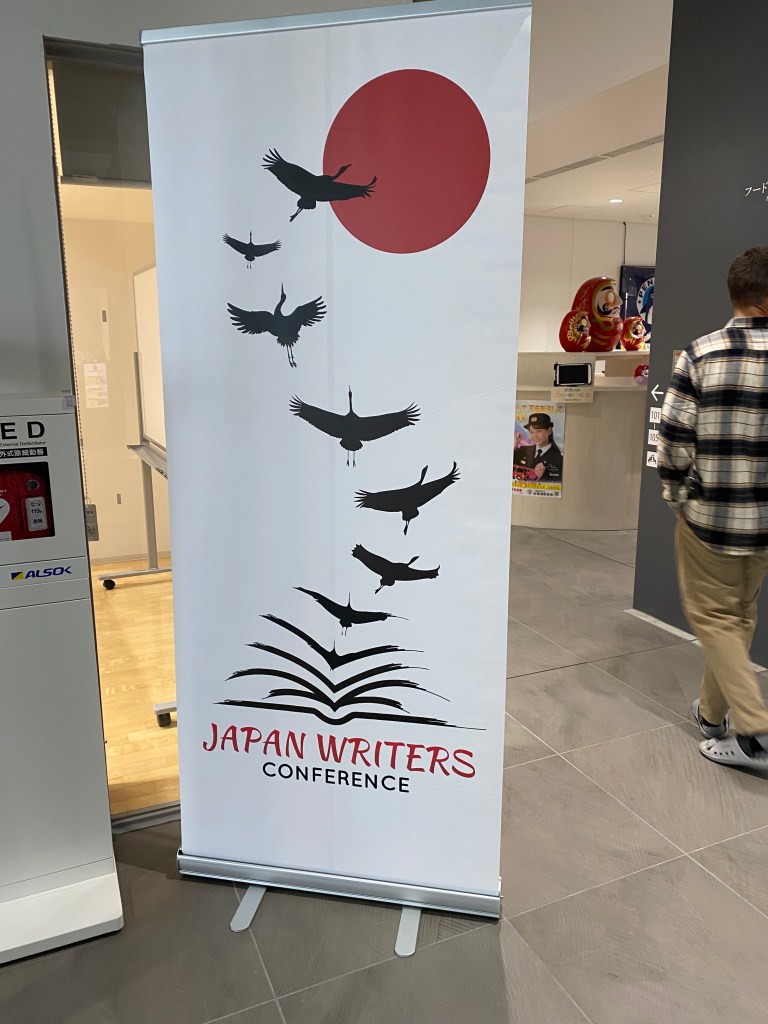
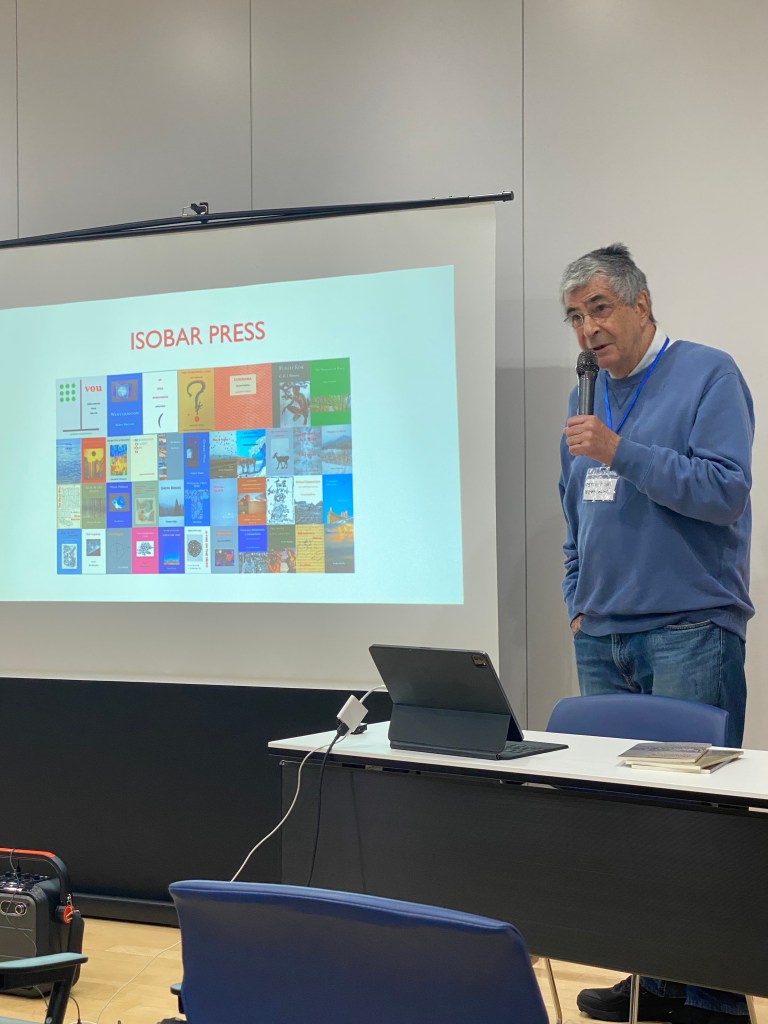
I ultimately finished my novel. I was not the only member of this group who went on to publish books. In addition to writing and publishing, another wonderful thing that came out of this now defunct virtual community was the Japan Writers Conference, which was first held in 2008. One of the members, poet and writer Jane Joritz-Nakagawa, whose most recent book is the searing LUNA (Isobar Press, 2024), proposed a grassroot gathering of writers in Japan. There would be no keynote speaker, no fees for participants, and no payments for presenters. We would just get together and share our writing and our expertise.
Another member, Diane Hawley Nagatomo, who recently published her second novel, Finding Naomi (Black Rose Writing, 2024) after an illustrious career in academia, volunteered to host the initial conference at her university. Chanoyu University, in Tokyo, is famously the institution attached to the kindergarten attended by the Japanese royal family. It was also the site of the first Japan Writers Conference.
Since then, the conference has been held at various universities and colleges around the country, including in Okinawa, Hokkaido, Kyoto, Iwate, and at Tokushima University, hosted by me in 2016. Over the years, many notable speakers have appeared, such as Vikas Swarup, whose novel Q & A became the film Slumdog Millionaire, popular American mystery writer Naomi Hirahara, and Eric Selland, poet and translator of TheNew York Times bestseller The Guest Cat by Takashi Hiraide. The list goes on and on.
This past year, the conference was held not at a university, but at the Futaba Business Incubation and Community Centre.
When I told my husband that I was going to Futaba, he looked it up on a map.
“That’s in the exclusionary zone,” he said, somewhat alarmed.
Indeed, the conference would be held on the coast in Fukushima Prefecture, not too far from the site of the nuclear power plant which was hit by a tsunami in 2011. For years, there have been concerns about radiation, however the area is staging a comeback. The host of this year’s conference would be the Futaba Area Tourism Research Association, an organisation committed to “promoting tourism and land operations, inviting people to rediscover the charms of Fukushima’s coastal areas. The company’s mission is to bring people worldwide to this unique place that has recovered from a nuclear disaster.”
“I don’t think they would hold the conference there if it wasn’t safe,” I told him.
The JWC website reported that although the town had been evacuated after the 2011 Great East Japan Earthquake and the meltdown at the Fukushima Daiichi Nuclear Power Station, evacuation orders had been lifted for about 10% of the town on August 30, 2022. Decontamination efforts are still underway. New homes are being built, new businesses are emerging, and the annual festival Daruma-Ichi resumed in 2023. The areas hosting the JWC had been deemed safe, “with radiation levels regularly monitored and within acceptable limits.” I reserved a room at the on-site ARM Hotel and went ahead with my plans.
Getting to Futaba from my home in Tokushima took all day. I got up before the sun and took a bus, a plane, then a succession of trains. As I got closer to my destination, I noted the absence of buildings along the coast. I tried to imagine the houses that might have been there before the grasses had gone wild. Later, the appearance of earth-moving equipment suggested future development.
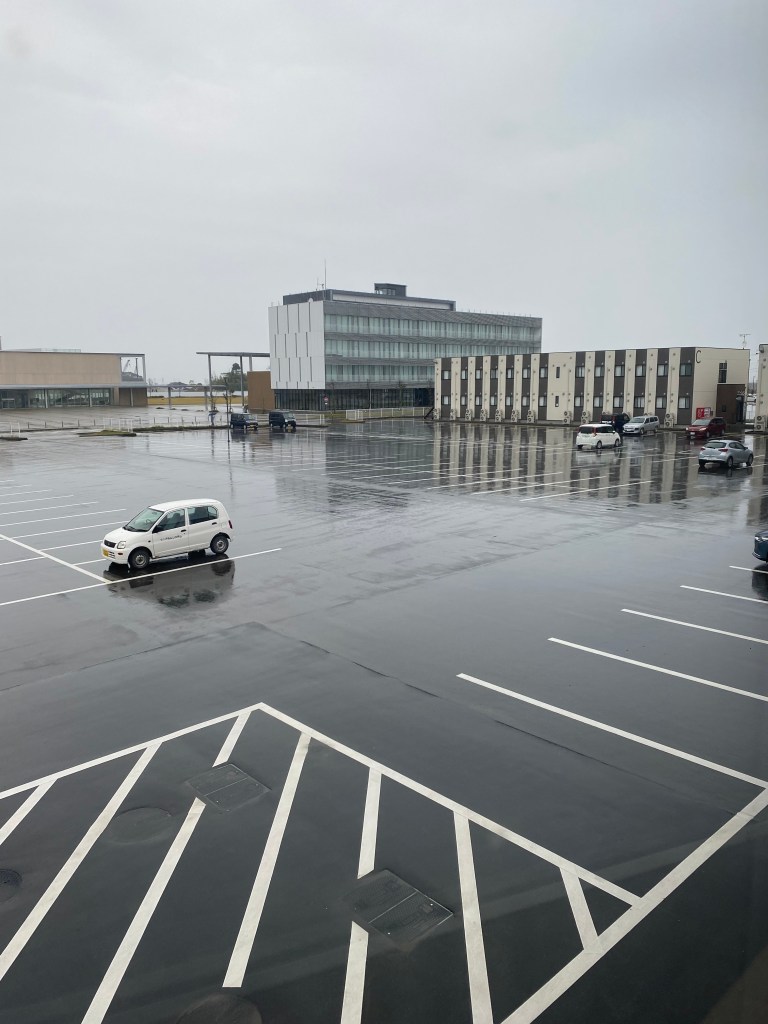
From the nearly deserted train station, I took a bus, and then lugged my suitcase to the hotel’s registration desk. There was nothing around besides the convention center and the hotel. I saw a very tall breakwater, blocking my view of the ocean. I felt as if I were on the edge of the world.
The evening before the conference began, I had dinner at the hotel restaurant, where I met up with some writers I had gotten to know at past conferences. Ordinarily, we might have moved on to a bar to continue our literary discussions, but after the restaurant closed at eight, there was nowhere else to go. There was some talk of going to the beach. A few of us went out into the night and sat on the seawall, sipping Scotch from paper cups, and talking under the stars. At one point, we contemplated the waves below, all those who were washed out to sea and remained missing.
The conference began the following morning. I was amazed that, in spite of the effort that it had taken to get there, presenters had come from all over the world – a Syrian poet who was based in Canada, a poet from Great Britain, a Japanese writer and translator who lived in Germany, a Tunisian writer and motivational speaker who’d flown in from UAE.
I gave a presentation on writing for language learners and shared my haiku in another session. Others presented on a variety of topics including literary correspondence, storytelling and tourism, climate fiction, and writing the zuihitsu[1]. In between sessions, I caught up with old friends and met new ones. On Saturday night, there was a banquet with bentos featuring delicacies such as smoked duck, mushroom rice, and salad with Hokkigai clams.
In retrospect, it was especially meaningful to attend the conference in Futaba, and to feel that we were able to play some small part in the rejuvenation of the area. It was also exciting to interact with writers who came from so far away. Although it’s still very much a grassroots event, it has become truly international.
American authors Karen Hill Anton and David Joiner talk about literary correspondencePaul Rossiter, publisher of Isobar Press, introduces new Japan-related titles.
Suzanne Kamatawas born and raised in Grand Haven, Michigan. She now lives in Japan with her husband and two children. Her short stories, essays, articles and book reviews have appeared in over 100 publications. Her work has been nominated for the Pushcart Prize five times, and received a Special Mention in 2006. She is also a two-time winner of the All Nippon Airways/Wingspan Fiction Contest, winner of the Paris Book Festival, and winner of a SCBWI Magazine Merit Award.
PLEASE NOTE: ARTICLES CAN ONLY BE REPRODUCED IN OTHER SITES WITH DUE ACKNOWLEDGEMENT TO BORDERLESS JOURNAL
My day job is “associate professor,” so I sometimes attend academic conferences. When I learned of an upcoming conference on language teaching in Fukui Prefecture, which I had never been to, I was eager to sign up. Sure, I wanted to hear all the cutting-edge theories about teaching English to language learners – how to motivate my students to write haiku, how to use AI, and so on – but my primary reason was to see the dinosaur bones.
Although at one time it seems that dinosaurs pretty much roamed the whole world, fossils of dinosaur bones weren’t discovered in Japan until 1989. Those bones were found in Katsuyama City, Fukui Prefecture. Since then, even more bones have been discovered, and a museum ̶ Fukui Prefectural Dinosaur Museum ̶ opened in 2000. As part of the pre-conference activities, the host university had arranged for a trip to the museum. A free shuttle but would depart at 11:30am.
I consulted an app on my smartphone and determined that it would take me about five hours to reach Fukui Station from my home in Tokushima Prefecture on the island of Shikoku. I would have to take a bus, a train, another train, and the high-speed bullet train. After a recent trip to Tokyo, I had learned how to use an electronic transit card, which was basically an app on my phone. This app could be used to breeze through ticket gates at train stations, as well as on buses and subways.
I got up at 5:30am on the day of the museum tour. My husband dropped me off at the bus station. I got on the bus and got off in Osaka. Then I took a train to Kyoto, which was mobbed with travelers. Although I thought I could get on the next train, the so-called Thunderbird, with my app, I discovered that I needed to have a reservation. I suppose I could have made one on my smartphone while standing in line, but I was confused. I left the platform and queued up to buy a reserved ticket from the vending machine, which disrupted my tight schedule and meant I would not be able to make it to Fukui in time for the free shuttle bus.
The Thunderbird goes straight from Kyoto to Fukui with few stops in between. The scenery is mostly composed of rice fields and squat mountains. The monotonous view was calming. About an hour later, the train pulled into Tsuruga where I had to switch to the brand-new Hokuriku Shinkansen for the last seventeen minutes of my journey. In my rush to finish my business at the vending machine in Kyoto, I had inadvertently booked a seat in the most luxurious car. I was the only one there.
I texted a friend who was also attending the conference. She had already arrived. I told her that I would be late, and that I wouldn’t be able to ride the bus with her. This was Japan, where everything was always on time! However, the organisers were Americans, and they were willing to wait for me. Hooray!
As soon as I got to Fukui Station, with its moving animatronic raptor keeping guard out front, I hopped into a taxi and finally arrived at the university, where the bus was indeed waiting. I sprinted onboard, apologised to my fellow passengers, and thanked the organiser profusely.
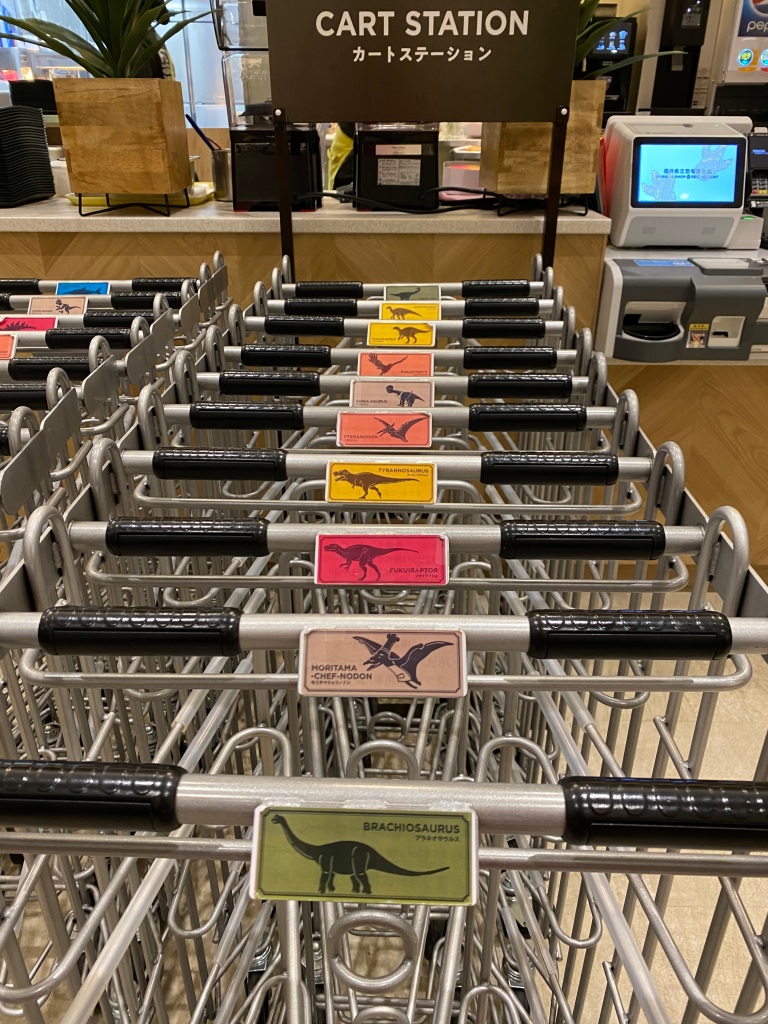
The museum was impressive, as advertised. Replicas of dinosaurs discovered in such far-flung locales as Morocco and Mongolia were on display. There were, of course, also exhibits of the five dinosaurs and one bird species discovered in Fukui, including the long-necked stubby-legged Fukuititan, the herbivorous Fukuisaurus, and the Fukuiraptor. Although the museum offers an excavation experience where visitors can pretend to dig and discover fossils, my friend and I just walked around looking at all of the cool rocks and bones.
Having gone through my son’s dinosaur obsession when he was young, I could remember some of the dinosaur’s names – the Ankylosaurus with its bumpy back, the Stegosaurus, and Pterodactyl. When we were ready to take a break, my friend and I made our way to the cafeteria for dino-themed snacks.
While many famous destinations in Japan are struggling with over-tourism, Fukui, while slightly off the beaten track, has a pleasantly relaxing vibe. Things may change with the new bullet train, but for now, I recommend it as a fascinating horde-free place to visit.
Suzanne Kamatawas born and raised in Grand Haven, Michigan. She now lives in Japan with her husband and two children. Her short stories, essays, articles and book reviews have appeared in over 100 publications. Her work has been nominated for the Pushcart Prize five times, and received a Special Mention in 2006. She is also a two-time winner of the All Nippon Airways/Wingspan Fiction Contest, winner of the Paris Book Festival, and winner of a SCBWI Magazine Merit Award.
PLEASE NOTE: ARTICLES CAN ONLY BE REPRODUCED IN OTHER SITES WITH DUE ACKNOWLEDGEMENT TO BORDERLESS JOURNAL
At the end of April and the beginning of May, several Japanese holidays fall close together. This special time of year is called Golden Week. Often, a few work/school days fall between the holidays, however many people take advantage of the break and travel. I have a hard time remembering which days are which holidays, however I do remember that one of them is Midori-no-hi, or Green Day (which falls on the Showa Emperor’s birthday, May 4).
Not long after I graduated from college, I came to Japan to work as an assistant English teacher. I was assigned to a high school in Naruto, a city in Shikoku, southeast of Osaka, noted for its tasty seaweed and huge, natural whirlpools.
The principal of the high school was very friendly and often invited me to drink tea and chat with him, so I was none too surprised when he called me to his office one April afternoon. This, however, wouldn’t turn out to be a typical encounter.
The principal began to tell me about the annual Midori-no-hi (Green Day) ceremony. Each year, it’s held in a different prefecture, and that year it was Tokushima’s turn. The Emperor and Empress are always in attendance. Only a select group of people would be invited to attend the proceedings, the principal told me, and I had been chosen to participate.
How could I refuse? I imagined meeting the Emperor and Empress and telling them about my hometown in America. Maybe we’d sip green tea together from the locally-crafted pottery cups.
A full rehearsal was scheduled a couple of weeks in advance of the actual event. I boarded a bus at 5 a.m. along with a group of high school band members who would be performing during the ceremony.
As we approached the park settled in the mountains of Tokushima, I noticed that the formerly rough road had been paved. The roadside was lined with marigolds which had been freshly planted in anticipation of the imperial couple’s visit.
At the park, we all practiced our separate parts. Mine would be quite simple. Two other young women — a Brazilian of Japanese descent and an Australian who’d just arrived in the country — and I would be escorted to a spot in front of the Emperor and Empress. We would then bow, accept a sapling from the governor, and plant it in the ground with the help of boy scouts.
As the Emperor would be there and the entire ceremony would be broadcast on national television, everything had to be perfect. We practiced bowing many times with our backs straight and our hands primly layered.
Finally, Midori-no-hi arrived. The day was cloudy and occasional rain drops spotted my silk dress. Everyone hoped that the weather would not ruin the proceedings.
Marching bands, an orchestra, and a choir made up of students from various local high schools and colleges filled the morning with music. Instead of the sun, we had the bright brass of trombones, trumpets and cymbals.
Modern dancers in green leotards enacted the growth of trees. Later, expatriate children from Canada, France, Peru and other countries announced “I love green” in their native languages. This was followed by the release of hundreds of red, blue and yellow balloons into the grey sky. A hillside of aging local dignitaries were on hand to view the pageantry.
About mid-way through the ceremony, the Emperor and Empress arrived. They followed the red carpet laid out to the specially-constructed wooden dais, the Empress a few steps behind her husband as protocol demanded, to “Pomp and Circumstance”. The rustle of Japanese flags waved enthusiastically in the air threatened to drown out the orchestra.
After many solemn addresses and much bowing, the Emperor and Empress stepped down to “plant” trees. His Highness pushed some dirt around the base of a cedar sapling with a wooden hoe. His pink-suited consort did the same while balancing on high heels. The placement of the trees was only for show. Later, everything would be transplanted to a more suitable location.
At last, it was my turn. The other young women and I were led to the grass stage to the accompaniment of a harpist. I accepted my tree and buried its roots in the ground. The tree was a sudachi, which bears small green citrus fruit and is the official tree of Tokushima Prefecture.
The music and majesty of the occasion made me feel like I was doing something important on Earth. I was adding to the verdure of the world, enabling Nature. I felt a sense of awe.
When all of us were finished planting, we bowed in unison to the Emperor and Empress, then filed off the field. Afterwards, there was a mass-gardening session as all of the attendants on the hillside began planting prepared saplings.
I didn’t get to meet the royal couple after all. Although they passed by within a few meters of where I was standing, there were no handshakes, no pleasantries, not even any eye contact.
What I did get was a big bag of souvenirs — a cap, a small wooden folding chair, commemorative stamps, a flag, sudachi juice, and a book of photos so that I could always remember that misty day, that baby tree.
Sudachi treeSudachi fruit
Suzanne Kamatawas born and raised in Grand Haven, Michigan. She now lives in Japan with her husband and two children. Her short stories, essays, articles and book reviews have appeared in over 100 publications. Her work has been nominated for the Pushcart Prize five times, and received a Special Mention in 2006. She is also a two-time winner of the All Nippon Airways/Wingspan Fiction Contest, winner of the Paris Book Festival, and winner of a SCBWI Magazine Merit Award.
PLEASE NOTE: ARTICLES CAN ONLY BE REPRODUCED IN OTHER SITES WITH DUE ACKNOWLEDGEMENT TO BORDERLESS JOURNAL















 Borderless