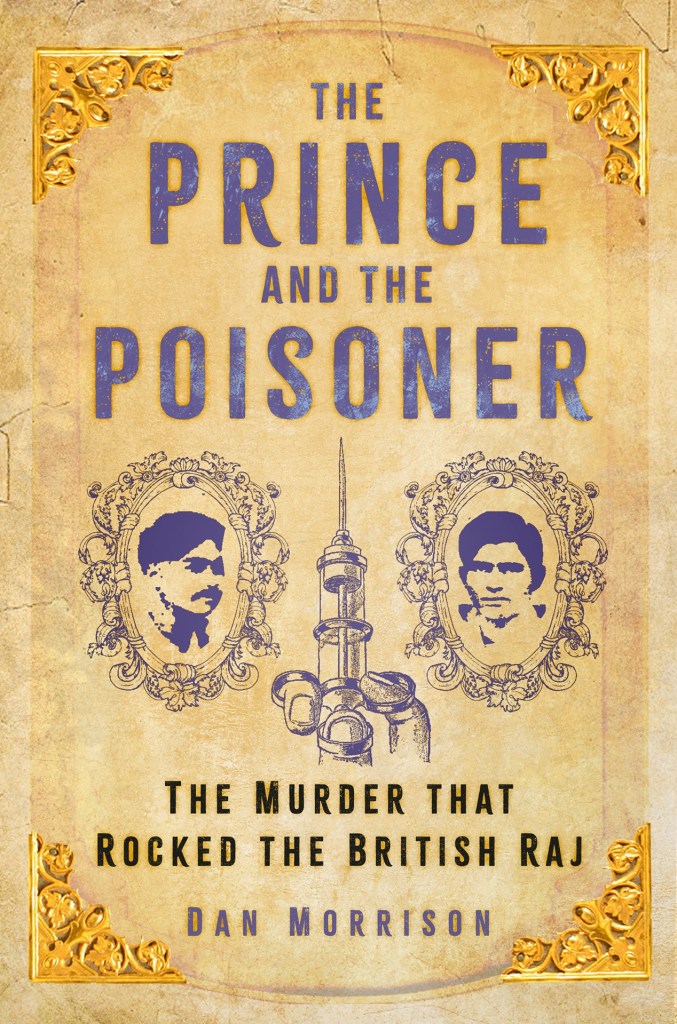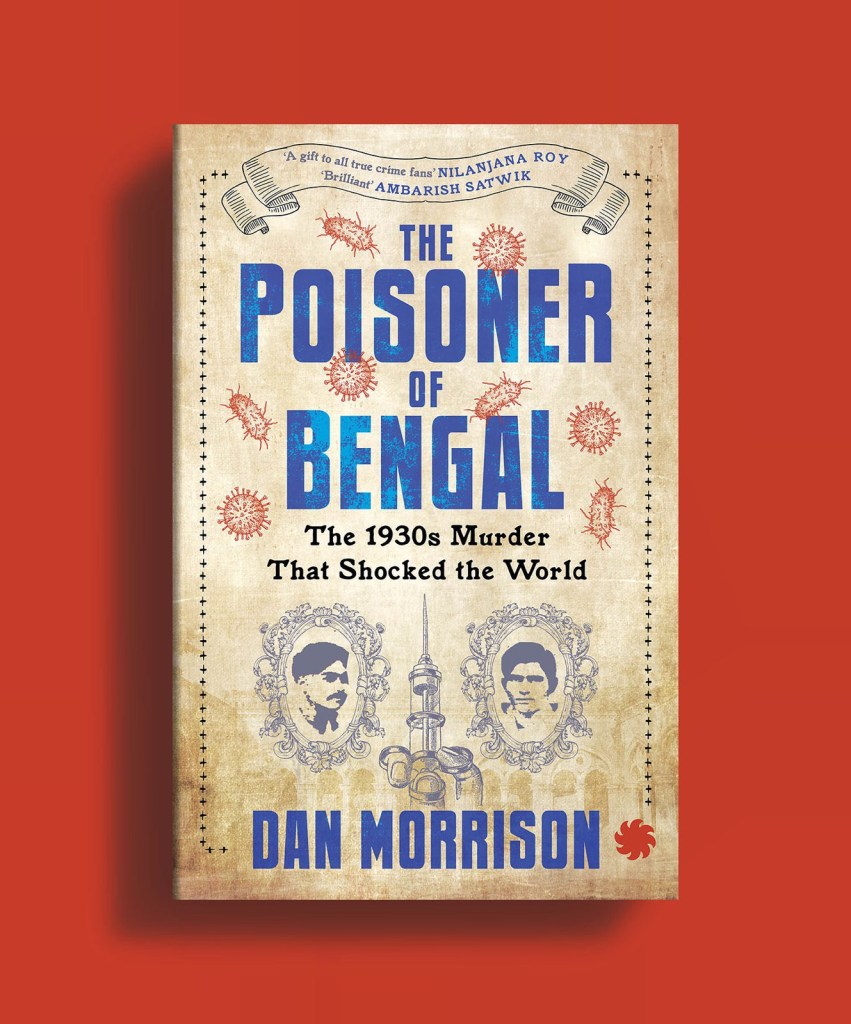
Titles: The Poisoner of Bengal/The Prince and the Poisoner
Author: Dan Morrison
Publishers: Juggernaut (India)/ The History Press (UK)
November1933:HowrahStation
For most of the year, Calcutta is a city of steam, a purgatory of sweaty shirt-backs, fogged spectacles, and dampened décolletage. A place for melting. In summer the cart horses pull their wagons bent low under the weight of the sun, nostrils brushing hooves, eyes without hope, like survivors of a high desert massacre. The streets are ‘the desolate earth of some volcanic valley’, where stevedores nap on pavements in the shade of merchant houses, deaf to the music of clinking ice and whirring fans behind the shuttered windows above.
The hot season gives way to monsoon and, for a while, Calcuttans take relief in the lightning-charged air, the moody day- time sky, and swaying trees that carpet the street with wet leaves, until the monotony of downpour and confinement drives them to misery. The cars of the rich lie stalled in the downpour, their bonnets enveloped in steam, while city trams scrape along the tracks. Then the heat returns, wetter this time, to torment again.
Each winter there comes an unexpected reprieve from the furious summer and the monsoon’s biblical flooding. For a few fleeting months, the brow remains dry for much of each day, the mind refreshingly clear. It is a season of enjoyment, of shopping for Kashmiri shawls and attending the races. Their memories of the recently passed Puja holidays still fresh, residents begin decking the avenues in red and gold in anticipation of Christmas. With the season’s cool nights and determined merriment, to breathe becomes, at last, a pleasure.
Winter is a gift, providing a forgiving interval in which, sur- rounded by goodwill and a merciful breeze, even the most determined man might pause to reconsider the murderous urges born of a more oppressive season.
Or so you would think.
On 26 November 1933, the mercury in the former capital of the British Raj peaked at a temperate 28°C, with just a spot of rain and seasonally low humidity. On Chowringhee Road, the colonial quarter’s posh main drag, managers at the white- columned Grand Hotel awaited the arrival of the Arab-American bandleader Herbert Flemming and his International Rhythm Aces for an extended engagement of exotic jazz numbers. Such was Flemming’s popularity that the Grand had provided his band with suites overlooking Calcutta’s majestic, lordly, central Maidan with its generous lawns and arcing pathways, as well as a platoon of servants including cooks, bearers, valets, a housekeeper, and a pair of taciturn Gurkha guardsmen armed with their signature curved kukri machetes. Calcuttans, Flemming later recalled, ‘were fond lovers of jazz music’. A mile south of the Grand, just off Park Street, John Abriani’s Six, featuring the dimple-chinned South African Al Bowlly, were midway through a two-year stand entertaining well-heeled and well-connected audiences at the stylish Saturday Club.
The city was full of diversions.
Despite the differences in culture and climate, if an Englishman were to look at the empire’s second city through just the right lens, he might sometimes be reminded of London. The glimmer- ing of the Chowringhee streetlights ‘calls back to many the similar reflection from the Embankment to be witnessed in the Thames’, one chronicler wrote. Calcutta’s cinemas and restaurants were no less stuffed with patrons than those in London or New York, even if police had recently shuttered the nightly cabaret acts that were common in popular European eateries, and even if the Great Depression could now be felt lapping at India’s shores, leaving a worrisome slick of unemployment in its wake.
With a million and a half people, a thriving port, and as the former seat of government for a nation stretching from the plains of Afghanistan to the Burma frontier, Calcutta was a thrumming engine of politics, culture, commerce – and crime. Detectives had just corralled a gang of looters for making off with a small fortune in gold idols and jewellery – worth £500,000 today – from a Hindu temple dedicated to the goddess Kali. In the unpaved, unlit countryside, families lived in fear of an ‘orgy’ of abductions in which young, disaffected wives were manipulated into deserting their husbands, carried away in the dead of night by boat or on horseback, and forced into lives of sexual bondage.
Every day, it seemed, another boy or girl from a ‘good’ middle- class family was arrested with bomb-making materials, counterfeit rupees, or nationalist literature. Each month seemed to bring another assassination attempt targeting high officials of the Raj. The bloodshed, and growing public support for it, was disturbing proof that Britain had lost the Indian middle class – if it had ever had them.
Non-violence was far from a universal creed among Indians yearning to expel the English, but it had mass support thanks to the moral authority of Mohandas Gandhi. Gandhi, the ascetic spiritual leader whose campaigns of civil disobedience had galvanised tens of millions, was then touring central India, and trying to balance the social aspirations of India’s untouchables with the virulent opposition of orthodox Hindus – a tightrope that neither he nor his movement would ever manage to cross.
And from his palatial family seat at Allahabad, the decidedly non-ascetic Jawaharlal Nehru, the energetic general secretary of the Indian National Congress, issued a broadside condemning his country’s Hindu and Muslim hardliners as saboteurs to the cause of a free and secular India. Nehru had already spent more than 1,200 days behind bars for his pro-independence speeches and organising. Soon the son of one of India’s most prominent would again return to the custody of His Majesty’s Government, this time in Calcutta, accused of sedition.
It was in this thriving metropolis, the booming heart of the world’s mightiest empire, that, shortly after two o’clock in the afternoon on that last Sunday in November, well below the radar of world events, a young, slim aristocrat threaded his way through a crowd of turbaned porters, frantic passengers, and sweating ticket collectors at Howrah, British India’s busiest railway station.
He had less than eight days to live.
About the Book:
A crowded train platform. A painful jolt to the arm. A mysterious fever. And a fortune in the balance. Welcome to a Calcutta murder so diabolical in planning and so cold in execution that it made headlines from London to Sydney to New York.
Amarendra Chandra Pandey, 22, was the scion of a prominent zamindari family, a model son, and heir to half the Pakur Raj estate. Benoyendra Chandra Pandey, 32, was his rebellious, hardpartying halfbrother – and heir to the other half. Their dispute became the germ for a crime that, with its elements of science, sex, and cinema, sent shockwaves across the British Raj.
Working his way through archives and libraries on three continents, Dan Morrison has dug deep into trial records, police files, witness testimonies, and newspaper clippings to investigate what he calls ‘the oldest of crimes, fratricide, executed with utterly modern tools’. He expertly plots every twist and turn of this repelling yet riveting story –right up to the killer’s cinematic last stand.
About the Author:
Dan Morrison is a regular contributor to The New York Times, Guardian, BBC News and the San Francisco Chronicle. He is the author of The Black Nile (Viking US, 2010), an account of his voyage from Lake Victoria to Rosetta, through Uganda, Sudan and Egypt. Having lived in India for five years, he currently splits his time between his native Brooklyn, Ireland and Chennai.
.
PLEASE NOTE: ARTICLES CAN ONLY BE REPRODUCED IN OTHER SITES WITH DUE ACKNOWLEDGEMENT TO BORDERLESS JOURNAL
The Bengali poet, Kazi Nazrul Islam (1899-1976), is widely remembered as the fiery iconoclast who fought against the structures of oppression and orthodoxy. The iconic bidrohi or ‘rebel poet’ of Bengal, Nazrul continues to be loved for his songs and poetry that were aimed at arousing the rebellious spirit of both Hindus and Muslims alike. But what of his prose, his journalism, and his politics? Selected Essays reveals to us the extraordinary versatility of Nazrul as a writer, thinker, and activist. Addressing subjects as diverse as social reform, politics, communal harmony, environmental concerns, education, aesthetics, ethics, and philosophy, this rich collection showcases Nazrul’s dynamic vision and unique use of language as an instrument of change. The essays chart his evolving consciousness as a thinker, writer, and activist, offering vivid glimpses of the ethos of his times, his relationships with leading figures such as Tagore and Gandhi, and his active engagement with social, political, and cultural processes.
Of the forty-one essays selected here, (three undated), the first thirteen are all written in different places all in the year 1920. That was the year Nazrul returned to Bengal after serving in Karachi during World War I as a member of the Bengal regiment of the colonial British army. Reacting to the Jallianwallah Bagh massacre he writes, “May the Dyer monument never allow us to forget Dyer’s memory” because on that occasion Hindus and Muslims embraced each other and wept together as brothers. They shared the same agony as children of the same womb. In ‘Strike’, he praises the social awareness that has swept among the ranks of the labouring class and believes that the “protest is not just a rebellion, but the death-bite of the suffering, moribund class”. When some migrants were fired upon after a clash with the armed police at a place called Kanchagarhi, he asked in ‘Who is Responsible for the Killing of Migrants?’, whether anyone can ever tolerate such injustice towards humanity, conscience, self-respect and independence and states that they are no longer going to passively accept such assaults. ‘Awakening Our Neglected Power’ contends that democracy or people’s power cannot be established in our country because of the oppression inflicted by the Bhadra[1] community.
There are several essays in which Nazrul speaks about the state of National Education, he envisages ‘A National University’, and in a very powerful piece that he wrote from Presidency Jail in Kolkata on 7 January 1923, titled ‘Deposition of a Political Prisoner’ he reveals his self-confidence:
“If anything has struck me as unjust, I have described it as injustice, described oppression as oppression, named falsehoods as falsehood. …For that endless mockery, insults, humiliation and assaults have been rained on me, from within my home and beyond. But nothing whatsoever has intimidated me into dishonouring my own truth or my own Lord. No temptation has overpowered me enough to compromise my integrity or to diminish the immense self-satisfaction gleaned through my own endeavours…. I repeat, I have no fear, no sorrow. I am the child of the elixir of immortality.”
Nazrul grew up in a traditional religious environment, yet in his writings he drew upon both Hindu and Islamic sources, and expressed a faith that transcended the limits of any single religion. In several essays, he harps on the problems of Hindu-Muslim amity and enmity and warns us about “this hideous business of purity of touch and untouchability”. He wants only humans to live in India as brothers and wants everyone to be wary of the terrible deceptions created by both the religions.
In the essay ‘Temple and Mosque‘, he states that both parties have the same leader, and his real name is Shaitan, the Devil. Written in response to the communal riots that broke out in Kolkata on 2 April 1926, he feels that those very same places of worship that ought to have been bridges between heaven and earth are instead causing harm to humanity today, and so those temples and mosques should be broken down. In another essay titled ‘Hindu-Muslim’, penned the same year, Nazrul talks about the question of an internal tail in human beings. He says, “There’s no telling what animal excitement lured the human mind to discover a substitute for tails in the beard or tiki[2]!” He further elaborates:
“Both Hindu and Muslim ways of life can be tolerated, but their faith in tikitwa and daritwa, the orthodox ways of tiki and beard, is not to be borne, for both instigate violence and killing. Tikitwa is not Hindutwa, it is perhaps punditwa, the way of the pundit! Likewise, the beard, too, is not Islamic, it is mullatwa, the way of the mullah. These two types of hair tufts, marked with religious dogma, are precisely the reason for all the conflict and hair-splitting we witness today!”
Though it is not possible to discuss all the different editorials, book reviews, and political pieces that are included in this collection, one must mention at least two essays that speak about literary issues as well. In 1932, Nazrul wrote for Patrika (subsequently reprinted in Bulbul the following year), an interesting piece titled ‘World Literature Today’. In it he states that there are two kinds of writers present in the world today and their different tendencies have assumed immense proportions.
“Ranged on both sides are great war heroes, champion charioteers of the battlefield. On one side are the dreamers, such as Noguchi, Yeats and Rabindranath, and on the other, Gorky, Johan Bojer, Bernard Shaw, Benavente and their ilk.”
But Nazrul’s ire in being ostracized comes out clearly in ‘A Great Man’s Love Is a Sandbank’ (1927), where he criticises the high-handedness of Rabindranath Tagore. He begins by telling us how he was a prisoner of state at the Alipore Central Jail when he was informed by the assistant jailor that Tagore had recognised Nazrul’s talent and dedicated his play Basanta to him. The other political prisoners present there had laughed at him not in joy but in incredulity. For him, the blessing turned into a curse. His very close friends and state prisoners also turned away from him. He realised what massive internal damage this outward gain had caused him. Busy with his political agenda, he didn’t have the time to sit and meditate as advised several times by Tagore. So Nazrul writes, “I find that the brighter my countenance shines in this glory, the darker some other famous poets’ faces seem to appear.” He mentions that he had grown accustomed to police torture but when literary personages begin to torment one, their brutality knows no bounds. “Alas, O youthful new literature!” His crime was that young people celebrated his work. He laments further,
“That Kabiguru[3], revered by both parties like the grandsire Bhisma, should assent to this plot of killing Abhimanyu, is the greatest sorrow of our times. …As for me, I have discarded that topi–pyjama—sherwani–beard look[4], only out of fear of being mocked as a ‘Mia Saheb’. But still there is no respite for me…. Now we get the feeling that the Rabindranath of today is not the same Rabindranath we have always known.”
That the trajectories and beliefs of Tagore and Nazrul went in the opposite direction is well- known. In the essay, Nazrul then further continues his complaints against Tagore. He questions whether they have been considered as his enemies, simply because they didn’t go to him frequently. Also, since the goddess of wealth blessed him, Kabiguru did not know what dire poverty the new writers had to struggle against, languishing in conditions of starvation or semi-starvation. So, he humbly requests Kabiguru not to sprinkle salt on their wounds by mocking the impoverishment that is their singular affliction, for that is one form of heartlessness that they cannot tolerate.
Of the last three essays written in 1960, namely, ‘The Science of Life’(where men “are surrounded by all sorts of travails and sufferings, and many of them cannot be alleviated”), ‘A Point to Ponder’(where the nation faces an immense problem regarding the dispute about the instructions and procedure for the worship of the mother, the Bharatmata, our Mother India) and in ‘What We Need Today’, Nazrul speaks of the necessity of a “vast tumult in India”. Making his readers aware of the vast duplicity and trickery in the name of religion, he warns that unless one avoids the baseness of being subjugated by an external power, there is no prospect of heaven for us, only the grotesqueness of hell. He wants the kalboishakhi, the wild summer storm, to “approach in all its fury, rearing his head like a hooded serpent swimming in the unchecked torrents of an ocean of blood” and sweep everything away.
Before concluding one should also make a few comments on the translation. As a veteran translator, Radha Chakravarty, has successfully managed to transcreate some very difficult Bengali idioms, cultural nuances and analogies that Nazrul used in some of his essays. As she admitted in the Introduction, “[T]ranslating Nazrul’s prose proved to be a challenge, as demanding as it was exhilarating. …The endeavour demanded experiment and creativity rather than mechanical lexical ability and involved some difficult choices…Literal translation has been avoided, with greater focus on the sense, emotion, intellectual import, rhetorical features and stylistic particularities of the Bengali source texts.” She further adds that the present translations stemmed from a desire to bring Nazrul’s essays to a contemporary audience in South Asia and the rest of the world, to draw attention to his literary achievement as well as his significance as a writer, thinker, activist, and visionary. Though a lot of research and translation projects on Nazrul has been going on in Bangladesh for quite some time (where he holds the status of National Poet), in India, especially in West Bengal, the response is still rather lukewarm. Hence this volume is strongly recommended as a collector’s item.
[1] Literally decent but here indicates the bourgeoisie.
There is a large grey wave painted in the middle of the canvas. It is falling over a large group of people standing on the edge of a seashore. Many men wear skullcaps. The women have black burkas. The group has widened eyes and open mouths. Some have turned their backs to flee. Others have raised their arms and clenched their fists, as if they are about to break into a run.
At the bottom of the canvas, on the left, there is another group of people. They are also standing on another seashore, with windswept hair. There is a woman with a large sindoor in the middle parting of her hair. A young man, in jeans, has a necklace with a gold crucifix. A boy stands with a placard showing a dove with a leaf in its beak. The words, ‘Let’s all live in peace,’ are written in bold, red letters. Others raise placards with slogans like ‘Say No to communalism’, ‘Syncretism is in our DNA’, and ‘We are all brothers and sisters in this great nation’.
Painter Ashraf Mahmood steps back and stares at the image. A slight smile plays on his lips. He had woken up that morning and this image had come floating into his mental screen. Ashraf kept staring at it, eyes closed, lying on his back. His wife had got up and gone to the kitchen. Alia liked to make her tea using Tata Gold. He preferred Brooke Bond Red Label. So they made separate cups.
When he entered his studio on Mira Road, in Mumbai, at 9 am, he got down to work, using an easel and grey paint.
He worked steadily. It was silent inside. But Ashraf did register the outside sounds of a typical Mumbai street. The horns blowing. Tendrils of smoke from exhaust pipes floated in through the window. His nose twitched as he noticed a foul smell. It seemed as if somebody had thrown garbage on the street. Ashraf closed his nose with the tip of his fingers for a few seconds. “The crazy smells of Mumbai,” he thought.
He grew up near Mandvi Beach in Ratnagiri (343 kms from Mumbai). The air was fresh, and the wind blew constantly. The only sound was the roar of the waves and the beautiful sight of seagulls making circles as they flew above the sea. Ashraf’s father, Mohammed, was a government school teacher. His mother was a homemaker. He had two elder brothers and three sisters. Ashraf was the youngest. He displayed artistic talent from his school days.
Unlike most fathers, Mohammed encouraged his son. His father took him to an art teacher, who taught him how to draw and paint. Ashraf’s major breakthrough happened when he got admitted to the JJ School of Art in Mumbai. After that, there was no looking back…
It was evening when he finished the work. His soles ached. Ashraf had been standing for hours.
This image reflected all that he felt. The grey resembled the growing intolerance towards Muslims. This seemed to be overwhelming especially in places like Uttar Pradesh and Madhya Pradesh. There was the rise of majoritarianism. And the fracturing of relations between people of different communities. And yet, Ashraf felt that the DNA of the people over centuries was syncretic. A ready acceptance of people of all faiths.
It was only the hate campaigns, through speeches, social media, and songs, that had swayed the people. He was sure the fever would die one day. Syncretism would rise again. “After all,” he thought, “throughout human history, love always conquered hate. But it took time.”
Ashraf wanted to tell the viewers of his work not to lose hope. And hence the pigeon and the symbol of peace. For the title, he used a quote by the Greek philosopher, Aristotle, “Hope is the dream of a waking man.”
Ashraf rubbed his chin a few times and walked to a table on one side. A packet of fresh buns lay on the table. Ashraf opened a fridge. He took out a container which contained butter and a bottle of strawberry jam. He sliced the bun into half with a stainless steel knife, placed butter and jam in between, and began eating it. These were fresh buns from a nearby bakery. Ashraf had bought them when he had stepped out for lunch. He made tea on the gas stove. Then he sat on a stool near the table and sipped it.
This was his 35th year as a painter. Now, at 55, he could look back with reasonable pride. He took part in regular exhibitions and won a few awards and grants. Profiles of him appeared in the newspapers and on social media. His paintings sold, thanks to his realistic and simple style. An art sensibility was only gradually building up among the people. Ashraf knew that images drawn from his unconscious mind had a pulling power. Why this was so, he did not know. He remembered how one art critic described a David Hockney painting as having a ‘psychological charge’. Hockney was a renowned English painter. Ashraf realised that art needed to have a psychological charge if it had to have an impact.
But Alia had already made an impact on him. He met her when she came to view his exhibition one day at the Jehangir Art Gallery. She was slim and tall, with curves that were accentuated by the chiffon saree she wore. Like Ashraf, she came from a small town. Through grit and perseverance, she passed competitive exams and got a government job. They went for dates. Ashraf was smitten. Within a year, he proposed and they got married.
Alia was a superintendent in the sales tax department. She would earn a pension once her career got over. She had another ten years to go. Their two daughters had married and settled down in Aligarh and Delhi. Both had two children each, a boy and a girl.
Alia wanted Ashraf to earn more money. But he was not a hustler or a man who liked to build a network. If a buyer came and offered a decent price, he sold it. Most of the time, he remained isolated. Sometimes, he met other artists at exhibitions and art seminars. He would chat with them. But that was all.
He was not keen on extramarital flings or experimenting with drugs or drinking too much. Ashraf led a steady life. In many ways, he was happy with the way his life had turned out.
He washed the cup and the pans. Ashraf placed the cup on a hook which hung on a wall. He had yet to finish the bun.
He made his way back to the painting. It was 5.30 p.m. In half an hour, he would close his studio and walk back to his house, fifteen minutes away. The couple owned their apartment. Alia, with help from Ashraf, had cleared the bank loan over 15 years.
At this moment, he heard a murmur of voices from outside the door. Ashraf wondered what it was. The sound arose. “Was there an emergency?” he thought. “Is the building on fire?”
He came to the door. Ashraf saw that the lock was coming under strain. It seemed to be bulging backwards towards him. Somebody gave a violent kick and the door sprang open. Ashraf moved to one side.
A group of young men rushed in. Some wore red bandanas. Many were in T-shirts and trousers. Some had thick, muscular arms. They were shouting. It seemed like slogans. In his shocked state, Ashraf could not register the words. They rushed to the canvas on the easel. One man, using a long knife, sliced the canvas into two. He pushed the easel. It fell with a clattering sound to the floor.
There were a bunch of finished canvases placed on one side. Ashraf had been doing work to showcase in an upcoming solo exhibition. The group spotted it. They rushed there, pushed the canvases to the floor, and began ripping them one by one with their knives. Within a few minutes, the work of several months lay ripped out. Ashraf remained by the side of the door. He had not moved.
“Hey you Muslim kutta (dog),” one of them said. “We will come again if you carry on working. No art for Muslims. Clean the sewers. That’s the only job you are good at.”
Ashraf half-expected one of them to stab him. But they didn’t. They left as quickly as they came.
Ashraf felt as if a large, round ball had settled at the base of his throat. He could not swallow it nor could he spit it out.
He blinked many times. Ashraf wasn’t sure whether this event had actually happened. It took place so fast. But there was no doubt about the ripped canvases lying all over the floor.
He felt a pain in his heart. Ashraf rubbed the area. “I hope I am not having a heart attack,” he thought to himself, as he took in lungfuls of air to calm himself down. Employees from other offices on the same floor came to the door. They entered. Most had goggle-eyes.
“Sir, what happened?” one young man said.
Ashraf shook his head.
“I don’t know,” he said.
“Who were these people?” a woman said.
“No idea,” Ashraf said, as he surveyed the damage.
“Sir, you will have to call the police,” another man said.
“Yes, I will,” said Ashraf.
A couple of men shook his hand.
All of them surveyed the damage silently. Work was calling them. “All chained to their desks,” thought Ashraf. “At least, that way, I am free. No boss on top of me. No attendance marking every day. No targets to meet. No one shouting at me. But then, no steady income. And no camaraderie. Large amounts of time spent alone.”
Then he returned to the stool, returned to the present, and placed his head in his hands.
‘What’s happening to this country?’ he thought. ‘‘There seems to be a collective madness. Indians attacking Indians. And these young people were ruining their lives by working for political leaders. They will be used and discarded.”
He had not seen them before in the locality. They might have come from some other area. Was it a deliberate ploy to send a shock wave through him and the community? Who knew how they thought?
What should he do now?
Ashraf realised he had to think rationally. He stood up and went to the door. He realised immediately, he could not do anything immediately. A carpenter would have to be called tomorrow.
He called Alia and informed her about what had happened. She said she would come directly to the studio from the office. Ashraf called up his media contacts, both in the print and visual media. They said they would arrive with their photographers and cameramen. Ashraf took several photos and videos on his mobile phone, documenting the damage.
He would have to report the attack at the police station and file an FIR.
Ashraf realised his work had been ruined, but he would recreate it. He had photos of all the canvases.
To prove to himself, he had returned to normality, he went back to the table and finished the rest of the bun. He put the butter and the jam back into the fridge. He washed the plate and the knife.
Fifteen minutes later, Alia arrived.
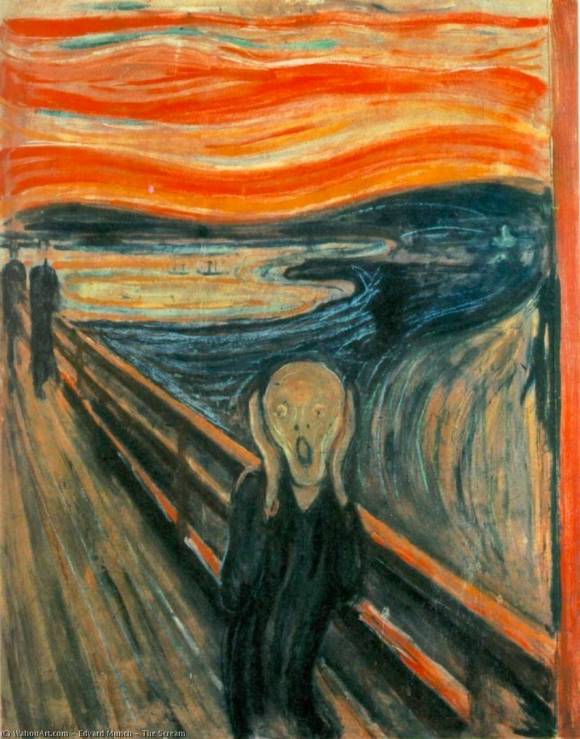
In silence, she stared at the canvases lying on the floor. Ashraf saw her press her hand against her open mouth. He realised it was a silent scream.
In the end, she came up to Ashraf and said, “They have tried to violate your dignity as an artist and a person.”
The couple hugged.
After a while they broke away.
“Don’t keep the canvases here anymore,” she said.
Ashraf rubbed his chin with his fingers.
Finally, he nodded.
“There was something strange about the attack,” he said. “They didn’t overturn the table or the fridge. And for some reason, they did not assault me. It seemed to me they had to leave in a hurry. So I got saved.”
Alia said, “They are keeping a watch on everybody.”
“Yes, I read online there is a pervasive deep state,” said Ashraf. “In every neighbourhood there are spies who report about all that is happening.”
“What is the next step?” she said.
“I am waiting for the media to come. After that, I will file the FIR,” he said.
At that moment, a few print and TV journalists arrived.
Ashraf spoke to the reporters. The photographers and cameramen began recording all that had happened.
They left after half an hour.
The couple then shut the door, as best as they could. But there was a small gap at one side. They went to the police station. The police allowed an FIR to be filed against ‘unknown persons’. He faced no hindrances because, as Ashraf surmised, the police were aware of his reputation as an artist.
The couple took an autorickshaw and returned to their apartment.
Alia changed into a nightgown. She washed her face, and informed their daughters about what had happened on her mobile phone.
Ashraf changed into a T-shirt and shorts. He made a glass of whisky mixed with water for himself. Every night he had one peg.
As he sat on the sofa, nursing his drink and staring at the TV screen, he felt the pain arise in him. It was an ache in the middle of the chest. To see his work treated in such a callous manner was a calamity. He wondered whether he would ever overcome this fear that had come into him. Work on a piece the whole day and in the evening, somebody could come in and rip it up.
Closed doors did not offer any protection. It was a time of lawlessness. People with criminal behaviour could operate with impunity. Leaders wanted to instil fear in people.
And would he be able to recreate these ripped-up paintings with the same intensity? He was not sure.
On the screen, some leader was having his say. His eyes enlarged, he made violent movements with his hand, and spoke with a loud voice. “Horrific,” thought Ashraf. “How do you create art in this environment?”
Yes, indeed, how do you?
But it did not take long for him to tell himself, “But we must, whatever be the cost. Art is the candle that brings light to the darkness.”
.
Shevlin Sebastian has worked for magazines like Sportsworld, belonging to the Ananda Bazar Patrika Group in Kolkata, The Week, belonging to the Malayala Manorama Group, in Kochi, the Hindustan Times in Mumbai, and the New Indian Express in Kochi. He has also briefly worked in DC Books at Kottayam. He has published about 4500 articles on subjects as varied as films, crime, humour, art, human interest, psychology, literature, politics, sports and personalities. Shevlin has also published four novels for children.
.
PLEASE NOTE: ARTICLES CAN ONLY BE REPRODUCED IN OTHER SITES WITH DUE ACKNOWLEDGEMENT TO BORDERLESS JOURNAL.
Narrative by Debendranath Tagore, translated from Bengali by Somdatta Mandal
Note from the Translator
Debendranath, Father of Rabindranath Tagore
Born to Dwarkanath Tagore in Shelaidah, Debendranath Tagore (15 May 1817 – 19 January 1905) was a Hindu philosopher and religious reformer. One of the founders of the Brahmo religion in 1848, his journey in the role of ‘Maharshi’, the great ascetic, was an attempt to spread the Brahmo faith and he travelled extensively to various places, especially in different parts of the Himalayas like Mussourie, Shimla, Kashmir, and Dalhousie. He even constructed a house in Bakrota called ‘The Snow Dawn’ where he used to reside for months. Although Debendranath was deeply spiritual, he managed to continue to maintain his worldly affairs — he did not renounce his material possessions, as some Hindu traditions prescribed, but instead continued to enjoy them in a spirit of detachment. His considerable material property included estates spread over several districts in Bengal. Debendranath was a master of the Upanishads and played no small role in the education and cultivation of the faculties of his sons.
In his memoir, Jeevan Smriti [Memories of Life], Rabindranath also narrates in detail about his trip with his father in the Himalayas when he was just eleven years old. Debendranth founded the Tattwabodhini Patrika (1843) as a mouthpiece of the Brahmo Samaj and apart from his autobiography, wrote several other prose pieces which also reveal his wanderlust.
Among the two entries included here, we have ‘Moulmein Bhraman’ which is an interesting travel piece narrating his sojourn in Burma in September/October 1850. In the Chaitra 1817 Saka issue of Tattwabodhini Patrika, a travelogue ‘Mori Bhraman’ narrating Debendranath’s trip to Mori was published. Interestingly, as a prologue to this piece Sri Chintamani Chattopadhyay tells us that he was so enamoured after listening to Debendranath’s oral narration of the trip undertaken 28 years earlier, that he decided to transcribe it for the satisfaction of the readers.
Moulmein Bhraman (Travel to Moulmein)
After a year, the splendour of autumn revealed once again and the desire to travel blossomed in my mind. I could not make up my mind where to go for a trip this time. I thought I would make a trip on the river and so went to the bank of the Ganges to look for a suitable boat. I saw that several khalasis — dockyard workers – of a huge steamer were busy at their work. It seemed that this steamer would soon set sail.
“When would this steamer go to Allahabad?” I asked them.
In reply they said, “Within two or three days this will venture into the sea.”
On hearing that this steamer would go to the sea, I thought that this was the easiest way my desire for a sea journey could be fulfilled. I went to the captain instantly and rented a cabin and in due time boarded that steamer to begin my sea journey.
I had never seen the blue colour of the sea water before. I kept on watching the beautiful sights by day and night amid the continuous bright blue waves and remained immersed in the glory of the eternal spirit. After entering the sea and swaying with the waves for one night, the ship dropped anchor at three o’clock the next afternoon. In front of us, I saw a stretch of white sand and something that looked like human habitation. So, I took a boat and went to see it. As I was wandering about the place, I saw a few Bengali men from Chittagong with charms around their necks coming towards me. I asked them, “How come you are here? What do you do?”
“We do business here. We have procured the idol of Goddess Durga in this month of Ashwin[1],” they replied.
I was really surprised to hear that they celebrate Durga puja here in Khaekfu town of Burma. Durga puja was celebrated even here!
From there, I came back to the ship and started towards Moulmein. When the ship left the sea and entered the Moulmein River, I remembered the scene of leaving Gangasagar Island and going into the Ganges River. But this river did not offer any such good scenery. The water was muddy and full of crocodiles; no one bathed in it. The ship came and dropped anchor at Moulmein. Here a Madrasi resident called Mudeliar came and greeted me[2]. He came on his own and introduced himself. He was a high-level government official and a true gentleman. He took me to his house, and I remained a guest there and accepted his hospitality for the few days I stayed at Moulmein. I stayed very comfortably in his house.
The streets in the city of Moulmein were wide and clean. The shops that lined both sides of the street selling different kinds of things were all manned by women. I bought a box, and some very fine silk clothes from them. Going around the marketplace I went to the fish market at one time. I saw big fish for sale displayed on huge tables.
“What are these big fish called?”
They replied, “Crocodiles.” So, the Burmese ate crocodiles; they spoke verbally about ahimsa and the Buddhist religion, but their stomachs were filled with crocodiles!
One evening when I was wandering on the wide streets of Moulmein, I saw a man walking towards me. When he came close, I understood that he was a Bengali. I was quite surprised to see a Bengali there. From where did this Bengali arrive across the ocean? It seemed there were no places where Bengalis did not go. I asked him, “From where have you come?”
“I was in trouble and so came here,” he replied.
Instantly I understood his trouble[3]. I asked him further, “How many years of trouble?”
“Seven years,” he replied again.
“What did you do?”
“Nothing much. I just duplicated some papers of a company. Now my term is over, but I cannot go home because I do not have the money.”
I offered to give him the passage money. But how will he go home? He had set up a business, had got married, and was living quite comfortably. Would he ever go back to our country to show his shameful black face there?
Mudeliar told me that there was a mountain cave here which people went to visit[4]. If I wished he would accompany me there. I agreed. On the first moon night[5], he brought a long boat during the high tide. There was a wooden cabin in the centre of that boat. That night, Mudeliar, I, the captain of the ship and seven or eight other people boarded the boat and it left at two o’clock at night. We sat up for the whole night in that boat. The foreigners kept on singing English songs and requested me to sing Bengali songs. So, I kept on singing Brahma-sangeet occasionally. No one understood anything. They did not like them and went on laughing. We travelled for about twenty-seven miles that night and reached our destination at four o’clock in the morning.
Our boat reached the shore. Everything was still dark. On the shore I saw a cottage full of trees and creepers from which light was coming out. I got curious and ventured alone to that unknown place in the darkness. On reaching there I found it was a tiny cottage. Inside several bald-headed priests in yellow ochre robes were placing candles in different parts of the room. I was quite surprised to see people resembling the priests of Kashi[6] here. How did they come here? Later I came to know that they were the leaders of the Buddhist monks and known as Phungis. I hid myself and observed them playing with the lamps but suddenly one of them saw me and took me inside. They gave me a mat to sit on and water to wash my feet. I had come to their house, so this was their way of entertaining guests. According to the Buddhists, serving guests was a sacred act.
I returned to the boat at early dawn. The sun rose. Mudeliar and the other invited guests came and joined us. This made us fifty in number. Mudeliar fed all of us there. He had arranged for several elephants; about two or four people got on each elephant and proceeded towards the dense jungle. There were small hills all around and in between was that dense forest. There was no other way of travelling here except on elephant back. We reached the entrance of the cave in the mountain around three o’clock in the afternoon.
We descended from the back of the elephants and started to walk in the jungle where the undergrowth was waist high. The entrance to the cave was small; we had to crawl in. After crawling in a little we could stand up straight. It was very slippery inside and we kept on slipping and falling. So, we started walking very cautiously. It was pitch dark inside. Though it was three in the afternoon it seemed like three at night. I was scared that if we lost our way in the tunnel, we would not be able to come out. We would then have to wander inside the cave for the whole day. So, wherever I went, I kept an eye on the faint light at the entrance of the cave. All the fifty of us spread ourselves in various parts of the cave and everyone had sulfur powder in their hands. Then each person put a little sulfur powder in the little holes in the cave next to where he was standing.
After everyone’s place was defined, the captain lit his share of the sulfur powder. Instantly each one of us lit matches and ignited our portion. Now the cave was lit simultaneously at fifty different places like fireworks, and we could see the inside clearly. What a huge cave it was! On looking up to the ceiling our vision could not gauge its height. We saw the different natural formations that had been caused by rainwater seepage inside and were really surprised.
Later, we came out and had a picnic in the forest and then came back to Moulmein. On our way back we heard different musical instruments being played together. Locating that sound, we went forward and saw a few Burmese people dancing with all kinds of gestures of their bodies. Our captain and the foreigners also joined them and started to dance in a similar manner. They found great pleasure. A Burmese lady was standing at the entrance of her house. She watched the mimicry of the foreigners and went and whispered something in the men’s ears. They stopped their singing and dancing immediately, and all of them suddenly left the scene and disappeared somewhere. The captain went on entreating them to resume their dance, but they did not listen. It was amazing to see how much hold the Burmese women had over their men.
We came back to Moulmein. I went to meet a high-level Burmese official at his house. He received me very politely. There was a huge room and in its four corners sat four young women stitching something.
One of the girls instantly came and handed me a round box full of betel leaves. On opening it I found it to contain different condiments. This was the local Buddhist custom of receiving guests. He then gifted me some excellent saplings resembling the Ashok flower. I had brought them home and planted them in my garden, but they did not survive despite great care. The fruit of this tree is very popular with the Burmese. If someone had sixteen rupees then he would spend the entire amount to buy that fruit. We disliked their favourite fruit because of its smell[8].
Mori Bhraman (Travel to Murree)
On the 10th of Pous, 1789 Saka[9], I abandoned all work and ventured in full earnest to go for a tour in the west. I did not decide where I would go. Just as a confined river feels overjoyed when released, I too left home with equal enthusiasm. Two servants accompanied me. One was a Punjabi Sikh called Gour Singh, the other was Kashi Singh, an Odiya Kshatri. At that time the train went only up to Delhi.
Upon arriving at Delhi, I found out that there was no other way to go except by mail coach. So, I booked a seat on it. My destination was Punjab. The horses of the coach in which I travelled up to a place near Sutlej were not steady. Because of them the coach swayed on both sides. I feared that it might topple, and it did tilt on one side and fell down on the ground.
I got out of the coach through its panel and shouted at the driver in the topmost voice – “You made me fall down, the body is hurt in many places and the nose is bleeding.” The driver had assumed that I had already died under the pressure of the carriage. Feeling assured after hearing my voice he replied, “Baancha to – at least you are alive.” My servant brought some water from a nearby well. I washed my nose. It was almost evening by then. Seeing a rest house nearby, I spent the night there.
Early next morning, I boarded the mail carriage again. It crossed the huge bridge upon the river Sutlej. Upon looking down I saw that the water had a tremendous current. I had never seen such a large bridge before. The wind was blowing fiercely. The strange sound of the waves hitting one another created great pleasure in my mind.
After that I reached an inn near the Beas River. Having our lunch there, I boarded the coach again at four in the afternoon. It was almost evening; we hadn’t progressed far when all of a sudden, a heavy storm rose. The road was just along the river. Sand started blowing to form clouds and cover the surroundings. Nothing was visible in front of us. Sand filled our nostrils and the coach could hardly move. I couldn’t decide where to go and take shelter. We found a settlement a little further ahead. Seeing a two-storied house I got off the coach and spent the night there. The storm continued unabated till three o’clock at night. As soon as it stopped, I boarded the coach again.
In this manner, travelling from one inn to another, I ultimately reached Amritsar. Earlier when I had gone to Shimla, I had spent a few days with great pleasure in Amritsar in an old, dilapidated house located next to a narrow sewer line. Immediately upon reaching Amritsar, I went looking for that beloved house.
I came next to the sewage line but saw that the house did not exist anymore. There wasn’t even a sign of it anywhere. This was an example that nothing was permanent in our lives.
I came back from there in a depressed mood. I rented a small single storied hut next to the road. As a traveller on the road, I stayed there amid the dust in that small room quite stoically but with great excitement. I cannot express in words how much I enjoyed living in such seclusion. The room wasn’t much taller than the road. Unknown travellers would stop by and speak to me in a manner as if we had been acquainted before. I was also happy to interact with them. One of them was a devotee of Hafiz and I too became an admirer. He did not want to leave me and became an earnest friend of mine.
Days went by in this manner. One day a Brahmo gentleman called Shibchandra babu came from the Brahmo Samaj at Lahore. He said that he had been sent by the Brahmos there once they heard that I was here, and I had to go to Lahore. Seeing his eagerness I started for Lahore. Babu Nabinchandra Roy had arranged for my accommodation beforehand in a house located next to a wide road at Anarkali. Once I reached there, the Brahmos came and surrounded me with devotion. During my stay in Lahore, I even had to deliver a lecture in Hindi.
From there the Brahmos arranged for my stay inside a garden. Surrounded by lime trees, the dwelling house was in the middle. With only two servants accompanying me, who was going to cook for me? I developed diarrhoea after eating the hard rotis that were served. Soon, I was also attacked by malaria. The Brahmos informed a Muslim doctor, and he came and saw me. I did not take the medicines prescribed by him. My own medicine was powdered Myrobalan and I took that. The next day there was a lot of emission of blood. I became weak; wanting fresh air I went up to the first floor. There I felt the tremendous heat of the sun and my head started reeling. The very next moment I fainted. Upon hearing this news, two Brahmos came and started feeding me sugar cane and I regained my consciousness after their nursing.
The body was in a miserable condition. The next day I sat wondering where I could go in such a state and that too without a cook. How could I return home in the heat of summer? As I was feeling tense thinking about it and could not decide what to do, my heart suddenly said, “Go to Murree.”
Thinking this to be a god-sent instruction I started preparing to go to Murree. The local Brahmos came to meet me at around two in the afternoon. My body was still very weak, and I didn’t have the energy to even talk much. They asked me what I wanted to do now, and I told them that I had decided to go to Murree and would begin my journey that day itself. After they left, Nabin babu and a few other Brahmos came.
I told them, “I want to go to Murree today so please arrange for a coach.”
They sent Gour Singh and arranged a mail carriage for me. Nabin babu asked me what I would eat on the way. He then gave me two bottles of pomegranate juice. After the coach arrived, I had the two big trunks loaded on its roof and got inside with the two bottles of juice as sustenance. Two servants sat on the roof of the coach. Despite my objection, the Brahmos dismantled the horses and started pulling the coach by themselves. I had to persuade them to stop. The coachmen attached the horses again and started moving.
After travelling a little I realised that the coach was swaying too much, and it was also not strong enough. The Sikh Gour Singh who was sitting on top was very strong, and there were two heavy trunks; if the roof collapsed on my head, there would be nothing I could do. I started feeling scared. Travelling in this manner, I reached a dak bungalow. It was a great relief and I felt that my life was saved. After eating there, I boarded the coach again. Gradually I came to the Jhelum. Gour Singh’s house was located there. He stopped the coach and was pleased to call his relatives and introduce me to them.
In this manner I arrived at Rawalpindi, which was situated in the Murree valley. From this point the road went up and down. Many broken wheels lay scattered here and there as proof of this dangerous road. I became scared on seeing them and kept wondering what would happen to me if the wheels of this unstable coach also broke. But by God’s grace, we overcame all these various hurdles and safely reached another dak bungalow[10]. As soon as I arrived there, the local Bengali gentlemen came to meet me. The pain in my body and the strain of travel made it difficult for me to speak. A gentleman called Dwarik babu started taking special care of me. He went here and there looking for a house, and at last went and requested a Parsi gentleman to allow me to stay in his garden.
I stayed in that garden and a Punjabi doctor came to see me. I told him that milk was my only food, but I could not digest that milk very well. I asked him for some medicines that would help me to digest that milk and was slightly relieved with what he gave me. I had become very weak. At night when I went to bed, I felt that I would not be able to get up the next day.
When Dwarik babu came the following day, I told him that I wanted to go to Murree. He told me that there were still no shops and markets at Murree, and I would find it difficult to stay there. But I went on pestering him. So having no other way he arranged for two basket carriages called dulis that would take me to Murree. I went in one duli and my luggage was put in the other one, while the servants went walking. I reached Murree after three days and a lot of hardship.
It was situated at a height of 7,500 feet. The bearers asked me where I wanted to go, and I told them to take me to the place where the sahibs usually landed. They took me to a huge house which was totally deserted and not a single human being was around.
I told them, “Why did you bring me here? Take me to a bungalow where people are staying.”
So, they took me to another bungalow. But the people there told me that it was a club house and not a place for travellers to stay. So, I could not put up there. I told the bearers to take me back to that same uninhabited house where they had taken me at first. They got annoyed and went back there and said that they would not go anywhere else. They placed my duli under a tree in front of that house. Looking up I saw the sky overcast with clouds. Here in the hills, it doesn’t take long for clouds to gather and rain. I was worried and wondered where to go now. I asked the bearers to take me inside and they carried the duli up to the verandah. I got down and inspected the house. There was no one anywhere. I selected a room and again asked the bearers to bring all by bedding from the carriage and spread it out near the wall so that I could sit up and take some rest. They did that and the very next moment quickly disappeared with their dulis.
A little later it started raining. The servants had not reached till then. Through the windowpanes, I could see that a heavy storm was raging outside. The leafless branches of all the big trees were fiercely swaying and big hailstones started hitting the windowpanes as if they would break them, but nothing happened. I kept on thinking that if I arrived here a little late then I would surely have died inside the duli in this severe hailstorm.
After a while the two servants came shivering. With the cold, the rain, and the hailstorm, they were in very bad shape. After wringing their clothes, they came near me. I told Gour Singh to look for a bearer or the caretaker of this hotel and bring him to me.
So he went and got the chowkidar. I asked him to fetch the furniture for the room, but he said he couldn’t do that till he received orders from the master. I threatened him that if he did not bring the furniture out under my orders and if his owner got to know about it, then he would be instantly dismissed from his job. The man got scared and then brought out a charpoi. I spread out my bedding on that cot and lay down. That night Gour Singh brought me a roti and some water. I could neither eat that hard roti nor drink the ice-cold water of Murree. So, I spent the night without any food. In the morning, I sent Gour Singh to fetch some milk and kept on counting the hours until his return.
It was eight o’clock and still there was no sign of Gour Singh. Those eight hours seemed like eight days. At last, he came back at 9 am with some buffalo milk. Upon drinking it, I found it to be diluted with water and tasteless. I could not digest that milk, and nothing remained in my stomach. The milk just passed out as it was. I covered myself with layers of blankets and shawls and went to sleep in the charpoi in that tremendously cold weather.
While I was lying down, I saw a shivering sahib entering my room. I realised how extremely cold it was outside when I found his teeth were chattering. He lit a fire in the next room and because of that I felt a bit comfortable.
The next day Gour Singh brought such diluted buffalo milk once again. I drank it but again the milk went out of my body as it is. Having starved for three nights I felt almost half-dead on the third night. I laid down quite comfortably on the charpoi with all the warm clothes layered upon my body and did not feel any pain. I felt as if someone like my mother was sitting near my head. I was breathing and along with that breath I saw my friend, Sajuja, also looking at me. Breathing in and out in that manner I spent the whole night doing easy yoga and cannot describe how happy I felt.
Soon the night was over, and it was morning. Once again Gour Singh brought that kind of diluted buffalo milk. I drank it. How strange! I digested the milk that day. Since pure milk was unavailable here, I told Gour Singh that it would be nice if he went looking for a cow. So, he went to Rawalpindi and bought a small cow for thirty rupees. He said that she gave ten seers of milk per day. Now milk has become my staple diet.
After drinking that milk my body became a little stronger. I had been staying in Bekereya Hotel from the beginning but now I decided that it was not feasible to continue staying there any longer. So, I went to look for a rented house. I went up the hill in that extremely weak condition and found an empty house. But it was so cold there that I did not find it suitable. A little lower from that point I found another house and liked it. I rented it for nine hundred rupees and started staying there. The next day the postal peon brought me a letter from my nephew Gnanendranath. I opened it with excitement, and he had included a Brahma-sangeet which read thus:
Gao rey tahar naam Rochito jaar visvadhaam. Dayar jaar nahi biram Jharey abitito dhaarey.
[Sing His name/He who has created this world/Whose blessings endless/Falls continuously on earth]
I had already received His blessings to get back my life from the verge of death; the same blessings that were referred to in this song made me feel excited and my heart leaped with joy. This sort of a letter, and at such a time! How strange! How strange!
In this new house I managed to get a cook. He prepared green moong dal for me, and I liked its taste. It was sufficient for my lunch. After a long time, I felt satiated after an afternoon meal. As my health started improving, I gradually began to increase the quantity of my milk consumption. Early in the morning after the upasana was over, they brought the cow in front of me, and I would immediately send a bowl for the cow to be milked before my eyes. The bowl of milk was brought to me; I drank it and sent the bowl back. The cow would then be milked again, and I would once again drink from the bowl. This procedure was repeated several times and after drinking four or five bowls of milk, I would go for a walk in the mountains. Walking in the fresh cool breeze and under the direct rays of the morning sun, I wandered here and there and then came home. Instantly I would have tea, chocolate, and milk. During lunch I would drink milk again, and in the evening, and before going to bed. In this manner, I would drink about ten seers of milk each day and whatever was left over was made into butter to be consumed with rotis the next morning.
Within seven days, I regained my strength and, feeling exuberated started travelling in the mountains. I started singing songs praising the grace of our creator and there was no end to those songs. For a long time, I had been cherishing dreams of visiting Kashmir and it seemed that our creator would now fulfill it. So, I started enquiring about how to go to Kashmir. By the beginning of May, Murree became full of people and the place took a new look with the red uniform of the British soldiers and the fanciful clothes of the other British men and women. Deserting its shabby look, even nature filled up the place with varieties of flowers. After staying in Murree for three months, I heartily began my journey to Kashmir on the 4th of September.
[ Excerpted from Wanderlust: Travels of the Tagore Family. Translated and Edited by Somdatta Mandal. Kolkata: Visva-Bharati, 2014]
[2] Sri Murugesam Mudeliar was the then Commissariat contractor of the military outpost at Moulmein.
[3] The fact was that the man had been banished here. Usually, political prisoners were interned in Moulmein prior to 1848. But after 1848 Port Blair in the Andaman Islands was made the new place for banishment and imprisonment. This narrative is dated 1850.
[4] The local name of this famous cave was Kha-yon-gu, and Farm Cave in English. It was situated in the northeast part of Moulmein town and was approachable through the Ataran River.
Title: Out of Sri Lanka: Tamil, Sinhala and English Poetry from Sri Lanka and its Diasporas
Editors: Vidyan Ravinthiran, Seni Seneviratne and Shash Trevett.
Publisher:Penguin India (Vintage)
AAZHIYAAL (b. 1968)
Aazhiyaal (the pen name of Mathubashini Ragupathy) was born in Trincomalee in Eastern Sri Lanka. She taught English at the Vavuniya Campus, Jaffna University, before moving to Australia in 1997 where she worked for two decades in the IT sector and commercial management in Canberra. Aazhiyaal has published four collections of poetry in Tamil: Uraththup Pesa (2000), Thuvitham (2006), Karunaavu (2013) and Nedumarangalaai Vazhthal (2020), the last honoured by Canada’s Tamil Literary Garden. Her poems have appeared in anthologies and have been translated into several languages. She in turn has translated Australian Aboriginal poetry into Tamil (Poovulagaik Kattralum Kettalum, 2017). Aazhiyaal writes about women’s place within patriarchy and uses her work to make sense of the war in Sri Lanka: ‘I believe that poetry is the antidote to the present rat-race. It is needed, it is necessary.’
Unheeded Sights
After the rains the tiled roofs shone sparklingly clean. The sky was not yet minded to become a deeper blue. The tar roads reminded me intermittently of rainbows. From the entire surface of the earth a fine smoke arose like the smoke of frankincense, or akil wood, the earth’s scent stroking the nostrils, fragrant as a melody.
As the army truck coming towards me drives away, a little girl transfers her candy-floss from one hand to the other raises her right hand up high and waves her tiny fingers.
And like the sweet surprise of an answering air-letter all the soldiers standing in the truck wave their hands, exactly like her.
The blood that froze in my veins for an instant, in amazement, flows again rapidly, asking aloud, ‘War? In this land? Who told you?’
[tr. from Tamil by Lakshmi Holmström]
BASHANA ABEYWARDANE (b. 1972)
Rohitha Bāshana Abeywardane was a member of the founding editorial board and later editor in chief of the Sinhala alternative weekly newspaper Hiru. In 2003, he was one of the activists who organised the Sinhala-Tamil Art Festival. His journalistic commitments brought on threats to his life, and he had to leave Sri Lanka. He continues to publish and coordinates Journalists for Democracy in Sri Lanka, an organisation founded by journalists in exile. Following a stay in the Heinrich Böll House, Langenbroich, Abeywardane took part in the PEN Writers in Exile Program from September 2007 to August 2010. Today, he lives in Germany with his wife.
The Window of the Present
Nightmares, long dead, peer through the shattered panes of the window of the present.
The dead of the south, killed on the streets, with bullet-riddled skulls, walk once again, through an endless night,
and those of the north drowned in deluges of fire when rains of steel drench their unforgiving earth, gaze through the shards of glass empty eyed;
as slaughtering armies, prowl under starless skies, upholding sovereignty with blood-soaked hands.
PACKIYANATHAN AHILAN (b. 1970)
Born in Jaffna in the north of Sri Lanka, Packiyanathan Ahilan has lived through the thirty-year civil war. An academic as well as a poet, he has published three collections of poetry and is Senior Lecturer in Art History at the University of Jaffna. As well as writing about the visual arts, poetry, theatre and heritage, he curates art exhibitions and is co-editor of Reading Sri Lankan Society and Culture (Volumes 1 & 2). Ahilan’s poetry is sparse and staccato, like a heartbeat: he is one of the most influential poets writing in Tamil in Sri Lanka today.
Days in the Bunker III
Good Friday. The day they nailed you to the cross.
A scorching wind blew across the land and the sea. One or two seagulls sailed in an immaculate sky. The wind howling in the palm trees spoke of unfathomable terror. That was the last day of our village.
We fishermen came ashore, only the waves returned to the sea. When the sun fell into the ocean, we too fell on our knees and wept.
And our lament turned slowly into night.
In the distance our village was burning like a body being cremated.
Good Friday. The day they nailed you to the cross.
[tr. from Tamil by Sascha Ebeling]
A Poem about Your Village and My Village
1 I do not know. I do not know if your village is near the ocean with its wailing waves or near a forest. I do not know your roads made from red earth and lined with tall jute palms. I do not know the birds of your village that come and sing in springtime. I do not know the tiny flowers along the roadsides that open their eyelids when the rains pour down. I do not know the stories you tell during long nights to the sound of drumbeats or the ponds in your village where the moon goes to sleep.
2 Tonight, when even the wind is full of grief, you and I know one thing: Our villages have become small or perhaps large cemeteries. The sea with its dancing waves is covered with blood. All forests with their trees reaching up to the sky are filled with scattered flesh and with the voices of lost souls. During nights of war dogs howl, left to themselves, and all roads and the thousands of footprints our ancestors left behind are grown over with grass. We know all this, you and I. We now know about the flowers that died, the abandoned lines of poetry, the moments no one wants to remember.
3 But do you know if the burnt grass still has roots, or if the abandoned poems can still be rooted in words? If, like them, you do not know whether our ancient flames are still silently smouldering deep down in that ocean covered with blood, know this today: They say that after he had lain in hiding for a thousand years one day the sun rose again.
[tr. from Tamil by Sascha Ebeling]
ABOUT THE BOOK:
Out of Sri Lanka shines light upon a long-neglected national literature by bringing together, for the first time, Sri Lankan and diasporic poetry written in and after Independence. Featuring over a hundred poets writing in English, or translated from Tamil and Sinhala reshapes our understanding of migrational poetics and the poetics of atrocity. Poets long out of print appear beside exciting new talents; works written in the country converse with poetry from the UK, the US, Canada and Australia. Poems in traditional and in open forms, concrete poems, spoken word poems, and experimental post-lyric hybrids of poetry and prose, appear with an introduction explaining Sri Lanka’s history.
There are poems here about love, art, nature – and others exploring critical events: the Marxist JVP insurrections of the 1970s and 80s, the 2004 tsunami and its aftermath, recent bombings linked with the demonisation of Muslim communities. The civil war between the government and the separatist Tamil Tigers is a haunting and continual presence. A poetry of witness challenges those who would erase, rather than enquire into, the country’s troubled past. This anthology affirms the imperative to remember, whether this relates to folk practices suppressed by colonisers, or more recent events erased from the record by Sinhalese nationalists.
ABOUT THE EDITORS:
Vidyan Ravinthiran was born in Leeds, to Sri Lankan Tamils. His first book of poems, Grun-tu-molani (Bloodaxe, 2014), was shortlisted for the Forward Prize for Best First Collection, the Seamus Heaney Centre Poetry Prize and the Michael Murphy Memorial Prize. His second, The Million-petalled Flower of Being Here (Bloodaxe, 2019) was shortlisted for the Forward Prize for Best Collection, the T.S. Eliot Prize and Ledbury Munthe Poetry Prize for Second Collections. After posts at Cambridge, Durham and Birmingham, he now teaches at Harvard.
Seni Seneviratne, a writer of English and Sri Lankan heritage published by Peepal Tree Press, with books including Wild Cinnamon and Winter Skin (2007), The Heart of It (2012), and Unknown Soldier (2019), which was a Poetry Book Society Recommendation, a National Poetry Day Choice and highly commended in the Forward Poetry Prizes 2020.
She is currently working on an LGBTQ project with Sheffield Museums entitled Queering the Archive and her latest collection, The Go-Away Bird, was released in October 2023. She lives in Derbyshire.
Shash Trevett is a Tamil from Sri Lanka who came to the UK to escape the civil war. She is a poet and a translator of Tamil poetry into English. Her pamphlet From a Borrowed Land was published in 2021 by Smith|Doorstop.
Shash has been on judging panels for the PEN Translates awards and the London Book Fair, and was a Visible Communities Translator in Residence at the National Centre for Writing. Shash is a Ledbury Critic, reviewing for PN Review and the Poetry Book Society and is a Board Member of Modern Poetry in Translation. She lives in York.
Sri Lanka can be savoured best via its street food stalls; the aroma of the spices that emanates from the flurry of dishes left drying in the hot sun is supposed to hold the flavour of the country in its entirety.
Quite appropriately, I step out of the airport in Colombo just as dark clouds assemble overhead for an impromptu November gathering. The path to the bus terminal is waylaid in the melee, and the eventual taxi that comes around is met with immense gratitude for the warmth it emanates from within.
Meanwhile, the clouds have picked up pace and lambasted in full strength upon my flimsy raincoat. As the taxi — a Tata Nano — pulls out of the airport, I read a sign that tells me, rather ominously, ‘Welcome to Sri Lanka!’
.
But have I arrived? The drizzle accompanies me all day even as I try to venture out northwest from my dorm near the Galle Face Green towards Independence Square and Viharamahadevi Park. The park has a tinge of tenderness that makes me long for home barely six hours after I have left.
The soldier who has been entrusted to protect the monument of Gautama in the centre of the park slights me at first by asking me to put my camera away, but something about my nationality sparks enough curiousity and reverence in him to apologise and show me around its premises.
Named after the mother of the great Sri Lankan king Dutugemunu [161-137 BCE], who united the island under his banner after generations of oppression from Indian invaders, the park is tranquil in a manner that only the moneyed can afford to be. To be welcomed here by a member of the Lankan military seems ironic to me. Quite intrinsically, I discover that the affluent neighbourhood of Cinnamon Gardens is merely a stone’s throw away.
.
The sunset at Galle Face Green is where I lay my eyes upon the Indian Ocean for the first time; the gentle disappearance of the disk of fire in its graceful attire with lakhs of denizens of the city in attendance is not an event to be forgotten in a hurry.
It strikes me in the bouts of consciousness I still have with me on the start-stop train to Anuradhapura the next morning, which miraculously manages to reach the ancient capital of the island only moments after its scheduled time of arrival despite having spent about fifteen stoppages in the rough-hewn greenery of north-central Lanka.
The Isurumuni Royal Temple, Anuradhapura.
The Vanni, which separates the north from Anuradhapura, begins here, and I do not think I have gathered enough courage to bypass it just yet.
The Maha Sri Jaya Bodhi — a sapling of the Bodhi Tree under which the ascetic Sakyamuni had sat all night in meditation in the fifth century BCE and attained Enlightenment in Gaya — transposes much of the tranquillity one must have felt had Gautama himself been around; instead, hundreds of his lay followers deify his idol and consecrate his ideals with flowers and oaths of incorruptibility.
The compound where the Maha Bodhi stands allows one the permission to whisk the mind away from its constant whirl of thought and towards action based on feeling; its way, as Gautama’s, holds that offering the grant of ‘self-realisation’ to one’s fellow man is far more sumptuous a gift than an endowment of land or capital can ever accomplish.
Novice monks at the Ruwanwella Dagoba in Anuradhapura.
The Ruwanwella Dagoba, which the great Dutugemunu had painstakingly built, offers the refuge that the Maha Bodhi implores one to seek by going inwards. Two quarts of the Buddha’s relics are enshrined here, and the inflow of visitors ensures that the joyful policemen on duty are hard put to shred their visages of quietude, which one would have moments ago thought to be beyond them.
The next morning, with a German fellow traveller — whom I met at dinner while watching India decimate New Zealand on television in the semifinal of the cricket World Cup — I excavate whatever innards of peace and serenity I could from the Isurumuni Royal Temple.
My new friend from Germany tells me of of his experiences while travelling in Japan. He explains how he had made good use of the public parks (greens) at night as the locals did not use them after dark. He did not have money to sleep in hostels/ hotels and used benches in the public parks instead!
I offer him freshly plucked oranges from the gardens abutting the temple, where princes and princesses of an earlier age used to amble while seeking matches.
I get so drawn into the ethics that Gautama’s teachings must have instilled among the laypeople of the island that I almost forget to notice when my landlord — from whom I had also borrowed a bicycle — casually doubles the rate of his homestay when I check out. I learn — only much later — that he is no believer in the path Sakyamuni trod and speaks Tamil.
The Sigiriya rock fortress from afar.
Sigiriya seems much hotter than Anuradhapura1 was, and I write this even as the sun goes down and I climb up to a hidden rock far from the one which gives the town its name. The sun sets farther still from the Sigiriya Galla, and along with a bunch of British fellow travellers, I enjoy the last beads of light seeping past the horizon.
My evening is considerably brightened when our guide Vasu points me towards a green-looking hillock supposed to be the one Hanuman brought from the Himalayas as he sought for the life restoring ‘sanjeevani’ herb. While descending, a girl from Cornwall shrieks in considerable awe of the girth of the trunk of the first elephant she has ever seen.
The hike up Kasyapa’s fortress2 takes little effort, and the sparse crowd makes it feel worthwhile all the more. My newfound British friends — devoid of the SAARC3 protection of a reduced entry ticket to the top — climb the eastward facing Pidurangala instead. They tell me much later that they found the visage of Sigiriya quite appealing from the top of the latter; in a picture they show me, I cannot help but speculate that the black spot on the top of the rock was my shadow.
A dip in a hidden lake authorised by the owner of the backpacker’s hostel we are in is sprinkled liberally with views of the fortress in the backdrop; even the arrival of a slimy water snake that nibbles at my friend Jackson Price — a former telecommunications manager from Bristol — is not enough to shatter our sense of innate wellbeing.
.
There is just about enough time to catch the temple near the centre of Dambulla town unawares before Rapahel Nuding — a mechanical engineer from Stuttgart — and I take the bus south to Kandy. The carvings on the rocks inspire us both differently; me to poetry and him to decode how it could possibly have been done without the help of modern-age machinery.
Kandy is damp and misty when we arrive; the flecks of raindrops prance around nicely as neither of us wants to close the window shades of the rusty old bus we are travelling in. The lake can be sensed before we can see it; within an hour, we are back in the area to witness the ceremony at the Temple of the Tooth Relic where the dante dhatu, or the tooth relic, is displayed to laypeople.
Temple of the Tooth Relic
I help Raphael tuck into his — and my first this trip — masala dosa in the hordes of Tamil restaurants near the temple; I wonder if he asks for a second helping of the mango lassi to cool his inflamed tongue down or merely because he has liked the sensation the frozen — and possibly preserved — fruit. He stays back for a day, but I sling my bag to get on the morning train to Nuwara Eliya, having had enough of the cultural capital of Lanka already.
.
The bitter cold that greets me in Nuwara Eliya is only slightly lessened by the endless cups of tea that keep rolling through the night at the Laughing Leopards backpackers’ hostel. I struggle to explain to Helen Brinkmann, a post-graduate student from Dortmund, why I shall go to bed in tears having watched Australia demolish India in the final of the World Cup; the memories keep plaguing me a few days later in Ella when I sit down to get a grip upon myself and form an understanding of the ill-fated event.
Of the twin haunts of Nuwara Eliya and Ella, it is the journey that fascinates me the most; the rickety old contraption that passes off as a train is as old as I am in spirit and wanders only slightly off the gorgeous trails that have to perforce be left behind. Quite like the train, I am too enamoured by the countryside to trade it for the capital a week later.
The hills of Uva, as seen from Ella.
The hills that rise from the extensive green wildernesses filled with shrubs of undefinable assortment catch my eye in Ella, and it is some time before I can catch a grip of my sentiments and force myself to sit down. The bats and monkeys that gather in numbers at the Ravana Ella — or Ravana’s cave — scare me out of my wits before I can even put my foot into the mouth of the opening. Outside, the sun shines generously on a creek drifting past the hills in a muted whirr that only the sapient can perceive.
.
It speaks highly of the natural largesse that Sri Lanka possesses. Within hours of leaving the cool climes and peaks of Ella, I arrive at sea level, and the Indian Ocean peeks in patches to the left when the bus turns right from Matara, the southernmost tip of the isle. Indeed, I have breakfast in the hills and lunch on the coast.
Sunset at the beach in Mirissa
Mirissa, where I am headed next, brags of pristine beaches uninjured by the droves of tourists that fill it during the season. On arrival that evening, I find a rock to the west that garnishes a panorama that is stunning. My first encounter with kottu roti is astride a charitable helping of coconut sambal which my tongue finds excitable, and I tell myself that I am finally in the south.
.
Excursions are made to the beaches that litter the southern Lankan coast without rhyme or reason, or even distinction to one’s name or creed. Weligama, Midigama, Ahangama, the air force base at Koggala, Habaraduwa and Unawatuna all become names interchangeable with rapture perpetuated by the lack of inaccessibility. From another country, people struggle to reach me on my cell, and their needs stay blissfully away from my purview.
The sun shines on the coast much like it had done when I was in the west; the north and central parts of the country are barraged by untimely rains and I am glad to have left them behind.
The harbour as seen from Galle Fort.
Galle, where I am to stay for a night before heading back to Colombo, charms me out of my wits and looks askance as I walk away evincing a wry smile from the preposterous shindig that one might as well call a fort. The cricket ground stirs a longing for a home I have no rush to return to; on account of the goodwill and record I enjoy, I am allowed into the members’ stand for a gracious helping of a local under-19 match.
The entrapments that the Portuguese, the Dutch and the British had all in turn instituted — that now passes off as a spectacle of great pleasure — protect the town of Galle from outsiders, and also, it seems to me, from itself. Inward-looking to a fault, the Sinhalese of Galle have been known to open their hearts and hearths to all but those who have boasted of a skin tone less plentiful than white.
Upon being given to understand the intricacies of such delights and lodging in a palatial mansion owned by a Lankan Muslim family, I exult in the first serious gelato I have had in my life; an egg roti earlier in the day had barely served the purpose it was intended for.
.
Return to Colombo. I see the capital with eyes that I had not been endowed with when I first landed on these shores; it seems to be a lifetime ago now. The polished highway outside the President’s House, which abut the Chinese-funded port and end up at the imperial inheritance of the Galle Face Green purport me to a world I thought I had left behind in the countryside.
I put it down to my lack of vision but the night creeps up on me unannounced even as I try to trudge out of the humongous man-eating machine they call the One Galle Face shopping mall. It is not without some discomfort that I take flight, aware that it may not be for the last time.
Built during the reign of King Kasyapa [477-495 CE] ↩︎
South Asian Association for Regional Cooperation ↩︎
Mohul Bhowmick is a national-level cricketer, poet, sports journalist, essayist and travel writer from Hyderabad, India. He has published four collections of poems and one travelogue so far. More of his work can be discovered on his website: www.mohulbhowmick.com.
PLEASE NOTE: ARTICLES CAN ONLY BE REPRODUCED IN OTHER SITES WITH DUE ACKNOWLEDGEMENT TO BORDERLESS JOURNAL.
Tahira Naqvi, the Pakistani American writer, has extensively translated the works of Saadat Hasan Manto, Khadija Mastur, Hajra Masroor, and the majority of works by Ismat Chughtai from Urdu into English. As a teacher/professor of Urdu language and literature at New York University, she has regaled us with several short stories that speak of cross-cultural encounters of immigrant Pakistanis in America, especially about how women experience acculturation in the New World. The History Teacher of Lahore is her first novel where she recollects the sights, sounds, and ambience of growing up in Lahore in intimate details. The setting of this novel is the nineteen eighties, which was particularly a time of unrest in Lahore. In this debut political novel, Naqvi eloquently portrays the struggle between a besieged democracy and the rise of Islamic fundamentalism on the one hand, and the thriving cultural traditions of Urdu poetry on the other.
The story begins with the young protagonist Arif Ali who moves from his hometown of Sialkot to Lahore with a dream of being a history teacher and a poet. A ‘tall, slight man in his late twenties,’ we find him relaxing on a bench in Jinnah Park — a place that has become haven for him to spend his time reading, far away from the ferocity of traffic and street crowds. In the days that followed, Arif realised that in the Government Model School for Boys where he taught, he was forced to teach the boys another kind of history for his sake as much as theirs. But that required deep thought, time, and enthusiasm. He befriended Salman Shah, another teacher in his school, and his rapport with him grew stronger by the day. But once again, Arif found the atmosphere in the school was becoming increasingly confining. He would often engage in animated chatter with the high school Islamiyat teacher Samiullah Sheikh, whom he found disagreeable. Not only dressed in Shariyah compliant clothes, but this man was also waiting for his opportunity to teach at a madrassah[1]. This was the period when bans were being imposed on popular music of the kind Nazia Hasan and her brother sang for the younger generation, and even though ‘Disco Deewane’ and ‘Dreamer Deewane’ were sung loud, fear had become an elixir for rebellion. Arif was forced to resign from the school and along with his friend Salman. he ultimately got another position as a history teacher in another private school, Lahore Grammar Institute, where there was more freedom to teach than in the earlier one. The free socializing among the sexes here was new and noteworthy for Arif.
As Arif’s impotent rage towards the increasing religious intolerance grew, he joined his friend’s uncle Kamal and his partner Nadira to secretly help them rescue underprivileged children in clandestine ways. In the meantime, his poetic creations found great impetus when he found a secret admirer in Roohi, Salman’s sister, and started sending her his poems regularly. Though they never met, Roohi would write letters to him every week, and gradually, the more letters Arif received from her, the more his feelings for her grew. The secrecy of their epistolary courtship continued for quite some time till things were disclosed and after a lot of twists and turns in the story, they were finally engaged to get married.
In the meantime, his friend Salman got engaged to a colleague Zehra Raza, and despite the Shia-Sunni clashes that prevailed in society all around, they were unaffected by such ideology. The three of them developed a close camaraderie among themselves, but soon after, the General’s death brought in a lot of political turmoil in the city. The mentality of the public also changed, people went en-masse to watch public flogging, and trouble loomed ahead when Sunni Shia, Ahmadi non-Ahmadi, Punjabi Urdu-speaking, Protestant-Catholic, divisions and sub-divisions, inter-faith, inter-class and inter-religion issues became more and more marked in all spheres of society. The warp and weft of faith produced such tangled intricacies as could only be imagined in nightmares.
As the nation was caught in the vortex of religious extremism, Arif’s position also underwent a great change in the school when he wanted to teach ‘true’ history to his students. He was caught in a dilemma when he found he was forced to teach false historical information in the doctored textbook that Aurangzeb with his hatred of other religions was adored whereas Akbar with more religious tolerance was totally sidelined. He tried to rectify the errors by providing supplementary notes to his students, but that landed him in more trouble. Apart from differences of opinion with the other teachers in school, Arif’s was gripped with a kind of fear and frustration when some unidentified goons threatened him to stay away from issues that did not concern him. Things got worse when a Christian student in his class was falsely accused of blasphemy and Arif decided to save him from being arrested. He embarked on a dangerous mission to resolve this Christian-Muslim conflict that landed him in the middle of sectarian clashes and without giving out all the details, one just mentions that the novel ends at a tragic moment.
In the acknowledgement section Naqvi states that she is grateful to her father for many things but especially for his Urdu poetry which she has used freely in translation. These poems, ghazals and nazms, help to explain the different moods of the protagonist and his mental situation very clearly. One interesting aspect of the novel is that each of the twenty-two chapters is prefaced by a small quote that in a way summarizes the mood and content of that chapter. Most of these quotes are from Jean-Paul Sartre, while others are from Spinoza, Ghalib, Shakespeare’s Sonnet 116, H.W. Longfellow, Jacques Derrida, Tertullian, Thomas Mann, and four entries particularly from The Lahore Observer dated 15 September 1990, December 1990, January 1997, and January 1998 respectively. These wide-ranging quotes not only increase the story-telling impact, but also endorse the erudition of the novelist herself.
To conclude we can say that Bapsi Sidhwa’s The Ice-Candy Man gave us the sights, sounds and details of Lahore during the Partition in 1947, and the same city becomes wonderfully alive again through the pen of another woman writer from Pakistan who had spent her growing years there, and who gives us details about it from the 1980’s onwards when the political situation of the country was once again very murky. The novel wonderfully portrays the radical Islamisation of the country that included murder, mayhem, and public flogging and more that was visible in Lahore, as this process resulted in terrible uncertainty in the lives of the city’s residents from all walks of life. Strongly recommended for all readers, we eagerly wait for more novels by Tahira Naqvi in the future. The insider-outsider’s point of view offered by her is remarkable and this debut novel can be counted as a collector’s item.
An introduction to Ratna Magotra’sWhispers of the Heart: Not Just a Surgeon (Konark Publishers) and a conversation with the doctor who took cardiac care to the underprivileged.
“I slept and dreamt that life was joy. I awoke and saw that life was service. I acted and behold, service was joy?”— Tagore, Whispers of the Heart: Not Just a Surgeonby Ratna Magotra
“There are at least five estimates of the number of poor people in India, which put the number of poor in India between 34 million (equivalent to the population to Kerala) to 373 million (more than four times the population of West Bengal). This puts the number of the poor between 2.5% of the population to 29.5%, based on different estimates between 2014 and 2022.”
How are the healthcare needs of the poverty stricken met in a country with a vast number who are unable to foot their daily food, housing, and potable water needs? This has been a question that confronts every doctor in cities where labourers who build housing for the middle class are themselves homeless just like the street side immigrants who beg. Even dwellers of shanties that spring up around colonies of the well-to-do to provide informal labour to the affluent are hardly any better off. Few in the medical profession move towards finding solutions to bridge this gap.
Dr Ratna Magotra, who moved from Jammu to find a career in healthcare in Mumbai, is one such person. Recently, she wrote an autobiography which has consolidated the work being done by cardiologists to bridge this gap. In her book, Whispers of the Heart: Not Just a Surgeon, while identifying this divide, she writes: “Poverty, inequality, deficient primary healthcare, unequal access, and the escalating commercialisation of medical care were causing an angst that I found difficult to make peace with. As medical practitioners, our expertise lies in providing treatment, but we often overlook the broader social factors underlying ill health. It might escape the attention of a surgeon performing intricate heart surgery that a child who survived a complex heart surgery could succumb to diarrhoea due to the lack of access to clean drinking water. Issues like malnutrition, skin infections, superstitious beliefs, and poverty may be the harsh realities in the patient’s actual living conditions beyond the confines of sanitised medical environment. /Medical training, regrettably, seldom includes the connection between poverty and disease.”
The land reforms laws that followed post-Partition[1] led to her family losing their wealth. But Magotra bears no ill-will or scars that have crippled her ability to contribute to a world that needs to heal — of taking healthcare to those who can’t afford it. She starts her biography with vignettes from her childhood: “I recall that the agricultural land we owned in our village in Jammu was considered very fertile with the best Basmati rice grown there. Though I was very young, I have faint memories of the house amidst lush paddy fields and a small stream that we had to cross to enter the village. It was very close to the international border between India and Pakistan. The way my mother was respected reflected the high esteem that villagers had for my father. Though their tenant status had changed to that of being landowners, the villagers visited the house as they did before and received generous gifts from her. /They would indulge us children with home-made sweets made of peanuts, jaggery and spices. Rolling in heaps of post-harvest grains piled up in open fields was great fun.”
She lost all that and her father. But with supportive family and friends, drawn to healthcare, she became a doctor in times when women doctors were rare. If they at all specialised, it was mainly in gynaecology. She chose cardiac surgery trained in UK and US. She made friends where she went and with a singular dedication, found solutions to access the underprivileged. She elaborates: “The quantum leap in India’s healthcare sector occurred during the 1990s following the economic reforms and the liberalisation of the economy. The end of the licence raj system facilitated the imports of advanced technology and medical equipment. Specialists, who had long settled abroad, began contemplating a return to India.”
While she attended an International Course in Cardiac Surgery at Sicily to update her skills, she tells us: “During our interactions, some German surgeons raised questions about the rationale behind a developing country like India engaging in an expensive speciality like cardiac surgery. I realised how biased opinions can be formed and spread, though rooted in ignorance. /By this point, however, I had grown accustomed to explaining the paradox — why it was essential for India to advance in specialised care alongside its priorities in basic healthcare and poverty alleviation.”
She cites multiple instances of cases that she dealt with from the needy rural population, for who to pay prohibitive costs would mean an end to their family’s meals. Magotra writes, “I had seen numerous poor heart patients who suffered not only from the ailment itself but also from financial burden of the treatment. The medical expenses incurred for a single family member affected the well-being of entire household, depleting their limited resources and savings. Unfortunately, medical education does not include health economics as a subject. As a result, doctors, especially specialists, trained in a reductionist approach to diseases tend to move away from a holistic perspective. They readily embrace new technological advances, often neglecting proven and cost-effective treatment options. This, in turn, drives up healthcare costs and makes it unaffordable for the common man.”
Living through a series of historical upheavals, she brings to light some interesting observations. She came in contact with Jinnah’s personal physician while looking for a placement in Mumbai. There she mentions that many wondered if the Partition of India could have been averted if this doctor had shared the information that Jinnah had limited life expectancy as he had advanced tuberculosis. She has lived through floods in Mumbai and riots and wondered: “I was staring at the blood on my clothes, which had come from multiple patients. In that quiet moment, I couldn’t help but wonder if there was a ‘test’ to distinguish between a Hindu blood and a Muslim blood.” She joined the anti-corruption movement started by Anna Hazare and fasted! She has travelled and watched and collected her stories and she jotted these down during the pandemic to share her world and her concerns with all of us. In the process, recording changes in health care systems over the years… the historic passing of an era that documents the undocumented people’s needs.
Dr Ratna Magotra
An award-winning doctor for the efforts she has made to connect with people across all borders and use her experience, she talks to us in this interview about her journey and beliefs.
What made you write this book? Who were the readers you wanted to reach out to?
I had asked myself the same questions before I started and even while I was writing: Why and for whom?
Some younger friends and family members would find the anecdotes and stories, I would relate to them from time to time, interesting. They would often prod me to write about these. People, situations, my travels to places — not the usual popular tourist destinations, invoked further curiosity in them to know more about my life. As such I like to write my thoughts (usually for myself) and have been contributing small articles to newspapers, magazines, and Bhavan’s Journal for their special Issues. The pandemic provided me an opportunity to contemplate further when I seriously considered about writing an autobiographical narrative.
As I progressed with my account, I envisaged a wider readership outside the medical community as multiple facets emerged about places, people and events of varying interests.
What were the hurdles you faced while training as a doctor — in terms of gender and attitudes of others?
Fortunately, I can’t recall any specific hurdle or adverse experience because of my being a woman. Studying for MBBS degree at Lady Hardinge Medical College (LHMC), made it a normal affair as LHMC was an all-women medical college.
The struggle that I faced in getting PG admission in Bombay also had nothing to do with gender. The problem was being an outsider in Bombay when number of seats were limited. Students from local medical colleges and rest of Maharashtra had first preference for selection to PG courses. Anyone in my place would have had to go through a similar grind as I did.
Once PG admission was secured, it was smooth sailing through training and working alongside male colleagues! I asked for no concessions being a woman and worked as hard as they did or may be little more. We had a very close and harmonious working relationship with healthy mutual respect leading to lasting friendships.
What made you choose cardiac surgery over other areas of specialisation?
The decision to become a doctor and a surgeon was firmed very early in life. Interest in Cardiac surgery was acquired much later when I started working with Dr Dastur in Bombay. Seeing and touching a beating heart was fascinating and at the same time very challenging at that time. I was tempted to take it up for further specialisation. And yes, it was a very glamorous specialty at that time with names like Denton Cooley[2] and Christiaan Barnard [3]making waves in mainstream conversations!
Cardiac surgery was perceived by some as the forte of the rich, but you have shown how many villagers also had the need for the same specialised care. So, what was it that made you realise that? What could be seen as the incident that made you move towards closing social gaps in your horizon?
Heart disease affects the rich as also the poor. In fact, in earlier times when lifestyle diseases were not as common, it was the poor who suffered more from many afflictions including heart disease. Rheumatic heart disease was the bane of the underprivileged, living in overcrowded spaces with repeated streptococcal throat infections that eventually ravaged their heart valves. Congenital heart disease was common though not diagnosed as often. While the rich and affluent could afford to travel abroad to get treatment, in turn costing precious foreign exchange to the nation, others had to make do with whatever was available. Indian surgeons stretched their resources, skills and imagination to fill the gaps in the infrastructure.
Working in teaching hospitals, I saw the suffering and helplessness of the poor from very close. Inadequacies in healthcare stared at us every day. Moreover, those days cardiac surgery was being performed only in 4-5 teaching hospitals in the country.
I tried looking beyond the patient, connecting their illness with the social and economic environment they came from. Their personal courage, resilience and faith in overcoming difficult moments of life stirred something inside me. One such incidence involved a patient, Ahir Rao, from interiors of Maharashtra. His surgery at KEM and my subsequent visit to his home opens the chapter on ‘Reaching the Unreached’ in my book.
Ironically flip side of development and changing economic status, is that lifestyle diseases like hypertension, diabetes and heart disease are affecting less affluent even more. Lack of awareness about diet, and rapidly adopting urban fads have changed the rural-urban spectrum of heart disease.
The prejudices and biases of the developed countries influenced many in the country also to question a developing country like India from investing in super-specialty like cardiac surgery instead of focussing on providing basic amenities to the people.
It was amusing to see the BBC presenters asking the chronic questions as recently as the landing of Chandrayaan on moon in August 2023 — whether India should have space missions? Persistence of same mind set exposed their ignorance about the benefits the technology and the science bring to common man as also reluctance to accept the progress India has made!
How did your travels to other countries impact your own work and perspectives?
Traveling is a great education to broaden one’s horizon. My travels in India and to different countries contributed towards my personal growth by helping me connect to the geography, nature as also the people belonging to different cultures and sensibilities. Different foods, attires or attitudes but with one common underlying bond of humanity with similar aspirations.
Professionally, going to advanced centres exposed me to a work culture that was very different from ‘chalta hai’[4] attitude back home. Staying ahead with the best research, better working conditions, new technology were just the stimulants I needed in doing better for our patients.
There were many people you have mentioned who impacted you and your work. Who would you see as the persons/organisations who most inspired and led you to realise your goals?
I owe so much to so many people, whom I met at different stages of my life and who influenced my thinking, values and my work. It is difficult to pick one or two, however, if asked to narrow down to three or four most important individuals, these would be my mother and Prof Rameshwar in early years, and Dr K. N Dastur in my professional choice and career. However, biggest influence in my later life has been my Guru, Swami Ranganathananda — who imparted the wisdom of practical vedanta giving ultimate message of oneness and freedom of thought and action for universal good as propagated by Swami Vivekananda.
Why did you join Anna Hazare and his organisation? How did it impact you? What were your conclusions about such trysts?
I had heard of Anna Hazare as an anti-corruption crusader and had met him once at his village while accompanying Dr Antia. It was very admirable the way he had motivated the village people to participate voluntarily in the economic and social development making Ralegaon Siddhi a model village. This simple rustic person could stand up to the high and mighty and often made news in local newspapers; the politicians took his protests seriously at least in Maharashtra. When India Against Corruption (IAC) came into existence in 2011, I didn’t think twice before joining the unique coming together of civil society to fight corruption in the highest corridors of power. I was personally convinced that corruption had eroded and marred the dream of India keeping the common people poor and backward even as the corrupt flourished. As an individual, one could not do much beyond complaining and paying a price for a principled life. It required the civil society to stand up collectively to oppose the corrupt who were (are) actually very powerful!
There was nothing personal to gain by joining the protest but only lend my voice to the common objective of checking, if not eradicating, the menace of corruption.
The experience, highs and lows of the movement form a chapter in my book. The movement becoming political and losing the momentum of a countrywide movement was a big disappointment.
What would be the best way of closing the divides in healthcare?
There has been some forward movement in healthcare at grass root levels in last two decades or so. These gains need to be streamlined as at present we have islands of excellence with vast areas of dismal healthcare — the imbalance needs correction.
Increased spending by the State for healthcare, forward looking national health policy keeping in mind the diverse needs of such a vast country, rural urban realities are the way forward. Investment in medical and nursing education, primary health care, paramedics, rational use of appropriate technologies — all these need to be considered in totality and not in isolation.
Lot of the healthcare work is bridged by NGOS as per your book. Do you think a governmental intervention is necessary to bring healthcare to all its citizens?
My narrative belongs to the eighties and nineties when NGOs were vital in taking basic medical services to remote places where none existed. These organisations did a herculean task and several continue to be a significant provider even as the governments, both at the Centre and State level, have initiated many schemes that include healthcare besides general rural development. I personally think that the NGOs too need to retune their earlier approach of being stand-alone providers seeking funding from government and foreign donors to remain relevant. NGOs, though a vital link between the governments and the communities, have traditionally taken adversarial position to the governments. While keeping their independence of work, maybe they should strive to avoid duplication of services; provide authentic data, and create awareness. These along with constructive criticism and cooperation would benefit the communities and the stakeholders alike. Health education, women empowerment, strengthening the delivery of healthcare integrated with holistic rural development are best done by NGOs working at ground level.
What reform from the government would most help bridge these gaps and can these reforms be made a reality?
The question has been partially answered as above. Increase in budgetary allocation and intent are the prime requirement with focus on nutrition, clean drinking water, sanitation (end of open defecation, provision of toilets, is a major reform) and clean cooking fuel impact public health at grassroots substantially, especially that of women and children. These alone should reduce the load of common diseases and prevent 70 to 80 percent of maladies in a community. This is similar to what Dr Antia used to advocate — “People’s health in People’s hands”. No medical specialists are required, and community health workers would be fully capable of taking care of routine illness. The gains would need to be evaluated periodically to see the impact by way of reduced infant mortality, maternal health, reduction in school dropouts and increase in rural household incomes. Use of technology is an important tool to connect the masses with healthcare centres for more advanced care.
More thought is necessary for specialist oriented medical care. I am aware that we have some very wise and thinking people at the top deciding on national medical policy that should actually map the number of specialised centres and the doctors in each specialty and super specialities (SS) required over say next 10 years. The number of training programmes should be tailored accordingly. It is saddening to know that so many seats for post-doctoral training continue to remain vacant. It is specially so in surgical SS like cardiovascular, pediatric, and neurosurgery that are seeing less demand with interventional treatment making roads in treatment.
The change in the attitudes of administration as also the medical community is important. The benefits should be harvested with honest appraisals for course correction where needed for better planning in consultations with doctors, civil society, and the NGOs working in the rural areas.
Another idea close to my heart has been to motivate or even incentivise the senior medical practitioners to serve the rural areas for 2-3 years prior to their retirement from active service. They would carry experience and wisdom to manage medical needs even with limited resources as compared to enforced bonds for fresh graduates who are short of practical experience, anxious about their future and that of the families. Seniors on the other hand have fulfilled their responsibilities and may be really looking forward to satisfaction of giving back to the society. Having secured their future and relatively in good health, can be very useful human resource for the governments and the communities. This should be entirely out of volition and not under any pressure from the authorities.
Now that you have retired, what are your future plans?
Life is unpredictable at my age. I would, however, wish to remain in reasonable health to be able to be a useful citizen. I have no firm plans and will go where the life takes me like I have done so far.
I am aware that the age would no longer allow me to continue with specialised and highly technical profession I am trained for. Modern communication has narrowed the distances and made it possible to stay connected. I should be satisfied if I can provide any meaningful inputs, retain the attitude of service and remain contended in my personal being.
How can anybody comprehend Beijing, one of the largest and most ancient cities on Earth? Its origins date back three millennia, but Keith Lyons tries to get a sense of the real Beijing in just full three days.
Photos provided by Keith Lyons
Day Three*
After a series of false starts on the previous day, when I’d thought I would be ticking off Beijing’s main iconic sights, for my third and final day in the city I took a different approach. Instead of heading into the heart of the capital, I sought out enclaves that were more on the periphery of the megacity, both literally and figuratively.
I’d been reading the accounts of Colin Thubron’s visits to China, including his 1987 book Behind the Wall which started in Beijing. Feeling displaced in the impersonal capital, his impression of Beijing was more of a building site than a city. “I tramped its streets in disorientation, looking for a core which was not there.” He found Tiananmen Square arid and couldn’t wait to get out of the city. “The fission of solitary travel — travel in a boyish euphoria of self-sufficiency — tingles in my stomach as I march across Beijing’s railway station,” he writes as he sets off on his travels around the Middle Kingdom as it emerged from decades of Mao and Cultural Revolution oppression.
Looking back on the previous day’s ‘failures’, I tried to reframe the disappointing experiences as learning, rather than ruminating on the rejection I felt after not getting inside the Forbidden City.
One turning point in my journey was coming across a quote from Robin Sharma while thumbing through a bilingual personal growth book that sat among the artsy and anime library at my new accommodation, the hipster co-working space and ‘serviced apartment boutique hotel, ’ Stey 798. Initially when I saw the pull quote in English and Mandarin, I thought to myself, “What a douchebag; it’s fine for the business guru to say, having made millions spouting his stuff to the likes of Microsoft, IBM, General Motors and FedEx.” But then I reflected on the words and realised the truth in them: “There are no mistakes in life, only lessons. There is no such thing as a negative experience, only opportunities to grow, learn and advance along the road of self-mastery.”
I wasn’t exactly on the road to self-mastery when I found myself lost, tired, bothered and despondent on an unnamed minor road on the outskirts of Beijing. However, I realised that some of my preconceptions had been limiting.
For example, the fixed idea that because Beijing was big and busy that it would be dangerous to hire a bike and cycle around. There were rows and rows of identical-looking bicycles for hire at every street corner, wide separate cycle lanes, and lots of visitors navigating successfully around Beijing by bike. If I’d been on a bike the previous day, I could have cycled right through Tiananmen Square rather than circle wide around the massive open space (though security personnel will still make sure you don’t stop to take photos at the best spots).
So, note to self (and to others), try exploring Beijing on bike rather than just using the subway, taxis, or buses. To make bike hire possible, get a Chinese SIM card, install Mobike, and set up payments via WeChat and Alipay, so you can use the lockless sharing bikes provided by Meituan (yellow bikes), Didi Bike (green) and Hello Bike (blue) simply by scanning QR codes, or unlocking bikes with Bluetooth.
I’ve since learnt some bike hire operators can loan high-quality bikes, with English-speaking staff who deliver bikes to your hotel. So even without a smartphone connected with a local SIM and data, you could arrange to discover the city formerly known as Peking by bike.
Beijing was once capital of the ‘kingdom of bicycles’, with the uptake of bikes trebling in the 1980s across China, as the rationing was cut for locally made bikes such as the prestigious Flying Pigeon brand. Cycle lanes were first incorporated into main roads throughout much of Beijing when car ownership was limited to government officials, with more than 3/4 of Beijing’s road space taken by cyclists in 1988. According to one study, some busy intersections saw 20,000 bicycles an hour, and 8 out of 10 Beijing’s used a bike as their primary transport.
While China is the leading exporter of bicycles, bikes dropped from 62% of vehicles on the road in the late 1980s Beijing to just 16% by 2010. However, in the last decade, there has been a boom in bike use, not so much by the proletariat but by middle-class Chinese with an environmental and health consciousness embracing a post-materialist sharing society. Bike schemes featuring special locks, non-deflating tyres, rust-resistant bodies and GPS tracking have proliferated across Beijing and in most cities and towns, though following the boom there was also a bust for some players unable to cope with aggressive competition practices copied from the Uber monopoly playbook.
In tandem with the return of the bike have been some other initiatives to address the problem Beijing was once synonymous with: air pollution. Much has been made of just how bad air pollution is in China, with 16 of the 20 worst air quality cities up to recently located in China. For the nation’s capital, vehicle emissions and burning coal to produce electricity have been the main causes of smog, but a wide range of measures have seen air pollution in Beijing decline by 50%. The air pollution in Beijing is still three times as bad as that in the US’s most polluted city Los Angeles, and some daily measures still exceed the World Health Organisation’s guidelines, but the initiatives which include better urban planning, switching away from coal, extensive public transport, and Low Emission Zones where only e-vehicles are allowed seem to be working.
As an aside, a recent comparison of air pollution readings found Delhi was five times as polluted as Beijing, though the sources, composition and frequency of air pollutants are different for the two cities, with Delhi’s woes from biomass burning, road dust and the burning of agricultural waste. Delhi has been judged the world’s most polluted capital for four years in a row, according to IQAir.
There’s another thing too. Much has been made about how polluted the air is in Beijing, but on the three full days I visited, only one day seemed to be overly hazy with smoggy, dirty air. Admittedly, particles in the air don’t have to be visible to be harmful, as the world is learning with more research into fine particles, but from a check of several air monitoring sites, including the US Embassy’s real-time monitoring which started in 2008, the readings were not too high. Probably no worse than smoking half a packet of cigarettes. Maybe that’s why many people in China wear face masks, not just because of illness or to stop the spread of germs.
So next time — if there is one — I will definitely brave it on a bike. But that’s for next time.
If Colin Thubron’s stomach was tingling with excitement in anticipation of travel, my stomach that morning was rumbling with anticipation of food to enable me to experience different parts of Beijing. Eating local is one of the best ways to experience a new place.
I retraced my steps to the window-in-the-wall vendor I’d got a snack from the previous night, who made one of the specialties of Beijing, a thin savoury crisp-friend crepe stuffed with a selection of fillings. The man recognised me from the previous day, and we went through the process of assembling the ingredients to my liking to go on and in the pancake, which is eventually folded and wrapped like an American breakfast burrito. Unlike other jianbing I’d seen being made by small eateries, roaming food carts, or on the back of tricycles, my man’s crepes were made with buckwheat rather than wheat or mung bean flour, giving them a speckled purple appearance which I said to myself was like choosing a healthy option at McDonalds.
To keep things fresh, jianbing are always made-to-order and cooked under the watchful attention of the mouth-drawling customer. Once the batter has formed small bubbles on the large round hotplate, a series of interventions are enacted, from cracking eggs over the pancake, to flipping it with long chopsticks. With brushes, the chef would smear on spicy and sweet fermented bean pastes (like miso), hoisin and chilli sauces, sprinkle on chopped coriander leaf, scallions and tangy pickled vegetables, and then add crunchy crispy-friend wonton dough strips and lettuce before cutting it in half and folding it into a rectangle.
The pancake is Beijing’s favourite breakfast, but the staple food is little known outside China compared to steamed buns, dumplings and Yum cha dim sum.
Also not well known outside China is the fact that Beijing has a sizeable Muslim population. At least a quarter of a million people who identify as Muslim reside in the capital, with a Muslim presence in the city dating back to the 8th century. As you may know from following the news, China has some issues in its north-western province of Xinjiang where Turkic-speaking Uyghur Muslims account for 12 million of its inhabitants, along with some ethnic Kazakhs. Less well-known and visible are the Hui Muslims, classified as an ethnic group and religious affiliation, who are found all across China. The Huis have adapted to the dominant Han Chinese culture, while maintaining their beliefs and customs.
There’s one feature of Muslim life that is at odds with Chinese living, and that’s the eating of pork. Pork is China’s favourite and default meat, accounting for up to 70% of all meat eaten. With Muslims not eating pork, deemed unclean, impure and forbidden, instead the preferred Islamic meat is beef, with lamb/goat also featuring. This food divide meant that Muslims often lived together in neighbourhoods with not only a mosque, but also Muslim food processing and services. Across China, Muslim beef noodle restaurants are ubiquitous, and considered cheap and cheerful as well as clean, a godsend in a land of food hygiene concerns and stomach upsets.
In Beijing Niujie and Madian are the two main Muslim enclaves, though the latter in the north has declined. Niujie, south of the centre, even has its nearby subway station, and while there is still a mosque (with Chinese-style architectural characteristics) the main attraction for most visitors is the distinctly Muslim food available, with snacks and delicacies on offer.
Of the quarter of a million Muslims who officially reside in Beijing, perhaps half live in the neighbourhood of Niujie. There are halal supermarkets, butchers selling mutton and beef, a Hui hospital and a kindergarten.
For a block, on both sides of the wide street, are stalls and restaurants, and queues. The smoke from sizzling charcoal grills serving fatty lamb skewer kebabs and the aromatic cumin-scented air probably push Niujie’s air pollution readings beyond acceptable World Health Organisation levels, but no one is complaining. Uyghur vendors, wearing round white hats, call out over the grill to whip up even more business, or shout out to younger men to fetch more of the freshly-baked sesame-studded flatbreads that are stacked high beside tandoor ovens, like round naan, but with a thick edge, like a deep dish Pizza Hut crust.
Steam rises from the large bowls of beef noodle soups slurped by families sitting on low stools around a square table, and visitors line up to order from a selection of fruit pastries. The largest amount of tripe you may ever see is cooked in a huge pot, while a rich cake made with dried fruit, nuts, seeds and sugar is sold by weight.
One of the quests for the self-labelled traveller, as opposed to the unaware tourist, is to be less an outsider and a consumer of tourism products. But underlying all this is the enigma of travel. That we go to experience things that are different from back home. And occasionally we wish to be less visible as an outsider, and more like an insider.
I think you can do this to a certain degree, depending on where you are and the acceptance of diversity of that place. But for me, as a visitor of European heritage, to the reasonably homogeneous and definitely differentness of China, I stand out. Not just because of my height at 6 feet. Or that my hair isn’t the standard black.
So what I seek is more of an authentic experience. Which for me often involves shopping local, eating local, random exploration of neighbourhoods rather than ticking off sights, preferring places without tickets or queues.
It is travel with some risks, not mentioned in the insurance fine print. It is travel which is self-deprecating, acutely aware of my ‘otherness’ and awkwardness, and of how I might connect with others. Some of that is transactional. I buy fruit from an old lady at a local market. I hop on a bus. I go to a place, but it is not the place recommended by the receptionist or concierge.
In Niujie, I am both an outsider and the ‘other’. Yet I have more empathy for and connection with the Muslim street vendors than I do with the Han Chinese who have come that afternoon to eat delicious food that is different to their normal diet.
After rubbing shoulders with fellow diners at a cramped eatery in Niujie, having finally located the area that doesn’t feature in most Beijing guidebooks, I still had one mission to complete.
Photo provided by Keith Lyons
So, as you are probably aware, Beijing hosted the Olympics back in 2008, with much fanfare and pomp. It was China showing off to the world just how modern and developed it was. It awed us not just with its impressive pageantry but also its buildings and facilities, many created just for the International sporting event. The Olympics provided the impetus for numerous infrastructure projects, particularly transport networks which were state-of-the-art.
Some facilities remain, and the Bird’s Nest is still an attraction in itself, despite its lack of use following the 16 years. You probably remember the Water Cube, the swimming pool.
Bird’s Nest: Photo provided by Keith Lyons
Often when I travel, I check to see if there are swimming pools near my accommodation, or even inside my hotel (if someone else is picking up the tab). So when I found out that Water Cube is open for casual swimming, I set my sights on swimming a lap or two in the famous pool.
It turns out the pool for public use isn’t the actual one for Olympic races — that’s reserved for competition — but the training pool where swimmers warmed up and down has been open to anyone for more than a decade. But there’s a catch.
First, you have to know that you can swim there. And there’s another level of safeguard. Because the pool is several metres deep, and there’s the danger of non-swimmers drowning, the pool is partitioned into two halves. The accessible half has a raised floor so it is only around a metre deep. You can stand up in it. Kids can stand up.
But the other half, where the depth darkens the water to deep blue, is strictly controlled entry. You need a swipe card to access it. And to get that, as an American working in Beijing described to me, involved a medical test as well as completing various swimming feats, which included swimming two lengths without pausing.
Without the time in the city to complete the rigorous entry requirements, I had to contend myself with the learner’s side, where parents walked alongside their children like chaperons, adults swam on both sides of the lanes, and there were frequent close calls or collisions.
Inside the Water Cube: Photo provided by Keith Lyons
I’m a reasonably tolerant person, and having lived in China for more than a dozen years had got used to behaviours I initially found, to my mind and upbringing, a little disgusting. But when I swam my first length, only having to stop a couple of times to negotiate around erratic swimmers, the first sound I heard was from a fellow swimmer rising up from his lane to loudly clear his throat and spit onto the floor edge. I made a mental note not to rest my goggles up there.
While I had the passive-aggressive stance towards those spitters, during rests at the end of the lane other swimmers struck up conversations. A middle-aged women confided how she had lessons to swim in her 40s, and now tried to swim at the Water Cube a few days each week, even if she could not go a few metres without gasping for air. “Can you give me any tips to improve my swimming,” she asked as she returned to my end. I replied in Chinese the word my blind masseur used to give me when he hit a sore point on my feet. “Fang song” — relax. It was probably the worst word to say, like shouting ‘keep calm’ out repeatedly when something has gone disastrously wrong.
I probably should have taken on board my own words, as I swam into a father shepherding his daughter along. He was blocking my way. I saw him do the same to others. Deliberately blocking the way of oncoming swimmers. You are the symbol of modern China, I thought. Selfish, entitled, arrogant. Because I am a man of peace and goodwill to all, when he next blocked my way, I just carried on swimming, exaggerating my kicking to churn up the water and splash his rotund belly and smug grin.
I switched to another lane, and after a few more lengths, as I waited for a slow swimmer to get a head start, a boy of 12 years decided to strike up a conversation with me. “My mother says I should practice my English, so that’s why I like to come here,” he said, pointing up to the viewing window where a dragon mom waved and then proceeded to turn her phone camera towards us. After exchanging the usual questions about himself and me, he then abruptly turned the conversation around to China and the world. “China is the biggest country in the world. We are the leader.”
Unable to find the right words to express himself, he asked another swimmer, a man who had just moved to Beijing from the north, to articulate.
I wanted to ask him if China was such a great country, why did so many of its people want to escape to a better life in the US, Canada, Australia and New Zealand. But conscious that swimming at the Water Cube gives just two hours in the facility I escaped myself and tried to complete a length unimpeded or uninterrupted.
When I got back, the boy, who was rather overweight, was still there, waiting with another claim about China’s might.
Maybe I’m being nostalgic, about the good old days, but in the 1990s and 2000s, being a foreigner in China meant automatic adulation and attention from Chinese. Foreigners were feted and admired regardless of their behaviour and personality.
Now, in the mid-2020s, things have changed. They started changing a decade ago, when China realised that foreigners were not so great after all. When stories from the government claimed that most of the foreigners were economic spies. When Chinese TV had footage of young Americans drunk and predatory on the Shanghai subway. When my friends said how they’d heard that many foreigners teaching in China were losers in their own country. The tide had turned. The golden days were over. China has regained its swagger. The sleeping giant was waking up. The dragon was turning. And I was getting tired.
Before my number got called and I got requested to leave the pool, I got out, and used my token in the shower, wishing I’d brought my flip-flops to protect my feet from contact with the floor.
Not just being in the water, but being underground, it always takes a little to adjust to being back above ground and at maximum gravity, weightless. One of the things I like about swimming is that afterwards, some of that fluidity, ease of movement, body perception and gentle feeling remains, like a reminder of how you could be in the world. My senses feel renewed, my mind a little lighter, my awareness more centred.
Near the Bird’s Nest, they were having a skateboard class, with over 50 participants, many of them young women. And as I strode along the wide boulevard, groups of newly initiated skaters wove in and out of the family groups and sightseers, a sign to the world of new ways of being, new freedoms, and new leisure. Was this a victory for American culture? Or was China taking this recreation and adding Chinese characteristics to it?
My last swim was both a relaxation exercise at the end of the day, and a future — proofing myself for a long-haul flight home.
The faint linger of chlorine on the webbing of my hands and fingers. The sensation of lying face down and being held by the water. The realisation that the more I know the less I understand about China. These are the things I took with me as I sat in the aisle seat, stretched out my legs, and reminded myself, that I was 30,000 feet above the earth, going from the ancient capital to one of the youngest nations on earth (New Zealand). Much is lost, falling away, lost in time, the memories not so much fade as slip away imperceptibly. I scroll through the photos on my iPhone. So long Beijing.
Keith Lyons (keithlyons.net) is an award-winning writer and creative writing mentor originally from New Zealand who has spent a quarter of his existence living and working in Asia including southwest China, Myanmar and Bali. His Venn diagram of happiness features the aroma of freshly-roasted coffee, the negative ions of the natural world including moving water, and connecting with others in meaningful ways. A Contributing Editor on Borderless journal’sEditorial Board, his work has appeared in Borderless since its early days, and his writing featured in the anthology Monalisa No Longer Smiles.
.
PLEASE NOTE: ARTICLES CAN ONLY BE REPRODUCED IN OTHER SITES WITH DUE ACKNOWLEDGEMENT TO BORDERLESS JOURNAL.
A brief introduction to Remaking History:1948 Police Action and the Muslims of Hyderabad, published by Cambridge University Press, and a conversation with the author, Afsar Mohammed
Afsar Mohammad
In a world given to wars and fanning differences, an in-depth study of history only reflects how we can find it repeating itself. In Remaking History:1948 Police Action and the Muslims of Hyderabad, academic and writer, Afsar Mohammad, takes us back to the last century to help us fathom a part of history that has remained hoary to many of us.
On 15thAugust, 1947, when India and Pakistan ‘awoke’ to a freedom amidst the darkness of hatred and bloody trains and rivers, there was a part of the subcontinent which remained independent and continued under the rule of a Nizam, Mir Osman Ali Khan, Asaf Jah VII. This was Hyderabad. Later, in post-Jinnah times, when India decided to integrate the independent kingdom, which had even found a name for its independent existence — ‘Osmanistan’ — what broke out was an episode called Police Action, code name Operation Polo. Mohammad’s book is an exhaustive relook at the integration of a people into the mainstream nation of India, using the voices of common people.
There were strands of communists in the Telangana movement and the mercenaries we know of as Razakars. His own family was involved in the events, and he had an uncle arrested for the performance of Burra Katha, a form of theatre used by Left to educate the audience, somewhat like a musical street theatre. Mohammad has interviewed survivors extensively and knitted into his narrative findings which make us wonder if religion or nationalism were used as a subtext of power play and greed. For, we have the local cultural lore where the people despite differences in faith had a tehzeeb or a way of life, where Hindu writers wrote in Urdu for the love of it and Muslims used Telugu.
Afsar Mohammad interviewing an activist from abasti in Old Hyderabad. Photo Credits: Sajaya Kakarla
Hyderabad was perceived by some as a sanctuary, like writer Jaini Mallaya Gupta. He contends: “Like me, many leftist writers and activists had migrated to the city at that point and they became popular by using pseudonyms. Hyderabad was like a sanctuary as it could hide us in its remote neighborhoods where we were supported by local Muslim community too. But we all became really closer to each other and more connected to the Urdu literary culture that indeed provided a model for our activities.”
But did things stay that way post Operation Polo? Razia, a witness to the police action, states: “It was a phase of unfortunate turns—everything so unexpected! Not about the Razakars or the Nizam, but most of the ordinary Muslims (ām Musalmān) whom I know fully well since my childhood had a hard time. Particularly young Muslim men and women … all suddenly became suspects and many of them from their homes leaving everything. They just wanted to live somewhere rather than dying in the bloody hands of the Razakars and Hindu fundamentalists.”
That cultural hegemony has a tendency of typecasting languages based on political needs is shown as a myth by Mohammad as both Hindu and Muslims used Urdu and Telugu in Hyderabad. His book revives Hyderabadi tehzeeb as the ultimate glue for defining a Hyderabadi. This is somewhat similar to what Bengal faced which had been divided along religious lines in 1947. Professor Fakrul Alam, a well-known academic, essayist and translator, tells us in his essay on the birth of Bangladesh in 1971, “The key issue here was language and the catalyst was the insistence by the central government of Pakistan that Urdu should be the lingua franca of the country…” Bangladesh emerged as a protest against linguistic and cultural hegemony. Eminent writer, Aruna Chakravarti, goes further back in history in her historical novel, Daughters of Jorasanko (2016), and shows how Tagore was involved in preventing the division of Bengal proposed by Lord Curzon in 1905. However, despite these historic precedents, we are seeing the world suffer wars from such divides and common people continue to be affected by the violence and bloodshed, losing their homes, livelihoods and often, their lives. What happened in the last century continues to reiterate itself more virulently in the current world. In times such as these, Remaking History surfaces as a book that has much to offer, perhaps if humanity is willing to learn lessons from history.
Your book is focussed on a small group of people, the common people of Hyderabad who suffered during the integration into a nation. Why would this be important in a larger context? How would it assimilate into stories of the world? By stories, I would mean plight of Rohingyas,Muslims, Jews … more or less plight of minority groups of people. Do you see any emerging patterns in all these stories?
In this work, I’ve consistently used the category of ordinary people as related to Hyderabad and Deccan. I needed this term to speak about both Hindus and Muslims as I was constantly reminded of the divisive politics persistent in this region and throughout South Asia. Despite the focus on the Muslims of Hyderabad, this work emphasises the inseparability of Hindus and Muslims when it comes to the violence and trauma of the Police Action of 1948. According to many interlocutors, the violence had inflicted the entire community — mostly the ordinary people of the Deccan.
I started writing this book with a primary idea that this lens of ordinariness helps us to not just this 1948 violence in Deccan, but many other religious conflicts now rampant through the globe. The examples you just mentioned above are not an exception. Since we’re blind to an ordinary person’s approach or emotional life, we totally failed to capture many dimensions of these violent events. Most patterns, either subjective or objective, that emerge out of this violence and trauma have their origins in this search for ordinariness.
Along with a few interviews, you have brought up the issues through writings of great Telugu and Urdu writers of that time. Can you tell us if literature actually translates to real life situations?
To be honest, being a writer and poet by myself, I’ve always believed that literature is half-truth which is filtered by multi-dimensional subjectivity of a writer. Specifically, when there’s a political situation, literary writings also tend to project a partial reality. However, these gaps could be filled by empirical evidence that we gather from the stories of ordinary people who not only witnessed the violence, but also suffered many setbacks caused by such violence. Yet, we require a balanced perspective to level these oral narratives and written materials. In this way, rather than relying fully on a singular story, we can explore the possibilities of multiple stories of a singular event.
Your family and you profess Leftist leanings. And yet, you write of religious minorities. Historically, the Left professes to be above traditional religions, like Hinduism and Islam. How do you integrate religion into communist ideology? Would you agree with Harari that Left is a religion unto itself?
One of the major critiques in this work is to contest the left-centric approach to 1948 and even the Telangana armed rebellion of 1946-1951. As I argued in this book, leftist writers, poets and ideologues completely failed to capture the reality of the day. I’ve presented evidence for this argument from various writings and witness narratives too. Since their high emphasis on economic determinism, many key social and religious dimensions remained their blind spots. Various religious and caste developments during the periods of the 1930s and 40s were determining factors of modern Indian history. Yes, of course, I still believe in the Leftist ideology, but never worship it though! To put it simply, I’m a critical Leftist and critical Muslim!
‘Popular understanding is largely shaped by what exists in circulation. This is what we see in the form of how people understand the Police Action across India as well as folklore, including the reconstructed folk narratives such as Adluri Ayodhya Rama Kavi’s burra katha. Such popular representations further reinforce the larger narrative peddled by the state.’ What exactly is burra katha? And what was your family involvement in it?
Burra katha was a popular storytelling and music genre in Telugu utilised by the leftist organisations to circulate their idea of resistance against the status quo in Telangana and elsewhere. Shaik Nazar was an icon of this radical narrative tradition and he also trained hundreds of disciples in this genre. Most artists and writers from the leftist camp were busy producing stories based on the Telangana armed rebellion and other resistance movements to gather the people in the public meetings between 1946 and 1952. My family also had some role in the production and circulation of this genre. However, it’s a story beyond my family’s history and had numerous political and performative implications that I’ve discussed in my book. I already have a detailed narrative of these personal and professional connections in my book and I encourage my readers to access them directly from the book. Just a brief note, many performers were arrested and put in prisons for months and months during this armed rebellion and they also suffered heavily due to the oppression of the Nehru’s government.
Do you see a parallel between what was happening then to such performers and protest writers in more recent times? Do you find still that popular opinion is being shaped by stuff circulating in media?
I see many parallels between the past and the present conditions of performers and writers who speak out against the hierarchies and status quo. Recent times, we see more strategic ways of silencing such protest and performance genres. Various apparatuses of the state have become extremely powerful and most writers/performers are being cleverly trapped into a governmental system. Nevertheless, there’re always exceptions. This book captures such intense moments that stubbornly contested the government-led media or privileges. We need more such strong voices to change the current state of things.
Were Razakars the Nizam’s army? I had been under the impression that they were mercenaries — irrespective of religion. But you say they were volunteers. Can you explain who were the Razakars exactly?
During the earliest phase of the Razakar activism, this was not Nizam’s army. It was supposed to be a group of young Muslims who volunteered to initiate radical changes in the Hyderabadi-Deccan Muslim community. In that sense, Razakar was a “volunteer,” the actual literal meaning of the term. Later, when Kasim Razvi became the president of this group, it took on a totally different manifestation. Razvi promoted a version of the Razakar activism that eventually served the military needs of the Nizam. I actually tried to show these different faces/phases of Razakar activism by collecting evidence from various writings and oral histories.
Before the Indian government ‘integrated’ the state of Hyderabad, there seems to have been a simmering of resentment against the Nawabi lifestyle and the common people, irrespective of their religious beliefs as you have shown. Do you find in the world context such reactions against wars or cultural hegemony currently?
Before, during and after the integration of the state into the Indian national government, it was an extremely complicated situation which we could name it as a “transition” period. It was similar to many states in India, but Hyderabad state had a peculiar situation due to its local politics and Deccani identity. Of course, there was a resistance to the Nawabi lifestyle as the new generation Muslims were engaging with many facets of modernity and embracing a reformist version of Islam. Nevertheless, these changes were not merely the products of local Muslim life. As I argued in the book, local Islam and Muslim sense of belonging was in constant dialogue with the larger networks of Islam and Muslim politics. I see similar thread continuing in contemporary Muslim discourse since 1992 when Hindu nationalism became a defining factor for many identities.
Did and do common people resent the “integration” as they did the Nawab? What would be the cause of that? Was it religion or economic and social discontent that becomes the focal point of riots then and as of now?
Whereas the Nawab’s resistance had his own political and private reasons, as I noticed from the evidence, the resistance from ordinary people had more to do with the common good and also, there was a protest against the way the entire military invasion was initiated and promulgated. People were concerned about the atrocities of the military which were aimed at wiping out the leftist movement on the first hand. At the end of the day, the Nawab and the Nehru government remained safe and friendly, while thousands of people were killed for this power sharing. Despite several different viewpoints, most of the public opinion was against this military invasion and the killings.
Why is evolving a Muslim, or for that matter any religious identity, important in today’s world? Will these not lead to conflict as we are experiencing in the post-pandemic twenty first century?
It’s not about a specific religious identity: now it’s high time for any identity to be discussed and disseminated. I see this more as a conflict resolution so that we become aware of our differences and learn the limits of our discourses. We’ve bigger issues that the pandemic. We’ve caste, religion, gender and regional issues that we need to sort out gradually. Many conflicts around us are due to our failure to acknowledge these identities and their role in the making of our community.
“The nationalist/textbook version of history is determined by the nation-state as is seen in how a nascent India emphasized and celebrated the ‘integration’ with an utter disregard for native opinion or the costs people paid associated with the bloody event.” Is this true not just in the Indian context but in context of the battles we see happening in the world?
Yes! Absolutely! The desire for “integration” is a product of hegemonic politics and turning into global phenomenon and we’re all plagued by the idea of nationalism and we’re forced to declare a singular nation, culture and language in many instances. We’ve too many examples right now to prove this and I don’t have to rehearse everything here.
Can you suggest a solution to finding and enforcing, peace, love, kindness and forgiving?
At first, we need to realise our mutual desire for such love and compassion. Our sheer dependence on political parties and making their goals as our own goals is a self-defeat by all means. I see community as a larger concept and we need to acknowledge its real sources of being and belongingness.
Thanks for your time and the comprehensive book.
.
PLEASE NOTE: ARTICLES CAN ONLY BE REPRODUCED IN OTHER SITES WITH DUE ACKNOWLEDGEMENT TO BORDERLESS JOURNAL.