Categories
Stories

Exorcising Mother

By Fiona Sinclair

In the taxi from the station, Emily hugged her freedom as if it was an expensive handbag. At twenty-nine, she was returning from her first ever weekend away from home.

London had meant an orgy of sightseeing that her old friend Hannah was happy to accommodate. Like a time poor tourist, Emily had galloped through St Pauls, The Tower of London and Westminster Abbey until her friend had begged for a sit down and some food. “These buildings have been here hundreds of years,” she panted, not understanding that Emily’s default setting was playing catch up.

Now Emily trotted up the bungalow’s short driveway, a suitcase in one hand and, in the other, shopping bags ripe with new clothes. ‘No more hand me downs’ she thought with a smile.

It was an exceptionally warm spring that year, as if the weather, too, was in cahoots with her. Inserting the key into the front door, Emily knew from experience that the pokey bungalow trapped extremes of weather. So, with windows and doors shut up for four days, she knew it would be like entering a forge.

But, stepping into the hall, she was struck by an uncanny chill, as if an air conditioner had been switched to its maximum setting and left unchecked for many hours. It did not provide a welcome contrast to the unseasonable spring weather outside. Instead, she began to shiver, the hairs on her arms raised like hackles and a rash of tiny goose pimples spread across her skin.

Emily instinctively pulled on a cardigan and wrapped it around her. She waited for the chill to dial down. It did not. In fact, if anything, it intensified. Her next response was to move into the small kitchen to see if the freezer door had swung open, reasoning that in a place little more than a bedsit, the chill from the freezer might well have filled the place with cold air. But the door was secure. She then went methodically room by room, trying to find some other source for the cold. She found no answers, but the bedrooms, bathroom and sitting room, were all equally as chilled as meat lockers.

This frosty atmosphere did not frighten her. Emily was accustomed to weird and little phased her now. Standing with her hands on her hips in the sitting room she suddenly recognised the atmosphere as the brooding anger that was her late mother’s trademark. Since childhood, she had been familiar with this withdrawal of affection for some minor misdemeanour, anything from ripping her jeans in some Tom boy escapade to playing out with friends, ignoring her parent’s curfew. At these times, her mother’s beautiful features became an ice queen mask as maternal love was switched off, a punishment that stung far more than a slap or being confined to her bedroom.

Now the adult Emily, suspecting that death did not dissolve a person’s worst traits, knew that the house was overwhelmed by her mother’s disapproval of her daughter’s behaviour in the aftermath of her death. From her mum’s perspective, she had betrayed her on many counts. So, this was, Emily suspected, a sort of supernatural sulk.

Decades before, her mother’s life of delicious domesticity was ruptured by dad’s sudden death at 40. Now there were bills to settle, a living to be earned and a daughter to raise. But mum was unable to face the challenges. She was proactive only in seeking a replacement for dad, a knight on a charger who would solve her troubles. However, she soon found that she was considered more mistress material than wife. Her beauty was too showy for a rural backwater and millionaires with money to purchase shiny things were in short supply.

She had begun drinking just to take the edge off her problems, in the days following her husband’s death. Failure to find a new man sent her mother’s moral compass spinning off its course. Liaisons with a series of rogues paid the bills. Sex was anaesthetised by copious amounts of booze then. It also helped to blur the truth of herself in the dressing table mirror.

For Emily, her dad’s death was the death of her childhood. As family and friends peeled off with mother’s plunging reputation, at eleven she was promoted to confidante. By eighteen, when her own life was becoming fecund with opportunity, her mother’s needy ‘You won’t leave me too’ tethered Emily to her and the bungalow. She procured her wine in the morning and put her to bed when it finally overwhelmed her.

Emily did this because she adored her mother. She was absolutely partisan, saw her as a beautiful victim relentlessly kicked by fate. Decades passed in this dreary routine. Mother and daughter’s lives contracted to the parameters of the tiny bungalow. Even the rogues fell away, except one who visited weekly, left money discreetly on the sideboard, claiming he expected nothing in return. However, his eyes constantly alighted on Emily like a fly, suggesting he was, in fact, watching an investment develop.

Then, in her mid-fifties, the knight she had always sought rode in to save mother. Sadly, it was more black than white and arrived in the guise of a tumour. Turning her back on treatment and determined that cancer would not run riot in her body as it done with her husband, she decided that suicide would be the cleanest exit.

The finding of the lump winded Emily. She crawled like an invalid through those early days of diagnosis. All the while mother insisted there would be no discussion and life would default to their version of normal. Emily’s shock was compounded when she understood that her mother expected her to facilitate death. Sick to her stomach, she nevertheless agreed, thereby giving her mother peace of mind. But she secretly offered up desperate prayers that it would not come to it.

The origins of the suicide pact were hazy. Looking back, it was like trying to accurately recall a nightmare. Had her mum suggested it? Or had Emily been unable to contemplate life without her? Either way, mother’s relief was evident. In her addled mind, it was an elegant solution to an ugly problem.

From her contracted perspective Emily could not envisage a future for herself. She was isolated as a heroine in a Victorian novel, having had no contact with her family since she was eleven. In a sense she had grown up supernumerary to her mother who took precedence even in something as basic as clothes. Emily had not had her own new garments since childhood. As she grew into a young woman, mother would rummage in her own chest of drawers to provide underwear, jeans, and tops. Largely because all surplus money must go on alcohol.

Mother had also guessed that the one remaining rogue who kept a seemingly friendly eye on them, in fact had an agenda. Whilst Emily lacked her mother’s beauty she had the asset of youth. Some residual maternal instinct must have kicked in here. She knew that her protection was finite now. The rogue was playing a not so long game for the prize of a vulnerable young woman. In retrospect, Emily thought mother’s advocacy for the suicide pact was a blur of all these factors, with perhaps a jigger of jealousy as well for her daughter’s youth and health.

In the months before the cancer overwhelmed, Emily basked in her mother’s praise, “You are so brave.” Even at 28, she still craved the approval that was dealt out so meagrely. Of course, mother had no idea that it was all bravado, but it helped ameliorate the prospect of the pact and almost made her decision worth it.

But in truth Emily was horrified. It was as if the cancer had invaded both their bodies, decided both their fates. At times she was able to park her terror by bingeing on classic literature and junk food. Other times, at night, she lay awake, horrifying images running riot in her mind, silently screaming, “I don’t want to.” At these times, her love of life fought with love for her mother.

Mum sensed when the cancer was making its final move. Laying claim to her brain, it was gradually stealing her mobility and reducing her voice to a whisper. That day, Emily downed a bottle of wine herself to take the edge off proceedings. Unaccustomed to alcohol, she worked in a haze. The afternoon took on a ‘down the rabbit hole’ unreality. She talked her way through the preparations. This served to focus her mind and subdue fear. But there were still moments when she felt like a prison warder forcing her petrified body towards the noose.

A lack of basic physics saved her. The flex caused the water in the bath to merely ripple like a mini tide. There was an element of dark humour about the botched attempt, but neither laughed. Emily took the failure as an intervention by fate. As she clambered from the bath the truth tumbled from her mouth. “No, I don’t want to.”

In contrast, her mother sobbed at the abortion. Having lost all agency to cancer, she could not now determine her own death. Her daughter, with strength gained from years of practice, now supported mum back to bed.

And then her mum performed the only selfless act of the past twenty years. She instructed Emily to phone her estranged grandmother. As is often the case, the two hit it off. Whilst Emily had never resembled her mother, she now saw her genes were gifted from this woman. They shared the same brown hair and eyes. Their temperament was similar, too. The granddaughter inheriting her indomitable spirit.

Of course, Emily knew there would be a reckoning in the future. At some stage she would have to make peace with the guilt she had stashed away in a corner of her mind; the broken promise of living on after her mother, the disloyalty of accepting her grandmother’s protection, the process of carving out a future for herself. But, at the moment, Emily was distracted by the sheer novelty of living.

And now, suddenly, she began to throw open all the windows and doors. The heat waiting outside burst into the bungalow, seeing off the cold from every corner, melting the ice of her mother’s anger until, standing bathed in sunlight, Emily smiled, knowing that, for now, her mum was routed.

.

 Fiona Sinclair lives in a village in the UK. She is a poet with several collections published by small presses. Fiona has just begun writing short stories especially about subjects that cannot be covered by poetry. 

.

PLEASE NOTE: ARTICLES CAN ONLY BE REPRODUCED IN OTHER SITES WITH DUE ACKNOWLEDGEMENT TO BORDERLESS JOURNAL

Click here to access the Borderless anthology, Monalisa No Longer Smiles

Click here to access Monalisa No Longer Smiles on Kindle Amazon International

Categories
Review

A Hiding to Nothing

Book Review by Somdatta Mandal

Title: A Hiding to Nothing

Author: Chhimi Tenduf-La

Publisher: Hachette India

Let me be honest enough. When I received this book for review penned by a Sri Lankan author, I expected it to be a debut novel written by a person who is one of the many new voices that keep on emerging in sub-continental English fiction every other day. But the unusual name of the author made me enquire a little further to find out that he was half Tibetan and half English, educated at Eton and Durham in England, and has been managing an international school in Sri Lanka for thirty years. All these issues account for and contribute to the background of the novel’s setting. More surprise was in store when I found that Chhimi Tenduf-La has been writing fiction for the past ten years and his first novel, The Amazing Racist, was published way back in 2015. Since then, he has penned two more books and now his fourth book, A Hiding to Nothing, is what he himself defines as his “first domestic thriller.”

Such background information therefore definitely helps the reader to understand the nature of this present novel, which is set in Colombo’s manicured gardens owned by rich, elite and sometimes dicey people, and simultaneously moves to the activities set in England in Durham’s cobblestone streets.

The central issue of the story revolves around the miscarriage of Neja Pinto after she marries Ramesh in England and her subsequent inability to conceive which results in taking recourse to surrogacy. Believing in the stigma of South Asian sensibilities when a woman is looked down upon if she cannot give birth to her own off-spring, they want to keep the entire matter as secretive as possible so that they can come back from England to Sri Lanka and claim the child, Devin, as their own biologically born offspring till a point when the child is kidnapped by unknown people. From this point begins a lot of questions like who would dare take Devin – and why? As the incidents of the story march forward at electronic speed, creating the right atmosphere of a well-devised whodunit, the novel is crowded with innumerable characters, some unique, others quite stereotypical, but none out of suspicion. Is it the swimming coach Neja gets too close to? Could it be the ghosts of their past – the ruthless creditors Ramesh deceived in a Ponzi scheme, now back for blood? Or is it the enigmatic Dr Haksar who helped them have a child? And what of the mysterious woman from the British High Commission, whose probing questions hint at knowledge she shouldn’t possess? As the whispers grow louder, one name resurfaces with terrifying weight: Satya Basu, who actually bears the child in lieu of money. Is she back to settle an old score?

As mentioned earlier, at the centre of the story are the protagonists Neja and Ramesh Pinto, who are now husband and wife, but are also portrayed in their pre-marital days in England. Then there is Ramesh’s mother Loku Madam who is a stern and powerful woman with complete control over her son, which results in a sort of mother fixation. Loku Madam is planning a fourth marriage with a rich tea garden owner.

There is a swimming pool trainer called Johnny Dias with whom Neja has a fling resulting in several complications in the plot; the child Devin who disappears after he is kidnapped and from where many more eventful activities take place in the story; then there is Mercy Mbangwa who works at the British High Commission but also takes too much of an interest in the affairs of Neja and Ramesh Pinto. The Pintos take on names as Nita and Ravi Ponniah when they live in Durham because they want to remain incognito and take possession of a surrogate child in the making by another character called Satya Basu ( I am surprised because though ending with an ‘a’, in Bengali Satya is usually a male name and not a female one), Dr. Haksar and several other characters, all of whom are illegal immigrants in England. There are bartenders, hustlers and many other minor characters that crowd the scene too.

Chhimi Tenduf-La unravels a suspenseful tale where the truth is elusive – and the cost of uncovering it may be too high to bear. He brings in all possible locations and situations with very intense visual details which makes us feel it to be the right ambience for a Netflix movie. The novel is architecturally very carefully set through fifty-six chapters (some as short as one and a half pages) to others slightly longer, and the chapters are very carefully juxtaposed by alternating between Sri Lanka, 2024 and London/England 2015, 2016, 2017 and 2018. In fact, the last chapter brings us to the present Sri Lanka in 2025 where finally all the mysteries are unravelled and the author hints at a positive and optimistic note where all the sound and fury is resolved to a quiet ending.

The racy speed at which the author takes the readers through this 310 page-turner mystery at times makes one confused and it seems that since he is attempting a new sub-genre of what he calls a first attempt at a ‘domestic thriller’, he has attempted to put in as many things as possible. Some of that could probably have been avoided. But his innovative style and deft handling of the English language needs special mention, and this reviewer strongly recommends everyone to read and appreciate the novel.

.

Somdatta Mandal, critic and translator, is a former Professor of English at Visva Bharati, Santiniketan.

PLEASE NOTE: ARTICLES CAN ONLY BE REPRODUCED IN OTHER SITES WITH DUE ACKNOWLEDGEMENT TO BORDERLESS JOURNAL

Click here to access the Borderless anthology, Monalisa No Longer Smiles

Click here to access Monalisa No Longer Smiles on Amazon International

Categories
Essay

Does the First Woman-authored Novel in Bengali Seek Reforms?

By Meenakshi Malhotra

The translation published by Shambhabi The Third Eye in 2022

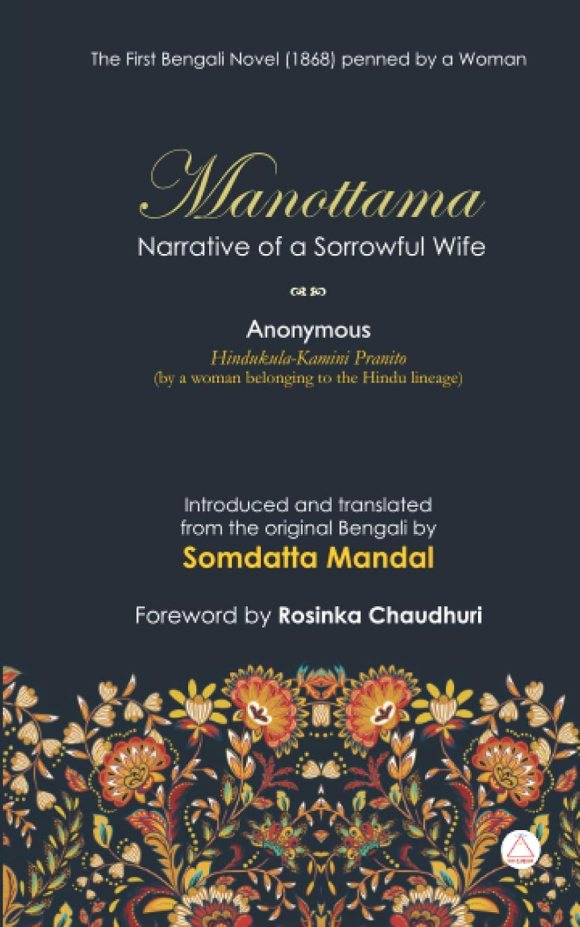
Published in 1868, Manottoma: Dukkhini Sati Charit (Manottama: Narrative of a Sorrowful Wife) the first novel written by an unnamed Bengali woman identifying herself as ‘A Woman belonging to the Hindu Lineage’, which is technically not a pseudonym, has been translated by Professor Somdatta Mandal and published recently in 2022. Somehow evading the attention of literary historians, the text, or any detailed information about it was unavailable for a long time till it was unearthed by a researcher in London only in 2010. In the foreword to the translated novel, Prof Rosinka Chaudhuri points out that the year 1868 was only a decade after the introduction of the main genres of modern Bengali literature: the modern novel, poetry and drama. This was a time of revision and reinvention, of recasting selves and literary forms and genres.   

Manottama narrates the sufferings of a educated and long-suffering wife who labours under the petty punishments meted out to her by her uneducated husband, depicting the conflict between patriarchal expectations and prescriptions and women’s education and presumably, agency. The eponymous novel depicts a situation where Manottama, an educated woman, is married to an uneducated husband. Because of the latter’s profligate ways, she is subjected to penury and untold hardships, which she seems to accept without demur.

The narrator of Manottama claims it’s a ‘history’. Cast in a dialogic format as a conversation between two friends, Jadhav and Madhav, (a common format in its time) the novel, in one interpretation, tells us about the pitfalls of female education in the nineteenth century, a period that also saw the emancipation of Bengali women through education in a significant way. Written in the traditional Indian Puranic style of narration, with plenty of sub-plots and digressions and without conforming to the western dictates of unity of time, place, and action, it provides a domestic picture where an educated wife has to compromise with the activities and worldview of an uneducated husband. At one level of interpretation, it seems to be an attack on patriarchy. As an early narrative by an anonymous woman, the  work needs — and in a way, demands — greater attention now after more than a century of neglect in order to reinterpret and reconfigure its didacticism and question its meek acceptance of status quo.

Can we accord this work the status of a novel? Also is there a way in which we can unpack the didacticism of the text and pave the way to a  subversive reading of patriarchies?

In showcasing a woman who seems to meekly accept her lot in life without complaint, the intention purportedly was to show the benefits of education and how an educated woman navigates her destiny.  There are many instances of rampant social injustices in the text. The husband’s profligacy, his marrying a second time and frittering away family fortunes — all these are accepted by the protagonist, Manottama, in a spirit of apparent equanimity. She seems to accept the social injustices meted out to her meekly, without demur or protest. She obeys and serves her father during his visit and continues to perform her conjugal and domestic duties vis-a-vis her undeserving  husband. If anything, she continues in her endeavour to instruct her children and the children of the quarrelsome second wife. No complaint against marital injustices pass her lips, even when her father expresses concern over the indigent condition of the household. Her behaviour is ideal in every respect and she is upheld as a paragon.  

Manottama” in Bangla can be translated into someone with a superior mind or soul and the protagonist named as such fits the bill. She keeps quiet about her individual woes while trying to ensure the well-being of the whole family.

The novel shows the impact of the many instruction manuals and advice/conduct books  that were plentifully available at the time and herein lies part of the problem of the book as a novel. For one, there is no attempt to depict the inner thoughts of the protagonist. She at times seems like a cardboard cutout, a compendium of all the virtues extolled by patriarchs and paternalists in 19th century Bengal and India. She is a stereotype and seems almost a parodic version of the ’good woman’ who sacrifices self-interest at all times. Whether this narrative qualifies/succeeds as a novel is something which has to be decided by the reader .She embodies the ‘patibrata’ or the devoted wife, a kind of woman who helps in the salvation of the husband and nation. To quote a writer at the end of the 19th century:

The Patibrata wife is the road to liberty and mobility of man. If the women of India follow the footsteps of Sita and Savitri, then this fallen country will be the blessed land  again. (Chandranath Basu, Bagchi 85)

The discovery of this text forms a story by itself and is a precious nugget as it was located in the British library relatively recently, in 2010. The significance of this text  is also that it is a woman’s voice addressing other women, advising them with a strong didactic intent. As readers, we can only speculate that the writer intends this homily as a form of advocacy to women that they should not abandon their traditions and customs, but use their education in order to better themselves, and devote themselves  to serving their husbands.  

The narrative in a dialogic style seems like an extended conversation or debate between a proponent of tradition and a spokesperson and modernity. Some of the conversation between Nilabrata, the irresponsible husband, and Manottama, echo aspects of this debate. According to Nilabrata, who is rendered somewhat insecure by his educated wife and voices the biases against women’s education, only foolish men will send their daughters to school in order to train their daughters as prostitutes. “Educating women and showing them the path to go astray are similar,” he asserts.

One is reminded of Bankim Chandra Chatterjee’s (1838-1894) essay on Prachina o Nobina or “The Traditional Woman and the New Woman”(Woman Old and New, 1879). The debate on whether to educate women were along the contours of conservatism versus progressivism, albeit with shades and finer nuances.We can suppose that the author is in conversation with a conservative perspective which argues against women’s education and where she attempts to demonstrate that tradition and women’s education are not mutually opposed or divergent.

Bengali literature offers many examples of women who were poised on the brink of the  paradoxical conundrum of modernity, which made them embrace education and reform without abandoning traditional values. This attempt to recast and position the ‘new’ Indian woman was a pre-emptive gesture  to counter the accusation of Westernization and deracination levelled against the reformist attempts to redefine gender roles and relations in late 19th century India.

While one can grasp the discursive aspect of the text, the lack of what we understand or perceive as a natural human response on Manottama’s part to any of her husband’s actions — misdemeanours, follies or vices —  leave us feeling deeply dissatisfied. If the novel as a form shows the interactions of the individual with other individuals or with society, the lack of any credible response from Manottama casts her in the mould of a ‘patibrata’   woman but stifles the text as a novel.

However, if we keep in mind that many great writers  novelists from Bengal and elsewhere — Bankim Chandra Chatterjee, Rabindranath Tagore and Sarat Chandra Chattopadhayay— have often used the novel as vehicles of ideas, which generate debate both within the world of the novel and in a larger socio-historical context, this  novel can surely be counted as a precursor and a prototype of the discursive/social discussion novel in Bengali. As for the other question raised earlier about the possibility of a subversive reading, Manottama by showing  the evils  besetting patriarchal systems, manages to show the untenable nature of the same and the fact that men like Nilabrata, for all their bravado, are liable to collapse, unless rescued and sustained by sensible wives. In that sense, it hold a lesson for men to marry wisely and recognise the true worth of educated wives, without getting lured either by false friends or duplicitous women.   

The book has received a fresh lease of life in the hands of a competent translator and commentator. The foreword similarly draws out the significance of the narrative, placing it in the context of its times and the larger context of Bengali literature. An exploration of its discursive trajectories and varying cartographies adds to the joys of discovering and reading the narrative.

.                

Meenakshi Malhotra is a Professor of English Literature at Hansraj College, University of Delhi, and has been involved in teaching and curriculum development in several universities. She has edited two books on Women and Lifewriting, Representing the Self and Claiming the I, in addition  to numerous published articles on gender, literature and feminist theory.       

.

PLEASE NOTE: ARTICLES CAN ONLY BE REPRODUCED IN OTHER SITES WITH DUE ACKNOWLEDGEMENT TO BORDERLESS JOURNAL

Click here to access the Borderless anthology, Monalisa No Longer Smiles

Click here to access Monalisa No Longer Smiles on Kindle Amazon International
Categories
Slices from Life

To Bid or Not to Bid… the Final Goodbye?

That is the question Ratnottama Sengupta is asking with so many grey heads since London’s Westminster voted in favour of Assisted Dying

From Public Domain

“She was in so much pain these last four months that we are not mourning her final exit. We are celebrating her liberation.”

Speaking with Bhabhi’s[1] nephew last week forced me to readjust my emotions regarding the final goodbye. Condolences are in order, worldwide, when a dear one departs the mortal world. But of late I have been noticing that people “celebrate the life’ of the departed soul rather than mourn the death. Yes, every departure is a loss, taking an emotional toll of those left behind. And still I am not shocked nor angry that on June 20, a day after Bhabhi breathed her last in Singapore, the British Parliament voted in favour of a bill to legalise Assisted Dying for terminally ill people.

This has paved the way for a long debated social change that has, for as long as I can remember, been held in abeyance. Because? It has always been argued that, since we cannot bring the dead to life, we do not have the right to take away life. Indeed, the UK parliamentarians voted on the subject 10 years after it was first proposed, I learn from the news reports. And even as the Wise Men of London debated the issue, demonstrators outside were crying out, “Kill the Bill, Not the Ill.”

Once the Bill is passed by the House of Lords, the Terminally Ill Adults (End of Life) Law will give “mentally competent, terminally ill adults in England and Wales with six months or less life to live, the right to choose to end their life with medical assistance. Those who would want the procedure would have to gain the compassionate “Aye!” of two doctors and a panel of experts.

While the scrutiny by the Upper House might take months, it is unlikely to be blocked now that it has gone past the Commons and secured a nod from the PM.

*

My first acquaintance with the concept was garbed in the words, ‘Mercy Killing’. I was a school-going teenager when I read a Bengali courtroom drama, Parashuramer Kuthar (1989, Parashuram’s Axe) where the son was in the dock, fighting the charge of murdering his mother with morphine. “Night after night she would cry out of acute pain. Night after night I sat by her bed, watching her inch towards death. The doctor had prescribed the morphine that let her sleep at night. But when that failed, I gave her a repeat dose so she could go to sleep…”

Half a century ago that sounded ominous. Now, having seen — and digested — the ‘Assisted Suicide’ of celluloid icon Jean Luc Godard [2] in the autumn of 2022, I have been weighing my responses to the concept. 

Godard, born on July 7, 1930, had lived in France from where he had revolutionised cinema across the globe. At the age of 91, with “multiple disabling pathologies” — to quote his doctors — he went to Switzerland because that was the only country to have legalised euthanasia as long back as 1941. Albeit they have specifications, the overriding one being this: the person assisting the suicide must not have any selfish — read, monetary — motive to provide the seeker the means to exit. 

*

“Euthanasia is death with dignity,” my Jyotish Pishamoshai had said three decades ago. At 90 something, the man who went around all his life in trams and buses, to look up his younger cousins, simply hated to be bed bound. Besides, he had seen his youngest brother Dinesh “hang till death” at age 20, without a trace of remorse for having bombed the Writers Building in the Capital of the Raj. So why would the elder brother, his memory intact, want to “be a burden” to even his only son? Mercifully, Sudhir Da did not have to go the way of Parashuram. The almighty in heaven voted for the nonagerian’s exit.

*

My response to the issue peaked when I read this poem, ‘Antim Akanksha’ (The Last Wish) , by Purnendu Ghosh of Jaipur. This IIT-ian from Kanpur, a diehard cinema aficionado, has penned the same thoughts in Bengali and English too. But I had already translated his anguish in Hindi before I spoke with him. “I had written these lines when I was sitting by my mother-in-law, then languishing in the hospital. When I had first seen her, she was 46. Over the next 46 years, I was witness to the transformation age had forced upon her  I could only watch, helpless, because the final exit is in the hands of only the Almighty.”

I am still weighing my responses. Yes, I believe in the Existence of a Superior Force. Still, when a person has to lie waiting to bid goodbye to pain, would he or she wait for His mercy, or that of the medics?

[1] Sister-in-law

[2] https://www.onmanorama.com/entertainment/entertainment-news/2022/09/16/filmmaker-film-critic-jean-luc-godard-suicide-debates-switzerland.html

Ratnottama Sengupta, formerly Arts Editor of  The Times of India, teaches mass communication and film appreciation, curates film festivals and art exhibitions, and translates and writes books. She has been a member of CBFC, served on the National Film Awards jury and has herself won a National Award. 

.

PLEASE NOTE: ARTICLES CAN ONLY BE REPRODUCED IN OTHER SITES WITH DUE ACKNOWLEDGEMENT TO BORDERLESS JOURNAL

Click here to access the Borderless anthology, Monalisa No Longer Smiles

Click here to access Monalisa No Longer Smiles on Amazon International

Categories
Slices from Life

From Cape Canaveral to Carnarvon

Narrative by Meredith Stephens & photographs by Alan Noble

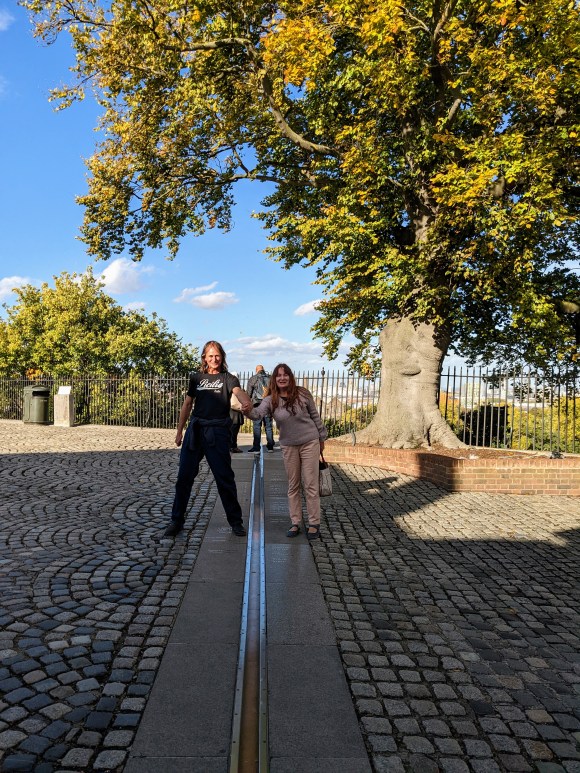
The Prime Meridian Line.

Whenever we visit another city, Alex and I always head straight for a science or maritime museum. When we spent a day in London several years ago, Alex insisted that we visit the National Maritime Museum in Greenwich, and then the Royal Observatory. The highlight of the latter was John Harrison’s marine timekeepers, which made the calculation of longitude at sea possible, therefore making navigation safer. A fun part of visiting the Observatory was standing on either side of the Prime Meridian Line, which defines zero longitude and divides the eastern and western hemispheres of the earth. If you are facing north, the person on the left is in the western hemisphere, and the person to the right is in the eastern hemisphere. We had to queue behind other couples to stand either side of the line. The couple in front of us were taking an inordinate amount of time to have their photo taken here, from which global time is calculated.

“Time’s up!” quipped someone behind us.

“What’s time?” came a philosophical comment from someone else.

The quick banter between strangers is one of the many reasons why I love visiting London.

During our short stay we devoted hardly any time to visiting any other tourist sites. The changing of the guard at Buckingham Palace held little allure. After visiting the Royal Observatory, we strolled past the historic British clipper ship “Cutty Sark” and then caught a ferry back from Greenwich to Central London. We briefly hopped off to see the Houses of Parliament, but after having visited the Royal Observatory Alex’s curiosity was sated.

Fast forward to March 2025 and we found ourselves in a remote town in Western Australia called Carnarvon. The first attraction Alex wanted to visit was the Carnarvon Space and Technology Museum. Carnarvon has a little-known relationship to Cape Canaveral in Florida. Many people have heard of Cape Canaveral and its rocket launching site, but who has heard of the not dissimilar-sounding town of Carnarvon?

Unlike the grand public museums in Western Australia, this one is self-funded and run by volunteers. NASA established a tracking station at Carnarvon in 1964, which played a critical role for both the Gemini and Apollo programs. Carnarvon was strategically located as the most distantly located site on the earth diametrically opposite from Cape Canaveral, providing the ability to track spacecraft over the Indian Ocean that were out of range from Cape Canaveral. The most famous launch was Apollo 11 in July 1969, which achieved humanity’s dream of landing humans on the Moon and safely returning them to Earth.

This museum was different from public museums in that when we visited it was managed by a grey nomad couple from the east coast. (“grey nomad” is an Aussie term for retirees who embark on an extended period of travel around the country, usually in a caravan.) A resident cat curled himself into a ball proudly on the reception desk. It was the only museum we visited in Western Australia that required a fee to enter. The first experience we sought was to hop in the replica of the Apollo capsule to get a feel for the astronauts during the July 1969 launch. I was worried about a panic attack coming on in a confined space but the manager assured me that he would open the door to let me out at any time if I felt uncomfortable. We lay down with the lower half of our bodies propped up on a platform in what we hoped was an astronaut launching posture, while footage from the 1969 launch played out on the screen in front of us. Countdown on the screen was followed by lift-off. Not only did I not have a panic attack, it felt exhilarating to be transported to Cape Canaveral in 1969. Having watched this on black and white television when we were in primary school, it was all the more meaningful to watch it as adults. After touring the rest of the museum, we returned to the Apollo capsule to experience it a second time, like the space nerds we were.

We braced ourselves to face the oppressive heat as we headed outside to view the original satellite dish. Rather than languishing as ancient technology the dish has been leased to an overseas company who were upgrading it to track satellites orbiting Earth.

After viewing numerous 1960s space memorabilia, such as a replica of a Gemini capsule, which had preceded the Apollo series of capsules, and a life-sized replica of the lunar lander module, we bought some tourist T-shirts, chatted with the manager couple, and bade farewell to the resident cat. This was the most thrilling of the magnificent museums we visited in Western Australia. Thanks to Alex, we had a bias to visit maritime museums, including The WA Maritime Museum in Fremantle, The Museum of Geraldton, and The WA Shipwrecks Museum. They provided rich accounts of the many arrivals from distant lands to the west Australian shores since Dutchman Dirk Hartog’s nearby landing at Shark Bay in 1616. All visits were immensely educational and informative, but somehow the less glamorous Carnarvon Space and Technology Museum stood out. Unlike the public museums, it was somewhat ramshackle, but this was more than made up for in terms of authenticity and charm. Who would have thought that this outpost in regional Western Australia that even many Australians have not heard of, could have played such a pivotal role in the tracking of Apollo 11? This museum enjoys none of the fame of the Royal Observatory in Greenwich, but the role it played in history is just as moving.

.

Meredith Stephens is an applied linguist from South Australia. Her recent work has appeared in Syncopation Literary Journal, Continue the Voice, Micking Owl Roost blog, The Font – A Literary Journal for Language Teachers, and Mind, Brain & Education Think Tank. In 2024, her story Safari was chosen as the Editor’s Choice for the June edition of All Your Stories.

PLEASE NOTE: ARTICLES CAN ONLY BE REPRODUCED IN OTHER SITES WITH DUE ACKNOWLEDGEMENT TO BORDERLESS JOURNAL

Click here to access the Borderless anthology, Monalisa No Longer Smiles

Click here to access Monalisa No Longer Smiles on Kindle Amazon International

Categories
Review

Job Charnock and the Potter’s Boy

Book Review by Somdatta Mandal

Title: Job Charnock and the Potter’s Boy

Author: Madhurima Vidyarthi

Publisher: Niyogi Books

The nomenclature ‘historical fiction’ is sometimes quite confusing for the reader who keeps on wondering how much of the novel is real history and how much of it is the figment of the author’s imagination. Beginning in 1686, and set in the later part of Aurangzeb’s reign, this work of historical fiction named Job Charnock and the Potter’s Boy charts the turbulent history of an insignificant hutment in the inhospitable swamps of Sutanati in Bengal that becomes one man’s unyielding obsession. This man is no other than Job Charnock whom we all claim to be the original founder of the city of Calcutta.

Bengal during that period was the richest subah of the Mughal Empire and the centre of trade. The English were granted a toehold in Hugli when Shah Jahan ousted the Portuguese in 1632 and made it a royal port. Since then, they had been worrying Shaista Khan, the current nawab at Dhaka, to give them permission to erect a fort at the mouth of the river but the wily old nawab did not agree and dismissed their petitions repeatedly. This was a period of extreme flux when the European powers like the Dutch, the Danes, the French and the English were all playing out age-old rivalries in new battlefields, aided and abetted by individual interests and local conflicts. This is when Sir Joshua Child was at the helm of East India Company’s affairs in London throughout the 1680s and his plans were brought to fruition in faraway Bengal by William Hedges and then Job Charnock.

Of the earliest champions of the British Empire, none was as fanatic or single-minded as Job Charnock. He evinced no wish for private trade or personal gain, and unlike many of his contemporaries who returned to England as wealthy ‘nabobs’, he lived and died here as a man of modest means. His life’s work was only to identify the most strategic location on the river and secure it for his masters.

Sutanati, with its natural defences and proximity to the sea, appealed to his native shrewdness and he applied himself in relentless pursuit.  The story of this novel begins in Hugli in 1686, on the first day of the monsoon, when a poor potter, Gobardhan, and his wife, Indu, find it difficult to make ends meet and their life is centred around their young son Jadu. In the guise of Gobardhan relating bedtime stories to his son, the novelist very tactfully gives us the earlier historical background of the place. He tells us how during his great-great-grandfather’s time, two hundred years ago, Saptagram was the greatest city in the country, the greatest port in the Mughal Empire where ships and boats came from all over the world. Later the Portuguese bought land and built a fort at Golghat, but the Mughals grew jealous of them and finally attacked Hugli and ousted them from there.

Coming down to the present time, Jadu is twelve years old when his parents are burnt to death in front of his eyes as they were innocent bystanders in the struggle for power between the East India Company and the Nawab of Bengal. By a quirk of fate, Jadu is rescued by his father’s Mussalman friend, Ilyas, who is really protective of the boy and acts as a substitute father figure. But soon Ilyas leaves for Dhaka on a diplomatic mission and thrusts the young boy in the hands of a trusted Portuguese sailor and captain called D’ Mello. Since then, Jadu is drawn into the whirlwind of events that follow. He spends a lot of time on the river, and from December 1686 to February 1687, stays at Sutanati. Then, he moves from Sutanati to Hijli, and back to Sutanati up to March 1689, till at last he stands face to face with the architect of his misfortune — Job Charnock himself.

The rest of the tale hovers around how Jadu becomes one of his most trusted aides and though Charnock’s grand dreams did not come to fruition during his lifetime. When he died in 1693, the place was still a clutch of mud and timber dwellings still awaiting the nawab’s parwana[1] to build and fortify the new settlement. The English finally managed to acquire the zamindari rights to Sutanati, Kolkata and Gobindopur in November 1698, when the area had become quite lucrative by then.

In exploring the how, but more importantly the reason for this coming into being, the story then speaks of the motivations of the great and good and the helplessness of the not so great, all of whom in their own way contributed little nuggets of history to the city’s birth.  The novel is also filled with common folk, both local natives as well as foreigners, who watch unheeded while destinies are shaped by the whims of rulers. Interwoven with verifiable historical events and many notable characters from history, the novel therefore is above all primarily the story of an innocent boy Jadu who navigates the different circumstances he is thrust in and emerges victorious and hopeful in the end. As the narrative continues, he also moves from innocence to maturity. Through his eyes we are given to read about a wide range of characters who form the general backdrop of the story.

In the ‘Author’s Note’ at the end of the novel, Madhurima Vidyarthi categorically states that this is not a history book, but she has strung together imaginary events over a skeleton of fact, based on the sum of information available. She states, “While trying to adhere to accepted chronology, the temptation to exercise creative license is often too great to be overcome”. The most significant character in this perspective is Job Charnock’s wife, who has been the subject of much research and her treatment in the Company records is typical of the time. But though a lot of information is available about Charnock’s daughters repeatedly in letters, Company documents, baptismal registers, and headstones, their mother is conspicuous by her absence. This is where the author applies her ‘creative license’ and makes Mrs. Charnock’s interactions with Jadu reveal his coming of age, and with her death, he symbolically reaches manhood. Vidyarthi also clarifies that several characters in the novel like Jadu, his parents, Ilyas, Manuel, Madhu kaka and Thomas Woods are also imaginary, and they represent the nameless, faceless masses during that period and therefore provide a ‘slice of life’ that make up history. All in all, this deft mingling of fact and fiction makes this almost 400-page novel a page-turner, ready to be devoured as fast as possible.

[1] Written permission

Somdatta Mandal is a critic, translator and a former Professor of English, Visva Bharati, Santiniketan.

.

PLEASE NOTE: ARTICLES CAN ONLY BE REPRODUCED IN OTHER SITES WITH DUE ACKNOWLEDGEMENT TO BORDERLESS JOURNAL

Click here to access the Borderless anthology, Monalisa No Longer Smiles

Click here to access Monalisa No Longer Smiles on Amazon International

Categories
Poetry

Poetry by Jenny Middleton

From Public Domain
I Go Walking In His City   

night blurs blue
sky to electric
fish hatch in space

I search
for him in the café bar's
lights' ring

conversations
are a fume of voices
hovering in loops

above our mouths
the street lights
burn brilliantly

throats
of climbing honeysuckle
flower with shadows

my shadow
is one
moving and swimming

the street
belongs to the sea
trees waver

repeating
sighs in budding
leaves

canopies thickening
with night
he pours me a second glass

Jenny Middleton is a working mum and writes whenever she can amid the fun and chaos of family life. Her poetry is published in several printed anthologies, magazines and online poetry sites.  Jenny lives in London with her husband, two children and two very lovely, crazy cats.  You can read more of her poems at her website  https://www.jmiddletonpoems.com.

.

PLEASE NOTE: ARTICLES CAN ONLY BE REPRODUCED IN OTHER SITES WITH DUE ACKNOWLEDGEMENT TO BORDERLESS JOURNAL

Click here to access the Borderless anthology, Monalisa No Longer Smiles

Click here to access Monalisa No Longer Smiles on Kindle Amazon International
Categories
Editorial

“Imagine all the people/Living life in peace”

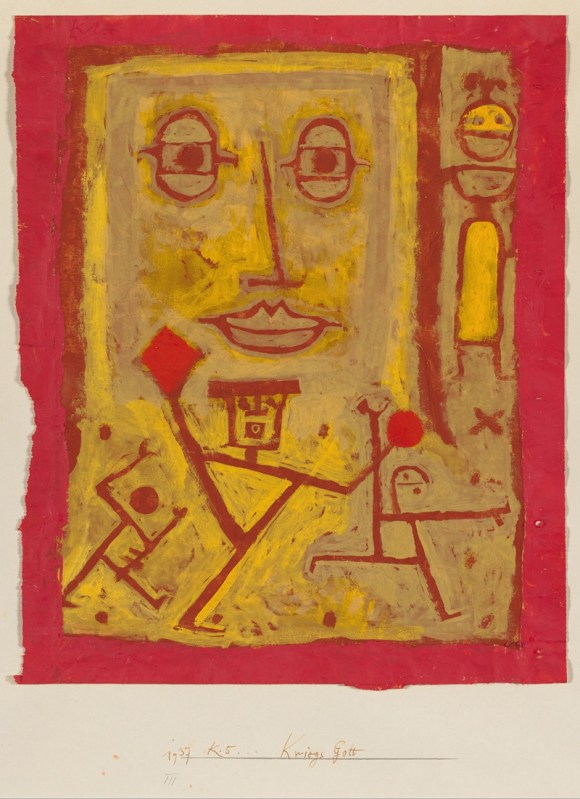
God of War by Paul Klee (1879-1940)
The sky weeps blood, the earth cannot contain
The sorrow of the young ones we've slain.
How now do dead kids laugh while stricken by red rain?

— from Stricken by Red Rain: Poems by Jim Bellamy

When there is war
And peace is gone
Where is their home?
Where do they belong?

— from Poems on Migrants by Kajoli Krishnan

Poetry, prose — all art forms — gather our emotions into concentrates that distil perhaps the finest in human emotions. They touch hearts across borders and gather us all with the commonality of feelings. We no longer care for borders drawn by divisive human constructs but find ourselves connecting despite distances. Strangers or enemies can feel the same emotions. Enemies are mostly created to guard walls made by those who want to keep us in boxes, making it easier to manage the masses. It is from these mass of civilians that soldiers are drawn, and from the same crowds, we can find the victims who die in bomb blasts. And yet, we — the masses — fight. For whom, for what and why? A hundred or more years ago, we had poets writing against wars and violence…they still do. Have we learnt nothing from the past, nothing from history — except to repeat ourselves in cycles? By now, war should have become redundant and deadly weapons out of date artefacts instead of threats that are still used to annihilate cities, humans, homes and ravage the Earth. Our major concerns should have evolved to working on social equity, peace, human welfare and climate change.

One of the people who had expressed deep concern for social equity and peace through his films and writings was Satyajit Ray. This issue has an essay that reflects how he used art to concretise his ideas by Dolly Narang, a gallery owner who brought Ray’s handiworks to limelight. The essay includes the maestro’s note in which he admits he considered himself a filmmaker and a writer but never an artist. But Ray had even invented typefaces! Artist Paritosh Sen’s introduction to Ray’s art has been included to add to the impact of Narang’s essay. Another person who consolidates photography and films to do pathbreaking work and tell stories on compelling issues like climate change and helping the differently-abled is Vijay S Jodha. Ratnottama Sengupta has interviewed this upcoming artiste.

Reflecting the themes of welfare and conflict, Prithvijeet Sinha’s essay takes us to a monument in Lucknow that had been built for love but fell victim to war. Some conflicts are personal like the ones of Odbayar Dorj who finds acceptance not in her hometown in Mongolia but in the city, she calls home now. Jun A. Alindogan from Manila explores social media in action whereas Eshana Sarah Singh takes us to her home in Jakarta to celebrate the Chinese New Year! Farouk Gulsara looks into the likely impact of genetic engineering in a world already ripped by violence and Devraj Singh Kalsi muses on his source of inspiration, his writing desk. Meredith Stephens tells the touching story of a mother’s concern for her child in Australia and Suzanne Kamata exhibits the same concern as she travels to Happy Village in Japan to meet her differently-abled daughter and her friends.

As these real-life narratives weave commonalities of human emotions, so do fictive stories. Some reflect the need for change. Fiona Sinclair writes a layered story set in London on how lived experiences define differences in human perspectives while Parnika Shirwaikar explores the need to learn to accept changes set in her part of the universe. Spandan Upadhyay explores the spirit of the city of Kolkata as a migrant with a focus on social equity. Both Paul Mirabile and Naramsetti Umamaheswararao write stories around childhood, one set in Europe and the other in Asia.

As prose weaves humanity together, so does poetry. We have poems from Jim Bellamy and Kajoli Krishnan both reflecting the impact of war and senseless violence on common humanity. Ryan Quinn Flanagan introduces us to Canadian bears in his poetry while Snigdha Agrawal makes us laugh with her lines about dogs and hatching Easter eggs! We have a wide range of poems from Snehprava Das, George Freek, Niranjan Aditya, Christine Belandres, Ajeeti S, Ron Pickett, Stuart McFarlane, Arthur Neong and Elizabeth Anne Pereira. Rhys Hughes concludes his series of photo poems with the one in this issue — especially showcasing how far a vivid imagination can twist reality with a British postman ‘carrying’ sweets from India! His column, laced with humour too, showcases in verse Lafcadio Hearn, a bridge between the East and West from more than a hundred years ago, a man who was born in Greece, worked in America and moved to Japan to even adopt a Japanese name.

Just as Hearn bridged cultures, translations help us discover how similarly all of us think despite distances in time and space. Radha Chakravarty’s translation of Kazi Nazrul Islam’s concerns about climate change and melting icecaps does just that! Professor Fakrul Alam’s translation of Nazrul’s lyrics from Bengali on women and on the commonality of human faith also make us wonder if ideas froze despite time moving on. Tagore’s poem titled Asha (hope) tends to make us introspect on the very idea of hope – just as we do now. At a more personal level, a contemporary poem reflecting on the concept of identity by Munir Momin has been translated from Balochi by Fazal Baloch. From Korean, Ihlwah Choi translates his own poem about losing the self in a crowd. We start a new column on translated Odia poetry from this month. The first one features the exquisite poetry of Bipin Nayak translated by Snehprava Das. Huge thanks to Bhaskar Parichha for bringing this whole project to fruition.

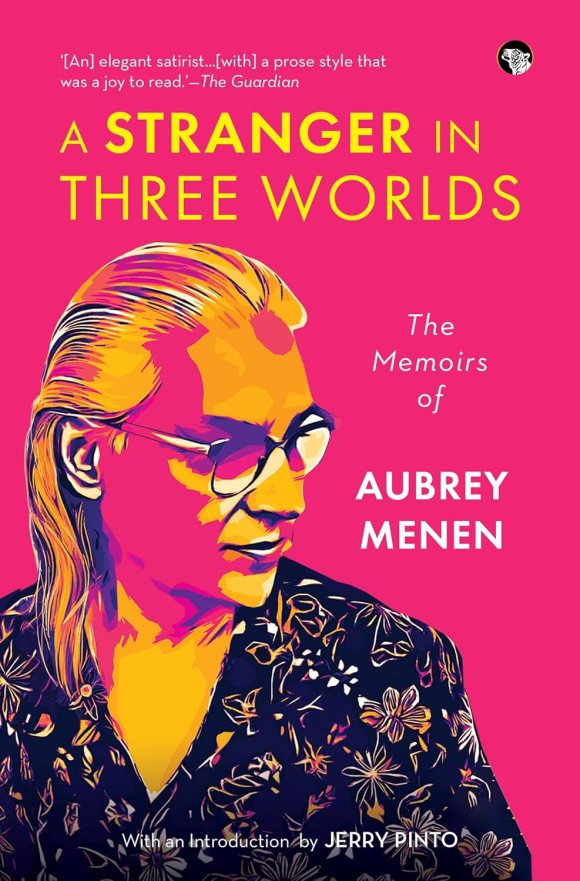
Parichha has also drawn bridges in reviews by bringing to us the memoirs of a man of mixed heritage, A Stranger in Three Worlds: The Memoirs of Aubrey Menen. Andreas Giesbert from Germany has reviewed Rhys Hughes’ The Devil’s Halo and Somdatta Mandal has discussed Arundhathi Nath’s translation, The Phantom’s Howl: Classic Tales of Ghosts and Hauntings from Bengal. Our book excerpts this time feature Devabrata Das’s One More Story About Climbing a Hill: Stories from Assam, translated by multiple translators from Assamese and Ryan Quinn Flangan’s new book, Ghosting My Way into the Afterlife, definitely poems worth mulling over with a toss of humour.

Do pause by our contents page for this issue and enjoy the reads. We are ever grateful to our ever-growing evergreen readership some of whom have started sharing their fabulous narratives with us. Thanks to all our readers and contributors. Huge thanks to our wonderful team without whose efforts we could not have curated such valuable content and thanks specially to Sohana Manzoor for her art. Thank you all for making a whiff of an idea a reality!

Let’s hope for peace, love and sanity!

Best wishes,

Mitali Chakravarty

borderlessjournal.com

Click here to access the contents page for the May 2025 Issue

READ THE LATEST UPDATES ON THE FIRST BORDERLESS ANTHOLOGY, MONALISA NO LONGER SMILES, BY CLICKING ON THIS LINK.

Categories
Review

A Stranger in Three Worlds

Book Review by Bhaskar Parichha

Title: A Stranger in Three Worlds: The Memoirs of Aubrey Menen

Author: Salvator Aubrey Clarence Menen

Publisher: Speaking Tiger Books

Salvator Aubrey Clarence Menen (April 22, 1912 – February 13, 1989) was a British author, novelist, satirist, and theatre critic. Born in London to Irish and Indian parents, he studied at University College, London, before becoming a drama critic and stage director. During World War II, he was in India, organising pro-Allied radio broadcasts and editing film scripts for the Indian government.

After the war, he returned to London and worked in an advertising agency’s film department, but the success of his debut novel, The Prevalence of Witches (1947), led him to write full-time. Menen’s satirical works explore themes of nationalism and the cultural contrast between his Irish-Indian heritage and his British upbringing.

Menen, a remarkably gifted author who frequently goes unnoticed, adeptly delves into the intricate themes of identity, nationality, and the sense of belonging. He does so with his signature blend of irony and profound insight in his two acclaimed autobiographical pieces. A Stranger in Three Worlds: The Memoirs of Aubrey Menen is an exceptional autobiographical account that spans multiple continents. Menen’s writing is noted for its irony, insight, and a nuanced exploration of themes such as belonging and the quest for the self in a multicultural context.

Menen’s life narrative is defined by his experience as an outsider, or a ‘stranger,’ within the three distinct cultures of England, Ireland, and India. This position of being an outsider enables him to keenly observe and critique the social and cultural norms prevalent in each society with remarkable clarity and humor.

 The memoir explores the inherent tensions and contradictions that arise from possessing multiple, often conflicting, identities, as well as the difficulties of establishing a coherent sense of self when one does not entirely belong to any particular group.

The book’s narrative style is marked by irony and a keenly humorous outlook on the absurdities of the social conventions and biases he encounters across these cultures. His insights are both deeply personal and widely relatable, resonating with anyone who has navigated the complexities of multicultural or diasporic identity.

The essays featured in Dead Man in the Silver Market, originally published in 1953, analyse themes of jingoism, social class, and the absurdities associated with national pride, intertwining personal stories with sharp social critique.

Written shortly after World War II, his irreverent insights into English society, colonial history, and human nature continue to resonate powerfully in contemporary discourse. ‘The Space within the Heart’, authored in 1970, presents a more personal and philosophical exploration of existence, love, and self-awareness.

Infused with humour and gentle satire, it contemplates the essence of the soul, drawing from the Upanishads and European literary traditions. Menen’s seemingly straightforward yet deeply impactful writing encourages readers to transcend rigid identities and appreciate the fluidity inherent in the human experience.

With an introduction by Jerry Pinto, this omnibus edition functions as a memoir, offering personal reflections and experiences, while simultaneously serving as a critique of imperialism, examining its impacts and consequences.

Furthermore, it thoroughly explores the intricacies of identity, rendering it an exceptional piece of literature that is both informative and captivating, prompting readers to engage in deep reflection on its themes.

.

Bhaskar Parichha is a journalist and author of Cyclones in Odisha: Landfall, Wreckage and ResilienceUnbiasedNo Strings Attached: Writings on Odisha and Biju Patnaik – A Political Biography. He lives in Bhubaneswar and writes bilingually. Besides writing for newspapers, he also reviews books on various media platforms.

.

PLEASE NOTE: ARTICLES CAN ONLY BE REPRODUCED IN OTHER SITES WITH DUE ACKNOWLEDGEMENT TO BORDERLESS JOURNAL

Click here to access the Borderless anthology, Monalisa No Longer Smiles

Click here to access Monalisa No Longer Smiles on Amazon International

Categories
Stories

Going to meet the Hoppers

By Fiona Sinclair

The announcement of a ‘major retrospective’ sent Alice’s friends giddy with excitement. Reviews in The Guardian raved.  The five stars awarded barely seeming adequate.  

Alice remained silent. In truth she had never heard of the American artist. Her tastes were more European; Turner, Vermeer, Caravaggio.

Some friends raced to become early bird visitors. They had joined queues like static conga lines and came away gushing with praise.  But to Alice, the Hoppers became like an irritating family, who mutual friends declared “You will love’.  However past experience had taught her that when introduced, she had found no common ground.

“We must put it on the list,” declared Julia.  Her closest friend and partner for any such cultural initiatives.  Julia hated finding herself on the back foot at parties when the latest event was mulled over by guests who had already taken it in.

Alice nodded noncommittally, changed the subject by drawing attention to a stylish pair of shoes in a store window.  

Fortnightly visits to the Maudsley psych hospital in southwest London had become routine to her now. A years’ worth of psychotherapy was succeeding in untangling her past. She no longer entered the outpatients with eyes fixed on the squares of carpet tiles. A ploy in those early days to avoid any interaction with the human flotsam that mental health had beached in the waiting room.

But over time she saw that this was a place where calmness was carefully curated. Pictures of flowers bloomed on the walls.  The décor was always spruce and the staff — from receptionists to psychiatrists — treated the patients, however ramshackle, with respect.  

Now she and her therapist Margaret would chit chat as key codes where punched into pads, in order to gain admittance to each level of the labyrinthine building. The sounds like birds of prey that issued from the acute wing no longer made her start.

This particular Monday morning, her appointment was at a bleary eyed 8 am. Fine if she lived in London — however she was a two hours train ride away so her alarm clock blared reveille at 5 am.

Her session was finished by nine. “You’ve got the rest of the day to yourself,” Margaret remarked as she shouldered the final door whose second line of defence seemed to be that it always stuck.  Alice was at a loss as to how to spend this time. London brimmed with museums and galleries, but nothing tempted her. “You know what Dr Johnson said,” grinned her therapist.

“When a man is tired of London, he is tired of life,” responded Alice. “Probably not the best sentiments to quote in Maudsley,” they both agreed.

Since the peak hour ticket had been expensive Alice felt the outlay should reward her with more than counselling. She was not in the mood for aimless shopping.  But scrolling from memory through the current exhibitions, she found there was a dearth, except of course for the Hoppers at the Tate. It was a short tube ride away. “Well there’s always cappuccino and cake in the café afterwards.” She consoled herself.

On the Victoria line, as the train jolted to a halt at each station, her carriage never fully aligned with hoardings that trumpeted the event. And as the tube accelerated away, she only got a zoetrope impression of images that did nothing to ignite her enthusiasm.

“If it’s crowed,” she decided, “I won’t bother.” Envisaging hordes of retirees, school parties and tourists mobbing the entrance, all waiting for 10am like a starting gun.

In truth most exhibitions only admitted a hundred or so visitors every hour. But even so,  from past experience, she knew there would be a funeral pace past each picture as if it was laying in state.

Alice blamed those headphones that explained each painting down to the final daub. Visitors planted themselves in front of the picture until the recording told them to move onto the next image. “Just look and form your own opinion,” she would mutter whilst craning to catch a glimpse of the artwork.

The Thames accompanied her towards the Tate. There was a Monday morning feeling in this part of London, as if the area was drawing breath after a busy weekend. The district was dedicated to tourism with The Globe and The Turner being near neighbours.

The gallery was housed in a decommissioned power station designed by the architect Sir Giles Gilbert Scot, in a time when even functional buildings were given an aesthetic flourish. The conversion to art gallery had retained the original deco building but also made sympathetic modern additions. The brickwork was cleaned back to its original red and the towering chimney advertised itself on the London skyline.

With the internal machinery removed, the empty core allowed for spacious galleries ideal for art on an ambitious scale. The turbine hall alone was so vast that it dwarfed the escalators that bore visitors up to the galleries. Here even Michelangelo’s’ 17 ft David would look lonely.

Alice was quite accustomed to taking herself off to the cinema, theatres, exhibitions alone. Most of her friends were married, therefore had commitments. She was often too impatient to wait whilst they managed the logistics of their domestic lives, to find time to accompany her.

There was a freedom in being on her own, a spontaneity that meant she could hop on a train, and head to London whenever she felt inclined.

Friends found her ease at flying solo incomprehensible. “You’re so brave,” they would remark in tones that simultaneously managed to be admiring but also patronising, “I could never do anything like that on my own.”

“It’s practice,” she would explain. As an only child she had grown up used to her own company. Moreover, without a partner now, the fact was if she wanted the rich cultural life she craved, Alice had to take matters into her own hands.

Over time she had developed strategies that gave her confidence. Aware that even in the 21st , a single woman going to the theatre or cinema on her own still  garnered curious glances, she was, therefore, always accompanied by a book.

Arriving at the Tate’s ticket desk, Alice was surprised to find only a dribble of people. 10 am on a Monday morning was apparently too early even for the keenest of visitors.

Consequently, with extraordinary timing she had the luxury of being the only person in the exhibition. Grinning at her good fortune she placed herself in the centre of the largest room. She then made a 360 degrees turn to get an overview of the Hoppers before moving in on specific images that beckoned to be examined.

What she saw utterly contradicted her preconceptions of the artist and his work. These were not the cosy representations of American life she had expected.  

Human loneliness was delineated in every scene. There were no cosy family meals or girlfriends gossiping. Indeed, these people seemed to possess no faculty for laughter. Married couples who had run out of things to say to each other long ago, now gazed off into their own private horizons.  Solitary men sat on stoops smoking with blank expressions as if they had given up on thinking. Many eyes were cast down, or concealed beneath hats, so that all emotional cues were transferred to their body language whose droop spoke of hopelessness.

This despair was not confined to cityscapes. There were landscapes too, where forests growled at the edges of civilisation, and unkept grass prowled up to the stoops of solitary white wooden houses. These homes were personified as if conveying by proxy the emotions the characters in other pictures could not. Doors screamed and windows gaped.

Above all she had never seen an artist paint silence so effectively. It emanated from the pictures, seeming to seep into the gallery itself. 

In all the years of visiting exhibitions she had never seen one that reflected back her own experience of life. The images did not bring her mood down rather she felt exhilarated that she was able to look these pictures in the face without flinching.  

Alice returned home buzzing with a convert’s zeal. As a result, her friend hastily cleared a Saturday. She farmed her kids off to their cousins for the day and left a ready meal for her husband in the fridge. Of course, Alice was champing to revisit the exhibition, although she was savvy enough to understand that she would never be able to recreate the timely conditions or the wonder she had experienced on first seeing the pictures.

The two women arrived at the gallery early enough for there to be a lunchtime lull.  From past experience she knew her friend did not work her way methodically through an exhibition but liked to see the artist’s greatest hits first. Juila made for the voyeuristic 

‘Night Windows’, where a woman is observed in a bedsit,  her back to an open window from which curtains billow, a favoured image for fridge magnets and coasters.

Alice felt the same rush of enthusiasm for the pictures. She was desperate to enjoy again images that had particularly affected her, but good manners tethered her to Julia’s side. Nevertheless, she could not help breathlessly pointing out details in ‘Night Windows’ that had struck her before. Alice’s words tumbled out in her desire to share the image with her friend. However, Julia seemed to have left her enthusiasm with her coat in the cloakroom. She regarded the painting in silence. Alice grimaced inwardly wondering if her effusiveness was deterring her friend so turned off her gush of words.

Julia still did not engage with this painting or indeed any others. She paused before each image briefly without comment. Alice trailed behind her at a loss. She wondered if her friend had suddenly become unwell. There was a precedent for this when she had once passed out from a UTI at the theatre. And she knew her friend well enough that if she hated an exhibition, she was quick to speak her mind.

“Are you feeling okay?” she whispered.

“I’m fine,” Julia responded. But the ‘fine’ was loaded with a subtext Alice could not at that moment fathom.

Julia stood briefly before the artist’s other well-known pictures as if mentally ticking them off.  Alice desultorily picked out a detail here and there like offering titbits to someone who had lost their appetite. Her friend merely nodded or squeezed out a ‘hmmm’.

From her peripheral vision the paintings she ached to enjoy again beckoned to her. Finally, she made her way to them, hoping that by giving her friend some space she might find some way into the works. However, looking over her shoulder she saw Juia had begun to move past the paintings without pausing, barely glancing at the images. Eventually feeling as if she was abandoning her friend at a party of strangers she returned to her side. They had reached ‘Night Hawks’. “Surely she’ll respond now,” she thought. Her friend did but not with appreciation, instead she raised her hand to her eyes as if shielding her gaze. Alice was reduced to foolishly gesturing ‘the famous one’ as if trying to chivvy a child’s interest.

“Well I think we’ve seen enough,” Julia suddenly found her voice again, “Let’s get out of here.”  And without waiting for Alice, she bolted through the exit and plonked herself in a comfy armchair in the coffee shop and took a deep breath as if the atmosphere in the gallery had tried to choke her. In an effort to raise her friend’s spirits, Alice brought her a double shot cappuccino and a slab of cake. Seated by a large picture window looking down on the Thames, Alice commented on a few landmarks by way of breaking the silence. It was still a one-way conversation though until revived by the food, Julia began to join in.

Clearly there was not to be their usual post event discussion.  This was unprecedented. They could not even agree to disagree as they had many times before if they could not even discuss the exhibition.   During this smallest of small talk, Alice tried to make sense of her friend’s reaction. She began to feel as if she had forced Julia to accompany her. Then remembered it was actually her friend’s agency that had brough them to the Tate. Reasoning to herself that they couldn’t spend the rest of their lives avoiding all reference to the Hoppers she brushed the small talk aside, took a breath and blurted out, “Did you not like the exhibition?”

Julia paused before speaking, “Look, I know you love them but for me, there was no beauty in there.” She gestured with her head towards the gallery they had come from. “They are so dreary.” Her tone verged on whining as if the exhibition had got her there under false pretences. Alice was quick to point out that they had seen other exhibitions genuinely devoid of conventional beauty  — Rothko, Warhol, Gilbert and George. None of whose work could have comfortably inhabited a sitting room.

“But I know what to expect with abstract art,” her friend pointed out.  “I can stomach geometric shapes and dribbled paint because they engage my mind not my emotions,” she paused, “also somehow they don’t reflect real life.” The caffein had clearly loosened her tongue. “I expect at least some beauty in representational art.” She began to list Hopper’s faults. “Why are there so few people in the city? It looks post-apocalyptic. And they are so miserable. That picture of the psycho house seems to sum up the whole collection.” She added as a last shot.

Alice felt as if her friend’s criticism was aimed at her as well as the artist. She attempted to put her case for the paintings. “But don’t you see that they reflect the isolation of modern life?” Her friend’s face remained adamant. Alice searched for a comparison then had a brain wave, “Look’ we both studied TS Eliot at uni. Can’t you see it’s ‘The Waste Land’ translated into art?” She felt rather pleased with her analogy.

But Juila shook her head. “You can distance yourself from words, but pictures,” she grimaced. “Nothing erases an image, once seen it gets trapped in your mind.”

Alice pondered the two divergent responses to the Hoppers. Both were extreme in their own ways. She wondered if the roots of their reactions lay in their backgrounds. Her own history, even her therapist agreed, verged on the Gothic. Whereas Julia had enjoyed an Enid Blyton childhood. Throughout her life she had been adored by her father and encouraged by her mother. Her marriage to Jim was that rare thing, a pairing that lasted without a whiff of infidelity. Admittedly their life together had not been entirely charmed — ill health, a father’s dementia — redundancy had been faced down over time. Now their reward was a very comfortable life.

Her friend seemed to have read her thoughts. “I know I have a good life compared to most,” Juila admitted. “And I know there’s ugliness in the world. I just don’t want to be reminded of it on a day out.” 

Alice began to understand that the pictures were an uncomfortable reminder of less kind lives. Whilst they were not in the face brutality of war, instead they showed men and women recognizably modern whose lives were the playthings of circumstance and as such had visibly given up.

They seemed to have awakened some existential fear in her friend, perhaps a dread of feeling hopeless. The Hoppers were a reminder that even middle-class lives could falter and fall if fate gave a push.

Julia suddenly changed the subject with a hand brake turn. She gave a round up of her daughters’ careers and love lives, her husband’s progress on the kit car he was building. She seemed in this way to be deploying her family as a buffer against the images she had just seen.  

Making for the exit, it was usually part of their ritual to visit the gift shop. But whilst Alice turned to enter, eager to buy more Hopper related merchandise, Juila swept passed deep in describing  the minutiae of her family’s next trip to Italy . Alice shrugged, “I’ll pop in next time,” she thought.

.

 Fiona Sinclair has had several collections of poetry published by small presses.  Her short stories have been published in magazines in the UK, US and Australia. 

.

PLEASE NOTE: ARTICLES CAN ONLY BE REPRODUCED IN OTHER SITES WITH DUE ACKNOWLEDGEMENT TO BORDERLESS JOURNAL

Click here to access the Borderless anthology, Monalisa No Longer Smiles

Click here to access Monalisa No Longer Smiles on Amazon International