Several years ago, I published a short book, A Girls’ Guide to the Islands (Gemma Open Door, 2017) about traveling amongst the islands of Japan’s Inland Sea with my daughter, who is deaf and uses a wheelchair. One of the islands that we visited was Naoshima, the site of several art museums, including the Chichu Art Museum, which houses five paintings from Claude Monet’s Water Lilies series. In addition to writing about our responses to the various artworks, I touched upon the difficulties and differences in traveling with a wheelchair user. For one thing, the ferry which conveyed us from Takamatsu City to the island, did not have an elevator to the upper decks. While others got out of their vehicles to take in the scenery from above decks, my daughter and I spent the crossing in my car.
Shortly after this trip, I received a grant from the Sustainable Arts Foundation for a longer book about traveling with my daughter, which became the award-winning Squeaky Wheels: Travels with My Daughter by Train, Plane, Metro, Tuk-tuk, and Wheelchair(Wyatt-Mackenzie Publishing, 2019). A slightly different variation of our trip to Naoshima appears in that book.
Although I loved our time on the island, and had not yet visited all the museums and installations, I had not been back since that trip with my daughter. I finally had a chance to revisit last month when I learned that the couple who had administered the grant that had made my book possible would be visiting Naoshima. I arranged to meet with them on my way back from Kyoto, where I was going to attend a book launch. Unfortunately, I wouldn’t be going with my daughter this time. She is now an adult living in Osaka, and it takes a bit of effort to coordinate our schedules. Nevertheless, I figured I could scout out the situation before planning our next mother-daughter adventure.
Although on previous visits, I had taken a ferry from Takamatsu, on the island of Shikoku, this time I took the shinkansen, Japan’s high speed bullet train, from Kyoto to Okayama, where I spent the night in a hotel. The next morning, I easily found the stop for the bus bound for the ferry terminal. Almost everyone in the queue was foreign. As far as I could tell, most of them were from Europe.
No doubt some had timed their visit with the Setouchi Trienalle, an art festival which takes place mainly in the ports and amongst eleven islands every three years. Japan, in general, has seen a huge surge in tourism over recent years due to the weak yen and governmental efforts to promote inbound tourism. While this has been good for Japan’s economy, it has driven prices up for local residents. It also means that public transportation is often crowded.
When we arrived at the ferry terminal, I purchased my ticket and joined the tail end of a very long line. Luckily, I was able to board the ferry and find a seat. I was pleasantly surprised to find the ferry had been upgraded since my last visit. Not only was it appointed with plush seats facing the water, but also there was now an elevator!
About twenty minutes later, we arrived at Minoura Port. Armies of English-speaking guides were readily available. I quickly found my way to the bus stop and onto the bus that would take me to the recently opened Naoshima New Museum of Art. I had just enough time before meeting my benefactors to check it out and have lunch.
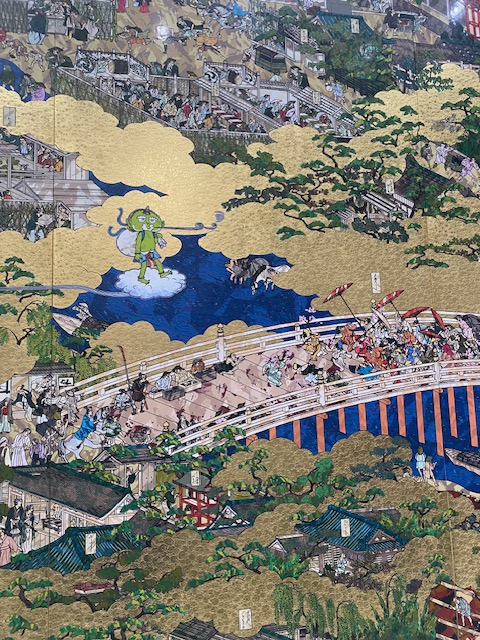
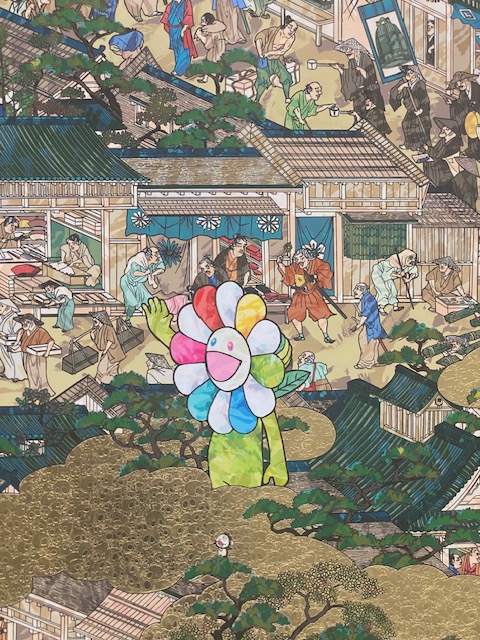
The inaugural exhibition featured the work of twelve artists and groups, including Takashi Murakami, who has achieved worldwide fame. His cartoonish characters appear on coveted Louis Vuitton bags. He also designed a special shirt, printed with cherry blossoms, for fans of the Los Angeles Dodgers. His work on display, a 13-meter-wide painting, is modeled after a 17th century folding screen titled Scenes In and Around Kyoto by Iwasa Matabei. Murakami’s rendition portrays scenes of everyday life in early modern Kyoto. But look closely, and you will find some of his iconic original characters!
Another impressive exhibit, Head On, by Cai Guo-Qiang, features lifelike wolves running toward and colliding with a glass wall. According to the exhibit brochure, the wall “symbolizes the intangible yet deeply felt ideological and cultural divisions between people and communities.”
After going through the exhibits, and vowing to return with my daughter, I popped into the museum café for a quick lunch. The dining area was in open air, with a view of the sea and the islands beyond. I ordered pumpkin toast, perhaps Naoshima’s answer to America’s ubiquitous avocado toast, and a nod to the famous Yayoi Kusama pumpkin sculptures which grace the island.
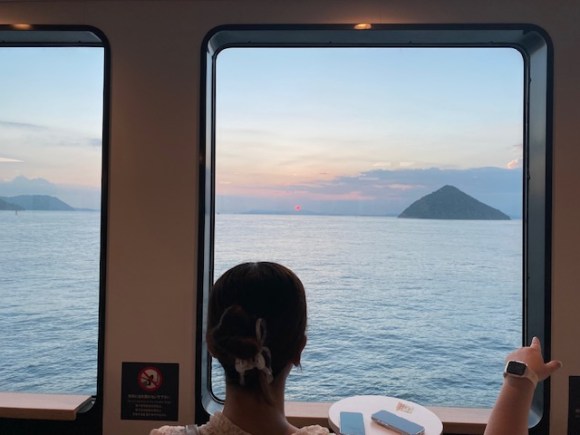
Finally, I took another bus and went to meet my friends. They are no longer awarding grants to parent artists, having shifted their focus to indigenous groups, however, I will remain forever grateful for their support. We met and had a drink near the Benesse House Park, just outside the Terrace, where my daughter and I had dined several years ago. Then it was time for me to head to the ferry terminal and back to Takamatsu, where I would catch a bus. I happened to cross at sunset – a final blast of beauty before returning home.
Suzanne Kamatawas born and raised in Grand Haven, Michigan. She now lives in Japan with her husband and two children. Her short stories, essays, articles and book reviews have appeared in over 100 publications. Her work has been nominated for the Pushcart Prize five times, and received a Special Mention in 2006. She is also a two-time winner of the All Nippon Airways/Wingspan Fiction Contest, winner of the Paris Book Festival, and winner of a SCBWI Magazine Merit Award.
PLEASE NOTE: ARTICLES CAN ONLY BE REPRODUCED IN OTHER SITES WITH DUE ACKNOWLEDGEMENT TO BORDERLESS JOURNAL
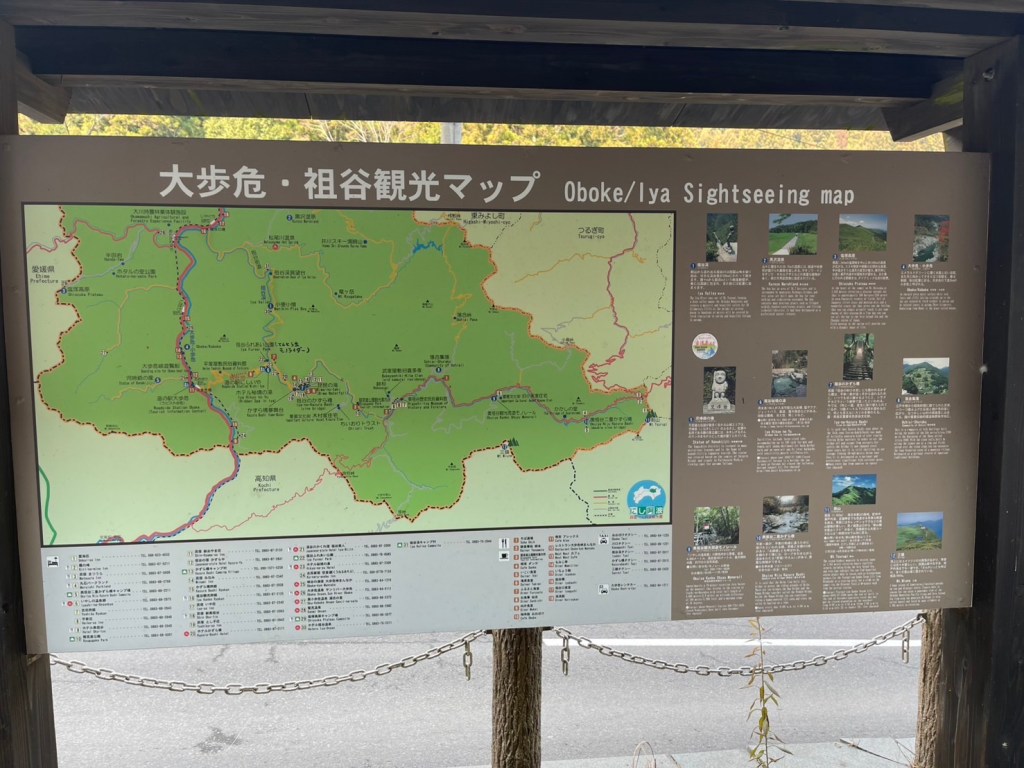
When I first arrived in Japan over thirty-five years ago, one of the first places that I visited was the Iya Valley, deep in the interior of Tokushima Prefecture. It wasn’t easy to get there then, and it’s not easy now. From Tokushima, there are no trains – only very occasional buses, or you can brave the narrow, twisty mountain roads sans guardrails and drive on your own. At the time I visited, I recall no restaurants or hotels, but apparently some abandoned houses have been refurbished as high-end inns.
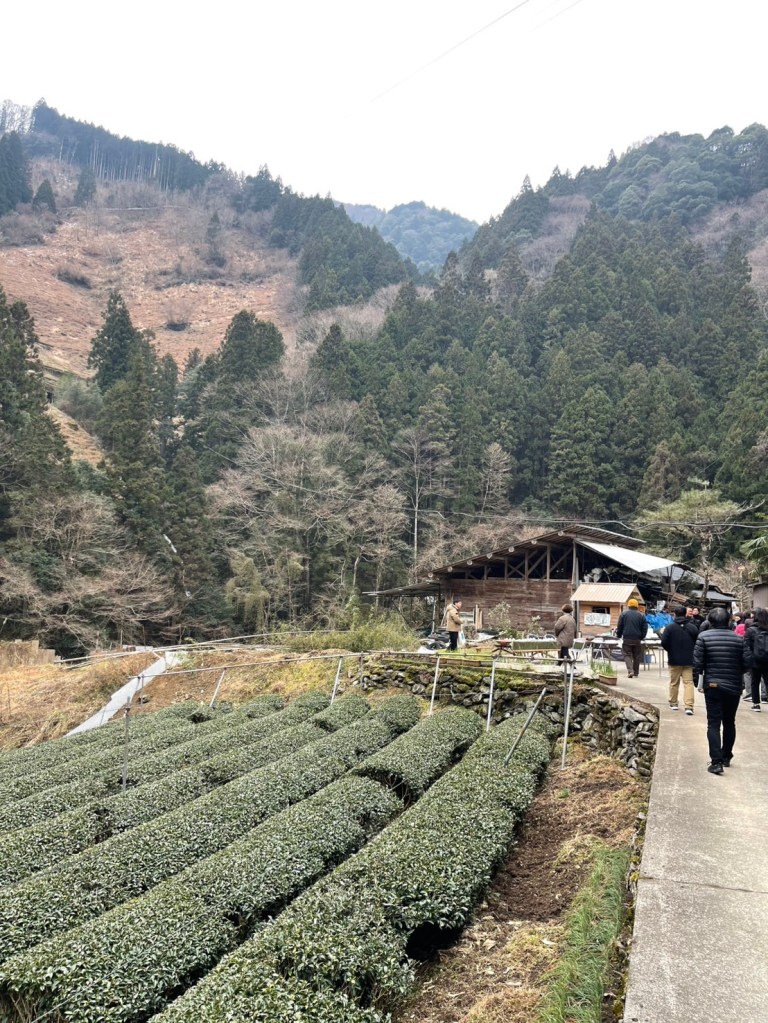
Tea gardens of Iya
The Iya Valley attracts adventurous travelers who are up for white-water rafting on the river that cuts through the Oboke Gorge. Another thrill that can be had is crossing Iya Kazurabashi, the swaying vine bridge that spans the gorge. I crossed the bridge on that first visit years ago, and I remember clinging to the rope railings while taking careful steps, my heart hammering all the while.
The vine bridge is periodically reconstructed, but the original was said to have been created by aristocrats who had fled the capital of Kyoto. The Heike clan, who have been immortalised in the Japanese literary classic Heike Monogatari, were defeated by the Minamoto clan in the Genpei War (1180–1185) at the end of the Heian Period. They found the wilds of Shikoku to be the perfect hideout. Their descendants continue to live in the area.
I found this story incredibly fascinating. As a university student, I had been captivated by descriptions of Heian court life – the ladies-in-waiting in their layered brocade kimono, lover’s messages exchanged in the form of poetry. As anyone who has seen the recent miniseries Shogun has noted, ancient Japan was filled with aesthetic delights. Imagine going from a wooden house with fragrant tatami mats, sliding paper doors, and an ornamental garden to an untamed mountain, probably teeming with wild boar and monkeys.
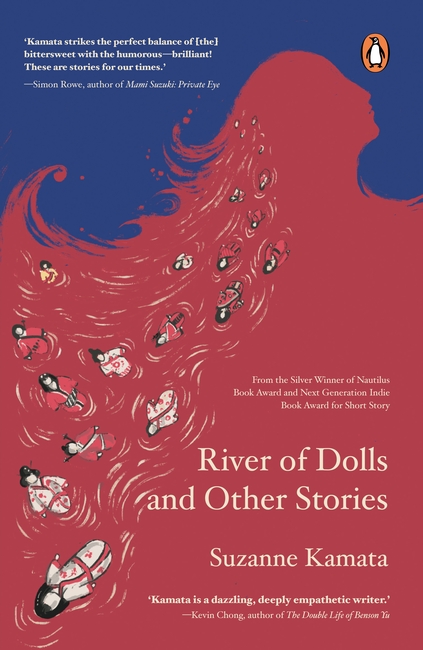
I was inspired by this place to write the short story “Down the Mountain,” which appears in my newly published collection River of Dolls and Other Stories. I blended ancient history with the Japanese folktale “Kaguyahime,” or “The Moon Princess.” I was also influenced by reports that I had read of the forced sterilisation of Japanese women who were mentally ill. The story begins like this:
You say that you want to leave this mountain, daughter, and I know that your will is strong. For you, there is not enough of life in selling fish-on-a-stick or serving noodles to strangers. You look at the swaying vine bridge and see a magnet for tourists, those busloads of people who come up from the city, filling the valley with sounds of laughter and loud voices. I will not stand in your way, but before you go, there are some things that you must know.
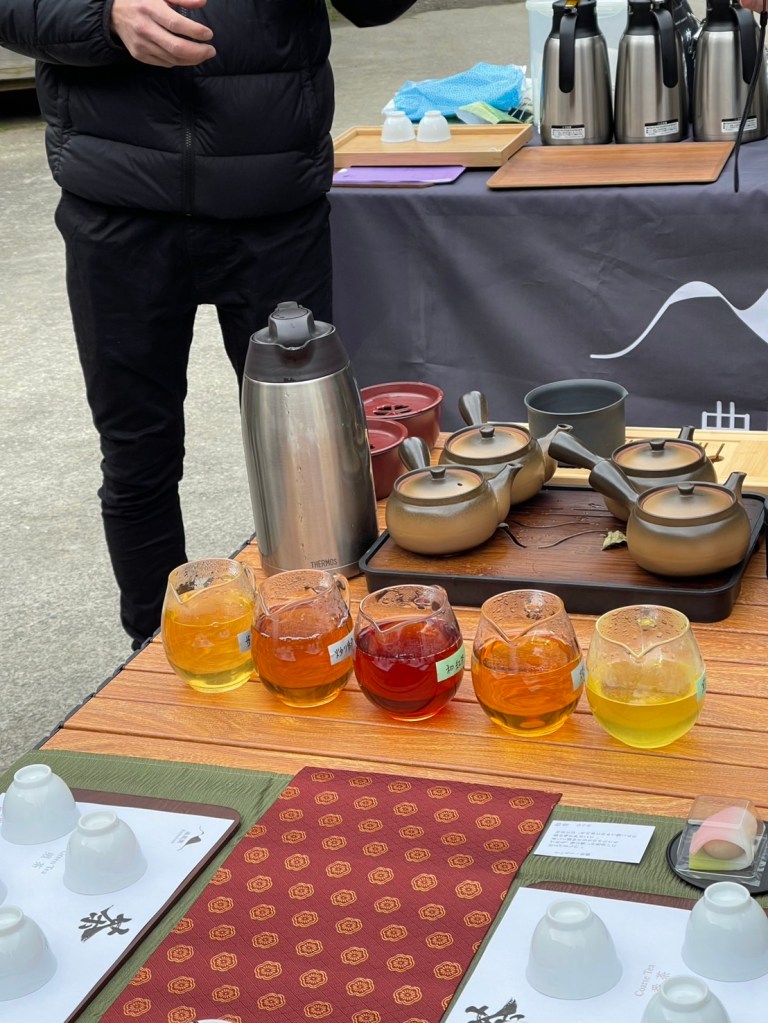
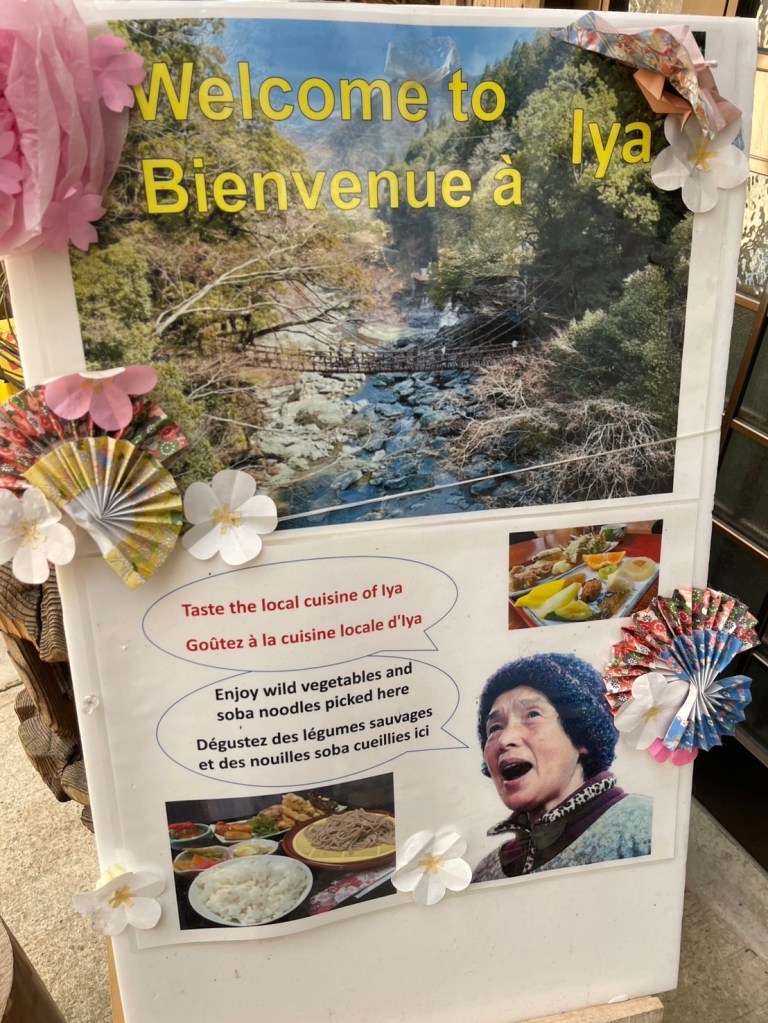
Last week my husband, who is newly retired, took a trip to the Iya Valley as a tour-guide-in-training. While I was at work, he crossed the bridge and was treated to thick udon noodles in broth and a sampling of teas grown on the mountain. A local woman sang a traditional song to the group of visitors.
“Have you ever been to Iya?” he asked me when he’d returned home.
“Yes,” I told him. “Long ago. As a matter of fact, I even wrote a story about it.”
Suzanne Kamatawas born and raised in Grand Haven, Michigan. She now lives in Japan with her husband and two children. Her short stories, essays, articles and book reviews have appeared in over 100 publications. Her work has been nominated for the Pushcart Prize five times, and received a Special Mention in 2006. She is also a two-time winner of the All Nippon Airways/Wingspan Fiction Contest, winner of the Paris Book Festival, and winner of a SCBWI Magazine Merit Award.
PLEASE NOTE: ARTICLES CAN ONLY BE REPRODUCED IN OTHER SITES WITH DUE ACKNOWLEDGEMENT TO BORDERLESS JOURNAL
Many years ago, when my children were small and I was working on my first-to-be-published novel Losing Kei, I joined an online writing group made up of members of the Association of Foreign Wives of Japanese. Since I live off the beaten track, on the island of Shikoku, this group was a godsend for me. Not only was I able to connect with non-Japanese women raising biracial kids in a supposedly homogenous country, but I could also connect with others writing in English.
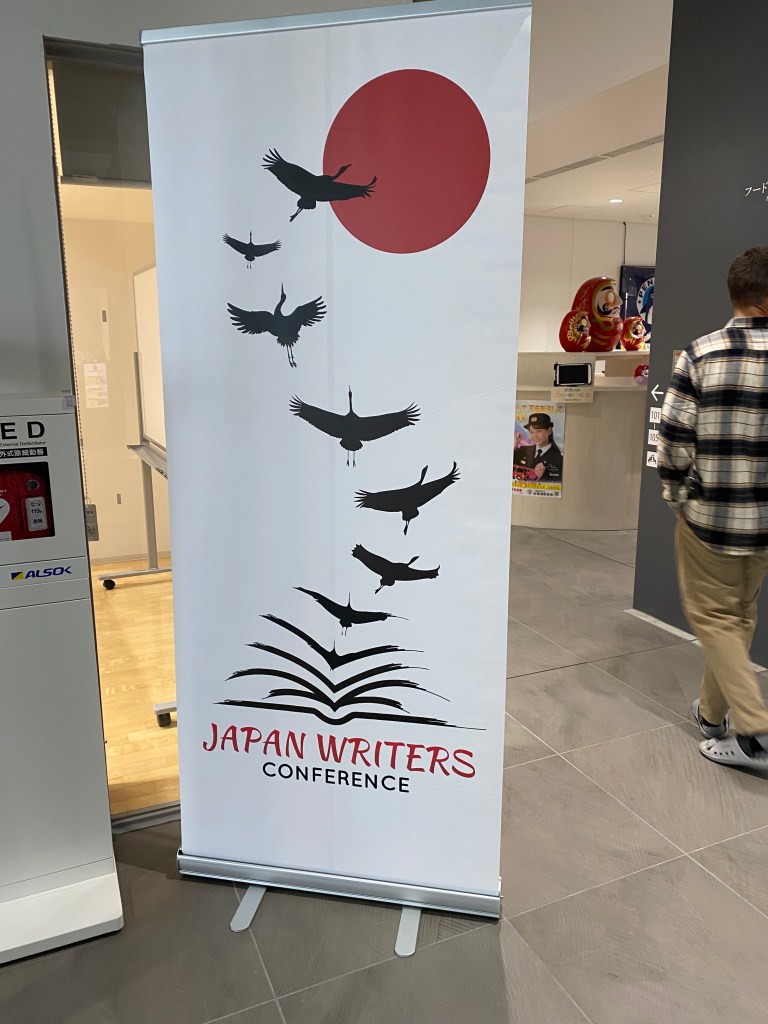
I ultimately finished my novel. I was not the only member of this group who went on to publish books. In addition to writing and publishing, another wonderful thing that came out of this now defunct virtual community was the Japan Writers Conference, which was first held in 2008. One of the members, poet and writer Jane Joritz-Nakagawa, whose most recent book is the searing LUNA (Isobar Press, 2024), proposed a grassroot gathering of writers in Japan. There would be no keynote speaker, no fees for participants, and no payments for presenters. We would just get together and share our writing and our expertise.
Another member, Diane Hawley Nagatomo, who recently published her second novel, Finding Naomi (Black Rose Writing, 2024) after an illustrious career in academia, volunteered to host the initial conference at her university. Chanoyu University, in Tokyo, is famously the institution attached to the kindergarten attended by the Japanese royal family. It was also the site of the first Japan Writers Conference.
Since then, the conference has been held at various universities and colleges around the country, including in Okinawa, Hokkaido, Kyoto, Iwate, and at Tokushima University, hosted by me in 2016. Over the years, many notable speakers have appeared, such as Vikas Swarup, whose novel Q & A became the film Slumdog Millionaire, popular American mystery writer Naomi Hirahara, and Eric Selland, poet and translator of TheNew York Times bestseller The Guest Cat by Takashi Hiraide. The list goes on and on.
This past year, the conference was held not at a university, but at the Futaba Business Incubation and Community Centre.
When I told my husband that I was going to Futaba, he looked it up on a map.
“That’s in the exclusionary zone,” he said, somewhat alarmed.
Indeed, the conference would be held on the coast in Fukushima Prefecture, not too far from the site of the nuclear power plant which was hit by a tsunami in 2011. For years, there have been concerns about radiation, however the area is staging a comeback. The host of this year’s conference would be the Futaba Area Tourism Research Association, an organisation committed to “promoting tourism and land operations, inviting people to rediscover the charms of Fukushima’s coastal areas. The company’s mission is to bring people worldwide to this unique place that has recovered from a nuclear disaster.”
“I don’t think they would hold the conference there if it wasn’t safe,” I told him.
The JWC website reported that although the town had been evacuated after the 2011 Great East Japan Earthquake and the meltdown at the Fukushima Daiichi Nuclear Power Station, evacuation orders had been lifted for about 10% of the town on August 30, 2022. Decontamination efforts are still underway. New homes are being built, new businesses are emerging, and the annual festival Daruma-Ichi resumed in 2023. The areas hosting the JWC had been deemed safe, “with radiation levels regularly monitored and within acceptable limits.” I reserved a room at the on-site ARM Hotel and went ahead with my plans.
Getting to Futaba from my home in Tokushima took all day. I got up before the sun and took a bus, a plane, then a succession of trains. As I got closer to my destination, I noted the absence of buildings along the coast. I tried to imagine the houses that might have been there before the grasses had gone wild. Later, the appearance of earth-moving equipment suggested future development.
From the nearly deserted train station, I took a bus, and then lugged my suitcase to the hotel’s registration desk. There was nothing around besides the convention center and the hotel. I saw a very tall breakwater, blocking my view of the ocean. I felt as if I were on the edge of the world.
The evening before the conference began, I had dinner at the hotel restaurant, where I met up with some writers I had gotten to know at past conferences. Ordinarily, we might have moved on to a bar to continue our literary discussions, but after the restaurant closed at eight, there was nowhere else to go. There was some talk of going to the beach. A few of us went out into the night and sat on the seawall, sipping Scotch from paper cups, and talking under the stars. At one point, we contemplated the waves below, all those who were washed out to sea and remained missing.
The conference began the following morning. I was amazed that, in spite of the effort that it had taken to get there, presenters had come from all over the world – a Syrian poet who was based in Canada, a poet from Great Britain, a Japanese writer and translator who lived in Germany, a Tunisian writer and motivational speaker who’d flown in from UAE.
I gave a presentation on writing for language learners and shared my haiku in another session. Others presented on a variety of topics including literary correspondence, storytelling and tourism, climate fiction, and writing the zuihitsu[1]. In between sessions, I caught up with old friends and met new ones. On Saturday night, there was a banquet with bentos featuring delicacies such as smoked duck, mushroom rice, and salad with Hokkigai clams.
In retrospect, it was especially meaningful to attend the conference in Futaba, and to feel that we were able to play some small part in the rejuvenation of the area. It was also exciting to interact with writers who came from so far away. Although it’s still very much a grassroots event, it has become truly international.
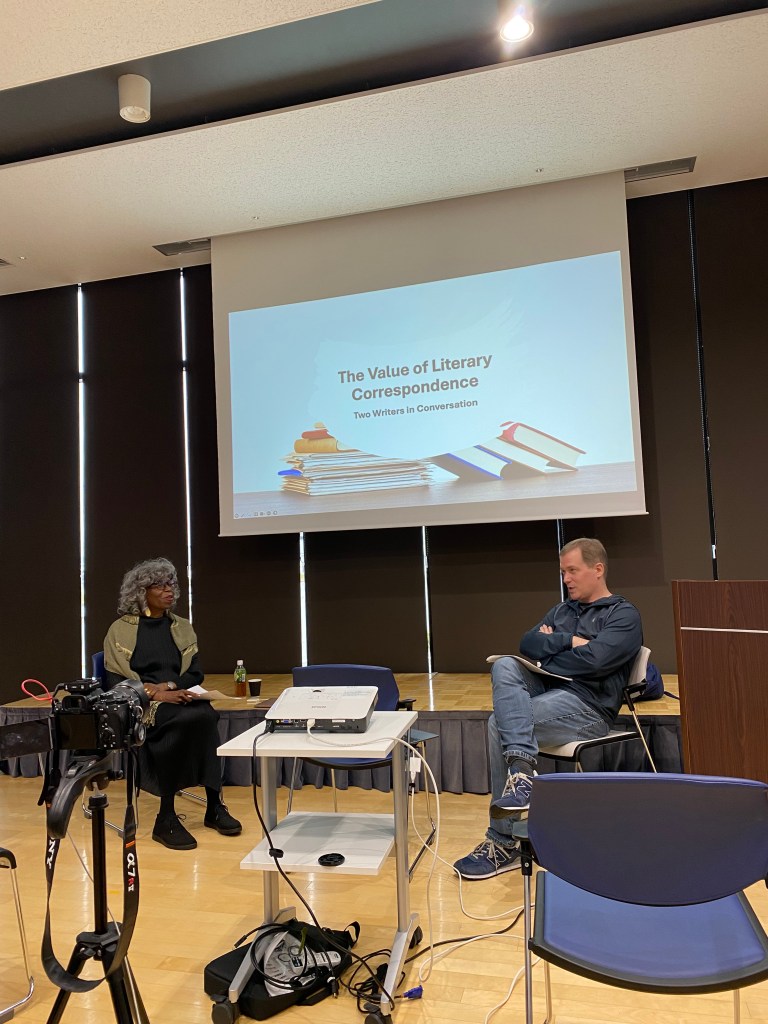
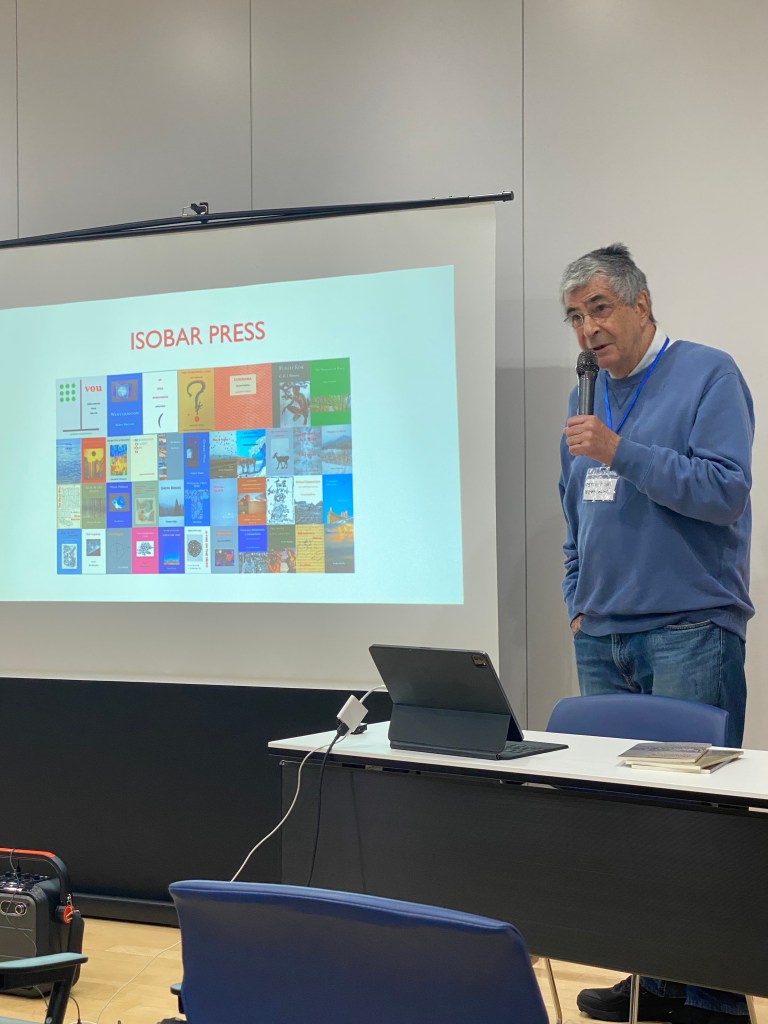
American authors Karen Hill Anton and David Joiner talk about literary correspondencePaul Rossiter, publisher of Isobar Press, introduces new Japan-related titles.
Suzanne Kamatawas born and raised in Grand Haven, Michigan. She now lives in Japan with her husband and two children. Her short stories, essays, articles and book reviews have appeared in over 100 publications. Her work has been nominated for the Pushcart Prize five times, and received a Special Mention in 2006. She is also a two-time winner of the All Nippon Airways/Wingspan Fiction Contest, winner of the Paris Book Festival, and winner of a SCBWI Magazine Merit Award.
PLEASE NOTE: ARTICLES CAN ONLY BE REPRODUCED IN OTHER SITES WITH DUE ACKNOWLEDGEMENT TO BORDERLESS JOURNAL
My day job is “associate professor,” so I sometimes attend academic conferences. When I learned of an upcoming conference on language teaching in Fukui Prefecture, which I had never been to, I was eager to sign up. Sure, I wanted to hear all the cutting-edge theories about teaching English to language learners – how to motivate my students to write haiku, how to use AI, and so on – but my primary reason was to see the dinosaur bones.
Although at one time it seems that dinosaurs pretty much roamed the whole world, fossils of dinosaur bones weren’t discovered in Japan until 1989. Those bones were found in Katsuyama City, Fukui Prefecture. Since then, even more bones have been discovered, and a museum ̶ Fukui Prefectural Dinosaur Museum ̶ opened in 2000. As part of the pre-conference activities, the host university had arranged for a trip to the museum. A free shuttle but would depart at 11:30am.
I consulted an app on my smartphone and determined that it would take me about five hours to reach Fukui Station from my home in Tokushima Prefecture on the island of Shikoku. I would have to take a bus, a train, another train, and the high-speed bullet train. After a recent trip to Tokyo, I had learned how to use an electronic transit card, which was basically an app on my phone. This app could be used to breeze through ticket gates at train stations, as well as on buses and subways.
I got up at 5:30am on the day of the museum tour. My husband dropped me off at the bus station. I got on the bus and got off in Osaka. Then I took a train to Kyoto, which was mobbed with travelers. Although I thought I could get on the next train, the so-called Thunderbird, with my app, I discovered that I needed to have a reservation. I suppose I could have made one on my smartphone while standing in line, but I was confused. I left the platform and queued up to buy a reserved ticket from the vending machine, which disrupted my tight schedule and meant I would not be able to make it to Fukui in time for the free shuttle bus.
The Thunderbird goes straight from Kyoto to Fukui with few stops in between. The scenery is mostly composed of rice fields and squat mountains. The monotonous view was calming. About an hour later, the train pulled into Tsuruga where I had to switch to the brand-new Hokuriku Shinkansen for the last seventeen minutes of my journey. In my rush to finish my business at the vending machine in Kyoto, I had inadvertently booked a seat in the most luxurious car. I was the only one there.
I texted a friend who was also attending the conference. She had already arrived. I told her that I would be late, and that I wouldn’t be able to ride the bus with her. This was Japan, where everything was always on time! However, the organisers were Americans, and they were willing to wait for me. Hooray!
As soon as I got to Fukui Station, with its moving animatronic raptor keeping guard out front, I hopped into a taxi and finally arrived at the university, where the bus was indeed waiting. I sprinted onboard, apologised to my fellow passengers, and thanked the organiser profusely.
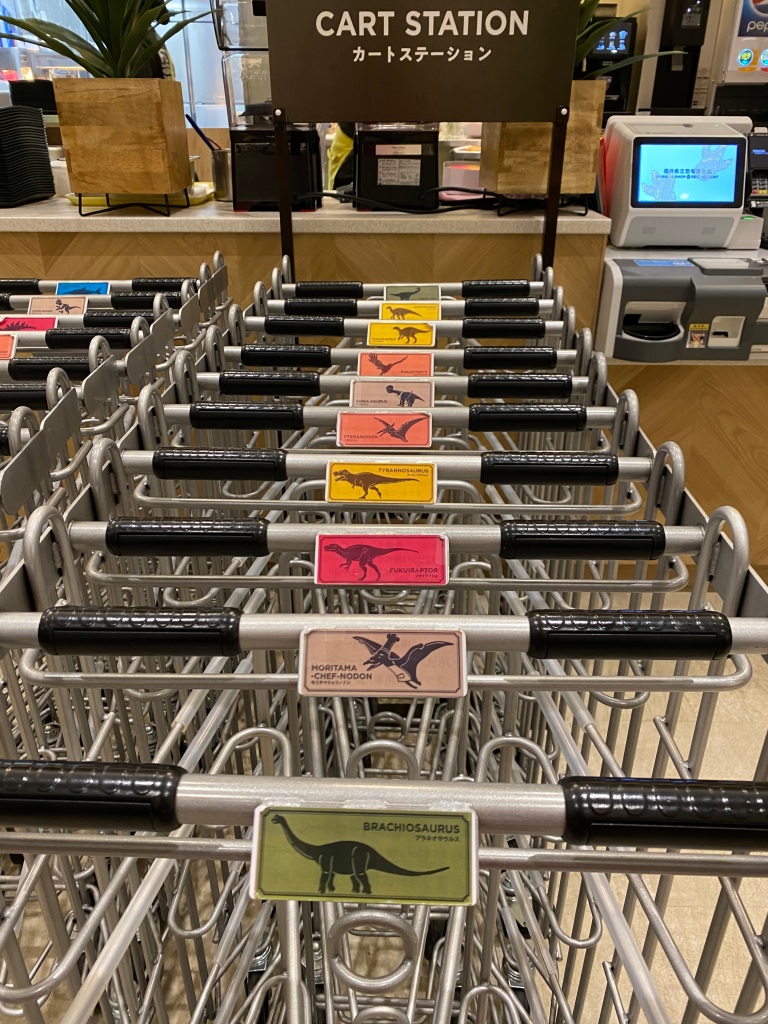
The museum was impressive, as advertised. Replicas of dinosaurs discovered in such far-flung locales as Morocco and Mongolia were on display. There were, of course, also exhibits of the five dinosaurs and one bird species discovered in Fukui, including the long-necked stubby-legged Fukuititan, the herbivorous Fukuisaurus, and the Fukuiraptor. Although the museum offers an excavation experience where visitors can pretend to dig and discover fossils, my friend and I just walked around looking at all of the cool rocks and bones.
Having gone through my son’s dinosaur obsession when he was young, I could remember some of the dinosaur’s names – the Ankylosaurus with its bumpy back, the Stegosaurus, and Pterodactyl. When we were ready to take a break, my friend and I made our way to the cafeteria for dino-themed snacks.
While many famous destinations in Japan are struggling with over-tourism, Fukui, while slightly off the beaten track, has a pleasantly relaxing vibe. Things may change with the new bullet train, but for now, I recommend it as a fascinating horde-free place to visit.
Suzanne Kamatawas born and raised in Grand Haven, Michigan. She now lives in Japan with her husband and two children. Her short stories, essays, articles and book reviews have appeared in over 100 publications. Her work has been nominated for the Pushcart Prize five times, and received a Special Mention in 2006. She is also a two-time winner of the All Nippon Airways/Wingspan Fiction Contest, winner of the Paris Book Festival, and winner of a SCBWI Magazine Merit Award.
PLEASE NOTE: ARTICLES CAN ONLY BE REPRODUCED IN OTHER SITES WITH DUE ACKNOWLEDGEMENT TO BORDERLESS JOURNAL
Unlike the rowdy reveling in my native US, the New Year’s holiday in Japan is usually a solemn and sedate affair, spent quietly with family. Usually, schools and businesses allow a holiday of a few days.
My adult children had returned home from Kyoto and Tokyo, and we enjoyed an American holiday meal complete with roast chicken, mashed potatoes, lemon-flavored squash, and cranberry sauce. The next day, New Year’s Eve, we started in on the o-sechi ryori, the food traditionally eaten on January 1, and the following days. In the past, the woman of the house spent days preparing these special foods, each with a particular meaning. For example, fish eggs are meant to encourage fertility, and sweetened black beans signify good health. The food is beautifully arranged in lacquer boxes.
In our family, my Japanese husband has been in charge of the New Year’s cooking in recent years, sometimes with help from our children. This year, however, we opted to buy already-made o-sechi ryori. We gathered at the table and sampled the various delicacies, then watched a music competition show on TV — another traditional Japanese activity. All across Japan, many other families were doing the same.
According to the Chinese zodiac, 2024 is the year of the wood dragon. In dragon years, it is said that people can harness the creature’s powers to unleash creativity, passion, courage and confidence. It is thought to be the ideal time to achieve one’s dreams, a time of hope and opportunity.
The aftermath of Noto Peninsula Earthquake in Japan that struck on 1st January 2024
My family and I awoke on January 1st, feeling renewed and refreshed, ready to continue pursuing our dreams. However, our moods changed when an earthquake occurred that afternoon in Ishikawa Prefecture. TV broadcasts were interrupted by frantic voices telling those in the affected area to evacuate immediately and to take cover. All across Japan, we were reminded of the devastating earthquake and tsunami of the Great East Japan Earthquake on March 11, 2011 which claimed nearly 20,000 souls (with many more remaining missing). I remembered, as well, being shaken awake in our fifth-floor apartment by the Great Hanshin Earthquake of January 17, 1995, during which 6,434 people were killed.
Although the loss of life in Ishikawa (still being tallied as I write this) has not been quite so severe, the devastation displayed on TV, in newspapers, and online is heartbreaking. We have heard of middle-aged parents who lost their two daughters who were home for the holidays, of thousands whose home were reduced to rubble, of hundreds of people in an evacuation center with only two toilets. The day after the initial earthquake, a Japan Airlines plane crashed into a smaller Coast Guard plane on the runway at Haneda airport. The latter was preparing to carry supplies to earthquake victims in Ishikawa. Again, my family was glued to the TV, unable to look away as the jet burned to the ground. We were relieved to learn that all crew and passengers escaped from the plane, but saddened by the deaths of five Coast Guard members who were seeking to help others.
Plane crash on January 2nd, 2024 in Tokyo
The foreign media often celebrates the resilience of the Japanese people: all those earthquakes and landslides and floods, and still they get on with their lives! However, Japan ranks only 54th on the 2022 Happiness Report, and suicide is the leading cause of death for men between the ages of 20-44 and women 15-34. The Japan Times reported in 2019 that according to a survey conducted by The Policy Institute and King’s College, London, only 24% of respondents in Japan agreed that “seeing a mental health professional is a sign of strength.”
Two of the first expressions that I learned when I first came to Japan were, “gaman wo suru” (“be patient”/ “endure”) and “shikata ga nai” (“it can’t be helped”). I came to understand that many Japanese have a sense of fatalism and helplessness, which might account for the general malaise in spite of Japan being a safe, peaceful, prosperous, orderly country with an excellent education system and exemplary healthcare.
During this past week, however, I have also been reflecting upon the changes wrought in response to disasters. After the 1995 earthquake in Kobe, schools stepped up their earthquake drills, and a disaster prevention center was established in our town. The school my daughter attended held a workshop on how to make dishes out of newspapers in the event of a disaster and began holding “disaster camps” simulating evacuation centers in the summer. Neighbourhood-wide disaster drills also increased, and signs were put up indicating sea levels and designated evacuation centers. Although it has been reported that evacuation centers in Ishikawa do not support those with disabilities, at least there is now an awareness of what needs to be changed.
Earthquakes and other natural disasters are unavoidable, but I admire the effort that the Japanese people put into mitigating their effects. My hope is that more and more people here will begin to understand that it is okay to cry, to mourn, to grieve, and to talk about our suffering. My wish for the Japanese people in the new year is happiness and the achievement of dreams.
Suzanne Kamatawas born and raised in Grand Haven, Michigan. She now lives in Japan with her husband and two children. Her short stories, essays, articles and book reviews have appeared in over 100 publications. Her work has been nominated for the Pushcart Prize five times, and received a Special Mention in 2006. She is also a two-time winner of the All Nippon Airways/Wingspan Fiction Contest, winner of the Paris Book Festival, and winner of a SCBWI Magazine Merit Award.
PLEASE NOTE: ARTICLES CAN ONLY BE REPRODUCED IN OTHER SITES WITH DUE ACKNOWLEDGEMENT TO BORDERLESS JOURNAL
A conversation with the author,Afsar Mohammed, and a brief introduction to his latest book, Remaking History: 1948 Police Action and the Muslims of Hyderabad. Click hereto read.
A conversation with Meenakshi Malhotra over The Gendered Body: Negotiation, Resistance, Struggle, edited by Meenakshi Malhotra, Krishna Menon and Rachana Johri and a brief introduction to the book. Click hereto read.
In His Unstable Shape, Rhys Hughes explores the narratives around a favourite nursery rhyme character with a pinch of pedantic(?) humour. Click here to read.
Mother & Child by Jamini Roy (1887-1972)Mother and Child by Picasso (1881-1973)
‘Victory to Man, the newborn, the ever-living.’ They kneel down, the king and the beggar, the saint and the sinner, the wise and the fool, and cry: ‘Victory to Man, the newborn, the ever-living.’
This is the month— the last of a conflict-ridden year— when we celebrate the birth of a messiah who spoke of divine love, kindness, forgiveness and values that make for a better world. The child, Jesus, has even been celebrated by Tagore in one of his rarer poems in English. While we all gather amidst our loved ones to celebrate the joy generated by the divine birth, perhaps, we will pause to shed a tear over the children who lost their lives in wars this year. Reportedly, it’s a larger number than ever before. And the wars don’t end. Nor the killing. Children who survive in war-torn zones lose their homes or families or both. For all the countries at war, refugees escape to look for refuge in lands that are often hostile to foreigners. And yet, this is the season of loving and giving, of helping one’s neighbours, of sharing goodwill, love and peace. On Christmas this year, will the wars cease? Will there be a respite from bombardments and annihilation?
We dedicate this bumper year-end issue to children around the world. We start with special tributes to love and peace with an excerpt from Tagore’s long poem, ‘The Child‘, written originally in English in 1930 and a rendition of the life of the philosopher and change-maker, Vivekananda, by none other than well-known historical fiction writer, Aruna Chakravarti. The poem has been excerpted from Indian Christmas: Essays, Memoirs, Hymns, an anthology edited by Jerry Pinto and Madhulika Liddle, a book that has been reviewed by Somdatta Mandal and praised for its portrayal of the myriad colours and flavours of Christmas in India. Christ suffered for the sins of humankind and then was resurrected, goes the legend. Healing is a part of our humanness. Suffering and healing from trauma has been brought to the fore by Christopher Marks’ perspective on Veronica Eley’s The Blue Dragonfly: healing through poetry. Basudhara Roy has also written about healing in her take of Kuhu Joshi’s My Body Didn’t Come Before Me.Bhaskar Parichha has reviewed a book that talks of healing a larger issue — the crises that humanity is facing now, Permacrisis: A Plan to Fix a Fractured World, by ex-British Prime Minister Gordon Brown, Nobel Laureate Michael Spence, Mohamed El-Erian and Reid Lidow. Parichha tells us that it suggests solutions to resolve the chaos the world is facing — perhaps a book that the world leadership would do well to read. After all, the authors are of their ilk! Our book excerpts from Dr Ratna Magotra’s Whispers of the Heart – Not Just A Surgeon: An Autobiographyand Manjima Misra’s The Ocean is Her Titleare tinged with healing and growth too, though in a different sense.
The theme of the need for acceptance, love and synchronicity flows into our conversations with Afsar Mohammad, who has recently authored Remaking History: 1948 Police Action and the Muslims of Hyderabad. He shows us that Hyderabadi tehzeeb or culture ascends the narrow bounds set by caged concepts of faith and nationalism, reaffirming his premise with voices of common people through extensive interviews. In search of a better world, Meenakshi Malhotra talks to us about how feminism in its recent manifestation includes masculinities and gender studies while discussing The Gendered Body: Negotiation, Resistance, Struggle, edited by her, Krishna Menon and Rachana Johri. Here too, one sees a trend to blend academia with non-academic writers to bring focus on the commonalities of suffering and healing while transcending national boundaries to cover more of South Asia.
That like Hyderabadi tehzeeb, Bengali culture in the times of Tagore and Nazrul dwelled in commonality of lore is brought to the fore when in response to the Nobel laureate’s futuristic ‘1400 Saal’ (‘The year 1993’), his younger friend responds with a poem that bears not only the same title but acknowledges the older man as an “emperor” among versifiers. Professor Fakrul Alam has not only translated Nazrul’s response, named ‘1400Saal’ aswell, but also brought to us the voice of another modern poet, Quazi Johirul Islam. We have a self-translation of a poem by Ihlwha Choi from Korean and a short story by S Ramakrishnan in Tamil translated by T Santhanam.
Our short stories travel with migrant lore by Farouk Gulsara to Malaysia, from UK to Thailand with Paul Mirabile while chasing an errant son into the mysterious reaches of wilderness, with Neeman Sobhan to Rome, UK and Bangladesh, reflecting on the Birangonas (rape victims) of the 1971 Bangladesh Liberation war, an issue that has been taken up in Malhotra’s book too. Sobhan’s story is set against the backdrop of a war which was fought against linguistic hegemony and from which we see victims heal. Sohana Manzoor this time has not only given us fabulous artwork but also a fantasy hovering between light and dark, life and death — an imaginative fiction that makes a compelling read and questions the concept of paradise, a construct that perhaps needs to be found on Earth, rather than after death.
The unusual paradigms of life and choices made by all of us is brought into play in an interesting non-fiction by Nitya Amlean, a young Sri Lankan who lives in UK. We travel to Kyoto with Suzanne Kamata, to Beijing with Keith Lyons, to Wayanad with Mohul Bhowmick and to Langkawi with Ravi Shankar. Wendy Jones Nakanishi argues in favour of borders with benevolent leadership. Tongue-in-cheek humour is exuded by Devraj Singh Kalsi as he writes of his attempts at using visiting cards as it is by Rhys Hughes in his exploration of the truth about the origins of the creature called Humpty Dumpty of nursery rhyme fame.
Poetry again has humour from Hughes. A migrant himself, Jee Leong Koh, brings in migrant stories from Singaporeans in US. We have poems of myriad colours from Ryan Quinn Flanagan, Patricia Walsh, John Grey, Kumar Bhatt, Ron Pickett, Prithvijeet Sinha, Sutputra Radheye, George Freek and many more. Papia Sengupta ends her poem with lines that look for laughter among children and a ‘life without borders’ drawn by human constructs in contrast to Jones Nakanishi’s need for walls with sound leadership. The conversation and dialogues continue as we look for a way forward, perhaps with Gordon Brown’s visionary book or with Tagore’s world view of lighting the inner flame in each human. We can hope that a way will be found. Is it that tough to influence the world using words? We can wish — may there be no need for any more Greta Thunbergs to rise in protest for a world fragmented and destroyed by greed and lack of vision. We hope for peace and love that will create a better world for our children.
As usual, we have more content than mentioned here. All our pieces can be accessed on the contents’ page. Do pause by and take a look. This bumper issue would not have been possible without the contribution of all the writers and our fabulous team from Borderless. Huge thanks to them all and to our wonderful readers who continue to encourage us with their comments and input.
Here’s wishing you all wonderful new adventures in the New Year that will be born as this month ends!
                        even in Kyoto

                     I long for Kyoto—

                          cuckoo!

               --Matsuo Basho (1644-94)*
My story begins at Kyoto Station, where I alight after a three-hour bus ride. I am on my way to meet my friend Yoko for dinner in the Kitayama area, and a drink at the Kyoto Hotel Roku. She and I once worked together at the same university in Naruto, but now she is an associate professor at a small women’s college in Kyoto. I head underground, through the Porta shopping center, and get on a subway bound for Kokusaikan. In spite of the crowds up above, the train allows for elbow room, and I easily find a seat. Most of the passengers are glued to their phones, some are masked. My eyes flit to an advertisement for a display of kimono. After several stops, I get off at Kitayama and find Yoko waiting at the wicket. We have a spaghetti dinner at a nearby restaurant, and then hail a taxi via Didi, Japan’s answer to Uber.
The taxi takes us through an upscale residential area featuring traditional homes. Yoko tells me that we are near Bukkyo University, originally an institution of research for monks, but now a university grounded in Pure Land Buddhism offering degrees in a variety of subjects including English, nursing, and social welfare. We are also not too far from my favorite temple, Kinkakuji. One of the first novels that I read upon arriving in Japan was Yukio Mishima’s TheTemple of the Golden Pavilion, translated by Ivan Morris, about a deranged monk-in-training who set fire to the gilded temple and burned it down. Surprisingly, none of the visitors from abroad that I have taken to this temple had ever heard of this 1950 incident or the book.
The driver turns down a long driveway and drops us off at the hotel entrance. “Nice hotel!” he says.
I resist the urge to defend our extravagance, to say we are just here for a drink, and then the next day for lunch. I have been commissioned to write an article about the hotel, but I can’t afford to spend the night.
The Roku Kyoto, which opened in September of 2021 when Japan was off limits to foreign tourists, is one of eight of LXR luxury properties worldwide, and Hilton’s first in Kyoto. (Others include The Biltmore, Mayfair in the United Kingdom, and the Mango House in the Seychelles.) Along with a tranquil, storied setting (in the 16th century, it was a community for artists and artisans), the hotel offers bespoke experiences, such as a session of kintsugi with a local master of the craft, using cracked hotel pottery, and traditional papermaking using water from the Tenjin River, which runs through the hotel grounds. Guests can also opt for a New Year’s Eve package including a two-night stay, and a viewing of the sunrise over Mt. Fuji via private plane at a cost of \4,800,000. Nevertheless, the hotel strives to be a place where local residents can come for escape and enjoyment as well as high-flying tourists.
We are greeted warmly at the entrance and shown to the dimly lit bar. Walking along the basin at the center of the hotel complex, I take in the reflection of the full moon on the water. I feel like we should be writing haiku. The veranda would be the perfect setting for filming a period drama.
Resturant in TemujinEngawa: Non-tatami matted flooring Photos Provided by Suzanne Kamata
The day before, I had tried and failed to make a reservation, and assumed that the restaurant was fully booked. However, after verifying that we could drop in for a drink or a cup of coffee without notice, we decided to go ahead with our plans. As it turns out, we are the only ones in the bar at a little after eight.
A small lamp is placed on our table, and the bartender brings us a menu bound in leather. I had been planning on having the Hana-monogatari (flower story) cocktail made from seasonal herbs and flowers from the hotel garden, but the Pear Moscow Mule sounds irresistible. Yoko selects the Frozen Rum Chai, made with amazake (sweet sake). We also order a plate of chocolates.
Ambient music plays softly in the background as we catch up on gossip about former colleagues and update each other on current research projects. We speak softly in the hushed atmosphere which is broken only by the sound of a cocktail shaker behind the bar.
Our drinks arrive with paper straws. Mine has a slice of Asian pear hooked over the edge. The fruit changes by the season, I am told. I take a sip, taste a hint of lime with the kick of ginger: delicious.
“Mmmmm. This is so good,” Yoko says of her drink. We negotiate over the assorted chocolates, which are filled with raspberry and orange peels, among other things. Yoko lets me have the piece topped with gold.
Later, a couple more small groups enter the bar, but the area is spacious. Our privacy remains intact. We talk a bit more, finish our drinks, and agree about where to meet for lunch the next day.
Late the following morning, I take the same route from a bargain hotel near Kyoto Station, weaving between young women in yukata and a foreigner with brightly dyed, intricately braided hair, and get off at Kitayama. This time, as I emerge from underground, I take note of the electronic cuckoo sound chirping from a speaker, and I recall Basho’s famous poem about longing for Kyoto. Nearly 400 years after it was written, I imagine that the poem evokes the same emotion – a longing for the city in days of yore.
I have visited Kyoto many times since I first arrived in Japan. On the first, when I was just beginning to learn Japanese and still didn’t know quite what was going on, I spent the night at the residence where the previous Empress was trained in housekeeping, a rite of passage even for aristocratic girls. As I mentioned, I was partially motivated to come to Japan because of literature, namely the Heian court poetry that I learned about from a class in Asian history. I was enthralled with the idea of courtiers communicating via verse, and as a newly heartbroken nineteen-year-old, I identified with the intense longing in poems by Murasaki Shikibu and Ono no Komachi. Later, I read a novel set in Kyoto –Ransom, by Jay McInerney. What I remembered most about it was the funny Japlish phrases and scenes of karaoke, still a novelty in America in 1985. Flipping through it more recently, I came across this description of the Kamogawa (Duck River):
“From its source the river drained fields and paddies heavily fertilized with petrochemicals and manure. Closer in, the Kyoto silk dyers dumped their rinse tanks. The white herons that fished the shallows had purple plumage one day, green the next—weeks in advance of the women who brought the kimono silk in the shops downtown.”
Can this book really be what made me want to come to Japan? And yet, I also recall being attracted by the cuteness and kitsch, the Disney meets sci-fi vibe prevalent in Bubble Era Japan implied in, for example, Ridley Scott’s film Bladerunner. In any case, nostalgia sometimes leaves out the worst, and things seem to have changed for the better. As we cross the Kamogawa in another taxi, this time by daylight, I see no evidence of pollution.
“There are tons of ducks on the river,” Yoko says. “And ibises.”
“It’s famous.” I have come across many references to it in literature.
We arrive at the hotel a bit early for our noon lunch reservation, so we are shown to a large room with sofas and chairs, where we can drink tea or coffee while we wait. We choose to sit next to a window which looks out onto the basins. The blue sky, the changing leaves, and the still water create a calming tableau.
“I feel like my mind and brain are being purified,” Yoko says.
No other guests are around, and I wonder how many of the hotel’s 114 rooms are currently occupied. Perhaps everyone has already left the hotel for sightseeing.
A strip of moss runs parallel to the basin.
“It’s of better quality than the moss at Kokedera,” Yoko says, referring to another famous nearby temple renowned for its moss garden. “And you have to make a reservation a month in advance and pay \3,000 to visit!”
I write down her words, never having reflected upon the quality of moss before.
“You’d better write ‘as good as,’” she amends, suddenly aware of her sacrilege.
Finally, a gray-haired Japanese woman in a kimono emerges from the hotel and traverses the walkway between the two basins. A few minutes later, I see a Western woman with long brown hair pushing a baby in a stroller. And then a little later, a child wearing a fox mask, saunters across the walkway, slashing the air with a toy sword.
“He must have gone to Fushimi Inari Shrine,” Yoko says, referring to the popular tourist attraction known for its Instagram-worthy red torii gates.
Moss. Photo Provided by Suzanne Kamata
Just before twelve, we make our way to the restaurant, where we are shown to a table. The Japanese host/sommelier, suggests that we both sit on the same side, facing the window which provides a view of the fall foliage. He brings us the menu, and wine list.
I have already decided that I am having the wagyu burger. A glass of robust red wine would probably suit it best, but I am intrigued by the locally produced orange wine, which I’m told is comparable to a rose. Yoko asks the sommelier a lot of questions. Her partner works in wine in California, so she has visited many vineyards.
“It’s nice to talk to someone who knows so much about wine,” he says.
One of our two code-switching servers, both, as it turns out, from Nepal, pours a swallow of the orange wine into a glass for Yoko. She tastes it, but decides upon the sparkling plum wine, and the lunch course.
My image of plum wine comes from the syrupy homemade stuff we’d once received from my husband’s relative. “For when you have a cold,” she’d said. But this wine is something else – fruity, but light, and effervescent. Yoko asks where she can buy a bottle of it.
The sommelier explains that the hotel’s wines come from the nearby Tamba Winery, which is open to the public for tastings in the fall. It’s a short drive from where we are now. Their wines sell out quickly just in Kyoto and are mainly used by restaurants.
Yoko’s first course is pesto-dipped scallops submerged in vichyssoise made with white beans. She invites me to taste it. I dip my spoon into the shallow bowl. The bright green of the basil is a surprising delight. There is a bit of a crunch.
“What is that crunchy thing?” I ask our server. “And what kind of flower is that?”
“Just a moment,” he says, and ducks away to find out.
The answer: croutons, and linaria.
I am almost regretting that I didn’t choose the lunch course as well, but then my burger arrives, along with a generous serving of fries, and I am glad that I skipped breakfast. I probably won’t need dinner, either.
I’d imagined that all wagyu was from Kobe, but the host tells us that it’s Kyoto beef.
Yoko’s second course is marinated salmon with spinach, potatoes, onion, and amaranth flowers. The server spoons duck sauce around it.
“Is there a lot of duck cuisine in Kyoto?” I ask Yoko, my mind going to the Kamogawa.
“Yes,” she says, “But I don’t think the ducks are from the river.”
Lastly, we have dessert—a fig cradled in a chocolate shell, topped with a dollop of cassis ice cream. The plate is painted with sauces. It is exquisite to both eyes and tongue.
Before leaving the property, we stroll around the grounds taking in the lawn where morning yoga and meditation are held, the orange tree and lavender beside the thermal pool (the peels of the former are used in footbaths at the spa), the exercise room redolent with cedar and cypress with a vista of Takagamine Mountain.
As we prepare to leave, Yoko suggests that next time, we treat ourselves to a hot stone massage in the spa, followed by afternoon tea on the veranda overlooking the stream. We can come in the winter, when there is snow frosting the mountain, for a different view. Yoko says that she might come by bicycle, and I vow to wear sneakers, so that I can walk from the station. Instead of longing for the past, we look to the future.
*This translation is from Kyoto: A Literary Guide (Camphor Press, 2020), translated, collated, and edited by John Dougill, Paul Carty, Joe Cronin, Itsuyo Higashinaka, Michael Lambe, and David McCullough.
Suzanne Kamatawas born and raised in Grand Haven, Michigan. She now lives in Japan with her husband and two children. Her short stories, essays, articles and book reviews have appeared in over 100 publications. Her work has been nominated for the Pushcart Prize five times, and received a Special Mention in 2006. She is also a two-time winner of the All Nippon Airways/Wingspan Fiction Contest, winner of the Paris Book Festival, and winner of a SCBWI Magazine Merit Award.
PLEASE NOTE: ARTICLES CAN ONLY BE REPRODUCED IN OTHER SITES WITH DUE ACKNOWLEDGEMENT TO BORDERLESS JOURNAL
The Penguin Cafe Orchestras, and the plural is necessary because there were several of them, were responsible for a unique sonic experience, creating a blend of folk, jazz, classical and faux ethnic music that managed to pull off the difficult trick of sounding instantly familiar to the subconscious mind, as if it had already existed in the past but had been forgotten for ages and now was being retrieved from some pool of inspiration common to humanity.
They formed one of the background soundscapes to my student years. I recall the first time I heard a Penguin Cafe track. It was ‘Music for a Found Harmonium’ and it accompanied a short film featured on television called simply ‘Interlude’ that I have never been able to trace since. The melody and the visuals matched well, but it was years before I learned who was responsible for the music and I did so by pure chance. I went into a record store and bought the album Broadcasting from Home at random. That was a habit of mine back then.
Perhaps the cover image had intrigued me. Listening to the album at home I was delighted to recognise ‘Music for a Found Harmonium’ as the opening track. But I might be misremembering. There’s a suspicion in my mind that I actually bought the album Signs of Life on cassette first. It hardly matters. The title of that soul enhancing song, ‘Music for a Found Harmonium’, struck me as curiously enigmatic, so much so that I later entitled one of my books Stories from a Lost Anthology as a sort of tribute, an allusion noticed by no reviewers.
The real story behind the track is that Simon Jeffes (1949-1997), founder of the Orchestra, was on tour in Japan and wandering through the backstreets of Kyoto when he found an abandoned harmonium balanced on the apex of a pile of rubbish. He located the person who had discarded it and obtained permission to take the instrument away. The song was composed to celebrate this lucky find. I have never found a harmonium in a backstreet, or any other musical instrument for that matter, not even a harmonica. But Jeffes was special and attracted beauteous oddity by some form of magnetism he carried around within himself.
That magnetism is present in all the music he made. Born in 1949, Jeffes studied the classics in London before trying his hand at experimental music. He grew to be dissatisfied with the barren tonalities of contemporary avant-garde work. Similarly, his brief flirtation with rock came to nothing. African music alone seemed to contain elements he was seeking, powerful rhythms, freer harmonic approach, the mysterious qualities of its silences, an unmelodramatic emphasis on cadence, imaginative tuning systems and improvisational flair. Most of all, he was seeking pure musicality, pieces constructed of the vital essence of the art.
A Penguin Cafe composition rarely seems made up of separate parts, but is much more like an organic growth. Melody and harmony, rhythm and tone colour are fused together right from the very beginning, in an ambient seed. Then the piece grows into fruition with little fuss and perfect symmetry. In 1972, food poisoning confined Jeffes to bed where he dreamed of a Kafkaesque residential block full of people with empty lives. The following day a voice in his head said distinctly, “I am the proprietor of the Penguin Cafe. I will tell you things at random.” Jeffes tried to imagine what the house band of that cafe might sound like. When he recovered, he transformed his dream into truth and invented the PCO.
For the Orchestra, he recruited like-minded players Helen Leibmann, Steve Nye and Gavyn Wright. Calling themselves the “four musicians in green clothes”, they began recording and in 1976 released their first album, Music from the Penguin Cafe. Leibmann on cello, Nye on keyboards and Wright on violin remained with Jeffes for most of the subsequent recordings of this first phase of the Penguin Cafe adventure, but apart from Jeffes, Leibmann was the only member who has appeared on every one of the early albums. For this first release, they also recruited Neil Rennie on the ukulele and Emily Young to design the eye-catching album cover. Emily Young, who is now a high-regarded sculptor, was supposedly the same Emily that Syd Barrett and Pink Floyd sang about in ‘See Emily Play’.
Music from the Penguin Cafe is the most uncharacteristic and dissonant of the Orchestra’s productions. The multi-instrumentalism and big arrangements that were to become a trademark are largely absent. Though Jeffes plays bass, quatro, spinet, cheng, ring modulator and mouth percussion on some tracks, his primary duty is as an electric guitarist. The two earliest songs, ‘Penguin Cafe Single’ and ‘The Sound of Someone You Love Who’s Going Away and it Doesn’t Matter’, rely on just four basic instruments, with Nye’s electric piano and Leibmann’s cello largely displacing Jeffes, and they wrench the heart, sounding like reservoirs of poignancy, dammed to prevent sadness slipping over into the other tracks.
Despite lengthy improvisational passages, highly unusual for the early Orchestra, they are among the most successful songs on the album. Other oddities are dubious and not wholly forgivable, including a drenching vocal lament and a squeaky piece called ‘Pigtail’. Only on one track does the Orchestra provide a foretaste of what was to follow in the coming magical years, ‘Giles Farnaby’s Dream’, spinet and ukulele in foot-tapping mode, the strength of the piece deriving from its frenetic repetition. The album is the least Penguiny of the Orchestra’s productions and it was released on the Obscure label of ambient maestro Brian Eno.
Avant-gardists believe it to be their best album and easy listeners regard it as their worst. But it is neither. It is simply a prelude to the next four albums, which are the quintessential recordings. Yet there was a five year wait for the first of these. Jeffes never seemed in a hurry. The eponymous Penguin Cafe Orchestra (1981) defined the Penguin Cafe sound once and for all with the opening track, ‘Air à Danser’, which can almost be regarded as the PCO’s anthem. The jumpy guitar and wistful strings sound instantly recognisable even to someone who has never heard the piece before. It is the most perfect example of Jeffe’s ability to tap into the Universal Subconscious, an effect that is both pleasing and slightly eerie.
Several other tracks became mainstays of live performance, ‘Cutting Branches for a Temporary Shelter’, ‘Numbers 1-4’, the two ‘Yodel’ songs and ‘Paul’s Dance’. Best of all, however, is the funky and hypnotic ‘Ecstasy of Dancing Fleas’, a hugely gleeful song with warm bass and joyous refrain. The method of working employed by the Orchestra almost guaranteed good albums. Over a number of years, recordings would be made and only the finest tracks released. Again, Jeffes was never in a rush to push his music out there. He preferred a measured approach. This doesn’t mean that all his music sounds polished. Sometimes rough-edged work is exactly what is required to provide ideal incarnations for musical ideas.
After Penguin Cafe Orchestra, it was difficult to believe that a more archetypal sound could be achieved, but in Broadcasting from Home (1984), Jeffes refined the spirit of the music even further. The PCO had grown to encompass thirteen members of varying abilities and Jeffes had taken to playing more and more instruments. With another whimsical but haunting Emily Young cover, this is a vital release and tracks such as ‘Music For A Found Harmonium’, ‘Prelude & Yodel’, ‘In the Back of a Taxi’ and ‘Heartwind’ are impossible to dislike. Strangely enough, the album contains a couple of sequels to tracks on the first release. ‘More Milk’ and ‘Another One from the Colonies’ are wry comments on their predecessors. Musicians include Geoffrey Richardson on viola, shaker and bass; Dave Defries on trumpet and flugel; Annie Whitehead on trombone; Nye, Leibmann and Rennie on piano, cello and ukulele; and Jeffes on drums, harmonium, omnichord, soloban, dulcitone, penny whistle, violin, milk bottles, triangle, bass, and much more. It is easy to forget how peculiarly exotic some of those instruments seemed to the British public in those days. Musically we were far more insular then than we are now.
The fourth album was released in 1987. Signs of Life has a ‘frontier-ceilidh’ feel to it, taking elements of American country music, bluegrass and mountain folk. There is also a classical touch, particularly in the moody ‘Oscar Tango’. Sadness was a rare emotion in the Orchestra’s output, apart from in some of the very early material. It is on Signs of Life that the description of the PCO as ‘a string quartet letting its hair down at some mysteriously-located barn dance of the future’ most holds true. The opening track, ‘Bean Fields’, is quirky and imprecise and one of my three favourite Penguin Cafe tracks ever. ‘Dirt’ is rhythmic and compelling, as is ‘Sketch’ and ‘Swing The Cat’. ‘Southern Jukebox Music’, on the other hand, belies its title and is a deeply melodic lament. ‘Perpetuum Mobile’ is a punning title that references the metronymic pulse of the piece but also the town of Mobile, Alabama, and further connects the album to its basic Americana source, although the music seems to belong to another galaxy and to the distant past of our preliterate ancestors just as much as it does to any existing tradition. The ten minute long meditation ‘Wildlife’ is an acquired taste, seeming at first to be a directionless filler, but is perfect background music for simple relaxation or mind wandering. Personally it is my daydreaming and falling asleep music of choice. It evokes a strange forest soundscape where very little happens but everything eventually is found to have changed. Of the two pieces played wholly by Jeffes, one deserves special mention: ‘The Snake and the Lotus (The Pond)’, a piece just for bass, primeval and rather mystical.
The next two albums were live recordings. When in Rome… (1988) is a wonderful retrospective of the previous work and thus the best introduction to the PCO’s career. Pieces from all four albums are included and many have been improved, especially ‘Giles Farnaby’s Dream’ and ‘Air à Danser’, which have both been spiced up. Others sound almost identical to the studio recordings. The deliciously smooth atmosphere of the performance is captured well and the musicians are in complete empathy with each other. Missing on this album is Gavyn Wright and the PCO is down to nine members, but Bob Loveday on fiddle more than makes up for the loss. This is the only album where a member, Geoffrey Richardson in fact, actually plays more instruments than Jeffes. Less convincing is Still Life (1990), a ballet arrangement of material for a conventional orchestra. Although a nice album in itself, some of the pieces, such as ‘Numbers 1-4’, have been overdone, and this sixth release is probably the least essential album of them all. Nonetheless, listeners who prefer the grander feel of a larger orchestra and the traditional accents associated with classical music could do much worse than to seek it out.
Unusually for a project associated with Jeffes, the cover isn’t by Emily Young, and this detracts from the finished result. Luckily she was back on hand for the seventh, most sprawling, ambitious and varied of the PCO’s albums to date. Union Cafe (1993) was one of my most cherished albums of the decade in which it appeared. I appreciated its abundance and it felt more like a voyage than their other albums. This is not to say that all here is smooth and accomplished. Some tracks are doldrums in the sound ocean. As for the bolts of its realisation, more musicians than the PCO had ever employed before were used, though sadly Steve Nye isn’t one of them. The other originals, Leibmann, Wright and Rennie, seem content to share duties with a host of other puffers, pluckers, scrapers or bangers. Even Jeffes has decided to wisp himself out a little, be less dogmatic and often takes a lesser role in the performance of his own compositions. On two tracks, ‘Thorn Tree Wind’ and ‘Discover America’ he plays nothing at all. The former is given over entirely to the warblings of an electric Aeolian harp and credited to the winds of the cardinal points. This is fair enough as the winds compose the piece while in the act of playing it. The latter track employs a large number of strings, including twelve violins (led by Gavyn Wright), four violas, four cellos and two double basses. The result is an ear wash that doesn’t necessarily leave the ears feeling cleaner. But the variety is impressive. There is a track played by a computer called ‘Pythagoras on the Line’ that seems similar to a song on an earlier album called ‘Telephone and Rubber Band’.
There is also the excellent ‘Vega’, one of the Orchestra’s longest tracks to date; the salty ‘Organum’ and ‘Another one from Porlock’ and ‘Lifeboat (Lover’s Rock)’. Jeffes had recently announced his awakened re-interest in the Western Classical tradition and this new enthusiasm, together with the experience gathered from exploring other cultures, resulted in this album, which might be a melange, a mess or a masterpiece. The opening track is the superlative ‘Scherzo And Trio’ and because it is superlative I guess this means I ought to say nothing more about it, as superlative things are quite beyond praise, so my dictionary informs me.
Yet the one track that really stands out, conceptually if not sonically, is the tribute to composer John Cage, who had died not long before the album was made. Entitled ‘Cage Dead’, these words are all the notes of the melody, played strictly in that order, C-A-G-E-D-E-A-D. This is an example of a musical version of OuLiPo[1] (itself useably explained and defined as a playful workshop to create literature-that-is-both-constrained-and-made-ingenious by mathematics) officially known as OuMuPo, or Ouvroir de musique potentielle. Essentially it is trickery of the highest whimsical order and John Cage himself perhaps would be very pleased by it. Having said that, he could be inexplicably stringent and uncompromising about his music. He was a composer who wrote a piece requiring a musician to wear a tuba like a hat and not play it. When it was first performed he berated the musician for not wearing it in the correct manner and therefore spoiling the sound.
Now I have drifted off the point. Partly and paradoxically defined as avant-garde easy listening, the Penguin Cafe Orchestra are whimsical and catchy, yet there’s an improbable seriousness too, and a deep sadness embedded in some of the melodies. Good, I have returned to the point, deftly, quite deftly. After Union Cafe there were dramatic changes. Jeffes died. In effect he was the PCO and it became a ghost after his leaving. Yet as ghosts sometimes do, it floated on, splitting like ectoplasm that turns out to be flimsy fabric in an eerie half glow.
Some of the musicians who had worked with Jeffes wanted to continue with the PCO, as is only to be expected. We might also say they had the right to do so. The moral right, perhaps, but not the copyright. The words ‘Penguin Cafe Orchestra’ are not in the public domain, unlike the sound waves they threw out into the atmosphere during their performances and recordings. Jeffes’ son, also called Jeffes inevitably, wanted the name for himself, or a variation of the name. There was plenty of toing and froing and confusion and struggling. Eventually the situation thankfully seemed to settle down somewhat and we were left with…
(a) A set of original musicians in a combo initially called The Anteaters and then renamed the Orchestra that Fell to Earth, who mainly play PCO songs at festivals, and (b) Jeffes Junior in an outfit called Penguin Cafe, no relation to the Penguin Cafe Orchestra yet at the same time every relation to it. Penguin Cafe are a group of many musicians, none of whom were in the PCO, and they have released three albums so far (I write this in the year 2018). These albums are good albums, nobody can accuse the younger Jeffes of trampling or otherwise violating the memory and legacy of his father. Very good albums in fact. But they have a different tone to the albums of the old PCO. They are lusher, they sound sometimes as if Philip Glass was involved in some way, there is a rotational melancholy and not a bean field, temporary shelter or harmonium on a trash heap in view. I know I sound disparaging and I don’t mean to. I will shut my mouth soon, so don’t worry.
A Matter of Life (2011) is a rich surge of sound and one especially succinct critic described it as a ‘love letter’ to the original PCO music. Certainly there is nothing to suggest a travesty of what has gone before. The proprietor of the Penguin Cafe, if he is listening, will have no inclination to expel his house band and secure the services of another. I could drink cappuccino to this music all morning. Yet the lush element is suggestive of an autumn after the heady spring and sultry summer. I long for off-key twangs, for an occasional wrong note. But if this was the first album I ever sampled that had the words ‘Penguin Cafe’ on them and I was unable to make judgments based on the emotional resonances of prior knowledge sharpened by nostalgia, I would be happy enough. The music has the quality of being perfectly ignorable if you wish to ignore it and yet it also rewards careful listening. When you choose to focus in close to the unfolding soundscapes, it is gratifying.
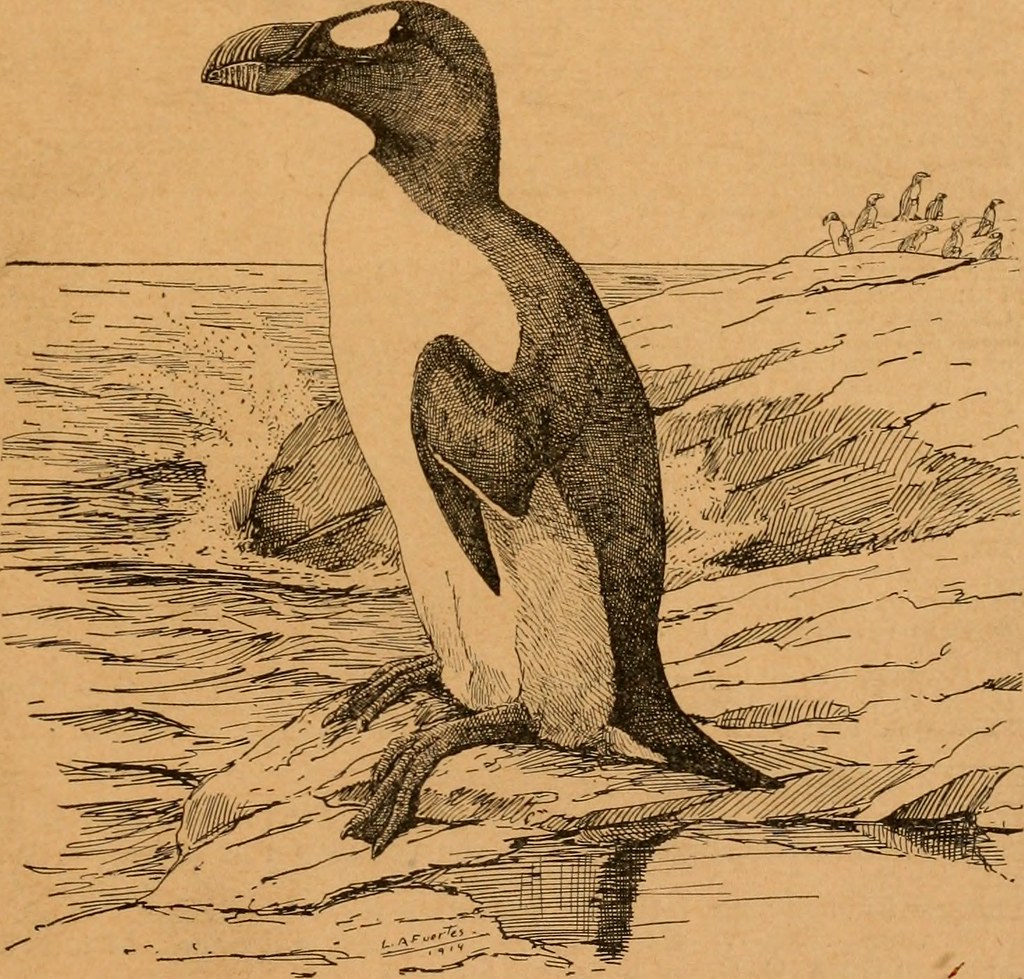
‘Landau’ is perhaps my favourite track, bouncy and melancholic at the same time. ‘Sundog’ is also very nice indeed. ‘The Fox and the Leopard’ contradicts everything I have said in the prior paragraph, being as softly jolly and funky as the earlier ‘Ecstasy of Dancing Fleas’. Perhaps I don’t know what I mean anymore. The Red Book (2014) and The Imperfect Sea (2017) present more of the same thing, hypnotic and wistful songs with a strong driving core that seems to want to become pure trance music. I haven’t yet seen them perform live but I absolutely will when I get the chance. This statement also applies to The Anteaters (who fell to earth). I had the privilege of being present when suggestions for a name change were open to their listeners. I had nothing to offer, but later the words ‘The Great Aukestra’ popped into my mind, an example of l’esprit de l’escalier (or ‘staircase wit’) in which one thinks of a rejoinder or a proposal when it is too late to be of any use. The great auk was the northern version of the more familiar southern penguin. It became extinct in the middle of the 19th Century and Anatole France wrote a satirical fantasy about a society of them called Penguin Island, in which he explains that the word ‘penguin’ first referred to auks. The great auks were the original penguins.
Image from page 48 of “The Auk” (1884)Penguins at Boulder Beach, Cape TownCourtesy: Creative Commons
I am about to go now, but I have just recalled that I forgot to mention a six track EP that the PCO released in 1983. The Penguin Cafe Orchestra Mini Album features four songs that can be found on other albums and two originals, one of which, ‘Piano Music’ (recorded live in Japan) is a gentle and dreamy piece that is also a little odd harmonically, reminiscent perhaps of Sorabji but not quite. It is nothing special really but it has a haunting quality despite its brevity. Yet the reason why this EP is worth hunting down is a track called ‘The Toy’, pure magic and too little-known compared with so many of their other songs. Right, I’m off.
[1]Ouvroir de littérature potentielle; roughly translates to “workshop of potential literature”. It is a loose gathering of (mainly) French-speaking writers and mathematicians who seek to create works using constrained techniques.
Rhys Hughes has lived in many countries. He graduated as an engineer but currently works as a tutor of mathematics. Since his first book was published in 1995 he has had fifty other books published and his work has been translated into ten languages.
.
PLEASE NOTE: ARTICLES CAN ONLY BE REPRODUCED IN OTHER SITES WITH DUE ACKNOWLEDGEMENT TO BORDERLESS JOURNAL











 Borderless