Ratnottama Sengupta writes she does not junk all the old Calendars and Diaries…
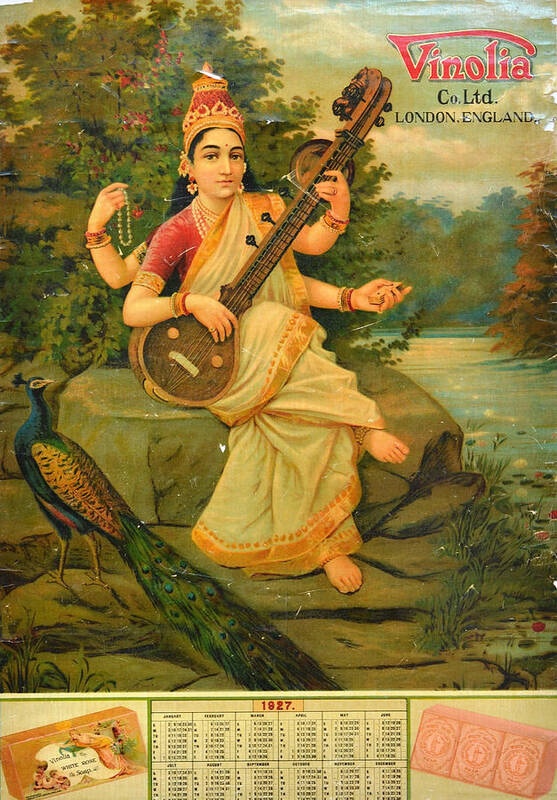
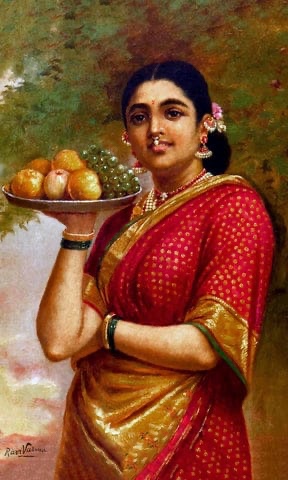
The dawn of every New Year brings with it the need for a new calendar and a couple of new diaries. So, wholesale markets in every major city on the map flourishes with these items in every shape and size. In the years of my growing up, a government organisation calendar, with only the dates and simply no illustration, was routine. Forget 12 images for as many months, even half that number was a rarity. This, even though in the previous decades Raja Ravi Varma’s [1] evocation of Saraswati, Shakuntala, Nala Damayanti or Lady with a Lemon, were coveted adornment for the walls. In certain instances, these images were individually dressed up with sequins and pearls too! Oleographs and mechanical reproductions had, by this time, won past hand paintings that once covered the mud-plastered walls with stories of Ram-Sita Vivaha[2], among others.
Calendars by Raja Ravi Varma (1848-1906). Photos provided by Ratnottama Sengupta
Since the turn of this century, which saw dealings in art skyrocket, galleries have made it a custom to bring out calendars on either a theme that’s tackled by a number of artists, or on works by one chosen artist. Simultaneously artists themselves became proactive in bringing out calendars sporting images of their own work. These are not driven so much with the need to publicise their creativity as to lend a personal touch to the annual give and take of ‘Season’s Greetings’.
I particularly cherish the textile scrolls published annually as calendar by my friend Subrata Bhowmik, one of India’s leading graphic designers. This ‘Design Guru’ has eighteen awards from the President for accomplishments in textiles, publications, advertisement, photography and craft communication. He was motivated to do these calendars in order to share what he learnt in Switzerland as also from his experience in the Calico Museum of Ahmedabad. And they spread a deep understanding of the contextual framework of design in the real world. I still cherish one such tapestry designed with Ajanta style beauties, though the year rang out seven years ago.
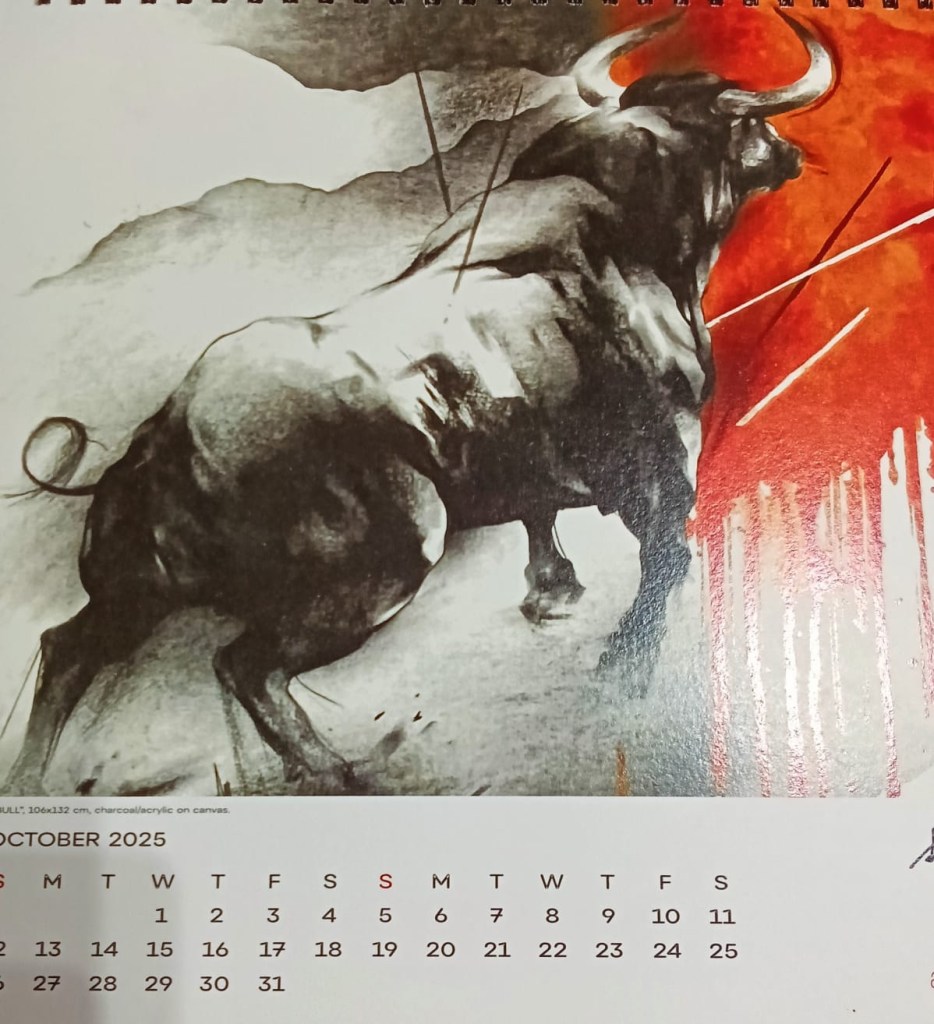
My friend Jayasree Burman’s desk calendar with detailed images of Laxmi Saraswati or Durga have, likewise, remained in my collection years past their expiry dates. Sohini Dhar used to regularly commemorate the memory of husband Ramlal Dhar with images of his landscape that shared pages with her own Bara Maasa, miniature style narration of the seasons. Ajay De’s limited-edition calendar published by Art and Soul gallery this January is in line with this custom.
Photos provided by Ratnottama Sengupta
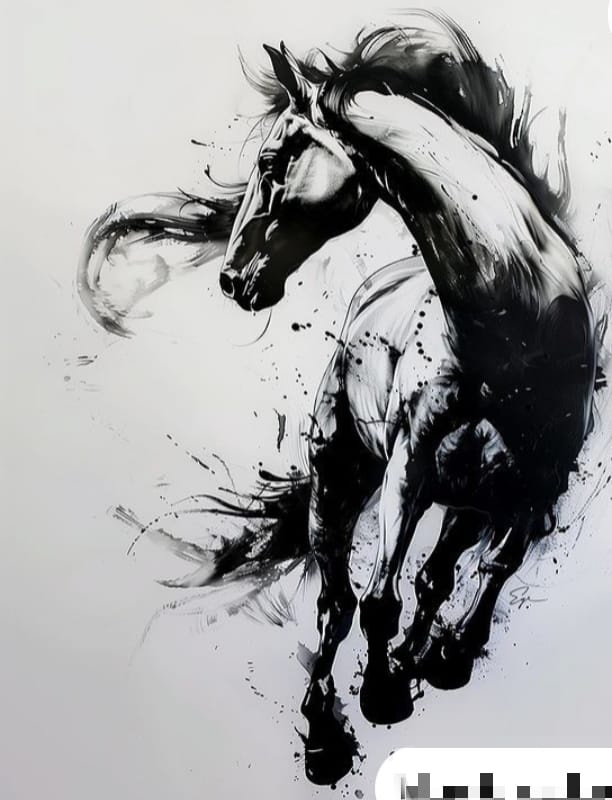
The passion in Ajay’s charcoal paintings of bulls and the stamina of his stallions bring to mind the energy of Assam’s wild boars that Shyam Kanu Borthakur familiarised; the vitality of the horses Sunil Das studied in Kolkata’s stables; the vigour of Husain’s much auctioned equines; even the animation of Paris-based Shahabuddin’s abstractions. However, the amazing vibrancy of Ajay’s treatment of a black and white palette acquires a touch of magic, with a red dot here or a wash of yellow there. And when he places the charging bull against a wall dripping the salsa red of blood, I recall the vivacity of a ‘Bull Fight’ that I had a chance to witness in Southern France a quarter century ago – before its forceful evocation in Pedro Almodovar’s Talk To Her (2002).
*
Prabal Chand Boral, as his name suggests, boasts kinship with Raichand Boral, a pioneer of Indian film music in 1940s. Not surprising that Prabal oftentimes breaks into songs on the terrace of his Kolkata home. Every Durga Puja finds him dancing with earthen dhunuchi[3]. And his diurnal routine finds him painting. Sketching. Outlining. Portraits. Flowers. Supernatural creatures. Illusive figures. Capricious forms. He creates videos to involve attentive viewers. And every year, out of his own pocket he brings out a wall calendar for private collection. “An artist craves to express himself in so many ways,” he told me last year when his calendar had sported six portraits in his signature style.
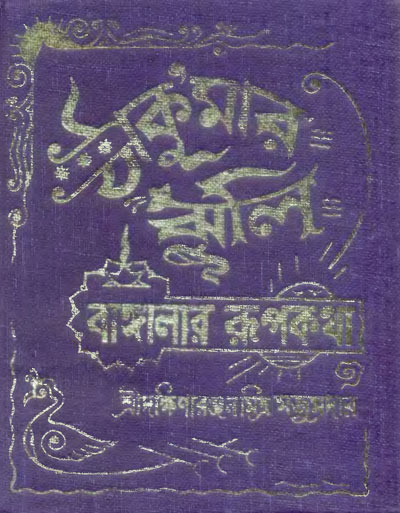
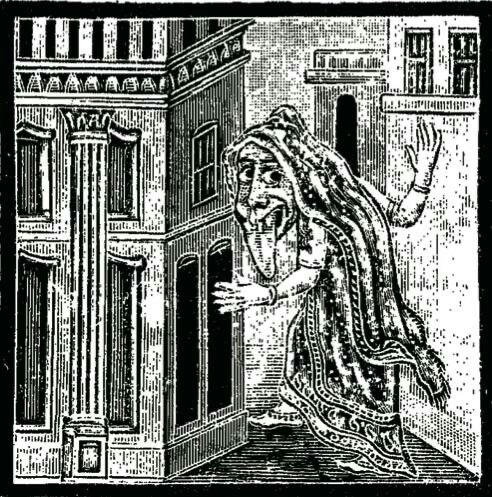
Thakurmar Jhuli (1907). From Public DomainDakshina Ranjan Mitra Majumdar’s illustration. Provided by Ratnottama Sengupta
This year Prabal pays an ode to Thakurmar Jhuli (Grandma’s Satchel). Written in 1907 – year 1314 of Bengali calendar — by Dakshina Ranjan Mitra Majumdar this landmark in Bengal’s pre-Independence literature compiles stories that have been orally handed down from one generation to another in the villages and backwaters of undivided Bengal. This was in the manner of the Brothers Grimm who wrote and modified Germanic and Scandinavian tales that have been translated, like Hans Christian Andersen, into every language spoken in the world. In the process they embedded in the collective consciousness of the West lessons of virtue and resilience in the face of adversity.
Much like them Dakshina Ranjan had gone around mechanically recording the tales of Lalkamal Neelkamal, Buddhu Bhutum, Dalim Kumar and Byangoma Byangomi. When first published, Nobel Laureate Rabindranath had written the foreword because he felt that publication of these legends was a need of the hour in order to counter the sense that only the European rulers had fairies, elves and ogres, imaginary beings with magical powers, to entertain and educate their young. Educate? Yes, because the dark and scary beings, even when they did not metamorphose like the Frog Prince, were metaphors for a state where the victim, though less powerful, always overcame the tormentor. Not only children and young adults but grown-ups too liked the stories that broke down the boundaries of time and culture. They encouraged and even emboldened the readers to look for wonder in their own lives.
Prabal had long cherished the desire to reinterpret the illustrations by Dakshina Ranjan himself. He has brought this to fruition with a touch of his own imagination. The result might not be a fairy tale – read, decorative – but none can deny the originality of this calendar.
*
I have personally felt happy to write for a diary – rather, a notebook – that has been published by Nostalgia Colours, a Kolkata based gallery that holds an annual exhibition in other metros of India. A number of the 17 exhibited artists are no longer with us in existential terms. K G Subrmanian, Paritosh Sen, Suhas Roy, Sunil Das, Robin Mondal, Prakash Karmakar — they do not eat-drink-chat with us across the dining table as they once did. Or as Anjolie Ela Menon, Jogen Chowdhury, Ganesh Haloi, Subrata Gangopadhyay and Prabhakar Kolte still do. But their watercolours and gouaches, contes and temperas continue to bring us as much pleasure as when these majors of art signed off their canvases. Only our viewing now is tinged with a certain sadness at the thought that they will no longer add new dimensions to Indian contemporary art scene with their thoughts, their arguments and their palette.
This precisely is what heightens the joy of an undated notebook richly decorated with aesthetic reproductions of not six or twelve but 52 works of art.
A thing of beauty, be it a calendar, a diary or a notebook, is joy forever. Raja Ravi Varma (1848-1906) can vouch for that.
.
[1] Raja Ravi Varma, an artist from the nineteenth century who mingled Indian and European styles
Ratnottama Sengupta, formerly Arts Editor of The Times of India, teaches mass communication and film appreciation, curates film festivals and art exhibitions, and translates and write books. She has been a member of CBFC, served on the National Film Awards jury and has herself won a National Award.
.
PLEASE NOTE: ARTICLES CAN ONLY BE REPRODUCED IN OTHER SITES WITH DUE ACKNOWLEDGEMENT TO BORDERLESS JOURNAL
Those were not the days to honour bravery on the domestic front. But if an award gets constituted to recognise such acts of valour, my grandmother would emerge as a strong posthumous contender. What she did remains remarkable, audacious, and inspirational to several generations of our family and relatives who idolise her for this singular outstanding quality that pushed her into the realm of greatness.
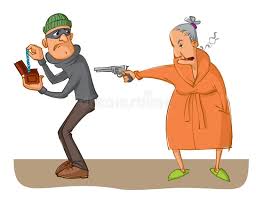
From the balcony of the second floor of the house in the village my grandmother was dumped – and assumed dead – by the band of veteran dacoits that had entered the mansion with the ulterior motive of robbery after a tip-off from some reliable sources that all the male members had gone to the city to place bulk orders for the upcoming festive season. Her agility to oppose the intruders and block their path was a source of irritation as they suspected their flawless plan would flounder in its execution if such resistance garnered support from the other families. Before conducting their operation in peace, they chose to get rid of the disturbing element. But they forgot to get the keys of the locker almirah from her.
Unfortunately, what they felt was designed to succeed had ended in disappointment as the old lady landed on a mound of haystack, suffering injuries that threatened to break her back but not her spirit. When one of their acolytes rushed down to search for the keys, she pretended to be dead by holding her breath. They could not find the key. The truth was that she had buried the bunch of keys in the haystack as soon as she crashed on the ground.
After the dacoit left her, she composed herself, swallowed her pain, and screamed louder than before, ensuring that the lamps in the neighbourhood lit up bright out of curiosity as the word daku[1] rend the air. Soon there were flames marching ahead to attack and overpower the intruders who thought it was better to retreat instead of facing the irate mob. With village folks arriving in droves to rescue her, the dacoits fled the scene without the booty, carrying with them only the jars of mango pickle lifted from the attic.
When she heard so many voices around her, including some familiar ones, she slowly opened her eyes but could not manage to get up on her own. She was carried inside the house and the medical examination revealed a fracture of the hip. After her sons and their families returned home to discover her in this state, they regretted their decision to leave her behind. But she said it was God’s plan to save the family fortunes. Within a few months, she regained the ability to walk slowly and she narrated dramatised tales of her big fight with dacoits. It was a fine blend of reality and her imagination. She became a feted character with immense popularity in the surrounding villages on account of her encounter and survival skills.
The trail of destruction that the intruders had left behind was in the form of overturned tables and dislodged beds, with sharp tools lying scattered in their hurry to escape the mob that her shout had garnered. Her narrative went through additions and alterations, making some infer what she reminisced was tweaked due to memory loss although it was her clever ploy to retain fresh appeal. Many people suspected she would never manage to regain her full strength and firmness, but her speedy recovery confirmed her bones had suffered minimal damage.
She basked in the glory of her valour and thanked God for giving her the opportunity to showcase this side of her personality that would never have emerged if this incident had not occurred. She averred she did not worry about personal safety for a single moment and acted the way her husband would have done. Such disclosures signified she was making a gender statement of equality, that she was no less courageous than her male counterpart who had settled well into his heavenly abode some years earlier. Now it was posing a challenge for her sons and daughters to set a higher benchmark though none of them looked capable of surpassing her next level of courage.
My grandmother herself was not sure how she gathered the intrepidity to stand in front of armed goons. Like flashes of brilliance, bravery also came in sudden spurts. Standing in the courtyard of the house, the sons assured boldly that if any dacoits made another daring attempt in their presence, they would chop their heads off with swords. Their stentorian voices did not carry an iota of conviction but they tried to convince their mother that they were equally brave and prepared to face life-threatening situations without any fear.
During their entire lifetime, the next generation did not suffer any violent attack or external aggression though they themselves were engaged in petty fights and quarrels that did not make them eligible for any honour. My grandmother lived a long life and always gave the family some reason to feel inferior. Without going to the battlefield, she had fought and survived a dangerous attack. As this story was still in circulation during our childhood, we grew up hearing it repeated with great interest from none other than our grandmother. She was corrected by other members of our family for introducing changes in the narrative she had shared earlier.
Mythological tales did not catch our imagination as much as her own story. We loved to hear it retold in her voice. The element of suspense retained freshness in her narrative and we were hooked to her storytelling. Although dacoits became a rarity by the time we were growing up, and their attacks were seen only in Hindi masala films, there was a recurring dream of facing a similar crisis where a band of dacoits would hold us hostage, but we would somehow manage to escape unhurt from their clutches.
Contemporary dacoits have become multi-tasking experts with a diverse set of skills as their earlier focus on the few wealthy families in rural areas has now shifted to other profitable, prepaid criminal gigs like contract killing and shoot-outs. They prefer to work from remote locations on a freelance basis just like writers and copywriters. The middle-class families now face burglary from thieves armed with daggers wafting in their apartments like evil spirits.
Travelling by train to visit central India, crossing the Chambal Valley known as the hub of dacoits, I was expecting dacoits on horseback, galloping ahead along the railway track, to catch up with the superfast train, to latch on to the door and enter the air-conditioned coach and hold the passengers on board captive at gun-point. This would be an ideal opportunity as I would –at the right time — emerge from the toilet and catch the ‘Gabbar’ [2] of their gang from behind, snatch his weapon and point it at his tilak[3]-smeared forehead, ordering his team mates to jump off the train before I finished counting fifty. This would be the best outdo the family record of heroism. Saving the lives of fellow passengers would make me eligible for the highest bravery award for civilians.
As I sat brooding over this possibility, the train crossed the Chambal region safely and the passengers heaved a sigh of relief. That the fear of such attacks still resides in many hearts was evident as the curtains of the windows were pulled apart only after the train had crossed the danger zone. My window seat had the emergency exit and I am sure if the attack had taken place, I would have been the first one to jump out to save my life and wait for better heroic opportunities.
Dacoits have appeared as positive characters with a sad story of exploitation that compelled them to pursue this profession. They have been glorified in our films for carrying a heart of gold, not just pots of gold. As some of them became political leaders after winning elections, one is forced to take a relook and believe in the forgiving nature of the masses who elect them and give them the chance to rule and become an integral part of the mainstream. Though I must admit I have no idea of how many dacoits turned politicians have helped the nation grow as their personal rivalries and internal fights culminated in their untimely end. However, the sobering impact of such narratives makes one reflect on the entire concept of who loots and plunders at an individual level and how the colonisers looted and robbed in an organised and official manner. It should not come as a surprise if their tales of violence and exploitation get compared with those who plundered cities and states though they were entrusted with the task of protecting them.
Returning to my earlier tale, my grandmother’s framed and garlanded portrait on the wall urged me to seek her blessings. Even though it was not exactly a case of getting thrown off by pillaging dacoits, my late grandmother blessed me one day with a chance to survive a similar attack. Getting pushed down the staircase by a nefarious businessman but landing safely without sustaining head injuries due to my proven skills of tackling motion while disembarking from moving local trains as they entered the platform, I was able to retain my balance and save myself, which made me think of the miraculous escape and how I got the privilege to emerge as a hero for the current generation. Perhaps the spirit of my grandmother stood firmly behind me and saved my head from cracking up like a coconut.
This scary episode made me feel closer to my grandmother. I have contributed to the glory of the family, preserving the rich legacy by making worthy additions to it. Those who were eagerly expecting to crush my skull were surprised to see me unhurt. Full credit goes to my grandmother for supporting me invisibly – though she is not around to see me replicate her distinction. Now we share a special bond and a common fate of surviving a deadly attack and telling the tale, rising in stature and esteem after the heroic fall.
[2] An allusion to a Bollywood hit dacoit leader called Gabbar Singh from the film Sholay (1975)
[3] A mark in the centre of the forehead with vermilion or ash to show devotion to a deity.
Devraj Singh Kalsiworks as a senior copywriter in Kolkata. His short stories and essays have been published in Deccan Herald, Tehelka, Kitaab, Earthen Lamp Journal, Assam Tribune, and The Statesman. Pal Motors is his first novel.
PLEASE NOTE: ARTICLES CAN ONLY BE REPRODUCED IN OTHER SITES WITH DUE ACKNOWLEDGEMENT TO BORDERLESS JOURNAL
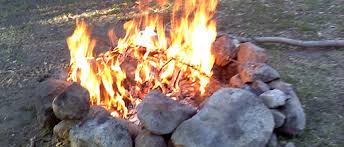
the expanse of the splintering fire flames flash across space time, pouring onto grey pupils. I like how they appear once, and then in another form: another.
lanterns of tinted glass in power starved the rural households, streaking through bland darkness. arrival of the faintest rays from the shaded corner of the mud brick encased kitchen,
lights the letters on the pages to life. rice puffs and fluffs on the oven pit, letting out splinters, across the skin of burnt deadwood, like sparks in the void of silence.
the newborn within me giggles to the flickering flames. carried by the wind across the face of decades of dead, burnt leaves, I search for consciousness.
I SEARCH FOR A FRIEND
I left my home; not knowing where I'd go. I search for my friend in
the narrow alleys led on by dim lit street bulbs. it is the aftermath of the Bengali New Year; feels like the last one to bless us.
my friend, he has a voice. he wants to sing. I run off in my pajamas for a front row seat
to the courtyard converted into an auditorium. I knock at his front door. years of knocking scatter to dilution.
the deserted terrace smiles at me. empty smile. empty house. rust crawls to my palm
from the railings. darkness piles on my sweaty shirt collar.
hands grappling through piles of epitaphs among cluttered newspaper columns. I search for a corpse.
Lokenath Roy, a writer from Kolkata who explores themes of society, memory, and the human experience, has published in several literary journals and online magazines like The Cawnpore Magazine, The Monograph Magazine, The Aeos Magazine and the Borderless Journal.
PLEASE NOTE: ARTICLES CAN ONLY BE REPRODUCED IN OTHER SITES WITH DUE ACKNOWLEDGEMENT TO BORDERLESS JOURNAL
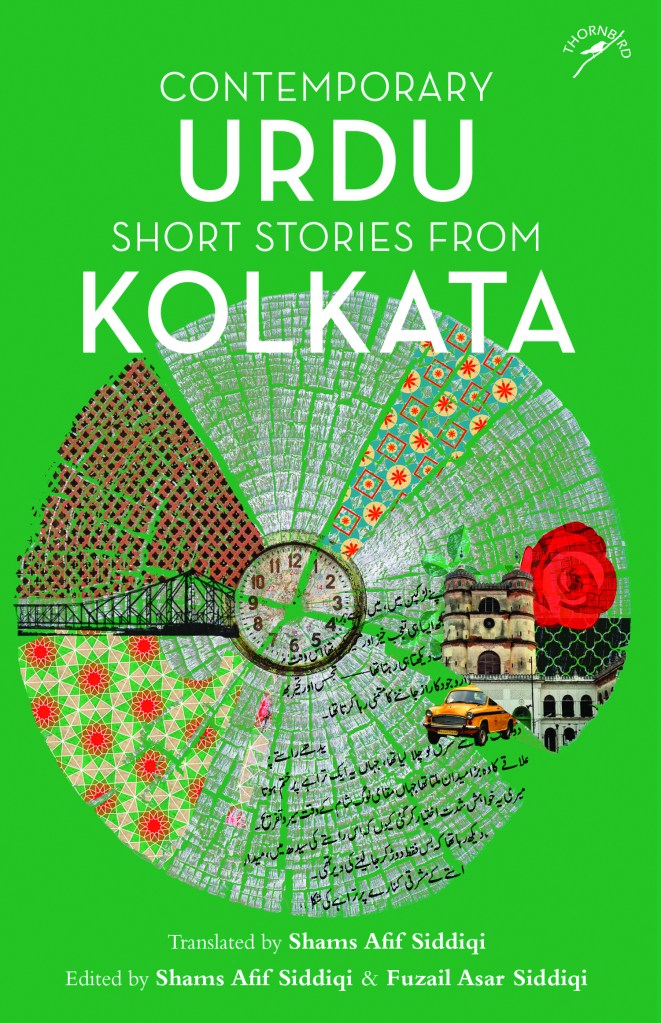
Translated by Shams Afif Siddiqi, edited by Shams Afif Siddiqi and Fuzail Asar Siddiqi
Publisher: Niyogi Books
The Stopped Clock
By Siddique Alam
The hands of the clock had stopped permanently at 13 past two and two seconds. Sitting on the bench under the shed, I am trying to understand the oval dial of the clock, the Roman letters of which had become dimmed and its edges covered with spider webs. I wonder when the clock might have stopped. I am 35 years old. Is there apparently any difference between us? Just like the clock, I have also stopped for a while because there was no announcement about the arrival of my train, its departure time being four hours ago.
I am trying to survey the place with wide open eyes. It is a usual day and an ordinary station that we are accustomed to see.
I have bid farewell to the city of my birth. I am leaving the city like a failure. But it seems after relinquishing me, the city, with a feeling of guilt, now wants to take me back. Its first step in this direction is to delay my train for an indefinite amount of time.
Despite being in the midst of a city, a station is free from its clutches. I am enjoying that freedom with a one-way ticket in my pocket. A bit of patience, I tell myself, and I would be far away. Nobody can stop me, neither by erecting obstacles in the way of the railway tracks nor by stopping the hands of the clock. Maybe I am a loser, but the journey of my life is yet to end. I am only 35 years old. I have to go far away from this place. The most important thing is that I am satisfied that the address I am carrying in my pocket is not my last destination.
It is a temporary waiting place that can help me make a new beginning. After all man is born free. The sun does not select a particular spot to shine, nor is every wave that dashes against the shore the last one, losing which the boatman would have to wait all his life for another wave.
An old coolie, wringing khaini[1] in the palms of his hands, passes by me. He is clad in a white banian and dhoti, his red flannel shirt thrown on his left shoulder.
‘Since when has the clock stopped?’ My question stops him in his stride. He turns around, his tired, thoughtful eyes staring at me. A sense of shame overpowers me. He may be an illiterate coolie, not a station employee who is answerable for such a question. ‘I am sorry,’ I quickly add, ‘I should not have put the question to you. I take back my words.’
‘Why sir?’ he stands by the side of the bench, and looks at me with a sense of intimacy. ‘People will be asking questions about a stopped clock, isn’t it? They cannot to be blamed. The story of the stopped clock is well known but only the signal man Gocharan Ray has the right to tell its tale. He had spent all his life showing green and red flags to trains and has retired today.’
‘Who has replaced him?’ my question betrays my foolishness. My imprudence had always entangled me in thoughtless acts.
‘Why don’t you ask the station master?’ The coolie moves away. ‘It’s a question that requires an answer; otherwise, you will regret it all your life.’
I was not ready for such an unexpected turn of events. I thought that my relationship with the city had been cut off forever. What do I make of a station that has ignored me, as if the ticket in my pocket is of no worth? Once again, I look at the dial of the clock hanging from the shed. It had stopped at 13 past two and two seconds. What might have happened when it stopped? Did an accident take place at the station? Had any incident of murder taken place? Was it at the time of the departure or arrival of an important leader? An attack by Naxalites? Or was the place the site of a communal incident?
The coolie returned again. This time he was wearing his shirt. ‘Unless you hear the story,’ he says, ‘your train will not arrive. This is the rule here. It may take weeks, months, or even years and you have to move from one platform to another with your suitcase. Once, a passenger alighted here to board another train. He faced a similar dilemma. He asked the same question about the clock but I do not know what happened and why he refused to listen to the story. Do you know what happened to him?’
‘How can I?’ I replied impatiently. ‘The city hardly gave me any time so that I could listen to stories.’
‘You are becoming irritated unnecessarily, Sir,’ he said. ‘I want to tell you about the man. The fact is nobody knows much about him. Some say he went to the city and did not return. Others say he took another train that never reached its destination. Some may even tell you that a prostitute took him to her house by the railway tracks where he developed leprosy and is slowly dying there. There is also no dearth of people who say he is still moving, suitcase in hand, amidst platforms, difficult to spot in the teeming crowd of passengers.’
‘You mean to say he can be anyone, even me?’
‘Did I say that, sir?’ He was on the verge of leaving. ‘It seems you have tasted bitter gourd.’
I was staring at the departing coolie’s back. The constant use of the flannel shirt had not only exposed its fibres, it had also thinned the material exposing the bones of the man’s neck. I have no hesitation in saying that I did not believe him. Since the time when suitcases developed wheels, the number of coolies has dwindled in stations. The last nail was the introduction of the backpack. Either passengers drag their suitcases on wheels, or carry luggage in their backpacks, leaving the coolies with little work. So, this may be their way of passing time.
About the Book
Dealing with love and loss, dreams and reality, as well as history and violence, this is a collection of best 19 short stories that encompasses the whole gamut of human experience, seen through the eyes of current Urdu writers from Kolkata.
Stories from Kolkata are often assumed to be about bhadralok culture and the Bengali way of life. But Kolkata is a city with amultiplicity of stories to share. Contemporary Urdu Short Stories from Kolkata highlights the diversity of recent Urdu short stories fromthe city. In one of these stories, a writer trying to escape the city wants to find the reason why the railway clock has stopped working, in another, a new friendship sours as soon as it blossoms, while some other stories show how the complexity of human relationships is explored. There is an experiment in abstraction, and legend and reality are brought together when three sleepers of an earlier civilization wake up in the modern world.
About the Editor and Translator
Shams Afif Siddiqi, former Associate Professor of English (WBES), author, short story writer, and literary critic, was born in 1955 in Kolkata. He taught in government colleges of West Bengal for 35 years and was a faculty member at MDI, Murshidabad. Khushwant Singh selected his short story for publication in The Telegraph in the 1980s. His publications include The Language of Love and other Stories (2001), a critical look at Graham Greene’s novels, Graham Greene: The Serious Entertainer (2008), and an annotated edition of G.B. Shaw’s Arms and the Man (2009).
Fuzail Asar Siddiqi is currently a PhD candidate at CES, JNU, New Delhi, researching on the modernist Urdu short story, in general, and short stories of Naiyer Masud in particular. The founder/editor-in-chief of an academic editorial services company, he has been an Assistant Professor of English at Gargi College, New Delhi.
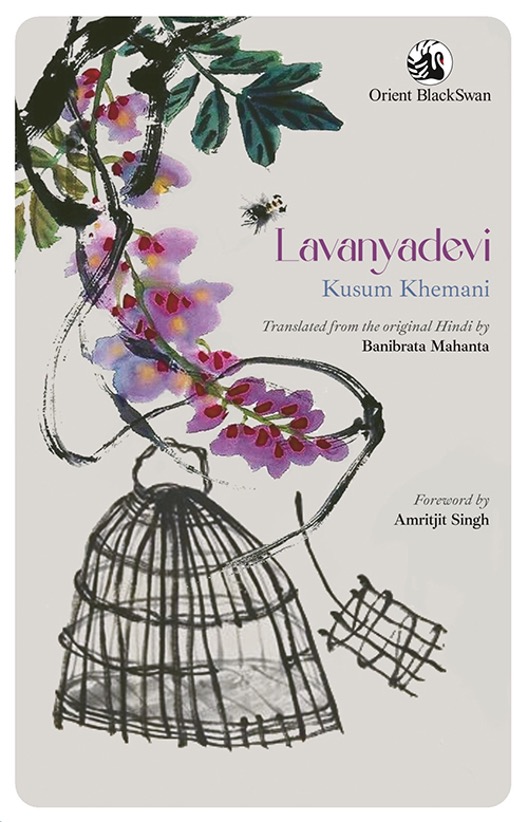
Author: Kusum Khemani (Translated from Hindi by Banibrata Mahanta)
Publisher: Orient BlackSwan Private Limited
Lavanyadevi is an award-winning 2013 novel by Kusum Khemani written in Hindi that chronicles five generations of a traditional aristocratic Bengali zamindar family as it transitions into modernity from British India to the present with the eponymous protagonist as its principal focus. Lavanyadevi—a compelling woman of perfection, extraordinary vision, qualities, and grace—remains real and credible because she is self-aware, self-critical, open to others, and to change. As a Marwari (people originally belonging to Marwar in Rajasthan) living in Kolkata, in Khemani’s fiction the schisms between ‘Bengali’ and ‘Marwari’ blur to reveal a delightfully plural, composite, and distinctively Indian ethos. Lavanyadevi is a story about women and their search for self, about shared laughter and friendships that endure across generations, beliefs and cultures—between mother and daughter, grandmother and granddaughter, and Marwari and Bengali women. Khemani’s women protagonists are strong, clear-sighted, both worldly and sublime, embodying a larger-than-life idealism while being grounded firmly in the everyday.
In his introduction to his novel Kanthapura (1938), Raja Rao had defined it as a sthala-purana[1], which he defined as a “legendary history” in which the old lady narrator in the village took recourse to the traditional Indian narrative technique, digressed at will to bring forth her point. Somehow the way Kusum Khemani takes recourse to multiple narrative techniques in Lavanyadevi and binds the different digressive stories and incidents into one contiguous whole when she tells us about the history of five generations of the Bengali zamindar family, reminds one of Raja Rao’s theory. She uses diverse narrative strategies like flashbacks, diaries, letters and emails, history, memory and the third person narrator to enrich its telling, lending it depth and range. A large part of the narrative revolves around telling us about past history when Lavanyadevi manages to lay her hands on her mother Jyotirmoyidevi’s diaries and finds great pleasure and thrill of reading one’s own family history. Not only do they offer a wonderful eye-witness account of the private and public sphere of Kolkata of those times, but they also make her easy transition into reading about her mother’s youth, her elaborate description of her magnificent wedding and the rituals that spread over almost a month.
The diary as metanarrative and the protagonist as reader/narrator are particularly effective, offering a telescopic perspective. Though at times it rambles a bit, the polyphonic structure of the novel engages Lavanyadevi the granddaughter, the daughter, the wife, the mother and the grandmother in conversations with her preceding and her succeeding generations. One must sometimes go back to the family tree and chart provided at the beginning of the novel to place people in proper perspective.
From the very beginning of the novel, Khemani portrays the character of Lavanyadevi in superlatives and this continues in different phases of her life till the end when she decides to remain incognito in the mountain ashram and yet control the lives of her descendants, well-wishers and others. From a child who always stood first in school and remained wholly ignorant of the real world, to her unusual marriage to a gentleman who moved over to Rangoon and then to London where she acquired many more degrees, till she came back to Kolkata, to rear her three children successfully, she seemed to excel in everything. This is how she is described at one place:
“Lavanyadevi was indefatigable. She administered the work of several institutions, her college and her home efficiently and with ease. She was never seen to panic. She was like Goddess Durga with her many hands – untiring in her zeal, handling all her duties unfailingly, responsibly and meticulously. No one could ever complain of being ignored by her. She loved all and treated everyone with the same degree of love and warmth. Scrupulous and hardworking, always upholding truth, Lavanyadevi was the unmatched standard of excellence in all aspects of life, her words worth their weight in gold.”
After judiciously assigning different welfare projects in the city as well as in far-flung places like Dhaka and the hills in Uttarkashi from the immense money she inherited from the family, and after her husband’s demise, Lavanyadevi decided it was time for her to leave the family premises and go and live in an ashram in the hills. There she did not stay in hibernation but her travels for work grew even more frenetic.
From the very beginning her rootedness and belief in the philosophical framework of Hinduism formed the core of her being. They propelled her to seek answers to questions of satya (truth) and mukti (liberation) that confronted her in the latter half of her life. She decided to transcend immediate personal concerns and address larger universal issues. Her transition from grihastha (householder) to sanyasa (renunciate) harkens back to the Hindu ideal of human life divided into four phases. However, contrary to the conception of life in isolation, Lavanyadevi, free of any kind of worldly considerations in this final phase of life, marshaled material and human resources to create a strong network of seva (social service) across the country and even beyond its borders. The list of her welfare schemes is too long to mention in the purview of this review, but ranged from renovating brothels in Kolkata’s red-light areas, creating self-help centres for rural women in Dhaka, de-addiction centres, eco-friendly schools in the hills, organic farming in South India, etc.
In the latter half of the novel, we find Lavanyadevi successfully transmitting her values and ideals to her children and grandchildren who are called the “Saptarshi Mandal friends” and who carry her legacy forward and emphasise that progress does not always mean breaking from the past. Here the novelist becomes too idealistic and brings in too many issues that seem a bit far-fetched. Issues of inter-caste and inter-religious relationships apart, the list of social welfare missions seems endless. Her “soul-children” unobtrusively usher in change and create space for diversity in relationships and ways of living. Harmonious cohabitation with nature became the foundational principle of all the education centres she built in the hills but the way she invisibly controls the activities of all her soldiers through emails and emphasises the middle path of life makes the advocacy of humanitarian concerns a bit overemphasised. She becomes larger than life for ideas and wish-fulfilment.
A Hindi novel about a Bengali family by a Marwari woman from Kolkata became significant when it was commissioned for translation into English. Winner of the PEN/Heim Translation Grant 2021, the jury called Lavanyadevi an ‘ambitious, far-reaching’ novel, lauding Khemani’s ‘energetic prose, deadpan sense of humor, and exquisite control’, and Banibrata Mahanta’s translation that ‘stretches and manipulates language to produce a vivid text’ and a must-read for lovers of Indian literature. Here one needs to mention the seriousness with which Mahanta gives us the ‘Translator’s Introduction’ at the beginning of the text and again ‘Translator’s Note’ at the end. This reviewer feels that both these could have been combined into one general essay highlighting the significance of the evolution of the Marwaris in Bengal, how Khemani’s novel is a hybrid artefact born out of multiple linguistic and cultural encounters, how the characters in the novel speak in languages other than Hindi produces dialogues in Bangla, Marwari, Haryanvi or Punjabi; and how between a breezy translation and a linguistically nuanced one, wherever possible the translator has eschewed the former and gone for the latter. As he rightly admits, translating this complex narrative into global or even a pan-Indian English is always risky, but Mahanta should be given due credit for overcoming all obstacles and bringing this immensely readable novel to a wide readership.
Newspapers with audited accounts of circulation and readership surveys gave the opportunity to claim that your piece was read by millions of readers. Even though the metrics did not suggest how the individual piece performed in terms of garnering readership, the millions of people who bought the newspaper were assumed to have read what you wrote. Unlike the digital space where the complete picture of reads, likes, and shares is accessible, the traditional media platforms provided a cover to indulge in tall claims of popularity and the collective statistics delivered a high to those who dabbled in writing to see their name in print. Even if the truth was that your piece was the least read one, there was no way to establish that in the editorial room where the high-brow editors cherry-picked on the basis of quality of writing and the relevance of the topic.
Bouquets and brickbats in the form of letters to the editor was the only reliable way to assess the merit or demerit of the piece, but these letters were dashed off as reactions to columns by leading commentators in the belief that the editor would grant space for the feedback on what the heavyweight columnists churned out. Readers were apprehensive that their letters would end up in the slush pile if they focused on newcomers. This fear was not unfounded as the interactive engagement often appeared limited to luminaries and experts on the edit pages.
Being published next to a syndicated column meant the equivalent of placing your debut novel on the same bookshelf where the works of a bestselling novelist were displayed. As neighbours, you had the liberty to brag about enjoying the same status even though your readership was negligible. You rushed to the newspaper vendor to buy additional copies of the same edition and keep it archived in your portfolio of published works. Printing xerox copies for circulation in your group of friends and relatives was the next big activity but the target group pricked your ego by saying that they do not read the newspaper that carried your piece. It was a polite way of saying that your breakthrough was no big achievement as they did not consider that newspaper suitable for reading.
The desire to see your name in print again and again was a good motivator in the initial stage. Since you never knew you would get the same space twice in a month, it was a struggle to try another kind piece to ensure you were carried on some other supplement page in the next week. You wanted readers of all age groups to notice your name in the newspaper, to register it in the list of frequent contributors. The easiest way to do so was to keep writing on a diverse range of topics. The byline fever gripped you and a week without a piece in the same newspaper or its competitor felt like a long gap of staying away from the limelight. Writing in a hurry also involved the risk of getting your piece rejected. Maintaining the same quality of writing and factual accuracy through proper research work was important because the team of editors should not get disappointed with any of your submission. As a precautionary move, bombing them with low quality pieces for the sake of byline was ruled out. But the obsession to become a regular contributor with a dedicated space led to several attempts across multiple genres to find your strengths. Even though you were able to find out what worked better in terms of flow and engagement, it was not possible to share the same observations with editors who drew their own inferences.
To keep struggling to write with no reward meant sustenance despite all odds. In such a situation, the byline was a big attraction to continue writing. If journalistic writing led to occasional disappointments, you had the freedom to turn to middles and infuse a dose of humour. There was further scope to write short stories and create a new world of awe, with the illustrator adding visual attraction to the theme of your fiction. This was a great opportunity to find your creative bent and, in case, it clicked, you could submit more elsewhere before getting a solo book of short stories published. Writing for some years in this fashion gave you adequate exposure and you turned confident enough to switch from regional publications to national dailies. Listing these achievements in the resume managed to draw the attention of an employer who himself was keen to get published in the same newspaper without releasing advertisements.
There was anxiety and depression every weekend as the expected publication of your piece was delayed due to editorial discretion. You went to browse at the nearby bookstall to know if you were inside the pages. The joy of seeing your name in print lit up your eyes and you picked up extra copies of the same publication without explaining to the vendor what made you do so. If you were lucky to find space for some weeks at a stretch, you chose to subscribe to it. But when you fell out of favour due to changes in the editorial policy or on account of a new editor storming in with his loyal team of freelancers, you felt like cancelling the subscription plan and never writing again. This temporary phase was soon over – when you found another piece of yours getting picked up by a rival publication. You felt buoyed again, determined to get your byline pieces carried to various homes. Your family was glad you were getting published so they did not discourage you. But they were aware you were getting close to the space where politicians dominated. They were convinced you had a future in writing even if it was an unstable one.
Although the honorarium was a modest amount, the thrill of getting paid for the piece was intense. You felt encouraged to write more to get those cheques and line up for encashment in MNC banks. The recovery of courier and stationery expenses from the published works removed the guilt of suffering losses in case of rejections. The newspaper stayed the whole day on your desk and additional copies were displayed in the lobby or the entrance, to let the guests or visitors catch a glimpse of the edition becoming special with your piece. The frisson of delight petered out as the frequency of publication gathered pace. Many readers, including friends and relatives, wrote to the editor in praise of your piece even though you never got to read those flattering comments in print.
When a delighted reader approached the newspaper office to gather your postal address and mailed a long epistle in appreciation of the style, it was an out of the world experience in the pre-digital era. When the elderly reader requested you to meet him at his residence, you did not feel shy to reach out to a stranger. Despite the wide age-gap, the conversation flowed well on writing issues as he was curious to find out whether it was a flirtatious relationship with writing or something more serious and everlasting would flower. Without confirming anything, you let it remain open-ended and interpretative. Despite your best efforts, the elderly reader inferred it was going to be an enduring relationship. When he confessed he was a writer with a book out of print, it was a humbling experience as you sat in front of a published author whereas you had no such credit. He got up and offered a signed copy and sought candid feedback on his work. You felt being the chosen one who could revive his interest in writing and motivate the septuagenarian.
You were also reminded of similar moments of frustration and encouragement from multiple sources. In his case, the story was different as he was battling health issues and yet seeking out advice pertaining to whether he should pursue writing or quit the domain. You felt like saying the magic of creativity should be kept alive even if there is nothing rewarding in the pursuit. You did not need to read the book to deliver this piece of advice. Whether he took it seriously or brushed it aside as a generic observation could not be ascertained. Later attempts to communicate proved futile. Perhaps he was gone, from the city or left the world, or maybe, the landline phone was dead. Searching for his byline in the newspapers and tomes in the bookstores produced no result. You did not feel like trudging up to the same apartment to uncover a bitter truth.
Your friends in the varsity were the most critical readers who always found something lacking in your piece but were also generous to appreciate the attempt. Some were jealous and competitive – driven by the urge to appear on the same page – and they went to the same editor with their submissions. Unable to bear rejection, they spread the word that the editor sought freebies to publish opinion pieces and it was the surest way to get a byline. Despite getting featured in multiple publications, the child-like curiosity to see your name again and again retained its flavour. Writing became a habit as a result, and the desire to be published generated the desire to write. Sustaining the urge to write was immense and, once it became a regular habit, everything else ceased to matter. You were confident of facing the blank page despite flak and rejections. Even if you wrote five pieces in a month and four of them were spiked, you had the satisfaction of seeing one in print. This was good enough to keep the pen flowing. You became more risk-bearing and tried out other avenues and other forms of writing at the same time. As the digital world opened up more options, you began exploring the writing opportunities on a global scale.
Years of honing your craft offered a better understanding of the writing world and the real world. When a young person read your piece against dowry and went to the newspaper office to collect your address and visit your residence and offer you a proposal to marry his sister, it was a moment of realisation how writing shapes perspectives and the immense responsibility it carries. It was an episode to remind you that good writing is read and the writer must pen his words with social responsibility. Such early encounters made you understand the value of writing beyond the power of bylines.
The writer must be prepared to reach a mature stage when the byline fever subsides. Whether you acquired a thousand bylines becomes immaterial after a certain stage, but the role of byline in offering you anchorage and encouragement cannot be sidelined in the formative years of your writing career.
Devraj Singh Kalsiworks as a senior copywriter in Kolkata. His short stories and essays have been published in Deccan Herald, Tehelka, Kitaab, Earthen Lamp Journal, Assam Tribune, and The Statesman. Pal Motors is his first novel.
PLEASE NOTE: ARTICLES CAN ONLY BE REPRODUCED IN OTHER SITES WITH DUE ACKNOWLEDGEMENT TO BORDERLESS JOURNAL
When a friend of mine glorified living in the hills and suggested I should live close to nature in order to nurture my creative side, I disagreed without showing displeasure as it would have appealed to me a decade ago. Instead of shifting to the mountains to forge a deep connection with nature, now I prefer to increase my interactions with nature and its elements in the nearby surroundings every day. Even if these exchanges are small and trivial, these are spread throughthe day and keep happening with amazing frequency.
Finding ample time to feel the presence of nature all around leaves me with negligible desire to relocate to the hillside where I would have the privilege to spread myself on a roadside bench and gaze and wave at newly married couples clasping their hands and walking down the road with melting ice-cream cones. I do not wish to turn into another such old man with a toothless grin, who never shies away from showing his naughty side whenever an opportunity arises.
Not considering such indulgences as effective remedies to stay young at heart during old age, the all-pervasive burst of energy actually comes from the bout of inspiration to produce a new creative work. The hills or the muse are just two known – and popular – sources while the fact is that there are infinite sources to explore. It depends on the individual embarking on this journey to awaken the creative self.
Hills are romanticised and considered to be the abode of purity with the power to trigger creativity like no other place. My recent visits to the hills did not prod me to write. While such a visit could be inspiring for many people who prefer the serenity of the hills to produce a masterpiece, I would consider myself an exception or a part of the small group holding a divergent opinion. Those who say you do not face writer’s block on the hillside are not telling the entire truth. Without contesting their belief, I am quick to retort by saying that I do not stare at the blank page and do not face any shortage of ideas here. I am happy to live in the plains and remain a plain writer without any complaints.
Those who live in the hills and write profusely get to write about nature and the people they observe closely during their long walks. The hill towns also have a vast population of ghosts to write about since they prefer to live and breathe clean, fresh air and enjoy the mist and fog of the mountains. This category of dead folks brings so many stories to life. With deadpan humour, the writers relate engaging stories but if there is an abundance of paranormal tales from writers in the hills, it does not mean that the writers from the small towns across the country do not have spooky encounters to narrate. There is no dearth of ghosts to explore in the haunted, dilapidated buildings, cemeteries and treetops. If the emerging and established writers take a keen interest to spin bewitching tales, there can be a potpourri of ghostly delights to feast upon. Instead of trekking to the hills in search of lively characters where the human population is not dense, it is better to seek variety in the plains where the population is teeming with saints and sinners of varying degrees, climbing the heights of divine glory and plumbing the lows of depravity.
Abandon the idea of finding a goldmine of ideas in the hills and choose to focus on the world you live in. Relocating to get inspired involves disconnecting in the greed of enrichment. The ability to source the hidden treasures from the town or the locality comes to those who respect it unconditionally, just as we value the love we get unconditionally. There are many who leave for the hills to become fantastic storytellers, but their output fails to impress and loses consistency. Only when they come down and hit the mean streets, travel in crowded buses and trains, enter flea markets and dingy, narrow lanes do they become an integral part of the creative madness and their output shows that solitude is not the sole stimulant: a chaotic environment can also work its magic to stir creativity in wandering souls.
In case you have garnered a modicum of success and wish to experiment, you can try the hills or the beaches to measure the impact on your creative output. But in case you realise you can write well without changing your pin code, and all you need is a house with big windows providing a wide view of the verdant garden lined with trees and plants, offering a clear vision of quietness, then you can deliver a good creative work by sourcing material from the life lived, from the things you can imagine.
Taking a short break to tour the hills has left me disappointed once again. A depressed state of mind and boredom gripped me more than the lush green vistas. I missed the traffic, the mad rush for trains, and the tearing hurry to cross bridges, the restlessness to leave others behind. The sense of satisfaction found in the hill people seemed to infect me. With limited sources of entertainment, preferring to hit the sleep mode was the best thing to do. The idyllic scenery relaxed me for a few days and then the craving for frenzy took over. Depriving myself of it further would make me sick. So, I returned earlier than I had planned to, with the realisation that writing in the hills would be a challenging job for me. It could force me to quit writing forever. I could well be one of those seasonal types who retreat there to recharge their batteries and come back super charged to face the daily hectic grind of the real world.
How long would an ambulance take to reach me during a medical emergency in the hills also loomed large as a growing concern. Negotiating a sharp bend and thinking about such situations made me feel low. As I grow older, I refuse to be enchanted by apples and apple-picking. The childhood fancy of farm-picking sessions, of plucking litchis, berries, and cherries and apples and eating them in the orchards can be skipped or realised within a week. This charming activity cannot make a strong case to become a resident of the hills. Besides, the local market in the neighbourhood has good supplies throughout the year.
Dozens of markets, malls, bargain stores, eating joints, beauty parlours, and multiplexes are likely to be missed in the hills where consumerism is still not rampant. Aside from natural produce, other staple items are more expensive in the hills. Maintaining budgets would be an uphill task for an aspiring writer. Farmer markets would tempt me exploit those, but I do not want to join the list of discredited experts who exploit and then write about exploitation, thereby showcasing their hypocrisy to the world. Locating an advertising agency in a hill station would be another challenge as the clients think creative honchos from the ad world and film world live in the big cities. Agreed, having a second home in the hills for vacation purpose or weekend breaks is a good option. But writers cannot have this luxury unless they churn out bestsellers to finance a second home.
You could be a writer who is read not just in the hills but also read by those from the plains and beyond. Make your location immaterial for writing. Junk the idea that a masterpiece with a universal appeal can come from a serene place alone. Writing thrives with speed, pace, and action. And the plains are remarkably good at offering this advantage, not just the slow-moving life and stillness in the hills that makes the mind race faster when the body is in a state of relaxation.
Devraj Singh Kalsiworks as a senior copywriter in Kolkata. His short stories and essays have been published in Deccan Herald, Tehelka, Kitaab, Earthen Lamp Journal, Assam Tribune, and The Statesman. Pal Motors is his first novel.
PLEASE NOTE: ARTICLES CAN ONLY BE REPRODUCED IN OTHER SITES WITH DUE ACKNOWLEDGEMENT TO BORDERLESS JOURNAL
It flaps and growls, Gathering all its might. But it's hollow like an empty can, And the wind doesn't help either.
It looks fierce But sways lightly From side to side, Unsure of its footing.
So, how long before you Lift your head, Look it in the eye And then reach out to crumple -- The daunting paper tiger Made of the sheaves of lies?
Ananya Sarkar is a creative writer from Kolkata currently living in Bangalore. Her work has been published in various ezines. She loves to go on long walks, cloud gaze and ponder upon miracles. She can be found on Instagram @just_1ananya and reached at ananya7891@gmail.com
PLEASE NOTE: ARTICLES CAN ONLY BE REPRODUCED IN OTHER SITES WITH DUE ACKNOWLEDGEMENT TO BORDERLESS JOURNAL
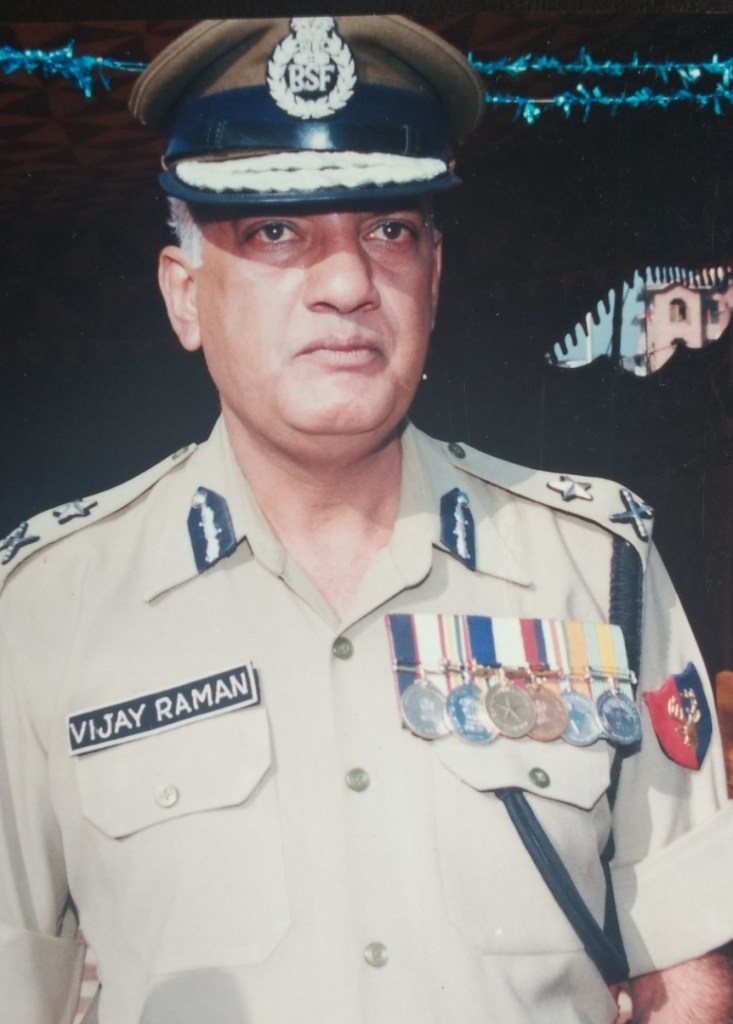
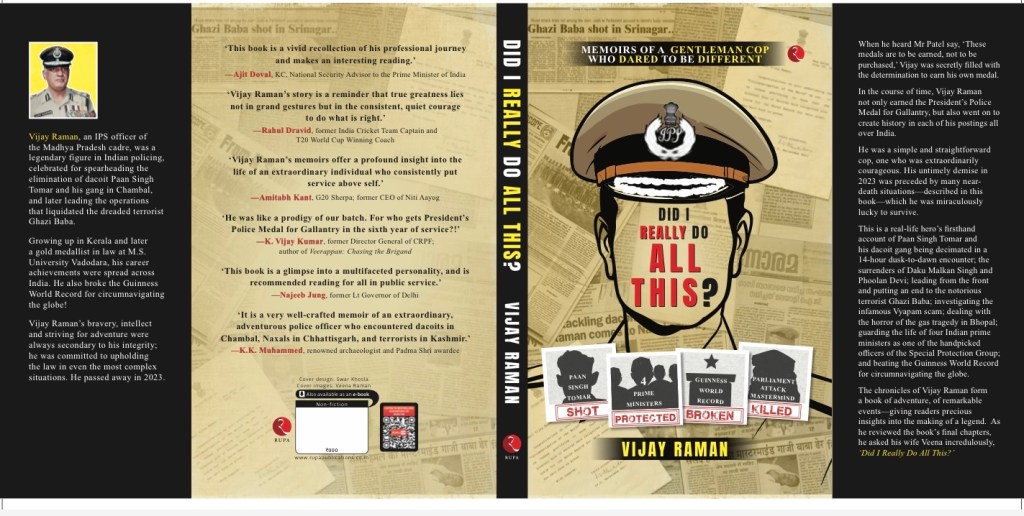
Ratnottama Sengupta, introduces the late Vijay Raman and converses with Veena Raman, the widow of this IPS[1] officer, about his book, Did I Really Do All This: Memoirs of a Gentleman Cop Who Dared to be Different. The memoir was recently launched by Sengupta and brought out posthumously by Rupa Publications.
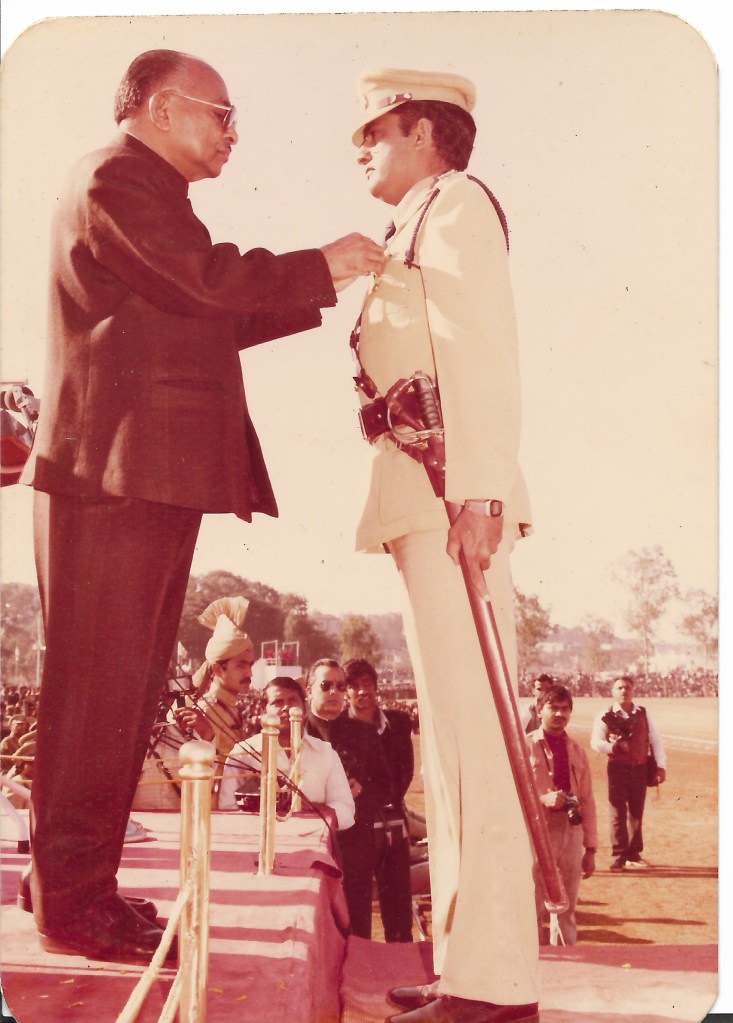
Vijay Raman (1951-2023)Vijay Raman receiving the President’s Police Medal for Gallantary in 1985Photos provided by Veena Raman
Vijay Raman’s success as a police officer was not merely a personal triumph. The career of this IPS officer traced the changes in the history of India’s security measures. India’s police organisation in 1947 — the Intelligence Bureau, Assam Rifles and CRPF[2] — were legacies from the British Raj. The 1962 Indo-China War led to the creation of the ITBP[3]; the 1965 war with Pakistan formed the BSF[4]. Investments in the Public Sector Undertakings led to the establishment of CISF[5]. Indira Gandhi’s assassination in 1985 led to crafting of SPG[6]. The sabotaged crash of Air India’s Kanishka[7] and the Operation Blue Star prompted the formation of NSG[8], and the 2008 terror attack on Mumbai was followed by NIA[9]. Vijay Raman’s life was intertwined with these organisations. He was also responsible for bringing in a number of terrorists and dacoits, including the notorious women dacoit, Phoolan Devi[10] (1963-2001)…He died last year.
In this conversation, Veena Raman[11] reflects on his life and his memoir, Did I Really Do All This: Memoirs of a Gentleman Cop Who Dared to be Different.
Veena this book is a tribute to a police officer who brought honour to his uniform. Having met Vijay Raman I know how wonderful a person he was – deeply loved by not only his family and friends but also many VIPs he interacted with in his professional life. Is this your way of mourning his sudden demise?
When Vijay passed away we — my son Vikram, daughter-in-law Divya, grandson Shaurya and I — were devastated. The cruel illness was swift and relentless: within months he grew weaker before our eyes, and before we were ready to accept the loss. We had no choice but to face it. While we tried to console each other Vikram said, “Mamma we should be grateful that we had him for all these years. After all, Papa was that proverbial cat with nine lives!”
Really?
Absolutely. And why nine? I can give you 19 instances in our years together when his life was in danger and he miraculously escaped.
I am all ears Veena!
At the very outset, in November 1978, when Vijay was in his first posting as assistant superintendent of police (ASP) in Dabra, Madhya Pradesh, a country-made bomb was flung at his jeep by agitating students in Gwalior. It fell and exploded nearby. Fortunately, no one was harmed.
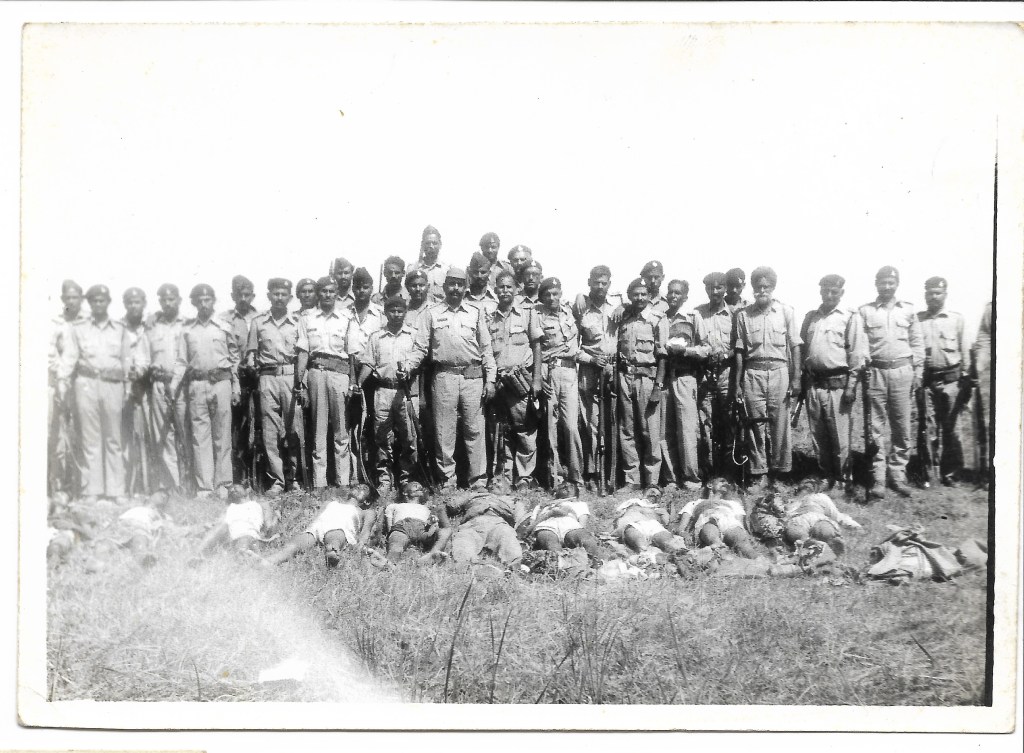
In 1981, based as he was in the Chambal, notorious for dacoits who stalked the nooks and crannies of the ravines, my illustrious husband had already faced dacoit encounters. The most dramatic of these took place in October, when he led the team that wiped out Paan Singh Tomar who, with his gang, had terrorised the region for years. As he describes in the book, bullets had rained on the encounter team from all sides, caught in the crossfire between the dacoits and the police.
The Pan Singh Tomar gang after a dusk to dawn encounter submits to the police: Photo provided by Veena Raman
He was superintendent of police (SP), Special Branch in Bhopal when the world’s worst industrial disaster took place. On the night of 3 December 1984, more than 40 tons of methyl isocyanate (MIC) gas leaked from the Union Carbide pesticide plant. At exactly that time Vijay was driving to the railway station. “Why inconvenience the driver to stay up late when I want to receive my parents myself?” he had argued.
Within minutes the gas had created havoc. He was shocked to see hundreds killed and untold hundreds maimed. Somehow he and his parents, so close to the scene of destruction, were spared.
In 1998, as inspector-general of police (IGP) Security, Jammu and Kashmir, while Vijay was in Srinagar, a bomb blast took place on the route during the hour he routinely travelled to office. He was saved that day because his driver had taken an alternative route!
In 2000, as IG-Border Security Force (BSF), Jammu, Vijay was responsible for erecting a much-needed part of the fence between Pakistan and India under highly adverse conditions. Enemy bullets rained down from across the border throughout the operation. That forced him to take some daring and potentially controversial decisions. How very relieved and thankful we were when he came home safe!
Vijay was appointed IG, BSF, Kashmir, in 2003 with the secret mandate to get Ghazi Baba, the mastermind of the 2001 attack on the Indian Parliament. Along with an informer, he had gone on an undercover exploration of the site where the encounter eventually took place. Most unexpectedly the informer pointed out the man himself! Vijay instinctively tried to open the car door and rush out to apprehend the terrorist. The informer roughly pulled him back and screamed to the driver to step on the accelerator and escape immediately. Later the informer explained that Ghazi Baba never left his lair unless he was strapped with explosives, and an attack would have spelled explosions that would have been the end of everyone in the vicinity.
Did he ever face a situation that he regretted?
One of the most dangerous situations Vijay ever faced in his risk-fraught career was as Special Director General (DG), Anti-Naxal Operations of the Central Reserve Police Force (CRPF). In April of 2010, many of his men were massacred in Dantewada by Naxalites. The loss weighed so heavily on him that his health declined: he neglected his meals and even forgot to take his medicines. He had moved from the headquarters in Chhattisgarh to Kolkata; Vikram and I were in Delhi. We understood the intensity of what he was going through only later, when he suffered a stroke.
Did your angst-ridden years end with his retirement?
Not really. For, four years after he retired, in 2015, Vijay was handpicked to be a member of a special investigation team (SIT) to investigate the Vyapam (Vyavasayik Pariksha Mandal[12]) examination scam. This was a challenging assignment because the entrance examination admission and recruitment had been going on since the 1990s and had come to light only in 2013.
Did he do anything that was not challenging? What got him a place in the Guinness Book of World Records?
Vijay came close to death even in the personal adventure he undertook with a friend. Together they circumnavigated the globe in an Indian-made car in the last 39 days of 1992. Don’t forget, that was an era when Indian manufacturing was just coming of age. Though this tremendous feat earned him a place in the Guinness Book of World Records, he was exposed to danger of a different kind. For 39 days, they drove at very high speeds, in different countries, different terrains, and different political climates. Let alone sleep on a bed, many a night they could not even catch 40 winks. And still they had only one accident! Yes, it left him badly injured, but he found the strength to complete the challenge and beat the record.
Doesn’t every policeman court danger — even death — in the course of duty? What made him stand apart from other men with stripes?
True, every policeman faces bullets in the course of duty. And Vijay, throughout his career, was inviting them, to see what they could do to him. His faith in the divine, in his own destiny, made him fearless. How very fortunate we were that, time and again, they were deflected.
Another thing that made him stand out was his sheer artlessness. In a field of work steeped in the dregs of humanity, he stood unwavering by the principles of human rights and democracy. Again, fortunately, he came out unscathed, retaining faith in humanity all through life.
This dream run surely merited documenting. And Vijay had a flair for writing. So why did he not pick up the pen until the last hours of his life?
It was indeed a dream run. And that was precisely why I urged Vijay for years to write a book. Yes, many people have achievements, but his narrative was different. Winning without challenges is victory, but winning after overcoming challenges is history!
I remember that, when you visited us in Pune in 2019, you had said that the range and scope of what he had done, deserved to be recorded. I myself maintained that the consistently straightforward way in which he had done it, had to be recorded for posterity. But whenever this was suggested Vijay would say, “Who would be interested in such a book!”
None of us agreed with him. We read books by many other police officers which made it clear that Vijay’s experiences were unique. While the others excelled in certain areas of policing, Vijay’s was a whole range of spectacular achievement!
He may be the only police officer in the country who has dealt with all the aspects of policing — and been successful at each. He was at the forefront of dealing with the changing nature of crime in the country and also at the epicentre of varied policing challenges.
Doesn’t he write about how his actions led to change in tackling crime and criminals?
Yes, his successes invariably led to major changes in the law-n-order situation in the region. In Bhind, removing the Paan Singh[13] gang led to the surrender of a large number of dacoits who previously considered themselves invincible. This list includes the most notorious Malkan Singh[14] and the celebrated Phoolan Devi.
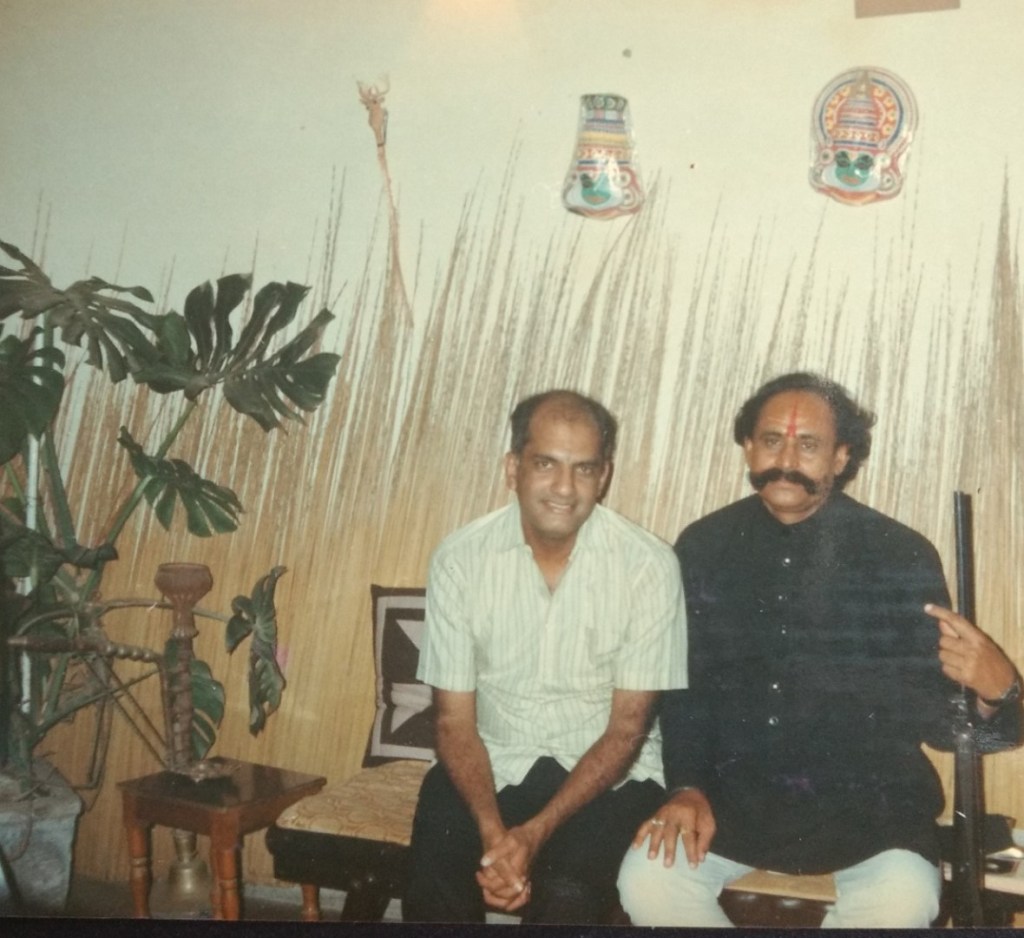
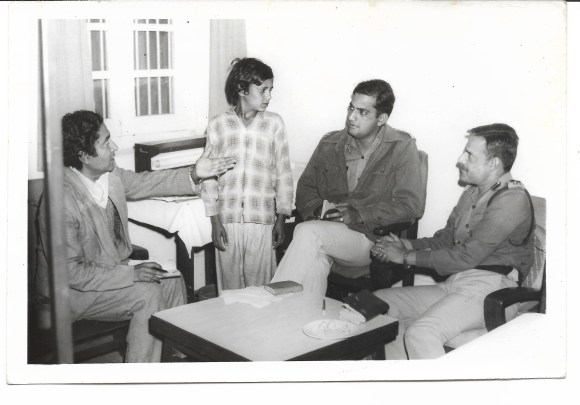
Surprise visitor Dacoit Malkhan Singh (right) with Vijay Raman Photo provided by Veena Raman
Similarly, when Vijay initiated the Indo-Pak border fencing, it was a major deterrent because most of the infiltration was from Jammu and there was a marked decline once the fence came up. Ghazi Baba too was seen as invincible, so the encounter destroyed a formidable opponent and also sent a clear message to enemies across the border.
Vijay’s success was not merely personal triumph. His career as an IPS officer traces the changes in the history of India’s security measures, right?
Indeed, his life and career were intertwined with an entire spectrum of events that enhanced the security of Indians. But let me point out that his daily life also contained an extraordinary range of experiences. He grew up in a village in Kerala, and later lived in villages among the most primitive of peoples in other Indian states. But he also lived in the cities, a privileged urban Indian. He had travelled in bullock carts on rutted roads and often walked 30 km in the course of an ordinary day through ravines. And he had also jetted across the world with the prime ministers he protected.
Vijay exemplified the essential truth of India being one, from Kashmir to Kerala!
Without a spec of doubt Vijay was that quintessential Indian who was intimately connected in different ways to the length and breadth of India. He grew up in Kerala, the deepest south, and spent some of the most significant years of his career in Jammu and Kashmir, the farthest north. His higher education took place in Gujarat; when he retired, we came to live in Pune.
The western part of India was his beloved home as an impressionable youngster, and then again in his final years. There were formative experiences in the east when, as a probationer in the Police Academy, he was taken to explore and understand India’s verdant Northeast. And he was in Calcutta for induction training at the ordnance factory, and later during his stint as Special Director General, Anti-Naxal Operations of the CRPF.
With these influences of north, south, east and west, it was only fitting that Vijay should be allotted the Madhya Pradesh cadre, at the very heart of India.
And he met his darling wife – then a hockey champion – in Nagpur! How did you meet? And how did you sustain your enchantment when the miles kept you in different corners of the land?
Vijay was an excellent writer. Of late I’ve been reading his letters to me over the years, from before we were married as well as during the tenures of separation induced by our work and careers. I can only marvel at his intellectual ability. Even at a very young age, he articulated his thoughts and feelings beautifully, and the letters reflect his tendency to introspect often, and be constantly self-critical.
I see a proud wife sitting before me.
I have always been extremely proud to be the wife of such an exceptional human being. But Vijay disliked being praised. At the peak of achievement, when his heroic deeds were earning him medals and he was surrounded by people singing his praises to the sky, when he was achieving success after success, he tried to ignore it all. Specifically he would tell me, “Please Veena, you don’t praise me. It’s all right that so many people are praising me. But if you start doing it, it’ll go to my head.”
Stupidly, I took him at his word. Of course, I boasted to others that the outstanding police officer was also the best husband, and the best father, ever. Even in the 1970s, when so few women had careers, he supported my ambitions. He knew he was marrying a woman who had her own dreams, who wanted to see the world. And yes, he knew that I had not learnt to cook!
I admired many other things about him. His commitment to perfection no matter how inconsequential the task. His commitment to service, to justice, to humanity. His love for reading. His wry sense of humour. His care for his parents and members of both our families. The deep respect he drew from whosoever knew him well — his family, his colleagues, his subordinates, his superiors, and even many criminals he came in contact with in the course of his duties.
But because he stopped me from praising him, I could never convey to him in words how much I admired him. It was only when he grew weaker that we worked fast and furious to get down on paper all that he was telling us. And as we approached the final pages of this book he said to me, with some surprise and wonder, “Veena, did I really do all this?”
So this book is Vijay’s story in his words. When he became too weak to speak, and when we lost him, my memories continued to pour in and I took the liberty to fill a few gaps.
May his legacy live on!
Vijay Raman at work with a kidnap victim. Photo provided by Veena Raman
The A B C of Vijay Raman

Adventure: Awarded citation in Guinness Book of World Records and Limca Book of Records for his around the world tour in an Indian Contessa car in 39 days 7 hrs 55 minutes
Brains: Gold Medals in Law
Courage: Presidents Police Medal for Gallantry

Experience: Over 34 years of rich experience in General Administration, Policing, handled PM Security, CM Security, anti-dacoity operation in Chambal, anti- terrorist operations in Jammu & Kashmir , anti-Naxalite operation, Investigated Vyapam Scam.

Awards
•	Presidents Police Medal for Gallantry.
•	Presidents Police Medal for Distinguished Service
•	Presidents Police Medal for Meritorious Service.
•	Gold medals in Law
[10]Phoolan Devi (1963-2001) was married at the age of eleven and sexually assaulted before she became a dacoit. She was jailed for eleven years and then joined politics till she was assassinated.
[11] Veena Raman retired as General Manager Marketing, Madhya Pradesh Tourism, after serving for 29 years. After retirement, she joined two NGO organisations, University Women’s Association Pune and Pune Women’s Council working towards empowerment of women. She was part of the national hockey team of India in 1975.
[12] Madhya Pradesh Professional Examination Board
[13]Paan Singh Tomar (1932-1981) was an Indian athlete and soldier who became a dacoit due to family feud.
[14]Malkan Singh (born 1943) is a former dacoit who has turned to politics
.
Ratnottama Sengupta, formerly Arts Editor of The Times of India, teaches mass communication and film appreciation, curates film festivals and art exhibitions, and translates and write books. She has been a member of CBFC, served on the National Film Awards jury and has herself won a National Award.
.
PLEASE NOTE: ARTICLES CAN ONLY BE REPRODUCED IN OTHER SITES WITH DUE ACKNOWLEDGEMENT TO BORDERLESS JOURNAL




 Borderless