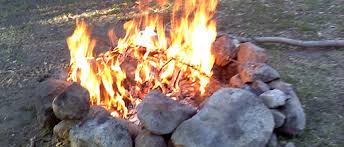
the expanse of the splintering fire flames flash across space time, pouring onto grey pupils. I like how they appear once, and then in another form: another.
lanterns of tinted glass in power starved the rural households, streaking through bland darkness. arrival of the faintest rays from the shaded corner of the mud brick encased kitchen,
lights the letters on the pages to life. rice puffs and fluffs on the oven pit, letting out splinters, across the skin of burnt deadwood, like sparks in the void of silence.
the newborn within me giggles to the flickering flames. carried by the wind across the face of decades of dead, burnt leaves, I search for consciousness.
I SEARCH FOR A FRIEND
I left my home; not knowing where I'd go. I search for my friend in
the narrow alleys led on by dim lit street bulbs. it is the aftermath of the Bengali New Year; feels like the last one to bless us.
my friend, he has a voice. he wants to sing. I run off in my pajamas for a front row seat
to the courtyard converted into an auditorium. I knock at his front door. years of knocking scatter to dilution.
the deserted terrace smiles at me. empty smile. empty house. rust crawls to my palm
from the railings. darkness piles on my sweaty shirt collar.
hands grappling through piles of epitaphs among cluttered newspaper columns. I search for a corpse.
Lokenath Roy, a writer from Kolkata who explores themes of society, memory, and the human experience, has published in several literary journals and online magazines like The Cawnpore Magazine, The Monograph Magazine, The Aeos Magazine and the Borderless Journal.
PLEASE NOTE: ARTICLES CAN ONLY BE REPRODUCED IN OTHER SITES WITH DUE ACKNOWLEDGEMENT TO BORDERLESS JOURNAL
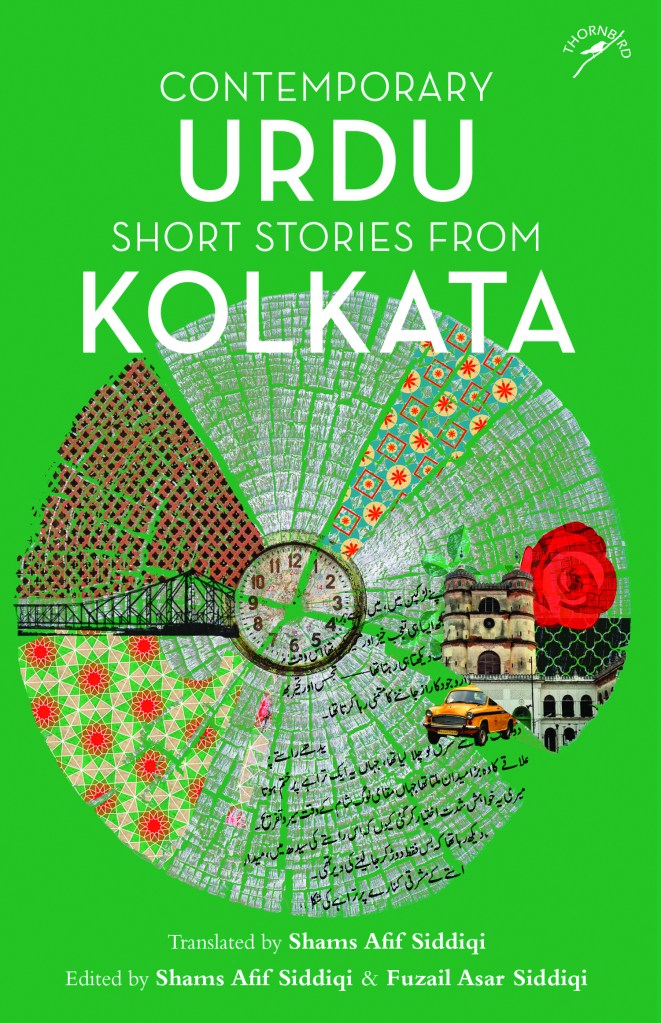
Translated by Shams Afif Siddiqi, edited by Shams Afif Siddiqi and Fuzail Asar Siddiqi
Publisher: Niyogi Books
The Stopped Clock
By Siddique Alam
The hands of the clock had stopped permanently at 13 past two and two seconds. Sitting on the bench under the shed, I am trying to understand the oval dial of the clock, the Roman letters of which had become dimmed and its edges covered with spider webs. I wonder when the clock might have stopped. I am 35 years old. Is there apparently any difference between us? Just like the clock, I have also stopped for a while because there was no announcement about the arrival of my train, its departure time being four hours ago.
I am trying to survey the place with wide open eyes. It is a usual day and an ordinary station that we are accustomed to see.
I have bid farewell to the city of my birth. I am leaving the city like a failure. But it seems after relinquishing me, the city, with a feeling of guilt, now wants to take me back. Its first step in this direction is to delay my train for an indefinite amount of time.
Despite being in the midst of a city, a station is free from its clutches. I am enjoying that freedom with a one-way ticket in my pocket. A bit of patience, I tell myself, and I would be far away. Nobody can stop me, neither by erecting obstacles in the way of the railway tracks nor by stopping the hands of the clock. Maybe I am a loser, but the journey of my life is yet to end. I am only 35 years old. I have to go far away from this place. The most important thing is that I am satisfied that the address I am carrying in my pocket is not my last destination.
It is a temporary waiting place that can help me make a new beginning. After all man is born free. The sun does not select a particular spot to shine, nor is every wave that dashes against the shore the last one, losing which the boatman would have to wait all his life for another wave.
An old coolie, wringing khaini[1] in the palms of his hands, passes by me. He is clad in a white banian and dhoti, his red flannel shirt thrown on his left shoulder.
‘Since when has the clock stopped?’ My question stops him in his stride. He turns around, his tired, thoughtful eyes staring at me. A sense of shame overpowers me. He may be an illiterate coolie, not a station employee who is answerable for such a question. ‘I am sorry,’ I quickly add, ‘I should not have put the question to you. I take back my words.’
‘Why sir?’ he stands by the side of the bench, and looks at me with a sense of intimacy. ‘People will be asking questions about a stopped clock, isn’t it? They cannot to be blamed. The story of the stopped clock is well known but only the signal man Gocharan Ray has the right to tell its tale. He had spent all his life showing green and red flags to trains and has retired today.’
‘Who has replaced him?’ my question betrays my foolishness. My imprudence had always entangled me in thoughtless acts.
‘Why don’t you ask the station master?’ The coolie moves away. ‘It’s a question that requires an answer; otherwise, you will regret it all your life.’
I was not ready for such an unexpected turn of events. I thought that my relationship with the city had been cut off forever. What do I make of a station that has ignored me, as if the ticket in my pocket is of no worth? Once again, I look at the dial of the clock hanging from the shed. It had stopped at 13 past two and two seconds. What might have happened when it stopped? Did an accident take place at the station? Had any incident of murder taken place? Was it at the time of the departure or arrival of an important leader? An attack by Naxalites? Or was the place the site of a communal incident?
The coolie returned again. This time he was wearing his shirt. ‘Unless you hear the story,’ he says, ‘your train will not arrive. This is the rule here. It may take weeks, months, or even years and you have to move from one platform to another with your suitcase. Once, a passenger alighted here to board another train. He faced a similar dilemma. He asked the same question about the clock but I do not know what happened and why he refused to listen to the story. Do you know what happened to him?’
‘How can I?’ I replied impatiently. ‘The city hardly gave me any time so that I could listen to stories.’
‘You are becoming irritated unnecessarily, Sir,’ he said. ‘I want to tell you about the man. The fact is nobody knows much about him. Some say he went to the city and did not return. Others say he took another train that never reached its destination. Some may even tell you that a prostitute took him to her house by the railway tracks where he developed leprosy and is slowly dying there. There is also no dearth of people who say he is still moving, suitcase in hand, amidst platforms, difficult to spot in the teeming crowd of passengers.’
‘You mean to say he can be anyone, even me?’
‘Did I say that, sir?’ He was on the verge of leaving. ‘It seems you have tasted bitter gourd.’
I was staring at the departing coolie’s back. The constant use of the flannel shirt had not only exposed its fibres, it had also thinned the material exposing the bones of the man’s neck. I have no hesitation in saying that I did not believe him. Since the time when suitcases developed wheels, the number of coolies has dwindled in stations. The last nail was the introduction of the backpack. Either passengers drag their suitcases on wheels, or carry luggage in their backpacks, leaving the coolies with little work. So, this may be their way of passing time.
About the Book
Dealing with love and loss, dreams and reality, as well as history and violence, this is a collection of best 19 short stories that encompasses the whole gamut of human experience, seen through the eyes of current Urdu writers from Kolkata.
Stories from Kolkata are often assumed to be about bhadralok culture and the Bengali way of life. But Kolkata is a city with amultiplicity of stories to share. Contemporary Urdu Short Stories from Kolkata highlights the diversity of recent Urdu short stories fromthe city. In one of these stories, a writer trying to escape the city wants to find the reason why the railway clock has stopped working, in another, a new friendship sours as soon as it blossoms, while some other stories show how the complexity of human relationships is explored. There is an experiment in abstraction, and legend and reality are brought together when three sleepers of an earlier civilization wake up in the modern world.
About the Editor and Translator
Shams Afif Siddiqi, former Associate Professor of English (WBES), author, short story writer, and literary critic, was born in 1955 in Kolkata. He taught in government colleges of West Bengal for 35 years and was a faculty member at MDI, Murshidabad. Khushwant Singh selected his short story for publication in The Telegraph in the 1980s. His publications include The Language of Love and other Stories (2001), a critical look at Graham Greene’s novels, Graham Greene: The Serious Entertainer (2008), and an annotated edition of G.B. Shaw’s Arms and the Man (2009).
Fuzail Asar Siddiqi is currently a PhD candidate at CES, JNU, New Delhi, researching on the modernist Urdu short story, in general, and short stories of Naiyer Masud in particular. The founder/editor-in-chief of an academic editorial services company, he has been an Assistant Professor of English at Gargi College, New Delhi.
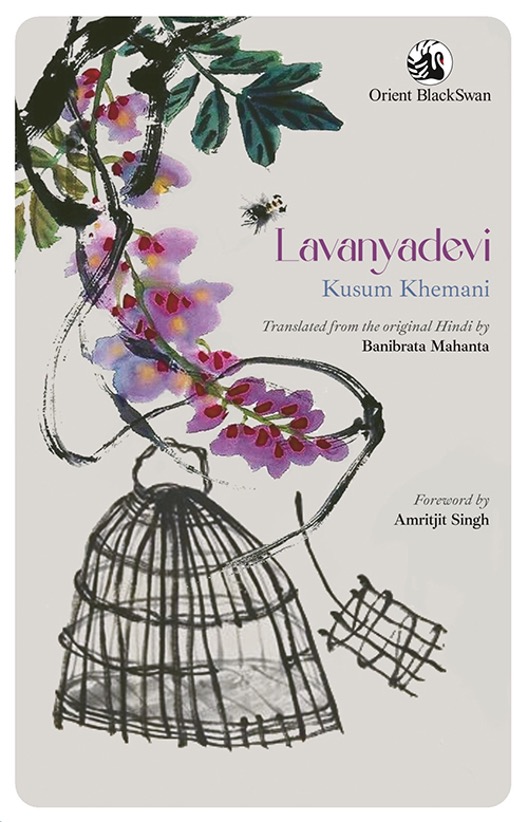
Author: Kusum Khemani (Translated from Hindi by Banibrata Mahanta)
Publisher: Orient BlackSwan Private Limited
Lavanyadevi is an award-winning 2013 novel by Kusum Khemani written in Hindi that chronicles five generations of a traditional aristocratic Bengali zamindar family as it transitions into modernity from British India to the present with the eponymous protagonist as its principal focus. Lavanyadevi—a compelling woman of perfection, extraordinary vision, qualities, and grace—remains real and credible because she is self-aware, self-critical, open to others, and to change. As a Marwari (people originally belonging to Marwar in Rajasthan) living in Kolkata, in Khemani’s fiction the schisms between ‘Bengali’ and ‘Marwari’ blur to reveal a delightfully plural, composite, and distinctively Indian ethos. Lavanyadevi is a story about women and their search for self, about shared laughter and friendships that endure across generations, beliefs and cultures—between mother and daughter, grandmother and granddaughter, and Marwari and Bengali women. Khemani’s women protagonists are strong, clear-sighted, both worldly and sublime, embodying a larger-than-life idealism while being grounded firmly in the everyday.
In his introduction to his novel Kanthapura (1938), Raja Rao had defined it as a sthala-purana[1], which he defined as a “legendary history” in which the old lady narrator in the village took recourse to the traditional Indian narrative technique, digressed at will to bring forth her point. Somehow the way Kusum Khemani takes recourse to multiple narrative techniques in Lavanyadevi and binds the different digressive stories and incidents into one contiguous whole when she tells us about the history of five generations of the Bengali zamindar family, reminds one of Raja Rao’s theory. She uses diverse narrative strategies like flashbacks, diaries, letters and emails, history, memory and the third person narrator to enrich its telling, lending it depth and range. A large part of the narrative revolves around telling us about past history when Lavanyadevi manages to lay her hands on her mother Jyotirmoyidevi’s diaries and finds great pleasure and thrill of reading one’s own family history. Not only do they offer a wonderful eye-witness account of the private and public sphere of Kolkata of those times, but they also make her easy transition into reading about her mother’s youth, her elaborate description of her magnificent wedding and the rituals that spread over almost a month.
The diary as metanarrative and the protagonist as reader/narrator are particularly effective, offering a telescopic perspective. Though at times it rambles a bit, the polyphonic structure of the novel engages Lavanyadevi the granddaughter, the daughter, the wife, the mother and the grandmother in conversations with her preceding and her succeeding generations. One must sometimes go back to the family tree and chart provided at the beginning of the novel to place people in proper perspective.
From the very beginning of the novel, Khemani portrays the character of Lavanyadevi in superlatives and this continues in different phases of her life till the end when she decides to remain incognito in the mountain ashram and yet control the lives of her descendants, well-wishers and others. From a child who always stood first in school and remained wholly ignorant of the real world, to her unusual marriage to a gentleman who moved over to Rangoon and then to London where she acquired many more degrees, till she came back to Kolkata, to rear her three children successfully, she seemed to excel in everything. This is how she is described at one place:
“Lavanyadevi was indefatigable. She administered the work of several institutions, her college and her home efficiently and with ease. She was never seen to panic. She was like Goddess Durga with her many hands – untiring in her zeal, handling all her duties unfailingly, responsibly and meticulously. No one could ever complain of being ignored by her. She loved all and treated everyone with the same degree of love and warmth. Scrupulous and hardworking, always upholding truth, Lavanyadevi was the unmatched standard of excellence in all aspects of life, her words worth their weight in gold.”
After judiciously assigning different welfare projects in the city as well as in far-flung places like Dhaka and the hills in Uttarkashi from the immense money she inherited from the family, and after her husband’s demise, Lavanyadevi decided it was time for her to leave the family premises and go and live in an ashram in the hills. There she did not stay in hibernation but her travels for work grew even more frenetic.
From the very beginning her rootedness and belief in the philosophical framework of Hinduism formed the core of her being. They propelled her to seek answers to questions of satya (truth) and mukti (liberation) that confronted her in the latter half of her life. She decided to transcend immediate personal concerns and address larger universal issues. Her transition from grihastha (householder) to sanyasa (renunciate) harkens back to the Hindu ideal of human life divided into four phases. However, contrary to the conception of life in isolation, Lavanyadevi, free of any kind of worldly considerations in this final phase of life, marshaled material and human resources to create a strong network of seva (social service) across the country and even beyond its borders. The list of her welfare schemes is too long to mention in the purview of this review, but ranged from renovating brothels in Kolkata’s red-light areas, creating self-help centres for rural women in Dhaka, de-addiction centres, eco-friendly schools in the hills, organic farming in South India, etc.
In the latter half of the novel, we find Lavanyadevi successfully transmitting her values and ideals to her children and grandchildren who are called the “Saptarshi Mandal friends” and who carry her legacy forward and emphasise that progress does not always mean breaking from the past. Here the novelist becomes too idealistic and brings in too many issues that seem a bit far-fetched. Issues of inter-caste and inter-religious relationships apart, the list of social welfare missions seems endless. Her “soul-children” unobtrusively usher in change and create space for diversity in relationships and ways of living. Harmonious cohabitation with nature became the foundational principle of all the education centres she built in the hills but the way she invisibly controls the activities of all her soldiers through emails and emphasises the middle path of life makes the advocacy of humanitarian concerns a bit overemphasised. She becomes larger than life for ideas and wish-fulfilment.
A Hindi novel about a Bengali family by a Marwari woman from Kolkata became significant when it was commissioned for translation into English. Winner of the PEN/Heim Translation Grant 2021, the jury called Lavanyadevi an ‘ambitious, far-reaching’ novel, lauding Khemani’s ‘energetic prose, deadpan sense of humor, and exquisite control’, and Banibrata Mahanta’s translation that ‘stretches and manipulates language to produce a vivid text’ and a must-read for lovers of Indian literature. Here one needs to mention the seriousness with which Mahanta gives us the ‘Translator’s Introduction’ at the beginning of the text and again ‘Translator’s Note’ at the end. This reviewer feels that both these could have been combined into one general essay highlighting the significance of the evolution of the Marwaris in Bengal, how Khemani’s novel is a hybrid artefact born out of multiple linguistic and cultural encounters, how the characters in the novel speak in languages other than Hindi produces dialogues in Bangla, Marwari, Haryanvi or Punjabi; and how between a breezy translation and a linguistically nuanced one, wherever possible the translator has eschewed the former and gone for the latter. As he rightly admits, translating this complex narrative into global or even a pan-Indian English is always risky, but Mahanta should be given due credit for overcoming all obstacles and bringing this immensely readable novel to a wide readership.
Newspapers with audited accounts of circulation and readership surveys gave the opportunity to claim that your piece was read by millions of readers. Even though the metrics did not suggest how the individual piece performed in terms of garnering readership, the millions of people who bought the newspaper were assumed to have read what you wrote. Unlike the digital space where the complete picture of reads, likes, and shares is accessible, the traditional media platforms provided a cover to indulge in tall claims of popularity and the collective statistics delivered a high to those who dabbled in writing to see their name in print. Even if the truth was that your piece was the least read one, there was no way to establish that in the editorial room where the high-brow editors cherry-picked on the basis of quality of writing and the relevance of the topic.
Bouquets and brickbats in the form of letters to the editor was the only reliable way to assess the merit or demerit of the piece, but these letters were dashed off as reactions to columns by leading commentators in the belief that the editor would grant space for the feedback on what the heavyweight columnists churned out. Readers were apprehensive that their letters would end up in the slush pile if they focused on newcomers. This fear was not unfounded as the interactive engagement often appeared limited to luminaries and experts on the edit pages.
Being published next to a syndicated column meant the equivalent of placing your debut novel on the same bookshelf where the works of a bestselling novelist were displayed. As neighbours, you had the liberty to brag about enjoying the same status even though your readership was negligible. You rushed to the newspaper vendor to buy additional copies of the same edition and keep it archived in your portfolio of published works. Printing xerox copies for circulation in your group of friends and relatives was the next big activity but the target group pricked your ego by saying that they do not read the newspaper that carried your piece. It was a polite way of saying that your breakthrough was no big achievement as they did not consider that newspaper suitable for reading.
The desire to see your name in print again and again was a good motivator in the initial stage. Since you never knew you would get the same space twice in a month, it was a struggle to try another kind piece to ensure you were carried on some other supplement page in the next week. You wanted readers of all age groups to notice your name in the newspaper, to register it in the list of frequent contributors. The easiest way to do so was to keep writing on a diverse range of topics. The byline fever gripped you and a week without a piece in the same newspaper or its competitor felt like a long gap of staying away from the limelight. Writing in a hurry also involved the risk of getting your piece rejected. Maintaining the same quality of writing and factual accuracy through proper research work was important because the team of editors should not get disappointed with any of your submission. As a precautionary move, bombing them with low quality pieces for the sake of byline was ruled out. But the obsession to become a regular contributor with a dedicated space led to several attempts across multiple genres to find your strengths. Even though you were able to find out what worked better in terms of flow and engagement, it was not possible to share the same observations with editors who drew their own inferences.
To keep struggling to write with no reward meant sustenance despite all odds. In such a situation, the byline was a big attraction to continue writing. If journalistic writing led to occasional disappointments, you had the freedom to turn to middles and infuse a dose of humour. There was further scope to write short stories and create a new world of awe, with the illustrator adding visual attraction to the theme of your fiction. This was a great opportunity to find your creative bent and, in case, it clicked, you could submit more elsewhere before getting a solo book of short stories published. Writing for some years in this fashion gave you adequate exposure and you turned confident enough to switch from regional publications to national dailies. Listing these achievements in the resume managed to draw the attention of an employer who himself was keen to get published in the same newspaper without releasing advertisements.
There was anxiety and depression every weekend as the expected publication of your piece was delayed due to editorial discretion. You went to browse at the nearby bookstall to know if you were inside the pages. The joy of seeing your name in print lit up your eyes and you picked up extra copies of the same publication without explaining to the vendor what made you do so. If you were lucky to find space for some weeks at a stretch, you chose to subscribe to it. But when you fell out of favour due to changes in the editorial policy or on account of a new editor storming in with his loyal team of freelancers, you felt like cancelling the subscription plan and never writing again. This temporary phase was soon over – when you found another piece of yours getting picked up by a rival publication. You felt buoyed again, determined to get your byline pieces carried to various homes. Your family was glad you were getting published so they did not discourage you. But they were aware you were getting close to the space where politicians dominated. They were convinced you had a future in writing even if it was an unstable one.
Although the honorarium was a modest amount, the thrill of getting paid for the piece was intense. You felt encouraged to write more to get those cheques and line up for encashment in MNC banks. The recovery of courier and stationery expenses from the published works removed the guilt of suffering losses in case of rejections. The newspaper stayed the whole day on your desk and additional copies were displayed in the lobby or the entrance, to let the guests or visitors catch a glimpse of the edition becoming special with your piece. The frisson of delight petered out as the frequency of publication gathered pace. Many readers, including friends and relatives, wrote to the editor in praise of your piece even though you never got to read those flattering comments in print.
When a delighted reader approached the newspaper office to gather your postal address and mailed a long epistle in appreciation of the style, it was an out of the world experience in the pre-digital era. When the elderly reader requested you to meet him at his residence, you did not feel shy to reach out to a stranger. Despite the wide age-gap, the conversation flowed well on writing issues as he was curious to find out whether it was a flirtatious relationship with writing or something more serious and everlasting would flower. Without confirming anything, you let it remain open-ended and interpretative. Despite your best efforts, the elderly reader inferred it was going to be an enduring relationship. When he confessed he was a writer with a book out of print, it was a humbling experience as you sat in front of a published author whereas you had no such credit. He got up and offered a signed copy and sought candid feedback on his work. You felt being the chosen one who could revive his interest in writing and motivate the septuagenarian.
You were also reminded of similar moments of frustration and encouragement from multiple sources. In his case, the story was different as he was battling health issues and yet seeking out advice pertaining to whether he should pursue writing or quit the domain. You felt like saying the magic of creativity should be kept alive even if there is nothing rewarding in the pursuit. You did not need to read the book to deliver this piece of advice. Whether he took it seriously or brushed it aside as a generic observation could not be ascertained. Later attempts to communicate proved futile. Perhaps he was gone, from the city or left the world, or maybe, the landline phone was dead. Searching for his byline in the newspapers and tomes in the bookstores produced no result. You did not feel like trudging up to the same apartment to uncover a bitter truth.
Your friends in the varsity were the most critical readers who always found something lacking in your piece but were also generous to appreciate the attempt. Some were jealous and competitive – driven by the urge to appear on the same page – and they went to the same editor with their submissions. Unable to bear rejection, they spread the word that the editor sought freebies to publish opinion pieces and it was the surest way to get a byline. Despite getting featured in multiple publications, the child-like curiosity to see your name again and again retained its flavour. Writing became a habit as a result, and the desire to be published generated the desire to write. Sustaining the urge to write was immense and, once it became a regular habit, everything else ceased to matter. You were confident of facing the blank page despite flak and rejections. Even if you wrote five pieces in a month and four of them were spiked, you had the satisfaction of seeing one in print. This was good enough to keep the pen flowing. You became more risk-bearing and tried out other avenues and other forms of writing at the same time. As the digital world opened up more options, you began exploring the writing opportunities on a global scale.
Years of honing your craft offered a better understanding of the writing world and the real world. When a young person read your piece against dowry and went to the newspaper office to collect your address and visit your residence and offer you a proposal to marry his sister, it was a moment of realisation how writing shapes perspectives and the immense responsibility it carries. It was an episode to remind you that good writing is read and the writer must pen his words with social responsibility. Such early encounters made you understand the value of writing beyond the power of bylines.
The writer must be prepared to reach a mature stage when the byline fever subsides. Whether you acquired a thousand bylines becomes immaterial after a certain stage, but the role of byline in offering you anchorage and encouragement cannot be sidelined in the formative years of your writing career.
Devraj Singh Kalsiworks as a senior copywriter in Kolkata. His short stories and essays have been published in Deccan Herald, Tehelka, Kitaab, Earthen Lamp Journal, Assam Tribune, and The Statesman. Pal Motors is his first novel.
PLEASE NOTE: ARTICLES CAN ONLY BE REPRODUCED IN OTHER SITES WITH DUE ACKNOWLEDGEMENT TO BORDERLESS JOURNAL
When a friend of mine glorified living in the hills and suggested I should live close to nature in order to nurture my creative side, I disagreed without showing displeasure as it would have appealed to me a decade ago. Instead of shifting to the mountains to forge a deep connection with nature, now I prefer to increase my interactions with nature and its elements in the nearby surroundings every day. Even if these exchanges are small and trivial, these are spread throughthe day and keep happening with amazing frequency.
Finding ample time to feel the presence of nature all around leaves me with negligible desire to relocate to the hillside where I would have the privilege to spread myself on a roadside bench and gaze and wave at newly married couples clasping their hands and walking down the road with melting ice-cream cones. I do not wish to turn into another such old man with a toothless grin, who never shies away from showing his naughty side whenever an opportunity arises.
Not considering such indulgences as effective remedies to stay young at heart during old age, the all-pervasive burst of energy actually comes from the bout of inspiration to produce a new creative work. The hills or the muse are just two known – and popular – sources while the fact is that there are infinite sources to explore. It depends on the individual embarking on this journey to awaken the creative self.
Hills are romanticised and considered to be the abode of purity with the power to trigger creativity like no other place. My recent visits to the hills did not prod me to write. While such a visit could be inspiring for many people who prefer the serenity of the hills to produce a masterpiece, I would consider myself an exception or a part of the small group holding a divergent opinion. Those who say you do not face writer’s block on the hillside are not telling the entire truth. Without contesting their belief, I am quick to retort by saying that I do not stare at the blank page and do not face any shortage of ideas here. I am happy to live in the plains and remain a plain writer without any complaints.
Those who live in the hills and write profusely get to write about nature and the people they observe closely during their long walks. The hill towns also have a vast population of ghosts to write about since they prefer to live and breathe clean, fresh air and enjoy the mist and fog of the mountains. This category of dead folks brings so many stories to life. With deadpan humour, the writers relate engaging stories but if there is an abundance of paranormal tales from writers in the hills, it does not mean that the writers from the small towns across the country do not have spooky encounters to narrate. There is no dearth of ghosts to explore in the haunted, dilapidated buildings, cemeteries and treetops. If the emerging and established writers take a keen interest to spin bewitching tales, there can be a potpourri of ghostly delights to feast upon. Instead of trekking to the hills in search of lively characters where the human population is not dense, it is better to seek variety in the plains where the population is teeming with saints and sinners of varying degrees, climbing the heights of divine glory and plumbing the lows of depravity.
Abandon the idea of finding a goldmine of ideas in the hills and choose to focus on the world you live in. Relocating to get inspired involves disconnecting in the greed of enrichment. The ability to source the hidden treasures from the town or the locality comes to those who respect it unconditionally, just as we value the love we get unconditionally. There are many who leave for the hills to become fantastic storytellers, but their output fails to impress and loses consistency. Only when they come down and hit the mean streets, travel in crowded buses and trains, enter flea markets and dingy, narrow lanes do they become an integral part of the creative madness and their output shows that solitude is not the sole stimulant: a chaotic environment can also work its magic to stir creativity in wandering souls.
In case you have garnered a modicum of success and wish to experiment, you can try the hills or the beaches to measure the impact on your creative output. But in case you realise you can write well without changing your pin code, and all you need is a house with big windows providing a wide view of the verdant garden lined with trees and plants, offering a clear vision of quietness, then you can deliver a good creative work by sourcing material from the life lived, from the things you can imagine.
Taking a short break to tour the hills has left me disappointed once again. A depressed state of mind and boredom gripped me more than the lush green vistas. I missed the traffic, the mad rush for trains, and the tearing hurry to cross bridges, the restlessness to leave others behind. The sense of satisfaction found in the hill people seemed to infect me. With limited sources of entertainment, preferring to hit the sleep mode was the best thing to do. The idyllic scenery relaxed me for a few days and then the craving for frenzy took over. Depriving myself of it further would make me sick. So, I returned earlier than I had planned to, with the realisation that writing in the hills would be a challenging job for me. It could force me to quit writing forever. I could well be one of those seasonal types who retreat there to recharge their batteries and come back super charged to face the daily hectic grind of the real world.
How long would an ambulance take to reach me during a medical emergency in the hills also loomed large as a growing concern. Negotiating a sharp bend and thinking about such situations made me feel low. As I grow older, I refuse to be enchanted by apples and apple-picking. The childhood fancy of farm-picking sessions, of plucking litchis, berries, and cherries and apples and eating them in the orchards can be skipped or realised within a week. This charming activity cannot make a strong case to become a resident of the hills. Besides, the local market in the neighbourhood has good supplies throughout the year.
Dozens of markets, malls, bargain stores, eating joints, beauty parlours, and multiplexes are likely to be missed in the hills where consumerism is still not rampant. Aside from natural produce, other staple items are more expensive in the hills. Maintaining budgets would be an uphill task for an aspiring writer. Farmer markets would tempt me exploit those, but I do not want to join the list of discredited experts who exploit and then write about exploitation, thereby showcasing their hypocrisy to the world. Locating an advertising agency in a hill station would be another challenge as the clients think creative honchos from the ad world and film world live in the big cities. Agreed, having a second home in the hills for vacation purpose or weekend breaks is a good option. But writers cannot have this luxury unless they churn out bestsellers to finance a second home.
You could be a writer who is read not just in the hills but also read by those from the plains and beyond. Make your location immaterial for writing. Junk the idea that a masterpiece with a universal appeal can come from a serene place alone. Writing thrives with speed, pace, and action. And the plains are remarkably good at offering this advantage, not just the slow-moving life and stillness in the hills that makes the mind race faster when the body is in a state of relaxation.
Devraj Singh Kalsiworks as a senior copywriter in Kolkata. His short stories and essays have been published in Deccan Herald, Tehelka, Kitaab, Earthen Lamp Journal, Assam Tribune, and The Statesman. Pal Motors is his first novel.
PLEASE NOTE: ARTICLES CAN ONLY BE REPRODUCED IN OTHER SITES WITH DUE ACKNOWLEDGEMENT TO BORDERLESS JOURNAL
It flaps and growls, Gathering all its might. But it's hollow like an empty can, And the wind doesn't help either.
It looks fierce But sways lightly From side to side, Unsure of its footing.
So, how long before you Lift your head, Look it in the eye And then reach out to crumple -- The daunting paper tiger Made of the sheaves of lies?
Ananya Sarkar is a creative writer from Kolkata currently living in Bangalore. Her work has been published in various ezines. She loves to go on long walks, cloud gaze and ponder upon miracles. She can be found on Instagram @just_1ananya and reached at ananya7891@gmail.com
PLEASE NOTE: ARTICLES CAN ONLY BE REPRODUCED IN OTHER SITES WITH DUE ACKNOWLEDGEMENT TO BORDERLESS JOURNAL
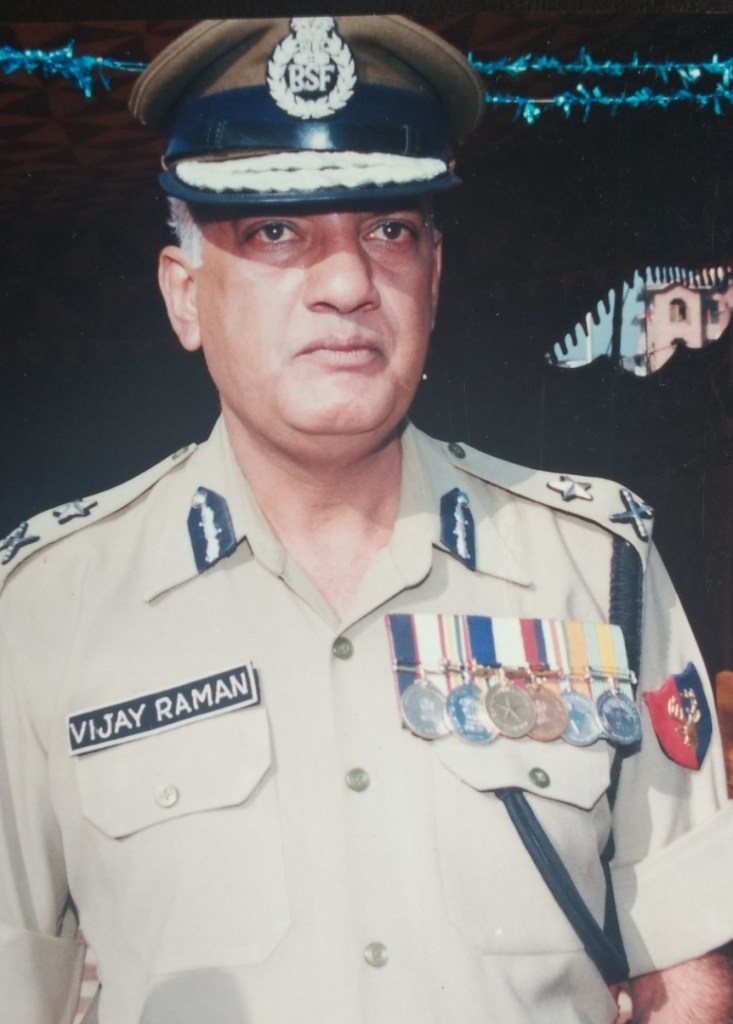
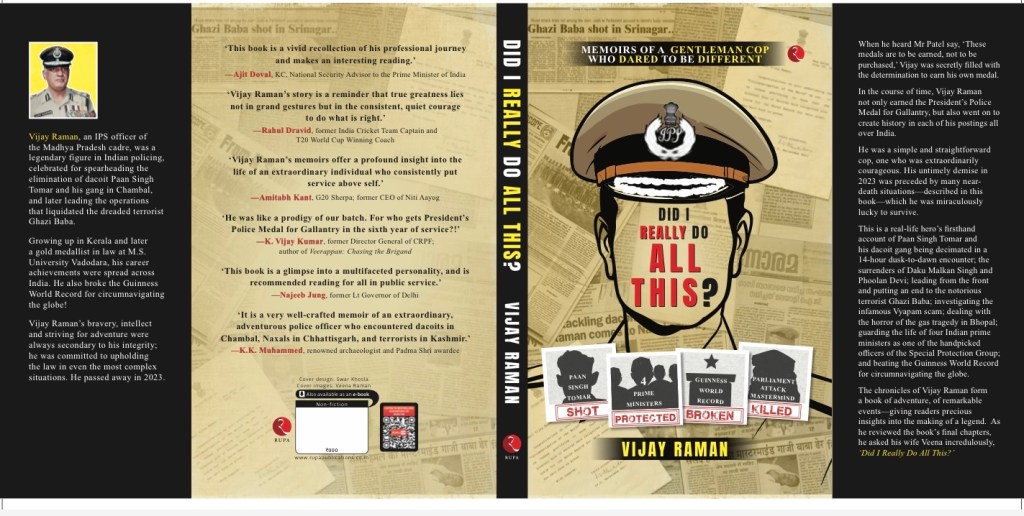
Ratnottama Sengupta, introduces the late Vijay Raman and converses with Veena Raman, the widow of this IPS[1] officer, about his book, Did I Really Do All This: Memoirs of a Gentleman Cop Who Dared to be Different. The memoir was recently launched by Sengupta and brought out posthumously by Rupa Publications.
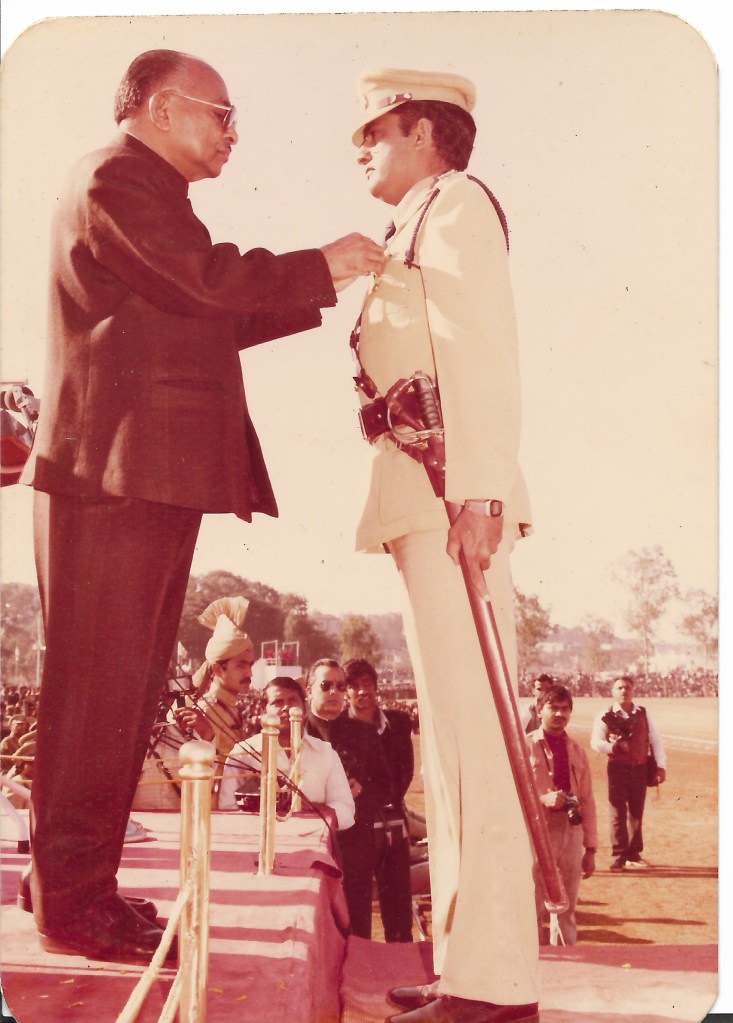
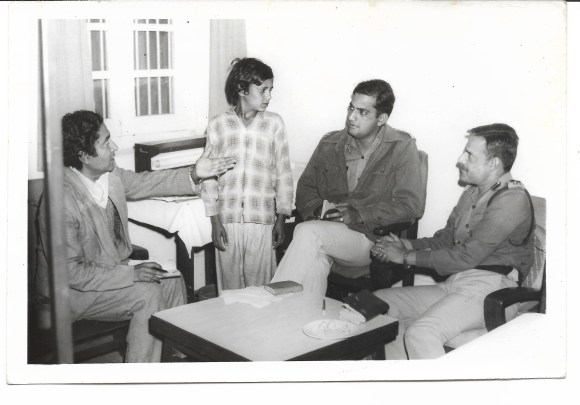
Vijay Raman (1951-2023)Vijay Raman receiving the President’s Police Medal for Gallantary in 1985Photos provided by Veena Raman
Vijay Raman’s success as a police officer was not merely a personal triumph. The career of this IPS officer traced the changes in the history of India’s security measures. India’s police organisation in 1947 — the Intelligence Bureau, Assam Rifles and CRPF[2] — were legacies from the British Raj. The 1962 Indo-China War led to the creation of the ITBP[3]; the 1965 war with Pakistan formed the BSF[4]. Investments in the Public Sector Undertakings led to the establishment of CISF[5]. Indira Gandhi’s assassination in 1985 led to crafting of SPG[6]. The sabotaged crash of Air India’s Kanishka[7] and the Operation Blue Star prompted the formation of NSG[8], and the 2008 terror attack on Mumbai was followed by NIA[9]. Vijay Raman’s life was intertwined with these organisations. He was also responsible for bringing in a number of terrorists and dacoits, including the notorious women dacoit, Phoolan Devi[10] (1963-2001)…He died last year.
In this conversation, Veena Raman[11] reflects on his life and his memoir, Did I Really Do All This: Memoirs of a Gentleman Cop Who Dared to be Different.
Veena this book is a tribute to a police officer who brought honour to his uniform. Having met Vijay Raman I know how wonderful a person he was – deeply loved by not only his family and friends but also many VIPs he interacted with in his professional life. Is this your way of mourning his sudden demise?
When Vijay passed away we — my son Vikram, daughter-in-law Divya, grandson Shaurya and I — were devastated. The cruel illness was swift and relentless: within months he grew weaker before our eyes, and before we were ready to accept the loss. We had no choice but to face it. While we tried to console each other Vikram said, “Mamma we should be grateful that we had him for all these years. After all, Papa was that proverbial cat with nine lives!”
Really?
Absolutely. And why nine? I can give you 19 instances in our years together when his life was in danger and he miraculously escaped.
I am all ears Veena!
At the very outset, in November 1978, when Vijay was in his first posting as assistant superintendent of police (ASP) in Dabra, Madhya Pradesh, a country-made bomb was flung at his jeep by agitating students in Gwalior. It fell and exploded nearby. Fortunately, no one was harmed.
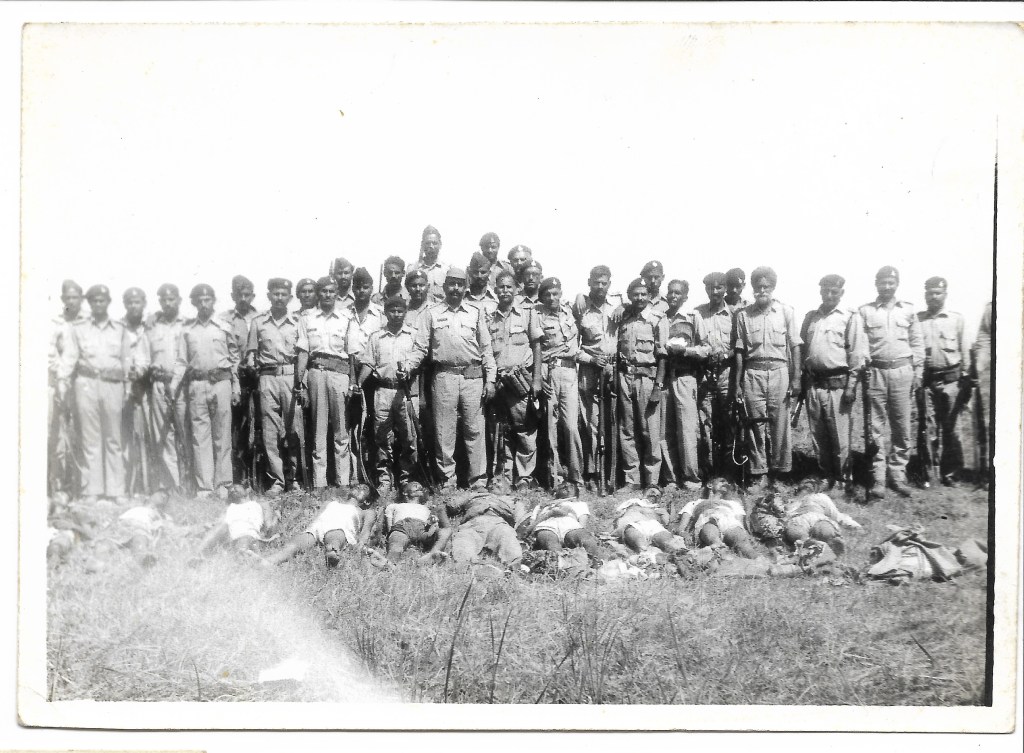
In 1981, based as he was in the Chambal, notorious for dacoits who stalked the nooks and crannies of the ravines, my illustrious husband had already faced dacoit encounters. The most dramatic of these took place in October, when he led the team that wiped out Paan Singh Tomar who, with his gang, had terrorised the region for years. As he describes in the book, bullets had rained on the encounter team from all sides, caught in the crossfire between the dacoits and the police.
The Pan Singh Tomar gang after a dusk to dawn encounter submits to the police: Photo provided by Veena Raman
He was superintendent of police (SP), Special Branch in Bhopal when the world’s worst industrial disaster took place. On the night of 3 December 1984, more than 40 tons of methyl isocyanate (MIC) gas leaked from the Union Carbide pesticide plant. At exactly that time Vijay was driving to the railway station. “Why inconvenience the driver to stay up late when I want to receive my parents myself?” he had argued.
Within minutes the gas had created havoc. He was shocked to see hundreds killed and untold hundreds maimed. Somehow he and his parents, so close to the scene of destruction, were spared.
In 1998, as inspector-general of police (IGP) Security, Jammu and Kashmir, while Vijay was in Srinagar, a bomb blast took place on the route during the hour he routinely travelled to office. He was saved that day because his driver had taken an alternative route!
In 2000, as IG-Border Security Force (BSF), Jammu, Vijay was responsible for erecting a much-needed part of the fence between Pakistan and India under highly adverse conditions. Enemy bullets rained down from across the border throughout the operation. That forced him to take some daring and potentially controversial decisions. How very relieved and thankful we were when he came home safe!
Vijay was appointed IG, BSF, Kashmir, in 2003 with the secret mandate to get Ghazi Baba, the mastermind of the 2001 attack on the Indian Parliament. Along with an informer, he had gone on an undercover exploration of the site where the encounter eventually took place. Most unexpectedly the informer pointed out the man himself! Vijay instinctively tried to open the car door and rush out to apprehend the terrorist. The informer roughly pulled him back and screamed to the driver to step on the accelerator and escape immediately. Later the informer explained that Ghazi Baba never left his lair unless he was strapped with explosives, and an attack would have spelled explosions that would have been the end of everyone in the vicinity.
Did he ever face a situation that he regretted?
One of the most dangerous situations Vijay ever faced in his risk-fraught career was as Special Director General (DG), Anti-Naxal Operations of the Central Reserve Police Force (CRPF). In April of 2010, many of his men were massacred in Dantewada by Naxalites. The loss weighed so heavily on him that his health declined: he neglected his meals and even forgot to take his medicines. He had moved from the headquarters in Chhattisgarh to Kolkata; Vikram and I were in Delhi. We understood the intensity of what he was going through only later, when he suffered a stroke.
Did your angst-ridden years end with his retirement?
Not really. For, four years after he retired, in 2015, Vijay was handpicked to be a member of a special investigation team (SIT) to investigate the Vyapam (Vyavasayik Pariksha Mandal[12]) examination scam. This was a challenging assignment because the entrance examination admission and recruitment had been going on since the 1990s and had come to light only in 2013.
Did he do anything that was not challenging? What got him a place in the Guinness Book of World Records?
Vijay came close to death even in the personal adventure he undertook with a friend. Together they circumnavigated the globe in an Indian-made car in the last 39 days of 1992. Don’t forget, that was an era when Indian manufacturing was just coming of age. Though this tremendous feat earned him a place in the Guinness Book of World Records, he was exposed to danger of a different kind. For 39 days, they drove at very high speeds, in different countries, different terrains, and different political climates. Let alone sleep on a bed, many a night they could not even catch 40 winks. And still they had only one accident! Yes, it left him badly injured, but he found the strength to complete the challenge and beat the record.
Doesn’t every policeman court danger — even death — in the course of duty? What made him stand apart from other men with stripes?
True, every policeman faces bullets in the course of duty. And Vijay, throughout his career, was inviting them, to see what they could do to him. His faith in the divine, in his own destiny, made him fearless. How very fortunate we were that, time and again, they were deflected.
Another thing that made him stand out was his sheer artlessness. In a field of work steeped in the dregs of humanity, he stood unwavering by the principles of human rights and democracy. Again, fortunately, he came out unscathed, retaining faith in humanity all through life.
This dream run surely merited documenting. And Vijay had a flair for writing. So why did he not pick up the pen until the last hours of his life?
It was indeed a dream run. And that was precisely why I urged Vijay for years to write a book. Yes, many people have achievements, but his narrative was different. Winning without challenges is victory, but winning after overcoming challenges is history!
I remember that, when you visited us in Pune in 2019, you had said that the range and scope of what he had done, deserved to be recorded. I myself maintained that the consistently straightforward way in which he had done it, had to be recorded for posterity. But whenever this was suggested Vijay would say, “Who would be interested in such a book!”
None of us agreed with him. We read books by many other police officers which made it clear that Vijay’s experiences were unique. While the others excelled in certain areas of policing, Vijay’s was a whole range of spectacular achievement!
He may be the only police officer in the country who has dealt with all the aspects of policing — and been successful at each. He was at the forefront of dealing with the changing nature of crime in the country and also at the epicentre of varied policing challenges.
Doesn’t he write about how his actions led to change in tackling crime and criminals?
Yes, his successes invariably led to major changes in the law-n-order situation in the region. In Bhind, removing the Paan Singh[13] gang led to the surrender of a large number of dacoits who previously considered themselves invincible. This list includes the most notorious Malkan Singh[14] and the celebrated Phoolan Devi.
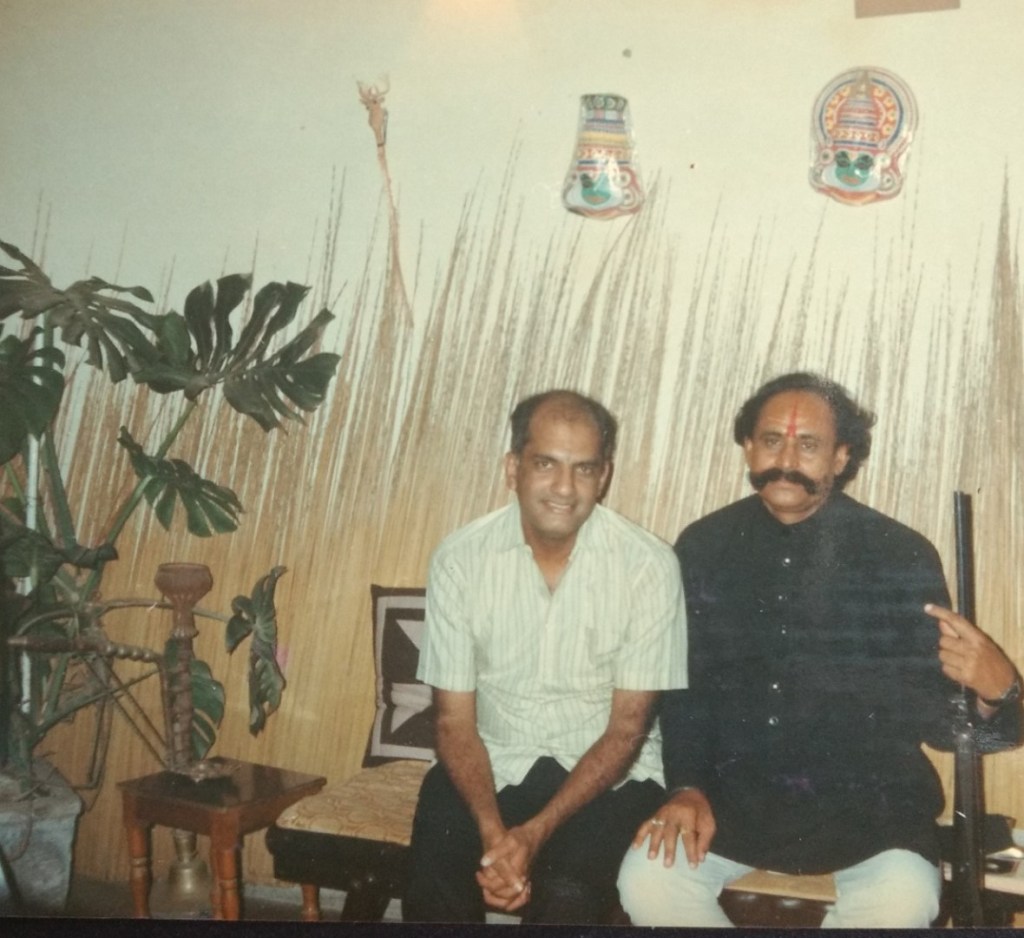
Surprise visitor Dacoit Malkhan Singh (right) with Vijay Raman Photo provided by Veena Raman
Similarly, when Vijay initiated the Indo-Pak border fencing, it was a major deterrent because most of the infiltration was from Jammu and there was a marked decline once the fence came up. Ghazi Baba too was seen as invincible, so the encounter destroyed a formidable opponent and also sent a clear message to enemies across the border.
Vijay’s success was not merely personal triumph. His career as an IPS officer traces the changes in the history of India’s security measures, right?
Indeed, his life and career were intertwined with an entire spectrum of events that enhanced the security of Indians. But let me point out that his daily life also contained an extraordinary range of experiences. He grew up in a village in Kerala, and later lived in villages among the most primitive of peoples in other Indian states. But he also lived in the cities, a privileged urban Indian. He had travelled in bullock carts on rutted roads and often walked 30 km in the course of an ordinary day through ravines. And he had also jetted across the world with the prime ministers he protected.
Vijay exemplified the essential truth of India being one, from Kashmir to Kerala!
Without a spec of doubt Vijay was that quintessential Indian who was intimately connected in different ways to the length and breadth of India. He grew up in Kerala, the deepest south, and spent some of the most significant years of his career in Jammu and Kashmir, the farthest north. His higher education took place in Gujarat; when he retired, we came to live in Pune.
The western part of India was his beloved home as an impressionable youngster, and then again in his final years. There were formative experiences in the east when, as a probationer in the Police Academy, he was taken to explore and understand India’s verdant Northeast. And he was in Calcutta for induction training at the ordnance factory, and later during his stint as Special Director General, Anti-Naxal Operations of the CRPF.
With these influences of north, south, east and west, it was only fitting that Vijay should be allotted the Madhya Pradesh cadre, at the very heart of India.
And he met his darling wife – then a hockey champion – in Nagpur! How did you meet? And how did you sustain your enchantment when the miles kept you in different corners of the land?
Vijay was an excellent writer. Of late I’ve been reading his letters to me over the years, from before we were married as well as during the tenures of separation induced by our work and careers. I can only marvel at his intellectual ability. Even at a very young age, he articulated his thoughts and feelings beautifully, and the letters reflect his tendency to introspect often, and be constantly self-critical.
I see a proud wife sitting before me.
I have always been extremely proud to be the wife of such an exceptional human being. But Vijay disliked being praised. At the peak of achievement, when his heroic deeds were earning him medals and he was surrounded by people singing his praises to the sky, when he was achieving success after success, he tried to ignore it all. Specifically he would tell me, “Please Veena, you don’t praise me. It’s all right that so many people are praising me. But if you start doing it, it’ll go to my head.”
Stupidly, I took him at his word. Of course, I boasted to others that the outstanding police officer was also the best husband, and the best father, ever. Even in the 1970s, when so few women had careers, he supported my ambitions. He knew he was marrying a woman who had her own dreams, who wanted to see the world. And yes, he knew that I had not learnt to cook!
I admired many other things about him. His commitment to perfection no matter how inconsequential the task. His commitment to service, to justice, to humanity. His love for reading. His wry sense of humour. His care for his parents and members of both our families. The deep respect he drew from whosoever knew him well — his family, his colleagues, his subordinates, his superiors, and even many criminals he came in contact with in the course of his duties.
But because he stopped me from praising him, I could never convey to him in words how much I admired him. It was only when he grew weaker that we worked fast and furious to get down on paper all that he was telling us. And as we approached the final pages of this book he said to me, with some surprise and wonder, “Veena, did I really do all this?”
So this book is Vijay’s story in his words. When he became too weak to speak, and when we lost him, my memories continued to pour in and I took the liberty to fill a few gaps.
May his legacy live on!
Vijay Raman at work with a kidnap victim. Photo provided by Veena Raman
The A B C of Vijay Raman

Adventure: Awarded citation in Guinness Book of World Records and Limca Book of Records for his around the world tour in an Indian Contessa car in 39 days 7 hrs 55 minutes
Brains: Gold Medals in Law
Courage: Presidents Police Medal for Gallantry

Experience: Over 34 years of rich experience in General Administration, Policing, handled PM Security, CM Security, anti-dacoity operation in Chambal, anti- terrorist operations in Jammu & Kashmir , anti-Naxalite operation, Investigated Vyapam Scam.

Awards
•	Presidents Police Medal for Gallantry.
•	Presidents Police Medal for Distinguished Service
•	Presidents Police Medal for Meritorious Service.
•	Gold medals in Law
[10]Phoolan Devi (1963-2001) was married at the age of eleven and sexually assaulted before she became a dacoit. She was jailed for eleven years and then joined politics till she was assassinated.
[11] Veena Raman retired as General Manager Marketing, Madhya Pradesh Tourism, after serving for 29 years. After retirement, she joined two NGO organisations, University Women’s Association Pune and Pune Women’s Council working towards empowerment of women. She was part of the national hockey team of India in 1975.
[12] Madhya Pradesh Professional Examination Board
[13]Paan Singh Tomar (1932-1981) was an Indian athlete and soldier who became a dacoit due to family feud.
[14]Malkan Singh (born 1943) is a former dacoit who has turned to politics
.
Ratnottama Sengupta, formerly Arts Editor of The Times of India, teaches mass communication and film appreciation, curates film festivals and art exhibitions, and translates and write books. She has been a member of CBFC, served on the National Film Awards jury and has herself won a National Award.
.
PLEASE NOTE: ARTICLES CAN ONLY BE REPRODUCED IN OTHER SITES WITH DUE ACKNOWLEDGEMENT TO BORDERLESS JOURNAL
Rajorshi Patranabis shares the philosophy and lore of Wiccans
What, if I say that 68% of the universe is dark? Well, this is not my statement. This is a scientifically proven fact. What is there inside the darkness? Sceptics will say, let science find it out. The spirituals will say there’s mysticism. A Wiccan will say there’s mystical magic. Magic, as in common parlance is entertainment, in Wiccan philosophy, it’s the basis of existence. Magic can be best explained as something that’s occurs yet cannot be fathomed.
The term, Wicca, came was popularised by Gerald Gardiner with his books. Many said, it was misogynistic. To be fair to him, 1925 was not as open as it is today, as far as societal norms were concerned. It is more accepted today. I, a practicing Wiccan, follow a way that is more open, more aligned to nature, supernature and the supernatural. What I follow was introduced into India by Ma’am Ipsita Roy Chakraverti.
While this movement may well be termed as historically the first ever feminist movement, the pagan practices involved are more than a thousand years old. Ritualistic worshipping of nature is seamlessly integrated into Wiccan practices. The ancient knowledges that had trickled down through generations are put together in the modern Wiccan practices. Wicca is a philosophy, and I detest calling it a religion. Here, we don’t believe, we seek. We use the knowledge to try and to unfathom mysteries that lie within the dark spheres of nature. Albeit, a miniscule bit, but we do delve into that 68% of darkness, once in a while.
From shamanism to voodoo, from the ancient Egyptian ways of healing to the 64 yoginis, this school covers every way by which the human soul and body can be healed. They say the basic apothecary of life is to align oneself to the directions given by nature. Manifestation of the female power of nature (shakti) forms the essence of this philosophy. The mind, the body and the soul form the complete sphere of the universe. Wicca believes that nothing is inanimate and that everything has a consciousness draped in a veil of conscience.
Everything that’s around us has been derived from this planet, and if this planet is living, Mother Earth is living, then, everything that comes out of it is also living. As the Law of Conservation of Energy says, the total energy is constant, it can neither be created, nor be destroyed. Hence, the body might change, the forms change but the energy remains. Energy is eternal. The metamorphic energy inside a human body that has derived its form mostly from the magnetic or the electric energies of this planet is called the soul. The soul thinks and decides with the mind and the body giving them a presence. A purified soul is the spirit and when this spirit raises itself to survive in unison with the nature, we call that person spiritual.
Chakraverti says every strong woman is a witch. The word ‘witch’ comes from the old English word ‘wik’, which means wise. A female spirit is more nuanced, stubborn, flexible and erudite. A witch is that wise woman who takes on her challenges head on. A witch or a wizard work on the same footing of aligning mankind to the deluges of nature to heal the spirit, the mind, which in turn takes care of the body. Historically, a Wiccan considers Joan of Arc, Robin Hood, Noor Jehan as witches / wizards. Witches were killed at a point due to patriarchal fears of powerful women. These women had been portrayed as negative women in many of the kindergarten folklores.
The Greek goddess, Diana, was worshiped by Wiccan by Budapest Wiccans. Did she metamorphose to Dayaan[1], when she travelled east? Dayaans were to be feared, to be killed if possible. We have come a long way, no doubt, but sporadic news of such killings are still rampant.
There are also certain myths about witches, one being, flying on the broom. The broom is symbolic of cleanliness — cleaning a society of the cobwebs of false beliefs and weak minds. Broom becomes synonymous with power. Flight is of the spirit. A potent spirit reaches places in such time that the body can never think of. There are innumerable examples of saints and sages being spotted at two or more places at the same time. Advanced Wicca philosophy is inclusive of the powers of Hatyoga and Tantra.
Wiccans are the worshippers of the mother Goddess Isis of Egypt. She’s the moon Goddess and the wife of Lord Osiris, the lord of the dark world. She’s the quintessential witch, the Goddess of magic, the Goddess of strength. Indian Wiccans are influenced by forms of Shakti known as Kamala and the Bhubaneswari. The most ancient traces of worship of the raw female power of nature can be found in Kali. Wiccans are also influenced by the Tibetan Tara and the concept of Dakini (the divine witch).
The basic Wiccan principle of worship is through sound vibrations. Chants take the centre stage. Chants of Buddhism are also regularly practiced as are those of Vodun faith with drumbeats. Healing is practiced with chants, as was a common practice in ancient Egypt. The sound of the singing bowl is potent in helping heal.
They have tools that help focus energies of the Earth. Some sound like falling rain. Then there are stones, as in a crystal, a rose quartz, an obsidian, the lapiz lazuli and so on. But the most important tool is the Athame. This is a blunt long knife that is charged and is used to tap the powers of the nature.
One of the oft asked questions is do Wiccans delve into the ‘other dimension’? Physicists have claimed for long, the existence of a celestial plane. Scientists have even said, that, there is a time difference between the celestial and the terrestrial plane. Dreams are said to be in the celestial plane, and hence, time moves differently in dreams. But in effect all humans would have had a brush with the two worlds through dreams. Wiccans believe the veil between the two worlds becomes very thin in autumn. Thus we have All Soul’s Day, Halloween, Bhoot Chaturdashi (holy night of the ghosts) all around the same time, in the autumn of the Northern hemisphere.
I would like to share a few supernatural experiences that I have had myself. These are all first-hand experiences, and I share them with no intention to influence the readers.
A psychic expedition at the Rabindra Sarovar Lake in Kolkata at around 9.30 am on a November morning revealed a figure in my camera. The lake was the psychiatric hospital for the American Soldiers during the 2nd world war. The spirit communicated with us and what could generally be fathomed was, ‘ 1942, Michael James, Death nail through my heart’.
Another time, I rode in an e-rickshaw with someone who had crossed over 20 years before. The driver was very much in congruence with my story when he said, he takes a ride every other evening. This place is a traditionally haunted village in East Midnapore district of West Bengal, India. And yet again, at one of the famous 5-star hotels in Delhi, I could feel someone removing the sacred thread[2] from my body.
I can go on and on. But when it’s Wicca, it’s the strength of Isis that needs to be manifested for healing. And as a true Wiccan, I take leave with, Tebua Netr Anset (You’re the Isis, we know).
[2] A thread worn by Brahmins after they go through an initiation ceremony in their teens.
Rajorshi Patranabisis a poet, critic, reviewer and translator. A Wiccan by philosophy and belief, he is a food consultant by profession with 10 books of poetry and 4 books of translation.
.
PLEASE NOTE: ARTICLES CAN ONLY BE REPRODUCED IN OTHER SITES WITH DUE ACKNOWLEDGEMENT TO BORDERLESS JOURNAL.
The school library was the place we were herded to once every week. Although a few of us were booklovers, the brief period of relief and relaxation inside the large, airy, and sunlit room stacked with books, bookshelves, and desks made us fake an immersive experience of reading bliss.
Contrary to the orders of Lobo Sir, our librarian who always emitted strange noises to remind us to maintain pin-drop silence, we occupied the window seats to gaze at the panoramic world outside and discuss what appeared in sight. It was more engaging, refreshing, and rewarding as an activity. I was not one of those smart, gifted fellows who focused on the brittle pages of the heavily borrowed titles to impress teachers.
Observing the lush green trees and the slow movement of traffic on the macadamised road outside the campus became the new pastime — punctuated with furtive, irksome glances at the middle-aged librarian who saw potential book thieves lurking within us. His long hands groping our pants and bellies during the mandatory exit check to locate books hiding inside never quite managed to reach the exact spot where books were hiding within some of us: inside our fecund, curious minds.
Most of the students were not fond of reading or stealing books when there were far more precious items like hearts waiting to get stolen outside the campus during those teenage years. Impressing the girls from the nearby convent with our natural gift of storytelling evinced an encouraging response and for us, it was a firm confirmation that holding a book in hand was less likely to catch their interest.
Keeping the library card was an obligation so we had to borrow at least one book in a month, get it stamped, and then return it within a week without further tears to avoid a hefty fine. It was wise to show the librarian the pages already torn, dog-eared, smeared with ink, or doodled with arrows piercing the hearts as his memory never failed to identify new signs of damage to the books and he would insist on replacement or recovery of its full monetary value at the given time.
Considering the perils of borrowing books from the library that made us careful about spilling tea or coffee or noodle (stuck between the pages) or tomato sauce dots ruining the cover, I decided that I should buy the book and then read it without any fear, even if it involved buying from a second-hand bookshop. With a strong sense of possession and freedom to toss and turn around, I felt free to place a tall glass of cold coffee on it and read it the way I liked. The sense of reading with a free mind had no substitute. Borrowing titles from the library did not inculcate this sense of freedom.
The possibility of forgetting a storybook inside the bus or train was high. Even tears would not convince the librarian to waive the costs if we lost it in transit even though its condition was nothing close to mint. Some of us took the library titles home, kept them in the safest custody of parents and then carried the titles back to school without reading a single page. Of what use was such trouble we could not fathom but negative thoughts resonated more, keeping us mired in anxiety.
Only the toppers borrowed classics to read and discuss with teachers what they grasped. The teachers agreed with their insights and analysis in a bid to sound encouraging even if what the high achievers said made little sense. It was a source of collective victory that some students showed the potential to read classics and match the wavelength of teachers whereas we could not go beyond the popular, readable titles.
The desire to read for fun and pleasure was stronger than the urge to read for knowledge during our school days. ‘Read more’ was the repetitive message from teachers even before it caught our attention as the tagline of a global publisher. Every teacher suggested serious reading to build our command over the language though we had no estimate of its utility except for those aiming for academics. Reaching college gave us a comforting truth — acquired from visiting bookstores in the neighbourhood: it is possible to become a writer without the ballistic power of vocabulary. Several successful authors wrote simple yet powerful prose even if their works were not considered fit for inclusion in school libraries.
Library trips made a comeback in my life at the university level due to my interest in spending more time in pursuit of a girlfriend who was fond of taking notes from various texts inside the library. While acquiring knowledge was not my goal, I chose to sit with a title and observed her fondness for the written word as she wanted her answers to be unique and well-researched. The slow, whirring fan turned the pages of the slim title for me, and I ended up turning twenty pages without having read a single sentence in an hour. My dedication and punctuality to visit the library around the time she reached was noticed by many others including the librarian though he never saw us talk or disturb others. Some weeks later, she said that it was futile for me to spend time in the library. But I contradicted her by saying it was always worthwhile to stay in the company of scholars. The peaceful environment inside the library – found nowhere else in the campus – allowed me to learn to focus on one thing even though it was not reading. She understood what I was referring to and her silence encouraged me to pursue this habit with greater concentration.
Everyday, I climbed the stairs to stare at this beautiful girl inside the library. I even suggested coffee inside the canteen. She declined but surprised me by suggesting a sip outside the campus. We came out of the library and allowed others to notice us together. The campus would be rife with speculation and to keep the world guessing was the first vital step to relish the taste of celebrity culture.
Within a few weeks, she distanced herself from me. I suspected someone must have poisoned her mind. I thought she had changed her timings to avoid me. I kept track of the library hours and noticed her regular absence. One afternoon, driven by the mad desire to check on her, I entered the library with a book purchased from a pavement stall. I scanned the room, but she was not there. The librarian came running as he saw me leaving the hall with a book in hand. Perhaps he thought I was a book thief – like Lobo Sir did in our school. He grabbed the book from my hand only to feel ashamed.
It was a romantic title with a suggestive cover that he took his bifocal eyes away from, assured that such books were not stored inside any library. Recovering from the embarrassment, he admonished me for bringing such dirty books inside the campus. He further disappointed me by saying the girl I came with had surrendered her library card without offering any reason, and I pretended as if it was not the information I was looking for, certainly not from him. My library trips came to an end with this bitter adventure, and I have not entered any library for more than a decade now.
The need to visit libraries has almost disappeared with the emergence of cafe cum bookstores where you can sit and read like you did inside the library, with a wide view of the world outside, but without the pesky librarian keeping track of the moves and ulterior motives. The book thieves are also taken care of by beeping machines installed at the exit point, thanks to advanced technology, and the innocent browsers do not have to suffer the indignity of groping hands of a security guard.
Devraj Singh Kalsiworks as a senior copywriter in Kolkata. His short stories and essays have been published in Deccan Herald, Tehelka, Kitaab, Earthen Lamp Journal, Assam Tribune, and The Statesman. Pal Motors is his first novel.
PLEASE NOTE: ARTICLES CAN ONLY BE REPRODUCED IN OTHER SITES WITH DUE ACKNOWLEDGEMENT TO BORDERLESS JOURNAL





 Borderless