Categories
Musings

Islands that Belong to the Seas

By Paul Mirabile

Islands belong to oceans and seas and lakes. They are born within the deepest depths of the marine underworld like infants in the depths of their mothers’ wombs. Born often from surging volcanic eruptions, the molten lava hardens into rock. The rock is smoothed by ocean-swept sands that turn fecund over time. They are gradually populated by migrating birds who rest their weary wings and deposit seeds from which sprout rich and luxuriant vegetation. To these shingled or sandy shores, little by little, pirates, buccaneers, conquistadors, renegades, the exiled or self-exiled, slaves, missionaries and migrant workers come to explore and eventually settle.

They all come flocking to this primordial land floating in the waters of the world, birds and humans, animals too follow. Bees buzz their contentment, donkeys hee-haw, goats baa and mosquitoes whine. And yet the islands do not belong to any one of these creatures. They belong to the oceans and seas and lakes — their creators and benefactors.

Ah! The birth of an island! The centre of which rises high above those shingled or sandy shores, the dense jungles or arid scrub, where Vulcan in rampant rage had spat out smouldering rock and tongues of lava. There they now waft as if levitating from their aqueous-bed, home to a new Humanity …

Since my childhood, whenever I poured over maps my eyes would invariably fall on the islands that dotted the oceans or seas or lakes of our world. They held a more significant, a more imaginative, a stronger attraction for me, ones with which I could empathise. For Sicily was my genealogical point of attachment on those maps, a legacy of thirteen civilisations or so which had landed, settled or departed, leaving their immemorial traces both on the land, in the architecture, in our very mixed genes. Sicily is a perfect ‘officina[1] which I translate as the ‘melding of Humanity’ !

I day-dreamed while pouring over those frazzled maps and islands, whilst reading Jules Vernes’ Mysterious Island and Daniel Defoe’s Robinson Crusoe. Actually, I don’t believe that I love islands because of those novels (or any other), but they did arouse in me a sense of friendship, affection and human compassion towards islands because of the extraordinary diversity of their errant or settled communities, their many languages and customs, their manifold landscapes. Languages that have forged the hybrid compositions of Creole, forged inter-marriages, forged populations whose quotidian merges into the hybrid species of fauna and flora.

I read and read again and again the fabulous tale of Hayy Ibn Yaqzān[2] who lived on his uninhabited island amongst the plants, trees and animals, all alone in wondrous solitude, learning from them: his human qualities, his religion, his love of humanity and sympathy for every quintessential being or object that came into contact with him — be it mineral, vegetal, animal or eventually human …

Islands are bursting with nature and nature is a friend of humanity, thus islands are bursting with friendship — bursting with hybrid species … like their ethnicities and their languages. Even when Nature can become an enemy, this enmity offers islanders the possibility of strength and force through trial and error. When storms arise, they build sturdier homes. When dangerous interlopers reach their shores, they offer hospitality and eventual integration. Perilous sea creatures and beating waves against boulders demand of islanders to muster their ingenuity and imagination. To cultivate friendship, virtue ; to draw closer to one another ; to be able to live only in a way that conforms to Nature … to an island’s generous and bountiful treasures ; to befriend Nature and Humanity, for they are equal in diversity and disinterestedness.

I suddenly stopped dreaming of islands as they pinched with patriotism, narrow nationalism, circumscribed communitarianism. I stopped dreaming of islands and with my fingers touched Sicily, Cuba, Cyprus, Malta, Madeira, and the Princess Islands stringing out in the Marmara Sea. I slid them upon the island of Olkhon on Lake Baikal in Russia, the oldest and deepest in the world; an island where Shamanism, the oldest religion of the world, and Orthodox Christianity vie in relative peacefulness. There my fingers brushed against layers of civilisation, of ethnic blending, of howling winds and raging white-crested waves off boulders and high cliffs and laughing seagulls on the wing. There I heard a myriad of languages spoken by the communities of Humanity both in the public and the private domains: Greek, Turkish, Sicilian, Spanish, Italian, Maltese, Russian, Arabic, Jewish-Spanish, Norman, Armenian and so on. There swelled dark secrets of mythical creatures, of legendary figures whose wild wisdom infused a shroud of enigma that piqued my curiosity towards the universal sympathy that exudes from those aforesaid islands: the fragrance of bougainvillaea, wisteria, honeysuckle and jasmine, of ossified forests laden with the ice of deep winter, of the briny sea spray of stoic rocks, of cries of fishermen at the docks and those of traders at the markets. When I lift my finger that sacred moment, that spell which has been cast upon me vanishes from my waking state …

To Sicily, Cuba, Malta, Madeira Cyprus, Olkhon and to the Princess Islands I weighed anchor and set sail on various shaped vessels — ships that cleaved the high seas or navigated the coasts. At dawn upon disembarking, the colours of the skies drip from violet to orange to red to blue. The fishermen at the harbours or docks always asked me: “How do you like it ?”

“What, the island ?”

“Yes.”

“There is no point on Earth that rivals an island,” I would always repeat in sympathetic earnest.

On shore, wherever that shore be, we would drink coffee or tea in one of the wooden cooperatives for fishermen, traders and sailors. Chickens cackled, dogs barked, seagulls laughed whilst glasses and conversation chimed out the tunes of the islanders’ community spirit: tunes chanted in many tongues, gesticulated in many forms. I broke bread and filled my glass, observing the leathern faces of these hard-working tradesmen mending their nets, fitting their poles, scraping or painting their sea vessels … accomplishing their livelihood together as a whole.

“The wind is blowing from the southeast,” a rough-looking chap declared for all to ponder upon.

“That’s rain !” shouted another with a slight nod of his head.

And then I fell asleep in my bungalow and dreamt of dancing boats and throngs of fishermen talking about their fortunes or misfortunes. Villagers living near the rising waves filled my sleep with their colourful robes or coiffeurs, their daily gestures of sympathy to both nature and humanity.

Pouring over maps filled my childhood. Fingering the points that we call islands submerged me in oceanic rhapsody. Entire archipelagos coiling from North to South and West to East pervaded my soul with the rhythmic cadence of their tides. And as the tides beat out cosmological tunes, my dreams ended. I woke and embarked on many an island adventure in Sicily, Madeira, Cuba, Cyprus, Olkhon, Malta and on the Princess Islands. Points on the map became the unchartered lands of my great middle age sympathetic adventure. I had returned to the lands of my ancestors ! Ships had bore me to those points of human sympathy, exploring fantastic landscapes, communicating in innumerable tongues. There I breathed the air of island sovereignty, simplicity, silence and solitude.

I lived happily on all those islands. And in spite of certain prejudices and intolerances, I rejoiced living with the islanders who are good, heroic, honest and fair in their daily commerce. Who earn their daily living by the sweat of their brow and by the devotion to one another, whoever be that one or other. Inside the cafés faces furrowed by wind and sun concentrated on their drink or their cards or dominoes, whilst outside, hands hardened by generations of toil and moil, mended nets, built boats, cut fish, rowed boats. I rejoiced at all those acts of universal friendship.

I lived happily, intermingling with the melded species of plants, birds and humanity — not only as a spectator, but as an actor: the spectator who observes himself acting, and the actor who perceives his observations. Like in a dream … day and night !

It seemed to me like paradise. Paradise, a word derived from the Old Persian ‘pairidaëza‘ which meant ‘enclosure, a place walled in’: walled in or enclosed by its creator — the water ! But its meaning shifted when read by the Hebrews and became ‘pardēs‘ ‘a garden’. The Garden of Eden ? Yes, a garden so pristine and divine, yet possessing that infamous apple tree of the forbidden fruit. All paradises can descend into the bowels of Hell if tempted by a slithering, sly, snaky and insidious interloper … As we shall soon see !

At present the tides of time have consumed my youth, so I have decided to write a humble meditation about my mingling amongst the islanders of so many islands, of so many archipelagoes. I see them all from the porch of my bungalow, stretching out like a necklace of pearls. A pearly necklace cast in its oceanic casket. So I write and wander upon the silent, deserted roads of the many islands that I have treaded; that I have seen, touched, smelt and tasted. The time has hence come to render homage to those islands, to the nature of those islands, to the nature of those populations.

At this point, I expect readers will retort and point out that not all islands should benefit from such a distinguished homage: How about Cyprus, and the Turkish-Greek conflict ? And Sri Lanka and the terrible war that raged between 1983 and 2010 ? Japan and England, too, big islands indeed but islands, nevertheless. Was the subjugation of Welsh, Scot and Irish not enough? No, those English islanders set out on the high seas to subjugate other ethnic communities … other islands! The first being Ireland, invaded in the XIVth century and conquered uninterruptedly by Henry the Eighth and Oliver Cromwell. The ‘de-Irelandising’ of the island, or more appropriately formulated, the genocidal ‘civilising mission’ produced exile, persecution, misery and death until the founding of the Irish Free State in 1921 and finally the Republic of Ireland in 1949![3]

Were the Japanese not content to eliminate any foreign intrusion on their precious island ? No, they set out to decimate and enslave the ethnic communities that thrived on the islands of the Pacific: Guam, Wake Island, the Philippines, the Solomon Islands, the Aleutian Islands, etc. Japan’s violent and bloody imperialism during WW II, and England’s century’s long brutal colonisation have marked all our History books and memories of their so called ‘civilising missions’. Be it the imperialistic brutality in the lands of the rising sun or that of the setting, as the French say: c’est bonnet blanc et blanc bonnet ![4]

Yes, these counter examples are, alas, historically documented. Are they then accidents of history or sorrowful exceptions? I will answer that in the case of Cyprus, the Cypriots, a fine blend of Greek and Turkish ethnic commingling since the Middle Ages, with a sprinkling of English since King Richard the Lion Heart (1191), became the unfortunate victim of Britain’s ‘civilising mission’. One needs only to read Lawrence Durrell’s Bitter Lemons of Cyprus[5]to understand the sad and tragic events that erupted in the 1950s and their never-ending aftermath and continuity. Cyprus belongs neither to Greece nor to Turkey (and certainly not to Great Britain), but to the Cypriot Greek and Turk, who in turn know perfectly well that their grand island for centuries has always belonged and will always belong to the brilliant whiteness of the Mediterranean Sea! The tragedy that befell this island sprang from the combined effort of British cynicism, Greek nationalism and Turkish overweening military reaction.

As to Sri Lanka, Sinhalese and Tamils had been living together since the twelfth century, assuredly not under the most perfect idyllic neighbourly conduct, yet the intermingling populations, be they Hindu, Christian or Budddhist, carried out their daily lives without too many eruptive disturbances. It was only with the full British conquest in 1815, and their fancied game of pitting one community against another, there, favouring the Tamil populations of the island, that a slow but steady bitterness, rancour and animosity grew within the Sinhalese population. The pent-up enmity exploded as soon as the British abandoned their ‘mission’, leaving both communities in a sort of political vacuum: Who was to govern? Who was to replace the ‘civilisers’ once they decamped without preparing Sinhalese and Tamil for self-rule, as the British had always done in the benignity and magnanimity of their decolonisation? The vacant legacy they left behind was rapidly filled with ethnic rivalry, exposed to Sinhalese vindictiveness and Tamil claims to share power and land in spite of their minority status. Each community claimed their rights as the deprived community at the expense of one another, a situation so similar to the void left behind by the British in Cyprus. The dramatic events that followed became the final act in the history of Britain’s ‘civilising mission’ performance …

In these two cases, the two communities, forsaken victims of the British colonial mindset, instead of achieving ethnic unity, wallowed in the abysmal chasm of oblivion. Islands that could be paradises plunged into the throes of Hell !

To conclude, an island belongs to the vast waters that enshrine it, as its etymology translates: a ‘land’ in ‘water’. Islands do not belong to imperialists or colonialist powers ; they belong to the oceans or seas or lakes that give birth to them, to the nature that stretches its silken carpet over them, to the ethnic groups or communities that gradually settle upon them, intermingling, trading, marrying, creating together a hybrid or Creole culture worthy of any ‘continental’ civilisation. For this very reason, there should not be any dominate power on an island, or official boundaries which sever communities from one another save the natural one that has nurtured and provided for its very existence: the surging billows and silent tides of their eternal creator …  

.

[1]‘Factory’ or ‘workshop’ of production. It is of Latin origin

[2] An allegory written by Alī Ibn Sinā or Avicenna (950-1037) Hayy Iby Yazqān, the Bird Salāmān and Absāl interpreted and adapted by Ibn Tufayl with the same title, born in Muslim Spain in the XIIth century. See Lenn Evan Goodman, Ibn Tufayl’s Hayy Ibn Yaqzān, gee tee bee, Los Angelos, CA, 2003.

[3]The slaughter of all Irish aristocrats, the prohibition of inter-marriage between Anglo-Normand and Irish and the prohibition of the Gaelic written language in 1592 were part of the English ‘civilising mission’ in Ireland.

[4]‘It all amounts to the same thing’ or ‘It’s six of one and half a dozen of the other’.

[5] Lawrence Durrell, Bitter Lemons of Cyprus, 1957.

Paul Mirabile is a retired professor of philology now living in France. He has published mostly academic works centred on philology, history, pedagogy and religion. He has also published stories of his travels throughout Asia, where he spent thirty years.

.

PLEASE NOTE: ARTICLES CAN ONLY BE REPRODUCED IN OTHER SITES WITH DUE ACKNOWLEDGEMENT TO BORDERLESS JOURNAL

Click here to access the Borderless anthology, Monalisa No Longer Smiles

Click here to access Monalisa No Longer Smiles on Kindle Amazon International

Categories
Editorial

Where have All the People Gone?

Courtesy: Creative Commons

Can humankind ever stop warring and find peace?

Perhaps, most sceptics will say it is against human nature to stop fighting and fanning differences. The first recorded war was fought more than 13,000 years ago in what is now a desert but was green long ago. Nature changed its face. Continents altered over time. And now again, we are faced with strange shifts in climate that could redefine not just the dimensions of the surface area available to humankind but also our very physical existence. Can we absorb these changes as a species when we cannot change our nature to self-destruct for concepts that with a little redefining could move towards a world without wars leading to famines, starvation, destruction of beautiful edifices of nature and those built by humankind? That we could feed all of humans — a theory that won economist Abhijit Banerjee his Nobel Prize in 2019 so coveted by all humanity — almost seems to have taken a backseat. This confuses — as lemmings self-destruct…do humans too? I would have thought that all humanity would have moved towards resolving hunger and facing the climate crises post-2019 and post-pandemic, instead of killing each other for retaining constructs created by powerbrokers.

In the timeless lyrics of ‘Imagine’, John Lennon found peace by suggesting we do away with manmade constructs which breed war, anger and divisions and share the world as one. Wilfred Owen and many writers involved in the World Wars wrote to showcase the desolation and the heartfelt darkness that is brought on by such acts. Nazrul also created a story based on his experience in the First World War, ‘Hena’, translated for us by Sohana Manzoor. Showcasing the downside of another kind of conflict, a struggle to survive, is a story with a distinctive and yet light touch from S Ramakrishnan translated from Tamil by B Chandramouli. And yet in a conflict-ridden world, humans still yearn to survive, as is evident from Tagore’s poem Pran or ‘Life’. Reflecting it is the conditioning that we go through from our birth that makes us act as we do are translations by Professor Fakrul Alam of Masud Khan’s poetry and from Korean by Ihlwha Choi.

A figure who questioned his own conditioning and founded a new path towards survival; propounded living by need, and not greed; renounced violence and founded a creed that has survived more than 2500 years, is the man who rose to be the Buddha. Born as Prince Siddhartha, he redefined the norms with messages of love and peace. Reiterating the story of this legendary human is debutante author, Advait Kottary with his compelling Siddhartha: The Boy Who Became the Buddha, a book that has been featured in our excerpts too. In an interview, Kottary tells us more of what went into the making of the book which perhaps is the best survivor’s guide for humanity — not that we need to all become Buddhas but more that we need to relook at our own beliefs, choices and ways of life.

Another thinker-cum-film maker interviewed in this edition is Vinta Nanda for her film Shout, which highlights and seeks resolutions for another kind of crisis faced by one half of the world population today. She has been interviewed and her documentary reviewed by Shantanu Ray Chaudhuri. Chaudhuri has also given us an essay on a bookshop called Kunzum which continues to expand and go against the belief we have of shrinking hardcopy markets.

The bookshop has set out to redefine norms as have some of the books featured in our reviews this time, such as Rhys Hughes’ latest The Wistful Wanderings of Perceval Pitthelm. The reviewed by Rakhi Dalal contends that the subtitle is especially relevant as it explores what it says — “The Absurdity of Existence and The Futility of Human Desire” to arrive at what a person really needs. Prerna Gill’s Meanwhile reviewed by Basudhara Roy and poetry excerpted from Greening the Earth: A Global Anthology of Poetry, edited by K. Satchidanandan and Nishi Chawla, also make for relooking at the world through different lenses. Somdatta Mandal has written about Behind Latticed Marble: Inner Worlds of Women by Jyotirmoyee Devi Sen, translated by Apala G. Egan and Bhaskar Parichha has taken us on a gastronomic tour with Zac O’Yeah’s Digesting India: A Travel Writer’s Sub-Continental Adventures with the Tummy (A Memoir À La Carte).

Gastronomical adventures seem to be another concurrent theme in this edition. Rhys Hughes has written of the Indian sweets with gulab jamun as the ultimate life saver from Yetis while trekking in the Himalayas! A musing on lemon pickle by Raka Banerjee and Ravi Shankar’s quest for the ultimate dosa around the world — from India, to Malaysia, to Aruba, Nepal and more… tickle our palate and make us wonder at the role of food in our lives as does the story about biryani battles by Anagaha Narasimha.

Talk of war, perhaps, conjures up gastronomic dreams as often scarcity of food and resources, even potable water and electricity is a reality of war or conflict. Michael Burch brings to us poignant poetry about war as Ramesh Karthik Nayak has a poem on a weapon used in wars. Ryan Quinn Flanagan has brought another kind of ongoing conflict to our focus with his poetry centring on the National Day (May 5th) in Canada for Vigils for Missing and Murdered Indigenous Women by hanging red clothes from trees, an issue that perhaps has echoes of Vinta Nanda’s Shout and Suzanne Kamata’s poetry for her friend who went missing decades ago as opposed to Rachel Jayen’s defiant poetry where she asserts her womanhood. Ron Pickett, George Freek and Sayantan Sur have given us introspective perspectives in verse. We have more poetry asking for a relook at societal norms with tongue-in -cheek humour by Jason Ryberg and of course, Rhys Hughes with his heartfelt poem on raiders in deserts.

The piece that really brought a smile to the lips this time was Farouk Gulsara’s ‘Humbled by a Pig’, a humorous recount of man’s struggles with nature after he has disrupted it. Keith Lyons has taken a look at the concept of bucket lists, another strange construct, in a light vein. Devraj Singh Kalsi has given a poignant and empathetic piece about trees with a self-reflective and ironic twist. We have narratives from around the world with Suzanne Kamata taking us to Osaka Comic Convention, Meredith Stephens to Sierra Nevada and Shivani Shrivastav to Ladakh. Paul Mirabile has travelled to the subterranean world with his fiction, in the footsteps perhaps of Jules Verne but not quite.

We are grateful to all our wonderful contributors some of whom have not been mentioned here but their works were selected because they truly enriched our June edition. Do visit our contents page to meet and greet all our wonderful authors. I would like to thank the team at Borderless without whose efforts and encouragement our journal would not exist and Sohana Manzoor especially for her fantastic artwork as well. Thank you all.

Wish you another lovely month of interesting reads!

Mitali Chakravarty

borderlessjournal.com

.

READ THE LATEST UPDATES ON THE FIRST BORDERLESS ANTHOLOGY, MONALISA NO LONGER SMILES, BY CLICKING ON THIS LINK.

Categories
Stories

Arthur’s Subterranean Adventure

By Paul Mirabile

Courtesy: Creative Commons

Arthur was a secretive lad, a strapping boy of alcoves and copses, of coombs and chasms … of shadows. He had no friends nor at school, neither in the neighbourhood. His extraordinary imagination provided him all that he required to communicate with the marvels of the world.

It was early spring, and unseasonably warm. After school, Arthur would rush up to his room to examine, over and over again, maps of the world and his large globe, which he turned ever so slowly, scrutinizing all latitudes and longitudes. The sixteen-year-old boy had been brewing a remarkable idea for months, and now would be the time for that idea to take a definite form: Dig a tunnel from his village that would lead him diagonally to Australia! The idea had struck him like a lightning bolt. It seemed perfectly feasible as he spun that globe round and round. He would have to tunnel southwards to the asthenosphere[1], then veer eastwards. It would take a year… No! Perhaps years. But it could be done…

For now, however, certain preliminaries had to be dispensed with: locating the exact place to start digging without being seen, concealing the tools, the ladder, the dug up dirt. Yes, it was quite a lofty programme that required organisation and determination.

He looked beyond the meadow from his upstairs room window, over the rye fields and into the thick woods where hidden in the thickets lay a seventeenth century cemetery into which no one ever ventured. That would be the perfect location to start his tunnel. His father had all that he needed; that is, a pickaxe, a shovel and a bucket. As to the dirt, he would just scatter that about the woods or fill in the plots that had long since sunken deep with their fallen, crumbling tombstones. Arthur wasn’t afraid of the dead, nor of their ghosts.

To put his journey into action he needed time, and above all, the utmost secrecy. No one must guess his intentions, especially not his parents. On Monday after school, Arthur went out on reconnaissance. He changed his clothes and trotted into the woods beyond the meadow. In the abandoned cemetery, he began searching for a place to dig. He strolled in and out of the tombstones amusing himself by reading the epitaphs on the cracked tombs, most of them having been written in Latin. Huge, yawning holes filled with weeds and yellow grass could be possible candidates for the digging, but … Arthur stopped dead in his tracks.

Behind a copse of sycamores and weeping willows, he spied out a low stone structure that appeared to be an old, village well. And indeed it was! He had never seen it before. A well rigged out with a rusting hand crank and bucket to boot. When he bent over the coping, he noted that iron rungs ran down the mossy side of it which, undoubtedly, served as a ladder. The coping had been broken on two sides, but there seemed no danger of it further crumbling. He peeked down, the bottom appeared dry. Arthur drew back in great excitement, for if the well were deep enough, how much time and energy he could save ! This was surely a good omen. Still, he would need to climb down with a torch to inspect the bottom. Arthur cringed at the thought of rats or other rodents of the subterranean world. He would just have to muster all the courage he possessed. He felt like dancing. And indeed he did, in and out of the sinking tombstones. What a wonderful beginning to his adventure, to his voyage to the centre of the Earth … and beyond to the lands of kangaroos and koala bears. 

The adventurer wasted not a moment. The next day, and the many more that followed, after school he would change, pack a clean shirt and trousers, gloves and sneakers in a backpack so that after his digging he could change his boots and work clothes before returning home. He hid the pickaxe and small shovel in the woods near the well, knowing perfectly well that his father, a rather absent-minded man, would never miss them. In fact, his father never had any need for them since he used the tools at the construction site.

As Arthur thought, the iron rungs proved to be sturdy. Equipped with his helmet, onto which he had strapped a torch, he descended into the well, mindful not to touch the moss or slime. At first, the horrible stench of rats or of their urine caused him to retch, but he got used to that.

The bottom, clayey, showed no signs of water, so he inspected the fractured stones of the sides following the needle of his compass, which slowly swung to a south-easterly direction, and there broke through the stone easy enough, picking and shovelling away the earth. Every half-hour or so he would fill the well-bucket, climb the rungs and pull it up with the hand crank. It was laboriously boring and tiresome work but better than carrying that bucket up and down those rungs.

Day after day, month after month, alone in his underground solitude, Arthur banged away at the brittle earth, carving out a tunnel into which he could easily crawl until seven o’clock in the evening. To tell the truth, the going was easier than expected. He would leave the tools in the tunnel (who would ever find them?), climb up, change into his ‘dinner clothes’ and return home, where his parents would be preparing their meal. He would run upstairs, jump into the shower (his fingernails were black with soil) and saunter down to join them at the table. The usual conversation ensued: How was school ? Where had he been the whole afternoon ? Had he any homework … and so on and so forth.

Everyday Arthur trained his mind and body to adopt to this new adventure, however arduous and lonely. His body grew leaner and muscular, his face taunt. His parents admired their son, who seemed to be in brighter spirits the past few months, more pleasant at the dining table, more affectionate, too, in the evening while chatting. His gradual metamorphosis truly surprised them, although his father couldn’t quite understand why the bright summer sunshine hadn’t tanned his son’s manly face ! But being a discreet father he never enquired about this unusual pallor.

After seven months of tunnelling, Arthur observed that the underworld temperature had risen considerably. His breathing grew erratic, oftentimes accompanied by bouts of coughing, even retching. Was he still in the Earth’s lithosphere, some forty-five miles thick ? The increase in the pressure and density of the air worked its way into and through his aching muscles and bones. His mind drifted to the upper world: the singing birds, the blue skies when it wasn’t raining, the fresh, cool breezes … Here, in the underworld all he heard were the screeching of rats and at times a deep, rumbling sound, hollow, unidentifiable.

One day as he toiled with much difficulty, hammering through a layer of granite, he discovered a coin. It was a two pence with the effigy of a queen, and on the reverse side a plume of ostrich feathers with a coronet. He smiled. It was his first underworld gratification. He would investigate the origins of his find more closely when back in his room. Which he did with much zeal. Arthur learned from a numismatic entry in his encyclopaedia that this coin dated from the 1970s, composed of bronze, copper and zinc.  The head was that of Queen Elizabeth the Second. He placed his prize delicately in a box, hiding it in a secret place lest his parents, by chance, should discover it.

As the Autumn months slid by, the whirling leaves had no effect on Arthur as he tunnelled and tunnelled, deeper and deeper, always in an easterly direction. And as he did, he discovered coins of the most extraordinary mint : A very rare 1937 Edward the Seventh brass three pence, three hammered coins from the seventeenth or fifteenth century called ‘Limas‘, during the reign of George the Second, two ‘Groats‘ from the fifteenth century from which Henry the Seventh gleamed perfectly visible. His box grew heavier and heavier with these extracted treasures whose wealth must have been estimable. Arthur’s excitement reached an apex when he scraped out of the extracted earth two imported coins of Frankish mint, a denier[2] and a sou[3]. Three days later, he added to his precious hoard a ‘Gold Slater’ whose effigy of Julius Caesar left him breathless.

Dreams of reaching the centre of the Earth visited his restless sleep every night now. He dreamed of encountering dwarves mining for gold, clinging to the walls of gigantic shafts tapping and hammering away. He dreamed of boring into enormous chambers glittering with sunny gems or sprouting with enormous mushrooms. One night he found himself on a deserted strand gasping at a vast ocean, out of whose fuming, stilled waters huge reptiles swam, whilst others lay bathing on the sunless sands. He would awake in a cold sweat. He had been reading too much of Jules Verne’s Journey to the Centre of the Earth and Tolkien’s Lord of the Rings.

Winter. Arthur crunched over a frosty bed of snow ‘back to work’. The weather had become terribly cold in the ‘upperworld’, whereas in the ‘lowerworld’, Arthur’s world, temperatures had become almost unbearable. How deep had he dug ? The outer crust of the Earth measured some 3,400 miles. His digging, shovelling, climbing up and down the rungs had become so laborious. At times he lay down flat on his belly in the damp tunnel and sobbed. Arthur reckoned that it would take years and years of unending toil to reach the centre of the Earth like his Jules Verne hero, much less the lands of kangaroos and koala bears. His spirits brightened, though, when he dug up three ‘Henistbury Head’ coins dating from 150 B.C., no doubt imported from Roman Gaul. They had been in circulation in England since the times of the Keltic tribes living in Dorset and Somerset, so he learned from a numismatic magazine he had recently purchased. In spite of this cheery event, the days went by rather drearily.

Then the miracle occurred! Banging away listlessly into the bleak and black airless universe in which he was engulfed, his shovel broke through a thin layer of sand sediment which tumbled into a pocket of emptiness. Arthur carved out a hole large enough to crawl through and lo and behold he found himself in a tunnel; a vast tunnel high enough to stand in, wide enough for two, even three men to walk abreast ! It must be a miner’s tunnel– he thought, and with a burst of fatigued emotion, leapt for joy. A miracle! A miracle!

How many miles would he gain? How many extracted buckets saved? How much energy economized? He could now walk, even trot if he felt so inclined. And the tunnel led downwards, deeper and deeper into the Earth. He checked his compass, not only deeper to the South, but also veering to the East. The work had been done for him.

Arthur checked his watch ; he still had an hour or two, although with Winter, night fell early. None the less, he had to explore this miracle a bit more before crawling back to the well. Which he did, jogging along, leaping now and then, inspecting the wooden framework of the tunnel, rotting here, split there, but still solid. He stopped in his tracks : At his feet lay a yellowing, rat pellet-filled newspaper : “The Dundee Evening Telegraph?”  he queried aloud. Odd, there was no echo here. He shouted. Nothing. Shrugging his shoulders, he picked up the paper and put it in his backpack to be examined once in his room. He spun on his heels and hurried back to the well: running, crawling and climbing.

As expected, his older sister came home for the Christmas holidays from university. Arthur was jolly glad to see her but said nothing of his subterranean adventure. That must never be revealed to anyone, even to his sister whom he loved very much, and in whom he had always confided his most intimate secrets. He chose to take a rest for that week; he had earned a bit of a holiday, and after all, the miners’ tunnel would save him days, even months of labour. That night when alone, he checked the newspaper found in the tunnel: 1934. Incredible. A miner must have packed his lunch in it.

When the festivities had ended and his sister had departed Arthur returned to his timeless underworld. The mine was longer than he imagined. He walked on and on and on, descending ever deeper, the heat oppressing him, compressing him. He laughed nervously: Would he stumble upon Smeagol or Gollum frantically searching for his ‘precious’ (ring), or Bilbo Baggins the Hobbit, he, frantically searching for a way out of his underworld impasse? Or a dragon’s lair, where the hoary creature lay upon its hoard of gold? At times he swore he heard the gnomic chanting of bearded dwarves, their rhyming tunes. He laughed and laughed at these imagined airs. Was he to become a dwarf, too … Or a Hobbit, lost in the dark, inventing riddles?

The air became thinner and thinner, his head lighter and lighter. He laughed and laughed. His dreamy thoughts wandered to his parents, completely unaware of his underworld activities, to his teachers, who marvelled at his good scores in history, geography and natural science. He laughed and laughed. How many hours at night had he pored over the history of his treasured coins, their minting and circulation? How many hours had he studied the layers of the Earth, its rock formations? He had scored the highest marks in his class! His parents were so proud of him, a bit sceptical at first, but none the less, proud. They had always favoured his sister, indeed highly intelligent, more intelligent than him. Perhaps they would now consider him ‘university material’ like his sister. Perhaps. But who really cared! And he laughed and laughed as he walked and trotted.

He must have reached the asthenosphere at this time because seams of sand sediment, roan red, broke through the rotting frame beams as he trained his torchlight on them. Yet, according to his research this meant that the temperatures would be ranging at 900 degrees ! Impossible. It was the last layer, some 250 miles wide and 1, 700 miles from the Earth’s crust. Could he have come that far into Mother Earth ? He shuddered at the thought and broke out into peals of hysterical laughter. So much laughter that he began to cry. Hot tears rolled abundantly down his dirty, hairless cheeks. He heard the plump-bellied rats screech around him and covered his ears.

Arthur walked on and on in sluggish footfalls imagining himself in Australia without having had to fly or sail. His head spun, and as it did frightful images of underworld creatures passed before his puffy, red eyes. Breathing had become a toilsome effort, whilst his heart beat at rapid paces. Suddenly Arthur’s torchlight fell upon a mass of rock. The tunnel had come to an abrupt end!

He stood face to face with seams of sediment stone, dull green. He listlessly took out his compass: The digger would have to renew his digging, slightly to the right. This very plain and painful fact soured his spirits. But at least he would not have to fill bucket after bucket with extracted earth ; he had only to shovel it out and throw it into the miners’ tunnel. That, at least, was somewhat of a compensation. He checked his watch, three more hours. So he set immediately to work, albeit with unenthusiastic, torpid strokes of his pickaxe, so heavy his limbs had grown, so hot the temperature had risen, so thin the air had become.

As he picked away in a slow-motion dream state, he saw himself near the liquid core of the Earth. What would he find: A vast ocean or sea? But that was 1, 700 miles deep under the crust of the Earth. Nonsense. He had lost all track of measured miles, of time … of reality. The digging, however, was easy enough, the earth dripping with humidity and somewhat sandy. “It must be the lower mantle of the asthenosphere,” he whispered as if not to disturb the spirits of the underworld. One last stroke before retiring for the day.

Besides, he had an examination in mathematics in the morning and had to go over his notes. He raised his pickaxe but there it remained in mid-air. Some weird noise caught his attention. He pressed his ear to the hot rocky earth; a distant swishing like a flush of bats unsettled him. He crawled back a bit then struck a blow to the rocky noise. Arthur gasped as a blast of hot air flushed his face rowan red. He screamed in pain, crawling backwards, rubbing his face with a gloved hand. The tunnel filled with steaming air, followed shortly by blasts of scolding water which sent the boy tumbling over and over. He rolled and floundered about in the tremendous rush of hot, scalding water. They were driving him towards the miners’ tunnel at incredible speed. He could hardly keep his head above the flow; a flow that scorched his chin and cheekbones.

His backpack was borne along with the rush as were hundreds and hundreds of rats or other creatures of the underworld, for he heard their high, pathetic screeches above the precipitating din. Keeping his head above the rolling flood he was propelled into the miners’ tunnel where he managed to get to his feet.

Arthur grabbed his backpack and dragged his water-logged boots as quickly as he could towards the first tunnel, the rushing flow somewhat slackened by the steep upward inclination of the miners’ tunnel. A myriad of rats were scurrying on all sides of him, as if they were keeping pace with their underworld companion. Arthur, no longer frightened of them, but thinking only of his own salvation, pushed on upwards, the waters now swirling about his feet. They were gaining momentum. The boy fell several times, crying aloud, praying that he would get out alive. Then a terrible thought seized him: He was responsible for this disaster. For indeed it was a disaster! A terrible one indeed that no one was to know … No one ! But what would happen when the flow reached the well ? Arthur trembled at the very thought of it.

The boy slushed on and on as the now cooling waters rose to his ankles … to his calves. When he spotted the first tunnel, diving into it, he was literally crawling through torrents of a lukewarm current, whose incredible swiftness swung him from one side of the wall to another. Parts of the tunnel were now caving in. Screams rose in his throat, choking him, making him cry: Would he be buried alive through his own monstrous making? Why had he not consulted a speleologist before undertaking such a dangerous journey ? No ! All this had to remain his secret … for ever…

And poor Arthur bounced along with that current, gasping for breath, dog-paddling alongside rats, mice and moles. Hours and hours seemed to pass. His limbs weakend. His head bobbed above the flow like a cork. But there, just ahead, the salutary shaft of light of the well. Out he was flung like the cork of a champagne bottle into the miry clay of the pit. He scrambled for the trusty rungs, climbed frantically towards the palely lit sanctuary of the upperworld, taking a look now and then at the ever-rising waters bearing all the beasts of the underworld …

Arthur threw himself over the coping, took a last peek down at the slow but steady rise of the unleashed watery fury, then dashed into the cemetery to change his clothes. Indeed, his parents must not know anything about this mishap. He stood shivering in the failing light of evening. The greyish sky was so low. He felt drops on his feverish face. It was sleet or snow. “The pickaxe and shovel ?” he cried out in a tearful voice. “ Ah, who would ever find them ?” In the dim whitish glow he thought he espied tribes of rats streaming out over the coping, scurrying for safety into the woods. They too sought sanctuary in the light of the upper world, deprived now of the secure darkness of theirs … and his ? It was all so paradoxical.

Without further ado, Arthur made a bee-line for home. No light shone at any window. His parents must have been out. So much the better. He charged up to his room, into the shower to scrape the dirt and filth out of his fingernails and hair, put cream on his rowan-red face, then fell on his bed, exhausted, crying like a baby.

When his parents came home and noticed all the lights off in the sitting room, they mounted the stairway and knocked at Arthur’s door somewhat perplexed at the sullen atmosphere of the house. But there he was, their loving son, studiously going over his notes for the next morning’s mathematics examination. He smiled at them and they smiled back. How happy they were that Arthur took his schooling so seriously, his father, however, somewhat wary about the his son’s sunburnt face ! In early Spring ? Anyway, they were sure that he would be excellent ‘university material’ like his older sister. They closed the door quietly.

The next morning Arthur awoke to the disturbing sounds of fire engines and police sirens. Through his window he looked out over the meadow, the rye fields and into the thick woods where firemen, police and neighbours had gathered to witness and stave off the dark waters spiralling up from the abandoned village well… from some dark subterranean past into the greyish wee morning hours of the present.

[1] The layer of semi-molten rocks under the lithosphere

[2] A penny.

[3] A shilling.

Paul Mirabile is a retired professor of philology now living in France. He has published mostly academic works centred on philology, history, pedagogy and religion. He has also published stories of his travels throughout Asia, where he spent thirty years.

.

PLEASE NOTE: ARTICLES CAN ONLY BE REPRODUCED IN OTHER SITES WITH DUE ACKNOWLEDGEMENT TO BORDERLESS JOURNAL

Click here to access the Borderless anthology, Monalisa No Longer Smiles

Click here to access Monalisa No Longer Smiles on Kindle Amazon International

Categories
Poets, Poetry & Rhys Hughes

Crossing the Date Line

Courtesy: Creative Commons

I have long been fascinated by the International Date Line, which I have never yet crossed but still intend to. I have unreasonable qualms that crossing it will change a person in some way, will project them into the past or future by a day and that some part of them will always remain displaced from the present. Even if they cross the line again in the opposite direction, they won’t entirely be back in alignment with themselves. It is difficult to explain without resorting to vague words such as ‘soul’ and the idea is without any basis in fact anyway. Yet it is a feeling that persists beyond logical thought.

I suppose that the origins of my excessive interest in the Date Line can be found in one of Jules Verne’s best novels, Around the World in Eighty Days, a book with one of the best twist endings ever devised. Phileas Fogg the explorer makes a bet that he can circumnavigate the Earth in only eighty days and thanks to an unfortunate set of circumstances he fails by one day. Or does he? He has crossed the Date Line from the east in order to enter the western hemisphere and thus has gone back in time one day. When he realises this fact, he uses the extra day to win the bet. Geometry saves him.

For a long time, I wondered why Verne wasn’t praised more highly for this brilliant plot device, but now I ask myself if it wasn’t a conceit he borrowed from Edgar Allan Poe, of whom he was a great admirer. Verne’s novel was first published in 1872 but thirty years earlier Poe’s short story ‘Three Sundays in a Week’ utilised the same ingenious idea for quite a different purpose. When the name of Poe is mentioned, we imagine tales of horror and bitter despair, morbid scenes, grotesque irony, but he also wrote strange comedies and ‘Three Sundays in a week’ is one of his lightest and happiest.

The narrator, Bobby, wishes to marry Kate, but her obstreperous father, Mr Rumgudgeon, is against the match while pretending to approve of it. He offers a generous dowry with his blessings but when Bobby asks that a date be fixed for the wedding, Mr Rumgudgeon replies that it will happen “when three Sundays come together in a week!”. This impossible condition is a cruelly humorous attempt to forestall the wedding. But Bobby is a clever young man. He knows a way in which the unfair condition can be met.

He arranges a dinner for himself, Kate and her father, and two guests, both of them sea captains who had lately returned from voyages around the world. The crucial point is that Captain Smitherton and Captain Pratt sailed in different directions while circumnavigating the globe. The dinner is held on a Sunday, but it is only Sunday for Bobby, Kate and Mr Rumgudgeon: for Captain Smitherton yesterday was Sunday and for Captain Pratt the next day would be Sunday. Thus, the impossible condition is met. It is a week with three Sundays in it and no further objection to the marriage can be made.

Poe was very clear in his mind about the technicalities of time difference in such voyages, as was Verne, but confusion about east/west crossings of the Line forms one of the recurrent absurdist jokes in W.E. Bowman’s The Cruise of the Talking Fish, in which the crew of a pioneering raft accidentally disrupt, at great cost, the launching of an experimental rocket from a remote Pacific island. This book was published in 1957 (one century after the midpoint date between Poe’s short story and Verne’s novel). It is a magnificent comedy that manages to make the reader doubt their own knowledge of how the Date Line works. And in truth the mechanics of the crossing still confuse me.

Yet another novel that utilises the Date Line and the oddities surrounding it is Umberto Eco’s The Island of the Day Before in which a becalmed sailor on a ship near an island that lies on the other side of the Line indulges in speculation as to the physical and metaphysical significance of our conventions of time. The island is unreachable but remains as an anchor that tethers his mind to the topic and he is unable to stop wondering (and extrapolating this wonder) until flights of fancy turn into mathematically-based obsessions. There is always the lurking suspicion that the Line is not just a human convention but something true that is now embedded in nature as a thriving paradox.

Deep down, I still believe that crossing the Line is an act of time travel, not only in terms of human timekeeping but also in relation to the natural world, so that a man who sails into tomorrow can find out the news of the day and learn such things from the newspapers or radio as to who has won a cricket match, then recross the Line in the opposite direction and lay bets on that team, raking in huge winnings. Or a man who has suffered an accident and is badly wounded can be carried back one day into the past, where he is well again and when the following day dawns, he can take evasive action.

I know that none of this is true, but I feel it is right nonetheless, and I have written my own stories in which the Date Line features, one of them being ‘The International Geophysical Ear’, which is about a gigantic ear positioned on the Line itself that can hear both backwards and forwards in time, and another being ‘The Chopsy Moggy’, concerning a talking cat who unfortunately turns up late for an inter-species conference that will determine the future of humanity. There are others and undoubtedly more will be written.

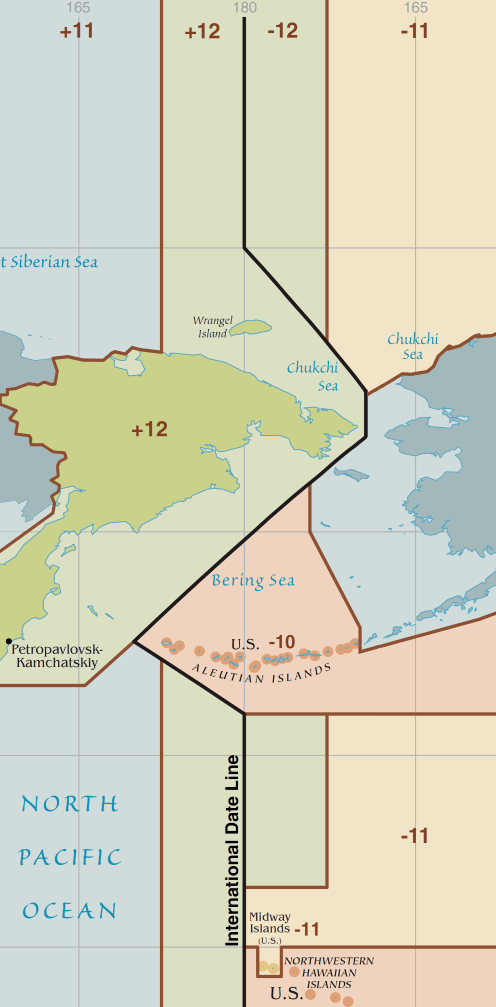
The Date Line has been host to rather strange happenings in reality as well as in fiction. On the map, it is no longer a straight line that follows the longitude of 180 degrees east and west. It veers abruptly to avoid landmasses, taking wide detours around islands. But once it deviated not one inch. It speared through the atolls and islands it encountered, dividing them in half, so that a person had the opportunity of standing with one leg in today and the other in yesterday or even tomorrow. Wrangel Island in the Arctic Ocean, the last dwelling place of woolly mammoths (still around when the pyramids were being constructed in Egypt), was one of these special places. Three Fijian islands too: Vanua Levu, Taveuni and Rambi, where unscrupulous plantation owners forced workers to cross the Line on Sundays to prevent them having a day off.

There is also the interesting fact that the equator crosses the Date Line and that a point therefore exists where it is summer and winter simultaneously while also being today and tomorrow (or yesterday). The SS Warrimoo was a ship that routinely travelled between Canada and Australia. On the last day of December 1899, the ship was very close to the point where the equator meets the Date Line and Captain Phillips realised that if he positioned the SS Warrimoo exactly on that point, something very curious could be achieved. He gave instructions for this to happen and on the stroke of midnight his vessel lay at 0 degrees latitude and 180 degrees longitude. Magical coordinates…

The forward part of the ship was now in the southern hemisphere and thus in summer while the rear remained in the northern hemisphere and in winter. Half of the SS Warrimoo was in the year 1899 (December) while the other half was now in the year 1900 (January). Captain Philipps was skipper of a vessel that was in two different days, two different months, two different seasons, two different hemispheres and two different centuries. Of course, the objection can be raised that December 30 is not the last day of a year. But the Captain waited until midnight before reaching the miracle point. December 31 did come but it flashed past in less than the blink of a mermaid’s eye. The ship leapfrogged an entire day, or at least the vast majority of it.

My hope is that there was a copy of Around the World in Eighty Days on board the ship when it made that spectacular crossing, or maybe a collection of the short stories of Poe. It is highly unlikely this was the case, of course. And I have just now had another thought. Suppose you are reading Verne’s novel on a ship that crosses the Line in an easterly direction. You have been reading it all day and have reached the last few chapters. Suddenly the ship crosses the Line and you are back in yesterday and find yourself only on the first page again. You might be frustrated not to know the ending to the book. Let me assist you. The hero and the heroine do get married.

Rhys Hughes has lived in many countries. He graduated as an engineer but currently works as a tutor of mathematics. Since his first book was published in 1995 he has had fifty other books published and his work has been translated into ten languages.

.

PLEASE NOTE: ARTICLES CAN ONLY BE REPRODUCED IN OTHER SITES WITH DUE ACKNOWLEDGEMENT TO BORDERLESS JOURNAL