Categories
Essay

Does the First Woman-authored Novel in Bengali Seek Reforms?

By Meenakshi Malhotra
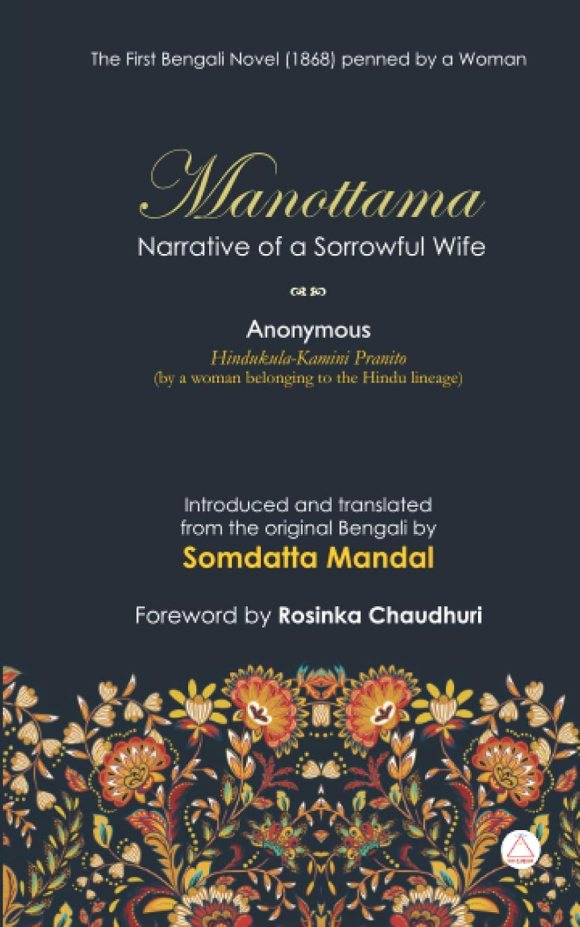
The translation published by Shambhabi The Third Eye in 2022

Published in 1868, Manottoma: Dukkhini Sati Charit (Manottama: Narrative of a Sorrowful Wife) the first novel written by an unnamed Bengali woman identifying herself as ‘A Woman belonging to the Hindu Lineage’, which is technically not a pseudonym, has been translated by Professor Somdatta Mandal and published recently in 2022. Somehow evading the attention of literary historians, the text, or any detailed information about it was unavailable for a long time till it was unearthed by a researcher in London only in 2010. In the foreword to the translated novel, Prof Rosinka Chaudhuri points out that the year 1868 was only a decade after the introduction of the main genres of modern Bengali literature: the modern novel, poetry and drama. This was a time of revision and reinvention, of recasting selves and literary forms and genres.   

Manottama narrates the sufferings of a educated and long-suffering wife who labours under the petty punishments meted out to her by her uneducated husband, depicting the conflict between patriarchal expectations and prescriptions and women’s education and presumably, agency. The eponymous novel depicts a situation where Manottama, an educated woman, is married to an uneducated husband. Because of the latter’s profligate ways, she is subjected to penury and untold hardships, which she seems to accept without demur.

The narrator of Manottama claims it’s a ‘history’. Cast in a dialogic format as a conversation between two friends, Jadhav and Madhav, (a common format in its time) the novel, in one interpretation, tells us about the pitfalls of female education in the nineteenth century, a period that also saw the emancipation of Bengali women through education in a significant way. Written in the traditional Indian Puranic style of narration, with plenty of sub-plots and digressions and without conforming to the western dictates of unity of time, place, and action, it provides a domestic picture where an educated wife has to compromise with the activities and worldview of an uneducated husband. At one level of interpretation, it seems to be an attack on patriarchy. As an early narrative by an anonymous woman, the  work needs — and in a way, demands — greater attention now after more than a century of neglect in order to reinterpret and reconfigure its didacticism and question its meek acceptance of status quo.

Can we accord this work the status of a novel? Also is there a way in which we can unpack the didacticism of the text and pave the way to a  subversive reading of patriarchies?

In showcasing a woman who seems to meekly accept her lot in life without complaint, the intention purportedly was to show the benefits of education and how an educated woman navigates her destiny.  There are many instances of rampant social injustices in the text. The husband’s profligacy, his marrying a second time and frittering away family fortunes — all these are accepted by the protagonist, Manottama, in a spirit of apparent equanimity. She seems to accept the social injustices meted out to her meekly, without demur or protest. She obeys and serves her father during his visit and continues to perform her conjugal and domestic duties vis-a-vis her undeserving  husband. If anything, she continues in her endeavour to instruct her children and the children of the quarrelsome second wife. No complaint against marital injustices pass her lips, even when her father expresses concern over the indigent condition of the household. Her behaviour is ideal in every respect and she is upheld as a paragon.  

Manottama” in Bangla can be translated into someone with a superior mind or soul and the protagonist named as such fits the bill. She keeps quiet about her individual woes while trying to ensure the well-being of the whole family.

The novel shows the impact of the many instruction manuals and advice/conduct books  that were plentifully available at the time and herein lies part of the problem of the book as a novel. For one, there is no attempt to depict the inner thoughts of the protagonist. She at times seems like a cardboard cutout, a compendium of all the virtues extolled by patriarchs and paternalists in 19th century Bengal and India. She is a stereotype and seems almost a parodic version of the ’good woman’ who sacrifices self-interest at all times. Whether this narrative qualifies/succeeds as a novel is something which has to be decided by the reader .She embodies the ‘patibrata’ or the devoted wife, a kind of woman who helps in the salvation of the husband and nation. To quote a writer at the end of the 19th century:

The Patibrata wife is the road to liberty and mobility of man. If the women of India follow the footsteps of Sita and Savitri, then this fallen country will be the blessed land  again. (Chandranath Basu, Bagchi 85)

The discovery of this text forms a story by itself and is a precious nugget as it was located in the British library relatively recently, in 2010. The significance of this text  is also that it is a woman’s voice addressing other women, advising them with a strong didactic intent. As readers, we can only speculate that the writer intends this homily as a form of advocacy to women that they should not abandon their traditions and customs, but use their education in order to better themselves, and devote themselves  to serving their husbands.  

The narrative in a dialogic style seems like an extended conversation or debate between a proponent of tradition and a spokesperson and modernity. Some of the conversation between Nilabrata, the irresponsible husband, and Manottama, echo aspects of this debate. According to Nilabrata, who is rendered somewhat insecure by his educated wife and voices the biases against women’s education, only foolish men will send their daughters to school in order to train their daughters as prostitutes. “Educating women and showing them the path to go astray are similar,” he asserts.

One is reminded of Bankim Chandra Chatterjee’s (1838-1894) essay on Prachina o Nobina or “The Traditional Woman and the New Woman”(Woman Old and New, 1879). The debate on whether to educate women were along the contours of conservatism versus progressivism, albeit with shades and finer nuances.We can suppose that the author is in conversation with a conservative perspective which argues against women’s education and where she attempts to demonstrate that tradition and women’s education are not mutually opposed or divergent.

Bengali literature offers many examples of women who were poised on the brink of the  paradoxical conundrum of modernity, which made them embrace education and reform without abandoning traditional values. This attempt to recast and position the ‘new’ Indian woman was a pre-emptive gesture  to counter the accusation of Westernization and deracination levelled against the reformist attempts to redefine gender roles and relations in late 19th century India.

While one can grasp the discursive aspect of the text, the lack of what we understand or perceive as a natural human response on Manottama’s part to any of her husband’s actions — misdemeanours, follies or vices —  leave us feeling deeply dissatisfied. If the novel as a form shows the interactions of the individual with other individuals or with society, the lack of any credible response from Manottama casts her in the mould of a ‘patibrata’   woman but stifles the text as a novel.

However, if we keep in mind that many great writers  novelists from Bengal and elsewhere — Bankim Chandra Chatterjee, Rabindranath Tagore and Sarat Chandra Chattopadhayay— have often used the novel as vehicles of ideas, which generate debate both within the world of the novel and in a larger socio-historical context, this  novel can surely be counted as a precursor and a prototype of the discursive/social discussion novel in Bengali. As for the other question raised earlier about the possibility of a subversive reading, Manottama by showing  the evils  besetting patriarchal systems, manages to show the untenable nature of the same and the fact that men like Nilabrata, for all their bravado, are liable to collapse, unless rescued and sustained by sensible wives. In that sense, it hold a lesson for men to marry wisely and recognise the true worth of educated wives, without getting lured either by false friends or duplicitous women.   

The book has received a fresh lease of life in the hands of a competent translator and commentator. The foreword similarly draws out the significance of the narrative, placing it in the context of its times and the larger context of Bengali literature. An exploration of its discursive trajectories and varying cartographies adds to the joys of discovering and reading the narrative.

.                

Meenakshi Malhotra is a Professor of English Literature at Hansraj College, University of Delhi, and has been involved in teaching and curriculum development in several universities. She has edited two books on Women and Lifewriting, Representing the Self and Claiming the I, in addition  to numerous published articles on gender, literature and feminist theory.       

.

PLEASE NOTE: ARTICLES CAN ONLY BE REPRODUCED IN OTHER SITES WITH DUE ACKNOWLEDGEMENT TO BORDERLESS JOURNAL

Click here to access the Borderless anthology, Monalisa No Longer Smiles

Click here to access Monalisa No Longer Smiles on Kindle Amazon International
Categories
Review

Portraying Urban Middle Class Life

Book Review by Meenakshi Malhotra

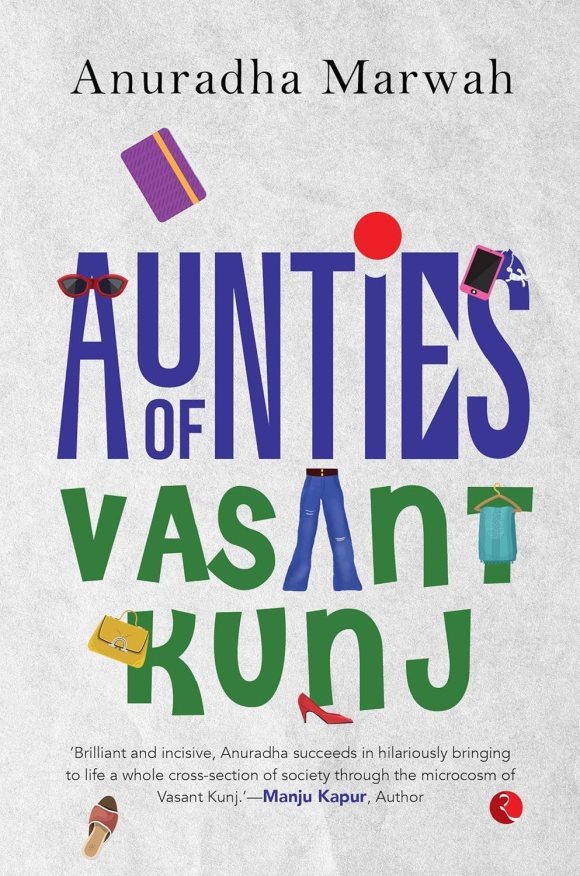
Title: Aunties of Vasant Kunj

Author: Anuradha Marwah

Publisher: Rupa Publications, India

A well-conceived and captivating take on the lives and circumstances of three different women who happen to inhabit  the same building in the middle class not so ‘posh’ locality in South Delhi called Vasant Kunj, Anuradha Marwah’s   observations  about  class, domesticity and “auntyhood” in the novel are both humorous and accurate. With three novels in her authorial bag, the fourth, Aunties of Vasant Kun,j revisits that time in a woman’s life when she is supposedly teetering on the verge of being middle-aged , somewhat on the wrong side of forty, except that the “aunties” are nowhere near “auntie-dom” understood in the conventional sense. In fact, in the  21st century urban churn, women and men are probably more unsettled than ever before, and often embrace that uncertainty. The subtle or not so subtle tension between traditional gender roles and expectations and the actual lives of urban middle class women is wittily and sensitively portrayed in this extremely readable novel.

The three women are almost wholly different from each other except in the fact that each of them is grappling with their own struggles where they have to juggle multiple  issues. The protagonists are  Shailaja, raw from her recent experience of betrayal by her long-standing boyfriend and facing harrassment at her workplace; Dini, in a demanding job with an international NGO,  a single-parented child, experiencing a half-acknowledged attraction to a handsome grass-roots activist and Mrs Gandhi who has subsumed her identity in the household resulting in a sense of neglect and loss of confidence. Ignored by her husband who seems to spend more time with his secretary  than with his wife, we realise that Sunil “Casanova” Gandhi has not only a roving eye, but is actively  engaged in pursuit of other women. In a clever sleight of hand, Anuradha Marwah turns a slice of life novel focusing on the everyday lives of women into a delicious take on the new modern woman as she navigates the quicksands of desire and domesticity, motherhood, meditation and professional commitments, simultaneously.

Shailaja, a newly single academic whose workplace woes are comparable to her messy not-quite-resolved (are they ever?) relationship with a recalcitrant ex who meanders in and out of her life, moves into Vasant Kunj which also houses the hospitable Mrs Gandhi, and the prickly Dini, who is fierce about guarding her privacy. The latter has also become equally adept at dodging both the hospitality as well as the probing questions thrown her way by the determined- to- be- friendly Mrs Gandhi.  Mrs Nilima Gandhi has her own share of troubles-a difficult mother-in -law, a cheating husband who has a roving eye that preys upon other women, a dismissive daughter who gangs up with her father to demean her mother — all these combine in varying degrees to further lower her already plummeting self-esteem. She is rescued from the throes of self-pity by the timely intervention of Mrs Malhotra and Navneeta Singh who encourage her to adopt the Buddhist practice of chanting as a way to address her problems. Listening to Mrs Singh’s optimistic projections, Mrs Gandhi experiences a twinge of doubt but nevertheless goes about it with single minded determination to transform her life and turn it around. As some things start falling into place for   her, Shailaja and Dini, the three women strike an unlikely friendship which provides a holding structure as they negotiate everyday challenges. Dini ‘succumbs’ to the abrasive charms of Radhey Shyam and Shailaja is able to shake off the vestiges of her previous relationship and take a bold new step forward. Mrs Gandhi is able to regain a sort of equilibrium.

As the women collectively register and celebrate their small and big victories in the course of the novel’s unfolding, we as readers are brought face to face with a relatively new sub-genre in the Indian English novel. It is the story of women by women narrated with both humour and compassion, occupying a niche in popular literature between chick-lit and mature women’s fiction, between popular and literary fiction. It actually challenges taxonomies of ‘literary’ vs ‘popular’ fiction. This is clear from the  choice of a title that is quite a masterstroke. Though it sounds subversive, the title seems to be the choice of an author who refuses to take herself too seriously. The  lightness of tone is sustained as the novel critiques societal attitudes towards single women and the entitled behaviour of men who are never held responsible or called to account within patriarchy.  Perhaps  the  only deviation from the lightness of tone is the autobiographical fragment towards the close of the novel which provides a sort of afterword articulating the impulse and desire to write the Aunties of Vasant Kunj. Post-publication, when the author was asked what impels her to create fiction, she replied that it was the hope of getting a glimpse of all the other lives that she might have lived. Marwah has achieved a fine balance in nuancing all her characters, making their stories at once convincing and identifiable.  

She has depicted the rhythms of everyday life and  nuanced the dialogues to suggest a bilingual sensibility. Cinematic and captivating, Aunties of Vasant Kunj provides plenty of fun and frolic without trivialising the serious concerns and conflicts of the three protagonists. Marwah’s humour is spot on, and she does not miss a beat in capturing the water woes and other roadblocks of quotidian life in the sprawling urban metropolis /megapolis of Delhi. The novel is likely to resonate with many readers in its highlighting of vital aspects of life in the city, along with the varied kinds of crises experienced daily.

The novel narrates the stories of its protagonists with verve and humour and with exactly  the ‘mot juste’ or the right words to irradiate them, creating a smorgasboard of delights for the reader.

Click here to read the book excerpt

.

Dr Meenakshi Malhotra is Associate Professor of English Literature at Hansraj College, University of Delhi, and has been involved in teaching and curriculum development in several universities. She has edited two books on Women and Lifewriting, Representing the Self and Claiming the I, in addition  to numerous published articles on gender, literature and feminist theory.  Her most recent publication is The Gendered Body: Negotiation, Resistance, Struggle.

.

PLEASE NOTE: ARTICLES CAN ONLY BE REPRODUCED IN OTHER SITES WITH DUE ACKNOWLEDGEMENT TO BORDERLESS JOURNAL

Click here to access the Borderless anthology, Monalisa No Longer Smiles

Click here to access Monalisa No Longer Smiles on Amazon International

Categories
Review

Mahasweta Devi: Writer, Activist, Visionary

Book Review by Meenakshi Malhotra

Title: Mahasweta Devi: Writer, Activist, Visionary

Editor: Radha Chakravarty

Publisher: Routledge

Mahashweta Devi (1916-2016) was a renowned and much awarded writer-activist-translator who was reputed for her close observation and documentation of tribal life and its marginalisation and willed forgetting by dominant power systems. Among the many awards received by her were the Padma Vibhushan, the Ramon Magsaysay, the Jnanpith and the Sahitya Akademi Award. The stated aim of the present volume — in keeping with the overall objectives of the Writer in Context Series — is to present a more rounded, multidimensional image of Mahasweta Devi. This has been admirably accomplished by Prof Radha Chakravarty who is an eminent translator and academic herself.

In the ‘Introduction’, she unpacks the partial truths that underlie the stereotypical image of Mahasweta Devi as an activist. Highlighting the fact that Mahashweta’s representations of different forms of mar­ginality bring together “the aesthetic and the political in ways that demand a more nuanced reading”, she reinforces the need to read Devi’s oeuvre as literature, and not only as “forms of social documentation or ‘wit­nessing’”. She interrogates the stereotype of the activist-writer and opens up the possibility of re-reading Mahasweta Devi’s life and work in “newer, more unsettling ways”. Further, Chakravarty highlights how her (Devi’s) creative writings in particular emerge as “ambivalent texts, simultane­ously imbued with radical potential and a continued reliance on traditional forms of signification”.

Mahasweta Devi’s writings often demonstrate a tenuous divide between fiction and non-fiction. As a matter of fact, she emphasises on “the historical basis for her creative writings”, which is evident in many of her novels like Mother of 1084 (Hazaar Churashir Maa, 1974), and stories like ‘Draupadi’ and many others, which are based on the Naxalite movement.  Simultaneously however, her literary works display a measure of social realism which, Chakravarty contends, is “offset by a visionary quality that enables the imagining of transformative possibilities.” The contents of this volume testify to the varied, diverse and  sometimes “contradictory dimensions of her multifaceted genius”.

The book under consideration aims to set the record straight for readers outside Bengal whose views are based on the “tiny fraction of her Mahashweta Devi’s work available in English translation”. She was an extraordinarily prolific and versatile writer who wrote in multiple genres, including fiction, biography, drama, children’s literature, memoirs, travel writing, and literary criticism. She also occasionally translated her own work into English.

Chakravarty’s introduction and compilations in this volume foregrounds the aspect  of Mahashweta’s political activism and how her writing itself  becomes a form of resistance. Her early  induction into Marxism was also partially attributable to her family background. Her family included Ritwik Ghatak (her father’s brother was a famed film maker) on her father’s side and on her mother’s, Sankha Choudhuri and Sachin Choudhuri, one a well-known sculptor and the other, the founder/editor of India’s foremost social science journal, Economic and Political Weekly, respectively.

Her early contact with Tagore and education at Santiniketan sensitised her to values of “inclusiveness, self-reliance, freedom of thought and expression, social responsibility, and environmental issues”. There, she also imbibed some of the spirit of the freedom struggle. Through her marriage to Bijon Bhattacharya, she grew familiar with IPTA[1] and the left ideologies. Later, she was associated with different radical movements in Bengal, Manipur, Jharkhand, Bihar, and Rajasthan, which find expression in many of her writings (Mother of 1084, ‘Draupadi’).

Her political commitment to these movements is evident in her use of language.  Local vocabularies become central to the style and subject of Mahasweta’s writings. She wrote in 1983: “Since I remain immersed in indigenous myths, oral legends, local beliefs and religious convictions, I find purely indigenous words very potent and expressive.”

She  was critical of writers in the Bangla literary establishment whose experiments with modernist aesthetics led to disengagement with the socio-political context. All the same, her writings evince special “linguistic, textual, and aesthetic strategies that can be compared to the prac­tices of other writers who were experimenting with new approaches”, using non-linear time. Oral traditions fascinated her and she worked closely with Prof G.N.Devy in her later years, to campaign for the recognition of tribal languages.

She also  translated and edited volumes on Indian folklore. In her own writings, she includes elements from the oral traditions, as in the snatches of local lore in Jhansir Rani (The Queen of Jhansi) or the lines from an untranslated Santhal song in ‘Draupadi’. As Chakravarty points out, “Heteroglossia, the use of language as an indicator of social hierarchies in multivocal, polyphonic texts, functions as a potent literary feature in her writings.” Alongside, many of her texts incorporate multilingual elements, as if to indicate the heterogeneities in South Asian societies and cultures.

The book is an comprehensive introduction to and reappraisal of Mahasweta Devi’s life and work. It is imaginatively conceptualised and organised into different sections, each highlighting diverse aspects of her work and the criticism thereon. Section 1 of the book called ‘Spectrum: The Writer’s Oeuvre’, offers the reader in English an overview of the full range of her oeuvre through brief samples of her literary writings across diverse genres to highlight her versatility. These include Jhansir Rani (1956), a fiction­alised biography of Rani Lakshmibai, Queen of Jhansi, which amalgamates historical sources, folklore, and creative characterisation, to show up the contradictions in different ver­sions of the Rani’s life and Hajar Churashir Ma (The Mother of 1084), her powerful novel about the political awakening of a mother after her son is killed by the police during the Naxalite movement of the 1970s, altered the trajectory of the Bengali novel. The extract from the final pages captures, in a style resembling stream-of-consciousness, the dramatic political power struggles in the outer world and the inner drama of the mother’s psyche.

The short story ‘Giribala’ narrates the plight of a girl married off at 14 to a man who sells their own daughters into the flesh trade to pay for the construction of his dream house. The play Bayen uses modern experimental techniques to present the story of a woman from the caste of Doms (cre­mation attendants), who becomes the victim of collective superstition and scapegoating and yet, in a final act of heroic self-sacrifice, saves the very community that has ostracised her. In a complete change of tone and style,’Nyadosh the Incredible Cow’, a delightful piece of writing for children, offers a witty anecdotal account of the devastating exploits of a cow in the author’s home. The extract from Tarasankar Bandyopadhyay, Mahasweta Devi’s English monograph on the iconic Bengali writer, reveals her incisive­ness as a literary historian and critic and also provides a window to her own literary values.

As Chakravarty clarifies, given the vast body of critical readings on Mahasweta’s writings, a comprehensive compilation is beyond the scope of this book. Instead, the selected essays in Section 2 (‘Kaleidoscope: Critical Reception’) offer the reader (in translation) a sense of the paradigm shifts that mark Devi’s critical recep­tion in Bengal, the rest of India, and in the international domain. Ten­sions, debates, and contradictions are highlighted, and overview of her critical reception over four decades –1957 to 1997 in Bengal is discussed by Arup Kumar Das. An essay by Dipendu Chakrabarti analyses the debates and contro­versies around her work. Dilip K. Basu’s account of Hajar Churashir Ma views itas a pathbreaking text that transformed the course of the Bengali novel in the 1970s.

The essays in English by other Indian critics include Sujit Mukherjee’s classic piece on Mahasweta and Spivak, Jaidev’s account of national alle­gory in Douloti, Arunabh Konwar’s comparative analysis of the creative use of fictionalised biography by Mahasweta and Indira Goswami, Shreya Chakravorty’s study of the politics of translation in the work of Spivak and Samik Bandyopadhyay, Anjum Katyal’s account of Mahasweta as a drama­tist, and Benil Biswas’ reading of the transmutations of Mahasweta’s texts via stage and screen adaptations.

International contributions include an important new essay on Pterodactyl by Gayatri Chakravorty Spivak, who interprets the rhetorical pointers in the text to speak of it as an activist mediation for the reader to learn about earn­ing the right to intervene. Shreerekha Subramanian’s essay offers a compara­tive study of the discourse on motherhood in novels by three women writers across different languages, locations, and literary traditions: Mahasweta Devi, Toni Morrison, and Amrita Pritam.

Section 3 (‘Ablaze With Rage: The Writer as Activist’) includes some of Mahasweta’s activist writings, such as ‘Tribal Language and Literature: The Need for Recognition’, a passionate demand for the inclusion of tribal languages in official discourse; ‘Palamau is a Mirror of India’, where she critiques what she perceives the failures of the state to address the plight of the oppressed people in post-Independence India; and ‘Eucalyptus: Why?’, a scathing critique of the nexus between local powers and global market forces that have led to the replacement of natural forests in Bengal with eucalyptus plantations that have destroyed the local ecology that sustained human and animal life there. Alongside, in ‘The Adivasi Mahasweta’, Ganesh N. Devy reminiscences about his first encounter with Mahasweta Devi and their subsequent collaborations in activist campaigns and projects. ‘Haunted Landscapes: Mahasweta Devi and the Anthropocene’, by Mary Louisa Cappelli, connects Mahasweta’s activist writings and fiction on the subject of the Anthropocene to indicate the need to take a composite view of her writing and activism as twin manifestations of the same vision.

Section 4, ‘Personal Glimpses: A Life in Words’, includes extracts from Mahasweta’s memoir Our Santiniketan (2022), along with interviews (with Naveen Kishore and Radha Chakravarty) and reminiscences by her family members (Nabarun Bhattacharya, Soma Mukhopadhyay, Sari Lahiri, Ina Puri), friends (writers ‘Anand’ and Anita Agnihotri), and associates (Ranjit Kumar Das ‘Lodha’, Dakxin Bajrange), which highlight different facets of Mahasweta’s life and personality, bringing to life the woman behind the public image.

The book offers a comprehensive overview of Mahashweta Devi’s writing and will be of immense use to students, researchers and to general readers. As Chakravarty reiterates , “New trends in Mahasweta studies continue to evolve, including emphasis on her environmental concerns, ethics, planetarity and the Anthropocene, intersectionality, the use of incommensurate realities and registers of writ­ing, comparative readings, and an emerging focus on her life”.

This is an ambitious attempt to give us an idea of the immense range of her work. While a full biog­raphy and a full bibliography of Mahasweta’s oeuvre is yet to be published, (encompassing the entire corpus of her work, including letters and other unpublished material) this volume is a vital step in that direction. In her excellent Introduction, Chakravarty charts the long-term impact of Devi’s work which continues to resonate in contemporary forms of activism and theatre. Through the actions of the many groups of people she inspired – the women of Manipur whose public protest imitated her fiction, to the per­formances of the Budhan theatre, and the rise to fame of the Dalit Bengali writer, Manoranjan Byapari— “Mahasweta’s impact and influence can be felt in many ways. She survives through the people she struggled to support all her life,”

It is an ironical reflection on our times that a prolific and much awarded Indian writer-perhaps deserving of the Nobel prize, should be excised from the university syllabus of a central university. This move has, perhaps paradoxically, elicited even more interest in Mahasweta Devi’s work and has also consolidated her reputation as a mascot, a symbol of resistance to state violence. A timely intervention, this volume proves yet again that a great writer, in responding to local , regional, environmental ethical concerns sensitively,  transcends his/her immediate context to acquire global and universal significance.    

[1] Indian People’s Theatre Association founded in 1943

.

Dr Meenakshi Malhotra is Associate Professor of English Literature at Hansraj College, University of Delhi, and has been involved in teaching and curriculum development in several universities. She has edited books on Women and Lifewriting, Representing the Self and Claiming the I, in addition  to numerous published articles on gender, literature and feminist theory.   Recently, she co-edited The Gendered Body: Negotiation, Resistance, Struggle.

.

PLEASE NOTE: ARTICLES CAN ONLY BE REPRODUCED IN OTHER SITES WITH DUE ACKNOWLEDGEMENT TO BORDERLESS JOURNAL

Click here to access the Borderless anthology, Monalisa No Longer Smiles

Click here to access Monalisa No Longer Smiles on Amazon International

Categories
Editorial

Will Monalisa Smile Again?

The first month of 2023 has been one of the most exciting! Our first book, Monalisa No Longer Smiles: An Anthology of Writings from across the World, is now in multiple bookstores in India (including Midlands and Om Bookstores). It has also had multiple launches in Delhi and been part of a festival.

We, Meenakshi Malhotra and I, were privileged to be together at the physical book events. We met the editor in chief of Om Books International, Shantanu Ray Chaudhuri, the editor of our anthology, Jyotsna Mehta, along with two translators and writers I most admire, Aruna Chakravarti and Radha Chakravarty, who also graced a panel discussion on the anthology during our physical book launch. The earlier e-book launch had been in November 2022. My heartfelt thanks to the two eminent translators and Chaudhuri for being part of the discussions at both these launches. Chaudhuri was also in the panel along with Debraj Mookerjee at a launch organised by Malhotra and the English Literary Society steered by Nabaneeta Choudhury at Hans Raj College, Delhi University. An energising, interactive session with students and faculty where we discussed traditional and online publishing, we are immensely grateful to Malhotra for actively organising the event and to the Pandies’ founder, Sanjay Kumar, for joining us for the discussion. It was wonderful to interact with young minds. On the same day, an online discussion on the poetry in Monalisa No Longer Smiles was released by the Pragati Vichar Literary Festival (PVLF) in Delhi.

At the PVLF session, I met an interesting contemporary diplomat cum poet, Abhay K. He has translated Kalidasa’s Meghaduta and the Ritusamhara from Sanskrit and then written a long poem based on these, called Monsoon. We are hosting a conversation with him and are carrying book excerpts from Monsoon, a poem that is part of the curriculum in Harvard. The other book excerpt is from Sanjay Kumar’s Performing, Teaching and Writing Theatre: Exploring Play, a book that has just been published by the Cambridge University Press.

Perhaps because it is nearing the Republic Day of India, we seem to have a flurry of book reviews that reflect the Sub-continental struggle for Independence from the colonials. Somdatta Mandal has reviewed Priya Hajela’s Ladies Tailor: A novel, a book that takes us back to the trauma of the Partition that killed nearly 200,000 to 2 million people – the counts are uncertain. Bhaskar Parichha has discussed MA Sreenivasan’s Of the Raj, Maharajas and Me, a biography of a long serving official in the Raj era — two different perspectives of the same period. Rakhi Dalal has shared her views on Shrinivas Vaidya’s A Handful of Sesame, translated from Kannada by Maithreyi Karnoor, a book that dwells on an immigrant to the Southern part of India in the same time period. The legendary film writer K.A. Abbas’s Sone Chandi Ke Buth: Writings on Cinema, translated and edited by Syeda Hameed and Sukhpreet Kahlon, has been praised by Gracy Samjetsabam.

We have a piece on mental health in cinema by Chaudhuri, an excellent essay written after interviewing specialists in the field. Ratnottama Sengupta has given us a vibrant piece on Suhas Roy, an artist who overrides the bounds of East and West to create art that touches the heart. Candice Louisa Daquin has written on border controls and migrants in America. High profile immigrants have also been the subject of Farouk Gulsara’s ‘What do Freddy Mercury, Rishi Sunak & Mississipi Masala have in Common?’ Sengupta also writes of her immigrant family, including her father, eminent writer, Nabendu Ghosh, who moved from Bengal during the Partition. There are a number of travel pieces across the world by Ravi Shankar, Meredith Stephens and Mike Smith — each written in distinctively different styles and exploring different areas on our beautiful Earth. Sarpreet Kaur has revisited the devastation of the 2004 tsunami and wonders if it is a backlash from nature. Could it be really that?

Suzanne Kamata gives us a glimpse of the education system in Japan in her column with a humorous overtone. Devraj Singh Kalsi dwells on the need for nostalgia with a tongue-in-cheek approach. Rhys Hughes makes us rollick with laughter when he talks of his trip to Kerala and yet there is no derision, perhaps, even a sense of admiration in the tone. Hughes poetry also revels in humour. We have wonderful poetry from Jared Carter, Ranu Uniyal, Asad Latif, Anaya Sarkar, Michael R Burch, Scott Thomas Outlar, Priyanka Panwar, George Freek and many more.

The flavours of cultures is enhanced by the translation of Nazrul’s inspirational poetry by Professor Fakrul Alam, Korean poetry written and translated by Ihlwha Choi and a transcreation of Tagore’s poem Banshi (or flute) which explores the theme of inspiration and the muse. We have a story by S Ramakrishnan translated from Tamil by R Sathish. The short stories featured at the start of this year startle with their content. Salini Vineeth writes a story set in the future and Paul Mirabile tells the gripping poignant tale of a strange child.

With these and more, we welcome you to savour the January 2023 edition of Borderless, which has been delayed a bit as we were busy with the book events for our first anthology. I am truly grateful to all those who arranged the discussions and hosted us, especially Ruchika Khanna, Om Books International, the English Literary Society of Hans Raj College and to the attendees of the event. My heartfelt thanks to the indefatigable team and our wonderful writers, artists and readers, without who this journey would have remained incomplete. Special thanks to Sohana Manzoor for her artwork. Many thanks to the readers of Borderless Journal and Monalisa No Longer Smiles. I hope you will find the book to your liking. We have made a special page for all comments and reviews.

I wish you a wonderful 2023. Let us make a New Year’s wish —

May all wars and conflicts end so that our iconic Monalisa can start smiling again!

Mitali Chakravarty,

borderlessjournal.com

.

Photographs of events around Monalisa No Longer Smiles: An Anthology of Writings from across the World. Click here to access the Book.

.

Insta Link to an excerpt of the launch at Om Bookstore. Click here to view.

E-Launch of the first anthology of Borderless Journal, November 14th 2022. Click here to view.