Categories
Editorial

Celebrating Borderless… Five Years and Counting…

Emerging by Sybil Pretious

Drops of water gather to make a wave. The waves make oceans that reshape land masses over time…

Five years ago, on March 14th, in the middle of the pandemic, five or six of us got together to start an online forum called Borderless Journal. The idea was to have a space that revelled with the commonality of felt emotions. Borderless was an attempt to override divisive human constructs and bring together writers and ideators from all over the Earth to have a forum open to all people — a forum which would be inclusive, tolerant, would see every individual as a part of the fauna of this beautiful planet. We would be up in the clouds — afloat in an unbordered stratosphere— to meet and greet with thoughts that are common to all humans, to dream of a world we can have if we choose to explore our home planet with imagination, kindness and love. It has grown to encompass contributors from more than forty countries, and readers from all over the world — people who have the same need to reach out to others with felt emotions and common concerns.

Borderless not only celebrates the human spirit but also hopes to create over time a vibrant section with writings on the environment and climate change. We launch the new section today on our fifth anniversary.

Adding to the wealth of our newly minted climate and environment section are poems by Luis Cuauhtémoc Berriozábal on the LA fires, Green by Mark Wyatt and Ecopoetry by Adriana Rocha in our March issue. We also have poetry on life in multiple hues from Kiriti Sengupta, Ryan Quinn Flanagan, Snehaprava Das, Stuart McFarlane, Arshi Mortuza, George Freek, Ahmad Al-Khatat, Jyotish Chalil Gopinathan, Michael Burch, Bibhuti Narayan Biswal, Owais Farooq and Rakhi Dalal. Tongue-in-cheek humour in poetry is Rhys Hughes forte and he brings us just that in his sign poem.

 Devraj Singh Kalsi with a soupçon of ironic amusement muses on humans’ attitude to the fauna around him and Farouk Gulsara lays on a coating of sarcasm while addressing societal norms. Meredith Stephens brings us concerns for a green Earth when she beachcombs in a remote Australian island. Prithvijeet Sinha continues to familiarise us with his city, Lucknow. Suzanne Kamata, on the other hand travels to Rwanda to teach youngsters how to write a haiku!

Professor Fakrul Alam takes us to libraries in Dhaka with the hope that more will start writing about the waning of such paradises for book lovers. Other than being the month that hosts World Environment Day, March also homes, International Women’s Day. Commemorating the occasion, we have essays from Meenakshi Malhotra on the past poetry of women and from Ratnottama Sengupta on women in Bengali Cinema. Sengupta has also interviewed Poulami Bose Chatterjee, the daughter of the iconic actor Soumitra Chatterjee to share with us less-known vignettes from the actor’s life. Keith Lyons has interviewed Malaysian writer-editor Daphne Lee to bring to us writerly advice and local lores on ghosts and hauntings. 

Our fiction truly take us around the world with Paul Mirabile giving us a story set Scotland and Naramsetti Umamaheswararao giving us a fable set in a Southern Indian forest. Swati Basu Das takes us on an adventure with Peruvian food while sitting by the Arabian Sea. Munaj Gul gives a heart-rending flash fiction from Balochistan. And Zoé Mahfouz shares a humorous vignette of Parisian life, reflecting the commonality of felt emotions.

Celebrating the wonders of the nature, is a book excerpt from Frank S Smyth’s The Great Himalayan Ascents. While the other excerpt is from Hughes’ latest novel, The Devil’s Halo, described as: ‘A light comedy, a picaresque journey – like a warped subterranean Pilgrim’s Progress.’ We have reviews that celebrate the vibrancy of humanity. Bhaskar Parichha writes of Sandeep Khanna’s Tempest on River Silent: A Story of Last 50 Years of India, a novel that spans the diversity that was India. Malashri Lal reviews Rachna Singh’s Raghu Rai: Waiting for the Divine, a non-fiction on the life and works of the famous photographer. Somdatta Mandal discusses two book by Tsering Namgyal Khortsa reflecting the plight of Tibetan refugees, a non-fiction, Little Lhasa: Reflections in Exiled Tibet and a fiction, Tibetan Suitcase.

One of features that we love in Borderless is that language draws no barriers — that is why we have translations by Professor Alam of Jibananada’s short poems on the impact of war on the common masses. We have a small vignette of Korea from Ihlwha Choi’s self-translated poem. And we have a translation of Tagore’s verses invoking the healing power of spring… something that we much need.

We also have a translation by Lourdes M Supriya from Hindustani of a student’s heartrending cry to heal from grief for a teacher who faced an untimely end — a small dirge from Tanvir, a youngster with his roots in Nithari violence who transcended his trauma to teach like his idol and tutor, the late Sanjay Kumar. With this, we hope to continue with the pandies corner, with support from Lourdes and Anuradha Marwah, Kumar’s partner.

Borderless has grown in readership by leaps and bounds. There have been requests for books with writings from our site. On our fifth anniversary, we plan to start bringing out the creative writing housed in Borderless Journal in different volumes. We had brought out an anthology in 2022. It was well received with many reviews. But we have many gems, and each writer is valued here. Therefore, Rhys Hughes, one of our editorial board members, has kindly consented to create a new imprint to bring out books from the Borderless Journal. We are very grateful to him.

We are grateful to the whole team, our contributors and readers for being with us through our journey. We would not have made it this far without each one of you. Special thanks to Sohana Manzoor for her artwork too, something that has almost become synonymous with the cover page of our journal.  Thank you all from the bottom of my heart.

Wish you all happy reading! Do pause by our content’s page and take a look at all the wonderful writers.

Best wishes,

Mitali Chakravarty

borderlessjournal.com

Click here to access the contents page for the March 2025 issue
Happy Birthday Borderless… Click here to read.

Vignettes from a Borderless World… Click here to read a special fifth anniversary issue.
Categories
Stories

Eyes of Inti

By Swati Basu Das

This happened far, far away from the home of the Incas; in a kingdom where Sindbad was born…

When the afternoon sun rays briskly melted into the sea and the sandy beach bathed in its glittering waves, a boy in his teens, sporting a mullet haircut, lounged in one of the decorative corners of an elite semi-outdoor eatery. He sat, busy scratching his legs with one hand and handling his phone with the other. The itchiness disturbed him. He failed to repel a menacing minuscule creature that lurked under the table. He spoke less. His eyes glued to the screen. The scowl he wore on his forehead highlighted his teenage disposition. His sombreness confirmed his teenage manifestations.

His family sat in awe to appraise the affluent ambience of the Peruvian-themed restaurant by the shore of the Arabian Sea.  An enormous vintage carved wood chandelier hung from the ceiling. It sprinkled dust of subtle golden light on the faces ogling up to adore it. Bonsai trees, creepers, elaborate Inca statues, and artefacts artfully contributed to the extravaganza. The crisp December draft made the semi-outdoor setting perfect for an exotic lunch. “Cheer up young man! The December heat has lulled the desert heat, what makes you frown?” a middle aged man, presumably his father interrupted his attention a little more.

“Welcome to the paradise!” A swanky waiter attended the guests in his customary white shirt, black pants and black waistcoat. He stood coated with a half-bistro apron around his waist and a pleasant smile. His generous hands served inviting prawn crackers and tempting avocado guacamole. “I would like to have Eyes of Inti[1],” the boy ordered a drink with a quick smile. “Great choice!” he hurried in and returned with the beverage. “Should you prefer sitting indoors? I must ask you this because some guests complained of mosquitoes two days back. Mosquitoes get nasty on you. It shouldn’t spoil your experience with us.” His teeth shone like pearls as he grinned.

 “Oh, they still didn’t trouble us. We prefer sticking to this table. It’s lovely out here,” the boisterous voice of the man answered. 

While methodically placed the cutlery on the table, the waiter continued. “No one fancies an attack from the monsters with their dangling moustache at lunchtime. They hum until they get tired of singing. When you become heedless, they sit on your bare skin to suck your blood with their straw-like weapon. Did you ever crush them between your palms to witness the lifeline in your palm raise a toast to your success with a daub of blood?” he chuckled at the boy and graciously served a glass of mocktail infusion with a smouldering orange hue popping out. “Eyes of Inti for you. It tastes like the nectar of immortality. While you enjoy the Peruvian meal, Inti shall keep a watch on those little devils.”

The banter amused him. Moving away from his phone, he began scrolling through the menu. “One Pargo a la Trufa and Inca’s Rage for me, please,” The red snapper ceviche with loads of truffle made his stomach growl for food. “So, these devils with dangling moustaches and trenchant weapons own free passes to Paradise? Or, perhaps Inti was too distracted. The wrath of Inti’s nemesis — I mean the mosquitoes – waned Inca’s rage?” the boy smiled.

“Ahh! I’m not quite sure,” the waiter chortled with a bland look. A simper smile lingered on the boy’s face.

Inti. From Public Domain

[1] Ancient Inca sun god

Swati Basu Das is a journalist based in Oman. Her columns and features on culture, and travel are published in newspapers and magazines. She relishes music, escapades, coffee and John Keats. 

PLEASE NOTE: ARTICLES CAN ONLY BE REPRODUCED IN OTHER SITES WITH DUE ACKNOWLEDGEMENT TO BORDERLESS JOURNAL

Click here to access the Borderless anthology, Monalisa No Longer Smiles

Click here to access Monalisa No Longer Smiles on Amazon International

Categories
Slices from Life

Juhu

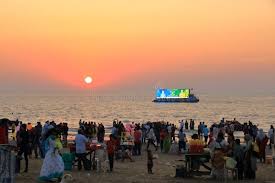
Lokenath Roy gives us a vignette of Juhu Beach, Mumbai[1]

You wake up to the wet, slimy plywood stuck to your long back brushed hair on the deck. It is morning already. The faint disc of the comforting winter sun bristles by your narrow eyes. Aditya guns his hoarse voice towards the sparse crew of the boat.

Another day on the Arabian Sea.

Bone-thin legs scramble to the colour-faded slippers as they flaccidly make their way down the pier. You trod the lukewarm Juhu surface sands. The legs dip deep at certain spots. It is still morgue cold underneath.

The shadows of posh skyscrapers do little to mask the scaly smell of fresh fish sold on rows of marble slabs. The dhaba[2] owner honks his hacked voice at the trickle of daily commuters. Scratching the rashes on your forearm you drag a pockmarked plastic chair from across the narrow alley. The smoking omelet with half-cooked onion bounces down your throat. This is breakfast every day.

The plastics pile up at this end. The ocean stays buried under trash cans, cardboard, and polythene. Ponds of rotting sabzi[3] stay entangle in decaying fishing nets. The gnawing boat treads this wasteland. Sahil adjusts the balloon bag as it fills up at the front. Your eyes scrape the collections on the deck for valuables. The stink gets to your nostrils, even under the thick-lined dirty handkerchief. This is livelihood.

You’re fourteen. The letters of the English alphabet only graze your eyes on the benches of dhabas, amongst folded newspapers left behind by morning office goers. You try to read them. An article on trash-clearing boats at the Juhu beach grabs your attention. Not the writing, but rather the image, the image of your boat. You bend forward, looking narrow-eyed into the pixels over the paper, trying to find any speck on the deck that resembles you.

.

[1] The persons mentioned are fictitious but typical of people he has noticed

[2] Street side eateries

[3] Cooked vegetables with spices

Lokenath Roy, a writer from Kolkata who explores themes of society, memory, and the human experience, has published  in several literary journals and online magazines like The Cawnpore Magazine, The Monograph Magazine, The Aeos Magazine and the Borderless Journal.

.

PLEASE NOTE: ARTICLES CAN ONLY BE REPRODUCED IN OTHER SITES WITH DUE ACKNOWLEDGEMENT TO BORDERLESS JOURNAL

Click here to access the Borderless anthology, Monalisa No Longer Smiles

Click here to access Monalisa No Longer Smiles on Kindle Amazon International

Categories
Excerpt

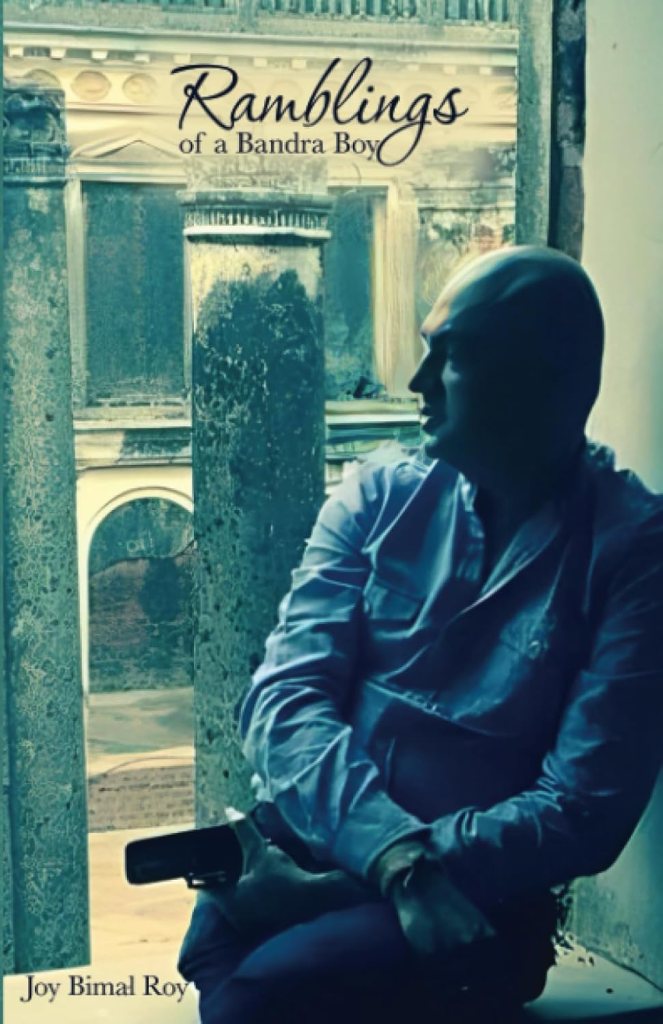
Ramblings of a Bandra Boy

Title: Ramblings of a Bandra Boy

Author: Joy Bimal Roy

(Excerpted from Ramblings of a Bandra Boy by Ratnottama Sengupta)

Joy Bimal Roy looks back at the many 21 Januarys, his birthday, that have dotted 70 calendars

On 6th February 1950 Baba and Nabendu Kaku arrived together in Bombay to work on Bombay Talkies’ Maa. I wasn’t born then, so I can only wonder if either of them, or their illustrious fellow travellers Hrishikesh Mukherjee and Asit Sen even imagined what a life changing experience that journey would be for each of them and, ultimately, for Indian Cinema.

This small but immensely talented and visionary team — Baba as director, Nabendu Kaku as screenplay writer and Hrishi Kaku as editor — created some of the best loved and most remembered classics of the golden ’50s and early ’60s: Do Bigha Zamin, Devdas, Madhumati, Sujata and Bandini.

When I was born on 21st January 1955, this team was already well established and feted in Bombay film industry. Co-incidentally (or perhaps not, because is there any such thing as coincidence?) six days after my birth, a daughter Ratnottama — Uttama to me — was born to Nabendu Kaku and Kanak Kakima in the same, Mandakini Nursing Home in Bandra. Uttama and I instinctively formed a bond which continues till today and seems to strengthen over the years. For me this became the link between our two families.

*

Some silly astrologer told my parents that they should not celebrate my first seven birthdays — else, ill-luck would befall me. So I grew up going to birthday parties of other children and wondering why I never had one.

That could explain why to date I hate my birthdays. It is a day of introspection and soul searching, assessing the past year of my life for gains and losses. No wonder I am more depressed than usual by the end of the day.

All that changed on my 40th birthday thanks to Sriram, my college classmate, and my sister, Aparajita, who was in Mumbai from Kolkata at that time. Together they conspired to have a small celebration at home. Sriram, ever generous, brought the champagne and glasses as well because he was not sure we had any.

Paradoxically it was possibly the worst time in our lives. We had lost the eviction suit our landlords had filed against us in the Small Causes Court, and had been given four months to vacate the premises, of which two months were already up. My birthday was on 21st January and three weeks after that, on 14th February, we were supposed to vacate our home of 46 years — unless we got a Writ Petition admitted in the High Court.

Plonk in the middle of this mess, the thought of celebrating my birthday had not even crossed my mind. But when Sriram entered holding the champagne bottle aloft like a trophy, along with his petite and demure wife Enakshi, and my classmates Divyakant and Ajay, their love and concern were so palpable that suddenly my spirit soared and I felt free as a bird. If I was blessed to have friends like them, Life couldn’t be so bad after all. 

It’s not that I celebrated every year after that but I was no longer traumatized on my birthdays.

*

The first birthday we celebrated after moving into our cottage was my 50th birthday. It doubled as a housewarming party, so it was a riotous affair. Everyone got high thanks to the ministrations of a bartender called Greenville and danced to blaring music like whirling dervishes. Our neighbours complained and the cops turned up. 

Not bad for someone who started out in life with no birthday celebrations at all, eh?

*

When my 60th birthday dawned I was not feeling particularly celebratory. But my sister was coming down, this time from Hyderabad, my niece from Dubai and my nephew from England, and I didn’t want to disappoint them.

Our home at that time was overrun with cats and the garden was a mess, so I looked for a more welcoming venue. The only place I could think of was Kekee Manzil, home to our old family friend Kekoo Gandhy, founder of Chemould, India’s first commercial Art Gallery — and his daughters Rashna, Behroz and Shireen. I asked hesitantly but they agreed enthusiastically and I will always be grateful for that.

Kekee Manzil is an elegant and gracious villa, a heritage structure overlooking the Arabian Sea at Bandstand. At one point of time the Gandhy family also owned the adjacent property which once went by the name of Ville Vienna and housed Baba’s mentor Nitin Bose — and now is famous as Mannat, owned by Shah Rukh Khan.

The venue was the hero on that evening filled with friends, food and fun, not me. Because I was feeling singularly ill at ease about my appearance.

I hadn’t had the time or the bandwidth to figure out what to wear for this milestone birthday, so I had to settle for the only new kurta I had. Unfortunately it looked like tent on me. To make matters worse I had burgeoned to 95 kilos, so I felt like a beached whale.

I made a mental resolution. I HAD to lose weight that year. But as they say, the way to hell is paved with good intentions. So my resolution remained just that — until months had gone by…

*

But before the year dovetailed into my 61st birthday, by sheer synchronicity I stumbled into the right dietician for me — and in eight months I lost 16 kg. Cereno, a trendy batch mate, told me about Zara and gave me a style tip for my hair. He said I would look much better if I had a very short haircut, like a crew cut. I didn’t like the idea of a crew cut but I realised I needed a makeover to go with my new clothes.

At the end of it all my reflection in the mirror was unrecognisable. A strange bald man looked back at me. My sister shrieked when she saw me but she was mollified by the favourable reaction of Cereno and other classmates.

The coup de grace was when a poker-faced Cereno borrowed my phone, fiddled with it, and handed it back to me saying he had put my profile on a dating app. “Just wait for five minutes,” he said, “and you’ll get your first hit.” Sure enough, after five minutes my phone went beep!

So in my 60th year I reinvented myself. Better late than never?

About the Book

Ramblings of a Bandra Boy is a compilation of Joy Bimal Roy’s posts on social media between 2017 and 2020. These slices of life “served without any extra seasoning or fancy garnish” as he puts it, have been described by Rachel Dwyer, professor of Indian Cultures and Cinema at SOAS, London, as jottings in kheror khata, the traditional cloth bound notebook that Satyajit Ray — and his father Sukumar Ray before him — used to pen down thoughts and visuals that are world’s treasure. It covers life in the glitzy Bandra where most of the Bollywood crowd resides… giving glimpses of real life of the giants peopling the cinema screens. 

About the Author

Joy Bimal Roy is the son of legendary Indian filmmaker, Bimal Roy, and one of India’s pioneer woman photographers, Manobina Roy. He started his filmmaking stint as an assistant director to Shyam Benegal.

.

Read the author’s interview by clickling on this link

PLEASE NOTE: ARTICLES CAN ONLY BE REPRODUCED IN OTHER SITES WITH DUE ACKNOWLEDGEMENT TO BORDERLESS JOURNAL. 

Click here to access the Borderless anthology, Monalisa No Longer Smiles

Click here to access Monalisa No Longer Smiles on Kindle Amazon International

Categories
Stories

Sunset Memories

By Saeed Ibrahim

Raj leisurely sipped his tea as he sat side-by-side with his wife on the balcony of their seventh floor flat facing the Arabian Sea. As a retired couple, this was their favourite time of day, enjoying the view of the setting sun with the great orange orb gradually diminishing in size before dipping completed out of view into the sea. The mellow serenity of the moment    filled Raj with a nostalgic tenderness. He reached out to touch his wife’s hand and his outstretched fingers grazed a certain hard object, its brilliance undiminished through the passage of years.

Raj had first met his wife through the good offices of a family connection who also happened to be the community matchmaker. This venerable matriarch had  insisted on accompanying them to her own trusted family jeweller for the purchase of  the engagement ring. Not wanting to disrespect or offend her, he had grudgingly agreed. After much unsolicited advice from their elderly companion, a beautiful solitaire diamond had been selected and Raj had proceeded to pay with his credit card.

To his utter embarrassment, the card had been rejected, casting an uncalled for shadow on the  financial viability of the groom-to-be. Visions of wagging tongues and whispered warnings   had floated before Raj’s eyes. Red faced, he had rushed to explain that the cause of this contretemps had been his having forgetten to upscale the payment limit on his credit card. The old lady had looked at him with a knowing smile, obviously relishing  his discomfiture. Ignoring her and trusting Raj’s good faith, his wife had quickly pulled out her own credit card and paid for the ring herself. The matchmaker had let out a horrified gasp at this breach of convention. Raj had shrugged his shoulders and the couple had walked out of the shop arm-in-arm, leaving the lady open-mouthed with disbelief.

Still smiling at the memory, Raj squeezed his wife’s hand and drew his chair closer. They had been married for 50 years and his practical-minded wife had saved the day more than once. 

.

Saeed Ibrahim is the author of two books – Twin Tales from Kutcch, a family saga set in colonial India, and a short story collection entitled The Missing Tile and Other Stories.

.

PLEASE NOTE: ARTICLES CAN ONLY BE REPRODUCED IN OTHER SITES WITH DUE ACKNOWLEDGEMENT TO BORDERLESS JOURNAL

Click here to access the Borderless anthology, Monalisa No Longer Smiles

Click here to access Monalisa No Longer Smiles on Kindle Amazon International

Categories
Poetry

Tillandsia

By Lakshmi Chithra

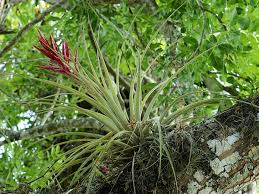
Tillandsia, A plant with herbal roots. From Public Domain
Once, on a dark snowy day in a strange land, 
I metamorphosed to an air plant.
First, I lost my tongue; then I lost my limbs;
My brown trunk swirled into itself.
A crusty mossy green veneer over my fern-like body.
I lay still, a green cocoon– I am going back.


This chip based plastic card is my DNA barcode.
It lets the rootless ausländer reside in this land,
to breathe it's AQI certified perfect-for-a walk air
for these exact contractual work years.
It keeps me safe -- a new sample specimen,
well preserved in a laboratory bell jar.
A permit -- a hermit immersed in nirvana liquid.
I gaze outside through the transparent glass --
everything magnified, everything distorted.
An enticing pool of sunlight at the far end of the lab,
beyond the windows, there are patches of green.
I look for familiar faces, long lost cousins and neighbours --
Is that the rabbit-ear-leafed* herb?
(the long wanderings on monsoon mornings to cure the little one’s cough)
the small-flowery-leafed* one?
(the herbal decoction for feverish nights)
the crawl-on-the-ground-palm* and down-the-stream-gooseberry*?
(a folk song, a ritual, the cure for yellow-fever)
The patches of green remained as aloof as they were.
They denied my identification procedure –
“Wir bist nicht deine ‘name-place-animal-thing’,
we are google lens-approved rational scientific botanic beings,
we were featured in Systema Naturae and
we are alien to your wobble-gobble”.

I swayed away and stared at the supermarket herbs section for hours.
Familiar fragrances -- dried and powdered and renamed.
And the authentic all-rounder -- “Indische Curry-Englisch style”
Black pepper from my backyard would disown me for this affair.
I reside, breathe in and breathe out the AQI verified air.
I reside, observe and wait, in this permitted residence of mine.
To live -- to live and thrive one should go back or grow roots.
(And then, herbs are no longer a supermarket section
they are an image of your soul in green,
a fibrous embrace that warms your blood.)

*Literal translations of medicinal herbs from author’s mother tongue

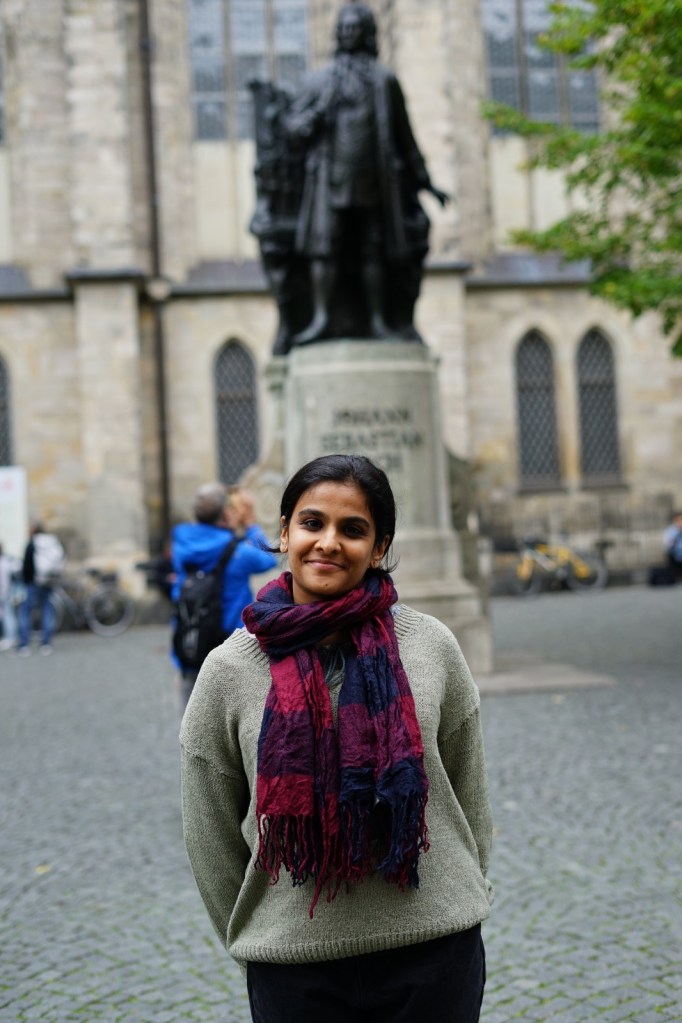
Lakshmi Chithra is a PhD student at the University of Augsburg, Germany. When academic life allows she welcomes her writer-ego to take over. She is from Kerala and is a lover of the monsoon, the Arabian Sea and Chai.

.

PLEASE NOTE: ARTICLES CAN ONLY BE REPRODUCED IN OTHER SITES WITH DUE ACKNOWLEDGEMENT TO BORDERLESS JOURNAL

Click here to access the Borderless anthology, Monalisa No Longer Smiles

Click here to access Monalisa No Longer Smiles on Kindle Amazon International

Categories
Essay

Where Three Oceans Meet

By P Ravi Shankar

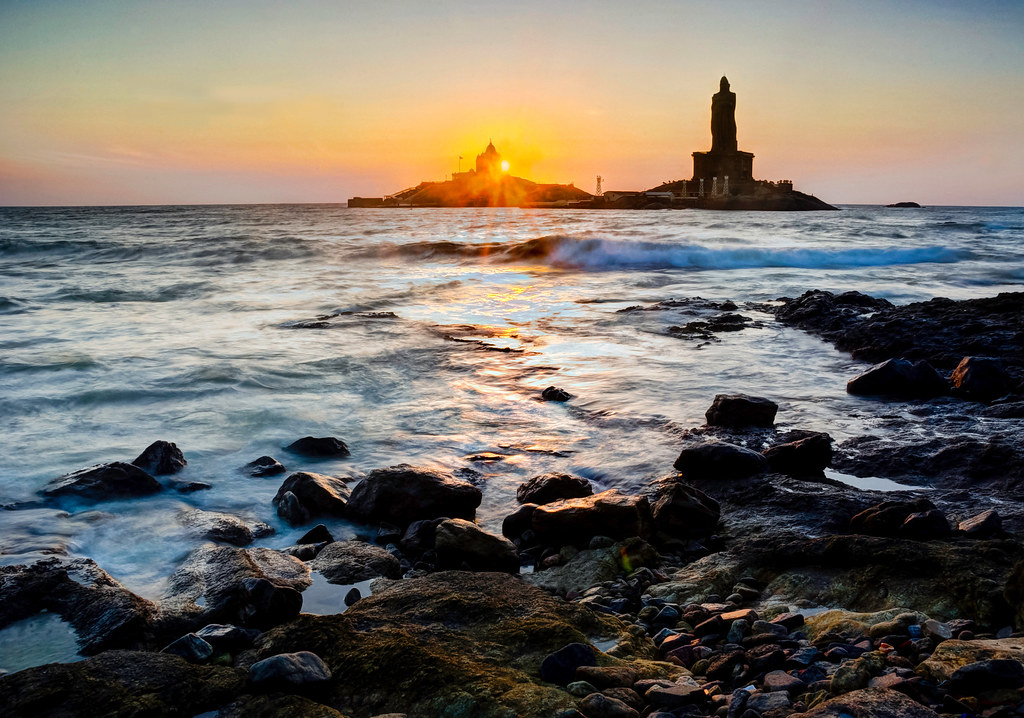
Vivekananda Rock Memorial. Courtesy: Creative Commons

I had always looked forward to visiting Kanyakumari. The idea of standing at the southernmost tip of India and gazing at the vastness of the Indian ocean was irresistible. There is no major land mass till you reach the southern continent of Antarctica. The union of the waters of the Arabian Sea, the Indian Ocean, and the Bay of Bengal make this area, referred to as Triveni[1]Sea, unique.

We wanted to visit the Southern most part – the Vivekananda rock, where Swami Vivekananda meditated before going to Chicago in 1893. However, the gate slammed shut as we rushed to the ferry terminal. It was past four in the afternoon, the hour when the last ferry departs for the rock that was at a point peaceful and calm. With it evaporated our hopes of visiting the Vivekananda rock memorial at Kanyakumari.

We were not deterred by having failed in our endeavour. We decide to continue our exploration on the mainland to see as much as we could. Huge crowds were everywhere. It was school holiday season, and everyone seemed to be travelling. Chaotic was the word that would best describe the situation. As my travel companion, Subhish, and I moved around, we noticed nearly every house in Kanyakumari seemed to have been converted into a restaurant and a homestay though waste management was poor and the toilets – especially in the tourist spots — were unsanitary and unusable.

We went to the Gandhi Mandapam by the Triveni Sea from where the Vivekananda Rock could be viewed. You can get an excellent view of the Vivekananda memorial and the statue from the top floor. In February 1948, Mahatma Gandhi’s ashes were immersed at this intersection. The memorial building houses several old photographs relating to Gandhi’s life but the museum needs maintenance and cleaning.

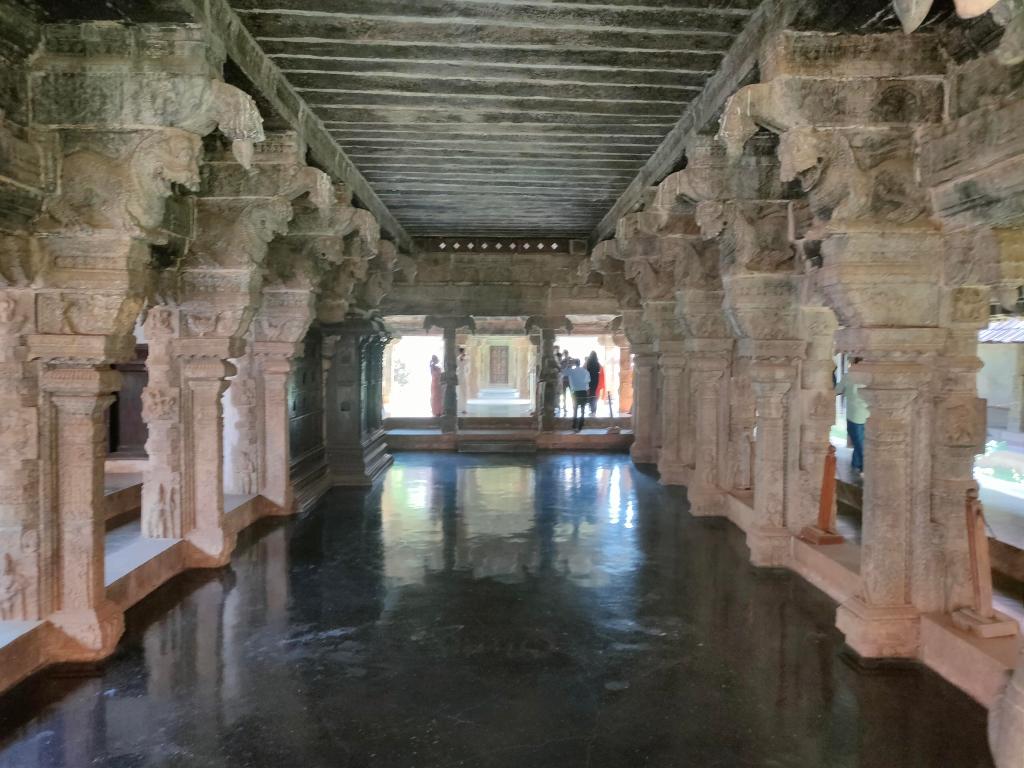
Kanyakumari houses ancient history. Our journey had started at the Sree Adi Kesava Perumal Temple, a temple dedicated to Vishnu, a major Hindu God, had been built in the Dravidian style and dates back at least to the seventh century. The stone and wood carvings speak of the deep devotion of the craftsmen.

Kanyakumari district had been part of the erstwhile kingdom of Travancore. King Marthanda Verma, who lived in the eighteenth century, is regarded as the founder of the Kingdom of Travancore. He had defeated the Dutch East India Company. A staunch devotee of Vishnu, he would pray before all his campaigns. Kanyakumari district had been the granary of the Travancore kingdom and was handed over to Tamil Nadu during the re-organisation of India along linguistic lines in 1956. Subish mentioned how his parents had told him about the fear and violence that existed for several years after the handover. Some of the monuments in the district are still maintained by the Kerala government under a 99-year lease. 


Just before lunch, we had visited the Padmanabhapuram palace, the capital of the Travancore kings which was rebuilt on an earlier structure from in the sixteenth century. King Marthanda Verma dedicated his kingdom to Lord Padmanabha, a manifestation of Lord Vishnu. The King and his successors saw themselves as Padmanabha dasa or subjects of the lord. The palace was vast and sprawling and situated in a four-kilometre-long fortress. Made entirely of wood, it had exquisite carvings. Though in some places, only the frames remain to suggest a story. There seemed to be massive halls where up to a thousand people could be fed at one time. They suggest a testament to the generosity of the kings. The palace unfortunately does not provide a glimpse into the life of its royal inhabitants. Having visited several museums and palaces elsewhere, I believe serious thought and action may be required on how to present this cultural gem better to visitors.

Pechiparai Reservoir

The Pechiparai Reservoir, where we stopped, has an interesting history. The dam was built across the Pechai River by a British engineer, Mr. Minchin working in the Travancore irrigation department. The site is peaceful, away from the hustle and bustle, and surrounded by green hills. In the 1880s when the dam was being built this would have been a remote location. Mr. Minchin’s grave has a home here – far from his own homeland in Britain.

Mathoor Aqueduct

We also visited structures closer to our times — the Mathoor Aqueduct, built in 1965. This is among the longest aqueducts in India. I was reminded of the Roman aqueducts. The view of the surrounding valley and hills from the aqueduct was spectacular. A rich agricultural area, you can walk along the aqueduct, come down and walk through the garden and playgrounds and then climb back to the starting point.

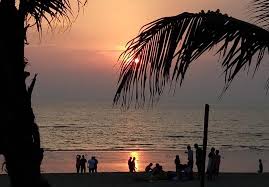
We drove to Sunset Point to watch the sun dip into the ocean after a hard day’s work. The sunset was spectacular. The few clouds had disappeared. The circular orb slowly sank into the silver sea.

Sunset Point

As dusk set in we started to drive back to Eraniel, Subhish’s hometown where we were staying. Subhish worked in Dubai and was on holiday like me. We stopped at Kilometre Zero on the national highway. The Indian politician, Rahul Gandhi had started his Bharat Jodho yatra[2] here a few months ago. ‘Kashmir to Kanyakumari’ is a popular slogan in India and this spot is a popular starting or ending point for political and other such marches.   

Kanyakumari has red bananas everywhere. They grow well in this soil. I am partial to this variety and enjoy them whenever and wherever I can. The district has several ancient Hindu temples. We were now returning from Kanyakumari. Dusk had settled in and there was a huge line of cars going back to Nagarkovil (Nagercoil in English). We were searching for the nongu fruit also known as ice apple, palmyra palm, and by several other names. We eventually located one at a roadside stall. Eating nongu was one of the best experiences of my life. An absolute delight.

Kanyakumari district has seen great progress over the last few decades. People from all over India have settled here. There are several water bodies scattered throughout the land and several wind farms. Tamil Nadu is among the wind energy giants in India. The climate here is less harsh compared to other parts of Tamil Nadu. Indians now have a good disposable income and are eager to explore their vast country. Will the tourism authorities pick up the gauntlet and cater to this population or will they continue along the old self-centred ways? Only time will tell!      


[1] Translates to where three sacred rivers – in this case oceans — meet

[2] Unite India March carried out in 2022 by the Congress Party

*Photos by P Ravi Shankar and Subhish, where unacknowledged

.

Dr. P Ravi Shankar is a faculty member at the IMU Centre for Education (ICE), International Medical University, Kuala Lumpur, Malaysia. He enjoys traveling and is a creative writer and photographer.

.

PLEASE NOTE: ARTICLES CAN ONLY BE REPRODUCED IN OTHER SITES WITH DUE ACKNOWLEDGEMENT TO BORDERLESS JOURNAL

Click here to access the Borderless anthology, Monalisa No Longer Smiles

Categories
Review

Tagore’s Cartography of the Imagination

Book review by Meenakshi Malhotra

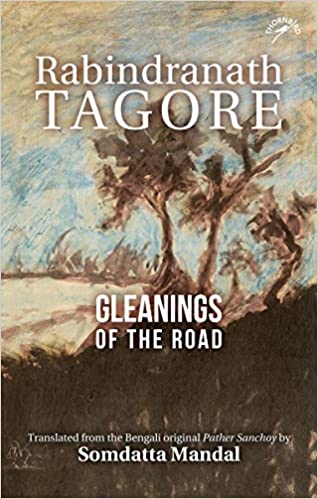
Title: Gleanings of the Road

Author: Rabindranath Tagore Translator: Somdatta Mandal

Publisher: Niyogi Books

Travels formed an integral part of the personae and creative artist that was Rabindranath Tagore. During his travels to England and the America (1912-13 and 1920) Tagore wrote essays for publication in various Bengali journals. Rabindranath Tagore was an inveterate traveller who travelled to the furthest corners of the globe. Detailing his travels in the  colloquial everyday language (also referred to as ‘chalit’ bhasha or language)  during his tour of England and USA in 1912-13, he used to publish regularly in journals like Prabasi, Bharati and Tattwabodhini Patrika. As the translator-editor Somdatta Mandal  informs us, Vishwa Bharati Publication Department in 1946 decided to discard Rabindranath’s own selection. They went back to the earlier formal register and included writings of the 1912 tour, irrespective of whether they were related to his travel.  

 The book blurb says: “In 1939, Tagore selected fourteen of these essays and an appendix containing seven letters he had written to some of the teachers in the Santiniketan ashram while he was on these trips, for publication as a volume. It was at this point that he rewrote the original essays then using the colloquial instead of the formal language; he also revised the texts substantially. Later editions altered the number of essays, sometimes digressing from Tagore’s own selection, sometimes going back to Tagore’s original formal language.”

The travelogue, if it can be called that, provides an insight into Tagore’s perception of the different facets of western life and the diverse philosophical issues that cross his mind as he journeys from one continent to another. Thus perhaps it is more appropriate that the collection is named “gleanings’’ rather than a travel account or narrative. They are philosophical ruminations where Tagore holds forth on various aspects of civilizations and cultures.

In the very first segment, Tagore’s critical observations about Indian society comes to the fore. Thus he comments on what he sees as  cultural differences and civilizational clashes, in “Prelude to the Journey”: “We always comfort ourselves by saying that we are a religious and spiritual race”. He sees this as a compensatory move by Indians to cover up our own sense of inadequacy, about our “weakness”  in the external world.(Tagore was acutely conscious of India’s status as a colonised country). “Many of us boast that poverty is our asset”, dwelling perhaps in a haze of pseudo-spiritualism which balks at admitting that this attitude is merely a kind of bravado.

Tagore’s essay here unpacks the notion of the binary that the West is materialistic while the East is spiritual by lauding certain aspects of Western and European culture. Thus he writes that “if we go to Europe with the aim of a pilgrimage, our journey will not be in vain”. He further explains that  this is not only because of the material developments achieved by Western culture, but their spirit and attitude.

Power, according to Tagore, is more than an external manifestation; rather, it has to do with a sense of real inner strength. He goes on to cite the instance of the Titanic and people’s altruism and self-sacrifice that was in evidence at that time, to interrogate the view, held by many Indians, that the average European is self-centred and self-serving. On the other hand, Tagore also gives plenty of instances where the spiritual poverty of Indians was in evidence. Thus he writes, “I know there has been a clash between our welfare and that of Europe and because of that we are suffering deep anguish and pain. We do not trust their religion and we criticise their culture as being too materialistic.” However, he continues that there are aspects of European culture which are worthy of emulation, which we would do well to follow, without feeling that it threatens our culture. He strongly commends that the path to seek the truth is a pilgrimage on which we should proceed without being blinded by ego, prejudice and false pride.

Coupled with this contrast of cultures, are observations about people and places. Thus he talks about the women of Bombay who are visible on the beaches of Bombay and contrasts it with the city of Calcutta, which according to him, is bereft of women in public places. Tagore also muses on the vast and limitless ocean which to him offers a cornucopia of literal and symbolic meanings. The sea and the ocean signify  vastness, depth, boundlessness and infinitude, as well as the lure of the unknown. In contrast, he bemoans  the loss of man’s ties with nature signified to him by the colonial appropriation of the river. He reflects that the river “Ganges was once one of Calcutta’s ties with nature…It was the one window of the city from where you could look out and realize that the world was not confined to this settlement.” He bemoans the fact that the once natural strength of the Ganga had been dissipated, “it has been dressed up in such tight clothes on both its banks and its waist band has been tightened so that the Ganges seems to be the image of a liveried footman of the city”. In contrast, the “special glory of the sea is that it serves man but does so without wearing the yoke of slavery on its neck.” His evocative description brings to life the various aspects of the landscape in full measure.

Tagore’s ‘travel’ writing is not just a mapping of people and places, but shows him as the supreme cartographer of the imagination. Witness his contrast of the earth and the ocean. The earth is compared to an excessively doting mother who binds her children to her and does not allow them to venture far away; the ocean by contrast “constantly allures him to venture towards the unattainable”. He adds, “Those who responded to that call and moved out are the ones who conquered the world.” Moreover, “that race of people on this earth who have specially welcomed this ocean have also found the unceasing effort of the ocean in their character.” Travelling on the Arabian sea, glimpsing distant shores, he stresses that the union of the two — the land and the ocean — signifying stability and movement are vital to an understanding of the truth.

The urge to travel, to move forward continuously, is forever present in man. In a philosophical vein , the poet muses that the soul “always wants to travel” and that it dies if it does not do so.In a series of similes and metaphors drawn from nature, he reflects: “Let us keep moving on, like the waterfall, the waves of the ocean, the birds at dawn, the light at sunrise.” He even transcends to the next plane when he says that “even the call of death is nothing but just a call to change the dwelling place”. In almost the same breath, he compares himself to a fairy princess who is fast asleep and who cannot be woken from her slumber, except with a golden wand.

Part anthropological study– at one point, the poet reflects that the vastness of the surrounding sea would have elicited devotion among many Indians, unlike the European traveller who is intent on enjoying the comforts and varieties of entertainment on the ship-part philosophic meditation, “Gleanings” represents the quintessential Tagore. His interrogation of Indian claims to spirituality is made in the tone of a concerned father warning his children not to fall prey to false pride and vanity. Deeply patriotic as well as an internationalist, he straddled two contrasting worlds of materiality and spirituality, without succumbing to limiting binaries and stereotypes.

Ably introduced and translated by Somdatta Mandal, a renowned Tagore scholar, the translation captures the iridescent and luminous quality of Tagore’s prose and its chiaroscuro effects.  

CLICK HERE TO READ THE BOOK EXCERPT

  Dr Meenakshi Malhotra is Associate Professor of English Literature at Hansraj College, University of Delhi, and has been involved in teaching and curriculum development in several universities. She has edited two books on Women and Lifewriting, Representing the Self and Claiming the I, in addition  to numerous published articles on gender, literature and feminist theory.       

.

PLEASE NOTE: ARTICLES CAN ONLY BE REPRODUCED IN OTHER SITES WITH DUE ACKNOWLEDGEMENT TO BORDERLESS JOURNAL

Categories
Musings

COVID-19: Days by the Arabian Sea

By Gracy Samjetsabam

COVID-19 lockdown continues. I am stationed in a small modern town, surrounded by rustic villages in coastal Karnataka. From some of the tallest buildings in the locality, you can see the mighty Arabian Sea in the horizon, far and wide like a steamy mirage. It’s dreamy!

As uncertain as the pandemic, the day kicks off with the thoughts of the “what ifs,” “What numbers?” and “What next?” Waking up to birds chirping, calm sunrise, though the sun’s the same — shining bright and ever brilliant — I wondered if today was going to be the same or any different. It was the same. It was a melodious morning with birds chirping and singing, except that I was missing the honking and bonking of the pre-office and office hours rush of children and people moving, waiting, walking, rushing, driving in or away, or embarking on their respective buses to work or school. My mind was not merry but having decided to ceremoniously spend some time in the garden before breakfast, I freshened up and invited my husband to join me. He isn’t always interested in garden stuff but agreed. In disbelief, he uttered, “COVID-19, it’s truly a Black Swan situation.”

I called home to find out their condition. Unsurprisingly, identical stories of the contagion loomed large enmeshed with gloom, grim and grimace. Feeling cynical, I asked my husband what would happen if things would get worse? Would we never go out again till some vaccine or a solution took the form of a saviour, or, if things got out of control, would we all fall sick and die — unable to get back to the old normal?

He just said, “Don’t be silly. It will be over soon. I mean, it has to …” Watering the plant leisurely, I was happy for those moments that I was able to spend tending plants, admiring the blooms and nurturing my garden. I wanted to think that this day was going to be a blessing in disguise.

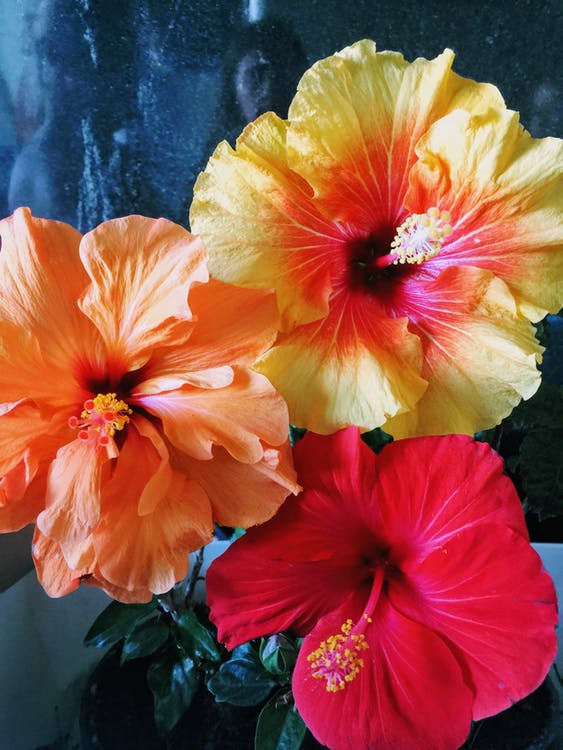
Multi-coloured Hibiscus

As I watered the plants, I was greeted by a couple of sunbirds sucking the nectar of the multi-coloured variety of hibiscus plants that grew along the fence in a row interrupted by jasmines followed by a parade of Ixora flowers mostly red, a couple of tall jackfruit trees bearing jackfruits big and small, a middle-aged cashew tree, a budding chikoo tree, curry leaf trees with its young ones sprouting around it like little children gathered around to listen to stories and, an alternate of tall coconut palm trees and lanky areca nut trees in each corner.

In one of the corners, was a family of plantains with one out of the two bigger ones that stood out gracefully, bearing tender bananas. They hung like braided hair with a flower at its tip. As I reached the corner, I could look up to the coconuts that hung so bountifully with spiky leaves that stretched out fiercely and proudly against the azure sky. For a moment I felt I was wrapped in a blue bubble.

I thought the sky is the same as the one I had seen from the rooftop of my house in Imphal on certain days when there were no clouds and the sky was exceptionally clear. But as I continued to look up almost breaking my neck, I twisted my head a little and wondered that it was the same sky yet it was different like a picture with filters. Spellbinding both though, in their own ways. 

Coucal

Spotting a greater coucal (crow pheasant) taking a quick-short flight from the cashew tree to the bushes reminded me of the Hume’s pheasant (Nong-in), the state bird of Manipur, which too loves to utilise the early hours of the day for food and fun. It reminded me of the familiar and at the same time made me curious.

Atypically, I missed rava idlis for breakfast, which I relished on certain mornings in the canteen, and so I had made plans to finally try cooking some at home. I always thought that the people of the place made it best, which surely is the case, but I thought of giving myself a chance. I looked up for the recipes and the procedures and made some with the emblematic coconut chutney. As I gave the final touches and made ginger tea, I thought of friends and family in this cosmic crisis. I could not help but feel heavy in my heart. I poured the hot aromatic tea into my favourite cups.

We were supposed to be home at this time of the year. By home, I mean my home in Manipur. A time we always look forward to, as the summer breaks are long and it has become a luxury to spend time at my home with dear and near ones. Along with the idea of longing and belonging, the idea of home too, keeps redefining with the passing time. And each time it gets defined, I get redefined too.

I remember, the first time I saw the Arabian Sea, it breathtakingly blew my mind. At the first glance, I felt like I was on the moon. The sea was calm and teeming blue. On the contrary, during the monsoons, the sea is wild, rough and voluminous. The sea, the waves, the sounds and sights of the beach slowly, becomes more familiar, the more I visit, the feeling is the less of a surprise but more of an endearing one.

Precarious as it may seem, the pandemic injected a moment of retrospection on the accustomed and the unaccustomed.

I continue to hope. I looked out into the garden from my window and smiled contentedly. I picked up my cup, sipped my tea and thought of home and of homes, at home. It captivatingly dawned on me that it was quite the same, yet not the same.

Gracy Samjetsabam teaches English Literature and Communication Skills at Manipal Institute of Technology, MAHE, Manipal. She is also a freelance writer and copyeditor. Her interest is in Indian English Writings, Comparative Literature, Gender Studies, Culture Studies, and World Literature. When not reading or writing, she loves to indulge in Nature.