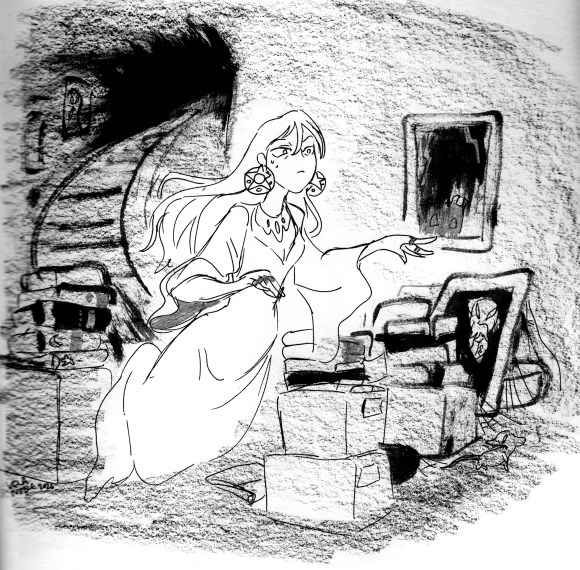
I levitate around my home. My toes barely graze the cold stone floor. Moving one box here, displacing another there, but still not getting any real work done. For I am a sorceress, a descendant from a rare and powerful subspecies of human who knows fearsome magic. Yet still, I cannot part with my piles of odd socks and large frocks. I clasp my slender, bejewelled hands together. That’s it, today I will declutter the castle for only twenty minutes – as that’s what the pros recommend.
There is a friction keeping me from knowing how to start, as too many souls have come and gone from this castle over the centuries. My father passed away grumpily in his bed in the north wing four decades ago. In his chambers, he left behind a husk of a gaming computer, piles of tangled tendril-like cables, a dusty vinyl record turntable and hefty piles of skating and street art magazines. He was bizarrely fascinated with the subculture he observed in mere mortals, one which he called ‘hip and cool’, despite being a gaunt three-hundred-and-forty-two-year-old wizard. He spent his last decades of life locked away in that room playing video games. I only ever witnessed an unearthly rainbow glow and pew-pew sounds from under his door day and night.
Then don’t get me started on my mother. She left behind her lifetime of artsy hobbies. From mosaic tile clippers, to a vinyl design t-shirt press, she had been the crafting queen. I don’t mind the crafting supplies, but other items of hers are more of a dilemma for me to know whether to keep. As a prolific vampiress, she had a tendency to never part with even a single skull belonging to her victims. They’re nostalgic, she used to parrot at me over the dining table. I opened the closet in her room and more than a dozen skulls fell on top of me. Mother, I am not up for dealing with your nostalgia right now!
Yet the worst of it all was my brother. It all happened one morning in the dead of winter, a blizzard was raging outside.
He said: ‘I can’t stand this place anymore!’
I remember his pained green eyes as he pushed open the large iron doors. With nothing but a bag on his side and tattered coat on his back, he left. That was half a century ago. It really worsened my father’s depression, and he never really got over it. I haven’t talked to my brother since then. I had assumed his old room had probably been taken over by clusters of breeding spiders by now. Yet, the one time a draught creaked the door open, I was horrified to see how empty it was — not a single book or a scrap of a poster left on any wall. Just bits of hardened Blu-Tak. Now whenever I pass by his room, I cannot remember the good times me and my spellcasting sibling had. I can only remember the hurt in his eyes when he left, so many moons ago. That memory is the one thing I cannot get rid of.
Decluttering is a challenging task, even for a wise and formidable sorceress such as myself, who can conjure up thunder and lightning with a mere twitch of my finger. It is inherently existential – well – it is for me at least. It makes you think about what legacy you’ll be leaving behind. Despite knowing I will probably live longer than both my mother and father, (both never, never exercised and the latter had a video game addiction, mind you) I feel such dread seize my heart just by looking at the piles. My lifelong research, reduced down to flaky and pitifully unsubstantial yellowy parchment.
I do not have any progeny, at least not yet, so will I leave behind a sorceress’s lifetime of sorry spellbooks that no living soul can decipher? How I wish there was any spell in one of these antediluvian old grimoires, anything to help me shift through these emotions and clutter! The only spell I can conjure up is to magically teleport everything to a storage shed in another continent, but my conscience gets the better of me.
The only living soul in this cold old mansion is me — and well, my greyhound, whose name is Speckles. I dust off my hands, I may not have made much progress today, but there is something I must do. I go into the kitchen to make myself a cup of tea. I then plop down in the loungeroom. Speckles snuggles his delicate pointed snout into my lap, I smile at him, I pick up a loose piece of parchment, dip my pen in ink and begin to write:
Hello dearest brother, how have you been?
Time will sort things out. The skulls in the closet can wait.
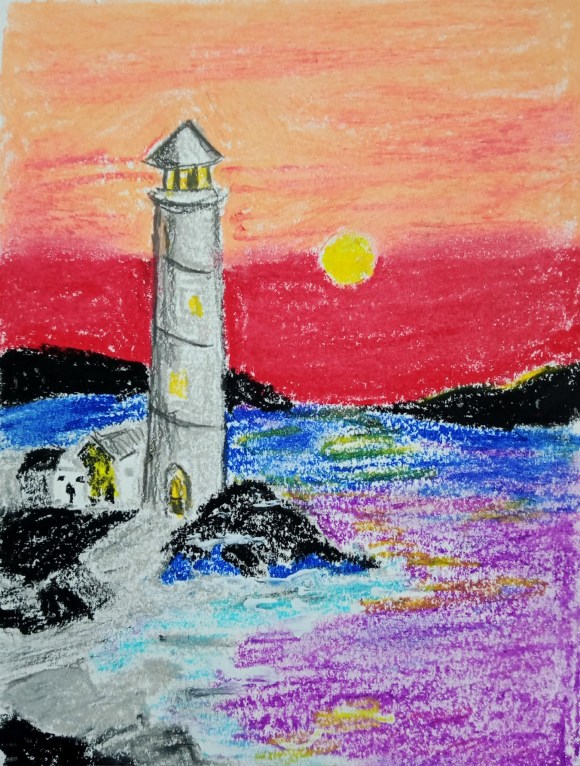
Illustration by Vela Noble
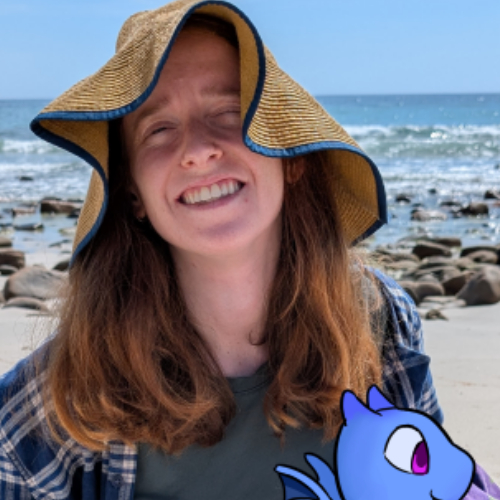
Vela Noble is multidisciplinary artist and writer based in Adelaide, Australia. She finished a BA majoring in Creative Writing at Adelaide University. You can see her work at velanoble.com.
.
PLEASE NOTE: ARTICLES CAN ONLY BE REPRODUCED IN OTHER SITES WITH DUE ACKNOWLEDGEMENT TO BORDERLESS JOURNAL
Narrative by Meredith Stephens: Photographs by Alan Noble
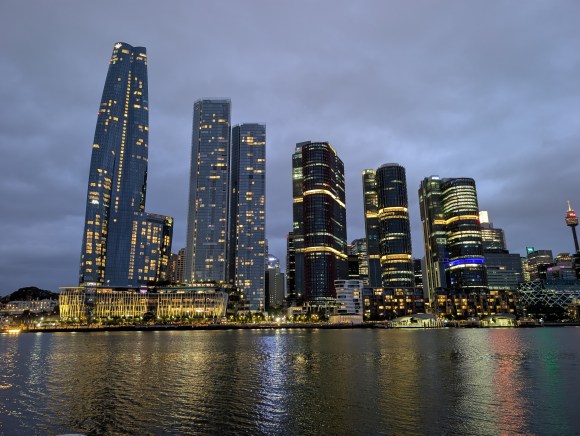
Sydney Skyline
We are not champagne sailors. The only time Alex and I drink champagne aboard a boat is to celebrate the end of a voyage of hundreds of nautical miles. Our sailing expeditions are characterised by breakages, deprivations and isolation. Sometimes the seas are so rough that I cannot move around the boat, let alone change clothes. I can only bathe once a week, and that consists of a dip in the ocean at anchor.
Our meals often consist of fish we have caught and cooked, unless we consume them immediately as sashimi. A single fish might last us days, served in various guises. Other meals are prepared from lentils or canned foods. In contrast to land trips, I usually lose a kilogram or two when at sea. I prefer not to use the term ‘yacht’, because people imagine us sunning ourselves on the deck while sipping champagne. Instead, I use the term ‘sailboat’. I do confess to a tad of reverse snobbery in the deprivations I endure and look down on those I describe as ‘champagne sailors’. But was that about to change?
We had been invited aboard the luxury observer vessel known as The Jackson to watch the start of the annual Sydney to Hobart Yacht Race on Boxing Day. After Christmas lunch, we headed to Adelaide Airport to catch our ninety-minute flight to Sydney. Upon arrival at our hotel, we caught the lift to our room. The lift doors opened on the third floor to let two brothers in, aged around 10 and 12. They met our gaze.
“Would you like us to sing you a Christmas carol?” the younger one asked.
The older one looked a bit embarrassed, but I thought asking strangers to join in singing a carol in a lift on Christmas Day was a nice, if not brave gesture, so I nodded enthusiastically. The younger one started singing ‘We wish you a merry Christmas’, and facing us, moved his hands in the manner of a choir conductor. I joined in. Then the boys noticed that they had arrived at their floor and stopped singing.
“See ya!” said the older one, as they exited.
We continued to the seventh floor and deposited our bags. The light was fading, so we decided to head back outside to take a stroll around the harbour. We returned to the lift. Once we reached the fifth floor the doors opened and the two boys entered again. Three other guests were standing behind us.
“More carols?” asked Alex.
They nodded and smiled. “Yes!”
They launched into another familiar carol, and again I joined in. The tall guest behind me gave a kindly chuckle. Then they reached the third floor, bade us farewell, and exited. We continued to the ground floor and made a tour of Darling Harbour in the remaining light. It had been a wonderful Christmas Day, and what better way to end it than the act of goodwill in being serenaded by children in a hotel lift.
The next day was the yacht race, which has been held annually since 1945 and is one of the world’s great ocean races. The sailors would be competing in a gruelling and treacherous race of 128 boats covering 628 nautical miles (1,200 km), south down the Tasman Sea, across Bass Strait, to Hobart in the south of Tasmania. This race is one of the highlights of Boxing Day and a television staple.
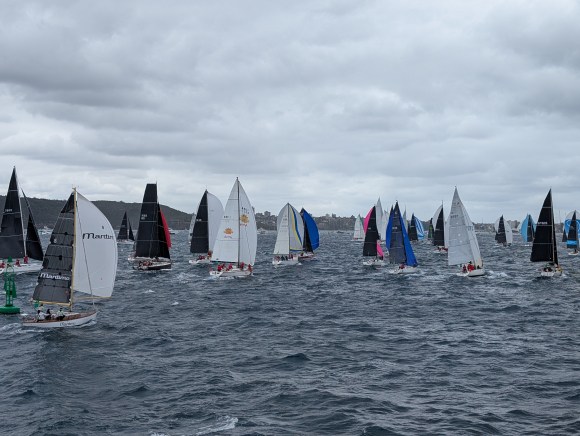
Start of Sydney to Hobart race
We walked to the appointed wharf and noticed a long queue waiting to board. Upon being noticed by our hosts, we were directed to a shorter queue and were ushered up the stairs to the top deck, limited to fewer than sixty people. A ribbon with ‘The Jackson’ written on it was affixed to our wrists. We were greeted by a waiter holding a tray proffering a range of drinks. Alex picked up two glasses of champagne and handed one to me. Was this the beginning of my new career as a champagne sailor?
The Jackson soon departed and we headed out to the deck to view the boats lining up for the race. Even though it was summer the cold penetrated my body and my hands shook. I was determined to brave the cold in order to hold my place to view the start of the race. The lady next to me made some commentary.
“That’s the start line,” she said, pointing to two yellow buoys. The start lines are staggered depending on the the size of the boats to help prevent collisions. It’s a southerly, so that should help.”
I nodded, feigning comprehension. I was not yet a competent enough sailor to pick up the wind direction so quickly. The cannon sounded on the deck below, and a plume of smoke rose. The yachts set off. Soon they had overtaken our observation vessel and most of the guests moved back inside the boat to watch the race on a large screen. Alex and I and a few other hardy souls remained on the outside deck to savour the unique setting of Sydney Harbour. Waiters braved the cold regularly to top up our champagne and offer us canapes. We accepted each time, although I eventually slowed down and shared a glass of champagne with Alex. Had we become the dreaded champagne sailors?
The yachts sailed through the heads until most of them disappeared from view. The Jackson turned around and headed back to King Street Wharf. We remained outside on the deck in the cold, making the most of every minute because Sydney Harbour is so far from home, and we may never have this opportunity again.
I stubbornly refuse to accept the title of champagne sailor though. We are temporarily boatless (which is another story) but once we resume sailing again later this year, we hope to return to the days of self-reliance on the boat and sourcing our meals from the ocean. Maybe not too much deprivation though, because we will continue to uncork a bottle of champagne, as is our tradition, after completing a major ocean passage of several hundred nautical miles.
Sydney to Hobart race
.
Meredith Stephens is an applied linguist from South Australia. Her recent work has appeared in Syncopation Literary Journal, Continue the Voice, Micking Owl Roost blog, The Font – A Literary Journal for Language Teachers, and Mind, Brain & Education Think Tank. In 2024, her story Safari was chosen as the Editor’s Choice for the June edition of All Your Stories.
PLEASE NOTE: ARTICLES CAN ONLY BE REPRODUCED IN OTHER SITES WITH DUE ACKNOWLEDGEMENT TO BORDERLESS JOURNAL
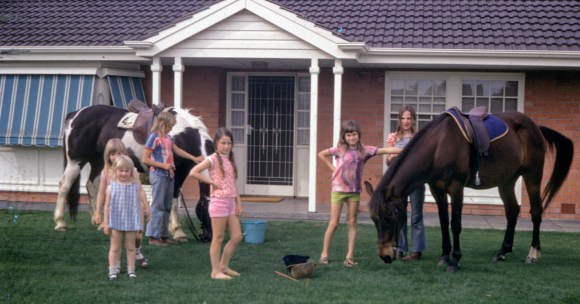
Sisters and friends and the author with horses, Whisky and Macka, outside Grandma’s house, in 1972. Photo Courtesy: Judith Stephens.
December 1972, Adelaide
I opened the fridge, pulled out some carrots and put them into the back pocket of my jeans. Then I headed into the backyard shed to retrieve my saddle and bridle. I slung the saddle over the handlebars of my bicycle and placed the bridle in the basket. Then I cycled to the first gateway to the riverbank. I left the bicycle by the fence and walked up the riverbank to find my bay steed, Macka. I couldn’t see him. Then I returned to my bike and cycled to the next entrance to the riverbank and looked for him. Still no Macka. When I entered the third entrance, I spotted him grazing by the river. I pulled out a carrot from my back pocket and held it out to him on my flattened palm. He pricked his ears, looked at me and headed towards me. He picked the carrot up with his soft lips and started crunching it. I slung the reins over his head, placed the bit in his mouth, and bridled him. Then I led him to a spot by the river where I could take advantage of the slope to stand higher than him and jumped on his back. I could never fatten him up, and his backbone pressed into my rear as I sat on him slightly askew. I regularly fed him chaff, and he grazed all day, but like some people, he remained forever thin. I rode him back to where the bicycle was, saddled him up, and trotted and cantered along the riverbank towards the sea.
This was my daily routine after school. Homework was rarely set, so I hardly ever studied in the evenings. Why would you study when you had already been at school all day? Sometimes my black labrador Jason accompanied me. In those days there were no rules about keeping your dog on a leash, so Jason would follow me, even if this meant swimming behind Macka and me to cross the river.
January 1973, Adelaide
“Meredith!” came the voice from my window at 5 am. It was my best friend, Debbie. Debbie owned a 16-hand piebald heavy horse, taller than her, called Whisky. Debbie knew that without pressure from her I would not rise this early. On this occasion, rather than being on the riverbank, Macka was stationed in the corral that Mum and Dad had built in the backyard.
I rose, dressed, and made my way to the corral to bridle Macka. Then I led him to the front yard where Debbie was waiting for me on Whisky. Today we were riding bareback, because our destination was the beach, and we were going to sit astride our horses as they swam. We headed to the riverbank and rode a kilometre to the mouth of the river. Then we rode across the sand and entered the water. When the horses started swimming, we started floating above them, my legs rising above Macka’s sides. I grabbed his mane so as not to part company with him. Then we turned the horses back towards shallow water. Once Whisky had found his feet, Debbie turned around and stood on his rump. From there she dived into the sea, quickly swam back and mounted him again. I wasn’t confident enough to attempt the same feat on Macka. Next, we headed back to shore and dismounted. We lifted the reins over the horses’ heads and held them while they rolled in the sand, thrashing their legs in the air. Then we jumped back on them, and galloped along the sand, before retracing our steps upriver.
August 2025, Monarto, South Australia
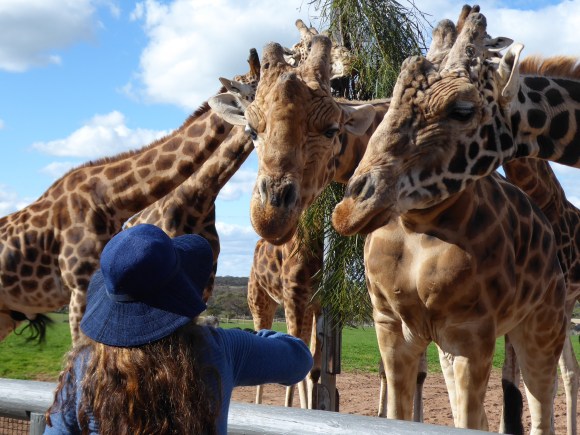
We were visiting the largest open-range safari park outside of Africa, Monarto Safari Park, an hour’s drive from Adelaide. Of all the African animals, I was most looking forward to seeing the giraffes and was excited to find myself a place on the giraffe tour. I took a seat on the bus and listened to the guide’s spiel as we made our way to the giraffe feeding station. The guide provided a bucket of carrot sticks for the tourists to feed to the giraffes.
I dipped my hand into the bucket, retrieved a carrot stick and offered it to the giraffe. He inclined his neck towards me, extended his enormous blue tongue to the carrot, gently took it between his lips, and started crunching it. I stood back in order to give the other tourists a chance to do the same, and a few came forward. In the next interval, I retrieved another carrot stick and offered it to the first giraffe. I stood back again for the other tourists, but few were interested. I ended up giving most of the carrot sticks to the giraffes because no-one else seemed to be as engrossed with this as I was. As soon as the bucket was empty the giraffes lost interest and gently loped away. I realised that the reason I was enjoying this so much was that I was reliving the experience of over fifty years earlier of feeding carrots to Macka.
In the years since the 1970s, although I never lost my love of horses, motherhood and working overseas took precedence over riding. My early years of daily caring for Macka felt like a distant dream. And yet in a distant time and space, I sometimes yearned for a simple life where I could care for large herbivores. I cannot return to 1973, and am unlikely to own a horse again, but at least I could re-experience the thrill of feeding carrots to gentle giant herbivores at Monarto Safari Park.
Feeding giraffes at Monarto Safari Park in 2025. Photo Courtesy: Cathie Noble.
Meredith Stephens is an applied linguist from South Australia. Her recent work has appeared in Syncopation Literary Journal, Continue the Voice, Micking Owl Roost blog, The Font – A Literary Journal for Language Teachers, and Mind, Brain & Education Think Tank. In 2024, her story Safari was chosen as the Editor’s Choice for the June edition of All Your Stories.
PLEASE NOTE: ARTICLES CAN ONLY BE REPRODUCED IN OTHER SITES WITH DUE ACKNOWLEDGEMENT TO BORDERLESS JOURNAL
The story of Hawakal Publishers, based on a face-to-face tête-à-tête, and an online conversation with founder Bitan Chakrabortywith his responses in Bengali translated by Kiriti Sengupta. Clickhere to read.
The Great War is over
And yet there is left its vast gloom.
Our skies, light and society’s soul have been overcast…

'The Great War is Over' by Jibanananda Das (1899-1954), translated from Bengali by Professor Fakrul Alam.
Jibanananda Das wrote the above lines in the last century and yet great wars rage even now. As the world struggles to breathe looking for a beam of hope to drag itself out of the darkness induced by natural calamities, accidents, terror attacks and wars that seem to rage endlessly, are we moving towards the dystopian scenario created by George Orwell in 1984, which would be around the same time as Jibanananda Das’s ‘The Great War is Over’?
Describing such a scenario, Ahmed Rayees writes a moving piece from the Kashmiri village of Sheeri, the last refuge of the displaced refugees who were bombarded after peace was declared in their refuge during the clash across Indo-Pak borders. He contends: “People walked back not to homes, but to ruins. Entire communities had been reduced to ash and rubble. Crops were destroyed, livestock gone, schools turned into shelters or craters. How do you rebuild a life when all that remains is dust?”
People could be asking the same questions without finding answers in Gaza or Ukraine, where the cities are reduced to rubble. While we look for a ray of sunshine, amidst the rubble, Farouk Gulsara muses on hope that has its roots in eternity. Vela Noble wanders on nostalgic beaches in Adelaide. And Meredith Stephens travels to the Australian outback. Devraj Singh Kalsi brings in lighter notes writing of driving lessons while Suzanne Kamata creeps back to darker recesses musing on likely ‘criminals’ and crimes in her neighbourhood.
Lopamudra Nayak writes on social media and its impact while Bhaskar Parichha writes of trends that could be brought into Odia literature. What he writes could apply well to all regional literature, where they lose their individual colouring to paint dystopian realities of the present world. Does modernising make us lose our ethnic identity and how important is that? These are questions that sprung to the mind reading his essay. As if in an attempt to hold on to the past ethos, Prithvijeet Sinha wafts around old ruins in Lucknow and sees a cemetery for colonial soldiers and concludes: “Everybody has formidable stakes, and the dead don’t preach the gospel of victory or sombre defeat.”
We have mainly poetry in translation this time. Snehaprava Das has brought to us Soubhagyabanta Maharana’s poems from Odia and Ihlwha Choi has translated his own poem from Korean. Sangita Swechcha’s poem in Nepali has been rendered to English by Saudamini Chalise. From Bengali, other that Jibanananda Das’s poems translated by Professor Fakrul Alam, we have Tagore’s pensive and beautiful poem, Sonar Tori (the golden boat). Yet another Bengali poet, one who died young and yet left his mark, Sukanta Bhattacharya (1926-1947), has been translated by Kiriti Sengupta. Sengupta has also translated the responses of Bitan Chakravarty in a candid conversation about his dream child — the Hawakal Publishers. We also have a feature on this based on a face-to-face conversation, giving the story of how this publishing house grew out of an idea. Now, they publish poetry traditionally, without costs to the poet. Their range of authors are spread across continents.
Our fiction again returns to the darkness of war. Young Leishilembi Terem has given a story set in conflict-ridden Manipur from where she has emerged safely — a story that reiterates the senselessness of violence and politics. While Jeena R. Papaadi writes of modern human relationships that end without commitment, Naramsetti Umamaheswararao relates a value-based story in a small hamlet of southern India.
We have more content. Do pause by our contents page and take a look.
Huge thanks to all our contributors without who this issue would not have materialised. Heartfelt thanks to the team at Borderless for their support, especially Sohana Manzoor for her iconic artwork that has almost become a signature statement for Borderless.
Let’s hope that next month brings better news for the whole world.
Narrative by Meredith Stephens & Photographs by Alan Noble
I have read about overtourism in Spain and Greece. Locals have been overwhelmed with the visitors, and some even displayed signs for tourists to go home. According to Fortune magazine (17 July 2024), some locals in Barcelona turned on tourists with water pistols, and others in the Canary Islands embarked on a hunger strike in response to the numbers of tourists. Images of overtourism in Santorini, Greece prompted me to search for an unpopulated area, and I didn’t have to look much further than our own state of South Australia. We hoped to visit deserted towns, dotted with ruins, where there are more sheep than people.
Alex, Verity and I headed out of Adelaide on a bleak wintery day, caravan in tow, to the outback. First stop was Burra, a former mining town where copper was mined from 1845 until 1877. Copper brought prosperity to the state of South Australia saving it from bankruptcy. The small town centre featured a proudly-standing rotunda. Businesses were open, and there were grand buildings and churches which overwhelmed this small town, standing testament to a thriving past.
The caravan was too big for a parking spot, so we parked it parallel to the kerb straddling several spots. We entered the tourist bureau, and as there was no-one in line, headed straight to the desk. We were greeted warmly by the assistant, who handed us a map and explained the various places where we could stay overnight in a caravan. There were free sites, a caravan park, and if you bought a meal at the pub you could camp in their grounds.
Then she pointed out the many historic sites on the map, fixing her eyes on me with a wide smile. I could sense Alex pulling away ever so slightly, as he was anxious to secure a caravan site and do some sightseeing before nightfall, but I was captivated by the enthusiasm of the guide and tried to remember as much as I could of what she was telling us. We headed to one of the recommended sites for the night and investigated the former mining sites with original equipment that had been shipped out from Cornwall, England, in the1800s. We were the only tourists at the site.
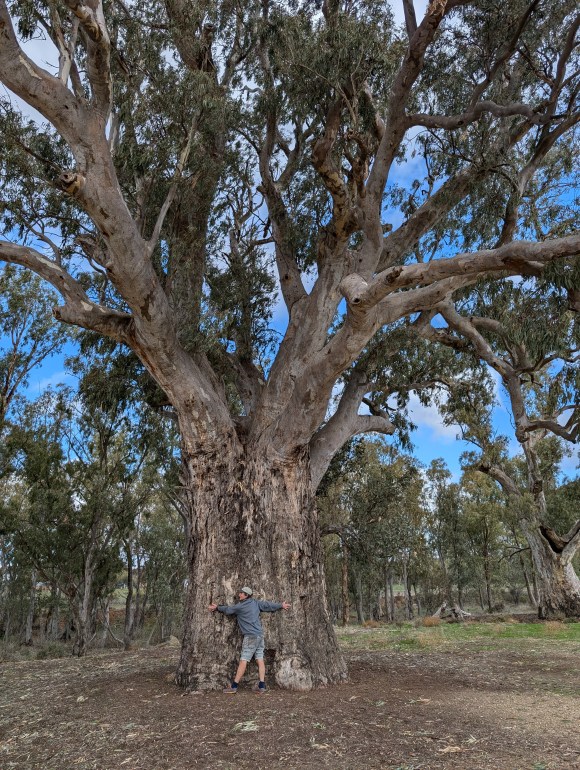
The next day we drove through Peterborough and Orroroo. We entered the cafe in Orroroo for lunch and asked the assistant what there was to see there. She gave us a map and explained that we absolutely had to see a spectacularly large 500-year-old tree on the outskirts of town.
Tree outside Orroroo
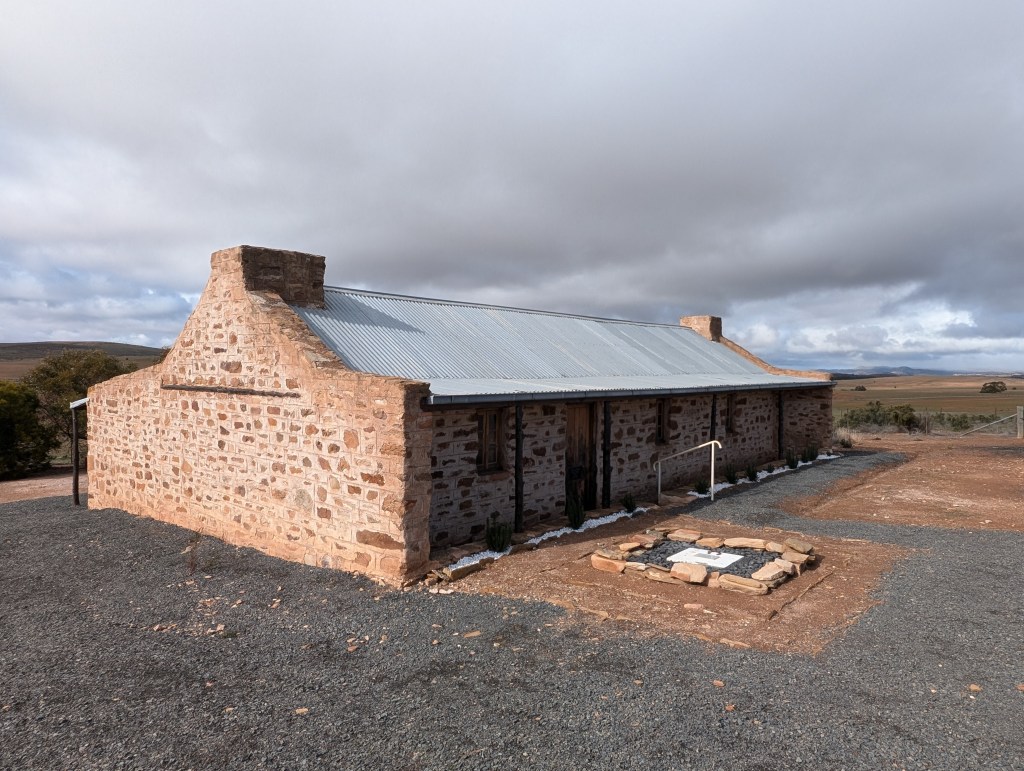
Next, we headed to the very small town of Hallet. There at the general store we asked for a key which would open the door to the now deserted birthplace of the polar explorer and aviator, Sir Hubert Wilkins. It was the first time we had been given a key to let ourselves into a tourist attraction, and we felt very privileged. We drove twenty kilometres to the home along dirt roads. Again, we were the only visitors. We made our way to the front door and unlocked it. This home, formerly rubble, had been lovingly restored by the Australian Geographic Society as a tribute to the explorer.
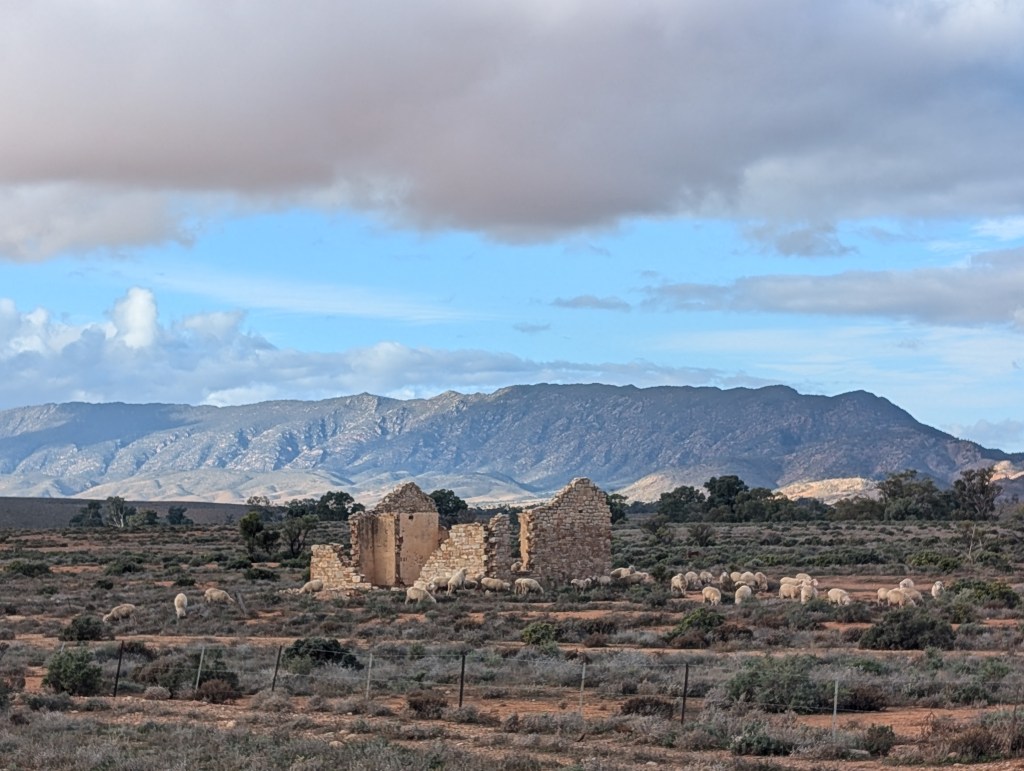
Ruins in the OutbackRestored home
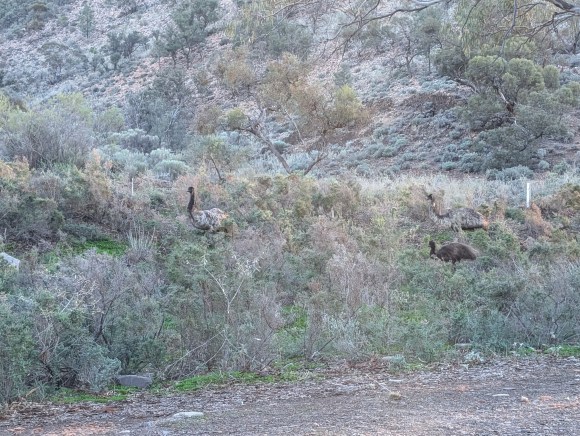
We continued to the Parachilna Gorge in the Flinders Ranges where we spent the night. Alex made a campfire, and we dined outside. Again, we were surrounded by ancient trees with generous girths in a dry riverbed. In the morning Alex woke to spot families of emus passing by, camouflaged by the foliage.
Emu family in Parchina Gorge
We continued onto the deserted nineteenth-century town of Farina that day. People started to abandon the town in the late 1800s, and the last of the inhabitants had left by the 1960s. Fortunately volunteers are keen to preserve the history and the ruins and manage the town during the school holidays. We were given a hearty welcome by a volunteer at the entrance to the bakery and received a map of the town.
Finally, on the 700kilometre drive back to Adelaide, we were low on diesel and made a brief detour to a small town off the highway. After putting the diesel in the car, I went inside to pay.
“Thanks, darling!” the cashier gushed.
“I like your dog! Is he a kelpie?” I asked.
Then I was given an enthusiastic account of how the kelpie had been rescued from a shelter. I think the owners may have been deprived of human company and were glad to see a new face. Alex came in because he was wondering what had become of me, engrossed in conversation. We had the impression that we were their only clients for the day. Eventually, I managed to extricate myself.
On this trip we had no experience of overtourism. Rather we visited sites where few tourists could be seen. Guides were so enthusiastic that they fawned over us. One reason that there were so few tourists is that it was the middle of winter and there was intermittent rain. Another was the geographical isolation of the outback. Australia is distant from countries with large populations. South Australia is distant from the large Australian cities on the east and west coasts and the outback further still—although closer to Adelaide than any other Australian capital city.
The landscape of the outback feels as different as another country. Our city, Adelaide, has a multitude of houses and new freeways, but the outback has few houses and many ruins. These ruins attest to a time of optimism when settlers believed the rains would be consistent. We enjoy hitching up the caravan and driving to the outback, where there are so few tourists that the sight of another human being results in an effusive welcome.
.
Meredith Stephens is an applied linguist from South Australia. Her recent work has appeared in Syncopation Literary Journal, Continue the Voice, Micking Owl Roost blog, The Font – A Literary Journal for Language Teachers, and Mind, Brain & Education Think Tank. In 2024, her story Safari was chosen as the Editor’s Choice for the June edition of All Your Stories.
PLEASE NOTE: ARTICLES CAN ONLY BE REPRODUCED IN OTHER SITES WITH DUE ACKNOWLEDGEMENT TO BORDERLESS JOURNAL
FAR NORTH QUEENSLAND
(Phil and Kaye’s place, Malanda FNQ June 2024)

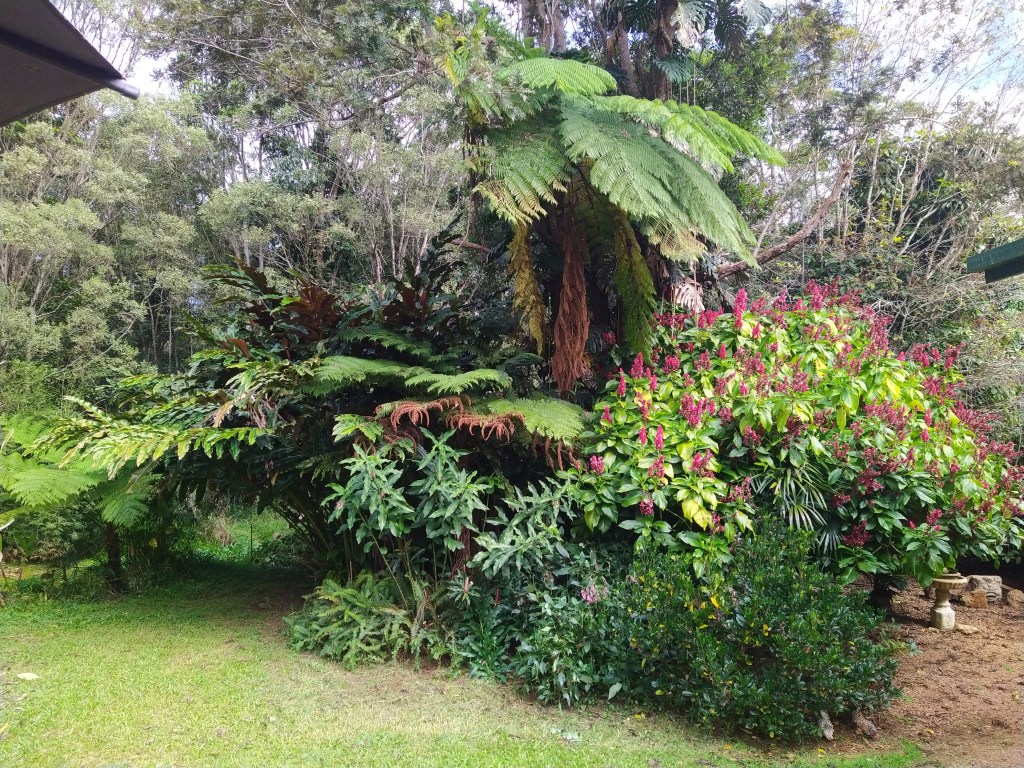
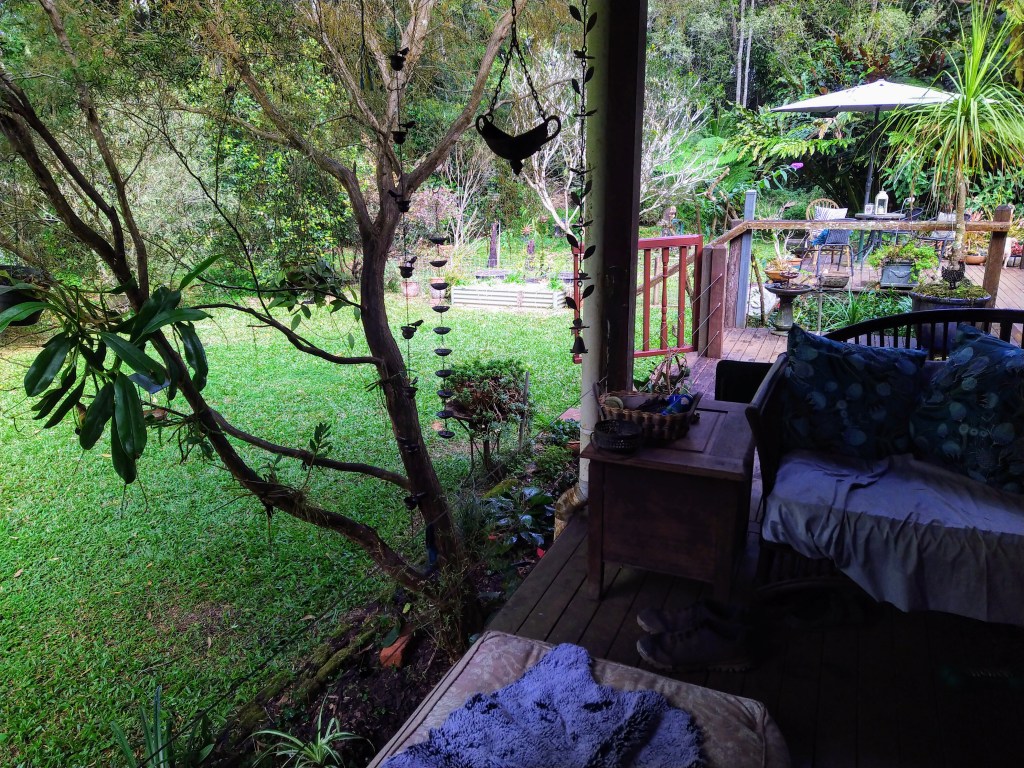
Overcast sky – air moist with pending drops – from the comfortable chair on the back verandah in this micro-Eden framed by roof and posts I watch the green King Parrots fly to the feeders and boot the Emerald Doves and little Mannikin Finches out. They soon return like a scherzo in a symphony – the Bar-shouldered Doves and cheeky Lorikeets follow. Almost everything else is green except the surprise of flowers in winter – Flame of the Forest and Morning Glory – red and purple survivors of uncertain weather – days of warmth and sunshine after a slow cold front.
On this afternoon it’s humid but cool enough for a cardigan. At dusk dwarfed by the Black Wattle and Kaurie Pines behind – the leafless Frangipani’s ghostly white limbs reach for the stars. It blooms in summer – an effusion of pink and yellow blossoms thick with bright green leaves – an arboreal attention-getter beside the huge Red Torch Ginger clump and the pond bursting with water lilies.
The old tall trees creak and chatter in the afternoon flurries –– stories and secrets veiled in their leafy realm – and I drift dreamily between the worlds –– here and there –– like the lovely Blue Emperor butterfly in the canopy.

TRIANGULATION OF HOME

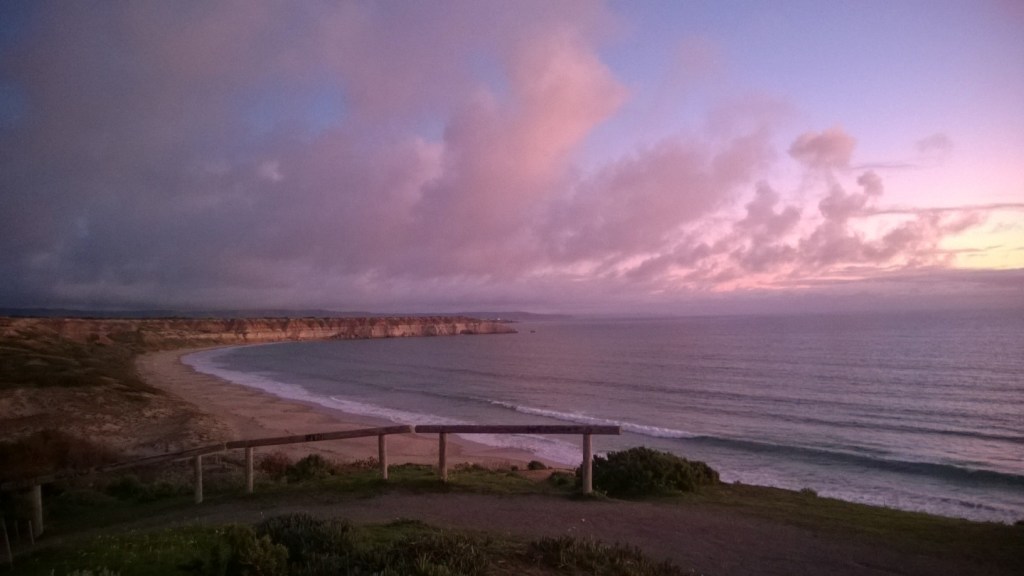
Home is barely more than 100 metres from the beach, though I rarely take the wretched stairs. I make the five-flight descent, all the way thinking about the return climb.
Walking with icy sand underfoot, in strong wind, as waves suck back, and forth again, I notice the seaweed, the shells, the crumbling cliffs, the open space, the expanse of sky.
But from the table high on the bluff, east-southeast I see the round hills of the Mount Lofty Ranges, the lush McLaren Vale vineyards, and full south, past the cliffs, I imagine the southern tip of Cape Jervis.
To the west at dusk, the sun sets over the gulf, most days in splendiferous colour. It’s a very long drop to the sea, and winter cold after heavy rain, with seagulls cawing overhead.
Disembodied in this timeless space above the wild grey ocean, my mind takes flight to the north
through the car park, over the combis, the SUVs, the 741 bus, and children playing on swings.
From the bluff, near home, it seems as though below the lone fisherman stands on the edge of the earth, and for a luminous moment, we merge in a quantum mist.
Atoms in fleeting form at the interstices.
Photo Courtesy: Lizzie Packer
Lizzie Packer is an experienced freelance writer, and an emerging poet. At Adelaide College of Arts, Lizzie established the online creative writing program and led it for over a decade.
.
PLEASE NOTE: ARTICLES CAN ONLY BE REPRODUCED IN OTHER SITES WITH DUE ACKNOWLEDGEMENT TO BORDERLESS JOURNAL
“So relieved that we will make good time today,” I declare. “I’ve had enough of arriving in the dark.”
“We have to stop to get diesel on the way but that won’t make too much of a difference,” Alex reminds me.
We head south of Adelaide to the most fertile part of the state. The coast is lined with stately Norfolk pines, and further south there are rolling green hills lined with heritage gums. There are more cattle than you could count, mobs of kangaroos, and horses wearing coats to protect them from the winter chills. We arrive in Yankalilla, the last town before our departure point, and fill the jerry cans with diesel. There is no fuel at Wirrina Cove, as the marina went out of business a few years ago, so we have to haul diesel to the boat.
We leave Yankalilla and head past yet more horses. After the turn-off for Wirrina I catch a glimpse of my favourites, two Clydesdales, one of whom has a forelock that reaches down past his nostrils. At the marina, we park in front of a tree to protect the car from the harsh marine environment. It’s mid-morning so there should be plenty of time to arrive in Kangaroo Island before darkness. My border collie, Haru, springs from the car, and happily trots down the finger wharf behind me as I carry my luggage to the boat. It’s hard for me to make the leap onto the boat from the finger wharf but Haru skips in while I am still worrying about how not to fall in the water.
“There is less wind than forecast. We’ll have to motor-sail,” bemoans Alex.
I move to the trampoline at the bow to savour the view of boats in their berths opening out in front of me as we exit. Haru sits next to me and whinges every time I stop patting her. Once we are in open water the boat starts rocking, and I walk back along the side of the boat, all the while gripping the side with my right hand, until I am safely inside. Haru trots lightly alongside me.
The waves become increasingly bouncy and Haru frowns. She eyes her crate which is sitting just inside the doorway. I open the flap, and she heads in and curls herself on the old silk cushions and Alex’s old woollen jumper lining the bottom of the crate. She prefers the safety of the crate to sitting outside with the possibility of being splashed.
I abdicate the task of sailing to Alex and watch him at the helm, while I settle myself on the couch, placing cushions behind my head and covering myself with a blanket. I can’t confidently move around on the boat when it is rocking this much, so I stretch my headphones over my head and listen to music, while watching Alex raise the sails and maneuver the boat towards Kangaroo Island. I feel a twinge of guilt at lying down in warm comfort while Alex busies himself with sailing, but he doesn’t seem to mind, so I close my eyes and revel in the music.
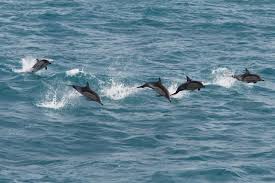
After several hours, we reach the middle of Investigator Strait. I glance outside and can see dorsal fins rising from the waters. As much as I like lying down with a blanket and listening to music, I cannot ignore pods of dolphins. I rise and brace myself for the cold and wind outside the boat. I head towards the bow, but the rocking motion and the cold winds defeat me. From the stern I can see dolphins swimming alongside the boat, and as I gaze into the distance yet more dolphins are breaching as they head towards us. Of our many crossings of Investigator Strait there has never been a time when I have not witnessed pods of dolphins, but the sense of wonder never diminishes.
Despite my determination not to arrive in darkness, by late afternoon the sun begins to slip into the horizon and Point Marsden is still well in the distance. The sky erupts in bright orange, and I hope the light will hold out till we reach our mooring. Heading for Point Marsden is like trying to reach the summit of a mountain. Finally, we pass the point and head into the bay, but darkness has already fallen. Alex locates the mooring buoy in the distance. I grab the boat hook and head to the bow. I crouch on the trampoline and stretch the hook out in front of me over the dark water. Haru crouches at my side and brushes herself against me, willing me to hook the buoy on the first attempt. I stretch forward, hook the buoy, and drag it up to the bow. I call Alex, and he leaves the helm to secure it.
Alex lowers the dinghy, and we prepare to alight. We lift our bags in, and I carefully place one leg into the centre and ease myself in. Meanwhile, Haru has delicately skipped into the dinghy behind me. Finally, Alex enters, unties the ropes, turns the outboard motor on and takes us to the shore. We shine the torch in front of the boat and locate the cove. It’s high tide. Alex hops out into chest-high cold dark waters. He pulls the dinghy towards the rocks and secures it. I clamber out and perch myself on a rock. Alex hands me the bags. I place them on a higher rock just behind me. Then he hands me his backpack containing our laptops. I hold on to them tightly, afraid to place them on the rock in case water rushes over them. Alex picks up Haru and holds her above the water, before placing her on the shore. Then he takes the backpack from me, picks up the bags, and returns to the shore. I pick my way in the dark over slippery rocks, not moving one leg until the other has been firmly anchored. We reach the sand and walk up the switchbacks. Haru delights in running along the switchbacks after having been confined to the boat.
I tread carefully in the dark up the hill, Haru brushing her side against my calf. The holiday house is in sight, and just as I am about to reach the road leading to the house I fall over a boulder and gasp. How did I manage to navigate the submerged rocks in darkness and yet stumble on land?
‘“Oh sorry!” exclaims Alex. “That’s because I wasn’t holding your hand.”
He grabs my hand, and we walk up the last part of the track to the house. We enter and I make a doggie dinner for Haru. Then I collapse on the sofa and Alex makes a fire. After the adventure of arriving by boat and walking up the steep hill in the dark, the pleasure of lounging on a sofa and warming to a fire is multiplied. I am looking forward to spending the next day curling up on the sofa, reading a book in the sunshine, and taking Haru for walks.
A few minutes later the phone rings.
“Auntie May is not doing well. You have to come home as soon as you can!” urges my sister Jemima.
Great Auntie May, aged 103, is my oldest living relative. She was in the nursing home for two decades, even outliving her sons, before moving to the palliative care ward of the hospital. I remember the card from the Queen which she posted on her dressing table three years earlier. She once said that she had lived too long, because her sons and friends had passed. Because her grandchildren are interstate, it is up to her grand-nieces and grand-nephews to visit her.
“OK. We’ll be there as soon as we can!” I reassure Jemima.
“Alex, Auntie May is doing poorly. We have to get back to the mainland as soon as we can.”
“I’ll just check the weather,” he replies. “The wind is in the wrong direction. It’s a north-northeasterly. It may be too rough.”
His brow furrows as he scrutinizes the forecast.
“Can we fly home instead of sailing?” I ask.
“The weather will be getting worse over the week, so it won’t even be safe to let the boat stay on its mooring. Perhaps we can sail to the marina in Penneshaw and leave the boat there. Then we can catch the bus home from there.”
We decide to leave the next morning, but it is noon by the time we lock the front door. I dress Haru in her lifejacket, and don mine as well. We head back down the hill, and down the switchbacks to the shore. Alex picks up Haru and places her in the dinghy. She stands tall, ears pricked, the wispy hairs on her forelegs blowing in the wind, trusting that we will join her.
Alex places the bags in the dinghy. It’s too far away for me to board. If I walk to the dinghy in freezing water, I won’t be able to hop in from water at chest height. Alex pushes the dinghy to the rock I am standing on, and I leap in. He switches on the outboard motor, and we bump over the waves to the boat. Haru is at the front, and she winces as sprays splash onto her face. I pull her back against me to protect her from the sea-sprays. The boat is bobbing in the water. Alex grabs the rope to secure us. I stretch my left leg onto the boat, but the dinghy moves away, and my legs are thrown apart. I don’t want to fall victim to the cold water below. I move my left leg back into the dinghy. The waves are thrusting the dinghy towards the stern.
“Move back. It’s safer to alight from further back,” advises Alex.
Meanwhile Haru jumps effortlessly onto the boat, undeterred by the rough conditions.
“Now!” urges Alex, during a lull in the waves.
This time I extend my left leg onto the boat and somehow the rest of my body follows. Haru is standing expectantly at the bow wondering what all the fuss has been about. Alex raises the dinghy, then the sails, and we head towards Investigator Strait. Once we are in the boat the sea conditions are not as difficult as we had anticipated.
“I think we can sail across to the mainland in these conditions. We don’t need to leave the boat at Penneshaw after all,” Alex informs me.
The sea is bumpy but not enough to make me seasick. I bring Haru inside, and swaddle myself in blankets and locate my headphones, leaving Alex to manage the sailing. Six hours later we arrive at Wirrina Cove and drive back towards Adelaide in darkness.
“Let’s head straight to the hospital!” I urge Alex. “We can’t afford to waste any time.”
Alex floors the accelerator on the freeway, weaving past slow coaches who are blocking our way. Haru curls herself up on the back seat, oblivious to the drama around her.
We arrive at the palliative care ward and enter through the back door where visitors are allowed to enter with their dogs. Will Auntie May have waited for us? We make a beeline for her room. Auntie May is propped up on pillows and beams when she sees us. Haru jumps onto her bed and lies down facing her waiting for a pat.
“I had a bad turn, but I am feeling better today. Did you sail all the way back from Kangaroo Island to see me?”
“Yes, we did.”
“I’m sorry to have put you out. I’m feeling much better now.”
Alex and I glance at each other, and I catch the relief in his eyes. Even though she is 103, we aren’t ready to say goodbye. We hope she will make at least 110.
A few days later the phone rings. It’s the nurse from the palliative care ward.
“Would you come and pick up your Great Aunt May please? She is doing much better than expected and we need to move her out of the palliative care ward. The social worker has found a room with an ocean view for her in the Star of the Sea Nursing Home.”
Later we celebrate Auntie May’s 104th birthday at the nursing home, and next year we look forward to celebrating her 105th birthday. We continue to sail back and forth to Kangaroo Island, choosing our weather to only sail in favourable seas, never hurrying back. Haru continues to sail with us and enjoys visiting Auntie May just as much as we do.
.
Meredith Stephens is an applied linguist from South Australia. Her recent work has appeared in Syncopation Literary Journal, Continue the Voice, MickingOwl Roost blog, The Font – A Literary Journal for Language Teachers, and Mind, Brain & Education Think Tank. In 2024 her story Safari was chosen as the Editor’s Choice for the June edition of All Your Stories.
PLEASE NOTE: ARTICLES CAN ONLY BE REPRODUCED IN OTHER SITES WITH DUE ACKNOWLEDGEMENT TO BORDERLESS JOURNAL
“Singapore is intimately linked with home and, yet for me, home has always been a process of lifelong search. Partly because of the early months of my birth. The record says I was born in March 1949, but the time was not certain as I do not have a birth certificate. My father forgot to register my birth,” reminisces Dr Kirpal Singh, an internationally recognised scholar. Born in the Straits Settlement of Singapore, before the island emerged as an independent entity, he has lived through much of history. He tells a story of multi-racial, multi-cultural growth that the island afforded him.
His father, he tells us, was “well known throughout Malaya — Jeswant Singh nicknamed as ‘Just One’ — a boxer who would knock people down with his left hook. In 1954, he left boxing when he killed someone during a match.” His mother, a Jewish Scot who he cannot recollect, he tells us, “ might have been David Marshall’s sister according to my stepsister but no one else has said that.” Marshall[1] was the first Chief Minister of Singapore from 1955 to 1956 and then Singapore’s Ambassador to France, Portugal, Spain, and Switzerland 1978 to 1993. He is the founder of the Worker’s Party. His parents had emigrated from Baghdad to Singapore in 1908 according to current resources.
How did Singh’s parents come to be in Singapore? Were they immigrants or colonials?
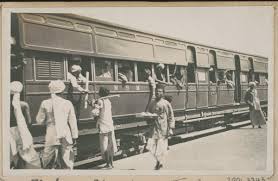
He responds with what he knows: “My grandfather and grandmother came to Singapore on board a ship in 1900. They left Jullunder, Punjab, in 1899. By the time they reached Singapore, it was the end of 1900. They left to seek their fortune. They were from the farming community. My grandfather was only sixteen and my grandmother was about twelve. They were in transit in Penang for six months. They came to Singapore in 1901. Actually, it was all Malaya — Singapore was part of the Straits Settlement. They came to Singapore by train. Trains were just starting out. It was around August 1901.
Trains in Malaya
“My uncle was conceived during this journey. They halted in Singapore for only two or three weeks. My grandfather’s cousin was in Perak[2], in Malaya. So, he wanted to be with his cousin. His cousin had cattle. Most of the Sikhs were cattle farmers. They settled in Pahang[3], an area which eventually became a nuclear dump[4] for Australia. It is closed to public now. There was a stone that proclaimed the land was a nuclear dump when I went with my son a few years ago.
“My father moved to Singapore as his prospects were better here as a boxer. This is where he met my mother. I was born here. He actually met mum because my mother’s two brothers had invited her to come from Glasgow. My mother is Scottish, from an industrial background. Her brothers came to the Far East to make money. She finished her school leaving exams and came to visit her brothers during her vacation. She would go with her bothers to watch boxing, where she saw my father, the champ. She was only fifteen or sixteen. The next thing the brothers knew was she was pregnant with me.”
Jeswant Singh was popular with colonials. Kirpal Singh tells us: “Some Europeans saw him box and offered him a job then in the Base Ordinance Depot. This was the British Military camps in the Far East. There were three bases in Singapore: the naval base, Kranji and one in the South. He worked there for thirty years and retired after that. In 1972[5], after the final British withdrawal from Singapore, dad’s formal employment status ended. After that he just did odd jobs, ending up as a security guard, looking after the factories in Jurong, earning about two to three hundred dollars a month.”
Kirpal Singh spent his childhood with his grandmother and uncle. Before he started schooling, his father left him with his grandmother and divorced his mother in favour of a new bride. Dr Singh tells us the story of how he returned to Singapore: “I was basically in Perak with my grandmother. My uncle, who was the first Sikh to become a Christian in Southeast Asia, left home because his father gave him a beating for changing his religion. My uncle was an Anglican. His conversion saved him from the Great Depression as the clergy was very well looked after. From 1929 to 1933, the church looked after him because he was the priest in Seramban. My father was still young. My uncle was born in 1911 and my dad in 1923. My grandmother bore eighteen children. Five of the infants passed away before they were one month old. But thirteen survived. She passed away at 95… I knew when I left for my doctorate programme in Adelaide that that was the last time I would see her. I had a hunch and was crying on the plane. Six weeks later, I got a letter with the news of her death.”
He adds: “Dad was in not in a position to look after me. The responsibility fell on his brother William. His full name was William Massa Singh s/o Deva Singh. He had studied at the Ipoh Chinese school, topped the school, eventually worked as an insurance agent. He was very good in English. The principal of his school, a New Zealander, arranged for my uncle to move to Singapore. Then my father moved there too. Singapore was the metropolis even then. It was the centre of English education. Penang was the other one. In 1956, I was sent to Singapore from Perak on a train — a one-and-a-half-day journey to my uncle.”
His grandmother joined them within a few months as his uncle was, he says, “more interested in aiding Lee Kuan Yew get rid of the colonials. Lee Kuan Yew was a self-made man. He met Goh Keng Swee[6] and Rajaratnam[7] as students in England. They became buddies and wanted to move out of colonial rule and be independent.”
Then, how did a young child survive? Dr Singh tells us: “I used to earn my pocket money from age five six by watering gardens. I have had very interesting experiences. When I was in primary two, I used to give tuition to primary one students. With enough gumption, you can survive in this world.”
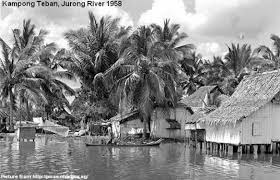
Kampongs in Singapore’s past
“I grew up with my uncle’s wards, who were brought home to be educated. There was even one who was a Chinese-Japanese mix. So, I grew up being familiar cross-cultural marriages and in a multicultural home. I grew up in the kampong with a Chinese boy and we became friends from the age of seven-and-a-half when we were in primary two. His name is Tan Jwee Song — I call him Jwee, ‘my good saint’. He told me after O-levels he would support me to study further and took to teaching. At that time, you could become a teacher after completing your O level. I joined Raffles late during my time in high school because it was too expensive for me. I taught in night classes started by Lee Kuan Yew and studied. I owed Jwee $80,000 dollars and I wanted to pay his widow back — but she would not accept it. When I graduated in 1973 with an honours’ degree, I was $44 thousand in debt. Then, I was given a scholarship.”
And slowly, Kirpal Singh came to his own. When television came into being, he tells us: “I was often on TV in 1970s — days of early television — debates and interviews as a guest.” Kirpal Singh grew into an intellectual of repute as he worked and studied with the support of the many races and many people who, often like him, were migrants to Singapore.
As time moves forward, these stories — that are almost as natural as the sand, the wind and the sea — ask to be caught in words and stored for posterity, stories from life that show how narrow borders drawn by human constructs cannot come in the way of those with ‘gumption’.
(Written by Mitali Chakravarty based on a face to face conversation with Kirpal Singh. Published with permission of Kirpal Singh)
A narrative set against the 2020 impact of Californian forest fires, a community bent on healing the Earth and a travelogue with photographs by Meredith Stephens
The drive up the mountains to the town of Shaver Lake, California, continues to shock me, even though it has been three years since the 2020 fires. Where there formerly stood proud ponderosa pines extending into the sky, there are now barren mountains exposing charred tree trunks and the view beyond of granite boulders previously hidden. The bottom half of the mountain is scarred on both sides of the road, but the upper half is charred and desolate on one side and partially untouched on the other. As you ascend the mountain you notice gates announcing the entrance to where ranches once stood. Some have positioned a caravan or two on the site where their house was. Once you have passed through the town, at an elevation of almost six thousand feet, you notice a line of ponderosa pines adjoining a barren landscape indicating the point where fire-fighters saved the community.
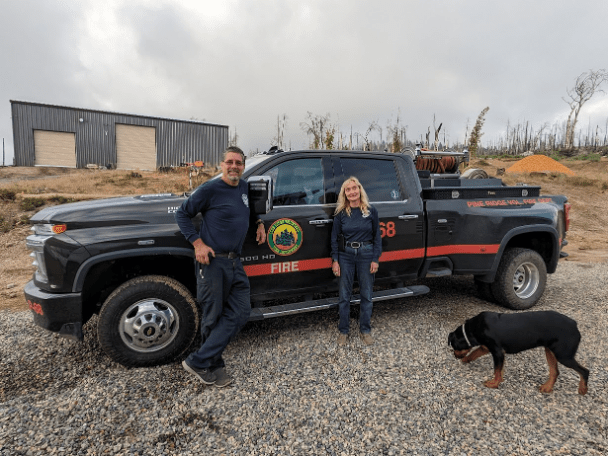
As the Assistant Chief of the Shaver Lake Volunteer Fire Department, James and his team were saving Shaver Lake, while his own property further down the mountain was under threat. His wife Janet, also a fire-fighter, received a mandate to evacuate. Janet was reluctant to leave her home, but obeyed the order, and left with her two dogs. This was just as well, because their house and property were ravaged by the wildfire and she and her dogs would not have survived had they remained at home.
My partner, Alex, had been put into contact with James and Janet when the fires had begun ravaging the mountain in 2020. A mutual acquaintance sent an email to Alex at his home in Adelaide, Australia, asking whether he could offer his holiday house in Shaver Lake to James and Janet. Alex had been focussed on watching the nightly news of the fires back in Adelaide, and scrutinised the maps of the fires every evening to see whether they would engulf his holiday house. It was spared, so he was able to offer it to James and Janet. Alex was unable to visit California himself because of international travel restrictions during the pandemic.
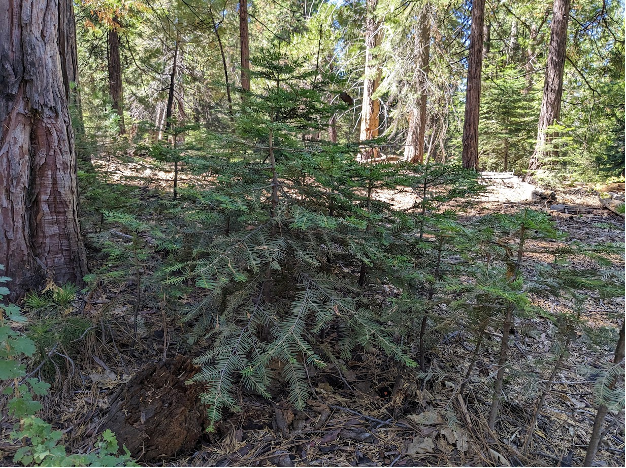
Cluster of Baby Ponderosas
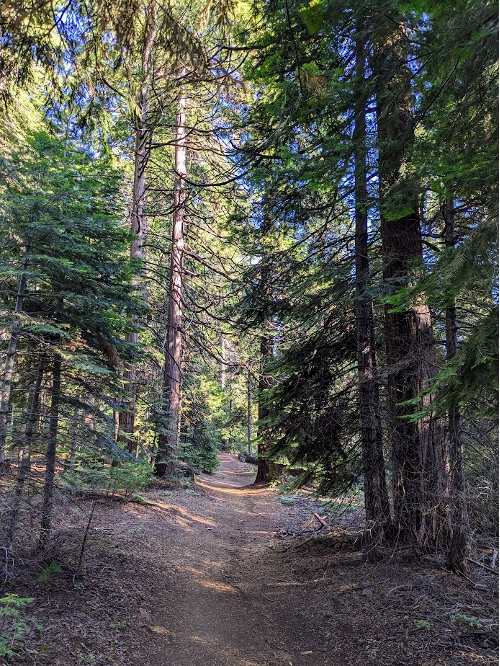
In 2023, Alex and I made the eight-thousand-mile trip from Adelaide to Shaver Lake. Once we arrived, we indulged in morning and evening walks on an undulating path through the ponderosa pines, Douglas firs, and cedars. The path was soft beneath our feet in the aftermath of rain the day before. There was a scent of pine which was immediately calming. In places it is fashionable to pursue ‘forest-bathing’, but here you can simply walk out of your back door and experience biophilia without having to consciously seek it out.
Lupins alongside the Forest Path
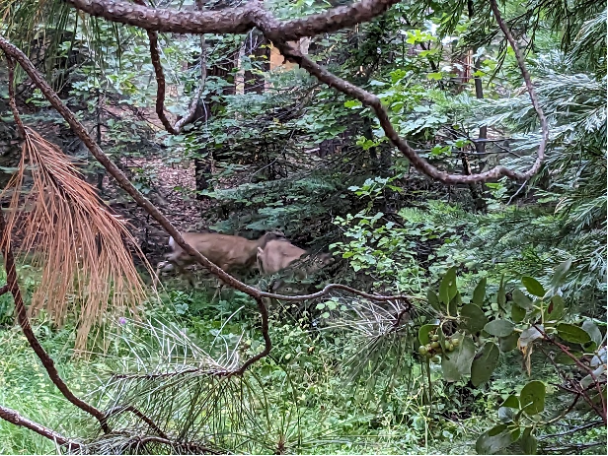
Whenever I heard a rustle I half-expected to see a kangaroo, as I would have in Australia, but instead spotted squirrels hiding behind tree trunks, or a pair of deer cantering away from us as they heard our voices. The path was adjacent to a national park where hunters could hunt deer with a permit in the hunting season.
“When is the deer hunting season?” I asked Alex.
“Not until autumn.”
Phew! It was still late summer, so I needn’t have worried.
“Best wear a fluorescent top in the hunting season,” he advised.
Can you spot the deer?
When I chatted to residents further down the mountain, some said that they could not bear to rebuild their lives on their beloved mountain, such was the shock and devastation of their loss. They had left the site of their former home and relocated to the city of Fresno at the base of the mountain. Others, like James and Janet, have bravely rebuilt their house and are busily engaged in revegetation.
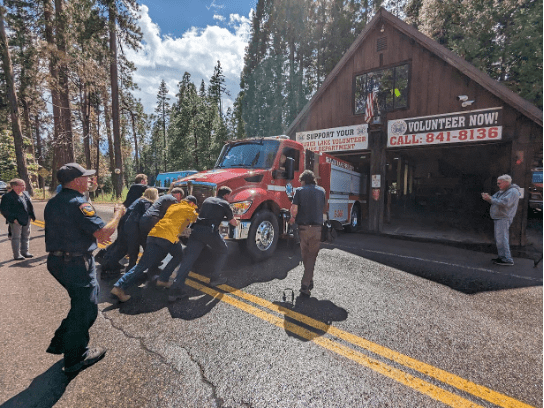
In August, 2023, James and Janet invited us to a fire-truck “push-in ceremony” at Shaver Lake, to celebrate the arrival of a new firetruck. We drove to the township the next day at three pm. The road was blocked by the flashing lights of the sheriff’s patrol cars. We turned back and parked the car, and then entered the township on foot. A crowd of well-wishers was cheering the volunteer fire-fighters, who were pushing the shiny new firetruck into its new home. They strained as they pushed it into the narrow confines where it will be housed. Once it was pushed in, the crowd cheered, and everyone was offered a free ice-cream.
James, Janet, and Cyclone.
I hope the firetruck remains shiny and new, and never has to confront smoke and flames, so that the people of Shaver Lake, the deer, the squirrels, and the ponderosa pines, can live in peace.
.
Meredith Stephens is an applied linguist from South Australia. Her work has appeared in Transnational Literature, The Muse, The Font – A Literary Journal for Language Teachers, The Journal of Literature in Language Teaching, The Writers’ and Readers’ Magazine, Reading in a Foreign Language, and in chapters in anthologies published by Demeter Press, Canada.
PLEASE NOTE: ARTICLES CAN ONLY BE REPRODUCED IN OTHER SITES WITH DUE ACKNOWLEDGEMENT TO BORDERLESS JOURNAL





 Borderless