Categories
Poetry

The Middle-Class Maze

By Mohit Saini


I. CHILDHOOD

A boy is born to modest means,
where dreams are weighed in gold
not for him, but for the house,
where bills pile, stories untold.
His father sweats in sunlit streets,
a wallet thin as thread,
each rupee split for bread and books,
while dreams hang by a thread.
The boy, he learns to bite his tongue,
to bury wants too deep
"Can we afford this course?" he thinks,
while others soar, he creeps.

II. LESSONS

No talk of stocks, no wealth, no bonds,
just whispers 'cross the wall,
"Auntie bought a fridge today!"
"How? Who will pay it all?"
They teach him to gossip, not grow,
to judge, but not invest.
He masters how to count flaws,
but not to pursue his own interests.
The classroom hums with bright futures,
while he just counts the cost.
His grades dip low, his focus strays
a lifetime’s chance is lost.

III. ADULTHOOD

Then comes the wife, then comes the war,
the mother’s tear-stained cheek.
He stands there, torn and hollow-eyed,
too weak to speak or seek.
"Choose her or me!" the women scream,
his heart a fractured bone.
He pleads for peace but feeds the fight,
and weeps—yet stands alone.
Promotions pass, his peers ascend,
while he’s knee-deep in strife.
No raise, no risk, no rebel leap—
just middle-class for life.

IV. CYCLIC ECHOES

The cycle spins, his son now stares
at fees he can’t afford.
The boy, like him, will shrink his dreams
to fit the family’s hoard.
Oh, middle-class! Your chains are soft
no tyrant’s whip, no decree,
just love that clips the wings you yearn,
and calls it "family".

Mohit Saini is a poet, writer, and researcher, working as an Assistant Professor at Compucom Institute of Technology & Management, Jaipur. He currently serves as an editor in the Journal of Advances in English, Telugu and Indian Languages (AQIE Publication) and for the International Journal of Language, Linguistics, Literature and Culture.

.

PLEASE NOTE: ARTICLES CAN ONLY BE REPRODUCED IN OTHER SITES WITH DUE ACKNOWLEDGEMENT TO BORDERLESS JOURNAL

Click here to access the Borderless anthology, Monalisa No Longer Smiles

Click here to access Monalisa No Longer Smiles on Kindle Amazon International

Categories
Musings

When Nectar Turns Poisonous!

By Farouk Gulsara

” No, you cannot refuse this!” my wife said. “This is prasad, the divine offering to the gods.”

A motichoor laddoo… Photo courtesy: Farouk Gulsara

I reluctantly looked at the glazed motichoor ladoo[1]. The memories of my last blood test results started flooding my mind. 

The learned GP looked disapprovingly at my results through his reading glasses, one eye fixed on the result and the other condescendingly on me. Did I hear geckos chapping away in the background, or is the doctor making disgruntled sounds about my glucose levels?

“9.0 fasting sugar is not good! Congratulations, you are a diabetic now!” he declared. I thought I saw a gleam in his eyes as he announced it. 

“Let him have his day,” I told myself. “This is his terrain, let him have his last say.”

Quietly, I was guessing how well the doctor’s fasting sugar would be. Looking at his general appearance, it would not be so great. Proudly carrying around his protuberant apron of a paunch, slouched in his chair all day, the closest he must come to exertion would be leaning forward to examine his patients; he does not scream of a paradigm of health. Yet, this is his turf. Hence, I sheepishly blurted, “Yes, doctor.”

There are some things in life one cannot fight, like who your parents are and the garbage of genetic material one is thrown with. With my very strong family history of diabetes, it was a matter of time before I was garlanded with the same laurel. No amount of time spent at the gym or hours of burning the soles of my running shoes was going to steer me away from his genetic heirloom. I knew that. Still, it is unfair to say, nevertheless. 

So when she offered me the sucrose-dripping divine offerings, I looked at them as my mug of hemlock, as a concoction offered with an intended outcome, no matter how much one can sugarcoat it with divine intervention. Like an accountant who tallies debit and credit transactions, the body does not take into account whether a food is blessed or otherwise. It is quite transactional in its dealings with the trash that is shoved in versus the energy consumed, aided by detoxifying and catalytic agents. 

My mind then wandered upon the practice of emphasising food as one of the highest deeds one can offer to humanity. Every religious function invariably ends with a big feast. Forget prayers; one would get upset if a wedding, a birthday invitation, or even a casual visit to an acquaintance’s home is not accompanied by a meal or at least a snack. What is a birthday party without loads of sugar or unnecessary calories? Feuds have occurred in the past when caterers failed to meet their hosts’ promises. Our community believes that the taste of the wedding meals should be savoured much longer than the newlyweds keep their wedding vows. 

The highest brownie points in most religions must surely be for feeding the masses. No one is denied a meal in most places of worship. Why this fixation on meals and their intermingling with divinity? If any calamity were to befall any part of the world, the Sikh brothers would always be the first to be at Ground Zero to whip out some piping hot vegetarian food for the victims. Where do the homeless in the underprivileged part of town go for a square meal? A langar[2] , the Sikh community kitchen, of course.

I once heard an actress boasting about her polyamorous lifestyle and how she managed to win so many hearts. Her answer stuck in my mind. “Honey, the sure way to a man’s heart is through his stomach. You can either stir a nice meal, or you can compliment him on how slim he looks. You can tell him you can hardly see his stomach!” The actress also said that Belgian chocolates win any girl’s heart. 

Why this fixation on meals and their intermingling with the human psyche and divinity? Food and divinity are closely intertwined, not only because a hungry soul cannot sing praises of the giver, but also because the gratitude and joy showered upon their givers can be intoxicating. It fosters human connection at a primordial level, regulating social orders. After all, hunger remains one of the primitive needs before social conditioning expanded our insatiable wants. 

Famine has been a regular feature in the Indian subcontinent[3]On the other end of society, opulence and wastage were prevalent. The society decided to imbue the act of ‘giving a dog a bone’ with religious fervour, bestowing it with a divine status. We were undernourished then and overnourished now. Either way, we are malnourished[4] , just that in the former, we were fed a wee bit too little, while in the latter, a tad too much. Both leave us much to be desired, metabolically speaking. 

Just as Empress Marie Antoinette could not comprehend why the peasants did not stop their boisterous shouts and just eat the cake[5], my wife cannot understand why I am having second thoughts about indulging in some blessed sweet ladoos.

.

[1] Sweet

[2] A Sikh community kitchen serving free meals to all regardless of religion, caste, gender, economic status, and ethnicity

[3] https://en.wikipedia.org/wiki/Timeline_of_major_famines_in_India_prior_to_1765

[4] . Malnutrition is an imbalance between the nutrients your body needs to function and the nutrients it gets. It can mean undernutrition or overnutrition.

https://my.clevelandclinic.org/health/diseases/22987-malnutrition

[5] “Let them eat cake” is the traditional translation of the French phrase, “qu’ils mangent de la brioche“, said by ‘a great princess’ according to Rosseau. It has been attributed to Marie Antoinette. Brioche is not cake but an enriched bread made with eggs, flour, butter and sugar. (ref:  https://en.wikipedia.org/wiki/Let_them_eat_cake)

Farouk Gulsara is a daytime healer and a writer by night. After developing his left side of his brain almost half his lifetime, this johnny-come-lately decided to stimulate the non-dominant part of his remaining half. An author of two non-fiction books, Inside the twisted mind of Rifle Range Boy and Real Lessons from Reel Life, he writes regularly in his blog, Rifle Range Boy.

PLEASE NOTE: ARTICLES CAN ONLY BE REPRODUCED IN OTHER SITES WITH DUE ACKNOWLEDGEMENT TO BORDERLESS JOURNAL

Click here to access the Borderless anthology, Monalisa No Longer Smiles

Click here to access Monalisa No Longer Smiles on Kindle Amazon International

Categories
Poetry

Alcove and the Theory of Time

By Saranyan BV

At the fourth level, there is an alcove hidden from other human beings. 
(I didn’t know fourth level existed.)
From here a slope moving down in the form of roof,
Looks over another slope, again a roof.
If I can’t see the people, neither can they me!
The pane at this level has a small crack
To allow the air I require to breeze in. Thank you, Lord.
The space in the alcove allows me to stretch,
Allows me the freedom to assume a foetal posture.
The alcove keeps me cold, keeps me warm.
It gives the creepy feeling I might fall off or roll down.
It gives the assurance I am safe.
Here shadows spill light, nights shine darkness.
The whole thing is about the mind.
There is always the whistle, the thoughts about sex,
When it’s not about the sex, it’s about Gods,
About men travelling in trains, men running for cover to hide nakedness.
I am always missing my trains, waiting to find the station’s rest rooms,
Waiting in front of restrooms for the restrooms to be free.
Here people don’t acknowledge truth, the media doesn’t.
The Caxton phenomenon* is dead, all channels whore.
And then there is the sky, the big clear sky like a slice of cake.
The big sky out there where the birds fly, birds make the clouds wait for another day.
How little I feel, how little.
I speak to the feathers to share the alcove.
I speak to feathers because, reasons can’t speak to anyone else in this high alter of solitude.
I impress upon them to share the alcove
Because times are not shareable.

*Caxton phenomenon refers to the impact William Caxton had on English literature and language when he introduced the printing press to England in 1476
From Public Domain

Saranyan BV is poet and short-story writer, now based out of Bangalore. He came into the realm of literature by mistake, but he loves being there. His works have been published in many Indian and Asian journals. He loves the works of Raymond Carver.

.

PLEASE NOTE: ARTICLES CAN ONLY BE REPRODUCED IN OTHER SITES WITH DUE ACKNOWLEDGEMENT TO BORDERLESS JOURNAL. 

Click here to access the Borderless anthology, Monalisa No Longer Smiles

Click here to access Monalisa No Longer Smiles on Kindle Amazon International

Categories
Bhaskar's Corner

‘Language… is a mirror of our moral imagination’

By Bhaskar Parichha

Prof. Sarbeswar Das (1925–2009): A scholar of depth, a teacher of light. Photo Provided by Bhaskar Parichha

In the intellectual history of modern Odisha, Professor Sarbeswar Das stands as one of those rare figures who seamlessly bridged scholarship, ethics, and social commitment. A luminous teacher, an erudite writer, and a quiet Gandhian, his life and work embodied the moral seriousness and intellectual curiosity that marked a generation shaped by the freedom struggle and the promise of a newly independent India.

Born in Sriramchandrapur village in the Puri district of Odisha in 1925, Sarbeswar Das grew up in a milieu where simplicity, discipline, and community values were deeply ingrained. His brilliance shone early—he topped the matriculation examination across Odisha and Bihar, a distinction that foreshadowed a lifetime of academic excellence.

His educational journey took him first to Ravenshaw College, Cuttack, the cradle of higher education in Odisha, where he absorbed the liberal spirit and rigorous intellectual training that the institution was known for. He later studied at Allahabad University, one of India’s foremost centers of learning, before proceeding to the University of Minnesota, for advanced studies in English literature.

His exposure to American academia at a time when few Indian scholars ventured abroad profoundly shaped his intellectual orientation. The years in Minnesota opened to him a new world of thought—modern literary criticism, American fiction, and the philosophy of democratic humanism—all of which left a deep imprint on his teaching and writing in later years.

On returning to India, Das joined the teaching profession, which he would pursue with remarkable dedication and grace for several decades. He served as a professor of English in some of Odisha’s most respected institutions—Christ College (Cuttack), SCS College (Puri), Khallikote College (Berhampur), and Ravenshaw College (Cuttack).

As a teacher, he was known not only for his formidable command of English but also for his clarity of expression, quiet humour, and empathetic engagement with students. He could bring Shakespeare and Emerson alive in the classroom, weaving them into the moral fabric of everyday Indian life. His pioneering initiative was the introduction of American Literature as a formal subject of study in Indian universities, long before it became fashionable to do so.

In an age when English studies in Odisha were largely confined to the British canon, he expanded its horizons by introducing writers like Walt Whitman, Emily Dickinson, William Faulkner, and Mark Twain to Indian classrooms.

Das believed that literature must connect with lived experience. He often told his students: “Language is not just a means of expression; it is a mirror of our moral imagination.” This conviction shaped generations of students who went on to become writers, teachers, and civil servants. Among them was the late Ramakanta Rath, later one of Odisha’s most celebrated poets, who fondly remembered Prof. Das as a teacher who inspired intellectual courage and aesthetic sensitivity.

Alongside his teaching, Prof. Das was a prolific writer and scholar. He authored around twenty-five books spanning essays, literary criticism, translations, and reflections on education and society. His writings in English and Odia reveal a mind steeped in both classical and modern traditions. Fluent in English, Odia, and Sanskrit, he was at ease quoting from the Bhagavad Gita and Hamlet in the same breath.

His essays in English reflected on the role of language in education, the cultural responsibility of intellectuals, and the need for moral clarity in modern life. He consistently argued for a vernacular humanism—a belief that English education must not estrange Indian students from their cultural roots but rather help them view their own traditions through a broader, universal lens.

As a principal, he brought administrative efficiency and human warmth to his role. His tenure is remembered for reforms that encouraged academic discipline, faculty collaboration, and student participation. He believed that education was not merely about acquiring degrees but about shaping ethical citizens.

Prof. Das’s intellectual life was inseparable from his moral and civic commitments. As a young man, he participated in the Quit India Movement, aligning himself with the Gandhian values of simplicity, non-violence, and service throughout his life.

Late in life, Prof. Das turned inward to recount his journey in his autobiography, Mo Kahani (My Story), which has since acquired the stature of a modern Odia classic. Spanning eight decades of personal and social history, it offers not only a memoir of a life well-lived but also a vivid ethnography of Odisha across the twentieth century.

In Mo Kahani, he paints rich, affectionate portraits of his family—his parents and sisters, Suruji and Hara Nani—and evokes the rhythms of village life, with its festivals, hierarchies, and hardships. His account of the great famine of 1919, passed down through family memory, is a haunting narrative of suffering and resilience.

The autobiography captures the moral universe of rural Odisha—its compassion, faith, and silent endurance—while chronicling the social changes wrought by modernity, education, and political awakening.

The book transcends personal recollection to become a social document of rare authenticity, preserving the voices and values of an era in transition. Scholars have hailed it as a valuable resource for understanding Odia social and cultural history, as well as a significant contribution to Indian autobiographical writing.

Prof. Sarbeswar Das passed away in 2009 at the age of 84, leaving behind a legacy of intellectual depth and human kindness. Those who knew him remember his calm demeanour, his Gandhian simplicity, and his unwavering belief in the power of education as a moral force. His students and colleagues regarded him not merely as a teacher but as a guide who exemplified integrity and humility in every aspect of life.

His contributions to English literary education in Odisha were transformative. By introducing American literature, promoting cross-cultural study, and insisting on a pedagogy grounded in ethical reflection, he helped modernise the study of English in the state and inspired a generation to approach literature as a bridge between worlds.

Even today, his writings—both critical and autobiographical—continue to speak to the challenges of our times: the search for meaning in education, the reconciliation of global and local cultures, and the enduring need for moral clarity in a rapidly changing world.

In the final measure, Prof. Sarbeswar Das remains not only a scholar and educator but also a moral historian of his age—one who chronicled the soul of Odisha with the sensitivity of a poet and the precision of a teacher. His Mo Kahani endures as his final lesson: that learning is not a mere accumulation of knowledge, but a lifelong practice of understanding, empathy, and truth.

.

Bhaskar Parichha is a journalist and author of Cyclones in Odisha: Landfall, Wreckage and ResilienceUnbiasedNo Strings Attached: Writings on Odisha and Biju Patnaik – A Political Biography. He lives in Bhubaneswar and writes bilingually. Besides writing for newspapers, he also reviews books on various media platforms.

PLEASE NOTE: ARTICLES CAN ONLY BE REPRODUCED IN OTHER SITES WITH DUE ACKNOWLEDGEMENT TO BORDERLESS JOURNAL

Click here to access the Borderless anthology, Monalisa No Longer Smiles

Click here to access Monalisa No Longer Smiles on Amazon International

Categories
Poetry

Found in Translation: Rohini K.Mukherjee’s Odia Poems

Five poems by Rohini K.Mukherjee have been translated from Odia by Snehaprava Das

Rohini K.Mukherjee
AT THE MYSTICAL SANCHI 

An unknown voice beckons
At the early hours of the morning.
Moved by a new surprise
Buddha relapses into meditation.
A crystal dawn, cold as marble,
Is traced
On his hands and feet
And his eyes and forehead.
Some instant, invisible signal prompts him
To turn on his side and sleep.

After Buddha’s Nirvana,
Calm settles in the valley, slowly.
Thousands of
Branches and branchlets
Radiate blissful divine light.
The trees too, in a lavish growth,
Spread out everywhere --
From the earth below to the sky above --
And meditate!


THE EXECUTIONER

No one could predict
The next scene.
But in the one enacted now
The executioner has
A prominent presence.

The executioner stalks the moon,
His face hidden in the veil of clouds,
Knife in hand, a gleam of smile
On a phony face,
A sharp, keen gaze under the glasses,
Exuding the smell of
An expensive perfume.

The indistinct footfalls may
Prompt one to flick a look back
But there would be no one behind
Only clouds clad in midnight blue
Sailing in the sky.
From somewhere far floats in the music
Of a mountain stream.
Slowly, sorrow dissipates and a
Path opens up for the spring,
A wonderland of fairies.
In his unguarded moments,
The knife in the executioner’s grip
Glitters in the furtive moonlight.
Any moment that poison-coated knife
Could find the moon’s throat,
The moon knows that well.
But it forgives,
Because it also knows well
That the executioner cannot
Hide for long
And will be trapped in
The moonlit garden of tangled clouds.


THE DEATH OF A HAPPY MAN

One day, the eyes lost sleep
And all the locusts flew away,

Not one spectator had guessed
That one day
The man will sprawl out on
On the sea beach sands
Washed away by the waves
From distant lands.

The eyes lost sleep one day.
The flock of locusts flew away.

But no one could guess
The pains, the sobs
That seared that forlorn soul.

Petals drifted in piles
To make him a delicate shroud.
The smell of sandalwood came wafting
In the sea-breeze from the north.
Seagulls flocked around the body,
Unintimidated by the crowd in the beach,
Drowning the voice of
The living men there
With their loud squawks of dissent.
Ooh! What a long wished-for
Happy death
On a cool and blissful sea beach!

After the flock of locusts flew away
Carrying all the dreams back
On their wicked wings,
The eyes lost sleep!


ANKLETS OF THE NIGHT

There is still time for the nightfall.
But the air tinkles with the sound of
The anklets of the night
As if someone is retreating from
An ineffectual, moon-washed garden,
As if someone from the grave
Watching the landscape,
Or someone standing at the riverside
Hums the tune of a departed season,
Or someone hurrying aimlessly away
To escape the approaching dawn.

It is not yet night,
But the night’s anklets ring.
You are probably returning
To your shelter of old times
In search of a new hope.
Just take a look behind to see
The painting of a conflicting wind
Fluttering across the courtyard.

It is not yet night
But its anklets begin to jingle in the air.

How cool you appear in your
Evening chanting of the mantras!
How calm and steady you are
In the pure fragrance of the descending steps
As you set out on the journey
Holding your heart on your palm
Like a burning clay-lamp.
May be when you arrive there
The dawn around you would be sonorous
With the notations of Raga Bhairavi.

There is still time for the nightfall
But the night’s anklets tinkle in the air!


THEY DID NOT COME

I waited for them, but
They did not come,
I waited all this time in vain, and
Knowingly, let myself fall a victim
To the first rays of the sun.
The sun’s whiplash spurred me on
To the jungle.
It forced me to cut wood
And tie them in bundles.
The hunger of the sunset hour
Prodded me back to where
I had started.
The smell of soaked rice, and the aroma of
Onions and oil
Drifted thick in the air of my house.

The sun came in, an intruder,
Sat by me and watched.
Then it devoured all the food,
Leaving nothing,
Not even a single dried-up onion-peel.

Because they did not come,
For me the morning was
Meaningless in its futility.
I knew I was never one
In the list of their ultimate interests
When their tenure of life here ended.

The footfall of the light
Trod easy on my skin.
Days rolled on this way
In sun and light.
The sun was everywhere, all the time.
Whenever the door opened,
The sun stood there.
When the meteor came shooting down,
When words rode over
the waves of sleep to float in the air,
The treacherous sun always appeared.

And for me, there was
No hope of their coming back.

But, one day as I leapt up in a hurry
At the Sun’s summon,
I discovered the Sahara Desert
That I believed had
Remained hidden in my
School Geography book,
Lying face down all these days
Under my own hooves!

Rohini Kanta Mukherjee has authored, edited and co-edited several volumes of poetry and short stories in Odia and English. Many of his poems have been translated and published in various Indian languages , broadcast over several stations of All India Radio and Doordarshan . Some of his poems and translations have appeared in Wasafiri, Indian Literature, The Little Magazine , Purvagraha, Samasa among others. He retired as Associate Professor of English, from B.J.B Autonomous College, Bhubaneswar, Odisha.

Dr.Snehaprava Das, is a noted writer and a translator from Bhubaneswar, Odisha. She has five books of poems, three of stories and thirteen collections of translated texts (from Odia to English), to her credit. 

PLEASE NOTE: ARTICLES CAN ONLY BE REPRODUCED IN OTHER SITES WITH DUE ACKNOWLEDGEMENT TO BORDERLESS JOURNAL

Click here to access the Borderless anthology, Monalisa No Longer Smiles

Click here to access Monalisa No Longer Smiles on Kindle Amazon International

Categories
Review

Silver Strands of Soaring Symphonies

Book Review by Anita Balakrishnan

Title: Silver Years: Senior Contemporary Indian Women’s Poetry

Editors: Sanjukta Dasgupta, Malashri Lal and Anita Nahal.

Publisher: Sahitya Akademi

Several centuries ago, women poets had to fight to be heard, their poems often dismissed as unworthy or mediocre. It is a testament to their determination, grace and sheer talent that today female poets are amongst the most celebrated and respected the world over. In India, pathbreaking women poets such as Toru Dutt, Sarojini Naidu and Kamala Das paved the way for more recent talents such as Eunice de Souza, Suniti Namjoshi and Sujata Bhatt. Of course, this list does not include the vast number of women poets writing in Indian languages ranging from Assamese, Bengali, Hindi, Malayalam, Punjabi, Tamil and Telugu to name but a few.

A recent anthology of poems by senior contemporary Indian women poets titled Silver Years, reflects the centrality of women in today’s Indian society. While elders have always been revered in this society, the overwhelming influence of western media has brought in a certain skepticism towards such traditions. In this context, it is refreshing to read these poems that showcase the maturity, resilience, humour and sagacity of these women. They offer their diverse perspectives on the experience of being an Indian woman, exploring changing societal attitudes to their place in the world, the dynamics of their social roles and the trauma and transcendence they encounter in their lives.

The poems in this collection are not just pretty words that pander to social expectations, they carry the weight of the experiences of fifty senior women poets who have lived rich and varied lives, working in their chosen fields and observing the radical transformation of the world around them. The common thread that runs through this anthology is the forthright tone and boldness of expression in the over 160 poems included. As women who have lived full lives, both in India and across the world, these poets never shy away from controversies, rather expressing with rare grace and tenderness what it means to be sixty plus and female in contemporary society.

The introduction to this volume is no less impressive than the poems. Jointly written by the editors of the collection, Sanjukta Dasgupta, Malashri Lal and Anita Nahal, the introduction traces the evolution of Indian women’s poetry in English, eloquently delineating the political and social challenges faced by women writing in English. Furthermore, the introduction also explores the impact of a deeply patriarchal culture on women in Indian society. The recasting of mythology to suit contemporary societal expectations also finds a mention as well as an emphasis on the voice, agency and power these poets claim for themselves through their poetry. Most significantly, the introduction underscores the resolve, resilience and charm of these sixty plus women, who erase with the power of their words the negativity and weakness associated with aging.

The poems in this anthology vary widely in style and theme, ranging from poems that reimagine gender and societal roles, to those that focus on the havoc wrought by humans on the environment. Perhaps understandably, in an anthology of poems by women poets over sixty, perspectives on aging are numerous.

Anita Nahal’s poem ‘We are the Kali Women’ is a searing condemnation of patriarchal oppression, casteism and discrimination based on skin colour. The poems refrain “Ma Kali. Ma Kali. Ma Kali. Don’t think she’s not watching” strikes a warning note to those hypocrites who are guilty of crimes against her followers while piously bowing before her image.

On a similar theme, but in an entirely different key, is the poetry of Lakshmi Kannan. This poet’s feminism is not overt, but the poems convey an effective message nonetheless. ‘Silver Streaks’ sets forth an idea that is common to many of the poems in the anthology, that senior women do not become less attractive as they age. Instead, this poem emphasizes the power of self-knowledge that maturity brings.

Malashri Lal’s poetry slides into the readers’ consciousness as smooth as silk. Replete with irony and layered with nostalgia, her minimalistic verse has a visceral appeal. ‘Book of Doubts’ evokes a sense of loss for the books one used to treasure. ‘Jaipur Bazar’ is almost like a haiku, conveying the beauty of an emerald and the heritage it encapsulates. ‘Kashmir One Morning’ contrasts the senselessness of sectarian violence with the Gandhian legacy of nonviolence. ‘Krishna’s Flute’, juxtaposes the mellifluous music of the flute and the dreaded coronavirus pandemic. One is associated with the certitude of faith that Krishna’s tunes represent while the other stalks the silent city leaving death and loss in its wake. This is elegant poetry, that does not shock for effect, instead gently evoking images that resonate in the reader’s mind.

Sanjukta Dasgupta’s poems focus on aging with honesty interwoven with humour. Her poems cut to the bone without any unnecessary sentimentality or understatement. Aging, for Sanjukta Dasgupta is an undeniable fact, she asserts that one has to accept the harsh reality of physical debility and the inevitability of death. The poet does not try to gloss over the signs of age, rather she sees them as a culmination of a life lived to the hilt.

The poem ‘When Winter Comes’, is a recasting of P. B. Shelley’s famous line ‘…when winter comes, can Spring be far behind’. The optimism of Shelley’s ‘Ode to the West Wind’ is contrasted with the reality of aging as Dasgupta notes:

In such an intimate Winter
No time
To spring back to Spring

Spreading its embrace….
Scripting a cryptic memoir
On every inch
From face to toe

The poem ‘Fall’ resonates with the repetition of the words ‘falling’ and ‘failing’, which sets the tone for the final descent “into everlasting rest”. The images used in these poems are at once concrete and fanciful, “the swan throat a tortoise neck now” with “countless rings of recorded time”. The poem “Crowning Worry” addresses the anxiety of aging:

Silver waved among blackened hair
Like flags of treachery
Flashing grin of metallic strands

This poem highlights the power of poetry to acknowledge the reader’s anxieties and ameliorate their lack of self-worth:

Black and blonde tresses howled
In low self-esteem, utter frustration
And massive bi-polar manic depression
As the Grey Gorgeous divas
Grinned and Glowed

Poems such as these emphasise the beauty of the older woman, whose youthful innocence may have gone, replaced by something finer, the beauty of self-assurance and poise.

Another significant theme among the poems is climate change and environmental degradation, the burning issue of our times. As mature adults who are aware that their legacy to future generations includes denuded forests, polluted rivers and oceans, arid landscapes and a rampantly consumerist mindset, these poets feel compelled to lament. The elegiac tone is prominent in many poems. Well-known poet from Northeast India, Mamang Dai celebrates the biocentric culture of the tribes of the region in her poem ‘Birthplace’. The poem ‘Floating Island’ also describes the harmony that exists between women and nature. ‘Earth Day’ by Smita Agarwal is another poem that focuses on the negative impact humanity has had on the environment.   

The poems in this anthology reflect the changing status of women in present day society. The poets are successful women and their clear-sighted view of life reflects their wisdom and rich experience. Aging is not seen as degeneration, but an enlightened phase where the wealth of one’s experience makes for a perspective that is to be celebrated. The poets included herein write with skill, empathy and wisdom, showing readers the hidden nuances of life that are often overlooked in the heedlessness of youth. They are unafraid to boldly present their wrinkles and grey hair as signs of a new beauty, one that is bolstered by maturity and self-acceptance. Pathbreaking feminist Betty Freidan sees aging not as decline, but as a new stage of life filled with power and promise. Her famous quote “Aging is not lost youth but a new stage of opportunity and strength” emphasises her views on the fountain of age.

In these 143 poems, these poets have offered readers a fresh perspective on these new horizons, so that they can be viewed with compassion and a renewed appreciation for the felicities of life. Most significantly, these poems reiterate that the silver years are a time of hope and light that shines on the promise of fresh achievement.  

.

Dr. Anita Balakrishnan is former Head, Department of English, Queen Mary’s College, Chennai, India. Author of Transforming Spirit of Indian Women Writers (2012) and contributor to the Routledge Encyclopaedia of Postcolonial Studies, ed by Sangeetha Ray and Henry Schwarz. Has published papers in national and international journals and reviewed books for The Book Review, Borderless Journal  and others. Her interests include contemporary Indian Writing in English, Ecocriticism, Ecofeminism, Cultural Studies and Postcolonial studies.

.

PLEASE NOTE: ARTICLES CAN ONLY BE REPRODUCED IN OTHER SITES WITH DUE ACKNOWLEDGEMENT TO BORDERLESS JOURNAL

Click here to access the Borderless anthology, Monalisa No Longer Smiles

Click here to access Monalisa No Longer Smiles on Kindle Amazon International

Categories
Poetry

Across the Sands of Time

By Shivani Shrivastav

From public domain
Walking together along the Path,
Sometimes, you walked ahead.
Sometimes, I lingered.
Sometimes we missed each other
By seconds...
Oftentimes, we have met
Looked into each other's eyes.
For a moment we connected
Across centuries, across millennia
Then our minds overtook all else...
Travelling the Sands of Time,
Souls searching for completion,
My heart prays
For that one spark
That lasts across lifetimes...

Shivani Shrivastav is a a UK CGI Chartered Secretary and a Governance Professional/CS. She loves meditation, photography, writing, French and creating.

PLEASE NOTE: ARTICLES CAN ONLY BE REPRODUCED IN OTHER SITES WITH DUE ACKNOWLEDGEMENT TO BORDERLESS JOURNAL

Click here to access the Borderless anthology, Monalisa No Longer Smiles

Click here to access Monalisa No Longer Smiles on Amazon International

Categories
Stories

Pause for the Soul

By Sreenath Nagireddy

Phoenix, 2008

The kettle whistled just as Asha reached for the canister of tea leaves. She turned off the stove, letting the silence settle like the layer of steam on the kitchen tiles. The small two-bedroom apartment smelled faintly of turmeric and Lysol—a combination that reminded her of trying to make something sterile feel like home.

She lived here now—on the third floor of a brick building with cracked mailboxes, faded door numbers, and a neighbour who didn’t say hello. The hallways always smelled vaguely of other people’s dinners, none of them hers.

Asha had been in Arizona for six months. Her husband, Abhinav, came two years earlier on an H1-B visa to work as a systems analyst. They used to talk on the phone every day, sometimes twice. She would sit on her parents’ terrace in Vizag, watching the sky darken over the Bay of Bengal, listening to him describe snow he’d never seen before, traffic patterns, the taste of a burrito. But after she came, the words had started to thin out like overused thread.

Now they sat across from each other during dinner, nodding politely, asking about work. His replies were short — “busy today,” or “nothing special”. He didn’t complain, didn’t shout. But he had stopped asking about her dreams. Somewhere between the visa interviews and the flight and the unpacking, they had become polite strangers sharing a lease.

She poured the tea into two silver cups, added milk, and crushed a cardamom pod between her fingers—her mother’s old habit. Back home in Vizag, her mother would brew tea each evening, calling it her “pause for the soul.” Asha had once dismissed it as drama. But now, standing in this quiet kitchen with its humming refrigerator and fluorescent light, she understood.

She placed a cup near Abhinav’s laptop. He was on the couch, scrolling through code, earphones in. He nodded without looking. She stood a moment longer, watching the steam rise and disappear, then returned to the kitchen window.

Outside, a tree was shedding its leaves. Orange and gold pirouetted to the pavement. She had never seen autumn before this year. The first time she touched a fallen maple leaf, it crumbled like a memory in her hand. Everything here was so temporary, so willing to let go.

Her phone buzzed. It was a message from Maya Aunty, a family friend from Tucson: “Come for lunch Sunday. We’ll make Biryani. Bring Abhinav if he agrees to socialize.”

Asha smiled. Maya Aunty was the closest thing she had to home here—her voice too loud, her saris too bright, but her affection sincere. She had a way of filling rooms that made loneliness impossible, at least for a few hours. Abhinav never liked going. He said those gatherings were a waste of time, full of women gossiping and men complaining about taxes.

Still, Asha replied: “Yes, I’ll come. Maybe Abhinav too. See you then.”

That night, as they sat across from each other over reheated sabzi[1], she asked, “Do you want to come to Maya Aunty’s house Sunday?”

He shook his head, scooping rice. “You go. I have a deadline.”

She had expected that. Still, she had asked. It was important to keep asking, even when you knew the answer.

They ate quietly. The news on TV murmured in the background—something about traffic and an upcoming storm. The weatherman’s voice was cheerful, as if storms were just another entertainment option.

After dinner, he returned to his laptop. She washed the plates slowly, running her fingers over the floral pattern on the china—part of the wedding gift set her mother had packed with such hope. “Start a life with this,” she had said. “You’ll need beauty when you’re far away.”

But some days, Asha felt like everything beautiful was now in another language. The sky here was wider but emptier. The silence is louder.

Sunday

She wore a green georgette saree and a pearl chain. The apartment smelled of her sandalwood perfume, a scent that felt like an argument against disappearing. She kissed Abhinav lightly on the forehead before leaving. He didn’t look up.

Tucson was a long ride on the commuter train. The landscape rolled past—brown, flat, dotted with cactii that looked like they were raising their arms in perpetual surrender. At the station, she sat beside a young woman reading an Agatha Christie novel. Asha wondered if she should start reading again. She used to read in college—Yaddanapudi Sulochana Rani, James Hadley Chase novels that made her mother shake her head in mock disapproval.

At Maya Aunty’s house, the air was warm with ginger, cloves, and nostalgia. Women laughed in the kitchen, the pressure cooker hissed, and the television played an old Telugu song that made Asha’s throat tight.

“You’re glowing!” Maya said, hugging her.

“I’m just tired.”

“You need to eat. And talk. Come, sit with me.”

Over lunch, Maya talked about her daughter in Seattle, about growing desert plants that refused to die, about how this country gave you everything and yet made you feel invisible. “You work, you pay bills, you exist,” she said, “but where do ‘you’ live?”

“Does Abhinav talk to you much?” she asked gently, after a pause.

Asha shook her head. “Not really.”

“Men here, they carry stress like skin. But you must not disappear. You must not become a shadow in your own life.”

That line stayed with her. It echoed in the train on the way home, in the empty apartment that evening.

Two Weeks Later

Asha began taking walks in the evening. She bought a notebook and wrote small things—memories, recipes, dreams she had stopped sharing. The act of writing felt like reclaiming something. She emailed an old professor in Hyderabad about doing a remote literature course.

He responded in all caps: “YES, WRITE AGAIN. SEND ME SOMETHING.”

She didn’t tell Abhinav. Not yet. Not until she found the words that would hold.

One evening, she made adrak chai [2]with extra cardamom. She handed him a cup, as usual.

This time, she didn’t walk away.

“I’ve started writing again,” she said.

He paused, looking up from the screen. “Writing?”

“Just… notes. Short stories. Memories.”

He nodded, sipping the tea. “That’s good.”

Silence.

Then: “The cardamom reminds me of your mother’s tea.”

It was a small sentence. But it cracked open a window.

She smiled. “Yes. She used to say it made the soul pause.”

He looked at her for the first time that evening—really looked, the way he used to during their terrace conversations, before the distance taught them to look away.

“Maybe I need to pause,” he said quietly.

The tea was still hot. Outside, another leaf fell from the tree. But this time, Asha thought, maybe it wasn’t about letting go. Maybe it was about making space for something new.

She didn’t say anything. Just set her hand on the couch between them, palm up.

After a long moment, he put his hand down next to hers. Not quite touching. But close.

[1] Indian style vegetables

[2] Ginger tea

Dr Sreenath Nagireddy is a physician from Phoenix,  Arizona. A versatile writer, he explores genres ranging from humour and adventure to thriller and science fiction. His works have been published in 365tomorrows, Kitaab, Twist and Twain Magazine, among others.”

.

PLEASE NOTE: ARTICLES CAN ONLY BE REPRODUCED IN OTHER SITES WITH DUE ACKNOWLEDGEMENT TO BORDERLESS JOURNAL

Click here to access the Borderless anthology, Monalisa No Longer Smiles

Click here to access Monalisa No Longer Smiles on Kindle Amazon International

Categories
The Lost Mantras

More Poems by Isa Kamari

Poetry and translation from Malay by Isa Kamari

DAWN

Hey, the morning breaks!
Hey, the faithful sun!
Hey, the disappearing dew!
Hey, the layered air!
The breath desires,
the soul asks:
Who do you greet?
Have you pondered, sons of Adam?
Death awaits, life prolongs.
Have you realised, progenies of Eve?
The earth is impregnated and layered by purpose.
The one that you welcome is the morning,
The one that you coax is the sun,
The one that you touch gently is the dew,
The one that you breathe is the air.
The gift of death,
life fulfilled,
accompanies the inevitable:
morning, sun, dew, and air.
A breath dissipates, a soul obliterates.
Nothingness. Gone.
Hey!

THE FIELD

The green grass is a mother’s heart,
the velvet of love for her children.
Although stepped upon by mischief and transgression,
she distils dews of hope
that her children would grow with the sun.
The earth is the preparation of a father:
soil and compost for his children
where character would be rooted.
Barren or fertile,
he digs into his responsibility and self-worth,
as long as the rain nourishes his age.
Grass flowers are the children
who only know the joy of the wind
for as long as their dreams
have not landed on earth
and kissed the grass.

MOLTEN EARTH

This moment,
we’re walking in the rain,
accompanied by a bluish rainbow
and red birds with purple blood.
If they’re heading towards the dais,
we have yet to embrace the longing.
When the moon is in tears,
it’s just ill-suited for us to sail
on the orange henna sea.
In truth,
we verily love the eagle
that flies in the desolate morning.
If not for ravens like you,
our forest would be infested with rabbits.
Give us white wings;
we want to fly with blue birds
that return to reciprocate love.
We want to taste milk.
Is it for us only urine,
the manifestation of love by dogs?
Sound your prayer call in our shacks
so that our tears
are not just to bear
the pain and bitterness
of a plate of rice.
If your pensiveness is just to reminisce
the sufferings of night longing for day,
our tears have flowed
from the earth’s molten belly,
which are stepped upon
by saints like you and them
who have cast curses
upon us wretched souls.

POTPOURRI

The screw pine thrives on damp soil,
next to the swampy pond.
It spreads its green in the wild;
roots clench the earth we tread upon.
The jasmine grows on the lawn,
marks the boundaries of property.
Sturdy branches, leaves flourish;
petals open, greet the clouds.
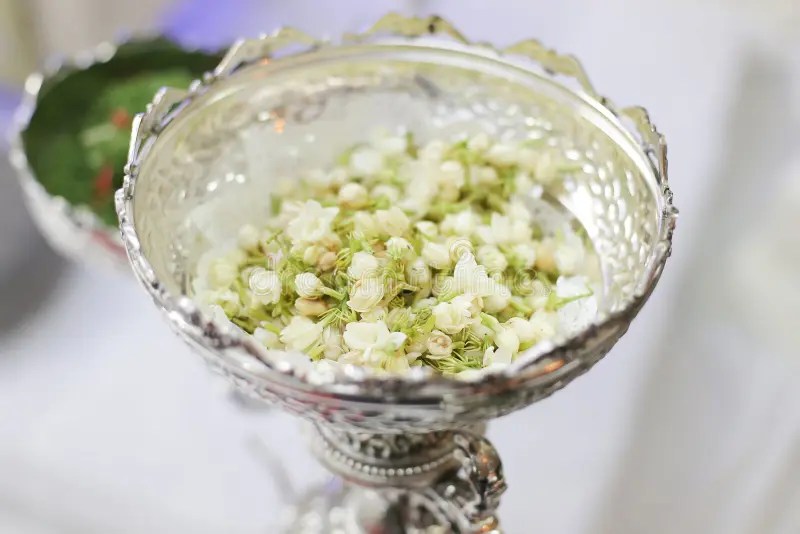
The sliced screw pine in a receptacle,
the jasmine blossoms spread on the tray,
perfume sprinkled to enhance the scent:
the potpourri of bunga rampai welcomes guests.
The ceremony officiated by the qadi,
the couple duly married,
customs and culture celebrated in fragrance,
religious laws honoured on the dais.
The shaving of the baby’s head,
first steps on the soil,
the coffin carried to the grave—
the potpourri of bunga rampai
adorns every domain,
binding firmly entire life’s moments.

Isa Kamari has written 12 novels, 3 collections of poetry, a collection of short stories, a book of essays on Singapore Malay poetry, a collection of theatre scripts and lyrics of 3 music albums, all in Malay. His novels have been translated into English, Turkish, Urdu, Arabic, Indonesian, Jawi, Russian, French, Spanish, Korean, Azerbaijan and Mandarin. Several of his essays and selected poems have been translated into English. Isa was conferred the S.E.A Write Award from Thailand (2006), the Singapore Cultural Medallion (2007), the Anugerah Tun Seri Lanang (2009) from the Singapore Malay Language Council, and the Mastera Literary Award (2018) from Brunei Darussalam.

He obtained a BArch (Hons) from the National University of Singapore in 1989, an MPhil (Malay Letters) from Universiti Kebangsaan Malaysia in 2008 and is currently pursuing a PhD programme at the Academy of Islamic Studies, Univeristi Malaya. His area of research is on the problem of alienation and the practice of firasat (spiritual intuition) in selected Singapore Malay novels.

The Lost Mantras is a collection that blends spirituality, Malay cultural heritage, and universal human experience. First published as part of Menyap Cinta (Love Greetings, 2022, Nuha Books KL), these poems are like a bridge between mysticism and everyday life, where traditional images (betel, jasmine, kris[1], oil lamps, setanjak[2]) are woven with Qur’anic echoes, prayers, and existential questioning. The collection carries a Sufi resonance—always circling back to longing, humility, surrender, and beauty as signs of God. The poems are not only lyrical but also function as cultural memory: they preserve Malay traditions, communal practices, and village life, while situating them in a cosmic framework of faith, sin, and redemption. The use of Malay customs, rituals, and objects is powerful: it asserts that spirituality is not abstract but embedded in heritage. This makes the collection uniquely Southeast Asian despite its universal in appeal.

[1]A dagger

[2] Malay headgear

PLEASE NOTE: ARTICLES CAN ONLY BE REPRODUCED IN OTHER SITES WITH DUE ACKNOWLEDGEMENT TO BORDERLESS JOURNAL

Click here to access the Borderless anthology, Monalisa No Longer Smiles

Click here to access Monalisa No Longer Smiles on Kindle Amazon International

Categories
Notes from Japan

Return to Naoshima

Narratives and photographs by Suzanne Kamata

Several years ago, I published a short book, A Girls’ Guide to the Islands (Gemma Open Door, 2017) about traveling amongst the islands of Japan’s Inland Sea with my daughter, who is deaf and uses a wheelchair. One of the islands that we visited was Naoshima, the site of several art museums, including the Chichu Art Museum, which houses five paintings from Claude Monet’s Water Lilies series. In addition to writing about our responses to the various artworks, I touched upon the difficulties and differences in traveling with a wheelchair user. For one thing, the ferry which conveyed us from Takamatsu City to the island, did not have an elevator to the upper decks. While others got out of their vehicles to take in the scenery from above decks, my daughter and I spent the crossing in my car.

Shortly after this trip, I received a grant from the Sustainable Arts Foundation for a longer book about traveling with my daughter, which became the award-winning Squeaky Wheels: Travels with My Daughter by Train, Plane, Metro, Tuk-tuk, and Wheelchair (Wyatt-Mackenzie Publishing, 2019). A slightly different variation of our trip to Naoshima appears in that book.

Although I loved our time on the island, and had not yet visited all the museums and installations, I had not been back since that trip with my daughter. I finally had a chance to revisit last month when I learned that the couple who had administered the grant that had made my book possible would be visiting Naoshima. I arranged to meet with them on my way back from Kyoto, where I was going to attend a book launch. Unfortunately, I wouldn’t be going with my daughter this time. She is now an adult living in Osaka, and it takes a bit of effort to coordinate our schedules. Nevertheless, I figured I could scout out the situation before planning our next mother-daughter adventure.

Although on previous visits, I had taken a ferry from Takamatsu, on the island of Shikoku, this time I took the shinkansen, Japan’s high speed bullet train, from Kyoto to Okayama, where I spent the night in a hotel. The next morning, I easily found the stop for the bus bound for the ferry terminal. Almost everyone in the queue was foreign. As far as I could tell, most of them were from Europe.

No doubt some had timed their visit with the Setouchi Trienalle, an art festival which takes place mainly in the ports and amongst eleven islands every three years. Japan, in general, has seen a huge surge in tourism over recent years due to the weak yen and governmental efforts to promote inbound tourism. While this has been good for Japan’s economy, it has driven prices up for local residents. It also means that public transportation is often crowded.

When we arrived at the ferry terminal, I purchased my ticket and joined the tail end of a very long line. Luckily, I was able to board the ferry and find a seat. I was pleasantly surprised to find the ferry had been upgraded since my last visit. Not only was it appointed with plush seats facing the water, but also there was now an elevator!

About twenty minutes later, we arrived at Minoura Port. Armies of English-speaking guides were readily available. I quickly found my way to the bus stop and onto the bus that would take me to the recently opened Naoshima New Museum of Art. I had just enough time before meeting my benefactors to check it out and have lunch.

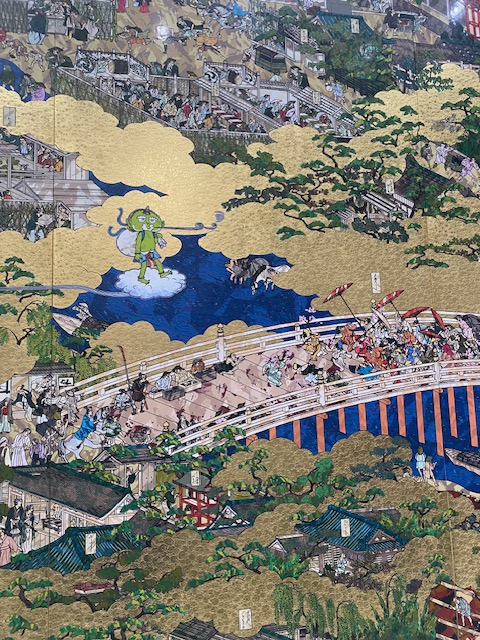
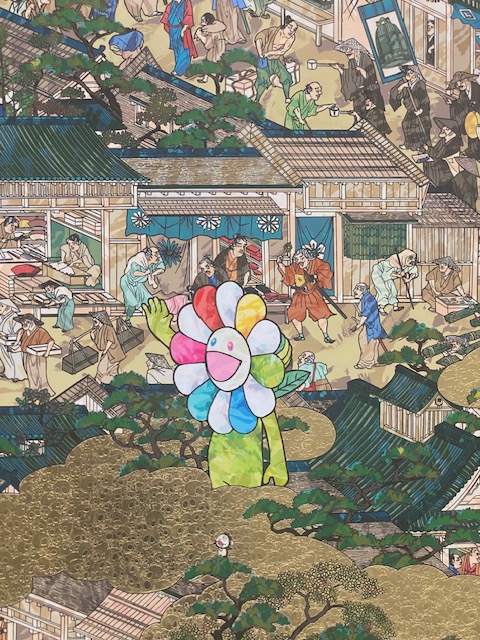
The inaugural exhibition featured the work of twelve artists and groups, including Takashi Murakami, who has achieved worldwide fame. His cartoonish characters appear on coveted Louis Vuitton bags. He also designed a special shirt, printed with cherry blossoms, for fans of the Los Angeles Dodgers. His work on display, a 13-meter-wide painting, is modeled after a 17th century folding screen titled Scenes In and Around Kyoto by Iwasa Matabei. Murakami’s rendition portrays scenes of everyday life in early modern Kyoto. But look closely, and you will find some of his iconic original characters!

Another impressive exhibit, Head On, by Cai Guo-Qiang, features lifelike wolves running toward and colliding with a glass wall. According to the exhibit brochure, the wall “symbolizes the intangible yet deeply felt ideological and cultural divisions between people and communities.”

After going through the exhibits, and vowing to return with my daughter, I popped into the museum café for a quick lunch. The dining area was in open air, with a view of the sea and the islands beyond. I ordered pumpkin toast, perhaps Naoshima’s answer to America’s ubiquitous avocado toast, and a nod to the famous Yayoi Kusama pumpkin sculptures which grace the island.

Finally, I took another bus and went to meet my friends. They are no longer awarding grants to parent artists, having shifted their focus to indigenous groups, however, I will remain forever grateful for their support. We met and had a drink near the Benesse House Park, just outside the Terrace, where my daughter and I had dined several years ago. Then it was time for me to head to the ferry terminal and back to Takamatsu, where I would catch a bus. I happened to cross at sunset – a final blast of beauty before returning home.

Suzanne Kamata was born and raised in Grand Haven, Michigan. She now lives in Japan with her husband and two children. Her short stories, essays, articles and book reviews have appeared in over 100 publications. Her work has been nominated for the Pushcart Prize five times, and received a Special Mention in 2006. She is also a two-time winner of the All Nippon Airways/Wingspan Fiction Contest, winner of the Paris Book Festival, and winner of a SCBWI Magazine Merit Award.

PLEASE NOTE: ARTICLES CAN ONLY BE REPRODUCED IN OTHER SITES WITH DUE ACKNOWLEDGEMENT TO BORDERLESS JOURNAL

Click here to access the Borderless anthology, Monalisa No Longer Smiles

Click here to access Monalisa No Longer Smiles on Amazon International