Categories
Review

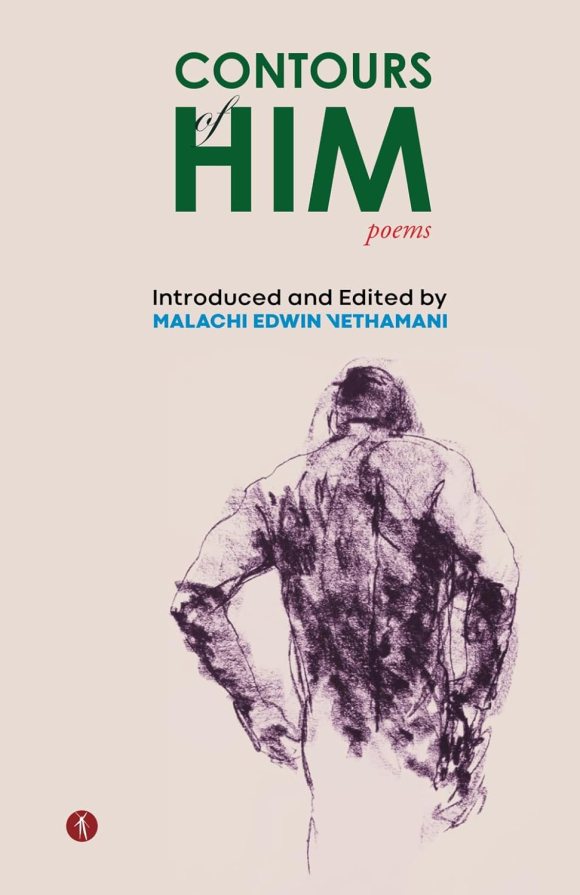
Contours of Him

Book Review by Meenakshi Malhotra

Title: Contours of Him: Poems

Edited and Introduced by Malachi Edwin Vethamani

Publisher: Hawakal Publishers

Contours of Him: Poems has been edited and introduced by Malachi Edwin Vethamani, a Malyasian academic of repute. The book has a rich assemblage of poetical voices — from both men and women — representing the contours and nuances of the many aspects and shades of masculinity. The poems explore the male body as a symbol of identity, art, and humanity, delving into themes of masculinity, strength, vulnerability, and beauty. It also examines the male body and psyche as the site of hurt and wounding. The book features poems that scrutinise the male form revealing or concealing it to explore these themes.

The focus on corporeality or the somatic coexists with the psychological in many poems in the anthology. Childhood innocence and curiosity coexist and yield to what could  be viewed as growing pains or  the challenges of maturation and understanding. There are several poems on the father-son theme, with poems  that express homage to the father. Christina Yin’s prose poem ‘To My Father’ and Gopal Lahiri’s ‘My Ideal Man’ are cases in point. Sudeep Sen in the poem, ‘Baba/Father’, captures the enormous vacuum left by the loss of the father as Sen completes the elaborate death rituals as the eldest son of his dead father, performed as per brahminical  prescriptions. In a gnomic and nuanced vein, Vethamani , the editor of the anthology, gives his take on father-son  intimacies. 

This book examines the contours of the male body and psyche at different stages of life and could be viewed as a psycho-somatic exploration of masculinity across diverse cultures. It also explores the strength and fragility of the male physique, occasionally dipping into cultural repertoires of  male archetypes, human and divine. At the same time, it acknowledges societal expectations from men and their concomitant cultural insecurities, particularly regarding their identity and the search for acceptance.

A common motif in many of the poems is about the unwitting and unwillingly borne burden and baggage of masculinity. The protagonists/personae of many of these poems seem to be conscious that masculinity is but a performance, involving the display of muscles and embodying a certain swag. Yet this definition of and  expectation from men within patriarchies, can be a cage and  straitjacket which binds, restricts and confines the human being. If patriarchies bind women, men are not exempt from it either. It is this theme that resonates(among others) in Angshuman Kar’s poem called ‘Tears’: “When mountains cry, rivers are born/From a woman’s tears, pearls have always been born/And when mothers cry, dormant volcanoes awaken…No one in the world knows/why a strong man cries/or why, when he does/he looks so sacred and beautiful.” 

The predominant focus, however, is on corporeality that has led to the exploration of its many aspects of the  body in the poems. The many facets locates the male body along a spectrum of materiality, vulnerability, relationality and the transcendental possibilities of the body. In recent years, there have been a plethora of poems by women discussing corporeality in multiple registers, exploring female subjectivity, desire and sexuality. Focus on the psychosomatic aspects of the gendered body has led to numerous explorations and analyses of femininity, on being/becoming women, on trans-identities. Many poems have been written on the human-divine aspect of the female body. Kamala Das and others (including Pakistani women poets) have written evocatively about the transgressive desires and  the many hungers of the female body .

Voices from the global south recording the voices of men was perhaps the need of the moment. The anthology includes a few poems on masculinity as a construct, especially focusing on the male body through various lenses — vulnerability, performance, shame, violence, and transformation. These poems offer a critical lens rather than idealising masculinity, exposing its social constructions and internal contradictions. They also highlight the relational nature of masculinity which are often traditionally embedded within family structures in South Asia. There are glimpses of guilt in Arthur Neong’s poem, “At this juncture of age, I feel like a teenager again,” where the persona/speaker seems keen to shed and slough off the burdens of masculinity and be in an escapist mode. He writes “At times I go to my wife for a little reprieve/Yet eyes open, think of ways to cheat”. Some of the poems read like love poems, like David C.E. Tneh’s poem, ‘Crossings’, that memorialises his dead friend. Tneh writes: “between the shared spaces and/ private moments come a synergy of collective memories/that I have  of you.”

 A writer writing on the  female body once referred to it as  a story discussed by men. Similarly, the anthology at hand discusses the contours of male corporeality and affect. The anxieties of masculinity, of literally not measuring up, pepper these poems and forms one of the vital themes of this anthology. Occasionally, a kind of narcissism creeps in, often giving way to musing or self-introspection. After voicing the common masculine concerns(and anxieties) of corporeal self-consciousness, the poet Kiriti Sengupta declares:

“I don’t look at veiled people anymore. 
It is either my age or my hormones.
I now look beyond the flesh, bone and keratin.”

In the last revelatory line, there is a movement towards transcendence: “I have been told /the finer body dwells undressed.”

In a different context but similar vein, Sandeep Kumar Mishra in ‘The Canvas of Form’ writes, “The naked body, stripped of all pretence,/Breathes honesty, raw beauty, fragile strength.” The profundity of the closing lines is inescapable: “The body, bared, is neither shame nor pride/But speaks of histories, of fears ,of love. It tells  of burdens carried, joys embraced/And in its stillness, whispers human truth.”

Much canonical poetry, including that of the famed  icon of modernist poetry, T.S.Eliot, writing a century ago, display a preoccupation with masculine anxieties in his iconic ‘The Love Song of Alfred J Prufrock’. The effete personae/protagonist , immortalised in the eponymous poem, Felix Cheong writes of ‘Middling Age’ that it’s “So unbecoming to have become so old? You’d sooner wear the ends of your frailty rolled”, lines echoing   T.S.Eliot’s The Love Song of Alfred J Prufock, “I will wear the bottoms of my trousers rolled.”

From Justin Baldoni’s Man Enough to Shyam Selvadurai’s Funny Boy, there are many coming of age stories  in our cultural landscape-on book lists and bestseller lists. While the sociology of sex and gender has long been a part of sociology and social psychology, the growth and development of a field of knowledge –gender studies– in the last four decades or so, has thrown into relief the fact that if femininity is a construct, so is masculinity.

Meenakshi Malhotra is Professor of English Literature at Hansraj College, University of Delhi, and has been involved in teaching and curriculum development in several universities. She has edited two books on Women and Lifewriting, Representing the Self and Claiming the I, in addition  to numerous published articles on gender, literature and feminist theory.  Her most recent publication is The Gendered Body: Negotiation, Resistance, Struggle.

.

PLEASE NOTE: ARTICLES CAN ONLY BE REPRODUCED IN OTHER SITES WITH DUE ACKNOWLEDGEMENT TO BORDERLESS JOURNAL

Click here to access the Borderless anthology, Monalisa No Longer Smiles

Click here to access Monalisa No Longer Smiles on Amazon International

Categories
Essay

A Short, Winding, and Legendary Dhaka Road

By Fakrul Alam

From Public Domain

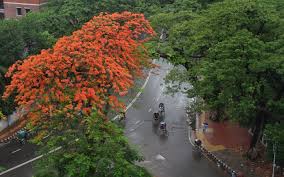
Fuller Road, the short and winding road in the middle of the University of Dhaka campus, is quite legendary, not only as far as the history of that institution is concerned, but also in the annals of Bangladesh. It must also be one of the most beautiful of Dhaka city’s roads, having till now mostly escaped the degradations other old roads of the city have been subjected to due to rampant urbanisation. It is steeped in history, but still looks as if it was built not that long ago. Undoubtedly, it has real character and a distinctive place in the city’s life.

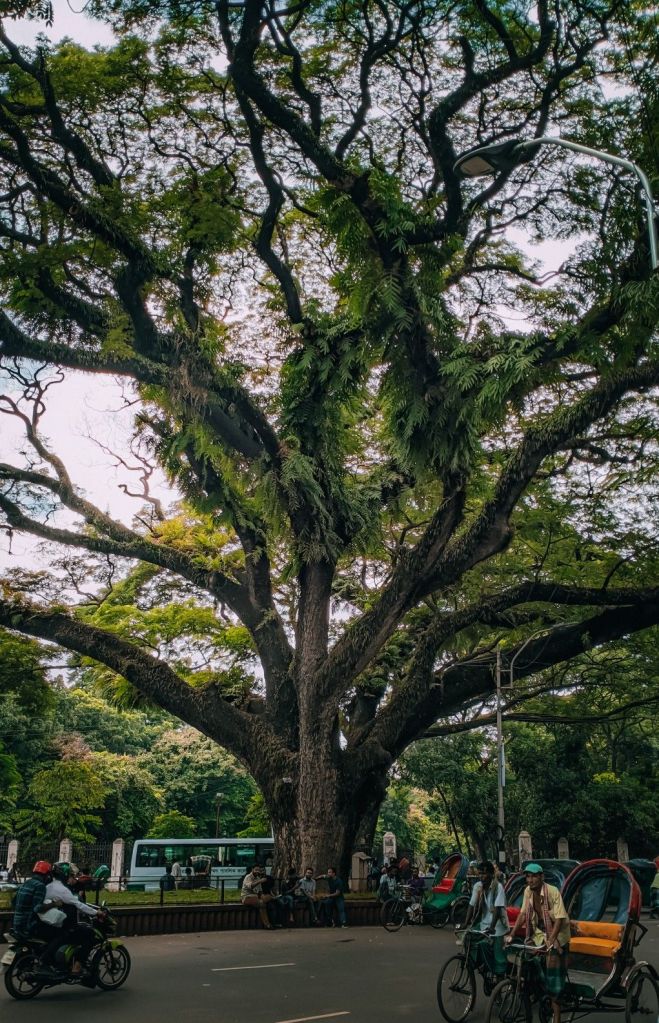
Bampfylde Fuller[1] was the first Lieutenant Governor of the province of East Bengal and Assam but he held that position for less than a year. Fuller Road must have been named to acknowledge his indirect role in the creation of Dhaka’s university. A controversial administrator and a very opinionated man, he had quit his position in a huff after less than a year at his job. The Partition of Bengal had been revoked in 1912, and all Fuller left behind then in his brief stint seemingly was the beautiful Old High Court Building of the city (whose construction he had initiated) and the splendid, sprawling rain trees of the university he had apparently imported from Madagascar. Nevertheless, the naming of the road indicates that he was part of the historical current that would lead not only to the building of the University of Dhaka in 1921, but also to the Partition of India in 1947, and the birth of Bangladesh in 1971. Fuller Road is thus replete with history.

Enter it from Azimpur Road and you will see it flanked on one side by Salimullah Muslim (or SM) Hall, and on the other by Jagannath Hall. The former, of course, is named to honour Nawab Salimullah, one of the university’s founders, and someone who had donated a lot of land to the university. Built in 1930-1931, SM Hall is a splendid building, incorporating features not merely of Mughal architecture and gardens, but also of design elements of the colleges and halls that echo another venerable university, Oxford (one reason why the University of Dhaka was once called the “Oxford of the East”). Jagannath Hall comes with an overload of history as well. It, too, was originally modelled after the halls of the University of Oxford and was named after a zamindar of Savar who had contributed to the founding of Jagannath College, which had an organic connection with the university for a long time.

Fuller Road, in fact, is also steeped in the history of Bangladesh. If you enter it from its Azimpur Road entrance, you will see the Swadhinata Sangram, a group of sculptural busts by Shamim Sikder that commemorates the legendary names associated with the university and the birth of Bangladesh. If you care to enter the university staff quarters from either the left or right of the road, and if you then ask the guards to show you around, you will find the graves of intellectuals (or plaques honouring them). These were men martyred in 1971 due to the single-minded determination of the Pakistani army and its Bengali collaborators to eliminate dissident intellectuals who had worked for the birth of Bangladesh, thereby crippling the country at the moment of its birth.

If you exit the road on Nilkhet road, you will find a solemnly built commemorative area in another island, containing plaques listing university teachers, staff members, and students martyred in 1971. The sculptures and the plaques are testaments not only to the sheer bloody-mindedness of the Pakistani forces of yore but also to the major contribution made by the university’s people to Bangladesh’s independence. I grew up listening to snatches of the history of the University of Dhaka and Fuller Road that are relevant here.

One of my uncles, for instance, is still fond of retelling an incident when he escaped from the Pakistani police’s bloody assault on demonstrators protesting on February 21, 1952, against the imposition of Urdu as the sole national language of the nascent state by (West) Pakistani administrators and their cohorts. He had taken refuge at that time in the Fuller Road flat of an European Jewish academic, who was then a faculty member. A few of my teachers have either talked about or written about the movements that continued from that memorable incident till December 16, 1971, describing their involvement with the various other movements that led to the emergence of Bangladesh. They highlight, in the process, noteworthy moments in the road’s history and the roles its denizens played in our country’s pre-liberation stages, as well as the memorable transitional historical moments they had either witnessed or were part of.

As I move in from the Swadhinata Sangram island on the Azimpur Road entry point of Fuller Road nowadays, I can see only a few remnants of the natural beauty the road once boasted. Gone is the basketball court placed in a picturesque setting that SM Hall once possessed, or the lush green grass tennis court of the Hall that my uncle reminisced about. He played there before my time. For a long time, there were many statuesque and lovely trees on the SM Hall side of the road. However, the distinctive architectural features of the SM hall building still strikes me as very impressive.

On the other side, however, the first clear signs of the uglification of Fuller Road are visible in the drab features of the newly built extension of the Jagannath Hall complex. In addition to these two halls, Fuller Road is flanked on one side by the British Council and university staff quarters, and on the other by Udayan Bidyalaya (aka Udayan School/College), some faculty and staff quarters, the residences of one of the pro-vice chancellors and the treasurer, and the vice chancellor’s house. The two buildings of the pro-vice chancellor and the treasurer are pretty nondescript, as are the Udayan buildings, but the British Council setup is quite notable. I have written about the British Council’s transformation from an open access center for intellectual and cultural pursuits and my own memories of stimulating as well as adda[2]-filled days in anguished as well as indignant remembrance elsewhere, but let me just reiterate what I say in that piece briefly here: This new British Council is, indeed, sleekly designed and has state-of-the art security, but it is no longer the vibrant centre of intellectual exchange it once was, and is now mostly a place visited by those who can afford its wares of British education.

The Vice-chancellor’s residence, however, is undoubtedly still striking. If you have had the privilege of going inside, you must have been impressed by the building as well as the grounds, containing krishnachuras and jarul trees, which when flowering, make Fuller Road look vibrant and colourful—almost a garden in Dhaka city. Indeed, the rain trees, the krishnachuras and jaruls in bloom, one or two shirish and a solitary sonalu trees and (still) numerous mango trees play their part in making Fuller Road a distinctive floral phenomenon of the cityscape. Fuller Road is indeed as beautiful as you could expect any road to be in a bustling, bursting-at-its seam, and unsparingly chaotic city like Dhaka.

It is a road that also has many moods and that you can see in many lights—literally. I lived in Fuller Road for over two decades and frequented it for two more, and thus have had the privilege of viewing the road at different times of the day and on diverse occasions for at least four decades. When I now reflect on what I saw, I am struck by the immense variety of the experiences the road affords to those who live in it and even to passersby.

It was during my prolonged stay in Fuller Road that I got frequent glimpses of the wondrous place it once must have been. Even now, a nature-lover can take delight in its birds, for although the cacophonic crows still reign supreme amongst the bird population of the locality, throughout the day, and especially in the evening, you will see swiftly flying flocks of pigeons, tribes of parrots, and incomparably beautiful yellow-breasted holud pakhi[3]couples, in addition to the sad-looking, ubiquitous shaliks[4] and evening’s surrealistic bats.

When I first started living in Fuller Road, I would occasionally see snakes slithering by on monsoonal days; mongooses darting away at the sight of walkers is a not uncommon experience even now. Wild dogs roam in parts of Fuller Road at nights and early mornings. The foxes have disappeared, and I have seen a stray monkey only once or twice, but there is still enough flora and fauna around to make you feel an intimate connection with nature in this neighbourhood of the city. But of course, in addition to its nonhuman residents as well as its human ones, Fuller Road is now frequented mostly by people who find its free and open spaces appealing for different reasons at different times of the day.

Early in the morning or late in the evening, for instance, you will find men and women chatting away as they do their constitutionals; during the day students saunter across the road while vehicles fill the free and plentiful parking spaces; come evening lovers sit down discreetly in its dark spots, trying to be as close as possible and as far away as they can from prying eyes; with nightfall nouveau riche youths park faux sports and/or sleekly painted cars, trying to impress the girls who stroll across the road. Nowadays you will see with irritating frequency in evenings the parked motorcycles of busy-seeming student leaders. At night, Fuller Road can have a surrealistic feel to it—lit up but deserted, desolate as in some dreamscape, and as in a dreamscape, hauntingly familiar. 

What surely makes Fuller Road truly distinctive, though, are the festival days that it hosts throughout the year, and the processions and parades that cross it throughout the year for one reason or the other. If you list them by the English calendar, you can begin with the new year when celebrations continue from the final hours of the dying year and end till the first nightfall of the new one. February is a truly distinctive month in the road—first Bashanta Utshob[5]and then Valentine’s Day see it fill up with young men and women in bright, warm colours and obviously romantic, flirtatious moods. Even solemn Ekushey[6]February, when night-long Fuller Road residents hear the doleful notes of the Ekushey song commemorating our language martyrs, and when from dawn to afternoon the road is closed to all vehicular traffic, switches to a festive mood by late afternoon, as those crisscrossing it seem bent on leaving the sad notes behind to celebrate all things Bengali. But the most exuberant display you can see in and around Fuller Road is during Pohela Boishakh[7], when the road turns into a conduit for festival-loving people flowing from fun-filled event to event. Eid days and Durga Pujas, and Saraswati pujas too witness suitably dressed young people walking across the road in obviously celebratory moods, lighting up themselves and the people around them, as they either stroll by or stand in pairs or groups here and there in the curving road’s embrace.

And the processions and parades? Suffice it to say that they are motivated not only by politics but this or that reason or cause. In the three Fuller Road flats I lived in for twenty or so years, I felt the kind of contentment and ease that I did not experience in the many neighbourhoods of Dhaka I had lived in before, or the Dhanmondi flat I live in now. Mango-filled trees exuding mango blossom scents, kamini flowers with overpowering fragrances, wide open spaces where children and boys play to their hearts’ content and neighbours greet each other familiarly throughout the day made my life on Fuller Road incomparably pleasing.

Towards the end of my Dhaka University career, I moved to a flat on the ninth floor of the newly constructed faculty apartment complex. There I saw what I had never seen before—monsoonal cloud formations, magnificent sunsets (I would not get up in time for sunrises!), the moon in its full glory, and star-studded nights. Heaven seemed to come closer and closer to me then. I truly seemed to have ascended to celestial heights! But paradise has to be lost sooner or later and can only be regained in this world by willing the mind to vision it from exilic places every now and then. But to have had some close to it moments in this life through Fuller Road is truly something to be thankful for!

From Public Domain

[1] Fuller (1854-1935) held the position from 16 October 1905 until he resigned on 20 August 1906 after which he relinquished the position to Lord Minto (1845-1914).

[2] Tete-a tete

[3] Orioles

[4] Mynas

[5] Spring Festival

[6] Twenty-first February has been declared the mother tongue day by UNESCO. One of the reasons Bangladesh was formed was its insistence on Bengali being its mother tongue while Pakistan tried to impose Urdu as the national language.

[7] Pohela Boishakh (first day of the Bengali month of Boishakh) falls on 14th April in Bangladesh and  is celebrated as the start of the Bengali New Year with a holiday and fanfare.

(First Published in Daily Star on July 7, 2018)

Fakrul Alam is an academic, translator and writer from Bangladesh. He has translated works of Jibonananda Das and Rabindranath Tagore into English and is the recipient of Bangla Academy Literary Award (2012) for translation and SAARC Literary Award (2012).

PLEASE NOTE: ARTICLES CAN ONLY BE REPRODUCED IN OTHER SITES WITH DUE ACKNOWLEDGEMENT TO BORDERLESS JOURNAL

Click here to access the Borderless anthology, Monalisa No Longer Smiles

Click here to access Monalisa No Longer Smiles on Amazon International

Categories
Essay

The Year of Living Dangerously by Fakrul Alam

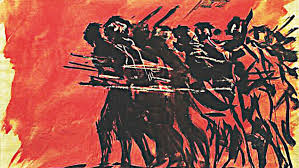
Painting by Zainul Abedin. From Public Domain

1971 began and ended on a note of hope but in the course of the year we went through the whole gamut of human emotions: love for our motherland and hate for its enemies; desire for freedom and abhorrence at those who had curtailed our right to be ourselves; feelings such as anxiety, fear, even terror caused by the knowledge that at any moment we might be abducted and murdered; and excitement and elation at the thought that relief could not be far away. 1971 was the year when for months we lived from day to day, totally insecure in a Dhaka which had become like a city of the dead; it was also the year when we discovered what it meant to hope against hope. 1971, in short, was a cataclysmal year; for every Bengali it was the year of living dangerously.

The year must have begun innocuously enough; at this point in time, I have simply no recollection what I did or how I felt in January and February of that year. But certainly, hope must have been in the air; after Sheikh Sahib’s massive election victory all of us must have been feeling confident and secure in the knowledge that we were finally about to master our destiny. For me—temperamentally apolitical and not yet out of my teens at the beginning of that year—the first sign that something was seriously wrong came one day while we were watching a test match in Dhaka Stadium on the first of March. Suddenly, the game was interrupted and then abandoned as news came about Yahya Khan’s decision to not call a meeting of the Pakistani National Assembly. Pandemonium ruled for a while in the field, but soon everyone left, muttering that this cannot be, indignant that the army chief could not go against the resounding mandate given to the Awami League to change the course of Pakistani history.

And then for a while: hartals[1], demonstrations, slogans, meetings, public displays of discontent, and the will to oppose and resist on one side and display of the carrot as well as the stick on the other. In fact, the month of March showed a whole nation in a state of ferment, ready to go to any length against a brutal but posturing force.

A first climax was Sheikh Saheb’s[2] speech of March 7. Hearing it now, I cannot but think: is it as stirring for people of this generation as it was for ours? Contemplated in retrospective, the speech seems to be the quintessence of the Bengali spirit in 1971: inspired, defiant, pulsating, and resolute. It considers the dangers ahead but is emphatic about the need to put up resistance and counter whatever measures were taken to contain us.

The real climax, of course, came on the night of March 25. That night I was in Sylhet, visiting my sister and her husband, along with my father and two other sisters. In Sylhet that night we could have no idea that Dhaka had become the scene of carnage or that our family, friends, and acquaintances were in the greatest of danger. It was only next morning, waking up to discover that Sylhet town was under curfew, and listening to Indian radio and the BBC, that we began to have an inkling of how devastated Dhaka had become in a night and in how much jeopardy our loved ones were.

Throughout the next week we alternated between a feeling of joy at the knowledge that Bengalis were fighting back and a foreboding that a grievous wound had been inflicted on us. We were elated by Major Zia’s declaration on the radio about independence and the reports of resistance everywhere; we were depressed by the news items transmitted in the air waves about Dhaka as a city that had been flattened by heavy weapons and was still burning. Since, our house was close to Farmgate, we were full of anxiety: had my mother and the sister we had left behind survived the mass slaughter of Dhakaites that was being narrated everywhere except on Radio Pakistan?

After a few days my father decided that he had had enough of waiting and uncertainty; he and I would head for Dhaka and determine for ourselves the fate of my mother and sister. My brother-in-law and three other sisters would remain in what seemed the relative safety of Sylhet. Little did we realise as we left them on a day in early April the hardship and suffering they would go through in the next few months, fleeing from tea garden to tea garden and even to the safety of Tripura[3] to escape the pillaging Pakistani army. Only after we were reunited with them in Dhaka in July did we get to know of their travails as they attempted to evade the marauding forces.

The trip to Dhaka was a tense and an unforgettable one. A few images are etched in my memory vividly: driving through the tea gardens, we saw tea garden workers with bows and arrows, determination wrought on their faces. In Brahmanbaria, we heard gripping stories of the confrontations that had taken place in Comilla and saw the intense preparations being taken in the town itself to resist the Pakistani onslaught. But the most vivid memory of the journey are the scenes of mass exodus we witnessed as we neared Dhaka: men, women, and children on foot or on rickshaws, looking harrowed, wearily fleeing to village homes from the city to escape genocide. Not a few of the people we met told us not to be so foolhardy as to return to Dhaka.

Thankfully, we managed to reach our Indira Road home without facing any unpleasant situations and found that my mother and sister were safe. But there were troop movements all the time and stories of mass arrests of young men during curfew. The elders of my family decided that I would be safer in my uncle’s house in Dhanmondi than in a house in the Farmgate area.

In the few weeks that I stayed in Dhanmondi I managed to get in touch with some of my friends. The news they told me was horrifying: Dr. Jyotirmoy Guhathakurta, my tutorial teacher, and the man who first made me feel that I had the sensitivity to be a student of Shakespeare, and who went beyond his role as a tutor to talk to me about his passion for radical humanism, as well as Mr. Rashidul Hasan, who taught us Blake and was as humble and meek as some of the denizens of The Songs of Innocence and of Experience, had been brutally murdered. More horror stories: one of my school friends, Arun Chowdhury, and his father, could no longer be traced after they had been abducted from Ranada Prasad Saha’s Narayanganj home along with the millionaire philanthropist; one of my uncle’s in-laws, a Rajshahi University professor, had also disappeared after being picked up by the army; other people that we knew had been shot at or humiliated or hurt. A friend who had joined her family in Bogra had witnessed their house being burned and the family had barely managed to escape with their lives. The whole Bengali nation appeared to be bleeding and bruised.

Nevertheless, no one felt defeated and hope still flickered as a candle newly lit and solidly fixed will even in the darkest night. For one thing, there were the daily broadcasts from Swadhin Bangla Betar Kendra[4]containing news about Mujibnagar and organised resistance all over the country. Then there was the knowledge that some friends had crossed the border and were receiving training so that they could be inducted into the Mukti Bahini[5]. Everywhere one could view the resentment against the Pakistani army being concentrated to the point when it would rebound upon them.

Eventually, my parents decided that we would take a house in a part of the city which was relatively free from regular army patrolling and I rejoined them in a Central Road flat. But, really, no part of the city was completely safe. One night, to take just one example, the boys of the neighbouring family climbed the wall separating our two houses because the army had raided the house next door and stayed with us till next morning. I still remember how tense we were that night and nervous and indignant.

Gradually, we learned to sleep better and not hear the stray shots that were fired into the night by who knows whom. Inevitably, we adapted to a life lived mostly indoors, listening to the radio or the tape recorder all day, or reading, or playing cards. But we had to be very careful about everything that we did: the radio had to be toned down, books with insidious sounding titles not read, and visit to and from friends of our age restricted. Fear of army raids constricted us and forced us to make life a diminished thing. Only my father would go out regularly to spend the day in office or shopping; his greying hair gave him a kind of limited freedom that we could not hope to have.

However, consolations for lives lived under such strained circumstances were not impossible to seek even in those days when we would rarely venture into natural light. By June, bombs which were beginning to explode at regular intervals all over the city announced loudly to us that the Bengali capacity to resist, far from being diminished, had transformed itself in spectacular fashion. My father told us one day that he was one of many people who had been donating money for freedom fighters who were now infiltrating into the city in large numbers. In July and August, the Mukti Bahini activity in Dhaka intensified and I even met a few of them. Also, every once in a while, a close friend suddenly disappeared from Dhaka and those of us who still remained in the city still unsure of what we should do talked about his decision to join the freedom struggle and his daring with a mixture of admiration and envy.

Of course, we knew that the life of a freedom fighter was far from a glamorous one, and full of risks. Exactly how hazardous their life could be was driven home to us when in late August a number of them were caught and murdered. Because we knew a few of these valiant fighters personally or by name, for some time, indeed for perhaps the only time that year, we felt depressed and shaken. But another few weeks and many amongst us roused ourselves and felt hopeful again. True, there had been a setback and some of the muktis[6]who had become legendary in a short time because of their exploits had been killed or imprisoned, but September showed that the spirit of resistance was very much alive.

Explosions could once again be heard in and around Dhaka and were signs to us of the vigour and irrepressible nature of our freedom fighters. By October, Swadhin Bangla[7]Radio broadcasts regularly reassured us that there were advances being made on the diplomatic front by our government-in-exile and that on the battlefield our reconstituted Bangladesh army were beginning to engage the Pakistani forces and defeat and demoralise them.

By early November, Nasim Mohsin, my best friend at that time, decided that it was time for him to join the freedom fighters and that the moment for a decisive assault on the Pakistani army was near. I was with him when he contacted some local muktis about crossing over to training camps in Tripura. They told him that the borders were already the site of daily skirmishes and that he should postpone the journey for a while till they could confirm a safe crossing. Desperate to become part of the freedom struggle, Nasim ignored their advice and our pleas to be patient and left us, never to be seen again. Much later, we were to discover that he had been captured by collaborators of the Pakistani army in a village in the Comilla border. They then handed him over to the local Pakistani troops who summarily shot him.

Late November and our excitement grew: the Bangladesh army was no longer content with skirmishes and raids and was now attacking the Pakistanis frontally. By late November war looked inevitable as desperate Pakistani tactics drew India into the campaign. Finally, on the night of December 3, the Dhaka night sky was spectacularly lit by tracer bullets and then invaded by Indian bombers targeting military installations. The next day all of us were on roof-tops watching dog-fights and cheering Indian jets attacking the airport and the cantonment, oblivious to the danger from shrapnel and debris from shattered planes.

Over the next two weeks, our joy grew by the hour, for every Swadhin Bangla Radio broadcast or Indian radio bulletin informed us of Pakistani reverses and detailed advances made by the liberation forces. In our enthusiasm we did not realise that we were going through dangerous times in the capital city as the Pakistani army and its collaborators, their backs against the wall, were becoming more and more vicious. It was only later that we discovered that the brother of a friend who had joined the freedom fighters had been picked up by the Pakistani army during this time and would disappear from our sights forever. And as the liberation forces closed in on Dhaka, rumours spread of youths and prominent people being abducted. Undoubtedly, the scariest memory I have from this period is of a Pakistani plane droning one night, which we knew had dropped bombs on an orphanage the previous night in a bid to discredit the Indian Air Force. It was a moment when we felt totally vulnerable and at the mercy of forces whose reason had become warped to the extent that they could indulge in mass destruction of innocents merely to smear India in the eyes of the world.

Nothing the vicious Pakistani military/propaganda machine could do, however, could thwart the logic of history and prevent liberation, and by December 15 we were hearing the booming of artillery in and around Dhaka. On December 16, we headed for the Ramna Race Course area because we heard that a surrender ceremony was scheduled there in the afternoon.

But we could only go as far as the Hotel InterContinental, where we got caught in a cross-fire. A friend who was with me got slightly hurt as a splinter from a bullet pierced his leg. We took him to his house and then scattered, telling ourselves that we had not survived nine months of occupation only to get killed at the moment of liberation. But by evening we were out in the streets celebrating with muktis, among whom I could see at least one close friend, firing his Sten gun into the air. The year of living dangerously was ending, and the time for unmitigated hope had finally come to stay with us, at least for a while!

(Published on March 31, 2019, The Daily Observer)

[1] Strikes

[2] Sheikh Mujibur Rahman (1920-1975)

[3] A northeastern state of India

[4] Independent Bengali Wireless Centre

[5] The freedom vehicle: The army that fought to free Bangladesh as an independent entity

[6] Freedom fighters

[7] Free Bengal

Fakrul Alam is an academic, translator and writer from Bangladesh. He has translated works of Jibonananda Das and Rabindranath Tagore into English and is the recipient of Bangla Academy Literary Award (2012) for translation and SAARC Literary Award (2012).

PLEASE NOTE: ARTICLES CAN ONLY BE REPRODUCED IN OTHER SITES WITH DUE ACKNOWLEDGEMENT TO BORDERLESS JOURNAL

Click here to access the Borderless anthology, Monalisa No Longer Smiles

Click here to access Monalisa No Longer Smiles on Amazon International

Categories
Review

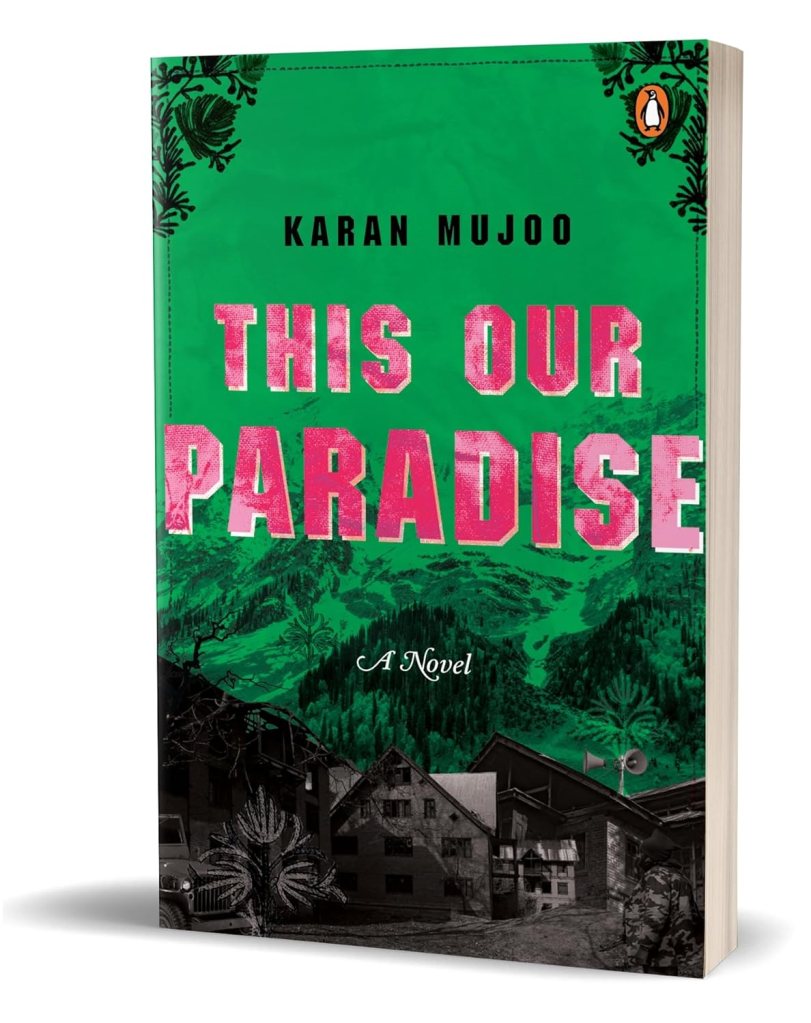
This Our Paradise

Book Review by Somdatta Mandal

Title: This Our Paradise: A Novel

Author: Karan Mujoo

Publisher: Ebury Press (an imprint of Penguin Random House)

A debilitating symptom of exile is unfamiliarity with your homeland” – Karan Mujoo

For ages, Kashmir had been defined as a paradise on earth. However, with the advent of insurgency, political unrest, strife, bloodshed, terrorism and insecurity for the past several decades, this picture of the ideal and beautiful place has been largely shattered. This debut novel by a person of Kashmiri origin, now settled near Delhi, is a moving tale of the ground realities that have been taking place in this region for a long time. Adding the suffix of “A Novel” to the title, the author obviously wants to steer clear of all the controversies that might arise because as he himself states in the “Author’s Note” at the end, “the names and places in this book are a mix of the real and the imaginary… Certain incidents in the novel are based on real events. But their details have been imagined. Hence the names of victims and perpetrators have been changed or tweaked.”

The author was acutely aware of the fact that Kashmir is too large a canvas to be contained in a single book or movie, and so he tells the story of two Kashmiri families, one Hindu and the other Muslim. The stories of both families intertwine tragically in the end. In both cases, the boys are at the mercy of forces much larger than them. Both lose their Kashmir, in different ways. The first story is of a Kashmiri Pandit family who, when the narrative begins, is moving half-heartedly from their house in Bagh-i-Mehtab in Srinagar to their new home in Talab Tillo in Jammu, which was just a dilapidated 12×12 foot hovel with a tin roof and crumbling walls. The patriarch Papaji is a clerk in a food cooperative and his wife Byenji is a homemaker. He is very optimistic that all this is a temporary affair. He still believed in the inherent goodness of people, in ties built over generations and that things would soon turn for the better. The narrator is their eight-year-old grandson who is one of the thousands of children of exile who had nothing to do, nowhere to go. He spent his days playing cricket and climbing the tangkul [1]in the garden. Everything is rosy till 1989. But then, propelled by ISI and the Jamaat, a secessionist movement rises and changes everything. There was gun culture everywhere. For the media, too, Kashmiri Pandits became disposable footnotes in a far greater struggle. Slowly they joined the ranks of the forgotten and became a tragedy that could not be prioritised. At the end of the novel, we find that the idea of exile which harboured within it the hope of return, did not apply to them anymore. They were truly displaced.

Mujoo juxtaposes the earlier story with the story of a Muslim family, set in Zogam, a small village in Lolab Valley. There, after years of prayers, a boy named Shahid is born to Zun and her husband in 1968. Quarantined from everyone else in the village, Sahid’s days passed listening to tales and making them up. As a result, he slowly developed into a shy, quiet boy who found it difficult to mingle with others and liked being with nature. Compared to the slick city dwellers, the people of Zogam seemed like wretched beings with no dreams and ambitions. They were content with their lot because they were not exposed to the luxuries and opportunities life held. Sahid gradually grew up in a society where corruption and unemployment were rife. He made friends with Rashid, who believed that the system had to be dismantled. The trajectory of his life changes when he meets Syed Sahab ― an Islamic theologian and rabble-rouser, who wants to overthrow the Indian state. He brainwashes the young boys into believing that the day they made Sharia their lives, their lives would become Jannat[2]. He preached that Jihad[3] was coming to the Valley soon, and everyone should be ready for it.


The next section takes us back once again to the Pandit protagonists and their life story. The year is 1968 and our young narrator gradually turns worldly-wise when he is taken to different places by his young uncle, Vicky, including the Dal Lake and the Sheikh Colony – a settlement of sweepers, scavengers and tanners who were reviled by all Kashmiris. Believing that education would relieve them of all penury and social ostracisation, Vicky becomes their temporary teacher. Without the knowledge of his parents, he gradually gets enmeshed within other radical ideas and different military groups that had emerged in the city. On the other hand, Shahid realised he could either be a clerk and part-time Jamaat[4]sympathiser or a full-time Jamaat worker. In the end, he opts for the latter and believes that he was no longer a poor farmer’s son from Zogam whose life and death were insignificant.

An interesting section of the narrative told in minute details is how the young jihadis[5] are escorted over the difficult mountain terrain by a Gujjar guide and clandestinely taken across the border to makeshift and rudimentary Pakistani camps in Muzaffarabad. The aim was to indoctrinate the boys in orthodox Islamic ideology and impart basic military training. They were brainwashed into believing that the most important thing was to attack all symbols of India: blow up government banks and offices, kill army and police personnel, murder judges, bureaucrats, teachers, politicians, cripple the state, silence all the voices who oppose the Tehreek[6] and instill the fear of Allah in the hearts of all unbelievers. After they are once again brought back to the Indian side, the boys turn into hardcore terrorists and Sahid is no exception. No matter how hard his parents tried, he had simply become one of the thousands of boys who were ready to fight for the cause.

Without giving out further details of the parallel storylines, we can conclude by stating that through this book Karan Mujoo has tried to ask some fundamental questions. How does a boy become a terrorist? How does society crumble?  What forces a family to go into exile? To serve this need, to create a picture of these chaotic years, he has attempted a certain sort of distillation. He only hopes that the illusion has been marginally successful. Through the vividly drawn characters whose lives intersect with one another, each navigating their own paths through love and life, the author successfully captures the essence of human experience and the eternal yet illusive search for paradise.

We have been reading fictional and non-fictional accounts of the problems in Kashmir for a long time, but the painstaking way in which this debut novelist has tried to give us the entire scenario in a nutshell is praiseworthy. The book is strongly recommended for all readers who would find the universal quest for happiness really moving, and how the author has blended fact and fiction with remarkable ease.

.

[1] A pear tree

[2] Paradise

[3] Holy war

[4] Party, community or assembly

[5] Warriors of Jihad

[6] Cause

Somdatta Mandal, critic and translator, is aa former Professor of English at Visva-Bharati University, Santiniketan, India.

PLEASE NOTE: ARTICLES CAN ONLY BE REPRODUCED IN OTHER SITES WITH DUE ACKNOWLEDGEMENT TO BORDERLESS JOURNAL

Click here to access the Borderless anthology, Monalisa No Longer Smiles

Click here to access Monalisa No Longer Smiles on Amazon International

Categories
Poetry

Poems by Caroline Am Bergris

Portrait of an Old Man by Johannes Vermeer(1632-1635)
YOU AND YOU 


I know exactly how to touch you,
how to slide my finger
down your forehead and moist nose,
then tickle you under your chin
with four of my fingers;
I glide down your back
navigating the abacus of your spine
as you turn over
and lie back in unabridged bliss, woofing.
I tickle your nipples
and softly caress your furry belly.

I know exactly how to touch you,
how to shelter your clawed hands in mine,
I dab concealer onto your eyebags
with my second finger
then, using my whole hand like a spider,
massage your grey scalp
until you murmur wordlessly.
I slap my hand on your back
during one of your coughing fits
and give you my arm to hold on
as I become your walking stick.

TRANSGRESSION                                                                                 

It wasn't the shock of him saying it.
It was the shock of my reaction - 
" I just do it to kill time."
KILL TIME?
AT OUR AGE?

Killing time is for twentysomethings
with long hair and journals
and daisychain dreams,
or for the terminally ill,
drinking regret on the rocks.

I felt an electric numbness --
he had taken time in vain.
When the hourglass sand
begins to look bottom-heavy,
then a year begins to feel like a month.
Like a crack addict,
all you want is more.

I wanted to shake him,
screech some sense into him,
but it was his time to lose,
not mine.

GIOVANNI

I can’t write a poem about you. It would be like flashing an emotional boob. We sit every week, talking, and I look at the curls in your beard dashed with grey. They seem to be a different formation every time, a different highlight, a different sign. It’s like interacting with a dynamic ancient Greek statue. The Vermeer light haloes in through the window to your right even when there is no sun, and the pink-brown skin of your face shimmers with optimism and comfort. Our conversation is sprinkled with ancient languages, modern dilemmas, and each other’s violent Netflix recommendations. We could have a timeless friendship except I signed a contract that we can’t be friends. It is so easy to read too much into cultural commonalities and humorous asides. So I do. We are both very Latin and very English at the same time, with veins of sarcasm pulsating at the temples. Maybe we are modern day explorers destined to meet like Livingstone and Stanley in Africa. I don’t love you. I don’t think you’re perfect. You leak grumpiness as you listen. Your feminism is mild. But. And we haven’t even met.

Caroline Am Bergris is a half-Colombian, half-Pakistani poet living in London. Her poems have been published, online and in print, in Europe and America. 

PLEASE NOTE: ARTICLES CAN ONLY BE REPRODUCED IN OTHER SITES WITH DUE ACKNOWLEDGEMENT TO BORDERLESS JOURNAL. 
Click here to access the Borderless anthology, Monalisa No Longer Smiles

Click here to access Monalisa No Longer Smiles on Amazon International

Categories
Poetry

Roam in this Rainbow

Poetry by Caroline Am Bergris

QUANTUM


It was a miniature hemisphere
of chocolate ice cream,
in a silver chalice,
with a gleaming spoon.

When is enough, enough? 
Having just one scruple?
The first four notes of Beethoven's fifth?
Taking four hundred pills like sprinkles?

I skimmed the dome with my spoon,
and licked off the coating.
Then I picked out the dark chips
and crunched down on them.

Finally, I anointed my mouth
with the frozen chrism itself,
That one scoop could have been six,
or ten, or a hundred.


NOCTURNE


I opened the blind to reveal the riches of the night…

Red of the roads
            Orange of the tree bark
                            Yellow of the moon 
                                            Green of the cat’s eyes
                                                                  Blue of the grass
                                                                                        Indigo of the sky
                                                                                                          Violet of the clouds


Run from the high chroma of the day!

Roam in this rainbow instead.

Caroline Am Bergris is a half-Colombian, half-Pakistani poet living in London. Her poems have been published, online and in print, in Europe and America.

PLEASE NOTE: ARTICLES CAN ONLY BE REPRODUCED IN OTHER SITES WITH DUE ACKNOWLEDGEMENT TO BORDERLESS JOURNAL. 
Click here to access the Borderless anthology, Monalisa No Longer Smiles

Click here to access Monalisa No Longer Smiles on Kindle Amazon International

Categories
Interview Review

To Egypt with Syed Mujtaba Ali and Nazes Afroz

A discussion with Nazes Afroz along with a brief introduction to his new translation of Syed Mujtaba Ali’s Tales of a Voyager (Joley Dangay), brought out by Speaking Tiger Books.

Translations bridge borders, bring diverse cultures to our doorstep. But here is a translation of a man, who congealed diversity into his very being — Syed Mujtaba Ali (1904-1974), a student of Tagore, who lived by his convictions and wit. Like his guru, Mujtaba Ali, was a well-travelled polyglot, who till a few years ago was popular only among Bengali readers with his wide plethora of literary gems that can never be boxed into genres precisely. People were wary of translating his witty but touching renditions of various aspects of life, including travel and history from a refreshing perspective, till Nazes Afroz, a former BBC editor, took it up. His debut translation Mujtaba Ali’s Deshe Bideshe as In a Land Far from Home: A Bengali in Afghanistan in 2015 was outstanding enough to be nominated for the Crossword Prize. Recently, he has translated another book by Mujtaba Ali, Tales of a Voyager (Joley Dangay[1]), a book that takes us back a hundred years in time — a travelogue about a sea voyage to Egypt and travel within.

This narrative almost evokes a flavour of Egypt as depicted by Agatha Christie’s Death on the Nile (1937) or The Mummy (film, set in 1932), simply because it is set around the same time period. Afroz in his introduction sets the date of Mujtaba Ali’s travels translated here between 1935 and 1939. The book was published in 1955. This book is a treasure not only because it gives a slice of historic perspective but also weaves together diverse cultures with syncretism.

Mujtaba Ali has two young travel companions, Percy and Paul, who despite being British (one of them is on the way to study in Oxford) seem to have a fair knowledge of Indian lore and there is the inimitable Abul Asfia Noor Uddin Muhammad Abdul Karim Siddiqi, who almost misses a train while trying to argue about the discrepancies shown in the time between his Swiss watch and the clock at Cairo. The description is sprinkled with tongue-in-cheek humour.

The voyage starts at Sri Lanka and sails through the Arabian Sea to Africa, where the ship pauses at Djibouti. Here, Mujtaba Ali expands his entourage with the addition of the long-named Abul Asfia, well-described in the blurb as a man who “carried toffees, a gold cigarette case, and other sundry items in his capacious overcoat pocket and who had the answer to all problems though he barely spoke a word ever.” Afroz himself has given an excellent introduction to the writer and the book — almost in the style of Mujtaba Ali himself. This is a necessary addition as it highlights Mujtaba Ali’s perspectives and gives his background to contextualise the relevance of this translation.

Mujtaba Ali’s style is poetic and humorous. It demystifies erudition and touches the heart simultaneously. His ability to laugh at himself is inimitable. He tells us a story about how the giraffe from Africa was introduced to China by a king from Bengal. At the end, he and his companions reflect about the tallness of this tale!

Mujtaba Ali contends: “‘…One of my friends is learning Chinese in order to read Buddhist scriptures in that language. Possibly you know that many of our ancient scriptures were destroyed with the decline of Buddhism in India. But they are still available in Chinese translations. My friend came across this story while searching for Buddhist scriptures. He had it translated and published in Bengali with the copy of the painting in a newspaper. Or else Bengalis would never have known of this because there is no mention of it in our history books or documents in the archives in Bengal.’”

The irony is not lost that Buddha is of Indian origin and yet an Indian has to learn Chinese to read the scriptures. The narrative continues with more dialogues:

“Percy said, ‘But sir, it didn’t sound like history. It [the giraffe’s story] exceeds fiction.’

“I [Mujtaba Ali] replied, ‘Why, brother? There is the saying in your language, ‘Truth is stranger than fiction.’

“And my personal opinion was that if the narrative of an event could not rouse interest in someone more than fiction, then that event had no historical value. Or I would say that the narrator was not a true historian. In our land, most of our historians are such dry bores.”

As Mujtaba Ali’s renditions are colourful – is he a ‘true historian’ by his own definition? Such narratives dot the travelogue, generating curiosity about major issues in a light vein and linking ancient cultures with the commonality of human needs, creating bridges, taking us to another time, finding parallels and making learned, hard concepts comprehensible by the simplicity of his observations.

Similarly, he says of the rose: “The Mughal-Pathan era of India ended a long time ago, but can we say for how long the roses brought by them will continue to give us fragrance?”

Some of his renditions are poetic and beautiful. Mujtaba Ali watches the sunrise by the pyramids and describes it: “Streaks of light were gradually lighting up the liquid darkness. The white parting in the middle of black hair was becoming visible. There was a light daubing of vermillion on that.”

Borrowing from diverse cultures, Mujtaba Ali skilfully weaves the commonality of cultures, customs and countries into his narrative under the umbrella of humanity. Afroz with his journalistic background and a traveller himself, is perhaps the best person to translate this narrative of another traveller from the past. The depth of erudition simplified with humour has been well captured in this translation too. In this interview, Afroz discusses more about the author, his new translation and the relevance of the book in the present context.

Nazes Afroz

You have translated two books by Mujtaba Ali. Is he essentially an essayist? Were there many essayists and travel writers at that point, especially from within Bengal? Where would you place him as a writer in the annals of Bengali literature?

I don’t think that ‘essentially an essayist’ is the right description of Mujtaba Ali. Of course he wrote many essays but his repertoire included novels, short stories, funny anecdotal pieces based on his experiences (in Bangla they are called romyorochona) and stories from his travels, his encounters with extremely interesting people across the globe. He was deeply interested in culinary experiences. So he wrote a lot about food habits, multitude of cuisine and also gave recipes. Hence, it is difficult to box him into one genre of writing. With the publication of his first book, Deshe Bideshe, (serialised in 1948 in Bangla literary magazine Desh and as a book in 1949) he instantly occupied a significant place in Bengali literature.

Syed Mujtaba Ali

His Bangla prose, steeped in effortless and seamless multilingual and multicultural references, swept the discerning readers of Bangla literature off their feet. It was not only the prose that he created but the breadth and depth of subjects his pen touched was unparalleled. No author in Bangla language has been able to write on such a wide range of topics till date.

Coming to the other part of the question about travel writers and essayist in Bengal in early part of the twentieth century: the short answer is, yes there were many. Travel writing has been an important genre in Bangla literature. Bengalis had been travelling – for pilgrimage, for rest and recuperation following illnesses, or just for pleasure since the middle of the nineteenth century, which was the time of Bengal renaissance. Writers who undertook such journeys, wrote about their travels too. So Mujtaba Ali is no exception in that regard. He followed in the footsteps of his predecessors and also his peers.

You have called the book ‘Tales’ of the Voyager — would you say that some of the stories are like tall tales here — perhaps tales to convey an idea or a thought which in itself would be larger than history in explaining the truth of a civilisation, like the tale of the giraffe? Would you see this as a comment on the gap between popular and documented narratives in history and on the different interpretations of history? 

Ali was an excellent raconteur. He was also gifted with an almost eidetic memory. This allowed him to learn a dozen languages – some with native proficiency. He was a voracious reader too. So, not only did he read tomes on history and philosophy in many languages across cultures but also he gathered fascinating tales from many corners of the world as he loved storytelling. Whenever opportunities came, he masterfully wove those stories into his writing. Thus the tale of the giraffe’s journey from Africa to China via Bengal found its way in this book as he was narrating stories from the east coast of Africa. There is another thing that makes Ali’s writing attractive. He weaves in fascinating quirky funny stories while discussing something apparently dense and dry. I have not come across many writers who have done that. I don’t know whether to name it as his comment on bridging the gap between popular and documented history. There’s no evidence to prove that he was trying to achieve that as he never mentioned it. We could only conclude that it was a style that he invented and mastered in an effort to engage with his readers.

A writer that came to mind while reading this book of Mujtaba Ali is, one who is really more entertaining than accurate –Marco Polo. We know he lived five centuries before Mujtaba Ali. Mujtaba Ali of course is erudite, a scholar, but he seems to have a similar fire within him, a wanderlust. Do you think he would have been impacted by the writings of Marco Polo? Was wanderlust not a very typical phenomenon that was part of the culture that had evolved in Bengal post the Tagorean renaissance? Did Mujtaba Ali also travel for wanderlust? 

Reading Ali’s books, one may think that he had wanderlust in the true sense. It will be correct to assume that he was fidgety; he refused to settle down; he moved jobs; he moved cities and even continents. But to be  truly smitten by wanderlust, one has to enjoy the travel, which wasn’t possibly the case for Ali. His son told me that even though he travelled extensively, Ali didn’t enjoy travelling much. There had been many, of his time, who were really smitten by wanderlust — like Rahul Sankrityayan (1893-1963, walked to Tibet twice and wrote only in Hindi), Bimal Mukherjee (1903-1996, a true globetrotter who cycled to London from Kolkata), Umaprasad Mukhopadhyay (1902-1997, who crisscrossed the Himalayas from one end to another), Probodh Kumar Sanyal (1905-1983, his travelogues of the Himalayas), Premankur Atorthi (1890-1964, author of Mahasthobir Jatok) — to name a few. While these authors were inherently bohemian and were drawn towards travelling only for the sake of it, Ali was more of an unsettled soul who travelled with a particular purpose and wrote about his experiences as he had picked up fascinating stories and observed connections between cultures. Because he loved to tell stories and also because he was infused with the idea of internationalism that he inculcated from Tagore, there was no way he could escape but narrating the stories and cultural experienced from his travels.

Tales of a Voyager takes us on a sea voyage to Egypt. Did you travel to Egypt while translating the book? Would you say that the Egypt of those times still resonates in the present day — especially after the 2011 uprising?

Even before his one night stopover in Cairo that he narrated in Tales of a Voyager, Ali had previous experience of Cairo where he spent a year as a post-doctoral scholar in 1933-34 at the Al-Azhar University. So there are many short pieces on Cairo and Egypt by him in his other books. He raved about the café-culture of Cairo and came to the conclusion that Egyptians surpassed the Bengali in terms of adda—hours of the purposeless sessions of chitchat and chinwag. I have been to Cairo at least half a dozen times and realised how acute his observation was. I witnessed in person why Ali mentioned that this was a city that never slept. The cafes and shops were open all night and the streets were full of people with families including children until well past midnight.

Late night, a cafe in Cairo. Photo Courtesy: Nazes Afroz

As expected, the political landscape that you mention in the question, would be completely different between Ali’s time in the 1930s and in 2010 when I started visiting Cairo. When Ali first went to Cairo in 1933, Cairo had just gained full independence from the forty years of British occupation (not as an annexed state but more of a protectorate). So there are some references of the political figures like Sa’ad Zaghloul Pasha[2] in his various writings but the main focus was on its cultures.

When I started travelling to Cairo from 2010, I witnessed some similarities in the cultural traits as elaborated by Ali. But politically by then, Egypt had moved far from where it was in the 1930. It had become an architect of the Non-Aligned Movement in the 1950s. It was the most prosperous country in North Africa and an important leader among the Arab nations. But it was also reeling under the oppression of one party rule and the youth were bubbling to break away from that. This is something we witnessed unfolding from 2011.

What were the challenges you faced while translating this book? Was it easier to handle as it was the second book by the same author? 

The main challenge of translating Mujtaba Ali is transposing his unique language steeped in multi-lingual references into English. Also to get his oblique sense of wit and puns from Bangla into another language, which at times, may not have the right words for them. Translating the second book of the same author doesn’t make it easier as the challenges I just mentioned remain for every book.

Tell us what spurs you on to continue translating Mujtaba Ali. Please elaborate.

Syed Mujtaba Ali’s writing had a huge influence on me from my young age. His writing shaped my worldview, planted the seeds of curiosity about many societies, taught me how to make friends in distant lands and start making connections between cultures. So what I’m today is largely due to his writing. As an avid reader of his texts, I felt that it was my duty to introduce him to a wider readership. That’s the motivation of my taking up the translation of Ali. It is also a tribute to a writer who had such an impact on me.

In your introduction you have written of Mujtaba Ali and his writing. What had he written to be put on the Pakistani watchlist in 1950s? 

He had penned an essay opposing the imposition of Urdu as Pakistan’s national language on the Bengalis who were in majority in the newly created East Pakistan. He even predicted how the Bengalis would rebel against such a policy, which came true in 1952 in the form of the Language Movement. He wrote this when he was the principal of a government college in Bogura. So he drew wrath of the Pakistani leaders and an arrest warrant was issued against him. That was the time when he left Pakistan and returned to India in 1949.

There also the other difficult personal situation. His wife (married in 1951) who was from Dhaka and was working in the education ministry, continued to live in East Pakistan with their two sons while he lived in India working for the Indian Government. So Pakistanis always thought he was an Indian spy while he was under suspicion in India that he was on the side of Pakistan!

Did Mujtaba Ali participate in the political upheaval between Pakistan and Bangladesh? Please elaborate if possible. 

Ali was hugely affected in 1971 because of his personal situation as I just mentioned. I don’t know how deeply he was involved with the liberation war in Bangladesh but he wrote a novel, Tulonaheena (his last novel), against that backdrop – based in Kolkata, Shillong and Agartala and told through the story of a lover couple – Shipra and Kirti. So it is likely that he was involved in some capacity with the war efforts.

Mujtaba Ali studied in Santiniketan — that would have been in the early days of the university. Would he have been influenced by Tagore himself and the other luminaries who were in Santiniketan at that time? Can you tell us how? And did that impact his work and outlook? 

The simple answer is: it was huge. Tagore was the polar star for Mujtaba Ali, which he acknowledged every now and then in his writing. This experience also decided his life’s journey. He imbibed humanism and internationalism as a direct student of Tagore in Santiniketan. He also developed deep apathy towards all sorts of bigotry. So it was not surprising that he would find it very difficult to accept a country that was created on the basis of religion.

Do you find him relevant in the present-day context? Is your writing influenced or inspired by his style?

I feel that his relevance will never fade. His ability to create cultural connection from different corners of the world will continue to fascinate readers for generations. Yes, in this globalised world when information from around the world are at our finger tips with the click of a button but one also needs to learn how to look at those information beyond mere facts and go deep underneath to make a sense. Apart from being fun and entertaining read, I feel his writing is one such training tool to learn how to make cultural connections. This way, if one wants, one can truly become a global citizen.

As for me, my outlook towards the world is massively influenced by Ali’s writing but not my writing style. It’s simply because I’m not a polyglot like him! I’ll not be able to come anywhere close to his style even if I try.

Well, that is for the reader to judge I guess! You have books on Afghanistan. But you do travel with your camera often. Will you write of your own travels at some point — like Mujtaba Ali but in English?

I have only one book on Afghanistan – a cultural guide book that I co-authored with an Afghan friend. I was working on my own book on Afghanistan, which would have capture one decade of Afghan history and interspersed with my own direct experiences of the country between 2002 and 2015. But the research got stalled for lack of funding. I hope to revive it at some point. And, yes I would like to do my own writing from my travels. That’s there in the wish list.

What are your future plans as a journalist, writer and photographer? 

Travel more, see the world more, make more friends and photograph more!

Thanks a lot for giving us your time and the wonderful translation.

[1] Literal translation from Bengali, In Water and On Land

[2] 1857-1957, Egyptian revolutionary and statesman

Read the excerpt from Tales of a Voyager by clicking here


(The online interview has been conducted through emails by Mitali Chakravarty)

PLEASE NOTE: ARTICLES CAN ONLY BE REPRODUCED IN OTHER SITES WITH DUE ACKNOWLEDGEMENT TO BORDERLESS JOURNAL. 
Click here to access the Borderless anthology, Monalisa No Longer Smiles

Click here to access Monalisa No Longer Smiles on Kindle Amazon International

Categories
Stories

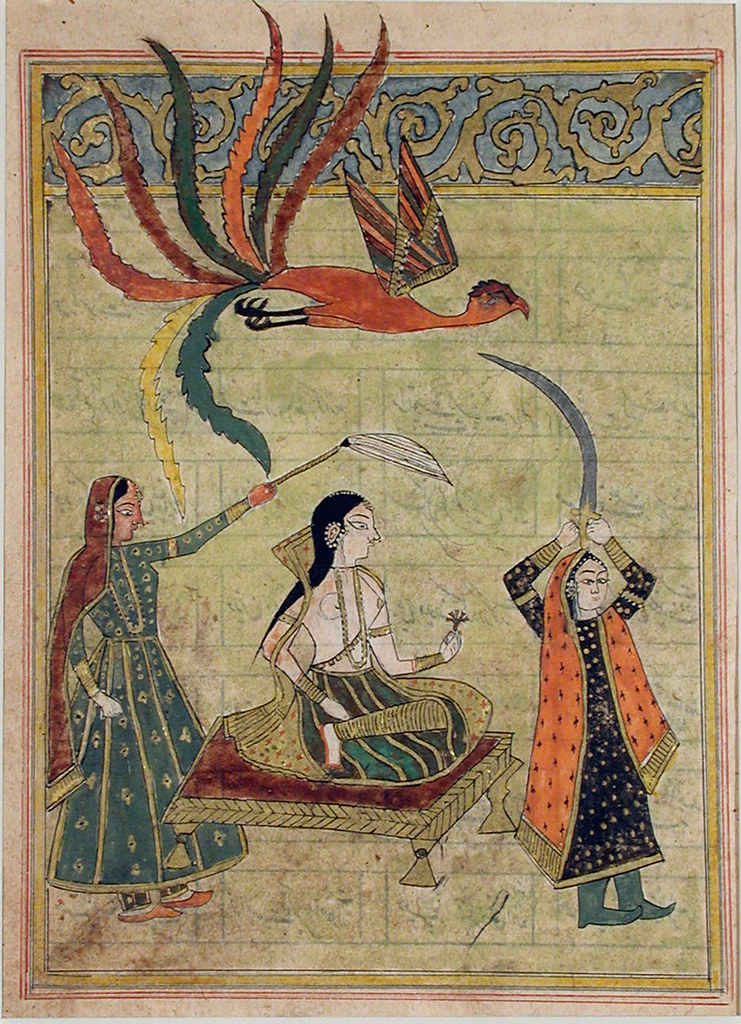
Even A Simurgh Cannot Change Destiny

Balochi folktale translated by Fazal Baloch

A simurgh flies over a princess. Courtesy: Creative Commons

Once there lived a king who had a daughter who no one wanted to marry. The king summoned all soothsayers, palmists, astrologers and fortune-tellers of the land to determine the fate of his daughter. They all came to the conclusion that the child who was in his brother’s wife’s womb would marry his daughter. The king however was hostile to his sister-in-law and did not like her at all. Moreover, by then his daughter was twenty. He also felt by the time his nephew would grow old enough to marry, his daughter would have passed the marriageable age. The king had asked his brother to divorce his wife many times, but he brusquely refused.

One day when his brother went on a hunting expedition, the king summoned his men and commanded them to take his brother’s wife to a forest and rip her belly open. The servants did exactly what the king directed them and hurried back to the palace. In the meantime, a shepherd walking nearby noticed the woman lying dead with a baby wriggled in her womb.

Ironically, the shepherd did not have any child. He extracted the baby out of mother’s womb, and carried it to a midwife to get his umbilical cord cut. The shepherd and his wife were so happy that they could barely sleep that night.

Time passed. The boy grew into a handsome youth. One day, the king set out on a hunting trip. Wandering about the jungle, thirst overwhelmed the king’s party. They went to a hamlet in search of water. The king, leading the caravan made it to the nearest wigwam which coincidently belonged to the shepherd who was out then. The shepherd’s son, who actually was king’s nephew, brought water to the members of the royal caravan. The king was stunned by appearance of the boy. He was very handsome.

He asked the young man, “Whose son are you, boy?”

The boy said, “I am the son of the shepherd.”

But the king did not believe him. He called for shepherd’s wife and inquired of her: “Who are the parents of this boy? I’ve heard you don’t have any child.”

The shepherd’s wife retorted, “O Sovereign! The boy first belongs to the Almighty Allah, and then he is my son”.

In the meantime, the shepherd arrived and noticed the king looked angry. He had barely exchanged greetings with the gathering when the king bluntly asked him, “Hey shepherd! Whose son is the boy?”

He humbly answered, “Your Majesty! He is my son”.

The king looked askance at him and said, “The boy does not resemble any of you. How come you say he is your son?” King’s anger peaked. He threatened the couple,

“Tell me the truth otherwise I will cut the boy into two halves”.

The helpless shepherd admitted: “O Honorable king! Let the lie be separated from the truth. He is not my blood but I’ve brought him up. Many years ago, I went to pasture to tend my cattle herd, I saw a woman lying on the ground with her belly ripped open and the baby was in her womb. I took the baby home. The handsome young man who is now standing before you, is the very baby whom we brought up”.

The king knew the woman was his brother’s wife and the baby was the child who the soothsayers had declared a groom for his daughter. The desire to kill the boy sprang in king’s heart in that very instant.

The king immediately wrote a letter to his vizier addressing him: “The moment this boy delivers the letter, kill him. Carry his dead body to the graveyard with great pomp and show. I will join you there”.

He gave the letter to the boy and instructed him to deliver it to the vizier. The boy set out on his mission. He reached his destination by midday. It was summertime and everyone was asleep. The young man tucked the letter in the fold of his turban and paused by the king’s palace to beat out the heat and eventually drifted off to sleep.

Heaven knows at what moment a maidservant noticed a handsome young man was lying asleep at the door. She rushed to the princess and informed. The princess followed her out of the palace. When princess’ eyes fell on the boy, she almost stunned. When she drew a little close to him, she noticed a piece of paper tucked in the fold of his turban. She gently extracted the letter and read it. She figured out her father’s handwriting and became aware of his intentions. Thus, she hurried back to the palace and addressed a new letter to the vizier. She wrote: “The moment this young man delivers you the letter, solemnize his marriage with my daughter amid great celebration before my arrival.” She scrawled her father’s signature at the bottom of the letter and tucked it back in the fold of young man’s turban.

In the evening the boy got up and walked over to the vizier and hand delivered him the letter. The vizier after having gone through the letter gazed at the handsome boy and was convinced that at last the king had found a young man who deserved to be the husband of the princess. The vizier sent for a mullah to solemnise the marriage.

Later in the day when the king leading his caravan reached the graveyard, there was nobody there. The sound of drumbeat was coming from the palace. The king sent a servant to his vizier and asked him if he had performed the task he had been told of. The vizier replied in affirmative and asked the servant to tell the king to come and see with his own eyes.

When the king arrived, he was furious. He asked the vizier for the corpse of the young man. The vizier was taken aback. He asked the king, “Whose corpse?” The king said that he had written asking him to kill the young man bearing the letter. He had further instructed he wait with his dead body at the graveyard for his return. The vizier was confounded. He went and brought the letter he had received and presented it to the king. When the king read the letter, he too was surprised to see his signature scrawled at the bottom of the letter but there was not a word about young man’s murder.

Thus, he was convinced that “Even a simurgh[1] cannot change one’s destiny”. His daughter was destined to marry with his nephew. And what is written in the destiny cannot be changed by one’s desire.

(This folktale was originally published in Gidar-12 January  2021 retold by Sadiq Saba. Fazal Baloch has the translation rights.)

[1] The simurgh is a mythical bird. It is believed that whosoever has this bird will have whatever they desire for.

Fazal Baloch is a Balochi writer and translator. He has translated many Balochi poems and short stories into English. His translations have been featured in Pakistani Literature published by Pakistan Academy of Letters and in the form of books and anthologies.

.

PLEASE NOTE: ARTICLES CAN ONLY BE REPRODUCED IN OTHER SITES WITH DUE ACKNOWLEDGEMENT TO BORDERLESS JOURNAL. 
Click here to access the Borderless anthology, Monalisa No Longer Smiles

Categories
The Observant Immigrant

We had Joy, We had Fun…

By Candice Louisa Daquin

Courtesy: Creative Commons

Heortology (the study of festivals) has expanded beyond its initial Christian focus to embrace all festivals and their enduring appeal and necessity in our human culture. Festivals remind us to celebrate, and celebration is a positive experience. The very idea of festivals is ancient. No existing history book is old enough to document when the first festival took place or what its origins were, but it’s a safe bet they had some kind of worship element attached. Modern festivals often also land on old pagan holidays, whilst others are more obvious in their origins. Many who attend festivals have no idea of their origins but go for entirely celebratory reasons. We have learned a lot about the history of varied festivals but another question to consider is: Why are humans drawn to festivals and what do they provide us?

Imagine the ancient world. As much as we think we know now, they knew a tremendous amount also, considering their lack of modern resources. This may well be down to the ‘necessity is the mother of invention’ paradigm. Or that we severely underestimate our ancient ancestors, in our egocentric belief the modern world knows best. Just as we underestimate the knowledge of animals and their abilities to survive. Perhaps we could even say, we have lost the art of survival and wouldn’t know how to, if our computers were offline and our cars did not work and the supermarkets were empty.

What we do know, is the ancients were able to amass a great deal of knowledge, despite seemingly not having easy access like we do today, with our modern telescopes and technology. They had to understand mathematics and science at the very core, to establish theorems on the universe and our place in it. Whilst many were later corrected, it is surprising how many ancient scientists, mathematicians and philosophers, got it right. Almost against all odds. It is fair then to say, we dismiss the richness of the ancient world, and imagine everyone lived ignorant lives, which was not the case. When ignorance did reign, it did so deliberately, with the quashing of knowledge by various religious groups, and resulting periods of ‘dark ages’.

The ancient world was in touch with what it means to be human. Being human isn’t knowing how to work your iPhone or microwave. It’s not having a huge house, with a swimming pool and driving a Lexus. Nor is it eternal youth, fame and glory. Being human is about surviving — just as it is with any animal. When we then add an awareness of our own being, which it is argued, not all animals understand, then we become the modern human we recognise today. A being who has the choice, the ability to reflect and learn, and a tendency to seek beyond themselves. In seeking beyond oneself, we find an innate or shaped desire for ‘more’ and that ‘more’ has often come in the guise of a God-head or spirituality of some kind.

Whether we believe humans are prone to worshipping gods or being spiritual, because Gods actually exists or we just have a propensity to create them, is immaterial. The outcome is the same. The God gene hypothesis proposes that human spirituality is influenced by heredity and that a specific gene, called vesicular monoamine transporter 2 (VMAT2), predisposes humans towards spiritual or mystic experiences, perhaps that is what is at work? In essence a transmitter in our brain that makes it more likely we will believe in God (and could explain why some people do so fervently, whilst others do not). Or perhaps we may find meaning in believing in a spirituality beyond the temporal world. But what we do know is, as long as humans evolved from their primate ancestors, they have formed meaning around some kind of spiritual observance and festivals were tied to this worship.

Why do we do this? We are born part of something (a family) but are also separate (an individual). Perhaps festivals and what they represent, is the coming together of all things: Nature. The seasons. Marking time (birth and death). Marking passages (fertility, menstruation, maturity, marriage, children, dying). These are the cornerstones of meaning, with or without God. I say without God, because for many, their notions of God are tied to nature, so it’s more the world around them than specific deities. For others, it’s the manifold destinies of humanity, or history of deities. But whatever the reason there is a sense of coming together in celebration of being alive, and acknowledging that life. A festival in that sense, irrespective of its actual purpose (the harvest, pagan holidays, etc.) is a ‘fest’ of life. Maybe this is why we can have such a happy time being part of it.

Growing up, neither of my parents liked festivals. They thought they were silly. I remember a street festival I went to as a child, for Fête du Travail (Labour Day) in France. I dressed up as princess and the frog (taking my toy Kermit with me) and felt an excitement like I had never felt before. The throngs of people and other children, the food, the smells, the magicians, the shows and the things to see. It was like walking through a market of treasures. I couldn’t understand why neither of my parents liked this; to me, it felt like a jewel had opened. But for some, festivities are synonymous with rituals and a degree of adherence to religion, even when it’s not. And rather than entering into the spirit of it and enjoying it, they feel what it represents is part of social control.

In France, like many countries, festivals abound. The national Fête du Citron (Menton Lemon Festival) draws crowds from around the world, as does the film screening: Festival de Cannes –near where I grew up — and Fête des Lumières (festival of lights, in Lyon). More traditional festivals include Défilé du 14 Juillet (Bastille Day). In the Middle Ages in France, on Midsummer’s Day, at the end of June, people would celebrate one last party (fête de la Saint-Jean or St. John’s Day). Bonfires would mark this longest day and young men would jump over the flames. This also happened on the first Sunday of Lent (le Dimanche de la Quadragésime), where fires are lit to dance around before carrying lit torches. Religion dominated many of the Autumn/Winter festivals historically.

In France, Christmas, is marked over twelve days with the Feast of the Innocents, the Feast of the Fools, New Year’s Eve and culminates in the Feast of the Kings with its traditional galette des Rois. Events include Candlemas (Chandeleur) with its candlelight process. Likewise, many Christian societies have some celebration connected to Easter (Pâques, in French)) or its Pagan roots. In France (and New Orleans in America) these include Shrove Tuesday (typically Mardi-Gras in America), marking the last feast day before Lent, and many others until Pentecost Sunday. My favorite ‘fest’ was Shrove Tuesday (also known as Fat Tuesday or Pancake Day, in other countries) because my grandma would make pancakes, despite our being Jewish. The notion was to eat before Christian Lent and a period of fasting, which has much in common with Muslim beliefs too (unsurprisingly since God is one in the Jewish, Christian and Muslim faiths). In America, they serve fish options every Friday for much the same reason.

Far more impressive and immersive festivals occur in India, with Hinduism celebrating among the highest number of festival days in the world. Over 50 festivals are celebrated throughout India by people of different cultures and religions. These Indian festivals form an integral part of the rich heritage of the country. The ancient Hindu festival of Spring, colors and love known as Holi is one. “Holi is considered as one of the most revered and celebrated festivals of India and it is celebrated in almost every part of the country. It is also sometimes called as the ‘festival of love’ as on this day people get to unite together forgetting all resentments and all types of bad feeling towards each other.” Holi is celebrated on the last full moon in the lunar month of Phalgun, the 12th month in the Hindu calendar (which corresponds to February or March in the Gregorian calendar).

With social media, more of the world have been granted access to the visual beauty of Holi – “This ancient tradition marks the end of winter and honors the triumph of good over evil. Celebrants’ light bonfires, throw colourful powder called gulal, eat sweets, and dance to traditional folk music.” One of the most popular legends in Hindu mythology says the Holi festival marks Lord Vishnu’s triumph over King Hiranyakashyapu, who killed anyone who disobeyed him or worshipped other gods. With coloured powder thrown on people as part of the celebration, many countries now celebrate Holi just as Indians may celebrate Halloween or Día de Muertos. The crossover effect may seem to dismiss the individualistic cultural value and smack of appropriation but, in reality, it’s more a sign of respecting other cultures, learning about them, and celebrating with them.

Mexico, which I live near to now, celebrates over 500 festivals yearly and consequently is one of the most festive cultures in the world. In San Antonio, TX, where I currently live, we celebrate many of these fiestas, alongside American ones. The most popular being Día de Muertos, Día de la Virgen de Guadalupe, Cinco de Mayo and Día de la Candelaria, (like the French Candlemas, celebrated after Three Kings Day, which is a bigger holiday than Christmas in Mexico). The variables in cultures are fascinating. In San Antonio, we get a huge influx of Mexican tourists over Christmas because they aren’t home celebrating as they do so a few days later. We have a fiesta in San Antonio that is much like those in Mexico, due to our large Mexican population and it’s heartening to see the merging of the two.

As a child I celebrated the Jewish Pilgrim Festivals—Pesaḥ (Passover), Shavuot (Feast of Weeks, or Pentecost), and Sukkoth (Tabernacles)—and the High Holidays—Rosh Hashana (New Year) and Yom Kippur (Day of Atonement). But I attended a school that celebrated all faiths so we also celebrated Ramadan, the Muslim sacred month of fasting, akin to Christian Lent. Growing up, my friends of all faiths, celebrated Eid-ul-Fitr or simply Eid which is among the religious festivals for the Muslim community, marking the end of Ramadan. This festival is celebrated on the day after seeing the night crescent moon with devotees offering prayers at mosques and then feasting with their near and dear ones.

We would also celebrate Kwanzaa, which is a worldwide celebration of African culture, running from December 26 to January 1, culminating in a communal feast called Karamu. Its creator was a major figure in the black power movement in America, “Maulana Karenga created Kwanzaa in 1966 during the aftermath of the Watts riots as a specifically African-American holiday. Karenga said his goal was to ‘give black people an alternative to the existing holiday of Christmas, and give black people an opportunity to celebrate themselves and their history, rather than simply imitate the practice of the dominant society.’”

Are we socially controlled when we attend festivals? Given we have a choice, I would say no. Someone who chooses to be part of something, isn’t signing up for life, they’re passing through. Since my childhood I have been lucky enough to have attended many festivals in many countries. For me it is a reaffirming experience, seeing people from all walks of life come together in happiness. I like nothing better than dressing up and meeting with others and walking through streets thronged with people. Be they carnivals, even political events, there is an energy that you rarely feel anywhere else.

The May Pole festival, believed to have started in Roman Britain around 2,000 years ago, when soldiers celebrated the arrival of spring by dancing around decorated trees thanking their goddess Flora, is an especially interesting festival because it is still practiced almost as in ancient times. The ribbons and floral garlands that adorned it represent feminine energy and the beauty of the ritual is enduringly something to behold.

Likewise, another event ‘Guy Fawkes Night’ is steeped in ritual and British history, with much symbolism in the burning of straw dummies that are meant to represent Guy Fawkes thrown onto bonfires. However, the act of throwing a dummy on the fire to represent a person, has also been done since the 13th century to drive away evil spirits. What most people seem to take away from Guy Fawkes Night are the abundant fireworks in a beautiful night sky, alongside children and families holding sparklers and eating horse chestnuts in the cold, wrapped up in mittens. It’s a ritual that is beloved and a chance to ‘be festive’ even if it’s not a specific festival. As much as anything, it marks time, another year, another November, and gives wonderful memories. If we didn’t mark time or have those memories, we’d still have others, but there is an ease with festivals because they do it for us, unconsciously.

Young collegiates often attend festivals that involve dancing and sometimes drugs. Again, this is not a modern occurrence but has been going on for years, as rites of entering adulthood. The desire of the young to get out and meet others and dance and enjoy life, is primeval, and possibly a part of who we are as humans, marking a potent stage in our lives. Recently I went to a birthday party at a night club. I observed the diverse throngs of party goers and reveled in that abundant diversity. In just one night I saw: Pakistani women in saris, Japanese girls in anime costumes with ears, a pagan woman with huge, curled bull horns and floor length leather dress, Jamaican families in neon shorts and t-shirts, transgender wearing spandex dresses and big wigs, Hispanic Westsider’s filled with tattoos, and gold necklaces, Lesbian and gay couples holding hands. Old couples in sensible church clothes including one old black man with a pork pie hat and a waist coat.

I thought of all the diversity that had attended this club to dance the night away. All ages, all genders and backgrounds and ethnicities, and I thought how wonderful it was that one place could hold them all. In many ways this is the essence of a festival, especially nowadays where anyone can attend most festivals. Years previous, they were segregated by subject. Only those followers of that subject usually attended and you could be harmed if you tried to attend and were an outsider. The advantage we have today is we are more accepting of outsiders and when you attend festivals today, you see a wide range of people. Maybe this is the best opportunity we have to put down our differences and celebrate our similarities.

When I lived in Canada, I loved the homage paid to different seasons in varied outdoor festivals, where shaking off the lethargy of Winter, Canadians would celebrate with fairgrounds, amusements, shows and food among other things. It was like a period of renewal. Likewise, during my time in England, the Notting Hill Carnival, celebrated the Afro Caribbean culture, so essential and entrenched in English culture, with gorgeous street displays and floats, as well as some of the best music around. The idea of welcoming everyone into the fold, helps to remove any tensions between cultures and promote a feeling of unity, whilst not denying the unique properties of those cultures and ensuring they are promoted in their adopted countries. It may be idealistic and not entirely accurate, but it’s a better step than ignoring those myriad cultures exist.

As Halloween and Día de Muertos is fast approaching, I am thinking of how many of my neighbours attend these parties, despite some of them being from very conservative churches. Just last year, we all sat outside in the green spaces and had a mini fireworks display. I sat next to my little 4-year-old neighbour and watched her face as the older kids, dressed in all sorts of costumes, shrieked at the fireworks, and ran around with neon bangles, throwing glow powder at each other. I saw how inculcated we are, since childhood, but despite this I truly believe festivities are in our hearts, even if we weren’t introduced to them at an early age. Children mark their growing up by the events of their lives and it’s not just their birthday they celebrate but the touchstones of their respective culture and nowadays, many other cultures.

My Egyptian grandfather used to tell me about the Nile festival which celebrated the flooding of the river and the replenishing of life in Egypt. Without the Nile, Egypt couldn’t exist, and the ancients knew this. They employed methods to enhance the flooding and gave thanks for it. Gratitude like this can be found in many celebrations, including the American Thanksgiving (although this is a double-edged sword, given the history of genocide of the Native Americans by European pilgrims and invaders) and Harvest throughout the world. A celebration of life through food with music, is at the core of the human ability to endure and overcome hardship. More recently many of us celebrated healthcare workers by singing out of our windows and putting messages of thanks in our windows. We do this because it symbolizes essential parts of our lives, without which we would suffer.

Owing to its melting pot past, Egypt celebrates the Coptic Orthodox Christmas, the more ancient Abu Simbel Sun Festival that is akin to the Egyptian Sun God Ra (who in turn was one inspiration for the Christian God many years later), Sham Ennessim, the national festival marking the beginning of spring, as it originates from the ancient Egyptian Shemu festival, Ramadan and the Muslim Eid al-Adha (honoring the willingness of Ibrahim (Abraham) to sacrifice his son Ismail (Ishmael) as an act of obedience to Allah’s command). As a Jew, my grandfather’s family celebrated Passover, the festival celebrating the Jews Exodus from Egypt, despite our family still living there! Nowadays it is no longer safe to live in Egypt as a Jew but the memory of all people’s experiences is preserved through ancient festivals and events, marking our shared history.

Before the advent of mass-produced entertainment, festivals were also a highlight in any village or town, because they were entertainment. Traveling theatres and shows for children, even book sellers and traders of items not commonly found locally, could be bartered or purchased at such events and it was almost a spilling out from the market square economy that kept such villages alive. Perhaps evolving from our natural tendency to barter for things we want, we evolved to invite others from outside to come for specific events to gain greater reach. With this trading and bartering, came the accoutrements such as eating, drinking, dancing. Not only did this increase diversity and knowledge of foods and drinks from other locales, but brought people who may otherwise not meet, together into a camaraderie.

Sharing stories is also part of festivals, by way of theatre, or more improvised scenarios. It is at our heart to pass on oral knowledge and we haven’t lost that desire. We may do this now via YouTube more than face to face (which is a shame), but the desire to get out and talk directly, is innate, as evidenced by how many people have done just that since Covid 19 restrictions are eased. Religion, folklore, ritual and a desire for escapism, alongside our desire to celebrate things or others (saints, gods, seasons, harvest) are all reasons why festivals endure. Just like children will instinctively dance when music is played, maybe it is our innate nature to enjoy festivals because they foster inter-relationships we all crave to some degree. We may be diverse and believe different things, but we can also come together and respect the perspectives of others. Never more so than through our shared love of celebration.

.

Candice Louisa Daquin is a Psychotherapist and Editor, having worked in Europe, Canada and the USA. Daquins own work is also published widely, she has written five books of poetry, the last published by Finishing Line Press called Pinch the Lock. Her website is www thefeatheredsleep.com

.

PLEASE NOTE: ARTICLES CAN ONLY BE REPRODUCED IN OTHER SITES WITH DUE ACKNOWLEDGEMENT TO BORDERLESS JOURNAL.