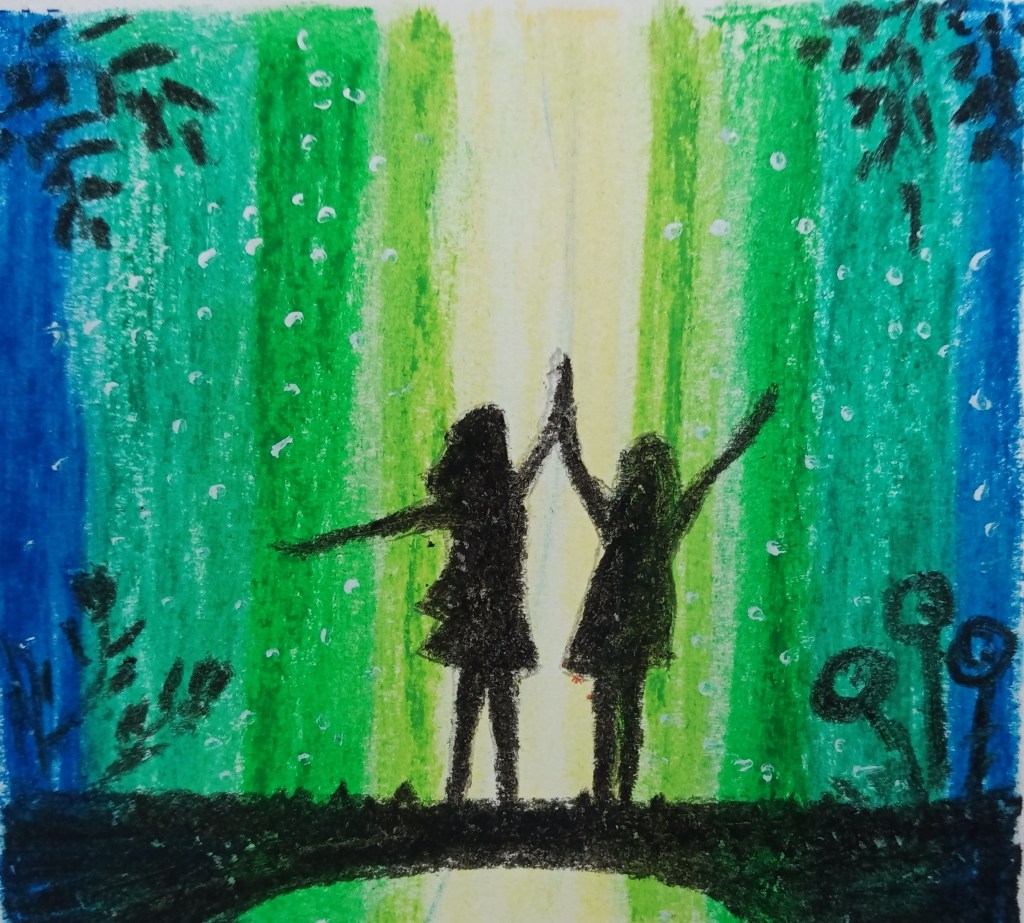
Art by Sophia P, CypressArt by Hugo A, Quezon CityFrom Public Domain
In 1985, famous artistes, many of whom are no longer with us, collaborated on the song, We are the World, to raise funds to feed children during the Ethiopian famine (1983-85). The song was performed together by Michael Jackson, Willie Nelson, Bob Dylan, Ray Charles, Diana Ross, Stevie Wonder, Smokey Robinson, Paul Simon, Tina Turner, Dionne Warwick, Lionel Richie, Billy Joel and Bruce Springsteen. The producer, Julia Nottingham, said: “It’s a celebration of the power of creativity and the power of collective humanity.” The famine was attributed to ‘war and drought’.
Over the last few years, we have multiple wars creating hunger and drought caused by disruptions. Yet, the world watches and the atrocities continue to hurt common people, the majority who just want to live and let live, accept and act believing in the stories created by centuries of civilisation. As Yuval Noah Harari points out in a book written long before the current maladies set in, Homo Deus (2015), “…the stories are just tools. They should not become our goals or our yardsticks. When we forget that they are mere fiction, we lose touch with reality. Then we begin entire wars ‘to make a lot of money for the corporation’ or ‘to protect the national interest’. Corporations, money and nations exist only in our imagination. We invented them to serve us; why do we find ourselves sacrificing our lives in their service?”
What Harari says had been said almost ninety years ago by a voice from another region, by a man who suffered but wrote beautiful poetry, Jibanananda Das… and here are his verses —
“The stories stored in my soul will eventually fade. New ones— New festivals—will replace the old — in life’s honey-tinged slight.”
We carry the poem in this issue translated by Professor Fakrul Alam, lines that makes one dream of a better future. These ideas resonate in modern Balochi poet Ali Jan Dad’s ‘Roll Up Not the Mat’ brought to us in English by Fazal Baloch. Korean poet Ihlwha Choi’s translation takes us to longing filled with nostalgic hope while Tagore’s ‘Probhat’ (Dawn) gives a glimpse of a younger multi-faceted visionary dwell on the wonders of a perfect morning imbibing a sense of harmony with nature.
“I feel blessed for this sky, so luminous. I feel blessed to be in love with the world.”
Starting a new year on notes of hope, of finding new dreams seems to be a way forward for humanity does need to evolve out of self-imposed boundaries and darknesses and move towards a new future with narratives and stories that should outlive the present, outlive the devastating impact of climate change and wars by swapping our old narratives for ones that will help us harmonise with the wonders we see around us… wonders created by non-human hands or nature.
We start this year with questions raised on the current world by many of our contributors. Professor Alam in his essay makes us wonder about the present as he cogitates during his morning walks. Niaz Zaman writes to us about a change maker who questioned and altered her part of the world almost a century ago, Begum Roquiah. Can we still make such changes in mindsets as did Roquiah? And yet again, Ratnottama Sengupta pays homage to a great artiste, filmmaker Shyam Benegal, who left us in December 2024 just after he touched 90. Other non-fictions include musings by Nusrat Jan Esa on human nature contextualising it with Milton’s Paradise Lost (1667); Farouk Gulsara’s account of a fire in Sri Lanka where he was visiting and Suzanne Kamata’s column from Japan on the latest Japanese Literary Festival in the Fukushimaya prefecture, the place where there was a nuclear blast in 2011. What is amazing is the way they have restored the prefecture in such a short time. Their capacity to bounce back is exemplary! Devraj Singh Kalsi shares a tongue-in-cheek musing about the compatibility of banks and writers.
Exploring more of life around us are stories by Sohana Manzoor set in an expat gathering; by Priyatham Swamy about a migrant woman from Nepal and by Naramsetti Umamaheswararao set against rural Andhra Pradesh. While Ahmad Rayees gives a poignant, touching story set in a Kashmiri orphanage, Paul Mirabile reflects on the resilience of a child in a distant Greek island. Mirabile’s stories are often a throwback to earlier times.
In this issue, our book excerpts explore a writer of yore too, one that lived almost a hundred years ago, S. Eardley-Wilmot (1852-1929), a conservationist and one who captures the majesty of nature, the awe and the wonder like Tagore or Jibanananda with his book, The Life of an Elephant. The other book takes us to contemporary Urdu writers but in Kolkata —Contemporary Urdu Stories from Kolkata, translated by Shams Afif Siddiqi and edited by Shams Afif Siddiqi and Fuzail Asar Siddiqi. A set of translated stories of the well-known Bengali writer, Bibhutibhushan Bandopadhyay by Hiranmoy Lahiri, brought out in a book called Kaleidoscope of Life: Select Short Stories has been reviewed by Somdatta Mandal. Malashri Lal has discussed Basudhara Roy’s A Blur of a Woman. Roy herself has explored Afsar Mohammad’s Fasting Hymns. Bhaskar Parichha has taken us to Sri Lanka with a discussion on a book on Sri Lanka, Return to Sri Lanka: Travels in a Paradoxical Islandby an academic located in Singapore, Razeen Sally.
Bringing together varied voices from across the world and ages, one notices recurring themes raising concerns for human welfare and for the need to conserve our planet. To gain agency, it is necessary to have many voices rise in a paean to humanity and the natural world as they have in this start of the year issue.
I would like to thank all those who made this issue possible, our team and the contributors. Thank you all from the bottom of my heart. I cannot stop feeling grateful to Sohana Manzoor for her fabulous artwork too, art that blends in hope into the pages of Borderless Journal. As all our content has not been mentioned here, I invite you to pause by our content’s page to explore more of our exciting fare. Huge thanks to all readers for you make our journey worthwhile.
I would hope we can look forward to this year as being one that will have changes for the better for all humanity and the Earth… so that we still have our home a hundred years from now, even if it looks different.
Nusrat Jahan Esa muses on human nature keeping in mind Milton’s Paradise Lost
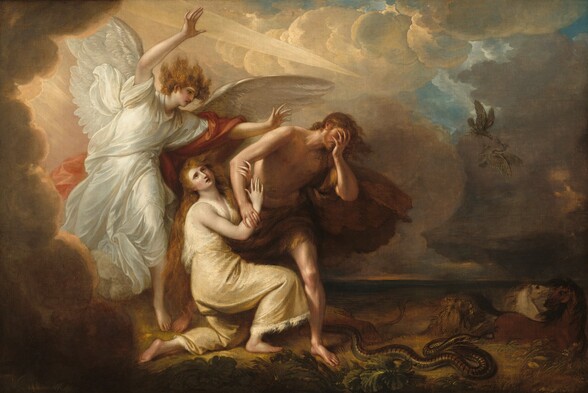
The Expulsion of Adam and Eve from Paradise by Benjamin West (1738-1820)
Just as dance unveils step by step moving each step towards a new movement to tell a story, so too does the forbidden thoughts. They dance like a flicker of shadow at the edge of our consciousness. They call us, not always with words, but with whispers that tempt, tantalise and stir the mind. To step closer is to cross a line, but is it not also inherently human? Do you think it is possible to categorise humans as purely good or evil?
I was struck by a sudden realisation, one that is not uncanny to my musings. Yet I had never tried to pose to myself. I was exploring the nexus between Satan’s allurement and criminal psychology with Paradise Lost (1677). But why were Adam and Eve ensnared by the temptation of Satan rather than the guidance offered by God? What is it that Satan bestows, and that God misses?
Human beings are frequently pigeonholed into two distinct categories: Good or Evil. To some extent, we may add nuances like “not-so-good” or “not-so-bad”. Yet can we truly define an individual as purely good or purely evil based on their face value? What if one nurtured the attraction of or bore malice, while concealing such tendencies from the world? How do we classify them, good, evil or somewhere in between? Do they forever exist somewhere in the shadowed space?
For instance, there exist a considerable number of individuals who are avid admirers of psychological thriller films, fictions, and documentary series. They appear to be not distasteful to scenes or words of bloodshed, dead bodies, and acts driven by vengeance. They find enjoyment from such scenes and words, and the visual or imagery feels entirely natural to them which astonishes me. So, why would these individuals refrain from imitating these actions in reality? If driven by vengeance, one of the seven deadly sins, why do not they resort to murder? It’s because they are confined with morality. These morals work as a barrier. It stops humans from evoking the sense of their inner darkness or denied feelings.
If one can suppress their repressed and dark desires, how then can they be lured by Satan’s allurement? Let’s say that we are constantly drawn to invitations. Why, then, do we not enthusiastically respond to God’s call? What is it that God fails to offer, while Satan has already taken the lead in his temptations? What thoughts crossed Eve’s mind before eating the forbidden fruit? Is it merely the word “no” that beckons us and draws us with irresistible allure? Or does Satan possess a unique technique to draw us in his magical world?
More importantly, can we truly call those who suppress their dark insides “good”? Or do we dare to believe that a person can possess completely good intentions both outside and inside, without any shadow lurking within?
Nusrat Jahan Esa is currently an undergraduate majoring in English literature at the University of Liberal Arts Bangladesh (ULAB). She writes on criminology, psychology, and education.
.
PLEASE NOTE: ARTICLES CAN ONLY BE REPRODUCED IN OTHER SITES WITH DUE ACKNOWLEDGEMENT TO BORDERLESS JOURNAL
Dustin Pickering in conversation with Mitali Chakravarty
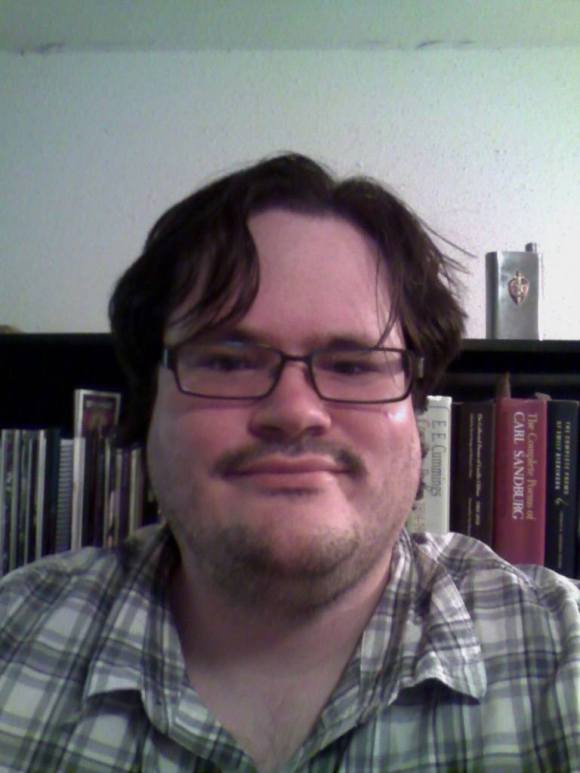
He talks of love and religion and writes poetry that is often critiqued by some as similar to verses from the past. And his role model is from the Renaissance — Michelangelo. To some, he is a loyal friend in need, a person who whips up essays and articles on demand. He is often published within India, which could well be his second literary home. He is prolific with his writing and publishing. He also does paintings and sings songs with a guitar on you tube. Some might have guessed by now — he is Dustin Pickering.
Pickering is the founder of Transcendent Zero Press. This year one of their books, Neon Apolcalypse by Jake Tringali, has been nominated for the Elgin Award 2020 along with names like Ilya Kaminsky, Marge Simon and Brian Dietrich. Pickering is also the founding editor of Harbinger Asylum, which was nominated for best poetry journal by the National Poetry Awards in 2013. That same year, Pickering participated in Houston’s Public Poetry reading series and was interviewed on 88.7 KUHF. He has been a featured poet for Ethos Literary Journal, a contributor to Huffington Post, and has published essays in Cafe Dissensus, Countercurrents, Borderless, Journal of Libertyand International Affairs, as well as reviews in The Statesman (India), Tuck Magazine, Lost Coast Review, World Literature Today, and Inverse Journal. He placed as a finalist in Adelaide Literary Journal‘s 2018 short story contest, and was a Pushcart nominee in 2019.
His books include The Daunting Ephemeral, The Future of Poetryis NOW: bones picking at death’s howl, Salt and Sorrow, A Matter of Degrees, Knows No End, Frenetic/No Contest, The Alderman: spurious conversations with Jim Morrison,O’Riordan: spurious conversations with Dolores, The Madman and Fu, Be Not Afraid of What You May Find, The Red Velvet Robe, The Forever Abode, and a collaboration with Dory Williams called Imitations of Love Poems. He recently attended New York City Poetry Festival, and has been a reader at Austin International Poetry Festival many times. He hosts the interview and oddities for authors site thedailypoetsite.com. He co-edited the anthology Selfhood: Varieties of Experience, and published its companion Epiphanies and Late Realizations of Love. He has written introductions for books by Amit Saha Sankar, Kiriti Sengupta, Bitan Chakraborty, and Jagari Mukhergee. He was given a Jury Prize at Friendswood Library’s Ekphrastic reading in 2019, and was awarded with honourable mention by The Friends of Guido Gozzano in 2019. He lives in Houston, Texas, USA. In this exclusive, Pickering reflects on his journey as a writer.
Why do you write?
Within me, there seems to be a deep passion and yearning for something inexplicable. I also write to combat doubts, leave a record of my thoughts for myself, and to tell the world whatever interior mysteries I uncover within my own mind and studies.
When and why did you start writing?
Very young. One boring day at home in 1st grade, I asked my grandmother what sort of activity I should do. She suggested I write a story about something I wanted but didn’t have. I wrote a children’s book called The Little Red Wagon about a child who loses a wheel on his wagon. He looks everywhere for it and finds it behind a tree where he least expected to find it.
What form came to you before — poetry or prose?
Prose, but poetry is always more natural to me.
Lots of your essays and poetry have to do with God or spirituality. What makes you weave these into your lore?
I was raised Catholic, and as they say, “Once a Catholic, always a Catholic.” I model myself after an early hero of my teen years, Michelangelo. I consider myself a person of Renaissance nature. I also believe we are in a pivotal moment in human history where the guidance of God and Spirit is needed. I think poets are the best people to bring this message to the world, that science and faith are compatible.
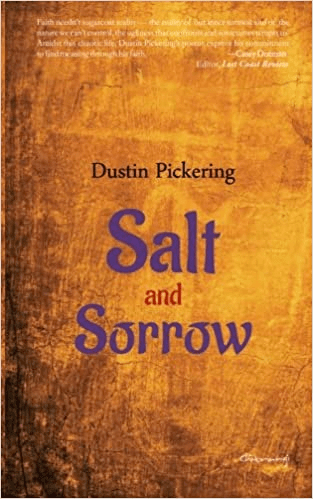
You have a whole book dedicated on God, I believe, which did rather well — Salt and Sorrow. Do you believe in God or are you an atheist? Do you believe in any religion? If you are an atheist why do you write on God?
I counted myself an atheist for many years, beginning at age 13. I was probably led there by the punk band Bad Religion and may have inherited it from my mother whose father was also an atheist. Yet some part of me felt connected to the mysteries of Spirit I could not apprehend and did not want to. Something moves the world and the universe, but I believe that is something I am inclined to believe is sentient, not merely pure accidental motion. I believe this because my life has always felt purposeful to me. I also borrow from Christian humanists such as Erasmus, the Renaissance artists, Shakespeare, many others who share a love for humanity and a sense of purpose for our existence. Although Macbeth did say:
“Life’s but a walking shadow, a poor player
That struts and frets his hour upon the stage
And then is heard no more: it is a tale
Told by an idiot, full of sound and fury,
Signifying nothing.”
The use of the word “signifying” is mysterious to me. It seems to designate a sense of randomness or entropy — perhaps humankind is the idiot? Yet life is a tale told, passionately!
You have published Salt and Sorrow in India. Was there a reason for that?
I connected with publisher Kiriti Sengupta a few years ago after publishing the acclaimed Indian poet Usha Akella’s masterful work The Rosary of Latitudes. He saw a lot of my Facebook posts at the time concerning spirituality and asked me to write a collection that brought out “the God of the Bible.” For some reason, perhaps my sensibilities, I have developed a strong presence in India. I have never visited, but I hope to someday!
You often refer to fossil in your poetry, especially in your upcoming collection, The Skin of Reality, you have a poem that says, “I stare but see an empty fossil:/ what is final is never the end.” To what purport do you see the fossil? Is it a relic from the past? Why do you use the image of fossil?
The simple answer is I am fascinated by rocks, fossils, embodiments of history. What came before. It is still present in the very earth we walk on. I believe the human genome is a record of where we have been, and it also records where we are individually and contains a lot of animal history. Jung’s archetypes and collective consciousness seem to indicate this as well. As a child age 5, I used to sit on the playground where there were a lot of rocks. I picked them up, observed them. I kept some but the teacher told me I could not take them home. I told her they were fossils. She examined them herself and agreed, surprised. She allowed me to take one home. I still have it. That line seeks to illumine the truth I see that death is not final—who we are leaves an impression on the world irrevocably.
Where will you be bringing out this collection? In India or US?
I don’t have a publication plan right now. It is still in its infancy.
Where do you find/seek your inspiration?
Most of my ideas come from a lot of readings and thought. I don’t even entirely understand a lot of what I read, but it shapes my creative impulse in an extraordinary way. I am very forgetful too, so I have to continuously reinvent myself and how I choose to express my ideas. A lot of my imagery comes from life, including my long battle with mental health struggles.
Which writers fascinate you the most? Have any of them influenced your writing?
I cite as my primary influences in thought and writing the German philosopher Friedrich Nietzsche and The Holy Bible, particularly The Old Testament. I also am intrigued by mystical writings from the Kabbalah, St. John of the Cross, sacred Hindu texts such as The Upanishads and Bhagavad Gita, St. Francis of Assisi, and the endless list of mystics. I also found metaphysical poetry interesting in my college years. I accidentally stumbled upon John Donne and found him interesting. Milton influenced me in my teen years as well. My senior yearbook quote was, “The mind is its own place and in itself can make a hell of heaven, a heaven of hell.”
I love the surrealist poetry of David Gascoyne. I read all of William Blake, W H Auden, and a long list of others, but those seemed to have left the strongest impression. I’m also interested in psychoanalysis and have read a lot of Anthony Storr, Freud, Jung, Kay Redfield Jamison, and several others.
I appreciate philosophy too, and enjoy works by Plato and Aristotle, Heidegger, Sartre, Emerson, Burton, and many others. Among fiction writers, I enjoy Henry James, Tennessee Williams, James Joyce, Samuel Beckett, Hermann Melville, Dostoevsky, and many others. I especially love Dostoevsky’s psychological acumen in The Double. I tend to prefer short fiction but have read all of Joyce. Nietzsche has invaluable insights into the art of writing, but you have to mine them.
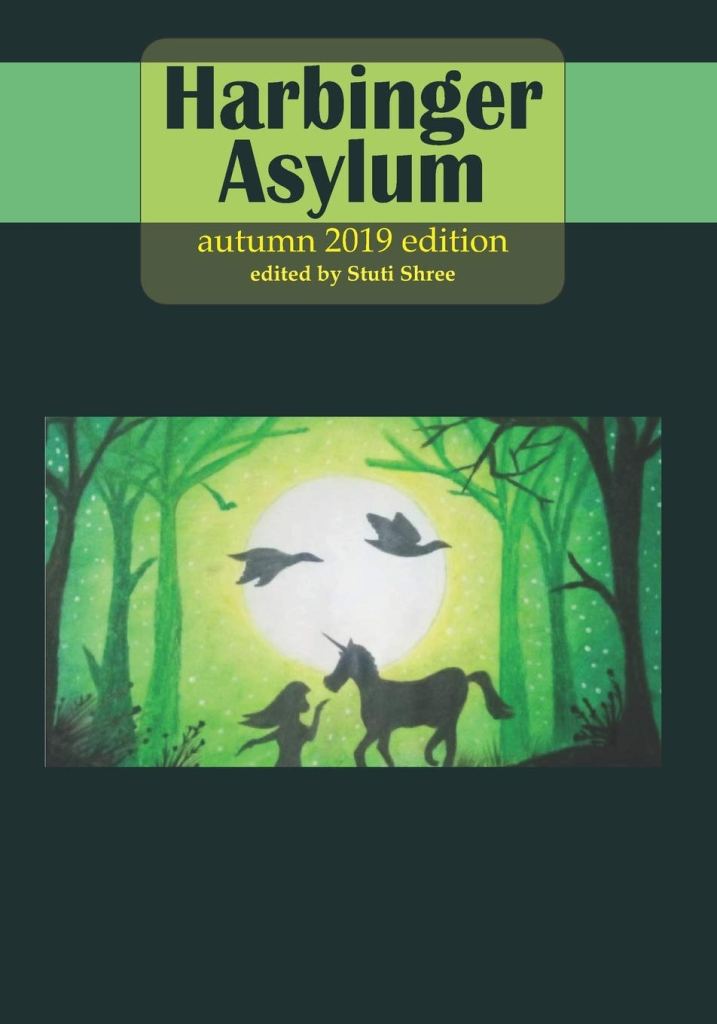
You bring out a popular quarterly, Harbinger Asylum. Did you start that? When and why?
I founded the journal in 2010 with my longtime friend Alex Maass who sometimes writes the “Not Quite a Political Column” and suggests themes. I started it after a poetry gathering at University of Houston-Clear Lake. I was invited by my new friend at the time Dru Watkins, who was an early contributor, and after coming home I thought about how I could better serve the literary community. The journal started with an anarchist bent and I published a lot of libertarian writing. I also included writing by friends. Over the years, we’ve had submissions from highly regarded poets such as Simon Perchik, Joseph Bottone, and others whose names I ran across before getting their submissions. Later on, we acquired two new editors Z. M. Wise and Stuti Shree. Z. M. is my good friend and business partner, and Stuti is a university student in India.
You run a blog that belongs to Transcendent Zero Press. It is a strange name. Any reason for calling it as such?
Transcendent Zero Press is the company through which I publish Harbinger Asylum, as well as other books. It’s the name of my publishing company. Years ago, it was my punk band that never happened. I liked the concept. So, I re-made it into the publishing company.
It began with a word I read in the dictionary combined with the popular song “Zero” by Smashing Pumpkins. I thought it had a distinct conceptual flavor. Ultimately, I also designed the logo to be conceptual. On one side of the zero, there is a dark crescent. The other side has a bright crescent. This symbolizes Ultimate Nothingness, the idea that all is in harmony. Essentially my own mystical concept. Then a “T” crosses it, symbolizing the axis of the universe. I also conceived of God as having the qualities the Tao ascribes to great leaders. A person who does nothing yet let’s all happen. Lao Tzu wrote, “A leader is best when people barely know he exists, when his work is done, his aim fulfilled, they will say, we did it ourselves.” Zero signifies such an approach to life.
What are your future plans as a writer, editor and publisher?
We recently expanded into publishing literary criticism. So far, the books have dealt with Indian works in English. I would like to publish more literary criticism but about literature in other countries. We will soon have an anthology of Albanian poetry released. I’m interested in Southeast European literature as well. I may publish a broad collection of Edgar Lee Masters’ lesser known work. I have a friend, Dr. Ryan Guth, who plans to work that out for us.
Any message for aspiring writers?
My English teacher in high school Mrs. Teltschik used to say, “Write because you have to.” Something in you must answer a call. Write to contribute but write for yourself. It is hard to break in at all. Don’t shoot high if you are young unless you have exceptional talent, connections, or both. Work your way through. Don’t be afraid to learn. Be thankful and mindful of all your successes, and consider failure and rejection an instructor, not an obstacle. Don’t fear revision. Stay focused. Write a lot. Read a lot. Find what makes you spin rapturously and write about it. Keep a journal, especially if you are young. Don’t throw away your writing. Mine old material or edit when you are dry on inspiration. Most of all, learn to enjoy! Live as well as write. Travel!
.
PLEASE NOTE: ARTICLES CAN ONLY BE REPRODUCED IN OTHER SITES WITH DUE ACKNOWLEDGEMENT TO BORDERLESS JOURNAL.




 Borderless