A translation from Nabendu Ghosh’s autobiography, Eka Naukar Jatri(Journey of a Lonesome Boat), translated by Dipankar Ghosh, from Bengali post scripted by Ratnottama Sengupta. Clickhereto read.
Ueharaby Kamaleswar Barua has been translated from Assamese and introduced by Bikash K. Bhattacharya. Clickhere to read.
Kurigram by Masud Khan has been translated by Professor Fakrul Alam from Bangla. Clickhere to read.
Bonfire by Ihlwha Choi has been translated from Korean by the poet himself. Clickhere to read.
In Indian Pale Ale, Rhys Hughes experiments with words and brews. Click here to read.
Conversation
Being fascinated with the human condition and being vulnerable on the page are the two key elements in the writing of fiction, author and poet Heidi Northtells Keith Lyons in a candid conversation. Clickhere to read.
In Multicultural Curry, Suzanne Kamata reflects on mingling of various cultures in her home in Japan and the acceptance it finds in young hearts. Clickhere to read.
Ratnottama Sengupta explores the poetry in lyrics of Bollywood songs, discussing the Sahityotsav (Literary Festival) hosted by the Sahitya Akademi. Clickhere to read.
Imagine a world without wars, without divisions, where art forms flow into each other and we live by the African concept of Ubuntu — I am because you are’ — sounds idyllic. But this is the month of March, of poetry, of getting in touch with the Dionysian elements in ourselves. And as we have said earlier in the introduction of Monalisa No Longer Smiles: An Anthology of Writings from across the World, what could be a better spot to let loose this insanity of utopian dreams than Borderless Journal!
Having completed three years of our Earthly existence on the 14th of March, we celebrate this month with poetry and writing that crosses boundaries — about films, literature and more. This month in the Festival of Letters or Sahityaotsav 2023, organised by the Sahitya Akademi, films were discussed in conjunction with literature. Ratnottama Sengupta, who attended and participated in a number of these sessions, has given us an essay to show how deep run the lyrics of Bollywood films, where her father, Nabendu Ghosh, scripted legends. It is Ghosh’s birth month too and we carry a translation from his Bengali autobiography which reflects how businessmen drew borders on what sells… After reading the excerpt from Nabendu’s narrative translated by Dipankar Ghosh and post-scripted by Sengupta, one wonders if such lines should ever have been drawn?
Questioning borders of a different kind, we have another piece of a real-life narrative on a Japanese Soldier, Uehara. Written by an Assamese writer called Kamaleswar Barua, it has been translated and introduced by Bikash K. Bhattacharya. The story focusses on a soldier’s narrative at his death bed in an alien land. We are left wondering how his need for love and a home is any different from that of any one of ours? Who are the enemies — the soldiers who die away from their homes? What are wars about? Can people live in peace? They seemed to do so in Kurigram, a land that has faded as suggests the poem by Masud Khan, brought to us in translation from Bangla by Professor Fakrul Alam, though in reality, the area exists. Perhaps, it has changed… as does wood exposed to a bonfire, which has been the subject of a self-translated Korean poem by Ihlwha Choi. Tagore’s poem, Borondalatranslated as ‘Basket of Offerings’, has the last say: “Just as the stars glimmer / With light in the dark night, / A spark awakens within/ My body. / This luminosity illuminates / All my work.” And perhaps, it is this luminosity that will also help us find our ideal world and move towards it, at least with words.
We have a book review by Aruna Chakravarti of Bornali Datta’sIn A Better Place: A Doctor’s Journey, a book that is set amidst immigrants and takes up certain social issues. Baba Padmanji’s Yamuna’s Journey, translated from Marathi by Deepra Dandekar, one of the oldest Indian novels has been discussed by Somdatta Mandal. Bhaskar Parichha has told us about S.Irfan Habib’s Maulana Azad – A Life. Basudhara Roy has brought out the simplicity and elegance of Robin Ngangom’sMy Invented Land: New and Selected Poems. He writes in the title poem that his home “has no boundaries. / At cockcrow one day it found itself/ inside a country to its west,/ (on rainy days it dreams looking east/ when its seditionists fight to liberate it from truth.)”. We also carry an excerpt from his book. Stories by Jessie Michael, Brindley Hallam Dennis, Sangeetha G and Shubhangi bring flavours of diversity in this issue.
Our journey has been a short one — three years is a short span. But, with goodwill from all our readers and contributors, we are starting to crawl towards adulthood. I thank you all as caregivers of Borderless Journal as I do my fabulous team and the artists who leave me astounded at their ability to paint and write — Sohana Manzoor, Gita Vishwanath and Pragya Bajpai.
Thank you all.
Looking forward to the next year, I invite you to savourBorderless Journal, March 2023, where more than the treasures mentioned here lie concealed.
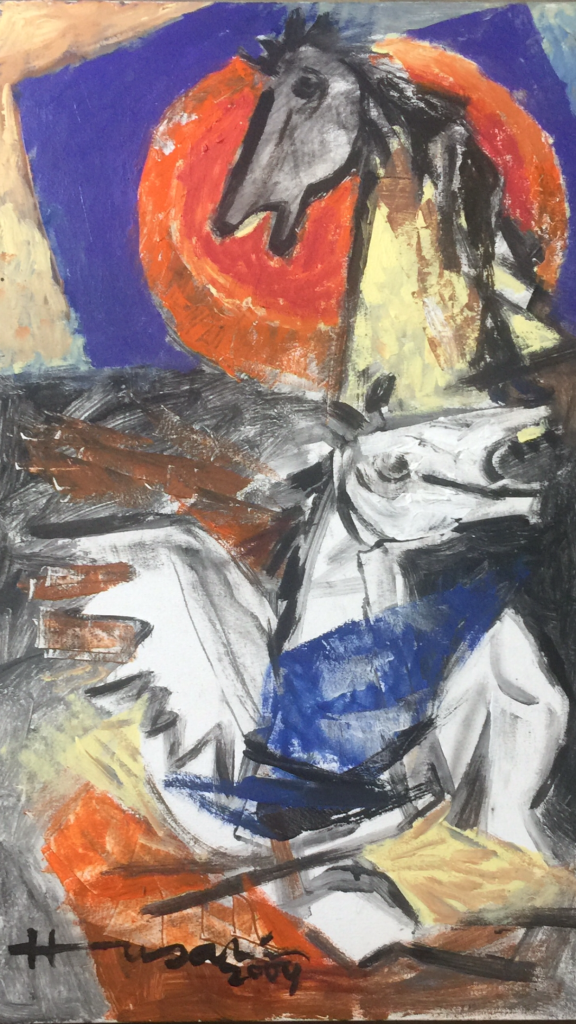
Pegasus in Blue by MF Hussian, 2009. Courtesy: Creative Commons
“There is a man, at the gate, who says he is the brother of Madam Goodman,” the nervous Gurkha announced in a low, soft whisper oozing respect.
“A brother?”
“Yes sir.”
Mr. Goodman turned to his bejewelled short portly wife.
“Do you have a brother…I mean, a real blood brother?”
“Not as far as my human memory can recall,” declared Mrs. Goodman in a cheerful voice, surveying the Saturday-night-party going on in the big hall of exquisite chandeliers and imported Italian tiles.
“But there is a man, at the gate, who claims to be your kin,” persisted Mr. Goodman in a tipsy voice. Young couples, in various stages of drunkenness and fever, were dancing to a loud orchestra. December night of cold foggy winter and a howling wind was knocking the windowpanes of the huge hall. “A who?” demanded Mrs. Goodman, refusing to tear her slightly reddish eyes, from the un-rhythmic crude dance of the fused couples.
“A man,” Mr. Goodman said patiently, his alcoholic eyes surveying a lissome beauty’s body contours, like a hungry caveman attacking the raw flesh of an animal, “Your brother…resurrected from void…wants to see you.”
Mrs. Goodman felt irritated by this unauthorized intrusion of an alien. Her porcelain-white face, with painted cheeks, arched eye-brows distorted in fury, “We demand to see that imposter. Now… in our study.”
The small Gurkha cringed in fear.
The private study was small and comfy. In the tradition of a European or a British manor house. Hard, leather-bound books from the floor to the ceiling- all of them untouched. A leather -bound sofa; a centre glass-topped table; two low stools and a crackling hearth. A large M.F. Husain– those galloping horses against a featureless background– to lend an ‘ethnic’ touch to essentially the foreign opulence. The man was ushered in, Mrs. Goodman did not like the appearance of this new object: small, medium-height, grizzly; wearing rumpled denim jeans, a brown turtle-neck sweater sitting tight on a protruding belly, a crumpled jacket and tear-shaped bifocals that enlarged his big brown eyes brimming with brotherly love and tenderness; and an imitation crocodile skin brief-case. Mrs. Goodman looked at him and looked hard.
The man, intimidated, said, “How are you, sis…my beloved sister?”
Mrs. Goodman did not register. Incomprehension. The man waited for a response.
“You OK., Leela?”
Mrs. Goodman looked on uncomprehending.
“I am your younger brother…Your little Kabir.”
Mrs. Goodman, a perfect picture of faded aristocracy, said, “I have no brother.”
Thunder rolls and lightning strikes. The little man said, “Have no brother? What do you mean?”
“You heard me.”
“Come on, Leela.”
“Mrs. Goodman,” said the lady sharply, “The wife of a top diamond merchant of South Africa, on a winter vacation in the mystical magical India.”
“Cut the crap…You are Leela…the same old little sis good at play-acting.’
A young man popped in, “Any problems, Ma?”
“How are you, Rajiv? I am your maternal uncle.”
The man smiled and said nothing.
“This little man says he is my brother.”
The young man smiled broadly, “Oh, not again! The rich and famous have carloads of unclaimed relatives.’
Roll of thunder and lightning. “I can prove it,” the little man insisted.
“How? By calling God to the witness stand?” the young man asked.
“Or through genetic study?” enquired the booming voice of Mr. Goodman from the doorway, “Welcome to our private and exclusive little world, Mr.….?”
“Kabir, your little brother-in-law.”
Both the men surveyed each other: the former with open curiosity and the latter with fond remembrance. Mr. Goodman sank in the sofa, whipped out a Havana cigar, lit it, emitted a rich aromatic smoke, “How do you prove your kinship, Mr. Intruder?”
The little man, a bit confused, sat down on the opposite chair of the sofa set.
“I can prove it — if proof were required, although in blood relations no proof is required…blood recognises blood.”
“Ok. Proceed,” says Mr. Goodman, “Make it quick…we have thirty guests on our hands for this champagne- and-dinner party.” The little man fishes out a frayed small pocket-sized family album, opens it on the third page and announces, “Here you are…This picture…see, Leela and I….”
The picture is grabbed greedily by the Goodman family: a sixteen-year-old “Leela” and a ten-year-old Kabir against a railway bungalow with lots of shady trees in the background.
“And this one: When she staged a play…. Ah! King Lear, yeah…at the auditorium of the Railway Officers’ Club…I am third there… And this wedding picture…she and you at the reception…”
The pictures were scrutinised carefully. “And this New-year greeting-card from Leela with her signature from Johannesburg…” Mrs. Goodman seems bored, “My cat, my cat…where is my favourite cat?”
The young man “Rajiv” presses a bell. A male servant puts his face in the doorway.
“Fetch Kohinoor.”
Within seconds, a beribboned white cat is brought by a liveried maid servant. Mrs. Goodman is all affection, “Come on, sweetie, my precious, my L-O-V-E…”
“Anything else?” demands the merchant of diamonds and orders a large one for him.
“Like?” the little man asked.
“Anything… family trivia…”
“My L-O-V-E,” coos Mrs. Goodman.
“Family trivia? You mean family history?”
“Yeah…sort of…”
“My precious,” sang Mrs. Goodman.
“Well, our father was a station master at Lalitpur…he met your father there who was a personal valet of an English captain Mr. Goodman. Mr. Goodman was a bachelor and very wealthy…he was very fond of your family, especially your mother’s artistic talent…You were young and handsome…. People called you an Englishman.”
“Ha, ha, ha,” The merchant laughed like an Englishman, “He was more than a father to me…. Good.”
“The English captain acted as a matchmaker. He arranged this match between Leela and you. He stayed on in the free India and invested a lot and wisely here and multiplied his wealth. Then, in late 60s he moved on to South Africa along with your family…There he invested a small fortune in the diamond industry and became stinking rich. After his death, you inherited the business.”
“My cuties,” Mrs. Goodman crooned, “what a wonderful creature!”
“Wonderful,” declared Mr. Goodman.
Mrs. Goodman returned her attention to the new object of the study.
“Are you listening?” asked Mr. Goodman.
“Yeah…listening pretty good…So, this interview is now over?” enquired Mrs. Goodman.
“What is the judgment?” Rajiv quipped.
“Well, the photographs can be manipulated, autographs forged, and family trivia can be collected by any good detective. In short, this man is an imposter,” said Mrs. Goodman. Her voice is devoid of any emotion. Like a judge pronouncing death sentence in a cold, impersonal tone.
“And Leela, why should I do that?” asked the devastated little man, Kabir.
“For money, maybe,” ventured Goodman Sr.
“I see,” said Kabir, hurt obvious in the weather-marked, lined face and voice, “I see now…Your whole world revolves around money only…Money, status, parties…You have no idea of emotions and love and beauty.”
“Wrong,” butts in Rajiv. “My Ma and pop love animals, paintings and people. Ask our staff.”
Silence — heavy, awkward. The little man Kabir looks at their well-fed, contented faces. He faces them and asks Leela, “You recognize me?”
“No.”
“You, Mr. Goodman?”
“No.”
“You, Mr. Goodman, Junior?”
“No.”
And he was denied thrice.
“OK! sorry to disturb you. I did not come here to claim money but to claim the affection of my elder sister and her family. I wrote letters for many years and made an occasional call but got no response…Today, I made bold to come over here and reclaim a part of my emotional existence… Now, I find I was wrong in my pursuit.” He paused sadly and looked at them again. No response. He concluded, “If claiming a sister or a brother as your own is a crime, I am a criminal. Goodbye.”
As a courtesy, Goodman Jr, escorted the man to the gates of the spacious, sprawling farmhouse in Delhi. The party was in full swing.
Alcohol, tobacco smoke was in the air. “A parade of obscene wealth,” thought the intruder.
“OK! It was a nice encounter,” said Goodman Jr. ironically, lips pursed.
“Or a non-encounter?” asked the man. They shook hands. When he looked up, he saw his own face mirrored in the face of Goodman Jr.
Mesmerised, he again looked: his own face beamed back at him.
Kabir shuddered at the unreality of the whole situation and resumed a long walk towards the first bus stop.
Sunil Sharma is an academic and writer with 23 books published—some solo and joint. Edits the online monthly journal Setu.
Sunil Sharma,PhD (English), is a Toronto-based academic, critic, literary editor and author with 23 published books. His poems were published in the prestigious UN project: Happiness: The Delight-Tree: An Anthology of Contemporary International Poetry, in the year 2015. Sunil edits the English section of the monthly bilingual journal Setu published from Pittsburgh, USA: — https://www.setumag.com/p/setu-home.html For more details, please visit the link:— http://www.drsunilsharma.blogspot.in/
.
PLEASE NOTE: ARTICLES CAN ONLY BE REPRODUCED IN OTHER SITES WITH DUE ACKNOWLEDGEMENT TO BORDERLESS JOURNAL.


 Borderless