Narrative by Meredith Stephens& photographs by Alan Noble
The Prime Meridian Line.
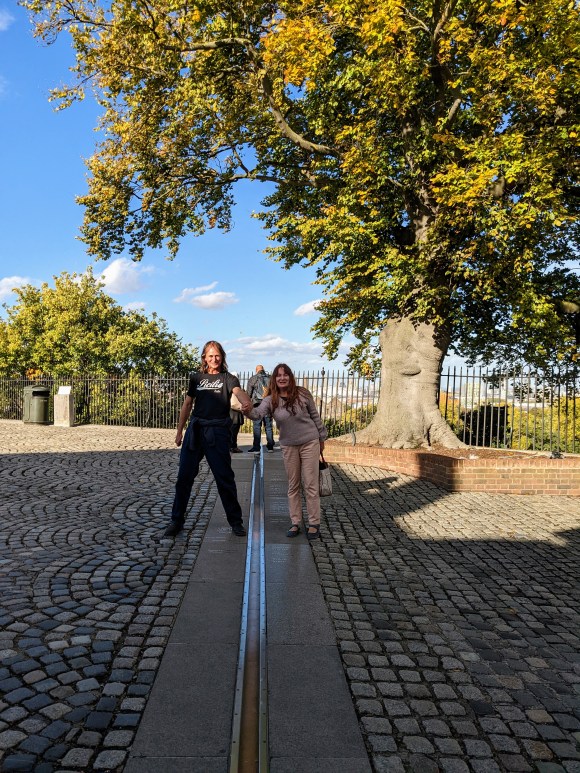
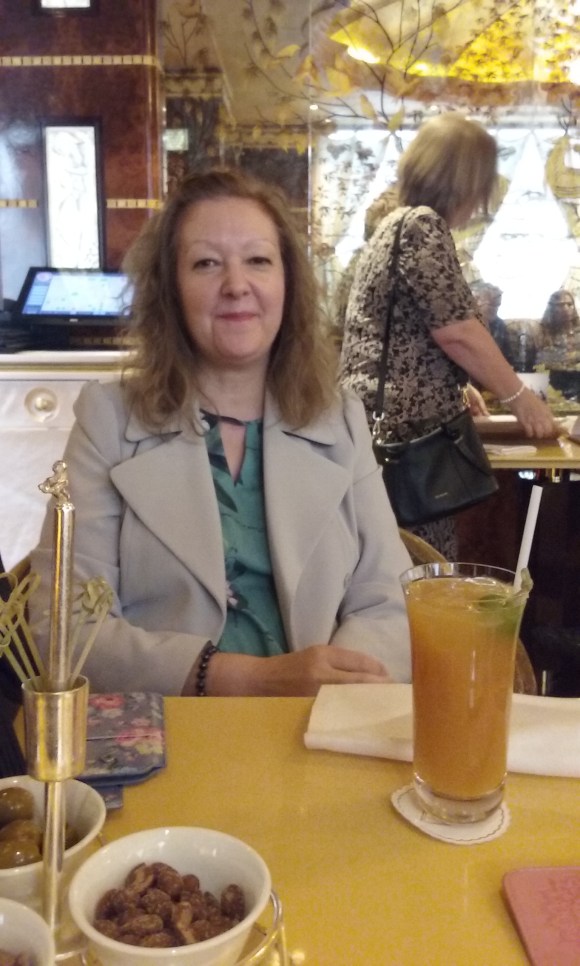
Whenever we visit another city, Alex and I always head straight for a science or maritime museum. When we spent a day in London several years ago, Alex insisted that we visit the National Maritime Museum in Greenwich, and then the Royal Observatory. The highlight of the latter was John Harrison’s marine timekeepers, which made the calculation of longitude at sea possible, therefore making navigation safer. A fun part of visiting the Observatory was standing on either side of the Prime Meridian Line, which defines zero longitude and divides the eastern and western hemispheres of the earth. If you are facing north, the person on the left is in the western hemisphere, and the person to the right is in the eastern hemisphere. We had to queue behind other couples to stand either side of the line. The couple in front of us were taking an inordinate amount of time to have their photo taken here, from which global time is calculated.
“Time’s up!” quipped someone behind us.
“What’s time?” came a philosophical comment from someone else.
The quick banter between strangers is one of the many reasons why I love visiting London.
During our short stay we devoted hardly any time to visiting any other tourist sites. The changing of the guard at Buckingham Palace held little allure. After visiting the Royal Observatory, we strolled past the historic British clipper ship “Cutty Sark” and then caught a ferry back from Greenwich to Central London. We briefly hopped off to see the Houses of Parliament, but after having visited the Royal Observatory Alex’s curiosity was sated.
Fast forward to March 2025 and we found ourselves in a remote town in Western Australia called Carnarvon. The first attraction Alex wanted to visit was the Carnarvon Space and Technology Museum. Carnarvon has a little-known relationship to Cape Canaveral in Florida. Many people have heard of Cape Canaveral and its rocket launching site, but who has heard of the not dissimilar-sounding town of Carnarvon?
Unlike the grand public museums in Western Australia, this one is self-funded and run by volunteers. NASA established a tracking station at Carnarvon in 1964, which played a critical role for both the Gemini and Apollo programs. Carnarvon was strategically located as the most distantly located site on the earth diametrically opposite from Cape Canaveral, providing the ability to track spacecraft over the Indian Ocean that were out of range from Cape Canaveral. The most famous launch was Apollo 11 in July 1969, which achieved humanity’s dream of landing humans on the Moon and safely returning them to Earth.
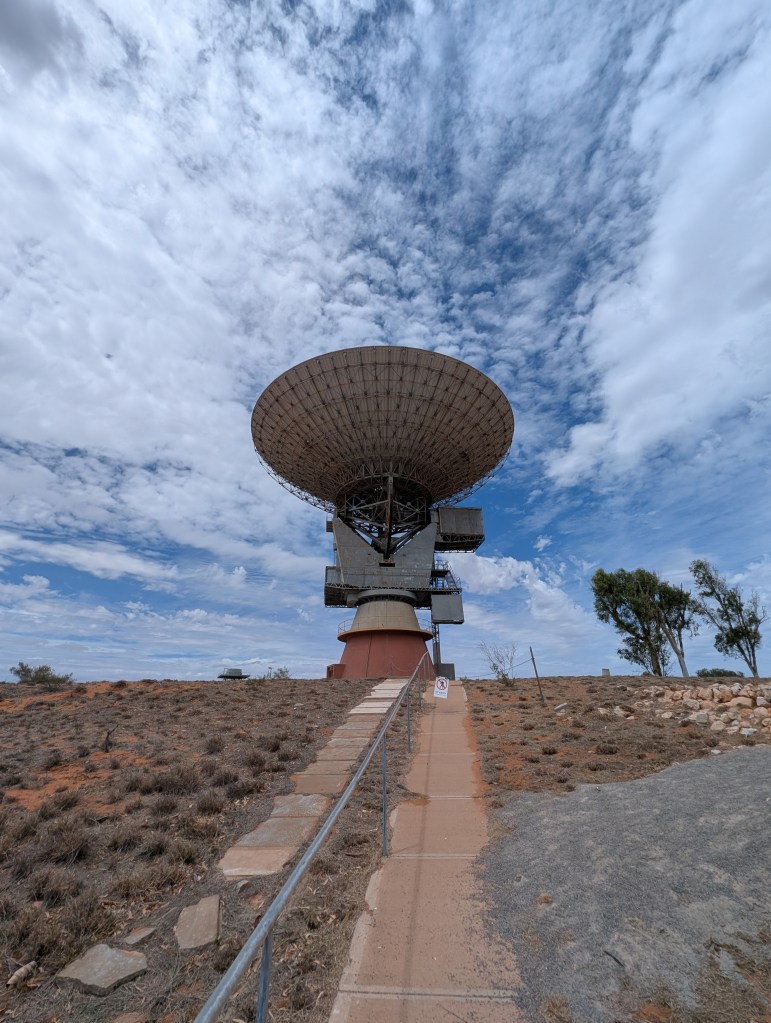
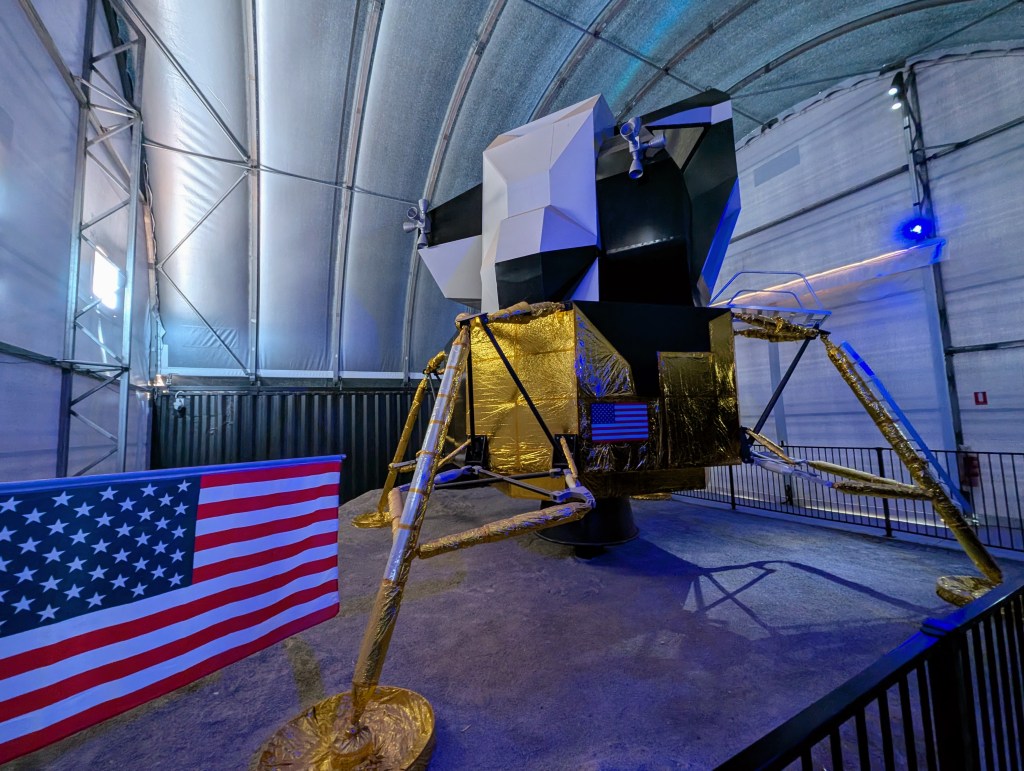
Radio Astronomy Dish Apollo 11 Lunar Lander Module (replica)Exhibits at Carnarvon Space and Technology Museum
This museum was different from public museums in that when we visited it was managed by a grey nomad couple from the east coast. (“grey nomad” is an Aussie term for retirees who embark on an extended period of travel around the country, usually in a caravan.) A resident cat curled himself into a ball proudly on the reception desk. It was the only museum we visited in Western Australia that required a fee to enter. The first experience we sought was to hop in the replica of the Apollo capsule to get a feel for the astronauts during the July 1969 launch. I was worried about a panic attack coming on in a confined space but the manager assured me that he would open the door to let me out at any time if I felt uncomfortable. We lay down with the lower half of our bodies propped up on a platform in what we hoped was an astronaut launching posture, while footage from the 1969 launch played out on the screen in front of us. Countdown on the screen was followed by lift-off. Not only did I not have a panic attack, it felt exhilarating to be transported to Cape Canaveral in 1969. Having watched this on black and white television when we were in primary school, it was all the more meaningful to watch it as adults. After touring the rest of the museum, we returned to the Apollo capsule to experience it a second time, like the space nerds we were.
We braced ourselves to face the oppressive heat as we headed outside to view the original satellite dish. Rather than languishing as ancient technology the dish has been leased to an overseas company who were upgrading it to track satellites orbiting Earth.
After viewing numerous 1960s space memorabilia, such as a replica of a Gemini capsule, which had preceded the Apollo series of capsules, and a life-sized replica of the lunar lander module, we bought some tourist T-shirts, chatted with the manager couple, and bade farewell to the resident cat. This was the most thrilling of the magnificent museums we visited in Western Australia. Thanks to Alex, we had a bias to visit maritime museums, including The WA Maritime Museum in Fremantle, The Museum of Geraldton, and The WA Shipwrecks Museum. They provided rich accounts of the many arrivals from distant lands to the west Australian shores since Dutchman Dirk Hartog’s nearby landing at Shark Bay in 1616. All visits were immensely educational and informative, but somehow the less glamorous Carnarvon Space and Technology Museum stood out. Unlike the public museums, it was somewhat ramshackle, but this was more than made up for in terms of authenticity and charm. Who would have thought that this outpost in regional Western Australia that even many Australians have not heard of, could have played such a pivotal role in the tracking of Apollo 11? This museum enjoys none of the fame of the Royal Observatory in Greenwich, but the role it played in history is just as moving.
.
Meredith Stephens is an applied linguist from South Australia. Her recent work has appeared in Syncopation Literary Journal, Continue the Voice, Micking Owl Roost blog, The Font – A Literary Journal for Language Teachers, and Mind, Brain & Education Think Tank. In 2024, her story Safari was chosen as the Editor’s Choice for the June edition of All Your Stories.
PLEASE NOTE: ARTICLES CAN ONLY BE REPRODUCED IN OTHER SITES WITH DUE ACKNOWLEDGEMENT TO BORDERLESS JOURNAL
The nomenclature ‘historical fiction’ is sometimes quite confusing for the reader who keeps on wondering how much of the novel is real history and how much of it is the figment of the author’s imagination. Beginning in 1686, and set in the later part of Aurangzeb’s reign, this work of historical fiction named Job Charnock and the Potter’s Boy charts the turbulent history of an insignificant hutment in the inhospitable swamps of Sutanati in Bengal that becomes one man’s unyielding obsession. This man is no other than Job Charnock whom we all claim to be the original founder of the city of Calcutta.
Bengal during that period was the richest subah of the Mughal Empire and the centre of trade. The English were granted a toehold in Hugli when Shah Jahan ousted the Portuguese in 1632 and made it a royal port. Since then, they had been worrying Shaista Khan, the current nawab at Dhaka, to give them permission to erect a fort at the mouth of the river but the wily old nawab did not agree and dismissed their petitions repeatedly. This was a period of extreme flux when the European powers like the Dutch, the Danes, the French and the English were all playing out age-old rivalries in new battlefields, aided and abetted by individual interests and local conflicts. This is when Sir Joshua Child was at the helm of East India Company’s affairs in London throughout the 1680s and his plans were brought to fruition in faraway Bengal by William Hedges and then Job Charnock.
Of the earliest champions of the British Empire, none was as fanatic or single-minded as Job Charnock. He evinced no wish for private trade or personal gain, and unlike many of his contemporaries who returned to England as wealthy ‘nabobs’, he lived and died here as a man of modest means. His life’s work was only to identify the most strategic location on the river and secure it for his masters.
Sutanati, with its natural defences and proximity to the sea, appealed to his native shrewdness and he applied himself in relentless pursuit. The story of this novel begins in Hugli in 1686, on the first day of the monsoon, when a poor potter, Gobardhan, and his wife, Indu, find it difficult to make ends meet and their life is centred around their young son Jadu. In the guise of Gobardhan relating bedtime stories to his son, the novelist very tactfully gives us the earlier historical background of the place. He tells us how during his great-great-grandfather’s time, two hundred years ago, Saptagram was the greatest city in the country, the greatest port in the Mughal Empire where ships and boats came from all over the world. Later the Portuguese bought land and built a fort at Golghat, but the Mughals grew jealous of them and finally attacked Hugli and ousted them from there.
Coming down to the present time, Jadu is twelve years old when his parents are burnt to death in front of his eyes as they were innocent bystanders in the struggle for power between the East India Company and the Nawab of Bengal. By a quirk of fate, Jadu is rescued by his father’s Mussalman friend, Ilyas, who is really protective of the boy and acts as a substitute father figure. But soon Ilyas leaves for Dhaka on a diplomatic mission and thrusts the young boy in the hands of a trusted Portuguese sailor and captain called D’ Mello. Since then, Jadu is drawn into the whirlwind of events that follow. He spends a lot of time on the river, and from December 1686 to February 1687, stays at Sutanati. Then, he moves from Sutanati to Hijli, and back to Sutanati up to March 1689, till at last he stands face to face with the architect of his misfortune — Job Charnock himself.
The rest of the tale hovers around how Jadu becomes one of his most trusted aides and though Charnock’s grand dreams did not come to fruition during his lifetime. When he died in 1693, the place was still a clutch of mud and timber dwellings still awaiting the nawab’s parwana[1] to build and fortify the new settlement. The English finally managed to acquire the zamindari rights to Sutanati, Kolkata and Gobindopur in November 1698, when the area had become quite lucrative by then.
In exploring the how, but more importantly the reason for this coming into being, the story then speaks of the motivations of the great and good and the helplessness of the not so great, all of whom in their own way contributed little nuggets of history to the city’s birth. The novel is also filled with common folk, both local natives as well as foreigners, who watch unheeded while destinies are shaped by the whims of rulers. Interwoven with verifiable historical events and many notable characters from history, the novel therefore is above all primarily the story of an innocent boy Jadu who navigates the different circumstances he is thrust in and emerges victorious and hopeful in the end. As the narrative continues, he also moves from innocence to maturity. Through his eyes we are given to read about a wide range of characters who form the general backdrop of the story.
In the ‘Author’s Note’ at the end of the novel, Madhurima Vidyarthi categorically states that this is not a history book, but she has strung together imaginary events over a skeleton of fact, based on the sum of information available. She states, “While trying to adhere to accepted chronology, the temptation to exercise creative license is often too great to be overcome”. The most significant character in this perspective is Job Charnock’s wife, who has been the subject of much research and her treatment in the Company records is typical of the time. But though a lot of information is available about Charnock’s daughters repeatedly in letters, Company documents, baptismal registers, and headstones, their mother is conspicuous by her absence. This is where the author applies her ‘creative license’ and makes Mrs. Charnock’s interactions with Jadu reveal his coming of age, and with her death, he symbolically reaches manhood. Vidyarthi also clarifies that several characters in the novel like Jadu, his parents, Ilyas, Manuel, Madhu kaka and Thomas Woods are also imaginary, and they represent the nameless, faceless masses during that period and therefore provide a ‘slice of life’ that make up history. All in all, this deft mingling of fact and fiction makes this almost 400-page novel a page-turner, ready to be devoured as fast as possible.
night blurs blue sky to electric fish hatch in space
I search for him in the café bars lights ring
conversations are a fume of voices hovering in loops
above our mouths the street lights burn brilliantly
throats of climbing honeysuckle flower with shadows
my shadow is one moving and swimming
the street belongs to the sea trees waver
repeating sighs in budding leaves
canopies thickening with night he pours me a second glass
Jenny Middleton is a working mum and writes whenever she can amid the fun and chaos of family life. Her poetry is published in several printed anthologies, magazines and online poetry sites. Jenny lives in London with her husband, two children and two very lovely, crazy cats. You can read more of her poems at her website https://www.jmiddletonpoems.com.
.
PLEASE NOTE: ARTICLES CAN ONLY BE REPRODUCED IN OTHER SITES WITH DUE ACKNOWLEDGEMENT TO BORDERLESS JOURNAL
Poetry, prose — all art forms — gather our emotions into concentrates that distil perhaps the finest in human emotions. They touch hearts across borders and gather us all with the commonality of feelings. We no longer care for borders drawn by divisive human constructs but find ourselves connecting despite distances. Strangers or enemies can feel the same emotions. Enemies are mostly created to guard walls made by those who want to keep us in boxes, making it easier to manage the masses. It is from these mass of civilians that soldiers are drawn, and from the same crowds, we can find the victims who die in bomb blasts. And yet, we — the masses — fight. For whom, for what and why? A hundred or more years ago, we had poets writing against wars and violence…they still do. Have we learnt nothing from the past, nothing from history — except to repeat ourselves in cycles? By now, war should have become redundant and deadly weapons out of date artefacts instead of threats that are still used to annihilate cities, humans, homes and ravage the Earth. Our major concerns should have evolved to working on social equity, peace, human welfare and climate change.
One of the people who had expressed deep concern for social equity and peace through his films and writings was Satyajit Ray. This issue has an essay that reflects how he used art to concretise his ideas by Dolly Narang, a gallery owner who brought Ray’s handiworks to limelight. The essay includes the maestro’s note in which he admits he considered himself a filmmaker and a writer but never an artist. But Ray had even invented typefaces! Artist Paritosh Sen’s introduction to Ray’s art has been included to add to the impact of Narang’s essay. Another person who consolidates photography and films to do pathbreaking work and tell stories on compelling issues like climate change and helping the differently-abled is Vijay S Jodha. Ratnottama Sengupta has interviewed this upcoming artiste.
Reflecting the themes of welfare and conflict, Prithvijeet Sinha’s essay takes us to a monument in Lucknow that had been built for love but fell victim to war. Some conflicts are personal like the ones of Odbayar Dorj who finds acceptance not in her hometown in Mongolia but in the city, she calls home now. Jun A. Alindogan from Manila explores social media in action whereas Eshana Sarah Singh takes us to her home in Jakarta to celebrate the Chinese New Year! Farouk Gulsara looks into the likely impact of genetic engineering in a world already ripped by violence and Devraj Singh Kalsi muses on his source of inspiration, his writing desk. Meredith Stephens tells the touching story of a mother’s concern for her child in Australia and Suzanne Kamata exhibits the same concern as she travels to Happy Village in Japan to meet her differently-abled daughter and her friends.
As these real-life narratives weave commonalities of human emotions, so do fictive stories. Some reflect the need for change. Fiona Sinclair writes a layered story set in London on how lived experiences define differences in human perspectives while Parnika Shirwaikar explores the need to learn to accept changes set in her part of the universe. Spandan Upadhyay explores the spirit of the city of Kolkata as a migrant with a focus on social equity. Both Paul Mirabile and Naramsetti Umamaheswararao write stories around childhood, one set in Europe and the other in Asia.
Do pause by our contents page for this issue and enjoy the reads. We are ever grateful to our ever-growing evergreen readership some of whom have started sharing their fabulous narratives with us. Thanks to all our readers and contributors. Huge thanks to our wonderful team without whose efforts we could not have curated such valuable content and thanks specially to Sohana Manzoor for her art. Thank you all for making a whiff of an idea a reality!
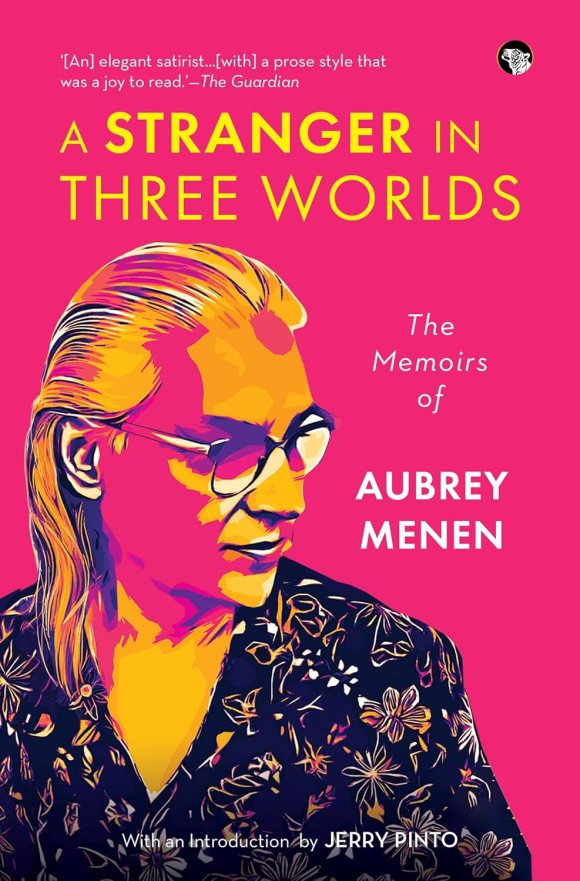
Title: A Stranger in Three Worlds: The Memoirs of Aubrey Menen
Author: Salvator Aubrey Clarence Menen
Publisher: Speaking Tiger Books
Salvator Aubrey Clarence Menen (April 22, 1912 – February 13, 1989) was a British author, novelist, satirist, and theatre critic. Born in London to Irish and Indian parents, he studied at University College, London, before becoming a drama critic and stage director. During World War II, he was in India, organising pro-Allied radio broadcasts and editing film scripts for the Indian government.
After the war, he returned to London and worked in an advertising agency’s film department, but the success of his debut novel, The Prevalence of Witches (1947), led him to write full-time. Menen’s satirical works explore themes of nationalism and the cultural contrast between his Irish-Indian heritage and his British upbringing.
Menen, a remarkably gifted author who frequently goes unnoticed, adeptly delves into the intricate themes of identity, nationality, and the sense of belonging. He does so with his signature blend of irony and profound insight in his two acclaimed autobiographical pieces. A Stranger in Three Worlds: The Memoirs of Aubrey Menenis an exceptional autobiographical account that spans multiple continents. Menen’s writing is noted for its irony, insight, and a nuanced exploration of themes such as belonging and the quest for the self in a multicultural context.
Menen’s life narrative is defined by his experience as an outsider, or a ‘stranger,’ within the three distinct cultures of England, Ireland, and India. This position of being an outsider enables him to keenly observe and critique the social and cultural norms prevalent in each society with remarkable clarity and humor.
The memoir explores the inherent tensions and contradictions that arise from possessing multiple, often conflicting, identities, as well as the difficulties of establishing a coherent sense of self when one does not entirely belong to any particular group.
The book’s narrative style is marked by irony and a keenly humorous outlook on the absurdities of the social conventions and biases he encounters across these cultures. His insights are both deeply personal and widely relatable, resonating with anyone who has navigated the complexities of multicultural or diasporic identity.
The essays featured in Dead Man in the Silver Market, originally published in 1953, analyse themes of jingoism, social class, and the absurdities associated with national pride, intertwining personal stories with sharp social critique.
Written shortly after World War II, his irreverent insights into English society, colonial history, and human nature continue to resonate powerfully in contemporary discourse. ‘The Space within the Heart’, authored in 1970, presents a more personal and philosophical exploration of existence, love, and self-awareness.
Infused with humour and gentle satire, it contemplates the essence of the soul, drawing from the Upanishads and European literary traditions. Menen’s seemingly straightforward yet deeply impactful writing encourages readers to transcend rigid identities and appreciate the fluidity inherent in the human experience.
With an introduction by Jerry Pinto, this omnibus edition functions as a memoir, offering personal reflections and experiences, while simultaneously serving as a critique of imperialism, examining its impacts and consequences.
Furthermore, it thoroughly explores the intricacies of identity, rendering it an exceptional piece of literature that is both informative and captivating, prompting readers to engage in deep reflection on its themes.
.
Bhaskar Parichha is a journalist and author of Cyclones in Odisha: Landfall, Wreckage and Resilience, Unbiased, No Strings Attached: Writings on Odisha and Biju Patnaik – A Political Biography. He lives in Bhubaneswar and writes bilingually. Besides writing for newspapers, he also reviews books on various media platforms.
.
PLEASE NOTE: ARTICLES CAN ONLY BE REPRODUCED IN OTHER SITES WITH DUE ACKNOWLEDGEMENT TO BORDERLESS JOURNAL
The announcement of a ‘major retrospective’ sent Alice’s friends giddy with excitement. Reviews in The Guardian raved. The five stars awarded barely seeming adequate.
Alice remained silent. In truth she had never heard of the American artist. Her tastes were more European; Turner, Vermeer, Caravaggio.
Some friends raced to become early bird visitors. They had joined queues like static conga lines and came away gushing with praise. But to Alice, the Hoppers became like an irritating family, who mutual friends declared “You will love’. However past experience had taught her that when introduced, she had found no common ground.
“We must put it on the list,” declared Julia. Her closest friend and partner for any such cultural initiatives. Julia hated finding herself on the back foot at parties when the latest event was mulled over by guests who had already taken it in.
Alice nodded noncommittally, changed the subject by drawing attention to a stylish pair of shoes in a store window.
Fortnightly visits to the Maudsley psych hospital in southwest London had become routine to her now. A years’ worth of psychotherapy was succeeding in untangling her past. She no longer entered the outpatients with eyes fixed on the squares of carpet tiles. A ploy in those early days to avoid any interaction with the human flotsam that mental health had beached in the waiting room.
But over time she saw that this was a place where calmness was carefully curated. Pictures of flowers bloomed on the walls. The décor was always spruce and the staff — from receptionists to psychiatrists — treated the patients, however ramshackle, with respect.
Now she and her therapist Margaret would chit chat as key codes where punched into pads, in order to gain admittance to each level of the labyrinthine building. The sounds like birds of prey that issued from the acute wing no longer made her start.
This particular Monday morning, her appointment was at a bleary eyed 8 am. Fine if she lived in London — however she was a two hours train ride away so her alarm clock blared reveille at 5 am.
Her session was finished by nine. “You’ve got the rest of the day to yourself,” Margaret remarked as she shouldered the final door whose second line of defence seemed to be that it always stuck. Alice was at a loss as to how to spend this time. London brimmed with museums and galleries, but nothing tempted her. “You know what Dr Johnson said,” grinned her therapist.
“When a man is tired of London, he is tired of life,” responded Alice. “Probably not the best sentiments to quote in Maudsley,” they both agreed.
Since the peak hour ticket had been expensive Alice felt the outlay should reward her with more than counselling. She was not in the mood for aimless shopping. But scrolling from memory through the current exhibitions, she found there was a dearth, except of course for the Hoppers at the Tate. It was a short tube ride away. “Well there’s always cappuccino and cake in the café afterwards.” She consoled herself.
On the Victoria line, as the train jolted to a halt at each station, her carriage never fully aligned with hoardings that trumpeted the event. And as the tube accelerated away, she only got a zoetrope impression of images that did nothing to ignite her enthusiasm.
“If it’s crowed,” she decided, “I won’t bother.” Envisaging hordes of retirees, school parties and tourists mobbing the entrance, all waiting for 10am like a starting gun.
In truth most exhibitions only admitted a hundred or so visitors every hour. But even so, from past experience, she knew there would be a funeral pace past each picture as if it was laying in state.
Alice blamed those headphones that explained each painting down to the final daub. Visitors planted themselves in front of the picture until the recording told them to move onto the next image. “Just look and form your own opinion,” she would mutter whilst craning to catch a glimpse of the artwork.
The Thames accompanied her towards the Tate. There was a Monday morning feeling in this part of London, as if the area was drawing breath after a busy weekend. The district was dedicated to tourism with The Globe and The Turner being near neighbours.
The gallery was housed in a decommissioned power station designed by the architect Sir Giles Gilbert Scot, in a time when even functional buildings were given an aesthetic flourish. The conversion to art gallery had retained the original deco building but also made sympathetic modern additions. The brickwork was cleaned back to its original red and the towering chimney advertised itself on the London skyline.
With the internal machinery removed, the empty core allowed for spacious galleries ideal for art on an ambitious scale. The turbine hall alone was so vast that it dwarfed the escalators that bore visitors up to the galleries. Here even Michelangelo’s’ 17 ft David would look lonely.
Alice was quite accustomed to taking herself off to the cinema, theatres, exhibitions alone. Most of her friends were married, therefore had commitments. She was often too impatient to wait whilst they managed the logistics of their domestic lives, to find time to accompany her.
There was a freedom in being on her own, a spontaneity that meant she could hop on a train, and head to London whenever she felt inclined.
Friends found her ease at flying solo incomprehensible. “You’re so brave,” they would remark in tones that simultaneously managed to be admiring but also patronising, “I could never do anything like that on my own.”
“It’s practice,” she would explain. As an only child she had grown up used to her own company. Moreover, without a partner now, the fact was if she wanted the rich cultural life she craved, Alice had to take matters into her own hands.
Over time she had developed strategies that gave her confidence. Aware that even in the 21st , a single woman going to the theatre or cinema on her own still garnered curious glances, she was, therefore, always accompanied by a book.
Arriving at the Tate’s ticket desk, Alice was surprised to find only a dribble of people. 10 am on a Monday morning was apparently too early even for the keenest of visitors.
Consequently, with extraordinary timing she had the luxury of being the only person in the exhibition. Grinning at her good fortune she placed herself in the centre of the largest room. She then made a 360 degrees turn to get an overview of the Hoppers before moving in on specific images that beckoned to be examined.
What she saw utterly contradicted her preconceptions of the artist and his work. These were not the cosy representations of American life she had expected.
Human loneliness was delineated in every scene. There were no cosy family meals or girlfriends gossiping. Indeed, these people seemed to possess no faculty for laughter. Married couples who had run out of things to say to each other long ago, now gazed off into their own private horizons. Solitary men sat on stoops smoking with blank expressions as if they had given up on thinking. Many eyes were cast down, or concealed beneath hats, so that all emotional cues were transferred to their body language whose droop spoke of hopelessness.
This despair was not confined to cityscapes. There were landscapes too, where forests growled at the edges of civilisation, and unkept grass prowled up to the stoops of solitary white wooden houses. These homes were personified as if conveying by proxy the emotions the characters in other pictures could not. Doors screamed and windows gaped.
Above all she had never seen an artist paint silence so effectively. It emanated from the pictures, seeming to seep into the gallery itself.
In all the years of visiting exhibitions she had never seen one that reflected back her own experience of life. The images did not bring her mood down rather she felt exhilarated that she was able to look these pictures in the face without flinching.
Alice returned home buzzing with a convert’s zeal. As a result, her friend hastily cleared a Saturday. She farmed her kids off to their cousins for the day and left a ready meal for her husband in the fridge. Of course, Alice was champing to revisit the exhibition, although she was savvy enough to understand that she would never be able to recreate the timely conditions or the wonder she had experienced on first seeing the pictures.
The two women arrived at the gallery early enough for there to be a lunchtime lull. From past experience she knew her friend did not work her way methodically through an exhibition but liked to see the artist’s greatest hits first. Juila made for the voyeuristic
‘Night Windows’, where a woman is observed in a bedsit, her back to an open window from which curtains billow, a favoured image for fridge magnets and coasters.
Alice felt the same rush of enthusiasm for the pictures. She was desperate to enjoy again images that had particularly affected her, but good manners tethered her to Julia’s side. Nevertheless, she could not help breathlessly pointing out details in ‘Night Windows’ that had struck her before. Alice’s words tumbled out in her desire to share the image with her friend. However, Julia seemed to have left her enthusiasm with her coat in the cloakroom. She regarded the painting in silence. Alice grimaced inwardly wondering if her effusiveness was deterring her friend so turned off her gush of words.
Julia still did not engage with this painting or indeed any others. She paused before each image briefly without comment. Alice trailed behind her at a loss. She wondered if her friend had suddenly become unwell. There was a precedent for this when she had once passed out from a UTI at the theatre. And she knew her friend well enough that if she hated an exhibition, she was quick to speak her mind.
“Are you feeling okay?” she whispered.
“I’m fine,” Julia responded. But the ‘fine’ was loaded with a subtext Alice could not at that moment fathom.
Julia stood briefly before the artist’s other well-known pictures as if mentally ticking them off. Alice desultorily picked out a detail here and there like offering titbits to someone who had lost their appetite. Her friend merely nodded or squeezed out a ‘hmmm’.
From her peripheral vision the paintings she ached to enjoy again beckoned to her. Finally, she made her way to them, hoping that by giving her friend some space she might find some way into the works. However, looking over her shoulder she saw Juia had begun to move past the paintings without pausing, barely glancing at the images. Eventually feeling as if she was abandoning her friend at a party of strangers she returned to her side. They had reached ‘Night Hawks’. “Surely she’ll respond now,” she thought. Her friend did but not with appreciation, instead she raised her hand to her eyes as if shielding her gaze. Alice was reduced to foolishly gesturing ‘the famous one’ as if trying to chivvy a child’s interest.
“Well I think we’ve seen enough,” Julia suddenly found her voice again, “Let’s get out of here.” And without waiting for Alice, she bolted through the exit and plonked herself in a comfy armchair in the coffee shop and took a deep breath as if the atmosphere in the gallery had tried to choke her. In an effort to raise her friend’s spirits, Alice brought her a double shot cappuccino and a slab of cake. Seated by a large picture window looking down on the Thames, Alice commented on a few landmarks by way of breaking the silence. It was still a one-way conversation though until revived by the food, Julia began to join in.
Clearly there was not to be their usual post event discussion. This was unprecedented. They could not even agree to disagree as they had many times before if they could not even discuss the exhibition. During this smallest of small talk, Alice tried to make sense of her friend’s reaction. She began to feel as if she had forced Julia to accompany her. Then remembered it was actually her friend’s agency that had brough them to the Tate. Reasoning to herself that they couldn’t spend the rest of their lives avoiding all reference to the Hoppers she brushed the small talk aside, took a breath and blurted out, “Did you not like the exhibition?”
Julia paused before speaking, “Look, I know you love them but for me, there was no beauty in there.” She gestured with her head towards the gallery they had come from. “They are so dreary.” Her tone verged on whining as if the exhibition had got her there under false pretences. Alice was quick to point out that they had seen other exhibitions genuinely devoid of conventional beauty — Rothko, Warhol, Gilbert and George. None of whose work could have comfortably inhabited a sitting room.
“But I know what to expect with abstract art,” her friend pointed out. “I can stomach geometric shapes and dribbled paint because they engage my mind not my emotions,” she paused, “also somehow they don’t reflect real life.” The caffein had clearly loosened her tongue. “I expect at least some beauty in representational art.” She began to list Hopper’s faults. “Why are there so few people in the city? It looks post-apocalyptic. And they are so miserable. That picture of the psycho house seems to sum up the whole collection.” She added as a last shot.
Alice felt as if her friend’s criticism was aimed at her as well as the artist. She attempted to put her case for the paintings. “But don’t you see that they reflect the isolation of modern life?” Her friend’s face remained adamant. Alice searched for a comparison then had a brain wave, “Look’ we both studied TS Eliot at uni. Can’t you see it’s ‘The Waste Land’ translated into art?” She felt rather pleased with her analogy.
But Juila shook her head. “You can distance yourself from words, but pictures,” she grimaced. “Nothing erases an image, once seen it gets trapped in your mind.”
Alice pondered the two divergent responses to the Hoppers. Both were extreme in their own ways. She wondered if the roots of their reactions lay in their backgrounds. Her own history, even her therapist agreed, verged on the Gothic. Whereas Julia had enjoyed an Enid Blyton childhood. Throughout her life she had been adored by her father and encouraged by her mother. Her marriage to Jim was that rare thing, a pairing that lasted without a whiff of infidelity. Admittedly their life together had not been entirely charmed — ill health, a father’s dementia — redundancy had been faced down over time. Now their reward was a very comfortable life.
Her friend seemed to have read her thoughts. “I know I have a good life compared to most,” Juila admitted. “And I know there’s ugliness in the world. I just don’t want to be reminded of it on a day out.”
Alice began to understand that the pictures were an uncomfortable reminder of less kind lives. Whilst they were not in the face brutality of war, instead they showed men and women recognizably modern whose lives were the playthings of circumstance and as such had visibly given up.
They seemed to have awakened some existential fear in her friend, perhaps a dread of feeling hopeless. The Hoppers were a reminder that even middle-class lives could falter and fall if fate gave a push.
Julia suddenly changed the subject with a hand brake turn. She gave a round up of her daughters’ careers and love lives, her husband’s progress on the kit car he was building. She seemed in this way to be deploying her family as a buffer against the images she had just seen.
Making for the exit, it was usually part of their ritual to visit the gift shop. But whilst Alice turned to enter, eager to buy more Hopper related merchandise, Juila swept passed deep in describing the minutiae of her family’s next trip to Italy . Alice shrugged, “I’ll pop in next time,” she thought.
.
Fiona Sinclair has had several collections of poetry published by small presses. Her short stories have been published in magazines in the UK, US and Australia.
.
PLEASE NOTE: ARTICLES CAN ONLY BE REPRODUCED IN OTHER SITES WITH DUE ACKNOWLEDGEMENT TO BORDERLESS JOURNAL
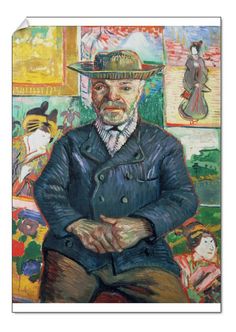
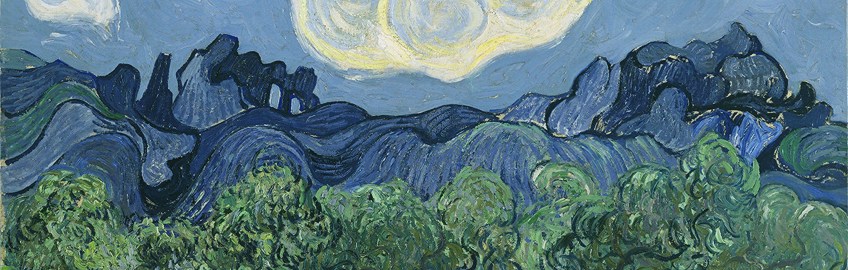
Painting by Vincent Van Gogh (1853-1890). From Public Domain
MY DAD; HE LIKED A WHISKY

My dad; he liked a whisky.
A single malt would do.
Not too much; but sufficient.
Maybe a glass or two.

'Just ample,' he'd always say,
'to see the evening through.'
It was, he would maintain,
a nice pastime to pursue.

'Conversation freely flows
once you've had a few.'
And sometimes I'd introduce
a bottle of something new.

'It's not unappealing,' he'd opine;
as appreciation grew.
He liked a double negative;
enjoyed a double Cardhu.

A touch of water, new flavours
did magically imbue.
He was watchful of my intake.
'Do not think I don't know you!'

Right, of course, as next day
a hangover would ensue.
Finally, that knowing glance.
'Don't say I didn't warn you!'

As the drams, they added up,
so the years they did accrue.
I miss your conversation.
I miss your point of view.

I recall the pipe, of course;
the measured voice I knew.
Now only an empty glass;
an empty bottle too.
Stuart McFarlane is now semi-retired. He taught English for many years to asylum seekers in London. He has had poems published in a few online journals.
.
PLEASE NOTE: ARTICLES CAN ONLY BE REPRODUCED IN OTHER SITES WITH DUE ACKNOWLEDGEMENT TO BORDERLESS JOURNAL
The last, forlorn days of winter; still do they stubbornly cling. Idle thoughts turn to graveyards. I hear a mournful bell ring. Yet there stirs an awakening. I see a bluebird take wing. Violets bloom, and daffodils. I resist an urge to sing. My thoughts now turn to sunlight; to the new life it will bring. Farewell, the last days of winter. Behold! The first days of spring.
THE TREE MEN
I
Walking through the park, this winter morning, I saw how the Council's been at the trees. Some men, in heavy, black jackets, were throwing branches in the back of a truck. One was still sawing hard, finishing the job. The branch rolled onto the grass. The man wiped his brow with his leather glove.
II
They said the trees blocked the view; of what, exactly, it was hard to see. But trees, I suppose, you can't talk to; or urge to have smaller families. You just take an axe to them.
III
All along the avenue there are now trees marked with yellow paint. These are the next for hacking; and those, already cut, stand stark against the winter sky; their severed limbs now stacked in the back of council trucks. And, now, I wonder if, when the tree men are gone, maybe in the quiet of night, these mutilated stumps will still feel a spark crackle along a tattered nerve-way; that savage lunge, as a sharp blade splits the skin.
Stuart McFarlane is now semi-retired. He taught English for many years to asylum seekers in London. He has had poems published in a few online journals.
.
PLEASE NOTE: ARTICLES CAN ONLY BE REPRODUCED IN OTHER SITES WITH DUE ACKNOWLEDGEMENT TO BORDERLESS JOURNAL
The three youngsters: Rachel, fourteen, her fifteen year old brother, Victor, both born in Edinburgh but raised in Moffat, Scotland, and Kenneth, sixteen, born in Moffat, were inseparable. After school or on week-ends they would explore all the surrounding forests and burr-filled heathers around their town. Victor, good at maps, chartered every trail twisting through, over and around the wooded hollows and hillsides of rowan, hazel, holly and hawthorn sloping up or down the cloven banks of the Annan River. Kenneth and Rachel, excellent artists, sketched all the cawing rooks, starlings and wild owls they espied perched in trees; all the weird insects they avoided crushing during their jaunts. Victor, also a fine artist, drew stags, wild boar, snakes and turtles which he observed at the foot of leafless trees or upon snow-packed hill-tops. They were quite an adventurous trio to say the least, unafraid of steep gorges or the trackless stretches of marshy woodlands.
Our tale opens on a warm spring day; a tale of artistic ardour, ingenious artifice, and especially childhood passions …
The entrance of the cave lay hidden behind a tangle of thorny bramble, thistle and snapdragons. Rachel was the first to discover it when from its mouth a swarm of swallows suddenly darted out, frightened no doubt by her approaching footsteps. Rachel advanced slowly, pushing aside thorny, arching thickets. She halted wide-eyed, staring at a narrow passage that slipped gently downwards deep into darkness.
“Kenneth … Victor, quick I’ve fund[1] a cave!” the excited girl cried, craning forward at its threshold. The boys, sleepy-eyed because they had been up with the larks, trudged towards the resounding shouts of their fellow explorer. They broke through the bramble and bush, joining Rachel at the mouth of the cave.
“Don’t go in,” warned Kenneth. “We have no torches and it may be a bear’s den.” Rachel, who had stepped into the passage, shuddered.
“Stop scaring her,” Victor snapped. “Da[2] said that a bear hasn’t been seen in this area since the 1920s.”
Kenneth raised his chin haughtily: “Perhaps … still, we need light to explore it.”
“Listen, tomorrow we’ll come back with torches, pokes[3], bits[4] and paper to make a map of it,” Rachel suggested sagely.
“A map of what?” asked her brother, poking his head into the cavernous umbers.
“Of our cave, laddie, what do you think? It may be full of treasure?”
“Gold … diamonds … rubies …?” asked Kenneth with sarcasm, giggling under his breath.
“Aye! Aladdin’s cavern,” echoed Victor quite seriously. “Let’s get back and make all the preparations.” The three jubilant explorers did exactly that after having zig-zagged through the patches of fabled forest and heather fields that girted their town.
They spent that evening readying their equipment: sandwiches stuffed into knapsacks, boots, torches, pocket-knives, pencils, paper and rope, if needed. Nothing was to be said about the cave to their parents. It was their secret, and their secret alone …
It was in the wee hours of a Saturday morning after a speedy breakfast that they penetrated the mouth of the cave, heedful of anything alive, wary of anything dead. Not once did they have to stoop. Training their torches on the walls, the youngsters at first walked down a long, narrow gallery whose walls glistened smooth like obsidian, yet brittle to the touch. Then the gallery suddenly widened into a huge chamber.
“It’s like a kirk[5],” whispered Kennth, almost with reverence.
“How do you mean?” whispered Victor in turn.
“Well … look, we’re standing in the nave, and there, further back is the apse.”
Victor stared in awe. The chamber indeed bulged out in colossal dimensions; it did have a church-like configuration.
“Here … Here!” Rachel gesticulated in a hushed voice as if not to disturb anything … or anyone ! “It’s a well.” She stepped back. Victor and Kennth rushed over, stopping at the edge of a huge opening in the rocky floor. Kenneth picked up a pebble and tossed it down. Down and down and down it floated: soundlessly …
The children stared at one another somewhat put off. They walked cautiously back into the ‘kirk’ chamber.
Rachel stopped, scanning the walls: “I have an idea, laddies.” She paused to create a suspenseful sensation, a whimsical smile highlighting her bright, round eyes. “Why don’t we decorate the walls of the cave with animals … or hunters just like the cavemen artists did in their caves ? I’m first in my class in art and so is Kenneth. Victor, too, paints marvellously well.” The two boys eyed her curiously.
“But why would we want to do that?” Kenneth enquired superciliously, although intrigued by Rachel’s idea, for indeed Kenneth had proven himself the best artist at their school.
Rachel trained her torch on the walls then argued: “First, to practice our painting, right ? Then … then … to play a joke on everyone in town about their origins.” Rachel’s eyes glowed with mischievousness.
“What do you mean play a joke on everyone in town?” It was now Victor who sized up his sister suspiciously.
“We could tell everyone that we ‘fund‘ cave paintings and have our pictures in the dailies.” Rachel was absolutely radiate with rapture.
Kenneth laughed. Victor appeared to warm to the idea, albeit prudently. He paced the cavern floor, scanning the smooth, dry walls. He spun on his heels and faced an adamant Kenneth, who scrutinized both with a cool aloofness: “Aye! What a bloody good idea! It’ll be our project, a real artistic project; and who gives a damn if people are fooled or not. Don’t you see Kenneth, it’ll be a brilliant chance to paint what we want to paint.”
Kenneth passed his hand carefully along the cave walls, his finger-tips tracing imaginary designs. He chuckled: “Brilliant idea, Rachel,” he admitted. “Aye, a stroke of inspiration! We can ground and sift our own pigments with the forest and riverside plants and minerals just like the cavemen did. The rock isn’t granite, look, it just chips away when you scratch it. First we’ll engrave the pictures then paint them. It’ll fill the cave with a magical lustre, a true primitive or prehistoric aura.”
“We could steam vegetables and use the juice to paint,” added Victor, growing more inflamed.
“We could even mix the paintings with hot wax for a more aged effect,” Rachel suggested.
“Nae! That’s how the Greeks painted. That technique is called encaustic. We want a caveman’s artistic technique and touch,” Kenneth checked her.
“But won’t we be going against the law?” Victor asked in a subdued tone.
“Don’t be a dafty, of course not!” Rachel reprimanded him. “It’s our cave. We fund it, didn’t we ? We’re only decorating it.”
“Aye. But to play a trick on adults,” he continued lamely.
“A little trick won’t have us tossed into gaol, laddie,” reminded Kenneth. “It’s a swell idea, and we can really explore our painting techniques and colour schemes.”
And so in the depths of that cave, unknown to the rest of the world, the youngsters’ project, or should I say, scheme, had been sealed.
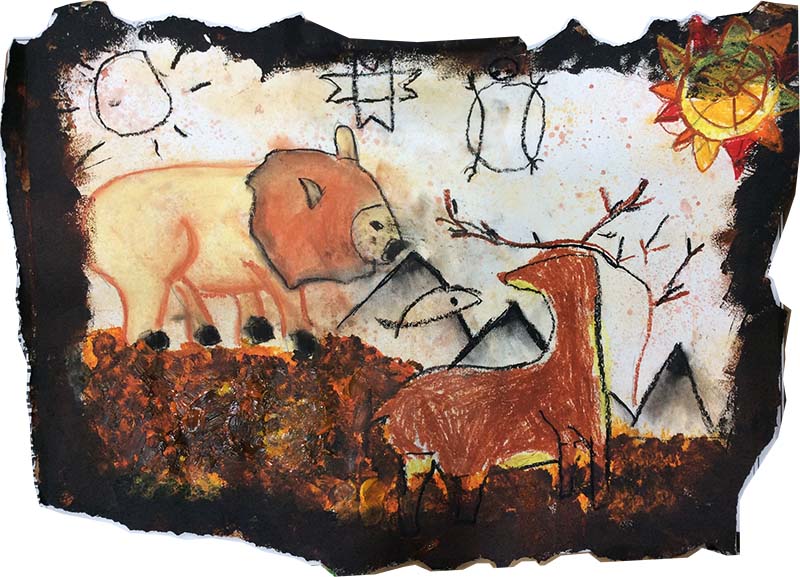
Hence, the cave became their point of reference, their realm of eternal childhood, more intimate than either school or home, their retreat of borderless imagination. Day after day on those barren walls within the dry darkness of their grotto-world, their imagination, so fertile because bubbling over with youthful turbulence, brought to life animal figures, first hewn with small chisels then painted with fingers (especially thumbs), or with sticks, brushed over with clumps of grass. No paint-brush was ever used. Their painting techniques remained those of prehistoric cave-artists.
Kenneth, well versed in rock painting from his school art classes and own research, chose the designs and advised Victor and Rachel how to apply the pigments. Each chose a section of the cavern to exercise his or her talents: Victor began to draw several cattle heads in the kirk with umbers that he ground and sifted from clay, boiled acorns, with their cups, and boiled mushrooms. It conferred to his cattle grey, tawny tones; tones that seemed to afford a glow of warmth to the cold walls.
Kenneth took charge of the western nave of the kirk, animating its walls with a big black cow, two galloping horses and two bison, all in charcoal black with a fringe of madder pigment. The plant had been gathered at the Annan riverside, then ground and sifted into a deep, crimson red.
As to Rachel, she applied her talent on the eastern nave wall with a two-metre long frieze of deer heads. Rachel also took charge of making a small fire to boil the plants and vegetables, whose steamed-juice transformed the plants or vegetables into liquid pigments. She poured the liquid into small glass containers and let them sit for one night before application.
“We’re like the cavemen who discovered fire,” Rachel said cheerfully as she steamed the plants and vegetables she had gleaned either from the forest or ‘borrowed’ from her mother’s kitchen.
“Not so, lassie. It was light that discovered fire, the cavemen merely rendered it physical,” corrected Kenneth smugly. Rachel shrugged her shoulders …
With his customary pedantry, Kenneth advised: “Don’t forget mates, painting doesn’t reproduce what is visible, but restores or renders what no one has ever seen.”
Rachel and Victor ignored him, chuckling to themselves.
They worked diligently in rhythm with the stillness of the cave, their imaginations soaring to the height and breadth of their lithic horizon. For they were careful not to surpass those limits, not to crowd the walls with too many figures. The roaming animals needed space to breathe and the young artists provided them with that vital space: horses trot … cows graze … deer gambol. Kenneth, after having examined a hunter armed with a bow in a book of cave paintings, added this figure to his zoological repertoire. The hunter had let fly an arrow and followed its flight towards something unknown. Kenneth had his arrow fly towards one of his elks. The posture of the hunter having released his arrow from a taunt bow was crudely traced then coloured in rusty ochre. It would be the only human representation of the grotto paintings.
All the paintings had been previously drawn on a flat surface of paper by Victor. Rachel arranged the positions of their depictions and the boys made mental notes of them before undertaking the actual wall representation. Kenneth had reminded Rachel and Victor that the intention of the artist was not to copy what they see but to express it, and that their undertaking should not seek a tawdry or fantastic effect, but a simple one, for simplicity is essential to true art. If they really hoped to convince the townsfolk of the millennial authenticity of their pictures, then this artistic canon had to be respected scrupulously.
Gradually the cave walls burst out into a magical menagerie: Victor’s two-horned aurochs, painted in umber came to life and Rachel’s deer-head frieze boldly gambolled out of the rock in striking shades of madder red. Rachel, applying a prehistoric technique, blew the madder pigment on to the wall through a straw, then smeared it roughly with her thumb or a feather.
The volume of their art thickened with vegetal and mineral glints as the volume of the walls, too, thickened with a phantasmagoria creatures depicted in a style they thought of as from stone ages.
Sometimes, the youngsters would dance and sing round the fire, recite poetry, or even compose a few verses of their own in joyful wantonness. “Our cave is the setting of an unfolding story, laddies,” Rachel giggled.
This pictural setting was indeed the fruit of their childhood imagination … and talent.
The day finally arrived when the cave-artists put the final touches to their masterpiece, an œuvre of considerable talent, even genius, given the lack of adult counsel and absence of light in the cave. For they had laboured as the prehistoric artist had laboured: by torch light (theirs, of course, electric!), and from the flames of their little fire’s chiaroscuro dancing upon the walls.
This being said, to divulge the discovery of the cave and its pictural contents would be a bit dodgy. They chose to wait several weeks to reflect on how they would announce their discovery. Kenneth, meanwhile, every now and then tossed dust on the pictures to harden and ‘age’ them. They lost their glint but the umbers seemed to strike the eye more prominently. They left nothing in the cave that would jeopardise their scheme. The ashes of their fire were swept into the well or used to tinge some of the figures in a rough, taupe grey.
Finally, on a clammy late Saturday morning, Rachel and Victor stormed into their parents’ home out of breath :
“Maw! Da! Come quick,” exclaimed Rachel red in the face. “We fund a cave.”
“Aye, a real deep cave full of animal pictures,” seconded Victor, sweating from the brow, either from exhaustion or fear. “You have to come to see for yourselves,” he insisted. “The cave’s not far off, near the riverside.”
Their mother and father, not very eager to tear themselves away from their armchair reading, nevertheless let their panting children drag them to the mouth of the cave. Once there, they all entered, the parents a bit warily. Victor, at the head of the expedition, led them down into the cave, scanning the walls with his torchlight which exposed several paintings. His father, unversed in cave-paintings, had, however, studied art at university in Edinburgh. The paintings intrigued him. His wife stood dumbfounded before such a vast array of art work.
“What striking pictures!” she exclaimed, staring wide-eyed in admiration as her husband illumined one section of the wall after another. Bedazzled by such parental compliments, Rachel felt an ardent urge to thank them. She checked herself. Victor remained quiet.
“Aye!” uttered their father reflectively. “This is certainly not a chambered cairn tomb. I’ll contact specialists immediately. Meanwhile, you two (indicating his children) get the school authorities to photograph the cave and the paintings. Even if they’re not authentic, they do make for a good story in the local papers until the police find the culprits who contrived this whole thing.”
“What do you mean not authentic?” asked Victor timorously.
“Well, you know, there have been art counterfeiters over the ages, but it takes time before the experts uncover their ingenious device.”
“What happens to them?” Rachel dared ask, eyeing Victor sullenly.
“They’re tossed into gaol where they rightly belong!” concluded their father, puckering his lips. Rachel winced at the word gaol …
When their parents had returned home, Rachel and Victor made a bee-line for Kenneth’s house, where they informed him of their parents’ reaction, especially the tossing into gaol.
Kenneth chuckled out of the corner of his mouth: “Keech[6] ! Minors aren’t thrown into gaol, goonies[7]. Nae, you know what they say: ‘Fools look to tomorrow. Wise men use tonight.’” Neither Rachel nor her brother really understood that point, but it did have a pleasant ring to their ears.
The following weeks were hectic ones for the youngsters both at home and at school. Pupils bombarded them with questions whilst at home the telephone never stopped ringing. All the thorny bramble, thistle and snapdragons had been cut away from the mouth of the cave allowing photographers to take pictures and journalists to examine the figures for themselves. Soon travellers from afar reached the cave to feast their eyes on these wonderful works of prehistoric art. During that feverish time no one dreamed that they had been drawn by our three adventurers …
Secretly the adventurers were delighted. And for good reason: they had their pictures taken in front of the cave by professional photographers, and had been interviewed not only by local reporters, but reporters sent from Edinburgh, Glasglow and even London. Experts had been contacted, seven to be exact, two of whom from London.
Kenneth brooded over the outcome. He sensed that the arrival of the experts bode ill-tidings. He knew they wouldn’t go to gaol, but, would they query of the age of the pigments however primitive their mixtures, their application and original whereabouts? Would they suspect foul play simply because, besides carved stone balls, prehistoric art work had never been discovered in Scotland? These men had very technical means to detect the precise date of pigments and their wall application …
All seven arrived together. Together they entered the cave brandishing large, powerful torches and miners’ helmets. Huge crowds had gathered for the occasion: photographers, journalists and even local writers swarmed throughout the surrounding hilly forests. Kenneth sat on a rock, his chin cupped in his hands. He felt miserable. Victor, wringing his hands frantically, paced back and forth near the riverside until his footfalls had traced a path. Rachel bit the ends of her hair nervously, casting furtive glances towards the thickening crowd. Dozens of people had been congratulating them on their find all morning.
“Would they congratulate us as much if they learned we were the artists?” snickered Victor sarcastically.
“Aye, I wonder,” Rachel responded drily.
“Bloody hell, why make things worse!” Kenneth snorted stiffly, staring at the backs of the crowd in front of the cave. “The whole thing was zany[8] to begin with. Those professors will be on to us, I’m sure.” All the three bowed their heads resigned to their fate in silent expectation.
The seven filed out of the cave with wry smiles difficult to decipher. A strange composition indeed: severe or cryptic … sharp or ironic … gruff or awe-inspired! No one appeared to be able to interpret those ambivalent smiles, especially our three young artists, who had by then stomped up the humpy hillside towards the murmuring crowd. Everyone present eyed the children in nervous anticipation as if they held the key to unlock those facial mysteries. Alas none had …
The experts pushed through the crowd and reached the standing children. One of them with a pointy beard and a sweet smile asked them very politely to lead them to the home of their parents where they would like to speak to them in private. Kenneth’s father ran up and immediately agreed to offer his home for their conference. Besides, it was the closest. He led the way through the fabled forest and over the heather fields. Arriving at the door, the pointy bearded expert informed Kenneth’s father that their conference was be held without parental intrusion. Had the father any choice ? Apparently not, for the front door of his humble home was shut quietly in his astonished face …
Now whatever took place behind the shut door of that humble home the ever-present narrator is, alas, at a loss to relate. For hours and hours and hours seemed to pass, and having reached the number of words permitted in this tale, it behoves him to abandon his readers to imagine the outcome … or the verdict themselves …
Paul Mirabile is a retired professor of philology now living in France. He has published mostly academic works centred on philology, history, pedagogy and religion. He has also published stories of his travels throughout Asia, where he spent thirty years.
.
PLEASE NOTE: ARTICLES CAN ONLY BE REPRODUCED IN OTHER SITES WITH DUE ACKNOWLEDGEMENT TO BORDERLESS JOURNAL
                  I
Johnny died a soldier
on a strange and foreign shore.
He'll ne'er be any older,
but twenty forevermore.

He loved his country, it was true,
he would defend his native land;
did not question what he must do,
but still he did not understand.

He knew there always must be war,
that a soldier's duty is to die;
yet yearned to know a little more,
could not really help but wonder why.

A piece of shrapnel pierced his brain;
they buried him there, or thereabouts;
buried him in the mud and rain,
along with all his fears and doubts.

                       II

'We are sorry to inform,' the telegram ran.
He was now a part of official losses;
no longer to be remembered as a man
but as a cross among ten thousand crosses.

Or as a name engraved on a monument
in some rural village square,
commemorating those in the regiment
who fought and died 'over there'.

'Fell this day in a just cause,
his life was cruelly slain.'
And so, through time, in all wars
the words remain the same.

Yes, still the words remain the same,
perpetuate the same, old story.
Too soon do we forget the pain;
a soldier's death is wreathed in glory.

                     III

This is the lot of a soldier --
better he has no name or face,
kitbag thrown across his shoulder,
consigned to some faraway place.

A soldier marches many a mile;
yet when he finally dies,
who can recall the warmth of his smile
or the colour of his eyes?

Those will there be who cherish his name,
who will remember him every day…
Till only a photo in a frame,
as, one by one, they each pass away.

Yes, Johnny died a soldier
on a strange and foreign shore.
He'll ne'er be any older,
But twenty forevermore.
From Public Domain
Stuart McFarlane is now semi-retired. He taught English for many years to asylum seekers in London. He has had poems published in a few online journals.
.
PLEASE NOTE: ARTICLES CAN ONLY BE REPRODUCED IN OTHER SITES WITH DUE ACKNOWLEDGEMENT TO BORDERLESS JOURNAL



 Borderless