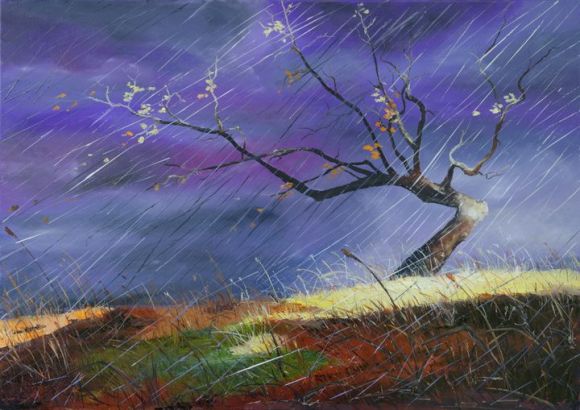
Storm in purple by Arina Tcherem. From Public Domain
If we take a look at our civilisation, there are multiple kinds of storms that threaten to annihilate our way of life and our own existence as we know it. The Earth and the human world face twin threats presented by climate change and wars. While on screen, we watch Gaza and Ukraine being sharded out of life by human-made conflicts over constructs made by our own ‘civilisations’, we also see many of the cities and humankind ravaged by floods, fires, rising sea levels and global warming. Along with that come divides created by economics and technology. Many of these themes reverberate in this month’s issue.
From South Australia, Meredith Stephens writes of marine life dying due to algal growth caused by rising water temperatures in the oceans — impact of global warming. She has even seen a dead dolphin and a variety of fishes swept up on the beach, victims of the toxins that make the ocean unfriendly for current marine life. One wonders how much we will be impacted by such changes! And then there is technology and the chatbot taking over normal human interactions as described by Farouk Gulsara. Is that good for us? If we perhaps stop letting technology take over lives as Gulsara and Jun A. Alindogan have contended, it might help us interact to find indigenous solutions, which could impact the larger framework of our planet. Alindogan has also pointed out the technological divide in Philippines, where some areas get intermittent or no electricity. And that is a truth worldwide — lack of basic resources and this technological divide.
On the affluent side of such divides are moving to a new planet, discussions on immortality — Amortals[1] by Harari’s definition, life and death by euthanasia. Ratnottama Sengupta brings to us a discussion on death by choice — a privilege of the wealthy who pay to die painlessly. The discussion on whether people can afford to live or die by choice lies on the side of the divide where basic needs are not an issue, where homes have not been destroyed by bombs and where starvation is a myth, where climate change is not wrecking villages with cloudbursts. In Kashmir, we can find a world where many issues exist and violences are a way of life. In the midst of such darkness, a bit of kindness and more human interactions as described by Gower Bhat in ‘The Man from Pulwama’ goes some way in alleviating suffering. Perhaps, we can take a page of the life of such a man. In the middle of all the raging storms, Devraj Singh Kalsi brings in a bit of humour or rather irony with his strange piece on his penchant for syrups, a little island removed from conflicts which seem to rage through this edition though it does raise concerns that affect our well-being.
Parichha has also reviewed a book by another contemporary Odia woman author, Snehaprava Das. The collection of short stories is called Keep it Secret. Madhuri Kankipati has discussed O Jungio’s The Kite of Farewells: Stories from Nagaland and Somdatta Mandal has written about Chhimi Tenduf-La’s A Hiding to Nothing, a novel by a global Tibetan living in Sri Lanka with the narrative between various countries. We have an interview with a global nomad too, Neeman Sobhan, who finds words help her override borders. In her musing on Ostia Antica, a historic seaside outside Rome, Sobhan mentions how the town was abandoned because of the onset of anopheles mosquitos. Will our cities also get impacted in similar ways because of the onset of global ravages induced by climate change? This musing can be found as a book excerpt from Abiding City: Ruminations from Rome, her book on her life as a global nomad. The other book excerpt is by a well-known writer who has also lived far from where he was born, MA Aldrich. His book,From Rasa to Lhasa: The Sacred Center of the Mandala is said to be “A sweeping, magnificent biography—which combines historical research, travel-writing and discussion of religion and everyday culture—Old Lhasa is the most comprehensive account of the fabled city ever written in English.”
With that, we come to our fiction section. This time we truly have stories from around the globe with Suzanne Kamata sending a story set in the Bon festival that’s being celebrated in Japan this week for her column. From there, we move to Taiwan with C. J. Anderson-Wu’s narrative reflecting disappearances during the White Terror (1947-1987), a frightening period for people stretched across almost four decades. Gigi Gosnell writes of the horrific abuse faced by a young Filipino girl as the mother works as a domestic helper in Dubai. Paul Mirabile gives us a cross-cultural narrative about a British who opts to become a dervish. While Hema R touches on women’s issues from within India, Sahitya Akademi Award Winner, Naramsetti Umamaheshwararao, writes a story about children.
With such hope growing out of a neolithic burial chamber, maybe there is hope for life to survive despite all the bleakness we see around us. Maybe, with a touch of magic and a sprinkle of realism – our sense of hope, faith and our ability to adapt to changes, we will survive for yet another millennia.
We wind up our content for the August issue with the eternal bait for our species — hope. Huge thanks to the fantastic team at Borderless and to all our wonderful writers. Truly grateful to Sohana Manzoor for her artwork and many thanks to all our wonderful readers for their time…
My name is Amina Salvador, 13 years old. I was born in the rural community of Santa Maria, Philippines. I want to share with you the events that prompted me to give testimony to the police. That day was the hardest day in my life. After it was done, two long months went by until my mother received the decision of the Prosecutor’s office, stating:
“A person here left unnamed raped me, while I was still a virgin. The charges against the perpetrator were two counts of rape of a minor by sexual assault and three counts of lascivious conduct.”
The course of my life changed abruptly when my mother Selina decided to leave for Dubai in search of work as a domestic worker. Before she left, she spoke to me with tears in her eyes, promising to give me a good future and proper home where I could have access to all the comforts of life, good internet access, and would be able to pursue my studies. She would also buy me new clothes and provide for adequate food so I would not starve.
My mother left me under the care of my father. He was 43 years old, a muscular and strong man. He worked as a painter for newly built church buildings. Initially, he started pampering me with fancy items, like trendy watches and expensive clothes. This might seem like he was an ideal father.
My mother is an attractive woman, rather plump, with a pleasant face. She had a difficult life. Her parents were poor and not able to give her an education. Now, she is 40 years old.
It was by accident that I found out that my mother ran away from my “father”, the man she had married. After daily beatings in the hands of her alcoholic and abusive husband, she had no choice than to go south where her parents lived.
With a small bag of clothes and photographs of the five young children she had left behind with her abusive husband, she returned to her hometown to start afresh. At the time when all this drama was unfolding, I was still not born.
I heard that I was conceived when my mother fell in love again with another man who promised her to love and protect her. I suppose that I came into life as the sweet fruit of that promise. It didn’t take long, however, for her to discover the true character of this man whom she saw as a savior from her former abusive husband. It turned out that her boyfriend was a womaniser and a very jealous person. He too was another wife-beater.
As a result, my mother ran away a second time, with a three-month-old baby growing inside her. Feeling she had nobody to turn to, she returned to the cruel husband she had left some months ago. In this way, my mother continued her old subservient life.
I was born in a dilapidated clinic in our town, and three months later I was baptized as Amina Salvador. I took my mother’s husband family name. Anselmo Salvador was the father I got to know while growing up, until my mother, black and blue from physical abuse and humiliation, fled once more. Sad to say she ran away once more to her previous lover boy, the jealous and cheater one. Are you confused by now?
I am too young to understand what was going on inside my mother’s head. All this time I just kept quiet and did not ask questions about adult matters. As a young girl, I just wanted to play with my friends, go to school, and be myself. I still considered myself a normal kid.
Dark clouds started to form a few days after my mother flew out to Dubai. As I told you before, my mother entrusted me to her live-in partner. As you remember, previously my mother had left her lover already pregnant with me. It turns out that Solomon, yes him, is my real father. That is what my mother thinks and I have no right to refute her own truth. I was only 7 years old when she and I took a long bus ride back to her old lover boy. She held my left hand tight when we reached Solomon’s house.
The fights between her and Anselmo, and her and Solomon left a lasting impression in my young mind, yet I could not understand the causes of all of this. I suppose I was just caught in the middle of some nasty adult fights, whether I liked it or not.
I remember exactly after I said goodbye to my mom at the airport, my papa started abusing me. I woke up once in the middle of the night feeling his hands sitting on me. I was crying almost every night. I didn’t tell anyone what was going on. I was too ashamed to talk to anyone. I felt dirty. I lost weight and became more reserved.
I tried to reach out to my mother, but my monster papa was controlling my cellphone and my Facebook account he had created himself. He interfered with the messages I tried to send out. I have no idea how on earth he did this.
My harrowing experience went on and on for several months until I finally got a chance to message my mother. I did not know what to say. I simply wrote, “Is it right for may papa to kiss me on my lips?”
Instinctively, my mother felt there was something completely wrong happening to me. She asked her sister, my aunt Lenny, to take me away from my papa’s house. Aunt Lenny took me to her house and stayed with me until my mother’s immediate return from Dubai.
I am in safe hands now, under the protection of my mom and aunty. My dad was arrested and is now in prison, currently applying for bail. Prior to his arrest, he posted sexually explicit materials about me and my mom on social media, exposing me and my mom to shame in front of our extended families and friends. He also tried to kidnap me at school before my mother could return from Dubai. He orchestrated a smear campaign against me to make me appear as a flirt and a lose girl. It was terrible.
I am relieved that he is in prison right now, although he is begging my mother to withdraw the charges against him in exchange for money, and all kinds of tricks to make us back down and settle out of court.
While I am happy to see the monster in prison, my mother has a different idea. She wants to protect me from the prying incursions of the court. She knows that my case may take a year or more to conclude. She keeps telling me that she just wants to me to move on with my life. She also plans to go back to Dubai to make some money so she can support me and the rest of my siblings from my other father. I tell her, “It’s up to you, mama.”
You see, I am traumatised like my mother, but I am trying to convince myself that what happened to me should not define who I am. I can’t be in a similar situation like my mother is. It is sad to say that while we are still busy with my legal case, she has met another man. At first, he appeared gentle and kind, but lately, I overheard him cursing my mother over money squabbles. So, what can I say. It’s her life.
I choose not to be broken by my story. I will fight the demons in my head. I know it won’t be easy. I will show my mother that there is another way to live, and it is to love myself.
.
Gigi Baldovino Gosnell has degrees in Psychology and Education. She lectures in Psychology, worked in various NGOs, and the public service in the fields of women empowerment, land reform, social development and local government.
.
PLEASE NOTE: ARTICLES CAN ONLY BE REPRODUCED IN OTHER SITES WITH DUE ACKNOWLEDGEMENT TO BORDERLESS JOURNAL
August in Kabul:America’s Last Days in Afghanistan and the Return of the Taliban is a real-life account of a journalist who returned to Kabul from Dubai to be with his “friends”, to let them know that their well-wishers had not abandoned them, even while the American forces withdrew and the Taliban took over. Most, including President Ghani, were flying out of Kabul while acclaimed photojournalist who had spent eight years there, Andrew Quilty, flew back from Dubai on 14th August, 2021.
His account traces the history of the takeover, the inception of the Taliban, the reactions of the people to their earlier regime dating from 1996 to 2001: “The Taliban were initially welcomed there, and many young, uneducated male residents, enamoured by the group’s piety, joined their ranks. But to Soviet-era communist officials, senior Hezb-i Islami figures and those with tertiary educations or financial means, the Taliban’s devoutness foretold merciless intolerance, and they left the country, travelling to the West through costly smuggling networks or to neighbouring Pakistan or Iran, joining the millions who had moved there during the Soviet war, as refugees.”
He is vocal about the Doha Agreement made by the Trump regime and executed by Biden, where the handing over left gaps which caused suffering not only among foreigners but also the local population of Afghanistan. Citizens died trying to find safety for themselves and their loved ones. Chaos prevailed and both Taliban forces and American soldiers killed innocents. With more than hundred interviews, Quilty brings the plight of these people to light. What touches the heart in this narrative is the human suffering caused by political games and beliefs. This has been captured well in the account.
That the current acknowledged rulers of Afghanistan, the Talibans, have reverted in certain senses to their past stance, especially pertaining to a major issue, the freedom of women has been acknowledged. But is this an issue that is related essentially to Taliban only or does it run deeper within the culture? Through the narrative of a young girl, Nadia, the author relates the equation for Afghani women: “Preserving the safety of women is a common sleight of hand used by Afghan men to keep those within their family under control. Neglecting such a duty and allowing a young woman the freedom to walk when they wish in the streets, to socialise with unrelated men, and to develop their understanding of the world outside the home and their ideas about their place therein, is deduced by many outside the immediate family to imply the woman is what Nadia refers to euphemistically as a ‘bad girl’. Boiled down, a ‘bad girl’ is one who cavorts and sleeps with men out of wedlock—a prostitute in Afghan terms, a great stain on a family’s honour. To avert such a possibility, rather than confront those who deliberately misinterpret the young woman’s ways and use it to undermine her family, instead, her brothers, father and male members of the extended family more often elect to restrain her behaviour.”
Women are not the only victims of a society that balks at liberal or out of the box thinking. The book is an eye-opener and reveals how the events of that August unfolded in 2021. It was an amazing coincidence that the takeover was completed on a date that coincided with the Independence Day celebrations of its neighbours, India (15th August) and Pakistan (14th August).
This account varies from an earlier account of Afghanistan written almost a century ago in its tone – that was humorous essays, a memoir by Syed Mujtaba Ali translated by Nazes Afroz from Bengali, called In a Land Far from Home: A Bengali in Afghanistan. This is a journalistic account. But one thing that runs through both the narratives is the bonding both these writers experienced with the locals, perhaps a bond born of friendship with people who have lived in oppressed communities and the need to get the world to hear their voices. The social norms still sound the same with wild gun shots marking celebrations. But what was not mentioned in the earlier were the scars left by Soviets and American weapons – because Mujtaba Ali’s account ended at the start of the civil war (1928-29), long before the superpowers intervened in a major way, even though the then-ruler Amanullah Khan (1892-1960) had abdicated and escaped to British India.
Andrew Quilty in Kabul. Photo provided by Quilty
Andrew Quilty who gives a splendid coverage of the current scenario, had been in Afghanistan since 2013. He is the recipient of nine Walkley Awards, including the Gold Walkley, for his work on Afghanistan. He has also received the George Polk Award, the World Press Photo Award and the Overseas Press Club of America award for his investigation into massacres committed by a CIA-backed Afghan militia. In this conversation, Quilty tells us more about the writing of the book and his own responses to the change in regime and the takeover, and most of all what made him return to a conflict zone.
What made you return to Kabul, when others were fleeing from a Taliban takeover?
There were two things: as a journalist and photographer, the days ahead of when I decided to return to Afghanistan were going to be the country’s most pivotal since the US invasion in 2001. Having covered the country for eight years at that point, despite the risk, I really wanted to be present to cover the period that was to follow. But more than that, at the time I really just wanted to be with my friends, both foreign and Afghan, with whom I had experienced so much with in the country over the years leading up to August 2021. While many of my Afghan friends felt the international community was abandoning them, I didn’t want them to feel their friends had as well.
In your ‘Epilogue’, you tell us that the book turned out to be different from what you had thought it would be at the start. What was it that you had wanted to start with and how has it departed from the way you had visualised it earlier?
I had envisaged writing a book about the way international military special forces had, through their tactics of night raids and air strikes, turned much of the rural Afghan population against the central government and the US-led military coalition.
You are a well-known photo-journalist and yet your book is written only in words. Why did you opt to use words instead of photographs this time?
I am currently working on a photo book that will cover the entire time I spent in Afghanistan (2013 – 2022). But my photos of the events of 2021 alone wouldn’t have been sufficient to tell the story of what happened in the detail the way words can.
In the twentieth century, a book had been written by Syed Mujtaba Ali in Bengali and translated by a journalist who was in Afghanistan, Nazes Afroz, talks of the dislodging of Amanullah by Bacha-ye-Saqao (Habibullah Kalakani) during the civil war. Can Bachai-ye-Saquao be seen as some kind of a precursor to the making of Taliban? Please elaborate.
Not really. He was of Tajik descent and so didn’t have the support of the majority Pashtuns. Also, his rule didn’t even last a year. The Taliban that took control of Afghanistan in 1996 are a closer replica of the Taliban that took control of the country in 2021 than Kalakani.
Afghanistan seems to be a country torn by the politics induced by Cold War, which of course is said to have concluded now. How would you compare the Soviet intrusion from 1979 to 1989 with the recent American intrusion which concluded with the Taliban takeover? You have mentioned how bio warfare by Soviets ruined the countryside. Please elaborate.
There are a lot of comparisons that could be made. Both the Soviets and the US-led coalition had superior technology, equipment and training. The Mujahedin and the Taliban (whose fighters call themselves Mujahedin) had poor quality weapons, funding and training, but they had a motive to fight that invading nations could never match. The nature of the style of warfare they used also made them very hard to defeat — ie. an insurgency that lives among the population, whose fighters are very difficult to distinguish from the local non-combatants.
Reading some of the case stories that you have taken up in your non-fiction, the oppression of women seems to be an accepted social norm in Afghanistan and persisted before the current invasion of the Taliban. Can you please comment on this?
While there were improvements for women in Afghanistan after the Taliban were ousted in 2001 — education was once again permitted, they were allowed to work in all sectors of the workforce and allowed to own property etc. — across much of the country, especially in rural areas, many women’s lives were still highly restricted by conservative cultural norms. Despite the constitution giving women many more rights than they had previously, culture often overrode the law. That said, the Taliban have now enshrined the most conservative interpretation of cultural norms in law, and so for those families who had permitted women to live under the more permissive post-2001 laws, the choice is no longer theirs to make.
One of the major issues one gathers from various narratives as well as yours in Afghanistan is not only the lack of freedom to women but also extends to freethinkers. Is this a cultural issue, religious issue or Taliban induced?
I think this is more about stamping out dissent as well as ideas that don’t conform to the Taliban’s worldview, like communism or democracy for example. So, it’s both religious as well as a means for the Taliban to enforce those under their control to follow their very strict worldview.
The Taliban destroyed the Bamiyan Buddha. Have they changed since then to become more accepting of diverse thought?
I had hope that they might be. Most Afghans cautioned my optimism, and they seem to have been proven vindicated. While the Taliban haven’t yet destroyed any cultural heritage like the Buddhas, it took them five years in control to do that in 2001. The way they have rolled back rights in the 18 months they have been in control, it doesn’t bode well for what the next few years will bring. So far, however, they don’t seem to have been targeting ethnic minorities specifically or systematically.
The Taliban had taken control once earlier to be driven out by Americans in 2001. Can you tell us a bit about the origin of Talibans? Are they the same as Mujahedins?
The Taliban emerged from several groups that, combined, were known internationally as the Mujahedin. Once the Soviets left Afghanistan in 1989, the seven Mujahedin factions fought for control of the country. The Taliban, whose fighters were mostly drawn from religious madrasas, and known to be better-disciplined than the other lawless factions, promised to bring order to the country. Initially they were welcomed.
Photo provided by Andrew Quilty
You had moved to Afghanistan in 2013. Would you think of returning there now? Why?
I hadn’t planned to live in Afghanistan. Initially I went for two weeks to photograph the Afghan cricket team for an Australian magazine. I only planned to stay two weeks but quickly fell in love with the country and my work there and stayed nearly a decade. I have no plans to return as yet, but it will always be close to my heart, and I would love to return one day when it feels right.
Are you planning more books in the future? On Afghanistan?
Yes. As I mentioned, I will publish a photo book on Afghanistan later this year with Melbourne University Press. After that, let’s see.
Thank you for your time.
(This review and the online interview conducted through emails are by Mitali Chakravarty)
Time

Time is a strange entity, you can't see it,
But it shows you a lot, you can't sense it,
But it teaches you a lot.
Time heals many wounds,
Frustrates some beyond healing.
The best time to act is now,
For yesterday is writing on water,
Tomorrow written on clouds,
Only today is written on solid walls.
Ashok Manikoth was born in 1956 in the coastal city of Visakhapatnam in Andhra Pradesh, India.Ashok is now residing with his family in Dubai, UAE.
.
PLEASE NOTE: ARTICLES CAN ONLY BE REPRODUCED IN OTHER SITES WITH DUE ACKNOWLEDGEMENT TO BORDERLESS JOURNAL
The call for fajr from the local mosque
Pierces the stillness of early morning,
The sruthi box in the puja room stirs awake.
It is dawn in Calicut. The house is quiet, except for the muffled sound of water from the washroom, where my aunt does her ablutions before prayer. She shuffles her way into the puja room and hurriedly shuts the door, careful not to let even a slice of light escape the room and disturb the rest of us. For the next hour, she will be in deep meditation.
Across my bed, I see Amaama. Wisps of white hair framing her toothless mouth, she seems peaceful. Sleep didn’t come to me easy the previous night. A long journey back home and the sudden shock of seeing my grandma succumb to inevitable illness, leaving both her mind and body fragile, have rattled me. I watch her, drifting away in the land of nod.
As the sun peeks out reluctantly from the rain clouds, she wakes up. She looks at me, a question mark on her face. “Do you remember me, Amaama?” I ask. She nods, but when I ask her to tell me my name, she mumbles. I realise that I have become unrecognisable to her. Even after watching her struggle with her memory for the past two years, this upsets me.
My aunt makes idlies for breakfast. I offer to feed Amaama idlies and sugar. It is the food of infants, but it seems like she is a helpless child all over again. After an hour, she quips in a plaintive tone, “I haven’t eaten anything.” We make her a cup of Horlicks and she smacks her lips appreciatively while sipping on the sweetness of the malt.
I spend the day sitting near her bed, reading, in an effort to forget the maze of memories that cloud my mind. I also feel vaguely guilty, though I can’t really tell why. Should I have called her more often when I was away? Should I have been more affectionate to her when she could remember? Could I have been a better grandchild? The regrets pile on, one after the other, and then I understand that the root cause of my guilt is the startling realisation that I never got to know Amaama as a person. All my life, she has been Amaama. What was she like as a child? What was she like as a young woman? What made her happy? Did she have any regrets? I will be in Calicut for the next two weeks and I determine to make use of that time to understand more. I speak to my aunts, pore through old photographs, try talking to Amaama herself.
*
A little girl in pigtails and pinafore
Finds the greatest joy
In knitting needles and yarn.
My grandmother, Saraswathi Menon, was born in 1932. Her ancestral house is in a village called Kalapatti, in the district of Palakkad, in the foothills of the Western Ghats of southern India. Sarasu, as she is known to her family, was the fifth of seven children. Her father was an inspector in the public works department of the Indian Railways. The family moved between Tuticorin and Sucheendram, two towns on the tip of the Bay of Bengal, and Sarasu grew up in relative affluence. The first brush with hardship must have come at the age of eight, when she lost her mother, who at that time was hardly thirty-three.
Sarasu’s paternal aunt helped raise her, and she moved back to her hometown in Kerala with her younger siblings. As a teenager, she developed a lifelong interest in embroidery and knitting, spending all her time with her knitting needles and balls of yarn. She did not pursue studies after her high school matriculation exams; she did not pass the English examination and did not want to place a burden on the family’s dwindling finances by making another effort.
A memory of Amaama urging me to study flashes across my mind. At that point, she had self-deprecatingly joked that she had no buddhi and that’s why she didn’t study further. I think back and often marvel at how Amaama still aced the many challenges that life presented her, despite this lack of formal higher education. To think of the person she could have become with the right opportunities…
Barely out of her teens, Sarasu returned to Tamil Nadu, as a newly married bride. This time, she found herself in Trichy. I look at Amaama sitting in her bed, propped up by pillows, listening to a version of the Ramayana rendered by Kavalam Sreekumar. I try to jog her memory, and surprisingly, she offers a story of her Trichy days. Her eyes well up as she mentions hopping onto rickety buses that took her to the Rockfort temple and the Sriranganathan temple on an island in river Cauvery. She smiles as she remembers an old lady who taught her how to make murukku and other delectable goodies that she treated her daughters to after a long day at school. She remembers getting married to my Thatha, and accompanying him to the various towns that his job as a sales engineer demanded.
I try to ask more questions, but Sarasu’s spark has disappeared now, and Amaama cannot remember anything else. She can remember events that occurred more than thirty years ago, but she cannot remember what she ate this morning — how treacherous is this mind!
As Kavalam Sreekumar sings in the background, my aunt quietly tells me of Sarasu’s first born child — it was not my aunt, as I had always thought. Sarasu’s first born was a boy; they named him Ravi but they lost him to smallpox at the age of two. This news startles me again — how had Amaama coped with the loss of her only son all those years ago? He would have been the brother my mother never had. How little do we really know of those close to us!
Life blessed Amaama and Thatha with four other children, all of them girls. My aunt talks about the ridicule and pity heaped on her parents, Amaama in particular – “Four girls! No sons! How will you raise four girls?” They raised them with love, making numerous sacrifices, instilling in them courage, confidence, compassion, and a sense of fierce dignity, a determinedness to be independent. It is a testament to Amaama’s sacrifices that all her daughters, and by extension, us — my cousins and I — have reached so far.
*
Coffee stains on the table
A jumbled-up algebra problem
Anger turns into a ghost of regret.
The day has come to an end. I have learnt new things about Amaama’s life, and I can now see a glimpse of Sarasu, behind the shadow of Amaama. My mother lights the lamp and takes it to the entrance of the house, chanting “Deepam, Deepam!” It is auspicious to keep a lit lamp at the door front at twilight. The air is alive with the buzz of mosquitoes. Amaama is awake. I venture to sing an old bhajan which she used to love. She smiles, she seems to recognise the song, but she still cannot recognise me. Memories spring up from the cobwebs of my mind.
It is supposed to be a holiday for Amaama. Two months in Dubai with her youngest daughter, my mother. I am in grade 10, at the peak of schoolgirl rebellion. A few weeks before the all-important board examinations begin, we have study leave. With my parents away at work, I find myself alone with Amaama.
One morning, I am working on algebra, timing myself to see how quickly I could finish a sum. I hear a cup of coffee being knocked over in the kitchen, but I pretend not to hear. Amaama calls out for me, but I ignore her. When she calls me a third time, I can no longer ignore her, so I stomp into the kitchen, sulking. Not saying a word, I mop up the coffee stains, and slam the microwave to warm another cup of coffee from the flask.
Amaama has not spoken a word about my unreasonable behaviour. I know I have reacted badly, behaving like a spoilt child, but a false sense of pride keeps me from apologising. I hand her a second cup of coffee and try to study for the rest of the day. It is a completely useless day; my anger has now turned to regret and guilt.
When my parents return from work, I observe Amaama speak with them. Will she snitch on me, complain about the brat they raised? She remains quiet, does not say a word about me; instead, she asks them about their day and tells them about gifts she wants to take back from Dubai. I feel uncomfortable. I would have felt better if she had reprimanded me instead.
That night, I toss and turn in bed. Amaama and I share a room, and I hear her sob quietly into her pillow. Guilt engulfs me. I reach out to hug her and I begin to cry too. Amaama turns over and asks what is upsetting me. Exams, I mumble, not wanting to apologise. She hugs me tight and says “What is there to worry? You’re such a midukki kutty. God is always with you!” I sob into the softness of her sari and she says, “I was wondering why my midukki kutty doesn’t like me anymore!” I reply in my garbled Malayalam that I would always love her, but I still did not apologise.
Forgiveness has always been Amaama’s best friend.
*
Barefoot pilgrims walk to Pandharpur
Saffron flags fluttering in the wind
“Vitthal! Vitthal!” The palkhi bearers chant.
It is pilgrimage season in Maharashtra. Visiting my aunts in Mumbai after ages, we arrange for a trip to Shirdi. A road trip will take us at least six hours. Amaama cannot sit in a car for that long. We decide that the Shirdi trip can wait, but Amaama insists that we do not cancel on account of her. “I’ll stay alone. Will keep myself busy with TV and my books. And anyway, Padma will come for a few hours in the afternoon, so I won’t be lonely”, she says. I wonder what sort of conversation our Marathi speaking helper will have with Amaama whose vocabulary in Hindi (leave alone Marathi) does not extend beyond Kaise Ho! I tell my parents and aunts to go ahead, and I offer to stay with Amaama. “Nothing doing, you have to go see the Baba at Shirdi!” Amaama insists. I slowly understand where my mother gets her stubbornness from.
We set out at dawn the next day and reach Shirdi a little ahead of noon. We spend the next few hours in the temple town, offering our prayers, and soaking in the meditative stillness of the masjid where Baba lived — it is a salve to a weary heart. Before dusk sets, we leave Shirdi. We whizz past fields of sugarcane and cotton, growing in abundance, on the rich black soil of these lands, stopping for a quick cup of tea at Igatpuri. There is a thick shroud of mist, and my mind keeps wandering back to Amaama. What could she be doing, all alone in that flat?
We reach home an hour before midnight. The Matunga neighbourhood is quiet. Amaama is in her chair by the puja room, reading Narayaneeyam. “Did you get scared, Amaama?”, I ask. She shrugs away the question and asks me back, “What is there to get scared of when I have God by my side?” Faith has always been Amaama’s best friend.
*
The Nilambur river quietly chugs along
Through hills and fields and forests
And merges into nothingness at Beypore.
It has now been three years since Amaama finally succumbed. Watching her struggle through ill health, losing control of her mind and memory, has been an excruciating journey for all of us. Ironically, death seemed to free her, release her from the terrible pain she endured for a few years. When I miss her a little too much, I turn to my phone which had faithfully captured a Boomerang video of her making a dosa when she was in better health. It reminds me of better days in the past when she would make bite sized unniappams, as dainty as the dimples on a toddler’s fist. Sometimes the grief of losing her is too much to bear. I think of a story I read as a child — something about a magic pot which kept cooking porridge for a hungry family. The family gobbled up the porridge, but the pot simply would not stop. It kept cooking porridge, till the porridge overflowed and flooded the entire city! Sometimes, my grief is like that. But then, I look at the photo of Amaama by my bookshelf. A sparkle in her eyes, and a half smile on her lips, she looks the picture of equanimity.
Many dawns have now passed by in that house in Calicut. Sometimes, during the monsoon season, I gaze at the grove of coconut trees outside. The wind rustles the coconut palms and the foliage sways, like dervishes drunk on divine nectar. Sometimes, a bubble of calm quietens an intense battle in my head. Sometimes, instead of holding onto an angry thought, I just let go, like the Nilambur river. In those times, I feel as if Amaama is watching me, from somewhere, where she is reunited with her beloved Krishna, where she can forever listen to the lilting melody from his flute, where she can watch him play by the Yamuna river. In those times, I feel as if her prayers and love have formed a protective shield, an invisible amulet protecting me from all perils. Love has always been Amaama’s best friend.
Glossary
Fajr – The first of five Islamic prayers, also known as the dawn prayer
Sruthi box – An instrument used in Indian classical singing to help tune the voice
Puja room – A shrine room for worship, religious rituals, prayers, and meditation in a Hindu household
Amaama – Malayalam word for grandmother
Idlies – Steamed rice dumplings, traditionally eaten as a breakfast dish in south India
Buddhi – Malayalam word for intelligence
Murukku – Savoury crunchy snack made from rice flour and lentils
Thatha – Tamil word for grandfather
Deeepam, deepam – The word “deepam” means lamp in Malayalam. In Kerala, at dusk, women carry lit lamps to the entrance of the house, chanting “deepam, deepam” in order to invite light and auspiciousness into their homes.
Midukki kutty – Malayalam term for smart girl
Vitthal – Form of the Hindu god Vishnu or Krishna, as he is known in the state of Maharashtra
Palkhi – Marathi word for palanquin. In this context, the verse refers to a yearly pilgrimage where devotees carry the sandals or padukas of the saint Dnyaneshwar from his shrine at Aalandi to the famous Vitthal temple at Pandharpur. The barefoot pilgrims carry the padukas in a wooden palkhi and the journey takes around 21 days by foot.
Shirdi – A town in Maharashtra, which is the home of Shirdi Sai Baba, a revered fakir or saint
Kaise ho! – Hindi phrase for “How are you?”
Narayaneeyam – An epic poem, comprising of 1,035 verses, narrating the life of Lord Krishna. The poem was composed in the 16th century by Melpathur Narayana Bhattathiri, a renowned Sanskrit poet hailing from Kerala.
Unniappam – Sweet dumplings made with rice, banana, jaggery and coconut
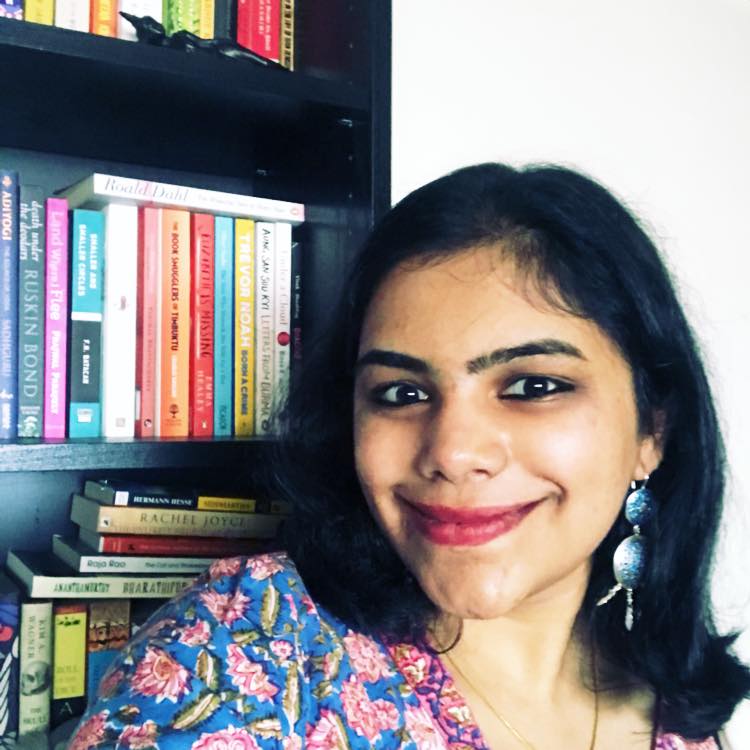
Krishna SruthiSrivalsan is a chartered accountant by profession and is passionate about books, writing, travel, and celebrating diversities, not in any particular order. She firmly believes that human beings should not strive to “fit in” when they are designed to “stand out”. She reads on a variety of subjects and genres and hopes to publish a novel someday.
.
PLEASE NOTE: ARTICLES CAN ONLY BE REPRODUCED IN OTHER SITES WITH DUE ACKNOWLEDGEMENT TO BORDERLESS JOURNAL
The month of May in 1984. Schools closed, scorching summer heat and best of all, the trip to Lucknow, where the family of five went every summer vacation, without question. Riha, all of seven years old, was ecstatic to have reached her grandparents’ house after the two-day long train journey. The house appeared to be as large as a palace to her. Much bigger than their two-bedroom house in Bombay.
That, however, paled in comparison to this –- the most perfect of all homes to Riha’s young eyes. The aangan* in the centre –- bigger than their private terrace –- with rooms all around, a green garden patch with the open water tank, dank, green water whose depth could not be fathomed by her and which, through an unerring child’s instinct, she kept at a safe distance. The steep, curving staircase with treacherous and oddly angled steps leading up to the roof which secretly scared her; which she was vaguely aware she took much longer to ascend than her cousins who lived here. But once conquered, you were on a long roof with a view of the neighbourhood – and the room on the roof. (This was the best of all houses!) Surely haunted, but only after dark as per her childish logic.
Many years later, when she visited the same house in her mid-twenties, in what was to be her last visit to it – she saw the house just as it was – crumbling and old, destined to be pulled down and replaced by a taller, sleeker rectangular block, having permanently divided the family over its sale proceeds. The staircase which had intimidated her as a child was just ordinary. Mixed feelings and some regret – perhaps she would have preferred those childhood memories to the reality of this crumbling, derelict version.
But this story is about one of the magical days from all the summers spent in that city and of only one of those many mornings. A morning from a riotous summer for Riha along with her two siblings, and five cousins that lived here in the hauntingly enchanted city of Lucknow of the eighties as viewed from the vinyl covered cycle rickshaw seat. The driver laboured over the pedals in a mesmeric rhythm, navigating impossibly narrow streets, cows, street dogs, people, the occasional cars, tempos and handcarts and the noise that was always a part of the city – the shouts, honking, bleating of goats, mingling with the call of the azaan*.
Riha was a happy, confident and an attractive child and though she would vehemently deny it later; citing ‘middle child’ as her defence; perhaps a little pampered by her aunts and uncles here. She woke early with anticipation for the promised outing – utterly excited that they were having an Enid Blyton style morning ‘picnic’, complete with a wicker basket full of buttered buns, the sweet milk bread which she loved and a rajai* and a bedsheet to spread on the grass. They had to go very early, to avoid the dreaded loo* and the heat, which didn’t bother her, but which was just a convenient excuse for her elder cousins and aunts to not play catch or hide and seek with her during the afternoon.
That morning they were approaching the gates of ‘The Residency’, in quite a grand procession of two cycle rickshaws hired in addition to the spotlessly clean and sparkling white Ambassador belonging to her ‘Advocate’ grandfather. Riha was sure they would be the very first visitors here as she had awoken at an impossibly early hour, so she was surprised to see a few people already there –- walking about with dogs on leashes.
They walked quite far from the entrance, on wide green rolling lawns, way past the museum and dungeon, quite close to another set of ruins –- just walls with no roofs bordering unkempt taller grasses. The bedsheet was rolled out, basket deployed and after a while as it got sunnier and sunnier, without quite knowing how, Riha had soon wandered into the semi-walled ruins to explore the ground for unusual stones and wild flowers, her younger brother Aahan trailing behind her as usual.
She smiled at the other girl she saw there, enchanted by her blonde hair – “Hi! Are you here for a picnic too?” she asked, arrested by the lovely crisp white lacy and ruffled “birthday dress” the other girl wore. Only birthday dresses were so beautiful! Riha looked down at her own blue cotton dress, which she had worn a lot many times.
“You’re so lucky your mother let you wear your party dress!” Riha said. The other girl looked down at her dress and that’s when Riha noticed the ketchup patch all down the front of the lovely white dress. Exactly where she had once stained her dress while eating pakodas* with ketchup when her impish younger brother had jolted her arm. She felt immediately concerned and sorry for her –- she knew her mother would be upset and if her mother was anything like hers, there would have been good chances of receiving a stinging slap for messing up her party dress like this.
“Is that your brother?” the girl asked.
Riha nodded. “My brother is here too.” Riha moved closer but could not spot the other boy –- hoping he could be a playmate for her brother. He must’ve wandered off.
“Who’re you talking to?” said Aahan. Riha rolled her eyes knowing her brother was annoying her as usual.
“How rude, Aahan!” She looked at the girl, sharing the – ‘younger brothers!’ look. “Sorry about him… I’m Riha, what’s your name and why don’t you come and play with us?” she invited, frowning at Aahan.
“I’m Mary. Look,” she pointed across the greens, “My mother is calling us –- I have to go.”
Riha could not quite spot which of the women in the far distance Mary was indicating, but she was not happy at the thought of losing a newfound playmate.
“I’ll walk with you till you find your mother and we could ask her permission to play with us – we are a big group here,” she confidently proclaimed.
“Okay, I’ll ask her, maybe we can meet near the museum after some time,” smiled Mary.
“Okay, bye!” shouted Riha, happily.
Riha looked around for Aahan but he must have run off earlier. As she left the ruins, she saw her aunt halfway there, calling her to come quickly away from the dangerous ruins.
“They’re not dangerous at all!” scoffed Riha.
“Who were you talking to?” her mother asked. “Aahan said you were trying to scare him by pretending to talk to someone.”
Riha plonked herself down on the sun-soaked sheet and glared at Aahan. Why were younger brothers such pests? Describing the encounter, she couldn’t resist remarking how the other girl had been allowed to wear such a nice dress to a park. “But didn’t you say she’d spilled ketchup on it?” retorted her mom.
With the elders finding it too hot, it was time to leave but Riha insisted on stopping by the museum to say goodbye to Mary and dragged the whole family there. After waiting for a while it was clear no one was coming there and Riha was reluctantly made to leave, with promises of one more picnic there for sure.
Now, years later, sitting on the sagging charpai*, under the bright stars that evening in that old house, the moment triggered a memory of the picnic to the Residency. In her teens she had been quite intrigued by the history of the place and read about the slaughter of the British families including women, children and babies there during the siege of 1857. She remembered quite vividly that evening years ago, cuddling on her grandmother’s roomy lap on the same charpai.
Naniji* had surprised her by asking for a detailed account of the girl she had met. In Riha’s world, that morning was already firmly in the past. Her grandmother was quite interested in the ketchup stain too. Later, she had noticed the elders having a discussion in whispers and looking at her.
Annoyingly, Aahan was allowed to hover around them or perhaps they hadn’t noticed. He had then galloped up to her and shouted in glee, “See, I told you, you met a ghost! That was not ketchup, it was blood!”
.
Glossary:
*Aangan = an inner open courtyard
*Aazan = Islamic call to prayer
*Rajai = block printed comforter/ duvet
*Loo = hot and dry summer wind
*Charpai = traditional Indian woven bed
*Nani – Maternal grandmother, ‘ji’ a respectful suffix
.
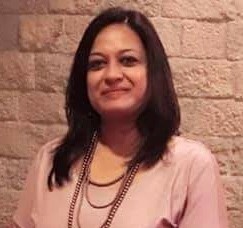
Rakhi Pandeheads the English department at a British curriculum school in Dubai, UAE. She segued into this profession after quitting her erstwhile post as General Manager in the field of brand management in India. Having spent her formative years in Mumbai she has spent a decade in each profession before exploring greener pastures abroad. An avid reader and award-winning educator, while dabbling with blogging and other creative pursuits, she tries to write whenever time permits. Hopefully, there’s a book in her.
This feels so dystopian. The world today. The television streaming clippings of people, suddenly thrown out of work and asked to leave, to go back to wherever; just leave. Isolation is the keyword, it seems. Lock yourself in your homes, if you don’t have a home somewhere; in a drain pipe, a hole, a box anywhere. Just leave they have been told. They have been let down by the cities of their dreams, the people they worked for, the world collectively. Can we do anything about it? Nothing! And we hang our heads in shame, in our living rooms.
Panic grips as I learn, in Italy the death toll has crossed ten thousand. I don’t want to know, but the WhatsApp forwards, don’t let me be. I have heard great leaders speak that they have everything under control, the fear on their faces, still visible. I don’t believe them. I look for the latest data on a live update on the virus, my finger going touching the names of the places, I had dreams of visiting.
I live in one of the most affluent cities in the world, we have been blessed with abundance. Food, water, electricity, shelter. our city is being sanitized I hear, and I feel protected. But then fear is not far behind, every time I get to know someone, who is not supposed to have stepped out of the home; is irresponsible.
The truth is, none of us is safe anymore, anywhere. Dubai, New Delhi, New York, Madrid, Rome, Paris; all of them vulnerable, and heartachingly weak in the face of this Pandemic. I try and think of something cheerful and look at a picture of our friends on my phone at the last house party. So, we decide to meet online, the familiar faces smiling back to me from a computer screen. We laugh, chat and raise a toast. It feels like ‘almost normal’. It will be a while till we get to hug them touch them, till then these smiling faces are good enough. I am thankful for them. This will be over soon. This surreal life that we are living in.
Our kids are attending school from their bedrooms, sometimes huddled in their beds; their identities shrunk to initials. Their beloved teachers are just faces attempting to cheer them up while teaching. They struggle to focus on solving that equation, while the pet dog lying at their feet is vying for attention. Dogs and cats are immune to the virus, I am told. You can hug them as much as you can. That for me seems to be the only silver lining.
I share pictures of my cooking with my friends, a beautiful watermelon and feta cheese salad, tossed with balsamic vinegar. I have stocked up well to cook exotic meals so that my family is not bored. I have planned our meals for days in advance, every meal promises to be a surprise, to bring a twinkle in the eye. While I bask and revel in my culinary and ‘disaster management skills’; a friend shares a picture of an old lady walking alone towards home thousands of miles away, since transport has been shut for the Pandemic. More pictures come in of people swarming, towards a place. A place that will be safe for them. Does such a place exist? What do these people know of social distancing? Social distancing is a privilege, for them. I cringe, my stomach churns and I feel terribly uneasy. The privileges I have are the reason, I am devasted by them.
This — I am told is grief. Oh, is it? If this is grief, then it’s good. I am relieved. My greatest fear was that one day I will be sanitized to all these happenings around me. The face of that old woman is going to haunt me. I feel guilty of being blessed with an abundance of food, of shelter, of feeling happy, after chatting with my friends. Since, when has this crept into our lives? Since when has ‘feeling happy’ become loaded with so much of heaviness and helplessness. This is becoming too much, these ramblings in my mind. These are calamities I can do nothing about. I still have to cook, sing, paint, write; do things that make me happy and keep me sane.
Suffering has always been there in this world; even before I was. Every time someone laughed, there has been at least one person somewhere in utter sadness. I grieve for all things lost, for everything that shouldn’t have happened. I have tremendous respect for the health workers, the cleaners, the researchers looking for an antidote. Each one of them, who have risked their lives for mine. And I am not going to just clap, I will do more, I promise. While most of the things look grim; I have hope. Hope for humanity to bounce back. This is a time for great learning, at every moment. We will do our bit in our way when we are ready.
The world has shrunk, we all have come together. There is no superior nation, no superior power anymore. We all have been battered equally; we stand broken. And we will come out of it collectively, till then we have to hold on to each other. Cherish every happy occasion and shed a tear for every death, in every corner of the earth. Because that is the balance, the fulcrum on which this world will keep going. My family back home, are making bread at home to distribute to the stray dogs. They are making sure that the wages are paid to the employees. These small things; are hope personified. I am sure there are many like this amongst us. We just have to find ways. There is a way. There always is. I smile; this time without feeling guilty. I sigh and cup my face with my hands. Someone shrieks, “no don’t touch your face”. I dash towards the rest room, wash my hands, reach out for the sanitizer bottle, and say a prayer!
Rituparna Mahapatra, is writer based in Dubai. She taught English literature at Sambalpur University, Orissa and Delhi University. She worked briefly with Britannica India, and has contributed to many leading newspapers both regional and national. Currently she is editor-at-large UAE, of Kitaab.org; and teaches creative writing in English.
As I gaze into the crystal flattened and stretched
I search for meanings – of life and of memories etched.
Who am I?
Where am I?
Why am I?
Here?
I ask myself these questions till I faintly hear :
You are chaos
You are the cosmos
You are light and darkness
Shining brightly through prisms of uncut gems.
Alive in a spectrum of life and death and then life again.
You are the elaichi in kadak chai
The icing on macaroons and
Pani in the hands of the puchkawala.
You are the dal in the khichdi and
every grain of atta in your paratha.
You are the pandal blocking the road on Durga Puja.
You are the magician at the end of his Act saying, “ Ta da”.
You are a drop of rain. You are the ocean.
You are the sun and moon and stars altogether.
You are the highways and by-ways
And dead ends of a one- way street to bedlam.
You are the question and the answer.
You are the lie and the truth.
You are no one and everyone.
You are a mystery of this universe
but not a mystery to you!
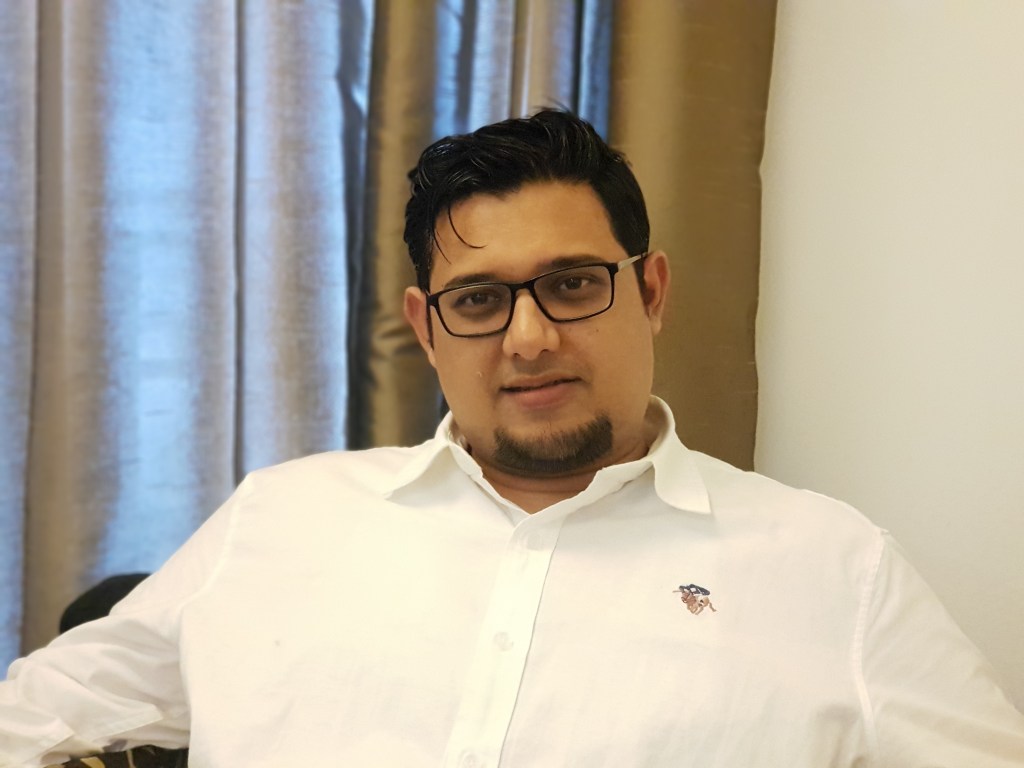
Sheldon John Diasis an Educational Supervisor and a teacher of English and Drama at GEMS Modern Academy, Dubai. He has also served on several examination boards and panels. He is passionate about theatre and elocution and is currently working on his first book






 Borderless