Odbayar Dorj writes of celebrating the start of the new school year in Mongolia and of their festivals around teaching and learning. Click here to read.
Naramsetti Umamaheswararao gives a story set in a village in Andhra Pradesh. Clickhere to read.
Feature
A conversation withAmina Rahman, owner of Bookworm Bookshop, Dhaka, about her journey from the corporate world to the making of her bookstore with a focus on community building. Clickhereto read.
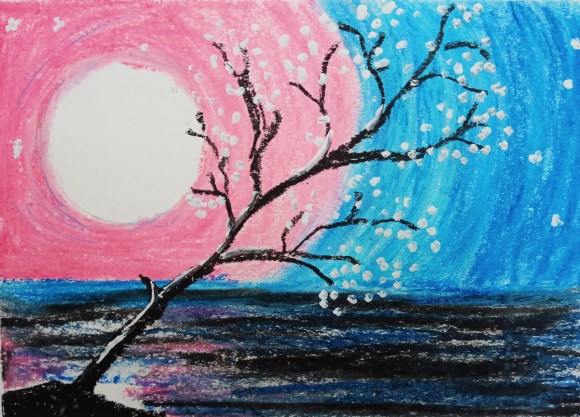
The idea of spring heralds hope even when it’s deep winter. The colours of spring bring variety along with an assurance of contentment and peace. While wars and climate disasters rage around the world, peace can be found in places like the cloistered walls of Sistine Chapel where conflicts exist only in art. Sometimes, we get a glimpse of peace within ourselves as we gaze at the snowy splendour of Himalayas and sometimes, in smaller things… like a vernal flower or the smile of a young child. Inner peace can at times lead to great art forms as can conflicts where people react with the power of words or visual art. But perhaps, what is most important is the moment of quietness that helps us get in touch with that inner voice giving out words that can change lives. Can written words inspire change?
Our featured bookstore’s owner from Bangladesh, Amina Rahman, thinks it can. Rahman of Bookworm, has a unique perspective for she claims, “A lot of people mistake success with earning huge profits… I get fulfilment out of other things –- community health and happiness and… just interaction.” She provides books from across the world and more while trying to create an oasis of quietude in the busy city of Dhaka. It was wonderful listening to her views — they sounded almost utopian… and perhaps, therefore, so much more in synch with the ideas we host in these pages.
Our content this month are like the colours of the rainbow — varied and from many countries. They ring out in different colours and tones, capturing the multiplicity of human existence. The translations start with Professor Fakrul Alam’s transcreation of Nazrul’s Bengali lyrics in quest of the intangible. Isa Kamari translates four of his own Malay poems on spiritual quest, while from Balochi, Fazal Baloch bring us Munir Momin’s esoteric verses in English. Snehprava Das’s translation of Rohini K.Mukherjee poetry from Odia and S.Ramakrishnan’s story translated from Tamil by B.Chandramouli also have the same transcendental notes. Tagore’s playful poem on winter (Sheeth) mingles a bit for spring, the season welcomed by all creatures great and small.
We have good news to share —Borderless Journal has had the privilege of being listed on Duotrope – which means more readers and writers for us. We are hugely grateful to all our readers and contributors without who we would not have a journal. Thanks to our wonderful team, especially Sohana Manzoor for her fabulous artwork.
Hope you have a wonderful month as we move towards the end of this year.
Parry Lines was an ordinary fellow, so much so that even his friends couldn’t be bothered to find out his actual name and were content to call him “Parallel,” his nickname since childhood. Regular, indeed nondescript features were surmounted by his trademark bald pate; the most you could say was that occasionally he wore a bright plaid shirt in neon pastels to liven things up a bit.
Ten weeks A.G. (After Gherkin)
Yet his death (by gherkin) caused a butterfly effect that changed the world. Until the incident with the gherkin, the most notable thing that had ever happened to Parry was when his surprisingly dashing teenaged son had consumed an entire teacup full of gravy during Thanksgiving dinner. Honoured guests had watched in horror as Parry Jr. (PJ for short), notable for his twinkling hazel eyes and flowing chestnut hair, gulped down the rich, brown fluid–though they should have expected something of the kind when he poured the gravy from the pitcher on the table into the China cup ready at his place setting for after-dinner tea.
Present at that event, and at the gherkin incident as well, was Mrs. Honoria Tadpole, English professor and amateur sleuth. Her demure, conservative appearance (she always wore a smart, tailored suit–or at least the best the local thrift shop could provide–and had her silver-blonde hair cut in a perky, short bob) and her self-effacing manner and diminutive (if plump) stature belied the sharpest mind north of California. It would fall to her to unravel the complicated mystery that the local paper dubbed “Gherkingate.”
Interviewed by the features’ editor, as the criminal trial of the alleged murderer dragged on, Mrs. Tadpole was asked the inevitable question of how it had all started. The interview took place in Mrs. Tadpole’s well-appointed parlour, a room replete with Victorian bric-a-brac. With characteristic hospitality, she poured out a strong brew of BC Bold to accompany the delicate sandwiches (ham, egg, and cucumber) and homemade oatmeal cookies that were her signature “high tea,” known to local islanders as a four o’clock tradition at the old manse where Mrs. Tadpole rented a small suite.
“Now, Mrs. Catchpole, I understand you were part of the original party that travelled to Moany Bay,” the interviewer began.
“Tadpole,” Mrs. Tadpole corrected. A veteran instructor of nineteen- and twenty-year-olds, she was used to misspellings and mispronunciations. Marpole, Rumpole, Toadpole: she had heard and seen it all, and could make the necessary correction without even flinching anymore. She cast her mind back almost three months to a mid-summer weekend off British Columbia’s Sunshine Coast.
She began with an allusion to classic culture: “Just sit right back and you’ll hear a tale, a tale of a fateful trip…”
Sadly, the features’ editor of the Island Gleaner failed to catch the reference to Gilligan’s Island, one of the best sit-coms of the 1960s. Mrs. Tadpole had been a toddler when the series was first aired, but its popularity throughout her childhood made it a touchstone for, really, almost everything in life, according to her observations. She knew that some people accorded such a status to the iconic, original Star Trek, but what did Captain Kirk have that “the Skipper” did not? Not much, thought Mrs. Tadpole.
The premise of Gilligan’s Island was classic: a small number of people, randomly-assorted, stranded on an island together with no real prospect of deliverance. After all, wasn’t that just the paradigm of human existence? You didn’t need to be an English proffessor (though Mrs. Tadpole was one, of course) to figure that out.
That fateful weekend, when the seeds of the gherkin incident was sown, had been rife with undertones of Gilligan’s Isle.
Breathing deeply of the fresh Pacific breeze, the passengers sat out on the deck of the vessel as it hugged the rugged BC coastline. The rushing water behind the Skirmish flumed out into a fan of spray, while the murky depths offshore spat out seals and sealions–even the occasional humpback whale–with random irregularity. Black bears hid among the rocks and evergreens in the uninhabited areas; cabins dotted the beaches in the populated areas of cottage country. On the way up the coast, the party of friends and family had composed their own version of the theme song, with each member of the group assigned to a role from the original cast. Mrs. Tadpole was the Professor, of course. Never mind that the community college where Mrs. Tadpole worked had opted not to accord academic titles to their teachers, or that the original Professor in the TV series was a man. (As Mrs. Tadpole had been known to say to her first-year college students, we live in a post-gender, post-glass-ceiling world. And if we don’t, we should).
Aboard the Bayliner, Skirmish, Parry Lines was the Skipper, and his hapless, gravy-drinking son was typecast as the irrepressible Gilligan, full of mischief and ridiculous ideas. Mrs. Tadpole could only hope that her adorable niece, Mary Anne (same name as her Gilligan’s Island counterpart!), was immune to his sauce-swilling charms.
The Millionaire role was assumed by the reclusive entrepreneur Deadhead, Mickey Garcia (if that were in fact his real name), accompanied by his charming wife, Penelope, a voluptuous brunette. Together they had built an empire founded on tribute bands and biopics. The rumour mill had it that there was trouble in paradise, but no one outside his immediate family had seen Mickey for years, so it was difficult to substantiate the gossip.
The cast was fleshed out (so to speak) with a bona fide movie star, the internet sensation who began as one of the central figures in a YouTube series called Project Man Child (“For the price of a cup of coffee… you can buy this underemployed househusband a cup of coffee!”) and had gone on to a viral barrage of TikToks under the sobriquet of “The Naked Gardener”. Mrs. Tadpole was relieved (as no doubt were the others) to note that all the passengers aboard the Skirmish, including this one, appeared to be fully clothed.
At least, all whom she could see wore conventional travelling attire: Mr Garcia, recovering from surgery and groggy with heavy opiates, was shrouded in a blanket and wearing dark glasses. He slumped a little to the side, and his heavy breathing attested to a well-earned reputation for napping as a pretense in order to ignore his surroundings.
As Mrs Tadpole later told the Gleaner interviewer, the real concern of the trip quickly emerged: not the rapprochement of Mary Anne and Parallel Jr., but the burgeoning, even violent antagonism between Parry Sr. and Penelope Garcia, whom the latter insisted on calling “Cherry” with a suggestive leer while her husband languished in his bunk. “Is he grateful? Or just dead?” quipped Lines. One night, Penelope went so far as to brandish a knife in Lines’ general direction and had to be restrained by Mrs Tadpole and Mary Anne in tandem.
Although Madame Garcia was the only one to meet his taunts with open animosity, no one was spared the self-proclaimed wit of Parallel Lines.
He had the nerve to call Mrs Tadpole’s beloved niece, whose sunny disposition was outshone only by the sweet, fair face that perched above her perfect figure, “Mistress Mary, Quite Contrary” –nothing could have been further from the truth! Of course, Mary Anne merely smiled and shrugged it off, as if no insult could penetrate her cheerful exterior … but others were less armour-clad.
The bully referred mercilessly to the Naked Gardener as “Jamie Oliver, the Naked Chef” (whom he slightly resembled) a slur that obviously got under the man’s skin (“I couldn’t boil an egg to save my life!” he protested angrily. “That’s not my brand at all! He’d better watch his back…”).
Even Mrs. Tadpole (surprisingly resilient after having been bullied through her shy youth as resembling a chubby little toad) came in for her share of abuse, rechristened as “Mrs Toad” after making her one of specialties, toad-in-the-hole, for her shipmates. (Once she discovered that the galley of the Bayliner was stocked with a potato ricer and La Ratte potatoes, there was no holding her back. A ring of caramelized onions surrounded each serving dish, with two nut-brown sausage-ends sticking out of the centre, for all the world like a couple of froggy eyes.) “No one calls me Toad,” she intoned ominously.
Cruelly and unaccountably, Parallel Lines saved his worst tirade for his own son. Recalling that terrible moment of youthful folly, that mind-gripping shame that only time could heal, the father saluted the son like a champion hog-caller summoning his prize sow. “Sooooo-Eeeeee! Want some gravy with that?” Alternatively, he would break into song to the tune of ‘Hey, Jude’:
"Au jus,
Just make it fat,
Take some gravy
And make it wetter..."
It was pitiful to see the boy’s response, especially in front of Mary Anne. His pale face was suffused with a ruddy glow beneath his chestnut fringe, and hot, angry tears rose in his sensitive, hazel eyes.
“I’ll kill him,” PJ muttered under his breath.
And now the tranquil Mary Anne, who couldn’t have cared less about any vitriol directed her way, was at last roused to fury in defense of her maligned and helpless friend. “I’ll do it for you!” she offered. “By G—!”
Two Hours B.G. (Before Gherkin)
Suffice it to say, no one was all that distressed when Parallel Lines failed to return to the Skirmish after an afternoon in the seaside village of Egmont (pronounced with an “egg” and not an “edge”).
Penelope had steered Mickey off in a collapsable wheelchair they had stowed on the boat; “the millionaire and his wife” were off for lunch al fresco, heading for a picnic table in an accessible, though private, spot. Roast beef sandwiches and condiments, along with champagne and a couple of plastic flutes, had been assembled into a decorative yet sturdy straw basket which the amazon-like Penelope slung easily over one arm as she manouevred the wheelchair down the forest path.
The movie star had gone in search of Egmont’s famous cream cheese cinnamon buns, hoping to be recognised at the Forest Cafe by someone who would do a double take and exclaim, “Hey! Wait! Aren’t you that man child?”
Mrs Tadpole and her niece decided to go for a refreshing swim in the brisk waters of the bay, washing off the grime of shipboard life before stopping at the Village Green Room for a bowl of veggie curry soup and some fresh, hot rolls.
As for PJ, he declared himself too upset to leave the Skirmish, and was hoping to curl up with a graphic novel, a diet soda, and a bag of Doritos, to forget all his cares for a few hours while the rest of the party looked around Egmont Village.
But where was Parallel? It was time to cast off. If they didn’t leave soon, they wouldn’t make it to the Coastal Lodge before dark. And–not to mention–P. Lines was the skipper!
“I’m perfectly capable of getting us there,” insisted PJ, fortified by his power nap. “I’ll bet you anything, dad’s holed up at the Drifter Pub, and he’ll crash at the hotel there. I’m sure he’s as tired of us as we are of him. Let’s just go. We’ll all have cooled off by tomorrow morning, and I’ll swing back and get him then, bring him up to the Lodge for the rest of the weekend.”
The plan sounded good, and all agreed to it willingly. Off they set for the rustic cabin someone had dubbed the Coastal Lodge in hopes (quite justified, as it turned out) of charging a tidy sum in AirBnB rates. Never mind that it featured a remote outhouse and a camp kitchen; the setting was beyond beautiful, and the (now) congenial group looked forward to beach and forest walks, blazing bonfires, and midnight swims. Mrs Tadpole insisted on taking charge of the outdoor kitchen: she had brought the ingredients for her famous moussaka and looked forward to the challenge of cooking it in a casserole dish on the barbecue. PJ and Maryanne diced feta, tomatoes, onions and cucumbers for a Greek salad, while the movie star tried in vain to get a cell signal and the millionaires played cribbage by the big bay window in the cabin.
Parallel Lines could cool his heels at the Drifter until morning, thought PJ and crew.
G.T. (Gherkin Time)
“So,” said Mrs. Tadpole to her interviewer, “Can you guess who did it?”
“Uh,” said the Features editor. “Nope.”
“I’ll give you a hint: don’t ask who was the perpetrator. Ask who was the victim!”
“Well, that would be Mr. Lines, would it not?”
“Would it? What if the wheelchair-bound invalid, Mr. Garcia, was really Parallel Lines in disguise?”
“But–”
“He was wrapped in a blanket, wearing dark glasses and a mask, slumped in his chair. And there was a switcheroo.”
“A what?”
“A switch. In the forest.”
“Well, I’ll be jiggered. Why haven’t you said anything?”
“Blackmail.”
“You’re blackmailing the unlikely lovers? Parry Lines and Madame G?”
“No, they’ve been blackmailing me. But it’s time to come out. My trans-formation is at hand!”
“Mrs Tadpole! What a story for the Gleaner–and for the world! May I be the first to congratulate you?”
“You may.”
Deborah Blenkhorn is a poet, essayist, and storyteller living in Canada’s Pacific Northwest. Her work fuses memoir and imagination, and has been featured in over 40 literary magazines and anthologies in Canada, the United States, Britain, the Netherlands, Germany, Australia, Brazil, India, and Indonesia.
PLEASE NOTE: ARTICLES CAN ONLY BE REPRODUCED IN OTHER SITES WITH DUE ACKNOWLEDGEMENT TO BORDERLESS JOURNAL

 Borderless