Categories
Bhaskar's Corner

Amrita Sher-Gil: An Avant-Garde Blender of the East & West

Bhaskar Parichha explores how the life and art of Amrita Sher-Gil was an amalgam of the best of India and the West

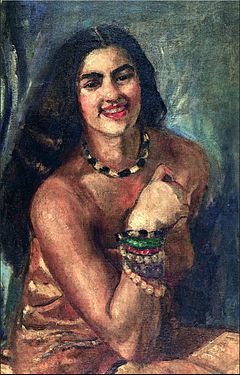
Much before the Punjabi diaspora spread its wings across continents, there was one woman who not only became a venerated name in the field of art but also gave art an altogether new identity in India. She was Amrita Sher-Gil (1913-1941). Born to Umrao Singh Sher-Gil Majithia, a Sikh aristocrat and a great scholar of Sanskrit and Persian, and Marie Antoinette Gottesmann, a Jewish opera singer from Hungary, Amrita inherited a legacy that was consummate and effervescent. 

Amrita was the eldest of the two daughters. Her younger sister was Indira Sundaram, mother of   painter Vivan Sundaram. Amrita spent her early childhood in Dunaharaszti, Hungary. She was also the niece of the Indologist Ervin Baktay. It was Baktay who guided her — by being a critique of her works — and gave her the academic underpinning that helped Amrita flourish. Ervin also taught her to use domestic helpers as models; and the reminiscence of these models eventually motivated her to return to India. 

Sher-Gil’s quest for the fine art led her to Paris, with her mother, when she was barely sixteen. She studied first at the Grande Chaumiere under Pierre Vaillant and subsequently at the Ecole des Beaux-Arts, where she was taught by Lucien Simon.

In her early twenties, Sher-Gil returned to India in 1921. The family began living in Shimla. She was by now an accomplished painter, equipped with some of the most essential modules that make one a great artist. She had an unquenchable thirst to be on familiar terms with the grammar and the language of painting, a virile tenacity of purpose and the single-mindedness about her role in life. 

 In 1924, she went to Italy and joined Santa Annunciata, a Roman Catholic institution. In Santa, Amrita Sher-Gil got an exposure to the works of Italian artists. While studying in Paris, she had already been influenced by the works of European greats like Paul Cézanne and Paul Gauguin. Her later paintings would echo a strong influence of the Western artists, chiefly from the Bohemian circles of Paris of the early 1930s.

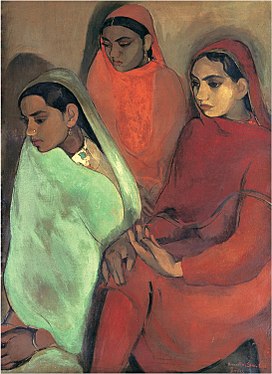
 In 1932, she displayed her first important work, Young Girls, which led to her appointment as an Associate of the Grand Salon in Paris in 1933, making her the youngest ever and the only Asian to have received such recognition. In 1934, while in Europe, she was haunted by what is known through her letters ‘an intense longing to return to India’ and ‘feeling in some strange way that there lay my destiny as a painter’. 

After her return, she began a rediscovery of the traditions of Indian art which would continue till her death. It was also during this period that she pursued an affair with Malcolm Muggeridge. In the mid-thirties, Amrita Sher-Gil’s mission for exploring further into Indian art began. It was a never-ending journey and her contributions to art was a breakthrough and uniquely superb. From Mughal miniatures to the Ajanta paintings and Southern styles, the Indian influence on her work was complete and irreversible. 

 In 1936, at the behest of Karl Khandalavala, art collector and critic, Amrita pursued her lifelong passion for realizing her Indian roots. She found inspiration in the Pahari School of painting. Later, in 1937, she toured South India and produced the famous South Indian trilogy paintings- ‘Bride’s Toilet’, ‘Brahmachari’ and ‘The South Indian Villagers’. These paintings mirror   her passionate sense of colour and an equally passionate empathy for Indian subjects. Poverty and despair constitute a major theme in Amrita Sher-Gil’s works and they find plentiful representation on her canvas. Her works also showed an engagement with the works of Hungarian painters, especially the Nagybanya School of painting in the interwar years.

In 1938, Amrita married her Hungarian first cousin, Dr. Victor Egan. After this marriage, they moved to Gorakhpur (UP) and, still later, the couple shifted to Lahore where she lived till her death in 1941.

Amrita Sher-Gil was one of the most gifted Indian artists belonging to the pre-colonial era. Her works reflect her deep ardour and perception for colours. Her profound understanding of the Indian subjects comes so vividly in her works that it is difficult to find parallels elsewhere. The works of Amrita Sher-Gil have been declared national art treasures by the Government and most of her paintings adorn the National Gallery of Modern Art in New Delhi. There is also a Delhi road named after the painter — Amrita Sher-Gil Marg. 

Amrita Sher-Gil’s legacy stands at par with those of the masters of the Bengal renaissance. She is said to be the ‘most expensive’ woman painter in India. Besides remaining an inspiration to many contemporary Indian artists, she was the muse for one of the longest running Urdu plays, Tumhari Amrita (1992), directed by Javed Siddiqi, with Shabana Azmi and Farooq Sheikh playing the lead roles. Her works are also a central force in the novel, Faking It, authored by Amrita V Chowdhury. The beauty and depth of Amrita Sher-Gil’s paintings has earned her inordinate admiration and recognition beyond her days.

.

Bhaskar Parichha is a journalist and author of No Strings Attached: Writings on Odisha and Biju Patnaik – A Political Biography. He lives in Bhubaneswar and writes bilingually. Besides writing for newspapers, he also reviews books on various media platforms.

.

PLEASE NOTE: ARTICLES CAN ONLY BE REPRODUCED IN OTHER SITES WITH DUE ACKNOWLEDGEMENT TO BORDERLESS JOURNAL

Categories
Review

Transforming Banking Practices

Book Review by Bhaskar Parichha

Title: Transformational Leadership in Banking

Author: Multiple. Edited by Anil K. Khandelwal

Publisher: SAGE Publications/ New Delhi, 2021

India’s banking system, as it has evolved in the past two hundred years, is a mixed bag. It has cooperative banks, domestic financing institutions, scheduled commercial banks, regional rural banks, pre-reform traditional private sector banks, tech-savvy private banks, and foreign banks. One can add to this protracted list are the newer entities — small finance banks, payments banks, and the large number of mobile applications.

Even as India’s banking sector has expanded tremendously in the past few years, there is a lot to be desired from these financial institutions. Banks have, of late, been the government’s whipping boys, and the so-called reforms have only been half-baked. Bank mergers have taken place but they are yet to show up on their balance sheets.

While Non-Banking Financial Companies (NBFCs) have grabbed the space vacated by commercial banks, financial stability of banks is at crossroads. Monitoring and supervision have fallen drastically, reflecting in the persistent growth in Non-Performing Assets (NPAs). Post -Covid, there is an unfathomable shadow on India’s banks. It is in this scary backdrop that this book carries enormous importance. Transformational Leadership in Banking: Challenges of Governance, Leadership and HR in a Digital and Disruptive World by Anil K. Khandelwal comes in handy for the beleaguered leadership of the banking sector.

A thought leader, author, international speaker on leadership and governance, Anil K. Khandelwal is an acclaimed authority on human resource and leadership in the banking sector. He is a rare transformation leader. Transforming Bank of Baroda from a staid Public Sector Banks (PSB) to one of India’s most valuable international banks won him many awards, including the Asian Banker Singapore’s Lifetime Achievement Award. His brand of human resources leadership and its application in business turnaround also won him the Lifetime Achievement Award from the National Human Resource Development Network. He also chaired the government-appointed committee on HR in PSBs and was a member of the first Banks Board Bureau for banking reforms and selection of whole-time directors.

The book, as the blurb says, “offers a roadmap on leadership which is all about converting adversity into an opportunity for transformation. Through an excellent set of articles, case studies and interviews, this book offers a way forward for transformational leadership of the Indian banks.” Despite their many achievements, public sector banks continue to face several challenges, such as increasing non-performing assets, depleting market share and low market capitalization.

The volume is comprehensive because it deals with almost all aspects of Indian banking. With a Foreword by former Comptroller and Auditor General of Inida, Vinod Rai, the book has three parts. In part I there are essays from academics and practitioners. Part II deals with case studies. The last part deliberates on perspectives from experts. With  more than thirty chapters — each chapter contributed by a doyen in the banking sector and the academics — the 500 plus page book is clearly laid out with  sections on governance, leadership, human resources and of course the future of the banking environment

In the introduction, Dr Khandelwal writes: “The book comes at a time when Indian banking is undergoing crisis.” It gives a strong message that banks become robust institutions by addressing governance, leadership, talent and culture. The author’s argument is that the banking sector is likely to remain in a perpetual crisis mode, unless these measures are initiated immediately. 

The book, as the titles suggests, is on leadership in banking. Evidently, it has chapters on changing context of governance and leadership in public sector banks, the digital revolution, future of work in BFSI (Banking, Financial Services, and Insurance) organisations, human capital and ethical bank governance, leadership choices in building better governance in the context of regulation or culture, strategic human capital management and banking governance (unexplored symbiotic relationship in PSBs), honoring legacy while embracing evolution: (the ethics narrative in State Bank of India), leadership experience and fifteen actionable insights from the trenches, organizational transformational and an agenda for Indian banks, coaching and mentoring in the backdrop of the unsung and underutilized warriors of leadership development, grooming leaders in public sector banks, crafting and living in  bank culture et al. 

There are also some illuminating pieces on leadership in times of crisis. For example, lessons from COVID-19. Employer branding to build human capital advantage, trade unions in the digital economy, skilling  a new currency,  a new manifesto for chief human resource officers in the era of digital change, wellness and yoga investment for the bankers,HR as strategic business partner in SBI ,sustainable people processes and leadership development in Bank of Baroda, the human resources story of ICICI Bank, digital transformation of HR at Union Bank of India, fear psychosis in the executives, and  bank directors require training in specific areas of technology are the other chapters which make a value addition to the book.

In the context of competition and digitalization requiring new business models, the book argues for a fundamental shift in the structure and process of governance, including board-level autonomy, CEOs tenure and compensation, people process, talent development and building a leadership pipeline, to make banks resilient and future-proof. 

Transformational Leadership in Banking is both well-timed and edifying. With admirable standpoints on the issues of authority, management and HR in a digital environment, the book is a clear blueprint for makeover and restructuring. The book is, mostly, meant for public sector banks, and will be of immense value to policymakers, regulators, board members, CEOs, researchers and to all those who are  in  the leadership roles and the public on the whole. 

Dr Khandelwal’s book makes an overriding case for crucial and cohesive reforms in India’s banking sector. It offers timely solutions by focusing on several issues. A must-read for anyone interested in the well-being of Indian banking.

.

Bhaskar Parichha is a journalist and author of No Strings Attached: Writings on Odisha and Biju Patnaik – A Political Biography. He lives in Bhubaneswar and writes bilingually. Besides writing for newspapers, he also reviews books on various media platforms.

.

PLEASE NOTE: ARTICLES CAN ONLY BE REPRODUCED IN OTHER SITES WITH DUE ACKNOWLEDGEMENT TO BORDERLESS JOURNAL

Categories
Index

Nature & Us

Environment and man — are they separate or is man a part of nature? Different writers have interpreted nature and its forces in different ways over a period of time, in glory, in storm and at battle. Explore some of our selections on nature on World Environment Day… Enjoy our oeuvre.

Translations

One Small Ancient Tale

Rabindranath Tagore’s Ekti Khudro Puraton Golpo (One Small Ancient Tale) from his collection Golpo Guchcho ( literally, a bunch of stories) has been translated by Nishat Atiya. Click hereto read.

Bolai

Rabindranath Tagore’s Bolai translated by Chaitali Sengupta. Click here to read.

Songs of Seasons: Translated by Fakrul Alam

Bangla Academy literary award winning translator, Dr Fakrul Alam, translates seven seasonal songs of Tagore. Click here to read.

Poetry

Bodhi Tree by Sumana Roy

Click here to read

Seasonal Whispers by Jared Carter

Click here to read

This Island of Mine by Rhys Hughes

Click here to read

Observances by Michael Burch

Click here to read

Playlet

A playlet by Sunil Sharma set in Badaun, The Dryad and I: A Confession and a Forecast, is a short fiction about trees and humans. Click here to read.

Essays/Musings

Unbowed, She Stayed

Bhaskar Parichha gives us a glimpse of the life of Wangari Muta Maathai founder of the Green Belt Movement, which has  — through networks of rural women — has planted over 30 million trees. Click here to read.

Photo Essay: Birds & Us

Penny and Michael B Wilkes take us on a photographic journey with a narrative in San Diego. Click here to read.

Cyclone & Amphan Lockdown

As cyclone Amphan fireballed and ripped through Kolkata, Nishi Pulugurtha gives a first hand account of how she survived the fear and the terror of the situation. Click here to read.

Stories

This Land of Ours

Shevlin Sebastian captures man’s relentless struggle against unsympathetic forces of nature. Click here to read

Maya & the Dolphins

Mohin Uddin Mizan writes about Dolphin Sighting in Cox Bazaar, Dhaka. Click here to read.

A Fight

Eduard Schmidt-Zorner shows the struggle between man and nature. Click here to read.

Categories
Contents

Borderless, May 2021

Editorial

And this too shall pass… Click here to read

Translations

Songs of Seasons: Translated by Fakrul Alam

Bangla Academy literary award winning translator, Dr Fakrul Alam, translates six seasonal songs of Tagore. Click here to read.

Temples and Mosques

Kazi Nazrul Islam’s fiery essay translated by Sohana Manzoor. Click here to read.

Purify My Life

Kazi Nazrul Islam’s poem, Purify my Life, translated by Shahriyer Hossain Shetu. Click here to read.

Waiting for Godot by Akbar Barakzai

Akbar Barakzai’s poem translated by Fazal Baloch. Click here to read.

Solus

Aditya Shankar translates a poem by Sujith Kumar. Click here to read.

The Last Boat

Tagore’s Diner Sheshe Ghoomer Deshe translated by Mitali Chakravarty with an interpretation in pastels by Sohana Manzoor. Click here to read.

Poetry

Anasuya Bhar, Scott Thomas Outlar, Saranyan BV, Matthew James Friday, Nitya Mariam John, RJ Kaimal, Jay Nicholls, Tasneem Hossain, Rhys Hughes, Vatsala Radhakeesoon, Ihlwha Choi, Himadri Lahiri, Sunil Sharma, Mike Smith, Jared Carter

Nature’s Musings

Photo-Poetry by Penny & Michael Wilkes. Click here to read.

Poets, Poetry & Rhys Hughes

Lear and Far

As a tribute to the 209th anniversary of Edward Lear, Rhys Hughes writes of his famous poem, ‘Owl and the Pussycat’, and writes a funny ending for it rooted in the modern day. Click here to read.

Stories

If at all

Shobha Nandavar, a physician in Bangalore, depicts the trauma of Covid 19 in India with compassion. Click here to read.

First Lady

Rituparna Khan gives us a brief vignette from the life of one of the first women doctors in India, Dr Kadambari Ganguly. Click here to read.

Mr Dutta’s Dream

Atreyo Chowdhury takes us into the world of unquenchable wanderlust. Click here to read.

Neemboo Ka Achaar or Maa’s Lemon Pickle

A compelling flash fiction by Suyasha Singh hovering around food and a mother’s love. Click here to read.

The Literary Fictionist

In A Lunch Hour Crisis, Sunil Sharma raises humanitarian concerns that though raised in a pandemic-free world, have become more relevant and concerning given our current predicament. Click here to read.

Musings/Slices from Life

Serve the People

Danielle Legault Kurihara, a Quebecker in Japan, writes of differences in rituals. Click here to read.

Why I write?
Basudhara Roy tells us how writing lingers longer than oral communications. Click here to read more.

The Quiet Governance of Instinct

Candice Louisa Daquin, a psychotherapist, talks of the importance of trusting our instincts. Click here to read more.

Musings of a Copywriter

In Nations without NobelDevraj Singh Kalsi takes a fresh look at national pride with a soupçon of sarcasm and humour. Click here to read.

Adventures of the Backpacking Granny

In Visit to Rural BaoyingSybil Pretious travels to spend a night with a local family in rural China in a ‘hundred-year-old home’.Click here to read.

Essays

Four Seasons and an Indian Summer

Keith Lyons talks of his experiences of seasons in different places, including Antarctica. Click here to read.

Rabindranath and the Etchings of His Mind

Anasuya Bhar explores the various lives given to a publication through the different edited versions, translations and films, using Tagore as a case study and the work done to provide these online. Click here to read.

My Experiments with Identity

Tejas Yadav explores identity from the context Heraclitus, Rumi down to his own. Click here to read.

Can Songs be the Musical Conscience of a Film?

Prithvijeet Sinha uses Gaman (Departure), a Hindi movie around the pain of migrant workers, as a case study to highlight his contention that lyrics and songs convey much in Indian films. Click here to read.

Bhaskar’s Corner

In Manoj Das – The Master Storyteller, Bhaskar Parichha pays a tribute to one of the greatest storytellers from the state of Odisha, India, Manoj Das( 1934-2021). Click here to read.

Book Excerpt

Excerpted from A Bengali Lady in England (1885): Annotated Translation with Critical Introduction to Krishnabhabini Das’ Englandey Bangamahila by Nabanita Sengupta. Click here to read.

Book Reviews

A review of Feisal Alkazi‘s memoir, Enter Stage Right: The Alkazi Padamsee Family Memoir by Rakhi Dalal. Click here to read.

A review of Shakti Ghosal‘s The Chronicler of the Hooghly and Other Stories by Gracy Samjetsabam. Click here to read.

Bhaskar Parichha reviews Raising a Humanist by Manisha Pathak-Shelat‘s and Kiran Vinod Bhatia. Click here to read.

Interviews

Communication scholars and authors, Manisha Pathak-Shelat and Kiran Vinod Bhatia, discuss how to bring up children in these troubled times, based on their book, Raising a Humanist, which has just been released. Click here to read.

Sonya J Nair of Samyukta Poetry talks about the Samyukta Research Foundation and its affiliates and its festival, Anantha. Click here to read.

Sara’s Selections, May 2021

A selection of young person’s writings from Bookosmia. Click here to read.

Categories
Review

Conscious Parenting in an Increasingly Fragmented World

Book review by Bhaskar Parichha

Title: Raising a Humanist, Conscious Parenting in an Increasingly Fragmented World

Authors: Manisha Pathak-Shelat & Kiran Vinod Bhatia

Publisher: SAGE Publications India/SELECT, 2021

Unusual times warrant unusual responsibility. And, when the responsibility is manifest in parenting, it becomes even more important. Raising a Humanist: Conscious Parenting in an Increasingly Fragmented World by Manisha Pathak-Shelat and Kiran Vinod Bhatia is, as the title suggests, meant for the troubled times in which we live. 

On the face, this book is not a typical work on parenting, rather it goes far beyond the remit. Written by   two media professionals, it is a sort of prescription   for modern day parents. 

Says the blurb: “The world is immensely divided and broken. We have lost the art of having conversations with those who are different from us. While we cannot change the world, we can take small remedial steps starting with our homes and communities.” 

Manisha Pathak-Shelat is a Professor at Centre for Development Management and Communication, MICA (Mudra Institute of Communications, Ahmedabad, Gujarat, India) and Kiran Vinod Bhatia is a doctoral candidate in the School of Journalism at the University of Wisconsin-Madison. Coming as it is from two media professionals, the book results from their engagement with parents, teachers and the youth. Being communication scholars, the authors mull over their work, contributing meaningfully and substantially   towards a better world. And, they have succeeded in this effort to a large extent. 

Using critical questions, rational tips and exciting anecdotes, they touch upon the abysmal number of discordant issues of our society and provide fascinating ways to use art, technology and media. The idea is to provide the progenies with a nurturing community. The conversation is appealing and enriching because the writers have a vast experience in the area.

With a Foreword by Lina Ashar, Educationist and Entrepreneur, the book has in all nine chapters and the approach of the subject is avant-garde. It provides a much-needed investigation of how adults can guide children to become kind, liberal and critically thoughtful humans in an ever-changing technological world.

The authors write in the preface: “Critical thinking, empathy and the readiness to engage with different viewpoints have to be a gradual and lifelong process — beginning with ourselves, including our children  and extending it to our larger social circles.” 

That the authors   have taken up a subject as vast as ‘parenting’ is itself challenging. How to raise a child in this polarized and conflicted world is every conscious parent’s concern and the book offers the solution with insight and wisdom. It is multidisciplinary in its sweep and yet not wandering off from the root issue. The mainstay of the book is its account of everyday experiences.

Raising a Humanist results from over three years and interactions with more than 120 parents. It aims to help parents deflate stereotypes, prejudices, mental conditioning about gender, caste, religion and class. 

That politically complex and technologically upsetting times warrant responsible parenthood needs no reiteration. If children from a young age are conditioned into stereotypical and biased ways of thinking, parents are largely to blame. The book not only raises the right questions but also offers solutions by providing a deeper understanding of popular culture and the role of the media in gender, religious, caste and class portrayals. This scholarly book tells us how to unlearn and re-learn as parents. 

Raising children in a scrappy world who can walk through life with self-confidence and empathy is challenging. This book solves that challenge. ‘Raising a Humanist’ mainstreams the power of initiating hard conversations and discussions, guided by a strong yet sensitive rationale at its core. The lucid case studies and the real-life examples are educational and motivating. The book not only sketches the social divide but also remediates it by addressing its concerns. The book talks of the nuances of religion and prejudice in the most succinct manner.

 It is a must-read, especially for parents, educators and concerned citizens who are ambitious for a radical vision of the world that will leave our children free from anxiety and misgiving. This book is a refreshing departure from the tiresome ‘how to’ books imposed on caregivers, as you see guilt and fear taking a rightful back seat to more nuanced, critical and creative conversations that generate excitement for how we would like to see the world turn for the better.

For delving deep into some of the most challenging questions of our times in a rigorously and thoughtfully way, it is an essential reading for anyone interested in parenting. Bold and provocative, this influential book is a decent companion in raising a humanist in the child.

.

Bhaskar Parichha is a journalist and author of No Strings Attached: Writings on Odisha and Biju Patnaik – A Political Biography. He lives in Bhubaneswar and writes bilingually. Besides writing for newspapers, he also reviews books on various media platforms.

.

Click here to read the interview of the authors.

PLEASE NOTE: ARTICLES CAN ONLY BE REPRODUCED IN OTHER SITES WITH DUE ACKNOWLEDGEMENT TO BORDERLESS JOURNAL

Categories
Bhaskar's Corner

Manoj Das – The Master Storyteller

Bhaskar Parichha pays a tribute to one of the greatest storytellers from the state of Odisha, India, Manoj Das( 1934-2021), who lived to be 87 and passed on from normal causes this April

“I have now read the stories of Manoj Das, with very great pleasure. He will certainly take a place on my shelves beside the stories of Narayan (R K Narayan). I imagine Odisha is far from Malgudi but there is the same quality in his stories with perhaps an added mystery.”

Graham Greene.

“Whenever people praise Paulo Coelho and the like, I always think of Manoj Das. What a great prolific writer we have. He could have easily reached the heights and beyond of the one Coelho reached. But he preferred the silence, simplicity and serenity to fame and glory. In this, he has lived the very values he gave us through his stories.”

— Aravindan Neelakandan, Indian Journalist

With the passing away of Manoj Das, Indian literature has lost a master storyteller who wrote bilingually — in English and his mother tongue Odia — with equal affluence. Novelist, short story writer, poet, essayist, editor, columnist and a sadhaka, Manoj Das will be remembered by generations of Odias for his literary outpouring for over half a century. Odisha-born (in a village called Sankhari in Balasore district bordering West Bengal), his fame went far beyond terrestrial limits.

Manoj Das began   writing quite early. His first work — a book of poetry in Odia — Satavdira Artanada (Cries of a Time) was published in 1949 when he was barely in high school. In 1950, he launched a literary magazine, Diganta (Horizon). His first collection of short stories Samudrara Kshudha (Hungry Sea) was published the following year. Manoj Das often cited Vyasa, and Valmiki and Fakir Mohan Senapati, as his early influences.  

He took active interest in student politics while studying for his bachelor’s degree in Cuttack’s prestigious Ravenshaw College. A youth leader with radical views, he even spent a year in jail for his revolutionary undertakings. After graduating from Puri’s SCS (Samanta Chandra Sekhara)

College, he received a postgraduate degree in English literature from Ravenshaw College. He was also a delegate to the Afro-Asian students’ conference at Bandung, Indonesia in 1959.

After a short stint as a lecturer in Cuttack’s Christ College, Manoj Das came away to Sri Aurobindo Ashram in Pondicherry in 1963, where he had been professor of English Literature at the Ashram’s International Center of Education. Pondicherry (modern Puducherry) became his ‘Karma Bhoomi’ and his abode of sadhana. His quest for devoutness motivated him to become an inmate of Sri Aurobindo Ashram of which he was an integral part till his end.

Manoj Das wrote expansively and in various genres. Poetry, novel, short story   travelogue and books on India’s history and culture dominated his works. Shesha Basantara Chithi (Spring’s Last Epistle ),Tuma Gam o Anyanya Kabita (Your Village and Other Poems) Dhumabha Diganta ( Dusky Horizon), Manojpancabimsati (Twenty-five short stories) and the most recent one, Shesha Tantrikara Sandhanare (In Quest of  the Last Tantric), are among the Odia works he is best known for. His writings in Odia have mesmerized readers for decades. 

Manoj Das has often been known as the Vishnu Sharma of modern Odia literature —   for his magnificent style and effective use of words. His   oeuvre displayed many dimensions of human nature. He was a truth-seeker, a thinker-writer whose works are defined ‘as a quest for finding the eternal truth in everyday circumstances’.

He began his English writing in 1967 with the publication of the short story collection A Song for Sunday and Other Stories. It was followed by Short Stories of Manoj Das. Both attracted commendation from literary doyens like Mulk Raj Anand, K P S Menon and K. R. Srinivasa Iyengar. Some of his other notable works in English are ‘ The Escapist’, ‘A Tiger at Twilight’, ‘The submerged Valley and Other Stories’, ‘The Bridge in the moonlit Night’, ‘Cyclones’, ‘Mystery of the Missing Cap’, ‘Myths’, ‘Legends’, ‘Concepts and Literary Antiquities of India’. He wrote his memoir ‘Chasing the Rainbow: Growing up in an Indian Village (2004.) 

After the publication of ‘The Submerged Valley’, Graham Greene, whose appreciation of contemporary Indian fiction was limited to R K Narayan, wrote to Dick Batstone, publisher of the book, expressing happiness at his discovery of Das. “I imagine Odisha is far from Malgudi, but there is the same quality in his stories with perhaps an added mystery.” 

Manoj Das is best known for his dramatic expression as well as satire. His writings dealt with various social and psychological issues: displacement, natural calamities such as floods, people’s belief in ghosts and spirits, duplicitous politicians, et cetera. While his writings were social commentaries on post-Independence times, the short stories, novels, essays and poems blended physical experiences with fantasy and left an indelible impression on Indian literature.

An exponent of the philosophy of ‘Sri Aurobindo and The Mother’, Manoj Das wrote weekly columns in almost all national dailies: The Times of India, The Hindustan Times, The Hindu and The Statesman. A whole generation of readers grew up reading his columns, which were contemporaneous and dealt with emergent issues. His newspaper writings — revealing the subterranean truth — are treasured by many.

He wrote for academic journals and periodicals too; and his international appeal grew most in the 1970s and 1980s when The Illustrated Weekly of India and The Imprint published his numerous stories. He also edited a cultural magazine, The Heritage, published by Chennai’s Chandamama group.

Awards came to Manoj Das effortlessly:  the topmost being the Saraswati Samman, Padma Shri and Padma Bhushan for his lasting contribution in the field of Literature and Education. Kendriya Sahitya Akademi conferred its highest award on Manoj Das. He was Member, General Council of Sahitya Akademi, and the Author-consultant, Ministry of Education, Government of Singapore in the early eighties besides leading an Indian delegation of writers to China.

In 1971, his research in the archives of London and Edinburgh brought to light some of the little-known facts of India’s freedom struggle in the first decade of the twentieth century led by Sri Aurobindo for which he received the first Sri Aurobindo Puraskar (Kolkata).

Being a bilingual writer, when someone asked about the language he envisaged before writing a piece, he answer back:  “In the language of silence — if I do not sound presumptuous, the creative process ought to be allowed some mystery. Inspiration surely precedes articulation through any language. This is absolutely true in regard to good poetry and substantially true in regard to good fiction. Without this element of inspiration, which is beyond language to begin with, literature can hardly have a throbbing soul.”

From a disenchanted Marxist to an ardent humanist, Manoj Das was an ingenious author. His creative works – running into a thousand and more — dealt with the Indian psyche and were so spontaneous that it impressed both the Indian and the Western reader — for the authenticity and the diversity.

Manoj Das had an uncanny capacity for presenting the serious and the serene in a way that was amusing, often arousing a lasting humor. Elements of fantasy as metaphor have a domineering presence in his fictions.

 P Raja, author of Many Worlds of Manoj Das, has a deeper insight into his works: ‘Mystery in a wide and subtle sense, mystery of life, indeed, is the core of Manoj Das’s appeal. Born before Independence, he has thoroughly used in his fiction. His experiences, gathered at an impressionable age, of the epoch-making transitions through which the country was passing. Thus we meet in his works lively characters caught up in the vortex of India’s passage from the colonial era to freedom, the impact of the end of the princely states and the feudal system, and the mutation of several patches of rural India into clumsy bazaars.’

For thousands of men, women, and children of the past three generations, Manoj Das has been the very synonym of courtesy and bliss. His words have inspired countless readers and have instilled a faith in the purpose of life.

Glossary

Sadhaka – Someone who pursues a certain discipline with devotion.

Sadhana — Meditation

.

Bhaskar Parichha is a journalist and author of No Strings Attached: Writings on Odisha and Biju Patnaik – A Political Biography. He lives in Bhubaneswar and writes bilingually. Besides writing for newspapers, he also reviews books on various media platforms.

.

PLEASE NOTE: ARTICLES CAN ONLY BE REPRODUCED IN OTHER SITES WITH DUE ACKNOWLEDGEMENT TO BORDERLESS JOURNAL

Categories
Contents

Borderless, April, 2021

Greetings from Borderless Journal for all Asian New Years! Click here to read our message along with the video and a translation of a Tagore song written to greet the new year, with lyrics that not only inspire but ask the fledgling to heal mankind from deadly diseases.

Editorial

New Beginnings

A walk through our content and our plans for the future. Click here to read.

Interviews

In Conversation with Arundhathi Subramaniam: An online interview with this year’s Sahitya Akademi winner, Arundhathi Subramaniam. Click here to read.

Sumana Roy & Trees: An online interview with Sumana Roy, a writer and academic. Click here to read.

Poetry

(Click on the names to read)

Arundhathi Subramaniam, Jared Carter, Matthew James Friday, Michael R Burch, Aparna Ajith, Jenny Middleton, Rhys Hughes, Jay Nicholls, Achingliu Kamei, Vatsala Radhakeesoon, Ihlwha Choi, Smitha Vishwanath, Sekhar Banerjee, Sumana Roy

Photo-poetry by Penny Wilkes

Poets, Poetry & Rhys Hughes

With an introduction to Blood and Water by Rebecca Lowe, Rhys Hughes debuts with his column on poets and poetry. Click here to read.

Translations

The Word by Akbar Barakzai

Fazal Baloch translates the eminent Balochi poet, Akbar Barakzai. Click here to read.

Malayalam poetry in Translation

Aditya Shankar translates a poem by Shylan from Malayalam to English. Click here to read.

Tagore Songs in Translation

To commemorate Tagore’s birth anniversary, we translated five of his songs from Bengali to English. Click here to read, listen and savour.

Tagore Translations: One Small Ancient Tale

Rabindranath Tagore’s Ekti Khudro Puraton Golpo (One Small Ancient Tale) from his collection Golpo Guchcho ( literally, a bunch of stories) has been translated by Nishat Atiya. Click here to read.

Musings/Slice of Life

Pohela Boisakh: A Cultural Fiesta

Sohana Manzoor shares the Bengali New Year celebrations in Bangladesh with colourful photographs and interesting history and traditions that mingle beyond the borders. Click here to read.

Gliding along the Silk Route

Ratnottama Sengupta, a well-known senior journalist and film critic lives through her past to make an interesting discovery at the end of recapping about the silk route. Click here to read and find out more.

The Source

Mike Smith drifts into nostalgia about mid-twentieth century while exploring a box of old postcards. What are the stories they tell? Click here to read.

Lost in the Forest

John Drew, a retired professor, cogitates over a tapestry of the Ras lila. Click here to read.

Tied to Technology

Naomi Nair reflects on life infiltrated by technology, by Siri and Alexa with a tinge of humour. Click here to read.

Adventures of a Backpacking Granny

In Inspiriting SiberiaSybil Pretious takes us with her to Lake Baikal and further. Click here to read.

Musings of a Copywriter

In Tributes & AttributesDevraj Singh Kalsi pays tribute to his late mother. Click here to read.

Essays

Reflecting the Madness and Chaos Within

Over 150 Authors and Artists from five continents have written on mental illness in an anthology called Through the Looking Glass. Candice Louisa Daquin, a psychotherapist and writer and editor, tells us why this is important for healing. Click here to read.

At Home in the World: Tagore, Gandhi and the Quest for Alternative Masculinities

Meenakshi Malhotra explores the role of masculinity in Nationalism prescribed by Tagore, his niece Sarala Debi, Gandhi and Colonials. Click here to read.

A Tale of Devotion and Sacrifice as Opposed to Jealousy and Tyranny

Sohana Manzoor explores the social relevance of a dance drama by Tagore, Natir puja. We carry this to commemorate Tagore’s birth anniversary. Click here to read

Photo Essay: In the Midst of Colours

Nishi Pulugurtha explores the campus of a famed university with her camera and words and shares with us her experiences. Click here to read.

Bhaskar’s Corner

Oh, That lovely Title: Politics

A short piece by Bhaskar Parichha that makes for a witty comment on the forthcoming Indian elections. Click here to read.

Stories

Pothos

Rakhi Pande gives us a story about a woman and her inner journey embroiled in the vines of money plant. Click here to read.

Elusive

A sensitive short story by Sohana Manzoor that makes one wonder if neglect and lack of love can be termed as an abuse? Click here to read

Ghumi Stories: Grandfather & the Rickshaw

Nabanita Sengupta takes us on an adventure on the rickshaw with Raya’s grandfather. Click here to read

Flash Fiction: The Husband on the Roof

Carl Scharwath gives us a story with a strange twist. Click here to read

Flash Fiction: Flight of the Falcon

Livneet Shergill gives us a story in empathy with man and nature. Click here to read

The Literary Fictionist

A playlet by Sunil Sharma set in Badaun, The Dryad and I: A Confession and a Forecast, is a short fiction about trees and humans. Click here to read.

Book reviews

Bhaskar Parichha reviews Reconciling Differences by Rudolf C Heredia, a book that explores hate and violence. Click here to read.

Nivedita Sen reviews Nomad’s Land by Paro Anand, a fiction set among migrant children of a culture borne of displaced Rohingyas, Syrian refugees, Tibetans and more. Click here to read

Candice Louisa Daquin reviews The First Cell and the Human Costs of Pursuing Cancer to the last by Azra Raza. Click here to read.

Book Excerpt

Excerpted from Raising a Humanist: Conscious Parenting in an Increasingly Fragmented World by Manisha Pathak-Shelat and Kiran Vinod Bhatia, the focus is on media and its impact. Click here to read.

Sara’s Selection, April 2021

A selection of young person’s writings from Bookosmia. Click here to read.

Categories
Bhaskar's Corner

Oh, That Lovely Title: Politics

Bhaskar Parichha debuts his column with a witty collection of quotes that he has picked up with his wide reading, arranged in a way that they take the reader through a series of thought-provoking comments on contemporary issues

Cartoon by Mario Miranda in the November 8th,1987 issue of Illustrated Weekly.
Photo courtesy: Bhaskar Parichha

We, in India, are in the throes of a big political churning right now. No one knows who the victor and who the vanquished will be. But politics — and obviously elections in India — are as multi-hued as they are rancid.

Adore it or loathe it, politics has its own share of quotable quotes. From the funniest quotes to the dumbest one, here is an uplifting list of famous lines said by equally famous people. 

Niccolo Machiavelli, a fifteenth century florentine philospher, has a very pertinent line for the present day politics. He said, “Politics have no relation to morals.” Charles de Gaulle’s take on politicians is so sensible! “In order to become the master, the politician poses as the servant.” Two other famous literary figures — the Irish George Bernard Shaw and British novelist George Orwell — too were scornful of politicians. Shaw said, “He knows nothing and thinks he knows everything. That points clearly to a political career.”

Orwell remarked, “In our age there is no such thing as keeping out of politics. All issues are political issues, and politics itself is a mass of lies, evasions, folly, hatred and schizophrenia.” 

American comedian George Carlin had a terse remark on that country’s politicians: “Now, there’s one thing you might have noticed I don’t complain about: politicians. Everybody complains about politicians. Everybody says they suck. Well, where do people think these politicians come from? They don’t fall out of the sky. They don’t pass through a membrane from another reality. They come from American parents and American families, American homes, American schools, American churches, American businesses and American universities, and they are elected by American citizens. This is the best we can do folks. This is what we have to offer. It’s what our system produces: Garbage in, garbage out.”

There is so much of coaxing and wheedling to take part in elections. Plato, the great Greek philosopher, observed, “one of the penalties for refusing to participate in politics is that you end up being governed by your inferiors.” Elections in India have become so expensive that ordinary mortals like you and me can’t think of fighting them even in our dreams. Will Rogers said, “Politics has become so expensive that it takes a lot of money even to be defeated.” Gore Vidal has a different take on this issue: “Apparently, a democracy is a place where numerous elections are held at great cost without issues and with interchangeable candidates.” 

US President Calvin Coolidge once said, “Politics is not an end, but a means. It is not a product, but a process. It is the art of government. Like other values it has its counterfeits. So much emphasis has been placed upon the false that the significance of the true has been obscured and politics has come to convey the meaning of crafty and cunning selfishness, instead of candid and sincere service.”

What New York City writer Christian Nestell Bovee who relished the intimate friendship of Washington Irving, Longfellow, Emerson, and Oliver Wendell Holmes believed politics is interesting: “Political aspirants make too much of the people before election, and, if successful, too much of themselves after it. They use the people when they want to rise, as we treat a spirited horse when we want to mount him; — for a time we pat the animal upon the neck, and speak him softly; but once in the saddle, then come the whip and spur.”

Finding the right candidate in elections is next to impossible. Cartoonist Kin Hubbard too had the same dilemma when he said, “We would all like to vote for the best man but he is never a candidate.” Edmund Burke’s caution on gentlemen despising politics is worth the while. Eighteenth century statesman and thinker Burke said, “When bad men combine, the good must associate; else they will fall one by one, an unpitied sacrifice in a contemptible struggle.” NOTA (none of the above) has been added to the preference for voters in the EVMs (electronic voting machines) these elections. American comedian, WC Fields , once said, “Hell, I never vote for anybody, I always vote against.” 

Why there is widespread abhorrence of politics is easy to fathom. According to radio commentator, political commentator, author, columnist, Cal Thomas, “One of the reasons people hate politics is that truth is rarely a politician’s aim. Election and power are.” Lord Acton’s famous quote hardly needs mention. He said, “power corrupts and absolute power corrupts absolutely.” It was Henry A. Kissinger who rather pithily observed: “Ninety percent of the politicians give the other ten percent a bad reputation.” Groucho Marx , a humorist, opined, “Politics is the art of looking for trouble, finding it everywhere, diagnosing it incorrectly and applying the wrong remedies.”  

What essentially should a political party have? According to Dwight D. Eisenhower, “If a political party does not have its foundation in the determination to advance a cause that is right and that is moral, then it is not a political party; it is merely a conspiracy to seize power.”

Winston Churchill’s famous take is worth remembering today ever than before: “Politics are almost as exciting as war, and quite as dangerous … In war, you can only be killed once. But in politics many times.”

American Novelist Edgar Watson Howe thought, “If you have sense enough to realize why flies gather around a restaurant, you should be able to appreciate why men run for office.”

According to the former US president Barack Obama, “We’ve come to be consumed by a 24-hour, slash-and-burn, negative ad, bickering, small-minded politics that doesn’t move us forward. Sometimes one side is up and the other side is down. But there’s no sense that they are coming together in a common-sense, practical, nonideological way to solve the problems that we face.”

And, finally, Columnist and Editor Doug Larson has this warning against the political class: “Instead of giving a politician the keys to the city, it might be better to change the locks.”

.

Bhaskar Parichha is a journalist and author of No Strings Attached: Writings on Odisha and Biju Patnaik – A Political Biography. He lives in Bhubaneswar and writes bilingually. Besides writing for newspapers, he also reviews books on various media platforms.

.

PLEASE NOTE: ARTICLES CAN ONLY BE REPRODUCED IN OTHER SITES WITH DUE ACKNOWLEDGEMENT TO BORDERLESS JOURNAL

Categories
Review

Reconciling Difference

Title: Reconciling Difference — Beyond Collective Violence in India

Author: Rudolf C. Heredia

Publisher: Speaking Tiger Books, 2021

“When the British Imperialists left the Indian subcontinent in 1947, they left behind a legacy of governance based on communal and ethnic polarization. Since then, India has been engulfed by religious and ethnic violence—from the Partition to the more recent Gujarat riots of 2002 and Delhi riots of 2020. This trajectory is in direct opposition to the ideals of ‘justice, liberty, equality and fraternity’ enshrined in the Indian Constitution. Our increasingly polarized society is now faced with the question: Will India follow the ethnic nationalist route that seems to be becoming a global phenomenon?” enquires the blurb of this remarkable book.

Reconciling Difference — Beyond Collective Violence in India by Rudolf C. Heredia is an attempt by an anxious citizen and academic to understand the nature of hate and violence prevalent in India. It is also an effort to find practical ways to restore peace and harmony–so essential to present turbulent times.

A leading sociologist and thinker, Heredia is an independent writer and researcher. Based in Mumbai, he taught sociology at St Xavier’s College, where he was the founder director of the Social Science Centre. With a keen interest on issues related to religion, education and globalization, Heredia has authored Changing Gods: Rethinking Conversion in India andTaking Sides: Reservation Quotas and Minority Rights.

In the preface to the book, Heredia writes: “Violence has no borders. It is like a forest fire which once lit, even if by an accidental spark, in a dry, hot summer drought burns out of control, fanned by the wind until the entire forest is gone. It must then wait for the next rains to restore it. If the rain fails, desertification will inevitably follow.”  

He continues: “But first the crisis must be recognized before it can be addressed, the problem understood, before a resolution can be attempted. The urgency of the present emphatically suggests that collective violence in India, with its brutalizing horrors, is now becoming the new normal.”

In this in-depth study, Heredia urges citizens to seek contexts beyond punitive justice. What he suggests is returning to the Gandhian ideas of ahimsa — non-violence and compassion — in order to heal the fraying fabric of the society. While doing so, he recalls Nehru’s ideas of a pluralist and inclusive India, as well as Ambedkar’s idea of the republic.

With eight reasonable and coherent chapters, Heredia inspires the readers to undertake a politico-historical journey — the way promises were broken and hopes betrayed, the cultural/psychic/political roots of the “spiraling violence”. In this quest, he feels the need to understand Gandhi as “a new hermeneutic is needed to dialogue with Gandhi’s counter-culture and its basic themes of swaraj, swadeshi and satya”.

Relying heavily on pedagogy, Heredia is unfaltering in his conviction. He feels intensely about restoring the country’s damaged polity. Drawing inspiration from the Truth and Justice Commission set up in post-Apartheid South Africa, he urges steady and thoughtful discourses between polarized citizens in order to heal the past wounds of collective violence. Drawing on India’s history, the Constitution and even contemporary initiatives, he shows us how we can bring a healing touch to close the fault lines in our society.

Sample this: “If this dream of peace is to become a reality, we must divest ourselves of a great deal of the presumptions and pre-options we have been, and still are being socialized into by exclusive communal identities and religious fundamentalisms, national extremists and radical rationalism.”

What distinguishes this volume from other such works is its ability to persuade the reader to see the disgruntlements of the times we are living in, comprehend the pathology of the limiting identities, cultivate the art of dialogue, understand plurality and differences, and move towards peace.

Heredia concludes the book by saying: “We need to deconstruct this ideology of exclusion and the politics of hate. We need a struggle, a jihad, a crusade, a padayatra for the idea of a sovereign, democratic secular socialist India. We need to sow the good seed of meaningful, relevant, liberating humane cultural and religious traditions for a hundredfold harvest of a harmonious peace, premised on tolerance and justice, forgiveness and reconciliation. For if we stop dreaming peace, we will stop dreaming India.”

Written in a florid yet graspable language, the argument put forward is persuasive and convincing. Far from being a hypothetical one, the 300 plus paged book is observant, dialogic and meticulously researched and with a touch of contemporariness. Heredia offers solutions to every problem and every delinquent behavior. Coming as it is from a renowned sociologist-activist, this book is an essential read, especially for those who are concerned about preserving the secular and democratic ideals of India.

.

Bhaskar Parichha is a journalist and author of No Strings Attached: Writings on Odisha and Biju Patnaik – A Political Biography. He lives in Bhubaneswar and writes bilingually. Besides writing for newspapers, he also reviews books on various media platforms.

.

PLEASE NOTE: ARTICLES CAN ONLY BE REPRODUCED IN OTHER SITES WITH DUE ACKNOWLEDGEMENT TO BORDERLESS JOURNAL

Categories
Review

Beyond Dharma

Book Review by Bhaskar Parichha

Title: Beyond Dharma – Dissent in the Ancient Sciences of Sex and Politics

Author: Wendy Doniger

Publisher: Speaking Tiger Books, 2020

When one of the world’s most acclaimed and charming scholars of Hinduism presents a trailblazing interpretation of ancient Indian texts and their historic influence on subversive resistance, the book ought to be of more than ordinary interest.

Eminent Indologist Wendy Doniger’s book was published by Yale University Press earlier under a slightly different title. It has now been republished in India by Speaking Tiger Books, thus widening the scope of readership.

Their blurb on the book reads: “Ancient Hindu texts speak of the three aims of human life: Dharma, Artha and Kama. Translated, these might be called religion, politics and pleasure, and each is held to be an essential requirement of a full and fulfilling life. Balance among the three is a goal not always met, however, and dharma has historically taken precedence over the other two qualities, or goals, in Hindu life.” 

 Doniger is the author of several acclaimed and bestselling works, among them, The Ring of Truth: Myths of Sex and JewelryHindu Myths; On Hinduism; Siva, the Erotic Ascetic; Dreams, Illusion and Other Realities and Reading the Kamasutra. She is the Mircea Eliade Distinguished Service Professor of the History of Religions at the University of Chicago and has also taught at the School of Oriental and African Studies, University of London, and the University of California, Berkeley. Then, she has also been a controversial historian. Her earlier book The Hindus: An Alternative History was banned in 2009 because of some disruptive exemplifications of Hindu gods. 

In the present book, she offers a spirited and close reading of two ancient Indian writings—Kautilya’s Arthashastra and Vatsyayana’s Kama Sutra. She argues that scientific disciplines have offered animated and continuous criticism of dharma over many centuries. While she chronicles the tradition of veiled subversion, she uncovers connections — to voices of dissent all the way through Indian history. 

The book offers deeper insights into the Indian theocracy’s subversion of science by a limited version of religion these days. In the preface she contends: “Prime Minister Narendra Modi’s attempts to replace genuine science with ludicrous religious science debases not only the work of real scientists working in India today but a strong ancient tradition of scientific opposition to religious dogma, a tradition that we can see at work in the two great texts.”  

The Hindu belief system has always encouraged deliberations, debates and questioning of not only one’s beliefs but also, of all the ancient Indian texts — whether they are religious or impious. Consequently, Doniger’s book offers to the readers an occasion to deliberate on Indian texts in the modern day context. 

The book with its exemplary research is insightful and also somewhat controversial as it attempts to define the elusive word dharma and its overall place in human life. It is not just about the philosophical aspect of dharma, rather it draws parallel between Kautilya’s Arthashastra and Vatsyayana’s Kama Sutra and how both oppose what is mentioned in the Dharmashastras.

The book picks up popular terminologies from Hinduism, such as moksha (freedom from the cycle of birth) and provides different views of the word when mentioned in Arthashastra and Kama Sutra.

While talking about Hinduism and dharma, it is impossible to not talk about Manu. Doniger argues, “There are many other dharma texts, with significantly different ideas on many of the subjects that concern us here; some are older, some later than Manu… But Manu’s text remains the gold standard that later texts either accepted or rebelled against, and it provides a base against which we may measure the other two texts that are our main concern.”

Doniger makes some interesting observations that exists in the two ancient texts. For instance, in the section ‘Spying and Seducing’, the author brings out exhilarating facts. “The paranoid psychology of the political text casts its shadow over the erotic text. Eternal vigilance is the price of tyranny — but also the price of adultery.”

Divided into eight chapters, the book pronounces, “As not only Protestants but Victorian Protestants, the British rejected as filthy paganism the sensuous strain of Hinduism, both the world of kama and much of Hindu theological dharma, with what they saw as kitschy images of gods with far too many arms. It reminded them of Catholicism.”

In the epilogue, Doniger brings forth the colonial impact on these texts. She says, after the British colonized India in the eighteenth century only a sanitized version of the Kamashastra arrived.

As a whole, Doniger’s book must be read with panache. Even though it is a well–researched book with a liberal outlook, her point of view would surely give rise to opposing discourses.

.

Bhaskar Parichha is a journalist and author of No Strings Attached: Writings on Odisha and Biju Patnaik – A Political Biography. He lives in Bhubaneswar and writes bilingually. Besides writing for newspapers, he also reviews books on various media platforms.

.

PLEASE NOTE: ARTICLES CAN ONLY BE REPRODUCED IN OTHER SITES WITH DUE ACKNOWLEDGEMENT TO BORDERLESS JOURNAL