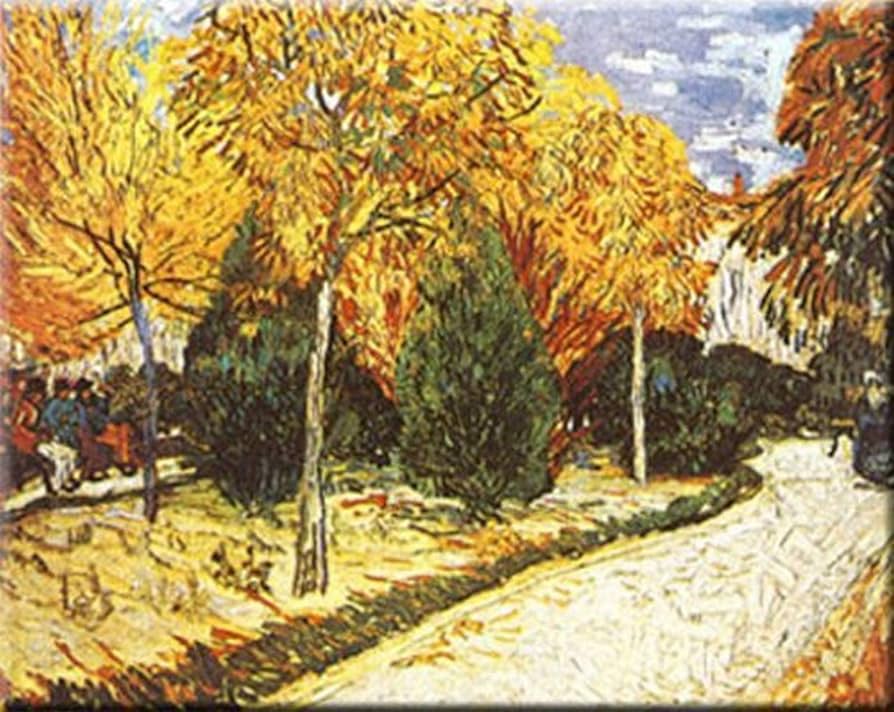
Autumn Garden by Vincent Van Gogh (1853-1890). From Public Domain
September heralds the start of year-end festivities around the world. It’s autumn in one part and spring in another – both seasons that herald change. While our planet celebrates changes, dichotomies, opposites and inclusively gazes with wonder at the endless universe in all its splendour, do we? Festivals are times of good cheer and fun with our loved ones. And yet, a large part of the world seems to be in disarray with manmade disasters wrought by our own species on its own home planet. Despite the sufferings experienced by victims of climate and war-related calamities, the majority will continue to observe rituals out of habit while subscribing to exclusivity and shun change in any form. Occasionally, there are those who break all rules to create a new norm.
One such group of people are the bauls or mendicants from Bengal. Aruna Chakravarti has shared an essay about these people who have created a syncretic lore with music and nature, defying the borders that divide humanity into exclusive groups. As if to complement this syncretic flow, we have Professor Fakrul Alam’s piece on a human construct, literary clubs spanning different cultures spread over centuries – no less an area in which we find norms redefined for, the literary, often, are the harbingers of change.
Mandal, herself, has a brilliant translation featured in this issue. We have a review of her book, an interview with her, and an excerpt from the translation of Jaladhar Sen’s The Travels of a Sadhu in the Himalayas. Written and first published in the Tagore family journal, Bharati, the narrative is an outstanding cultural bridge which even translates Bengali humour for an Anglophone readership. That Sen had a strictly secular perspective in the nineteenth century when blind devotion was often a norm is showcased in Mandal’s translation as well as the stupendous descriptions of the Himalayas that haunt with elegant simplicity.
Our fiction this month seems largely focussed on women’s stories from around the world. While Fiona Sinclair and Erin Jamieson reflect on mother-daughter relationships, Anandita Dey looks into a woman’s dilemma as she tries to adjust to the accepted norm of an ‘arranged’ marriage. Rashida Murphy explores deep rooted social biases that create issues faced by a woman with a light touch. Naramsetti Umamaheswararao brings in variety with a fable – a story that reflects human traits transcending gender disparity.
The September issue would not have been possible without contributions of words and photographs by many of you. Huge thanks to all of you, to the fabulous team and to Sohana Manzoor, whose art has become synonymous with our journal. And our heartfelt thanks to our wonderful readers, without who the effort of putting together this journal would be pointless. Thank you all.
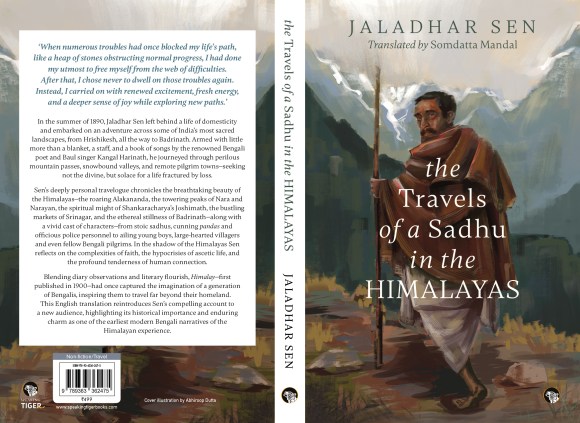
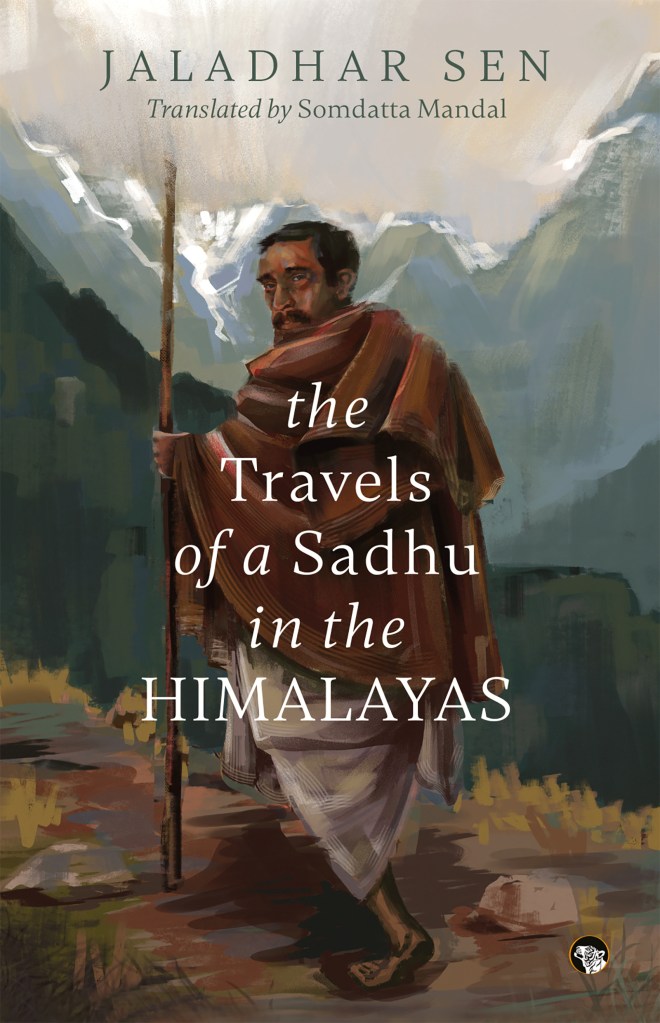
A review of Jaladhar Sen’s The Travels of a Sadhu in the Himalayas, translated from Bengali by Somdatta Mandal, published by Speaking Tiger Books, and a conversation with the translator.
Jaladhar Sen (1860–1939) travelled to the Himalayas on foot with two sadhus[1] in quest of something intangible. His memoir makes us wonder if it was resilience, for after all he lost his daughter, wife and mother — all within a few months. He moved to Dehradun from Bengal for a change of scene after his tragic losses before journeying into the hills.
Written in Bengali and first published as a serial in the Tagore family journal, Bharati, in 1893, the book was brought out in 1900 as Himalay. It has been brought to Anglophone readers by Somdatta Mandal, an eminent translator who has extensively translated much of Tagore’s essays and journals. She is a critic and scholar, a former professor of Santiniketan, an excellent translator to bring Jaladhar Sen’s diary to light. Mandal has given a lucid and informative introduction to Sen, his book and her translation — very readable and without the use of scholastic language or words which would confuse readers. Her commentary adds value to the text by contextualising the people, the times and the circumstances.
Her translation is evocative of the journey, creating vivid visual impact with the play of words. Sen is a Bengali who has picked up Hindi during his brief stay in Dehradun. That he uses multiple vernaculars to move around with two more Bengali migrants who have turned to a religious life and meets locals and pilgrims from a variety of places is well-expressed with a smattering of expressions from various languages and dialects. Mandal has integrated the meanings of these words into the text, making it easy for readers unfamiliar with these phrases to read and enjoy the narrative without breaking the continuity.
Sen is secular and educated — not ritualistic but pragmatic. You can see his attitudes illustrated in an incident at the start of the book: “We quickened our pace, but when we caught up to the two sanyasis, I felt a mix of amusement and irritation. One of them turned out to be my former servant, whom I had dismissed twenty or twenty-five days earlier for theft. His transformation was remarkable—dressed in the elaborate robes of a sanyasi, with tangled hair and constant chants of ‘Har Har Bom Bom’, he was barely recognisable as the thief he once was. It was sheer bad luck on his part that our paths crossed that day.”
At the end of the journey too, Sen concludes from his various amusing and a few alarming experiences: “Many imposters masquerading as holy sanyasis brought disgrace to the very essence of renunciation. Most of these so-called sanyasis were addicted to ganja[2], begged for sustenance, and carried the weight of their sins from one pilgrimage site to another.”
Yet, there is compassion in his heart as the trio, of which Sen was a part, help a sick young youth and others in need. He makes observations which touch ones heart as he journeys on the difficult hilly terrain, often victimised by merciless thunderstorms, heavy downpours and slippery ice. He writes very simply on devotion of another: “I felt happy observing how deep faith and belief illuminated his face.” And also observes with regret: “We have lost that simple faith, and with it, we have also lost peace of mind.” He uses tongue-in-cheek humour to make observations on beliefs that seem illogical. “In such matters, credit must be given to the authors of the Puranas. For instance, Hanuman had to be portrayed as colossal, so the sun was described as being subservient to him. However, with the advancement of science, the estimated size of the sun grew larger, and instead of diminishing Hanuman’s glory, his stature had to be exaggerated even further. Similarly, Kumbhakarna’s nostrils had to be depicted as enormous, so that with each breath, twenty to twenty-five demon monkeys could enter his stomach and exit again.”
Mandal has translated beautiful descriptions of the Himalayas from his narrative with lucid simplicity and elegance. When Sen chances to see the first snow peaks, the wonder of it, is captured with skill: “We were amazed to see a huge mountain of snow, its four large peaks encircling us. The sun was already quite high in the sky, and its bright rays fell upon those mountain peaks, radiating hues that cannot simply be described in words. Even the best painter in the world could not replicate the scene with his brush.” And: “Yet the scenery that unfolded before my eyes was simply magical. Standing in front of this pristine beauty, man’s power and pride were humbled. He could recognise his own triviality and weakness very clearly and, to a certain extent, grasp the greatness of the creator within his heart.”
And of course, there is the typical Bengali witty, sardonic banter creeping in to the narrative: “On certain days, when I felt inclined to indulge in minor luxuries, I would purchase a few pedas. However, such bravado was rarely worth the effort, as one might have needed the assistance of archaeological experts to determine the sweets’ actual date of origin—no one could tell how many generations of worms had made their home inside them!”
The translation has retained the simplicity of the narrative which Sen tells us was essentially his style. He had no intention of publishing what he wrote. He had started out in company of a sadhu with a staff, a blanket and a stock of Baul Kangal Harinath’s songs. He writes at the end: “I didn’t intend to write a diary. I had a songbook with me, and when that book was being bound, I had added a few blank pages with the idea of writing down new songs if I came across them.” He scribbled his notes in those blank pages.
The journey makes a wonderful read with its humorous descriptions of errant sadhus, frightening storms, descriptions of geographies and travel arrangements more than a hundred years ago, where the pilgrims live in shop houses and eat meagre meals, the perseverance, the wonder, the love and friendship one meets along the way. Though there is greed, theft and embarrassment too! Some of his narrative brings to my mind Nazes Afroz’s translation of Syed Mujtaba Ali’sIn a Land Far from Home: A Bengali in Afghanistan.
Mandal tells us: “A prolific writer, Sen authored about forty-two books, including novels, travelogues, works with social messages, children’s literature, and biographies.” In real life, she describes Sen as “a writer, poet, editor, philanthropist, traveller, social worker, educationist and littérateur.” That’s a long list to wear. There’s more from Mandal about what the book offers and why she translated this unique travelogue in this exclusive interview.
Traveller-translator Somdatta Mandal
How did you chance upon this book and why did you decide to translate it? How long did the whole process take?
I have been writing and researching on Indian Travel Writing for almost over two decades now and so was familiar with the sub-genre of travel writing about the Himalayas. In Bangla, there exists a great number of books on travel to holy places as part of a pilgrimage from the mid-19th century onwards. But this book was unique because it was written by a secular person who did not go to the Himalayas as part of a pilgrimage but nevertheless got influenced by the other pilgrims with whom he went along. It was in the summer of 1890 when he actually travelled, and later in 1893, his perilous experience was published serially in the Bengali periodical Bharati which was then edited by Rabindranath Tagore’s niece, Sarala Devi Choudhurani.
During that period, with the proliferation of travel narratives being regularly published in several contemporary Bengali periodicals, Jadadhar Sen’s narration became very popular and after 1900 when it was published in book form, it took the Bengali readers of the time by storm. Its popularity led to it being included as part of the syllabus at Calcutta University. Feeling that pan-Indian readers who could not read the original text in Bangla should get to read this interesting text in English, I was inspired to translate this travelogue for a long time and Speaking Tiger Books readily accepted my proposal a couple of years ago.
The places visited by Sen might not seem unique in the present context, but the period during which he undertook the travel and the culture-specificity of it needed special attention. I was busy editing two volumes of travel narratives to Britain then, and after I finished my project, I took up translating this text in full earnest. It took me about three months to complete the translation, and I send the manuscript to the publishers in January this year. After several editorial interventions, it ultimately saw the light of day in July 2025.
Did you need to input much research while doing the translation? How tough was it to translate the text, especially given that it has multiple language and cultural nuances?
I did have to do some biographical research on Jaladhar Sen as his narrative is absolutely silent about why he moved from Bengal to Dehradun and the actual reason for his setting out on this particular journey. Interestingly, I was also researching about Swami Ramananda Bharati, who was the first Bengali traveller to Tibet and Manas Sarovar, and who wrote the famous book Himaranya (The Forest of Snow) whom Sen knew earlier and with whom he actually undertook the journey. With several cross references I could fill in a lot of biographical gaps in the narrative.
Regarding translation, it must be kept in mind that though something is always lost in translation, one must always attempt to strike the right balance between oversimplification and over-explanation. Translation is also a sort of creativity and the challenges it poses are significant. The intricate navigation between the source language and the translated language shows that there are two major meanings of translation in South Asia – bhashantar, altering the language, and anuvad, retelling the story. Without going into major theoretical analyses that crowd translation studies per se, I feel one should have an equal grasp over both translated and source languages to make a translated piece readable.
What are the tools you have used to retain the flavour of the original narrative? Please elaborate.
Readability of this old text Himalay in the present context is of paramount importance and though it is very difficult to replicate the grandiose writing style of late nineteenth-century Bangla, I have attempted to retain as much of the original flavour of the text as possible. Without using glossary or footnotes, the meaning of certain words becomes evident through paraphrasing the text. Thus, in keeping with Jaladhar Sen’s original work, the names of some words have been retained as they are. For example, the words dharamshala and chati—resting places on the pilgrim’s path—are so culture-specific that they are retained in their original forms. Sen also uses other culture-specific words such as panda (the Brahmin middleman who acts as the intermediary for worshipping the deity), the kamandalu (the water jug carried by sanyasis), lota-kambal (the jug and blanket that emphasise one’s identity as a sadhu), the jhola (the typical cloth bag that hangs from the shoulders), and the mahanta, or the head priest of the temple. Again, different terms such as sadhu, sanyasi, and yogi are used at different points to define ascetics and are often employed interchangeably. The term math, denoting seats of authority and doctrinal learning, has also been retained in its original form. As a Bengali gentleman settled in western India— Dehradun—the author often refers to Bengal as his desh, which literally means ‘country’, but in his parlance refers to the region of Bengal, which is as much a part of India as Dehradun. This definition should not create any confusion in the reader’s mind.
You, like the author, never clearly tell us why Sen starts out on such a perilous journey. Why do you think he went to this journey?
From evidential sources we get to know that like any other domestic person Jaladhar Sen began his career as a teacher in a High School in 1883 in Faridpur in Bengal. He got married in 1885 but however, a few years later he endured a great personal tragedy, losing his family members in quick succession. In 1887, his newborn daughter died on the twelfth day after her birth, and his wife passed away another twelve days later. Within three months, his mother also died. Overwhelmed by grief and seeking solace, he moved to Dehradun at the foothills of the Himalayas, where he worked as a teacher.
It is known that Sen did not venture into the Himalayas out of wanderlust. Dejected with domestic life, he apparently went to Kumbh Mela in Haridwar, where he chanced upon Swami Ramananda Bharati, an elderly Bengali sadhu whom he had known previously. He decided to accompany him on a trek all the way to Badrinath on foot. This was the background to his Himalayan travels and how he became a paribrajak sadhu or a traveller saint. The year was 1890.
Even though the memoir spans only a month, the author underwent many changes. Would you regard this book as a bildungsroman of sorts, especially as there is a self-realisation that comes to Sen at the end? Please elaborate.
In his travel account Sen documents his experiences of journeying to various places of religious significance, namely Devaprayag, Rudraprayag, Karnaprayag, Vishnuprayag and Joshimath before reaching the temple town of Badrinath in the upper Himalayas. He undertook this journey as a secular sojourner. But the travel impacted his soul in such a way that at the end of his narrative he admits that he had ventured in the Himalayas with a funeral pyre burning within his heart; and he merely embraced the cool breeze of the mountains with his hands and pressed the hard snow against his chest. He is doubtful whether he had the time or the state of mind to witness the eternal glory of the Lord revealed in the heavenly scenes around him. Could he lift his head and look towards heaven? That sense of wonder was absent within him. But some sort of change had already appeared within him. In this context, I feel the last two sentences of his narrative to be very significant when he states: “If anyone feels inspired to visit the Himalayas after reading this simple travel narrative of mine, then all my writing will have been worthwhile. And if anyone journeys towards the feet of the god of the Himalayas, my life would have been fulfilled.”
What was your favourite part of the book. Did you enjoy translating some things over others? Please elaborate.
There are several sections in the book which I really enjoyed translating. Most of them relate to specific incidents that Sen encountered during his travels and how human nature was the same everywhere. The first one was when they were on their way to Devaprayag and in his diary entry on 11th May, he tells us about the incident when his money pouch along with the Swamiji’s tiger skin was stolen on the way and how with the help of a panda he managed to retrieve it after a lot of effort. Though they were not very much spiritually inclined, they realized that there were crooks on the way to the pilgrimage sites who also dressed up as sadhus and everyone could not be trusted in good faith.
The second memorable incident is when trekking during extremely inclement weather — rain and thunderstorm– and when stones rushed down from the mountain slopes nearly killed them, how Achyutananda or Vaidantik who was accompanying them managed to protect him by shielding from the natural calamities with his own body as a mother hen does to protect her chicks.
The third interesting incident that Sen narrates is dated 3rd June when they got stranded at a chati in Pipul Kuthi. The head constable or jamadar sahib arrived there to enquire about a theft and Sen tells us how even in that remote mountainous region, the police had the reputation for rudeness and stern behaviour as the Bengal police had. He writes, “These officers, tasked with restraining wrongdoers and protecting civil society, displayed the same demeanour no matter where they were stationed. It seemed that the police were the same everywhere.”
Another memorable section is when they chance upon a young boy who probably ran away from his house and was trekking with them for some part of the way. The way in which the sick lad was ultimately deposited under the care of a doctor in the local hospital is extremely moving. Several other sections can also be mentioned here but it will turn my reply excessively long.
Why did you feel the need to bring this book to a wider readership? Are you translating more of his books?
I have already mentioned the importance of Sen’s travelogue in charting the long tradition and rich repertoire of Bengali travel narratives on the Himalayas that focus on travel as pilgrimage. As early as 1853, Jadunath Sarbadhikari embarked on a journey from a small village in Bengal to visit the sacred shrines of Kedarnath and Badrinath. Returning in 1857, he chronicled his travels in Tirtha Bhraman (1865). Two lesser-known pilgrimages to the Himalayas were undertaken by monks of the Ramkrishna Mission order – Swami Akhandananda and Swami Apurvananda—in 1887 and 1939, respectively. Their travelogues were published many years later by Udbodhan Karyalaya, the official mouthpiece of the Mission. In both narratives, we find vivid details of the hardships of travelling during that period, marked by limited financial resources and minimal material comforts.
Jaladhar Sen’s narrative also holds a significant position in this chronological trend of writing about travelling in the Himalayas. From the 1960s onwards we find a proliferation of Himalayan travel writing in Bangla by writers such as Prabodh Kumar Sanyal, Shonku Maharaj, Umaprasad Mukhopadhyay and others, and many of these texts need to be translated provided one finds a responsive publisher for them. I am not translating Jaladhar Sen anymore, though as a prolific writer Sen authored about forty-two books, including novels, travelogues, works with social messages, children’s literature, and biographies.
How do you choose which text to translate? You always seem focussed on writers who lived a couple of centuries ago. Why do you not translate modern writers?
There is no hard and fast rule for selecting which text I want to translate. I have already translated several travel texts by Bengali women beginning from Krishnabhabini Das’s A Bengali Lady in England, 1876, to later ones. But I have not translated any travelogue about the Himalayas before. Here I must be candid about two issues. I pick upon writers usually whose texts are free of copyright as that does not entail a lot of extra work securing permissions etc. The second more practical reason is that I still have a long bucket list of translations I would like to do provided I find an agreeing publisher. But that is very difficult because several of my proposals have been rejected by publishing houses because they feel it will not be marketable in the current scenario.
As for the query about translating modern writers let me narrate a particular incident. As a woman writer and as someone interested in translating travel narratives of all kinds, I had approached Nabanita Dev Sen through a willing publisher to translate her visit to the Kumbh Mela that she wrote about in her book titled Koruna Tomar Kone Poth Diye[3]. After seeking necessary permission and meeting her personally on several occasions to discuss several chapters, I gradually got frustrated because even after three sets of corrections, the translation did not satisfy her.
She consulted several other people, including her own daughter, and ultimately told me that she couldn’t accept my translation because she ‘didn’t find herself in it.’ The colloquial Bangla humour in some places were not sufficiently translated. As far as I got to know from the publisher, she changed editors thrice, and in the end the translated book was published with one of the editors named as the ‘translator’. When I chanced to meet her at my university on a different occasion, Nabaneetadi told me that she had mentioned my name in the acknowledgement section of the book, which of course I didn’t bother to buy or check. From such a bitter experience, I feel staying with writers dead long ago is a safer bet for me.
You are working on a new translation. Will you tell us a bit about your forthcoming book?
As I have already mentioned, I found Swami Ramananda Bharati’s Himaranya (The Forest of Snow) to be a companion piece for translation. Not only is this significant because it was the same Swamiji with whom Jaladhar Sen travelled to the Himalayas, and though his name is not mentioned anywhere by Sen, we get to know a lot about him already through his narrative. As a monk, Bharati travelled to Mount Kailash and Manas Sarovar in Tibet during 1898, the first Bengali to do so. These travels form the basis of Himaranya. It was not entirely ‘spiritual’ or ‘theological’ but rather depended on the traveller’s own temperament. There are presentations of secular interests and considerations, and modern readers can relate to them easily, especially because the route to Kailash and Manas Sarovar has now been opened for Indian pilgrims once again and several groups are going there every other day. The manuscript is already with the publisher and hopefully the book should see the light of day by the end of this year if everything goes well.
You have translated so many voyages by Tagore, by Sen, do you now want to bring out your own travelogues or memoirs?
I have been translating travel narratives of different kinds for a long time now. I still plan to do a few more if I get a proper publisher for the same. I am an avid traveller myself and have actually trekked to Kedarnath, Badrinath, Gangotri and Yamunotri twice. I have also trekked for fourteen days to visit Muktinath in Nepal way back in the early 1980s, and during the pandemic days when I was confined at home, I managed to key in that experience in Bangla from the diary I kept at that time. That narrative was published in the online journal Parabaas which is published from the United States. But I have never taken writing about my own travelogues or memoirs seriously. Of course, last year and also forthcoming this year, a special Puja Festive number of a Bengali magazine has been publishing my travel articles. But there is nothing serious or academic about it.
Do you have any advice for fledging writers or translators?
Translating has caught up in a big way over the past five or six years. Now big publishing houses are venturing into publishing from regional bhasha literatures into English and so the possibilities are endless. Now every other day we come across new titles which are translations of regional novels or short stories. My only advice for young writers or translators is that since copyright permissions have become quite rigid and complicated nowadays, it is always advisable to seek permission from the respective authorities before venturing into translating anything. I was quite young and naïve earlier and just translated things I liked without seeking prior approval and as usual those works never saw the light of day. Also, as time went by, I learnt that translating should have as its prime motive current readability and not always rigidly adhering to being very particular about remaining close to each individual line of the source text. The target readership should also be kept in mind and so the choice of words used and glossary should be eliminated or kept to a minimum. The meaning of a foreign word should as far as possible be embedded within the text itself. All these issues would definitely make translating an enjoyable experience.
Thanks for the wonderful translation and your time.
[1] Mendicants. Sadhu and swami also have the same meaning
[3] Translates from Bengali to The Path to Compassion, published in 1978. The translation was published by Supernova Publishers in 2012 as The Holy Trail: A Pilgrims Plight. Soma Das is mentioned as the translator.
(This review and online interview is by Mitali Chakravarty)
Travel writing by Tagore: Translation by Somdatta Mandal
In 1885, under Jnanadanandini’s1 editorial venture, a children’s magazine called Balak was published from the Tagore household in Calcutta. It contained different writings of the young Rabindranath, who would handle a lot of things for the publication. This magazine was later merged with Bharati and edited by his elder sister, Swarnakumari Devi. Among the different entries that Rabindranath contributed for Balak are two interesting travel pieces. One travelogue published in Vol. 3, Ashar 1292 B.S. (July-August 1885) called “Das Diner Chhuti” (Ten Days’ Holiday) narrates his trip to Hazaribagh that year along with his nephew and niece during their school holidays. The second one called “Baraf Pora” (Snowfall) describes his first experience of snowfall in England in the winter of 1878 when he was living in Brighton along with his brother Satyendranath’s family2.
Rabindranth Tagore (1861-1941) in England
Baraf Pora (Snowfall)
The outlines of pictures gradually blur out of the mind; the shadows of all that we see every day come ahead and crowd it, replacing the things we had seen a few days earlier. We cannot clearly understand where the earlier images get lost in the melee.
I went to England in the year 1878 A.D. That was about seven years ago. At that time, I was young too. I can remember overall what I had seen in England, but all her pictures are no longer clear in my mind. I cannot match one line with another. A kind of mist has already descended on my memories of England. The pictures must be brought out occasionally and aired in the sun. That is why I have brought out my memories in the sunlight today.
It was the middle of October when I reached England. I didn’t feel it to be too cold then. We stayed in Brighton. It was sunny in Brighton then. Happy with the sunshine, all men, both young and old, had come in hordes to the seashore. The sick and the elderly people moved in pushcarts with one or two young girls or any other member of the family accompanying them. The ladies were dressed up in different kinds of clothing with umbrellas over their heads. Small boys dragged iron wheels and ran along with them. Some ladies sat on the seashore with open umbrellas over their heads. Some were busy following the movement of the waves and collecting different kinds of seashells. An Italian beggar was moving around playing an organ. Vegetable and milk vendors were returning after supplying their products in different houses. A man and a woman were riding their own horses on the pathway and the dressed up stable boys were following them. Some schoolmasters were walking with a big group of boys following them; on the other hand, each schoolmistress had a whole trail of schoolgirls following her. They had come to enjoy the sea breeze, or if not, at least the sunshine. Quite often we would run around the grassy fields near the seashore. Though the age was not conducive for running around, we didn’t mind because no one suitable was present there to criticise us for our out-of-the-way behaviour. The best time for our outing was ten or eleven o’clock in the morning. Whatever it might be, the seaside was celebrating the festival of sunshine when we reached Brighton.
As the days went by, the cold started increasing. The mud on the streets froze in the cold weather. The dew on the grass would freeze too and it seemed as if someone had scattered lime powder everywhere. On waking up in the morning I found that ice crystals had formed different designs on the windowpane. Sometimes I also found one or two sparrows that had died in the cold lying on the road. The few yellow leaves remaining on the trees also fell down, leaving the lean bare branches behind. The small little robin birds came to the glass windows with reliable hearts begging for bits of bread. Everyone assured us that we would soon witness snowfall.
Christmas was almost approaching. It was biting cold on a moonlit night. The doors and the windows of the room were all shut tight with the curtains drawn over them. The gas was burning. A fire was lit to warm up the place. After dinner we were all around the fireplace busy chatting. The two young boys attacked me. Despite having plenty of proof, I do not want to mention here that they never behaved politely with me. They have grown up now, they even read Balak; so, I do not want to write about them and then make my life more miserable answering their questions. A few days later they will also learn to protest. Because I would not be able to counter them, I remained quiet. You readers can guess whatever you like about their behaviour – I will not volunteer to take any responsibility on my shoulders.
Everyone was sitting warm enough when suddenly we got the news of the snowfall. As all our doors were shut, we did not know when it began. All of us including the children ran outside to see the beautiful sight. The cold seemed to have frozen the moonlight in layers and stuck on the streets, on the grass, the bare branches, the sloped slate roofs. There was no one on the street. All the houses in front of us had their doors and windows shut. The night and quietness, the moonlight and the snow all blended to create a wonderful scene! The children (and I too) picked up the snow on the grass and turned it into little balls. As soon as we brought them in, they melted into water.
For me this was the first night of snowfall. After this I have seen snowfall several times. But describing it is not easy, especially after so many years. I was walking on the street covering myself entirely in black woolen clothes. The sky was grey. Little flakes of snow were falling all around like quinine powder. It did not fall like raindrops – it came in lightly as if flying or dancing. It came and touched your clothes lightly; you could dust and collect them. The wheels of cars left their marks on the soft white layers of snow. One also felt sad to leave dirty and muddied shoe imprints on the white layer of snow. It seemed as if the petals of the parijat flower were falling from the sky. Snow also got stuck on the black dresses and black umbrellas of the pedestrians.
Parijat flowers fallingSnowflakes falling
It was wonderful to watch how everything got covered with snow gradually. At first, it fell merely like some white streaks on the streets. There was a small plot of land in front of our house. It had a few saplings and creepers – no leaves on the shrubs but just bare branches. Those branches were still not covered with snow, so it was a mixture of green and white. The saplings seemed to be freezing in the cold. Their clothes were gone; wearing white funeral clothes of snow, the sap in their veins also seemed to be freezing. The black slate roof of the house was gradually turning grey and then white. Soon the streets were also covered with snow – the small saplings got buried in it. The snow also piled up on the narrow windowsill. The noses of the few pedestrians on the street turned blue, their faces shriveled in the cold. Far off at a distance, the church steeple was faintly visible like a white ghost in the sky.
It is very difficult now in this hot and humid summer month to even imagine how cold it was. I remember how after taking a cold-water bath in the morning my hands would become so numb that I could not find the handkerchief in my pocket. There was no limit to the amount of warm clothes on my body. Despite the thick shoes and socks, the soles of my feet would become cold in no time. Even after getting inside a bundle of blankets at night, I would be worried how I would turn on the other side because whenever I turned, I would get a shock. We heard the story about four fishermen who had gone out to fish in the sea. When a ship came near their boat, they saw that the four of them had already frozen to death. The coachman who was sleeping on his carriage at night had also died. The water in the pipes often froze and caused the pipes to burst. Snow had covered up the River Thames. The lake inside Hyde Park was also frozen. Hundreds of people wore a kind of iron shoes and skated over that lake every day.
This skating was a wonderful affair. Hundreds of people wearing skating shoes turned and bent and twisted and glided over that hard lake. The way people skated was like the way a boat moved with its sail. With the body slightly tilted on one side, one could float easily on the ground. No effort was needed to step forward – one did not have to quarrel with the ground or defeat it with each footstep.
Trying to bring back the winter of England to our country even through our imagination is futile. The heat here rises very quickly, melts like the snow and cannot be grasped. It is not sufficiently welcomed within the blankets and quilts here.
Rabindranath Tagore (1861 to 1941) was a brilliant poet, writer, musician, artist, educator – a polymath. He was the first Nobel Laureate from Asia. His writing spanned across genres, across global issues and across the world. His works remains relevant to this day.
Somdatta Mandal is a critic and translator and a former Professor of English at Visva-Bharati, Santiniketan, India.
.
PLEASE NOTE: ARTICLES CAN ONLY BE REPRODUCED IN OTHER SITES WITH DUE ACKNOWLEDGEMENT TO BORDERLESS JOURNAL
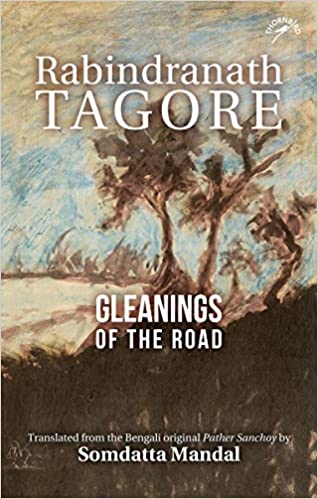
Travels formed an integral part of the personae and creative artist that was Rabindranath Tagore. During his travels to England and the America (1912-13 and 1920) Tagore wrote essays for publication in various Bengali journals. Rabindranath Tagore was an inveterate traveller who travelled to the furthest corners of the globe. Detailing his travels in the colloquial everyday language (also referred to as ‘chalit’ bhasha or language) during his tour of England and USA in 1912-13, he used to publish regularly in journals like Prabasi, Bharati and Tattwabodhini Patrika. As the translator-editor Somdatta Mandal informs us, Vishwa Bharati Publication Department in 1946 decided to discard Rabindranath’s own selection. They went back to the earlier formal register and included writings of the 1912 tour, irrespective of whether they were related to his travel.
The book blurb says: “In 1939, Tagore selected fourteen of these essays and an appendix containing seven letters he had written to some of the teachers in the Santiniketan ashram while he was on these trips, for publication as a volume. It was at this point that he rewrote the original essays then using the colloquial instead of the formal language; he also revised the texts substantially. Later editions altered the number of essays, sometimes digressing from Tagore’s own selection, sometimes going back to Tagore’s original formal language.”
The travelogue, if it can be called that, provides an insight into Tagore’s perception of the different facets of western life and the diverse philosophical issues that cross his mind as he journeys from one continent to another. Thus perhaps it is more appropriate that the collection is named “gleanings’’ rather than a travel account or narrative. They are philosophical ruminations where Tagore holds forth on various aspects of civilizations and cultures.
In the very first segment, Tagore’s critical observations about Indian society comes to the fore. Thus he comments on what he sees as cultural differences and civilizational clashes, in “Prelude to the Journey”: “We always comfort ourselves by saying that we are a religious and spiritual race”. He sees this as a compensatory move by Indians to cover up our own sense of inadequacy, about our “weakness” in the external world.(Tagore was acutely conscious of India’s status as a colonised country). “Many of us boast that poverty is our asset”, dwelling perhaps in a haze of pseudo-spiritualism which balks at admitting that this attitude is merely a kind of bravado.
Tagore’s essay here unpacks the notion of the binary that the West is materialistic while the East is spiritual by lauding certain aspects of Western and European culture. Thus he writes that “if we go to Europe with the aim of a pilgrimage, our journey will not be in vain”. He further explains that this is not only because of the material developments achieved by Western culture, but their spirit and attitude.
Power, according to Tagore, is more than an external manifestation; rather, it has to do with a sense of real inner strength. He goes on to cite the instance of the Titanic and people’s altruism and self-sacrifice that was in evidence at that time, to interrogate the view, held by many Indians, that the average European is self-centred and self-serving. On the other hand, Tagore also gives plenty of instances where the spiritual poverty of Indians was in evidence. Thus he writes, “I know there has been a clash between our welfare and that of Europe and because of that we are suffering deep anguish and pain. We do not trust their religion and we criticise their culture as being too materialistic.” However, he continues that there are aspects of European culture which are worthy of emulation, which we would do well to follow, without feeling that it threatens our culture. He strongly commends that the path to seek the truth is a pilgrimage on which we should proceed without being blinded by ego, prejudice and false pride.
Coupled with this contrast of cultures, are observations about people and places. Thus he talks about the women of Bombay who are visible on the beaches of Bombay and contrasts it with the city of Calcutta, which according to him, is bereft of women in public places. Tagore also muses on the vast and limitless ocean which to him offers a cornucopia of literal and symbolic meanings. The sea and the ocean signify vastness, depth, boundlessness and infinitude, as well as the lure of the unknown. In contrast, he bemoans the loss of man’s ties with nature signified to him by the colonial appropriation of the river. He reflects that the river “Ganges was once one of Calcutta’s ties with nature…It was the one window of the city from where you could look out and realize that the world was not confined to this settlement.” He bemoans the fact that the once natural strength of the Ganga had been dissipated, “it has been dressed up in such tight clothes on both its banks and its waist band has been tightened so that the Ganges seems to be the image of a liveried footman of the city”. In contrast, the “special glory of the sea is that it serves man but does so without wearing the yoke of slavery on its neck.” His evocative description brings to life the various aspects of the landscape in full measure.
Tagore’s ‘travel’ writing is not just a mapping of people and places, but shows him as the supreme cartographer of the imagination. Witness his contrast of the earth and the ocean. The earth is compared to an excessively doting mother who binds her children to her and does not allow them to venture far away; the ocean by contrast “constantly allures him to venture towards the unattainable”. He adds, “Those who responded to that call and moved out are the ones who conquered the world.” Moreover, “that race of people on this earth who have specially welcomed this ocean have also found the unceasing effort of the ocean in their character.” Travelling on the Arabian sea, glimpsing distant shores, he stresses that the union of the two — the land and the ocean — signifying stability and movement are vital to an understanding of the truth.
The urge to travel, to move forward continuously, is forever present in man. In a philosophical vein , the poet muses that the soul “always wants to travel” and that it dies if it does not do so.In a series of similes and metaphors drawn from nature, he reflects: “Let us keep moving on, like the waterfall, the waves of the ocean, the birds at dawn, the light at sunrise.” He even transcends to the next plane when he says that “even the call of death is nothing but just a call to change the dwelling place”. In almost the same breath, he compares himself to a fairy princess who is fast asleep and who cannot be woken from her slumber, except with a golden wand.
Part anthropological study– at one point, the poet reflects that the vastness of the surrounding sea would have elicited devotion among many Indians, unlike the European traveller who is intent on enjoying the comforts and varieties of entertainment on the ship-part philosophic meditation, “Gleanings” represents the quintessential Tagore. His interrogation of Indian claims to spirituality is made in the tone of a concerned father warning his children not to fall prey to false pride and vanity. Deeply patriotic as well as an internationalist, he straddled two contrasting worlds of materiality and spirituality, without succumbing to limiting binaries and stereotypes.
Ably introduced and translated by Somdatta Mandal, a renowned Tagore scholar, the translation captures the iridescent and luminous quality of Tagore’s prose and its chiaroscuro effects.
Dr Meenakshi Malhotra is Associate Professor of English Literature at Hansraj College, University of Delhi, and has been involved in teaching and curriculum development in several universities. She has edited two books on Women and Lifewriting, Representing the Self and Claiming the I, in addition to numerous published articles on gender, literature and feminist theory.
.
PLEASE NOTE: ARTICLES CAN ONLY BE REPRODUCED IN OTHER SITES WITH DUE ACKNOWLEDGEMENT TO BORDERLESS JOURNAL
Translated from the original Bengali by Somdatta Mandal
Translator’s Note
The earliest journeys of Rabindranath Tagore (1861 – 1941) were in his mind and he has left us accounts of these as well as of the later physical journeys in various travel writings – letters, diaries, poems, songs, and essays. Right from his childhood he made innumerable trips both within India and abroad. Apart from his regular full-fledged travelogues, we find many lesser known but interesting experiences of his travel. Included below are four such entries. The first essay is a trip to Hazaribagh with his nephew and niece. The second entry is a hilarious letter about his second visit to Darjeeling. The third a letter that narrates his trip to Satara in Maharashtra State, one of the towns where his elder brother Satyendranath Tagore served in the Civil Service. The last one is from Balia in Uttar Pradesh where Rabindranath complains that he is tired of travelling and wants to settle down peacefully as a bird in its nest.
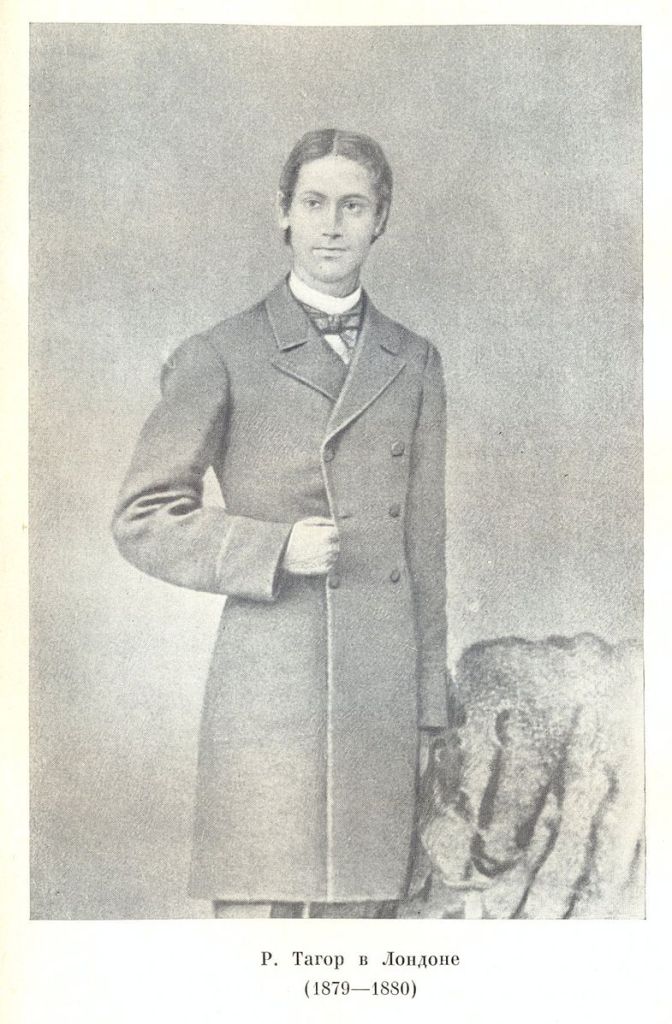
Tagore in London, 1879. Courtesy: Creative Commons
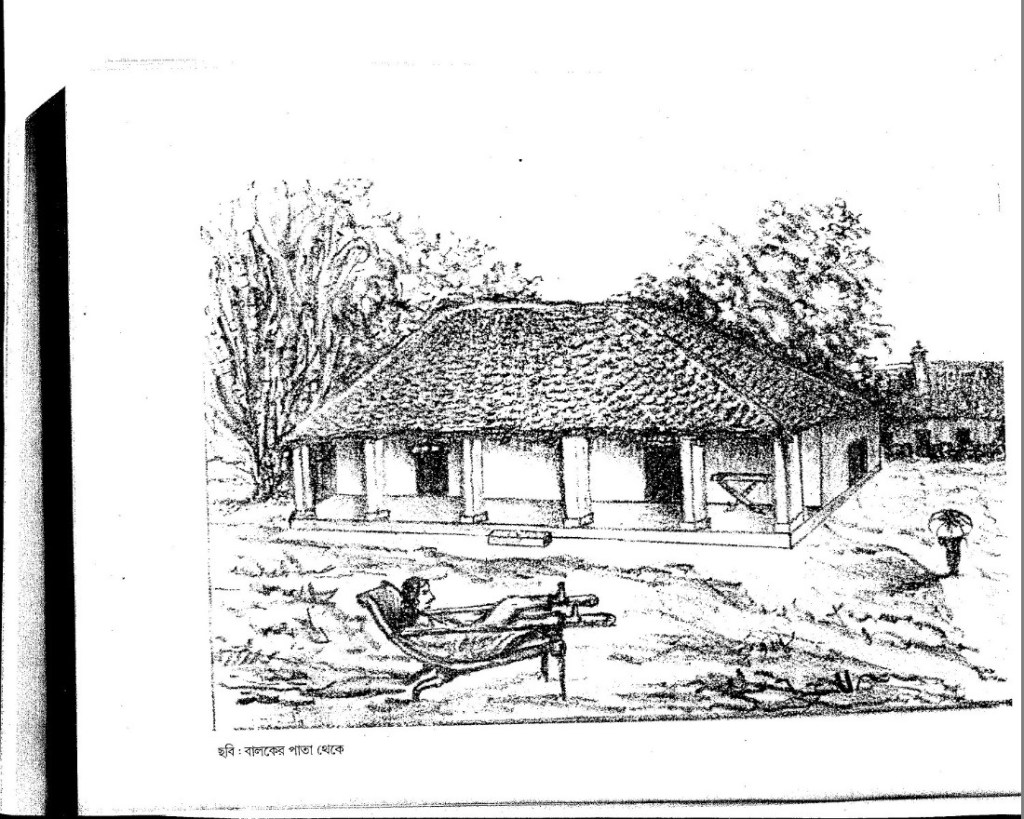
In 1885, under his sister-in-law Jnanadanandini’s editorial venture, a children’s magazine called Balak was published from the Tagore household in Calcutta. Though the life-span of this magazine was less than a year and only eleven issues were totally published, it contained different writings of the young Rabindranath, who would handle a lot of things for the publication. This magazine was later merged with Bharati and edited by his elder sister Swarnakumari Devi. Among the different entries that Rabindranath contributed for Balak and published in Vol. 3, Ashar 1292 B.S. (July-August 1885) was an essay called “Dus Diner Chhuti” (Ten Days’ Holiday) that narrates his trip to Hazaribagh that year during the school holidays. The two children referred to in this article were Surendranath and Indira, son and daughter of his elder brother Satyendranath and Jnadadanandini Devi. The sketch of the bungalow below is also done by him.
An illustration accompanying the essay ‘Dus Diner Chhuti’ (Ten Days’ Holiday). First published in Balak magazine. Somdatta Mandal suggests it could be the handiwork of the Kobiguru.
Trip to Hazaribagh – First published in Balak Magazine
Two children have made me homeless in this summer heat! Their school has been closed for ten days but that’s not just the reason. There would not be so much chaos in the house even if twelve suns appeared on the horizon. The older brother blunted the tips of all the pens he found within his reach, drew pictures on whatever paper he found; tried out the sharpness of a knife on his existing thigh; took out the machine from the watch he found and tried to rectify it; undid the bindings of all the books within his reach; climbed up on my shoulders if he found the opportunity – and so on! He moved on parapet walls in places where there were stairs for climbing; though everyone in the whole world believed in getting out of a car only when it stopped, he thought it was his only duty to jump out of a running car.
Everyone accepted the fact that the sun was too hot during the summer but the human child that I am talking about probably did not differentiate much between sunshine and moonlight. So during the school vacation, the difference in belief and behaviour between him and other ordinary people created a sort of revolution in the neighbourhood. The news that recently the elder brother has got leave for ten days spread everywhere. People were not so overwhelmed even when they received the news of the English-Russian war.
In the meantime, his younger sister came to me off and on and demanded – “Uncle–.” It would be nice if he called me ‘Uncle’ but I would receive new names at least three times in a day – names which were not heard in any civilized country. These naughty children also scattered and turned my own possessions upside down. My own name also did not have a proper address. I could not make them understand that my own name was my personal possession. Anyhow, the small girl (not that she was too small) came and pleaded, “Uncle, come with us to Hazaribagh.” After a lot of thought I did not say anything else and ventured out on this summer day.
One cannot see much in a vacation of eight or ten days but at least we can peek at nature outside. At least one can stand beneath the open expanse of the blue sky and the vast open green fields for a few seconds and feel free. We live in the city and occasionally it becomes essential to prove that the world is not built entirely with bricks, wood and mortar. So, four of us began our journey. I have already acquainted you with the boy and the girl. I need to introduce the other person. He was a fat, round and simple man. He was older than all of us but even younger than these children. His fair and stout figure was full of humour and he seemed like a ripe and juicy fruit. Just like the bubbles in a huge pot of rice being cooked, his humour came out from his nose and eyes. There are some people who resembled the ‘sandesh’ – the sweetmeat without a covering, without anything hard inside, without thorns – just a smooth, juicy blend of cottage cheese and sugar. Our innocent and harmless companion was that kind of a very edible man.
We boarded the train at Howrah at night. The swaying of the train confused one’s sleep – the sleeping conscience and the dream and waking up all got mixed up. There were occasional series of lights, sound of gongs, shouting, and calling the name of a station in a strange intonation. Again after three strikes of a gong all the sounds would subside within a few seconds and everything would become dark and quiet except for the continuous sound of the train wheels moving in the dark. Keeping in tune with that sound all the strange dreams would keep on dancing in my head all night. We had to change trains at Madhupur Station at four o’clock in the morning. As the darkness faded away, I sat at the train window and looked outside at the early morning light. This was a new country! It seemed that due to some disturbance our flat land had cracked and was torn apart. It was rough, broken and full of big and small sal trees and there were high and low undulations everywhere. There were plenty of sal trees but they did not endear each other as they did in Bengal. Each tree stood independently on its own soil. In Bengal all the trees, plants and creepers entwined each other in a familial bonding, but I did not notice that in this hard soil here. Maybe the people here were also like that. We did not notice much habitation. Only occasionally one or two huts stood friendless here and there. In the wet and salubrious climate of Bengal, trees and plants, men and men, houses and houses all stick to each other, but here in this rough and dry place everything seemed to be standing independently on their own.
The train moved on continuously. In the cracked fields one could sometimes see the sand of dry river beds and in those river beds huge black rocks and stones lay like skeletons of the earth. Sometimes a few hills stood up like severed heads. The hills in the distance were dark blue in colour. The blue clouds in the sky that came to play with the earth seemed to get caught up here. They had raised their wings to fly back to the sky but could not do so because they were tied up. The maidens from the sky came and embraced them. I saw one dark man with a broad face, with his wild hair tied up in a knot, standing there with a stick in his hand. The plough was attached to the back of two buffaloes; they had not begun tilling yet, and they stood still looking at the train. Occasionally there were some clear plots of land encircled with fencing made of ghritakumari plants and with a brick well that was constructed in the centre. The whole region looked very dry. The thin, tall and white dry grass looked like grey hair. The short leafless berry plants were shriveled, dry, and dark. In the distance a few palm trees stood with their small heads and one long leg. Occasionally a peepul or a mango tree was also visible. A lone old roofless cottage with its broken frame stood in the middle of the dry land and looked at its own shadow. Nearby there was a stump of a huge burnt tree.
We reached Giridih station at six o’clock in the morning. There were no more train lines after that and so we had to take carriage drawn by human beings from here. Could we call this a car? It was a small cage over four wheels. As we began our journey in the morning, the four of us started chirping inside it like four fledglings. The young brother and sister began to talk about many things and also pester me with joy. Our stout companion mingled with the children and turned into such a child that by just looking at them my own age was reduced by fourteen years and eight months. At first we went to the Giridih Dak Bungalow and refreshed ourselves. There was no sign of grass anywhere as far as we could see. There were a few trees in between and waves of red earth everywhere. A lean pony was tied under the tree; after looking all around it didn’t know what to eat. Having nothing to do it stood scratching its back on the wooden post. A goat was tied to another tree with a long rope and after a lot of research it stood breaking a sort of green plant with ease.
We resumed our journey from here. There were coal mines in Giridih but we could not see it due to lack of time. The road was hilly. We could see a great distance both in front and behind us. The long and winding road lay on the dry and empty terrain like a serpent basking in the sun. The car was pushed on the uphill road with a lot of effort and then it would slide smoothly downhill. As we went along we saw hills on the way. There were tall and thin sal trees, termite heaps, stumps of trees that had been cut down. At certain places some hills were covered with only tall, thin and leafless trees. The starving trees seemed to spread their lean dry fingers towards the sky and the mountains seemed as if they had been pierced by hundreds of arrows like the bed of arrows on which Bhisma rested on the battlefield of Kurukshetra. The sky was overcast and it began to drizzle. The coolies were letting out loud shouts while pulling the carriage and when their steps occasionally hit pebbles on the road, the carriage would suddenly shake up. Somewhere on the way the road ended and we saw a huge bed of sand with a narrow river in the distance. On asking the coolies we were told that it was the Barakar River. The carriage was pulled across the river and taken to the road on the other side. There were shallow ponds on both sides of the road and four or five buffalos leaning their heads on one another, dipped half their bodies in the water to relaxed themselves and gave us very casual glances.
When evening descended we got down from the carriage and went walking for the rest of the way. We saw two hills in the distance and the road went up and down through them. Whichever way we looked, there were no people, no human habitation, no grains, no tilled land. On all sides the undulated earth stood silent and barren like a hard ocean. The golden hue of dusk in the horizon cast dark shadows on us. Though there were no human beings or animals around us, there was a feeling that this huge earth was preparing for a huge person to come and sleep on its bosom. Like a sentinel someone was guarding the place with fingers on his lips and so everyone felt scared to breathe. The shadow of a traveller with luggage on his horseback came along from a distance and gradually crossed our path.
The night somehow passed between sleep and waking and tossing and turning sides. Upon waking up we saw a thick forest on the left hand side. There were creepers on the trees and the ground was covered with different kinds of shrubs. Above the forest we could see the blue peaks of distant hills. There were huge rocks and among their crevices were a few trees, their hungry roots growing long and spreading out on all sides. It seemed as if they wanted to break the rock in search of food and grasp it with their strong grip. Where did the forest on the left disappear all on a sudden?
There were fields stretching at a distance. Cows were grazing. They looked as small as goats. Farmers were tilling their land with the plough attached to bovine shoulders. Sometimes, they twisted the cows’ and buffaloes’ tails. The tilled lands rose like steps on the hills. We had come close to Hazaribagh. One or two of the hills stood as relics of some great natural revolution.
We reached the dak bungalow at Hazaribagh at three o’clock in the afternoon. The town of Hazaribagh looked very clean amidst the wide landscape. There was no city-centric ambience here – no narrow lanes, dirt, drains, jostling, commotion, traffic, dust, mud, flies or mosquitoes. Amid the fields, trees and hills the town was absolutely clean. The giant houses in Kolkata are proud as stone – they stand treading the earth below, but here it was different. Here the clean and small thatched roof houses stand quietly in friendship with nature; they do not have glamour, they don’t exert might. The town seemed to be like a nest in the trees. There was deep silence and peace everywhere. We hear that even the Bengalis who live here do not quarrel among themselves. If this was true, then there would be no enmity between the crow and the eagle or between the cat and the dog.
One day was gone. It was afternoon now. I sat alone quietly in a couch on the verandah of the dak bungalow. The sky was blue. Two thin pieces of clouds sailed by. A mild breeze blew an earthy, grassy smell. There was a squirrel on the roof of the verandah. Two shalik birds (mynahs) were hopping about on the verandah and shaking their tails. I could hear the sound of cow bells as they from the adjacent road. People were moving in different ways. Some carried luggage on their shoulders and walked with open umbrellas on their heads; some were chasing a couple of cows, and some moved slowly riding on the back of a pony. There was no commotion, no hurry, and no sign of worry on their faces. It seemed that human life here did not pant rapidly like a fast railway engine or move with screeching noises emanating from the wheels of a heavily laden bullock cart. Life here moved in the manner of a gentle breeze blowing beneath the shade of trees.
The courthouse was in front of us. But even the court was not that rigid here. While the two lawyers in their black coats fought with each other inside, two papaya birds sat outside on the peepul tree and conversed among themselves constantly. The people who came here seeking justice sat in a group in the shade of the mango tree and laughed loudly among themselves. I could hear them. Sometimes, the midday gong started ringing in the courthouse. Its sound seemed very serious in this leisurely ambience and slow rhythm of life. The occasional sound of the gong was a reminder that time did not flow by in the casual slow cadence of life here. Standing in between it seemed to pronounce in its iron tone, “I am awake, even if others are not.” But the writer’s condition was not exactly the same. I felt sleepy. It was not a deep sleep. I realised that though the all-pervading stillness of nature and beauty encircled me with great care, my senses were failing to capture the details.
I spoke whatever I had to say about Hazaribagh (some might be thinking that I could have spoken much less) except that I did not mention that we became newly acquainted with the children of one of my friends. Upen Babu read the Akshanmanjari so we had to treat him with respect. I had mistakenly confused the alphabet sequence and he had instantly corrected it. That is why I was grateful to him. But in spite of many entreaties his sweet-looking naughty sister did not speak to us. I threatened to write an article and take revenge on her, so according to that promise I am spreading the word today letting the whole world know about her shy and coy words, and how she would run away whenever guests came to her house. I also cannot keep it a secret how we had received sweet sandesh and even sweeter welcome from our friend.
In order to save time on our return journey we came down in a two-wheeled small carriage. If nothing else happened, at least it reduced our longevity as the whole body got shaken up with the bones and the joints fighting against each other. As the body went on jerking and dancing like mad, the five elements with which it was composed gave us a tough time. I could hold it together somehow but nothing much beyond that. With so much of revolution in the whole body, I could not hold books in my hands, the cap on my head, the spectacles on my nose, food in my stomach. To add to all that was the scorching heat of the sun. I had left home with the full sixteen annas of my body intact but when I returned, I could not even account for twelve annas of it. The ten days’ holiday is over. Ah!!
More Humour: Letters from Tagore
I
Darjeeling
September 1887
Here we have reached Darjeeling. On the way Be_____ behaved very well. Didn’t cry much. Shouted a lot, created commotion, made various noises with her mouth, turned her wrists and even called birds, though we couldn’t see birds anywhere. There was a lot of trouble in boarding the steamer at Sara_____ Ghat. It was ten o’clock at night – hundreds of pieces of luggage, a few coolies, five women and only one man[1]. After crossing the river, we boarded a small train – in it there were four berths and we were six people. The ladies along with their luggage were put up in the ladies’ compartment. Though it sounds pretty simple, the actual process wasn’t so. There was a lot of calling, shouting, and running around but even then Na___ said that I did nothing. That means that the image of a terribly annoyed grown up human being was the only one suitable for a man. But no gentleman of twenty-six years has done what I have done in the last two days – opened so many boxes and closed them, pushed them under the benches, again pulled them out from there, run here and there behind so many boxes and bundles, so many boxes and bundles have chased me like a curse, so many have been lost, so many regained, so many not found and so much attempt made to recover the lost ones. I am surely suffering from box-phobia – my teeth start chattering whenever I see boxes.
When I look all around me, I see boxes, just boxes – small, big, medium, light and heavy, made of wood, tin, leather, and cloth—one below me, one above me, one next to me and one behind me – then all my natural strength to call, shout and run around totally disappears. And then my blank look, dry face and poor countenance makes me seem like a mere coward; so whatever Na____r have said about me is correct. Anyhow, let it be. After that I went and slept in another coach.
Two other Bengalis were there in that coach. They were coming from Dhaka; one of them was almost totally bald and his language was very different. He asked me whether my father was in Darjeeling. If Lakshmi was around she would have replied to him in his incorrect Bangla but I did not have such an instantaneous answer.
The way from Siliguri to Darjeeling was filled with continuous exciting comments from S_____: “Oh my god!”, “How strange,” “How wonderful!” – She kept on nudging me and saying: “R_____ look, look.” What to do, I had to look at whatever she pointed out – sometimes trees, sometimes clouds, sometimes an indomitable flat-nosed girl from the hills, sometimes such things which passed by because the train was moving forward and S______ lamenting that R_____ could not see them. The train kept on moving. Gradually there was cold, then clouds, then running noses, then sneezing, then shawls, blankets, quilts, thick socks, chilly feet, cold hands, blue faces, sore throats and just after that Darjeeling. Again those boxes, those bags, those beddings, and those bundles! Luggage upon luggage, coolies after coolies! It took me about two hours to retrieve our luggage from the brake-van, identify them, put them upon the heads of coolies, show the receipts to the sahib, have arguments with him, unable to find some things and then make necessary arrangements to retrieve them.
II
Calcutta
June 1889
As soon as the train departed Be___ looked all around and sat seriously thinking from where we arrive in this world, where we move, what the intention of life was. Thinking about all these issues I saw her yawning frequently and after a little while she put her head on the ayah’s lap, spread out her legs and went to sleep. I too kept on thinking both about pleasant as well as unpleasant ideas about life but could not sleep. So I started humming the Bhairavi raga on my own. Once you hear the melody of the Bhairavi raga, you develop a strange attitude towards life. It seems as if a routine mechanical hand is constantly winding the organ and from that pain of friction a deep and sad raga emerges from the centre of the whole world. The light of the early morning sun seems to fade. the trees listen quietly as the sky seems to be engulfed by a world full of tears. In other words, if one looks at the distant sky, it seems as if a pair of tearful blue eyes are staring at you.
Near the backyard of the station we saw our sugarcane fields, lines of trees, the tennis field, houses with glass windows; for a few moments my heart felt sad. This was really strange! When I lived here, I did not have much sympathy for this house – I cannot even say that I was very emotional when I left it. But when I saw it for a split second from the window of the running train, the way the lonely house was standing with its playground and empty rooms, then my entire heart went and pounced upon that house – a sound inside my chest from left to right – the train passed by quickly, the sugarcane field disappeared, everything ended, only the strings of the heart got fixed on a lower scale. But the engine of the train didn’t bother much about these things; it went on moving at the same speed over the rails; it doesn’t have the time to notice who was going where. It only drank water, belched smoke, gave loud shouts and went on rolling. Its movement could be beautifully compared to the motion of life, but it was so old and hackneyed that I just mentioned it and stopped. Once we came near Khandala the sky was full of clouds and rain. The mountain tops looked blurred because of the clouds – as if someone had drawn some mountains and then later rubbed them with an eraser – a few outlines were visible and in some places the pencil marks had got smudged.
At last, the bell rang for the train to leave. From a distance one could see its sleepless red eyes; the earth started quivering, the people working at the station emerged with their shoes and sandals from different rooms — their decorative jackets and round caps with metallic labels on their heads; the huge lantern in their hands radiated light in all directions; the servants stood alert taking care of all their belongings. Be____ went on sleeping. We boarded the train. Be____ started being restless for no reason. Though there was no sunshine, we started feeling hot as the day advanced. But time didn’t seem to move. It seemed that we had to touch every minute and push it forward. Fortunately, after travelling for some time it started raining heavily. Shutting the windows all around us, it was a pleasant experience to watch the clouds and the rain through the glass panes. At one place I was amazed to see the activities of the river in this monsoon season. It had swelled up and ran at full speed, digging its head on the stones, encircling them, then flowing over them and creating a sort of commotion. I hadn’t seen such wildness anywhere else. In the afternoon when we came and had our food at Sohagpur, the rain had stopped by then. When the train started again, the sun with its bright redness was setting among the clouds. I thought that all the other passengers were spending their time quite comfortably by eating, gossiping playing or reading and therefore were not bothered about the existence of time at all; whereas I was swimming upon time, its entire expanse was hitting me on my face and body … The train reached Howrah in due time. One by one we saw different people – first the sweeper of our house, the Jo___, after that Sa___. After that we dumped the rolled up luggage, my dented tin suitcase and a big basket (which contained milk bottle, different utensils, tin pot, bundles etc.) on the roof of the second class carriage, we reached home.
A commotion, gathering of people, salute of the durwans, obeisance of the servants, the greetings of the clerks, all the contradictory opinions about who had reduced and who had gained weight among us, the exuberance that S___ and company had with Be___, people surrounding the table during tea, bath, food, etc.
III
Balia
Tuesday, February 1893
I do not feel like travelling any more. I really wish to sit down in one quiet corner in a relaxed mood of adda. India has two parts – one part is domestic, and the other ascetic; some do not move out from the corner of their house at all, and some are totally homeless. I have both these parts of India within me. The nook at home pulls, and the outside world also beckons me. I wish to travel a lot and see everything and again my perturbed and tired mind gets lured by a nest. The feelings are like that of a bird. It has a small nest to live in and the huge open sky to fly. I love the nook only to pacify my mind. Within my mind I feel a desire to work untiringly and I am perturbed when it gets deterred at every step in such a way when I am among people — it keeps on constantly hurting me from within a cage. It can think freely in solitude, it can look all around, and express all its feelings in a satisfactory manner. It wants eternal rest day and night. Just as the creator is alone within his own creation, it also wants to live alone in its world of emotions.
[1] The people in this trip included Rabindranath, Mrinalini Devi, Madhurilata, Soudamini Devi, Swarnakumari Devi, Hironmoyee Devi, Sarala Devi and a maidservant. This was his second trip to Darjeeling. He had started for Darjeeling for the first time on 19th October 1882. The details of this travel are found in Swarnakumari Devi’s article “Darjeeling Patra” published in Bharati and Balak.
Rabindranath Tagore (1861 to 1941) was a brilliant poet, writer, musician, artist, educator – a polymath. He was the first Nobel Laureate from Asia. His writing spanned across genres, across global issues and across the world. His works remains relevant to this day.
Somdatta Mandal is a critic and translator and a former Professor of English at Visva-Bharati, Santiniketan, India.
.
PLEASE NOTE: ARTICLES CAN ONLY BE REPRODUCED IN OTHER SITES WITH DUE ACKNOWLEDGEMENT TO BORDERLESS JOURNAL



 Borderless