
Categories
Contents

Borderless, August 2025

Art by Sohana Manzoor

Editorial

Storms that Rage… Click here to read.

Translations

Nazrul’s Jonomo, Jonomo Gelo (Generations passed) has been translated from Bengali by Professor Fakrul Alam. Click here to read and listen to a rendition by the famed Feroza Begum.

Ajit Cour‘s short story, Nandu, has been translated from Punjabi by C Christine Fair. Click here to read.

The Scarecrow by Anwar Sahib Khan has been translated from Balochi by Fazal Baloch. Click here to read.

Five poems by Aparna Mohanty have been translated from Odia by Snehprava Das. Click here to read.

Angshuman Kar has translated some of his own Bengali poems to English. Click here to read.

Sunflower, a poem by Ihlwha Choi,  has been translated from Korean by the poet himself. Click here to read.

Tagore’s Shaishabshanda (Childhood’s Dusk) has been translated from Bengali by Mitali Chakravarty. Click here to read.

Poetry

Click on the names to read the poems

Ron Pickett, Fakrul Alam, William Miller, Meetu Mishra, Heath Brougher, Laila Brahmbhatt, Luis Cuauhtémoc Berriozábal, Snigdha Agrawal, George Freek, Ashok Suri, Scott Thomas Outlar, Dustin P Brown, Rajorshi Patranabis, Ryan Quinn Flanagan

Poets, Poetry & Rhys Hughes

From the Vale of Glamorgan are two poems on the place where Rhys Hughes grew up. Click here to read.

Musings/Slices from Life

Menaced by a Marine Heatwave

Meredith Stephens writes of how global warming is impacting marine life in South Australia. Click here to read.

The Man from Pulwama

Gowher Bhat introduces us to a common man who is just kind. Click here to read.

More than Words

Jun A. Alindogan writes on his penchant for hardcopy mail. Click here to read.

To Bid or Not to Bid… the Final Goodbye?

Ratnottama Sengupta ponders on Assisted Dying. Click here to read.

Musings of a Copywriter

In Syrupy Woes, Devraj Singh Kalsi looks at syrupy health antidotes with a pinch of humour. Click here to read.

Essays

‘Verify You Are Human’

Farouk Gulsara ponders over the ‘intelligence’ of AI and humans. Click here to read.

Does the First Woman-authored Novel in Bengali Seek Reforms?

Meenakshi Malhotra explores Somdatta Mandal’s translation of Manottama, the first woman-authored Bengali novel published in 1868. Click here to read.

Bhaskar’s Corner

In Bidyut Prabha Devi – The First Feminist Odia Poet, Bhaskar Parichha pays a tribute to the poet. Click here to read.

Stories

The Sixth Man

C. J. Anderson-Wu tells a story around disappearances during Taiwan’s White terror. Click here to read.

I Am Not My Mother

Gigi Baldovino Gosnell gives a story of child abuse set in Philippines where the victim towers with resilience. Click here to read.

The Archiver of Shadows

Hema R explores shadows in her story set in Chennai. Click here to read.

Ali the Dervish

Paul Mirabile weaves the strange adventures of a man who called himself Ali. Click here to read.

The Gift

Naramsetti Umamaheswararao moulds children’s perspectives. Click here to read.

Notes from Japan

In American Wife, Suzanne Kamata gives a short story set set in the Obon festival in Japan. Click here to read.

Conversation

Neeman Sobhan, author of Abiding City: Ruminations from Rome, discusses shuttling between multiple cultures and finding her identity in words. Click here to road.

Book Excerpts

An excerpt from M.A.Aldrich’s From Rasa to Lhasa: The Sacred Center of the Mandala. Click here to read.

An excerpt from Neeman Sobhan’s An Abiding City: Ruminations from Rome. Click here to read.

Book Reviews

Somdatta Mandal reviews Chhimi Tenduf-La’s A Hiding to Nothing. Click here to read it.

Madhuri Kankipati reviews O Jungio’s The Kite of Farewells: Stories from Nagaland. Click here to read.

Bhaskar Parichha reviews Snehaprava Das’s Keep it Secret: Stories. Click here to read.

.

Click here to access the Borderless anthology, Monalisa No Longer Smiles

Click here to access Monalisa No Longer Smiles on Amazon International
Categories
Editorial

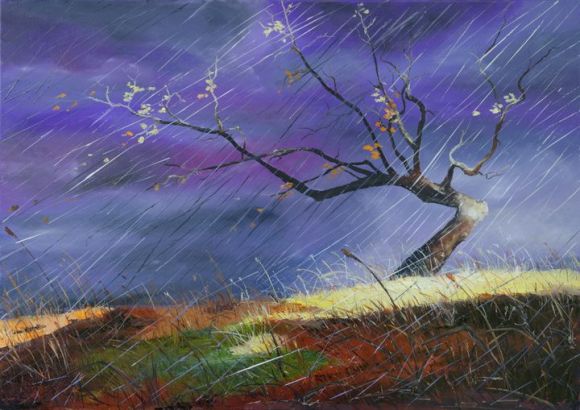
Storms that Rage

Storm in purple by Arina Tcherem. From Public Domain

If we take a look at our civilisation, there are multiple kinds of storms that threaten to annihilate our way of life and our own existence as we know it. The Earth and the human world face twin threats presented by climate change and wars. While on screen, we watch Gaza and Ukraine being sharded out of life by human-made conflicts over constructs made by our own ‘civilisations’, we also see many of the cities and humankind ravaged by floods, fires, rising sea levels and global warming. Along with that come divides created by economics and technology. Many of these themes reverberate in this month’s issue.

From South Australia, Meredith Stephens writes of marine life dying due to algal growth caused by rising water temperatures in the oceans — impact of global warming. She has even seen a dead dolphin and a variety of fishes swept up on the beach, victims of the toxins that make the ocean unfriendly for current marine life. One wonders how much we will be impacted by such changes! And then there is technology and the chatbot taking over normal human interactions as described by Farouk Gulsara. Is that good for us? If we perhaps stop letting technology take over lives as Gulsara and Jun A. Alindogan have contended, it might help us interact to find indigenous solutions, which could impact the larger framework of our planet. Alindogan has also pointed out the technological divide in Philippines, where some areas get intermittent or no electricity. And that is a truth worldwide — lack of basic resources and this technological divide.

On the affluent side of such divides are moving to a new planet, discussions on immortality — Amortals[1] by Harari’s definition, life and death by euthanasia. Ratnottama Sengupta brings to us a discussion on death by choice — a privilege of the wealthy who pay to die painlessly. The discussion on whether people can afford to live or die by choice lies on the side of the divide where basic needs are not an issue, where homes have not been destroyed by bombs and where starvation is a myth, where climate change is not wrecking villages with cloudbursts.  In Kashmir, we can find a world where many issues exist and violences are a way of life. In the midst of such darkness, a bit of kindness and more human interactions as described by Gower Bhat in ‘The Man from Pulwama’ goes some way in alleviating suffering. Perhaps, we can take a page of the life of such a man. In the middle of all the raging storms, Devraj Singh Kalsi brings in a bit of humour or rather irony with his strange piece on his penchant for syrups, a little island removed from conflicts which seem to rage through this edition though it does raise concerns that affect our well-being.

The focus of our essays pause on women writers too. Meenakshi Malhotra ponders on Manottama (1868), the first woman-authored novel in Bengali translated by Somdatta Mandal whereas Bhaskar Parichha writes on the first feminist Odia poet, Bidyut Prabha Devi.

Parichha has also reviewed a book by another contemporary Odia woman author, Snehaprava Das. The collection of short stories is called Keep it Secret. Madhuri Kankipati has discussed O Jungio’s The Kite of Farewells: Stories from Nagaland and Somdatta Mandal has written about Chhimi Tenduf-La’s A Hiding to Nothing, a novel by a global Tibetan living in Sri Lanka with the narrative between various countries. We have an interview with a global nomad too, Neeman Sobhan, who finds words help her override borders. In her musing on Ostia Antica, a historic seaside outside Rome, Sobhan mentions how the town was abandoned because of the onset of anopheles mosquitos. Will our cities also get impacted in similar ways because of the onset of global ravages induced by climate change? This musing can be found as a book excerpt from Abiding City: Ruminations from Rome, her book on her life as a global nomad. The other book excerpt is by a well-known writer who has also lived far from where he was born, MA Aldrich. His book, From Rasa to Lhasa: The Sacred Center of the Mandala is said to be “A sweeping, magnificent biography—which combines historical research, travel-writing and discussion of religion and everyday culture—Old Lhasa is the most comprehensive account of the fabled city ever written in English.”

With that, we come to our fiction section. This time we truly have stories from around the globe with Suzanne Kamata sending a story set in the Bon festival that’s being celebrated in Japan this week for her column. From there, we move to Taiwan with C. J. Anderson-Wu’s narrative reflecting disappearances during the White Terror (1947-1987), a frightening period for people stretched across almost four decades.  Gigi Gosnell writes of the horrific abuse faced by a young Filipino girl as the mother works as a domestic helper in Dubai. Paul Mirabile gives us a cross-cultural narrative about a British who opts to become a dervish. While Hema R touches on women’s issues from within India, Sahitya Akademi Award Winner, Naramsetti Umamaheshwararao, writes a story about children.

We have a powerful Punjabi story by Ajit Cour translated by C.Christine Fair. Our translations host two contemporary poets who have rendered their own poems to English: Angshuman Kar, from Bengali and Ihlwha Choi, from Korean. Snehaprava Das has brought to us poetry from Odia by Aparna Mohanty. Fazal Baloch has translated ‘The Scarecrow’, a powerful Balochi poem by Anwar Sahib Khan. While Tagore’s Shaishabshandha (Childhood’s Dusk) has been rendered to English, Nazrul’s song questing for hope across ages has been brought to us by Professor Fakrul Alam.

Professor Alam has surprised us with his own poem too this time. In August’s poetry selection, Ron Pickett again addresses issues around climate change as does Meetu Mishra about rising temperatures. We have variety and colour brought in by George Freek, Heath Brougher, Laila Brahmbhatt, Luis Cuauhtémoc Berriozábal, Snigdha Agrawal, William Miller, Ashok Suri, Scott Thomas Outlar, Dustin P Brown, and Ryan Quinn Flanagan. Rajorshi Patranabis weaves Wiccan lore of light and dark, death and life into his delicately poised poetry. Rhys Hughes has also dwelt on life and death in this issue. He has shared poems on Wales, where he grew up— beautiful gentle lines.

 In spring warm rain will crack
the seeds of life: tangled
roots will grow free again.

('Tinkinswood Burial Chamber' by Rhys Hughes)

With such hope growing out of a neolithic burial chamber, maybe there is hope for life to survive despite all the bleakness we see around us. Maybe, with a touch of magic and a sprinkle of realism – our sense of hope, faith and our ability to adapt to changes, we will survive for yet another millennia.

We wind up our content for the August issue with the eternal bait for our species — hope. Huge thanks to the fantastic team at Borderless and to all our wonderful writers. Truly grateful to Sohana Manzoor for her artwork and many thanks to all our wonderful readers for their time…

We wish you all a wonderful reading experience!

Gratefully,

Mitali Chakravarty.

borderlessjournal.com

[1] Homo Deus: A Brief History of Tomorrow (2015) by Yuval Noah Harari

.

Click  here to access the contents for the August 2025 Issue

.

READ THE LATEST UPDATES ON THE FIRST BORDERLESS ANTHOLOGY, MONALISA NO LONGER SMILES, BY CLICKING ON THIS LINK.

Categories
Review

A Hiding to Nothing

Book Review by Somdatta Mandal

Title: A Hiding to Nothing

Author: Chhimi Tenduf-La

Publisher: Hachette India

Let me be honest enough. When I received this book for review penned by a Sri Lankan author, I expected it to be a debut novel written by a person who is one of the many new voices that keep on emerging in sub-continental English fiction every other day. But the unusual name of the author made me enquire a little further to find out that he was half Tibetan and half English, educated at Eton and Durham in England, and has been managing an international school in Sri Lanka for thirty years. All these issues account for and contribute to the background of the novel’s setting. More surprise was in store when I found that Chhimi Tenduf-La has been writing fiction for the past ten years and his first novel, The Amazing Racist, was published way back in 2015. Since then, he has penned two more books and now his fourth book, A Hiding to Nothing, is what he himself defines as his “first domestic thriller.”

Such background information therefore definitely helps the reader to understand the nature of this present novel, which is set in Colombo’s manicured gardens owned by rich, elite and sometimes dicey people, and simultaneously moves to the activities set in England in Durham’s cobblestone streets.

The central issue of the story revolves around the miscarriage of Neja Pinto after she marries Ramesh in England and her subsequent inability to conceive which results in taking recourse to surrogacy. Believing in the stigma of South Asian sensibilities when a woman is looked down upon if she cannot give birth to her own off-spring, they want to keep the entire matter as secretive as possible so that they can come back from England to Sri Lanka and claim the child, Devin, as their own biologically born offspring till a point when the child is kidnapped by unknown people. From this point begins a lot of questions like who would dare take Devin – and why? As the incidents of the story march forward at electronic speed, creating the right atmosphere of a well-devised whodunit, the novel is crowded with innumerable characters, some unique, others quite stereotypical, but none out of suspicion. Is it the swimming coach Neja gets too close to? Could it be the ghosts of their past – the ruthless creditors Ramesh deceived in a Ponzi scheme, now back for blood? Or is it the enigmatic Dr Haksar who helped them have a child? And what of the mysterious woman from the British High Commission, whose probing questions hint at knowledge she shouldn’t possess? As the whispers grow louder, one name resurfaces with terrifying weight: Satya Basu, who actually bears the child in lieu of money. Is she back to settle an old score?

As mentioned earlier, at the centre of the story are the protagonists Neja and Ramesh Pinto, who are now husband and wife, but are also portrayed in their pre-marital days in England. Then there is Ramesh’s mother Loku Madam who is a stern and powerful woman with complete control over her son, which results in a sort of mother fixation. Loku Madam is planning a fourth marriage with a rich tea garden owner.

There is a swimming pool trainer called Johnny Dias with whom Neja has a fling resulting in several complications in the plot; the child Devin who disappears after he is kidnapped and from where many more eventful activities take place in the story; then there is Mercy Mbangwa who works at the British High Commission but also takes too much of an interest in the affairs of Neja and Ramesh Pinto. The Pintos take on names as Nita and Ravi Ponniah when they live in Durham because they want to remain incognito and take possession of a surrogate child in the making by another character called Satya Basu ( I am surprised because though ending with an ‘a’, in Bengali Satya is usually a male name and not a female one), Dr. Haksar and several other characters, all of whom are illegal immigrants in England. There are bartenders, hustlers and many other minor characters that crowd the scene too.

Chhimi Tenduf-La unravels a suspenseful tale where the truth is elusive – and the cost of uncovering it may be too high to bear. He brings in all possible locations and situations with very intense visual details which makes us feel it to be the right ambience for a Netflix movie. The novel is architecturally very carefully set through fifty-six chapters (some as short as one and a half pages) to others slightly longer, and the chapters are very carefully juxtaposed by alternating between Sri Lanka, 2024 and London/England 2015, 2016, 2017 and 2018. In fact, the last chapter brings us to the present Sri Lanka in 2025 where finally all the mysteries are unravelled and the author hints at a positive and optimistic note where all the sound and fury is resolved to a quiet ending.

The racy speed at which the author takes the readers through this 310 page-turner mystery at times makes one confused and it seems that since he is attempting a new sub-genre of what he calls a first attempt at a ‘domestic thriller’, he has attempted to put in as many things as possible. Some of that could probably have been avoided. But his innovative style and deft handling of the English language needs special mention, and this reviewer strongly recommends everyone to read and appreciate the novel.

.

Somdatta Mandal, critic and translator, is a former Professor of English at Visva Bharati, Santiniketan.

PLEASE NOTE: ARTICLES CAN ONLY BE REPRODUCED IN OTHER SITES WITH DUE ACKNOWLEDGEMENT TO BORDERLESS JOURNAL

Click here to access the Borderless anthology, Monalisa No Longer Smiles

Click here to access Monalisa No Longer Smiles on Amazon International