Memoirs of civil servants offer a ringside view of the events that shape up a country. Of late, there have been several memoirs by civil servants of India. But this one is unique.
In the Service of Free India–Memoirs of a Civil servant by BD Pande has some of the best chronicles as India was in the formative years after she got freedom. In reverence to his wishes, the memoir has been published posthumously. It is a fascinating record of Pande’s own life and that of India in the half century after Independence.
Edited by his daughter Ratna M Sudarshan, the autobiography comes more than a decade after Pande’s death in 2009 at 92. The memoirs were penned between 1986 and 1999 and the family was instructed to publish these at least five years after his death.
B.D. Pande was the first person from Kumaon and Garhwal division to pass the Indian Civil Service (ICS) examination in London in 1938. In his thirty-nine years as a civil servant, Pande held many important offices in the state and central governments. He served as finance secretary, development commissioner and food commissioner in Bihar; chairman of LIC at then Bombay; and finally cabinet secretary to the Government of India from 1972 to 1977. The first person from Uttarakhand to be appointed the governor of West Bengal and later Punjab, President K.R. Narayanan conferred on him the Padma Vibhushan for his meritorious service to the nation.
Says the blurb : “In the decades following 1947, as the tallest national leaders were building a new India, they were supported by a band of idealistic civil servants fiercely committed to the country’s Constitution and its people. Among these remarkable officers was Bhairab Dutt Pande, a young man from the Himalayan district of Kumaon, who joined the Indian Civil Service in 1939. Over almost forty years as a civil servant, and later as governor, he played an important role in the country’s administration, and interacted with leaders like Indira Gandhi (as cabinet secretary during the Emergency), Morarji Desai and Jyoti Basu.”
Writes Pande in the preface: “Ever since I retired in 1977, people have been asking me to write my memoirs, even more so after I resigned as governor of Punjab in July 1984. I have also been approached by some publishers. But I always refused on the grounds that I have no talent for writing. I was a student of science and writing was never my forte. During my service, I did not write notes exceeding a page or page-and-a-half, no matter how intricate the subject. And more importantly, I kept no notes during my service or lifetime, kept no copies of important papers, letters or memos and therefore my recollections will tend to be biased. With the passage of years, one’s memory tends to play tricks and might even get facts wrong. Furthermore, I did not possess any means of rechecking what I have written from contemporary accounts or official records. For these reasons I never took up the pen to write.” Honesty at its best!
Pande chronicles several landmark events and initiatives that he either participated in or witnessed. He helped increase food-grain allotment to the state as food commissioner of Bihar in the early 1950s and drew up a new famine code as land reforms commissioner. His work in the Community Development programme some years later still has important lessons for today’s Panchayati Raj institutions. After retirement, he was governor of West Bengal during the resurgence of Naxalism in the early 1980s, and of Punjab in 1983-84—a tragic and turbulent year in the history of the state and the nation. Pande chose to resign as governor rather than carry out unconstitutional orders.
A trumped-up narrative about Punjab’s situation was built in the months leading up to Operation Bluestar in June 1984, leading to disastrous consequences. The five chapters in this memoir on Punjab offers an absorbing narrative of the behind-the-scenes events and negotiations leading up to the Anandpur Sahib Resolution and Operation Blue Star is of great value.
Pande, who had a front-row seat of the events, lauds the Sikhs as a community and is highly critical of the central leadership, especially PM Indira Gandhi, and some “Hindu hardliners and vernacular press for contributing to the false narrative”. He also blames the tussle between President Zail Singh and former Punjab CM Darbara Singh for the unfolding of the events. It is his view that many Sikhs had been the victims of attacks by terrorists, he writes, and whenever an incident occurred, the Punjab Police Intelligence was blamed even though they had supplied advance information.
Mark these dauntless words: “I have known people who, living in Delhi, were even afraid of coming to Chandigarh. Then from Chandigarh, if one went to the real Punjab — Amritsar, Jalandhar, or Ludhiana — one would find similar normalcy. Driving through the countryside, all was peaceful, with farming going on normally. The cities were bustling with activity. Factories were working normally, even schools and colleges. Hindus and Sikhs were walking together, visiting each other’s shops, riding together. The contrast between what one anticipated and what one actually experienced was vivid… I could not help but emphasize on this otherwise peaceful atmosphere.”
On the controversial ‘White Paper’ tabled by the Centre before the Army operation, Pande says he was not even consulted. He notes that Akali leaders of the time were divided. They came to meet him separately while other political parties came to one group. He has also questioned the official figures of casualties in Operation Blue Star. “The number of casualties among the terrorists and civilians was 1,200 (and not 700). Some 200 terrorists still got away. Blue Star did not achieve the desired result.”
For everyone who wants to know the truth behind the Operation Bluestar in Punjab, this is a de-facto account. The machinations by the central government of the time are revealing. The other chapters in this 300-paged memoir make for a fascinating read and give a privileged perspective on issues and their outcome.
Stimulating and exalting in coequal measure, this memoir, with photographs from the author’s personal album, is both a riveting record of an extraordinary life and an important and an informative document. There is also a detailed timeline to refresh one’s memory.
This book is a must-read for anyone who has been, is, or aims to be a civil servant in India and equally, for anyone who is interested in the history of the times. It is a candid memoir of past times, and the events leading up to them. The informal style of the memoir makes it effortless to read and transports the reader to that time period.
.
Bhaskar Parichha is a journalist and author of Unbiased, No Strings Attached: Writings on Odisha and Biju Patnaik – A Political Biography. He lives in Bhubaneswar and writes bilingually. Besides writing for newspapers, he also reviews books on various media platforms.
.
PLEASE NOTE: ARTICLES CAN ONLY BE REPRODUCED IN OTHER SITES WITH DUE ACKNOWLEDGEMENT TO BORDERLESS JOURNAL
An important task for those committed to tracking the path of women’s Issues, past and present, is to embark on a study of the academic discourses on gender sparked off by feminist scholars and activists — an area that is fast gaining ground all over the world. Yet there is another dimension to the effort. It also involves an exploration of creative writing generated by sensitive, imaginative feminism. It is important to understand that concepts such as Patriarchy, Agency and Resistance are not limited to feminist debate and discourse. They are equally and dynamically present in poetry and fiction. In India, the field of feminist creative writing is growing rich with promise every day.
One such endeavour is Devika Khanna Narula’s novel Beyond the Veil. A work of epical dimensions it operates on a vast canvas. Vast both in terms of space and time, it spans half a century, between 1900 and 1950. It offers interesting insights into life as lived by upper class and middle-class women during a momentous period of Indian history. A time when a mass resistance against British rule was spreading all over the country culminating in the independence of India. A movement in which some women also participated.
Spatially the narrative shuttles between two families from two different parts of India linked by marriage. They belong to different cultures though they come from a common stock. They are the Punjabis of Lahore and the Punjabi Khatris of Bandhugarh, a fictional name for Bardhaman, in West Bengal. The founder of the Kapoor family in Bandhugarh, came from Punjab in the sixteenth century and, by sheer dint of merit and hard work, amassed lands and wealth. His progeny followed in his footsteps, established themselves as zamindars and, at some point, were dignified by the title of Rajah by the British.
The Khannas of Punjab and the Kapoors of Bandhugarh seem very different in externals. The first belongs to the ‘small business’ class. The other is related to royalty. One is of pure Punjabi extraction. The other, though from the same genetic type, is highly Bengalised having lived in Bengal over many generations. They speak Bengali, eat Bengali food, dress like Bengalis, worship in Bengali temples and use idioms and expressions that serve to accentuate the effects of defamiliarization and alienness among the daughters-in-law who, in an effort to keep the bloodline pure, are brought from the old pristine stock.
These women face the challenges their upheaval brings in its wake. They are required to come to terms with another kind of life, learn to adapt to a new environment, cope with taunts about their dissimilarities and conquer their fears and insecurities. It works both ways. Roopmati, coming from Punjab has to turn herself into a Bengali in her marital home. Her daughter, brought up as a Bengali in Bandhugarh, is wed to a young man in Lahore and has to adapt to a different set of priorities and values for which she is totally unprepared.
Yet, scratch the surface and the fates of women, whether in Punjab or Bengal, are identical. Denial of education, economic dependence on the male, social conditioning over generations and the suppression of individual identity by an oppressive ‘joint family’ ideology are present across the spectrum. Humiliation and desertion by husbands, violence—physical and mental, molestation and rape both marital and by other males of the family are normalized and hidden from view. Adherence to tradition have rendered other horrors acceptable and inevitable. The custom of Sati and Purdah, female infanticide and neglect of the girl child are part of a patriarchal system that exists in both communities.
The strange thing is that the women who suffer these indignities, day in and day out, are the very ones who are entrusted with perpetuating the system. Males set the rules but females are expected to implement them. And many do. Mindlessly like automatons. Some even enjoy the process. Because this is the only area of dominance men have relegated to women. Women like Bebe of Bandhugarh and Rukmini of Lahore enjoy power through a determined subjugation of the younger women of the family, particularly the daughters-in-law. They also see it is as their duty to break the clay of the other and force it into the patriarchal family mould.
The world in which the young women of Beyond the Veil live is cold and dark. But occasionally a shaft of sunlight pierces through the clouds. Some women upset the status quo from time to time. These are rebels who expect consideration and fair play. They demand change. The mother and daughter duo Roopmati and Maina are two such women. It is heartening to see that, under their influence, their husbands too develop sensitivity and compassion for the women in their households. Other males follow suit. The curtain falls on a world slowly waking from slumber.
The ambience of both worlds is created with great sensitivity and detail. Descriptions of food eaten, clothes worn, journeys undertaken and the joys and sorrows of day-to-day living are totally credible. The narrative flows smoothly unmarred by jolts and jars. The topography of Lahore, Karachi and Bandhugarh of those days is authentic and accurate. Life as it is lived in, whether it is the Khanna family or the Kapoor, the cultural differences come through with clarity and precision. Events and locales are rooted in history and dates are adhered to. Names of streets, restaurants, railway stations, cinema halls… even the films that were shown in them a century ago… can be put to the test and will not fail. Best of all are the local legends and myths that have grown around communities and families, rivers and lakes, temples and mansions. The book is a storehouse of information of a bye gone era.
.
Aruna Chakravarti has been the principal of a prestigious women’s college of Delhi University for ten years. She is also a well-known academic, creative writer and translator with fourteen published books on record. Her novels Jorasanko, Daughters of Jorasanko, The Inheritors have sold widely and received rave reviews. Suralakshmi Villa is her fifteenth book. She has also received awards such as the Vaitalik Award, Sahitya Akademi Award and Sarat Puraskar for her translations.
.
PLEASE NOTE: ARTICLES CAN ONLY BE REPRODUCED IN OTHER SITES WITH DUE ACKNOWLEDGEMENT TO BORDERLESS JOURNAL
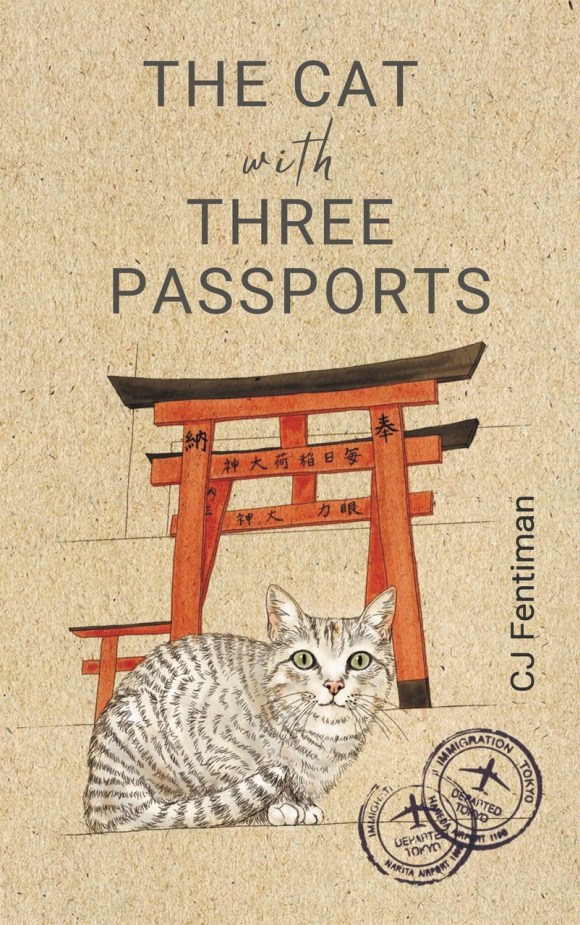
Going to Japan to teach English seemed like a good way to earn money, but animal lover CJ Fentiman came away from living and working in Japan with more than she expected as chronicled by her in The Cat with Three Passports: What a Japanese cat taught me about an old culture and new beginnings.
A book that could be considered a travel memoir, but it stretches beyond the normal scope of a travelogue, due partly to the introverted author’s inner reflection and personal transformation, but mainly due to the courageous actions of the writer in turning a soft spot for a cat into an international animal relocation mission. Sorry to spoil the ending of the book, but in most cases, foreigners going to a strange and different country take a “What happens in Vegas, stays in Vegas” approach. So when they leave, it is with fond memories, tales of culture shock and culinary misadventures, and bulging suitcases.
Not so with Fentiman and her partner, Ryan, who faced new challenges while taking a homeless cat with them to Australia, some 8,000 kilometres away. So why would you rescue from the streets a bedraggled silver tabby and then contemplate taking it with you across the oceans? If you are a cat lover, you already know the answer.
Let’s back up. One of the reasons The Cat with Three Passports is such a good read is that from the outset, the reader is invited in to experience Japan as seen through the eyes of someone right off the plane after a long flight. Throughout the book, there are vivid descriptions of landscapes, encounters and events, including weird festivals (naked men) which give an insight into an unfamiliar culture.
If the anticipation isn’t enough, the author exposes her vulnerability by sharing her anxieties and self-doubts, along with her past patterns of escaping situations and places, and how she has been distant from her estranged family.
Cats feature literally and figuratively throughout the book, and the author has blended in feline-related sayings and some of Japan’s cat wisdom. In a way, the cats make CJ and Ryan more “at home” in Japan among the cherry blossoms, bullet trains and vending machines. Essentially, the cats they encounter are the facilitators of the adaption and softening, helping them discover their purpose and giving them fulfilment.
Things take a turn for the surreal when they transfer to a job at a school set in a British theme park high in the mountains. Their time in Japan is not complete without a visit to the famed Cat Island, where cats outnumber humans perhaps thirty five to one. In the same way that cats love warmth and sun, humans are also attracted to cats because they bestow blessings on homo sapiens. One study found that cat owners have better psychological health than people without pets. Cat feeders claim to feel happier, more confident, less nervous and to sleep, focus and face problems better in their lives.
The Cat with Three Passports will appeal to anyone who has or wants to visit Japan, any animal lover or ailurophile along with readers who enjoy travel memoirs. It is a heart-warming and touching tale of outer and inner discovery.
If you’ve already encountered some travel classics on Japan, such as Lost Japan by Alex Kerr, Hokkaido Highway Blues by Will Ferguson, or Pico Iyer’s recent A Beginners Guide to Japan, consider reading The Cat with Three Passports even if you aren’t a pet lover or Japan fan.
Keith Lyons (keithlyons.net) is an award-winning writer, author and creative writing mentor, who gave up learning to play bagpipes in a Scottish pipe band to focus on after-dark tabs of dark chocolate, early morning slow-lane swimming, and the perfect cup of masala chai tea. Find him@KeithLyonsNZor blogging at Wandering in the World (http://wanderingintheworld.com).
Title: Turmeric Nation: A Passage Through India’s Tastes
Author: Shylashri Shankar
Publisher: Speaking Tiger Books
Shyalashri Shankar is an academic whose third non-fiction, Turmeric Nation: A Passage through India’s Taste, won a woman author’s award in India called the AutHer Award (2021). This book is a detailed and rich journey through India’s multiple cuisines and culinary cultures divulging interesting facts like Aurangzeb was a vegetarian.
In the literature of food writing, we have both advocates of diversity, food fusionists as well as food fashionistas. Shankar’s approach is fairly eclectic and informed, drawing on the anthropology and sociology of both food and the cultures they originate from. Professing to write a “food biography” of India, she also realises that such a task is both “challenging and daunting”, given the magnitude and diversity of the task involved. She describes Indian cuisine as layered and pluralistic, where there is no one cuisine which can be described as ‘Indian’. Her book proceeds to map these regional diversities not only in food and food cultures, but also cooking styles.
Giving veritable gastronomic glimpses into the fascinating world of the great Indian kitchen, Shankar explores food histories of ancient India dating back to Harappans, while keeping a keen eye for networks of customs, habits and styles of living. From time to time, the cuisine has absorbed new methods of food processing and cooking and been hospitable to new and foreign influences. At the same time, it has at times exerted injustices since the sociology of food is shown to be intricately linked to the that of the caste as shown in the section on Dalit foods. Shankar rightly refuses to mythify or romanticise food, instead she refers to social anthropologist James Laidlaw’s notion that nowhere in the world are food transactions socially or morally neutral, and that the politics of and around food are probably the sharpest in South Asia.
She draws from the theories of ethnologist Claude Levi-Strauss, who, she argues, analysed different cooking techniques to put forward an influential structuralist idea of the raw and the cooked. Food, according to this theory, is a medium between nature and culture. The activity of cooking performs a process of civilising nature.
Shankar asks more fundamental questions: Did our ancestors determine the way we eat? What is the DNA of food preferences? Which is a better diet — vegetarian, non-vegetarian or paleo (what Is paleo)? Does food have a religion? What food creates ardour and desire? What are the transgressions and taboos on certain kinds of foods? What is the purpose and function of certain rituals around food — for instance, the logic of feasting and fasting? As Shankar takes us on this fascinating journey of culinary exploration, we see the emergence of a rich map of cultural anthropology.
Turmeric Nation is an ambitious and insightful project which answers these questions, and then quite a few more. Through a series of fascinating essays—delving into geography, history, myth, sociology, film, literature and personal experience—Shylashri Shankar traces the myriad patterns that have formed Indian food cultures, taste preferences and cooking traditions. From Dalit ‘haldiya dal’ to the last meal of the Buddha; from aphrodisiacs listed in the Kamasutra to sacred foods offered to gods and prophets; from the use of food as a means of state control in contemporary India to the role of lemonade in stoking rebellion in 19th-century Bengal; from the connection between death and feasting and between fasting and pleasure, this book offers a layered and revealing portrait of India, as a society and a nation, through food. It takes us on a fascinating culinary journey through the length and breadth of the subcontinent.
The proof of the pudding, many might feel, is in the eating. Why such a learned dissertation on food, gastronomy and culinary traditions? Is it ultimately to map unity, diversity, and work towards an idea of syncretism? Either ways, the book is worth keeping on our shelves and stocking in libraries, swelling the corpus on food studies which is now studied as an important part of Cultural Studies in many universities. The book ultimately gives us much food for thought as it theorises the practices of cooking and eating across Indian cultures.
.
Dr Meenakshi Malhotra is Associate Professor of English Literature at Hansraj College, University of Delhi, and has been involved in teaching and curriculum development in several universities. She has edited two books on Women and Lifewriting, Representing the Self and Claiming the I, in addition to numerous published articles on gender, literature and feminist theory.
.
PLEASE NOTE: ARTICLES CAN ONLY BE REPRODUCED IN OTHER SITES WITH DUE ACKNOWLEDGEMENT TO BORDERLESS JOURNAL
‘I have seen the Mahanadi in so many ways: in the early morning light, in the reclining afternoon glow, in the blaze of the midday and in the shadow of the orange tinge of the sunset. I have seen this river in the form of its narrow current in winter, amidst profuse rain, in the forested region where it originates, and in the turbulent boundlessness of the estuary. And each time the river, serene, terrifying and quiet, has filled my mind with tremendous joy and nostalgia. Many people, both at the origin and basin of this river, are known to me. Their lives, inextricably linked with the river, have made me think, and have both fascinated and enriched me. The chronicle of this river, therefore, is also an extract of my life.’
One of the largest rivers of India, the Mahanadi has flown more than a thousand kilometers through Chhattisgarh and Orissa from the foothills of the Sihawa hills in Dhamtari district of Chhattisgarh and has fallen into the Bay of Bengal. Leaving behind the huge diamond reservoir at Sambalpur in Orissa, the archeological background of Subarnapur and Buddhist districts, the plains of Nayagarh, Cuttack and Jagatsinghpur flow through the middle of the deep forested gorge of Satakoshia, finally crossing the border near the port of Paradip.
But its journey is endless, as it flows day-after-day from the plateau to the forest to the ravine and finally to the plains. It unites with the sea every day. At every new turn, it leaves behind scores of villages, towns and cities. The din and bustle of a mofussil town, the solitary life in a standalone village, people’s struggle for survival, the episodes of their joys and sorrows, the sighs of the displaced people of Sambalpur during the building of the Hirakud dam mingles with the cries of the endangered people on the banks when the river overflows.
In the long journey of the river, it encounters mountainous plateaus, dense forests, villages and uninhabited emptiness. There are traces of the Paleolithic era at its source. There are ancient lyrical stories around it. Farmers, weavers and artisans have come and settled on the banks of the river to draw in the water. Mahanadi is to Odisha what Huang Ho is to China.
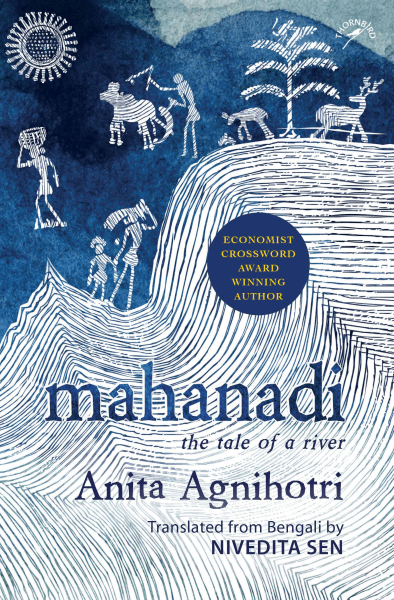
And so, Anita Agnihotri’s novel Mahanadi –The Tale of a River (translated from Bengali by Nivedita Sen) captures all these essential elements in a never written story of a stream which is a sorrow rather than a joy for crores of people in Odisha.
A civil servant, Anita Agnihotri, writes in Bengali in a wide variety of genres — poetry, novels, short stories and children’s literature. Recipient of prestigious awards like Bangiya Sahitya Parishad Award and the Bhuban Mohini Dasi Gold Medal conferred by Calcutta University, her writing explores the vast and complex Indian reality, many facets of human relations, and brings out the unheard voices of the marginalised and the underprivileged and has been translated into several Indian and foreign languages.
Translator Nivedita Sen taught English Literature at Hansraj College, University of Delhi. She worked on other popular genres, apart from Indian writing in English, post-colonial fiction and translation studies. She has translated Tagore’s Ghare Baire, and stories by Syed Mustafa Siraj, Leela Majumdar and others.
In the fiction, the narrative is through stories of the people living on the banks of the Mahanadi. Characters like Tularam Dhuru, Malati Gond, Neelakantha, Bhanu Shitulia, Parvati and others might never meet each other, but the story of their lives will remain strung together by the common thread of the ever– the streaming Mahanadi. The chronicle of Mahanadi is a journey through travails and misfortunes into life’s joys and mysterious beauty.
Writes Sen in the ‘Translator’s Note’: “A socially conscious writer with a relentlessly dissident voice, Anita Agnihotri’s writing explores struggles in the lives of marginalised communities that are oppressed by underhand politics, social privilege and economic disparity. Though she was a member of the Indian Civil Service, she has maintained an anti-establishment stance throughout her writing career spanning four decades.
“In this novel, her non-noncompliance exposes the irony of Nehru’s urging those dispossessed by the building of the Hirakud dam to accept their suffering in the larger interest of the nation. She critiques the police turned into mercenaries by the state when they passively stand by during a violent attack on a social activist because they are paid to do just that. But she also elicits commensurate outrage at two policemen having to confront and succumb to senseless Maoist violence. The novel depicts how a cotton mill falls apart due to squandering of money and corruption in higher places and also how an upcoming steel factory with international collaboration threatens the livelihood of betel-leaf farmers. Her characters with enhanced sensibilities are haunted by the blatant social and economic inequality they witness all around. Yet Tanmay’s research on the abysmal living conditions in the slum clusters of Cuttack cannot resolve their problems.”
What is of significance is that there are a lot of facts in the novel that substantiates the geography, history and economics of the river and the state it mostly passes through. She sensitively kindles – rather in great detail — the realism, the deprivation and the travails of the people living on the riverbanks. The river forms the crux of the narrative, both as the central character and the primary subject.
As a novel, Mahanadi is poignant and is a fitting tribute to the place and people. Anita Agnihotri has been a percipient writer.
.
Bhaskar Parichha is a journalist and author of No Strings Attached: Writings on Odisha and Biju Patnaik – A Political Biography. He lives in Bhubaneswar and writes bilingually. Besides writing for newspapers, he also reviews books on various media platforms.
.
PLEASE NOTE: ARTICLES CAN ONLY BE REPRODUCED IN OTHER SITES WITH DUE ACKNOWLEDGEMENT TO BORDERLESS JOURNAL
Considering the amount time that it takes to mull over an idea, digest it, and then write a work of fiction, and the glacial pace of publishing, it seems incredible that novels set during the current COVID-19 pandemic are already in print. Then again, orders to stay home and widespread cancellation of events have given many authors unprecedented time for reflection and writing of short stories, novellas, and even novels. One such novella is the intriguing Life is Elsewhere/Burn Your Flags by long-term Japan resident Iain Maloney.
The story takes place on Christmas Day in 2020, several months into the pandemic, and a few months after the ban on re-entry of foreign residents was lifted. Cormac, a forty-year-old Irish bar owner, has just returned from a visit to his sister in Dublin. His wife, Eri, is worried about judgmental neighbors. She tells him not to tell anyone where he’s been. This deliberate withholding of information hints at one of the themes of the book: Cormac and his wife suffer from a lack of communication. Finding themselves in close proximity for days on end, they can’t seem to get along. They may well be on the cusp of a COVID divorce.
The novella is divided into two sections. The first is told from Cormac’s point-of-view, as he goes on a hike alone while awaiting the results of a medical test. Present concerns mingle with memories of a friend lost to a drug addiction in a country that considers it a crime (“Japan doesn’t do rehab, it just does jail”), riffs on Yukio Mishima’s Confessions of a Mask and veiled women in Muslim countries, along with composed-on-the-spot haiku. In the second half, Eri, who is now the seemingly conventional owner of a language school, thinks back on her days as a fifteen-year-old high school dropout living with the punk rock band ‘Burn Your Flags’, and filming their exploits. As an act of rebellion, the band members wore their shoes inside their apartment. Earlier, Cormac tries to jolly Eri out of her midlife crisis, saying, ‘Yoko Ono is eighty-five and is still punk. You’re still punk.” But it’s not enough to dispel her malaise.
The publisher’s name is Liminal Ink Press, which seems particularly apt; Maloney’s novella perfectly captures this liminal space we’ve all been in. These characters are in-between, and the outcome of their stories is indefinite. Will Cormac get a clean bill of health? Will the couple stay together? Will the pandemic ever end? We don’t know. When the future is so uncertain, there is nothing to do but return to the past.
.
Suzanne Kamatawas born and raised in Grand Haven, Michigan. She now lives in Japan with her husband and two children. Her short stories, essays, articles and book reviews have appeared in over 100 publications. Her work has been nominated for the Pushcart Prize five times, and received a Special Mention in 2006. She is also a two-time winner of the All Nippon Airways/Wingspan Fiction Contest, winner of the Paris Book Festival, and winner of a SCBWI Magazine Merit Award.
.
PLEASE NOTE: ARTICLES CAN ONLY BE REPRODUCED IN OTHER SITES WITH DUE ACKNOWLEDGEMENT TO BORDERLESS JOURNAL
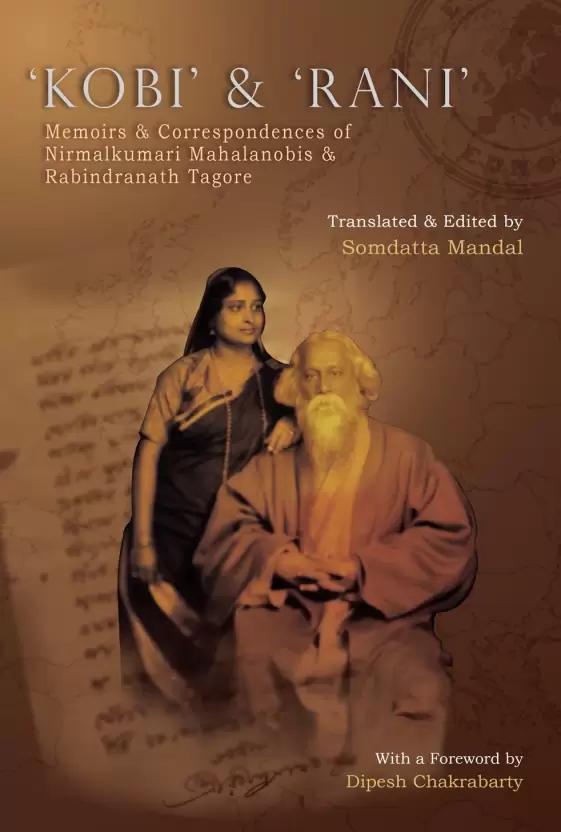
Title: ‘Kobi’ and ‘Rani’: Memoirs and Correspondences of Nirmalkumari Mahalanobis and Rabindranath Tagore
Translator/Editor: Somdatta Mandal; Foreword by Dipesh Chakrabarty.
Publisher: Bolpur: Birutjatiya Sammiloni.
Memoirs and correspondences constitute two alternative sources for reconstructing historical narratives. Generally kept outside the pale of mainstream history, memoirs, such as those included in the volume under review, can offer significant insights into the reading of important public figures and their activities. Despite the charges of ‘unreliability’ of memories with the help of which personal narratives are constructed, memoirs contribute to the understanding of a historical period with the help of small, apparently insignificant, details which can offer penetrating insights into reality. Personal correspondences with a public figure, preserved in family archives, too may contain interesting facts, figures and episodes which may help constructing their lives and recreating the social and intellectual environment of the time. Due to their very subjective nature, which mostly flouts the norms of objectivity, these genres may provide unique dimensions to the familiar historical narratives.
Somdatta Mandal’s book ‘Kobi’ and ‘Rani’: Memoirs and Correspondences of Nirmalkumari Mahalanobis and Rabindranath Tagore(2020), selected, translated and edited by her, is an important source, particularly for non-Bengali readers, for comprehending Rabindranath Tagore, the Nobel Prize winning poet from Bengal who continues in global limelight. It unearths hitherto unknown facts, some activities of ‘small’ actors who played a role in history and ‘trivial’ details which help us view Rabindranath Tagore and his contemporaries from fresh perspectives. Written from an informed woman’s point of view, the narratives offer us opportunities for discovering ‘the lighter’ and homelier aspects of Tagore’s life – this is something “which is sorely missed in other serious narratives and biographies” (Mandal xvii).
The publication of this book is timely for yet another reason. Tagore’s tirade against fascism, unfettered authoritarianism, aggressive nationalism and his advocacy for personal freedom, national independence, universal humanism and global understanding have much relevance in our times. Reading Kobir Shonge Europey (With the Poet in Europe, 1969) in particular, one understands how a public figure with an impeccable record of liberal philosophical practices and humanist activities can be duped by the machination of fascist agents and utilised for fascist propaganda to the consternation of liberal intellectuals and common citizens across the world. For this very reason we need Tagore more than ever before. This is a point strongly emphasised by historian Dipesh Chakrabarty in his ‘Foreword’ to the book.
‘Kobi’ and ‘Rani’ anthologises English translation of two memoirs of Nirmalkumari Mahalanobis — Kobir Shongey Dakshinatte (With the Poet in the South) and Kobir Shongey Europey (With the Poet in Europe). The European tour took place in 1926 while Tagore travelled to South India and Ceylon in 1928. In her valuable Introduction to the book, Mandal raises the question of difficulty of determining the genre of the narratives. These are, according to her, not just memoirs, they are travelogues as well. Through them, one gets the feeling of following the trajectory of the author’s journey. But a reader also feels how Rani’s journey, along with her husband, revolves round an iconic personality whom they revered and valued. From this point of view, the memoirs often read like hagiographies as well.
In addition to these two memoirs, the anthology includes Pathe O Pather Prante (On the Road and Beyond It),a collection of sixty letters Tagore wrote to Nirmalkumari whom he affectionately called Rani. In the Appendices, we find three other articles on Tagore written by Nirmalkumari: “Om Pita Nohosi,” “Tamaso Ma Jyotirgamaya,” and an essay written for children and originally published in Anandamela, a children’s magazine published by the Anandabazar Patrika. All these make the book voluminous and largely comprehensive. It may be mentioned here that Mandal has recently translated and edited another volume on Tagore entitled The Last Days of Rabindranth Tagore in Memoirs(April 2021). It includes memoirs by Pratima Thakur, Rani Chanda, Maitrayei Devi, Nirmalkumari Mahalanobis, and Amita Thakur.
Interestingly, all these memoirs were written by women who either belonged to the Tagore family or were in close contact with the poet. Dipesh Chakrabarty, in the ‘Foreword’ to Kobi and Rani, raises the issue of his “friendship with women that Tagore sought and sustained throughout his life” (iv), and mentioned in this context the names of Ranu Adhikari, Maitreyi Devi, Hemantabala Devi and Kadambari Devi. He observes that “a feeling of respectful affection and concern for the poet finds a deeply gendered and womanly expression in this book. It oozes out of each page” (iv). The above statement is true of The Last Days of Rabindranath Tagore in Memoirs too. Taken together, these two anthologies provide a very intimate and comprehensive account of one of the greatest poets of our time.
Tagore felt the need for recording the accounts of his travels in writing. That would be, in his opinion, a valuable source of literary and historical information in future. He was particularly sensitive about his European tour during which he met several well-known intellectuals. In the ‘Introduction’ to On the Road and Beyond It, he asserts, “the value of the narration of my European tour that has not been published anywhere is enormous” (391). Similarly, Tagore said in the Foreword to With the Poet in the South, “They [the details of his tour] should not be lost” (317). This sense of preservation of history is also present in Kobir Shonge Europey (With the poet in Europe). Here in the ‘Foreword’, Rani notes that Tagore, in a letter published in Prabasi, complained, “Those who had accompanied me during my foreign travel did not take the responsibility of protecting my travelogue, and that is why this chapter remains unknown to people, etc.” (3). As both her ‘Foreword’ and Prasantachandra Mahalanobis’s ‘Preface’ to the same memoir indicate, it was clearly the result of a misunderstanding for which Tagore apologised later.
The history of this misunderstanding goes deeper. The couple suspected the involvement of some insider in the loss of the file containing the manuscript of the despatches sent by Prasantachandra from Europe for publication in Visva-Bharati Bulletin. The file containing Nirmalkumari’s letters were also lost. Although retrieved afterwards, some valuable letters were never found. Rani narrates in detail how the tour to Europe was mired in controversy and conspiracy right from the beginning. Rani’s narrative convincingly proves that Professor Guiseppe Tucci and Professor Carlo Formichi, two visiting professors at Visva-Bharati, functioned as Mussolini’s spies.
They were instrumental in Tagore being invited to Italy by Mussolini. Formichi who oversaw the arrangements of the tour conspired to exclude the Mahalanobis couple from the entourage. He also severely censored the list of Tagore’s visitors in Italy. How Benedetto Croce could meet Tagore with the help of Captain Rapicavoli reads like a detective story. Formichi wilfully misinterpreted Tagore’s messages to the press to create an impression that Tagore supported Mussolini’s fascist regime. The twisted versions were published in newspapers, and these spread across Europe, misrepresenting Tagore’s views.
When Tagore met Romain Rolland in Switzerland, Rolland was initially not well-disposed to Tagore because of the fake news stories in circulation. Nirmalkumari records all the details of Formichi’s machination in Kobir Shonge Europey (With the Poet in Europe). For this alone, if not for anything else, this book will provide invaluable materials to historians and common readers alike.
Although the narrative of the poet’s European tour will be of paramount interest particularly to non-Bengali readers who will try to visualize the poet from the East in the maelstrom of radical politics in Europe and to place him in the interface of East-West cultural encounter, his tour of Southern India will be of immense importance to readers intent on knowing the background history of two of his important novels Jogajog (Relationships) and Sesher Kobita(The Last Poem). This is provided in Kobir Shonge Dakshinatte (With the Poet in the South) which also brings to public knowledge intimate details such as how Tagore was affected by the Jalianwalla Bag killings, and how his interaction with Chittaranjan Das went on, C.F. Andrews’ meeting with Mahatma Gandhi as Tagore’s emissary, how intensely engaged Tagore himself had been in writing Lipika and so on. Tagore felt that all these should be preserved as “very important historical documents” (317). The poet’s meeting with Sri Aurobindo in Pondicherry is also an important part of the memoir.
Trivial but amusing incidents such as the idiosyncrasies of C.F. Andrews, Tagore’s own obsessions and childlike behaviour – all come out with a touch of humour. These correspond to Rani’s power of observation and sense of humour evident in the descriptions in Kobir Shonge Europey (With the Poet in Europe). She describes how a fancy dress ball was arranged aboard the ship Orama which took the Mahalanobis couple to Europe (36), how Rani was initially afraid of a large shark swimming on the water near Port Said (37), how Rani and her female companions, dressed in typical Indian attires and decked with heavy ornaments, became a public spectacle in Naples (39-40), how the unhygienic packaging of chocolates in Turin caused repulsion in Rani (70), and several other incidents.
Mandal has done well by including On the Road and Beyond It, Tagore’s collection of sixty letters, in the volume. Tagore wrote these letters to Rani after his return from Europe. He observes in the ‘Introduction’ to the collection, “I continued to keep our relationship alive through letters” (390-91). It, therefore, is intimately connected in spirit with the memoir With the Poet in Europe. The letters, the best medium for conveying emotional exuberance, testify to Tagore’s great affection for, and dependence on, Rani.
The book includes some black and white photographs of important persons and places. Two images of the first edition of Bangla Pathe O Pather Prante (On the Road and Beyond It) have found their place in the anthology. Mandal’s criteria for selection of texts are quite appropriate, her translation is smooth and editing praiseworthy. Her erudite Introduction will help the readers contextualising the texts included in the volume. The paratextual components of the book are aesthetically pleasing. On the whole, the production of the book is superb. This volume will be a valuable resource for Tagore Studies.
.
Himadri Lahiri is former Professor of English, University of Burdwan, West Bengal. Currently, he is Professor of English at the School of Humanities, Netaji Subhas Open University, Kolkata. Asia Travels: Pan-Asian Cultural Discourses and Diasporic Asian Literature/s in English (Bolpur: Birutjatiyo Sahitya Sammiloni, 2021) and Diaspora Theory and Transnationalism (Hyderabad: Orient Blackswan, 2019) are his latest books. He writes book reviews for academic journals and newspapers. He also writes poetry.
.
PLEASE NOTE: ARTICLES CAN ONLY BE REPRODUCED IN OTHER SITES WITH DUE ACKNOWLEDGEMENT TO BORDERLESS JOURNAL
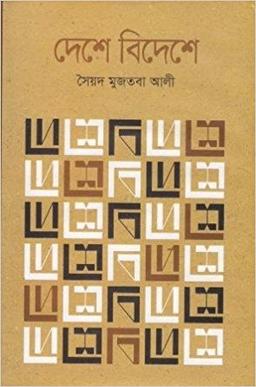
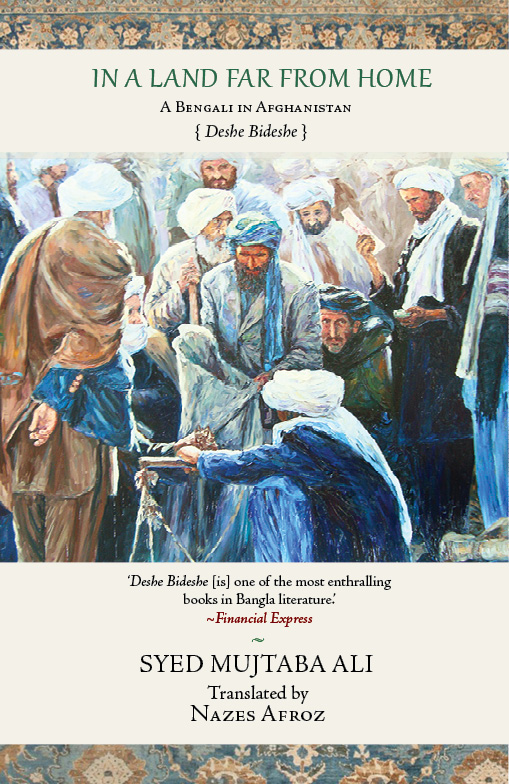
Cry, My Beloved Country (1948) reflected the plight of Africans and the deep divides that created schisms between different groups in South Africa. The book won the author, Alan Paton, a Nobel prize. Another remarkable book that was published in the same year was a non-fiction written by a student of Tagore called Syed Mujtaba Ali. Mujtaba Ali wrote Deshe Bideshein Bengali. This has been translated in recent times by the former BBC editor, Nazes Afroz, as In a Land Far from Home: A Bengali in Afghanistan. It is an outstanding memoir that demystifies and explains what led to the issues that are being faced by a country repeatedly jostled by varied regimes, a country that seems to be so steeped in problems that worrying about the pandemic remains a far cry for the common inhabitants.
Deshe-Bideshe in Bengali, published 1948
Nazes Afroz’s translation brought out by Speaking Tiger Books (2015)
For many decades this book had been feted by only a small group of readers, though the book is no lesser than Paton’s in crying out against injustices, terrors of violence and starvation, because it was written in Bengali. It was so witty and flavourful that people were afraid to translate it for the fear of losing the nuances of the original. As Afroz tells us in this interview, he had similar reservations. A book written by a scholar, it peppers history and political issues with lucidity and humour, making it an enjoyable experience for the lay reader. The author has a way of turning the mundane or intellectual into an amusing anecdote. During a conversation at an embassy party, the author through the voice of a fellow professor, makes a hilarious observation – but also, one that does convey much about Afghanistan despite its attempts at liberalisation.
“Madame Vorvechievichi argued, ‘But there are mullahs in this country.’
“Dost Muhammad said reassuringly, ‘No need to worry, Madame. I know these mullahs very well. Their knowledge of religion is very little and I can teach you all of it in three days. However, a woman can’t be a mullah.’
“Madame Vorvechievichi said angrily, ‘Why not?’
“With a deep sigh Dost Muhammad said, ‘Because she can’t grow a beard.’”
The book is speckled with multiple such instances. Along with these witticisms, the pathos of the country, the plight of the people is well captured by poignant observations:
“The real history of the country was buried beneath the soil, much like the way that Indian history was hidden in its Puranas, Mahabharata-Ramayana. Afghanistan is a poor country; Afghans do not have the time or the resources for archaeological excavations to write their own history.”
The writer, Syed Mujtaba Ali (1904-1974) a polyglot, scholar, traveller and humanitarian did just that – he recorded the history of the time he spent in Afghanistan, a time when a swift takeover from the liberal king Amanullah (1892-1960) was staged by Bacha-ye-Saqao (1891-1929) during the Afghan Civil War (1928-29). Does this sound familiar, reminding one of the recent August 2021 takeover by Taliban?
A Humboldt scholar, Mujtaba Ali was conversant in fourteen languages, lived in five countries, including Afghanistan, where he had gone to teach. That his erudition never interfered but enhanced without marring the simplicity of rendition is what makes the book an attractive read for all lay persons. His astute observations are laced with wit and realism. The residue of the book lingers as the vibrant narrative flows — vicariously bringing to life, with humour and empathy, a culture that is distinct and yet warm in its uniqueness. His style is reflective of an in depth understanding of the situation and a sense of empathy for the common people with who he interacted daily – like his man Friday and the colleagues he mentions. For the author, everyone, from an uneducated villager to the crown prince (who invited him to play tennis), seemed to grow effortlessly into a rounded persona of a friend. All these have been transmitted by Afroz in the translation too. Translating two cultures across borders in a language that does not have all the words to capture the intimate nuances is not an easy feat, but it has fruited into an unusual and captivating read.
Nazes Afroz
Afroz’s maiden venture at translation was shortlisted for the Raymond Crossword Book Award. Afroz himself has spent a long stretch of time in Afghanistan. He joined the BBC in London in 1998. He was a senior editor in charge of South and Central Asia for a number of years. He has visited Afghanistan, Central Asia and West Asia regularly for over a decade. In 2013, he moved back to India. A passionate photographer, he writes in English and Bengali for various newspapers and magazines. In recent articles, he has been voicing his own concerns about developments in Afghanistan. In this interview, he reflects on what led him to translate the book, the situation as it was then and as it is now. He dwells not only on the historic civil war as captured in the book but also on current day politics and the Taliban takeover.
You are a journalist. What got you interested in translating a Bengali classic from the last century?
I became a journalist five years after I read Deshe Bideshe. I was still a teenager when I picked up the book from a library rack. Reading Mujtaba Ali at that age had a profound impact on me. The erudition, the smooth sailing between multitude of cultures and languages, the gripping storytelling in his writing mesmerised me. I had never read anything like that in Bangla. Every Bengali reader of Syed Mujtaba Ali had felt the same way as I did. As a child I had the uncontrollable urge for travels and seeing the world. In Mujtaba Ali I found a role model. Deshe Bideshe stayed with me since then. It was one book that I would read two to three times a year from my teenage. So, by the time I decided to translate Deshe Bideshe more than thirty years after I first laid my hands on the book, I had read it for more than a hundred times! I knew its each page, I knew its each story and Afghanistan had seeped inside me permanently as I could relate to all the characters of the book.
While working for the BBC World Service in London, I had the opportunity to go to Afghanistan in 2002 soon after the Taliban were dislodged from power in a short war towards the end of 2001. I visited the country a number of the times in the following few years. As I travelled more, I befriended my BBC colleagues there and met other journalists and people on various walks of life. Some of them became good friends as well. I used to refer to events from the times of King Amanullah while discussing Afghanistan. They were surprised to hear all the details that I mentioned from a time that they said, ‘Even we don’t know!’ So, I mentioned how a Bengali scholar came from Kolkata to Kabul in 1927 and taught here, was a participant of the modernisation project of Amanullah by teaching English and French, played tennis with the crown prince Inyatullah (1888-1946) became an eyewitness of the rebellion against the king, got caught in the anarchy in the winters of 1928-29, and nearly perished starving before managing to go back to India. Hearing my story, they asked if there was any English translation of the book as they were keen to read. I told them that there was none as it was untranslatable!
As years went by and more and more of my Afghan friends got to know about Deshe Bideshe, they demanded that I did the translation. But I had my doubts. Would I be able to capture Mujtaba Ali’s unique language? Would I be able to transpose his wicked sense of humour? Would I be able to convey his erudition?
Eventually in 2011, I had already made up my mind to quit the BBC and move back to India. At that point my day-to-day workload in the BBC was significantly reduced. As I had ample time in hand, I thought I would attempt the translation. At that point I didn’t think of any publication; I wanted to do it just for fun and for my Afghan and non-Afghan friends who knew about the book and were keen to read it. I thought I would give them a taste of Mujtaba Ali’s writing by doing a few chapters. So, I did the first few chapters and shared them with a few friends. After reading those chapters they wanted to read more. I felt encouraged and I carried on with the translation for the following few months. Eventually the whole book was complete in about a year. After completing the translation, I let it sit for a few months before picking it up again and reread it as new text without looking at the original text. That exercise went on several times over the following one year till the final manuscript shaped up.
How many countries have you worked from? You were also in Afghanistan for several years I believe. Can you share your experiences?
My work has taken me to a dozen country or so. But as an intrepid traveller, I have visited more than 40 countries so far across four continents. Apart from my regular visits to Afghanistan, I spent months at a stretch on several occasions. Working in Afghanistan was certainly a unique experience. It wasn’t a country where one could travel and roam around freely. There were always the security alerts. One needed to negotiate security barriers everywhere. The accommodations – hotels, guesthouses were guarded by armed men. In the early years – in 2002 to 2004, there weren’t so much security in the hotels or guesthouses we stayed in. But that started to change from 2010 onwards as the Taliban had at that time started to regroup, and they made their presence felt in the country and in Kabul. Even at that time, cities like Mazar-e-Sharif and Herat were considered lot safer than Kabul. With increased and unpredictable attacks by the Taliban, the country became more and more edgy.
What was it about the book that drew you to it?
As I mentioned earlier, the uniqueness of Mujtaba Ali was that his erudition wasn’t frightening. He penned Deshe Bideshe almost twenty years after he left Kabul. By then, he had completed his PhD in comparative religion from Germany as a Humboldt scholar, did his post-doctoral research from al-Azhar university in Cairo, learned more than a dozen languages, and travelled extensively in Europe. So, even though his narrative of Afghanistan was drawn from what he had witnessed in his mid-twenties while teaching there, when he decided to write the book, he had acquired profound knowledge in philosophy, literature, culture and history of the world in many languages. The multilingual and multicultural references with an oblique yet gripping story-telling style infused with a wicked sense of humour that came in his writing, had been drawing ardent followers, including me, since 1948 when Deshe Bideshe was first published.
The book highlighted a growing divide between the minority with liberal education and the majority without education. Is that true still? Would you call the book relevant to the present-day crisis?
Yes, that divide between the educated and the not educated that Mujtaba Ali elicited in Deshe Bideshe is still there. But the gap has certainly reduced. The years between 1929 to 1978 had been relatively stable and peaceful in Afghanistan. Modern education had spread but without giving a jolt to the conservative society and keeping the clergy more or less content. In Kabul and other major cities, girls and women were getting more and more education; they were also seen in public life more. Following the coup through which the communists – the People’s Democratic Party of Afghanistan or PDPA came to power in 1978, there was a big push for universal education. This created a much bigger educated class. Women were the biggest beneficiary of that time in terms of acquiring knowledge and finding jobs. Women were joining the police and military as well. Following the capitulation of the PDPA government in 1992, the modern education system collapsed during the Mujahideen civil war years until 1996 and then after the takeover of virtually the whole of the country by the Taliban.
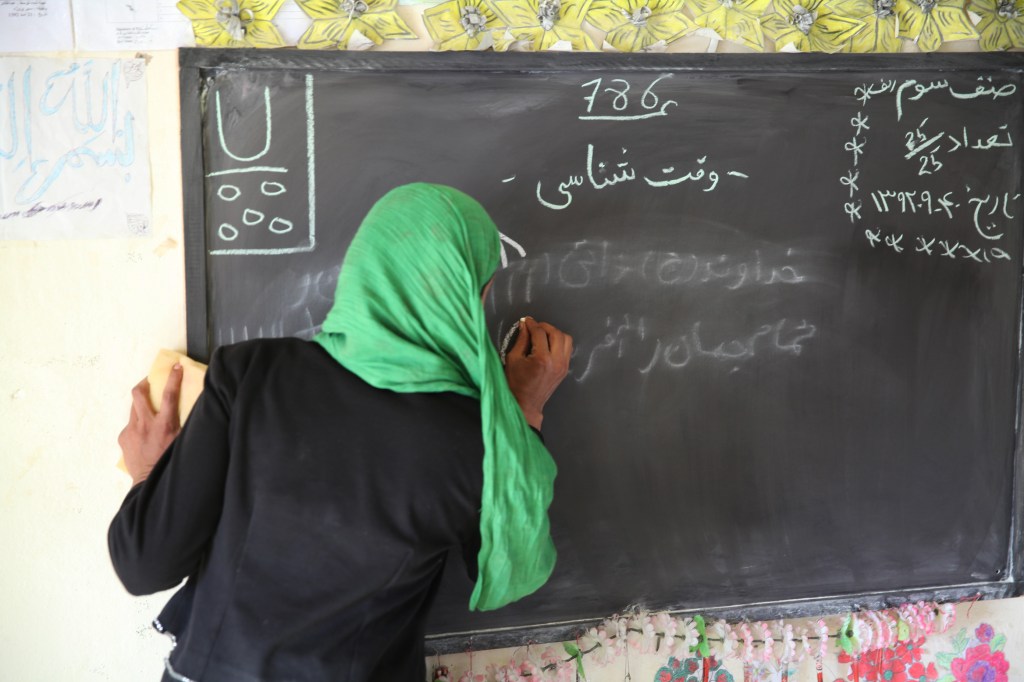
Girl in class
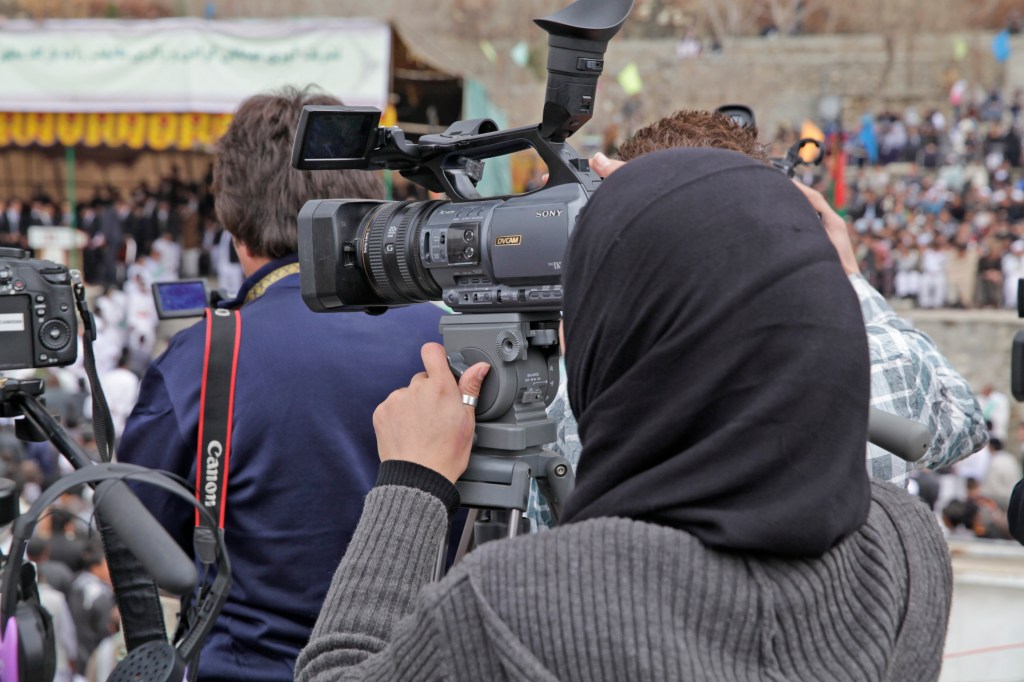
Camerawoman
Afroz’s camera captured women at work in Afghanistan. Courtesy: Nazes Afroz
A large number of Afghans – almost a quarter of the population became refugees in neighbouring countries or elsewhere. When the American led international forces ousted the Taliban from power in 2001 following the 9/11 attacks in the USA, the population got a fresh chance to get education. Schools opened again. Both girls and boys went back to school. Internationally there were many programmes to give scholarships to Afghan women and men who were seeking higher education. As a country with a very young population (the average age of Afghanis is 18), a large number of students joined the public and private universities. So, tens of thousands of young women and men are now educated holding masters or even PhD degrees in the country. But the rural areas lagged behind. So, the gap is more of the city and rural areas.
Do you find similarities between the Afghanistan of then and of now?
The way the Afghan society works, based on its ethnic and tribal identities as witnessed by Mujtaba Ali, still exist. The stranglehold that the clergy had on the uneducated mass about a century ago has possibly changed; it’s been replaced with more political interpretation of their religion. The ethnic divisions have sharpened for multitude reasons – primarily due to the outside interference and the way ethnic groups have been used in the larger geo-political game of the world powers.
One of the issues that tussles through the book is that people were basically poor and lacked education. Syed Mustaba Ali spoke of the vicious cycles of poverty, how much has it changed from what he wrote and what you experienced? Please elaborate.
Mujtaba Ali talked about how poverty contributed to the cycle of unrest in Afghan history. Yes, that poverty still exists but with that, a toxic potion of religio-politics has been added to the cauldron. The conflict of the past four decades is more due to the global religio-political dynamics rather that its own poverty.
Did/ do you find parallels in the political situation where Amanullah and his brother escaped from the invading hardliner, Bacha-ye-Saqao? Would you see Bacha as a precursor of Taliban?
The only parallel that one can draw between 1929 when Amanullah and his brother Inayetullah fled and now in 2021 is that the suddenness of the events. Amanullah’s fall happened in months and Bacha took over Kabul in matter of days – almost the same way the Taliban took control of the country.
I don’t think Bacha-ye-Saqao or Habibullah Kalakani as he called himself, was a precursor of the Taliban. Bacha was more of an opportunist; he grabbed the opportunity that came his way. But the Taliban are more of an organised religio-political force what was the product of the geo-politics of the last decade of the Cold War. So, they two are not comparable.
Did the American or Russian intrusions into Afghanistan serve any purpose? Did they actually help the Afghans?
The short answer is no. Both the superpowers came to achieve their own strategic and foreign policy objectives. The Soviets came to expand their sphere of influence beyond their borders in Central Asia. In the process they were badly bruised and had to retreat. The Americans came to get hold of Osama-bin-Laden and dismantle the al-Qaeda infrastructure. It was never about helping a nation that had been devastated by decades of conflict in which they had no role. They just became pawns in the greater game of geopolitics.
By the descriptions in the book, Afghans seem to be fairly open as humans and yet, they have a distinct identity borne of their culture, their ethos — very different from any other. Was that undermined in any way by the attempts at modernisation?
Like many other rural, traditional and old societies, Afghans are hospitable and warm people. They are bound and governed by their age-old custom and codes of conduct.
Even when they are outside of their own land – in the West too, they extend their hospitality to strangers the same way they would in their own country and their behaviour would not differ much. It is not the question, if modernisation has or will undermine their tradition. They have had encounters with modernisation – the way modernisation is understood from the Western prism. Did that change the people who had experienced that modernisation in the time of Amanullah? Mujtaba Ali saw that the ‘so called’ modern people did not lose their Afghan-ness. The same can be said now. As a people they have largely remained unchanged despite connecting with the outside world like never before.
In the book, the international community was practically chased off Afghanistan. As the US troops left, one felt the same way. Do you feel intervention from the international community is necessary in Afghanistan? Why?
The backdrops of 1929 and the present are not identical. In 1929, the rebellion was against the king who had lost the support of the clergy. The king did not come to power with foreign intervention. So, the international community was not chased out in 1929. The Europeans left because of the chaos and the violence. The rebels didn’t fight with the foreigners. Yes, there was an armed opposition to the presence of the USA since the war in 2001, but that opposition wasn’t big enough to send the USA packing.
The USA left because they had achieved their goals in Afghanistan, and it was becoming hugely expensive for them to stay on. Many are also drawing parallels of the US’s departure from Afghanistan with their hasty retreat from Vietnam in 1975. But they were again not identical. In Vietnam, the USA visibly lost the war. But in Afghanistan they did not lose. They could have stayed on if they wanted but it made no sense to them to spend tens of billions of dollars each year. Hence, they left. They had been talking about withdrawing from Afghanistan since 2012, a year after they killed Osama bin Laden in Pakistan.
The intervention that the Afghans had been experiencing since 1979 – first by the Soviets, then Pakistan and finally the US led Western nations, devastated the country and the ordinary Afghans had been paying for it with all they had. No external intervention is beneficial for any country. It’s not desirable to have; certainly not the way the global powers had been intervening for the past 40 odd years in various corners of the world. But the question is, if unspeakable atrocities are committed on certain sections of a country or society, what does the international community do? Should the international community intervene? The world powers have unfortunately always used these as pretexts to intervene to further and achieve their own objectives not only in Afghanistan but in other countries too.
In the book, only foreigners with work seemed to be in Afghanistan. Is/ Was it possible for tourists to visit Afghanistan, even before the Taliban took over?
In the last twenty years, Afghanistan had been unstable. Violent incidents kept happening. So, it was not advisable for tourist to go there. But the country always issued tourist visa for short visits! For a few years, Japanese tourist used to come to visit the ancient Buddhist sites like Bamiyan. That too waned due to the escalating conflict.
Thank you for this wonderful interview and also for the flawless translation of a classic memoir.
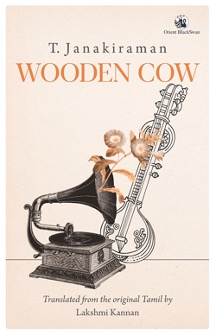
Author & Translator: T. Janakiraman, translated from Tamil by Lakshmi Kannan
Publisher: Orient Blackswan Private Ltd, 2021
T. Janakiraman (1921-82), affectionately known as Thi Jaa, is an iconic, widely read and revered Tamil writer and one of the most influential figures of the twentieth century. Belonging to the Manikkodi movement in Tamil literature, which brought in new ways of writing, with an emphasis on the art of fiction as practiced by the Modernist writers in England, he wrote in a deliberately pared-down style and explored psychological ramifications. It is no coincidence that the hundredth year of his birth is being celebrated in 2021 in a great way. As a tribute to him, Orient Blackswan has just published a second edition of his Tamil novel Marappasu (Wooden Cow) aptly translated by Lakshmi Kannan, the well-known contemporary bilingual writer and poet. A novel quite controversial when it was written, it is basically the portrayal of a strong woman who lives by her own convictions, rejects the institution of marriage, and who remains true to herself, despite social censure.
Narrated in the first person by the protagonist Ammani, it is through her consciousness that the events of the novel are reflected. Divided into two parts, the first section delineates Ammani’s growth from a precocious child to a luminous, spirited young woman. She leaves her natal home for higher education to live with her Periappa and Periamma, her uncle and aunt, and starts living a non-traditional life. The opening sentence of the novel, “Almost anything makes me laugh” vouches for her strange beliefs and behavior. Her headstrong nature coupled with her intolerance of injustice results in her being mired in controversy over and over again. She ‘hardened’ her mind as she “knew there is no meaning in marriage and all that sham in the name of respectability”. She doesn’t wish to steal but wishes to live on her own terms. She spouts communist philosophy and rails against the unjust treatment of the poor by the government. Though financially very poor, she goes and invites the famous singer and musician Gopali to perform at her cousin’s wedding celebrations. Soon Gopali’s charisma draws her into his ambit. He takes her to Madras and also arranges dance lessons for her and moves her into a house he buys for her. Ammani rejects marriage as a bourgeois concept but soon accepts her hedonistic new life and begins her unconventional and volatile relationship with Gopali.
In the second part of the novel, we see Ammani as a woman of the world, divested of all her connections with traditional Brahmin society. Wary of marriage, which she sees as a lifelong imprisonment, she travels around the world giving Bharatnatyam performances. Gradually her relationship with Gopali is strained when he realises that he is not her only male companion. Ammani’s many romantic entanglements provide her with a different view of the man-woman relationship. She gets into a relationship with a man called Pattabhi but laughs it off when he proposes marriage, thus wounding him deeply. Throughout the novel there are many more instances of her waywardness. She poses as a streetwalker in London and picks up a Vietnam war veteran called Bruce with whom she spends three weeks. Initially Bruce is convinced that he “got to know a rare human being”. He tells her, “You may have slept with three hundred people and kissed a few thousand. But you are a very pure woman”. But when he tries to be intimate with her, Ammani states: “I’m a public girl. At the same time, I’m also not public. I can be bought. But I’m also not for sale. It’s possible to stick to me, but it won’t last. Why are you looking at me as if I was an exhibit?”
She explains to him that she has no relations or friends. She drops each friend in their place and moves on. While on a train journey with Gopali, she makes a sardonic assertion that she is not Gopali’s wife and confuses the fellow English passengers travelling with them. Thus, far from adhering to the caste and class hierarchies and morality, the novelist portrays Ammani as a woman who lives by her own convictions and remains true to herself despite social censure. Towards the end of the story however she realises through the marital relationship between her servant Pachiappan and his wife Maragadham that a man and a woman can also be true soulmates, and this renews her faith in the institution of marriage.
The title is based on her perceptions when she sees a dead cow on the street one day. People were wary of the unpleasant task of having to dispose the carcass, even though the cow had provided milk and had borne calves when she was alive. Metaphorically speaking, she perceives herself to be similar to the cow that lacks functionality, and therefore wooden. By disclaiming the institution of marriage, she has been merely a shining curio that has not been of any real value to others.
Translation and its problems are nothing unique and hence critics have even labelled it by terms like ‘transliteration’ and ‘transcreation.’ In Mouse or Rat? Translation As Negotiation, Umberto Eco writes about a postlapsarian movement between different tongues, the perilous attempt to express concepts from one language into another. “Translation is always a shift, not between two languages but between two cultures. A translator must take into account rules that are not strictly linguistic but, broadly speaking, cultural.” By suggesting that translation is a ‘negotiation’ not just between words but between cultures, whether it be a loss or a gain on either side, Eco emphasizes that a translator’s job is to decide what elements are vital and which may be neglected. In another instance, the problems of translation are put forward by Jhumpa Lahiri in her latest novel Whereabouts (which she self-translated from Italian to English) attests to the fact: “Translation shows me how to work with new words, how to experiment with new styles and forms, how to take greater risks, how to structure and layer my sentences in different ways.”
That Lakshmi Kannan decided to re-translate the original Tamil text once again after a gap of nearly forty years vouches for the fact that a translation can never be declared as one and final. What she did in the first edition in 1979 left her dissatisfied and as she herself declared, trying to do a fresh translation of an older piece of work was like wrestling with “a new kind of beast that is hard to describe and difficult to handle”.
By paying more attention to enhance readability for a contemporary audience as well as to preserve the Tamil flavor of the original by retaining many original words in the text and providing a glossary at the end, this revised version has emerged rejuvenated as a new text.
As Anita Balakrishnan rightly points out in her foreword, the author wrote in the distinctive Tamil dialect of the Kaveri delta that created a characteristic style. This made the task of translating even more daunting, for the carrying across of the nuances of the Thanjavur Brahmin register is no mean task. Also, Jankiraman’s technique of interweaving the mellifluous strains of Carnatic music with his pathbreaking themes helped him to ensure his place in the great tradition of modern Tamil fiction. With a good command of both English and Tamil, Kannan’s translation ably captures the nuances of the original text, and she should be congratulated for bringing the works of T. Janakiraman to a pan-Indian as well as global readership. Her unique attempt to re-translate the novel once again by rectifying all the lapses in the earlier translation speaks of her sincerity, integrity and ultimately love for her mother tongue Tamil as well.
Somdatta Mandal is a critic and translator and a former Professor of English at Visva-Bharati, Santiniketan, India.
.
PLEASE NOTE: ARTICLES CAN ONLY BE REPRODUCED IN OTHER SITES WITH DUE ACKNOWLEDGEMENT TO BORDERLESS JOURNAL
Suzanne Kamata is an American writer, academic, and a fiction editor, who resides in the Tokushima Prefecture, Japan. She has authored or edited 14 books including, memoirs and award-winning books. Her anthology The Broken Bridge: Fiction from Expatriates in Literary Japan (1997) was nominated for the Kiriyama Prize. She is a winner in the best novel category of the Half the World Global Literati Award. The Baseball Widow (2021) is her latest book.
The Baseball Widow (2021) is the tale of the life and aspirations of a passionate young American teacher Christine as she juggles through encounters in a multi-cultural setting and with having a child with special needs. Christine falls in love and marries Hideki Yamada, an aspiring Japanese high school baseball coach despite the complicacies that may arise due to cultural differences. She settles down with Hideki in Japan with dreams of teaching English and travelling to lower income Asian and African countries to help the underprivileged with English language skills.
Their daughter Emma has cerebral palsy. She is wheelchair bound and communicates through sign language. Emma is named with love after Queen Emma of Hawaii (1836-1885), who promoted a multicultural outlook. Their younger son Koji is sensitive and undergoes bullying in school because of having a specially abled sister. Stereotypes and societal judgments over their cross-cultural marriage, having a child that needs frequent hospital visits and extra care, and the other child getting harassed in school are a constant sources of anxiety for Christine and Hideki. Moreover, Hideki’s wholehearted dedication as a coach, who considers his baseball team as his first “family” and as someone who takes the demands of his job seriously, heightens Christine’s responsibility as a wife and a mother in the family.
The story has a lot to offer for cross-cultural enthusiasts. Through a host of characters, one gets to look closely into some aspects of life in Japan and into a mish mash of cultures. Interestingly, Kamata also manages to juxtapose the perspectives of Japanese and Americans on baseball as a sport, schooling, varying rituals of birthday celebrations, ways of coping with old age, accent issues, food culture, mannerism, a father-daughter relationship that Kamata calls “skinship” and so on. The story takes a larger overtone as it gives a glimpse of experiences on the notion of the term “Hafu”, which means a Japanese biracial. Half-Japanese or half-American, both in Japan or in America, such persons seem to face more societal hurdles than advantages. Additionally, the main plot along with the other sub-plots has a lot more to speak about relatable experiences of cross-cultural encounters in terms of love, education, health, travel, companionship, and the expectations and realities of life and relationships in general.
Kamata gives a unique take on disabilities and disparities of life experiences through Christine and her family’s experience with their own family and society. As parents, Christine and Hideki tried to cater to the needs of both the children and stay strong. Even though, their family was often subjected to gossip and rumours born of Emma’s condition, they reconciled to her disability. As Koji was victimised, they struggled to change him to a private school. They struggled to make life better for their children and family.
The story runs in two parts. In the first part, Kamata takes the reader back and forth from present day to a flashback as she introduces us to the story and the myriad themes of the novel. The story starts with Christine and her views on Japan and her life in Japan. She sets off to Thailand on a mission to help Cambodian refugees. She walks through her dream of helping needy and disenfranchised kids exploring the bigger questions of dreams and reality, love and longing, and the purpose of life. Experiencing a sort of “compassion fatigue” and looking at the brighter side of life, she returns to Hideki and Japan with hopes for a better future. Hideki coaching the baseball team at the Tokushima Kita High School dreams big and works hard to secure a place for his team to the prestigious national baseball tournament at Koshien. Kamata beautifully portrays how life is complicated with love, dreams and responsibilities through the shorter stories within the framework of the main narrative.
Part two of the novel takes a new turn as Christine comes to her mother’s place in South Carolina for a vacation and she meets her old school friend Andrew, an American Iraq War vet, whom she got to reconnect through the Internet. A fatal attraction and an affair ensued to bring out the raw side of reality. Hideki speculates saying, “… there was no such thing as pure joy, that even the greatest happiness was tarnished somehow, temporary, but worth striving for all the same”. Christine motionlessly undergoes strong emotions as she sees Hideki in the hospital. He too reminisces over lost time with Christine that he over dedicated to his career and reaches out to Christine to start all over again saying, “… Please come home”.
The Baseball Widow is a gripping novel that powerfully explores issues of responsibility, disability, discrimination, violence, dreams, love, longing, health, career, parenting, youth and old age through a cross-cultural spectacle. Hope and forgiveness overrule the human flaws in the story. Christine positively declares “everything is fine!” about Emma’s disabilities to rise about the surprise, pity, apologies and embarrassment of daily encounters. Beautifully embellished with an exquisite watercolour artwork cover by Giorgio Gosti, dark yet shaded in harmony, humour and positivity, The Baseball Widow will touch lives across ages, genders and cultures.
.
Gracy Samjetsabam is a research scholar at the Manipal Institute of Communication (MIC), MAHE, Manipal. She is also a freelance writer and copy editor. Her interest is in Indian English Writings, Comparative Literature, Gender Studies, Culture Studies, and World Literature.
.
PLEASE NOTE: ARTICLES CAN ONLY BE REPRODUCED IN OTHER SITES WITH DUE ACKNOWLEDGEMENT TO BORDERLESS JOURNAL






 Borderless