Categories
Review

Lines across the Ocean: Love and the Impossibility of Words

Book Review by Soni Wadhwa
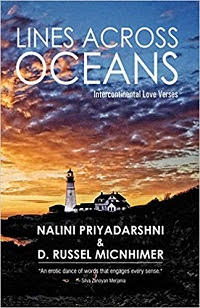
Title: Lines Across Oceans

Authors: Nalini Priyadarshni and D. Russel Micnhimer

A few days before this Valentine’s Day, Nalini Priyadarshni urged her friends on Facebook to  “consider getting a book of love verses for your sweetheart this Valentine”. The book is Lines Across Oceans: Intercontinental Love Verses which she has co-written with the late poet D. Russel Micnhimer, also a winner of Poet Laureate award in India. To those who love poetry and those who have been in love, Priyadarshni’s mischievous call to action invoked nothing less than a gleeful sentiment of “ooooh… another one” tinged with “oh no – not again!” It is a sentiment that gushes out of a lover/beloved every time a note of pleasure comes close enough to unfold aspects of loving.

While the book was published three years ago, it was a perfect moment to discover how the two poets from different continents would reinvent ways of understanding, expressing love and talking about it. The book does two wonderful things for the readers — it begins with Rumi and then somewhere in the middle declares what lovers already know about the impossibility of syncing love with speech:  

Listen if you must

Not my words, for they may be unbefitting

Listen to my silence in pure intent

My pauses bring forth what my words couldn’t 

If you don’t get my silence, my words were a waste

Anything that can be explained away in sounds and signs

can neither be deep nor abiding 

Eternal and elemental, the absolutely best in us

expresses itself as much in black as in white fire

Love cannot be spoken about, and yet, lovers continue to speak about it. Priyadarshni and Micnhimer affirm the paradox of writing about silence in love and so one can peacefully move on to enjoying the way of words that have the audacity to express being in love:

Words born in the recesses of your heart, I treasure 

Even before they rise in your throat 

Or find release from your lips 

I know them from another place, another time 

The refrain “another place, another time” throughout the piece concedes that being in love is being resonant with the idea of love that precedes the lovers in question. Hence, Rumi. Hence, poetry. Hence, reading. Hence, writing. This idea of another time, another place constitutes the iconography of love at the hands of Priyadarshni and Micnhimer:

We pour ourselves out to make room

For the best is yet to come.

What’s love poetry without the snapshots of togetherness? Here is an instance of the mood of the Valentine from the book:

Morning Ritual of shared coffee 

with a tea person should make you wary . . . . 

Mightn’t be the coffee they are after 

but coffee flavored kisses

One wants to blush at the thought of being outdone by the beloved thus. And then one wants to know how the beloved will walk the path of passion:

Knead me as a loaf with your fingers jaan . . . .

– I am growing, expanding, soaking 

in the joy of your laughter’s leavening 

overlapping the edges of meeting hearts. 

The eroticism spread throughout the book brings one back to words as the units constituting the idea of love:

How can I make my words taste as good as ice cream on a hot day 

make them tremble in your ears as they tumble from my tongue?

Lines Across Oceans is interesting for the way it weaves the idea of being together with that of writing together. This laying bare of the cohabitation in the text makes the collection of poems apt as more than a Valentine’s Day read. Sample the lines that articulate this: 

When you write poems for me

and I string my words together 

to write about you and us

we do more than make love

to each other with our words

we bestow each other with 

a slice of eternity

The book appeals to the right spot called desire – desire, that sits perched delicately on the suture between the pleasures of writing, loving, and being loved. In the ritual of reading a collection of love poetry, desire begins to linger on all rituals of living and making sense of life. 

While general readers will be able anchor their experience of love in the light and intense moments in Lines Across Oceans, “serious” and regular readers of poetry will find interesting for its experiments at the formal level in the way it incorporates less known forms of poetry – katuata, sedoka, choka and so on. A ‘choka’, for instance, works very tightly with a form organized around the alternating lines of five and seven syllables:

Let nights and days of

Our loving playfulness, stretch

Into forever

Love is about opening one’s self and shrinking it too. Each number in the book reflects that opening and shrinking in different ways. The collection affirms that love and poetry are so alike. 

Do pick it up — even though the Valentine’s Day is gone, the Valentine is still around.

Soni Wadhwa is an academician based in Mumbai. Her work can be found on Asian Review of Books and Deccan Herald, some of which has also got republished in Scroll and South China Morning Post

Categories
Review

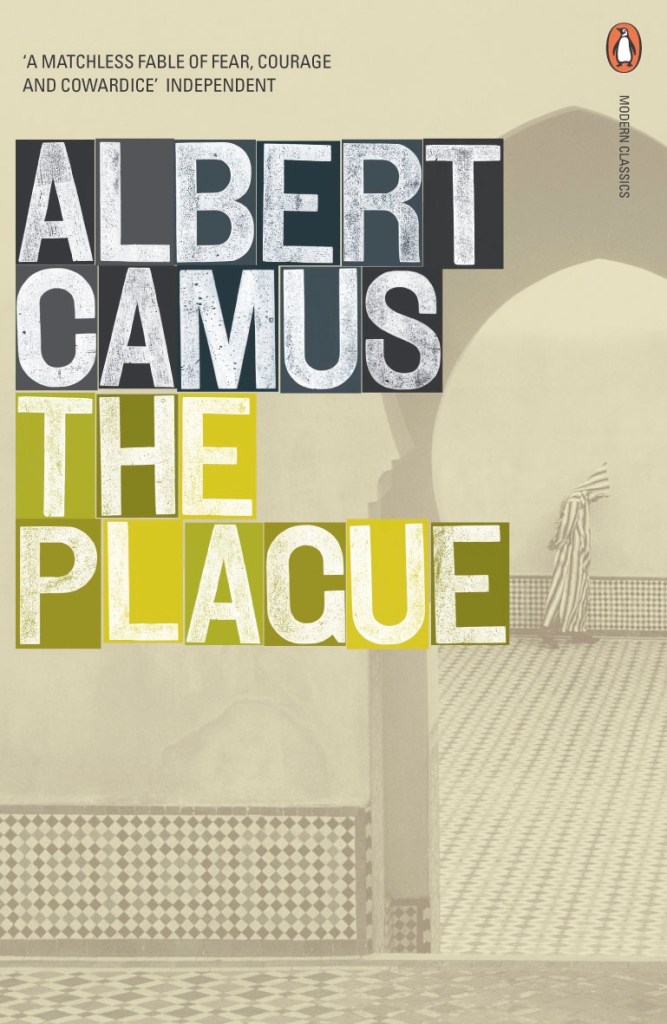
‘What’s true of all the evils in the world is true of plague as well. It helps men to rise above themselves’: The Plague by Albert Camus

Book Review by Rakhi Dalal

Title: The Plague (1947)

Author: Albert Camus

Camus’ La Peste has never been out of print. In the wake of pandemic that now sweeps the entire world, its sale has seen a surge quite unlike at any other time since its publication in 1947. What else can be a greater proof of the relevance of a work that seems to be an ageless parable of human condition.

The novel, most of which he wrote in confinement, away from his family due to his acute illness, is the story of a town suffering from bubonic plague. But this novel can also be seen as an allegory of human crisis brought about by moral contagion.

Camus belonged to a generation which was born either before or during the First World War, reached adolescence during the worldwide economic depression and turned twenty the year of Hitler’s rise to power. Next they saw the civil war in Spain, the Munich Agreements, the start of another World War in 1939, the fall of France in 1940 and four years of enemy occupation and underground struggle.

All of this, in his opinion, resulted in a human crisis where most people, disillusioned by religion or nationalism and wary of the traditional morality imposed upon them, lived in contradiction. They accepted war and violence which was given to them, which they had never wanted but from the consequences of which they could not escape. It was as if the entire generation was plagued by an indifference which led people to accept human suffering as a banal reality.

In one of his lyrical essays, The Almond Trees (1940), Camus wrote:

I do not have enough faith in reason to subscribe to a belief in progress or to any philosophy of history. But I do atleast believe that men have never ceased to grow in the knowledge of their destiny. We have not overcome our condition and yet we know it better. We know that we live in contradiction, but that we must refuse this contradiction and do what is needed to reduce it. Our task as men is to find those few first principles that will calm the infinite anguish of free souls. We must stitch up what has been torn apart, render justice imaginable in a World which is so obviously unjust, make happiness meaningful for nations poisoned by the misery of this century.”

He believed in human kindness and solidarity. He believed that if in the face of a crisis people could rise and act, not out of some heroic courage expected of them, but with reason and optimism, then it would be possible to reduce human suffering.

Written in the given context, the novel quite pertinently, became a tale of a persisting contradiction and subsequent human actions in overcoming the condition.

What’s true of all the evils in the world is true of plague as well. It helps men to rise above themselves.”

In the novel, after initially rejecting the plague, the people of Oran are forced to go into isolation and quarantine. In fact the whole city is closed down and its borders are sealed. There are people suffering from the disease, people in exile – away from their loved ones, people serving those ridden with disease and also people trying to make more money by smuggling goods. Here the depiction of illness, loneliness and separation is quite vivid – much that we can relate to as well at present?

Dr. Rieux, the one who detects the illness, assumes his responsibility and does what he must. He is an ordinary man doing extraordinary things, not out of a notion of valour but out of simple decency and a sense of moral obligation. His character personifies individual moral responsibility essential to make effective public choices in a society. At one point, he says:

When you see the suffering it brings, you have to be mad, blind or a coward to resign yourself to the Plague.”

Rambert, a young journalist who is exiled in Oran, tries to escape the city initially but later he realises that he shares a common fate with rest of the people and joins in serving those afflicted.

Then one fine day, the plague disappears as mysteriously as it had appeared but not without playing havoc with the lives of people. Later when the people celebrate in the streets of Oran, Dr. Rieux observes:

The plague bacillus never dies or vanishes entirely, it can remain dormant for dozens of years in furniture or clothing, it waits patiently in bedrooms, cellars, trunks, handkerchiefs and old papers, and perhaps the day will come when, for the instruction or misfortune of mankind, the plague will rouse its rats and send them to die in some well-contented city.”

Camus knew that even if a contagion, whether biological or moral, ends – one couldn’t be too sure of its absolute extinction. So in the absence of a clear moral lesson from this book, what is it that makes the book still relevant?

In the face of the present pandemic which lurks in the corners of our cities and stares at us from outside the windows of our isolated homes, this book not only brings to our notice the horrors such plagues can inflict but also the human will, solidarity and collective resistance that remain instrumental in overcoming such disasters. It puts our focus back where it should be – on assuming moral responsibility as individuals — on each act of kindness, on goodness which when collective not only helps combat a pandemic but also rouses our alertness lest our laxity make us miss the signs of an impending darkness. 

Rakhi Dalal is an educator by profession. When not working, she can usually be found reading books or writing about reading them. She writes at https://rakhidalal.blogspot.com/ . She lives with her husband and a teenage son, who being sports lovers themselves are yet, after all these years, left surprised each time a book finds its way to their home.

Categories
Review

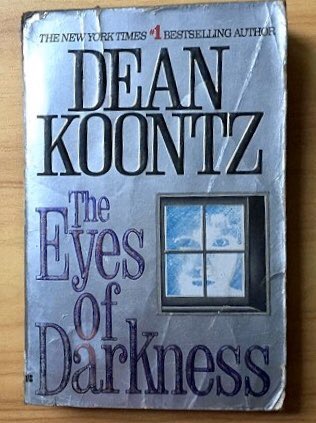
The Eyes of Darkness: Was it all predicted?

By Mitali Chakravarty

Title: The Eyes of Darkness

Author: Dean Koontz

Publisher: Pocket Books, USA, 1996

One of the passages from a thriller that has been  circulating the social media circles during COVID 19 is how the Wuhan virus was evolved in a lab in the United States with a  Chinese refugee’s help, one who had defected to US “carrying a diskette record of China’s most important and dangerous biological weapon in a decade.” The book, The Eyes of Darkness by Dean Koontz, is listed as a thriller, mystery, suspense and horror. It has been republished with a few changes in 1996, post-Glasnost and post-Tiananmen incident.

In the novel, the virus, called Wuhan 400, was said to have been developed in a lab in the outskirts of Wuhan. It “afflicted only human beings”. The fictitious virus had an incubation period of less than twenty-four hours. We are told, “It destroys part of the brain that controls the autonomic functions. The victim simply ceases to have a pulse, functioning organs, or any urge to breathe.” People died within a few hours of the infection.

The corona, luckily for mankind, does not affect the brain – only the lungs and most recover with mild flu-like symptoms and some have no symptoms at all.

The Wuhan 400 has been shown to be so infectious that one single panic-ridden, irresponsible, contaminated scientist infected a huge batch of boys and their teachers, who were on a trip that would teach the youngsters survival skills. Ironically, except for one child, the rest die. What gave the child the resilience to survive becomes the source of study for scientists in the middle of a deserted spot in Texas. The story revolves around how the child is rescued by his mother and her boyfriend who fly incognito all the way from Las Vegas to Reno and then into the wilds.

The book has a touch of the paranormal.  The author tells us in an ‘Afterword’: “The Eyes of Darkness was one of my early attempts to write cross- genre novel mixing action, suspense, romance, and a touch of the paranormal.” And the title is based on the paranormal activity. The paranormal activity is a little eerie and the descriptions are just frightening to the right degree.

The Eyes of Darkness had been revised in 1996 and republished. This is the version that is doing the rounds of the social media platforms. The earlier 1981 version was authored by Dan Koontz under the pen name of Leigh Nichols. In the 1981 version, the virus was called Gorki 400 virus and developed in Russia. This was before Mikhail Gorbachev used the terms perestroika(restructuring) and glasnost to indicate an openness in the Soviet Union which was its first step towards democratisation. Then in 1991, Boris Yeltsin moved towards a loose federation of Russian states. In 1989, the terrifying incident of Tiananmen Square killed thousands of innocent protestors.

In the 1996 edition, Dombey, a scientist in the facility which housed the research tell us , “The Russians… they’re now supposed to be our new friends, but they keep developing bacteriological weapons, new and more virulent strains of  viruses, because they are broke, and this is a lot cheaper than other weapons systems…” That the paranoid of weaponists and security experts obviously knows no bounds anywhere in the world is well borne out by the narrative. This has nothing of the conspiracy theories to wipe out the world. It is a thriller like a James Bond! It does not dwell on Machiavellian concepts quoted in Dan Brown’s thriller, Inferno:

“When every province of the world so teems with inhabitants that they can neither subsist where they are nor remove elsewhere, every region being equally crowded and over-peopled, and when human craft and wickedness have reached their highest pitch, it must needs come about that the world will purge herself in one or another of these three ways: floods, plague and famine”

Dan Brown has something similar in Inferno where the world is threatened by a conspiracy to decimate the population based on Machiavellian and Malthusian principles by a villain who is more colourful and dramatic than Koontz’s and weaves the story in the city of Florence.

The story of Inferno, located in Italy, is interesting and perhaps can be the subject of another review. I enjoy a Dan Brown thriller more because it is woven around history and philosophy.

The Eyes of Darkness is simpler lore — with shooting, bars, the glamorous world of casinos, racing from place to place, helicopter and fast car rides, homes getting blown up, strange paranormal activities that wreck a room and bomb blasts from which the protagonists escape. The villain is perhaps a little less colourful than Dan Brown’s or the Joker from Batman — but weird none the less. The plot is intriguing! Take a plunge and see — it is a good and easy read while you wait out the virulence of the real COVID 19! 

Mitali Chakravarty is a writer and the founding editor of borderlessjournal.com.

Categories
Review

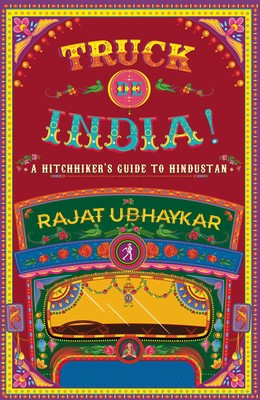
Truck de India: An Epiphanic ride

Book Review by Rakhi Dalal

Title: Truck De India

Author: Rajat Ubhaykar

Publisher: Simon and Schuster, India, 2019

“Gaddi jaandi ae chhalanga mardi

(The truck goes jumping)

  Mainu yaad aaye mere yaar di”

(I remember my beloved)

The one image that I have always associated with the thought of truck/ goods carrier on Indian roads is a boisterous Punjabi driver driving the truck in abandon while singing this song full throttle. Part of the reason lies in my spending my early childhood years in Punjab and part in being enamoured by the bitter sweet song which is as much about love as it is about lamenting the distance between lovers.

But apart from this sweet image, one other image that has been deeply ingrained in my mind about these trucks is that of a formidable giant body on wheels which must never ever be overtaken on a highway.

This was one of the first lessons I was given while learning to drive – “Don’t ever overtake a moving truck or a bus, especially on Haryana Roadways.” So while I have adhered to this rule most of my life, sometimes I have indulged in the guilty pleasure of overtaking the giant on a highway, more specifically whenever I found it trudging painfully slow. It generated a sense of exhilaration when I beat the king of the highway on its own territory.  

But other than this, the sight of a truck never evoked much contemplation. That was not until I came across Truck De India.

Really, I thought? A book on trucks? WOW.

And then I read the subtitle – A hitchhiker’s guide to Hindustan

In the prologue of the book, the author narrates the incident which kind of seeded the idea of discovering the country through road:

Staring outside the window on that trip, the wind tousling my unruly hair, I remember being struck by a sort of epiphany, that India is bigger than the boundaries of my imagination, or anyone’s, for that matter. You didn’t have to go the scale of the cosmos to imagine something vast – India was enough.”

That the author, Rajat Ubhaykar, chose trucks to hitchhike to undertake the journey was at first kind of bewildering to think. But then as I read on, I realised what better way to discover a country if not through the eyes of one of the most vulnerable yet surprisingly one of the most underrated and suspected class in the workforce of the unorganised sector which forms the backbone of logistics across the country.

Another reason might be the mysterious air that hovers around the sight of a truck on a highway. It seems to be destined for discovering vistas unknown to commoners like us and so the experience of its riders may seem much richer than that gained through journeys undertaken by conventional means.  

Ubhaykar started the journey from Mumbai, moving all the way upto Kashmir and then Far East to Nagaland before finally reaching Kanyakumari in the South. A journey across the country hitchhiking thus with truck drivers and their helpers, gave him a first-hand experience of the many tribulations and dangers they face while transferring goods for people like us — the goods we eventually consume unthinkingly.

What I found immensely likeable about his hitchhiking with truck drivers is that he entered their world only when taken kindly in. Throughout, he maintained a respectful distance while asking questions about their lives, their experiences. He found that apart from paying “taxes” on road to braving harsh weathers, the threat of insurgents or evading highway robbers, the drivers also spent long periods away from family only to save a couple of thousands more. But none of the problems that they faced made them hostile as they conversed about these with a total stranger. In fact, as opposed to the commonly held notion, he found most of them very friendly and warm.  

Aap humare mehmaan hain” (you are our guest). How else can one define the gesture of the driver paying for a stranger’s meal where a single penny mattered to him? Or sharing the already cramped space for two to sleep with someone they had barely met? What held them together apart from the commonality of being part of the same journey from one destination to the next? Or was it the inherent human desire for the need to be understood, respected and treated kindly by fellow beings? In the journey of life each of us choose a path, most suitable circumstantially, and so, a comparison materialistically is not only naïve but also degrading.

While on his journey to initially discover the unseen India, Ubhaykar found what really mattered were the transits which characterise life. He has penned his experience to showcase what happens in the lives of the truckers who spend most of their lives behind wheels — away from their loved ones — to ferry goods and materials which not only run our country’s economy but also bring comfort to the lives of millions of strangers. 

It is fascinating to enter Ubhayakar’s world of truckers in India who live with the uncertainties of highways and circumstances to earn their livelihoods. Now, with this book by your side, are you ready to embark on the ride?

Rakhi Dalal is an educator by profession. When not working, she can usually be found reading books or writing about reading them. She writes at https://rakhidalal.blogspot.com/ . She lives with her husband and a teenage son, who being sports lovers themselves are yet, after all these years, left surprised each time a book finds its way to their home.

Categories
Review

The Forever Abode

Book Review by Candice Louisa Daquin

Title: The Forever Abode
Author: Dustin Pickering
Publisher: Transcendent Zero Press

I’d not read a lot of Dustin Pickering before reading a draft copy of The Forever Abode. Pickering had mentioned this was a collection of poetry about a long-term relationship and thus, I found the idea intriguing. Poetry and love going so well together.

The first thing you notice reading Pickering is, he’s not a modern poet. His writing style and the emotional emphasis behind it, is very much inspired by, and in the genre of poetry from the 17th and 18th century poets.

For many this may be a little too classical, but I found it refreshing and ironically, original, because of its homage to the poetic form of old. What better genre in which to accomplish this than poetry about love or love in poetry?

Pickering is a huge romantic, that’s clear from the first few lines. Another thing in his favour. When men are romantic, I think they excel at it. It becomes their life blood and bleeds into their words effortlessly. Who better to be romantic about than a woman? She is the object of desire, whether we with our modern principles accept this or not.

The style is distinct. Pickering doesn’t title all his poetry. He has three sections. In 1. Baby, the first poem speaks of:

“because I honor you because love isn’t cheap— / my heart sequestered by phantom desires / and touch what soul?”

I love the use of his question(ing) in the lines, this reminds me of William Blake so much and is very poignant, working so well with the idea of asking (the desired one) whilst at the same time beseeching them.

“when darkness preens our bodies / flight like a whistle birds of stone we cannot eat / I lay quietly in your light.”

If you say this poem out loud, you can hear the skill with which it was wrought. There is a baseline melody and then an upper cadence, rhythmic throughout and the ‘voice’ is extremely predominant, almost begging you to usher it into existence. This accomplishes a sense of: the poet himself, the object of his desire, his emotions. In many ways this is a classical recipe when writing love poems and you either love them or hate them. I fall into the former category.

Beautiful wordplay also dominates almost effortlessly. One such example: the use of “phantom desires” saying so much in two words. And the ending – “I lay quietly in your light” such a brief ending, so perfectly crafted with the flow of words, and overall feeling of gentle love and adoration. The tenderness he is able to evoke using his mastery of language is evident from the first line.

Although it’s harder to navigate the book due to not having titles, I quite like the idea of titleless poems and a reliance instead on the meaning, the emotion, the swell so to speak. In the second poem of 1. Baby, the lines: “by design I am fatal/ horse of sleep / carrying you toward me / where dreams eviscerate the mind” stood out as being stocked with metaphor and glorious imagery. Sometimes when you write obliquely in some ways and at the same time, say so much through your use of image, you set a stage far more vividly than by deliberate illustration. Suffice to say, such lines appear classic in their magnificent deliberation, how Pickering is able to shift our reading by the choice of which line they appear on, is surely the poet at his finest.

Poem 3 in the same series states: “you inhabit this tender world/ with a majesty no one recognizes/ but me.” By using “tender” before world Pickering deliberately and artfully softens the tone. Again using “majesty” he reveres his subject without needing to say more, and so, in three lines, so much is given, and little is lost. Another poetic device few possess, for we are often tempted to spell out what can be self-evident if we know our craft well enough.

As I read on, I find lines like: “the efficacy of dawn / like hammers clutched to the skin—” . These are equal to lines you would recall from taking a poetry course, that’s how tight and well-woven they are, and remain long after reading. Few authors have the ability to bring two lines alive with such dexterity and it is to Pickering’s credit that he is able to do this throughout this collection again and again.

Then suddenly there is a titled poem – “We Are Descending Together (After Marcel Duchamp’s Nude Descending a Staircase, No. 2)” and from this, I learn, how Pickering is able to be the poet I find. He takes a snapshot of something beautiful and speaks on it. As he does here, as he does throughout, and it works with such a crescendo of evocative naturalness, you feel he’s the creator and the subject:

“I admit to my failure at lovemaking. / I don’t make love; I destroy it.”

These lines are shattering. Their purity is staggering and I am reverent in my appreciation of Pickering’s high feeling like I have never been before.
I become aware that maybe I have mis-stepped, that this format is actually more deliberate than I even realised. I think of Duchamp’s staircase and then see the way these poems are arranged, with title or section title it matters not, these are meant to be read as one would fall down or climb up a staircase. You can hear it in the arrangement, as if Pickering were a composer writing music. That is exactly how this collection reads and I have never read a book of poetry that did this, not even Rossetti’s Goblin Market.
Within this, lines stand out like stars: “in empty fear there is an impulse to love—”. A mature and eerie understanding of human beings, emotions, desire, compulsion: “bolt the doors, rinse your wings: / every fear is justified. / nightingale slit throat, stolen honey.” It is a veritable glut of homage to every poet from Keats, the Brontë’s, through to Sappho, but done so naturally that it is in no way pretentious or seeking acclaim on the back of another. No, this is informed writing at its best.

Whether you are fan of poetry en masse or classical poetry, you will sink into lines like: “how do worms canker the flower? / envy’s sweet bud purses its lips in song.” I expect at times you may find this removed from the modern world and that will be a delight, because poetry isn’t of this world and a real poet will not conjure our world but a mirror of it, and reflect it back. Pickering has accomplished this through his breadth of knowledge about the world of literature and his own heart, that lives among those airy lines.

In the second section, ‘II Adult.’, Pickering shows his virtuoso as a philosopher of poetry with lines like; “What is known is not what we are certain of” and “heaven is anonymous and there are raging flags / above us”. And “nothing is senseless. Only the lack of sense.” (‘Intuition and Destiny’). Lines like those make me envy the quiet mind Pickering possesses, how he intuitively gleans beneath surfaces and remains in his imagination in ways that bring redolent colour and depth to his language.

The irony of when Pickering states: “you will be born forever into my tired stanzas.” Is that nothing could be further from the truth. These stanzas are anything but tired, they are fresh with intensity and passion and for those who love poetry, they are a welcome boon from the lackluster world beyond. If you find yourself envying his muse, then you know his work as a true romantic poet is accomplished.

Section Three is called ‘Walking Stick’ and symbolically I felt this line spoke of its meaning: “if I was perfect your stars would engage me.” This is the last part of the journey, where love slips through his hands, as beautifully as tragedy can be:

“if a monster I am, let me galvanize the pretty flux of death. / rapid sleep, dream in agency, I will not forgive.”

As an ardent fan of tragic love as well, I found Pickering’s handling of this delicate grief remarkable. It is far, far too easy as a writer to slip into maudlin self-pity and to retain that flourish of poetry whilst writing such despair is extremely challenging. Pickering succeeds in making tragedy beautiful and this is when you know, yes, he’s got that bittersweet magic in his soul:

“if prayer and fortune are no better than chance, / sublime randomness rules the punch— / we dig in, we live, the banquet of folly.”

It sounds pretentious of me to say this, but I have to because it’s what I thought reading The Forever Abode. Dustin Pickering’s writing reminds me of Shakespeare in his dexterous handling of tragedy especially and John Keats or Gabriel Garcia Marquez, in his wild submergence into love. With lines like:

“I will not forget my love, for she is silver / to gestalt eyes.”

What else can come to mind but those greats, who know how to pick silver from the darkness and make it see? Equally, as a writer of poetry I have learned so much about the importance of line breaks, something so seemingly obvious and yet, Pickering could give seminars on it in his sleep.

Two final points necessary to make mention of. Firstly, that Pickering may use old-world language in such a way we have seen and grown bored of before, but he does it with intelligence. He doesn’t just borrow the words; he inhabits and understands them. Many times, I read words like ‘o-er’ and know the author doesn’t really understand more than the obvious meaning behind them, and not how to employ the rhythm and romance of those old words into song. Pickering is dexterous in his awareness of these words, both then and now, and as such they are not just symbols, he is bringing the past into the future.

Lastly, Pickering has wrought a beautiful creation with The Forever Abode. He has reminded me why I was drawn to poetry way back when I first read it. He has tapped me on the shoulder and let me know it’s okay to be a hopeless romantic. He has let it be okay to love language and wordplay without needing a modern twist. For this I owe him a debt of gratitude. Reading The Forever Abode has been an awakening into my own love affair with poetry and how no matter what, it endures within us, without us and throughout us, in its ability to make us feel … everything.

“Gold chalices are floating in an array of fleecy torpor: / wind puts the candle to its test. Failure is only a game./ It doesn’t matter how or when— / love will sink into you like a raw fruit / seeded by memory. / The thought of you reconciles me to death.”

Candice Louisa Daquin is a Sephardi immigrant from France who lives in the American Southwest. Formerly in publishing, Daquin is now a Psychotherapist and Editor, having worked in Europe, Canada and the USA. Daquins own work is also published widely, she has written five books of poetry, the last published by Finishing Line Press called Pinch the Lock. Her website is www thefeatheredsleep.com

Categories
Review

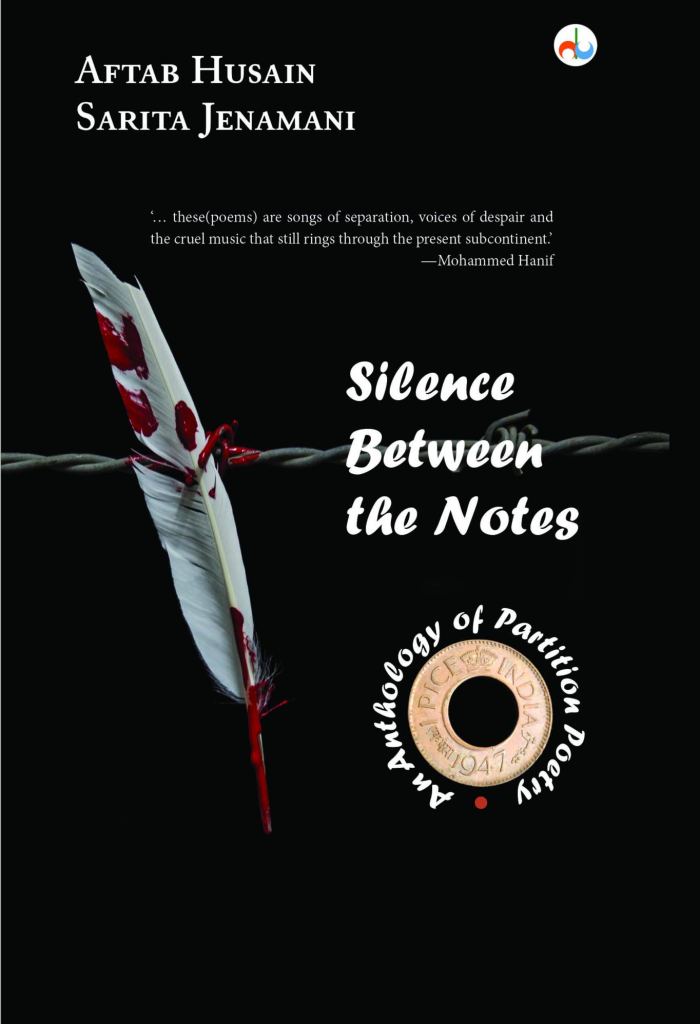
Silence between the Notes

Title: Silence between the Notes – Anthology of Partition Poetry

Selected, edited and introduced by Aftab Husain and Sarita Jenamani

Book Review by Namrata

Despite being more than seven decades old, Partition continues to be raw and unflinching. Endless books and movies have tried to capture its pain and enigma and yet there seems to be so much more that needs to be told about that one incident that changed so many lives, forever.

Silence between the Notes is an anthology of Partition poetry which includes contributions from Urdu, Punjabi, Sindhi, English, Hindi, Bengali and Kashmiri languages. It is a unique collection as this is the first book which is extensive, representative and inclusive of it all. Selected, edited and introduced by Aftab Husain and Sarita Jenamani, this anthology promises to bring forward the voices which had perhaps got lost somewhere in all the noise that followed Partition.

Sarita Jenamani is a poet based in Vienna who writes in English, Hindi and Odia, her mother tongue. A general secretary of the Austrian chapter of PEN international, she is also the co-editor and publisher of the bilingual literary magazine Words and Worlds.

An eminent name on modern Ghazal poetry from South Asia, Aftab Husain writes in Urdu, English and German. His poems have been translated into many languages. Apart from being a member of the Austrian chapter of PEN international, he is also the co-editor of the bilingual literary magazine, Words and Worlds.

When India was declared independent, the joyous news was also followed by the sad news of Partition of India into two countries, India and Pakistan. What followed was mass migration of lakhs of people as Muslims in India migrated to Pakistan while Hindus and Sikhs in Pakistan migrated to India, all in a hope for better tomorrow. Nobody knew how this supposed call for betterment led to so much blood shed on both the sides that till date, the cries and blood stains can be heard and seen.  Was it religion or was it politics, no one can say! All one can say is that the wound is too deep for even time to heal it.

My soul quivered at the sight of human blood, spilled here and there

Like beasts, men madly roamed at city’s every thoroughfare.

(‘The Partition’, Maikash Ambalvi)

Picking up gems from different languages ranging from Urdu and Kashmiri to Bengali and Sindhi, this collection of ninety-one poems is a heart-wrenching read. One cannot read this collection without feeling that pinch in their heart and sensing a lump in their throat on this poignant portrayal of the incidents that happened before, on and after Partition. The beauty, irrespective of the language they were written in and despite being translated, leaves one unnerved.

With works of stalwarts like Sahir Ludhianvi, Faiz Ahmed Faiz, Amrita Pritam, Agha Shahid Ali, Taslima Nasreen, Keki Daruwalla and many others featured therein, these poems are strung together with the thread of hope binding them. Taking us through the conflict they witnessed, heard or experienced, the poems in this collection make you witness the trauma inflicted upon through Partition. One can almost hear the sobs and feel that fear undergone through these pages.

Even in some of the darkest stanzas it is difficult to miss the tiny glimmer of hope in the hearts of the poets. Like that ladies who tied pillows on their waists and stomachs to protect themselves, or the one where they talk about how trains arrived at stations but the names of the places had been changed, leaving them unidentifiable. These poems talk endlessly about kind neighbours who took them in and protected them or that random stranger who had offered them food. There might be pain in their words and through ink, they might be giving form to their blood and tears shed at that time. However, their voices are trying hard to hold onto hope.  As Sarita Jenamani’s poem, ’70 years later’ begins,

‘August is the cruelest month

It drags us

To a butchery

Plastered with mirrors-

Mirrors of the ancestral rage’

And ends with,

‘August in a month of monsoon

And monsoon brings

A maze of hope’

If someone were to ask, whom did the Partition benefit, there would be pin-drop silence in response. This is the same eerie silence that reflects out in the title of the book ‘Silence between the notes’. Each poem, each stanza, every word is followed by a pause which is reverberating with questions but sadly, has no answers. This silence is also reminiscent within the moments when the reader pauses reading the book briefly after finishing one poem, just to regain composure and start reading it again.

Today, almost seventy years later, we are still at a point where the harsh memories of this incident have chained us and sadly, there are times, when we see the signs of it reoccurring around us clearly pushing us further down the abyss. The only thing that helps us stay afloat is that we have hope, for a better tomorrow, for a kinder world and for humanity to prevail above it all.

Namrata is a lost wanderer who loves travelling the length and breadth of the world. She lives amidst sepia toned walls, fuchsia curtains, fairy lights and shelves full of books. When not buried between the pages of a book, she loves blowing soap bubbles. A published author she enjoys capturing the magic of life in her words and is always in pursuit of a new country and a new story. She can be reached at privytrifles@gmail.com.

Disclaimer: The opinions expressed are solely that of the author.