Categories
Interview Review

Akbar: The Man Who was King

In Conversation with Shazi Zaman, author of Akbar: A Novel of History, published by Speaking Tiger Books
“I profess the religion of love, and whatever direction
Its steed may take, Love is my religion and my faith.”
— Ibn-i-Arabi (1165-1240), Akbar: A Novel of History by Shazi Zaman

These lines were written by a mystic from Spain who influenced Emperor Akbar (1542-1605), a ruler who impacted the world with his broad outlook. Based on such ideology as preached by Ibn-i-Arabi more than three hundred years before him, with an urge to transcend differences and unite a world torn by strife, the great Mughal founded his own system of beliefs. He had few followers. But Akbar chose to be secular and not to impose his beliefs on courtiers, many of whom continued to follow the pre-existing religions. He tried to find tolerance in the hearts of practitioners of different faiths so that they would respect each other’s beliefs and live in harmony, allowing him to rule impartially.

Akbar is reported to have said: “We perceive that there are varying customs and beliefs of varying religious paths. For the teachings of the Hindus, the Muslims, the Parsis, the Jews and the Christians are all different. But the followers of each religion regard the institutions of their own religion as better than those of any other. Not only so, but they strive to convert the rest to their own way of belief. If these refuse to be converted, they not only despise them, but also regard them for this very reason as their enemies. And this causes me to feel many serious doubts. Wherefore I desire that on appointed days the books of all the religious laws be brought forward, and that the doctors meet together and hold discussions, so that I may hear them, and that each one may determine which is the truest and the mightiest religion.” Of such discussions and ideals was born Akbar’s new faith, Din-i-ilahi.

Was it exactly like this? Were these Akbar’s exact words?

They have been put in perspective by an author and a journalist who has written a novel based on his research on the grand Mughal, Shazi Zaman. He tells us in the interview why he opted to create a man out of Akbar rather than a historical emperor based only on facts. He has even mentioned that Akbar might have been dyslexic in the introduction. But Zaman’s admiration for the character he has recreated for us overflows and floods the reader with enthusiasm for this legendary Mughal. Akbar is depicted as a man who was far ahead of his times. He talked of syncretism and secularism in a world where even factions within the same religion were killing each other.
Akbar by Shazi Zaman in Hindi

The novel was first written and published in Hindi in 2017 by the bilingual Zaman, who started his three-decade-long career in broadcast journalism at Doordarshan and has since, worked with several media organisations. Zaman trans created his Hindi novel on Akbar to English to reach out to a broader audience. The whole experience has been a heady one for Zaman as the interview shows but for the reader what is it like? To start with one felt like the Connecticut Yankee in King Arthur’s court, except one was flitting around in the Indian subcontinent of the sixteenth century, with a few incursions to the Middle-East, but mostly within India. Transported to a different age, it takes a while to get one’s bearings. Once that is established, the novel is a compelling read.

The first part deals with Akbar’s developmental years and the second part with his spiritual outlook which helped him create an empire with many colours of people and religions. This is a novel that has been written differently from other historical novels, like Aruna Chakravarti’s  Jorasanko (2013), for the simple reason that it belongs to a different time and ethos which was farther from our own or Tagore’s times.  Akbar has a larger tapestry of people across a broader canvas than Jorasanko and it takes time to grasp the complexities of relationships and interactions. The other recent non-fiction which springs to the mind while reading Akbar is Avik Chanda’s Dara Shukoh: The Man Who would be King (2019) about the great grandson of the emperor who lived from 1615-1659. Again, this was a narrative closer to our times and was not a novel, but a creative non-fiction based strongly on history. While Dara’s character painted by Chanda showed weaknesses like an inability to respect the nobility or plan wars, Akbar painted by Zaman is kind but a man of action who ruled and intended to rule well. A leader — one has to remember — is not always the most popular man. Nor was Akbar with his eccentricities and erudition despite his inability to read — the book does tell us why he did not learn to read and how he educated himself. Most of the novel is a work of passion based on extensive research over two decades. As Henry Kissinger had said at a much later date, “The task of the leader is to get their people from where they are to where they have not been.” And the Akbar recreated by Zaman does just that.
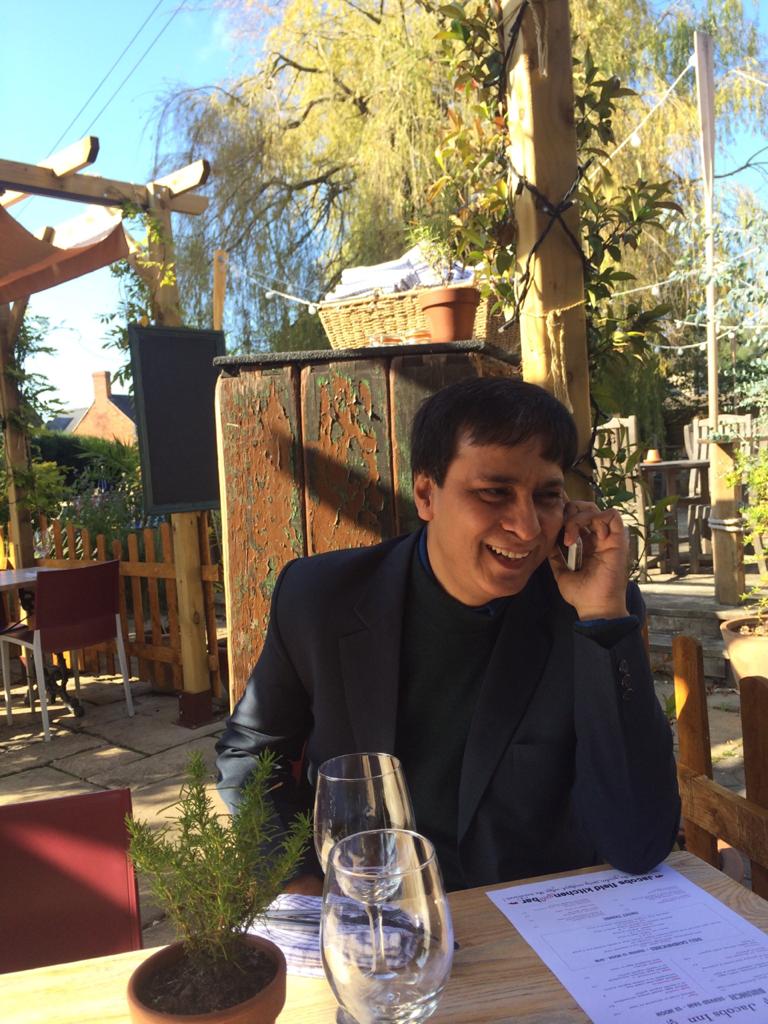
Shazi Zaman

Zaman who had been with the ABP (Anand Bazar Patrika) News Network as their Group Editor, was on the governing bodies of the Film and Television Institute of India, Pune, and the Indian Institute of Mass Communication, Delhi. He has worked with Aaj Tak, Zee News, Star News and also with the BBC World Service, London. He has served as the Director, Video Services of the Press Trust of India. Akbar is his third novel. He has authored two novels in Hindi earlier. In Akbar: A Novel of History (2021), Zaman with his journalistic background and his love for literature inherited from his novelist father, Khwaja Badiuzzaman, has done the mammoth task of astutely bringing to life a character who might have been a perfect solution to the leadership crisis that many are facing in the current day.

If you are still wondering how close this novel comes to the Bollywood movie called Jodha Akbar (2008), the major things in common were the grand Mughal’s sense of justice and his ability to tame wild elephants! For a deeper understanding of both the emperor and the book, in this exclusive, Zaman tells us what went into the making of this novel and his journey.

Why did you choose to write of Akbar?

One has to have a bit of Akbar inside oneself to write on him—and to read about him as well. Writing on Akbar was not a conscious decision. By the time I realised that I was going to write a novel of history on Akbar, my sub-conscious was miles ahead. Of course his personality had attributes that appealed to me consciously and sub-consciously, especially his belief in primacy of ‘aql’ (reason) over ‘naql’ (blind imitation of tradition) and his ability to question all orthodoxies.

Do you think Akbar is relevant in the current context?

I believe that his message is so ennobling that it transcends the boundaries of space and time. Across ages and across geographies, and within a geography by various groups and communities, his memory has been kept alive.

There was a book a few years ago called Dara Shukoh: The Man who would be King. Would you say he would be more relevant for our times than Akbar or is Akbar a better choice?

It is difficult to give them a comparative score. Dara could have been a very worthy successor to Akbar. And his initiatives and writings are really inspiring. Robustness of ideas and your resolve to push them are tested when faced with exigencies of statecraft. Sadly, Dara did not get that chance and Akbar did. I find that Akbar could navigate but sometimes be audacious to the extent that his courtier poet-musician Tansen had to caution, ‘dheere dheere dheere man, dheere hi sab kachhu hoye (Slowly, slowly, slowly, all happens at a slow pace)’.How would Dara have navigated while on throne is an unanswered question in Indian history. Having said this, his defeat in the battle of succession should not undermine the originality of his initiatives.

Why did you choose to write this in a novel form? Dara Shukoh was a non-fiction. Have you introduced fiction into this?

History largely tells us what happened. Most often it does not tell us of the state of mind that brought people to the point where we find them take momentous decisions. I think momentous events or actions are rooted in mental journeys. And these journeys are seldom documented. When Akbar faced a mental crisis—‘haalat-i-ajeeb’ (a strange state) as a contemporary called it— in the summer of 1578 on the banks of the river Jhelum, one wants to map what was happening in his mind and what had brought him to that point.

What lay behind the agitation of this man who was one of the mightiest emperors of the world, who had never lost a battle and was at the peak of his power ? Were there some forces testing his patience ?  Or as he stood at a place linked to the history of his forefathers, did he wonder about the trauma they had faced ? Or when he dealt a physical blow to a top cleric of yester years, there must have been a mental journey preceding this act. One can try and go into a person’s mind by closely studying his actions and utterances as also that of people and texts that influence him. We all know that people often mean much more than what they choose to say and sometimes, they say one thing and mean the other.

A close examination of this maze can give a glimpse of what was happening inside the great mind. As you try to create a period piece around his state of mind you mine information from all available sources—textual, aural, visual, architectural. For me fidelity to known facts is essential even in historical fiction. But there does come a point when the trail goes cold. Even the best documentary evidence might be insufficient in finding all the pieces of the period piece. For example, we do not know what Akbar was wearing the night he experienced the ‘haalat-i-ajeeb‘ but we have a Mughal miniature in all likelihood of the next morning when Akbar takes an unexpected decision about the great game. Now, it has come down to us that he appeared wearing last night’s clothes. So we know what he was probably wearing at the time he was in ‘haalat-i-ajeeb’ of the previous day. Or we do not know the details of the carpet of the room where he lay dying. Nobody recorded that. Thankfully, some details have come down to us of carpets of those times. I have chosen to use them. After exhausting all means of finding the right pieces of this period piece, I have exercised my imagination. So this is fiction very much rooted in history. If I have been able to do what I had intended, you would feel you have read his mind as also feel that you are actually standing backstage in the Akbarian arena.

In the debate I often encounter about the element of history in historical fiction, perhaps we miss a basic point. Most fiction has history in it. Some have history that is known. Some have history that is personal or unique to the author. It is only when known history figures in your work that the issue of reality versus fiction surfaces. Otherwise, this mingling is not questioned.

What was the kind of research you did? How long did it take you to research and write this book? Tell us about its evolution.

The idea had been simmering under the surface since early years. As I have mentioned in my preface, a childhood incident imprinted Akbar on my mind. During my school days, a member of the education department of the government made a surprise inspection and gave a short introduction to Akbar’s life and his relevance to our times. It left a mark. I was especially blessed to have teachers who stoked my interest. I shall be eternally grateful to my teacher Muhammad Amin–Amin Saheb as he was called at St.Stephen’s College (Delhi University) — to have brought history to life in classroom and sessions outside classroom. Amin Saheb taught us Akbar’s ‘sulh-i-kul’ , which he said stands not for tolerance or co-existence because even these terms denote some separation. He said, Akbar’s ‘sulh-i-kul’ meant harmony. Amin Saheb taught us about Akbar’s desire to build bridges and his respect for diversity. Many like me graduated from the university but never left his class. I feel privileged that for quarter of a century after leaving College I continued to sit at his feet and learn about Akbar. A good teacher teaches and also shows the path to further learning.

My interest in Mughal miniatures took me to various museums within the country and abroad and of course to places like Fatehpur Sikri–a city that Akbar created with a purpose– very often.  Over decades I have gathered in my personal collection most of what has been written about Akbar and almost all books published on his art and architecture. I can say that all published Mughal miniatures reside in my study now.  So Akbar was a character I had been breathing much before it became the idea of a novel.  However, for a period spread over two decades I did consciously try to piece together a story.

 How did you create the character of Akbar ?

Akbar was not merely a historical figure. He was also acutely conscious that he was making history. And as a person conscious of this, he left ample footprints.

When you try to get into a person’s mind you piece together all he saw and read (or in case of Akbar, was read to) and experienced; all he interacted with; all he surrounded himself with; all he spoke and wanted to be spoken, read and spread; and all that he created. Foremost, of course, is  Akbarnama which was a monumental image  building exercise entrusted to a close and trusted courtier, Abul Fazl. Abul Fazl knew what went on in Akbar’s mind. This work is rich in details and is a comprehensive history of Akbar and his forefathers. Akbar also commissioned others who knew his forefathers to write histories that would help Abul Fazl in his work. Akbarnama is an official account. It was vetted by Akbar and tells us how Akbar wanted to be seen by his contemporaries and by future generations. It is extremely useful in giving us the image the emperor aimed to project.

Then there were many others who wrote their histories during his reign. But it is the history called Muntakhab-ut-Tawarikh by a disgruntled cleric, Mulla Abdul Qadir Badayuni, which was written secretly that gives us an unofficial perspective.  I am grateful to the anonymous author of the historic Rajasthani work, Dalpat Vilas, for giving an informal and unique access into the emperor’s mind. Anybody studying Akbar feels especially grateful for the elaborate atelier —tasveer khana — as it was called — that the emperor established. Paintings made under his direction and patronage give us a vivid picture of what he thought was worth projecting. If you look closely, Mughal miniatures of his time often have a story and even a back story that gives you an indication of the emperor’s mind.

Akbar built at a huge scale and many of his buildings still stand tall and the stones speak even now of why he gave them the shape that he did. Then of course are works related to his ancestors like Baburnama which Akbar was fond of and later, of his son’s Tuzuk-i-Jahangiri. Akbar’s public contact and communication was prolific. We might well have seen him if we were living in that age. He travelled and interacted widely.

Almost every morning of his half a century long reign he appeared at the balcony so that the subjects could see him. Even those who did not see him felt his presence. Banarsidas, a trader of his time, who also wrote a chronicle, notes the widespread alarm amongst common people when the emperor fell ill. Letters  Jalaluddin Muhammad Akbar wrote to Uzbek and Persian kings, the emperor of Spain and Portugal, to nobles and others have been handed down to us. His interactions with religious persons find mention in Vaishnavite, Jain and Mahdawi literature. The letters that Jesuits at his court were writing to their superiors are useful for their perspective as also for the ‘unofficial’ details. Then there were personalities Akbar drew to his court who were poets, warriors, administrators and diplomats who were themselves eminent enough to be written about, or  were writers themselves. I closely studied them.

Abdur Rahim Khan-i-khanan was like a son to Akbar and wrote poetry that is timeless in its appeal. Tansen, an eminent poet and musician at his court wrote ‘takhat baitho Mahabali ishvar hoye avtar (the mighty Emperor sits on the throne as incarnation of God)’, which is how Akbar would have wanted to be described.  Works written on Raja Mansingh like Mancharit and Mancharitra Raso helped me understand a mighty noble, who again was like a son—‘farzand’—to Akbar. Akbar himself is believed to have been a poet and pieces of poetry deemed to be his have come down to us. His memory resonates even now in folk songs.

In terms of material evidence of personal effects, we have an armour of Akbar which was helpful in ascertaining his approximate height. Of course, this was achieved with the help of experts.  Not all that one gathered necessarily went into this work but I tried to gather as much as I could so as to know how Akbar lived, ate, slept, worked, played, deliberated, relaxed, fought and thought and what was the world he inhabited, and also what was the kind of world he wanted to inhabit.

I must say that I tried to access original sources in Persian, Sanskrit and other languages with the help of experts, in addition to what I could read myself in English, Hindi and Urdu.

In your introduction you have said Akbar might have been dyslexic or bipolar. Why? What made you think he might have been dyslexic or bipolar? Could it not be that as a child he was not just into books and therefore did not learn to read?

There has been some academic work on some of the issues Akbar faced. I think his behaviour on the full moon night of the year 1578 on the banks of the river Jhelum and on occasions before that definitely call for more investigations in that direction, though one is conscious that the emperor himself is not available for close examination. As for dyslexia specifically, one can say that the man loved books. He commissioned and collected them at a huge scale but he did not read them. They were read out to him. Historical sources indicate that he could not read or write. Though I have seen copies of his handwriting, they seem laboured. It would be a fair assumption that he was dyslexic. I think he was a great visual learner. That is why no Mughal emperor before or after had as big a tasveer khana as him.

You have repeated this phrase thrice in the book. ‘Hindus should eat beef, Muslims should eat pork, and if not this, fry a sheep in the pan. If it turns into pork, Hindus and Muslims should have it together. If it turns into beef, Hindus and Muslims should have it together. If it becomes pork, Muslims should have it. If it becomes beef, Hindus should have it. A divine miracle would thus happen.’ Why?

More than one account reveal puzzling behaviour and utterances of the emperor. This forced one person to say that this was ‘haalat-i-ajeeb’. Nobody at that time could fully understand his state or his words. I feel that it was reflective of his anguish over religious disputes and religious orthodoxy. An emperor who had never lost a contest was getting impatient. In moments of mental crisis it is possible for a person to  say things which have layers of meaning. One has to peep underneath the words to fathom the anguish of  a sensitive mind. This was one such utterance. 

What is the most endearing quality you found in Akbar? And why?

It is difficult to pinpoint one in a person who embodied numerous qualities. His belief in giving precedence to ‘aql’ (reason) over ‘naql’ (blind adherence to tradition). His spirit of enquiry and his desire to provide space for differing thoughts. He believed—“It is my duty to have good understanding with all men. If they walk in the way of God’s will, interference with them would be in itself reprehensible; and if otherwise, they are under the malady of ignorance and deserve my compassion.”

There is an incident mentioned in the book. The Jesuits who came with the intention of converting Akbar finally despaired because he would give them ample space and ample attention but stop short of conversion. So one evening, they came and sought leave since their embassy had failed in its purpose. Jalaluddin Muhammad Akbar replied, “…how can you say that the time you have spent with us has been profitless, seeing that formerly the Muslims had so much credit in my land that if any had dared to say that Jesus Christ was the true God, he would straightway have been put to death; whereas you are now able to say this, and to preach the same in all security ?”

You wrote the novel first in Hindi and then trans created it to English. Why? What is the difference between the Hindi and the English versions?

The novel Akbar naturally came to my mind in Hindi, a language the emperor would have been comfortable with had he been alive. Having said this, I am grateful to my publishers, Rajkamal and Speaking Tiger, for initiating the idea of an English  version. And I did immediately see the need to take Akbar to a wider audience because the novel has an idiom and language rooted in Hindustan but Akbarian thought and vision have an appeal that is wider than the regions he ruled. So the challenge was to take the text, sub-text and the idiom to an English audience. The challenge was also to make Akbar’s 16th century intelligible to 21st century English-speaking world. I have tried my best with help of editors at Speaking Tiger to make it a work English speakers would be at home with. I am sure they would be able to savour the milieu, the plot and the sensibility of 16th century Hindustan in their preferred language.  A good translation should in fact be a trans creation and should read like it has been written in the same language. 

You have two novels in Hindi. Do you plan to translate those too to English? Why? Why not write directly in English?

I believe that no thought is completely translatable into words and no words are completely translatable into another set of words. Thus the word transcreation. The first two novels Premgali Ati Sankri (The Narrow Alley of Love) and Jism Jism Ke Log (Various Bodies) have intense conversation between characters which is rooted in their shared understanding of an idiom. Translation is desirable and relatable because stories strike a chord across space but works have texts, sub-text and idiom. The problem and the challenge lies in taking the sub-text and the idiom into another language. That is why trans creation requires a deep understanding of the text, the sub-text and the idiom of the original work as also of the sensibilities of the audience for whom you are trans creating. Having said this, I would be happy to translate the first two novels for an English readership. The theme would strike a chord, the idiom would need some fine work.

Will you shuttle between English and Hindi in the future? Are you planning more books?

Shuttling between Hindi and English is an interesting thought. I am already seized by an idea that came to my mind as an English text. It is germinating. As for more books, I have already sent a Hindi novelet for publication which could be thematically seen as third in series after Premgali Ati Sankri and Jism Jism Ke Log. While telling stories to my children, and making them up as I went along, I created a short novel for children which awaits publication. I am also in the process of writing another novel in the genre of historical fiction.

Thank you for your time.

This is an online interview conducted on behalf of Borderless Journal by Mitali Chakravarty.

Click here to read an excerpt from Akbar: A Novel of History

.

PLEASE NOTE: ARTICLES CAN ONLY BE REPRODUCED IN OTHER SITES WITH DUE ACKNOWLEDGEMENT TO BORDERLESS JOURNAL

Categories
Review

The Best of Travel Writing of Dom Moraes

Book Review by Indrashish Banerjee

Title: The Best of Travel Writing of Dom Moraes: Under Something of a Cloud

Author: Dom Moraes

Publisher: Speaking Tiger Books

Travel books that I have read so far, broadly fall into two categories. One is investigative and the other is a spontaneous account of the author’s experience. If one is analytical, the other is immediate. It’s not necessary that the two styles can’t be combined. V.S Naipaul’s A Million Mutinies Now (1990) is a good example of that: a mix of investigation of a place’s past and present through ordinary people’s lives combined with day-to-day travel details. Bill Bryson’s Travels in Small-Town America (1989) is about Bryson’s experience of visiting the towns of America with occasional dosage of nostalgia.

The Best of Travel Writing of Dom Moraes: Under Something of a Cloud falls into the second category – a spontaneous account of events as seen by the author. However, where it’s different from travel books in general (and the ones mentioned above) is that it doesn’t stick to a singular theme. A collection of essays, some autobiographical, some reports, the book takes the reader through a kaleidoscopic journey spanning continents, lives and topics ranging from when the author takes his first steps into the world of writing as a child to the time he is a mature travelling journalist covering topics as diverse as Suharto’s rule in Indonesia to dacoits in India. 

If you are familiar with Dom Moraes ((1938-2004) as a poet, novelist and columnist, you will not be surprised by the sheer finesse of writing you encounter as you move from one essay to another, although you may have your own favourites. Regarded as one of the giants of Indian English literature, Moraes won the prestigious Hawthornden Prize when he was just 20 followed by Sahitya Academy Award and a series of other literary awards in England, America and India.

The book starts with an introduction by Sarayu Srivastava recounting the last days of Moreas with detours to his past. The introduction has a morbid element to it, as did Moraes’s life. But, surprisingly, the morbid mood the introduction sets, vaporises in the pieces that follow.

The first two travel pieces are purely autobiographical. ‘His Father’s Son’ (1945) recollects the carefree childhood days of Dom Moraes in Ceylon (now Sri Lanka) where is father, a reporter with Times of India, was posted. There is a strong visual element to how the natural world of these places has been described. Anecdotes about a child – Moraes – discovering this natural world slowly almost reads like the formative pages of a novel. In ‘Figures in the Landscape’ (1955) Moraes is equally carefree, if a little awkward, going through a range of experiences, some writerly, others potentially amorous, in that global capital of arts, artists and sensuality, Paris.

But there is a tragic and frightening aspect to the pieces, too, which appears and retreats only to reappear as if to remind you that life is not just about gambolling. That aspect is the gradual mental deterioration of Dom Moreas’s mother who was given to violence. Her fits of violence form a recurrent theme until she leaves Ceylon and returns to Bombay to stay with her relatives. But even after she departs, her presence constantly lurks in the background. And when she does reappear, either actually or via recollection, the atmosphere of the essay instantly changes.

She, although absent from many other pieces in the collection, casts a shadow on her son such that some of the actions of the son, particularly his introverted and melancholic personality, seem to be coloured by his mother’s tragedy. One can sense in later essays where the author has grown up, how the derangement of the mother would have affected the son. That almost becomes a subterranean subtheme.

The following opening passage of ‘The Chinese at the Doorstep’ is a case in point.

One recalled the oddest things: I remember a toy-shop in a Knightsbridge arcade where I used to go when very unhappy, during my first days in London, in order to buy small delicate glass toys which I later smashed, one by one, in the fireplace of my flat, with a malediction against anything beautiful.”

Moraes had a complex relationship with his mother. And in the essays that are a throwback to his childhood days, you meet a helpless child unable to make up his mind whether he loves his mother for who she is, or is indifferent to her — seeing her from a distance with a sense of fright and awe.

As the book progresses, the world of Moraes opens up further. ‘The Chinese at the Doorstep’ (1959) is about a sudden journey to Sikkim and surrounding places. There is a tension in the place that it’s abuzz with Chinese spies, and that China is engaged in incursions and military build-up in the Indian border states. The year is 1959 and developments are admittedly a precursor to the things to come in 1962. Written more than half a century ago, the essay reads disturbingly current. The essay’s narrative is much tauter, almost like a spy thriller, than the other essays.

Since the global brouhaha about climate change is not older than roughly a decade and half, we tend to locate all climate disasters to recent times, having settled into the belief that the past generations were coexisting with nature in peace and harmony. However, the subcontinent has always been home to extreme climate events going back to the 18th century.

“Geography as well as history has always been linked to East Pakistan.” When I read this sentence, the first sentence in ‘Death by Water’ (1970), I thought I was in for an account of the atrocities on the Hindu population of East Pakistan during that period but was surprised to find an extremely well-informed report on a cyclone which had hit the region in 1970. The sea level had risen to a great height creating a ‘water wall’, according to eyewitnesses, which had then crashed on the land raging inland with a monster force and then stopping and moving back into the sea. The next day when helicopters were sent to survey the damage, bodies of humans and cattle were found floating in the sea, river and crevices. 

In ‘Dispatches from Indonesia’ (1972), Moraes visits a country under the tyrannical rule of General Suharto. The dictator had come to power seven years before his visit through a military coup, and immediately after, there was a crackdown on the intelligentsia. Some were executed and some sent to prison camps. Moraes travels to one such prison camp outside the city and meets two famous prisoners, Suprapto (Soeprapto), the former Attorney General, and Pramudja (Pramudya Ananta Tur), a famous writer. Their lives are a reflection of the losses and tragedies the critics of the regime suffered.

In ‘The Company of Dacoits’ (1981), Moraes withdraws from the world of dictators and devastating floods and enters the rugged terrain of dacoits.  We meet Lajjaram, who is dead and whose body is being constantly mishandled by the police, and Lakshman Singh Rathore, alias Lachhi, an eighteen-year-old boy who was thrust into dacoity by his circumstances, first to seek help to avenge his father being deceived, and then to pay for the help received by becoming a fulltime bandit. The rest of the essay is about Lachhi trying to get himself acquitted of the crimes committed by other dacoits in his group. 

Likewise, the other pieces also deal with human conditions in varied settings.                    

The essays are undoubtedly dated, but the subjects they deal with brim with recency: human disaster, tyrannical govt, national expansionism, inaccessibility of justice. Over a period of time, these subjects, of course, have acquired a new lexicon: territorial conflict, climate change, human right excesses and so on.

The collective time span of the pieces is almost 60 years. Dom Moraes’s gaze is that of a writer, rather than of a journalist, always looking out for human tragedies, helplessness and intricacies within bigger narratives of climate disaster, military coups and national conflicts.

.

Indrasish Banerjee has been writing and publishing his works for quite some time. He has published in Indian dailies like Hindustan Times and Pioneer, and Café Dissensus, a literary magazine. Indrasish is also a book reviewer with Readsy Discovery. Indrasish stays and works in Bangalore, India. 

.

PLEASE NOTE: ARTICLES CAN ONLY BE REPRODUCED IN OTHER SITES WITH DUE ACKNOWLEDGEMENT TO BORDERLESS JOURNAL

Categories
Review

Growing up Jewish in India

Book review by Bhaskar Parichha

Title: Growing up Jewish in India: Synagogues, Customs, and Communities from the Bene Israel to the Art of Siona Benjamin

Editor: Ori Z. Soltes 

Publisher: Niyogi Books

This is a wonderful anthology of non-fiction on Jews in India. The gorgeously produced book offers a historical account of the primary Jewish communities, their synagogues, and unique customs. It traces how Jews arrived in the vast subcontinent at different times from different places, both inhabiting diverse locations within the larger Indian community, and ultimately creating a diaspora within the larger Jewish diaspora by relocating to other countries, particularly Israel and the United States.

Edited by Ori Z. Soltes, who teaches art history, theology, philosophy and political history at Georgetown University and who is also a former Director of the B’nai B’rith Klutznick National Jewish Museum having curated more than 85 exhibitions on history, ethnography and modern and contemporary art, this book gives a veritable account of the Indian Jews who have retained their distinctive physiognomies. He shows Jews have been integrated into the larger Indian diaspora because of their receptive, flexible and inimitable traits.

The text and its rich complement of more than 150 images explore how Indian Jews retained their unique characteristics despite being well-integrated into the larger diaspora of Indians and have continued to offer a synthesis of cultural qualities wherever they reside. Understandably, the editor Ori Z. Soltes, contends not many communities feel a sense of belonging with two countries they view as their own — the Jews call India their motherland, and Israel, their fatherland.

The Bene Israel Jews are the largest Jewish Indian community and there are a number of theories regarding the timing of their arrival on the western coast, some dating back to the reign of King Solomon, 3,000 years ago. Another theory is that they were part of the lost 10 tribes that disappeared from north Israel and from history in the aftermath of the conquest of the Israelite kingdom by the Neo-Assyrian Empire. And there are other theories too on which Soltes elaborates to bring clarity to the matter.

The book has an elaborate discussion on the unique art of Siona Benjamin, who grew up in the Bene Israel community of Mumbai and then moved to the US. Her work reflects Indian and Jewish influences as well as concepts like tikkun olam (Hebrew for ‘repairing the world’).

In a sense, the book is a memoir on growing up Jewish in India with essays on Siona’s Fulbright work in India and Israel, plus her other series of works. It offers a portrait of a unique slice of the Indian world for readers interested in history, art, religion, and culture, worldwide.

In combining discussions of the Indian Jewish communities with Benjamin’s own story and an analysis of her artistic output, this volume offers a unique verbal and visual portrait of a significant slice of Indian and Jewish culture and tradition.

The book begins on an existent note: “Indian Jews have historically lived across diverse parts of the Indian subcontinent over the centuries without experiencing the sort of anti-Semitism that has been so common in many other parts of the world, particularly Christian Europe, which exported its anti-Jewish sensibilities into the Muslim world eventually, particularly in the context of European colonialism and post-colonialism in the Middle East, culminating with World War I and its aftermath. Indeed, the most obvious exception to the rule of Jewish experience in India arrived with the control of Goa in the early 16th century by the Portuguese, who brought with them not only anti-Jewish feelings, but the specifics associated with the development of the Spanish and Portuguese Inquisition that would affect New Christians suspected of secretly continuing to practice Judaism-and continue until the formal abolition of the Inquisition authority in 1812.”

The introductory chapter throws light on the non-violence Hindu culture in India which allowed Jews to live in harmony with other communities as opposed to European countries: “The general lack of hostility and persecution may be understood in part as a cultural phenomenon, but also as a function of the nature of Hinduism, by far the dominant religion across India, and its embrace of diverse perspectives regarding how, specifically, one might understand and address divinity. Within the singularity of Brahman-Being-what we term ‘Hinduism’ recognises a nearly infinite possibility for divine manifestations: Brahma, Vishnu, Shiva, Devi, Krishna (and many other more minor figures) are both separate from each other and all understood to be part of each other and subsumed into a singularity that is Brahman.”

It further contends that India is as diverse with religions as it is linguistically. It is, as most people are aware, the country in which Hinduism was born, in fact the word ‘Hindu’ refers to the place, India, not to the form of faith. According to the author, “Hinduism’ is also a misnomer in being used as if there is a monolithic form of faith that goes by that name, just as it is often misunderstood to be polytheistic: there are, after all, any number of gods and goddesses, it would seem, that occupy its pantheon. In truth, (to repeat), an Indian who is part of this spiritual tradition understands all of these ‘gods’ and ‘goddesses’ to be particularised manifestations of a single god of Being.”

What is Hinduism? Soltes argues: “Hinduism’ may be understood by Westerners as a more complex version, in a sense, of Christianity in its understanding of God as triune, for instead of a threefold, Father/Son/Holy Spirit Godhead, ‘Hinduism’ offers a poly-une Brahman (Being) expressed as Brahma, Vishnu, Siva, Devi, and others. So, one is typically a Saivite, say, or a Vaishnavite, believing that Siva or Vishnu represents the consummate expression of God, but embracing the legitimacy of other expressions, as well. Moreover, among the 10 avatars assumed by Vishnu over history, one of them is as a dark-skinned (blue or black) anthropomorphic, Krishna, and over time, a growing community of Krishna’s followers or Krishnaites views him as the consummate manifestation of God-not as an avatar of Vishnu: on the contrary, Vishnu is viewed as a manifestation of Krishna.”

The book has in all six chapters with a foreword by Ralphy Jhirad. There’s a chapter on Kerala synagogues by Orna Eliyahu-Oron and Barbara C. Johnson; another on the synagogues of Calcutta Baghdadi Jews by Jael Silliman. Silliman weaves her narrative around the three synagogues of Baghdadi Jews of Calcutta, giving deep insights into the lives of the city’s Jewish community whose numbers have dwindled from 4,500-odd in the mid-20th century to 700 or so in the 1970s and about 20 now. Benjamin writes a memoir, ‘How I Turned Blue and Other Stories I Remember Growing up Jewish in India’.

 Benjamin’s piece gives a snapshot of the life of a diasporic Jew. She writes about her grandmother Elizabeth’s long and interesting life journey. Born in Quetta in Pakistan, Elizabeth’s family later migrated to India’s west coast. Her children dispersed to Asia, Africa and North America, perpetuating the idea of the diasporic Jew. The distance between the families seemed to widen with her parents in India, most of the family in Israel, a few relatives in the U.S. and Canada, and some in Africa. Soltes writes on ‘Refocus and Return’. Benjamin’s multi-layered art dots the book. Soltes also pens the epilogue on the community’s past.

The book is a must read for all as it addresses a complex issue in a rich scholarly way while making it eminently readable. It would be of interest to Jews and non-Jews, Indian and non-Indian alike, as well as to history enthusiasts and the general reader interested in art and culture.

.

Bhaskar Parichha is a journalist and author of UnbiasedNo Strings Attached: Writings on Odisha and Biju Patnaik – A Political Biography. He lives in Bhubaneswar and writes bilingually. Besides writing for newspapers, he also reviews books on various media platforms.

.

PLEASE NOTE: ARTICLES CAN ONLY BE REPRODUCED IN OTHER SITES WITH DUE ACKNOWLEDGEMENT TO BORDERLESS JOURNAL

Categories
Review

Masala and Murder: Sugar & Spice & Not Everything Nice

Book review by Gracy Samjetsabam

Title: Masala and Murder

Author: Patrick Lyons

Publisher: Niyogi Books

Masala and Murder is a tantalising detective novel by Patrick Lyons, who is an Anglo-Indian writer based in Melbourne, Australia. He has had an interest in crime stories since childhood and has been writing from a very young age. His writing reflects his experience as an Anglo-Indian growing up in Australia during the 1970s and 1980s, which paves the way for Lyons to explore broader concepts of exclusiveness, racism, identity, and duality. These notions subtly sprout in his work and fortify the plot and characters in his story.

The whodunit comes in a well-packed set of 40 chapters with a prologue and an epilogue. The opening of the murder mystery is at a place called Uluru, or Ayers Rock, a scenic, sacred place for the aboriginal Australians which houses a massive sandstone monolith in the heart of the country’s arid “Red Centre”. On the fateful day, a mix of noise and silence, natural and artificial at the foot of the Uluru after sunrise await the tourists along with the Bollywood crew as they prepare to scale the famous rock. The Bollywood celebrity, Subhani Mehta, is all set to shoot a dance number on the top of the Uluru. As they reach the summit, amidst the heat and dust, the lead lady readies herself. High-pitched music plays. The camera rolls. They all move in unison. All of a sudden, Subhani Mehta gasps for air and falls. She dies in a matter of seconds.      

This makes headlines in India although it was just another crime news in Australia. Aamir Mehta, a well-to-do industrialist, and father of the dead actress, suspects foul play and approaches Samson Ryder, a private investigator in Melbourne to investigate the incident. Ryder, who was not a private investigator by choice, accepts the case for easy money. Ryder also empathises with the helplessness of Subhani’s father as he had lost his only sister and had seen his parents suffer similarly. He still carries the pangs of guilt for not having done enough to save his sibling.

An initial inquiry to Subhani’s case is dismissed as her demise is listed as a “natural death”. What had actually led to her death continues to be a puzzle as the incident was wrapped up in a hurry. Widespread corruption made way to create an easy exit for the case. Little did Ryder know that the task would lead him to unknown territories that would not only give a fair share of closure for the case but also, add to a better understanding of his messed-up work and life.   

Lyons manoeuvres the crime novel with a set of interesting characters that harmonise to make an intriguing tale. Besides the fee, Ryder’s own past and his relationship with his family make him want to bring solace to the torments of the loss of a child to a family. Cross-cultural exchanges on the aspects of beliefs, rituals, taboos, faith, and spiritualism, black magic, talisman, spirits, tantric, curses, exorcism, Kali worship, etc. in the story are ingredients of the masalas that spice the scrumptious murder mystery. Traversing inner lanes of glamour and darkness, the narrative excitingly reveals the rawness of humans in Bollywood. Lyon presents the Anglo-Indian communities in Australia and Mumbai, with more focus on food and lifestyle to create a feeling of universal belonging. Additionally, his experience as a citizen and as an NRI, ultimately shares a greater awareness of stereotypes and realities of identity.

Lyons beautifully brings up the idea of dreams in relation to our state of mind through Ryder. Themes of minority, infidelity, jealousy, ego, vengeance, depression, grieving, trauma, death threats, abuse – physical and drugs — are touched upon as the story meanders to figure out who murdered Subhani.

Was it the Singhs, Nair, Nadar or Ms. Khan, or was it just a natural death? The suspense interestingly lingers till the end. There is a tussle of love and hate, good and bad, atheism and faith, fear and strength, an exploration of identities bringing to life the duality in characters and unraveling stories within the story. That people cope with personal loss in different ways is subtly shown. Ryder’s father and his godmother, Mabel, resort to faith and worship and his mother keeps herself busier with cooking.

Lyons brings in timely wit and humour. The romantic grids with Rebecca, Ryder’s love interest, and conversations on the unfolding of the crime with Mabel are the lighter shades in the story. Through the descriptions of  traffic, lanes, scent and sights of the cities of Melbourne and Mumbai, Lyons also captivates  with  glimpses of  relatable beauty and distasteful sides of the cityscape. Throughout Ryder’s investigation that unravels as he takes taxi rides, walks, runs, making smart moves, breaking laws or flying across cities, there is not a dull moment in the novel.  

The mystery behind the murder trickles from one circumstance to another making a string of unbelievable coincidences. The protagonist advances to the core of the investigation to be stuck with the question — was it all mere coincidence or planned? With every turn of the page, suspense is in the air right from the start to the end. The plot mingles the mysteries of murder with masalas that throw light on love and loss, blatant racism, complexities of identity and belonging, tradition and beliefs across cultures, and the constant battle of good and evil that we play out as human beings. Patrick Lyons’ Masala and Murder (2021) published by Niyogi Books is a crime novel that is refreshingly told and is a compelling read with content that is contemporary and relatable. A beautiful cover design complements the thrill of the narrative.  

.

Gracy Samjetsabam is a freelance writer and copy editor. Her interest is in Indian English Writings, Comparative Literature, Gender Studies, Culture Studies, and World Literature. 

.

PLEASE NOTE: ARTICLES CAN ONLY BE REPRODUCED IN OTHER SITES WITH DUE ACKNOWLEDGEMENT TO BORDERLESS JOURNAL

Categories
Review

A Luxury Called Health

Book Review by Rakhi Dalal

Title: A Luxury Called Health

Author: Kavery Nambisan

Publisher: Speaking Tiger Books

India is a country of staggering inequality. It is a fact which is much more apparent in the general ward of a government hospital. The author says that a brief visit to one will tell you everything about the healthcare available to poor. In a country where getting two square meals is arduous for most of them, can they manage when struck by grave illness? Or is health, perhaps their only resource, also a luxury unaffordable for them. 

Kavery Nambisan, a doctor and an author, who has been a rural surgeon for most of her life, through this book attempts to bring our attention to the basic healthcare that must be the right of every citizen of this country irrespective of class. She studied medicine and surgery at St. John’s Medical College in Bangalore and then went onto get a Fellowship of the Royal College of Surgeons from London. This book, her memoir, is her first work of non-fiction.

This book is not just a memoir. It is also a commentary on and a critique of the state of healthcare in India. Nambisan’s decision to return and then to serve as a surgeon in the rural areas of her own country is a testimony of her commitment towards the service which demands complete devotion. Her words echo with integrity, exemplifying her allegiance to her vocation. When she expresses concern over the low percentage of budget allocated to health care or the dismal infrastructure available in government run hospitals, the urgency of her call finds its way to the reader.

Being concerned about the increasing corporatisation of Medical Services in India, which has made good health services much expensive and out of reach of the middle class and the poor, she advocates the concept of Universal Health Care. Her suggestions are based on the system of National Health Scheme as offered by Britain to its citizens as well as on the efficiency of health care systems of countries like Germany, China, Russia, Spain, Cuba, Malaysia and Sri Lanka who seem to be doing better than countries like US and India. Her anxiety over miserable condition of health system in India reverberates with an earnestness which is sadly missing from the present national discourse. Though COVID did bring some attention to the terrifying reality of our incapacity to tackle pandemic like situations, it still hasn’t transformed into any visible effective change.

In the current times when private hospitals have more or less become business ventures focusing mainly on profits, there are few exceptions one may find. Nambisan tells us about her own heroes in the medical field. She talks most admiringly about the Dr Banerjees, a couple who after studying in UK set up Rural Medicare Centre in the outskirts of Delhi. They are the founder member of Association of Rural Surgeons of India (ARSI) which comprises of a spirited group of surgeons who have opted to practice in the rural areas of the country. It is heartening to note that nearly thousand surgeons are its members.

Account of her own experience as a surgeon is frequented by patients from every walk of life, whether it is a gun wielding youth from Mokama in Bihar or close aide of a Chief Minister of Tamil Nadu, a daily wage laborer or an upper middle class working women. Their appearance, accompanying the realities of their social lives, is also followed by the struggle and hardships which the doctor sometimes went through while treating them. She writes about the management of everyday affairs at different hospitals she worked in, about the frustration and vulnerability she was exposed to at times or the complete discipline of a hospital which would become much effective in managing a day.

Though in most of her writing, it is her practice in different rural areas of the country which takes the center stage, she does talk about being on the other side of the table. When her husband, the late poet Vijay Nambisan, was diagnosed with cancer she took the role of care giver. She writes about her nervousness and her apprehensions, about her helplessness and anger while watching him suffer. Her pain, subtly woven in her sentences, is like a palpable rap which makes the reader ache with an intensity unspeakable.

During the course of her narrative, Nambisan also gives the reader a peek into the history and evolution of medical practices. She emphasises the need of team work, touches upon the gender biases in the medical field, talks about the struggles a working woman grapples with and focuses upon the huge class divide much evident in the unequal accessibility to health care facilities.

A Luxury Called Health bravely courses through impeachment and defence as the writer compassionately tries to write about what she feels needs to be done. Sincere and spirited, candid and captivating, this book makes a compelling appeal for equity through the strengthening of India’s public health system by bringing in a national health scheme in operation. A timely and relevant advice the country may ignore at its own peril.

.

Rakhi Dalal is an educator by profession. When not working, she can usually be found reading books or writing about reading them. She writes at https://rakhidalal.blogspot.com/ .

.

PLEASE NOTE: ARTICLES CAN ONLY BE REPRODUCED IN OTHER SITES WITH DUE ACKNOWLEDGEMENT TO BORDERLESS JOURNAL. 

Categories
Review

A Discourse on ‘Freedom as Mobility’

Book Review by Meenakshi Malhotra

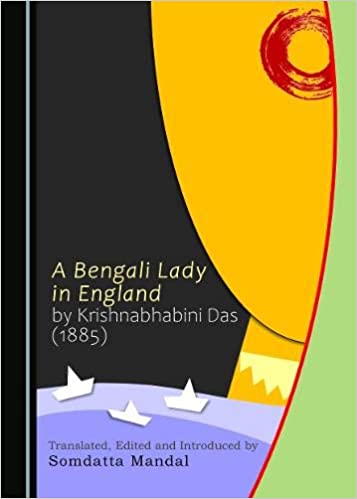
Title: A Bengali Lady in England by Krishnabhabini Das (1885)

Translator: Somdatta Mandal

Publisher : Cambridge Scholars Publishing

Somdatta Mandal’s translation from Bengali to English, A Bengali Lady in England, is a first person account  of the first ever woman’s travel narrative written in the late nineteenth century when India was still under British imperial rule. Krishnabhabini Das (1864-1919) was a middle-class  Bengali lady who accompanied her husband to England for eight years between 1882 and 1890.Her narrative, England-e-Bangamahila was published in Calcutta in 1885. 

Women’s travel writing in Bengal circulated /proliferated in the late nineteenth and early twentieth century through the popular form of serialized publications in journals such as Bharati (1877),  Prabasi (1901), Bangadarshan , Kalpataru, among others, but Krishnabhabini’s account was the first full length travelogue. Though there followed a rich output of travel literature, it would be a fallacy  to box the many writings as a single, homogenous genre. Travel writing in this time undergoes several generic modulations and modifications as it journeys through the turn of the century. For example, Krishnabhabini’s account could also be described as ethnographic writing  as she turns her gaze on British society, culture, customs , manners.

In addition to being a wonderful addition to the archive of women’s writing, Das’s account seems to reverse the gaze. It offers a fascinating glimpse into 19th century English life and culture, as she attempts to set the record straight in many ways. Krishnabhabini’s capacity for observation is admirable in its sociological detail, especially so when we consider that she was barely out of her teens when she wrote the book. A Bengali Lady in England also offers a wealth of ethnographic detail on English life, character, interaction between classes, marriage, attitude to work, family organisation and life.

As Krishnabashini responds to a spectrum of sights, sounds, affects during her extended stay in England, we come across many nuggets of information. The process of travel offers opportunities for emancipation where exposure to other cultures offers her a way of viewing and of gaining a perspective on her own experiences and that of her sisters in India. Krishnabhabini constantly refers to her Indian sisters and bemoans their sorry state and ignorance when she sees how active British women were in their families and societies. Her motive here is to overturn the largely negative view of British women that prevailed in colonised spaces like India, based on their view of the “memsahib” who were often stereotyped as being snobbish and indolent. Her endeavour seems to be to inform her Indian sisters that British women in England were more active than the colonial “memsahibs” they usually came across in India.

She is eloquent in lauding the virtues of British domesticity by pointing out the merits of companionate marriages, where the wife is active in being a true helpmate to her husband as well as being the custodian of the private domain. Her perception is that Indian women and men would benefit in emulating such models of domesticity, instead of remaining in segregation and separation. As the translator and editor Somdatta Mandal points out, Krishnabhabini’s opening of the veil as a means of freeing herself from the constraints of her family and society is probably the first step in “the discourse of freedom as mobility’’ that enables her to construct her own sense of self (Mandal p.xx). Though she deplores the materialism evident in English society, she is also acutely conscious of the difference between the two countries. Thus she writes, “the more I compare the two countries, the more I realise the great difference between them and looking at the poor condition of India, I keep on suffering within.”(150)       

The translation and commentary by Somdatta Mandal, a translator and academic of considerable reputation and experience, highlights Krishnabhabini’s keen and observant eye, both in her translation and her comprehensive introduction to it. Her introduction shows evidence of her scholarship as she contrasts Krishnabhabini’s narrative account with her husband, Devendra N. Das, who with “an Orientalist agenda”(Mandal xxiii) was trying to “educate his fellow Britishers with the myths, religion and lifestyle of Indians back in India-speaking about the jogee, the astrologer, the zamindars, the nautch girls, infant marriage, the matchmaker, the Hindoo widow, funeral ceremonies, et al-his wife was trying to educate fellow Indians about different aspects of British life-English race and its nature, the English lady, English marriage and domestic life, education system, religion and celebration, British trade, labour ”, cityscapes and rural life. Both the editorial commentary and Krishnabhabini’s narrative are peppered with delectable nuggets of information.       

Exposure to European literature, proliferation of print culture and ideas of romanticism percolated into the ‘Bhadralok” consciousness creating new modes of self-fashioning and new reading publics that made space for the publication of serialised travelogues . Much of the travel writing which did emerge and prove popular at this time were those authored by Hindu, upper class, western educated males, who were often renowned luminaries, scholars, or litterateurs in their own right. Several of the travel accounts are of men travelling outside India, usually to England. These works contained observations on western culture and a comparative study with India’s own. Romesh Chunder Dutt wrote Three Years in Europe: 1868- 1871, which was published in 1896. Both Rabindranath Tagore and Vivekananda authored various works on travel. An earlier account of travel writing was Bholanauth Chunder’s Travels of a Hindoo (1869) which chronicled his journey from Bengal to Punjab.

In contrast, socially sanctioned forms of travel for women till the mid nineteenth century was largely restricted to pilgrimage. However, with the advent of the railways and the opening of the Suez Canal, by the mid-nineteenth century we have instances of women, usually from educated Bengali upper-class families, travelling for entirely secular reasons—for convalescence, their husbands’ work, for leisure, or even for education. Aru Dutt and Toru Dutt went to England at around 1870 to pursue an education.

In 1871 Rajkumari Bandhopadhyay, wife of social worker Shashipada Bandopadhyay, became the first Indian woman to visit England. In 1877, Rabindranath Tagore’s sister-in -law, Jnadanandini , along with her children, travelled by ship to England to accompany her husband, Satyendranath Tagore(the first Indian ICS officer). This was against the wishes of her father-in -law, Maharshi Debendranath Tagore. In each of these instances, the act of travelling to a foreign land was deemed sacrilegious and transgressive, with the women facing extreme social backlash and, in the case of Rajkumari Bandyopadhyay, ostracisation. However, these acts set the way for further instances of travel, and more importantly, written accounts for the same. In 1894 Jagatmohini Debi set sail for England, and in 1902 published Seven Months in England (England e Saat Mash).

Krishnabhabini’s work is indeed a pioneering effort as far as Bengali women’s documentation of their travels, at home or abroad, are concerned. Yet her travel to England came at a personal cost; she had to leave her daughter behind with her conservative in-laws, resulting in lifelong estrangement. However, what ultimately makes this book unique it the quality of its specularity, its simultaneous awareness  of the self and other. It is this quality of self-consciousness or self-reflexivity which makes it  truly a  text of modernity.

.

Dr Meenakshi Malhotra is Associate Professor of English Literature at Hansraj College, University of Delhi, and has been involved in teaching and curriculum development in several universities. She has edited two books on Women and Lifewriting, Representing the Self and Claiming the I, in addition  to numerous published articles on gender, literature and feminist theory.       

.

PLEASE NOTE: ARTICLES CAN ONLY BE REPRODUCED IN OTHER SITES WITH DUE ACKNOWLEDGEMENT TO BORDERLESS JOURNAL
Categories
Review

The Hottest Summer in Years

Book Review by Gracy Samjetsabam

Title: The Hottest Summer in Years

Author: Anuradha Kumar

Publisher: Yoda Press

The Hottest Summer in Years is just one of the two books published in quick succession by the author, Anuradha Kumar. The other A Sense of Time and Other Stories appeared a month before this one. Kumar has authored a number of books  and writes for a number of journals. She has won the Commonwealth Award twice in 2004 and 2010 for her short stories. Earlier in 2021, in an interview, Kumar said that she lives and writes across continents and declared that she was “truly a borderless writer”. The Hottest Summer in Years (2021), is a testimony that upholds her declaration.

This novel opens with the protagonist, Hans Gerter, a perplexed young man caught in between dichotomies, in a world alternating between war and peace in the early 1960s, when India too as an independent country was young. The ‘Prologue’ sets the tone of the story. The protagonist is shown to be part of a German firm setting up the steel industry in a small town in the heart of India, a historical truth fictionalised with skill.

The first chapter starts with the puzzling murder of Ahmed Ali. It encompasses the formal and informal meetings of people, the ploy in the efforts to frame the Raja Sahib, the politics of governance and power play taking shape in a newly born India, the brewing Hindu-Muslim tension with a potential to ignite bigger flames in the future, and amidst all these Gerter’s attempt to protect the Raja’s family even as he whirls between his two worlds of the past and present. Gerter ruminates through the story and reflects on the heat in Africa of his childhood and the mirage-like images of all that happens after the night of the murder which holds the story together in what was supposedly one of the hottest years recorded in India, thus justifying the title of his novel.

Love, lust, and belonging criss-crosse across borders to amalgamate with the history and politics of the period from the 1940s to the 1960s. Gerter’s own history is beautifully linked to the Nazi regime and the German holocaust that followed. Through Gerter’s journey from Germany to his displacement in Rourkela and then to Dharamsala, a narrative that spans continents, Kumar brings out the futility of the big wars and their effect on the mental health of people across generations.

Blending facts and fiction, mesmerising scenes of love, abandonment, and mystery make the book an imaginative and compassionate read. Kumar manages to creatively flit through history wherein she props on the landscape people, forests, forest dwellers, animals, Adivasis, seas, the voyage, the call of the wild at night, the train and the railways. Each character and even the vehicles the Blue Daimler, Gerter’s constant companion, the green Austin or the ship SS Giovanni are brilliantly placed to add to the wealth of the narrative. Gerter battles with the fear of the inner demons that breed from his past and present. His taking up the role of a protector in the process changed him. Memory, love, and freedom drive the story with history and mystery gelled in.  

The cosmopolitanism in the story is starkly evident but subtly worked on. It is interesting to note the nature in which his ideas of home and identity sway with the impact of the places his destiny takes him. Gerter brings out the beauty in being the young edgy global citizen, who is everywhere and yet nowhere, as he describes himself as “always on the margins” and that “no place had been home” despite being in many homes far away from home. With a childhood spent in the west of Africa and, in his early youth having awakened to the truths of war and of his country, Germany in the early 1940s, Gerter sped on greater realisations of people he had met or been with, in different places in time. Despite the despair, madness and gloom, a letter and the fall of the Berlin Wall (1989) shines new hope in towards the end of Gerter’s narrative.

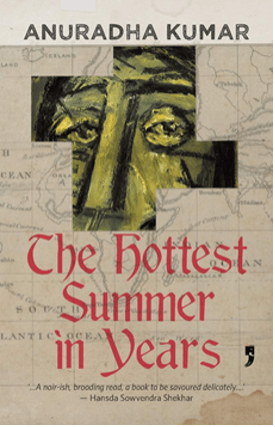
Kumar’s historical novel is a well-packed and well-paced story. It brings forth nightmares, conspiracies, insanity, secrets and fills them with love, hope and aspirations for a better world. The damages of war, the heartbreaks, the longing to mend the wrongs in life and history come together in Kumar’s fiction. In a blend of cultures and history, the story blends genres. Noir and mystery meet history in fiction. Indian writer, Hansda Sowvendra Shekhar, rightly described the novel as “… A noir-ish, brooding read, a book to be savoured delicately…”. Kumar, through Gerter in the novel, brings to light how we share different worlds, how multiple people seem to reside in one person and the varied lives we live. A beautiful cover illustration by Sanjhvi Noul rightly speaks to us on the climate of the book. Kumar’s The Hottest Summer in Years is definitely an all-season book.

.

Gracy Samjetsabam is a freelance writer and copy editor. Her interest is in Indian English Writings, Comparative Literature, Gender Studies, Culture Studies, and World Literature. 

.

PLEASE NOTE: ARTICLES CAN ONLY BE REPRODUCED IN OTHER SITES WITH DUE ACKNOWLEDGEMENT TO BORDERLESS JOURNAL
Categories
Review

Sisterhood of Swans

Book Review by Rakhi Dalal

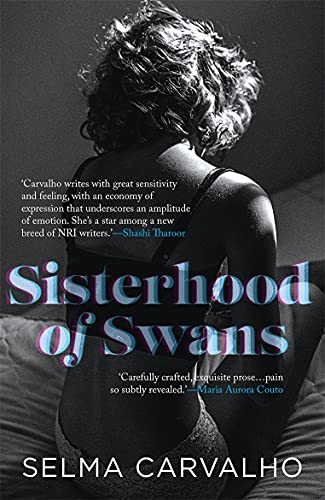
Title: Sisterhood of Swans

Author: Selma Carvalho

Publishers: Speaking Tiger Books

To feel a kind of belongingness, to find acceptance in a society is an inherent human desire. Perhaps this desire stems from the need to strengthen alliance with something larger than individual identities. It is not only family, but also the place we live in, the community we come from, as well as the prevalent societal and cultural norms which fall into this ambit for most of us. Sometimes the scales in life do not balance till this desire remains elusive. More so when one makes home a place not native to the community one belongs to.

Selma Carvalho is a British-Asian writer whose work explores the themes of migration, memory and belonging. She is the author of three non-fiction books documenting the Goan presence in colonial East Africa. She led the Oral Histories of British – Goans Project (2011-2014) funded by UK Heritage Lottery Fund. Her stories have been published in various journals and anthologies. She is the editor of two volumes of The Brave New World of Goan Writing & Art (2018 and 2020). Her work has been shortlisted for various literary prizes including London Short Story Prize and the New Asian Writing Prize. She is the winner of the Leicester Writes Prize 2018 and a finalist for prestigious SI Leeds Literary Prize 2018. Sisterhood of Swans, her debut novel, was shortlisted for Mslexia Novella Prize 2018 in the UK.

Carvalho’s book explores the complexities around this desire to belong and yet the inability to fully embrace the possibilities a place offers because of conceived notions a propos the idea of identity. Her writing, traversing the world of immigrant Indian community in London, is focused upon anxieties and their repercussions, as experienced by a second generation immigrant. Anna-Marie Souza is plagued by a yearning to belong and to hold onto the familiar. Her restlessness stems not only from the inescapability of ethnic alienation, being a Goan-Indian in Horton, but also from the inevitable suffering caused by her parents’ separation.

Consequently, she longs to find a soul mate, a bond for life. In her relationships, first with Nathu and then with Sanjay, she seeks a father figure, a man in whom she may find a resemblance of her father. The choices Anna-Marie makes are flawed and she carries on with them even while understanding that they might be doomed for failure.

The men in Anna-Marie’s world are all adulterers, diving into new relationships and then abandoning their families to move onto other women. It appears almost like a cycle. Every woman she comes across goes through the ordeal. Left in misery by their husbands/partners, they desperately try to put the pieces of their shattered selves together. Their kids endure fractured lives. But it is never the men who suffer, they keep moving on like a river flowing into another and renewing itself, unbroken and unburdened.

It is to this sisterhood of pain of women that Anna-Marie belongs. Like swans, these women look to pair for life but it is disappointment they are fated for. Whether it be her mother, Ines, Sanjay’s wife, Kaya, or her schoolmate, Jassie.

In drawing out the characters of Anna-Marie and her best friend, Sujata, Carvalho also puts the focus on what is inherited from parents subconsciously. In case of Sujata, her father’s illness comes a full circle to haunt her person as she grows up and try to make sense of her existence in a place she recognizes as her home but do not completely fit in. Anna-Marie on the other hand, start relating more to her mother once she steps into motherhood herself, recalling that it was never her father but mother who had always stood by her.

 Carvalho’s pen proficiently renders the intricacies brought about by intersection of different cultures and their consequent uncertainties. She handles the notions of belongingness delicately and with much sensitivity. Her characters are not without flaws and yet they are memorable for their openness and ability to perceive things genuinely. As pointed by Sujata, Anna-Marie comes to accept life as a constantly evolving construct in which to grow also means to allow oneself to evolve irrespective of the contradictions confronted with. To come to a juncture where the permanence of a place or constancy of people does not matter and lives are aglow with the radiance of all the love received.  

.

Rakhi Dalal is an educator by profession. When not working, she can usually be found reading books or writing about reading them. She writes at https://rakhidalal.blogspot.com/ .

.

PLEASE NOTE: ARTICLES CAN ONLY BE REPRODUCED IN OTHER SITES WITH DUE ACKNOWLEDGEMENT TO BORDERLESS JOURNAL. 

Categories
Review

John Lang: Wanderer of Hindoostan

Book Review by Bhaskar Parichha 

Title: John Lang; Wanderer of Hindoostan; Slanderer in Hindoostanee; Lawyer for the Ranee

Author: Amit Ranjan

Publisher: Niyogi Books

Retracing colonial history is always fascinating. And, if the characters are out of the ordinary, that re-examination is even more interesting. This book revisits the life of John Lang, an Australian writer-lawyer settled in India in the 19th century. 

John Lang: Wanderer of Hindoostan, Slanderer of Hindoostanee, Lawyer for the Ranee by Amit Ranjan is about Lang’s life, his accomplishments and his literary works. Lang (1816-1864) was a fiery journalist and novelist who constantly annoyed the establishment of the East India Company with his vituperative and pathogenic humor. He had lived in India since the age of 26. 

A visiting fellow at University of South Wales, Sydney, a Fulbright Scholar-in-Residence at Miami and who teaches English at NCERT , New Delhi Ranjan’s earlier books  include poetry collections Find Me Leonard Cohen, I’m Almost Thirty

A lawyer, John Lang picked up Persian and Urdu quickly to argue cases in lower courts. He mostly fought against the British and won a few well-known cases in the company’s own court. Also, Lang represented Rani Laxmibai in her legal battle against the annexation of her kingdom of Jhansi by the East India Company. 

In about five hundred pages, Ranjan looks at the personality of Lang rather vividly. Also Australia’s first native-born novelist, John Lang had a remarkable life. Coming from a family of ten children (including half- and step-siblings), he went to Cambridge to qualify as a barrister. When he represented the Rani of Jhansi against the East India Company, he documented his impression of the queen. 

Amusingly, this became the basis of some scenes in an Indian television serial depicting a fictitious intimate relationship between them. Lang flamboyantly fought yet another case of Lala Jotee Persaud for his due as a provisioner in the British army. Persaud won 2 lakh rupees, which was, in 1851, a princely amount. 

It is not because Lang was the first Australian writer or was among the first writers of English prose on India, or because of the historical place where Lang lived in the politically volatile 19th century that propelled Ranjan to write the book. The motive behind the book is clear:  Lang was a fine writer.

In his short life of 48 years, Lang produced 23 novels, one travelogue, some plays and five volumes of poetry. His novels were mostly in the romance genre and were set in India. His themes were typically bold and very much so somewhat rebellious. After his death in 1864, he remained a well-known writer and his books continued to sell for another 40 years. Lang’s novels were found to be too feminist for Victorian comfort, and his white male protagonists were often described by the narrator as ‘India he loved, England he despised’.

Lang also pursued a career as a journalist, producing The Mofussilite from Meerut — editions of which came out from Ambala, Calcutta. Apparently, as it carried anti-government reports, its file copies were destroyed. 

 “Lang can indeed be viewed as the father of Indian tabloid journalism. The tabloid, of course, had its equivalent of what is now known as ‘Page 3’, but it was very different–in that it was very literary, with an overdose of Lang’s Latin, Boccaccios and Byrons,” Ranjan writes in the book. 

As if all this wasn’t enough, the Indophile spoke at least five languages and produced works as a translator. There were numerous fictional works presumed to have been written or co-authored or significantly inspired by Lang. 

Lang’s versatile talents and established scholarship were surpassed by the colourful life that he led. His escapades and misadventures — landed him in a Calcutta jail for libel and in Vienna on suspicions of being a spy. He won the bets. His divorce and love affair even led to an illegitimate child. 

Lang had a rationalist’s curiosity about phrenology — a pseudoscience that correlated measurements of different parts of the skull with race and mental ability that was fashionable among Europeans in his times. All these are explored and commented upon. 

The book also captures some interesting episodes in Lang’s life like this one: There was a party in progress at John Lang’s house in Mussoorie as he died. Lang had frowned upon the idea of truncating it merely on account of his illness. Bronchitis was the immediate cause of this unforgettable personality’s demise. 

Writes Prof. Saugata Bhaduri in the foreword: “Far from being just another piece of sound academic literary-historical work and a well-researched biography of a lesser-known author who needs to be repatriated to the canon, this book is an exuberant exercise in passion – a passion that set one off on a late-night foray into the unknown just to look up some obscure tomb, or to pick up some obscure discursive thread. Amit’s is an exercise that demonstrates how variegated, yet connected, our little histories are.”

Part history and part literary pleasure, this book is captivating. It will be a delight for history and language buffs as also aficionados of wordplay. Ranjan’s book is well researched, with plenty of reference and end-notes. Witty and interweaving, the narrative makes for an interesting read.

.

Bhaskar Parichha is a journalist and author of UnbiasedNo Strings Attached: Writings on Odisha and Biju Patnaik – A Political Biography. He lives in Bhubaneswar and writes bilingually. Besides writing for newspapers, he also reviews books on various media platforms.

.

PLEASE NOTE: ARTICLES CAN ONLY BE REPRODUCED IN OTHER SITES WITH DUE ACKNOWLEDGEMENT TO BORDERLESS JOURNAL
Categories
Review

A Sagacious Tale of Oppression & Turmoil

Book Review by Rakhi Dalal

Title: Two and a Half Rivers

Author: Anirudh Kala

Publisher: Niyogi Books, 2021

How do we understand a land and its people? How do we look at its history, at a phase of turbulence which once ravaged the lives of its people? At the social structures rarely talked about? And how do we make sense of it? Can the perception be whole if only selective truths are voiced?

The Partition of India in 1947 had left Punjab with only two and a half rivers out of a total of five. From the early 1980s onwards, a state which had witnessed much violence and bloodshed at the time of Partition, began to be devastated by the spread of militancy again. This period of unrest spanning almost a decade was the time when common people, who had yet not recovered from the trauma of partition, faced the torment of not only terrorism but also counter insurgency. And though there are numerous reports on the violation of Human rights during counter insurgency in Punjab, both the Central and the State Governments have continually refuted such reports.

Two and a Half Rivers is a fictionalised account of those troubled years of Punjab through the lives of three main characters — a clinically depressed doctor, trying to take on life one day at a time, and Shamsie and Bheem, both Dalits, struggling to make their dreams a reality. Writing with keen perception, the author, Anirudh Kala, not only offers a striking account of the many ordeals that people went through that period and the solidarity which helped them keep afloat but also of the less addressed issue of oppression of lower castes and their sufferings.  

Kala is a psychiatrist by profession. His aim is to educate people about mental health and mental illness, focusing on eradicating stigma, labels, and prejudice. His debut fiction The Unsafe Asylum: Stories of Partition and Madness was published in 2018. Two and a Half Rivers published by Niyogi Books is his second work of fiction.

In this novel, he juxtaposes the situation of state with that of the mental illness of the doctor who is also the narrator. As the fog of depression descends on his mind, the state is also veiled by the layers of sorrows and anxieties from which no escape seems visible. With the increase in terrorists activities, the rivers start filling with the dead again as if to devour those who had somehow survived the Partition. An increase in extortion, abduction and killing by the terrorists leads to the nabbing of common people on doubt by police. The custody, seldom resulting in the release of those apprehended. Jails become torture centres and those captured subjects of experiments for effective torturing. The unrest that follows compels Shamsie and Bheem to shift to Bombay in search of a peaceful life only to return back few years later in the aftermath of a crackdown on Dance bars.

Following the timeline of those difficult years, the author looks at the tragic events which made the ‘Punjab problem’ worse in succeeding years. He takes into account Operation Bluestar, the assassination of the Prime Minister (who he names as Durga), the pogrom of November 1984 and counter insurgency. The novel offers a commentary upon the inept tackling of the situation by the state including ruling dispensation and police. The narrator minces no words while observing that the State and Army had conveniently forgotten that there were to be a large number of pilgrims in the Golden Temple at the time of that operation as it was the celebration of the martyrdom day of a Sikh guru or that more common people began disappearing after the police chief announced incentives and rewards to curtail terrorism.

While the narrator narrowly escapes the custodial torture after being picked for alleged connection with militants, Bheem isn’t that lucky. His identity becomes the final noose around his neck. Shamsie suffers assault too, a punishment for escaping advances of an upper caste boy in her teenage. Whilst common people die and more disappear, Punjab is steeped in sorrow of losing loved ones from which only the tears of grief bring some respite. We are told that more than eight thousand young people have not come home, and never will.

With the poignant telling of this tale, the author also prompts the reader to ask why the lives of those from lower castes are far more easily dispensable, why are they inconsequential, why this malaise is so deeply ingrained in the minds of upper caste and why is it a normal way of life. In a religion which believes “Awwal allah noor upaya qudrat keh sab banday, aik noor toh sab jag upjaiya kaun bhale ko mande” (All humanity was born from a single divine light, and everybody is born equal. All are the children of nature, and no one is good or bad), how can there really be a discrimination based upon caste?

Sensitive is one word that can be best used to describe Kala’s writing. He writes not only from a place of awareness but perhaps also pain and anguish. His description of the distressed years of Punjab carries a rare sensitivity which warrants a deeper understanding of the place as well as its people. That he chooses to tell it through the lives of two Dalit characters, also bring forward his focus on the otherwise lesser talked about issue of caste discrimination in Punjab. The narrative voice is subtle and sometimes seems distant, which works well for the reason that it gives the narrative a sagacious tenor, making it compelling and very moving.

.

Rakhi Dalal is an educator by profession. When not working, she can usually be found reading books or writing about reading them. She writes at https://rakhidalal.blogspot.com/ .

.

PLEASE NOTE: ARTICLES CAN ONLY BE REPRODUCED IN OTHER SITES WITH DUE ACKNOWLEDGEMENT TO BORDERLESS JOURNAL.