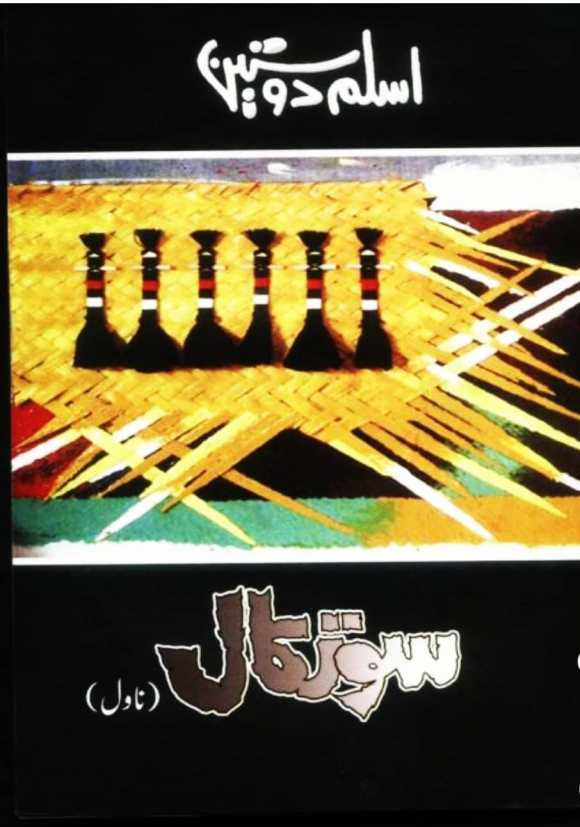
A physician by profession, Aslam Dostain is widely regarded as one of the prominent contemporary Balochi fiction writers. Although he has also written short stories, he is best known for his novels. To date, two of his novels have been published. The flexibility, fluency, and natural flow of language are among the most distinctive features of his novels. The passage under discussion is taken from his first novel, Sotkaal, which was first published in 2008 by Gaam Publications, Gwadar.
An excerpt from Aslam Dostan’s novel, Sótkál, been translated from Balochi by Fazal Baloch
Whenever Asumi spoke of Noddranzán, his words seemed to brim with longing. He was often found talking about the coast of Noddranzán.
Asumi was my cousin, and we were the same age. In the beginning, he was a shepherd like me, but later he began travelling with camel caravans and took up trading. He spoke so admiringly of the coast simply to tempt me and stir my curiosity.
As far back as I can remember, I had never been beyond Sótkál, except once. I have only a faint memory of it. My grandfather had taken me with him down to the coastal region to offer condolences. After that, my entire world was Sótkál. There was hardly anything in Sótkál that escaped my eyes. I knew where water could be found, where the trees and the shades rustled, where the ravines and gorges lay, and which areas were infested with ferocious wild beasts.
Grandfather used to say: “A shepherd who does not know his flock, its ways, and its temperament can never truly be a shepherd. And here, in rain and storms, to be unfamiliar with the temperament of the river that comes surging from the far reaches of Sótkál is to invite your own destruction.”
Grandfather had another story to tell. Once, a group of the British came here determined to find the source of the Sótkál River. Starting from here, they travelled northward, covering some eighteen manzil[1], but eventually grew exhausted and turned back. They said they had done everything they could, but they could not find its source. That is why only those who live along its banks truly understand the temperament of this river, and that, indeed, is the truth.
For as long as I can remember, my entire universe has been these sheep and goats. Grandfather said only this to me: “Ghulamuk, my son! This flock is yours now. You know what to do with it.”
I had no other work besides this. From dawn until I went to bed at night, I was occupied with the flock. Grandfather had, with great wisdom, kept me busy. It took me many years to understand that there could hardly be a greater calling than this.
Whether it was the scorching sun, the freezing winter rains and storms, or the hot, blistering winds of summer, I could find no rest. I was forever responsible for guarding and tending the flock: making sure that no goat fell into a ravine and broke its bones, that none wandered off and got lost, that no beast of prey carried one away, and that no goat drank all of its own milk.
By virtue of being a shepherd, I came to know every corner of the wilderness. Sometimes I would take the flock to the ravine of Kachól, sometimes to the Basshám Pass. At times I could be seen wandering with them through the desert of Mojén Dém, and at others in Masháni. But there was still one place in Sótkál that I had never taken the flock: Jinnani Jomp—The Mounds of the Jinns.”
Grandfather had strictly forbidden me from going there. “Ghulamuk, my child! You may go wherever you please in every corner of Sótkál, but never, ever turn towards the Mounds of the Jinns.”
We were allowed neither questions nor arguments. Whenever such a thing seemed about to arise, Grandfather would stop us before we could even finish speaking.We were always under his watchful eye.
“Don’t put your hands on your head, boy!”
“Don’t stand on the threshold. It is the time of sunset.”
“Straighten your slippers. They’re lying upside down.”
We always carried within us the fear that whatever we did, Grandfather would see it.
Except for one occasion, he had never actually beaten us. But threats, scolding, and warning us with nothing more than a look were part of his everyday manner.
God knows whether we had a guest that day or what the occasion was, but that day Grandfather slaughtered the hen with black-and-white feathers and had it cooked for lunch. We all sat down together for the meal. Everyone began to eat, but Asumi kept his hands to himself.
“What’s the matter, boy? Why aren’t you eating?” Grandfather asked.
“Grandpa, I don’t eat chicken,” Asumi replied.
“You don’t eat chicken? Why not?”
“I don’t eat chicken because chickens eat lizards.”
A look of disgust passed over everyone’s face, but no one said a word.
“So, chickens have only just started eating lizards, have they? They were eating lizards before you were born, and they’ll go on eating them long after you’re dead. Come on, start eating, and don’t talk such nonsense.”
“No, Grandpa. I don’t eat chickens that…”
Asumi had not even finished the sentence when a slap landed just below his ear. Everyone was startled, but no one dared say anything.
“You think you’re clever enough to make arguments? Eat, and be done with it. Didn’t I tell you never to find fault with the food?”
Without uttering another word, Asumi lowered his head and began to eat.
From that day onward, Asumi stopped finding fault with things. I am certain that no sage, mullah, or learned man could have cured him of that habit so swiftly. Yet one hard slap from Grandfather set him right in a moment.
Grandfather would always say, “Don’t be in a hurry. With time, you will ripen into wisdom.”
No one ever sat us down to advise or teach us the ways of the world. With the passing of time, we learned and gathered our share of experience.
How right Grandfather had been!
***
One scorching day, one of the straps of my sawás[2] snapped. I tried as hard as I could to mend it, but everything I did couldn’t fix it. The earth was burning like an oven, with waves of heat rising from it, while the goats of my flock had scattered in every direction.
Reluctantly, I set out across the scorching ground and gathered the flock. When I finally returned and sat down beneath a tree, I looked at my bare feet and felt tears welling up in my eyes. They were covered in blisters, some as large as lemons.
At dusk, I drove the flock home. By then, I could hardly put my blistered feet to the ground. The moment I reached home, I went straight to Grandfather.
“Look at my feet. Just look at how badly they’re blistered! This broken strap has caused me so much trouble. Please make me a new pair of sawás, whatever it takes.”
When Grandfather saw my blistered feet, he replied with a touch of sarcasm: “All right, son. Go and soak the dwarf-palm leaves in water. After dinner, I’ll make you a new pair”.
I did exactly as Grandfather had told me. After dinner, Grandfather sat talking with the family for a while. Then he lay down and soon drifted off to sleep. I thought to myself that perhaps he would make them for me early the next morning.
The next morning, I saw Grandfather heading towards the fields, a shovel slung over his shoulder.
“Grandpa, what about my sawás?” I called out.
“Oh, damn! I completely forgot,” he said with a laugh. “Never mind. You go on. I’ll ask a man named Nakam to make you a pair.”
I took my flock, tucked the dwarf-palm leaves under my arm, and set off towards the jungle, hoping to find Nakam there.
I waited for him for a long time, but there was no sign of him anywhere. My feet were still covered in the blisters I had got the day before, and I had no strength left to walk under the blazing sun.
There was no sign of Nakam.
“What am I supposed to do now, O God?” I wondered.
To hell with him. Let him come or stay away. Why should he care? It’s my feet that are covered in blisters. With that thought, I set about making the sawás myself. I had watched people make them before, so I knew more or less what to do. They might not have been perfect, but somehow, I managed to make myself a new pair.
I was overjoyed. At last, I thought, my feet would no longer have to suffer the burning ground. When I returned home, Grandfather looked at me and, as usual, asked with a teasing smile: “So, my son, did Nakam ever show up?”
“Grandpa, why did you make me believe that a man named Nakam would come and make me a pair of sawás? I waited for him for ages, but he never came,” I replied, a little irritated.
“My son, the truth is, there is no man named Nakam in the whole hamlet. I told you about him because you are a shepherd, and you must learn to fend for yourself. If I make your sawás for you today, what will you do tomorrow?”
Then he added: “Ghulamok, my son, learn to take care of your own needs. Do not sit around waiting for someone named Nakam, because there is no such man in the entire hamlet.”
[1]Manzil: A Day-long journey equivalent to forty-eight mile
[2]Sawás*: Traditional handcrafted Balochi slippers made of dwarf-palm leaves.
Front cover images of the first and second edition of Sótkál
Fazal Baloch is a Balochi writer and translator. He has translated many Balochi poems and short stories into English. His translations have been featured in Pakistani Literature published by Pakistan Academy of Letters and in the form of books and anthologies. He has the translation rights of this novel.
PLEASE NOTE: ARTICLES CAN ONLY BE REPRODUCED IN OTHER SITES WITH DUE ACKNOWLEDGEMENT TO BORDERLESS JOURNAL
From the porch, I could see a string of crows on a high branch. Then, as night came in, with my half-blind eyes, it seemed as if the very trees were crows, deep black with wings fluttering in the chilly west wind. And the hills were crows, And the road, The fence, The yard. Yet the caw came only from where I had first seen those silken ebony birds. Even in darkness, the tree crows put on hold the crows of my imagination.
SNAKE ENCOUNTER
The snake lifts its head slightly. Its bead eyes fasten on me. So where is that ancient fear of man instinctive to every serpent? Why doesn’t it slither away? But it would rather hiss softly as it takes my measure. Maybe it senses something vulnerable in me, a phobia it can play like a well-tuned harp.
I say something dumb and human, like "Shoo." But it doesn’t retreat. It doesn’t even blink. I am not prey but I am an interloper. My breath is an uneasy truce between two beings. We spend this unplanned armistice trying to read each other.
A DYING BLACKSMITH
I'm fading - not like sunset, no - like the cooling of iron left too long on a sideboard.
Sleep is near death, my bed’s a coffin with a forge for a crematorium.
Dreams speak the tools of my trade but twist them in ways that make my brows knot.
I wear that rutted road, not proud, just unsure how to smooth it out. And the flame is not my friend. My handle burns. My hammer’s head is about to shatter.
John Grey is an Australian poet, US resident, recently published in Shift, Trampoline and Flights. His latest books — Bittersweet, Subject Matters and Between Two Fires — are available through Amazon. He has work upcoming in Levitate, White Wall Review and Willow Review.
PLEASE NOTE: ARTICLES CAN ONLY BE REPRODUCED IN OTHER SITES WITH DUE ACKNOWLEDGEMENT TO BORDERLESS JOURNAL
She sprinted through the neon-drenched humidity of Yixin Road, her heavy boots clattering against the pavement. Ahead of her, a slender man darted through the crowd, frantically glancing back as if pursued by a phantom. Yixin—the street of “One Heart”—seemed to mock them. She pursued him with absolute, unwavering devotion; he fled as if his life depended on it.
Neither of them knew that their absurdity was a cosmic debt, overdue by a hundred years.
In their past life during the war, their souls had been bound by the flicker of oil lamps and the coarse hide of shadow puppets. He had been a wealthy heir; she, a destitute puppeteer’s apprentice. Amidst the ashes of conflict, they found solace behind the illuminated screen, maneuvering leather figures to sing of ancient lovers while the world fell apart. When death finally claimed them, their souls stood before the bridge of reincarnation, weeping.
He prayed for strength—wishing to be fierce enough to protect her in the next life. She prayed for freedom—wishing to be unburdened by delicate womanhood.
The universe, possessing a wry sense of humor, granted both wishes to the letter.
Thus, in this life, they returned with their genders swapped and personalities inverted. She was born with a towering frame, a fierce countenance, and an unbreakable willpower, yet her love life remained a string of tragic rejections. He was born with delicate, captivating features and effortless charm, yet was perpetually broke, fragile, and prone to trouble.
They crossed paths again at the dilapidated shadow puppet theater on Jiuru Road, a place facing immediate demolition. He was hiding from creditors; she was searching for the ghosts of her childhood.
“Stop running!” her booming voice echoed through the dusty auditorium.
Cornered against the stage, he raised his hands in surrender, trembling. But as she stepped closer, her eyes drifted past him toward the back of the theater—to the rusted, ancient brick stove where her grandmother used to cook.
In that moment, the noise of the modern world receded. Memories flooded her senses: the aroma of sizzled pork and garlic, the quiet clink of a teapot as her grandmother swiftly poured hot tea for her grandfather, and the silhouette of her grandmother’s hands moving rhythmically before the evening window—a puppeteer even in her everyday chores.
The man watched her expression soften, an unexplainable ache blossoming in his chest. A strange, familiar warmth rippled through his veins, as if his soul recognised her before his mind could comprehend it.
She walked to the backstage crate, reached inside, and pulled out two leather puppets—a warrior and a maiden. Without a word, she handed the maiden to him and switched on the yellow backstage light.
Behind the translucent screen, two shadows stood side by side. As their hands maneuvered the delicate rods, their movements synchronized instantly, effortlessly, across a century of silence. On Yixin Road, they had chased a shadow; on Jiuru Road, amidst the scent of memory and tea, they finally found the screen where two hearts belonged as one.
Yi-jung Chen is a writer from Taiwan whose work explores local cultural memory, traditional folk arts, and human connections across generations.
.
PLEASE NOTE: ARTICLES CAN ONLY BE REPRODUCED IN OTHER SITES WITH DUE ACKNOWLEDGEMENT TO BORDERLESS JOURNAL
The year was 1816. On the 21st October, Reverend Robert Sparke Hutchings, as part of his life mission to civilise the natives, started an English School free from the interference of royalty and wealth. The Penang Free School was opened to all people of Penang who wanted to learn. Hutchings’ idea of a school was not for free, as in charity, but free for all children of different races and creeds to mingle.
That year, too, the modern world first realised how closely connected it was. This was long before the world had known the song ‘It’s a Small World after all!’ A year earlier, Mount Tambora in the Dutch East Indies (present-day Indonesia) expelled megatonnes of volcanic material into the skies. It was the world’s most explosive eruption in recorded history, and its effluents lingered in the atmosphere for a full year, giving the air a permanent, greyish, dirty tinge. As a result, the European winter in 1815 was extreme.
By the following year, its effect became apparent. 1816 became the ‘Year without a Summer’. Global temperature plummeted as the sun’s rays were blocked by volcanic ash. Harvests across much of Europe and North America failed miserably. The change in global temperatures also disrupted the monsoon pattern in India. Famine ensued following a poor harvest. To add salt to the wound, the temperature change gave rise to a mutated form of cholera in Bengal. In Southern Europe, a typhus epidemic was seen. An event triggered in one corner of the planet had a devastating effect on the other side, thousands of miles away.
Food prices skyrocketed, sparking riots, arson and looting in Germany. The summer of 1816 in Europe was miserable. In Switzerland, it was cold and wet for many Europeans who wanted to spend the summer by the scenic lakes. The glacier took a long time to melt, resulting in ice jams where chunks of ice blocked river flow, causing rivers to overflow their banks and cause floods.
In that situation, Lord Byron hosted a group of friends at Lake Geneva for the summer. The inclement weather had left them homebound, and they decided to hold a writing competition. They were to write something scary after hearing someone read a ghost story. Byron’s physician, John Polidori, wrote a short story about Lord Ruthven, a charming, upper-class vampire. It was published later and evolved into a vampire figure associated with Bram Stoker’s Count Dracula. Mary Shelley recreated a scary dream she had the night before, which eventually led to the novel the world knows as Frankenstein.
An environmental disaster can indirectly give rise to the literary roots of a new genre: horror fiction.
Climate has long been blamed for many cataclysmic events on Earth . Because climate is so intertwined with vegetation, and thus with our food, its role cannot be brushed aside. Famines that result from crop failure invariably change ruling regimes. French peasants were not bemused when told to eat cakes; instead, they crushed the monarch, stormed the Bastille, and declared a Republic. The revolutionaries in the streets of Moscow brutally murdered the Romanov family and eventually placed a communist regime to rule over them. Many ancient Empires, including the Akkadian and Aztec civilisations, went extinct in the same way, through severe climate change and famine.
With modernisation, humans thought it was imperative to slash forests, denude vegetation, and create concrete jungles in place of a balanced environment where plants and animals lived in symbiotic harmony. This, in turn, had devastating effects on greenhouse gas emissions and increased global temperatures. The civil society noticed these subtle changes in our environment. As awareness was raised, people became more mindful of global warming caused by trapped heat. This phenomenon, later correctly termed climate change, became the buzzword of modern life. Climate change encompasses the heating of the planet, the melting of the Arctic ice caps, and the rise in sea level that could submerge many island nations.
Climate change not only shrinks our summer beachwear but also makes outdoor living impossible. Additionally, it’s proving to be more expensive to consume anything. Many advanced economies are imposing a carbon tax on every ton of carbon used by their citizens. Unfortunately, there is discordance in how these taxes are collected and dispersed. As shown during the 2005 Yellow Vest Riots in France, people protested rising fuel prices. The poor people from the countryside were taxed for using fossil fuels. This revenue was paradoxically used to subsidise green technology, benefiting affluent metropolitan dwellers, who least required assistance.
Green technology, an initiative that found its impetus after the Arab world held the rest of the world to ransom with the oil embargo way back in the 1970s, has been around for the longest time. More than half a century after its inception, the technology has not shown fantastic returns on investment. Germany, one of the pioneers in renewable energy, is still paying the highest electricity rate.
Some people subscribe to the idea that this whole scare about climate change is just scaremongering. They defend their conviction with research from climate scientists who present statistics that run counter to the mainstream understanding of the subject. These sceptics profess that global temperature trends merely mirror similar 80- to 90-year solar cycles in the solar system. They also question the 10- to 20-year lag in temperature rise after a burst of CO₂ production, such as during the Industrial Revolution or a world war.
Whether our weather change is man-made or a natural occurrence due to the restless tectonic plates that shape our planet, our climate will change the way we live. It will change our culture, maybe our food, our population migration demography, as the people gravitate towards a comfort zone, and probably change our leadership. If what the scientists say is correct, Mars and Venus once held water and an atmosphere. The way these planets appear today is a cautionary tale of what could happen when greenhouse gas accumulation goes overdrive. Oceans will evaporate, turning our planet into a wasteland.
Still, like Reverend Hutchings, who, despite the calamities associated with the ‘Year without a Summer’, decided that building a school was necessary, life had to go on amidst all the uncertainty surrounding climate change. The human race is stronger and has more plasticity than we think. We shall overcome. When life gives you lemons… make lemonade!
Photo Courtesy: Farouk Gulsara
Farouk Gulsara is a daytime healer and a writer by night. After developing his left side of his brain almost half his lifetime, this johnny-come-lately decided to stimulate the non-dominant part of his remaining half. An author of two non-fiction books, Inside the twisted mind of Rifle Range Boy and Real Lessons from Reel Life, he writes regularly in his blog, Rifle Range Boy.
PLEASE NOTE: ARTICLES CAN ONLY BE REPRODUCED IN OTHER SITES WITH DUE ACKNOWLEDGEMENT TO BORDERLESS JOURNAL
Wind plays the leaves like tambourines, but the stars aren’t listening. Clouds swim in the sky, Like fish out of water, but they’re only clouds, and they depart as the night’s illusions quickly pass by. Things I can’t see often affect me. It makes me feel I’m more stupid than a tree. I imagine such irrelevancy will emerge as poetry. Thinking like this has become my deepest need. As subterfuge, it’s a way of avoiding reality.
AFTERNOONS ON THE PATIO
Three evenings, with long afternoons and a way of forgetting words, which probably shouldn’t even be spoken. The thoughts I recall and a drink called something pink. At its bottom, tomorrow stretched and curled like a cat, toying with a lazy afternoon. The shadows were blue, and the roof went ping, when you touched your earring. Then it rained, and the day became long, and suddenly there were other people here. Something was always wrong.
Painting by Pierre-Auguste Renoir (1841-1919)
George Freek’s poetry has recently appeared in The Ottawa Arts Review, Acumen, The Lake, The Whimsical Poet, Triggerfish and Torrid Literature.
PLEASE NOTE: ARTICLES CAN ONLY BE REPRODUCED IN OTHER SITES WITH DUE ACKNOWLEDGEMENT TO BORDERLESS JOURNAL
Tea garden literature in various Indian languages forms a definite sub-genre of literary history and the present 340 pages book under review gives us a wide canvas of the rise of tea plantations in colonial Assam and the human cost that sustains them. The historical background of this novel is well-known.
Since tea gardens are extensively labour oriented, the common problem facing them is shortage of workers and this is where the arkathias or middlemen keep on recruiting Adivasi and tribal families from central India by promise them a rosy picture of Assam desh — a land of milk and honey where they can live with dignity, earn money and bring an end to their impoverishment. But reality turns out to be the exact opposite. These bonded labourers or ‘coolies’ as they are termed, are then packed onto overcrowded steamers and sent upriver, where hunger, disease and death shadow every step of their journey.
Among them is Durgi, a young woman whose resilience endures even in despair. She carries with her a small bundle of marigold seeds, a fragile memory of the land of red earth she has left behind. At her side is her husband, Dosaru, the rebellious archer, bound to her by love and the shared hope of building a life of their own. However, what awaits them at Atharighat Tea Estate, located just below the Bhutan border, is no promised land. Labourers are stripped, disinfected, confined to barracks, and driven into relentless work, while sickness, fear, and muted defiance simmer beneath the ordered rows of tea bushes.
The novel opens with Jonathan, a British tea planter and manager of the plantation, who has spent decades building the plantation from a small nursery into a large and profitable estate, arranging the supply of more Adivasi labourers to work on the plantation. His authority is near-absolute, as is his feeling of superiority. The plantation company grants him freedom to rule over workers’ lives as he sees fit, a role he takes seriously. He has to manage their arrival, ensure they do not bring malaria or cholera with them, train them to avoid snake bites and tiger attacks, and keep them productive, while also worrying about his own health in a harsh climate with limited medical care. Soon, after Jonathan’s departure, the atmosphere of the garden changes with the arrival of a comparatively young new burra-sahib called Fraser. He tries his best to uplift the living condition of the coolies and enhance the productivity of the tea estate.
Throughout the novel Kalita beautifully narrates the tensions and pressures of plantation life. As many as 60 out of every 100 new coolies die before they can even begin work. The strict discipline that they have to undergo while living in the barracks is described in the minutest details. Durgi, a talented singer and dancer, brings moments of joy to the workers through her singing at festivals and religious celebrations. Moonlight becomes a recurring image and a significant metaphor throughout the novel. The songs sung by the coolies emphasise their cultural significance and adds to the authenticity of the narrative.
After her husband’s death, Durgi’s life takes a complicated turn over the years—an intimate affair with Fraser, the white manager of the tea garden, results in the birth of three mixed race children. She becomes known as Durgi-mem and though Fraser pays utmost attention to her well-being, allotting her a separate cottage and farmland, things change dramatically when he leaves permanently and goes back to England.
Among the three children, the youngest one died of cholera. Fraser returned to England with his daughter who resembled his mother in appearance making false promises of her return. The only child left behind was the eldest. The boy is caught in the horns of a dilemma when he refuses to go far away and live in a hostel like many other mixed-race children. The unequal relationship between the white officials and their coolie concubines exposes another unspoken truth about plantation life. There are generations of similar children, many of whom, abandoned by their white ancestors, still live in Assam’s tea gardens today.
One interesting fact about this novel is the beautiful blend of fact and fiction. In the ‘acknowledgement’ section Kalita tells us how she was handed a slim volume written by a gentleman called Usman Gani narrating the life story of Durgi Bhumij and a few documents about her and requested her to write a novel on her life. Coincidentally, during that period she was researching on tea garden life and its people as one of the subjects for her new novel. So, though Durgi was a real-life character, and the people around her had deep roots in Assam, ultimately it was Kalita’s credit to turn it into an excellent work of fiction which became very popular and managed to receive the Sahitya Akademi Award too. The excellent translation of this Assamese novel into English done by Ranjita Biswas now brings the novel to a wider readership.
What is interesting in this story is how the novelist depicts life in a tea garden with minutest details while placing the story in a period when the independence movement from British rule along with Gandhi’s ideals of satyagraha was changing the social ambience in this region as well. The exploitation of plantation labour comes under increasing scrutiny, and workers begin to demand better conditions. Meanwhile Durgi also grows in prominence among the workers and becomes known to the new manager Fraser. Soon, these two worlds, once rigidly separated, begin to collide and ends with the killing of Durgi. So, while Kalita has woven the story around Durgi, at the same time she has meticulously portrayed other prominent people of Assam, the rebellion against colonial rule at a time when tea plantations flourished in Assam after the East India Company lost ground in China post the Opium War. This elevates the novel into a chronicle of the times too.
The epilogue serves as an interesting finale to the narrative when the first-person narrator tries to trace the whereabouts of Durgi’s daughter. After a lot of effort and attempts to tie loose information together, she manages to locate a ‘white girl’ at Rangachali Tea Garden, her last shelter and her fifth generation. This brings the story to end on a somewhat positive note, and the narrator promises to come back again with some gifts for the children there.
“One must still have chaos in oneself to be able to give birth to a dancing star.” – Friedrich Nietzsche
In our teenage, my sister and I used to haunt three libraries in our town.
One was a tiny, dark place, where older people sat outside in the evenings, reading newspapers and chatting; where all the books I wanted, battered, doodled, faded and ripped as they were, were crammed into one shelf, maybe two. I would head directly to these shelves; never even moderately curious to turn to the rest of the small library. Books that went missing or were never returned were not replaced. The books I wanted—by a beloved author or the next in a series or a new one I had heard of—were almost always checked out by someone else, and once in a while, if I’d find some of those much-desired books in transit, I would consider it magic.
The second was a larger and more frequented library in the heart of the city, with a range of medium battered books and a few good-looking ones. People who read them scribbled on their margins; sometimes the pages were torn. The books were bound tight and often we had to prise the binding apart to read. There was a moderate fine if books were lost or overdue. Readers would hide the books they wanted in a different shelf in a different part of the library so that they could find these during their next visit. Yes, it worked most of the time.
The third was an elegant, vast, air-conditioned, foreign space where we stepped into, holding our breath, for fear it would shatter its grandeur and sanctity. We had to take our shoes off at the entrance—the whole process giving a holy air to the place. We thoroughly enjoyed sinking our feet into the soft carpet. It would not be an exaggeration to say walking was one of the highlights of the library. Many of the readers hovering around the bookshelves looked befittingly intelligent, haughty and grave. The books were well maintained and arranged; and fines followed you home and lingered outside your door if you defaulted.
It gives me goosebumps when I recall youngsters slipping in and out of libraries with books under their arm, a sight I don’t see much these days for a variety of reasons. In the 80s and 90s, we were advised to keep story books away and focus on studies. Today we request and plead with our children to read a book or two.
Some of the books in the first library and perhaps in the second as well, were not recommended by grown-ups. No, we were specifically forbidden from approaching ‘those books’—they were ‘trash’. I concluded that books with intimate pictures on the cover were trash. They wrapped them in white paper to conceal the covers. In fact, the white wrapping signified a forbidden book. It also became the symbol of rebellion: when their teenagers walked about with white books, parents could only glare. I also associated some authors with this qualifier: ‘trash’. I dutifully kept my eyes away from them, however intriguing they seemed.
Years later, I would discover that some of those novels were actually thrillers and quite entertaining ones at that. The juicy cover picture served the purpose of enticing enough to make readers curious, and yet very little within the story would justify the image.
“The pleasure of creativity can erase any pain.” – Dr Nawal El Saadawi
When I started writing earnestly and was ready to release my work into the wilderness, I was, like any other writer, apprehensive about how it would be received. More than whether it would be disliked or ignored, I was worried that it would be of so poor a quality and would be considered ‘trash’. I had no clue what went into attaining that label, nor how to protect myself from it. I laboured to infuse energy and life and gravity into my writing so that it would be perceived a serious piece of work.
I have always been plagued by the question of what constitutes ‘trash’ or even ‘bad’ writing.
How do we, as readers and writers, distinguish good writing from bad?
A seemingly simple problem with a clear solution; however, it is anything but.
Surely a person who has been devouring books since the age of nine or ten, has grown up to be a decent judge of writing?
I am still unpacking the answer.
Bad writing could manifest itself in the form of poor language, unoriginal style, weak structure, unconvincing plots or flat characters, and generally would be unable to stand on its own. Good writing could excite the reader—by its concise, sharp and taut quality, rich characters, and its ability to surprise.
However, sometimes the difference is subtle. It is a feeling, rather than a quantitative measure of what went right or wrong. Reading is a subjective experience. One person’s ‘brilliant read’ could be another’s ‘trash’ or ‘boring stuff’.
One has only to take a glance at some of the reviews on critically acclaimed titles to know there is no such thing as a work that is loved by every single person who has read it.
Copied below are actual reviews on a renowned book by a Nobel Prize winner:
“I thought it was kind of boring.”
“This may be my favourite book of all time.”
“Pretentious, with poor descriptions and transparent characters.”
“The storytelling is so exhilarating that one gets goosebumps.”
The author may be beyond caring but the rest of us are around to assess their work.
A book that critics wrote off as mediocre becomes an overnight best-seller. A cleverly written, intriguing story with deep, unforgettable characters vanishes into the folds of history with not so much as a ripple. Every so often, out of the shadows of controversy emerges a superb piece of literature, taking off to heights unexpected. There is no formula to success in writing. Many factors apart from the quality of writing contribute to it. In fact, the very term ‘success’ defies definition. Famous critics, reviewers or others whose voices matter, can steer popular opinion in a certain direction as would clever marketing strategies. These are days when sales numbers do not necessarily mean what we think they mean.
No one sees your writing the way you do. No one.
Similarly, we can never really see our writing through another person’s eyes, and hence, never objectively judge it. The best we can do is to put some distance between us and the piece, come back to it weeks or months later and see if it still holds its ground.
By gauging the quality of writing in the works of both prominent and unknown authors, digging for their strengths and weaknesses, searching for the definition of ‘bad’ writing, I am trying to find the answer to the real question, simmering beneath the skin: How do I decide if my own writing is any good?
Am I a good writer?
There is a shift that happens almost overnight when you, as a discerning adult, transform from a ‘reader’ to a ‘writer’. From a person who praised or critiqued books with abandon, you have become one who appreciates the effort that goes into conjuring and creating something out of thin air.
All of a sudden, you have the superpower to see the writer behind a book, as though she were seated before you: working, seeking perfection, tearing her hair apart, rewriting, doubting and second guessing herself, pouncing on the perfect phrase, jumping for joy, sinking to the ground, all in a matter of minutes. You’re kinder to her and her creation, since you know the struggle so well.
I have heard writers (real as well as reel) declare that they have always wanted to write, and that they have been writing from the time they could pick up a pen.
I wish I had something similar to say but the truth is that although I did scribble in my teenage, I neither considered myself a writer, nor wanted to be a writer, and not even called my produce ‘writing’. It was just something I had to get out of my mind so it would not torture me so — jot it down, complete or not, and toss it to a side. If it clawed its way back into my mind, I would develop the idea and complete it—or procrastinate enough so that it died in my mind too.
A couple of friends who were allowed to read my writing were warned to keep their mouths shut about it. To this day, I have no clue what I was so terrified of. Of being laughed at? Of being read? Of being seen? Of being found? Of being ignored? Or was I not even sure? Had I tried to analyse the source of the fear, I might have found the courage to overcome it. I was intensely possessive of what I wrote, because it came from a well deep inside whose existence I could not explain or justify.
Like any wise teenager, I tore most of those writings apart, even set fire to some, so there was no way to judge their quality. What I remember makes me cringe a bit—but I consider it a good sign, because that is where I began.
Years later, when I got to the point of daring to call myself a writer, I sought the purpose of writing, several times: why do I want to write stories? Why do I write at all? Whence comes this beast, thrashing about in the dungeons of my mind? Why this unrelenting torment until I release it?
An answer would help me ascertain the best way to tackle the beast. The quest took me way back—to the point where I started reading.
As children, all of us loved listening to stories; many of us enjoyed reading as well. Books were perhaps the only engagement we had, apart from games.
Stories were captivating; they left us wanting more. When a narrative got dull, we could stop listening or reading. But what is it in stories that captivated us? Why did the thought of a book waiting for us, a story to come back to after school or work, excite us?
Books take us to worlds hitherto unknown; to people and cultures unfamiliar; to points of view unheard of. Add a breath-taking book cover to the mix—and there are no words to explain the exhilaration. That is the straightforward, simple response.
But no, I am not satisfied, so I dig deeper. What do we feel when we are reading a story; when we finish reading a story? Where does the hunger for the next book spring from?
In the midst of a particularly entertaining novel, I found my answer. The main character, lost and dejected like me, did something to change her life. She took a stand and went forward with a decision she had been postponing for long out of fear. I read that paragraph many times. I found that I could do something similar—and I did. I cannot recall if the outcome changed my life in any significant way—but the act of performing it did. The few hours I engaged in it, I was saved from darkness. I realised that I needed to keep changing my life in bouts and escapades.
Isn’t that the whole essence of life—not the outcome, but the journey? The book provided me with an answer not only to the wretchedness I was feeling, but also to my question—what do stories do?
Stories open up new possibilities. We read stories because somewhere in those pages we are going to find an idea; a solution. They may not solve all our problems, but they give us a direction. We realise we are not alone in this. We are reminded of how alike we are, across countries, across continents, across cultures, across genders, across race. The stories, for a brief moment in time, hold our heads above water. We breathe in huge gulps of air.
Which brings me to the next revelation—when we read, we are looking for a connection, of the kind that we don’t always find in real life. We connect with the characters, we identify with them and their challenges, we guide each other. We make friends with their friends. We fall in love with the people they fall in love with. We become them, flaws, follies, foolishness and all. Their embarrassment becomes ours. At the end of the book, we feel satisfied (though we want more) and we feel stronger and ready to take on the world, albeit for a short while.
We read and write stories to establish human connections. We read and write to feel less lonely, less depressed.
“How many times have people used a pen or a paintbrush because they couldn’t pull the trigger?” – Virginia Woolf.
Left to itself, the human mind has the tendency to sink to the bottom. Attaining peace is a daily struggle. We need to find a reason that has the power to raise our heads above the surface. Stories do that for us. For some of us fortunate enough to be able to create stories, all the more so. Isabel Allende writes in The Soul of a Woman: “I am grateful to that unhappy childhood because it provided ample material for my writing. I don’t know how novelists with happy childhoods in normal homes manage.”
The more miserable you are, the more meaningful and impactful the stuff you churn out. I am certain this applies to all forms of creativity. You have this vast reserve from which you can dredge out diamonds. I suppose the twisted way of putting it is, be happy you are miserable—misery makes you a genius.
One thing is certain: no one is coming to save us; we have to save ourselves. It’s a heady fact that simultaneously empowers and petrifies us.
And to save ourselves, we seek connections: a touch, a hug, a kind word, a compassionate look, a listening ear. However much we desire to live without depending on others, the universal truth is that, at some point or another, we would lean on them, and they on us.
When we write, we are doing the same thing: looking for connections in the world we create. If we feel them ourselves, so we can offer them to the reader.
We write to find and provide solace.
We write to find someone; often ourselves. At other times we write to get back at people we can’t in real life. It is liberating.
We write so as to do things we cannot in real life. We take flight in those pages, though in reality we are confined by infinite human laws. We write to break free. We write to support causes, we write to explore our stance.
It is said that when we write we are talking to ourselves; explaining and describing to ourselves; causing the situation to present itself before us in all its colours.
Even in an unlikely fictional world, one finds the author lurking between the lines. Her philosophy, her ideas, her notions and her truth jump at you. The exceptional writer does not distinguish between the story and herself. She becomes the story. The reader does not identify where the author ends and where fiction begins.
“For my best poems were all written when I felt the worst. When I was happy, I didn’t write anything.” – Langston Hughes
Human beings achieve immortality through their legacy. We read authors from centuries ago, see the world through their eyes, and realise, to our surprise, that they experienced pretty much the same prejudices and problems as we do in the 21st century.
Parents comment that their children are smarter than their own generation, older people speak of better times in their youth, there is always a war going on somewhere, bigotry thrives, slavery and oppression change forms and evolve, privileged people live comfortably and blame the underprivileged for their situation, the voiceless continue to suffer, everyone is unhappy.
Our convenience would always be the driving force of our progress. Any technological development that makes our lives simpler and allows us to be lethargic, would flourish. Everything else is a side dish.
I want my writing to survive. I want it to mirror today’s world. I want a future reader to earn a glimpse into my neck of the woods in this century. I want them to consider how similar life is, even when it is different. I want to reach out and hold their hands. Because the more we try to change, the more we go back to our original instincts.
For a person who was once mortified of her writing being seen, who was possessive about her thoughts and creativity, this desire seems strange: for her writing to be read and analysed and discussed and taken apart by the rest of the world—because it would mean she has lived. She has struggled. She has been brave. She has fallen and picked herself up. So many times. One has to pass through the long, dark tunnel of despair and emerge to have that change in perspective.
Creating art that survives is the only way a person can hope to achieve immortality. For most of us, the real question that keeps us awake at night is: will my writing outlive me?
Jeena R. Papaadi is a writer based in Bengaluru and Thiruvananthapuram, with six published books. Her work has appeared in several publications including The Hindu, Borderless Journal, The Hemlock Journal, Usawa Literary Review, The Wise Owl and Kitaab. Jeena’s work is listed at: https://linktr.ee/jeenapapaadi
PLEASE NOTE: ARTICLES CAN ONLY BE REPRODUCED IN OTHER SITES WITH DUE ACKNOWLEDGEMENT TO BORDERLESS JOURNAL
Keep your form limber, your faith like a rock, and your spreading roots upon which you rest, your down-to-earthiness a litmus test, your sap and wood protected by good bark to guard your sensitivity from shock that neither drought nor hurricane can wrest— even should you be bulldozed, so unblessed, your roots form an indomitable block.
Do not be afraid of the parching sun and learn to abide the snow and the frost; toughen yourself from those who sit inside, who look out with envy at everyone; remember that a tree cannot be lost: lives, falls, but unless it rots, won’t have died.
THE DECISION
My days are numbered. These are the last days. What a strange feeling. How each car passes is slower and viscous, like molasses. Yet now I am no longer in a daze. And now I understand this was a phase. The people? I see them as if through glass: foreigners. No longer a frightening mass: I am no longer involved in their ways.
My knife has been carving against the grain. I’ve been holding my finger to the dyke. I’ve been chasing the willful red balloon. I’ve been pushing like Sisyphus in vain. Straining to deny while trying to psych. My decision’s been made. Now wait. But soon.
David Francis has produced seven music albums and the collections Poems from Argentina (Kelsay Books), New York Revery (Cyberwit.net), and The Failure of the Violin (Cyberwit.net). He wrote and directed the autobiographical films VillageFolksinger (2013) and Memory Journey (2018). He lives in New York.
.
PLEASE NOTE: ARTICLES CAN ONLY BE REPRODUCED IN OTHER SITES WITH DUE ACKNOWLEDGEMENT TO BORDERLESS JOURNAL
Before stepping out of teens, Adarsh, my elder brother, also my father’s favourite son, stepped out of the ancestral house to live in a big city, to pursue higher education and fulfil his dreams camouflaged as the obligations of a responsible child. Hopes were pinned on him, on his powerhouse talent that would make the family gleam with pride one day. Whenever I heard my father praise him to the skies, I felt he was exaggerating like an astrologer.
Adarsh was not the kind of worthy son my father dreamt of. I remembered his last words before leaving for Bangalore to study engineering: Take care of the family. The way Adarsh said those precise words was conclusive. He would never come back to reside in the small town and shoulder his responsibilities.
To quote him verbatim would hurt my father deeply, to keep the truth estranged from him would be another kind of excess. I was expecting divine intervention to raise the curtain of his reality – to expose the opportunist lurking in Adarsh. A disappointment or a disagreement would be the ideal trigger to make my doting father examine the other side of his personality.
Fifteen years passed. His mask remained in place. I did not muster the strength to convey those exact words to my father who would never associate such thoughts with Adarsh. How could he go wrong in the assessment of his own child? Is human nature so misleading?
For two years, Adarsh had avoided coming home, citing professional compulsions. But my father felt our house lacked five-star amenities to suit Adarsh’s lifestyle.
I was considered a privileged son who enjoyed a life of comfort at home while the talented son struggled hard in the big, bad world outside. It was the duty of a parent to set the balance right, distribute love and affection equally between the legal heirs, not just the assets. Adarsh was perceived as the deprived child whereas I was the home-based pleasure-seeker exploiting the old man and his pension to meet my survival needs.
Using his provident fund proceeds, without consulting the family, the remorseful father built another floor and furnished one master bedroom with an attached washroom for his favourite son who came to meet him like an honourable dignitary for a couple of hours, for bear-hugs and to exchange pleasantries. And then returned to spend the night in a luxury hotel suite, around two hundred kms away, where his blonde wife had checked-in. Migratory birds stayed longer than he did and that was precisely what I queried my father about – he never controlled his budget to appease his older son. I questioned him about the urgent need to spend a fortune on the new construction when his health bills were expected to rise.
He justified it as a modest upgradation he could offer to the son who made him so proud. “If the entire town respects me today, it is because of your brother, not you,” he hollered, without thinking this could hurt me and strain the muscles of his ageing heart. Sometimes, parents reveal that their love for all children is far from equal. They are the prime architects of partiality in human relationships within the family.
I realised how demeaning it was to live in the house owned by him. I was aware of my own incompetence to build a similar house or pay my monthly bills. The roof provided by my father sheltered me along with my weaknesses and failures. Whenever I tried to move out — place myself under the open sky for a while — I was reminded of my actual status in life. As a result, I never challenged parental authority. Every insult that had come my way, I swallowed like mucus trapped in the throat.
Seeing him suffer emotionally because of Adarsh pained me though nobody expected me to be sensitive in this regard. If I revealed the other side of my brother, I was reminded of my own negligible contribution. I would be accused of trying to drive a wedge between the successful son and his loving father. The reality that he was also my father somehow faded. I was presented more like a dependent step-brother cribbing for his help all the time.
*
One day, I decided to disclose everything, oblivious of the outcome. The endless comparisons and insults lent toxicity to my anger. Surprisingly, my father listened to me quietly, without interrupting, immersed in finding good reasons to suspect and match those with his own observations. After several years of living abroad, the image of Adarsh seemed to develop cracks. It was not a development that made me happy though it was necessary at this stage for my own sanity.
Adarsh was expected like a good son to be around his father when he suffered his first heart attack. But he did not rush back home during the emergency. He said he did not get leave and he could not afford to quit. The recycled excuses did not work this time. I was the one by the bedside, arranging medical care, though the bills were later cleared by liquidating his fixed deposits.
Not finding the ideal son beside him was the reason for his heartbreak. The presence of an under-rated son round the clock was a matter of consolation for the father who had always belittled me. During the period of recovery, he reflected a lot, staring at the false ceiling mirroring his false pride. His sombre voice did not echo love and longing for the son who had deserted him. He came back from the hospital with two stents and a balanced perspective.
The special room built for my brother was always kept locked. Surprisingly, he offered me the keys and asked me to occupy the room. It was not just another accommodation. It was a sacred space in his heart reserved for Adarsh. That space was now being offered to me as he realised the ‘successful’ son would never get the leave to reach in time to light his funeral pyre. Whereas, this unregistered nominee carrying his DNA and residing for free on his premises would perform the last rites. He had reached this conclusion after introspecting and revising his expectations from high to low.
He could have had this realisation earlier but he was not able to see the other side without an emotional jolt. I never heard him criticise Adarsh for his shortcomings, for abandoning him in the hour of need. However, the frequent international phone calls and memory recalls turned rare now. He became almost non-existent for him — out of sight, out of mind.
Whenever I tried to mention Adarsh and his family, he changed the topic very quickly, faster than a chameleon changes colour. He seemed to have lost interest in what was going on in his life and career abroad. Or he did not wish to discuss him.
*
The day he suggested I should focus on my career and start some business was filled with surprise. He even offered financial assistance. Earlier, he vehemently opposed the idea of business since we belonged to a traditional family of service holders. Now he changed his outlook and made it global, without leaving the shore. Somewhere within he realised that promising careers are not always made abroad or by working for conglomerates alone.
I was well beyond the age to secure a decent job so I chose to become the first member in my family to take the entrepreneurial plunge. I was known as the one who always delivered losses. Yet now, he was not worried about losing his financial investment. He was rather keen to balance himself once again, by trying to favour me, to make amends for ignoring my future since I seemed to lack sparkle in my childhood years. In hindsight, he saw his concentration on Adarsh as a kind of injustice to me. Remorse overwhelmed him. I realised the best way for me to reduce his heaviness was to accept his offer. His kindness was a kind of balm for my bereaved heart.
*
On a modest scale, I set up the handicraft export business with his blessings. He broke the auspicious coconut and cut the ribbon at my new office. It took a couple of years for the business to register growth and enable me to repay his loan. My plans to expand and diversify the business – to establish units in the neighbouring states – were on the anvil. The fuel of ambition was clocking good mileage, taking my business in new directions at great speed.
My father was happy I was doing well for myself. The news reached him through his contact channels that I was invited to attend business summits, to deliver lectures, to receive awards and accolades. His retired friends glorified my initiatives of empowering the rural folks and ‘giving back’ to society. Sometimes he walked into the office and checked out the shelf space reserved for trophies and framed certificates of excellence and merit. He stood in front of the mantlepieces and smiled. He had heard stories about successful Adarsh. Here he was witnessing the meteoric success of his younger son.
I told him that Adarsh confirmed his visit to India that Diwali. I repeated it louder as he was watering the balcony plants. He showed no eagerness or excitement unlike in the past. I returned the keys of my brother’s fully furnished room he had offered me for personal use. I had not shifted in that space yet so I thought Adarsh could utilise it during his stay.
I was glad he was finally home-bound after a gap of two years – the first trip after the heart attack episode. For a change, he came alone, leaving his family behind. He looked unhappy though he did not share anything with me during the drive from the airport to the outskirts of the city. Only after he saw pictures and the website of my profitable business venture on the phone, he overcame the hesitation to open up his heart and share his current situation.
“I am ruined, bro, never saw this was coming,” Adarsh said, and wiped off the tears about to trickle down his cheeks. Surely there was some serious problem he was facing as I had never seen him emotionally fragile. I did not appear eager to dig up the details as he would gradually reveal the bruises. It appeared that a lot of stress and distress had piled up in his life during the last two years, about which we knew nothing. “I am preparing for divorce. My in-laws cheated me, siphoned off investments and she helped them in the loot,” Adarsh dropped the bombshell after regaining his composure. “Sometimes I feel she married me for wealth. Nothing else.”
The financial trouble he was coping with should not reach father, I thought, as he would be affected that his talented son was facing the consequences of betrayal in love and marriage. All I wanted to know from him was how he could be helped out. He disclosed he was planning for an out-of-court settlement first, then to return to India and build his future here.
“Father will be delighted to hear that. Great decision, bhai[1],” I cheered him for revising the plans and shuffling his priorities though it was late to rebuild from a scratch. “Just make sure the divorce thing is kept under wraps for some more time, for the sake of his health. No tension or anxiety.”
*
By the time we reached our housing colony, he opened up further. He did not want our father to know anything as the news of his suffering would take a toll on his health. Therefore, he wanted me to lend him financial support. Besides, he did not think he deserved to ask for anything from father as he had let him down with his choices and decisions. He pronounced himself guilty for he had not been a good son. Earlier, I was the one who went through such poor self-assessment. Finally, there was something that made us equal as brothers.
I parked the car in the outskirts near the primary school we attended together to revive good memories of childhood. We sat near the small pond and reflected on our childhood filled with days of joy and carefree lives. Dropping a pebble and watching the ripples in the water, thinking of a permanent solution to his problem. I gave it a serious thought and offered him equal partnership in my new business though it was not his domain of expertise. With the emerging integration of AI for business profitability, I thought his technological insights would help the business grow here and overseas. Seeing him snowed under genuine regret, I chose to forget the bitter past and assured him of all possible help as a blood brother, just like my father had surprised me with his assistance to rebuild my aimless, broken life. I felt then my decision was right.
*
Encouraged by my unconditional support, Adarsh snapped all ties with his in-laws and expedited the process of buying freedom by separating from his wife. The greatest joy for any father would be to see both the sons engaged in the same business. The unification and collaboration of the brothers through an act of destiny was the best gift in his old age.
The glowing expression of joy on hearing from Adarsh that he was going to settle down here was the best he could expect, the cherry on the cake. When he was asked why came alone after so long, he quoted a philosophical line to convey the universal truth, without revealing the truth of his personal life.
Whenever he was asked about his family again, he told the same story: she cannot come here with him because of her job obligations. Though the divorce thing was not specified, our father was not a fool to miss reading the faultlines on his glum face. He expected Adarsh to reveal it all on his own at the right time, whenever that was.
The special room meant for my brother was finally allotted to him. He was not told anything about the expenses incurred to make it luxurious. When Adarsh saw my ordinary room and compared the two, he realised there was still something special for him in his father’s heart. Finding me helpful, he offered space in the room. But I refused to sleep there. I thought I did not deserve the special room yet. My father came around later and asked me why I had not utilised that room when he had given me the keys. I said I was not used to such luxurious living.
Adarsh was living with us now though Dad tried to be cold and impersonal all the time. Whenever Adarsh asked about his daily medicines, he said I was put in charge of administering the doses. All the reports and prescriptions were in my custody, including the blood pressure monitoring gadget. Adarsh got the subtle message that health issues should not bother him now – the critical stage was thankfully over.
As Adarsh became busy with the business and helped me expand to the nearby states and overseas, my father was happy I was helping my brother with the equal partnership offer. He was discovering the goodness of the neglected son who built his life and business on human values and relationships. I had a slow start, but once it took off there was no looking back.
As the business grew well, and Adarsh became the visible face of the company. I chose to be eclipsed as a founder while he was all over the media for making it a global company. Just as my father was neglected as the investor who helped start a company that had now become a sensation. It was fine to be neglected here and there. Because the self is less important than the outcome. When Adarsh wanted to open an overseas branch in California, where he lived, I was supportive as he had a strong client network there. He thought it would help us grow more.
He approached our father to convince me to make it the head office.
“Settle it between the two of you, no mediation required from my end,” was how he responded to end his request.
I was beginning to sense Adarsh was planning to move out of the country again, empowering me to handle domestic operations while he wanted absolute control of the overseas business in the US and Europe. Frankly speaking, it was good that an Indian company was going global and making waves abroad. I saw no reason to reject his plan. Since I had already made him my equal partner, he had an equal say in the running of the business. Being more qualified and experienced than me, he could take the business to global heights.
Our father had dreams of our success and this was the best way to make that happen during his lifetime. Given his health condition, we should dissolve our minor differences and become a source of joy for him.
I agreed to let Adarsh execute his global vision. My father felt I was more than a brother to him. I took no credit as the business truly belonged to our father who invested at a crucial time when there was no other source of funding. He helped me set up a small business and Adarsh was my dear brother who expanded it. He deserved full credit for that, from local to going global.
*
As the divorce formalities were about to begin, Adarsh started preparing for his return. Within a year of staying in the house, in the special room constructed for his comfort, he decided it was time to move out. I did not want him to reveal anything about his marital discord and he honoured that promise. Our dinner-time discussions were all about business and our father never spoke a word about his marriage.
Our father was upset to hear about his departure, though he did not express his displeasure. He was perhaps thinking both his sons would stay with him forever, forgetting that Adarsh had a family abroad and they were also waiting for his return. Although Adarsh was leaving home, he consoled himself with the thought, that his sons were united. The sibling bond that had been missing all these years was firm now.
Adarsh vacated his room. He handed over the keys to me in the presence of our father, asking me to occupy the space forever, informing me that the cool breeze through the open windows on the southern side helped sleep well without the need for the air-conditioner.
At the time of leaving for the US again, he was grateful to the family for their timely support. When he reached there, he was a completely changed person. His first phone call was not about safe landing or the business development there. He chose to discuss the split of our family property and he wanted his share of the house since he needed to buy a new apartment there. He spoke about his meeting with real estate brokers and local promoters who were ready to buy our ancestral house during his stay at our residence. This was another deceptive face of Adarsh. I had given him the best offer to rebuild his life and he was discussing how I could persuade our father to sell the house and buy a small flat for ourselves.
“You are not going to marry and start a family now. But I wish to marry again and begin my second innings. My son will be the ultimate nominee.”
The man with tears in his eyes just a year ago could not be so selfish. I refused to believe he was the same Adarsh. He did not update me about the divorce and his remarriage. Just forwarded a few pictures of his new bride and sought my blessings. The speed of his execution was incredible. How could I tell our father that his son went back to divorce and remarry? How could I tell him that he wanted his share of the ancestral property as well? It was a dilemma for me. Sometimes I worried about the outcome of offering him partnership. He could gain control and split the business in his favour.
I reminded him he was doing well now so he could buy a house there with his earnings instead of forcing an aged parent to sell the house. He said he was not going to come back again and, after our father’s death, he would not like to get into litigation issues with me. I refused to compel our father to sell the property for Adarsh.
I was ready to transfer him the share of proceeds he needed from the sale of the house property after mutual discussion. “Consider the house sold and take the money and give me the signed, notarised legal papers specifying that you have got everything from our family.”
“Done.”
I gave Adarsh the full control over the overseas handicrafts business since he was leading it well. I slowed down my pace of work and spent more time with our father who was not keeping well. He noticed my growing aloofness from the business and I had to specify that Adarsh was handling it better than me.
“You supported your brother in so many ways. You gave everything he needed to rebuild his life and his personal setbacks were kept secret.”
He praised me to the skies for the first time with affectionate words, “You are a gem of a person. A wonderful human being. I am proud of you. Parents can also go wrong in understanding their own children. I am the best example to quote.”
The words I never got to hear were echoing in my ears for the first time. He gave me a warm, tight bear hug, the one I always saw between Adarsh and him.
I was wondering how my father learnt our secrets. When I pressed for the source, he chose to withdraw into a shell. Like a good journalist, he never revealed how he got to the core. He was glad he realised the worthlessness of Adarsh as a son, as a husband. He defended Adarsh’s first wife, saying he could not solely blame her for the breakup when there are so many flaws in his own son. “I do not want him to attend my funeral. And I will not give him a single penny of my savings. A hopeless son, a thankless brother who did not stay grateful to the person who helped him rebuild his life after divorce and financial loss. Tell him, this house will never be sold. It will become a public library.”
I told him to forget about Adarsh and his intentions. I suspected the local land sharks had contacted my father in my absence. I had already given up the controlling rights in the company and got his signature on the property papers. I showed my father the legal documents. Adarsh’s claims of ownership on this house had ceased to exist.
My father was glad that I had done exactly what he would have done. It was the first time I heard him speak glowingly about me: “I have only one son.”
The room meant for Adarsh was still kept locked – I never used it even though the keys were with me. It was a museum piece of sorts. My father insisted I should use it. But I did not want to be the substitute, a usurper of sorts. Sometimes I entered to clean the room and think of my lost brother for nowhere else in the house were his memories stored.
*
One day before my father died, he had asked me to open the special room. He looked at the pictures and smiled wistfully, trying to remember when these were clicked. I helped him fill up the gaps in his memory. He sat on the bed and looked outside the window, feeling the gentle breeze unsettle the tuft of grey hair on his forehead. Adarsh had a habit of putting it back in place. No such hand came forward to take of that.
*
I did not invite Adarsh to attend the funeral as per my father’s last wish. After the rites were over, ashes immersed in Haridwar, I informed him without mentioning the date of death and received a prompt message citing his problem to attend the cremation. He said he would organise a prayer meet in California and asked me to send a nice, smiling photograph of our dear father.
The burden of not informing him on time was off my chest as his response time indicated he would not have flown back to attend the cremation.
My father had realised his mistake during his lifetime and made amends. I chose to maintain my brother’s room as a closed space. I was sure if another mishap happened in his life, Adarsh would come back to seek support from the family, to take the keys of this special room to hide himself.
I handed over almost the entire business to him, retaining only a minor share for my basic needs. I never interfered in his decisions except when he delayed payments to the local craftsmen, artisans, and weavers or applied cost-cutting and retrenchment techniques as a corporate predator outsourcing traditional pieces of art and craft from the rural belt.
I continued to call it my brother’s room though I preserved it as a loving memory of my father. Adarsh had sold me his share of the property but I knew he would stake claim to it after my death. To prevent that from happening, I was left with the option of giving it a trust that would set up a library, like my father had wished to do. I went ahead with the formalities and started stocking books as my contribution. The upper floor was converted into a reading zone – except my brother’s room. I wanted to see a functional library during my lifetime so I let the trust take it over and begin the good work immediately. A marble bust of my father was installed and garlanded at the entrance, with a clear mention of his full name. The entire property became a public library.
My brother’s room was kept locked with a clear instruction to the trustee that in case a gentleman called Adarsh ever came here and sought refuge, he should be allowed to stay there as long as he wished to. Without any questions or objections.
I came out of the main gate and stood still for a while, gazing at the house of memories, at the nameplate announcing the late owner’s name. I stood under the open sky without fear or worries. I cast one final look at my brother’s room with closed windows on the upper floor. The rush of memories made me walk through life alone, looking at the blue sky and the fallen leaves on the pavement.
Devraj Singh Kalsiworks as a senior copywriter in Kolkata. His short stories and essays have been published in Deccan Herald, Tehelka, Kitaab, Earthen Lamp Journal, Assam Tribune, and The Statesman. Pal Motors is his first novel.
PLEASE NOTE: ARTICLES CAN ONLY BE REPRODUCED IN OTHER SITES WITH DUE ACKNOWLEDGEMENT TO BORDERLESS JOURNAL
I nearly told him we could be characters from a book that's never written. He asked why I needed to say everything out loud, why not let him be the bandage, instead of the wound. I told him:
you bloom as the smell of fresh coffee where there were scars once.
Unsaid things between us settle like coffee grounds.
He lies next to me, quiet, curling and uncurling a strand of my hair. I drink the last of the coffee in one breath.
And I nearly told him all of it even that the coffee steam takes his shape.
From Public Domain
Laila Brahmbhatt, a Kashmiri/Jharkhand-rooted writer and Senior Immigration Consultant in New York, has published haiku and haibun in several international journals, including Cold Moon Journal and Failed Haiku.
.
PLEASE NOTE: ARTICLES CAN ONLY BE REPRODUCED IN OTHER SITES WITH DUE ACKNOWLEDGEMENT TO BORDERLESS JOURNAL