Categories
Review

Nazrul and His World View

Book Review by Somdatta Mandal

Title: Selected Essays: Kazi Nazrul Islam

Author: Kazi Nazrul Islam

Translator: Radha Chakravarty

Publisher: Penguin Random House

The Bengali poet, Kazi Nazrul Islam (1899-1976), is widely remembered as the fiery iconoclast who fought against the structures of oppression and orthodoxy. The iconic bidrohi or ‘rebel poet’ of Bengal, Nazrul continues to be loved for his songs and poetry that were aimed at arousing the rebellious spirit of both Hindus and Muslims alike. But what of his prose, his journalism, and his politics? Selected Essays reveals to us the extraordinary versatility of Nazrul as a writer, thinker, and activist. Addressing subjects as diverse as social reform, politics, communal harmony, environmental concerns, education, aesthetics, ethics, and philosophy, this rich collection showcases Nazrul’s dynamic vision and unique use of language as an instrument of change. The essays chart his evolving consciousness as a thinker, writer, and activist, offering vivid glimpses of the ethos of his times, his relationships with leading figures such as Tagore and Gandhi, and his active engagement with social, political, and cultural processes.

Of the forty-one essays selected here, (three undated), the first thirteen are all written in different places all in the year 1920. That was the year Nazrul returned to Bengal after serving in Karachi during World War I as a member of the Bengal regiment of the colonial British army. Reacting to the Jallianwallah Bagh massacre he writes, “May the Dyer monument never allow us to forget Dyer’s memory” because on that occasion Hindus and Muslims embraced each other and wept together as brothers. They shared the same agony as children of the same womb. In ‘Strike’, he praises the social awareness that has swept among the ranks of the labouring class and believes that the “protest is not just a rebellion, but the death-bite of the suffering, moribund class”. When some migrants were fired upon after a clash with the armed police at a place called Kanchagarhi, he asked in ‘Who is Responsible for the Killing of Migrants?’, whether anyone can ever tolerate such injustice towards humanity, conscience, self-respect and independence and states that they are no longer going to passively accept such assaults. ‘Awakening Our Neglected Power’ contends that democracy or people’s power cannot be established in our country because of the oppression inflicted by the Bhadra[1] community.

There are several essays in which Nazrul speaks about the state of National Education, he envisages ‘A National University’, and in a very powerful piece that he wrote from Presidency Jail in Kolkata on 7 January 1923, titled ‘Deposition of a Political Prisoner’ he reveals his self-confidence:

“If anything has struck me as unjust, I have described it as injustice, described oppression as oppression, named falsehoods as falsehood. …For that endless mockery, insults, humiliation and assaults have been rained on me, from within my home and beyond. But nothing whatsoever has intimidated me into dishonouring my own truth or my own Lord. No temptation has overpowered me enough to compromise my integrity or to diminish the immense self-satisfaction gleaned through my own endeavours…. I repeat, I have no fear, no sorrow. I am the child of the elixir of immortality.”

Nazrul grew up in a traditional religious environment, yet in his writings he drew upon both Hindu and Islamic sources, and expressed a faith that transcended the limits of any single religion. In several essays, he harps on the problems of Hindu-Muslim amity and enmity and warns us about “this hideous business of purity of touch and untouchability”. He wants only humans to live in India as brothers and wants everyone to be wary of the terrible deceptions created by both the religions.

In the essay ‘Temple and Mosque‘, he states that both parties have the same leader, and his real name is Shaitan, the Devil. Written in response to the communal riots that broke out in Kolkata on 2 April 1926, he feels that those very same places of worship that ought to have been bridges between heaven and earth are instead causing harm to humanity today, and so those temples and mosques should be broken down. In another essay titled ‘Hindu-Muslim’, penned the same year, Nazrul talks about the question of an internal tail in human beings. He says, “There’s no telling what animal excitement lured the human mind to discover a substitute for tails in the beard or tiki[2]!” He further elaborates:

“Both Hindu and Muslim ways of life can be tolerated, but their faith in tikitwa and daritwa, the orthodox ways of tiki and beard, is not to be borne, for both instigate violence and killing. Tikitwa is not Hindutwa, it is perhaps punditwa, the way of the pundit! Likewise, the beard, too, is not Islamic, it is mullatwa, the way of the mullah. These two types of hair tufts, marked with religious dogma, are precisely the reason for all the conflict and hair-splitting we witness today!”

Though it is not possible to discuss all the different editorials, book reviews, and political pieces that are included in this collection, one must mention at least two essays that speak about literary issues as well. In 1932, Nazrul wrote for Patrika (subsequently reprinted in Bulbul the following year), an interesting piece titled ‘World Literature Today’. In it he states that there are two kinds of writers present in the world today and their different tendencies have assumed immense proportions.

“Ranged on both sides are great war heroes, champion charioteers of the battlefield. On one side are the dreamers, such as Noguchi, Yeats and Rabindranath, and on the other, Gorky, Johan Bojer, Bernard Shaw, Benavente and their ilk.”

But Nazrul’s ire in being ostracized comes out clearly in ‘A Great Man’s Love Is a Sandbank’ (1927), where he criticises the high-handedness of Rabindranath Tagore. He begins by telling us how he was a prisoner of state at the Alipore Central Jail when he was informed by the assistant jailor that Tagore had recognised Nazrul’s talent and dedicated his play Basanta to him. The other political prisoners present there had laughed at him not in joy but in incredulity. For him, the blessing turned into a curse. His very close friends and state prisoners also turned away from him. He realised what massive internal damage this outward gain had caused him. Busy with his political agenda, he didn’t have the time to sit and meditate as advised several times by Tagore. So Nazrul writes, “I find that the brighter my countenance shines in this glory, the darker some other famous poets’ faces seem to appear.” He mentions that he had grown accustomed to police torture but when literary personages begin to torment one, their brutality knows no bounds. “Alas, O youthful new literature!” His crime was that young people celebrated his work. He laments further,

“That Kabiguru[3], revered by both parties like the grandsire Bhisma, should assent to this plot of killing Abhimanyu, is the greatest sorrow of our times. …As for me, I have discarded that topi–pyjama—sherwani–beard look[4], only out of fear of being mocked as a ‘Mia Saheb’. But still there is no respite for me…. Now we get the feeling that the Rabindranath of today is not the same Rabindranath we have always known.”

That the trajectories and beliefs of Tagore and Nazrul went in the opposite direction is well- known. In the essay, Nazrul then further continues his complaints against Tagore. He questions whether they have been considered as his enemies, simply because they didn’t go to him frequently. Also, since the goddess of wealth blessed him, Kabiguru did not know what dire poverty the new writers had to struggle against, languishing in conditions of starvation or semi-starvation. So, he humbly requests Kabiguru not to sprinkle salt on their wounds by mocking the impoverishment that is their singular affliction, for that is one form of heartlessness that they cannot tolerate.

Of the last three essays written in 1960, namely, ‘The Science of Life’(where men “are surrounded by all sorts of travails and sufferings, and many of them cannot be alleviated”), ‘A Point to Ponder’(where the nation faces an immense problem regarding the dispute about the instructions and procedure for the worship of the mother, the Bharatmata, our Mother India) and in ‘What We Need Today’, Nazrul speaks of the necessity of a “vast tumult in India”. Making his readers aware of the vast duplicity and trickery in the name of religion, he warns that unless one avoids the baseness of being subjugated by an external power, there is no prospect of heaven for us, only the grotesqueness of hell. He wants the kalboishakhi, the wild summer storm, to “approach in all its fury, rearing his head like a hooded serpent swimming in the unchecked torrents of an ocean of blood” and sweep everything away.

Before concluding one should also make a few comments on the translation. As a veteran translator, Radha Chakravarty, has successfully managed to transcreate some very difficult Bengali idioms, cultural nuances and analogies that Nazrul used in some of his essays. As she admitted in the Introduction, “[T]ranslating Nazrul’s prose proved to be a challenge, as demanding as it was exhilarating. …The endeavour demanded experiment and creativity rather than mechanical lexical ability and involved some difficult choices…Literal translation has been avoided, with greater focus on the sense, emotion, intellectual import, rhetorical features and stylistic particularities of the Bengali source texts.” She further adds that the present translations stemmed from a desire to bring Nazrul’s essays to a contemporary audience in South Asia and the rest of the world, to draw attention to his literary achievement as well as his significance as a writer, thinker, activist, and visionary. Though a lot of research and translation projects on Nazrul has been going on in Bangladesh for quite some time (where he holds the status of National Poet), in India, especially in West Bengal, the response is still rather lukewarm. Hence this volume is strongly recommended as a collector’s item.

[1] Literally decent but here indicates the bourgeoisie.

[2] A tuft of hair at the back of a tonsured head 

[3] Tagore

[4] Cap-pyajama-longcoat – these with a beard were associated with the genteel muslim look – the look of the Mia Saheb

CLICK HERE TO READ THE EXCERPT

Somdatta Mandal, critic and translator, is a former Professor of English at Visva-Bharati, Santiniketan, India.

.

PLEASE NOTE: ARTICLES CAN ONLY BE REPRODUCED IN OTHER SITES WITH DUE ACKNOWLEDGEMENT TO BORDERLESS JOURNAL

Click here to access the Borderless anthology, Monalisa No Longer Smiles

Click here to access Monalisa No Longer Smiles on Kindle Amazon International

Categories
Poetry

‘…The Young in One Another’s Arms…’

By Kirpal Singh

SPRING IN INDIA

I arrive just as Spring begins —
There are the usual songs
And dancing which excite,
Especially, the merry young.

For oldies, like I, it’s nostalgia.
I recall Yeats and his haunting line —
The young in one another’s arms —
What happened in my life?
Where did my youth go?

It’s okay mutters a soft voice —
You have other springs to enjoy!
Excerpted from WB Yeats’s ‘Sailing to Byzantium’ (1927)

Kirpal Singh is a poet and a literary critic from Singapore. An internationally recognised scholar,  Singh has won research awards and grants from local and foreign universities. He was one of the founding members of the Centre for Research in New Literatures, Flinders University, Australia in 1977; the first Asian director for the Commonwealth Writers’ Prize in 1993 and 1994, and chairman of the Singapore Writers’ Festival in the 1990s. He retired the Director of the Wee Kim Wee Centre.

PLEASE NOTE: ARTICLES CAN ONLY BE REPRODUCED IN OTHER SITES WITH DUE ACKNOWLEDGEMENT TO BORDERLESS JOURNAL

Click here to access the Borderless anthology, Monalisa No Longer Smiles

Click here to access Monalisa No Longer Smiles on Kindle Amazon International
Categories
Essay

The Lyric Temper

By Jared Carter

In the last section of that book with the most beautiful of titles, Per Amica Silentia Lunae,[1] the Irish poet Yeats, addressing Iseult Gonne, refers to those moments when he becomes happy – when poetry over brims on the page, and things turn luminous, and time seems to “burn up” in the sense of no longer mattering, no longer having the power to detract or diminish.

He is writing about lyric poetry, of course, and about those special moments that may come upon us at any age or at any time, but which become more recognisable to the poet as he or she grows older, and more experienced and knowledgeable – although they are also becoming, in actuarial terms, more rare.

But perhaps not. Perhaps, with wisdom and insight and acceptance, they actually increase in frequency. Recently I told an old friend, a visitor to my home, that after all these years I have finally begun to understand how to write poems. Put simply, I have gotten better at being patient, and at waiting until they appear. I have learned the necessity of silencing my own thoughts in order to hear the brushing of their wings as they pass overhead.

Or, to change the metaphor – only when the wind dies down can the bee or the butterfly land on the blossom. Genuine lyricism comes only after the self has been quieted. Not put to sleep, or – least of all – “put on hold,” in that ugly modern phrase.

Rather, shifted into neutral. Allowed to drift, and possibly to become something rich and strange.

“It may be an hour before the mood passes,” Yeats writes, in a completely disarming, unexpected passage, “but latterly I seem to understand that I enter upon it the moment I cease to hate.” He goes on to say, “I think the common condition of our life is hatred – I know that this is so with me – irritation with public or private events or persons.”

He attempts to define what he means by not hating, and it is not necessarily loving. Rather, “in those brief intense visions of sleep, I have something about me that, though it makes me love, is more like innocence. I am in the place where the Daimon is, but I do not think he is with me until I begin to make a new personality.”

This new personality is a paradox. Recognisably human – fragile, perishable, transient – it lacks the negative aspects of selfhood. It is no longer selfish or greedy or hateful. It has accepted its present state of being and its eventual death and dissolution.

We are speaking, then, of neither comedy or tragedy, nor their dramatic manifestations in verse, but of the lyric temper in poetry, and of the manner in which the poem is its abode – just as the moth or butterfly, as it seeks to gather up the pollen, finds its momentary resting place in the flower. But there is a dark side to this metaphor, and in any such discussion it cannot be avoided. Even the purest lyric voice is, by its very nature, transitory and perishable.

Honeybees, too, gather up pollen, but these are worker bees, who venture far from the hive, and who overcome all manner of risk in doing so. Within the hive itself, the drones partake of the bounty, but they do nothing to earn their keep. Only one of them will bed the queen. The others, whether they know it or not, are doomed. By autumn, as part of the very nature of things, the workers, understanding that only a finite amount of food is available to see them through the winter, push the drones out of the hive, where they perish amid the thorns and brambles.

Sappho

The works of many a lyric poet, who has dined the summer long on the ambrosia of the imagination, will eventually be subject to sheer circumstance, and drop away from the hive. Sappho[2]’s main works are lost; Keats[3]’s productive years were pitiably few. Madness overtook Smart[4], Hölderlin[5], Clare[6], and dozens more. We know this, and thus each lyric poem we have managed to preserve from past centuries speaks to us in an especially poignant way. However lovely, however evocative, we know it will not last.

The philosopher and poet George Santayana[7] has summed up the situation: “Even the most inspired verse, which boasts not without a relative justification to be immortal, becomes in the course of ages a scarcely legible hieroglyphic; the language it was written in dies, a learned education and an imaginative effort are requisite to catch even a vestige of its original force. Nothing is so irrevocable as mind.”

This is why lyric poetry retains its power to speak to us, down through the ages: because it is perishing before our very eyes, even as our own eyes are perishing. And yet it does not matter. “I am in the place,” Yeats explains, “where the Daimon is.”

And what might that be – the presence of “the Daimon”? Such a term can mystify, but surely this refers to some fundamental antinomy of human existence, some intuition of paradox that lies at the heart of being. Keats called it “negative capability”; F. Scott Fitzgerald[8] praised “that ability to hold two opposed ideas in the mind at the same time, and still retain the ability to function.”

The two ideas? The notion that art itself, in all its fragility, strives to endure. Perhaps another poet, Edwin Arlington Robinson[9], best described the paradox, in his tribute to Walt Whitman[10]: “When we write / Men’s letters on proud marble or on sand,/ We write them there forever.”

To be with the Daimon, to participate in timeless awareness, is why we write lyric poems, why we return to them – and why we revere the great periods of lyric achievement. Undoubtedly there have been many, in different cultures around the world, but we have managed to record only a few.

We treasure the lyric writings of the Sufis and the Elizabethans. We hark back to the time of Wordsworth and Hölderlin, to the T’ang Dynasty [618-906] and to that amazing stretch from Baudelaire to Mallarmé in the second half of the nineteenth century, a time that included Tennyson, Dickinson, Verlaine, Hopkins, Housman, Hardy, and Yeats himself.

Eventually, in the course of time, all these will slip away and be forgotten, which is why they now seem so lovely and memorable. They are that which has managed to survive and come down to us in spite of everything. Wang Wei knew this quite well. As the glories of the T’ang began to crumble and fall away, he paid tribute to that bittersweet awareness that we have come to know as the lyric temper:


Be not disquieted either by kindness or by insult –
          empty joy or sorrow.
Do not count on good or evil – you will only
          waste your time . . .
And why seek advice from the Yellow Emperor
          or Confucius?
Who knows but that we all live out our lives
          in the maze of a dream?


“Per amica silentia lunae” is a line from the Virgil[11]‘s Aeneid. Yeats translates it as “Through the friendly silences of the moon”. It is a most pregnant line. The moon never speaks; its very essence is change. And yet each of us considers it a friend, and we invariably greet it with our innermost being, each time we see it in the night sky. We have carried on this friendship since childhood. Lyric poetry deals with such verities.

The following is by Witter Bynner[12], taken from his masterful introduction to The Jade Mountain: A Chinese Anthology: “. . . if we will be honest with ourselves and with our appreciation of what is lastingly important, we shall find these very same poems to be momentous details in the immense patience of beauty. They are the heart of an intimate letter. They bring the true, the beautiful, the everlasting, into simple, easy touch with the human, the homely, and the immediate.”

A key phrase in this passage is worth repeating and remembering: “The immense patience of beauty.” Surely it is to this that the poet must surrender if the lyric temper is to be made manifest.

[1] Translates to ‘Through the Friendly Silences of Moon’, was written by Yeats (1865-1939) between January and May of 1917, and consists of a Prologue and an Epilogue for Iseult Gonne

[2] Greek poet (630 – 570 BCE)

[3] English poet (1795-1821)

[4] English poet (1722-1771)

[5] German poet and philosopher (1770-1843)

[6] English poet (1793-1864)

[7] American poet and philosopher (1863-1954)

[8] American novelist, essayist, and short story writer (1896-1940)

[9] American poet and playwright (1869-1935)

[10] American poet, essayist, and journalist (1819-1892)

[11] Roman Poet (29-19BCE)

[12] American poet and translator (1881-1968)

Jared Carter’s most recent collection, The Land Itself, is from Monongahela Books in West Virginia. His Darkened Rooms of Summer: New and Selected Poems, with an introduction by Ted Kooser, was published by the University of Nebraska Press in 2014. A recipient of several literary awards and fellowships, Carter is from the state of Indiana in the U.S.

.

PLEASE NOTE: ARTICLES CAN ONLY BE REPRODUCED IN OTHER SITES WITH DUE ACKNOWLEDGEMENT TO BORDERLESS JOURNAL

Click here to access the Borderless anthology, Monalisa No Longer Smiles

Click here to access Monalisa No Longer Smiles on Amazon International

Categories
Interview Review

The Subliminal World of Radha Chakravarty’s Poetry

In conversation with Radha Chakravarty about her debut poetry collection, Subliminal, published by Hawakal Publishers

Radha Chakravarty

Words cross porous walls
In the house of translation—
Leaf cells breathe new air.

We all know of her as a translator par excellence. But did you know that Radha Chakravarty has another aspect to her creative self? She writes poetry. Chakravarty’s poetry delves into the minute, the small objects of life and integrates them into a larger whole for she writes introspectively. She writes of the kantha — a coverlet made for a baby out of soft old sarees, of her grandmother’s saree, a box to store betel leaves… Her poetry translates the culture with which she grew up to weave in the smaller things into the larger framework of life:

Fleet fingers, fashioning
silent fables, designed to swaddle
innocent infant dreams, shielding
silk-soft folds of newborn skin
from reality’s needle-pricks,
abrasive touch of life in the raw.

--'Designs in Kantha’

She has poignant poems about what she observes her in daily life:

At the traffic light she appears 
holding jasmine garlands
selling at your car window for the price
of bare survival, the promise
of a love she never had, her eyes
emptied of the fragrance
of a spring that, for her, never came.

--‘Flower Seller’

Some of her strongest poems focus on women from Indian mythology. She invokes the persona of Sita and Ahalya — and even the ancient legendary Bengali woman astrologer and poet, Khona. It is a collection which while exploring the poet’s own inner being, the subliminal mind, takes us into a traditional Bengali household to create a feeling of Bengaliness in English. At no point should one assume this Bengaliness is provincial — it is the same flavour that explores Bosphorus and Mount Everest from a universal perspective and comments independently on the riots that reft Delhi in 2020… where she concludes on the aftermath— “after love left us    and hate filled the air.”

The poems talk to each other to create a loose structure that gives a glimpse into the mind of the poetic persona — all the thoughts that populate the unseen crevices of her being.

In Subliminal, her debut poetry book, Radha Chakravarty has brought to us glimpses of her times and travels from her own perspective where the deep set tones of heritage weave a nostalgic beam of poetic cadences. Chakravarty’s poems also appear in numerous journals and anthologies. She has published over 20 books, including translations of major Bengali writers such as Rabindranath Tagore, Bankim Chandra Chatterjee, Mahasweta Devi and Kazi Nazrul Islam, anthologies of South Asian writing, and several critical monographs. She has co-edited The Essential Tagore (Harvard and Visva-Bharati), named ‘Book of the Year’ 2011 by Martha Nussbaum.

In this conversation, Radha Chakravarty delves deeper into her poetry and her debut poetry book, Subliminal.

Your titular poem ‘Subliminal’ is around advertisements on TV. Tell us why you opted to name your collection after this poem.

Most of the poems in Subliminal are independent compositions, not planned for a pre-conceived anthology. But when I drew them together for this book, the title of the poem about TV advertisements appeared just right for the whole collection, because my poetry actually delves beneath surfaces to tease out the hidden stories and submerged realities that drive our lives. And very often, those concealed truths are startlingly different from outward appearances. I think much of my poetry derives its energy from the tensions between our illusory outer lives and the realities that lurk within. In ‘Memories of Loss’, for example, I speak of beautiful things that conceal painful stories:

In a seashell held to the ear
the murmur of a distant ocean

In the veins of a fallen leaf
the hint of a lost green spring

In the hiss of logs in the fire,
the sighing of wind in vanished trees

In the butterfly’s bold, bright wings,
The trace of silken cocoon dreams

So, when and why did you start writing poetry?

I can’t remember when I started. I think I was always scribbling lines and fragments of verse, without taking them seriously. Poetry for me was the mode for saying the unsayable, expressing what one was not officially expected to put down in words. In a way, I was talking to myself, or to an invisible audience. Years later, going public with my poems demanded an act of courage. The confidence to actually publish my poems came at the urging of friends who were poets. Somehow, they assumed, or seemed to know from reading my published work in other forms, that I wrote poetry too.

Did being a translator of great writers have an impact on your poetry? How?

Yes, definitely. In particular, translating Tagore’s Shesher Kabita (as Farewell Song), his verses for children, the lush, lyrical prose of Bankimchandra Chatterjee (Kapalkundala) and the stylistic experiments of contemporary Bengali writers from India and Bangladesh (in my books Crossings: Stories from India and Bangladesh, Writing Feminism: South Asian Voices, Writing Freedom: South Asian Voices and Vermillion Clouds) sensitised me to the way poetic language works, and how the idiom, rhythm and resonances change when you translate from one language to another. Translating poetry has its challenges, but it also refined my own work as a poet. Let me share a few lines of poetry from Farewell Song, my translation of Tagore’s novel Shesher Kabita:

Sometime, when you are at ease, 
When from the shores of the past,
The night-wind sighs, in the spring breeze,
The sky steeped in tears of fallen bakul flowers,
Seek me then, in the corners of your heart,
For traces left behind. In the twilight of forgetting,
Perhaps a glimmer of light will be seen,
The nameless image of a dream.
And yet it is no dream,
For my love, to me, is the truest thing …

What writers, artists or musicians have impacted your poetry?

For me, writing is closely associated with the love for reading. Intimacy with beloved texts, and interactions with poets from diverse cultures during my extensive travels, has proved inspirational.

Poetry is also about the art of listening. As a child I loved the sound, rhythm and vivacity of Bengali children’s rhymes in the voice of my great-grandmother Renuka Chakrabarti. She has always been a figure of inspiration for me, a literary foremother who dared to aspire to the world of words at a time when women of her circle were not allowed to read and write. A child bride married into a family of erudite men, and consumed by curiosity about the forbidden act of reading, she took to hiding under her father-in-law’s four-poster bed and trying to decipher the alphabet from newspapers. One day he caught her in the act. Terrified, she crept out from her hiding place, and confessed to the ‘crime’ of trying to read. Things could have gone badly for her, but her father-in-law was an enlightened individual. He understood her craving to learn, and promised that he would teach her to read and write. Under his tutelage, and through her own passion for learning, she became an erudite woman, equally proficient in English and Bengali, an accomplished but unpublished poet whose legacy I feel I have inherited. Subliminal is dedicated to her.

As a child I absorbed both Bengali and English poetry through my pores because in our home, poetry, and music were all around me. I was inspired by Tagore and Nazrul, but also by modern Bengali poets such as Jibanananda Das, Sankho Ghosh and Shamsur Rahman. In my college days, as a student of English Literature, I loved the poetry of Shakespeare, Donne, Yeats, T. S. Eliot and the Romantics.

Later, I discovered the power of women’s poetry: Emily Dickinson, Sylvia Plath and Adrienne Rich, to name a few. I am fascinated by the figure of Chandrabati, the medieval Bengali woman poet who composed her own powerful version of the Ramayana. Art and music provide a wellspring of inspiration too, for poetry can have strong visual and aural dimensions.

You translate from Bengali into English. How is the process of writing poetry different from the process of translation, especially as some of your poetry is steeped in Bengaliness, almost as if you are translating your experiences for all of us?

Translation involves interpreting and communicating another author’s words for readers in another language. Writing poetry is about communicating my own thoughts, emotions and intuitions in my own words. Translation requires adherence to a pre-existing source text. When writing poetry, there is no prior text to respond to, only the text that emerges from one’s own act of imagination. That brings greater freedom, but also a different kind of challenge. Both literary translation and the composition of poetry are creative processes, though. Mere linguistic proficiency is not enough to bring a literary work or a translated text to life.

English is not our mother tongue. And yet you write in it. Can you explain why?

Having grown up outside Bengal, I have no formal training in Bengali. I was taught advanced Bengali at home by my grandfather and acquired my deep love for the language through my wide exposure to books, music, and performances in Bengali, from a very early age. I was educated in an English medium school. At University too, I studied English Literature. Hence, like many others who have grown up in Indian cities, I am habituated to writing in English. I translate from Bengali, but write and publish in English, the language of my education and professional experience. Bengali belongs more to my personal, more intimate domain, less to my field of public interactions.

Both Bengali and English are integral to my consciousness, and I guess this bilingual sensibility often surfaces in my poetry. In many poems, such as ‘The Casket of Secret Stories,’ ‘The Homecoming’ or ‘In Search of Shantiniketan’, Bengali words come in naturally because of the cultural matrix in which such poems are embedded. ‘The Casket of Secret Stories’ is inspired by vivid childhood memories of my great-grandmother’s  daily ritual of rolling paan, betel leaves stuffed with fragrant spices, and arranging them in the metal box, her paaner bata[1]. When she took her afternoon nap, my cousins and I would steal and eat the forbidden paan from the box, and pretend innocence when she woke up and found all her paan gone. Of course, from our red-stained teeth and lips, she understood very well who the culprits were. But she never let on that she knew. It was only later, after I grew up, that I realised what the paan ritual signified for the housebound women of her time:

In the delicious telling,
bright red juice trickling
from the mouth, staining
tongue and teeth, savouring
the covert knowledge
of what life felt like in dark corners
of the home’s secluded inner quarters,
what the world on the outside looked like
from behind veils, screens,
barred windows and closed courtyards
where women’s days began and ended,
leaving for posterity
this precious closed kaansha* casket,
redolent with the aroma of lost stories

*Bronze

But I don’t agree that all my poetry is steeped in Bengali. In fact, in most of my poems, Bengali expressions don’t feature at all, because the subjects have a much wider range of reference. As a globe trotter, I have written about different places and journeys between places.

Take ‘Still’, which is about Mount Everest seen from Nagarkot in Nepal. Or ‘Continental Drift’, about the Bosphorus ferry that connects Asia with Europe. Such poems reflect a global sensibility. My poems on the Pandemic are not coloured by specific Bengali experiences. They have a universal resonance. I contributed to Pandemic: A Worldwide Community Poem (Muse Pie Press, USA), a collaborative effort to which poets from many different countries contributed their lines. It was a unique composition that connected my personal experience of the Pandemic with the diverse experiences of poets from other parts of the world. The poem was nominated for the Pushcart Prize. I guess my poems explore the tensions between rootedness and a global consciousness.

What are the themes and issues that move you?

I tend to write about things that carry a strong personal charge, but also connect with general human experience. My poems are driven by basic human emotions, memory, desire, associations, relationships, and also by social themes and issues. Specific events, private or public, often trigger poems that widen out to ask bigger questions arising from the immediate situation.

Sometimes, poetry can also become for me what T. S. Eliot calls an “escape from personality,” where one adopts a voice that is not one’s own and assume a different identity. ‘The Wishing Tree’ and the sequence titled ‘Seductions’ work as “mask” poems, using voices other than my own. This offers immense creative potential, similar to creating imaginary characters in works of fiction.

There are a lot of women-centred poems in Subliminal. Consider, for example, ‘Designs in Kantha’, ‘Alien’, ‘River/Woman’, ‘That Girl’, ‘The Severed Tongue’ and ‘Walking Through the Flames’. These poems deal with questions of voice and freedom, the body and desire, and the legacy of our foremothers. Some of them are drawn from myth and legend, highlighting the way women tend to be represented in patriarchal discourses.

The natural world and our endangered planet form another thematic strand. I am fascinated by the hidden layers of the psyche, and the unexpected things we discover when we probe beneath the surface veneer of our exterior selves. My poems are also driven by a longing for greater connectivity across the borders that separate us, distress at the growing hatred and violence in our world, and an awareness of the powerful role that words can play in the way we relate to the universe. ‘Peace Process’, ‘After the Riot’ and ‘Borderlines’ express this angst.

How do you use the craft of poetry to address these themes?

Poetry is the art of compression, of saying a lot in very few words. Central to poetry is the image. A single image can carry a welter of associations and resonances, creating layers of meaning that would require many words of explanation in prose. Poems are not about elaborations and explanations. They compel the reader to participate actively in the process of constructing meaning. Reading poetry can become a creative activity too. Poems are also about sound, rhythm and form. I often write “in form” because the challenge of working within the contours of a poetic genre or form actually stretches one’s creative resources. In Subliminal, I have experimented with some difficult short forms, such as the Fibonacci poem, the Skinny, and the sonnet. Take, for instance, the Skinny poem called ‘Jasmine’:

Remember the scent of jasmine in the breeze?
Awakening
tender
memories
bittersweet,
awakening
buried
dormant
desires,
awakening,
in the breeze, the forgotten promise of first love. Remember?

The last two lines of the poem use the same words as the beginning, but to tell a different story. The form demands great economy.

I pay attention to the sound, and even when writing free verse, I care about the rhythm.  Endings are important. Many of my poems carry a twist in the final lines. I mix languages. Bengali words keep cropping up in my English poems.

Are your poems spontaneous or pre-meditated?

The first attempt is usually spontaneous, but then comes the process of rewriting and polishing, which can be very demanding. Some poems come fully formed and require no revision, but generally, I tend to let the first draft hibernate for some time, before looking at it afresh with a critical eye. Often, the final product is unrecognisable.

Which is your favourite poem in this collection and why? Tell us the story around it.

It is hard to choose just one poem. But let us consider ‘Designs in Kantha’, one of my favourites. Maybe the poem is important to me because of the old, old associations of the embroidered kantha with childhood memories of the affection of all the motherly women who enveloped us with their loving care and tenderness. Then came the gradual realisation, as I grew into a woman, of all the intense emotions, the hidden lives that lay concealed between those seemingly innocent layers of fabric. The kantha is a traditional cultural object, but it can also be considered a fabrication, a product of the creative imagination, a story that hides the real, untold story of women’s lives in those times. Behind the dainty stitches lie the secret tales of these women from a bygone era. My poem tries to bring those buried emotions to life.

As a critic, how would you rate your own work?

I think I must be my own harshest critic. Given my academic training, it is very hard to silence that little voice in your head that is constantly analysing your creative work even as you write. To publish one’s poetry is an act of courage. For once your words enter the public domain, they are out of your hands. The final verdict rests with the readers.

Are you planning to bring out more books of poems/ translations? What can we expect from you next?

More poems, I guess. And more translations. Perhaps some poems in translation. My journey has taken so many unpredictable twists and turns, I can never be quite sure of what lies ahead. That is the fascinating thing about writing.

Thank you for giving us your time.

[1] Container for holding Betel leaves or paan

(The online interview has been conducted through emails and the review written by Mitali Chakravarty.)

Click here to read poems from Subliminal.

PLEASE NOTE: ARTICLES CAN ONLY BE REPRODUCED IN OTHER SITES WITH DUE ACKNOWLEDGEMENT TO BORDERLESS JOURNAL. 

Click here to access the Borderless anthology, Monalisa No Longer Smiles

Click here to access Monalisa No Longer Smiles on Kindle Amazon International
Categories
Poetry

And There in This City

By R.S.

Courtesy: Creative Commons
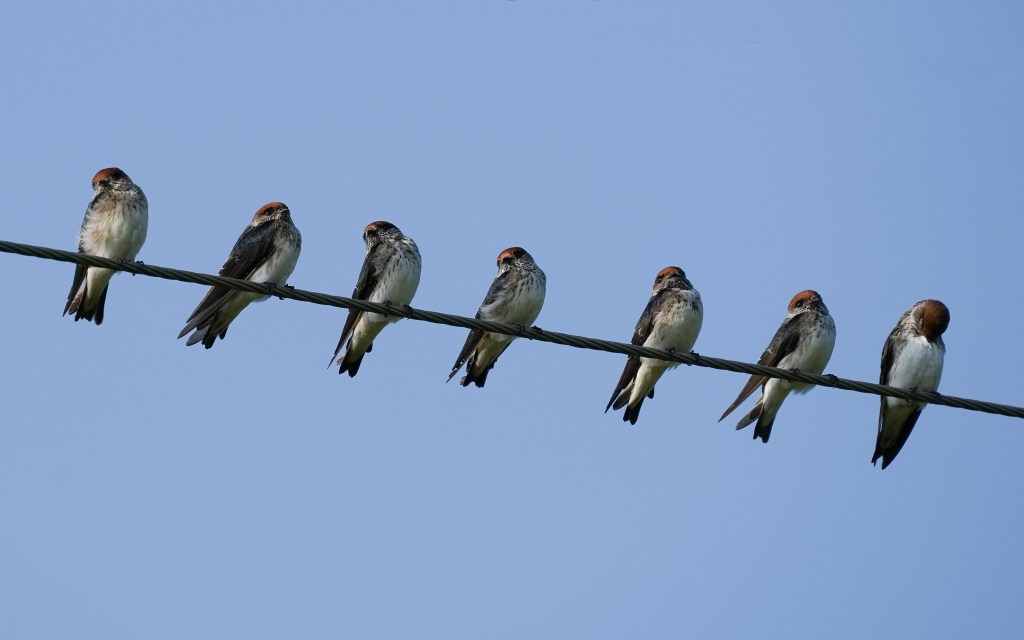
The swallows flew south,
Gathering on telephone wires.
The streets grumbled and huffed,
Weighed down by grey tyres.

The city ripped at the seams,
Worn-out, frowned.
In the sea of apathy,
Voices dwindled and drowned.

Joy shrivelled and wept,
waylaid in a corner—
Itself, the pallbearer 
And the mourner.

The lamp posts blinked and sighed,
In the midst of commotion
And the piers dangled their feet,
In the sleepy blue ocean.

Radhika Soni (R.S.) writes poetry to find harmony in life. She is greatly influenced and inspired by the poetry of Percy Bysshe Shelley, Lord Byron, Edgar Allan Poe, Robert Frost, Pablo Neruda, W.H. Auden and William Butler Yeats to name a few. She loves nature walks and rises early to draw inspiration from the morning star.

.

PLEASE NOTE: ARTICLES CAN ONLY BE REPRODUCED IN OTHER SITES WITH DUE ACKNOWLEDGEMENT TO BORDERLESS JOURNAL

Click here to access the Borderless anthology, Monalisa No Longer Smiles

Click here to access Monalisa No Longer Smiles on Kindle Amazon International

Categories
Review

I am Not the Gardener

Book Review by Ranu Uniyal

Title: I am Not the Gardener: Selected Poems by Raj Bisaria

Author: Raj Bisaria

Publisher:  Terra Firma, Bangalore

Here is a book that I have been waiting for.  In several sittings you go through these breathtaking poems by Raj Bisaria.  A book that needs to be read with patience and, if you have had the privilege of being taught by him, you read with a curious eye.  Soft and gentle – a touch of an artist gently goads you to read it loudly– as if you are in an auditorium reading out to an unknown audience.  Who will listen to this voice of a gardener who with I am Not the Gardener weaves seasons of delight “telling of one’s heart is not self-gazing” but divine contemplation? 

The book does not carry an introduction to the author.  It has forty-three poems with photos capturing moments with family and friends. A few pictures of the domes and spires from Lucknow too add a special meaning to the verses. As director, producer, designer, actor and professor, Raj Bisaria has left an indelible mark. Press Trust of India described him as “Father of the modern theatre in North India”. Raj Bisaria founded Theatre Arts Workshop in 1966 and Bhartendu Academy of Dramatic Arts in 1975 in Lucknow. He taught English literature for more than three decades at the University of Lucknow. He is the first to receive Padma Shree from Uttar Pradesh for his contribution to modern theatre.  As a theatre artist his contribution remains unparalleled.

The first poem in this collection is ‘The Curtain Boy’. The poem is a thoughtful mediation on the meaning rather meaninglessness of all our actions.  The poet writes “I am not the gardener, / Nor the owner of the garden. / My job is to do odd things/ To weed out little wrongs/ To keep the pathway clean”. ‘Odd’ and “little” acts of “watching” lead to an awareness of the burden of possession and the transitory nature of dreams.  And this is followed by a similar concern in the poem ‘To a Young Actor’ – “I was told once to discipline/ Imagination in the rhythm/ of iambs and trochees. Only I wonder / If external form will give / Meaning to chaos.”

The poet, artist, and the philosopher in him create a complex mirage of emotions that reflect the restlessness and the anxiety of a man who finds comfort in words.  “In your dying/ My love has found / A new lease:/ For beyond death / Only love goes on”, the poet expresses his love for his mother in the poem ‘Elegy’.  Like Hamlet he gives voice to his own fears and then affirms with a defining certitude “Love is a quiet secret, / The seed within the rose.” The images are drawn from garden to the sea and the mountains “And I learnt to be silent / with the unspeakable granite of the mountains.”

Travel as a motif binds his restless spirit and opens the unreachable corners of his heart.  Love and fulfilment are contraries in a world trapped in the mundane.  In his poem ‘Byzantium’, Yeats refers to “The fury and mire of the human veins”. An artist seeks perfection in this imperfect world. The desire to transcend the ordinary compels him to write. The debut collection of poems gives us fascinating insights as Bisaria draws us to a wide range of experiences with a cry for attention “Do not shut my words out.  It is winter.” Here in lies an assertion with a sad awareness that yes, life is ending.  The artist within and the performer without must often be traversing contradictory spaces.  Both are equally strong and vulnerable. 

Sometimes the voice of the performer seems to undermine the anguish of the poet.  “He who does not forgive himself/ Forgives others less.” These are poems of love, longing, grief, and interminable loneliness that invades an artist whenever he confronts his inner self.  Those familiar with Bisaria’s dramatic productions might find a different voice lurking behind these poems.  It requires courage to accept one’s vulnerabilities, to confront the inner daemons and to pour an array of emotions with a faith that only an eternal seeker can display.  “To your shrines I came my Lord, / But I came without faith; / To your people I spoke my Lord / But I spoke without love; …Yet give me Lord peace/ To bear my own emptiness, / And your silence /Quieten my doubting mind.” This is not just a poem with the title ‘Prayer’, but a plea that resonates with a quest for self-realisation. 

A sadness runs through these poems.  Read and receive every word, every glance, every touch of this mortal self where “Love comes slowly by and by…” and the poet firmly believes “Love’s life is more than time…”. “It is a flight in the freedom of self…”. Even if you try hard, it is difficult to run away from oneself.  Like a shadow your inner conscience follows you, here, there, and everywhere.   

Ranu Uniyal is a poet and a Professor from the Department of English and Modern European Languages, University of Lucknow.

.

PLEASE NOTE: ARTICLES CAN ONLY BE REPRODUCED IN OTHER SITES WITH DUE ACKNOWLEDGEMENT TO BORDERLESS JOURNAL

Click here to access the Borderless anthology, Monalisa No Longer Smiles

Click here to access Monalisa No Longer Smiles on Kindle Amazon International

Categories
Review

Tagore’s Play Performed 105 Times in WWII Concentration Camps

The Post Office by Tagore was written, translated and performed in multiple languages throughout Europe. Rakhi Dalal revisits the original translation done by Devabrata Mukherjee in 1912.

Title: The Post Office

Author: Rabindranath Tagore

Translator: Devabrata Mukherjee

Publisher: Niyogi Books

Dakghar was written in Bengali by Rabindranath Tagore in 1911. Devabrata Mukherjee, an Oxford University student at the time, translated the play into English in 1912. It was first published in London by Cuala Press in 1914 with an introduction by W.B.Yeats.  He, along with Lady Gregory, had also directed its first staging in English in 1913 by the Abbey Theatre in Dublin. The production then transferred to the Court Theatre, London, later the same year before the Bengali original was staged at Tagore’s Jorasanko theatre in Calcutta in 1917.

This play was translated into French by André Gide and was read on the radio the night before Paris fell to the Nazis. During World War II, there were 105 performances of The Post Office in concentration camps in Germany. Perhaps one of the most noteworthy was its staging by Janusz Korczak, a Polish-Jewish educator who ran a Jewish orphanage in a ghetto in Warsaw. It was there that the play was organised for children just a few weeks before they, as well as Korczak, were deported to the concentration camps of Treblinka.

The story revolves around a young child Amal, an orphan adopted by his Uncle Madhav, who suffers from an ailment. On the instruction of the physician treating him, he is restricted within the house and is not allowed to go outside. In his quest to explore the world beyond the confines of his home, he sits near a window facing a road and talks to people passing-by. He becomes fascinated by the newly constructed post office near his window and imagines receiving letters from the king. The play presents a vivid picture of Amal, his longings, his ideas of life and the limitations that he faces.

Nirmal Kanti Bhattacharjee, in the introduction to this edition, quotes the bard from the letter he wrote to Andrews in 1921 where he says, “Amal represents the man who has received the call of the open road – he seeks freedom from the comfortable enclosure of habits sanctioned by the prudent and from the walls of rigid opinion built for him by the respectable.”

The narrative traverses through the realms of a mind born free, eager to understand and appreciate the beauty of the natural world and, yet with time, constrained by the ideas fostered as acceptable by societal norms. Amal would rather venture outside and hop like a squirrel than sit at home, toiling at books which his Uncle thinks makes a man learn. He would rather cross mountains and go farther to seek work than be disheartened by their imposing structure. To his Uncle, the hills are barriers whereas to Amal, they are the hands of earth raised into the sky, beckoning people from far off.

The play also explores the nature of human dealings with outsiders, the usual conventions of a society while dealing with persons we may only come across as strangers and seem to emphasise upon the virtue of the sense of fraternity which the otherwise busier life tends to disregard. Amal meets a dairyman, a watchman, a flower gathering girl, a gaffer and a headman while sitting at his window and leaves an impression on each of them. He endears as a persona in harmony with nature as well as in his interactions with other people through his life so that the journey becomes more joyous for everyone. 

This play is written in two acts. In the first act, Amal wishes to discover the world outside his restrictions while sitting at his window. In the second act his condition worsens, and he is confined to his bed where he spends his time waiting for the postman to deliver a letter from King. And finally, he sinks into his last sleep.

In its October issue of 1914, The Times Literary Supplement wrote: “This is the first impression that the play gives, as a play should: an impression of actuality, complete within the limits of human life as seen and heard in a real world.” The second act may be seen as a wait for the messenger of God/death which delivers the final fate for Amal. W.B. Yeats says that the “play conveys to the right audience an emotion of gentleness and peace” which is epitomised by Amal’s character.

This play translated by Mukherjee more than a hundred years ago continues to touch hearts to this date. Given our present context, impaired by the excessive capitalistic tendencies of the age, marred by wars, blurred by frenzies of hatred seeping into the fabric of societies, this comes as a gentle reminder of the necessity to live in peace, to approach nature and humans, even strangers, with compassion and to show more consideration in our dealings with them. It helps us understand that a mind that can live in harmony with nature and with humankind, can eventually embrace the final call in tranquillity.

The Post Office is a splendid play written with a poetic cadence which has elements of tragedy and yet manages to leave the reader with a sense of serenity that seems to be the writer’s message for a life to live in harmony with nature, with humankind and with oneself.

.

Rakhi Dalal is an educator by profession. When not working, she can usually be found reading books or writing about reading them. She writes at https://rakhidalal.blogspot.com/ .

.

PLEASE NOTE: ARTICLES CAN ONLY BE REPRODUCED IN OTHER SITES WITH DUE ACKNOWLEDGEMENT TO BORDERLESS JOURNAL. 

Categories
Interview

 When a Hobo in a Fedora Hat Breathes Tolkien…

In Conversation with Strider Marcus Jones

Strider Marcus Jones
i'm come home again
in your Lothlorien

Strider Marcus Jones wrote these lines about an idyllic utopia that was named Lothlorien by JRR Tolkien in Lord of the Rings. Jones writes beautiful poetry that touches the heart with its music and lyricality and recreates a world that hums with peace, beauty, acceptance and tolerance – values that have become more precious than gems in the current world of war, strife and distress. He has created his own Lothlorien in the form of a journal which he has named after the elfin utopia of Tolkien. An avid reader and connoisseur of arts, for him all his appreciation congeals in the form of poetry which draws from music, art and he says, perhaps even his legal training! Let us stride into his poetic universe to uncover more about a man who seems to be reclusive and shy about facing fame and says he learns from not just greats but every poet he publishes.

What started you out as a writer? What got your muse going and when?

In my childhood, I sought ways to escape the poverty of the slums in Salford. My escape, while gathering floorboards from condemned houses every winter and carrying them through back entries in crunching snow to our flat, above two shops for my dad to chop up and burn on the fire was to live in my imagination. I was an explorer and archaeologist discovering lost civilisations and portals to new dimensions our mind’s had lost the ability to see and travel between since the time of the druids. Indoors I devoured books on ancient history, artists, and poetry from the library. I was fascinated by the works of Picasso, Gauguin, Bruegel and many others and sketched some of their paintings. Then one day, my pencil stopped sketching and started to compose words into lines that became “raw” poems.  My first mentor was Anne Ryan, who taught me English Literature at High School when I was fourteen. Before this, I had never told anyone I was writing poetry. My parents, siblings and friends only found out when I was in my twenties and comfortable in myself with being a ranger, a maverick in reality and imagination.

When I read your poetry, I am left wondering… Do you see yourself in the tradition of a gypsy/mendicant singing verses or more as a courtly troubadour or something else?

I don’t have the legs to be a courtly troubadour in tights and my voice sounds like a blacksmith pounding a lump of metal on his anvil.

I feel and relate to being gypsy and am proud of my Celtic roots passed down to me from my Irish Gypsy grandmother on my Father’s side who read the tea leaves, keys, rings, and other items telling people’s fortunes for years with scary accuracy. I seem to have inherited some of her seer abilities for premonition.

Like my evening single malt whiskey, age has matured the idealism of my youth and hardened my resolve to give something back to the world and society for giving me this longevity in it. The knocks from the rough and tumble of life have hardened my edges, but my inner core still glows like Aragorn’s calm courage and determination in the quest to bring about a more just and fairer world that protects its innocent people and polluted environment. Since Woody Guthrie, Tom Waits and Bukowski are influences I identify with deeply, I suppose I am a mendicant in some of my poetry but a romantic and revolutionary too, influenced by Neruda, Rumi, Byron, and Shelley shielded by The Tree of Life in Tolkien’s Lothlorien:

THE HEAD IN HIS FEDORA HAT

a lonely man,
cigarette,
rain
and music
in a strange wind blowing

moving,
not knowing,
a gypsy caravan
whose journey doesn't expect
to go back
and explain
why everyone's ruts have the same
blood and vein.

the head in his fedora hat
bows to no one's grip
brim tilted inwards
concealing his vineyards
of lyrical prose
in a chaos composed
to be exposed,
go, git
awed
and jawed
perfect and flawed,
songs from the borderless
plain
where no one has domain
and his outlaw wit
must confess
to remain

a storyteller
that hobo fella

a listening barfly
for a while,
the word-winged butterfly
whose style
they can't close the shutters on
or stop talking about
when he walks out
and is gone.

whiskey and tequila
with a woman who can feel ya
inside her, and know she's not Ophelia
as ya move as one,
to a closer and simplistic,
unmaterialistic
tribal Babylon,

becomes so,
when she stands, spread
all arms and legs
in her Eskimo
Galadriel glow,
sharing mithril breath,
no more suburban settlements
and tortured tenements
of death,
just a fenceless forest
and mountain quests
with a place to rest
on her suckled breasts,
hanging high, swinging slow.

war clouds HARP
through stripped leaves and bark,
where bodies sleeping in houseboat bones
reflect and creak in cobbled stones:
smokey sparks from smoked cigars
drop like meteorites from streetlight stars,
as cordons crush civil rights
under Faust's fascist Fahrenheit’s.
 
one more whiskey for the road.
another story lived and told

under that
fedora hat
inhaling smoke
as he sang and spoke
stranger fella
storyteller.

You seem to have a fascination for JRR Tolkien. You have a poem and a journal by the name of Lothlorien. Why this fascination? Do you think that JRR Tolkien is relevant in the current context? We are after all, reverting to a situation similar to a hundred years ago.

Yes, on all counts. Tolkien and his Lord of The Rings trilogy have been part of my life since I first read one summer when I was twelve years old.  My young mind, starved of adventure and elevenses in Salford’s slums, willingly absorbed the myths and magic, lore’s and legends beguiling me to enter the ‘Age of Man’. This living in a time of relative peace alongside other, more ancient races with musical-poetic languages reflected part of my own reality in living through the Cold War decades under the impending doom of nuclear annihilation where daily life often felt the shadows cast by the Cuban Missile Crisis, war in Vietnam, Pol Pot’s Cambodia, and famine in Biafra.

Sauron’s evil eye and invading armies echo an outgoing President Eisenhower’s ominous warning to curtail the influence and corruption of the banking-military-industrial-complex. Instead, Martin Luther King and President John F Kennedy were assassinated and a surveillance state and gilded slavery ideology is being imposed globally using artificial intelligence. Ancient civilisations in Iraq and Libya have been destroyed for control of oil and to maintain global Petro dollar power. Tolkien and The Lord of the Rings is just as relevant today in Ukraine, Yemen, and Syria and as it was through the slaughters of Verdun, the Somme and Flanders Fields. It is a warning that good must prevail over evil and this burden is borne by those with courage and conviction who cannot be corrupted.  

What is your Lothlorien? What does poetry mean to you and your existence?

My Lothlorien is a more peaceful world, with more tolerance of other individuals and cultures. Not perfect by any stretch but a place where people laugh, have their neighbours back and work with each other. A place of social justice and equality, music, poetry and art. It is no place for racism, sexism, ageism, corruption, or war. A kind of homestead with birdsong, forest, mountains and rivers, preferably in the French Pyrenees or Alaskan Bush. A place of words composed into poems and stories read and spoken, passed down and added to by each inspired generation in the Native American tradition. Poetry is all about communication and community in my existence. We are caretakers of our words and the world.

You have used Orwell, Gaugin and many more references in your poetry. Which are the writers and artists that influence you the most? What do you find fascinating about them?

Individuality of expression through fiction, poetry, art and music fascinates me. Now, at 62 years of age so many have influenced my poetry with or without me knowing or realising it. These include:

From the past – Chaucer, Tennyson, Shelley, Keats, Blake, W.B. Yeats, Auden, Langston Hughes, Hart Crane, Sexton, Plath, Kerouac, Heaney, Lorca, Orwell, Dickens, Dylan Thomas, Tolkien, Steinbeck, Heller, Donaldson, P.D. James, Ian Rankin, Vonnegut, Dostoyevsky, Rilke, Rumi, E.E.Cummings, Neruda, Leadbelly, Robert Johnson, Miles Davis, Thelonious  Monk, John Coltrane, Dylan, Tom Waits. So many.

From now – They know who they are. I have published their work in Lothlorien Poetry Journal.

You play instruments — saxophone and clarinet? Does that impact your poetry?

Saying I play instruments is a huge stretch of the imagination. I get strange notes out of my saxophone and clarinet that must sound like a hurricane blowing in anyone’s ears. My black Labrador, Mysty, covers her ears with her paws but I enjoy trying to play. I love jazz music, anything from the 1920s to early 70s, but Miles Davis, Monk, Coltrane, Mingus, and Ornette Coleman took jazz music to a level that transcends mortality.

Jazz music continues to be a profound influence in my poetry. I will explain how.     

Does any kind of music impact your writing?

In some way, unbeknown to me, jazz music, particularly that of Davis, Monk and Coltrane runs parallel to and interweaves with the rhythms of how I think when I write poetry. It closes my mind to the distractions of the outside world. The sound of those perfect and imperfect notes opens a door in my mind, I close my eyes, float into this dark room and my senses fill with images and words, which hover in the air like musical notes where I conduct them into rhythms and phrases bonded to a theme. Some become poems, others disintegrate into specks of dust, the moment gone. Sometimes, the idea and train of thought sleeps in my subconscious for years. This happened with my poems “Visigoth Rover” and “Life is Flamenco” which come from   my sojourns randomly wandering through Spain but were born years later listening to Paco playing Spanish guitar and Flamenco music which is another key influence in my poetry.

VISIGOTH ROVER

i went on the bus to Cordoba,
and tried to find the Moor's
left over
in their excavated floors
and mosaic courtyards,
with hanging flowers brightly chameleon
against whitewashed walls
carrying calls
behind gated iron bars-
but they were gone
leaving mosque arches
and carved stories
to God's doors.

in those ancient streets
where everybody meets-
i saw the old successful men
with their younger women again,
sat in chrome slat chairs,
drinking coffee to cover
their vain love affairs-
and every breast,
was like the crest
of a soft ridge
as i peeped over
the castle wall and Roman bridge
like a Visigoth rover.

soft hand tapping on shoulder,
heavy hair
and beauty older,
the gypsy lady gave her clover
to borrowed breath, 
embroidering it for death,
adding more to less
like the colours fading in her dress.
time and tune are too planned
to understand
her Trevi fountain of prediction,
or the dirty Bernini hand
shaping its description.

LIFE IS FLAMENCO

why can't i walk as far
and smoke more tobacco,
or play my Spanish guitar
like Paco,
putting rhythms and feelings
without old ceilings
you've never heard
before in a word.

life is flamenco,
to come and go
high and low
fast and slow-

she loves him,
he loves her
and their shades within
caress and spur
in a ride and dance
of tempestuous romance.

outback, in Andalucian ease,
i embrace you, like melted breeze
amongst ripe olive trees-
dark and different,
all manly scent
and mind unkempt.

like i do,
Picasso knew
everything about you
when he drew
your elongated arms and legs
around me, in this perpetual bed
of emotion
and motion
for these soft geometric angles
in my finger strokes
and exhaled smokes 
of rhythmic bangles
to circle colour your Celtic skin
with primitive phthalo blue
pigment in wiccan tattoo
before entering
vibrating wings
through thrumming strings
of wild lucid moments
in eternal components.

i can walk as far
and smoke more tobacco,
and play my Spanish guitar
like Paco.

Tell us about how music and language weaves into your poetry — “i’m come home again” — there is no effort at punctuation — and yet the poem is clear and lyrical. I really love this poem – Lothlorien. Can you tell me how you handle the basic tool of words and grammar in your poetry?

In my mind, music is poetry through sound instead of words. Like words, the combinations of notes and pauses have intricate rhythms and phrases. In many of my poems like “Lothlorien” and those above, I weave the rhythms and phrases of jazz music or Spanish guitar and words together with run on lines so there is no need for punctuation. This gives these poems, and many others a spontaneity and energy which feels more natural and real and has a potent, more immediate impact on the senses and emotions when combined with images and happenings. This whole process feels natural to me. It began in my early twenties, when I was listening to old Blues and the likes of Leadbelly and Robert Johnson alongside Dylan, Led Zeppelin, Tom Waits and Neil Young. These are the raw underbelly notes of my pain and anger at the world. Jazz is the mellow top notes. I hope this makes sense. It is hard to explain something that is natural to and part of who I am, so forgive any lack of clarity.

Sometimes, I just like to add a moment of mischievous fun to a serious poem as in these two:

REJECTING OVID

the fabulous beauty of your face-
so esoteric,
not always in this place-
beguiles me.

it's late, mesmeric
smile is but a base,
a film to interface
with the movements of the mind behind it.

my smile, me-
like Thomas O'Malley
the alley
cat reclining on a tin bin lid
with fishy whiskers-

turns the ink in the valley
of your quills
into script,
while i sit
and sip

your syllables
with fresh red sepals of hibiscus,
rejecting Ovid
and his Amores
for your stories.


OLD CAFE

a rest, from swinging bar
and animals in the abattoir-
to smoke in mental thinks
spoken holding cooling drinks.

counting out old coppers to be fed
in the set squares of blue and red
plastic tablecloth-
just enough to break up bread in thick barley broth.

Jesus is late
after saying he was coming
back to share the wealth and real estate
of capitalist cunning.

maybe. just maybe.
put another song on the jukebox baby:
no more heroes anymore.
what are we fighting for --

he's hiding in hymns and chants,
in those Monty Python underpants,
from this coalition of new McCarthy's
and it's institutions of Moriarty's.

some shepherds’ sheep will do this dance
in hypothermic trance,
for one pound an hour
like a shamed flower,

watched by sinister sentinels-
while scratched tubular bells,
summon all to Sunday service
where invisible myths exist-

to a shamed flower
with supernatural power
come the hour.  

How do you compose a poem? Is it spontaneous or is it something you do? Do you hear the lines or voices or is it in some other way?

Most poems come from life’s experiences and observations of people, places, nature, and events. These can be from the past, or present and sometimes premonitions of the future which often overlap depending on the theme/s and where I want it to go.

When it comes to composing a poem, I am not robotic, and neither is my Muse. I have no set time and never write for the sake of writing something each day which I find disrupts my subconscious process. A poem can begin at any time of day or night, but my preferred time to think and write is mid-evening going through to witching hour and beyond. I put some music on low, pour myself a slow whiskey and sit down in my favourite chair with pen and folded paper. I never try to force a poem. The urge to write just occurs. I don’t know how, or why. It just happens. My subconscious finds the thread, thinks it through and the poem begins to unravel on the page. I care about the poems since they care about the world and the people in it. So, I often agonise for days and in some cases years, over lines and words and structure, crossing out words and whole lines until they feel right. Editing, and redrafting is a crucial part of the writing process and requires courage and discipline. Butchering your own work feels barbaric in the moment but enhances your poetic voice and strengthens the impact of a poem on the reader.

You are a lawyer and in the Civil Service in UK. How does law blend with poetry?

I am a law graduate and retired legal adviser to the magistrates’ courts/civil servant who retired early. I have never practiced as a lawyer.

I never think about law when I write, but I am sure the discipline brings organisation to the orderly chaos of Spinoza’s universe that resembles the space inside my head.

Tell us about your journal. When and how did you start it?

I started Lothlorien Poetry Journal in January 2021. I publish the online rolling blog of poetry and fiction and printed book volumes — currently standing at eight issues featuring established and emerging poets and fiction writers published on the LPJ blog.

We are a friendly literary journal featuring free verse/rhyming/experimental poetry, short stories, flash fiction, and occasional interviews with poets.

We love poems about enchantment, fantasy, fairy tale, folklore, dreams, dystopian, flora and fauna, magical realism, romance, and anything hiding deep in-between the cracks.

I publish Lothlorien Poetry Journal periodically, 4-6 issues every year. Contributors to each issue (selected from the best work published on the Journal’s Blog) are notified prior to publication and receive a free PDF copy of the issue that features their work.

We nominate for the Pushcart Prize and Best of the Net.

 What do you look for in a poet as a publisher?

I look for a poet or writer’s distinct voice, that spark of originality in their theme/s, the rhythm and musicality in their language and phrasing.  I have no boundaries as to style, form, or subject – prose, rhyming, free verse, sonnets, haiku, experimental or mavericks who break the rules and write about the darker underbelly of society – if it is good and not offensive, racist or sexist Lothlorien Poetry Journal could be the natural home for your work. The best way to find out is to come to Lothlorien, have a read, and decide to submit.

LOTHLORIEN

i'm come home again
in your Lothlorien
to marinate my mind
in your words,
and stand behind
good tribes grown blind,
trapped in old absurd
regressive reasons
and selfish treasons.

in this cast of strife
the Tree of Life
embraces innocent ghosts,
slain by Sauron's hosts-
and their falling cries
make us wise
enough to rise
up in a fellowship of friends
to oppose Mordor's ends
and smote this evil stronger
and longer
for each one of us that dies.

i'm come home again
in your Lothlorien,
persuading
yellow snapdragons
to take wing
and un-fang serpent krakens-
while i bring
all the races
to resume
their bloom
as equals in equal spaces
by removing
and muting
the chorus of crickets
who cheat them from chambered thickets,
hiding corruptions older than long grass
that still fag for favours asked.

i'm come home again
in your Lothlorien
where corporate warfare
and workfare
on health
and welfare
infests our tribal bodies
and separate self
in political lobbies
so conscience can't care
or share
worth and wealth-

to rally drones
of walking bones,
too tired
and uninspired
to think things through
and the powerless who see it true.
red unites, blue divides,
which one are you
and what will you do
when reason decides.


IN THE TALK OF MY TOBACCO SMOKE

i have disconnected self
from the wire of the world
retreated to this unmade croft
of wild grass and savage stone
moored mountains
set in sea
blue black green grey
dyed all the colours of my mood
and liquid language-
to climb rocks
instead of rungs
living with them
moving around their settlements
of revolutionary random place
for simple solitary glory.
i am reduced again
to elements and matter
that barter her body for food
teasing and turning
her flesh to take words and plough.
rapid rain
slaps the skin
on honest hands
strongly gentle
while sowing seeds
the way i touch my lover
in the talk of my tobacco smoke:
now she knows
she tastes
like all the drops
of my dreams
falling on the forest
of our Lothlorien.

Thanks for your lovely poetry and time.

(This is an online interview conducted by Mitali Chakravarty.)

PLEASE NOTE: ARTICLES CAN ONLY BE REPRODUCED IN OTHER SITES WITH DUE ACKNOWLEDGEMENT TO BORDERLESS JOURNAL

Categories
Poets, Poetry & Rhys Hughes

My Favourite Poem

I am not sure it is wise to choose a favourite poem out of the millions that exist. It would seem to exclude all the others from the imaginary summit of a fictional pillar. The circumference of that pillar means that there is only room for one poem up there and it might be better not to erect the pillar in the first place and leave the literary landscape unobstructed.

But it is too late for me. I have already chosen a favourite poem. In fact, I have chosen a favourite several times. The first poet I read in any depth, Edgar Allan Poe, provided me with my first favourite, not ‘The Raven’ but a slightly less famous work called ‘The Bells’. How I loved the tinkle, jangle and crash of the cadences in the stanzas of that piece!

I read it again recently and found that it retains great musical power and it is still a poem I regard with intense fondness, but it is no longer my favourite of all. That is hardly surprising considering I was reading Poe when I was 15 years old. Our youthful tastes change not only according to our experiences but also as a result of all the other literature we consume. There is surely a tendency to prefer narrative poems when we are small and a diminishing reliance on actual stories as we grow older. Yet it was the music of ‘The Bells’ that fascinated me rather than the febrile images it contains.

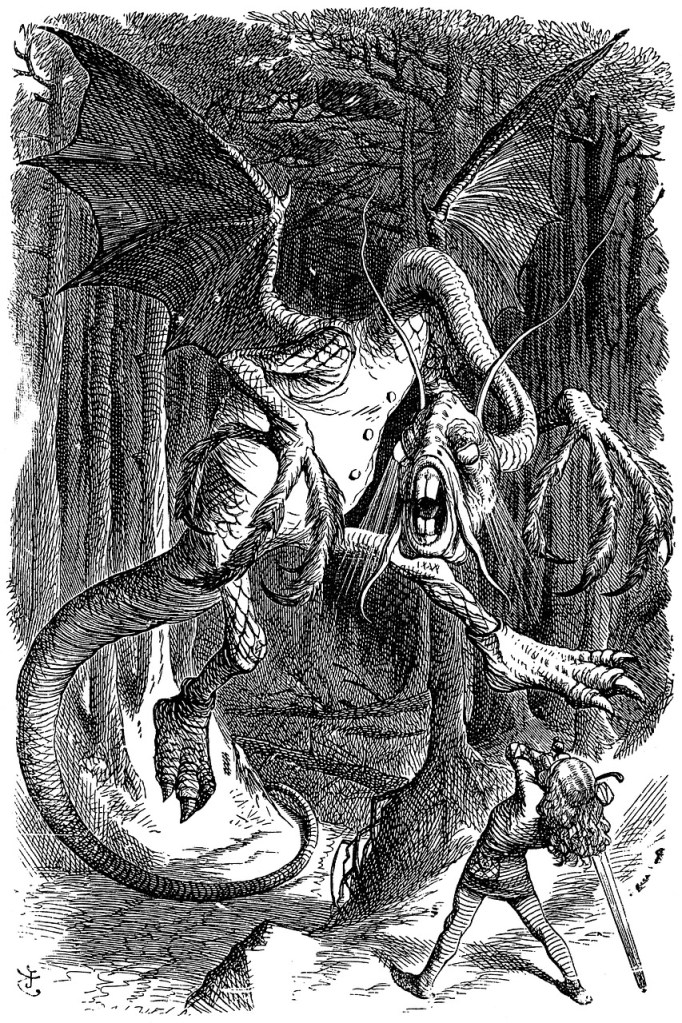
Jabberwocky. Courtesy: Creative Commons

I think my love of euphony has always meant that I relish the way a poem sounds more than I appreciate any meanings it might convey. This is why it was easy for a nonsense poem to become my new favourite and to gently push aside the Poe piece. Lewis Carroll’s ‘Jabberwocky’ became for me the supreme poem and I learned it by heart. It is a poem that makes contextual sense despite all the meaningless neologisms with which it is sprinkled. Somehow, we understand the new words coined by Carroll and there is no need to have them explained. It is a poem that we absorb through osmosis rather than through the normal process of everyday communication. A masterpiece!

When I was 18 years old, I began reading Byron, Shelley, Coleridge and a few other English Romantics, and I discovered ‘Ozymandias’. Now this seemed to me to be a perfect poem. It had music, imagery and a moral, and furthermore it was ironic, an archaic episode with timeless relevance. Again, I learned it by heart, and I found myself in the not uncommon position of reciting it to myself whenever I happened to be confronted with an ancient ruin, whether the blocks of a tumbled castle or shattered torso of a fallen statue. It is a poem that turns a reader into an actor, an introvert into a declaimer. It became my new favourite but only for a short while. The poem that caused it to fall in my estimation was another in the same anthology I was reading.

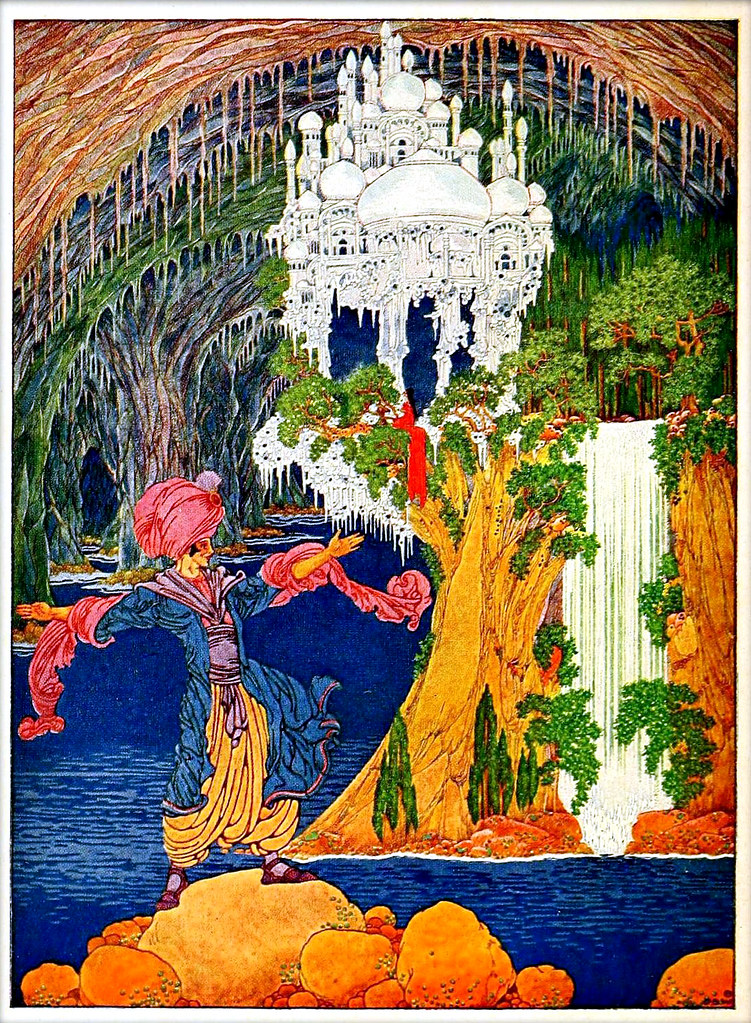
An Illustration from Kubla Khan. Courtesy: Creative commons

Kubla Khan’ struck me as especially appealing because it has a wildness about it that balances out its sense of control. I am not sure why Coleridge affected me to a greater extent than Shelley (and Byron affected me hardly at all) but I was enthralled by the imprecise exoticism and the intimations of doom among paradise in this poem, which is as menacing as it is delightful, as frantic as it is magical. Coleridge himself regarded it as a work in progress, a frustrated potential, unfinished, a burst dream bubble. I wonder if a continuation might have diminished it? The fragmentary nature of the piece adds to its allure by increasing its strangeness. There is atonality here as well as smoothness, like troubling chords inserted in a serene nocturne.

A few years passed and I discovered a new favourite and had to topple poor old ‘Kubla Khan’ from the apex of that idealised pillar and replace it with The Rubáiyát of Omar Khayyám in the first Edward Fitzgerald translation, but whether this series of seventy-five quatrains can be regarded as just one poem is open to debate. Personally, I regard the quatrains as linked inextricably by mood, metaphors as well as theme, and there is a mini-sequence within the whole that gains significant momentum by being treated as a single creation. My ambition once again was to learn the work by heart and recite it at moments that were appropriate but despite my efforts I failed in the endeavour. There was simply too much wordage for me to succeed.

I tried reading more modern poetry, serious and mature work that I failed to understand at first and had to consider very carefully before I could tease out any meaning. I read Akhmatova, Rilke, Pound, Eliot. I tried (but was generally defeated by) Ginsberg, Olsen, William Carlos Williams. This was all well and good but my candidate for new favourite turned out to be something light, an insignificant ditty dashed off by a poet who wrote it as a gift for a friend, and once again it was the music that won me over, the jangling, tinkling, tingling, clipping, clopping, jingly rhythms. ‘Tarantella’ by Hilaire Belloc imitates the sound of a guitar and clapping hands, it clatters along merrily, nostalgically, a tribute to an ephemeral occasion in a mountain tavern that can never be lived again, and the words and their phrasing evoke much of the atmosphere of that night with an appreciable impetus. A candidate for new favourite, yes, but it ultimately failed to displace the Rubáiyát.

That was in my early twenties and soon after I lost interest in poetry, I have no idea why, and rarely read any. Occasionally I would browse an anthology and discover something interesting, but only a few poems made any impression at all on me, and none became my favourite. The Rubáiyát of Omar Khayyám remained at the summit of my appreciation by default. My return to poetry was slow and uneven. The work of Federico García Lorca caught my attention and I chose ‘Canción de Jinete’ to learn by heart, which I did, probably poorly (my Spanish was never fluent). A little later I discovered the precocious genius of Arthur Rimbaud and taught myself ‘Le Coeur Supplicié’ because its torrent of fantastical words appealed to my inner ear.

Unfortunately, what I believed poetry had to offer was something I had no great use for. I misunderstood what it had to offer. That is no great crime, but I did miss out on its delights for a long time. Not until my mid-thirties did I start to return to the pleasures of poetry, and it was the humourist Don Marquis who ushered me back into the heaven I had forsaken, yet it is too much to claim that any of his poems became my favourite. I adore his cycle of poems about the cockroach Archy and the cat Mehitabel, but they must be taken as a whole in an evolving mythos. No individual poem of the cycle is worthy of special attention at the expense of the others. All are good, but together they are brilliant and thus they disqualify themselves from the game.

Now that I was reconciled with poetry, my tastes widened, and I read from a broader set of cultures and times than before. Sappho, Ovid, Catullus, Tagore, Basho, Tu Fu, Housman, Holub, Mandelstam, Eliot, Yeats, Edward Thomas, Dorothy Parker, Ai Ogawa, Ogden Nash, Derek Walcott. I was very enthusiastic about the novels and short stories of Richard Brautigan, so I read his poetry too and found a poem called ‘All Watched Over by Machines of Loving Grace’ that neatly summed up my own hopes for the future of the world. Did it become my new favourite? Not quite. I continued reading. Pessoa enthralled me, Cendrars and Queneau dazzled me. Complicated poetry dealing with the human condition and experimental verse based on mathematics made me nod my head sagely in a close approximation of a deep appreciation.

The City’ by C.P. Cavafy became my new favourite. I had heard his name often mentioned but felt no great desire to explore further. Then by chance I saw this particular poem. What a terrific piece! Hard, bleak even, wrenchingly bitter, but it does not depress the spirits of the reader despite its melancholy message. On the contrary it seems to inspire the reader to action. The poem is quietly and relentlessly insistent that you will never change your life for the better, that you can never escape the circumstances that have trapped you. It issues a challenge to the reader. Prove me wrong, the poem seems to say! I immersed myself in as much of Cavafy’s poetry as I could find. I went out of my way to visit his house in the city of Alexandria in Egypt, so wonderful did I now regard his work. Was this the final destination on my poetic voyage?

Not quite. There was another poem by another poet sunk deep beneath the surface of my awareness and it had been there for a long time. I can say that it had probably been my secret favourite from the beginning. I must have read it in an idle moment and forgotten about it, or thought I had forgotten about it, but it remained on the seabed of my subconscious, and ultimately it wrecked all the poetical vessels that followed, for I was never fully satisfied with any of those I called my favourites. I rediscovered it one unexpected day and it returned with unstoppable force into my affections. It was written by a poet who went to sea and saw the world, who travelled rather aimlessly for a number of years before the urge to write poetry took hold of him.

‘Cargoes’ by John Masefield is evocative and beautiful. It is heady and a little regretful at the same time. It contrasts the supposed splendours of the past with the drab present, and yet ironically in our own age we perceive romance even in the grime and smoke of Masefield’s ‘present’. Three ages are given to us for contemplation, a pre-classical time, the golden age of the Spanish Main, and the very start of the 20th Century, and three ships loaded with merchandise to represent those ages. The ships of Assyria and Spain are loaded with exotic and tropical treasures. They are floating envoys of a pair of widely spaced but equally fabulous cultures. The British ship is grimy and ugly and it wallows through a drab sea on a blustery day, carrying cargo that is practically an insult to the taste of the aesthete. The language employed is perfect for Masefield’s purpose. I know of no poem I like better.

Quinquireme of Nineveh from distant Ophir,
Rowing home to haven in sunny Palestine,
With a cargo of ivory,
And apes and peacocks,
Sandalwood, cedarwood, and sweet white wine…

Cargoes (1903), John Masefield (1878-1967) 

Rhys Hughes has lived in many countries. He graduated as an engineer but currently works as a tutor of mathematics. Since his first book was published in 1995 he has had fifty other books published and his work has been translated into ten languages.

.

PLEASE NOTE: ARTICLES CAN ONLY BE REPRODUCED IN OTHER SITES WITH DUE ACKNOWLEDGEMENT TO BORDERLESS JOURNAL

Categories
Essay

The Incongruity of “Perfect” Poems 

Rakibul Hasan Khan discusses Sofiul Azam’s poetry collection Persecution from a postcolonial perspective

Sofiul Azam is one of the most important English language poets from Bangladesh. Persecution (2021) is his fourth poetry collection, which has recently been published by Salmon Poetry (Ireland). His poetry has already appeared in some of the leading poetry or literary journals across the globe, including Prairie Schooner, North Dakota Quarterly, The Ibis Head Review, and Postcolonial Text, to name a few. In Persecution, Azam shows an astonishing poetic talent, offering some wonderful poems on the themes of love, war, and politics, among others. If we read the poems of this volume purely from an artistic viewpoint, we will find most of them as what might be called “perfect” poems, but we may find the same poems somewhat problematic if we read them from certain political perspectives.  

The volume has recently come to me travelling a long distance from its publishing house in Ireland to my present residence in New Zealand. This journey, which began in Bangladesh where Azam lives, has covered three different countries of three continents. Such a transnational breadth is the main motivation for writing in English for many South Asians today, who have internalised English as a language of their own for their creative expression, inherited from their colonial past.

These poets capture the complexity and multiplicity of South Asian life with the common thread that binds them all — the language, English. Their expressions are somehow distinctly South Asian. This fact makes Azam stand apart from many of his counterparts in Bangladesh. Very few English language poets from Bangladesh, especially those who were born and brought up there, write such “perfect” poems in English. But Azam’s perfectly written poems in “native” like English with somewhat Western outlook and a poetic expression deriving from Western literary canon make some poems of Persecution incongruous in the South Asian context. In this essay, I will shed light on this incongruity while exploring some other features of his poetry.    

The most obvious influences on Azam in this collection are Eliot (1888-1965), Auden (1907-1973), and Walcott (1930-2017). Perhaps, among them his true poetic inspiration is Walcott, who is sometimes alleged to be more an English poet  than a Caribbean. This is somewhat true about Azam as well, but his situation is, of course, unlike Walcott. Azam is a self-made poet who has mastered his art of writing poetry in English through reading, overcoming his spatial “limitation” of living his whole life in a Bangla dominant country like Bangladesh where English is no more than a foreign language. Therefore, it would be an injustice not to recognise his extraordinary achievement in mastering the language to write like a ‘native’. But his poetry is not all about language. Azam’s success in Persecution lies in the fact that almost each poem is neatly written, maintaining outstanding poetic and artistic expressions. If the poems were decontextualised from their social, political, cultural, and historical backgrounds, this would be a collection of “perfect” poems. Azam in Persecution is like Walcott – more an English poet than a Bangladeshi! It is, of course, an overstatement, but there are some truths behind this assertion. To illustrate my point, I quote some lines from his poetry:

I tell myself that I can afford to be happy
like a grizzly bear only having to feast on salmon
moving upstream through shallow creeks to lay eggs and die.
I need to act like a hiker does, getting all he needs
On the wild shrubbery dense paths in Yellowstone. 

(“The Capitoline Wolf,” 14-18, pp. 15)

In the quoted lines, no one can doubt the mastery of Azam’s versification. If one is not informed of who is the writer of these lines, it would be hard to imagine these were written by a Bengali (English) poet. Objects and images like “grizzly bear”, “salmon fish”, “hiking” and “Yellowstone” are so foreign in the Bangladeshi or even in South Asian context that they seem to be incongruous in an otherwise perfect poem.  

But Bangladesh is not untraceable in Persecution, particularly in the part entitled “Heat of Interrogations”, where Bangladeshi landscapes reappear time and again through the poet’s nostalgic recollection of his childhood life in his hometown near the Garo Hill. The hill and a backyard pond in his grandparents’ house are the two most frequented places for the poet to escape from the complexities of metropolitan life of Dhaka where he lives. There is a clear undertone of English romantic poetry in the poems of this section. The quoted lines below may clarify my point:

I grew up picnicking in the Garo Hills.
In summer, I saw trees and clustered vines
dance in the wind and get covered with red dust. 

One day we will go there, to see together
the rain falling and washing the dust 
off their green foliage. 

(“Rain,” 28-33, pp. 17)

This superb poem somehow reminds me of Yeats, especially the early Yeats of romantic phase. I quote some lines from “Coming of Age,” another poem from this part, which casts a shadow over a nostalgic recollection of childhood event through the experienced poet’s realisation of its innocent cruelty:

Even as a child, I did atrocities like floating rat pups
in a coconut shell on a pond’s calm water.
I hear their sqeaks though I’m not degaussed
to such evils yet, drifting far from atonement. 

(11-14, pp. 12)

Such memories are the backbone of his poetry. In retrospect, he offers a profound insight into his life, which has a general appeal: “What am I but an accumulation of memories, / each of which is surmounted with unsuccess?” (16-17). It is true that every individual is an accumulation of memories.

This is a prominent feature of Azam’s poetry to attempt to give vent to some sad truths of human lives in general terms, especially in this part of the volume. The following lines from “The Pond at Grandpa’s House” may support my claim:

                       But I
Remain tensed like a hyacinth
Worrying about the lowering water. 

(17-19. pp. 19)  

This “lowering water” perhaps makes all of us tense, humans whose existence is as uncertain as that of a hyacinth and threatened by the drying up of water – the most vital source of existence. It is more so for Azam who does not want to strike his root in any particular place:

                              I don’t ever relish
the singular idea of being rooted in just one spot;
I rather feel like a rhizome branching out new roots
from its nodes, trying out its various potential climates
for the plurality is itself a self-renewing adventure.
Losing faith in those too preachy about the singular,
I prefer to be an unpaired jerk lusting for the plural.
If I say this planet is where I began and my windows
open into the universe, would I be allowed to belong? 

(“Earth and Windows”, 22-30, pp. 30) 

This is an unequivocal statement of Azam’s internationalism or transnationalism, renouncing any specific national identity.

Azam’s preference for a transnational identity is a common choice among many poets and writers of the so-called postcolonial world. It makes them different from the traditional postcolonial poets who usually express their deep desires to be rooted in their lands and cultures. Therefore, Azam’s choice of a transnational identity, against the backdrop of his ancestral home that he often revisits, can be interpreted as the conscious choice of a poet whose writing in an adopted language opens up before him an outstanding opportunity to explore other horizons. But there are scopes for raising questions about the intention of such transnationalism. Is it an opportunity for the poet to make his poetry more presentable to an international audience, since creative writers in English from Bangladesh and South Asia in general inevitably sense the shadow of an international as well as an unknown readership at the back of their minds?

I am aware that I am making a clichéd and contentious claim, and I may even be charged for being a nativist for raising such questions. Therefore, I must clarify my discomfort in coming to terms with the idea of transnationalism, which I think is largely confined to privileged people who can afford to assume multiple identities. This is perhaps a narrow and simplistic view of transnationalism, but it cannot be denied that those who adopt transnational or multinational identities are generally from privileged social positions. However, one particular feature that intrigues me the most is Azam’s romantic recollection of the past often with a profound attachment to nature. It makes him, to me, the last romantic of the post-postmodern age!

Part two of the book, “The Flames of Desire,” also exemplifies his romanticism. It is the spiciest part of this volume, but some of the poems in this part slightly disappoint because they do not fulfil my expectation of capturing the complexities of human relationship that I expect from the twenty-first century love poems. I am quite sure that many readers will differ and I admit that what makes me critical of Azam in this volume is essentially because of our ideological differences; his poetry as a form of art has mostly nothing to do with it. However, an exciting feature of this part is Azam’s experiments with metaphysics. This part brings out the influence of English canonical literature in shaping his poetic sensibility and artistry. On the one hand, the erotic and sensual images that he creates with an abundant use of conceits may remind one of John Donne, on the other, the rendering of the metaphysical elements in a modernist vein will remind one of T.S. Eliot who rejuvenated metaphysics in modernist poetry. The following lines from “Krishna’s Return Home” show evidence of his use of metaphysics:

As I reluctantly walk out of your woolen warmth
far worthier than the promise of a kingship
in heaven, I see washing on the line under the sky
with a few stars peeping like pot-bellied spies
through the curtains of dark clouds. (1-5, pp. 37)

These lines, once again, reflect the impressive craftsmanship of Azam who succeeds in matching the poetic talents of the English poets who influence his poetry.  

The extramarital sexual trysts that Azam accumulates in this part may titillate readers. But while emulating the erotic art of a seventeenth century poet like Donne who is notorious for his misogyny, Azam also falls into the same trap of presenting women as an object of men’s sexual pleasure, without any agency. The poem “Who Doesn’t Want to Make Love to Someone’s Wife?” is a case in point, from which I quote the following lines:

Could I borrow you?
I promise you will be returned unhurt to him
who’ll know nothing of rain’s work on a taro leaf. 

(10-12, pp. 47)     

This wonderful poetic expression is problematic for its gendered undertone. Although it may sound like making a gross interpretation of a love poem, I cannot overlook the fact that the quoted lines’ that show women are men’s possessions and they can be borrowed like any other objects. It sounds like a very offensive idea to me. Similarly, in some other poems, he compares different parts of a female body with fruits to be consumed by men.

The third part of Persecution, “Embers of Disappearance,” contains the most politically conscious and powerful poems. I enjoyed the poems of this part the most, but some of those are, unfortunately, problematic for being Eurocentric in outlook. One example of Azam’s Eurocentrism or a Western attitude is his treatment of wars, which is a recurring theme of this part. Surprisingly, Azam does not look beyond the world wars of the twentieth century to reincarnate the horror of war, assumably because of his politically apolitical and liberal humanistic Western outlook. Here lies the main incongruity of his poetry, at least from my ideological perspective. I think it is incongruous of a twenty-first century Bangladeshi poet to rely so heavily and uncritically on the World Wars to reflect on the horrors of wars, whereas there are so many ongoing and past wars in his part of the world, so many struggles of the oppressed.

Even his so-called transnationalism and lack of belonging to any particular place perhaps do not justify his stand because there are also many poems in this volume that reflect his awareness of place and time. Therefore, his position is curiously ambivalent in relation to his homeland. This kind of ambivalence is often considered to be a quintessential characteristic of the so-called postcolonial poets, but the paradox is that Azam does not seem to be very keen to identify himself as a postcolonial poet.  

Azam’s treatment of wars also indicates the influence of modern English poets on him. The following lines from “Requiem for the Undead” reflect his reminiscence of Eliot’s rendition of the horror of the First World War in “The Wasteland”: “A desert greens with corpses planted as seedlings. / Did dry sands wish to be washed out with blood?” (11-12, pp. 76). In the same poem, Auden’s account of his devastating experience of the Second World War in “The Shield of Achilles” is echoed:

Weary footfalls, the oars knifing the watery flesh.
The dreams that linger are burst-out bubbles
or hollowed-out conches washed on alien shores.
Batons, barbed wares, and the cold greet the future.

(21-24, pp. 76) 

Similarly, in another poem, he echoes the final line of Walcott’s famous poem “A Far Cry from Africa.” Walcott writes “How can I turn from Africa and live?” and Azam writes “How can I write poems and think of beauty alone?” (“Worries at a Hilltop Resort”, 27, pp. 89). Such kind of “intertextualities” are often intentional. They are undoubtably very artistic and evocative expressions, but the problem is neither the intertextuality nor the art, rather the context of the time and place when he wrote these poems. Do I sound like a nationalist now? I would rather call myself a postcolonialist. However, the influence of classic English war poets like Wilfred Owen or Keith Douglas, or the Cold War period’s poet Boris Pasternak, or the holocaust theme of Auschwitz in his poems indicates not only his inclination to present twentieth century modernist themes but also his Western point of view of meditating on his own experiences and perspectives. In this sense, he is a twenty-first century modernist poet from a postcolonial location, although it is not unusual among the Anglophone postcolonial poets to embrace Western modernism as Jahan Ramzani explains in his comprehensive study on such poets in A Transnational Poetics (2009). The irony is that Azam and many others seem to reject the identity of the “postcolonial,” but that identity persists to hang stubbornly around their necks like the dead albatross.

The most ambitious poem of this volume is “Prayers to the God of Jihadists.” In this poem, Azam deals with the issue of Islamic radicalism, which is a pressing concern for the contemporary world, particularly for the West. Azam also writes the poem largely from a Western perspective, which is evident in his use of the word “jihadist” – a popular Western coinage to describe the radical Muslims, and it is sometimes indiscriminately used to label Muslims in general. For many in the West, Islamophobia has ominously led to suspect every Muslim as a potential jihadist, and by writing this poem from their perspective, Azam seems to simplify a complex issue. The poem thus turns out to be a problematic one despite having enormous potentialities to become a great poem.    

Nonetheless, there are many poems or short expressions in Persecution which save Azam from doing injustice to his poetic merit. “Persecution” and “The Photographer” are two such poems. In these poems, Azam offers exemplary political consciousness, being fully aware of his time and place. I quote some lines from “Persecution”:

In the wake of the Confederate flags flying
o’er the land of the free and the home of the brave!
I know brown won’t ever be de-browned to white. 

I’m a genealogist, cracking the encryption codes
of all those suspicions under my critical lenses.
Oh, don’t let colour and culture make distance between us.

Elsewhere lines of sanity are now increasingly blurred.
Erich said Hear, O Israel! A new Holocaust is raging on.
So between an anvil and a hammer I stammer:

For Jews in Hitler’s war my sad tears drip,
Also for kids bombed out in the Gaza Strip.
Not anti-Semitic but you know Zionists never get it. 

(43-54, pp. 93)  

Whereas the above lines from “Persecution” express Azam’s consciousness of international politics, the “The Photographer” represents his awareness of national politics. In the latter poem, Azam makes a bold statement about political persecutions in Bangladesh. The photographer in the title of the poem alludes to a renowned photographer and political activist in Bangladesh named Shahidul Alam, who was arrested on the ground of sedition during a time of political unrest in 2018. In the following lines from the poem, Azam asserts his support for the photographer, protesting the repressive political regime that restricts freedom of speech:

                         I want caged birds
to sing their dreams out loud so that captors

feel the horror of wings being of no use.
Palmyra palm trees, though rooted,
make wings of their fronds. And only freedom

gets us on the wing. But in this country,
rules from their laboratory rain down on us
clay subjects and wash away what we made

solid with labour. I wonder if they’ll wise up
to the light brewing under darkness.
Those mute photographs will be vocal soon. 

(“The Photographer”, 17-27, pp. 104)

Thus, Azam expresses his solidarity with an artist who fights for freedom of thoughts and expressions through photography. This poem of a national subject matter has an international significance, for nowadays persecutions for dissents are very common everywhere around the world. It also justifies the titling of the volume.   

In fine, I repeat that Persecution is a collection of “perfect” poems. There are some problematic areas in this volume, but those are hardly because of any artistic weakness of the poems; rather, Azam’s ideological position sometimes weakens his political stance. His over cautiousness with form and expression is probably another reason of his political compromise. There is hardly any contemporary issue that he does not deal with in this relatively thin volume. Though I have not mentioned it in my discussion, his ecological consciousness is another highlight of this book. Therefore, I warmly accept this collection, keeping in mind the way the speaker of one of his poems asks his beloved to accept him with all his imperfections:

                        I am not

requesting you to accept me as a gem
you might have lost by mistake on the way,
rather as one humanly rife with imperfections. 

(“Who the Hell Benefit from Denials?,” 51-54, pp. 60)

Rakibul Hasan Khan is a PhD Candidate in English at the University of Otago, New Zealand. He can be reached at rakib.hasan82@gmail.com.

.

PLEASE NOTE: ARTICLES CAN ONLY BE REPRODUCED IN OTHER SITES WITH DUE ACKNOWLEDGEMENT TO BORDERLESS JOURNAL