Categories
Interview

Sumana Roy and Trees

Sumana Roy

She loves trees and identifies with Tagore’s Bolai, who had an affinity for trees. She has written a non-fiction called How I became a Tree (2017), which is being reprinted now by Yale University Press. Sumana Roy is a writer who writes out her passion for trees and more. The draft of her first novel was long listed for Man Asian Literary Prize, but eventually, abandoned by her because she felt it was not good enough. She later authored a novel called Missing (2018), an anthology of poems called Out of Syllabus (2019), and a collection of short stories, My Mother’s Lover and Other Stories (2019). She also contributes essays regularly on various online forums and teaches in Ashoka University, near Delhi. Sumana hails from a small Himalayan town of Siliguri which impacts here writing in different ways. Her interview reflects how she lives by her convictions and looks beyond man made constructs in quest of an undefined Eldorado which is abstruse in itself. However, I am convinced, when she finds her Eldorado, her readers will probably be overwhelmed by the radiance of what she shares with the world. In this interview, she shares snapshots of her life as writer and her convictions.

When and why did you start writing?

I don’t think any of us can answer this question. I had no ambition to be a writer. I had not met a single writer in my life. In my middleclass Bengali life were people like my parents – teachers, bankers, officegoers, and the unemployed, looking for jobs. I wrote love letters for my friends in boarding school, and letters to the editor before that. Then I started studying literature at university, and I think I wrote nothing else except essays to pass examinations and the occasional letter to the man I would eventually marry. I say this just to reiterate that the idea of a writer as someone who could live an unremarkable life like myself wasn’t available to me at that time. I began working towards a PhD, and as I was living away from home, I hungered for the sound of Bangla. I began reading Bangla poetry and I felt something inside me loosen – I wanted to write like these poets had, but in English, the language I was most comfortable in. I kept the writing a secret from my family and the world. Only after I had submitted my doctoral dissertation did I begin sharing my writing with the world – by submitting to online magazines I liked reading, but also responding to most ‘Call for Submission’ pages that I came across in the early years of social media.

What gets your muse going?

Life. Living. I know this is a cliché and an unsatisfactory answer, but that is what it is – to live inside my writing …

Your first book is about trees. Tell us what egged you on to choose to write about trees and why?

I suppose it came from a disaffection – the Bangla word ‘bishaad’ would be more appropriate perhaps – for the social world, for the human in it. I wanted to live outside the emotion economy of social relationships. Groping for various possibilities, I realised that I wanted to live like a tree. I had been reading and living with plants long before that. I suppose I began seeing them differently after that epiphany.

Would you say your obsession with trees was similar to that of Tagore’s Bolai?

 I’ve written about Bawlai in How I Became a Tree. He is a relative, yes, among the many I discovered when looking for those who had felt the human-tree equivalence emotionally, intellectually, or, as in the case of Rabindranath’s story, intuitively.

You have also spoken of Nandalal Bose, the famous Indian artist who passed away before you were born in the book. Why him? Do paintings in general affect your writing?

I discovered Nandalal’s Vision and Creation in Santiniketan’s Subarnarekha bookstore. I might have seen it before, in Bangla, as a child, but much of it had disappeared from my consciousness. I was staying in a guest house in Ratanpalli. The full moon night of spring I still remember, as I do the curiosity of the mosquitoes. I found Nandalal teaching his students how to draw trees by constantly referring to the human anatomy – this analogical plant-human relationship seemed most natural to his imagination. That is how I found another relative in him.

To answer your second question, yes, art – and music – brings something to my life.

Your novel is about a missing woman. Parallels have been drawn between her and Sita. Why?

I don’t know who has drawn this parallel. What I do know is that I was interested in the life of the missing woman, a woman like Sita, in the world today. Why are battles fought and epics written around the missing woman? I did not make this comparison explicit, but always hope that the reader would, on their own, particularly because, like the seven adhyas (parts) of the Ramayan, the novel, too, is structured around seven sections – seven days in the lives of the characters.

If we perceive Rama as a democratic ruler who listened to his subjects, would you hold him guilty for abandoning Sita? How do you perceive him?

Rama was a king, not an elected representative, as we know. Even if he were, as you are asking me to imagine him hypothetically, I cannot see how anything can justify the demand on Sita to prove her ‘purity’. About abandonment, it is a personal matter between the two people involved. Using the narrative of abandonment of a woman to prove one’s purity as a ruler, as a democratically elected representative in our country has done recently, is as ridiculous as the State’s demand on Sita’s purity.

You are a professor too. You have been doing number of columns talking of educational values. What are the things you would want to see changed? And why?

I don’t think I’ve written about values. It’s a loaded word, and I feel incompetent to speak about it. What I have been writing against is the industrialisation of the curriculum, particularly in the English Literature syllabus, specifically the postcolonial syllabus.

What would I like to see changed in this regard? I’d like the structure of such a syllabus to be more egalitarian – in a real way – and not dictated by metropolitan impulses alone.

I remember your essay against long biodatas. Do you think reverting to past values where marketing oneself as a writer with a huge biodata was not a necessity would be relevant or possible today? Is this a construct of the publisher or the writer? Do you think the only the quality of one’s work without a publication history or academic excellence would allow a writer to get published?

The biodata is a marketing tool. The book can stand its own ground without us knowing where the author lives or what prizes they have won or where they studied. If there were blind submissions, without the name and bio of the writer, we might not be reading the same writers in the pages of The New Yorker or the London Review of Books – so much is published because of the reputation that attends writers. I think it is unfair to writers who are just starting out, and, most importantly, those who have not had many of the opportunities that their more well-published contemporaries have had. The snob value of the biodata also creates a hierarchy – it is against this that my reservation lies.

In your opinion, what is most important — fame, money or creative satisfaction? Why?  Can there be creative satisfaction without accolades of the external world? Would that be of any value?

I can only speak for myself. This has perhaps to do with one’s temperament. The three things you mention – ‘fame, money, creative satisfaction’ – may all be important for many artists, as it might be for a sportsperson or even a politician. I think I write just to be able to get away from the social world, to stay with myself, self-indulgently – that someone reads me in a world where so much of reading material is available for free is a gift from the reader to me. I don’t exactly know what ‘creative satisfaction’ is. It’s because I suffer from creative dissatisfaction. I dislike everything I have written or everything that I write. And yet I do not want to stop writing. So… I do not write for fame, money, or creative satisfaction. I write to make sense of my world, to protect myself from myself perhaps.

You often colour your writing with food and family. Why?

I enjoy a life of the senses, of eating. I like to cook and eat, but, most of all, I love to fantasise about eating – the things I want to eat, how I could make them, whether I will ever get to taste them, how to grow some of the produce, and so on.

My understanding of ‘family’ is not blood-bound. Those I love are my family, both humans and non-humans. They will naturally enter my writing.

Do you teach creative writing? Can creativity be taught? Is it any different from studying literature or language?

Yes, I teach Creative Writing at Ashoka University. Writing can be taught as much as music can be taught – both involve Riyaz(practice), which is what my writing workshops are meant to be. To be a singer one must first train to become a listener. And so, with writing – one must become a reader first. By this I do not mean that one has to read 52 books a year, but one must be mindful of how words work, how lines and sentences work through us, the senses in which literature comes to us, and so on.

Where are you located now? Gurgaon or Siliguri and does your locale impact your writing.

I live in Sonipat during the teaching semester. The rest of the year I am in Siliguri, which is where I always want to be. My surroundings affect me, and, by extension, my writing. This is true of everyone, I think? By this I do not mean that living in a small town will make me write about the idyllic life in contrast to a life in the metropolis. The sensory affects us and, consequently, our writing.

How do you juggle writing and teaching?

With a lot of difficulty, because there’s also housework and caregiving for the elderly. And yet, I now know that my students make me think of things that I wouldn’t have had I worked on my laptop all day.

What is your favourite genre in writing and why?

The poem and the essay, the shorter forms. I am also very fond of the letter and the interview as literary genres.

What are your future plans? Any more books coming our way?

I am waiting for the semester to end, to get away from the Zoom life, to rest my eyes, to play with my nephew and niece, to comb my mother’s hair, and, if the rains help, to plant a few moringa and jackfruit trees. I want to feel better, for my health to get better than what it has been over the last few months. I’m not thinking about books now.

This interview was conducted online by Mitali Chakravarty on behalf of Borderless Journal.

.

Click here to read a poem by Sumana.

PLEASE NOTE: ARTICLES CAN ONLY BE REPRODUCED IN OTHER SITES WITH DUE ACKNOWLEDGEMENT TO BORDERLESS JOURNAL

Categories
Essay

At Home in the World: Tagore, Gandhi and the Quest for Alternative Masculinities

By Meenakshi Malhotra


In exploring the question of Rabindranath Tagore (1861-1941) and alternative masculinities, it is important to keep in mind the multiple contexts and registers in which this question can be explored. One is obviously Tagore’s critique of and take on man-woman relationships in his books and stories throughout his life, which he had observed at close quarters in an extended/joint family context. Many of his short stories, like “The Exercise-Book”, and novels like, Chokhher Bali (A Grain of Sand), show a keen sympathy for women’s aspirations and the situation of that unaccommodated woman, the young widow. Tagore demonstrates his sympathy, even empathy, with the young widow, Binodini, while recognizing that she might pose a threat to social stability within the household of Mahendra and Asha, his girl-wife. The second register is the intertwining of creative writing and androgyny (the latter being a necessary attribute for an author, according to Virginia Woolf), and how Tagore in his capacity as a creative writer had qualities of empathy and sensitivity, which he drew upon to forge unusually close emotional bonds with women. This theme  has been discussed by writers and critics under the rubric of Tagore and the feminine or Tagore and women. However, this article seeks not just to explore Tagore’s views on women but his search for a calibrated and balanced way of being in the world without falling into the binaries of imperial and colonized masculinities, and to shape the contours of a self which makes the world its home and is at home in the world.

In his novel Ghare Baire (The Home and the World), we come across a criticism of extremist politics and jingoistic nationalism. A tripartite narrative about the growing political consciousness of Bimala, her failure to understand her liberal husband, Nikhilesh, a landlord and his friend Sandip, a fiery nationalist and a turbulent petrel, who storms the bastions of their household and marriage. Sandip’s brand of militant nationalism appeals to Bimala, who had once harboured feelings of inferiority because of her birth in an ordinary family, and who feels elevated and special under Sandip’s scrutiny. Sandip singles her out for special attention and calls her the “Queen Bee’’ and his muse and inspiration leading her to ignore Nikhilesh’s more mature and balanced views. Early in the novel, Nikhilesh who often functions as a mouthpiece for Tagore’s views in the novel, says that though he loves his country/nation, he cannot place nationalism over humanity. Reflecting Tagore’s views, which espouses internationalism and humanitarianism, Nikhilesh is not understood by his politically immature wife and ignored by his self-serving and unscrupulous friend.

Central to the formation of Tagore’s political views and suspicion about nationalism was his ideological debate with his own niece, his sister, the novelist Swarnalata Debi’s daughter, Sarala Debi Chaudhurani. A keen and fiery nationalist and patriot, Sarala was deeply impressed by the physical culture of imperial masculinities. She was particularly enthused/motivated by the concept of uplifting the nation through encouraging the growth of a physical culture. A statement that resonated with her was the idea of national character and she quotes lines from the ‘Educationist’:

“Physical weakness is a crime-against yourself and those who depend on you. Weaklings are despised and a weakling nation is doomed. The decline of ancient Greece and Rome which fell rapidly from the pinnacle of supreme civilization was due to physical neglect and abuse of the inflexible laws of nature. A physically weak nation is drained out mentally, its feet are on the downward path and it will end upon the scrap-heap if it does not act before it is too late.”

She also quotes a proverb which pronounces that the “battles of England are fought and won in the fields of Eton” (Chapter 18,129).  Her interest in and involvement with the politics of the freedom movement led her to initiate the celebration of Birashtami (festival of heroes to celebrate martial prowess, bravery and courage)) to mark courage and martial valour. Her belief in developing a physical culture and strengthening the national character made her revive certain traditions, re-invent rituals in order to paint a glorious version of India’s past. In doing so, she encouraged celebrations of Birashtami and invoked and revived the ‘braveheart’, Pratapditya, a landlord with questionable antecedents since he was also guilty of killing his father. In elevating such a figure to a status of a nationalist war-hero, she elicited mixed responses, particularly from her Brahmo family and her uncle, Rabindranath Tagore.

Rabindranath Tagore, among others, strongly objected to Sarala’s invocation of the figure of a parricide as a martial hero. Such a figure could act as a dangerous precedent since it would seem to encourage untrammeled and uncontrolled aggression and blur moral boundaries and ethical codes. This blunting of all moral and ethical codes and boundaries, the danger lurking in a militant and violent nationalism was, as indicated above, represented by Tagore in his novel, Ghare Baire but also in his essays on nationalism. In the novel, the conflict between a rational civic and humanitarian nationalism which eschews violence is embodied by the idealized figure of Nikhil and the primordial reactionary chauvinistic version of nationalism which endorses violence by his ‘friend’, Sandip. After casting a spell (metaphorically speaking) over the impressionable Bimala, whose affection he then misuses to drive a wedge between the couple and then to extract money from her to fund his terrorist activities.

The Scattred Leaves of my Life By Saraladebi Chaudhurani

Rabindranath’s indictment of Sandip could be viewed as his response, a sort of extended debate and dialogue with an ideological viewpoint diametrically different from his own, which was represented by his niece.  The increasing rift and estrangement between the two — Rabindranath and Sarala — might explain the wistfulness and occasionally melancholic and autumnal tone of Jibaner Jharapata (The Scattered Leaves of My Life) Saraladebi’s autobiography. A proud and self-respecting person, Sarala was probably conscious of the slur or aspersion of effeminacy that the British had cast on the Bengali character. She felt the humiliation and indignity too keenly to accept such descriptions and attributions quietly.

Gandhi and the Crafting of Political Masculinity

One common threadthat runs through the work and writings both these towering personalities of Tagore and Gandhi, is a critique of existing, culturally prescribed and sanctioned models of masculinity as they prevailed in the eastern (Tagore) and western (Gandhi) extremities of India. Both these great men, as public personages, were conscious that they were thought leaders and role models and that examples set by them would be emulated.

In the case of M.K. Gandhi(1869-1948), a great national leader who was instrumental in India’s throwing off the yoke of colonialism in 1947, there is a conscious experimentation with the “truth’’, presumably of one’s inner self, to oppose certain culturally sanctioned models of masculinity. Interestingly, his great-niece, Manu Gandhi referred to the ageing Gandhi as “Gandhiji, my mother” in her diaries, which were translated into English in 2019. When we focus on his corporeal politics, we see in Gandhi’s “experiments with truth” a series of experiments to do with the body which express both a consciously crafted gender ambivalence and throws a challenge to the concept of the manly body of the colonizer. Here my point is that Gandhi was consciously deploying his self, his body identity/ies and attendant subjectivities, in order to make a political point. He used his body and body-politics to establish his difference from the colonially attributed native body and also to mark his distance from colonial models of masculinity. While in one sense, this fluid body seems almost gender ambivalent, it is also an invitation to re-imagine and revision stereotypical notions of gender which circulate in cultures.

  Both of these thinkers were probably conscious of the import of the political masculinities espoused by them, particularly under the yoke of imperialism, at a specific historical conjuncture. This conjuncture is the first two decades of the twentieth century, when the models of masculinity available can be broadly conceptualized as imperial, colonial and ascetic masculinities.

The imperial masculinity model is based on the white imperial ‘master’, the civil servant, the ‘pukka saheb’, the kind extolled by Kipling and criticized by E. M.Forster. Coincidentally, this Kiplingesque masculinity, often caricatured, found its takers in people who extolled the muscular, strong masculinity of imperial cultures, like Sarala Debi, Tagore’s niece. The Forsterian view that the English public school culture shaped “well developed bodies, under-developed minds and undeveloped hearts’’ was not known to her, nor would it have found favour. This model also made its way into Indian discourses where it becomes linked with questions of national character and patriotism. In his book, The Intimate Enemy (1983) Ashis Nandy proffers the view that the Indian elite in the 19th century perceived the British as agents of progressive change and accepted the ethos of aggressive imperial masculinities.

According to historians and critics like Indira Chowdhury, Mrinalini Sinha and Chandrima Chakraborty, there was a developing discourse of de-masculinization and emasculation among the British, where they denigrated the Indian middle class and particularly the Bengali men as weak and effeminate and this also led some political leaders to move in the direction of defining and conscious crafting of alternative masculinities.    

Four Chapters by Tagore

The third or ascetic model is available in Ananda Math by Bankim Chandra Chatterjee and Char Adhay ( Four Chapters, 1933), the last and thirteenth novel by Tagore along with real life characters such as Swami Vivekanand (1863-1902) and Sri Aurobindo (1872-1950), albeit delineated with some ambivalence. Chandrima Chakraborty in her book on Masculinity, Asceticism, Hinduism: Past and Present Imaginings of India (2011), highlights the “conjunctural alignment of asceticism and masculinity in Indian political history,” in order for its transformation into a strident symbol of Indian nationalism.

Interestingly, there is a further dimension and  addition to this narrative. Jibaner Jharapata is not the only source of Sarala’s life story. She is described in Rajmohan Gandhi’s biography as Gandhi’s “spiritual wife”, because he felt strongly drawn to her, seeing in her a woman who possessed a unique combination of education and emotional strength. To Gandhi, she was a woman whose love for the nation was equally strong as his, although it followed and developed along different trajectories. In a peculiar role-reversal, we find Sarala Debi, who spent her formative years in Tagore family mansion at Jorashanko, inverts the models of “colonized masculinity” to promote and propagate militant nationalism. Tagore and Gandhi, whose spheres of influence she existed in, do not seem to have brought about much of a change in her. The great men eschewed and turned away from existing models of masculinity and moved towards the crafting of new masculinities, drawing on asceticism and spiritualism to do so.

References

Chakraborty, Chandrima(2011)Masculinity, Asceticism, Hinduism: Past and Present Imaginings of India. Delhi: Permanent Black

Chattopadhyay, Bankimchandra, Anandamath or The Sacred Brotherhood.Trana Julius Lipner, New DelhiOUP

Chaudhurani, Sarala Debi(2007)Jibaner Jharapata, Calcutta, Dey’s Publishing.(Bengali) All references in the text are to this edition,with translations by the author of this paper

Gandhi, Rajmohan (2006) Mohandas: A True Story of a Man, his People and an Empire. New Delhi:Penguin/Viking.

Kumar, Radha (1993) The History of Doing: An Illustrated History of Doing. New Delhi, Kali for Women

Malhotra, Meenakshi (2018) A Dark Goddess for a Fallen World: Mapping Apocalypse in Some of Bankim C.Chatterjee’s Novels in Unveiling Desire: Fallen Women in Literature, Culture and Films of the East eds Devaleena das and Colette Morrow. New Brunswick: Rutgers University Press

Ray, Sangeeta (2000) En-Gendering the Nation: Women and nation in Colonial and Postcolonial Narratives Duke UP

Dr Meenakshi Malhotra is Associate Professor in English at Hansraj College, University of Delhi and has been involved in teaching and curriculum development at several universities. She has edited two books on Women and Lifewriting, Representing the Self and Claiming the I, in addition  to numerous published articles on gender and/in literature and feminist theory.

.

PLEASE NOTE: ARTICLES CAN ONLY BE REPRODUCED IN OTHER SITES WITH DUE ACKNOWLEDGEMENT TO BORDERLESS JOURNAL

Categories
Musings

Gliding down the Silk Road

By Ratnottama Sengupta

These contemplations have come out of Ruhaniyat-e-Aam, an online festival of migrating music. Hosted by Indus Band, its focal theme was ‘Reconstructing the Silk Route’.  A webinar was the finale of the concept that was put into practice long before ‘COVID’ entered the Oxford dictionary – in 2018 when Somali Panda, founding head of the Kolkata-based Band came up with the novel concept of connecting online with performers in Greece. They played their music, we joined them with my reading, Tamal Goswami’s painting, and Somali’s songs.

Subsequently, during the pandemic, “when the world was compelled to stay indoors, the importance of connecting with the rest of humanity forcefully struck us,” says Somali. She then went on to host this series of interactions with musicians, artists, filmmakers and academicians from Greece, Czech Republic, Egypt, Iran, Kazakhstan and India — all participating in a celebration of the Human Migration that established bonding amongst nations, cultures, civilizations, and created a global community long before the term had come into existence.

The prime purpose of reconstructing the Silk Route — philosophically, ideologically, conceptually – was to forge a measure of friendship. Friends they became – Labros Kantos, singer from Greece; Saimir Bajo from the Czech Republic; Mesbah Kamal, academician from Dhaka; Sharofat Ara Bova, filmmaker from Tajikistan; Arqavaneh Folklore Ensemble from Isfahan, Iran; Mohamed Abu Zid from Cairo, Egypt; Sarower Reza Jimi, playwright from Lisbon, Portugal… Because music connects people most readily since it overrides the barrier of language, “and it gives inner peace and solace,” Somali adds.

 By the time it ended, Ruhaniyat-e-Aam had traced the cultural exchange from the time of Alexander and helped to understand how Hellenic Culture became Hellenistic through synthesis. Most of us know that after Alexander conquered the Persians, he established the city of Alexandria (339 BC). A little more detail: this was in the Fergana Valley of Neb – around modern-day Tajikistan. Leaving the wounded warriors behind Alexander moved on, and in time the Macedonians intermarried with the indigenous populace creating the Greco Bactrian culture that flourished in the Seleucid Empire after his death.

*

This festival of Migrant Music set me on a virtual journey down the Silk Road, the 6,400 km caravan tract that was actually an ancient network of trade routes. Formally established during the Han Dynasty of China, it linked in commerce the regions from China to Mesopotamia – should I say modern day Iran? – through India, Asia Minor, Egypt, the African continent, Greece, Rome and Britain too — between 130 BC and 1453 AD. Originating in Xian – now famed for its Terracotta Army – it followed the Great Wall of China to its northwest, bypassed the Takla Makan Desert, climbed the Pamirs, crossed Afghanistan, went on to the Levant region from where merchandise was shipped across the Mediterranean Sea.

What many of us don’t realize is that the Silk Route was not one single road. There were some that were longer and safer; some were shorter and more difficult. Some had been journeyed on much longer and thereby had witnessed more exchange than some of the shorter, more precarious roads and pockets like, say, Bhutan. And few travelled the entire length of the road: goods were handled in a staggered progression by middlemen.

The greatest value of the road lies in the exchange of culture it effected. Art, religion, technology, language, science, architecture — indeed, every other element of civilization was exchanged on these roads, along with the commercial goods that merchants traded from country to country

Marco Polo: Creative Copmmons

With the loss of Roman superiority and rise of Arabian power, the Silk Road became more and more unsafe. However, during the rule of the Mongols/ Mughals, Venetian explorer Marco Polo (1254-1324) travelled right up to China along the road that is now supposed to have been the main artery along which travelled the bubonic plague bacteria responsible for the pandemic of Black Death that decimated the Byzantine capital of Constantinople.

The network was used regularly till about 1453 when the Ottoman Empire boycotted trade with the west and closed the routes. By this time Europeans had become used to goods from the east, and so merchants set out to find new trade routes – over the oceans. That, as we know, led to the discovery of the New World and of new civilizations and forging of new cultures. In sum, we may say that laid the groundwork for the modern world.

*

What many of us don’t know: Part of the Silk Road still exists as a paved highway connecting Pakistan and the Uygur, an autonomous region of Xinjiang in China. It had given UN the impetus to plan a trans-Asian highway, and a railway counterpart of the road too had been proposed. The road had inspired cellist Yo-Yo Ma to found the Silk Road Project in 1999 in order to explore cultural traditions along its route and beyond, as a means for connecting arts worldwide, across cultures.

But why look back on the Road that has little to do with how it existed 2000 years ago? Forget the zeros – it is probably not like it was even two and half years ago! So what is its importance?

To my mind, the importance lies in the layers of history lining it. Glancing backward we realize that we stand on the shoulder of giants. Every visit into the past unearths stories of human civilization. And whenever I have done that – as I did in Kazakhstan as part of an ICCR effort in 2009 – I have got answers to questions like:

 A) Where was the Road going and why?

B) Why was it such a life transforming journey?

C) The road traversed through remote parts of the world, especially a huge part was ice covered desert. Then, why did the horse become such an important part of the journey on this road?

D) Horse was only one of the animals that were traded on the route. So, who named it Silk Road and why?

Arabian Nights

 It was so named by Ferdinand von Richthofen in 1877 CE because silk was a treasured part of the trade – indeed it was the primary attraction that started off the trade but few travellers walked the entire length of the road. They came to different posts on the route, exchanged goods, food, plants, and ideas along with spices and tea. Stories of The Arabian Nights give us an idea about the exchanges that were taking place in city like Baghdad. And we realise that the flying carpet was not a mere figment of imagination, it became a metaphor for journeying from one world to another.

*

Enough of history? Well then, let’s take note of the cultural exchanges closer to our life and times. Since Ruhaniyat-e-Aam was about Migrating Music, what we naturally traced was the commonality of instruments like sarod, santoor and violin… How come the last named string instrument most associated with Western Classical music gained such acceptance and became inseparable part of music in Iran and in South India’s Carnatic music? Was rabab, the folk accompaniment most widely associated with Afghanistan, the precursor of India’s sarod, internationalized by Ustads such as Ali Akbar Khan and Amjad Ali Khan? Indeed, it was from them that I learnt there have been several versions of the rustic musical instrument that was honed, refined, perfected and sophisticated until it became the sonorous voice of Indian classical music.

Again, our santoor has a close affinity with instruments in China, Persia, Greece, and so many other places. I remember my visit to China for the Festival of India under the aegis of the Ministry of Human Resources, then headed by Arjun Singh. As part of that government-to-government initiative, I visited some music schools and was amazed to see how much our santoor — once called shatatantri or hundred stringed veena — had in common with the Chinese hammered dulcimer, yangqin. There have been many versions of it – in Iran, Iraq, Greece, Armenia. I noticed that the music played on the Chinese instruments were a bit more staccato; in India I learnt from maestros closely identified with santoor — primarily Shiv Kumar Sharma and Bhajan Sopori – that strings have been added to get the murchhana or greater resonance so that the notes linger on…

If we go on to visual arts, the first name that comes to my mind is of Nicholas Roerich (1874-1947). The Russian lawyer-painter-archaeologist-philosopher born in St Petersberg had developed an abiding interest in Eastern religions, in Theosophy and Buddhism as much as Ramakrishna and Vivekananda, Tagore, Vedanta and Bhagavad Gita. His spiritual leanings took him across the Himalayas and make his home in the Himachal town of Naggar where he breathed his last.

Of greater consequence to Ruhaniyat-e-Aam was the fact that in mid-1920s the Roerichs together with their son and six friends went on a five-year-long Asian Expedition that started – in Roerich’s words – “from Sikkim and went through Punjab, Kashmir, Ladah, the Karakoram Mountains, Khotan, Kashgar, Qarashar, Urumchi, Irtysh, the Altai Mountains, Oyrot regions of Mongolia, the Central Gobi, Kansu, Tsaidam and Tibet…” A decade later he was to return to Mongolia and Manchuria to collect seeds of plants that prevent soil erosion.

In plainer words, because of these travels Roerich intimately knew not only the Himalayan range but a lot more of the Silk Road. This armed him with a scintillating palette of colours that painted mesmerizing mountains that are bold yet lyrical, rather mystical, even spiritual. I was absorbed by the tranquility that imbues the hypnotic series of 36 immersive images of the Himalayas preserved in the Roerich Gallery at the Chitrakala Parishath in Bangalore.

Roerich’s journeys along the Road had also prompted him to talk of preventing the destruction of art and architecture and work toward preserving the cultural wealth of the world. This had led to his nomination for the Nobel Peace Prize in 1929.

Deb Mukharji, a retired member of India’s Foreign Services, has also travelled through its hardy folds – and extensively photographed the Abode of Snow. The keen photographer who has authored Kailash and Mansarovar and exhibited Tall Tales of the Himalayas — among many others — is concerned about the ecosystem of the rugged and culturally rich Himalayas. “It is threatened by the highways that are being built through the mountains, either to promote religious tourism or for other purposes, he says after treks that took him from Garhwal to Nepal and Kailash to Manas.”

Cinematographer-director Goutam Ghose has journeyed through the Silk Route to make the ten-part documentary, Beyond the Himalayas. His project had started in 1994 and initially he had travelled with only 5-6 members who drove in a jeep and through the countries. “Our purpose was to look back from here and now in order to connect all the yesterdays that have transformed life and made us what we are today,” the celebrated filmmaker had said to me then.

So many stories of the exchanges enrich our literature too. Saradindu Bandopadhyay, author of many Bengali classics, had penned a story titled Maru O Sangha – The Monastery in the Desert. This was turned into a film, Trishagni/ Sandstorm (1989) by Nabendu Ghosh, another celebrated Bengali writer who became a legend as screenwriter of Hindi films. His film revolved around a monastery in Central Asia, somewhere on the Silk Route.  It showed traders who came to the monastery with a ration of food, clothes and other essentials. Those were days when people could not fly in in a helicopter and drop supplies… it took months for these traders travelling in groups to reach from one stupa to another. There was a focus on the lifestyle of the times. Buddhism was the first organized religion, and monastery being the centre of Buddhism was thus the centre of such exchanges 2000 and more years ago. These monasteries subsequently became the prototype for Islamic Madrasas and before that, of Christian universities: they were built along the lines of the monasteries which dotted Central Asia. And it is believed that the Stupa also gave the concept of the gumbad, the round top of so many masjids and forts too.

Another important exchange that was happening came to light when Trishagni was screened in many international film festivals outside India – in Tehran, Cairo, Thailand… One of the questions that cropped up was this: “You are talking about Buddhism but why are the men (and women) dressed like they dress in Islamic countries? Islam wasn’t there then!” It had to be pointed out that philosophy – and religion is a part of that – and ideas travel but Geography moulds what we wear. Because of the weather, when there was no air conditioner or even fans around, people in some parts of Africa wore no garments and in some parts of the Asian desert men wore long robes to cover the body from head to toe from the hot flying sand particles. They started covering their heads and ears and part of the face, and that wisdom became a convention and then a tradition.

Thus, geographical reality moulded why people in certain parts of the world dress in certain ways. And with the journey of religion, these dress codes also journeyed. The Romans did not wear silk because they admired the style in which the Chinese wore it but because of the inherent quality of silk. Cotton was also much in demand on this route since it was hot in the desert. So was indigo – native to India, primarily, and sought in Mediterranean countries as pigment for dyeing, medicinal and cosmetic use.

These exchanges which are now history happened largely because of geography. Why? I got the answer in the course of a seminar where artistes and academics had come from Azerbaijan and Uzbekistan, Tajikistan and Turkey. I started realizing that people were travelling from China down to Northern tip of Africa or the Mediterranean country, certain lifestyle changes were taking place. These landlocked pockets that had no access to the sea, had little green and only animals to live off. Naturally, many turned their attention to what was going on the Silk Road. Two very interesting things happened:

1) Many became bandits who would rob these caravans.

2) Many did the opposite: they offered themselves as guards to protect the goods in the caravans from bandits.

So, the same problem generated two different approaches to life, two different lifestyles. Those who became guards would travel with the caravans and they became warriors. They became warriors because they were living in very tough terrains, and they became skilled warriors because they were fighting off bandits to protect the caravans. Before long these men turned aggressive. Wars between tribes became endemic – and many of the lands strived to find stability and prosperity for their people by going into the lands of other people. (Once again, geography and history came together to define lifestyle and culture.)

We find versions of this later when people set out from Europe and landed up in America, and a new culture and civilizational evolved. Another such change took place when people were forced to travel from the Queen’s England to Australia. All these migrations and journeys have influenced the arts, ideas, religion, food habit… Why is it that in India’s Northwest – Afghanistan, to be specific — people cook meat and roti in tandoor ovens while in Bengal well-being is synonymous with ‘maachh-bhaat’ – fish curry and rice? Once again the answer lies in the history of geography – that is, geography moulding tradition and shaping history.

*

In 1892 Rabindranath Tagore wrote Kabuliwala, a story that touches the heart of humans everywhere in the world even today. It pivots on a peddler from Kabul who comes to Calcutta each year to sell dry fruits, and befriends a child, Mini. Circumstances force him to go to prison on charges of stabbing a debtor. On his release he goes to meet Mini and finds she is getting married. Rahman realizes that his daughter, now grown up, will also not have any recollection of her father – and he starts on his return journey, towards home.

This story has been filmed in India in Bengali by Tapan Sinha (1957), in Hindi by Hemen Gupta (1961), by Kazi Hayat of Bangladesh (2006), by Anurag Basu for a television channel (2015), by Deb Medhekar in 2018. It has been reimagined in totally different contexts.  Bioscopewala, set in 1990s, had Minnie going to Afghanistan where her father has died in a plane crash. In another script French Afghan writer Atiq Rahimi sets the story after the destruction of the Balmiyan Buddhas. This man from Kabul spells another exchange of ideas: he comes because this part of the world believes in reincarnation — and he is seeking his little girl who died during the destruction of the Buddhas!

Taking her cue from this same story, Sharofat Imam Arabova of Tajikistan made a lilting film where an Indian vendor selling things in that land strikes a friendship with a little girl. Desirous of paying a tribute to the author, the FTII-trained director approached Somali Panda to incorporate Tagore’s music in the script. “And when we did that using a santoor, it was so strikingly in sync!” says the music-maker from Kolkata who extensively used Raag Bhairavi. “That is the power of music – and also the bonding of migrant music,” she adds. And even as she spoke, I was reminded of Mrinal Sen’s Neel Akasher Neechey/ Under the Blue Sky (1959) wherein a Chinese hawker, Wang Lu, sold silk on the streets of Calcutta of 1930s, when India was under British rule. His life changed forever when he met Basanti, a housewife who gets arrested for her involvement in politics.

So what’s common between these stories? What connects the diverse players? Human situation where a man has travelled for work and struck friendship, an equation with a child – the most basic, most innocent form of humanity.

*

This is the importance of revisiting the Silk Route and renewing acquaintance with migrant music: that human beings everywhere in the world have been migrating. Individually too we have migrated. My grandfather migrated from East Bengal – Dhaka – to Patna, then a part of Bengal Presidency. Now Dhaka is a different country, and Patna is part of Bihar, a different state from West Bengal. My father ‘migrated’ from Patna to Calcutta to Bombay Presidency which became two states – Maharashtra and Gujarat. I was born in Bombay, which has become Mumbai, lived in Delhi which was earlier a Union Territory and now has become a state. At present, I live in West Bengal. My brother who was born in Patna studied in Pune, graduated in Medicine from Calcutta, lived in UK and worked in Germany, Brunei, Cyprus, Bosnia… So many migrations!

Today technology has opened new highways, new vistas of connecting with the world. And even as we speak (or read, as in this case) we are crossing boundaries almost every minute of our day. Within families to, a child goes out to study in London or New York, makes Singapore or Sidney his workplace, his family perhaps lives in Delhi, and he travels to Johannesburg to  Rio, Texas to Tokyo, Moscow to Hong Kong, Sweden to Israel. So many outposts of civilization – just as people on the Silk Road once did, for their trade.

The crux of it? Stories that tell us about human lives and human emotions highlight one simple thing: Humans are the same everywhere. They are all born of their soil – geography. And geography moulds our history. Because we are creatures of these two forces, periodically we need to look back and trace our commonalities in order to transcend the schisms in society.

.

Ratnottama Senguptaformerly Arts Editor of The Times of India, teaches mass communication and film appreciation, curates film festivals and art exhibitions, and translates and write books. She has been a member of CBFC, served on the National Film Awards jury and has herself won a National Award. 

.

PLEASE NOTE: ARTICLES CAN ONLY BE REPRODUCED IN OTHER SITES WITH DUE ACKNOWLEDGEMENT TO BORDERLESS JOURNAL

Categories
Slices from Life

Pohela Boishakh: A Cultural Fiesta

Sohana Manzoor shares the Bengali New Year celebrations in Bangladesh on April 14th, pausing on the commonality and differences with Poila Baisakh, the Indian version of Pohela Boishakh celebrated in the Eastern part of India

Happy & Prosperous New Year or ‘Shubho Nabobarsho’ in Bengali script

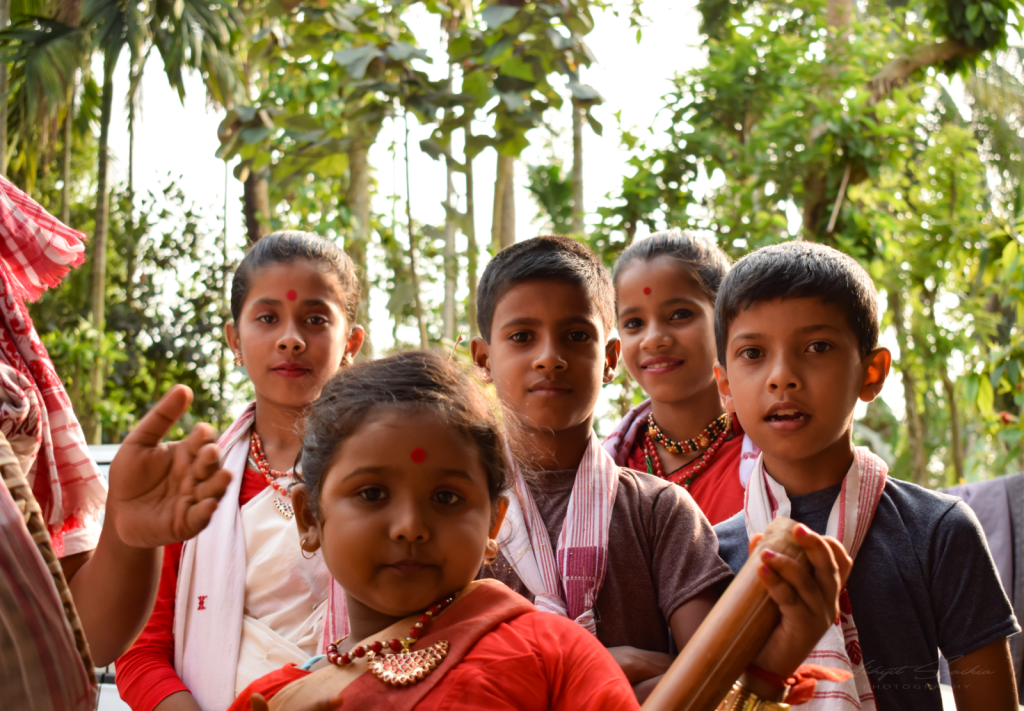
“Shubho Nabobarsho” (happy and prosperous new year) is the traditional greeting for the Bengali new year. The upcoming April 14 will herald the beginning of the Bengali year 1428 in Bangladesh, but in the Indian states of West Bengal, Tripura, Odisha and parts of Assam it will be the 15th of April. In Bangladesh, Pohela Boishakh is one of the biggest occasions of celebration, next to perhaps the two Eids.

Whereas the celebrations of Pohela Boishakh is now a regular thing, its history is somewhat unclear. According to most historians, the Bengali year or Bangabda was introduced by the Mughal Emperor Akbar. In those days, agricultural taxes were collected according to the Hijri Calendar. But then the Hijri calendar is a lunar calendar and naturally, it did not coincide with the agricultural year. The tax collecting time was not a time when the peasants and farmers could pay the taxes. It only added to the confusion of the people who tilled the land in various capacities. To streamline the tax collection, Akbar ordered a reformation of the calendar. As a result, in 1584 Bangabda was born. But the year started from 963, the Hijri year it was modeled on. According to some historians, however, it was adopted by another Muslim ruler called Hussain Shah of Bengal. There is yet another group that alludes to Shashanka, a seventh-century King of Bengal, for inventing Bangabda. It is quite possible that it existed before Akbar’s time and the Mughal Emperor reinvented it with the help of his royal astronomer and other pundits of his court.

An interesting aspect of Bangabda is that the names of the months were different in those times. The story of how the months of Farwardin, Urdibahish and Khordad became Baishakh, Jyoshthyha and Ashar is lost to us. But we do know that just as he had helped in modernizing the Bengali language, Dr. Muhammad Shahidullah helped in modernizing the Bengali year. Partially accepting his reformative suggestions, the Bangla Academy saw that the first six months had thirty-one days each and the last six, thirty. Hence there is no further confusion about which day of the Gregorian calendar Pohela Boishakh coincides with. In Bangladesh, it is always 14 April. But in West Bengal and other parts of India, it can be either 14 or 15 of April.

When the Bengali new year was first introduced, the most important activities on the first day of the year involved halkhata, opening of a new book for zamindars who would treat their tenants with sweets. On the last day of the old year, there would be Chaitra Sankranti, a day celebrating the end of the year. Actually, in rural areas, this day was more colourful than Pohela Baishakh. Charak Puja, a Hindu festival honouring the god Shiva is central to this celebration. The actual puja used to take place on the midnight of Chaitra Sankranti, and it was a very special kind of ritual and not too many people even know about it anymore. The preparation would start a month ahead of the actual puja and a total of twelve devotees would take part in it. There would be different kinds of festivities through the day, and snacks like puffed rice, ground gram called chhatu,  dry sugary sweets like khoi, murki, batasha, kodma, and many varieties of leafy vegetables would be available. In today’s Bangladeshi scenario, Chaitra Sankranti has almost disappeared except in some distant villages. Only lately, some initiatives are being taken in Dhaka to reintroduce the fair, even though it looks like any other fair and very different from the original Chaitra Sankranti.

With urbanization, the more secular Pohela Boishakh became popular. However, some elements from Chaitra Sankranti have been integrated in Baishakhi celebration. For example, there are fairs that still showcase puffed rice, khoi, murki, batasha and kodma. There are products made by rural artisans. Performances on musical instruments like ektara, dotara and dhol by rural artists are show cased. Riding the nagardola (a mini and wooden version of the Ferris wheel, reminiscence of the charak) is a central attraction of the fair.

It is impossible to conceive of any Bengali festival without food. The first food item that comes to mind regarding Pohela Baishakh, is hilsa fish. Different preparations of mouth-watering taste are prepared with hilsa. Then there are panta bhat (fermented rice) with green chili, all kinds of bhartas (mashes) starting with potatoes to tomatoes, sweet pumpkins, lentils, beans, shrimps and different types of fish, chutneys, shutki (bitters), authentic Bengali sweets, savoury snacks like fuchka, chotpoti and even traditional ice-creams, kulfi. Bigger cities find fairs and programmes in almost every locality.

Chhayanaut, an institution devoted to the propagation of Bengali culture, started celebrating the Bengali Nababarsha under the Ramna Botomul (a historic banyan tree) in 1967. Since the Liberation War of 1971, Pohela Boishakh has grown into a national festival for all Bangladeshis irrespective of religions. In Dhaka, the Pohela Boishakh procession begins from the Faculty of Fine Arts, University of Dhaka. The students start taking preparation for the procession from days ahead. They make masks and banners and wear elaborate costumes. This is known as the festive Mangal Shobhajatra, translated procession showcasing good fortune. In 2016, this festivity organized by the Faculty of Fine Arts was listed as UNESCO cultural heritage. Specific roads around Dhaka city are decorated with white and red alpanas, elaborate designs made with rice flour mixed with water.

At the break of dawn on Pohela Boishakh, people gather at the Ramna batamul festival ground. The day starts with singing the famous Tagore song, “Esho he Boishakh*” along with many others. The whole day is spent in celebration. Radios and TV channels air special programs on the day too. People dressed in white and red and other colourful attire flock around the city. It is also observed as a national holiday and a fun-day for everybody.

Sohana Manzoor is an Associate Professor of English at ULAB. She is also the Literary Editor of The Daily Star.

.

PLEASE NOTE: ARTICLES CAN ONLY BE REPRODUCED IN OTHER SITES WITH DUE ACKNOWLEDGEMENT TO BORDERLESS JOURNAL

Categories
Tagore Translations

Greetings on Asian New Years in April!

 This song by Tagore welcoming the new year, Esho He Baishakh, is especially relevant because it talks of the New Year wiping away diseases that weaken and kill humanity. Here is a translation of the lyrics and renditions by popular contemporary voices and a video of a dance performance to this song.

Come O Boisakh!
(A translation of Tagore's Esho He Boisakh, Esho, Esho, 1927)

Hail O boisakh! Welcome. 

Blow away deadly diseases with your ascetic breath. 
May the debris from the old year disappear. 
Let go of old memories, let go of old melodies. 
May sorrows and tears evaporate. 
Wipe away slanders, wipe away infirmities. 
May the Earth be purified by fire. 
Wither obsessive unhealthy passions. 
Summon a storm with a conch call to
Transfigure the misty webs woven by Maya*.

*Maya is an illusory play of divine intervention.

Jayati Chakraborty Click here to listen.

Iman Chakraborty Click here to listen.

Lopamudra Mitra Click here to listen.

Sadi Mohammad Click here to listen.

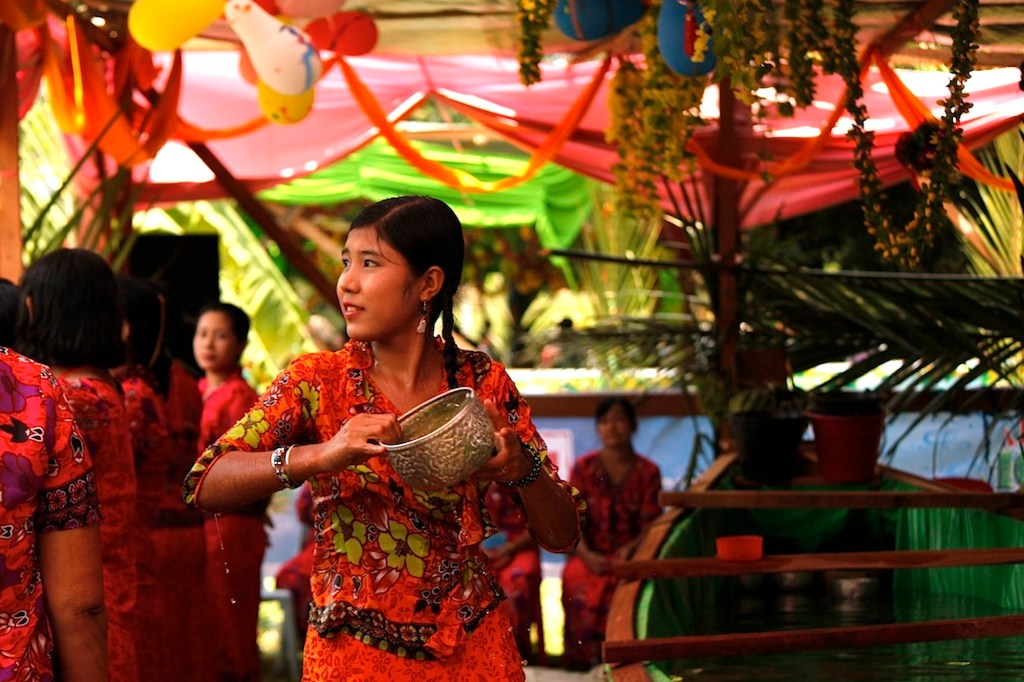
New Year arrives in some parts of Asia every April, around 13th to 15th. India celebrates new year under various names and with many different traditions –  such as Ugadi in Karnataka, Vishu in Kerala, Baisakhi among Sikhs and many more. Nepal observes Nava Varsha. Thailand celebrates Songkran, which is a bit like Holi in India as it involves water play and a bit like the Thingyan, the Myanmar New Year. Sri Lanka calls their festival Avurudu, which seems to have customs close to the Tamilian new year Puthandu or that of Karnataka. Bangladesh livens up with a national festival, called Pohela Boisakh, which is a bit different from the Polia Boisakh celebrations in the Eastern parts of India.

Intrinsic to all these is the joie de vivre of the festivities whether with water play, food, Bhangra dancing or with Rabindra Sangeet.

May we all have a glorious entry into our plethora of New Years!

Greetings again for all Asian New Years !

(Written and translated by Mitali Chakravarty)

PLEASE NOTE: ARTICLES CAN ONLY BE REPRODUCED IN OTHER SITES WITH DUE ACKNOWLEDGEMENT TO BORDERLESS JOURNAL
Click here to access the Borderless anthology, Monalisa No Longer Smiles

Click here to access Monalisa No Longer Smiles on Kindle Amazon International

Categories
World Poetry Day, 2021

Celebrating Poetry without Borders

“And as imagination bodies forth
The forms of things unknown, the poet’s pen
Turns them to shapes and gives to airy nothing
A local habitation and a name”

(William Shakespeare, A Midsummer's Night's Dream,1596)

Like clouds float, words waft through currents of ideas and take shapes and forms. We celebrate poetry across the world, across space and time, with the greatest and the new… our homage in words to the past, present and future…

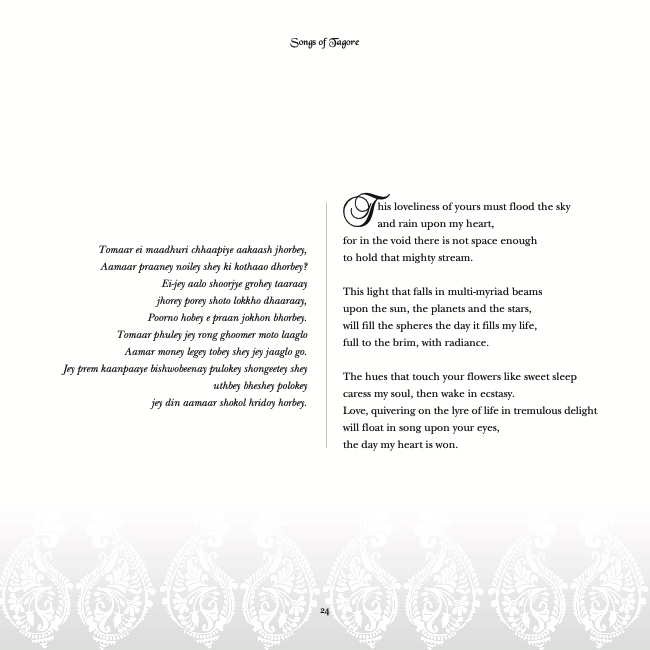
A paean to the skies, the Earth and empathy with nature sets the tone for this poetic treat. I offer you a translation/transcreation of a Tagore song, from the original lyrics penned by the maestro in Bengali…

The Star-Studded Sky  by Rabindranath Tagore

( A translation/transcreation of Akash Bhora, Shurjo Tara, 1924)

The sky replete with sun and stars, the Earth brimming with life,
In the midst of this universe, I have found my abode.
Spellbound by the plenitude, songs awaken in my being. 

The infinite, eternal waves that create planetary tides 
Resonate through the blood coursing in my veins.

As I walk to the woods, I step on the grass. 
Heady perfumes of flowers startle me into a rhapsody.
Benefactions of joy anoint the universe.

I have listened, I have watched, I have poured my life into the Earth.
Through knowing, I have sought the unknown. 
Spellbound by the plenitude, songs awaken in my being. 

(Translated/transcreated by Mitali Chakravarty on behalf of Borderless Journal,2021)

Poetry connects with eternal human emotions over space and time with snippets from old and verses from new.

Poets continue to draw from nature to express and emote. In empathy with the forces that swirl around us are poems written by moderns, like Jared Carter.

 What is that calling on the wind
           that never seems a moment still?
 That moves in darkness like a hand
           of many fingers taken chill?

(Excerpted from Visitant by Jared Carter)

Click here to read Jared Carter’s Visitant and more poems.

Tagore wrote and painted. Here we have a poem about a painting done by the poet-artist herself, Vatsala Radhakeesoon.

An endless expanse swirls
over the tropical island.
At the foot of the Meditative Mountain,
birds, bees and butterflies wonder --
who is this mystic blue?

(Excerpted from Swirling Blues by Vatsala Radhakeesoon)

Click here to read Swirling Blues by Vatsala Radhakeesoon and gaze at the painting.

Separated by oceans and decades, were poets empathetic?

I CELEBRATE myself, and sing myself,
And what I assume you shall assume,
For every atom belonging to me as good belongs to you...

The smoke of my own breath,...

My respiration and inspiration, the beating of my heart, the passing of blood and air through my lungs,
The sniff of green leaves and dry leaves, and of the shore and 
dark-color'd sea-rocks, and of hay in the barn,
The sound of the belch'd words of my voice loos'd to the eddies of the wind,
A few light kisses, a few embraces, a reaching around of arms,
The play of shine and shade on the trees as the supple boughs wag,
The delight alone or in the rush of the streets, or along the fields and hill-sides,
The feeling of health, the full-noon trill, the song of me rising from bed and meeting the sun.

(Excerpted from Song of Myself, Walt Whitman, 1881)

And despite exuberance of poets and their love of nature, came wars from across continents. Here are some of the responses of poets from all over the world to war and the pain it brings…

A soldier and a poet, Bijan Najdi (1941-1997) wrote in Persian, he captured the loss and the pain generated by war on children for us. This has been translated by Davood Jalili for Borderless

The world does not become bitter with the sword.

It does not become bitter with shooting, cries and fists.

The bitterness of the world

Is not the deer’s necks

And leopard’s tooth

And the death of a fish...

(Excerpted from Our Children by Bijan Najdi)

Click here to read Our Children by Bijan Najdi

Maybe children have a special place in poets’ hearts. Michael R Burch from across the Pacific writes of their longings too…

I, too, have a dream …

that one day Jews and Christians

will see me as I am:

a small child, lonely and afraid,

staring down the barrels of their big bazookas,

(Excerpted from I, too have a dream by Michael R Burch)

Click here to read Dreams of Children by Michael R Burch and more by him.

From Nepal, Manjul Miteri travelled to Japan to design a giant Buddha. While visiting the Hiroshima museum, he responded to the exhibits of the 1945 nuclear blast, a bombardment that ended not just the war, but many lives, many hopes and dreams… It heralded the passing of an era. Miteri’s poem was translated by Hem Biswakarma for us from Nepali.

Orimen*!
Oh, Orimen!
Mouthful of your Tiffin
Snatched by the ‘Little Boy’*!
The Tiffin box, adorned with flowers,
Scattered and spoilt,
Blown out brutally.

(Excerpted from Oh Orimen! by Manjul Miteri)

Click here to read Majul Miteri’s Oh Orimen!

Continuing on the theme of war, what can war weapons not do? Karunakaran has written a seemingly small poem about warplanes in Malayalam that embraces the nuclear holocaust and more. The words are few but they say much… It has been translated by Aditya Shankar for us.

No warplane 
has ever flown like a bird,
has lost way like a bird,
has halted mid-flight reminiscing a bygone aroma.

(Excerpted from No Warplane Has Ever Flown Like A Bird by Karunakaran)

Click here to read No Warplane Has Ever Flown Like A Bird by Karunakaran.

From wars and acquisition of wealth, grew the greed for immortality.

Aditya Shankar writes rebelling against man’s greed, greed that also leads to war.

Through the tube,

the world poured into that room

with news of war and blood.

(Excerpted from Human Immortality Project  by Aditya Shankar)

Click here to read Human Immortality Project by Aditya Shankar.

Continuing the dialogue on discrepancies is a poem written by a visiting professor from Korea. Ihlwha Choi was in Santiniketan and just like Tagore found poetry in Krishnokoli, he found poetry in Nandini…

There was Nandini’s small shop along with fruits' stalls and the bike shop.

Cows passing by would thrust their heads suddenly

Into the shop thatched with bamboo stems....

...There lived a flower-like little girl selling chai near the old house of Poet R. Tagore.

(Excerpted from Nandini by Ihlwha Choi)

Click here to read Nandini by Ihlwha Choi

Poetry is about moods — happiness and sadness, laughter and tears.

Reflecting on multiple themes that mankind jubilates and weeps about is the poetry of John Grey, camping out in Australian outbacks, revelling in the stars and yet empathising with hunger… A few lines from his poem hunger.

Hunger can sing soft but compelling

in the voice of the one who last

provided you with three meals a day.

That’s years ago now.

Hunger has no memory

but it assumes that you do.

(Excerpted from Hunger by John Grey)

Click here to read Camping out, Hunger and more … by John Grey

And now we introduce some laughter. A story-poem by Rhys Hughes, about an alien who likes to be tickled…

“Oh, tickle me under the chin,
   the chin,
 please tickle me
 under the chin.
 It might seem quite fickle
 or even a sin
 to make this request,
 to ask such a thing,
 but I must confess
 that to ease my distress
 there’s nothing so fine
    as a tickle.
 So please tickle me 
 under the chin,
    the chin.
 Tickle me under the chin.” 

(Excerpted from The Tickle Imp by Rhys Hughes)

Click here to read The Tickle Imp by Rhys Hughes

And here is a poem by Tamoha Siddiqui, jubilating the borderless world of friendship.

Yesterday I heard the sound of colourful feet

to Indonesian beats, in the middle of Michigan:

white, black, brown, all were one

pitter-patter paces in a conference hall.

(Excerpted from Birth of an Ally by Tamoha Siddiqui)

Click here to read Tamoha Siddiqui’s Birth of an Ally

We share with you now from the most unusual poetry we have on our site, from a book called Corybantic Fulgours. If you want to know what it means, click here to check it out!

Concluding our oeuvre to jubilate a world without borders, here are lines from a poet who probably has influenced and united majority of writers across the world…another truly universal voice.

Time present and time past
Are both perhaps present in time future,
And time future contained in time past.
If all time is eternally present
All time is unredeemable.
What might have been is an abstraction
Remaining a perpetual possibility
Only in a world of speculation.
What might have been and what has been
Point to one end, which is always present.
...
The dance along the artery
The circulation of the lymph
Are figured in the drift of stars
Ascend to summer in the tree
We move above the moving tree
In light upon the figured leaf
And hear upon the sodden floor
Below, the boarhound and the boar
Pursue their pattern as before
But reconciled among the stars.

Excerpted from TS Eliot's Four Quartets, Burnt Norton(1936)

The poetry of the historic greats are all woven by eternal threads that transcend man made boundaries. They see themselves almost as an extension of the Earth we live. Tagore, Whitman and Eliot write of the universe coursing through their veins. Shakespeare gives the ultimate statement when he brings in the play between imagination and nature to lift the mundane out of the ordinary. With inspiration from all these, may we move into a sphere, where poetry not only moves but also generates visions for a more wholistic and inclusive future.

.

PLEASE NOTE: ARTICLES CAN ONLY BE REPRODUCED IN OTHER SITES WITH DUE ACKNOWLEDGEMENT TO BORDERLESS JOURNAL
Categories
Editorial

Happy Birthday Borderless Journal🎉

A huge thank-you to all our contributors and readers across the world.

Borderless Journal has contributors from all the marked areas in the world map.

Borderless Journal was launched on March 14th, 2020, exactly one year ago, with eight published pieces from four countries. Today, we celebrate our journal’s year-old existence with more than six hundred publications online from 31 countries across the world. All this would not have been possible without the commitment of some very gifted writers. So, we have made a couple of additions to our ‘About Us’ — Writers in Residence and the Children’s Section Facilitator. We did this to express our gratitude to these excellent writers and the Children’s Section Facilitator, Archana Mohan of Bookosmia, for contributing pro bono to Borderless, selflessly and generously with words that enriched our journal. We plan to continue pro bono with goodwill as our only profit, giving our readers free, unpaid, advertisement-free access to excellent works.

In this first year, not only has our content grown but we have moved forward in our attempt to be a repository of quality writing in the virtual world. Translations of greats like Saratchandra Chatterjee, Tarashankar Bandopadhyay, Rabindranath Tagore, Bijan Najdi, Syad Zahoor Shah Hashmi and Nabendu Ghosh nestle along with writings by the moderns. We have published works by winners of the Sahitya Akademi award and the Pushcart along with that of novices. Our oldest contributor was born in 1924 and the youngest, in our young persons’ selections, was four years old.

Values and issues taken up by writers across time have often been similar. At Borderless, we look for writing that breaks borders, not so much of techniques but of issues that affect our civilisation. We want to create a flood of positive values that will deluge the world’s negatives, help to usher in an era of development, tolerance, love and peace. We are often told that this is unrealistic. But when have ideals and utopias ever been based on realism? And yet they changed the world over a period of time. We would not have the wheel or the fire if cave dwellers had not imagined them.  Borderless hopes to walk untrodden paths. Our journal also aspires to respond to the calls made by youngsters for a better Earth, to explore and store samples of human excellence for posterity, and to support attempts to improve the future of our species.

As a part of our celebrations, we are also announcing two books, constructed with selected content from Borderless. Bookosmia is bringing out a book from the children’s section, thanks to both Nidhi Mishra and Archana Mohan. For our adult contributors and readers, we are also announcing a second book stocked with some of the gems we have collected over the year. We are in conversation with a publisher. Once that is finalised, we will announce the book on social media.

This month, we had given the theme of ‘as mad as a March hare’ and aliens were invited to contribute. That resulted in some fantastic poetry from Rhys Hughes and Vatsala Radhakeesoon and also from one of our Contributing Editors, Michael R. Burch. Rhys has given us a funny story poem about an alien who tickles our sensibilities. Our poetry section only improves with Michael’s touch. We have poetry again from Pushcart winner Jared Carter, Tom Merrill, Ihlwa Choi, and new writers like Vijayalakshmi Harish and Shraddha Arora.

We carry a translation of a well-known poet from Nepal, Krishna Bajgai. Aditya Shankar translated a Malayalam poem about violence against women by young Krispin George. It is a powerful poem and an excellent translation that sets the tone for the month hosting the International Women’s Day. That the protest is voiced by men is also significant, especially in a world where margins need to blend into a single united shout against all injustices. While the poem critiques a crime, the translated prose shows how despite violations and oppressions, humankind have progressed.

A short story by Tagore’s sister, Swarnakumari Devi (1855-1932), one of the first female editors of the Tagore family journal and one of the earliest progressive women of the nineteenth century, has been translated by Chaitali Sengupta. Juxtaposed to the story by Swarnakumari Devi which was perceived as an act of defiance against the voicelessness imposed on women in a patriarchal set up, we have an unusual reflection translated by the noted filmmaker and journalist, Ratnottama Sengupta. Written in Bengali by Sandhya Sinha (1928-2016) the piece, while being an in-depth analysis of Arabian Nights, is an emphasis on how women progressed within the century to become independent, intellectual, thinking entities beyond the bounds set on them by outmoded norms. Thus, while the prose showcases how much women have progressed, the poetry contribution by young Krispin George and Aditya Shankar reflects how men and women are now united in their struggle for justice. We have indeed come far from the biases inherent in Rudyard Kipling’s poem, ‘Mandalay’, which was written after Swarnakumari Devi had already started writing and working against such divisive mindsets. Historically, we have moved forward.

A literary essay by Mike Smith tries to explore a new paradigm. He ponders if a short fiction by the first émigré Nobel Laureate from Russia, Ivan Bunin, could have been a precursor to flash fiction. We have experimented with a photo essay by Penny and Michael Wilkes. Some lovely photographs of the sea can also be found in the slice of life sent to us from Australia by Meredith Stephens. In Travels with the Backpacking Granny, Sybil Pretious takes the readers to the slopes of the Kiliminjaro with her 63-year-old self. Devraj Singh Kalsi in Musings of the Copywriter gives us his perception of creativity and madness – which you might say go hand-in-hand when you think of Vincent Van Gogh cutting off his ear and F Scott Fitzgerald who along with his wife, Zelda, suffered from depression. Kalsi gives the subject a satirical twist to explore if insanity can be substituted as medals of honour by a writer instead of ‘bits of metal’ that subscribe to more conventional concepts of fame and sanity. It is a fun read!

One of my favourite essays is by Debraj Mookerjee, who has shown how when West meets East, greatness blooms. He takes on giants like Tagore, Tolstoy, Emerson and many more. Reflecting the thoughts of one of these giants mentioned in the essay, is a book on the socio-political thoughts of Tagore where the author, Bidyut Sarkar, who is also the Vice Chancellor of Vishva-Bharati University and an erudite scholar, states: “Tagore stayed away from the hurly-burly of national politics. Despite sharing the nationalistic condemnation of the colonizer, Tagore never allowed this restrictive vision to cloud his concern for human emancipation.” Bhaskar Parichha has done an excellent review of the book.

Sutputra Radheye’s poetry collection from the Delhi Slam has been reviewed by Rakhi Dalal and Suzanne Kamata’s Indigo Girl has been reviewed by Gracy Samjetsabam. Indigo Girl is a novel that breaks cultural borders and norms to find love through a part-Japanese-part-American’s journey, with lessons learnt from a survivor of the Tohoku Tsunami in March 2011, where more than 15,500 died, a disaster that also led to the Fukushima nuclear plant melt down. The economic losses were estimated at $235 billion and people continue to be impacted by the decade-old disaster to this date. Indigo Girl, thus, is a celebration of mankind’s survival against multiple odds. It builds bridges across differences and disasters, a story of hope and friendships, values cherished in a borderless world.

We have an interesting excerpt from a book I really enjoyed, a collection of short stories that challenge man-made constructs, A Sense of Time and Other Stories. The author whom we interviewed, Anuradha Kumar, has 31 books with publishers like Hachette India to her credit, plus two Commonwealth awards and more. The other interview also stretches geographical bounds drawn by politicians. An American translator who lives in Thailand and translates from Japanese to English, Avery Fischer Udagawa, speaks to about her journey. Finding literature and bridging borders with translations is a recurrent theme in Borderless.

A number of stories that again look for the unusual can be found in this issue. I would like to mention an interesting one from Jessie Michael of Malaysia exploring blind beliefs, ‘Orang Minyak or The Ghost‘, while Sunil Sharma gives us a story that I will let you explore yourself. Sara’s Selections, showcasing a selection of writing from Bookosmia, adds to our oeuvre.

As usual, I have mentioned a few but not all of our content, which remains tempting.

I hope all of you will continue to enhance our writing and publishing experience by patronising our site and reading us regularly. Please do share our posts with your friends and family. We continue a family-friendly journal.

Again, a huge thanks and warm congratulations to the Borderless team and to all our fabulous contributors. We value each one of your pieces. Thank you.

To all our readers, welcome to our world and thanks for being with us and inspiring us to aspire for more. We have readership from more than 130 countries across the world.

Looking forward to the next lap of our journey –

Mitali Chakravarty

Borderless, March, 2021

Borderless Journal is read in more than 130 countries across the world.
Map Courtesy: WordPress
Categories
Review

Ray’s Goopy Bagha Revisited

Book Review by Nivedita Sen

Title: The Adventure of Goopy the Singer and Bagha the Drummer

Author: Upendrakishore Ray Chowdhury, translated from Bengali to English by Tilottama Shome. Illustrations by Sayan Mukherjee.

Publisher: Talking Cub, an Imprint of Speaking Tiger Books, 2020.

Upendra Kishore Ray Chowdhury’s name was well-known as an innovative children’s writer, painter, musician, photographer and a pioneer printer-publisher in the late nineteenth century. His grandson, Satyajit Ray, immortalized his long short story for children ‘Goopy Gyne Bagha Byne’ as a reputed film that deployed a lot of music, dancing and fantasy elements.

This graphic version of the story, particularly its musical score that was penned and directed by Satyajit Ray himself, had almost obliterated the children’s tale that was a household word in Bengal earlier. Since it is a story about two naïve, rustic boys who desperately try to be a singer and a drummer respectively, Satyajit Ray worked on and elaborated the musical potential of the story by writing lyrics for songs that could be sung by Goopy, with Bagha’s drumming as accompaniment. The songs like Dekho re Nayan Mele ( Opening Your Eyes and Look), Bhuter Raja Dilo Bor (The King of Ghosts Grants a Wish) and Maharaja Tomare Selaam (Salute to you Maharaja) have been all time favourites for the last fifty years. The two sequels to the film, Hirak Rajar Deshe (Hirak King’s Kingdom) and Goopy Bagha Phire Elo (Goopy Bagha Return) were written by Satyajit Ray himself, although the latter was directed by Ray’s son Sandip Ray. The innocuous Bengali story therefore surfaced on the celluloid screen, and then extended through sequels to follow the adventures of Goopy and Bagha through time.

The status of an internationally acclaimed film also enabled the story to traverse across space by getting translated in different languages, particularly English. Among recent translations are those by Swagata Deb (Penguin, 2004) and Barnali Saha (Parabaas, 2012). Perhaps in order to communicate a different tone and emphasis, in this one, Tilottama Shome took up another translation. She has stuck to each and every word of the original. Although Upendrakishore’s stories have been translated by well-known scholars, editors and translators like William Radice, Madhuchhanda Karlekar and Arunva Sinha, this translation is also very fluent. The use of casual vocabulary in English that is used on a daily basis, like ‘vocal warm-ups’, ‘country bumpkins’ and ‘spooked’, add to the readability of it. The illustrations by Sayan Mukherjee, which include a lot of the ghosts, is brilliantly evocative of the ghostly fun and frolic in Ray’s film.

The story, which is something between a folk tale, a benign ghost story and a fantasy around a realistic setting with two ingenuous protagonists, has many violent episodes. Most of Bengali children’s folk-fairy tales like those in Dakshina Ranjan Mitra Majumdar’s Thakurmar Jhuli portray such unpleasant interludes, which is not different from Grimms’ or Hans Andersen’s Fairy Tales depicting brutal human behavior and blood and gore. Such violence and deaths go back to the earliest children’s stories, possibly to equip children with the overpowering truth that is an important, if an unsavoury, aspect of life. The violence becomes an indispensable component of children’s stories, since children need to be aware of what they might confront in the real world.

Bruno Bettelheim, a psychologist who tried to read fairy tales in terms of Freudian psychoanalysis, said that children need to be exposed to fairy tales with grim episodes in them. He demonstrated that these dark happenings, fantastic as they may be, expose and initiate the child to real life that is inclusive of the ruthless and the arbitrary and contribute to children’s holistic understanding of life. In this story, when Bagha goes home, he finds that his parents have died in the interim he was away. Goopy’s parents remain alive, perhaps to signify that deaths in real life are ubiquitous, imminent but random. But there is greater cruelty than death in children’s stories.

According to Ernest Jones, Sigmund Freud’s biographer and a psychoanalyst in his own right, the savagery in children’s stories represents expressions of the unconscious mind like the jealousy and hostility inherent within family relationships. He elaborated how abstract moral concepts like anger, fear and guilt are ‘physicalized’ and ‘externalized’ in children’s tales to enable children to conquer them. Also, after acknowledging these harsher primal feelings and instincts, the child gets to make sense of what is happening all around.  Goopy and Bagha’s boat loses balance and capsizes due to their cacophonous singing and drumming, causing the passengers to tremble and roll around. This drowns and kills all the passengers except the two of them who are also terrified but keep afloat by clutching on to Bagha’s drum. But Gidwitz, a twenty first century children’s writer, explains how violence is deployed as a didactic tool to reinforce the moral certainty of good triumphing over evil, which must be punished. For example, in another episode where the garden house of the king is burnt down by the guards in accordance with royal injunctions, everyone who was responsible for proactively setting fire to the house dies but Goopy and Bagha, who are inherently good,  escape with the help of their magic boots.

Goopy Gyne is also a ghost story with a difference. Ghosts appear in such a story within a realistic backdrop, not by invoking them or within a supernatural setting, but out of the blue. They also do not haunt an individual human being, a particular place/ house or a specific object, and are therefore aliens who are removed as suddenly as they appear from the forest in which they are discovered, after they have performed their task. They are not characters who take part in the narrative.

Goopy and Bagha initially get panic-stricken on seeing the glowing eyes of the ghosts that are like burning coal and their radish-like teeth. However, these are not the spirits of the dead that have revived to take revenge or to try to fulfill their unfulfilled desires in life. These ghosts continue to act as external agents who empower the two friends, much like the fairy godmothers in fairytales who grant boons to the protagonists and rescue them from perilous situations.

The terror that these ghosts have the potential to invoke is one that instead becomes a pleasant experience because Goopy and Bagha learn very soon that these spirits are extremely generous. The film is also enlivened with the scene with the ghosts. The narrative describes a curious reversal in which Goopy and Bagha are themselves mistaken as ghosts, thanks to all the miraculous scenes associated with their magical powers.  But their achievement of raining delicacies and sweets, their accoutrements in looking like princes or the magic episodes of the two friends fleeing from any difficult situation with the help of their enchanted boots is actually an outcome of the three wishes granted to Goopy and Bagha by the ghosts. The ghosts are responsible for bestowing melody and rhythm to Goopy and Bagha’s music that used to be tuneless, jarring and noisy before.

The music in the story is wholly their contribution, something that has been underscored by Satyajit Ray in delightful compositions in the film. It might, in fact, be a pioneering enterprise, copyright permitting, to translate the screenplay that includes the songs.

Nivedita Sen is Associate Professor in English at Hansraj College, University of Delhi. She works on Bangla children’s literature, and has translated authors like Tagore, Sukumar Ray, Asha Purna Devi, Leela Majumdar and others for Harvard University Press, Vishwabharati Press, Sahitya Akademi, Katha, Tulika and more.

.

PLEASE NOTE: ARTICLES CAN ONLY BE REPRODUCED IN OTHER SITES WITH DUE ACKNOWLEDGEMENT TO BORDERLESS JOURNAL. 

Categories
Essay

Pandemic and Poetry: How Writers in Pakistan react to COVID-19

By Dr Aftab Husain

There is a proverb in Persian and Urdu that could be roughly translated thus — ‘A collective death has an air of festivity’. The great Urdu poet, Ghalib, however, would have not subscribed to this notion as was made evident from an episode in his personal life. Once afflicted by his financial and existential miseries, he had foretold his own death the following year. There broke out in the given year an epidemic that claimed many lives in the city, but luckily our poet survived. When asked later about his prognostication, Ghalib replied with a tinge of humour that his forecast had been accurate, but it would have degraded him to die a common death, therefore, he held himself back.

This could be seen as a hyper-individualistic thought process of a genius poet which was ultimately reflected in his poetry. But common human beings think differently. The line of wisdom that the proverb at the starting of this essay conveys does not in any way celebrate death, but our collective, gregarious nature. It is a strange fact of human existence that a catastrophe unites people more than a festivity.

World literature, as many of us know, is replete with the examples of writing inspired by or dealing with different catastrophes; draught, floods, different types of epidemic: plague, cholera, influenza etc. The Plague by Albert Camus (French), Love in the Time of Cholera by Gabriel García Márquez (Spanish) and Blindness by José Saramago (Portuguese) – incidentally all three written by Nobel laureates – immediately come to mind.  

Rabindranath Tagore’s long, descriptive poem: ‘Puratan Bhritya’ (Old servant) – ‘Keshta, old manservant of mine’, stemmed from smallpox.  In a few short stories by Premchand, the founding father of Urdu and Hindi fiction there appears pestilence – albeit as subtext. In ‘Idgah’ (mosque), the child protagonist lost his father to cholera. Similarly, in ‘Doodh Ka Daam’ (price of milk), one character dies of plague. Famous Urdu and English fiction writer Ahmad Ali who is known to the Urdu world as one of the contributors to Angaaree (The Burning Coals) an anthology of mainly short stories that had stirred the somewhat stagnant waters of the then Urdu literature, ventured into this area with his maiden novel in English. Ahmad Ali’s novel, Twilight in Delhi, offers a bleak and pathetic picture of the city in the wake of an epidemic. ‘How deadly this fever is. Everyone is dying of it. The hospitals are gay and bright. But sorry is men’s plight’.

Rebati, a well-known short story by Fakir Mohan Senapati, one of the pioneers of modern Odia literature depicts a village hit by a cholera epidemic. The list is endless, but so far Urdu literature is concerned, ‘Quarantine’, a poignant short story by Rajinder Singh Bedi presents a detailed and exclusive description of the life affected by plague and also of quarantine as the title of the story also indicates.

Human beings in the long span of their history have been going through many different epidemics, but the present one is unique in that it has not only affected different strata of society, it has also had a global outreach. With bated breath, we watch the movement of this pandemic that has paralysed social life. Nevertheless, health-care workers, scientists, politicians, policy makers, psychiatrists, media persons and many other groups are actively working to finding a solution to the problem or at least curb its growth.

People from art and literature too are responding to the disease in different ways. Pakistani writers, especially poets, have profusely responded to the situation.

One interesting fact that one notices is in the word ‘corona’, that is, we know, a noun but when spelt out in Urdu-Hindi it makes a full-fledged meaningful phrase: ‘Don’t do.’ Resultantly, one observes a lot of versifications exploiting this pun – albeit major and established poets have shunned this facile jugglery. Barring this word play, poets who have chosen to write in a lighter vein seemingly have set their comic spirit to work as a defence mechanism to make the grave situation a little less intimidating. For example, a poem entitled as ‘Thanks’ by a senior poet Tahir Sherazi argues that this compulsory restriction that confines us to our home places might provide us an opportunity to repair our broken relationships with our family members. The poems ends on a jubilant note on acquiring the newly-gained leisure in this way: ‘My wife will make a cup of tea for me and I will write poems on roses, lamps, on the earth and the heaven’. Well, the male poet is scheming of enjoying this free time at his will while his spouse will be doomed to carry on with her routine domestic chores. This aspect does make this otherwise light poem somewhat pathetic.

Poets with a religious sensibility see this development as sort divine wrath and put forward their sentiments either in direct prayers or by employing religious terminology. ‘A Dialogue with God in the Days of Epidemic’ by Najma Mansoor, and ‘In the Days of Epidemic’ by Safia Hayat, are both of this vein. But, in major and significant poets you find no direct recourse to divine powers or holy personages, but only a thin, veiled religious consciousness.

‘God Smiles in Their Eyes’, a poem by Ali Muhammad Farshi, a senior poet, pays tribute to the life-saving endeavours of a nurse who had wrenched back a bride from the clutches of death. Quite pertinently, the poet invokes figures of Mary and Christ, the messiah, and despite having no apparent reference to corona the poem provides a penetrating presentation of the present state of affairs. ‘God, Epidemic and Human Beings’ by Jameelur Rahman is also a poem sprinkled with religious diction, but its overall philosophical tone saves the poem from becoming mere-lamentation of a pious soul caught in an unbearable suffering.

However, Maqsood Wafa altogether rejects the role of religion in such a dreadful disease as he puts it in the closing lines of his poem, ‘The Captive Days’: “I will listen to the Prime Minister’s speech/And I won’t be able to make the people of this holy land understand/that when a virus attacks a human being/It doesn’t ask the name of his god”.  Almost similar is the tone in Saqib Nadeem’s poem: “We Don’t Accept (The Poem of A Petty Sentimentality)” where the poet lashes at the shallow and hypocritical religious community. “After every prayer we embrace and congratulate each other on being alive and we trade in kisses, (but) we don’t hear screams of virus in our kisses”.  

Then, there is a group that believes that one can with the power of love conquer this monster. ‘An Innocent Poem’ by Parveen Tahir speaks about the wishes of its female protagonist – a lover – who kisses her lover and dines with him in the naive expectation that the disease will at least spare those who are in love. Seemab Zafar’s ‘One Erects Love with the Bricks of Affliction’ does not offer such optimism but presents a desolate scenario – within and without. ‘On Death Bed’ by Fatima Mehru juxtaposes among the triad of love, disease and death. It is soulful poem that vacillates between life affirming spirit of love and that of despair.  Some poems in this category remind you Márquez’s Love in the Times of Cholera – at least title of the novel which is quite a popular book. Khumar Meerzada’s two short and impressive poems ‘Love in the Days of Epidemic’ and ‘Love and Epidemic’ show how love act in front of such a fatal malady.  Iftekhar Bukhari’s ‘We Descends from One Father’ does not lose touch to the ground reality, yet it rises up to the lofty human bonds. “We will not shake hands/This is time that we united our heart….Without urgent needs we will not leave our house/In order that roads, fields and gardens are again full of life…./If needed, we will go and die in a silent corner/So that the earth might echo with songs, even after our departure.” A powerful poem, indeed!   

Arshad Latif took a different, cynial and somewhat callous stance towards the given grave situation. “We couldn’t control our inhuman impulses/And our negative thoughts took us far away from the life itself…We, you and some others proved a total failure…./Embrace death willingly so that souls of us, yours and some others could bequeath peace”. (‘The World Wants A Cure’).

Whereas Salmat Sarwat’s ‘Quarantine No 1’ portrays the ennui spawned by an ever-spreading leisure and the resultant disinclination to write further, Gulnaz Kausar’s ‘Precaution’ is composed in the poet’s typically soft and feminine style. Her diction and her treatment leave, despite the morbid subject of the poem, a soothing effect on the reader. 

At least two other poems: ‘Quarantine’ by Irfan Sadiq and ‘Seventh Day in the Quarantine’ by Omer Aziz, take not only the term of quarantine in their titles, but they revolve around this trope.  Aziz, a doctor by profession, has quite effectively captured the physical affliction and mental agony of a patient put in quarantine.

Alongside such poems, there is a wide circulation of individual ghazal couplets: the two liners that quite succinctly sum up the general mood about the epidemic. Most of these small pieces, for their overflowing sentimentality or sheer propaganda do not have much appeal. Yet, a few of them not only hit the bull’s eye, but they do not veer away from the aesthetic requirement of a piece of literature.

Afsaos, Ye Wabaa Ke DinoN  Ki MohabbateN

Ik Doosre Se Haath Milaane Se Bhi Gaye

(Sajjad Baloch)

Alas, these love affairs in the days of epidemic!

Even shaking hands with each other is rendered hard

*

Har Taraf Aisii Khamoshii Hay Ki Sar Ghoomta Hay

Log Pahre MeN HaiN Aur GalioN Men Dar Ghoomta Hay

(Seemab Zafar)

A terrible hush rules all over and makes you feel giddy

Human being caught in the custody

While a certain fearfulness prowls in the streets

*

Ajeeb Dard Hay Jis Kii Dawaa Hay Tanhaaii

Baqaa e Shahr Hay Ab Shahr Ke Ujadne MeN

(Mahmood Shaam)

What a weird malady is it whose cure lies in solitude!

Now the survival of the city is in its depopulation.

Thus, we see that an overwhelming response to the pandemic came from our poets. As for prose, though in general there are a plethora of pieces written on the subject, that is,  journalistic writing, but quite rarely one comes across relevant fiction, fictional narrative or imaginative prose. Justifying this comparative absence fiction writer M Hameed Shahid says: “Poetry might be composed in reaction to a happening, for fiction that is not enough. Fiction needs something more to build up its aesthetics,” he adds. Well, our writers writing on the communal riots in the wake of the Partition of India in 1947 did produce literature in reaction to these events, though such literature was, to be sure, not created while the riots were still taking place.  M. Hameed Shahid is therefore in favour of waiting and seeing and letting his experience take a mature form, so he stayed away from offering something half-backed in fiction. Nevertheless, he has come forward with a non-fictional narrative: ‘Epidemic Days, Closed Door & Deserted Street’ – a sort of chronicle-narrative and despite its excessive self‐referentiality, the write up is interesting in the sense that it, at least, introduces us to the disquiet and anxieties of a writer finding himself in the midst of a prison-like claustrophobic confinement.  

Meanwhile, another fiction writer who has given a clarion call to his colleagues and urged them use their pens in dispelling the gloomy atmosphere created by the disease is Amjad Tuhfail. He was, however, snubbed by a senior short story writer declaring that any such move was to yield nothing but slogan-mongering that jump on the bandwagon could bring out only ‘faction’ and in no way any genuine fiction. A Lahore based short story writer, Tufail, did not take this warning seriously and immediately posted a three-page short story in a social-media outlet. Jabir Ali Syed had once called Shamsur Rahman Faruqi known as the  “the impetuous critic”. The gentleman story writer might be no match for Faruqi, but he shares, at least, this quality with his senior contemporary.

As a saving grace to this discouraging deficiency in prose, comes an English write-up, “Something’s not right with the world”, from Farah Zia. The small item that the writer prefers to call “a mood piece” appears like a free stroke by some accomplished painter: laconic, telling and powerful. “It is like waking up every day into a dream: in a place where life imitates fiction” thus begins the write up. Written with profound concern, yet at the same time, with a cold objectivity, it makes a serene and soulful reading. No wonder, the piece was quickly rendered into Urdu and published, but one wonders if such a deeply-felt prose could be translated without losing much of its essential charm and pathos.

Closing the deliberations one can say that each piece that is being written in the name of literature cannot be, quite naturally, up to the literary mark – let alone to be remembered by posterity. Most of these writings fall into the category of pièce d’occasion. But such pieces, occasioned by certain events sometimes transcend the given situation and live on, beyond the time of their creation. Some of the given stuff has remarkable literary value and therefore it might survive longer; the other ones might not be fortune enough, but the fact remains that they too bear a witness to a momentous phenomenon in human history and have transcribed these times on the climate of our minds.

Aftab Husain (Pakistan/Austria) is an eminent name in modern Ghazal poetry from South Asia. In addition to Urdu, he writes in English both poems and literary essays and translates from German to Urdu and vice versa. He earned his doctorate in comparative literature from Vienna University where he teaches South Asian Literature and Culture. He has four collections of poetry and three of books of translations – from German into Urdu – to his credit. He was a fellow of Heinrich-Böll-Haus, Germany as well as the ‘Writer of Exile’ of Vienna City. His poems have been translated into many languages. He is a member of the Austrian PEN and co-edits a bilingual magazine – Words & Worlds –  for migrant literature.

Categories
Musings

The Dawning of a New Era

By Mitali Chakravarty

More than a century ago Tagore wrote a song:

Kothao amar hariye java nei mana, mone, mone

Translated it stands, I can get lost anywhere within the infinite of my mind (imagination).

Time has come that we put his suggestion to test.

Though we are all torn by the isolation that battling COVID-19 demands, we still have a huge thing which we did not in the past, a thing that helps us all connect — the internet. While the educated stay connected, using social media and email, there will be many under isolation who will not have the skill sets to reach out, either due to lack of internet or due to the inability to write. There are countries like Singapore, where this is not an issue — but there is still a large population out there who cannot connect, who will be told by their community leaders that they need to remain isolated. Will that be a possibility? What about the homeless? What about those who do not have a clean potable water supply? What happens to them?

One thing that the tiny virus, which we cannot see with our naked eyes, has taught us is that mankind in its suffering cannot be bordered by economic, religious, cultural or political boundaries. As we all stand, in isolation, willing or unwilling to take up cudgels against a virus that has forced us to disturb, break and destroy the tenor of our lives, perhaps the time has come to assess our blessings.

Today, the fact that you are reading this means you are connecting with the internet and can read. You are connecting with my ideas, with my thoughts. We belong to the privileged few who can soar with internet and our imaginations. We have a home and hearth. We are educated and have enough to eat. We can afford to be kind and merciful to others.

The factory smoke has largely got silenced — even if temporarily. That means the air is getting cleaner. I can see more birds fly in the sky, bluer skies and hear bird calls. Perhaps, the Earth will stretch out in languor and awake from COVID19, a healthier and greener planet.

As I see the visa exempt, borderless virus roam the world, I am reminded of  Sir Arthur Conan Doyle’s novel, The Poison Belt (1913), where the whole of mankind loses a day as our planet passes through Ether, and then wakes up as the Earth emerges out of the sleep inducing belt of the ‘poisonous’ gas. Will such a thing happen? Will we wake up and see the corona disappear one day?

Probably not, given that we have already diagnosed the virus. But, when you think of it, mankind has been through so many pandemics and has continued to thrive.

Perhaps, the tiny virus has taken on more than it can digest. Each time, mankind emerged a winner, they had a better life. After the Great Plague that wracked Europe from 1348-1350, came a jubilant Renaissance with Leonardo Da Vinci, Botticelli, Michelangelo, Christopher Columbus and Galileo Galilei celebrating the wealth of human development.

Then there was small pox, which was introduced among Native Indians and Mexicans in the fifteenth century by Conquistadors, and was completely eradicated after two centuries; cholera, which continues to assail some countries and many more such diseases. Mankind battled these and emerged victor into a better equipped world.  

This time, the pandemic is more widespread because we are living in a more connected planet. Is that such a bad thing? We do not really want to live like the hermaphrodite humans in Isaac Asimov’s Solaria, where mankind is served by robots alone on a solitary planet and they never meet other humans. But a temporary and intelligent isolation can teach the little virus that for all its virulence, it cannot destroy mankind. This is just a temporary measure, a temporary gesture to help mankind move into a better world. We will have to reorganise our way of life, our tenor of existence. Given the climate, economic and political issues our planet faces, this may not be such a bad thing!

After all, twentieth century guru, Yuval Noah Harari in his recent article in Financial Times, concludes: “Humanity needs to make a choice. Will we travel down the route of disunity, or will we adopt the path of global solidarity? If we choose disunity, this will not only prolong the crisis, but will probably result in even worse catastrophes in the future. If we choose global solidarity, it will be a victory not only against the coronavirus, but against all future epidemics and crises that might assail humankind in the 21st century.”

And I would like to agree with Harari as he says with conviction: “Yes, the storm will pass, humankind will survive, most of us will still be alive — but we will inhabit a different world.”

Let us look forward to the dawning of that new world.

Mitali Chakravarty is a writer and the founding editor of borderlessjournal.com.