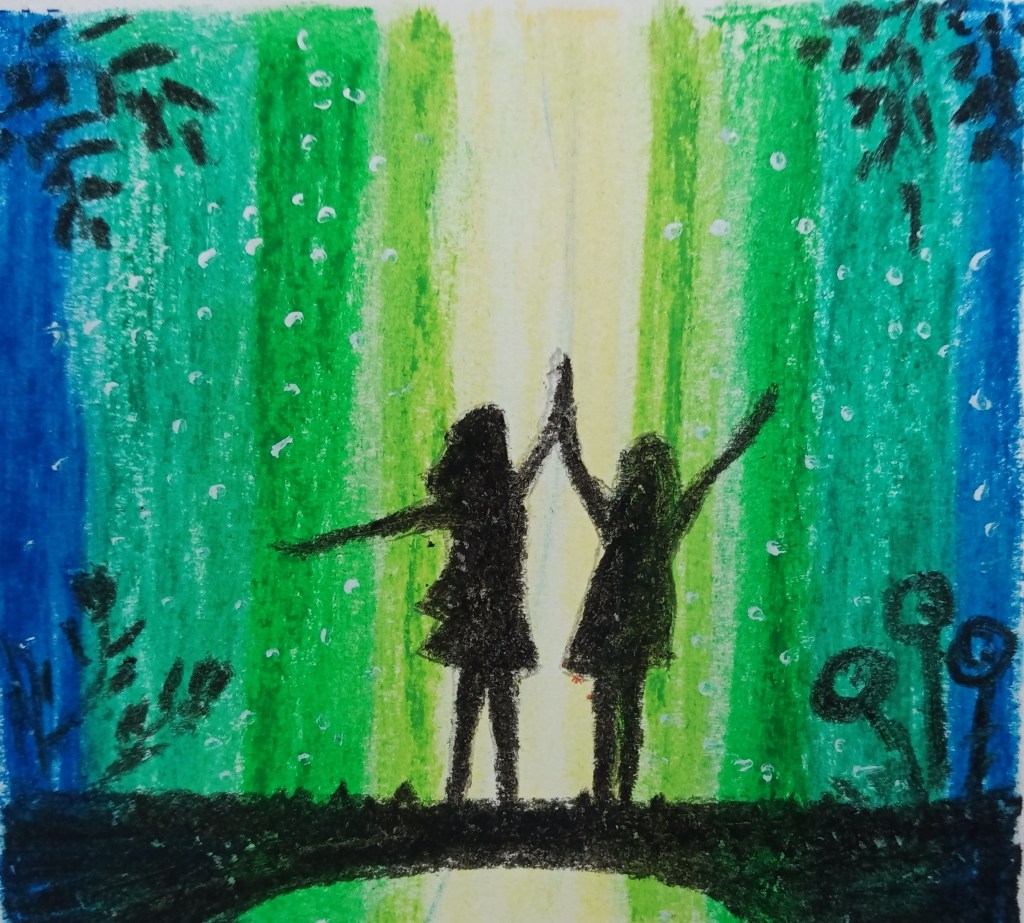
Art by Sophia P, CypressArt by Hugo A, Quezon CityFrom Public Domain
In 1985, famous artistes, many of whom are no longer with us, collaborated on the song, We are the World, to raise funds to feed children during the Ethiopian famine (1983-85). The song was performed together by Michael Jackson, Willie Nelson, Bob Dylan, Ray Charles, Diana Ross, Stevie Wonder, Smokey Robinson, Paul Simon, Tina Turner, Dionne Warwick, Lionel Richie, Billy Joel and Bruce Springsteen. The producer, Julia Nottingham, said: “It’s a celebration of the power of creativity and the power of collective humanity.” The famine was attributed to ‘war and drought’.
Over the last few years, we have multiple wars creating hunger and drought caused by disruptions. Yet, the world watches and the atrocities continue to hurt common people, the majority who just want to live and let live, accept and act believing in the stories created by centuries of civilisation. As Yuval Noah Harari points out in a book written long before the current maladies set in, Homo Deus (2015), “…the stories are just tools. They should not become our goals or our yardsticks. When we forget that they are mere fiction, we lose touch with reality. Then we begin entire wars ‘to make a lot of money for the corporation’ or ‘to protect the national interest’. Corporations, money and nations exist only in our imagination. We invented them to serve us; why do we find ourselves sacrificing our lives in their service?”
What Harari says had been said almost ninety years ago by a voice from another region, by a man who suffered but wrote beautiful poetry, Jibanananda Das… and here are his verses —
“The stories stored in my soul will eventually fade. New ones— New festivals—will replace the old — in life’s honey-tinged slight.”
We carry the poem in this issue translated by Professor Fakrul Alam, lines that makes one dream of a better future. These ideas resonate in modern Balochi poet Ali Jan Dad’s ‘Roll Up Not the Mat’ brought to us in English by Fazal Baloch. Korean poet Ihlwha Choi’s translation takes us to longing filled with nostalgic hope while Tagore’s ‘Probhat’ (Dawn) gives a glimpse of a younger multi-faceted visionary dwell on the wonders of a perfect morning imbibing a sense of harmony with nature.
“I feel blessed for this sky, so luminous. I feel blessed to be in love with the world.”
Starting a new year on notes of hope, of finding new dreams seems to be a way forward for humanity does need to evolve out of self-imposed boundaries and darknesses and move towards a new future with narratives and stories that should outlive the present, outlive the devastating impact of climate change and wars by swapping our old narratives for ones that will help us harmonise with the wonders we see around us… wonders created by non-human hands or nature.
We start this year with questions raised on the current world by many of our contributors. Professor Alam in his essay makes us wonder about the present as he cogitates during his morning walks. Niaz Zaman writes to us about a change maker who questioned and altered her part of the world almost a century ago, Begum Roquiah. Can we still make such changes in mindsets as did Roquiah? And yet again, Ratnottama Sengupta pays homage to a great artiste, filmmaker Shyam Benegal, who left us in December 2024 just after he touched 90. Other non-fictions include musings by Nusrat Jan Esa on human nature contextualising it with Milton’s Paradise Lost (1667); Farouk Gulsara’s account of a fire in Sri Lanka where he was visiting and Suzanne Kamata’s column from Japan on the latest Japanese Literary Festival in the Fukushimaya prefecture, the place where there was a nuclear blast in 2011. What is amazing is the way they have restored the prefecture in such a short time. Their capacity to bounce back is exemplary! Devraj Singh Kalsi shares a tongue-in-cheek musing about the compatibility of banks and writers.
Exploring more of life around us are stories by Sohana Manzoor set in an expat gathering; by Priyatham Swamy about a migrant woman from Nepal and by Naramsetti Umamaheswararao set against rural Andhra Pradesh. While Ahmad Rayees gives a poignant, touching story set in a Kashmiri orphanage, Paul Mirabile reflects on the resilience of a child in a distant Greek island. Mirabile’s stories are often a throwback to earlier times.
In this issue, our book excerpts explore a writer of yore too, one that lived almost a hundred years ago, S. Eardley-Wilmot (1852-1929), a conservationist and one who captures the majesty of nature, the awe and the wonder like Tagore or Jibanananda with his book, The Life of an Elephant. The other book takes us to contemporary Urdu writers but in Kolkata —Contemporary Urdu Stories from Kolkata, translated by Shams Afif Siddiqi and edited by Shams Afif Siddiqi and Fuzail Asar Siddiqi. A set of translated stories of the well-known Bengali writer, Bibhutibhushan Bandopadhyay by Hiranmoy Lahiri, brought out in a book called Kaleidoscope of Life: Select Short Stories has been reviewed by Somdatta Mandal. Malashri Lal has discussed Basudhara Roy’s A Blur of a Woman. Roy herself has explored Afsar Mohammad’s Fasting Hymns. Bhaskar Parichha has taken us to Sri Lanka with a discussion on a book on Sri Lanka, Return to Sri Lanka: Travels in a Paradoxical Islandby an academic located in Singapore, Razeen Sally.
Bringing together varied voices from across the world and ages, one notices recurring themes raising concerns for human welfare and for the need to conserve our planet. To gain agency, it is necessary to have many voices rise in a paean to humanity and the natural world as they have in this start of the year issue.
I would like to thank all those who made this issue possible, our team and the contributors. Thank you all from the bottom of my heart. I cannot stop feeling grateful to Sohana Manzoor for her fabulous artwork too, art that blends in hope into the pages of Borderless Journal. As all our content has not been mentioned here, I invite you to pause by our content’s page to explore more of our exciting fare. Huge thanks to all readers for you make our journey worthwhile.
I would hope we can look forward to this year as being one that will have changes for the better for all humanity and the Earth… so that we still have our home a hundred years from now, even if it looks different.
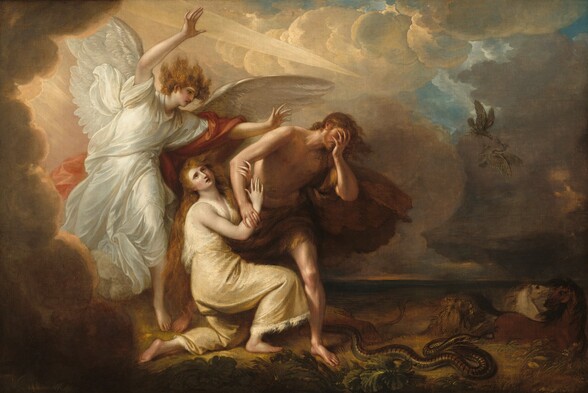
Nusrat Jahan Esa muses on human nature keeping in mind Milton’s Paradise Lost
The Expulsion of Adam and Eve from Paradise by Benjamin West (1738-1820)
Just as dance unveils step by step moving each step towards a new movement to tell a story, so too does the forbidden thoughts. They dance like a flicker of shadow at the edge of our consciousness. They call us, not always with words, but with whispers that tempt, tantalise and stir the mind. To step closer is to cross a line, but is it not also inherently human? Do you think it is possible to categorise humans as purely good or evil?
I was struck by a sudden realisation, one that is not uncanny to my musings. Yet I had never tried to pose to myself. I was exploring the nexus between Satan’s allurement and criminal psychology with Paradise Lost (1677). But why were Adam and Eve ensnared by the temptation of Satan rather than the guidance offered by God? What is it that Satan bestows, and that God misses?
Human beings are frequently pigeonholed into two distinct categories: Good or Evil. To some extent, we may add nuances like “not-so-good” or “not-so-bad”. Yet can we truly define an individual as purely good or purely evil based on their face value? What if one nurtured the attraction of or bore malice, while concealing such tendencies from the world? How do we classify them, good, evil or somewhere in between? Do they forever exist somewhere in the shadowed space?
For instance, there exist a considerable number of individuals who are avid admirers of psychological thriller films, fictions, and documentary series. They appear to be not distasteful to scenes or words of bloodshed, dead bodies, and acts driven by vengeance. They find enjoyment from such scenes and words, and the visual or imagery feels entirely natural to them which astonishes me. So, why would these individuals refrain from imitating these actions in reality? If driven by vengeance, one of the seven deadly sins, why do not they resort to murder? It’s because they are confined with morality. These morals work as a barrier. It stops humans from evoking the sense of their inner darkness or denied feelings.
If one can suppress their repressed and dark desires, how then can they be lured by Satan’s allurement? Let’s say that we are constantly drawn to invitations. Why, then, do we not enthusiastically respond to God’s call? What is it that God fails to offer, while Satan has already taken the lead in his temptations? What thoughts crossed Eve’s mind before eating the forbidden fruit? Is it merely the word “no” that beckons us and draws us with irresistible allure? Or does Satan possess a unique technique to draw us in his magical world?
More importantly, can we truly call those who suppress their dark insides “good”? Or do we dare to believe that a person can possess completely good intentions both outside and inside, without any shadow lurking within?
Nusrat Jahan Esa is currently an undergraduate majoring in English literature at the University of Liberal Arts Bangladesh (ULAB). She writes on criminology, psychology, and education.
.
PLEASE NOTE: ARTICLES CAN ONLY BE REPRODUCED IN OTHER SITES WITH DUE ACKNOWLEDGEMENT TO BORDERLESS JOURNAL
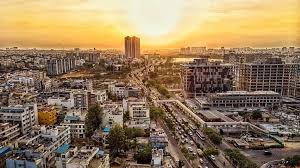
Right now, we are on the cusp between pre-monsoon and full-blown monsoon. The commencement of cool windy breezes and the partially cloudy skies comes as a welcome relief after the asphalt-melting summer heat, experienced this year. Just what is needed to uplift melting spirits. The mind has started recalibrating, the body readjusting, to the sudden dip in temperatures in the ‘Garden City’ of Bangalore, known for its salubrious climate right around the year. Defined by a short, short summer with the temperature barometer rarely rising above 34°C. December, January, and February, temperatures usually hover around 16°C to 18°C, a trend that has barely changed over the last thirty-plus years of my stay in the city. However, over these thirty-odd years, there have been several departures concomitant to the growth and evolution of the city.
The nomenclature “Pensioner’s Paradise”, has lost its significance with the progressive encroachment into virgin lands and lung spaces in the city getting systematically squeezed. A ‘Paradise lost’ and no hopes of it ever being regained. Road rollers, cranes, and crawlers are seen in every neighbourhood, slowly but surely picking the city clean of all its flora, fauna and water bodies. Justifiably nothing different from the growth path in other metros across the world but its impact on the environment, has become more and more evident. I can unequivocally say, that some of these major shifts have had a huge impact on both climate and the environment. The causative effect of overpowering greed hinged on profitability. The then Bangalore, a far cry from the now Bangalore. I will come to that later.
When I first relocated to Bangalore from Kolkata, a coastal city with a hot and humid climate, the sobriquet ‘air-conditioned’ City was not its only USP. It had earned the epithet ‘Silicon Valley’ that came about with IT companies/industries shifting their operations, lock stock and barrel to this much sought-after location, ergo necessitating a shift of manpower. The city thus, witnessed a massive exodus of techies/white-collar workers, moving in from various parts of the country to take up residence in the city. Dominique Lapierre’s City of Joy[1] saw the greatest pullout. Discarding the old for the new as some would think, was not so out of choice but for compelling reasons, following the shutdown of establishments, an antiquated work culture, and the government’s short-sighted policies; some of the contributing factors attributed to this attrition.
In June 1991, we moved into the city which surprised us pleasantly. First, there was no need to run ceiling fans. Strikingly different from Kolkata, where fans and air-conditioners did little to relieve the heat and humidity. Bangalore’s room air-conditioner vents remained tightly closed permanently, and by extension, contributed to a reduction in noise pollution. The susurration of the breeze, floating in through the windows was like being permanently plugged into music channels on YouTube. Therefore, it was unsurprising to that the figure for the first month’s electricity bill was a record low since the previous decade.
Natural lighting was more than abundant without anything to block it, eliminating the need to switch on the lights till well after sunset. The view from the 6th-floor apartment balcony on Richmond Road opened into an orchard of tall palm trees, beyond which stood the Good Shepherd Convent. Nuns walking in the coconut orchards while fingering the moving rosary beads had this effect of transporting one to a seaside setting, sans the sand and sea. Sublime. Often, I wondered if we had moved to a city at all! The ambience was so contrary to what one would conjure about big cities.
By the time, we moved out of the apartment, after a stay of twelve years, the view was curtained off. Gone were the tall trees. Felled indiscriminately. Spidery earth movers had taken over, raising noise pollution, and piercing through the ear drums. The heavily laden polluted air inhaled gave rise to frequent allergies. From the perspective of the locals, who resented the invasion of their paradise, parthenium was not alone to blame. Rightly so.
Funnily with the commencement of the academic year, my girls then twelve and eight were taken aback by the need to wear sweaters to school. “Woollens are for winter months, right Mamma?” True that. A strange phenomenon for the newly arrived Kolkata migrants precipitated the need to unbox the woollens, with naphthalene balls inserted between folds. Duvets and blankets intended to be unpacked during November and December got a premature release from their taped cardboard cartons. That was Bangalore weather then.
In a couple of years, as the girls moved from school to college, they were no longer layering during these monsoon months of June/July. The only conclusion drawn is either they had acclimatised to the Deccan plateau weather conditions or had become self-conscious during the growing up process, or was it a clear pointer to climate change? The latter seems more plausible. Supported by the fact that initially during the first few years, the bathroom geysers stayed plugged in for the entire day, to the subsequently reduced hours (one/two hours before shower time) stay highlighted with a bright marker on memory panels.
With the wiping out of tree-lined avenues and vintage colonial bungalows dotting the landscape, giving way to multi-storeyed offices and high-rise apartment complexes, the city soon acquired a garish makeover plastering the natural tone of the city’s face. Twelve years on Richmond Road, saw all this and more. Decentralisation was on its way. Moving out from the central district to the outlying areas, becoming inevitable. In 2003, we moved to our new apartment in Domlur Layout, still relatively pristine, with virgin forest cover. But not for very long. The tentacles of greed reached out grabbing all this, in justification of better civic amenities. In a couple of years, the inner ring road snaked its way connecting Indiranagar to Koramangala thus reducing travel time. Hailed as the best thing for commuters, at what cost? Filling up ponds, deforestation, levelling whole villages, and gobbling up military land as well — approvers of the city’s expansion worked tirelessly.
Water shortage was evident here with most residential complexes having to rely on tankers for water supply. A cost added to the already steep monthly maintenance fee paid by apartment dwellers as well as stand-alone homes. Unbudgeted. Dipping into pockets, water shortage was rearing its ugly head in the City of Thousand Lakes, conceived and built by Kempe Gowda. The bane of urbanisation, reportedly, of the eighty-one existing ‘live’ lakes Kempambudhi and Ulsoor dating back to the 16th century, have since shrunk in acreage. Many others have just disappeared from the landscape.
In our pursuit of green spaces and low noise pollution, we once again moved further to Whitefield, named the Electronic City, a neighbourhood in Bangalore developed explicitly for housing the electronics industry in 2017. Greens visible. Aha! This would be our paradise in a city turned inside out with ugly stitches showing up in the inner seams. Alas! A short-lived dream. The beautiful Vathur Lake, a huge water body, soon was seen foaming and frothing, spilling over to the adjacent lands as a consequence of chemical effluents pouring into the lake. Resulting in the discolouration of water and an unbearable stench, it became imperative for lake-side dwellers to shift residence. The lavender hyacinth blooms floating on the lake surface were permanently coffined and nailed down by concrete slabs. Roads ran over these. Voices were raised in protest. But who’s listening? Construction activities continued, all in the name of development, providing job opportunities, and housing for the increased growth in population. A city bursting at the seams.
This year summer took the worst toll, with temperatures peaking at 38.1°C on 2nd May, the hottest day in forty years. From no air conditioners being run in 1991 to sitting whole day in air-conditioned surroundings is riling for all. Faced with acute shortages, the city authorities clamped down on water usage, making it mandatory for apartment dwellers to install aerators on taps, to reduce the water flow. Failure to comply would invite heavy penalties, uniformly across the city. And they were deadly serious, warning of inspectors making surprise visits to homes to ensure compliance.
Now, in a two-member household, that to retirees, that made no sense. I confess to non-compliance and got away with it. Resorting to ‘bucket baths’ in place of standing under the shower, was a contribution in the right direction. With the rains, this mandate has been lifted. And that brought on chuckles rewinding to childhood memories of those bitterly cold winter months and Ma’s famous line ‘no kager chaan[2]’ before our baths and, most often, being sent back to repeat baths. Ma put up with no excuses for short-cut baths. But the writing on the wall is loud and clear. Heading to the apocalypse?
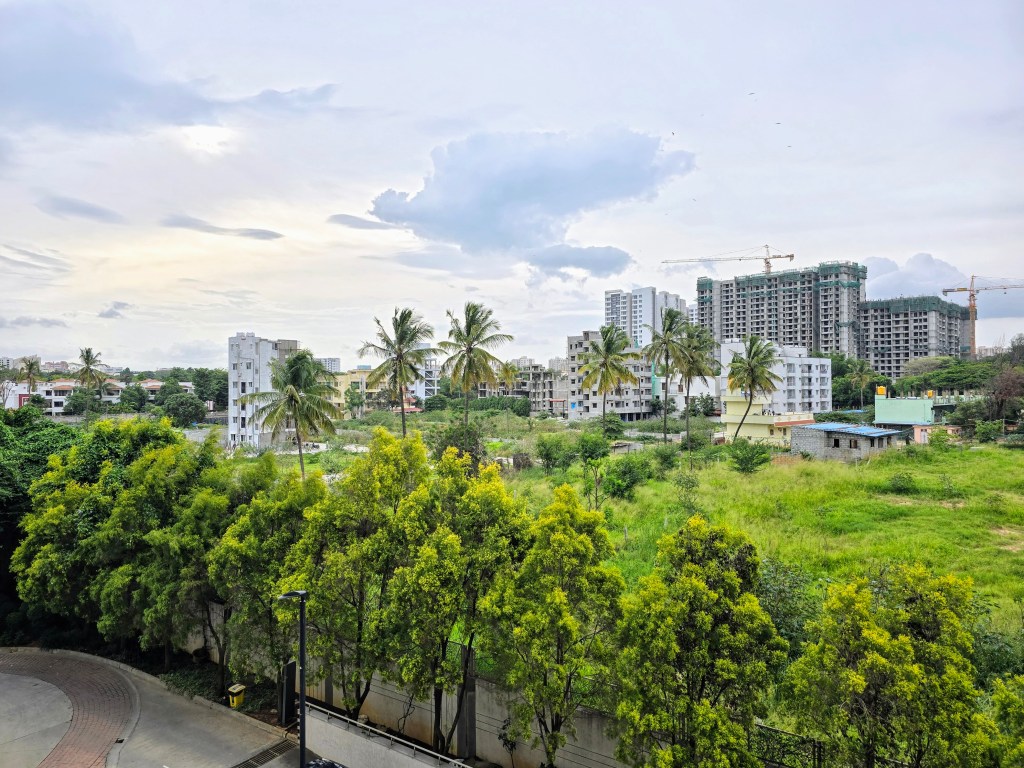
For the time being, I feel privileged that the green field outside my third-floor living room balcony, a disputed property, remains untouched. A treat for the old eyes. For how long is anybody’s guess?
The green field outside the window. Photograph by Snigdha Agrawal
[1] Kolkata. The City of Joy by Dominique La Pierre gave Kolkata that sobriquet
Snigdha Agrawal (nee Banerjee) is a published author of four books and a regular contributor to anthologies published in India and overseas. A septuagenarian, she writes in all genres of poetry, prose, short stories and travelogues.
PLEASE NOTE: ARTICLES CAN ONLY BE REPRODUCED IN OTHER SITES WITH DUE ACKNOWLEDGEMENT TO BORDERLESS JOURNAL
W. H. Auden’s poem “In Memory of W. B. Yeats” is often quoted to dismiss the importance of poetry as a form of social justice. The current fashion among poets is that poetry can revolutionize social inequalities, make positive changes, build empathy for marginalized groups, and convey information about causes important to the poet. For example, Robert Huddleston writes in Boston Review, “In its day, W. H. Auden’s claim that ‘poetry makes nothing happen’ was a necessary reproof to an ideologically mandated culture of protest that had a chokehold on the literary left in the 1930s, an example it remains important to consider today. Clashes over the political rights and wrongs of poetry, then as now, are often disguised contests over cultural and academic turf, ideological purity, and even the relative priority of criticism versus artistic practice.” He is correct concerning the cultural war that cloaks literary discussion. Literary figures and public intellectuals are often chided for their implicit biases. However, I conceive of the poem as saying something drastically different; I do not see it as being a political rebuttal at all, but rather serving as one within a larger context.
Auden’s poem contains these lines:
…For poetry makes nothing happen: it survives
In the valley of its making where executives
Would never want to tamper, flows on south
From ranches of isolation and the busy griefs,
Raw towns that we believe and die in; it survives,
A way of happening, a mouth.
The poem carefully navigates the terrain of the unchangeable dimensions of political life. However, it clears a safe space for the poem as a thing of its own. Poetry does not instigate events; rather, it is an event itself. The day remains cold for Yeats’s death, and his poetry lives beyond him through the many misinterpretations it will face. “In Memory of W. B. Yeats” defies the culture war to uphold the dignity of the human spirit to which poetry testifies. Auden once defended Pound from censorship by his publisher. He said anti-fascism will become the new fascism. The publisher relented and granted Pound a space in the anthology. In this course, Auden defends the integrity of the poet as a person whose work dignifies the ideal humanity. In this respect he clears a space for poetic license because a poet must spend their life empting themselves.
No, poetry makes nothing happen. It is an event itself. It is the fire of intellect applied to the cold apathy and spiritual destitution we suffer. As protest against the human condition, it becomes universal in its design.
Hence poetry is spiritual warfare. The poet is a paradigm for virtue. The contemporary world now challenges the absolute freedom of the visionary. It is historically stated that the visionary should be exempt from moral considerations. Recent shifts in consciousness concerning this attitude are becoming mainstream. The UK Telegraph reports, “Janet Marstine, Honorary (Retired) Associate Professor, School of Museum Studies, University of Leicester, added: ‘The National Gallery has taken an important step in acknowledging that it is no longer ethically tenable to interpret in an aesthetic vacuum. An artist’s position in the Western canon does not make them immune from accountability.’” The visionary in question at the National Gallery is Paul Gauguin. He is under question for exploiting the myth of the noble savage for his sexual and financial gain. The moral dilemma posed by such considerations does not discount the artistry or accomplishments of individual artists. Its intent is to hold artists accountable for immoral behaviour. The hope in the #metoo era is these considerations will keep living artists accountable rather than giving them license to act uninhibited, and influence the broader society.
Vincent van Gogh, a friend of Gauguin who he accused of insanity, wrote, “The way to know life is to love many things.” Van Gogh is historically considered a misunderstood visionary who underwent severe lifetime disappoint and failure. His legacy is a myth of its own. He was expelled from his church where he was minister. His father thought of him as a lunatic with stupid ideas. However, he is also considered a beautiful person who showed the world a light it misses in so much conflict. Don McClean wrote of van Gogh, “The world was never meant for one as beautiful as you.”
These two towering figures in art leave us with widely divergent displays of personal conduct. Van Gogh’s misconduct is chalked up to a serious mental health issue, but Gauguin is a sexual deviant who exploited the European assumption of the noble savage. What can be learned from these patterns? Emerging views of artists’ conduct have more at stake than aesthetic considerations. They are the battleground of the purpose of ideas. Gauguin’s art and moral conduct are under question not because his art is unpleasing, but because ideas hold power: we must take into account how ideas can effect culture and the treatment of others. Misconceptions of indigenous people have serious repercussions historically. Our worldview must consider that others are right to their cultural experience without infringement. This is where the culture war stems.
If we conceive a race as inferior, does our conduct toward them change? Gauguin is not being questioned as much as an entire colonialist legacy and how it shapes the behaviour within the culture that adopts it. Human dignity is universal; a person should never be treated as inferior. Perhaps we are right to question history so vapidly, and demand the culture at large change. The most important thing may be a humanist conception of world culture. Those who deny it are perhaps harming not only others, but also degrading themselves.
The culture war is the domain of values and whose values develop dignity in the human heart. Art is one of the most developed and poignant tools to communicate values. The Marshall Plan advanced capitalism throughout Europe using art to influence people. Culture is what stands as testimony to prevalent attitudes, reactions to those attitudes, and the historical presence of a people. We are right to subject it to deeper inquiry.
In fact, I would consider a moral duty to question historical circumstance through art. Duty is defined in the Bhagavad Gita, “It is better to do one’s own duty, however defective it may be, than to follow the duty of another, however well one may perform it. He who does his duty as his own nature reveals it, never sins.” This offers a subtext for individuality. Art is the historical realm of the individual—they who create art are the most developed in ideas. One’s heart will reveal one’s purpose. St. Paul writes in Romans 12:2 (KJV), “And be not conformed to this world: but be ye transformed by the renewing of your mind, that ye may prove what is that good, and acceptable, and perfect, will of God.” The world’s major faiths are abundant in praises of nonconformity. As St. Paul carefully describes, interpreting the will of God is a struggle. One must resist pressures external to oneself. Sometimes one must question oneself deeply to find the moral current within. Jihad, or “struggle”, is spiritual warfare in three senses: against one’s own temptations, against one’s peers, and in defense of one’s territory. Aristotle wrote, “Wicked men obey from fear; good men, from love.” The perennial wisdom seems to be of the consensus that morality is deeply personal, and one’s character is deeply revelatory. Art is where the person speaks honestly with high eloquence. Art itself is action. How much of artistic achievement depends on cultural consensus? Is art rather a defiance of consensus, bearing more of the soul of the artist than their times? A moral purpose should derive from the inner life, and counter the wheel of consensus in bare revolt. John Milton writes in Paradise Lost:
“A mind not to be changed by place or time. The mind is its own place, and in itself Can make a heav’n of hell, a hell of heav’n.”
Vatsala Radhakeesoon, contemporary poet of Mauritius, grants insight into the nature of freedom, character, and morality of being in her poem “Unconditional Thread”:
Born from the Divine’s golden thread Molded with perfection, purity and grace I’m the invisible heart – the unconditional thread ruling the universe
I’m soft I’m generous I’m not from the Mundane the materialistic world the uncanny competitive rules
I’m omnipresent but recognized, seen only by the unadulterated
I, Unconditional Thread survive in immortal realms and go on whispering in every ear “ Love, love and love discarding mental blocks and embracing spontaneity.”
A poet warrior embraces compassion, action, duty, and dream. Henry Miller writes, “All growth is a leap in the dark, a spontaneous unpremeditated act without benefit of experience.” One’s leap becomes one’s light. The darkness illumined is one’s spiritual landmark. To seek beyond one’s perilous comfort is an act of defiance in a world where complacency is sanctified. The artist’s presence stirs the world from sleep if they are securing their foundations. Ultimately, we are clueless about life: where it takes us, what it means, how we cope with it. We engage in symbolic acts of protest and incite civil discussion on important issues. Papers are published on every subject; scholars shake their fists at apathy and ignorance. Theories emerge from data and trends. Life’s most recent turn provides us with newfound perspectives. Once the trend is fulfilled, new storms rage on the horizon. Science is continuously revising and incorporating new facts and figures. There is nothing steady in the order we endure; in fact, to call it order defies its purpose.
In such a world of flux, kindness is even spirited defiance. In “Kindness”, Naomi Shihab Nye carefully constructs the meaning of kindness in counterintuitive language:
Before you know what kindness really is
you must lose things, feel the future dissolve in a moment
like salt weakened in a broth.
What you held in your hand,
What you counted and carefully saved,
all this must go so you know
how desolate the landscape can be
between the regions of kindness.
How you ride and ride
thinking the bus will never stop,
the passengers eating maize and chicken
will stare out the window forever.
Walter Pater writes in The Conclusion to The Renaissance: Studies in Art and Ideas, “Great passions may give us this quickened sense of life, ecstasy and sorrow of love, the various forms of enthusiastic activity, disinterested or otherwise, which comes naturally to many of us. Only be sure it is passion—that it does yield you this fruit of a quickened, multiplied consciousness.” Kindness is passion. Etymologically speaking, “passion” reflects suffering, endurance, and loss. Compassion means to “suffer with”; hence, Nye’s poetic rendering of kindness defines it as passion.
St. Francis of Assisi writes in “Praises of the Christian Virtues” of the three virtues of Wisdom, Poverty, and Charity that “Whoever possesses one virtue without offending the others, possesses them all.” Guatama Buddha is recorded as saying something profoundly similar, “We will develop and cultivate the liberation of mind by loving kindness, make it our vehicle, make it our basis, stabilize it, exercise ourselves in it, and fully perfect it.” In the doctrines of Buddhism, the problem of suffering is rooted in attachment. Attachment pertains to physical things, mental habits, and stubborn attitudes. When one is attached, the object of attachment invokes fear of its loss, and can trap the mind in unhealthy suffering. In Sanskrit, the word samsara translates “it flows together.” In Hinduism and Buddhism, the concept signifies worldliness, attachment, and the cycle of rebirth and suffering. To be released from this cycle one must be released of oneself and desire. This state of enlightenment is called Nirvana.
Octavio Paz, poet and ambassador of Mexico to India, writes in “Perpetua Incarnada”:
Hour by hour I saw him slide
wide and happy like a river
shadow and light linked its shores
and a yellow swirl
single monotonous intensity
the sun set in its center
Then he writes:
I ask for strength I ask for detachment
open the eyes
unharmed evidence
between the clarities that are canceled
Not the abolition of images
the incarnation of pronouns
the world that we all invented
sign town
and in its center
Solitary
Perpetual incarnate
one half woman
peña manantial the other
Word of all with whom we speak alone
I ask that you always accompany me
man reason
This poem reflects an existential loneliness but it extends into territories much broader. He asks prayerfully that the world be returned to the state of the ‘Word’ from its embodiment of images. Once again, we return to Pater in his essay on Leonardo da Vinci. “We recognise one of those symbolical inventions in which the ostensible subject is used, not as a matter for definite pictorial realisation, but as the starting point of a train of sentiment, subtle and vague as a piece of music.”
In “Flux and Movement in Walter Pater’s Leonardo Essay” critic Lene Østermark-Johansen writes, “The body which twists around its own spine creates the illusion of moving from one extreme to another thus resulting in a kind of harmony of opposites, a concordia discours.” This statement not only describes drawings and sculpture, but applies to rhetoric also. The concept of Self is illusion because all things contain their opposites. One cannot step in the same river twice. We are the river, and our Self is a form within the flux of promissory existence. We are granted time within this cycle of birth, death, and rebirth. As the Cross represents redemption, one reaches Nirvana by letting go. Christ is reborn to demonstrate he can conquer the forces of death.
Chögyam Trungpa Rinpoche writes, “The Shambhala teachings are founded on the premise that there is basic human wisdom that can help solve the world’s problems… Shambhala vision teaches that, in the face of the world’s problems, we can be heroic and kind at the same time.” A warrior poet sets the world aright through their heroism, but what does setting the world aright mean exactly? According to Shambhala: the sacred path of the warrior, the world must restore its focus to human dignity.
Mirabai writes:
O friend, I sit alone while the world sleeps. In the palace that held love’s pleasure the abandoned one sits. She who once threaded a necklace of pearls is now stringing tears. He has left me. The night passes while I count stars. When will the Hour arrive? This sorrow must end. Mira says: Lifter of Mountains, return.
– “The Necklace”
We cannot restore dignity alone. Existential dread implies that as individuals we are alone to choose and must live with that responsibility. In her abandonment, Mirabai still affirms her dignity as God’s beloved. She calls to God to return. This reflects the cycle of birth, death, and rebirth as eternal flux which harmonises with our physical existence. God is with us. Christ is ever present in our domain of suffering.
It is no coincidence that Paz concludes his poem with the words “I ask to be obedient to this day and tonight.”
U.S. Poet Laureate Joy Harjo writes in “The Myth of Blackbirds”:
“Justice is a story by heart in the beloved country where imagination weeps. The sacred mountains only appear to be asleep…We cannot be separated in the loop of mystery between blackbirds and the memory of blackbirds.”
Myth is a cultural awakening. Being “alone to choose” does not defer human dignity or one’s relationship to the divine because we are creatures of memory. As Plato reflected, learning is remembering what one already knows. Such a cycle is not promising. It is eternal.
We are ripe with questioning historical errors in this period of history. “The emergence of pessimistic philosophies is by no means a sign of some great and terrible distress; rather, these question marks regarding the worth of life arise when the human condition has been so improved and ameliorated that the mosquito bites of the body and soul are found too altogether gruesome and gory, and in their poverty of experience of actual pain, people will even take being troubled by ideas to be suffering of the highest order,” writes Nietzsche in The Joyous Science. Is our ability and right to assess history as such a privilege offered by our affluence and security? It was the intellectual who once hid in ivory towers. Now, do we all live in ivory towers with epigenetic fears and concerns?
Such a question does not demean our relative poverty, private traumas, failures and shortcomings, or deprivation. What it suggests is we have plateaued to become so complacent and unconcerned that it requires serious tragic thinking to stir our imaginations. We may long for suffering; yes, we may hunger for the cross. As they say, comedy is born of tragedy. Is the opposite also true?
Wendy Chen-Tanner describes Kai Coggin’s collection Wingspan in the following words: “Wingspan is a book about becoming, transforming, and unfurling into the fullness of selfhood in all its disparate parts.” The human soul fluxes and fades with the human condition. Being is Becoming. This discovery of the fullness of being is impressively expressed in “Everything Silver/Artemis and Her Lover.” Students of Greek myth know the story of Actaeon and his tutelage under Chiron. When he witnesses Artemis bathing, she turns him from hunter to the hunted. Coggin’s poem is deeply personal. She observes the two as lovers experiencing oneness together. She writes:
“I will watch them,
the hunter and the hunted,
these lovers mounted in the stars,
I will watch them,
and wish for an arrow to fall from the sky into my open heart.”
Aside from the sheer beauty of these lines, the poet transforms herself into hunted for the sake of the poem. Perhaps it is self-voyeurism—the poem is solitary in tone. Gazing into the attic of her heart, Coggin sees the night sky and the eternal myth of huntress and hunted. The ebb and flow of life enchants the poet deeply and she wishes to be one with it. The opening phrase “attic of my heart” parallels the night sky and symbolically suggests yearning for oneness. Chen-Tanner’s description is impressively accurate. Jeremy Taylor writes in Psychology Today, “The universally experienced world of dreams and dreaming has always been a deep mystery, ever since the first confusing hints of self-awareness arose in our instinctively nervous, curious mammalian ancestors. Awakening and remembering that we were dreaming just a moment ago always suggests that we live in two successively alternating worlds – one of made of dreams, and the other composed of our waking experiences.” The article (“The Expanse of Our Unconscious is as Immense as the Night Sky”) combines psychology with evolutionary principles to explain the interconnectedness of the dream and waking worlds. Poetically rendered, Taylor incidentally offers insight into the importance of myth. Our minds are myth-makers in their own right. The bridge between self-awareness and yearning, our ancestral past and myth, is accentuated in the story of Actaeon and Artemis. Coggin immortalises them in the starry fixtures of night. The hunter and hunted are not only archetypes, but also offer a dialectical conversation with oneself. Akin to Hegel’s master and servant dialectic, the need for truth anticipates struggle and dissipation.
Coggin’s poems are rich in spiritedness, thoughtfulness, and hope. Hope strives for unity of self, toward knowledge of one’s desires, and deeper into the wilderness of dream. The dialectic flips on itself as the wise hunter becomes the hunted—his desires are too stubborn to resist, and he is transfixed by the translucent beauty of the immortal. He ascends into fatherhood by transfiguration into his master’s image. The transfiguration is an exact mirror-image of his role as hunter. This reversal is symbolically important because it reflects a registry of Becoming. Revolutionary ideas shrivel into double standards, mimicry of their exactness, and memory. Hope is a struggle against the unfathomable and inevitable decline of meaning. It is assertive. Like energy within neurological structures, it dissipates and connects. The mind is forever incorporating the ancient and traumatic into meaning.
Andrea Gibson writes of Coggin’s Periscope Heart, “Kai Coggin’s Periscope Heart is beauty mapping the dark, a canyon of becoming and letting go.”
I want to learn you like a language,
speak you on my tongue until I am
no longer foreign to your body…
Periscope Heart feels more personal. In “Language”, loving is compared to constructing a language. In a real sense, myth-making is language. Language is universal mapping, constructing roads through the caverns of being, and developing a common language. Powerful insight serves as the poet’s resolution.
Dorothy Day writes, “To offer the suffering of celibacy, temporary or permanent, to the Lord is to make use, in the best possible way, of man’s greatest joy.” Such is the world we live in, Day writes, that “The lack of tenderness in people’s relations with each other, tenderness expressed by warmth of voice and speech, handclasp and embrace–in other words, the warmth of friendship–lack of these things too means a concentration on sex, and the physical aspects, the animal aspects of sex.” Poet and reviewer Jagari Mukhergee writes in “Metapoem”:
“My poems are vinyl dolls that I make for you sketching in eyes and nose and lips with watercolor ink. My poems are glass lanterns — every time one is lit on nights when the soul has no electricity from within… My poems are a dusty tempest seething. Each a life.”
The warrior poet brings light to the world. Her tenderness is chastity and her self-love is universal nature. Her tears water the foundations of our aching existence. Our longings are satisfied in her dissolutions and dreams. The warrior poet is the self within each person.
Dustin Pickering is the founder of Transcendent Zero Press and editor-in-chief of Harbinger Asylum. He has authored several poetry collections, a short story collection, and a novella. He is a Pushcart nominee and was a finalist in Adelaide Literary Journal’s short story contest in 2018. He is a former contributor to Huffington Post.
Disclaimer: The opinions expressed are solely that of the author.



 Borderless